Another siblicide at Loch of the Lowes and other news in Bird World

14 June 2022

I want to start this blog off today with one of the cutest videos called ‘My Turn’. It is from one of the first – if not the first – osprey cams on Dennis Puleston’s property on Long Island. I would like to quietly show this to every third hatch osprey!!!!!!!! It always lifts my spirits when it has been a rough day in Bird World.

Dennis Puleston was a remarkable man who spotted the decline of the Osprey populations in the US due to DDT.

Sadly, the Little Bob at the Loch of the Lowes fell victim to a brutal Big sibling that refused to let him eat and who finally killed him this morning shortly after 0530. Little Bob was alive in the image below, barely, from not having eaten in at least three days.

Laddie LM12 arrives on the nest but flies away. No fish.

Big Bob brutally attacks Little Bob and kills him.

Blue NC0 stares at the body of her Little one. It has not been a good year for this wee one who, like the others, just wanted some fish. It is unclear why there is so few fish coming to this nest. It has been a discussion about the other nests and people are conflicted. Is it intruders? has the loch not got the fish? is something going on with Laddie? All of the other nests are not having difficulties. Fly high Little one, fly high.

Sadly my list of siblicide victims this year is getting longer.

Blue NC0 looks worn out and hungry. She is hardwired, like all other Osprey Mums not to interfere. She looks down at her wee little babe. So sad. I do hope that whatever is troubling this nest that it goes away so that this family can heal.

There is another nest that remains worrisome.

To the relief of everyone cheering Little Bit 17 on at the ND-LEEF nest, that camera is back working. It is unclear if 17 got any food since the camera went down but he was seen doing wingersizing according to many of the chatters who watch the camera. He is not acting like the third hatch at Loch of the Lowes. 17 seems fine. I will not presume anything but let us all hope that if it is cooler tomorrow – which they say it will be – that the fish will be flying onto this nest. — I want to be optimistic. Many third hatches benefit from the older ones fledging. It seems both 15 and 16 are branching —- and not wanting to sound nasty but it would be nice if they would take a 2 day trip to see the beautiful area where their nest is! Little Bit could eat it all!

The eaglets on this nest are the following ages. ND 15 is 76 days old, ND16 75 days old, and ND17 is 71 days old. Little Bit is not ready to fledge. His tail needs to grow more. The feathers on his head are growing longer and covering up the bald spots caused by 16’s scalpings. This Little one has worked so hard to live. I want to believe I am seeing something of a crop under his beak and that he did get some nourishment today. Hang in there Little Buddy!

The streaming cam is also back up at the Cape Henlopen State Park Osprey Platform. It was a very interesting Tuesday morning. The female intruder with the torn feathers was in the nest. Another osprey landed on the nest and she got rid of them quickly. A third bird or was it this one that landed ?? could be seen flying by the nest on several occasions to the left of the platform.

The bird that almost looks like I cute and pasted it on was quickly shooed away by the female intruder on the nest. From that behaviour we might assume that this was not a bird associated with her.

She removes the body of the oldest and largest of those beautiful chicks from the nest.

As the sun was setting on Lewes, Delaware, the female intruder has now cleared the nest of any remnants of its former occupants. It is just gut wrenching what has happened here. I do wonder if the Mum is alive and if it is her flying to the nest? No one was at the nest overnight.

I have been praising Betty on the Mlade Buky White Stork next in The Czech Republic for not eliminating the smallest, the fifth storklet. Well, she has now done so. Let us hope that all four remaining chicks thrive! (The storklet did not survive the 9 metre/30 ft drop but it was quick, not like starving to death on the nest).

There is wonderful news coming out of Cal Falcons. Laurentium is one of Annie and Grinnell’s fledglings. She has a nest on Alcatraz. She has successfully fledged chicks in years before but not it is confirmed that she has two healthy grand chicks for Annie and Grinnell again. How wonderful!

I have neglected the Foulshaw Moss nest this year despite the fact that it is one of my favourites. Last year White YW and Blue 35 successfully fledged 3 osplets including Tiny Little Bob, Blue 463. The chicks below are around the 3 week period. They are healthy and doing well! Excellent parents. I cannot say enough good things about them.

I do not like the cam. You cannot rewind so if you don’t see it, the event is gone. Or if you do see it and don’t get a screen shot it is gone, too. That style of camera is very annoying if you are trying to document events on a nest.

Congratulations to everyone at the Ithaca Peregrine Falcon scrape. They had their first fledge today. It was Percy! One more eyases to go. How exciting. Falcon Watch Utica posted this gorgeous picture of Percy taking off. Look – those legs are held tight against the body and the feathers are in perfect shape. What a wonderfully healthy fledgling!

Even before the three Bobs had their breakfast Wednesday morning, Telyn was chasing after an intruder with feather wear – perhaps a moulting bird. Emyr Evans wants him to come back so they can get a ring number and ID the bird. He is evading all of the cameras. Emyr believes it is Teifi and if so, it is Telyn and Idris’s 2020 hatch come home to the natal nest. After, Idris brings in a lovely sea bass for Telyn and the kids.

Emyr Evans posted this on the 23rd of May. I think he will be updating his number after the intruder this morning to 8. Tegid – of the white egg – is one of my favourite hatches. Lovely to see his son back!

There was an intruder at the Llyn Brenig osprey nest. LM6 just about tore the nest up when Blue 416 from the Lake District arrived. Gracious. I thought she was going to toss the two wee chicks out, too. Lots of two years old successfully returning this year (like this one) causing mischief.

Aran was up early fishing for Mrs G and the gang.

Everything seems fine on the Glaslyn nest.

Sentry returned to the Redding Bald Eagle nest on 14 June after fledging on the 11th. He was tired and spent the night with Star in the nest sleeping duckling style. Star has yet to fledge.

It is getting to be time to check in with some of the Australian nests. Dad brought Mum a very nice fish on the nest. Oh, she looks so good. Last year she took raised the Port Lincoln three – Bazza, Falky, and our dear Ervie.

Beautiful Diamond with a full crop after a prey gift from Xavier at the Charles Sturt University falcon cam in Orange, Australia.

Lady incubating the two eggs of hers and Dad’s on the WBSE nest in the Sydney Olympic Forest. If you look close, you will see Dad sleeping and protecting the nest on the parent branch.

The CBD 367 Collins Street Falcon cam will not be back on line until September. It is usually started once eggs are laid.

Fledge watch started yesterday for the Cal Falcons. Here is Grinnell Jr with his super crop last evening! Looks like he is going to fly anywhere! So cute.

Thank you for joining me. This is a very early Wednesday morning check in. I will have a later report Wednesday evening. Take care everyone. See you soon.

Thank you to the following for their streaming cam and/or FB announcements where I took my screen captures: Sea Eagles@BirdLife Australia Discovery Centre, Charles Sturt University Falcon Cam, Port Lincoln Osprey, Friends of Redding Eagles, Bywyd Gwyllt Glaslyn, Dfyi Osprey Project, Friends of Loch of the Lowes and Scottish Wildlife Trust, ND-LEEF, Cape Henlopen State Park Ospreys, Llyn Brenig Ospreys, Emyr Evans, Falcon Watch Utica, Mlade Buky, Cumbrian Wildlife Trust, and Cal Falcons.

Sadness at Loch of the Lowes continues

14 June 2022

There have been intruders and both Laddie and Blue NC0 have been involved with them. That said, the oldest hatch Big Bob is making it impossible for Little Bob to have anything to eat despite there being plenty for all.

Laddie brought a fish in for tea time and both Big and Middle were being fed. Little Bob kept his head down. He is very weak and is not fish crying that I can tell.

Little Bob made a slight movement and Big Bob went over. Middle continued to be fed. Big Bob has a nice crop and you can see how much fish remains.

Little Bob is also playing possum and conserving any energy but he is listening and watching.

Little Bob begins to move around the nest to get up to Mum. The crops in both Middle and Big are busting.

Little Bob gets closer. There is still fish left.

To stop Little Bob from eating Big Bob goes back to get more fish.

Little Bob gives up and returns to the edge of the nest.

This is what siblicide looks like. Unless there is a miracle while the two big bobs are in food coma, Wee Bob will not make it. It is so sad but ever since he hatched there have been issues. There are days that I wish Ospreys only laid two eggs.

I wish that the news were better. We really need a miracle to turn this nest around. It is such a shame. Three beautiful osplets getting their juvenile feathers. There has been another loss today. At the Kielder 4 nest the small Bob died as well.

Thank you for joining me. I hope that I have wonderful news to share next time. Take care everyone.

Thank you to the streaming cam at the Loch of the Lowes, to the Friends of the Loch of the Lowes and Scottish Wildlife. That is where I took my screen captures.

Tragedy to tragedy. Late Monday and early Tuesday in Bird World

13-14 June 2022

The Cape Henlopen State Park Osprey nest kept me occupied for a large part of Monday . It is a very complicated situation. There are two intruder birds. They are distinctive in the very thick eye band. One has quite a good necklace and the other does not. Their eyes are close and often look like when we say ‘snake eyes’.

As the sun was setting both of the adult birds were on the nest. You can see their distinctive eye bands that are thick and go right to the shoulder. Except for their necklaces you might want to think they are twins.

One of the birds has some feather damage. It is the one who moved the chicks out of the nest. At first I thought the little chick had its wing caught in the talon but watching the bird try to remove and then in a second try achieve getting one of the bigger chicks off the nest – it was deliberate. She just didn’t have a good hold on that wee third hatch and it is probably – or was – at the base of the platform.

This bird has some interesting feather damage in at least two areas. I hope to get someone who knows about feather issues to examine the photo. It looks like a section around the scapula V on the right has been cut or torn or there are feathers missing. You can see the feather on the right hanging. The bird has flown on and off the nest carrying the chicks but returns quickly so she is just dumping them close by.

It appears that there is a third bird that is around the nest that these two are concerned about and it could be the Mum of the three dead chicks. Of course, this is simply speculation on my part. We have not seen that bird and none are ringed.

There are no adult ospreys on the Cape Helopen Osprey nest tonight, 13 June.

I have received word from ‘A’ and ‘EJ’ that the two intruders were at the Henlopen Osprey nest this morning and at one time a fish was brought and removed. The female intruder has also removed the third dead osplet from the nest. ‘A’ mentions the third osprey that has been bothering me. Is it Mum? is she injured? If it is her – our hearts go out to her. She has sadly lost her entire family.

I remember in an online discussion and chat with Sean and Lynn at Cal Falcons, they mentioned that the problem with the success of reintroducing these species is that there are too many birds. There are territorial fights, etc. Perhaps also it is the amount of habitat loss due to population growth and building, climate change and being able to get adequate food that is also a problem. For the Osprey there is then the issue of trees. Unlike Bald Eagles, Ospreys like to have their nests at the top of a dead tree. So many trees have been lost to deforestation and wildfires and in my community if someone sees a dead tree, it is cut down. Only in the marshes and mangroves do I see them. In South Australia they are busy building platforms in good places for the Ospreys if they have seen Ospreys nesting like Turnby Island. The new platform is up and the Ospreys are already on it along with most of their old nest. Do we need to get building more platforms? And if lakes and streams can be stocked for people to go fishing, what about the birds? It does appear – from many nests – that the success of both the Osprey and Eagle reintroduction programmes have caused issues for established nests – some outright tragedies. There must be some solutions.

Little Bob at the Loch of the Lowes was shut out from the evening feeding. Indeed, he had not eaten all day Monday that I am aware. Both Little and Middle stayed well out of the way of Big and just let him eat. Then Middle went up. By the time Little got up to the table the fish was gone. If this is a problem with Laddie not bringing in enough fish now – then Blue NC0 needs to step up the game and go fishing.

Big ate almost all that fish and has a big crop and so does Middle. Poor wee Bob. They can last for several days. We have seen this on many nests but it is time Little Bob had a good feed. Fingers crossed for Tuesday.

This is Blue NC0 defending the nest and chicks against the intruder.

The situation at the Loch of the Lowes has not improved. There is a ringed intruder and as such Laddie and Blue NC0 are both dealing with that. A fish finally came in at 16:00 but both Little and Middle Bob are getting pounded. Little Bob did not even raise its head and beg for food. There are any number of people worrying about this nest. I will be checking on it later. Some of the Osprey groups are already posting thoughts for Little Bob – he cannot go much longer if he is to live. I do not think he will make it either. So sad. Middle ate yesterday.

I started making a list of all the sadness at the nests this year and will post it later today. It has been a year of tragedy.

The West End fledglings – Ahote and Kana’kini – are really using their wings and learning how to land. Two of the chicks on the natal nest watch one of the siblings (I believe it is Kana’kini) fly off the nest and land on Transmitter Rock.

Perfect landing.

Kana’kini was still on Wray’s Rock Tuesday morning. She had flown there on Monday. Tuesday morning Ahote and Sky were on the natal nest when a fish delivery came in at 05:42. Waiting for Sky to fledge.

Kana’kini and Ahote have since flown off leaving Sky on the natal nest.

At the Two Harbours nest of Chase and Cholyn, Lancer will be 10 weeks old (70 days) tomorrow, the 15th. Cholyn is still flying in to feed their big girl!

There are big storms moving through the area of the ND-LEEF nest. The camera is out of sorts. This could seriously impact any prey deliveries for tomorrow. Little Bit 17 really needs a good meal tomorrow.

The system is going to impact a large area that have nests.

The camera is down because of the storm at the ND-LEEF nest. The eaglets are ND15 75 days old, ND16 74 days old and Little Bit ND17 is 70 days old. It sure would be a shame to lose this little fighter now. What a time to have a storm – backed up with days of little food. My goodness.

I haven’t checked on E1 and Nancy at the MN-DNR nest lately. Nancy made a prey delivery, E1 mantled quickly and was very aggressive to the adult. This is normal behaviour in eaglets getting ready to fledge.

There was a lot of strong winds and rain over night at the MN-DNR. The system is due to be about the same as the one in my city. It will calm down and may begin again. E1 survived it fine – thank goodness.

At the nest of Big Red and Arthur, it appears that the only eyas left to fledge is L4. Little cutie pie. And little cutie pie took advantage of having its big siblings off flying and getting prey elsewhere to eat up two prey items on the nest and get an enormous crop! Sometimes there are advantages to having your other siblings fledge. This might also work for Little Bit if everything came come together to get the parents able to find prey to deliver. I understand that this time of year at this particular nest prey deliveries suffer.

Big Red’s kids do not have that problem. Arthur is excellent at delivering food and Big Red is often hunting herself. They did a marvellous job this year. Amazing.

L4 could fledge. He has 5 going on 6 dark stripes and he is 47 days old. remember the average age of fledge is 46.5 days at this nest.

I love the stretching exercises after the meal. He stretched both sides like this.

The UFlorida-Gainesville Ospreys are not sleeping on the natal nest tonight.

The adults are dropping off fish on the nest and both of the fledglings, Big and Middle, make their way there when they see the parents flying in that direction. Big had the fish and then Middle got tired of waiting and took it. Both had a decent feed. These two are doing fantastic.

It is always good to remember that what you want to see are the chicks being fed by the parents on the nest after fledge. At other times, they will feed them off nest like they did with Little MiniO at Captiva. Often times the fledglings bolt and well, they need to get home. You might recall if you watched the NEFlorida Bald Eagle nest that Legacy (2021) was missing for about six days. She was so glad to find home she didn’t leave for another month!

It is early morning in The Czech Republic and Betty is feeding the four White storklets at the Mlade Buky nest. Oh, look. They are getting their pin feathers. Fantastic. Note: The smallest, the 5th storklet was eliminated on Sunday.

It is also lousy weather in Estonia but Karl II has been out fishing for these babies. Did you know he flies 10 km to get the little fish? It is monitored by his tracker.

Liz did a lovely – and short video (I always appreciate her short videos getting right to the heart of the matter) – of the three Black storklets of Jan and Janika’s in care late Tuesday having a meal. They are doing so very well. I think that you are witnessing an intervention that is going to go very, very well.

All three osplets on the nest of Aran and Mrs G in the Glaslyn Valley are doing quite fine. Just look at that face of Mrs G. I certainly would not want to mess with this Osprey Mum. In the second image all have crops after their afternoon tea time meal.

Idris taking the head off of the tea time fish for Telyn and the three Bobs. There is definitely not a problem at this nest!

Little Bob is in the middle and Telyn has been feeding him – and he will be fed til his crop is full! (or they run out of fish)

Llyn Brenig Ospreys have had their troubles. The third hatch died but the two surviving osplets appear to be doing very well. Let us hope that the horrible weather that has swept through the nests dissipates and gives these families a break!

The two surviving osplets at the Loch Arkaig nest have been enjoying all that nice fish that Louis brings in. The tea time one was a little too close to the lads or lasses but both got fed. Big Bob looks like he could be a problem. Let us hope that he isn’t! There is always fish on this nest of Dorcha and Louis.

They have had their problems up at Llyn Clywedog but it looks like those are behind them. Dylan brought in a huge Mullet for Seren and the three Bobs at 16:00:03. Just look at their crops after their tea.

That is a hop, skip, and jump through the nests with troubles and some of those that are doing so well. Seeing those three at Llyn Clywedog after the fear that Dylan was missing just warms the heart.

Last, Alden delivered what appears to be a pigeon. Annie gets it and this translates into a food fight between Lindsay and Grinnell, Jr. Neither have fledged yet but it is just morning in California! Fledge watch at Cal Falcons.

We may never know what ultimately happens at the Cape Henlopen State Park Osprey nest until we see who is on the nest for the next breeding season. If it is Mum who has been trying to get her nest back, let us hope that she either does so safely or she leaves the territory in good health to find another nest and mate.

I am working on two different pieces for you. One of Wildlife Rehabilitation Centres and their importance and another on the birds that we have lost since last 1 July. It is sadly a very long list. I had hoped to have the one on the rehabilitation centres finished this week but the events at some of the nests took over.

Thank you for joining me. Take care everyone. See you soon.

Thank you to the following for their streaming cams and/or FB pages or videos that I have captured and used for this blog: Liz M, Cape Henlopen State Park Ospreys, Cornell RTH Cam, ND-LEEF, Friends of the Loch of the Lowes and the Scottish Wildlife Trust, CarnyXWild, Bywyd Gwyllt Glaslyn, Dfyi Osprey Project, MN-DNR, Explore.org and the Institute for Wildlife Studies, Llyn Brenig Ospreys, Cal Falcons, Llyn Brenig Ospreys, Eagle Club of Estonia, Mlade Buky White Storks, UFlorida-Gainesville Ospreys, and NOAA.

Little Bit 17 has his mojo back!

30 May 2022

The last time that Little Bit had a full crop was the 26th May. He had eaten well for ten days and then the weather changed and then the weekend came and well, Little Bit was going on 72 hours without much food. All your positive wishes have made a difference. The food arrived today. But it was Little Bit’s actions that demonstrate what a brave eaglet he is – and how he knows how to ‘read’ his environment. Little Bit is very careful not to agitate 16. Little Bit appears to feel safe and secure around 15. Oh, how I wish we knew their genders.

Check it out. Food has arrived and Mum has been feeding. That is Little Bit to the right of Mum being fed! No one bothered him. Mum fed well.

You can see his beach ball size crop in the image below.

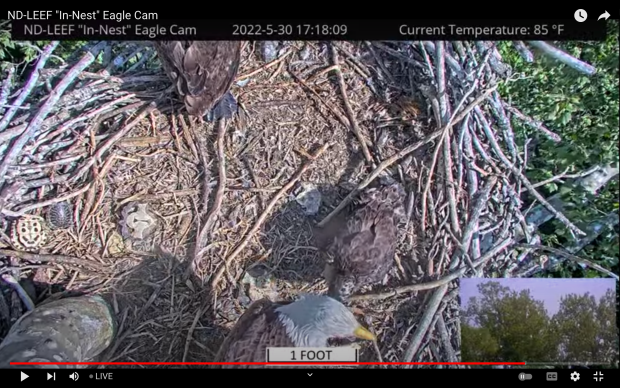
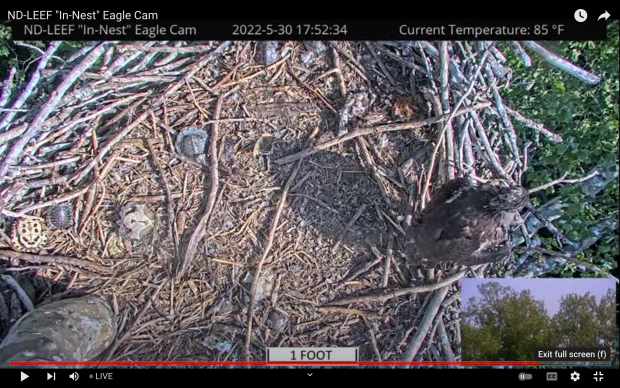
Little Bit has a huge crop showing at 17:18:09 and again at 17:52:34 – so he did not crop drop immediately from the earlier food. This means that Little Bit had food in his stomach. Crops are actually marvellous storage tanks for the birds allowing them to store food and then drop it down to the stomach when they need nourishment. It is reassuring to see Little Bit 17 with that big of a crop today. It has been a good day – few attacks from 16 and food to eat – a great combination equalling success. Little Bit worked hard to get food off of carrion (road kill) when it was on the nest. The older siblings could not be bothered. In the wild, they will have to bother – to eat what is there and eat even if they are full because it is never known when the next meal will come.

The image of Little Bit looking out beyond the nest with that big drop just brings tears to my eyes.

Little Bit has the energy and the joy of a full tummy so he flaps his wings.

Then there was another delivery! It came at 20:15:50. Little Bit is on the railing to the left.

Little Bit still has a crop from the earlier feeding. What is interesting to me is that the adult is very slow to begin feeding. This is a good thing. Slow feedings always benefit the wee ones hoping to get some bites.

At 28:50 Little Bit 17 begins to make his move from his corner by the tree. Just look. A day of eating has made such a huge difference. Little Bit 17 is getting his mojo back! He is reading his environment – this is crucial for a juvenile eaglet to survive in the wild. Don’t kid yourself. Everything that has happened to Little Bit on this nest is preparing him to survive in the wild. Watching, waiting. Knowing which birds attack and which are friendly. Good skills.

At 20:30:10 Little Bit makes his move to get under the adult to try and snatch and grab from under the tail behind the legs.

But wait…Little Bit doesn’t do that. Instead he goes right up to the adult beak and begins snatching and grabbing food — right from the beak!!!!! Food that might have gone to the big sibling waiting.

The big sibling does nothing. It has to be 15.

At 20:35:30 Little Bit is bursting full and has followed the adult. Little Bit is attempting to pull the last skin of the fish out of the parent’s beak. Yes, I am serious. Big sibling is looking on as this is happening.

Big sibling watches Little Bit play tug-o-war with the adult! Does everyone need a tissue? Little Bit’s bravery is just shining through. The adult ate the skin- they are hungry, too, but the level of confidence that has been shown today is the old Little Bit. Welcome back sweet little one.

Even with his full crop, Little Bit 17 is still eating every morsel of food he can find in the nest. One of the biggest lessons that Little Bit has learned is that you do not always have food. You need to conserve your energy and you have to eat what is available even if you do not like it.

Little Bit ‘staggers’ over to his favourite spot in the nest and heads to sleep.

Sweet Eagle Dreams to you Little Bit and to all your friends out there in Bird World.

This is just the best news in Bird World today. Thank you for sending all of your positive wishes to this nest and, especially, to Little Bit who is so deserving a full life beyond the confines of this nest! Keep it up!!!!!! We still have three weeks probably before Little Bit fledges. He needs to grow lots of feathers and get his strength up.

In other news, the eldest chick of Annie, Grinnell, and Alden – the female – has left the scrape box! Here is a video of this big milestone.

Tomorrow Cal Falcons will announce the final names. Please vote. There will be a short window of opportunity!

Thank you so much for joining me. This has been a miraculous day at the ND-LEEF nest. Little Bit is 55 days old. Fingers crossed for another good day tomorrow. Take care. See you soon!

Thank you to the ND-LEEF streaming cam where I took my screen captures.

Did Mama Raccoon take eaglet for revenge?

25 May 2022

I received a very interesting letter from EJ just a few minutes ago. What they wrote is something worth considering. I will leave the answer to the question up to you.

It is not often that we see what happens in the wild. If you were a mother with a nest of babies and another mother took one to feed their babies, how would you feel?

As it happens there is a video showing the female eagle at the Ft St Vrain nest delivering a live baby raccoon to the nest. She then feeds it to the two juveniles.

As it happens, it was only two days later that Mother Raccoon came up to the Eagle. Was she looking for her baby? Did she know what had happened to it? When Mother Raccoon got up to the eagle nest, she removed one of the eaglets off the nest. Its feathers were found later by a ranger. Can we expect that Mother Raccoon fed the eaglet to her remaining offspring?

Animal behaviour is very interesting. We do not often see events like this happening on streaming cams but I wonder how common they are in the wild?

Here is the video of that event:

It is just something to think about. I thank EJ for spotting that video about the baby raccoon otherwise, I would not have made the connection.

Cheers everyone! See you soon.

Late Wednesday in Bird World

18 May 2022

It is nothing short of rainy and freezing on the Canadian Prairies. The furnace is on. Outside people have a heavy coat on and hat. I am beginning to believe that we really could have snow in a couple of days.

Little Red. 15 February 2022

The garden/shed is no longer. It was built in 1902 on the property next door. In the 1940s it was moved to my property. Since I dream of living up on the Cape in the dunes with the Ospreys and the sand, everything was covered with cedar shakes. A cottage in an urban environment. I think I miss the shed as much as Little Red does already. 🙁

The Dutch designed and built Red Squirrel House arrived today – thank you DHL. Now to put it up and see if Little Red will accept the new accommodation. He has been stressed out and upset and he might well just go elsewhere. I just hope not in anyone’s attic!!!!

Prairie people dream of sand and water!

Beach Scene 7277” by Joanna Lee Osborn is licensed under CC BY 2.0.

One of my favourite beaches is Lunan Bay. It is just north of Arbroath, Scotland. Idyllic. Ospreys near by but not here at the beach.

If you want to read something other than factual books about Osprey development, I recommend both of David Gessner’s books. They evoke that beautiful New England coast. The first is Soaring with Fidel written when putting satellite trackers on Ospreys was novel. Gessner follows a bird – at first in an attempt to beat a BBC crew doing a documentary – and then was his own journey all the way to the mountains of Cuba where Ospreys fly in huge groups overhead as they fly to Venezula and Brazil. You will want to travel the same route – Gessner has a way of sucking you in to everything he does delightfully. The second is Return of the Osprey. A Season of Flight and Wonder. I do have a date with an Osprey and I will either be in Cuba on those mountains this September or next! Hidden within the pages of Gessner’s text is all kinds of information on Ospreys, too.

17 at the ND-LEEF Bald Eagle nest has not had any food and unless something comes in late, it will go hungry. 17 had a full crop last night but to grow this wee one needs food and lots of it. The other two are levelling off. Surely something will happen and turn this nest around! I just ache for this hungry little one. If falcons and hawks can manage five nestlings, what happened with the eagles. Why can’t they get enough food for all of them?

Mid-afternoon saw more fish arrive at the UFlorida-Gainesville Osprey nest. Both Big and Middle are sporting nice big crops. Talk about a nest that has turned around. I really wonder what is going on there??? If Dad does have two nests does he alternate weeks – one week one gets little while the other gets a lot and vice versa? [I am not saying he has two nests but it is certainly a theory]. It has been a good week and I will take it. Middle is doing fine. Both are fine.

Middle has big droopy wings now. He was so hot today. Good thing there was fish!

Say hello to RR16, Richmond and Rosie’s wee little one hardly a day old. Cute.

Did DH14 fledge? or is Big just up higher on the nest tree? Three or four fish have been delivered to the nest today! Middle seems to be giving away the hide-and-seek secret hiding spot. Fantastic.

More fish. Middle has an enormous crop after River feeding. I do wonder about Big. She always likes her fish.

There was some concern about the weather plowing through northern Minnesota. I just checked and the MN-DNR Bald Eagle nest is alright as is the Minnesota Landscape Arboretum Osprey nest where Mum is incubating two eggs.

Top is E1, Harriet, on the MN-DNR nest waiting for Mum Nancy to bring some more dinner!

Right by a field! There are two eggs being incubated at the Osprey nest below.

Aren’t they adorable? Can you see their ears? Those black mole-like dots behind the eye and a little down? Those will be covered with feathers soon. When you look at this group and want to place them in order of hatch, look at feather development, not size. Then you will always get it right.

From left to right, L1, L4 (always in front near the beak), L3, and then L2. It could be the camera angle but it might not. L3 looks larger than L2. I guess we will continue to watch and guess – boys or girls. L4 is definitely a little tiercel. And L1 is too much of a big Mama not be another Big Red. The world could use lots of good hawk mothers like BR.

The two chicks of Annie, Grinnell, and Alden are losing that ‘cute’ little newly hatched look. Feathers are coming in. They are getting taller and thinner. Annie spent time today trying to keep the two shaded. It must be hot in San Francisco. Oh, they are adorable. We could be only a week away from ringing them! And names…yes, names. Of course, one has to be Grinnell, right? I mean how could it not be Grinnell?

I would say they are hot!!!!!! I wonder if there is a bit of a breeze coming in from outside? It looks like they have been doing some egg painting.

Cal Falcons posted some information and two images of Alden taken by Moon Rabbit Rising. Check out her Instagram page for more images.

It is happening. Blue 33 and Maya were the first to arrive and lay eggs in the UK. Now we are getting into the next group of Ospreys. I know that there are quite a number together with Mrs G and Aran bringing up the end of hatch.

Right now there is a really nice pip at the nest of Laddie LM12 and Blue NC0 at the Loch of the Lowes!

Everything is fine at the Rutland nest of Maya and Blue 33. The kids eat, sleep, grow, eat some more. Maya is like Big Red. No one goes hungry at her house!

Thanks to ‘B’ who wrote and said Ervie is on the nest. I went and had a good look. Ervie arrived in the wee hours of the morning and slept on the perch flying down to the nest. He flew off and got a puffer. And it appears his talon is starting to grow in.

You can still see Ervie on re-wind on the PLO streaming cam. What a treat. Two days in a row. Thanks so much B from all of us!

You can see the talon just starting to grow.

Every nest seems to be doing fine except for ND-LEEF which has risen to the level of worrisome. If I say this and if everyone sends really positive energy over their way, maybe things will change for the good. As I look at Maya feeding the three Bobs, I sit in wonder. Big Bob survived the fish but I surely thought that Middle Bob was a goner – exposed to rain and the cool weather for 5 or 6 hours til Maya got the fish off and him under her. All three of them are alive and thriving. It is just such a happy positive sight. I wish all of the nests were like this one. We need a miracle for ND-LEEF. Let us all hope for it!

It has been a super long day. I have a few last images for you. I put out a new seed cylinder – they do really well for the garden birds when it is raining. Guess who found it in seconds? Dyson!!!!!!!!

The Baltimore Orioles are still visiting. In the chaos today I did manage to get to the birdseed store to get some White Millet. The place was packed with people purchasing special feeders for Baltimore Orioles. Yes, they are cute. Do you need them? No. A dish of any kind of jelly (not just grape) and orange slices set on something are absolutely fine.

This fellow has been eating oranges and Danish orange marmalade.

Thank you so much for joining me this evening. When I get Little Red’s house fixed, I will show you. Take care everyone. Stay safe.

Thank you to the following for their streaming cams and/or FB pages where I took my screen captures: DHEC, Cornell Bird Lab RTH, UFlorida-Gainesville Ospreys, Cal Falcons, ND-LEEF, MN-DNR, Minnesota Landscape Arboretum Ospreys, LRWT, Scottish Wildlife Trust, Port Lincoln Osprey Project, and SF Ospreys and Golden Gate Audubon.

Late Sunday in Bird World

15 May 2022

It has turned out to be a brilliant day on the Canadian prairies after the morning’s dreariness. At 18:33 the sky is clear blue, not a cloud anywhere. This, of course, could bode very well for the lunar eclipse tonight which I should be able to see – providing the sky stays the same – around 22:30-23:15. Will see if I can grab some shots of it for all of us!

It was a pretty good day in Bird World taken as a whole. The smallest eaglet in the Notre-Dame nest could really use some food. My goodness he is a tiny little tiercel compared to those two sprawling big siblings. I always get nervous when I check on that nest.

A fish was brought in to the UFlorida-Gainesville nest around 17:55. Middle managed to get a few good bites at the beginning by the old snatch and grab and screaming. Then Mum proceeded to feed almost the entire fish to Big. Middle is hungry but not starving. Holding my breath for tomorrow or another fish tonight.

The other super star of the male Ospreys in Wales is Idris. He has his nest with Telyn near the River Dyfi. Idris is ‘Daddy Longlegs’ and he is known for bringing whoppers onto the nest just like Blue 33.

I can’t wait for the chicks to start hatching on this nest! Last year these two fledged two brilliant osplets – a male, Dysynni and a female, Ystwyth. They have just been ringed and we will be looking for their return next year.

Blue 33 did as Blue always does – he brings in the fish, sometimes too much, and Maya has him remove them. The three chicks continue to thrive. No worries here.

The weather turned and it began to rain and blow in the late evening. Blue was on the nest with Maya and the kids. He is extremely protective and one of those ace providers! He also likes to feed his chicks.

The Dale Hollow eaglets are 77 days old. The average age for fledging is 84 days. So we still have some time, hopefully, with them.

The nest is falling apart in some places and River and Obey will have some work to do for next season. These two are gorgeous.

Just look at what was the rim of this nest. It is almost entirely gone!

E1 at the MN-DNR nest is pancaked down on the nest right now. Is there an intruder somewhere? or is this food coma?

Nancy was in to feed E1 at 19:00. These two are doing alright. Nancy is taking good care of E1, Harriet.

I have not checked on the Goshawk nest at Riga, Lativa for a few days. It is another one of those times when you blink and the chicks are getting bigger. There are four. I have checked and all seem to eat fine.

It rained heavily on the nest yesterday. Mum comes in with food and here is a video of that feeding of these Goshawk chicks. Goshawks are beautiful birds. I just don’t like them around Osprey nests!

One of the best books on the Goshawk continues to be T.H.Whites, The Goshawk. It has been reprinted in a small paperback for a very reasonable price.

There is no news that I am aware of coming from Richmond and Rosie’s Osprey nest in San Francisco about a pip.

When Big Red and Arthur laid their fourth egg many became quite concerned that the last hatch would simply not survive with three bigger siblings. It is always good to remember that this is a hawk nest – like the Goshawk above – and all of the chicks will be fed. In fact, when L4 hatched he was just a cracker. Nothing stood in the way of L4 and Mum’s beak. He learned quickly from a few days old just to heave himself over or through the big siblings. Of course, they are not beaking him or intimidating him onto the other side of the ledge. That is why watching Big Red’s nest is the best. The absolute best.

I made a video clip today of L4 doing his stunt to get in front. It is about 3 minutes long. At 1:54 L4 decides to pull a chippie. I thought he might be going to self-feed. At 2:22 he makes for the front. I am calling it the L4 scramble. Enjoy!

Thank you so much for joining me today. Take care everyone. See you soon!

European Starling. 15 May 2022

Thank you to the following for their streaming cams where I took my screen captures today: DHEC, UFlorida-Gainesville Ospreys, Cornell Bird Lab RTH, Latvian Fund for Nature, MN-DNR, SF Ospreys and Golden Gate Audubon, Dyfi Ospreys, ND-LEEF, and the LRWT.

Manton Bay Sadness and other news in Osprey and Falcon World

11 May 2022

I want to start this newsletter with something that is pretty wonderful before we get on to the big story of the day coming out of Rutland Water’s Manton Bay Osprey nest.

Forgive me if I am wrong but it looks to me like Alden is feeding the two chicks at Cal Falcons! Why do I think this is Alden? and why is this such a big deal? Well the left foot has a problem or did something happen to Annie? or is this just nothing and I am seeing things? Annie likes to feed the kids so that is why this is a big deal. But Alden has been nervous and seemingly shy of feeding. So what is going on?

Well this looks like an experienced parent.

The time is 06:03 and I am confused. The adult behaves like Annie but I am confused by the left foot.

At any rate, the chicks are fine. Gosh, golly. Do we have a foot injury on Annie??????? or has Alden suddenly turned into a pro at feeding chicks?

Everyone watching the Manton Bay nest of Blue 33 (11) and Maya are simply at a loss for words. A large fish came on the nest and flipped from the side over to the top of the nest cup hitting both chicks and the third egg. Just as watchers were stunned so was mum, Maya. Ospreys are used to fish flapping. Indeed, one of the historic reasons that the males eat the heat is to ensure that the fish is dead when they deliver it to the nest. Of course, that is not always the case. It can be a tragedy when day old osplets are on the nest.

One of the chicks has survived. The other was still breathing but was left exposed for a period of time. At 13:17 Blue 33 (11) comes to check on Maya. With what we can only believe as his encouragement, Maya moves the fish out of the egg cup and to the side of the nest where she eats some fish. With the fish out of the egg cup, she gathers both chicks under her to brood. Am I crazy to hope that wee one will survive?

Is the little one stuck under a stick or something? I wonder.

By 14:35 the rain is pouring down on Maya. She has both chicks and the egg under her and is hunkered down. Send your most positive wishes to this Osprey family. Hope for a miracle for that wee babe to come around and for two healthy osplets.

It is 15:30 and the rain has stopped. That is really good news for this Osprey nest. Maya is feeding a chick and eating herself. The other chick is drying off and is still moving but, honestly, it would be a miracle if this one makes it. Still, I hope.

Its little wing was raised up and moving. It is in front of the egg towards us. Maya will cover up both chicks and the egg. Mum is looking a wee better. We must remember that Maya may have had fish flop around in the nest before but she has never had a chick fatally injured by one. She has little time for mourning but did appear stunned and very lethargic when the event happened.

More tragic news has come from the Dahlgren Osprey nest. The third hatch has died. That nest is located at the mouth of the Machodoc and William’s Creek in King George County, Virginia. It is the nest of Jack and Harriet. The creek has had very high water and has flooded in places causing murky fishing for Jack. It is not clear but as of the 8th of May the third hatch was getting little food. It died this morning.

Things are, however, continuing to go well on the Captiva Osprey Nest. Middle Little or Captiva’s Daddy Long legs fledgling has been flying on and off the platform with a very large fish. He is flying like a pro now. So good!

There he goes in the middle to the 8island to enjoy his late breakfast!

After the Ospreys, it is often reassuring to check on the falcons and the hawks.

Everything appears to be fine as the day starts for Annie and Alden and the two eyases at the U-California Berkeley scrape.

All five eyases are alive and either preening or trying to sleep at the Manchester, New Hampshire scrape.

The three chicks at St Mary’s Church in Andover, Hampshire, UK had a really good feed today and all are doing well.

The two at the Indiana & Michigan Power scrape are also fine!

These two are really losing their baby down.

There are still only two eyases at the Utica NY scrape. Both are doing well and with sadness on the nests overall, two energetic chicks is great.

Sadly, there has been a unexplained death of the youngest eyas at the Cromer Peregrine Falcon scrape in the UK. Both chicks were eating fine and developing well. There appeared to be no problem. Sometime between 1315-1430 yesterday the youngest on died. I was not expecting that news. The fact that the chick ate well does not indicate Avian Flu. The owners of the scrape commented on its pale egg and feet thinking that there was something the matter with the wee ones health all along. Condolences go out to all the individuals associated with the Cromer scrape who work so hard to reintroduce the Peregrine Falcons into the UK.

All is well at the Dolina Baryczy Peregrine Falcon nest in Poland.

The chicks ate for a very long time and it was recorded. They look healthy. They are losing their down around the eyes and you can see the feathers coming in on the wings and the tail.

All is well at the nest of Big Red and Arthur on the Cornell Campus in Ithaca. the four eyases are growing like bad weeds, getting their feathers, and starting to spend a lot of time preening. Relief. They are sure taking up a lot of space along that ledge of the lightbox!

Thank you so much for joining me as I continue to monitor the situations at the Manton Bay and UFlorida-Gainesville Osprey nests. Take care all.

Thank you to the following for their streaming cams where I took my screen captures: LRWT Manton Bay, Captiva Ospreys and Window for Wildlife, Cornell Bird Lab RTH, Cal Falcons, Peregrine Networks, I & M DNR, Utica Falcons, Sokoi D Baryczy Zdenka, and Cromer Peregrine Falcons.

Continuing Broodmate Aggression at the UFL-Gainesville Osprey nest

2 May 2022

I have not spent the time I should have observing the UFlorida-Gainesville Osprey nest since the third hatch starved to death because of siblicide. The nest appeared to have ‘calmed’ down after that. I am, thus, very grateful to ‘R’ who took the time to write to me telling me about the change to aggression.

While my research focuses on that third hatch, it appears from the instances of aggression that we have seen this season – that ‘something’ is happening out there in the nests. Before we chat about these sorrowful avian behaviours, I want to go back to the book I am reading, The Eagle Man. It is about Charles Broley, a Canadian, who spent his time between here and Florida observing Bald Eagles and banding thousands. Broley’s observations are from direct observation or information provided to him by others. He did not have the benefit of the streaming cams and data collections that we have today. Still, some of his observations continue to hold true such as the ‘Northern’ Bald Eagles are larger than the ‘Southern’. In another instance, he notes that the ‘Southern’ eagles are more aggressive than their ‘northern’ counterparts. In terms of nest aggression, Broley said: “The more demanding of the babies gets the greatest amount, however, for the weaker, smaller one is always neglected for the more aggressive one. As a consequence on that is a little smaller, a trifle weak, perhaps, tends to grow weaker through lack of food, abuse from the older bird, and general neglect, while the stronger one, because it gets all the food, increases in size and strength rapidly (52).

In their article, “Why do some siblings attack each other? Comparative analysis of aggression in avian broods” by Alejandro Gonzalez-Voyer, Tamas Szekely, and Hugh Drummond (Evolution, 2007), the authors list eight traits that they are testing to determine if any, some, or none drive aggression on nests. Those traits are:

  • feeding method (monopolization of food). Direct feeding when food passes directly from the adult beak to the chick’s beak. This allows the dominant bird to violently exclude any competition. The authors believe that when food is placed on the nest floor in indirect feeding it is more difficult to monopolize. The feeding method theory predicts that “a greater use of aggression in species in which direct feeding predominates throughout the nestling period).
  • effective weaponry (pointed or sharp beaks)
  • limited escape possibilities (nest site typography)
  • differences in age and size of broodmates (hatching asynchrony)
  • large food parcel size
  • small brood size. As brood size increases the authors observe that it is more difficult to intimidate and attack.
  • aggressive potential (maturity and body size)
  • slow food transfer

The researchers studied and compared several species including the Accipitridae (eagles, hawks, and buzzards) along with Boobies, Anhingas, Ibises and Spoonbills, Egrets and Herons, Pelicans and Kingfishers. I was, of course, disappointed that they did not include Ospreys. Following lengthy observational study, the authors concluded that indirect feeding, small broods, and long nesting periods are significantly correlated with broodmate aggressive competition. They also agreed that more studies needed to be conducted because exchanging or removing even one factor might alter the results of the research. I did find it interesting that out of 58 Eagle nests studied compared to 52 falcon nests, the eagles were 81% more inclined to nest aggression. They thought that factors such as larger clutches, a shorter nesting period, and one other factor — that the broodmate aggression being eliminated through evolution- could be at the heart of why falcon nests have little siblicide. It is rare to find siblicide in falcons and hawks while, as we have seen recently, it is much more common in eagles and ospreys.

Within this season, we have seen siblicide, the deliberate killing of a sibling, at several nests. These include the third hatch, DH16, at the Dale Hollow nest on the border of Tennessee and Kentucky; the third hatch at the UFlorida-Gainesville Osprey nest; the second hatch at the MN-DNR nest who was physically abused (with holes in its head) in the nest and, ultimately, successfully shoved off the nest on the third attempt; and the biological chick killed by the foster chick at the Pink Shell Osprey nest in Florida. In addition, it is difficult to know what the outcome would have been at the Captiva Osprey nest if the oldest sibling had lived. Big did prevent the female and the two younger siblings from eating for a period of 72 hours before it literally dropped dead. Would the death of the youngest sibling at the Duke Farms Eagle nest be classified as siblicide?

The situation at the UFlorida-Gainesville Osprey nest has not stabilized. The information I received this afternoon from observations on the nest indicate that the eldest sibling is relentless in stopping the middle sibling from eating. Observations of the behaviour include – the mother feeding the dominant sibling, the dominant sibling abusing the younger even if its crop is full to overflowing, the younger one having to expend energy and become aggressive to even get a few bites of fish. I do not know the number of deliveries in a day or the size of the fish. The camera re-wind is such that it is not conducive to discovering this information. Tomorrow I plan to write to Gainesville and see if I can get the data which someone must be keeping – and also to find out precisely how old these osplets are. While there is no truly ‘safe period’ against broodmate aggression, it is normally expected to stabilize around the age of one month. That said, the dominant aggressive osplet in the Port Lincoln nest did throw its sibling over the nest to its death when the chick was 65 days old. This is why we cannot predict what will happen.

In the top image, the eldest chick, Big, has learned to get between the mother’s legs preventing Middle from getting food and from the advantage of having the adult in between the two birds. Thank you ‘R’ for drawing this to my attention.

Middle had to expend a lot of energy flapping its wings and trying to mantle to get a few bites. The ratio was more than 10 bites to 1 with Big having the advantage. I do not know when the Middle sibling last had a good meal with a crop.

We must remember that the more food Big gets the bigger and stronger that bird gets to the detriment of the younger. It is hot on top of that light stand in Florida and the fish is the only hydration the chicks get.

Middle is once again rushing at the Mum to try and get some food.

Another small fish comes on the nest later. In the image below, Big has been eating and has a huge hard crop. Middle has no crop. Big has been eating but Middle moved slightly and caught Big’s attention who went on the attack.

Big goes back to eating.

Eventually Middle gets a few bites of fish once Big passes out in a food coma. In essence, Big ate almost two entire fish with the Mum and the Middle sibling getting very little.

One thing that is missing in this discussion is the fact that the Mum also needs to eat. It was 25 degrees C today or 77 F on the ground and later in the day (9pm). It is very hot on top of that light stand. I cannot predict what will happen on this nest or on Middle’s survival. Normally I would say not to worry but Big has tried to push Middle off the edge – when I see this behaviour my antennae really begin to alert. It is going to depend on many factors some of which we just do not know – will there be an increase in size and number of fish being delivered? is there a genetic disposition towards aggressive behaviour at this nest?

I am sorry to bring you this sad news. I had so hoped that the aggressive behaviour would have ended with both chicks thriving. I will be keeping a closer watch on this nest and I am very grateful for the letter alerting me to the change. If you know of other nests where siblicide has occurred since 1 July 2021 to the present, please do let me know. It would be much appreciated.

Thank you for joining me. Take care everyone. See you soon.

Thank you to the UFlorida-Gainesville for their streaming cam where I took my screen captures.

Dad delivers two fish to his Ervie

I have to admit that I have been feeling rather sad for Ervie. He was so excited – and proud -to bring his catch to the nest. Then for it to turn out to be a toadfish, something that he cannot eat (or did not eat – he did eat the puffer fish!), had to be a real disappointment.

That fish remains on the nest and every once in awhile Ervie takes a look at it. You can see the fish to the right of Ervie. It also sticks to Ervie’s feet when he jumps around the nest trying to get a delivery from dad. I wonder why he doesn’t just shove it into the side of the nest?

Yesterday Dad brought in two fish meals for Ervie. Those times were 12:55:43 and 17:56:51.

Here is Dad delivering the first lunch for his lad.

Ervie is really lucky that Dad continues to feed him! Ervie reminds me of Izzi, the cutest peregrine falcon, at the scrape in Orange. Izzi did eventually leave the area but not until it was nearly time for his mother, Diamond, to lay her eggs for 2021. Some thought Izzi would have to stay and help take care for his siblings! It has happened in the UK.

It appears as long as there is a chick crying in the nest, no matter how big and old, Dad will continue to provide some food.

Ervie is really mantling his precious fish. He gives Dad a bit of a nudge to get him off the nest!

Dad is amazing. Ervie is really going to enjoy that fish.

Ervie slept in the nest last evening. I wish the camera could give us a view of the nest and Dad’s shed area. Is Dad not there? Is that why Ervie is sleeping on the nest? I have more questions than I will ever get answers.

In other Bird World News: Thunder has now laid her third egg at the West End Bald Eagle on Catalina nest with Akecheta. Bald Eagles Connie and Clive, realizing that their egg was not fertile, each helped bury it in the nest at Captiva. Today they are bringing in new soft materials covering the egg and the nest area. Does this mean they are going to attempt a second season?

There is a storm raging at the NEFlorida nest of Gabby and Samson. Gabby and the nest are almost at the point of being so deluged that she might not be able to keep the chicks dry. The other issue is that the temperature at the nest is 9 degrees C (49 F) and there is a wind advisory. Gusts up to 40 mph will ravage the area until Monday afternoon. The rain should stop by early evening. My heart goes out to Gabby.

Pa Berry has the nest stocked and while it is a little breezy, all seems well at the nest with Missy and little B15 at Mt Berry, Georgia.

Kincaid is growing and doing well. Louis doesn’t have quite the pile of fish he had on the nest. Thinking about those 10 fish and Coots reminds me. There was a question the other day and I am certain we have all thought about this. How well can Bald Eagles smell? That nest of Anna and Louis’s in the Kisatchie National Forest had to just reek.

Eagles have high temporal resolution – keen eyesight – and they rely more on their vision than smell. Turkey Vultures and others who rely on Carrion as a food source do have a developed sense of smell that helps them find their food. Eagles have functional olfactory glands meaning that they can smell but the numbers of those glands is relatively small in comparison to mammals. I will post a link to an article on Olfaction in Raptors at the end of this blog if you want to access it.

Kincaid is sitting up nice and straight. He is not yet walking around the nest but he sure manages to move relatively quickly, regardless. Anna keeps him full to the brim, normally!

There is an interesting story coming out of Alexandria, West Virginia Audubon Society about an Osprey that caught a crow. Have a read:

https://www.audubonva.org/news/osprey-killing-a-crow-in-alexandria-va?fbclid=IwAR143JSPR4PsbBCq5J-umVH_aML7MF-JpL_EAUcGTnFVbevRsK8zucOx8RU

Here is the article published by Oxford University’s Zoological Journal on Olfactory Glands in Raptors:

https://academic.oup.com/zoolinnean/article/189/3/713/5601241

It is -18 with a bright sky on the Canadian Prairies. I am hoping to go out and check on some birds this afternoon for awhile. February is always the month for ‘cabin fever’ and this year is no exception! I do have some images of our dear Dyson yesterday in the garden. He is sure enjoying that hard suet cylinder!

He managed to share it with the European Starlings yesterday. Sometimes I see him chasing them about the Lilac Bushes hoping that he will get them to move so he can have some seed.

For some reason Dyson likes to eat this hard seed cylinder or sit in the open square feeder and eat just Black Oil Seed. I cannot get him interested in anything else.

Dyson becomes a bit like an acrobat hanging on to that small branch of the tree and the wires of the suet holder.

He sure does bring me a lot of joy!

Little Red was out yesterday, too. When the temperatures dropped from -32 to -15, the squirrels became much more active. It was nice to see them all! Reassuring.

Thank you so much for joining me. I hope that you are all well. Stay safe! See you soon.

Thank you to the following for their streaming cams where I took my screen captures: Port Lincoln Osprey Project, Berry College Bald Eagles, KNF Bald Eagles, and NEFlorida Bald Eagles and the AEF.