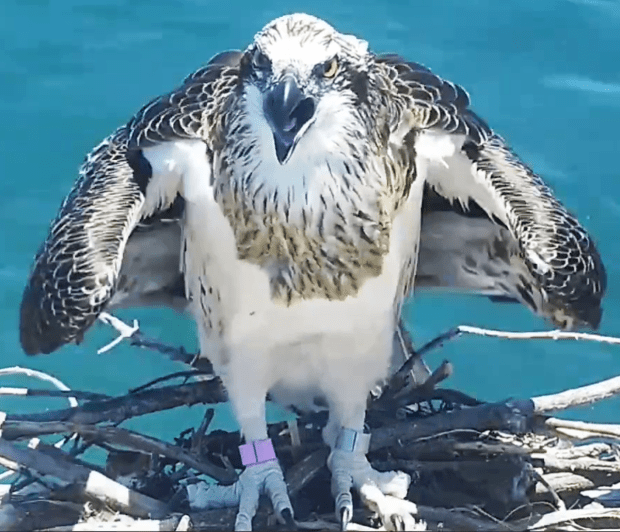
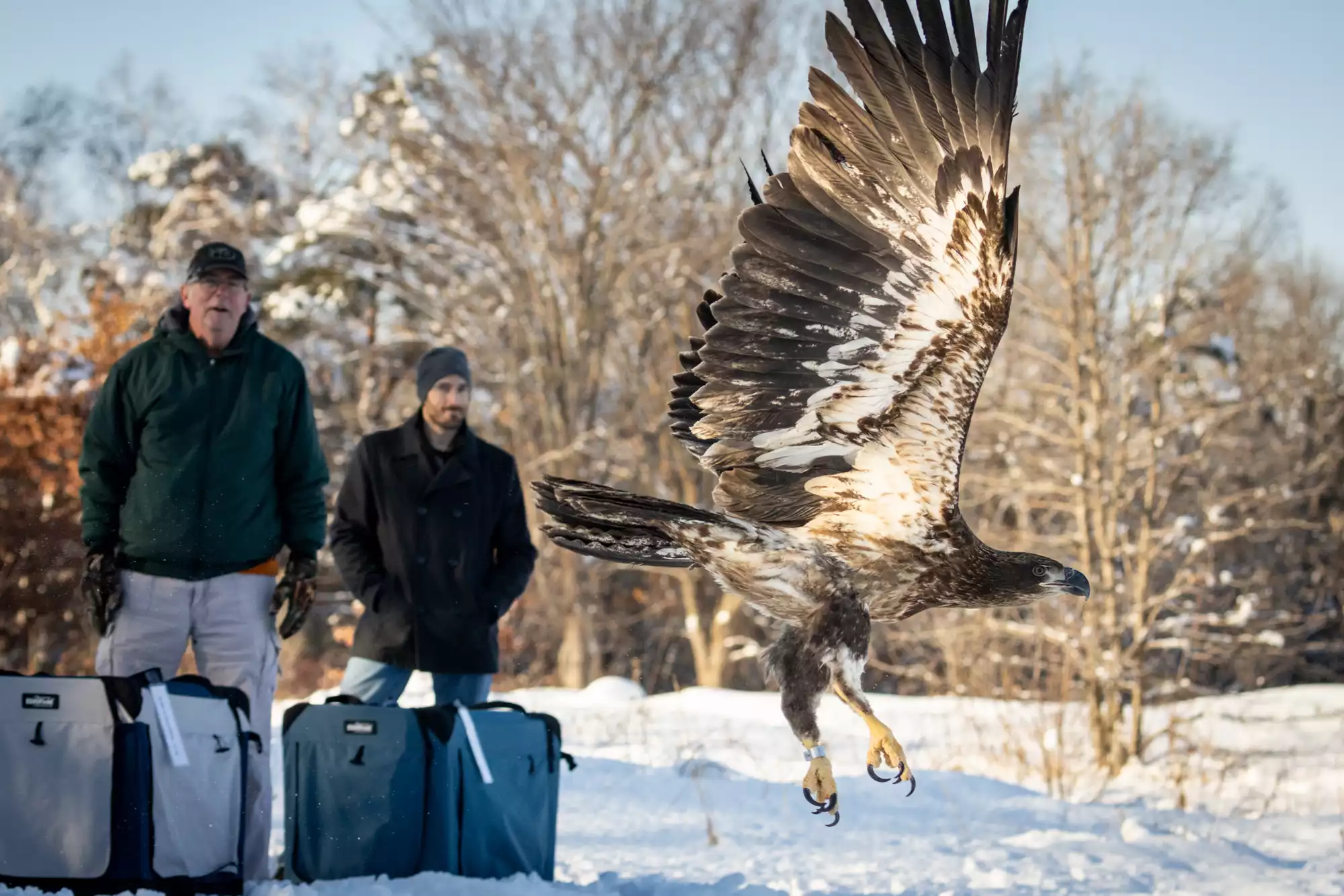
Poor Jackie…Monday in Bird World

16 January 2022

Good Morning!

I hope that you had a lovely weekend and that it has been a nice beginning to the week! It remains warm in Winnipeg. So warm that the snow on the glass roof of the conservatory melted on Sunday and the snow in the parking pad is sludgy. It is a good day for a walk. Whether I will head to the nature centre or finally take that drive an hour out of the city to see the chickadees – well, I have not decided. I love going to the same place, 20 minutes from where I live, and see how the visitors change from day to day. Will keep you posted!

On Sunday there were many visitors to the garden feeders – 38 European Starlings and about 60 House Sparrows. One Black-capped chickadee and Dyson and gang. About 30 Crows flew over head after chasing the GHO out of the neighbourhood. It is a regular occurrence during the winter. The GHO has a nest on the golf course a few blocks away. What is puzzling me is: where are the Blue Jays?

A Request: Just check this out.

I was so impressed by the perches (some osprey nests on the streaming cams do not provide these for their birds and that is sad). And the hide. Can you help with any images? See the information below.

Checking on our nests:

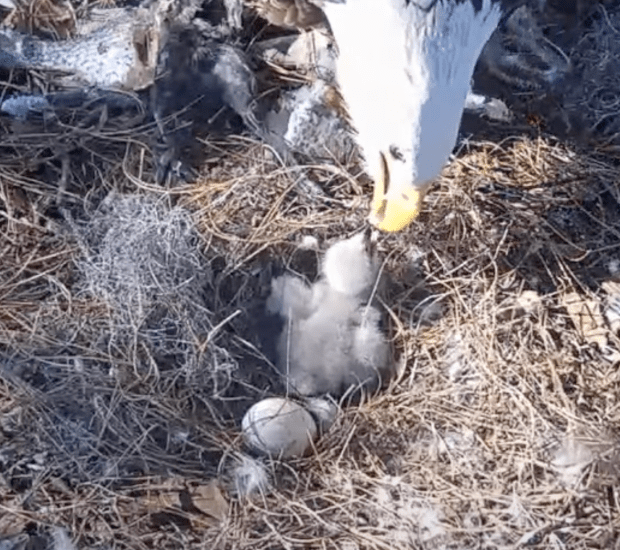
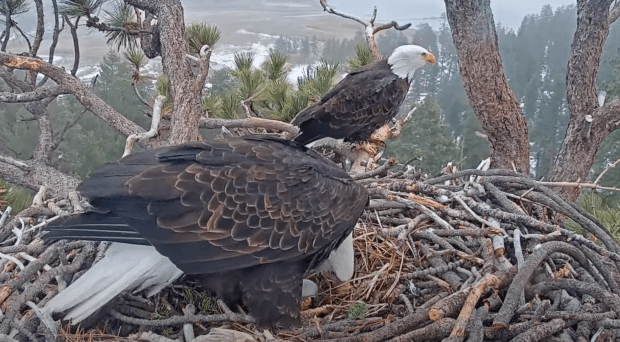
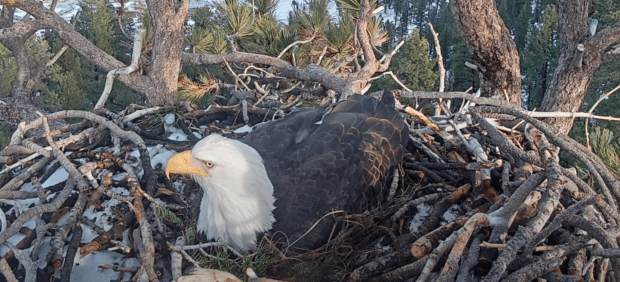
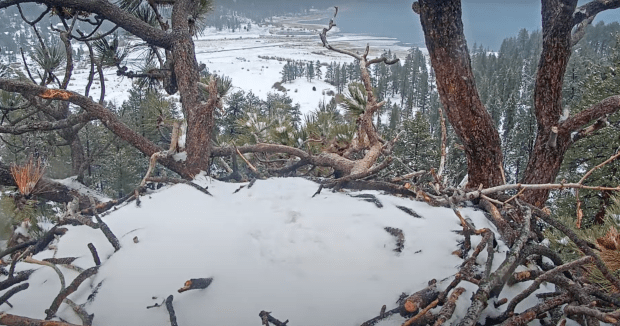
Oh, the weather just continued to get worse at Big Bear. Poor Jackie. She is one devoted mother. She has been incubating the eggs since the second was laid yesterday before 17:11 with a break but I have seen no food. No doubt Shadow has not been able to hunt and I do not know if this couple had a stash prepared.

We are all aching for this warrior Mum but, Jackie has lived in Big Bear Valley for now 11 years and she is used to the weather. Eagles have 7000 feathers to keep them warm and dry. My only concern is her need for breaks and food. Help, Shadow!

Shadow came in and relieved Jackie. She returned at 1408 and Shadow didn’t want to get off the eggs. Oh, sweetie. They have this!

Shadow is doing a great job.

Jackie arrives!

The weather is just horrific up on the nest at Big Bear. I don’t blame Shadow for not wanting to get off the eggs. Poor Guy. He is either going to have to go and hunt or perch on those madly swaying branches.

The snow is getting deeper by 1600.

Here is the exchange in video by Gracie Shepherd. The exchange begins at 12:43.

Shadow’s reluctance to give up incubation is caught on video:

We are sitting in our houses warm and dry. Just looking at Jackie makes me want to bundle her and Shadow up and bring them inside along with their eggs. They are, however, quite fine. Probably a lot better than if it were 45 degrees C!

1656 are watching Jackie and wishing her well (and warmth) as the winds and ice pellets fly on to the nest at 20:00 Sunday evening.

So how do birds stay warm in the winter? Here is some information from the British Trust for Ornithology. Most of the songbirds in my garden and others in winter need to eat the equivalent of their body weight in food to stay warm. They lose, according to this article, approximately 5% of their body weight during the night staying warm to stay alive. So, if you can, find some energy rich suet and peanuts and put them out for the birds! They will thank you. The world will thank you.

When Dad got up at 14:40 on Sunday to check her eggs, it looks like there could be a pip in one of them. Of course, it could just be nesting material, too, but if it isn’t a pip, we are getting close. Missy relieved them shortly after.

All of the other nests are fine with their eaglets eating well and growing. I have not spotted any problems and the eaglets at SWFlorida and KNF E3 continue to be little darlings with little if any beaking. Indeed, I have seen none so far on Sunday and it is about time they would grow out of this phase unless something happens in the food supply chain.

Anna feeding KNF E1-03. This is a sweetie pie.

Louis always keeps a lot of fish. Anna and the wee one will never need to worry about being hungry. Louis is awesome. These Louisiana eagles sure love their Coot. Maybe it is a nice change from fish??? The little one loves it as much as Anna!

The KNF gang looked at the unhatched egg and established that it is the first egg that was laid – the pointy one. It is now 46 days old and no hope of hatching so KNF E1-03 is from the second egg.

I am biased. Andria is a fantastic Mum. She is always checking to see if one or the other of the eaglets wants some more bites. These kids love their Coot just like E1-03. They are adorable and their plumage is changing. Just look at the natal down dandelions that are disappearing to reveal the deep charcoal thermal down. And you can really see the pin feathers when they move about. Growing before our eyes. Love this couple – Alex and Andria.

Alex and Andria enjoying a meal on the nest together after 01 and 02 are filled up! Just look at the crop on 02. One of those puffy pillows it appears.

01 is already in a food coma. Andria is checking to make sure that 02 is completely full. “Have som4e more little darling.”

Seriously, they look like old carpets or towels to me. Those dandelions are breaking off and look – KNF -E3 O1 is getting its mohawk!!!!!!!!!!! (look at the image above)

Big crop on KNF-E3-01.

Are you sure you have had enough, little baby?

The two eaglets are sleeping in food coma but ‘A’ reports something disturbing: “Then, at 16:02:10, as mum was getting another bite of food ready, the larger one suddenly and without any warning or provocation pecked the younger one on the top of the head, then grabbed it by the back of the neck and twisted. Then it grabbed it again and this time actually lifted it up by its neck (the little one was still in submissive pose with wings spread). It dropped the smaller eaglet again, then picked it up a third time and shook it. The entire attack lasted less than six seconds.” The eaglets will stagger over and go to sleep as if nothing happened.

I missed this attack. What in the world would cause KNF E3-01 to do this?  ‘A’ reports that the confidence of the little one is not phased as it went back up to eat some more, even with an enormous crop, and had to undue itself from the cuddle puddle it was in with the larger sibling. Good! How old are the eaglets? Osplets will start battering one another once the blood feathers come in from 8-12 days old. Must check!

E21 and E22 are adorable. Please watch this beautiful eagle family if you haven’t been because you are afraid of some beaking. The eaglets are adorable. They are growing fast and you cannot beat the parenting of M15 and Harriet. They have this whole process nailed down to the finest details and if M15 thinks E22 has not had enough – he gets in and gives the little gaffer some more food. These eaglets are so secure. They wait patiently for Harriet to feed them. No fighting. Nothing. I mentioned the other day that I felt that they were males. They could be two females, too but not an older female and a younger male. They are just getting along too well! The best nest I have watched for years was PLO’s 2021-22 Osplets – the three boys – Bazza, Falky, and Ervie. Oh, sure, they dusted up all over the place once they had fledged but that is normal survival in the wild. They have to work on it at home!

Keep an eye on the area around their mouth for it to turn yellow. This will happen at about a month of age.

A cuddle puddle.

E21 is full to the brim and Harriet is filling up 22.

Food coma.

CJ7 almost got walloped by a huge headless fish today. There is so much food on this nest – fish everywhere you look. Clive is an excellent provider. Ah, just a nervous auntie but I wish Connie would fill that little eaglet up with a lot of food a little more often. It is only tiny and needs those 45-60 minute feeds all day long.

I am really grateful to the readers who sent me a note and asked me why I was not mentioning Superbeaks. What a fabulous Bald Eagle nest this has turned out to be. Exceptional. Pearl is 38 days old and Tico is 37.

Wondering where the second eaglet is? They are on the opposite side of the nest looking away from the camera. This is why we can usually only see one!

It looks like the eagles in the Channel Islands are starting to get interested in their nests and thinking about much needed renovations for the 2023 season. Guess who was caught on camera today? Chase and Cholyn at the Two Harbours nest! Parents of Lancer (2022).

Akecheta was at Tor at the West End nest but I did not see Thunder nor did I see any eagles at the nest site.

If you are wondering about deliveries to Zoe, Mum brought in 2 fish for her girl yesterday, the 15th. In fact, it has been Mum that has been making the deliveries to the Port Lincoln barge. Wonder what will happen today?

Gabby and V3 have been at the nest tree. One is often perched on a branch seen by the other cam. There has been no active working on the nest for several days. Perhaps we will have to wait for another one of those fertile fortnights for Gabby or maybe all three have passed and we will wait for next year. Either way it is alright. It will give Gabby time to really get over the loss of Samson and also to see if V3 is going to last.

Thank you so much for being with me today. Please take care. See you soon!

Thank you to the following for their posts, their videos, their streaming cams that form my screen captures: ‘A’ for her report on KNF E3, Ospreys Only, FOBBV, BTO, Berry College, KNF-E1, KNF-E3, SWFlorida and D Pritchett, Window to Wildlife, Superbeaks, IWS and Explore.org, PLO, and NEFL-AEF.

It’s 2 eggs for Jackie and Shadow, 2016 Royal Cam chick returns…Sunday in Bird World

15 January 2022

Good Morning Everyone,

Oh, what a lovely weekend we are having on the Canadian Prairies. It is currently -5 C with a 4 km/h wind. It is lovely. Just lovely except that it is ‘grey’. No blue sky. No sun. Looking forward to a walk in the forest today! Will keep you posted on what I see. I hope the weekend has been kind.

Making News:

Eagle Nest Removal. One of our blog family did some additional research on the removal of the nest on that cell tower that I mentioned a day or two ago. ‘B’ located a news article from South Carolina with information including the e-mail address to write if you are concerned by these actions. As we are all too aware, nests are being cut down and blown down by weather and it is breeding season. You should read the article carefully. The eagles were present and around – this was NOT a disused nest! Indeed, it is outrageous that it was removed.

I will include a link to the article. ‘B’ draws our attention to a final paragraph. If you wish to voice your concerns about this incident – please use the e-mail below. The link to the article is below the quote and above the albatross image. Thank you for taking the time to speak up for our raptors who cannot speak for themselves!

“The South Carolina Department of Natural Resources responded to reports of the removal of a large raptor nest in Mt. Pleasant, South Carolina. The United States Fish and Wildlife Service has initiated an investigation regarding the removal, and inquiries concerning this incident should be directed to Office of Communications, United States Fish and Wildlife Service Southeast Regional Office at fw4_comms@fws.gov .”

https://www.newsbreak.com/news/2890157123613/fed-investigating-removal-of-mt-pleasant-eagle-s-nest

The 2016 Royal Cam chick, Moana, has been confirmed to have arrived at Taiaroa Head after 7 years at sea. Talk about incredible. Just think about that. She is very steady on her feet and Ranger Sharyn wonders if she didn’t arrive earlier and wasn’t spotted. She settled down by her half-brother GLY for a bit. Oh, my goodness. This is fantastic news.

American Golden-Plover with Yellowlegs” by Dendroica cerulea is licensed under CC BY-NC-SA 2.0.

Have you ever seen a Golden Plover? We do not, as far as I know, attract them to Manitoba but, oh, they are so gorgeous. I can only imagine them at sunset!

https://www.theguardian.com/environment/2023/jan/14/country-diary-a-golden-glint-in-the-gwynt?CMP=share_btn_link

More lead poisoning. I was going to try and put together a form letter for everyone to send to their various agencies but, the laws regarding lead vary from State to State and Country to Country. If this is an issue where you live – and it certainly is in the US and Canada – find out what the laws are. We know that some states have partial led bans. Get informed. Then use some of the information from posts such as the one below to write to your state and federal agencies asking them to ban lead from fishing and hunting equipment. Your letter should not be longer than a page and it should get to the point with facts.

Lincolnshire detectives warn that the poisoning of raptors could lead to human death. “The RSPB has described Lincolnshire as “a national hotspot” for the persecution of birds of prey”. How sad. Why do people believe they have a right to kill or severely injure animals or birds?

https://www.bbc.com/news/uk-england-lincolnshire-64225792

The AEF has made a memorial video of Samson. It shows some beautiful close ups of him, images of him and Gabby, and their kids. Get a tissue. I assume that they have now determined that something fatal has happened. So very sorry and sad. He was a magnificent partner and dad and I will just never forget the tender care he gave to Legacy and Jasper and Rocket. I did not watch this nest the year of Jules and Romeo).

There has been some discussion about physically challenged raptors. Here is another example of an eagle with one leg that landed on the Fort St Vrain nest in Colorado. Wonder when it lost its leg? and how it hunts its prey? There are places where challenged raptors can live out their lives; ‘L’ send me some information on them but, what about in the wild? Is it a case for not euthanising raptors if they have a single leg injury? I am, of course, thinking of our beloved WBSE26 right off the top but, there are others. I don’t know the answer. I am thinking out loud. Is it inhumane to even think that eagles could be freed with one leg? It is curious.

Checking on the nests:

Jackie laid her first egg on 11 January at 15:58. It is a horrible day in Big Bear Valley. It started out rather nice and quickly changed into high winds with pelting hail/rain/snow. Jackie will be laying egg 2 on this miserable day. Shadow has taken turns incubating and the pair have been on and off and always one of them around the nest at Big Bear.

At 12:28, there was still only one egg. The weather has changed the hour prior and is starting to get quite nasty for our darling Jackie.

Gabby at 13:54 Saturday. The cameras went out shortly after.

The second egg was laid before 17:11 on Saturday the 14th. In miserable weather. Poor Jackie. She must be hungry, too. Let us all hope tomorrow is a better day.

It looks like it is a much nicer day in central Florida for Superbeaks.

The first image is an unusual one. I am posting it here so you will see the blood feathers coming in on Pearl’s wing.

Connie and Clive’s little eaglet has fish juice on its feathers. It cannot be helped. Poor thing. Connie definitely likes to eat and I have yelled at her a few times to feed the baby! There is fish on the nest. Once Connie gets started and is not distracted, the eaglet normally winds up with a crop. Poor little one is also learning how to handle those huge bites…hence all the fish juice everywhere.

Anna is a bit like Connie. She sure likes her fish! Anna is making KNF E1-03 really stretch its neck to get any food. I must admit to getting irritated at both Anna and Connie. I want to see them feeding that wee babe til it can’t move and then having a big lunch themselves! Oh, well…they are never going to listen to me.

At the KNF E3 nest of Alex and Andria, E01 and 02 are doing fantastic. They look like two old wooly grey carpets. There is always an adult around but both can regulate their temperature now and it is a lovely day near Kincaid Lake in Louisiana.

Lots of good feedings and M15 and Harriet together in the later afternoon. These two are such sweethearts. I wonder if they are both male?

Ron and Rose were working on their nest on Saturday. That Rose is certainly a sweetheart. She is so smitten with her man.

MO and FO have both been at the Captiva Osprey platform nest on Saturday. (This is the same osprey).

Jack and Diane have been at the nest on the parking lot of the Achieva Credit Union in St Petersburg. They seem to be vigilantly watching for intruders instead of actually working on any aspect of the nest. Diane’s leg looks like it is almost entirely healed. Wonderful news.

Jack went fishing and came in with a nice fish breakfast for Diane at 07:52.

In Australia, Zoe had no fish deliveries on the 14th and nothing so far (noon) on the 15th none. The waters are very choppy. She is 119 days old. Mum and Dad could have trouble getting their own fish. Mum delivered one fish on the 13th. It looks as if Zoe is hunting around in the nest for leftovers, even dried fish. Is she catching her own? I don’t know but Mum and Dad fish at Delamere where Ervie does and Zoe might have followed them. Surely the parents are encouraging our girl to become independent and move out of the nest. She isn’t fish screaming either but that could be because Mum and Dad are not visible.

Nearly 1600 on Sunday for Zoe and no fish deliveries for more than 48 hours. She is either extremely hungry or she is fishing and eating off cam.

We will end in Australia with Elain’s nest highlights from Orange and the family of Diamond, Xavier, and Indigo.

Beautiful Diamond.

Save for poor Moana and Jackie, it has been a very quiet day. Pip watch soon for Berry College!

Thank you for being with me today. Take care everyone. See you soon.

Thank you to the following for their posts, videos, and streaming cams where I took my screen captures: Sharon Dunne and Royal Cam Albatross Group NZ, Openverse, The Guardian, Terry Carman and Bald Eagles Live Nest Cams and News, BBC, AEF, FOBBV, Superbeaks, Window to Wildlife, KNF-E1, KNF-E3, SWFL and D Pritchett, WRDC, Achieva Credit Union, Port Lincoln Ospreys, Charles Sturt Falcon Cam and Cilla Kinross, and Elain and Charles Sturt Falcon Cam and Cilla Kinross.

Rose and Ron bonding…Friday in Bird World

13 January 2022

Good Morning Everyone,

Here it is, Friday the 13th. I wonder how many people reading this are superstitious?

On Thursday afternoon, I put on the heavy coat and took out the camera and battery, warmest boots, scarf, toque and headed out to the nature centre. It was -12 degrees C with only a 4 kph wind and 84% humidity. Damp. It was a lovely day in the forest and a few friends were around the feeders.

Several Red Squirrels were running about enjoying the peanuts knocked down from the feeders by the birds or another squirrel ‘friend’.

‘Squirrel Friend’ in action!

A sweet little female Downy Woodpecker enjoying the suet. I love feeding suet in the winter because, unlike peanuts and Black Oil seed, have to be cleared up regularly.

The Black-capped Chickadees are simply precious. They flit about taking one seed, fly to a branch, open and eat it and fly back to get another – all day long.

What a treat it was to see a White-breasted Nuthatch.

Merlin Sound ID alerted me to a Yellow Flicker in the area but I did not see it. The deer were not around today near the hide.

Making News:

It is easy to worry about our favourite feathered families with the heavy rains and floods that have been happening in California (and at other places in the US and around the world). That makes it so much of a relief to see that Annie and her new male friend are at The Campanile and are safe.

They are putting sat pads on Ospreys in Senegal! It seems that the people in Africa are as curious about where their ospreys go to breed as we are to find out where they winter. This is just grand.

Creating new wetlands is a good thing.

If you missed The Flight of the Osprey presentations/shows/talks, Geemeff has reposted the links so that you can watch/hear:

The expectations are that Avian Flu will continue to kill domestic and wild birds. Are you noticing any shortage of eggs? Tests are going on now as duck hunting season is in full swing in places like California. The researcher in this article ” will deliver her samples to UC Davis, where lab personnel will test them first for avian flu in general and ultimately for the specific strain known as Goose/Guangdong (Gs/GD) lineage highly pathogenic avian influenza (HPAI). Gs/GD HPAI is the deadliest and most infectious bird flu ever to strike Europe or North America, according to wildlife epidemiologists. The strain ravages domestic poultry flocks and can sicken and kill more species of wild birds across a greater geographic area than any previous outbreak, leaving an unprecedented trail of death. So far, the virus has affected more than 52 million domestic poultry birds in the U.S. and has been tested for and confirmed in 4,362 wild birds across the country.” 

The first eagle in SW Virgina confirmed to have bird flu. This year there could be some very serious hardships.

I was interviewed last week about the impact of war on wildlife. Today there is an article appearing in The Guardian about Hooded Crows around Babyn Yar near Kyiv. Keeping in mind that there has been so much destruction in Ukraine, it is a very interesting article to read.

https://www.theguardian.com/environment/2023/jan/12/country-diary-the-silently-screaming-ravine-is-now-filled-with-bird-chatter?CMP=share_btn_link

In the mailbox:

‘L’ send me the latest Audubon news that shows their lobbying of the federal government has included many of their concerns about the environment and wildlife. Thanks, ‘L’. Have a read:

https://www.audubon.org/news/recently-passed-federal-funding-package-makes-investments-natural-climate

‘A’ has noticed that Clive is bringing a lot of trout to Connie and CJ7. Where is the trout coming from? That is such an interesting question. Thank you for asking it, ‘A’. I am reminded of when Dylan has brought Brown Trout into the nest at Llyn Clywedog that he shares with Serena Blue 5F. Dylan could get them from the local Reservoir but often humans are there fishing. I was so impressed with John Williams who tracked Dylan in a round about way and discovered that Dylan will escort intruders up to 25 miles away from the nest and it seems he stops along the way back home to fish! So now, where does Clive get those trout? Believe it or not, Captiva is well known for its winter fishing which includes Trout. Fresh Water Fishing Advice said this, “Spotted seatrout fishing is good in Captiva year-round. The season to fish for spotted seatrout in the region is high between January and October. The best time of the year to catch spotted seatrout in the area is between April and June.”

Checking the Nests:

The two eaglets at Superbeaks are growing and growing and then growing some more. It is difficult to get a screen capture of both of them together so I was pleased about the first image. It is early morning and Pearl and Tico are waiting for a fish delivery and breakfast. Their crops are empty!

Tico is 34 days old and Pearl is 35 days old today.

It is not long until fish arrive on the nest and these two get fed til they are full to the brim.

It is a wonder they can bend over. I am very impressed with these parents, PePe and Muhlady.

The two eaglets at the Kistachie National Forest E-2 nest of Alex and Andria are nothing short of precious. So civil to one another.

It is possible that KNF-E1-03 will be an only eaglet this year. In fact, this chick could be from the second egg. No matter. It will thrive under the watchful eye of Louis and Anna.

17:42. Probably the last meal of the day for the wee eaglet. Some people love the little pink feet but I love those little wings and the peek at the tail appearing.

Tonya Irwin gives us a short video of Louis taking care of E1-03 Thursday morning. Louis is such a proud daddy.

Shadow saw the precious egg that Jackie laid at 1600 on Wednesday early Thursday morning. Tine 07:06:22. After this, he flew out and returned with a nice fish for Jackie.

Jackie does not want to begin hard incubation until she is sure the second egg is in the nest. Otherwise the eaglets would be too different in birth times and this could cause severe rivalry. But, Jackie also knows that she cannot leave the egg alone or the Crows will get it. Little Fiona came to the nest but Fiona will not bother the egg.

One good way is for Jackie to perch near the egg – or Shadow – protecting the nest should a predator arrive.

What a sweet look – a marvel. Jackie looking at that egg she has laid. Oh, let us all hope that this is a good year for our Big Bear Valley couple. They deserve it. What fantastic parents they were to Spirit.

Notice how Jackie is sleeping over the egg to protect it from any predators but it is not yet hard incubating so if there is a second egg, the eaglets will hatch closer together. What a brilliant idea to keep the Crows at bay.

The California news is already celebrating Jackie and Shadow’s first egg! Oh, how wonderful.

https://www.nbclosangeles.com/the-scene/the-first-egg-of-2023-arrives-for-big-bears-beloved-bald-eagles/3071805/?_osource=db_npd_nbc_knbc_eml_shr

Connie and Clive’s little one had a nice big crop today. There are lots of fish on that nest! Some of them are hidden. The little one looks fine despite some concerns over Connie eating more than she is feeding the chick. It does not look like the second egg will hatch. Like the KNF-E1 nest, it is possible that this chick was actually from the second egg.

Gabby and V3 were working on the nest this morning. He is rather handsome. I know he is not Samson but there are things about him that remind me of Samson – like his tight ‘jeans’.

HeidiMc caught Ron and Rose bonding in the WRDC nest in Miami yesterday. They are such a funny eagle couple! I love how Rose nibbles on Ron’s feathers. Oh, so sweet.

The beaking at the Southwest Florida nest of E21 and E22, kidlets of Harriet and M15, is not that bad. The problem is E22 who does seem to stare E21 right in the eye and then aim at him/her with its beak and then E21 shows 22 who is boss.

Look carefully. You are going to see black dots. Those are not bugs. The plumage is beginning to change. Yes, already. You will see the thermal down but you will also begin to see tiny black dots where the shafts of the feathers are emerging. You will also notice that the egg tooth is disappearing.

E22 you should never look 21 in the eye. Never!

For now, 21 is the oldest and is the boss. Just leave things alone.

A short clip from SK Hideaways showing E21 and 22 eating a meal and rather behaving. They do not always. E22 can still get rough.

It is raining in Fort Myers and Harriet is keeping the two wiggle worms underneath her!!!!!! M15 has a big rabbit on deck for dinner when it stops.

Indigo the beetle-slayer! and Diamond chaser. Indigo is so proud of his beetles. Just imagine what it will be like when he gets his first ‘real’ prey!!!!!!!!!!!!

There is lots of news and things happening in the world. It is hard to keep track of everything and report on all the birds. All of the hatched eagles at every nest appear to be doing just fine. That is wonderful news. Diane at the Achieva Osprey nest appears to be so much better on her her injured leg. She even flew off with a fish in that leg’s talon today. I do not think we will see any more chicks at Captiva or KNF-01. Keep watching as we have Berry College Eagles coming up and for all of the Royal Albatross fans, the pip on the Royal cam chick is about a fortnight away?

Thank you so very much for being with me. Please take care of yourselves. See you soon.

Thank you to the following for their questions, their tweets, their posts, videos, and streaming cams that make up my screen captures: ‘A’, ‘L’, Cal Falcons, SKHideaways and Cal Falcons, Project Tougoupeu FB, BBC Dorset, Geemeff, Bay Nature, L Doyle and Bald Eagles Live Nests and Cams, Audubon News, Superbeaks, KNF E3, KNF E1, Tonya Irwin and KNF-E1, FOBBV, NEFL-AEF, HeidiMc and SWFlorida Bald Eagles and D Pritchett, SWFlorida Bald Eagles and D Pritchett, SK Hideaway and SWFL Eagles and D Pritchett, and Elain and Charles Sturt Falcon Cam and Cilla Kinross.

Eggs, Coots, and more…it is Thursday in Bird World

12 January 2022

Good Morning Everyone,

I hope that the week has been good to you. I think of everyone in the paths of the storms that I am reading about and I hope that all of you are safe.

I am repeating the story of Jackie laying her first egg. 3884 people were watching the nest at the time. It went up to over 4000. Incredible. Jackie and Shadow are much loved. It just made me giddy and all of us wish this couple the very best of luck this year. Let us hope for good weather, no predators and nothing untoward.

From the Bookshelf:

I continue to sing the praises of Slow Birding. It is my pick of all the books I have read so far as being one of the most informative and easy to understand. If you like picture books, it is not for you!!!!! Last night I tackled the chapter on American Coots. They visit us and last summer I had the privilege of seeing several at the ponds around our city on a daily basis. I want to share with you what I learned – it is fascinating.

Coots are not ducks. They are rails but they spend their time in the water – like a duck. Their bodies are a deep espresso brown black, the head a darker shade than the body. Their bill is white with a shield that ranges in colour from a deep red-brown to brick red. You can see this below. They have red eyes. Stunning. Their secondary feathers have a white trim and there is a tiny white line going down the middle of the tail to its tip. Their feet have toes and those toes have evolved over time to have phalanges that help them to swim.

American Coot (Fulica americana)” by Jacob McGinnis is licensed under CC BY-NC 2.0.

In the image below notice the red on the head of the chick.

Mud Hen or American Coot (Fulica americana) feeding her baby” by Peggy2012CREATIVELENZ is licensed under CC BY 2.0.

Some interesting facts about Coot behaviour:

  • Baby Coots have red heads. When predators are about they will stick their heads deep into leaves or into the nest so the predator cannot see them. As they age they can dive and camouflage their head by being under water. There is, on average, a five day spread between the first hatch and the last.
  • Adult Coots can tell the parasitic eggs (eggs laid by another Coot in their nest) from their own eggs due to patterns on the shell.
  • Adult Coot parents divide up the brood – older chicks with fading red heads and younger ones with red feathers. Chicks who kept their red feathers were the favourites of the adults to be fed. Unlike ducklings who can forage themselves, baby Coots are fed by the parents.

Making News:

Did you know that the Kakapo Recovery group check out the Rimu fruit, essential for Kakapo survival, to determine when breeding will begin? I didn’t.

More raptors are arriving in wildlife rehabilitation centres now that they are having to scavenge for food. Often this means that they are eating the innards left from hunters in the fields and woods – those are loaded with lead and it sends them right into care if they don’t die first. Sadly, this Golden Eagle got help but it was too late. This is entirely preventable. Write your representatives and urge them to ban all levels of lead in fishing and hunting equipment! Now. Thank you.

I would give just about anything to see a pile of ducks quacking away in my local park’s pond. They will return in the late spring. For now I have to rely on stories of others. I hate no idea, however, that Wigeons whistled, did you?

https://www.theguardian.com/environment/2023/jan/11/birdwatch-whistling-wigeons-winter-highlight?CMP=share_btn_link

Nest News:

How many of you worried and fretted that Connie had not fed the little eaglet? I sure did! Connie has now fed the eaglet – about 24.5 hours after it hatched! Yippeee. Oh, I bet that first bite of fish tasted good! Little one holding its head up nicely. There is no sign that the second egg is pipping but it could be. Perhaps the egg that hatched was actually the second one laid. We wait. The raptors will teach us patience whether we like it or not!

Connie fed the little one again at 13:39 and at 14:20. I am making an assumption that the feedings will be nearly hourly from this point onwards for a few days during daylight hours. Clive has brought in Mullet and Trout. Good job, Dad.

Thursday>. No obvious pip in the second egg at Captiva.

Oh, that little one at the KNF E1 nest of Anna and Louis is just a cute little butterball. Will that second egg hatch? I cannot see a pip there either. Oh, those little wings. Adorable. Just adorable. No signs of a pip in the other egg.

I do not see a pip on the second egg at KNF-E1 Thursday morning either but it could be there.

One big difference that you might notice is that Andria feeds her eaglets more often than Anna. That is a really good thing for those two eaglets especially the second hatch as it remains much smaller than the first. Both are being civilised and both are well fed and cared for – no worries here.

Jack and Diane were bringing in bark to the nest in St Petersburg Florida. I am sure hoping that they leave it as a liner to cover up that hole. Last year their eggs rolled in there and with the help of Crows, the couple had no osplets. The year prior they fledged three. Diane’s leg appears to be improving daily.

Both PePe and Muhlady have brought in fish to the nest. These eaglets, Pearl and Tico, are so lucky. What a great source for fish their nest has.

Pearl is really getting her juvenile feathers.

Just look at this beautiful eaglet.

Gabby and V3 were both at the nest this morning. V3’s talons have really taken a beating but they appear healing or healed. Then off to secure the territory while Gabby stays home! What a guy.

Gabby lets out a big cry at 09:46.

Both V3 and Gabby are at the nest tonight on their respective perches watching for intruders and probably hoping to get some rest.

We have all noticed the large number of intruders at Gabby’s nest – and, of course, no Samson is what started all of this. The Centre for Conservation Biology has noticed that Bald Eagles spend more time guarding than they did 20 years ago due to the growing number of eagles in the area. Here is an article that arrived in my inbox today. It really sheds some light on what could be happening in The Hamlet.

They continue to work on the nest at Big Bear. With body temperatures of 105 degrees, Jackie and Shadow can melt the snow on the nest very quickly. Keep an eye out for any fluff being brought to the nest bowl. That will signal egg laying.

Well, goodness. I said watch for the eagles to bring in soft nesting material and look what happened late Wednesday afternoon!

That nest bole has been occupied for longer than an hour. I am not ready for this! But it just might be that Jackie is!!!!!!!!!!! She certainly wouldn’t listen to me.

Oh, tears. Jackie just laid her first egg. Beautiful. Between 1557 and 1600. Jackie made it look easy.

There is a fully history of the Big Bear nest under the streaming cam. It is very possible that Jackie is the 2012 hatch of Ricky and Lucy. In 2019, Shadow arrives at the nest and refuses to leave. Eventually, Jackie’s mate Mr BB leaves the area. Jackie and Shadow fledged Cookie and samba in 2019. Tragedy strikes for the pair in 2020 and 2021. Last year Jackie laid eggs on 22 January and 25th. One of those hatched. It was Spirit who stole our hearts and who fledged on 31 May.

Jackie was still keeping that precious egg safe at 1800.

E21 and 22 are really enjoying the fish that was brought in on Wednesday. they are cuties. Both M15 and Harriet fed the little ones fish and both were nicely behaved. Yes.

Indigo loves bringing beetles into the scrape that he has caught. Today there were four that Elain caught in her video! Indigo is so proud of his catch.

Ron and Rose are still working on the nest in Miami-Dade. Today, Ron brought Rose a fish in the nest. How sweet.

I am waiting for the pip watch at Berry College for Pa Berry and Missey. Last year they raised a strong eaglet B15 that stayed in the area and entertained people well into the fall with his flying skills. They are not on YouTube. You must Google Berry College Eagle Cam.

The eagles are working on the nest at Duke Farms.

And the new couple at the Captiva Osprey nest, MO and FO, are working on eating a catfish (or is it a shark?) and mating at the same time. Good luck with that.

Thank you so very much for being with us today. Please take care. See you soon.

Thank you to the following for their posts, videos, tweets, and streaming cams that make up my blog: Openverse, Kakapo Recover, Terry Carman and Bald Eagles Live Nest Cams and News, The Guardian, Window to Wildlife, NF-E1 and E3, Achieva Credit Union, Superbeaks, NEFL-AEF, Centre for Conservation Biology, FOBBV, SWFL Bald Eagles and D Pritchett, Charles Sturt University Falcon Cam and Cilla Kinross, Elain and Charles Sturt Falcon Cam, WRDC, Berry College Bald Eagles, and Duke Farms Bald Eagles.

Jackie Lays first egg of the 2023 nesting season

11 January 2022

Hello Everyone,

I was going to save the news for tomorrow but, I couldn’t. Earlier in the day the eagles had been working on the nest. I commented that when they brought in soft nesting material for the egg bole we could then be watching for an egg. Well guess what?

Jackie brought in the nesting material. Laid down in the nest bole for over an hour and laid her first egg! Wow. It is the first time I have caught her live. What a lovely moment. Congratulations Jackie and Shadow.

Time 1600.

Thanks to FOBBV for the streaming cam where I took my screen captures.

Egg stealing, eaglets and more…Bird World for Wednesday

11 January 2022

Good Morning Everyone,

The month of January is flying by. My children are back in their classrooms teaching and I am enjoying the benefits of retirement – being here with you and the birds. I must begin with a request. If you have been writing to me at my outlook address (check your e-mail) and I have not responded, my apologies. Lewis finally chewed through the entire cord despite my putting electric tape all over it. He does not like the cord to the Mac Air – thank goodness. I will get a replacement but, I think moving forward please send letters to me at this address now that I have this other machine: maryannsteggles@icloud.com

Doesn’t he just look innocent? I blamed it on teething but I think Lewis is just ‘nuts’ about dangly things. In the image below, he has uncovered a window that was ‘wrapped’ so that he could not get to it. Surprise! The foamy stuff that has dried over the years caused me great anxiety. Of course – he found it! Terrible Mum put him in ‘time out’ until I could remove the window to the basement! You would have thought I was pulling his toe nails out. Poor thing. I wonder what he will think when I do trim those nails this evening?

Missy is a very big girl and she is not even six months old. That is the beautiful blanket that was given to her when she was adopted – I love the pastel granny squares. Perfect for such a sweet girl. The issue is her size! This is my grandmother’s old quarter-cut oak dining table. It is 50 inches in circumference (without the leaves) or 127 cm. Stretched out Missy is 38 inches or 96.52. How do you say Maine Coon? BTW. Yes, they have taken over the dining room table. They like the light on – like a heat lamp!!!!!!!

They are not fighting. Missy sleeps with her head on Lewis’s leg. Seriously. They are almost always inseparable. Never seen anything like it.

In the Mailbox:

Question: ‘A’ wonders if Indigo is capable of catching his own prey.

Answer: The majority of the resources that I read and have checked state that Peregrine Falcon Fledglings in North America can and do catch their own prey after about 4 weeks from leaving the scrape. So Indigo is certainly capable. He has been bringing in beetles which we all presume that he has caught. It reminds me of Izzi with his cicadas and then eating them like popsicles on the ledge of the scrape. If Indigo has not caught a bird yet, he is able to and should be doing so soon. I asked how much an adult peregrine needs to eat in a day and from several centres that do peregrine falcon recovery, the answer is approximately 70 grams of food a day is good for an adult – that is apparently equivalent to two Starlings or Blackbirds.

This video is actually from the 30th of December so it is now 12 days ago. Indigo arrives at the scrape with a large bug. He is so pleased with himself over these bug catches that it leads one to believe that they are his first successful hunting forays. Good protein in those bugs, too, for our young lad.

In the News:

Gemeff sent me this news item the other morning and it was too late to include in my blog for that day. You might think that egg collecting and putting feathers in ladies hats died out in the 19th and early 20th centuries. Turns out Scotland Yard has been working on Operation Easter Egg for 25 years. This is very sad, indeed. I am reminded of the four eggs stolen from Taiaroa Head where the Royal Albatross nest late in 2022. Despicable. You can find the entire story at Raptor Persecution UK.

‘A’ has written to me about the torrential rains and flooding that Melbourne has experienced. Have you ‘A’ or any of our other readers in Melbourne seen these floating platforms? and if so, are they working to help wildlife? I would love to have a personal account. They look brilliant and I am reminded of the floating loon nests that I just wrote about in my blog posted on 10 January.

Most of the people who read my blog know that helping wildlife makes you feel good. Many of us recognise the animals that come regularly to our gardens. An article appearing today in The Guardian carries the following message from the author:

Getting to know animals as individuals with varying personalities and behaviour grants them elevated importance. But be aware that it is likely to push you closer to vegetarianism and inspire you towards conservation. Because once you have a relationship and an attachment to another living creature, they become part of your sphere of compassion. And then there is no choice but to protect both the animal and its environment. 

Kate Ahmad, The Guardian, Befriending a wild animal will make you a better human – here’s why

https://www.theguardian.com/commentisfree/2023/jan/06/befriending-a-wild-animal-will-make-you-a-better-human-heres-why?CMP=share_btn_link

Ever wondered what it would be like to go to a Red Kite feeding station? I have and I would love to see these magnificent raptors. The Bellymack Hill Feeding Station is near Castle Douglas and the Galloway Red Kite Trail. This is a great little 10:04 minute video created by visitors to see the kites being fed. They also got to see other farm animals. At 1400 every day, food is put out for the raptors. They have hides where you can watch. Your admission helps buy the food. So, if you travel to anywhere in the UK, check and see if there is a Red Kite feeding station! Watch them for me! And if I get there first, I will publish lots of photos.

We all have dreams and like seeing Red Kites in the Wild come to feed, I really would like to see Ospreys migrating to their winter homes and then go on a trek to photograph and count them in those winter regions. Jean-Marie duPart goes up and down the Senegalese coast and into the parks and rivers in search of ospreys and he reports back. There seems to be more good news this year for various nests. You can catch his reports on FB by searching for his name: Jean-Marie Depart. He works for Nature et Oiseaux Sénégal .

The Nests We are Watching (some of them):

Connie and Clive’s first eaglet together is a cutie – CE9. So happy for this eagle couple after all they have been through.

Little eaglet is tuckered out. Hatching is hard work!

Some fish for the wee one? That first feeding will just be little bits and bobs and some fish juice and saliva. It is actually unclear whether the eaglet has been fed. Certainly Connie has eaten!!!!! Little one will be strong and hungry tomorrow morning screaming for fish.

Lady Hawk caught the hatch in a video. Dad Clive was on the nest when it hatched. The chick hatched at 11:22 on Tuesday. For whatever reason, Connie has yet to feed it despite fish on the nest.

Louis and Anna’s little eaglet is a chubby little one…so sweet. Anna is already covering up Louis’s fish – hoping that those nasty flies and mosquitoes will stay away. Maybe these nests need Zappers! I think the fact that the beautiful Spirit Bluff peregrine falcon chicks jumped to their death because of black flies has me on edge now when I see lots of insects. And, yes…we need insects. I am not proposing that we don’t have them. We need more actually but, maybe just not on smelly eagle nests when there are babies.

KNF E#-01 and 02 are doing well. Both have had big crops and there is no issue about an eaglet not being fed. Everything is going along fine.

It continues to look like Pearl is self feeding at the Superbeaks nest while Tico is being fed …that said, Muhlady also feeds Pearl but the oldest eaglet is trying. She is just over a month old.

At the Southwest Florida Bald Eagle nest, Harriet got a break around 0742 Tuesday morning. M15 took over the feeding and let Mum hang out having a break. M15 is fantastic. I love it when he feeds the eaglets because each gets to eat. He will also step in and feed the little one, this year little E22, if 21 is getting the majority. I often wonder if he came from a nest where he was the last hatch with a big sister? Things are fine at this nest!

These kids had a bunny breakfast. While eagles bring many things to their nests, some of the prey M15 delivers is road kill – bunnies, cats, etc. Bald Eagles eat almost anything – fish, ducks, Coots that they have caught, other mammals they have hunted, and carrion.

M15 and Harriet have given E22 several little private feedings. Fantastic.

The weather is nasty at the nest of Shadow and Jackie in Big Bear Valley today. Strong howling winds, blowing snow/ice. I really hope our gal doesn’t decide to lay her eggs during this period of bad weather. This storm caused power outages, etc even in San Jose where Sequoia has her scrape (an hour south approximately).

The winds have calmed down slightly.

They have calmed down for Sequoia, also.

It poured on the University of California-Berkeley campus. I hope that Annie is safe. So glad no chicks in the nest for Annie. Weather, wet weather, is difficult when there are new chicks. Many studies show that the decline in Peregrine Falcons in the far northern region is often due to rain – the damp cold and hunting for prey become issues for the adults.

The weather looks pretty good in Iowa. Both eagles were at the nest at Decorah, near the trout hatchery, at dawn. They later worked on the nest.

In Australia, Zoe was at the nest early hoping for a fish on the 11th. Before Dad arrived she turned and I would almost guess she had already had something to eat. Look at her profile. This is at 07:11. I think our girl is catching fish although it is a bit of a mystery. She did leave the nest between dawn and the time the fish was delivered. Was it enough? or did she get a fish drop off camera? I am so curious about this huge crop.

Dad obliged at 0714. Zoe is 116 days old today (115 when this fish was delivered in Australia).

For Achieva Osprey fans, Diane and Jack have both been at the nest today in St Petersburg, Florida. Jack brought Diane a fish and Diane was seen defending the nest. Her leg must be getting better. Such good news! Now if a fairy would repair the hole in the centre of that nest.

Thank you so much for being with me today. It is so exciting having a few more little eaglets to enjoy – and also to have a few nests with eaglets developing at different stages. It is a real way to visually see the changes from week to week at different nests. Somehow I always find I remember these developments easier if I can ‘see’ them rather than read about them. We should be watching for pips at both Captiva and KNF-E1. Pips will be coming up at Barry College in a week or so. Take care all. See you soon!

Thank you to the following for their letters, tweets, announcements, blogs, and streaming cams that make up my screen captures today: ‘A’, Geemeff, Orange CSU Peregrine Falcons, Raptor Persecution UK, #BirdTheFeckAtHome, The Guardian, Red Kite Feeding YouTube Video, Window to Wildlife, Lady Hawk, KNF E1 and KNF E3, Port Lincoln Ospreys, Achieva Credit Union, Superbeaks, SWFL Eagles and D Pritchett, FOBBV, San Jose City Hall Falcons, Cal Falcons, Raptor Resource Project and Explore.org.

Anna and Louis have a hatch, pip for Connie and Clive…Monday in Bird World

9 January 2022

Good Morning Everyone,

I hope that you had a lovely weekend. Maybe some time to watch some birds? or did you stay glued to the screen over the Es at Southwest Florida? It was beautiful here on the Canadian Prairies with a reasonable temperature but, the wind remained such that being outside had you gasping for breath. I am hoping to get out this coming week! Til then I am still working on all my new year’s cleaning! How can two kittens, not big cats yet, leave behind so many furry balls every day? It is like they invite friends over and party all night! Quietly.


I love the Starlings that come to my garden. I would not want them to ever stop coming. They are on the Red List in the UK – they were one of the first birds I posted when I began listing the 20 or so out of the 160 odd that are vulnerable to extinction. Here they are in murmuration.

Have a read. The decline in winter birds that migrate to the UK and their empty nests has many worried. Once there would have been 2 million Starlings murmuring in Somerset at dusk, now there is only 25% of that number. What is the cause?

https://www.theguardian.com/environment/2023/jan/08/uk-wintering-birds-sharp-decline?CMP=share_btn_link

HeidiMc has a lovely video of a day in the life of Ron and Rose..greetings, working on the nest, lots of chortling and a fish delivery. A nice celebration of a new relationship! Thanks H.

And another video by Golden Gate Audubon. Peregrine Falcons have been spending time on Richmond and Rosie’s Whirly Crane Osprey nest in SF Bay. I wondered if they were any of the fledged CalFalcon chicks but they answered this in the description – no. If they find out where the falcon was banded, they will let us know. Until then…he or she is a cutie.

There is news of WBSE27: On the 14th of December, WBSE 27 was at Swan Bay on the Karuah River. You can see Sydney and then the red pin. It is a distance of 188 km.

Isn’t she beautiful? I wish Lady and Dad knew their baby was safe and doing well.

WBSE27 is 17 months old and is going through her first moult. As a result she has shed her tracker which was attached to her tail. WBSE 27 is banded so any future sightings will be from the band and not the tracker. “Now SE27 starts the new year afresh – while we can no longer follow her adventures, we have a wealth of information to analyse and share! We are happy that she has found her way in the world after such a rocky start. She is familiar with a wide expanse of the Hunter Region of NSW, and has established travel corridors, roosting and feeding areas. We hope that in the next few years she’ll be able to find a territory, mate and nesting site, and one day produce chicks of her own to continue the journey.” Tears. After watching these beautiful babies thrive on the nest, it is a tragedy that they are so attacked by the smaller birds to the point of near death or death unless someone finds them and takes them so they can have the care they require. WBSE30 will get a sat pak tracker when she is released and we will be able to watch another baby.

My wish for the new year is that all of the sea eagle fledglings go and sit in front of the Discovery Centre – right away after fledging – and are taken into care so they will be able to thrive in the wild knowing how to hunt prey and fly well like 27. OR that someone comes up with a solution to the Currawongs, Boobook Owls, and Magpies that harass them til they are no longer in their parents territory, are injured, or stave to death.

Suzanne Arnold Horning caught Big Red and Arthur out in the sunshine on Sunday. Big Red first and Arthur the second image. Thanks SAH.

There are birds that instantly will draw me to tears – tears of joy and relief. In Ferris Akel’s tour of 7 January, we saw Big Red and L4 hunting. Cornell has posted a tweet showing L2 on Sunday morning. Also Karel Sedlacek had Arthur on his iPhone presentation on Sunday. So why am I so happy? All of Big Red and Arthur’s kids from 2022 are accounted for: L3 is in care but preparing for release in the spring (we believe). L2 and L4 are hunting in their parent’s territory. Sadly, we lost L1 when she hit a glass corridor at Cornell (shame on them for having no bird proofing on that!). This is the very first year that I can remember fledglings being present in January! There is obviously plenty of food and Mum and Dad are not anxious for them to go anywhere. Tears of joy.

Finally a good look at both of the eaglets on the Superbeaks cam at once and look at those crops. Goodness these eaglets are being well fed and nicely cared for by Pepe and Muhlady. Notice also that a big stick has been placed across that opening to the left! Yes.

Big crops for both E3-01 and E3-02 at 1302 on Sunday! And it looks like there are still about nine fish on that nest. Alex is a great provider.

Alex came in yesterday and diffused a bonking event. E3-01 was 12 days old. Bonking seems to start with the growth of the thermal down (or at the age of about 8 days in Ospreys). It is hard to watch and entirely not understandable with a nest with so much fish but, in fact, food sometimes has nothing to do with it. Just a dominance issue. Thanks, Alex, for stepping in. Not worried about them…the eldest just making sure the little one knows who is boss!

Sunday. Look at the fish on the nest of Alex and Andria. Both babies eating well.

The key is to let the older sibling eat til it is about to pop and then feed the younger. This is only a problem if there is not enough food. On this nest there is tonnes of fish. No shortage here and both parents are willing to feed til they each have a crop as in the image above and below. The eldest can be a stinker.

Anna is listening to the eggs as she has a fish lunch at the E1 nest in the Kisatchie National Forest. There is a pip in one of the eggs.

And there is a hatch!!!!! Welcome to the world, E1-03.

Oh, precious. Louis will start hauling in the fish now. Can’t wait to see what he brings in – last year he was so excited he brought in 11 and Anna brought in 9 for a total of 20 fish on the nest in a single day. These eagles in Louisiana hatched at Kincaid Lake eat well!

MO and FO are still there. Reports are coming in from the SW coast of Florida that a lot of Ospreys are now returning to the area. I hope there are not too many nest fights. Will Lena return? Is Andy still out there?

MO and FO are working on technique.

E21 and 22 are fed well. There is some beaking at times. Still, they are adorable. How many eaglets has Harriet raised? Everyone to fledge as far as I know. I do not worry about these two at all.

Gabby and V3 on alert today.

Both Gabby and V3 were sleeping at the nest tonight. You could see Gabby on cam 1 and V3 on cam 2.

It is nearing 0700 and Zoe is awake wishing for a breakfast fish. Mum and Dad appear to be trying to get their girl to go out and fish for her own breakfast. Yesterday Dad brought a fish and Mum brought a fish but the times for the deliveries were late in the day: 16:42 and 17:50. So our girl went to sleep full to the brim. Today she is 113 days old.

A screaming Indigo!!!!!!!

I wanted to stop and check on Karl II’s family – the Black Storks from the Karula National Forest in Estonia. There has been no transmission from Karl or Kaia since they were in Africa and this is expected. There has been no transmission from Bonus since he was crossing the Eastern Desert in Egypt and I do not know yet what to think about that. Urdu (2021) remains in Turkey near the Aegean Sea although he flew west and not south. Perhaps Udu will stay in Turkey??

Little Waba (2022) seems to have really settled in to staying in Sudan on their side of the Nile. He is actively fishing.

A few bobble heads to watch and keep you yelling at the screen when they are beaking. It does end! It is often not nice to watch. If it drives you crazy, take a few days off. It looks like Diane at Achieva has a problem. She flipped in the nest into that hole in the centre. Last year that ‘hole’ at their eggs. No sense laying them this year if that hole that the squirrels made is not patched!!!! It appears that the eggs at Metro Aviation are not viable. The female is new replacing a long term mate of the male this year. The new female is very restless on the eggs tonight. Maybe a miracle late hatch? It would be nice as that nest has a history of successful fledges.

Last, congratulations to Connie and Clive on the pip of their first egg at Captiva. Last year their eggs were not viable. Wonderful news after the tragedy of Hurricane Ian, too.

Thanks for being with me today. Take care all. See you soon!

Thanks to the following for their notes, posts, videos, announcements, tweets, and photos, and streaming cams that make up my screen captures: The Guardian, Heidi Mc and WRDC, Golden Gate Audubon, Raptor Recovery Australia, Suzanne Arnold Horning, @CornellHawks, Superbeaks, KNF-E3, KNF-E1, Window to Wildlife, SWFlorida Eagle Cam and D Pritchett, NEFL-AEF, PLO, Elain and Charles Sturt Falcon Cam and Cilla Kinross, and Looduskalender.

Bobbleheads, pips…Sunday Morning in Bird World

Good Morning Everyone!

Oh, Saturday looked promising for a nice walk in the forest. No! It was only -12 C but the winds were gusting more than 16 kph which means wind burn. I ‘decided’ reluctantly that it would be a good morning to clean house while listening to Ferris Akel’s tour. At the same time, I was very much aware of the European Starlings – all 40 of them – that had descended on the garden. Out went two new cylinders -a plain butter bark one and a seed cylinder. The images are poor because of the light. The Starlings came not just to eat but to ‘sun’ themselves on the tips of the lilac branches rotating their bodies to get warm. Brilliant.

These Starlings are nothing short of gorgeous. They live in harmony with the many sparrows that show up at the feeders. It is the squirrels that cause most of the havoc claiming the entire 10 metres of lilac bushes as their own.

All four of the squirrels were out and about – Dyson and two summer babies and Little Red. The images of them could not be lightened any more. It is unfortunate as this little summer offspring of Dyson is so cute. My offering is one meagre image. This little male was finding peanuts in the snow and eating them. So sweet.


My top story is a shout out to the wildlife rehabbers and the vets in Prince Edward Island for undertaking only the second spinal cord compression injury and the eagle surviving! When I was a professor, one of the things I valued was curiosity above almost everything else. ‘What if I did this?’ ‘How can we improve that?’ ‘Could something like this work?’ Questions that often result in our wildlife having a second chance at life. I wish more vets and rehabbers were as curious as some who make milestones in our understanding of raptor injuries and the potential with groundbreaking surgeries. Congratulations to everyone.

More good news. Another six of the Bald Eagles who suffered in Minnesota from phenobarbital poisoning (and some with high lead levels) were recently released. The staff at the wildlife rehab centre had to physically remove the poisoned/euthanized pets from the stomach of these beautiful birds before they could be treated. There were thirteen in total. One had Avian Flu along with the poisoning and died. Another two died leaving ten that were nursed back to health.

‘A’ has reminded me that pip watch will begin in one week at the Royal Albatross Colony on Taiaroa Head. The Royal Cam parents are GLY and L. What is so fascinating to me is how the NZ DOC recognises the impacts on Climate change and is trying to do something about it! ‘A’ included this quote from Ranger Sharyn Broni when she wrote, “

Virtually all the eggs will be hatched in the incubators as the increasingly hot summers make the risk of fly strike too great. We see the effects of climate change on these large birds quite markedly. During the 1950s for example, this type of work would have been unnecessary. By the 1990s conditions were more frequently hot enough to cause fly strike at some nests some of the time. It was during the 1990s that methods to repel flies and also to keep toroa cooler on the nest began. By 2018 fly strike is almost a certainty if the egg is left at the nest to hatch.

The dummy egg holds the parents on the nest while the egg hatches in the incubator over several days. The nest will be sprayed with AIL (Avian Insect Liquidator) to clear out any flies that may be living in the nest. The newly hatched chick has AIL applied to it prior to it being returned to the nest.

It is a whole lot better cleaning out kitchen cupboards and little ‘kitten’ things all over the house while listening to Ferris Akel’s Saturday Morning Bird tour of the Montezeuma/Ithaca area of the Finger Lakes area of upstate NY. I can stop and look if I hear something of interest or just listen. Ferris is a great advocate for being outside and for birdwatching as a way to let the stress of the world go! I will keep reminding all of us this winter as it is far too easy to stay inside on bad weather days. And sometimes advisable to do so!

There were Snowy Owls, swans of various species, gulls of various types including a Black-backed gull, Canada geese, Red-tail Hawks (a young adult with a red tail and light eyes), Northern Mockingbird, and Bald Eagles on the morning’s tour.

The images were chosen for very specific reasons.

Snowy Owls like ‘snowy, northern climates’. There are always a few around a small airport that Ferris frequents. They are commonly seen in the fields of the province where I live, and one, as you know, is in Southern California this winter!!!!!

A juvenile Tundra Swan with the grey head. Strangely, we have one still living in Winnipeg in an area that has some open water. It should not be here. Will it survive? So far our temperatures have not been constant -32 to -38 C. So, I am hopeful. Our climate is changing so it will be interesting if more stay in the future.

It is Bald Eagle hatch season in the US and while we all get giddy over little pink tootsies, it is good to know how the little eaglets change in their appearance until they become the iconic bird with it sure white head. The image below – look closely, has the yellow smile I spoke about yesterday in the eaglets on the Superbeaks nest. Its eyes are still dark but not as dark as the month olds at Superbeaks. They will continue to lighten. The cere, mandible, and beak are all espresso brown. The head is brown and the body has scattered white and brown striations on the chest. The eagle at the top fits nicely into being a year and a half old according to Avian Reports picture chart on eagle development (below this image). If it were a year old it would have prominent white streaks in its head.

The two eagles below are an adult pair. The beak and the head are definitive means of attributing age. Look at the chart often. It will not take you long to single out the age. But, always remember, eagles can get ‘stains’ on their feathers, especially the tail feathers and sometimes the head. So then look at the beak!

This is a gorgeous Red-tail Hawk. We know that it is at least a year old because it has its red tail. But the eyes remain light so it is not a full adult yet. What a beautiful hawk. My goodness you would think that it was a copy of a young Big Red with its extraordinary apron.

Those eyes are part way between a juvenile (blue/green) and an adult (dark chocolate).

Ferris spotted Big Red when he entered the Cornell Campus. For some reason, the sighting was very emotional. Big Red will be 20 years old this year. What she has gone through to survive that long is beyond imagination. As far as we know, she has only ever had one chick not fledge and that was K2 who had to be taken into care because of a beak/jaw infection/deformity and who had to be euthanised. She is the most famous Red-tail Hawk in the world and rightly so. She will be laying eggs in mid-March.

Ferris caught up with Big Red on one of the light stands as the light was really going late in the day. You can see the wind is really blowing. She is holding on tight to the bars of the stand. Every sighting of her is a joy. It is 1 degree C and the wind is blowing at 14 kph on the ground so it is really windy on the top of the tower. Evan the tower is moving a lot.

Ferris also found L4, the 2022 fledgling of Big Red and Arthur. It was the first year that Big Red had four eggs and had four fledglings. No one believed a 19 year old hawk could do that – Big Red is changing everything we know about Red-tail Hawks in the wild.

In this side view, you can clearly see that the eyes are still light. Not yet a year old.

L4 looking up as some Canada Geese fly overhead.

Little E22 is already such a cutie. Harriet and M15 are a dynamic duo. The DNA running through those two eagles gives us very strong eaglets right out of the broken egg shell. E22 is standing up pretty good…only a few hours after hatching.

Want some fish, E22?

By late afternoon, it was apparent that 21 and 22 had several feedings. There was fish juice all over them. Any bearing came accidentally from 22 whose eyes are not yet focusing. Harriet and M15 must be the most patient feeders!

At 1757, they both had juice and matted feathers everywhere especially 22. The following image gives you a terrific look at that egg tooth and how it extends so much below the mandible. Imagine the eagle on its back hammering away.

Harriet and M15 are great partners. It was only a matter of time before 21 bonked 22. So Harriet, who had been feeding the pair alone, called in M15 to help. Lady Hawk caught the tandem feeding in the following video.

At Anna and Louis’s KNF E-1 nest there have been plenty of opportunities Saturday morning to see the eggs but, no obvious pip. Eggs are 39 days old and 34 days. Average hatch time in Louisiana is 35-39 days so folks are sitting on the edge of their seats to see if this young couple will have a hatch (or two) this year.

Both Anna and Louis have been incubating and rolling the eggs. Louis is a great provider and Anna has proven to be a really good eagle Mum. I was so hopeful they would have two chicks this year as the food resources are there but, it might well be that they, again, have only one. One is fine!

Oh goodness. There is a pip seen after 1300 Saturday. Jumping up and down! Tomorrow there will be a wee one for Anna and Louis. (could be later in the day on Sunday depending on its progress)

At 1652, you can really see the progress that little eaglet is making. Well done!

It is raining in Louisiana this morning. Louis covered the eggs with nesting material not giving us any hint as to how the hatching is going!

At the E3, nest of Alex and Andria, the two eaglets are growing like bad weeds in the garden plot.

Look at the bottom of E3-01!!!!!!! Well fed eaglets, both of them.

Eggs are being rolled at Metro Aviation. It is unclear if there is a pip. I saw a black spot but I think it is nesting material. Will these eggs hatch? The first egg is 42 days old today. The second egg is 39 days. Remember the average is 35-39 for Louisiana Bald Eagle eggs. It is possible that neither egg is viable. But we wait and hope for this couple.

At Berry College, Pa Berry was on the nest. We have some time before pip watch for these two Georgia Bald Eagles. Egg 1 is 26 days old today and egg 2 is 23 days old.

All is well at Superbeaks! Both are on the nest and I haven’t had to scream yet today about the lack of chair rails…but, oh, I wish these eagles would strengthen the sides of this nest.

Rolling eggs at Captiva. Next week is pip watch for Connie and Clive at the Captiva Bald Eagle nest. That is a very clear camera image!!

At the Captiva Osprey nest, Andy and Lena are now replaced by FO and MO. They need to bring more nesting material and everyone would love to see some fish gifts. There is still time! Rumours have it that the pair mated on the nest for the first time on Saturday. I did not see it and I screamed at the rewind on the camera! I can neither confirm nor deny.

Elain continues to keep us up to date with her daily video summaries from Orange. Indigo made only one appearance on the 7th of January! Much more quiet, yes.

Geemeff posted an article on Twitter that is really informative about tracking devices and how they are so useful to our understanding of the movements, behaviour, and challenges our wildlife face. It is a really good read!

So where does a disappearing elusive Australian Painted-Snipe go if no one has hardly ever seen one? Just look at how lovely it is in the image above. I love that white eye line.

https://www.theguardian.com/environment/2023/jan/08/vanishing-bird-the-mystery-of-the-near-mythical-australian-painted-snipe?CMP=share_btn_link

Keeping closer to home and keeping in mind that lovely book, Slow Birding (I think it is the favourite of 2022), I want to remind all of us that we can do things at home now or next year to enrich the lives of the visitors to our own gardens.

  • Provide shelter. No, it doesn’t need to be some elaborate structure. It could mean leaving some of those tall perennials in place to provide a place away from the wind or rain. If like me you have had to cut trees down (yes, sadly), place the limbs and branches around the garden preferably stacking them. Great shelter. In addition, the rotting wood will provide great feasts for birds that feed on insect life. I have several different 60 cm tree trunks that are now about 20 years old. The birds peck away at them in the spring and summer as they are slowing breaking down into a kind of mulch.
  • Looking at the seed and garden catalogues and wishing. Consider – and you must consider your own planting zone – climbers for shelter in the fall and winter but also plants that are bird, bee, and butterfly friendly in your area. I am looking for quick growing berry bushes and a couple of trees with berries right now to plant in the spring. The birds will all thank you.
  • If you have the space, the finances, and the physical ability, why not set up a couple of bird feeders? Feeding the birds really gives them a boost and a better chance at winter survival. Also consider seeds with shells and no shells. All of my garden birds love the Black Oil Sunflower Seeds but the empty shells make a huge mess. You can purchase already hulled seeds. (I rake mind and push them to the back of the mini-forest where they break down and help the soil). If you do put up feeders or bird feeding tables, you have to be able to clean them. Feeding birds is also about responsibility to them so they do not get disease. “The National Wildlife Health Center recommends cleaning bird baths and feeders with a solution of nine parts water to one part bleach. (If there is visible debris, scrub it off before soaking in the bleach solution.) Dry out the feeder before hanging it back up”.
  • Want to give the birds some treats? These ideas I originally found on the RSPB website. You can blend birdseed with unsalted nuts, raisins, and lard and press it into moulds or over pinecones and hang outside. Do you have some old hard cheese that could be grated? (no Blue apparently). Birds love it. My Starlings are loving pieces of apple and pear as well as raisins, sultanas, and currants. It is a good way to use up some bruised fruit. I put chunks into a tray feeder.

It is always my pleasure to bring you some of the recent news about our feathered friends. I did not cover Zoe today but rest assured, the girl is eating! Dad brought her a fish yesterday and it is believed Mum added one to that as well. Most days she has 3 fish delivered by Daddy and Mummy Door Dash. Oh, they must be wishing she would move out of the house?? But, they will dutifully continue to feed their girl. No fear. They are dedicated. It is nearing noon in Australia as I write this and Zoe is 112 days old and she is yelling at Mum who is on the ropes for a fish. Time to become independent dear girl. Or are we set to break other records? She is exploring the area but is she exploring places where she could catch fish? And Ervie! Oh, I wish someone would submit some images of Ervie. Missing that beautiful boy.

Oh, thank you so much for being with me today. It is wonderful to know that there is such a supportive community ‘out there’ for our feathered friends. Please take care! See you soon.

Thank you to the following for their tweets, announcements, articles, posts, videos, and streaming cams where I took my screen captures: ‘A’ and NZ DOC, Ferris Akel Tours, Avian Reports, SWFL Eagle Cam and D Pritchett, Lady Haw, and SWEagle Cam and D Pritchett, KNF 1, KNF 3, Metro Aviation, Berry College Eagle Cam, Superbeaks, Window to Wildlife, Elain and Charles Sturt Falcon Cam and Cilla Kinross, Geemeff, The Guardian, and Port Lincoln Ospreys and Friends of Osprey.

Waiting for E22, wildlife protection laws in Northern Ireland and more…Friday in Bird World

6 January 2022

Good Morning Everyone!

It was -12 degrees C with no wind Thursday. The sky was a bright blue and there was hoar frost on the trees and shrubs. My photographs do not do the frost justice – it is like a fairy wonderland out there.

Today was my first walk at the nature centre this year. The lake is frozen and it is gorgeous. Simply gorgeous.

According to the Woodland Trust, “Hoar frost is a type of feathery frost that forms as a result of specific climatic conditions. The word ‘hoar’ comes from old English and refers to the old age appearance of the frost: the way the ice crystals form makes it look like white hair or a beard. It forms when the water vapour in the air comes into contact with solid surfaces that are already below freezing point. Ice crystals form immediately, and the ice continues to grow as more water vapour is frozen. On a still night, it can grow well on tree branches, where the surface temperature is unlikely to rise above zero for several hours.”

It was a bit of a fairy tale day. I had not expected to see any birds but, right off, there was a pair of Downy Woodpeckers – a male and a female – as I entered the forest. It felt like a really nice greeting.

When I went to submit the three Downy Woodpeckers to eBird, Cornell thought that was absolutely too many for this date. Thankfully I had images of the three of them. (The third was at a feeder).

There were only two Red Squirrels that I could see. One was eating out of this feeder and the other one was finding seed on the ground.

The Chickadees are so sweet. They will follow you through the forest.

There had been five deer feeding I was told but, this was the only one left when I got to the hide. It was about 3 metres away from me.

It was a good day to get outside for other reasons, too. E21 hatched! E22 is on its way and will be here by tomorrow morning. E21 is so cute and adorable and in a few days everyone will be yelling at that eaglet to stop beaking its sibling. It just happens. So, today was a good day just to be somewhere else.

And it starts. Those lovely soft feathers are going to be just coated and matted together with fish juice and pieces of prey! M15 had the honours of dropping this big piece of prey on E21’s little beak.

Oh, I hope E21 isn’t a little stinker. Looks like an eaglet with attitude.

Harriet is a pro of an Eagle Mother. How old is she now? 26? 28? The fact that the second egg is already pipping is a testament to her experience. The closer they are in hatch times, the better for them – more evenly matched in their dust ups.

Harriet was feeding E21 when the camera zoomed in and caught the precise moment that E22 broke through the membrane and the shell. Lady Hawk has it on video:

The progress at 0736 Florida time Friday morning for E22.

I am so glad that I did not get to see inside the Superbeaks nest. If you think the age and size difference is a lot at KNF-E3 with Alex and Andria, it has to be even a little more at Superbeaks. That first hatch is monster size compared to the little second one. We are now at the stage where they both have thermal down, there is plenty of food, and both are being fed well. My only worry – that will cause some minutes of loss of sleep – is that one area of the nest without a rail. One of the eaglets was hanging its head over that end today! By the way, jump for joy. The rain cleared off the camera (mostly).

Pepe is an amazing fisher and Muhlady has managed to raise two very different aged eaglets. Remarkable. Now I wish they would get their carpentry skills out and get with adding some chair rails before I have a heart attack!

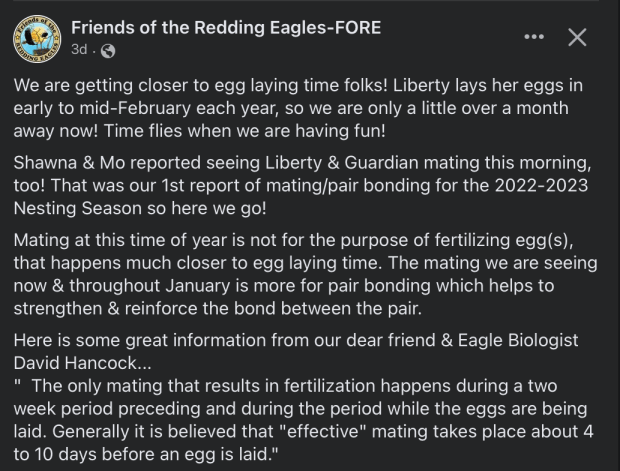
Our very own Dave Hancock answers some questions that have come up about Bald Eagles and mating.

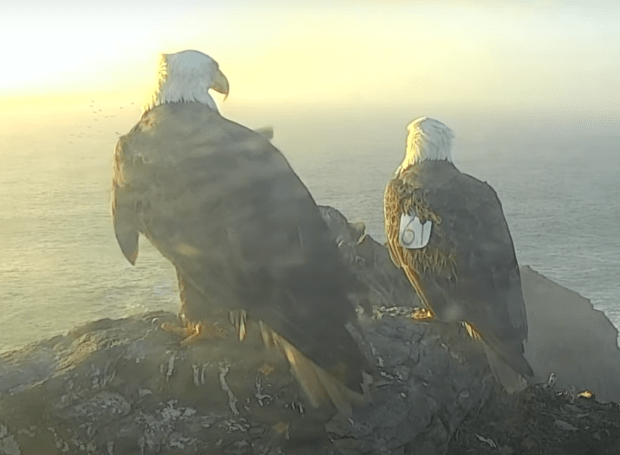
There they are. The beautiful Liberty and Guardian.

Thunder and Akecheta were at their West End nest in the Channel Islands. There has been rain and storms in the area but, it sure is beautiful around 1630 when the pair were spotted on the streaming cam.

The other Channel Islands nests – Fraser Point and Two Harbours – continue to show highlights from last season.

There was rain and pelting hail and show today at Big Bear. It did not stop Jackie from coming to the nest to eat her late lunch at 1344!

Nancy came to the MN-DNR to do a nest check today after the snowy weather yesterday.

The two eaglets at the KNF-E3 nest are doing fantastic. Prey items are continually brought to the nest and if the angle is right you can see the feathers coming in on the wing tips of 01.

They are both getting longer and more slender looking as they move towards losing that natal down and getting their wooly coat.

They still seem to have fat little bottoms with tails coming in.

Gosh, Andria is huge. She sure loves her fish!

The continuing saga of Gabby and V3! Thanks ‘J’. I didn’t see this but saw them sitting together. These two seem to have communication problems over prey deliveries and now Gabby’s signals to want to mate. Goodness.

Lots of eyes trying to get a glimpse of the eggs at the KNF-E1 nest of Louis and Anna. Is there a pip? It is not clear.

My memory – of the first eaglets to die in 2022 of Avian Flu – was the Hilton Head Eagle nest. At the time it was unclear if the parents had gotten sick or died from eating the virus laden prey. This announcement was posted in December. We will wait to see if the eagles return to the nest? Perhaps, sadly, they also passed away later. The GHOWs are still at the nest today, 5 January.

It appears that Diane – of Jack and Diane – at the Achieva Osprey Cam in St Petersburg, Florida is doing better today with her injured leg. That is excellent news!

I am continually surprised at how adaptable wildlife her to the challenges thrown at them. At the same time, I wonder why we do not give them that change to prove themselves? Why not a one legged eagle? Dennis Brecht has photographed one. Just asking. Check out this fox! Only 2 legs.

One reason that I continually peck at this issue is that when I was born, my dad had a three-legged dog that guarded my basket and enjoyed life like any other four-legged animal. I do not recall her having issues but, I do know that she lived to be more than 20 years old.

Before I went to the nature centre, I had a couple of things to pick up. Without naming the store, I noticed a woman fumbling around with a lot of things in aisle 6 – this aisle was fully of products to get rid of ants, mice, etc. I decided to ‘be nosey’. The woman told me she had mice and she had successfully used the traps with the cubes of rodenticide poisoning and also just to be sure, she puts glue traps on the floor around the traps.

I am so aware of the harmful effects of secondary rodenticide poisoning because of Missy and Lewis and losing a cat years ago to these designer toxins. Of course, we read about secondary poisoning for our eagles and other raptors every day. Every day. So I asked the woman some questions. How do you dispose of the glue pads once you have caught your mouse who has died a horrifically painful death? Did she imagine that the garbage bag could get ripped open by wildlife at the landfill and then it would also ‘trap’ them? Did she know that the mice eating the solid blocks of poison go outside, get sludgy and a local cat or hawk can eat them and die? I recounted the horrible death of Duncan – nothing the vets could do. This woman had no idea. She also had no idea that our City outlawed the use and sale of both products. So why are they still on the store’s shelf? My rant had zero impact as I saw her loading the items in her cart. She is more troubled by having the mice around and doesn’t care what happens to the pets of others or the wildlife. Sad.

All of this brings me to a very sad story. Remember the eagle floating on the ice? the one who was saved? and went into rehab?

More eagles in a different state – this time Montana – poisoned from euthanised pets being dumped. It sounds like this practice is more wide spread than anyone would have thought. Isn’t it time for someone to investigate and get in touch with every Vet society there is to stop this inhumane dumping practice that is causing widespread suffering in the Eagles. Cremation is the only way. Just do it.

Keeping in the thread of rodenticide and all manner of illegal killing of raptors – their persecution, we know that there are people working very hard to change laws in every country. Once on the books to try and get those laws enforced and then strengthen them when need be. It is not easy as you have seen by the postings from Raptor Persecution UK. I want to be hopeful that ‘finally’ people at all levels – including the highest in governments – will notice that there is a sea change and the population wants our wildlife, our water, and our land protected. We know the importance of this – help spread the word. Finally for today and certainly not least, Northern Ireland passed its own laws similar to those in the UK. Well done, Wild Justice. You can follow their progress and that in the UK by following Wild Justice and Raptor Persecution UK. Here is the announcement. Thanks, Geemeff for reminding me to post this important information!

Northern Ireland: new general licences which permit killing of a variety of birds are now published (link 1 below) The new licences are much improved: fewer species are listed and the lists make a lot more biological sense. For a bit more detail see our blog (link 2 below) 

These licences are now much closer in line with those in England (where we have taken successful legal challenges), Wales (where we took the former licences to court and although we lost the case, the changes that followed were what we had asked for) and Scotland (where changes have happened in response to those elsewhere in the UK and without us having to intervene, as yet). In particular, the slimmed down version of the ‘conservation’ licence, TPG3, only applies during the breeding season and only includes a couple of corvid species.  In addition, the licences are much better and more tightly worded than before.  

It has taken a long time, and quite a lot of effort, and quite a lot of money spent on legal fees, to get these changes but they wouldn’t have happened without Wild Justice. And by Wild Justice we mean you, our supporters too because many of you responded to the consultations (one aborted and one completed) that the Northern Ireland authorities launched.  And, of course, you funded all the legal challenges across the UK. You helped get this change – thank you.

Thank you so much for joining me today. Please take care of yourself as we await the hatch of E22. See you soon.

Thank you to the following for their notes, announcements, postings, Twitter feeds, videos, and streaming cams that make up my screen captures: SWFL Eagles and D Pritchett, Lady Hawk and SWFL Eagles and D Pritchett, Superbeaks, FORE, IWS and Explore.org, FOBBV, MN-DNR, KNF-E3, NEFL-AEF , NEFL-AEF and Lady Hawk, KNF-E1, Hilton Head Island Trust, Achieva Ospreys, The Telegraph, Terry Carman and Bald Eagle Live Nest Cams, Geemeff and Wild Justice, and Wild Skies Raptor Centre.

Welcome to the world E21!…and other news in Bird World for Thursday

5 January 2022

Good Morning Everyone!

As I begin writing this blog, there is a fuzzy ball under the front of Harriet. The time is 2034 on the 4th of January. More than two thousand persons are watching the streaming cam hoping for a first glimpse of this little fuzzy ball. Harriet and M15 are probably the ‘most popular’ Bald Eagles in the world and everyone wishes them well as they begin a new year. We can look forward to E22 hatching – and I hope he isn’t too far behind! This couple produces strong scrappy eaglets.

But before we go there, Geemeff sent me a video this morning. I laughed and laughed and perhaps, before you begin reading this you could use a big giggle. It is Alia – one of my all time favourite female ospreys and her three in 2020. Hang on to the end. Do not take your eyes off Captain, JJ7. Thank you Geemeff. I needed this more than anything. Your timing was perfect.

Here is the progress during the early evening of 4 January to the hatch:

Hey, Little One…I’m M15, your daddy! Just look at M15. He has done a fantastic job incubating the eggs (or trying to get Harriet up off them so she could). He knows that there will be a new little eaglet soon…he looks down with adoring eyes. All those foot kicks from Harriet seemed to work.

Working away…pecking with that egg tooth to get that hard shell to crack open. Gosh, just look at that…I bet that crack goes all the way around.

At 1834, the egg shell was fully cracked and much of it was in bits and pieces.

At 2034 a little fluff ball appears. How exciting! Welcome to the world E21.

At 2137 some egg shells are pushed away, out from under the eaglet in the nest.

At 202308, we get to see the little one.

‘J’ wrote first thing that she is ‘in love’ with E21. And she sent several photos of this cutie. Thanks, ‘J’. E21 is adorable and look at those cutie pie pink tootsies.

Oh, you already look like you have attitude! I sure hope E22 hatches fast!!!!!!!

At the KNF nest E1 of Anna and Louis, the chat moderator Tonya Irwin said this evening that the pip that they thought they had seen Wednesday morning – day 35 of the incubation – was just wishful thinking. They did not see it again during the day.

It is often very difficult to tell if there is a pip or a crack. Nesting materials can trick us all the time!

At the E-3 nest, Andria is doing an amazing job feeding the two eaglets. As many of you have noticed, 01 is pretty ‘chill’ until 02 gives it a poke and then 01 does one back to show who is boss. Most of that seems to be calming down (or I have just missed it). When it looks like they might both be full, Andria holds the bite of fish in between the two and waits to see if either will take it. Then she might press it closer. Both are doing extremely well. There is plenty of fish and no worries at this nest that I can see.

I wish the hatches would slow down. It is nice to get to watch a nest for a few days without rushing off to check on another. These two at E3 are adorable. Look carefully. You can see 01’s tail feathers just sprouting and a few black specks. Time passes too quickly.

Over the course of 2022, I posted numerous instances where raptors were killed on estates and/or by gamekeepers. Just yesterday I questioned whether or not there was some collusion between the authorities since it appears that charges are slow to be laid with penalties often small. Well, there is good news. A gamekeeper has pleaded guilty with sentencing to follow. I really hope he gets the most extreme sentence since he violated every law regarding raptors, firearms, and pesticides. Please go to the Raptor Persecution UK blog for all the details.

But why did I say collusion? and why did I ask about ties that bind people together causing them to overlook illegal activities when they are paid to do the opposite? This is why:

By keeping these horrific acts in the public eye, a few individuals have even risked their own lives to ensure that the restoration of these endangered raptors can move ahead hopefully without them being shot quicker than they can hatch and fledge!

I noticed that someone made a comment that they thought gamekeepers were employed to protect the wildlife. That is a misunderstanding. Games keepers are hired by the grouse hunting estates. They manage the wildlife that is ‘shot’ by people coming for shooting weekends. They are not hired to protect the raptors that might want to have a Red Grouse or a Pheasant for a meal. This is the full job description by one agency:

Gamekeepers look after game, including pheasants, partridges and grouse, as well as animals such as ducks, deer and fish. You’ll care for and protect the animals, and also the areas where they live. Gamekeepers organise the events where people shoot game.

That bad weather that was supposed to hit a little earlier is now causing snow and wind in Minnesota at the MN-DNR nest of Nancy and her new mate.

There was some snow earlier in Decorah, Iowa and as of this evening, it appears to have turned to rain which could produce quite icy conditions.

These same weather conditions were at the nest of Mr North and Mrs DNF.

It appears dry in South Bend, Indiana this evening, home to the ND-LEEF Bald Eagles – OR do we just call it Little Bit ND17’s natal nest? I sure wonder where he is and how he is doing after going into rehab at death’s door and coming out in such fine shape, flying and learning to catch prey with his parents and siblings. What a joyous ending that was! The adults have done a fantastic job – just look at those chair rails on this nest. You might remember that there was literally only a tiny piece of the original nest left. Eagles are dedicated. It is amazing how quickly they can put a nest back together! I just wish this one had a little larger area for the eaglets. But, oh, well…

As the sun set at Captiva, I did not see any Ospreys at the platform nest today.

There is another week before we will be looking for a pip at the Captiva Bald Eagle nest of Connie and Clive. Really wish them well. Connie and Joe’s two eaglets died of secondary rodenticide poisoning in 2020. The grief drove Joe from the nest. There were no eaglets last year so, there is much hope for this couple for 2023.

Rose was in the nest checking it out today and then Ron came along and they were both at the WRDC Bald Eagle nest in Miami.

My friend ‘A’ is astonished at the size of the oldest eaglet at Superbeaks. She mentions this all the time. PePe has made sure there is tonnes of food on this nest and Muhlady has fed those eaglets, stuffing the oldest one to the brim and then feeding the second. What you bet this big one is a large female? Look at that crop! Goodness. Muhlady feeds them until there are no more fish cries. It doesn’t matter if it takes 30 or 45 minutes. What a great Mum!

If playing footsie on a branch close to one another is the image everyone has been wanting, we have had several of Gabby and V3 yesterday and today. It is also readily apparent that V3 is going to be the ‘defender of the realm’ that we all had hoped he would be. He looks to be in good shape.

Of course, we have a problem. V3 flew in with a squirrel at 1003 and Gabby was on the branch. She was so excited and made such a racket that it scared him and he flew off with the squirrel. “V3 this is not how it is done…”.

It looks to be mostly highlights at the Channel Island Bald Eagle nests. It is a perfect time to go back and see the ‘Three Amigos’ from 2022 at the West End.

It is one thing to read about Bird Flu. It is another to see the impact of this deadly virus. Here is another good read from The Guardian in which one witness said: ““Most died out at sea and had been swept in to shore. Some would simply stand, comatose, oblivious to my presence. I would find them lifeless the next morning in the same spot I left them,” he says. “What struck me was that the vast majority of the dead birds I encountered had been fine, healthy creatures in excellent condition. They were not emaciated or undernourished.”

https://www.theguardian.com/environment/2023/jan/04/guardian-readers-describe-impact-of-bird-flu-aoe?CMP=share_btn_link

Just devastating and, of course, there are real fears for 2023 as Avian Flu seems to be staying, not leaving.

Let’s pop in and see what is happening with Zoe. On the 5th of January, in Australia, Zoe was 109 days old. Dad brought in 2 fish and Mum brought Zoe 1. I wonder what will happen today? Zoe will be 110 days old. She is nearing the average of 112 for leaving the nest but, will she? I don’t think so. She seems very comfortable.

And from ‘H’ a photo to help me with my Port Lincoln Nesting diaries seems appropriate here, too. A rather rotund Zoe!

Elain’s video of Indigo’s visit to the box on 4 January:

Thank you for being with me today. Some of you have asked for pictures in the garden and others of Lewis and Missy. The garden animals are not all that cooperative these days. Dyson & Company have been staying in the lilacs. I have not seen Little Red or the Crows in our yard for a few days and the Blue Jay has stayed in the lilacs as well. It appears to be the hawk who has begun hiding in the wood box and the neighbouring cats let out to ‘do their business’ which means coming in my yard to try and catch a bird. Of course, they all have collars and are well fed! It upsets me that people let them out. We have bylaws and in fact, the cats will have better health if they stay inside and won’t get hit by foolish fast drivers taking a short cut through our neighbourhood. Oh, ….they make me mad. Those people with those cats. Lewis and Missy will never taste a song bird. They can look and enjoy them!

These are not great images. The kittens are either playing full tilt – which means running and sliding and getting into all manner of mischief OR their battery is completely worn down and they are sleeping. Louis’s hidden-hole has been found. He has been going into a Chinese dresser from the back in a small opening. I pulled out a drawer and was shocked to find him the other day. Missy likes to sleep on top of a basket or a blanket on the table.

The tuffs at the tips of Missy’s ears are growing out. She has to be brushed every day and her tail is turning into something you could use to dust all the furniture. That is the Maine Coon in her.

She is looking down at Lewis – one or the other will jump on the other and then they will run all over the house. They certainly get good exercise.

Individuals in our community make blankets for each kitten that is adopted. This is the most beautiful granny square little blanket any kitten could ever hope to have! And what a generous and wonderful idea.

Missy likes to pretend she is ‘in the jungle’ when she stalks the birds outside from the conservatory.

Take care everyone. We will see you soon!

Thank you to the following for their posts, videos, blogs, and streaming cams where I took my screen captures: ‘A’, ‘Geemeff and Friends of Locks Arkaig, Woodland Trust, and People’s Post Code Lottery’, ‘J’, and ‘H’, SWFL Bald Eagles and the D Pritchett Family, KNF-E1 and E-3, Raptor Persecution UK, MN-DNR, Raptor Resource Project and Explore.org, ND-LEEF, Window to Wildlife, WRDC, Superbeaks, NEFL-AEF, ‘G’ video and NEFL-AEF, The Guardian, Port Lincoln Ospreys, and Elain and Charles Sturt Falcon Cam and Cilla Kinross.