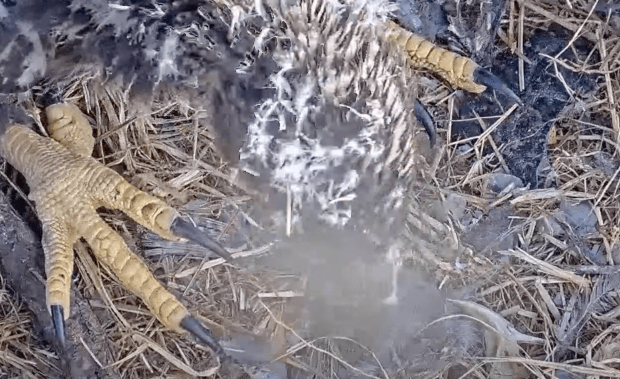
There has been much concern about Gimbir’s understanding about his role as father. Prey had not been brought to the scrape despite his showing up with a large crop.
Well, the first feeding is underway right now. Gimbir has provided Diamond with two birds for her and the little one.
I think we all can now feel a great deal of relief for this new family!
Heidi reports he has just brought in a third, landed with it and left with it. My goodness this young dad is quite enthusiastic!
Three cheers for three meals for his family – yeah, Gimbir.
Before we begin today, I want you to watch a really short and sweet video of Nugget and Valentine at the KNF-E3 nest by Rhonda. As you might recall, Nugget had an injured leg. Thankfully that is all better. Have a look – you will need this before you read the rest of the news, I promise. It is also a reminder that legs can heal, that good things can happen!
Also on the plus side – Diamond has returned to the scrape after the fearful fireworks set up near the tower several days ago. That was around 08:42 on the 16th in Orange. All three of the Orange falcons are now accounted for and all three have now been in the scrape. Diamond was the last. Welcome back, Diamond. sorry you had to go through that extreme stressful ordeal. Fireworks should be banned! Maybe, Diamond, they could use your beautiful face as the poster for why all loud sounding celebratory items need to be banned, not manufactured, not sold, banned…Every other raptor, wildlife, dog or cat will thank everyone.
Oh, goodness. Soap operas do not hold a candle to ‘As the Nest Turns’ and right now that saying goes for Redding Eagles Liberty and Guardian, Big Bear Valley Samson and Jackie, Captiva Ospreys Mabel and Angus, and, of course, SWFlorida with M15 and E21 and E22. Add the Frequent Female Visitor with the injured talon/s who is so hungry well, Wednesday was quite the day. There would be awards if this was afternoon television! Every nest would be signing contracts…just kidding, of course, but…what the heck?
There were quite a number of feedings at the SWFlorida nest today. I won’t go into them in detail but the one around 1300 caught one attention. M15 is really trying his best to get food to 22. We have all watched him move the fish around, side step, pause with a piece of fish hoping that 22 will grab it. Sometimes 22 is just too scared. Sometimes the fear of what has happened is cause to stop 22 from eating. So at this feeding, ‘A’ wrote this. It is lovely.
Towards the end of that lunchtime feeding, E22 eventually made a frantic grab while M15 was working on a piece, and got the tail of the fish, with some flesh attached. When he turned away with it, mantling, he couldn’t swallow it and M15 came over and picked up the piece. Just when I thought M15 was going to swallow it himself, he instead started feeding it to E22, who managed at least half a dozen decent mouthfuls plus the tail, which he was able to swallow once M15 had pulled off those half-dozen mouthfuls for him.
No matter what happens on this nest…M15 is trying even going without himself to ensure that these two eaglets survive to fledge. He is exhausted. You can see that when he finishes feeding them for the evening and gets on the nest and his head just falls. He is ravenous if you look at how fast he ate some fish today, too. He really is Dad of the Year and he is certainly making me tearful just thinking at how hard he is trying to make this work.
7771 people watched M15 feeding the eaglets when the hungry female flies down landing on the nest and scuffling with the eaglets. She flew down, began eating the fish, and nipped at 21. It was 16:12-13:18ish.
She started eating the fish so quickly. She is – I am sorry to keep saying this – but, she is starving because she cannot hunt for herself with the condition her talon is in. (I cannot confirm it but there are rumours that there are more than one female around the nest with 2 of the females having injured talons).
She is ravenous and is eating. The eaglets give her a wide berth.
Then M15 is back at the nest and he sees what is going on. At 16:14:28, M15 flies down to the nest and gets rid of the female.
He moves the fish so that he can continue feeding E22 but he is also very hungry and eats ravenously, too.
21 already had a crop and is ready for a nap…good timing for 22.
E22 did get food – that was all I cared about and so did M15. He ate like he hadn’t seen fish for a month which made me – at first glance – think it was the female but there were those dark streaks on top of the head! M15 looks exhausted.
E22 got the fish tail and at 16:24:59 he tried to hork it without success.
There’s the part of the fish tail!
M15 is still feeding 22 at 16:37. E22 leans over and does a reasonable PS at 16:38:40.
Oh, it wouldn’t splatter to the pond but it was a ps and that is good – 22 is not dehydrated. 22 actually was doing a pretty good job eating that fish when the commotion began again. So glad he had some bites.
And, yes, M15 must have forgiven her – or he knows she is extremely hungry and is sick, hopefully healing from talon injuries. He also knows that she has helped defend the territory. Still, he will not give her food before he feeds 21 and 22 and himself. So…hunger is a driver for bizarre behaviour. I have seen osplets attack their older siblings which are 8 times their size. And let us all be honest…M15 is worn out and tense. He is ferociously hungry. The eaglets are hungry. And the female is ravenous like 22.
The female returned and ate all the scrapes. She is with M15 on the branch tonight. She is awake and he is getting some much needed sleep. M15 you are our hero…you are working so hard and it is taking its toll on you – a single dad with all these intruders to contend with!
The struggle for survival at the SWFlorida Bald Eagle nest is a good example for all of us – it is helping us to understand the challenges that our eagle families face each and every day of their lives.
The latest news:
At the Captiva Osprey nest, there are now ongoing battles that have lasted for at least six hours for control of the nest. This could get rather gruesome. Hormones are raging during breeding season and we all know that many of the trees that are good for osprey nests and – some established nests on Captiva and Sanibel – even on the mainland – were destroyed by Hurricane Ian. Everyone is looking for a nest. ‘H’ recorded more than 40 separate events in 8 hours..frightening.
Then the excitement came to the Redding Eagle nest when Liberty laid her first egg of the 2023 season last night.
And then, it waned. Liberty flew off the nest and left the egg. The Magpies came and pecked on it. Finally Guardian was there …According to ‘B’, there are boots on the ground looking for Liberty. These two are dedicated parents like Jackie and Shadow, M15 and Harriet…there is something wrong. Do they have intruders as well?
Relief. Liberty flew in…was she gone since morning. An avid Redding eagle lover, ‘B’ commented that she arrived at the nest in full alert mode vocalising. Oh, I hope that there is no trouble at this nest with intruders. It is simply too close to what might have happened to Harriet.
The problem with the success of the osprey and Bald Eagle breeding in the US – their big comeback after DDT – is that their habitat is being lost, their food supplies are diminishing and everyone wants and needs a nest, food, and security! They will fight to the death to get it, too.
Then there is the lingering question of why Jackie and Shadow continue to be on and off again with the eggs? and Mating? Right now – it is early evening on the Canadian Prairies on Wednesday the 15th and the eggs at Big Bear were left for the last time at 16:28. No Eagles on them at 15:41. While eggs can survive for different periods of time and hatch, I am beginning to wonder if the eggs are non-viable to begin with…and when after a period of time, no sound or movement was detected – or they heard the eaglets and then it stopped – something has caused Jackie and Shadow to behave differently. Like everything at these nests, there is nothing for us to do but wait and watch. Or take a break and return in a day or two.
Last year we all wept when the fourth hatch – that energetic little scrambler – at PA County Farm died of hypothermia. It is congratulations to Lisa and Oliver on their third egg of the season. Oh, that nest bowl is deep this year…I wonder if they will have a fourth egg?
There is no news of Zoe. An osprey was on the power pole at Streaky Bay. Not identified as Zoe. So long and no news…surely with the way she flew before there would be some place she would ping cell service by now. Patience required.
Making News:
Audubon reports that there are several victories in Alaska at the start of the year that will have us all cheering. The Bristol Bay Project is one of those and the most recent is the Tongass Forest rulings. The Bristol Bay mining project had the potential of harming the waters and the fish and therefore, the birds that depend on those fish such as the Bald Eagles. The Tongass will not have roadless entry protections for species. Have a read.
Sometimes it just feels like a roller coaster. There is great environmental news and then, we turn, and there are 350 dead waterfowl in a Victoria nature reserve in Australia. Why?
Authorities believe it is a case of Avian Botulism which occurs when there is a lot of water and then that water dries up. “Avian botulism is a serious neuromuscular illness, causing problems with muscle paralysis which can result in death. Botulism outbreaks are common during drought when wetlands evaporate rapidly, causing more birds to be concentrated in smaller areas of warmer, shallow water, and resulting in a concentration of bird faeces”. So sad.
Let us all wish our nests a little calmer day today! There was a small piece of fish (or small fish) brought on to the SWFlorida nest at 0928. 21 ate. 22 got a scrap….
The camera at the nest of Big Red and Arthur has been offline for a long time. It is now back on just in time for nest building!
Thank you so much for being with me. Please take care. See you soon.
Thank you to the following for their notes, videos, articles, and streaming cams that form my blog: ‘J’, ‘A’, ‘H’, Rhonda A and the KNF-E3, Charles Sturt Falcon Cam and Cilla Kinross, SWFlorida Eagles and D Pritchett, Nancy Babineau and SWFL Eagles, FORE, M and FORE, FOBBV, PA Fair Country, Audubon.org, The Guardian and Cornell Bird Lab.
The sky is gradually turning blue and there are 57 European Starlings in the trees and 49 Old World Sparrows. Two Blue Jays have also already been to the feeders. There is so much snow. It was blowing and coming down hard around midnight and in certain places in the garden it is more than a foot deep. Winter has set in.
In the Mailbox:
Oh, I get the most marvelous mail but today ‘A’ reminded me of a very poignant moment last year. The 4th eyas at 367 Collins was dying. The entire family – including the siblings that had fledged – returned to the ledge to spend the night and keep the wee one warm as it passed. So, yes, the Collins Street falcons can fly back up to that ledge! Thanks, ‘A’. I remember that moment well. It is one of the finest examples of caring and grieving in Bird World. Do you remember?
I also received a fantastic letter from ‘K’ that reminds us of just how one single invention from an Ornithologist at Cornell saved the Peregrine Falcon population after its demise because of DDT. Do any of you know what that invention was? Think about it! I will bring it in to tomorrow’s newsletter.
Australian Nests:
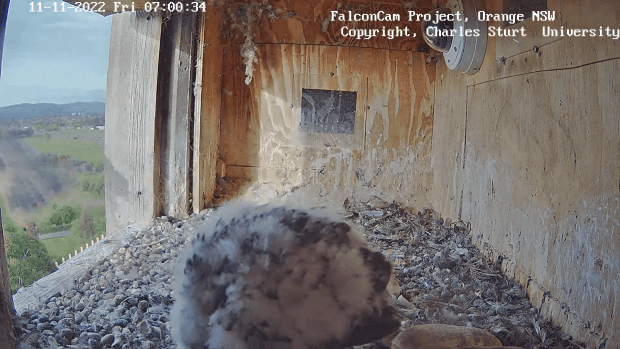
Friday has been a very eventful day in the Australian nests and it kicked off with Indigo’s fledge at 0700:34. My goodness what a beautiful flight and it appears that Diamond and Xavier kept a good eye on Indigo and may have just delivered a nice piece of prey to her in the trees – prey that Rubus thought might have been coming to him!
Off she goes. Rubus did not notice – too busy eating his breakfast.
An adult almost immediately comes into the scrape and feeds Rubus. This is a great strategy. Rubus is no where near fledging. Keep him full, keep him in the scrape. No premature fledging.
Oh, Rubus is clearly starting to look like a little falcon. Look at those eyes. Rubus stayed facing the camera when Xavier came in with the prey. Having no screaming Rubus, Xavier immediately departs with food and flies down into the trees where Indigo is.
Sleeping standing up. Notice the beautiful barring coming on Rubus’s chest.
Moderators RECAP: 06:42:35 X w/prey, Indigo takes; 07:00:33 Indigo fledges; 07:00:38 D follows Indigo; 07:01:33 D feeds leftovers; 07:25:43 juv star, X feeds; 09 26 07 D feeds scrap; 10:10:51 D w/prey, feeds…12:44:00 D with prey, Rubus takes; 15:54:13 X with prey, Rubus takes; 18:48:54 D with prey, Rubus takes.
There is a storm forecast for Orange on Sunday. Let us all keep positive thoughts flowing to Indigo. It will be day 3 after fledge.
When the excitement of the fledge at Orange had settled a wee bit, it was time for Melbourne and, much to the delight of everyone, a gentleman who has a view of the ledge from his bathroom actually filmed one of the eyases fledging this morning! Brilliant. It was quickly removed from the FB page but, the more than 500 viewers who saw it knew that there were no only 3 or, perhaps, 2 left on the ledge of 367 Collins Street. Two could be seen clearly. IF one was in the gutter, flat, loafing, then maybe three were left but, it is probably save to say that two have fledged in Melbourne.
For all the fledges may you always be safe, maybe your crop always be full, and may you feel the wind beneath your wings for decades.
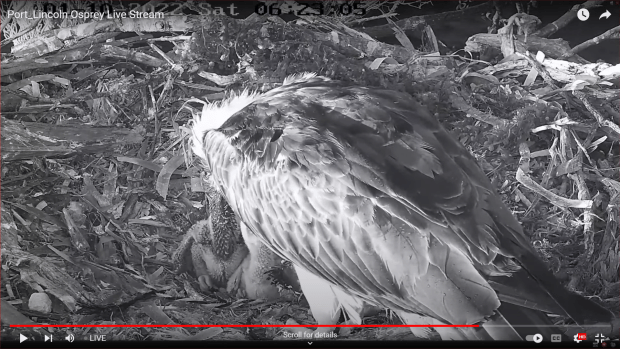
At Port Lincoln it is a question of ‘where is the fish’. The water around the barge is a little choppy. A fish came on the nest at 0835 and Mum, thankfully, ate her fill. She gave some bites to Big. Dad has not been up to his usual standards in terms of delivery numbers. Did the storm stir up the sediment and is the visibility poor for fishing? is it the choppy water? is Dad not feeling well. I noticed the other day when they did a close up of Dad’s talons that he had a lesion on one of them. All of know that he was unwell when eggs were being incubated. Let us hope that this is just passing and that all will be back to normal at Port Lincoln. This family has faced enough challenges this season. Big is not scheduled to fledge for at least another 8-10 days at least.
Ah, a fish has come in. Mum caught it and is eating her good share before taking it over to Big who is fish calling on the nest. Hold your horses Big – the order is: territory protected, parents fed, offspring fed.
And, if you are wondering, yes, this is Mum. She has gone out and caught the fish. Dad left earlier and has not returned. She is sure going to eat her share before she hands it off to Big. Just do a drop and dash – Big needs to self feed! Gosh. It has been 15 minutes. Wonder if Mum will eat the entire fish?
At 1509 Mum flew to the nest with the fish to feed Big. So far she has kept control of the fish and is feeding. Maybe she will eat some more herself.
Gosh, that fish is tough to get the flesh off. Mum is really working at it giving Big a few bites and some that she could eat on her own.
Mum is feeding slowly and she is eating fish, too. At 1546 Dad flies in with a headless fish to the nest. Mum is in the background eating fish as fast as she can. Big and her will have enough fish for today. Let us hope that Dad had a good portion, too. It is so nice to see Dad. He was gone for awhile. I hope he was out fishing with Ervie in those choppy waters.
Mum in the back eating the rest of her fish as fast as she can. Dad’s is not big. He could have just eaten it but, he doesn’t. He leaves his small offering for Big and Mum. Thanks, Dad! I do hope you ate. Big has a crop and is fine.
Port Lincoln has said there will be no banding on Saturday. So, perhaps, the banding will take place on Sunday or Monday.
Mum went over to cover her only surviving osplet when the rain started. What an amazing parent she is! Little Dad is down in the shed. Let us hope that these two are alright. Everyone was so worried about Dad yesterday. He was away for so long.
Right now it is pitching down rain at Port Lincoln. The forecast I am seeing so a high chance of rain all morning at Port Lincoln.
In some countries, birds are of least concern while, in others, they are vulnerable and, in the case of the Cirl Bunting, on the Red List in the UK. It is of LC in the United States.
This lovely little bird is a relative of the Yellowhammer. Just pause for a moment and look at the image above. How would you describe it? First, it is difficult to understand the size of the bird without any reference. Normally they are approximately 15 cm or 6 inches in length. During the breeding season, the males have a distinctive black chin. Below is a drawing of a male and female. In this you can get a better feel for how the male should look with its two yellow eye lines, black chin and crown, yellow line at the neck with a grey-olive collar and yellow underbelly. The female is much more striated with a vertically barred chest and a touch of the same olive-grey at the top of the wing. They are lovely little birds.
So why are the Cirl Buntings under threat of extinction? Farming practices is the main issue. The bird was once common all across the southern half of the United Kingdom. In the 20th century their population numbers began to spiral downwards when farming practices switched from spring sown cereal crops to autumn sown. Habitat intrusion and the use of pesticides also impacted the population numbers.
The RSPB worked with farmers in south Devon to switch back to traditional farming practices. The result was an increase in the numbers of Cirl Bunting along the cost. What had once been only 118 pairs in 1989 became 1000 pairs in 2016. This is fantastic news and all it meant was a return to the traditional sowing practices of farmers, the growth of shrubs and hedges, etc. Here is an excellent article from a farming on line journal that speaks to the challenges and what can be done for the Cirl Bunting to save it. Think rewilding!
There is still cause for concern. Farmers across the rest of the UK and elsewhere need to heed the use of pesticides and they need to pay particular attention to how their cycle impacts wildlife. The decline could lead to extinction just as quickly as the population numbers climbed over the past 30 years.
Other Nests:
I am so grateful to ‘B’ for alerting me to Indigo’s fledge but he also sent me a note telling me that Samson and Gabby were in their nest as Tropical Storm Nicole plummeted the area near Jacksonville. Well done you two. Riding out the storm together like Harriet and M15.
Jackie and Shadow are another power couple. They have really worked on this nest and they sure didn’t want a storm to take it away!
B’ wrote me first thing to say that both Gabby and Samson are fine and so is SWFlorida. Nicole has now passed through them. Fantastic.
Samson and Gabby
Sunrise over Samson and Gabby’s nest near Jacksonville, Florida.
Everything looks intact at the NEFlorida Nest. Maybe we need to get the Eagles to be our designers. These nests are amazingly strong.
Harriet and M15 have both been seen at SWFlorida and this looks like Harriet aerating that nest getting it ready for those precious eggs.
As Nicole moves out of Florida, there is sunshine on the nest of Harriet and M15. It is so good to see that they are fine and so are Samson and Gabby. The camera is still offline at Big Bear. It could have been damaged during the storm but, let’s all hope that it wasn’t.
Thank you so very much for being with me this morning. It is time for me to do some shoveling and fill the feeders! The Starlings are waiting for their Butter Bark. Take care of yourselves. See you soon!
Thank you to the following for their streaming cams and posts that make up the screen captures in my post: Farm Life, Port Lincoln Ospreys, 367 Collins Street by Mirvac, Charles Sturt Falcon Cam, NEFL-AEF, and SWFL and D Pritchett Family.
It is a lovely morning in Orange and beautiful Indigo decided it was a perfect day to fly and she did at 0700:33. Rubus did not even notice! He was too busy eating. Of course.
Congratulations to Diamond and Xavier, Cilla Kinross and the entire family that love these Peregrine Falcons. Well done Indigo! Beautiful flight. You stay safe out there. Live long, eat lots of parrots and Starlings, soar high.
Indigo was watching the parents and bobbing her head up and down, focusing.
She’s off. It was a gorgeous take off.
Indigo flew down to the trees and was immediately followed by an adult.
Squint. There is a grey dot in the centre of the trees. That is Indigo.
In a few minutes, Xavier shows up with prey for Rubus. They do not want Rubus leaving the scrape. Rubus is not nearly ready to fly despite being four days younger.
Oh, how grand! Thanks ‘B’ for sending me that note! So grateful.
Thank you to everyone at Charles Sturt Falcon Cam and Cilla Kinross. Let us all join them in thanking them for their streaming cam and the joy that watching this amazing falcon hatch and grow into a fledgling has given us.
When I went to sleep last night, I knew that I would wake up and Middle would no longer be with us. What an absolutely tragedy. He was so dehydrated that he was no able to lift his little head and eat despite the fact that fish after fish came on the nest….and the one time he did, Big attacked him. I apologize for this newsletter being highly disjointed. I do get upset when one dies, it digs at my heart for the days leading up to the death and then after. Somehow Middle is hurting the most. He was 43 days old, fully feathered, and his death did not need to happen.
Middle when he was still alive. Cold and needing comfort.
At this moment in time, I cannot tell you how rare it is in % for two osplets to die of siblicide on the same nest. Yes, siblicide. Textbook siblicide again just as with Little Bob. Port Lincoln is the only osprey nest that I have ever encountered where a double siblicide has now been recorded in three years: 2022, 2016, and 2015.
In 2017, the eldest threw the youngest (only 2 hatched) off the nest at 65 days. Stevie went into rehab and died a few months later. It might well be this single incident 5 years ago that makes the Friends of Osprey believe that Ospreys do not do well in care. I say now – for the future – take a bold step Port Lincoln. Get permission to remove the chicks when it is not too late. Get them to a rehabber that cares – someone like Dr Madis in your area, there must be someone in the whole of Australia! – and let’s try this again! Don’t wait for them to be thrown out of the nest or get so weak they can’t raise their head.
Claudio Eduardo and I are developing the International Data Base for Ospreys. It is to find out this % on streaming cams. No one has ever tracked predation and siblicide internationally. Sadly, Port Lincoln is our first entry for the year.
Despite the anticipation of what seemed the inevitable, I was having a really hard time anticipating the death of Middle so, as usual, I began my blog for today quite early yesterday. Dear Middle wanted to be warm and wanted some fish. And darling you, you got spunky and we just knew you would make it — against the odds of this nest – with a big aggressive female as first hatch. I am so very, very sad that you didn’t.
I hope that this finds you well. There were some changes in my house yesterday. Two small rescue kittens, 11 weeks old, have come to stay. One is a soft long hair tabby female and the other is a grey tabby with white runners in front, tall boots in the back, a white bib and tummy and he is Lewis – after Lewis Hamilton, the race car driver from the UK. The reason is simple – Lewis runs around the house so fast from the front of the L to the conservatory barely stopping and heading back the other direction. I fell in love with him for his energy and love of toys. The yet-to-be-named female is sweet but, like the female raptors, she let Lewis know immediately that she is one week older and is ‘the boss’. He agreed and went on playing. They are getting along splendidly.
It was a real delight to watch Lewis sitting under the table peering out of the windows at the birds. I was ever so hopeful that they would enjoy watching them…they will never be outside to bother them. Did you know that, on average, outdoor cats live to be 5-6 years old while indoor cats live to be 17-20? Less vet bills, fewer infections. It is a no brainer — and the birds live. Not killed by an overfed pet to be left lifeless on the grass. Nope. Lewis and his sister can only dream!
It is very, very dark on the Canadian Prairies as the time nears 2100. The temperature is 11 degrees C. Warm for this time of year with clear skies and lots of stars. The temperature will rise overnight until it is an unthinkable 18 degrees C tomorrow. For those used to F, that is 64.4 degrees. In Port Lincoln, it is 14 degrees C at noon; it is 13 degrees in Melbourne. Similar. But for Port Lincoln this is freezing.
There are rumours making the circuit that Middle had a ‘ps’ (poop shoot) at Port Lincoln this morning. If that is the case, then Middle has had some fish. Osplets that have not eaten much in 3 days are dehydrated, no ‘ps’. I find that somewhat promising. And then I don’t. It is extremely cold and windy for Port Lincoln.
Fish arrived. Lots of fish. Big ate and ate. Middle got none.
It is now after 1400 on the nest. Middle has had scant food for more than 3 days. He appears to be slowly drifting away. His energy is gone. He is totally dehydrated. It is a horrible way to die. With winds gusting to sometimes 50 mph, I feel that there is no hope for this little fighter. It is a tragedy. I did not ever think that I would see this when things were looking up last week.
It is 2300 in Winnipeg. I know that Middle will not be here when I wake in the morning. We weep for all the Littles and sometimes a Middle…the people in the area that live and work in Port Lincoln, that care and love these Ospreys needs to have a serious look at the depletion of the fish in that region. More on that shortly.
I cannot even express how sad this is.
In his book, Bowland Beth. The Life of an English Hen Harrier, David Cobham says, ‘These young lives are full of hazards: they need to be able to contend with prolonged periods of bad weather; they run the risk of being shot; in the excitement of chasing prey they may collide with vehicles or overhead wires; ground predators sometimes catch them unawares at their roost sites; and inter-guild predation by buzzards and goshawks may also be responsible for culling weak and unwary juveniles.’ (90) We could change the language slightly for our Ospreys but, right now, the entire family at Port Lincoln is having to contend with a 3 or 4 day period of prolonged stormy and cold weather.
I am almost finished reading Bowland Beth. Cobham is a gifted writer. I know the ending of the story. Most that pick up the book already do but, we are draw into the life of this exceptional raptor that was cut short by the Red Grouse hunts. It is a riveting and moving book and a must read if you want to understand why it is so important to ban the annual shooting hunts on the big estates and why the burning of the heather should be banned, at the same time. It is also about the short live of a very exceptional raptor and that was enough to get me reading. Cobham draws you into the day to day life of this bird trying to survive.
Did you know that the origins of ringing birds is traced to the Reverend Gilbert White? I didn’t. He would tie a cotton ring around the leg of a swallow to see if it would return to the same nest the following year. The metal and coloured rings that we are familiar with today are credited to Harry Witherby and Landsborough Thomas of the British Trust for Ornithology in 1937.
When Bowland Beth was ringed, this was how she was described, ‘Bowland Beth was one of those birds that you come across now and then that are absolutely perfect – her plumage, a rich, glossy chocolate brown, the most wonderful eyes, yellow irises, and vivid chrome-yellow legs with formidable black talons. She’s what I call a ‘super’ hen harrier.’ (74-75) Oh, had she lived!
There are no issues with either the scrape at Orange or at 367 Collins Street. Regular meals, the eyases developing right on schedule as if they read the textbook! Rubus – I almost called the new kitten Rubus because it is so energetic – is being his usual self. Or is it a her? It will be interesting to see what Cilla says. Rubus has certainly had a spurt in growing but its legs seem long and thin to me for a female. But, I am not a falcon expert. Let’s see what Cilla has to say.
Following Diamond’s instructions, Xavier brought a Starling in for Rubus and Indigo. He left it on the scrape despite the prey begging from Rubus. These two will need to learn how to self-feed if they are to survive in the wild.
Rubus is very curious and picks on the feathers and the head under the watchful eye of Dad. Indigo is not dazed or interested.
Xavier leaves. Indigo has joined Rubus staring at the prey wondering what they are supposed to do with it.
In this image you can get a really good look at the difference four days makes in growth. Examine the length of the tail feathers and the amount of down left on the back and wings of each eyas. Rubus still looks like he has been playing in the cotton candy machine.
Rubus goes back and works on the head of the Starling.
Then Diamond arrives to feed these two…look at Rubus almost push Mum over trying to get a bite of food.
Rubus is very aggressive. S/he is very hungry!
What a bunch of characters. Just look at their eyes!
Speaking of adorable…here is a video of selfies from the Orange scrape from yesterday. Rubus and Indigo can put a smile on our face and take away the utter sadness that we feel for Middle and his plight.
There are falcons on the 367 Collins Street nest! Just look at them and look at that mess – poop shots everywhere, feathers all over the place, the messier the healthier. Seriously.
Sharon Pollock put together a good video highlighting the new female – the Mum of the extraordinary Melbourne Four of 2022.
Back in the world of Bald Eagles working on their nests and we find the female at nest E-3 at the Kistachie National Forest not liking the wires that Cody put up for the camera and the sound. Let’s hope she doesn’t decide to do serious damage! The white wire is the sound.
At the Bald Eagle nest on the campus of Berry College in Georgia, Missy and Pa Berry are getting their nest in order. They fledged B15 last year and what a fabulous fledgling he was!
The GHOWs are starting early at the Southwest Florida nest of Harriet and M15. They are already knocking Harriet off the attic branch and her and M15 haven’t even finished rebuilding the nest.
Making News:
This is a great read. One of the things that I want to point out is the thank you at the bottom to all those who voted. 50,000 Euros were at stake and that prize has gone to a place that can really use it to help protect the albatross. Next time you see a chance to vote, look over the possible recipients and make your mark. It can truly make a huge difference.
Dr Sharpe and all the researchers at the Institute for Wildlife Studies have developed a mobile hospital to take on the needs of the raptors. Now, isn’t this a great idea. Something like this might work well in places like South Australia where there are no such services for Ospreys! And if they could get an Urmas and Dr Madis on staff – willing to take on an extraordinary project to try and give birds a chance that are normally written off as not doing well in care — well, everyone would be a winner. I am still sending loud cheers to the team in Estonia who advanced knowledge in the care and rehabilitation of Black Storklings. Bonus is living proof that their theories on how to care for the storklets worked!
Someone asked me once – oh, more than once – how I can deal with siblicide. It tears a piece of your heart out every time. Today is particularly difficult. Keep Middle in your thoughts. May he fly far, never to be hungry, never to be hurt, never to be cold – again.
In the memory of Little and Middle and all the other osplets that died on this nest because of siblicide and the few who did live to fledge, It has to be asked, based on the historical evidence at this Osprey nest in South Australia, WHY is siblicide so prevalent? Is it the lack of fish in the area? the erratic fish deliveries? Are we witnessing in Australia the need to raise fish for our Osprey families because we are depleting the oceans? is climate change impacting the number of fish?
Someone needs to be asking these questions. As I was once told, Australia and New Zealand are on the front line for climate change. Australia do something bold. Show the world that you care for your wildlife. Be proactive like New Zealand is at Taiaroa Head. Feed the chicks! Feed them. Put fish on the nest at Port Lincoln. Stand up and make the argument to the Ministry of the Environment and Water. Raise the fish and place them on the nest openly and with permission. Pull an Urmas and Dr Madis – get so proactive that the world will not stop talking about your kindness and care for your wildlife.
I will be taking a day off in memory of both Little and Middle Bob. I will be back with you on the 4th of November.
Thank you for being with me today. We will collectively grieve for that beautiful second hatch at Port Lincoln who had such potential… a life that we will never witness now. Take care everyone. Be gentle on yourself.
Thank you to the following for their posts, videos, and streaming cams where I took my screen captures: Port Lincoln Ospreys, 367 Collins Street by Mirvac, Charles Sturt Falcon Cam and Cilla Kinross, Albatross Lovers and BirdLife Australia, IWS, KNF, SWFL and the Pritchett Family, and Berry College Eagles.
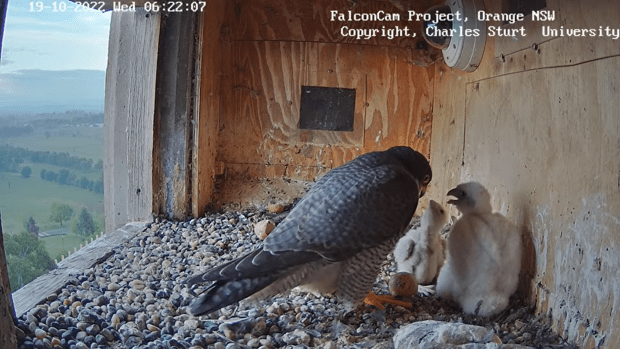
It is entirely possible that the most entertaining and educational streaming raptor cam of the year will be the Falcon Cam on the water tower at Charles Sturt University in Orange. It is the home of Xavier and Diamond, seasoned parents, and this year’s eyases, Indigo and Rubus.
How do you spell adorable? Indigo and Rubus! When Indigo was walking today, Rubus was very concentrated in watching his big sister.
Today, Indigo continued her quest to walk while, at the same time, she is practicing hitting the camera with her ps every day. The last one resulted in Dr Cilla Kinross, the lead researcher on the Peregrine Falcon Project, having to climb 170 steps inside the old water tower to clean the camera.
Watch Diamond’s reaction and then, don’t stop. Listen to how little Rubus is. Then, watch as Cilla finishes going down the ladder, Indigo has a near hit again!
Of all the streaming cams, this one with its three cameras gives you a view of the tower so you can see the peregrine falcons arrive and leave, and two views of the scrape. The closeness lets us catch the details that can be missed elsewhere including the incredible facial expressions and eye popping moments.
Indigo and Rubus have already had two feedings today. At 055209, Xavier arrives with the breakfast pigeon. That breakfast is over at 060314. At 074959, a bird with long red legs arrives. What is special about this feeding is that little Rubus is in front and gets some of the best and biggest mouthfuls yet. How splendid. He did not have to stretch his neck all the way to Sydney to eat! Cilla Kinross thinks it could have been a Red waddle bird.
Proud mama Diamond.
Indigo wants to walk and flap at the same time. She is just not quite coordinated yet!
This morning Indigo played, ‘Ring around the Rubus’.
That second prey item was very popular!
Look at that neck on Rubus!
The Melbourne Four had an even earlier breakfast. Dad arrives with the pigeon before Melbourne is even waking up. It was 055209. At 060314 Mum flies off, breakie is over. At 074959 there is another pigeon feeding! These parents are working hard to take care of the pigeon population in the CBD.
Port Lincoln was still waiting as the golden glow of the sun spread down on the nest with beautiful Mum and Big and Middle. It is the first time we will see Big stand.
Dad brought in a late fish last night but the osplets and Mum are starting to get a little peckish as 0800 gets closer. Big has pecked Middle a couple of times – late yesterday – but, in general the nest has entirely settled down. Middle is a beautiful bird. Look at the images of her/him next to Mum at the end.
We all miss Little. It is impossible not to grief that we have loved. What we need to learn is the ‘why’. But, now it is time to turn our attention to wishing well for Mum and Dad, for the nest to have a lot of fish, for these to fledge, and have productive lives building up the population of Ospreys in South Australia.
At the same time, take care of your garden birds, the birds at the park, and do whatever you can, how little or small, to make the world a better place for our feathered friends. A place where there is so much fish that all of the birds and animals depend on the oceans, the seas, the lakes, and rivers can thrive. We will talk about how you can do that later this week but, if you have good ideas or know projects, send them to me. I would be very grateful.
Middle is very smart. He tries not to make eye contact with Big yet. Instead, he moves over by Mum to look out over the water waiting for Dad’s arrival.
As Port Lincoln waits for breakfast, I will sign off. It is a sunny blue skied day in Manitoba. The temperature is 4 degrees C with the promise of a much warmer day coming on Thursday.
Thank you for being with me on our breakfast check up in Australia. Take care everyone. See you soon!
Thank you to 367 Collins Street by Mirvac, Port Lincoln Ospreys and Charles Sturt Falcon Cam for their streaming cams where I took my screen captures.
This is a quick check in to see what is happening with a few of our nests.
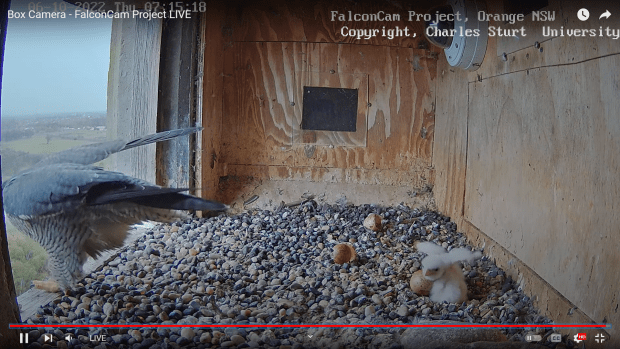
The second hatch of Xavier and Diamond at Orange had its first bites of prey this morning. Goodness, there is certainly a difference in size. Diamond did a great job handling two different heights with one chick who can now see and another than can’t.
Just look at that big sibling flap its wings. Wow. What a strong chick!
The wee one is so tiny.
When eyas #2 connected with Mum’s beak and the prey, the first bite was quite a substantial one.
Both so very cute. It will be exciting to watch Xavier and Diamond with two chicks this year.
This is a video of the big sibling from the other day having an encounter with Dad and flipping over.
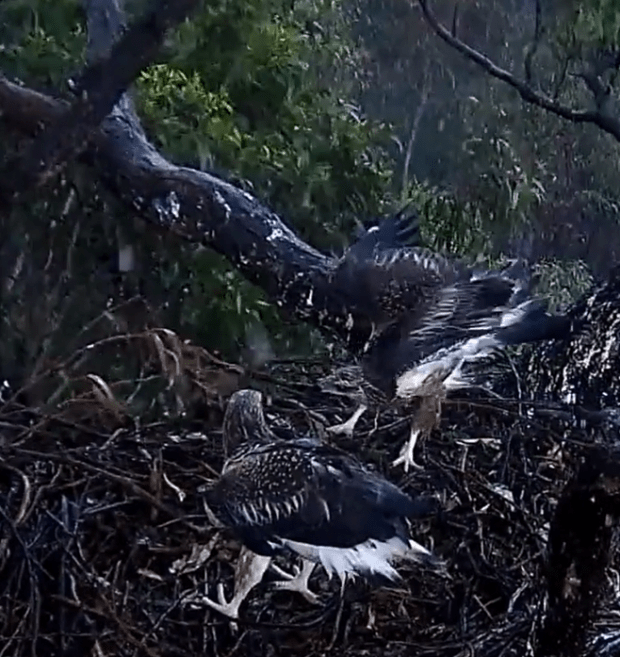
Yesterday it was pitching down rain in the Sydney Olympic Forest. SE29 and SE30 were having a bang-up time flapping in the pouring rain. Today, the camera appears to be down. So, we might not know if SE30 fledges or not. I suggest continually checking as it could come back online anytime.
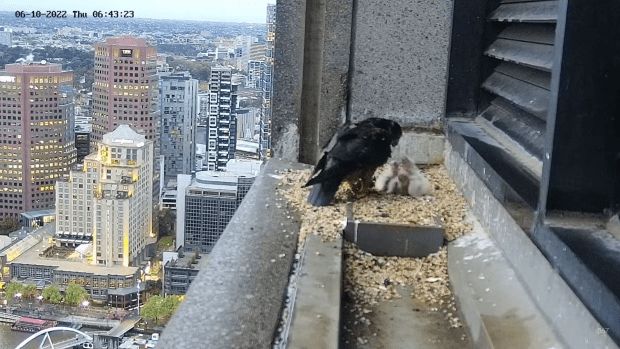
It has been raining in Melbourne. Mum has fed the four eyases and is working really hard at being a great Mumbrella for the little ones. They are warm and dry.
Port Lincoln osplets were waiting for the first fish of the day. It looks like it will be a sunny morning in Port Lincoln turning cloudy with rain arriving around 1600. Hopefully Dad will get some good fishing in before those drops start falling.
In migration news: There is a lot of activity happening at the Mispillion Harbour Osprey platform in Delaware. And it is not necessarily ospreys! You might recall that a banded Peregrine Falcon arrived on the nest the other day drenched to the bone from the rain from Hurricane Ian. ‘H’ has been watching the nest and has been surprised to see at least one Bald Eagle on the nest today, if not two or three. They are not banded. Thank you ‘H’.
When I think of migration, Delaware doesn’t readily come to mind but I absolutely do not know why it doesn’t! After ‘H’ contacted me about the falcon and then the eagle – eagles bringing fish and turtles to the nest – I began to wonder what migration is like on the easter seaboard of the United States. Then I found this article on the birds that fly through there, some of them staying. I would also think that all birds would hug that shore, not flying out in the Atlantic so there would be tens if not hundreds of thousands of birds flying through.
Here is the video that ‘H’ made of the visit and uploaded to YouTube.
For those who are Jackie and Shadow fans, this much beloved Bald Eagle couple were working on their nest in Big Bear today.
Thank you for joining me for this quick check in. Isn’t that little one of Xavier and Diamond’s adorable — and there are two of them! Take care everyone. See you soon.
Thank you to the following for their streaming cams where I took my screen captures: Port Lincoln Ospreys, Charles Sturt Falcon Cam, 367 Collins Street by Mirvac, Sea Eagles@Birdlife Australia Discovery Centre Sydney Olympic Park, and Mispillion Harbour and the Delaware DNR and ‘H’.
I cannot describe what a beautiful fall day it was out in the forest. The wind was only blowing at 2kmh. Leaves – the most gorgeous yellow, red, and orange were falling gently. Seven Black-capped chickadees, a few American Goldfinches, a sole White-breasted Nuthatch, and that lovely Red Squirrel kept me company at the hide. Oh, they must be so happy it is not raining and it is not too hot or cold – just right at 21 degrees C. It could not have been more perfect for humans or wildlife.
It seems that everyone was after the peanuts. They are so good at getting them out of the shells!
This beautiful White-breasted Nuthatch spent about 10 minutes at the feeders before flying off.
The little squirrel was enjoying all of the nuts on the forest floor. These squirrels are very lucky. There are Oak trees and acorns everywhere!
There were more geese on the ponds today than when I went to view them at dusk. There were only a few up in the grassy areas resting on a warm day.
The colours are changing. Autumn is my favourite time of year…it would just be nice if it would last longer! You can sit on the bench, close your eyes, and open your senses up to the smell of the leaves and the geese honking in the distance. Magical. Just try to be grumpy after sitting there for a half hour!!!!!
This Mallard was having a great time splashing about. What a bath.
And then…there was no mistaking the ‘Little Duck’. It remains the tiniest duck in the entire pond BUT — look, all of the back feathers are now in place. This duck cannot be more than 45 cm (8-9 inches) from the tip of its tail to the end of its beak. It looks larger in the photo but, it isn’t – and that is how I knew it was the wee one. (I did come home to compare with the former images just to make certain that the head line and beak were the same before I made a complete idiot out of myself). This tiny gaffer is a Blue winged Teal. It is positively adorable. I sure hope it gets a good wind to carry it south with those itsy-bitsy wings.
Besides finding the little duck, one of the great moments of this afternoon was seeing ten Cormorants in a tree sunning themselves on a beautiful day. Sometimes the Bald Eagle couple are up there in that tree. It is on a peninsula jutting out and there is no way for humans to disturb them. What a beautiful site. When I was standing admiring them, a couple walked up and told me that twenty years ago you would not have seen a Cormorant here. I felt blessed.
Whenever I am outside and getting tired, it is simply nice to remember that I am so lucky to be able to walk in the woods and be outside with nature. I know that many of you cannot – so I am taking it all in for you, too.
In the Mailbox:
So many of you have written to ask me if I think that any more eggs will hatch at either the Collins Street scrape in Melbourne or Xavier and Diamond’s scrape in Orange.
I do not expect the fourth egg at Melbourne to hatch. Falcons and hatch practice delayed incubation. This means that they will not incubate the eggs 24/7 until most of them are laid. This is so the chicks will hatch close together and not have issues of siblicide and food competition like exists in eagles and ospreys.
If a second egg is to hatch at Orange, I would really expect this to happen today or tomorrow. That said, I am not completely hopeful of another hatch there. Xavier and Diamond tend to have one hatch per 3 eggs.
I just received 3 letters with questions about siblicide. I presume that this subject has been brought up on chat or FB somewhere today.
The answer to your questions depends on the species and the circumstances. There are species of eagles where siblicide is almost always 100% (Black, Golden, Imperial). The eldest hatch always kills the youngest. Always. No wishing or hoping. Always. Siblicide is rare in hawks and falcons with most studies showing less than 1%. The stats come from watched nests. The average siblicide from studies at the University of Oklahoma is 3.8-4% in Bald Eagles. It is presumed to be the same or nearly the same in Ospreys. Some nests are more prone to siblicide than others. A good example of a nest where siblicide regularly occurred until last year is the Port Lincoln Ospreys. There is a history below the streaming cam that you can examine. The % at this nest would be much higher.
‘H’ wrote about the torrential rain and high winds blowing along the NE of the US because of Hurricane Ian. She has sent an image of a bird that has landed on the nest. It is banded. I believe it to be a juvenile Peregrine Falcon but I could be wrong. It is ahrd to identify birds when they are wet. So I am posting it here if anyone has any other ideas. This is the shores of Delaware at Mispillion Harbour. Birds are being blown off course. This one has two fresh new bands. Does anyone recognize them? If so, please send me a comment.
Nest News:
So it is time to check and see what is going on in Australia- when we left everyone yesterday afternoon, the Port Lincoln kiddos all had crops, the three at 367 Collins Street had been fed, the Sea Eagles were looking magnificent with SE29 basking in being up on the parent branch, and Xavier and Diamond had one beautiful eyas. Has anything changed today?
Diamond and Xavier have already fed their wee eyas twice this morning (it is 16:44 on the Canadian Prairies). The first was around 0533 and the second
The three eyases at 367 Collins Street have also had a good morning feed. I think that we can all relax and enjoy this new family learning how to parent in Melbourne. The male has brooded, shaded the chicks, fed them, and is bringing prey for Mum and them. It is time simply to sit back and watch these marvelous falcons grow! In less than 40 days they will be full grow and flying! So hold on – it is a fast ride!
The osplets at Port Lincoln were waiting on a breakfast fish to be delivered.
The two eaglets on the Sydney Sea Eagle nest are still home this morning! They are also waiting for breakfast!
Thank you so much for joining me today. Please take care. See you soon!
Thank you to the following for their streaming cams where I took my screen captures: Port Lincoln Ospreys, Mispillion Harbour Osprey Cam duPont Centre and Delaware DNR, 367 Collins Street by Mirvac, Charles Sturt Falcon Cam, Port Lincoln Ospreys, and Sea Eagles@Birdlife Australia Discovery Centre Sydney Olympic Park.
It was a lovely day on the Canadian Prairies. 20 degrees C. Summer. No jackets, no heavy sweaters, beautiful light. Today I got out of the house. There will not be many more likes this – and I discovered a new park in our City. This one is called King’s Park and it is huge – gently rolling hills along the river with a dog park, ponds, a water fall, and a Chinese pavilion. Few birds!
The big news of the morning in Australia is that Xavier and Diamond have their first hatch for the 2022 season. Chick was visible at 0926.
When I left, I was in a really good mood because I had looked back at the footage from the ledge at 367 Collins Street carefully. Yesterday the male came to the nest and the female had a wee break. He was fascinated with the eyases but was quite uncomfortable brooding so he just stood over them. That is fine. He is beginning to engage and he is providing food.
The eyases are being fed and without being able to see really close up, it looks like they are doing just fine.
The Sea Eaglets are incredibly gorgeous. They are up waiting for a breakfast delivery!
And it arrived – nice fish was brought to the nest around 0905. There is still little or no aggression between the siblings. Eventually Lady will feed them!
There was a very early feeding at Port Lincoln, 0620, today. The osplets had one big feed yesterday but it did not arrive til after 1500. They really needed to have fish first thing this morning. I continue to marvel at the civility that was at the nest yesterday. So happy.
When Mum gets up the kids get ready for a delivery. Note the difference in size between Middle Bob and Little Bob. Look at the wings.
Still sleepy babies.
Middle Bob has a bald spot right on top of its head. And now you can also see the size difference between Little Bob and Big — just look at the wings. That tells it all. It is a good thing that Little Bob is feisty like Ervie!
Little Bob still looks like you could have a good cuddle with him. I am astonished at the size of Big Bob already – even the length of its beak!
All is well in Bird World. Congratulations to Xavier and Diamond, Dr Cilla Kinross, and all the gang at the Orange scrape. We will wait and see if a second egg hatches for one of the most beloved Peregrine Falcon couples in the world.
Thank you so much for joining me for this brief look at what is going on in Australia as the 1st of October begins. Take care. See you soon!
Thank you to the following for their streaming cameras where I took my screen captures: Charles Sturt Falcon Cam, 367 Collins Street by Mirvac, Sea Eagles@Birdlife Australia Discovery Centre Sydney Olympic Park, and Port Lincoln Ospreys.