Monday in Bird World

On the Canadian Prairies, it is 8 November and it is 11 degrees C. There are some birds still around the southern part of our province including a large number of Great Horned Owls (GHOW) and Barred Owls (BADO). Several hours from where I live there are some hawks and Bald Eagles still making their way south. In celebration of such a gorgeous day with the promise of snow and plummeting temperatures on Wednesday, we decided to make one last check at Oak Hammock Marsh.

It was simply grand. You could see for miles.

The walk was great. It was sooooo quiet, a wonderful change from the noise of the city. If you were intent on counting tonnes of birds and seeing lots of species, then it was a bust! There were about 60 Canada Geese scattered about and a couple of Mallards, a male and a female.

They were all feeding on the tender marsh grasses below the surface.

Even the geese were quiet, no honking, nothing. Just working hard on those plants.

The two Mallards were quite interesting. They were sort of breaking down the grasses as they moved through forcing them under the water with their paddles and then eating them.

Beautiful little female Mallard.

The ducks were not bothered by the geese – everyone seemed intent on eating and enjoying the warm sunshine. The farmers in the area have finished harvesting their crops and the fields are bare. In several hours only six or seven Canada Geese flew into the wetlands.

It might have been quiet in rural Manitoba but there was a lot of things happening elsewhere. First up, for all of you that watch the Royal Albatross, OGK’s mate since 2006 has been YRK. OGK was first in on the peninsula excited to see her and build a nest but…she didn’t arrive. Time passed and she didn’t arrive. Today, 9 November YRK landed on Taiaroa Head. If people could have rung bells they would have. Instead many of us sat and shed tears. The fear is always there. OGK and YRK were the parents of very popular Royal Cam chick, Atawhai (aka Pippa) in 2020. This year will be their 8th breeding attempt.

In other Royal Albatross news, the new couple – Red and BOK (Blue-Orange-Black) have really been entertaining us. They are so sweet. Well, today, Red got some new bling. As one of a mated pair, he is now WYL (Whit-Yellow- Lime).

The image below shows the Ranger giving Red his new bling and identity. BOK is walking off the nest. She will return once everything is over.

Could this new couple with their first attempt at breeding turn out to be the Royal Family of the year? We wait.

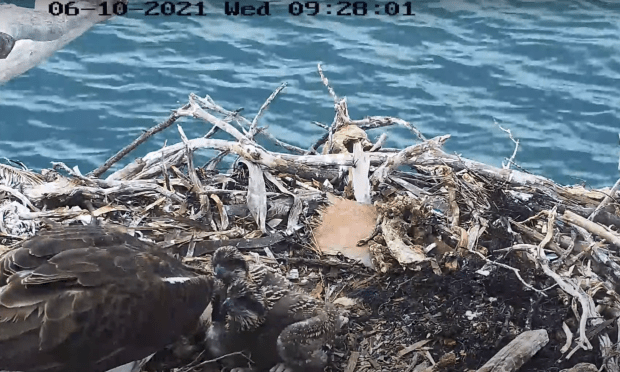
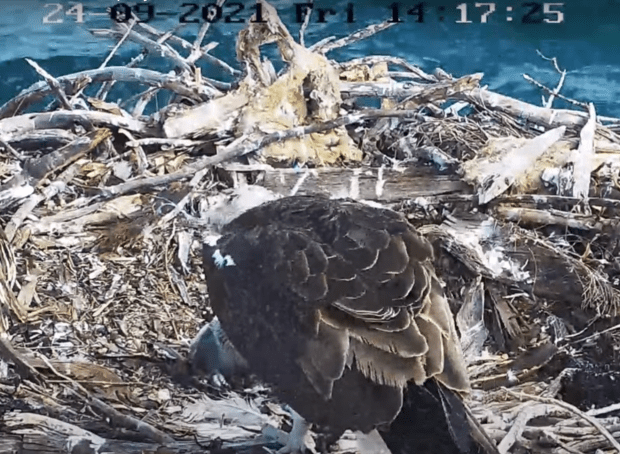
The Port Lincoln Osprey Mum decided it was time to go to the spa. She flew off the barge and went over and had a lovely bath in the warm Australian waters of the cove yesterday. It is well deserved. Her and her mate have raised three healthy boys this year.

Isn’t Mum just beautiful?

It is hard to keep up with the 367 Melbourne Peregrine Falcons. I ‘believe’ that there are two (probably female) still on the ledge.

Yes, still there. There is a lot of noise and it could well be the parents trying to lure these two off with prey.

There are theories about gender and fledging times in falcons and hawks. Because the females are substantially larger, it takes longer for their bodies to feather. Therefore, they generally fledge after the males. I do not know how accurate it is but I hear this often.

In Orange, Diamond’s foot is doing much better. At 8:11 Xavier, the male Peregrine Falcon of the scrape on the water tower of Charles Stuart University, delivers a Starling to Yurruga. Xavier does not wait. He drops the breakfast prey and gets out. I don’t blame him. It could definitely save his talons.

Notice how big Yurruga is compared to Xavier. Think Yurruga is a female like her mum, Diamond?

Yurruga is a very good plucker!

Cilla Kinross just posted a video clip of Yurruga. It is really short. Have a peek. I do not think those eggs are going to last much longer.

Everything is as it is expected at Port Lincoln. Dad flew in with a really nice fish but instead of letting the chicks do a grab, Mum got over quickly, mantled the breakfast, and proceeded to take control of the feeding.

It should, by now, not surprise anyone to the identity of the chick right up at Mum’s beak. Now the chick can be identified quite quickly – it’s Ervie! aka Little Bob.

The rule of thumb is that the males return to make their own nests near their natal nest. I hope there are three or four more barges available.

One last nest. NEFlorida with Samson and Gabby. They are both very busy working on that nest. They have been bringing in a lot of big twigs. Here is Gabby moving some of those around.

Cute little Samson looks like he is standing very still in his tight black jeans waiting for orders. What a sweetie.

Samson is a very good listener and Gabby is giving precise instructions. Looks like they are already thinking they need high rails this year.

Thank you so much for joining me today as we check in on some of ‘my’ favourites. Take care everyone.

Thank you to the following for their streaming cam where I took my screen captures: Cornell Bird Lab and NZ DOC, Port Lincoln Osprey Project, NEFlorida Eagle Cam and the AEF, Charles Sturt University Falcon Cam and Cilla Kinross, and 367 Collins Street Falcons by Mirvac.

Checking on the birds

Oh, how they have entertained us. How we waited to see if that fourth egg would hatch. How we watched as Dad was incubating during the earthquake. It has been quite the season with the Melbourne Peregrine falcons. Today, there is another nice article on the 367 Collins Street Falcons today. I have attached it in case you missed it!

We are so lucky that the four of them have decided to come out so that we can see them. Those downy feathers are disappearing quickly and they look like grown up falcons capable of taking on the skies of Melbourne -for awhile – til Mom and Dad boot them out. Certainly Mom and Dad have been doing flying demonstrations trying to lure them into thinking about taking the leap! They are a little over 5 weeks old today. Forty days and onward is approximate for fledging.

https://www.theage.com.au/national/victoria/for-melbourne-s-falcons-and-their-fans-a-new-domestic-drama-20211001-p58who.html?fbclid=IwAR1bgeKR4w2H622TETCdcJ0r0bgzLtVEE9BoK_35wrlcuWA4b0BzJ9VC0JI

Over in Orange, or should I say ‘up’ in Orange, Yarruga was one hungry chick waiting for supper that did not arrive. S/he had two feedings yesterday so she is going to be ravenous when breakfast arrives. There is no need to worry, though. She had a nice crop, larger than Diamond’s and Yarruga will not starve. In the world of raptors there are days of plenty and days of naught. Little ones need to learn that, too. Yarruga is 28 days old today. Four weeks.

Diamond was seen putting her entire weight on her right leg in the middle of the night to clean her talons. This is very good news. She has moved over to the ledge to grab some sleep before dawn and Diamond seems to be doing much better. How grand.

The Port Lincoln osplets are sound asleep. Little Bob is 50 days old today – while the two big siblings are 52 days old. We will be keeping an eye on those numbers because last year Solly fledged at 65 days (in the Northern Hemisphere it is 49 days onward). Solly was banded at 47 days and DEW at 46. On Monday, 8 November, these three will be banded, named, measured, and at least one will get a tracker. They are just wonderful – the three of them. I am surely going to miss this nest – perhaps the most civilized brood I have ever seen.

There is sadly some commotion going on at Taiaroa Head. Our beloved OGK may have realized that his mate, YRK, is not returning. He tried to mate – rather vigorously – with BOK who is also waiting for her mate to return. Being the gentleman that he is, OGK, returned to apologize in the Albatross way by doing a sky call with BOK later.

If it happens that YRK, Pippa Atawhai’s mum, does not return, it will not be from old age but from being caught in the lines of the fishing trawlers. I hope that you will think about our beloved Pippa and what a horrible death that would be – and it is entirely preventable! I feel rather gutted because these are all useless deaths that never have to happen. An albatross does not need to be decapitated every 5 minutes! The fixes are really easy. They include setting the lines at night, line weighting, and bird scaring lines. Some organizations are supplying these measures for free to the boats. The deaths are preventable. There needs to be international laws. Every country needs to stand up and demand that the fishing factories take these simple steps or not be able to fish. Write letters, phone your political representative – do it for Pippa. Then check out what the RSPB is doing. They are working alongside the Albatross Task Force to help end bycatch. Check out their website, ask who to contact. And remember – writing e-mails does help. Public pressure helps.

https://www.rspb.org.uk/our-work/policy-insight/marine-and-coastal/saving-seabirds-globally/the-albatross-task-force/

The Bald Eagles are really busy working on their nests in the US while the ones who came to Manitoba for their summer breeding are very slowly making their migration. Images of 30 or 40 along the river in my City have been posted locally the last few days but are not available to share beyond the Manitoba Birding and Photography FB page. I still have a few Slate Grey Juncos and today that meant a trip to the seed seller to get some more Husked Millet for them. The day is just starting in Australia and New Zealand so no telling what will happen. I long for YRK to fly in and just land on OGK’s head! That would be a rather dramatic entrance fitting for this very patient male who has been working on a nest for about six weeks now. No doubt Yarruga is going to be screaming for breakfast! I will post the updates on Grinnell tomorrow afternoon. In the meantime, thank you for joining me and take care everyone.

Thanks to the following for their streaming cams where I took my screen shots: Port Lincoln Osprey Project, 367 Collins Street Falcons by Mirvac, Charles Sturt University Falcon Cam and Cilla Kinross, and Cornell Bird Lab and NZ DOC.

Everything is just fine

I just watched the Dad at the Collins Street Peregrine Falcon scrape trying to feed a huge piece of pigeon to “the four”. He tried several beaks to see if any of them could handle it and then ate some and tried again. Bingo! Then he did it again. Bingo! These two are just amazing – the parents. It is a lot of work to feed 4 instead of the usual 3. I can’t even imagine what it will be like when each one wants their own pigeon! Makes me tired thinking about it.

The eyases are able to eat larger and larger pieces of meat.

Ah, so sweet. Open wide.

Here are some pictures of a beautiful mom a few hours earlier. The eyases have doubled in size. It is getting more difficult to brood them.

Notice how careful Mum is raising her leg to get off of the eyases, turn, and get to the ledge to take a break.

Whew. Oh, just look at how big those the chicks are that are sitting straight. If Victor Hurley could get to the scrape box and weigh and measure the wings of the eyases next week, he might have a good idea which are female and which are male. This, of course, will not happen. He does not wish to disturb them in any way. But a Peregrine Specialist can from those two measurements differentiate between the males and females at that early age. For us, when they are about 24 days old we should be able to tell the males from the females. The females are approximately 50% larger. According to the research, even though the females are so much larger they do not substantially require more food than the males, just about 25% more.

Ah, you will often see them playing with one another’s beaks. Beaks of course mean food! They will not hurt one another. They are much stronger today than they were yesterday and you will continue to see significant growth and strength.

Cutie Pies.

And, yes, all four are there! It is 22 degrees C in Melbourne. That is 71.6 in F. A really nice warm day.

Mom is taking another break. Sometimes if you listen very carefully you can hear Dad calling her. She has to eat, too, and Dad is in charge of filling the pantry. She will often pick up the food for the chicks and bring it to the nest.

You will notice that the parents do not normally leave food in the nest. You will also see Mum eating bits of old food left in the scrape. She doesn’t want to attract insects or anything that could harm the chicks. That level of cleanliness has evolved for millions of years.

Mom has now been gone for 12 minutes (my current screen time). The chicks are nice and toasty stacked up on one another on a beautiful warm Melbourne Day. Rest assured, the adults are not far away. There is someone nearby at all times despite the fact that there really are no predators in the area.

The Port Lincoln Osplets had their first feeding at 9:00:06. It was a really nice fish and very one was stuffed, leaving the table with a nice crop.

Just look at that crop on the chick in the foreground. My goodness. By my reckoning that is Little Bob. He might have had a bit of trouble getting into the right spot yesterday but it certainly looks like he did well this morning.

A half hour later and the chicks are still working on that fish.

Right before 9:30, the fish is completely finished. There is nothing left. One of the older siblings is looking at Mom. You can see their nice crop, too. Little Bob is the one with its head near Mom’s tail.

The second fish of the day arrived on the nest at 12:02. It was entirely consumed and the feeding fished at 12:20. My goodness.

The chicks are all lined up nicely for Mum. Everyone will be fed and the feeding will end with each of the three having a crop. If you are just joining us and are wondering what the word ‘crop’ means, it is like a pre-stomach stomach storage area in raptors. They can ‘drop their crop’ when they need food and energy. It really helps because out in the real world, away from mom and dad feeding them, the birds might not be so successful at fishing or hunting. This way if there is plenty they can eat lots and kind of store it for when there isn’t.

Little Bob is in the middle. You can see the ‘dot’ on his head in the image above and the stripe down his back is not as wide as the two older siblings. The length of the copper-red feathers coming in on the head and neck appears to be the same length now on all three. The tail feathers of the older two are longer.

At the end of the feeding the three were still lined up as they had been. This nest is so civil. Just causes smiles, big ones.

Oh, this has been such a great year to watch. Last year this nest was the one that almost made me stop watching Ospreys altogether. I am mystified but overjoyed. The only explanation is the closeness in the hatch. No one of the osplets is significantly smaller than the other- or the reverse, none is significantly larger than the others. Not like Tapps and Solly. In this instance, Little Bob is also tenacious and has not let Big Bob’s occasional attempts at dominance rattle him in any way.

In this short blog, so far, you have read about two Australian Birds. The Guardian newspaper out of London, UK is holding its voting for Australia’s Bird of the Year. You do not have to be Australian to vote. I will post the link. Please note that the Peregrine Falcon is still in contention! There is no Osprey to vote for but the Galah is still in contention. There are many other birds and you might have a different one you like. It doesn’t cost anything and every day some birds are knocked out of the competition. You can vote every 24 hours til the end. Please take part. It is a bit of fun!

https://www.theguardian.com/environment/ng-interactive/2021/sep/27/australian-bird-of-the-year-2021-vote-now-for-your-favourite

Also mark 9 October on your calendar. That is the big e-Bird count for the fall that helps in understanding where the birds are with regard to migration. Last year Cornell reported that 32,000 people from around the world submitted 80,400 check lists with 7, 128 species observed.

I am certainly curious about this year’s migration because today it was 28 degrees in my City today. That is a temperature that years ago we never even hit in the summer. It has become more normal over the past four years but not digging into October. So please do take part. Here is the information and instructions on how to do so.

https://ebird.org/news/october-big-day-2021

It is hatch watch for the Orange Falcons, Xavier and Diamond. Diamond has been letting Xavier do some of the incubating today. I hope she is spending some time enjoying herself in the sun. These two parents are going to be really busy very soon.

Royal Albatross male, OGK, spent the night on Taiaroa Head waiting for his mate YVR to arrive for the 2021-22 breeding season. Oh, he is such a handsome but sweet male. The amount of time and care he gave to his daughter, Miss Pippa Atawhai, when she was the Royal Cam chick a year ago won the hearts and minds of anyone who saw them together. He never rushed when he came to feed her. Always doing more than a few skycalls, OGK would often sit with his chick for long periods of time preening her and chatting. Sometimes he would even sleep!

It will be a joyous occasion when the two are reunited after being apart since before Miss Pippa Atawhai – their daughter and the 2020 Royal Cam Chick – fledged last September. I think OGK is anxious for his sweetie to arrive. Send all the positive wishes for this amazing couple. Maybe the NZ DOC will decide to have OGK and YRK has the Royal parents again this year. Wouldn’t that be amazing?

Take care everyone. It is getting late and I want to go and check out my book on duck ID. Thank you for joining me. Stay safe, watch the birds and be joyful! Vote for your favourite Australian bird and be sure to register for the big bird count!

Thank you to the following for their streaming cams where I took my screen shots: Port Lincoln Osprey Project, 367 Collins Street Falcons by Mirvac, Falcon Cam at Charles Sturt University in Orange and Cilla Kinross, the Cornell Bird Lab and the NZ DOC.

Tuesday in Bird World 5 October 2021

It is another glorious day. The sky is blue and it is going up to 28 or 29 degrees. Winds are a bit gusty. Still a noon walk around the pond seems to be something to aim for. Will it be too hot for the ducks and geese? Will they be sleeping on Duck Island and not on the water?

Before anything else happens during the day, I always check on a couple of nests, especially those in Australia to see if there are any surprises or if all is well.

The Port Lincoln Dad continues with his good fishing streak. Added to the already 3 or 4 feedings yesterday were two more: 16.41:26 and 18:33:08.

Everyone was fed yesterday. Each of the three is doing well and changing so much. What a magnificent Osprey nest to watch this year and despite some of the chatters fearing the worst (why I ask?), there is no evidence this year to indicate anything other than three successful fledges with their own sat paks.

It is only 6:33 in Port Lincoln. Not breakfast time yet.

There are four! A viewer was worried that something had happened to one of the little eyases. You have to be very creative in recognizing the individual falcons sometimes. They tend to collapse in a pile keeping each other warm. There is the baby looking right out at us. Each is thriving. Those parents are busy stocking the pantry! These kids can eat. This is not a nest that is going to have issues unless a real tragedy hits (like a parent dying). These are well seasoned parents that know precisely how to take care of their little ones. Not a worry at all. Just enjoy them!

How many of you watched the Peregrine Falcon nest at Orange with Xavier and Diamond last year? If you did, I know that Izzi, their only hatchling, stole your heart. Today, Izzi is having his one year birthday. Holly Parsons did a slideshow tribute to Izzi and posted it on YouTube. Here is the link:

Today we are waiting for the first hatch of Xavier and Diamond’s 2021 brood. It will happen anytime! Here is a link to the camera in Orange. You won’t want to miss any of that action.

The best guess on the first hatch is 7 October – tomorrow in Australia. This morning Xavier really wanted to incubate those eggs and Diamond let him! He is not giving us any hints if there is a pip. One happy Dad!

Do you know why Xavier is named Xavier? It comes from Saviour. In 2016, Diamond’s eggs were ready to hatch and her mate Bula went missing. Xavier showed up and helped Diamond raise the chicks that year. He provided all the food for them. Xavier and Diamond are a bonded pair raising their own chicks for the past five years. Xavier ‘saved’ (hence Saviour) the chicks lives that year. He is a very devoted Dad and a great mate.

Speaking of devoted mates, the Cornell Bird Lab has unveiled a Tupelo wood sculpture of Big Red and Ezra and their 2016 nest titled Hello Daddy. The artist, David Cohen, wanted to do a tribute to Ezra as he died the following year. The wood was decorated by burning and acrylics and depicts the first hatch with the other two eggs in various stages of hatching. Ezra wears the real metal band that he wore in life. The sculpture was unveiled today and will be on display for three years.

The trip to the duck pond to see the progression of the plumage changes in the male Mallards and the Wood Ducks was a bit of a bust. It is just too hot and almost everyone was on ‘Duck Island’ staying cool in the shade.

There was one lonely White-breasted Nuthatch foraging on one of the tree trunks as I arrived. They lack the black eye line and the rosy breast of the Red-breasted Nuthatch.

A few of the Canada Geese were out. Perhaps they were hoping that some of the picnickers might share some of their lunch with them. I don’t think it was working. Everyone seems very mindful of the signs saying “Do Not Feed the Wildlife”.

There were a couple taking a bath and flipping themselves over like people in a kayak. It was quite interesting to watch although it would have been much better as a video!

A few Canada Geese were flying in and landing.

What a great landing!

I could watch them all day!

Thank you for stopping in. I hope that you have had a really good day and that it continues that way. Stay safe. See you soon.

Thank you to the following for their streaming cams where I took my screen shots: Port Lincoln Osprey Project, The Falcon Cam at Charles Sturt University at Orange and Cilla Kinross, and 367 Collins Street Falcons by Mirvac. I would also like to thank Suzanne Arnold Horning for allowing me to post her images on my blog. She kindly attended the opening reception of Hello, Daddy.

Godwits…and more

I have heard the name but have never seen the bird – or, at least, I do not think I have. With my lousy shorebird IDs, I might have even confused this beautiful long-legged shorebird with a Greater Yellowlegs. Of course, everyone would have laughed.

Godwits are ‘very’ long legged shorebirds but their legs are not yellow! Their beak is ‘very, very’ long and is bi-coloured – light rose and espresso -and ever so slightly upturned at the end. They are called waders because they live in the mudflats and the estuaries. See how their legs go deep into the mud, too. They feed by sticking that very long beak into the mud, rooting around for worms and small shellfish.

“Bar-tailed Godwit” by naturalengland is licensed under CC BY-NC-ND 2.0

The breeding adults have a chest that ranges from a deep terracotta for the males to a brighter orange for the females. The wing and back feathers are more brown and white overall with a touch of the breast colour, sometimes. They have gorgeous dark eyes.

“Bar-tailed Godwit” by 0ystercatcher is licensed under CC BY-NC-SA 2.0

The juveniles have a cream coloured breast with overall brown and white feathering.

“Bar-tailed Godwit” by 0ystercatcher is licensed under CC BY-NC-SA 2.0

What is so miraculous about these shorebirds is their migration. They breed in Alaska and fly in September to New Zealand! They make only one stop, normally. And they do the trip in record time. It is an 11,265 kilometre journey or 7000 miles. They accomplish this in eight days! Yes, you read that correctly, eight days.

“Bar-tailed Godwits” by naturalengland is licensed under CC BY-NC-ND 2.0

Neils Warnock, the Executive Director of Alaska Audubon in 2017, remarked,These godwits are epic migrants. We had a bird, E-7, that we had tagged, and she left New Zealand in the spring. She flies non-stop seven days, ten thousand kilometres, to the Yellow Sea. All of the Bar-tailed Godwits of Alaska, they stop at the Yellow Sea.”

The Yellow Sea is located between mainland People’s Republic of China and the Korean Peninsula.

Historically the mudflats of the Yellow-Sea have been rich with food for the Bar-tail Godwits so they can fatten up and make the rest of the journey to their winter homes in New Zealand without having to stop. Today, the mudflats of the Yellow Sea are under threat – they are disappearing with coastal development. This could prove to be a major challenge for these beautiful shorebirds. There have been many studies and the researchers have seen a drop in the number of shorebirds by 30% in the last few years because the mudflat areas have been reduced by 65%.

https://www.science.org/news/2017/04/migrating-shorebirds-danger-due-disappearing-mudflats

The reports of the shrinkage of the mudflats has been coming in since 2013 with alarms sounding.

Today the Pukorokoro Miranda Shorebird Centre in New Zealand reported that Bar-tailed Godwit 4BYWW made his flight in 8 days and 12 hours arriving home at 03:00 on 26 September. He flew 12,200 km. His average speed was 59kph. 4BYWW may have set a new distance record for the Bar-tail Godwits. We will know when the others return home. Isn’t that amazing?

What I found most interesting was her route. She does not appear to have gone via the Yellow Sea. Is this because of the decline of the mud flats? Have the birds adapted their migratory route? I definitely want to look at this more closely.

This was the satellite tracking image posted by the Pukorokoro Miranda Shorebird Centre FB page:

The Centre was tracking another four adults and 3 juveniles on their journeys home. One of those, 4BWWB, has been reported as flying non-stop for 163 hours and over 10,000 km. Seriously, my head can’t comprehend what that must be like. I am also truly amazed at what these sat-paks can tell us about the birds and their amazing resilience. Just incredible.

Tiaki officially fledged on the 25th of September. The Royal Albatross cam chick of 2021 is foraging off the coast of New Zealand at the present time. She will eventually make her way to the waters off of South America near Chile. We wait for her return in four to six years to Taiaroa Head where we will hear that beautiful Sky call, again.

While millions and millions of birds are moving from their summer breeding grounds to their winter homes, others are waiting for eggs to hatch. Holly Parsons posted a table of Diamond’s incubation history.

Xavier and Diamond’s first egg was laid in the scrape box on top of the water tower at Charles Sturt University in Orange, Australia on 31 August this year. Cilla Kinross, the main researcher, is expecting a hatch from 6-9 October with the most promising day being the 7th. Can’t wait!

Diamond was catching some sleep this morning. If all of the eggs hatch, her and Xavier are going to be very busy!

If the hatch is expected around the 7th of October at Orange, then what about those Melbourne Peregrine Falcons? The first egg was laid on the 21st of August – yes, that is right. Ten days before the Orange falcons. So, I am going to be looking for a hatch at Melbourne starting in two days!!!!!! This means that all of the Melbourne eggs, if viable, will hatch before those in Orange. It will be nice to get to enjoy them without trying to watch both at the same time!

For those of you wondering about those beautiful White-bellied Sea Eagles, 27 and 28, here they are. Talk about gorgeous.

Things will really be starting to ramp up shortly. Bald Eagle breeding season in the United States begins in a few days. Looking forward to checking on some nests to see if the birds have returned – such as Anna and Louis who had the first hatch on a nest in the Kisatchie Forest last year since 2013. His name was Kistachie – very appropriate.

Then there is always the trio at Port Lincoln. They had two feedings this morning and a third at 11:31:27 when Dad brought in a very small fish. All of the chicks were well behaved – quite civil to one another. And, of course, Little Bob is right there in front! Look carefully you can see him.

Life is good. Everything seems to be going really well for all the nests.

Thank you so much for joining me today. I hope you enjoyed learning about the Godwits as much as I did. Incredible birds. Take care everyone!

Thank you to the following for their streaming cams where I took my screen shots or for postings on their FB pages that I have shared with you: Port Lincoln Osprey Project, 367 Collins Street Falcons by Mirvac, Falcon Cam Project at Charles Sturt University and Cilla Kinross, Pukorokoro Miranda Shorebird Centre, Sea Eagle Cam @Birdlife Australia Discovery Centre, and Cornell Bird Lab and NZ DOC.

Feature image credit: “Bar-tailed Godwit” by 0ystercatcher is licensed under CC BY-NC-SA 2.0

Late Friday in Bird World

It is 10:16 in Australia as I begin this short newsletter.

The osplets on the Port Lincoln barge had a small fish between them around 06:15. They have had nothing since and Big Bob is getting a bit restless. Sadly, he has been pecking Little Bob’s neck and Little Bob is going to have to learn to use his backside to protect himself when this happens. So far the beaking has not been too bad but, as all of you know – this Osprey nest makes me nervous. I will not be able to relax until Little Bob is a little older. It seems that Big Bob is trying to establish nest domination. Tiger Mozone wondered on the chat about DNA causing excessive aggressiveness in the chicks. Certainly this nest has a history of that type of behaviour. I also wonder about toxins in the water that enter the fish and stay in the tissue of the Ospreys.

Mom was hopeful around 09:45 and the chicks were in line to eat. Their crops have dropped from the small fish three and a half hours earlier.

The chicks are being fed more fish and for a longer period. What was six minutes a week ago has stretched into 45 minutes at the table. And these chicks will be fine today if a big fish does not come on the nest for a few more hours. The issue is Big Bob who seems to want to press his authority by fighting with the other two. Middle Bob is the clever one (so far) and seems to be able to stay out of the way but Little Bob still needs to learn how to protect itself.

The two older chicks are moving straight into the rapid growth period where they need lots of fish. Little Bob is following as quickly as he can. You can see that he is moving into the reptile phase himself. The dark feathers are coming in and he is losing the down on his head. Big Bob is awfully dark and a bit scary looking! He is the one holding his head the highest and looking towards you.

It is nearing noon, nest time. Dad has come to the nest without a fish. Is there a predator in the area? I actually thought that this nest was relatively free from predators unlike those in Europe and the US that have to deal with Goshawks, Great Horned Owls, etc. Or has Dad arrived to get the meal order from mom?

I couldn’t help myself. I had to check. Dad must have been taking the fish order at 11:25 because he delivered a fish to the nest around 12:25. Thank goodness. Big Bob behaved himself and everyone is getting to eat.

Look at who has his little mouth open wide!

Little Bob ate first. You can see from the crops. Middle and Big will eat next and by the time they finish, Little Bob will be hungry again. I hope that fish is big enough!

The big news over in New Zealand is that Tiaki has fledged on 25 September. She was 244 days old. Both her and Plateau Chick left the headland but, it has not been completely determined when that was. By the sat-pak it seems that Tiaki might have fledged at night but sometimes that sat-pak GPS requires adjustment. We all wish her a wonderful safe life, full of fish, and a return to us in five years time.

You can follow her satellite GPS. I will put the link below the fledging video.

Cornell Bird Lab caught the moment:

Here is the link so that you can check on Tiaki. Her satellite tracker should continue working for a year until her first moult. You can follow her dad, LGK also. His tracker should be good til he moults – another couple of months. There are only six chicks remaining to fledge.

https://my.wildlifecomputers.com/data/map/?id=6008d9ba31af59139976bcfe

The migration continues in Manitoba with everyone is excited. There are dawn breakfasts and evening dinners celebrating the arrival and departure of the Canada Geese – and, of course, the swans and all the other ducks and birds. Today marked the return of the Dark Eyed Junco to Winnipeg. Oh, people are so happy to see these adorable little birds. There are several sub-species of Junco and the one that visits Manitoba in the summer to breed is called the Slate-coloured Junco.

The Juncos love my red outdoor carpet. Tomorrow or the next day there will be 50 or more hopping about on it and jumping in and out of the dill. They love it if we ‘intentionally’ spill some seeds on the carpet. They are better than a vacuum clearing them up if we do. They do not feed at the feeders but are also seen on the ground for invertebrates. Isn’t this a real cutie? It was definitely not shy. The image was shot through a triple pane of glass so as not to disturb the bird. It seemed to not notice me.

Today, Mr Blue Jay had two other Blue Jay male visitors that wanted to help him eat his cob of dried corn.

By the time dusk arrives, the Jays and the squirrels – both red and grey – had made a real mess of the seeds. I think one of the squirrels wanted some of that corn but the Blue Jays were not having it. They would eat 3 or 4 kernels and then take some away in their beak. It was fascinating watching them through the windows.

Little Red decided it was easier to get up in the lilac bushes and balance himself on the bird feeder and eat his dinner there. Contending with three male Blue Jays was not something he wanted to do. So he kept quiet and ate and ate. He also doesn’t get on with the Grey Squirrels. He has picked a good place to eat in peace and quiet.

Awwww. Look at those tiny little nails.

It was a good day. All of the garden wildlife save for the rabbit were accounted for. There were also several new species of sparrow in the lilac bushes eating seeds. There were Chipping sparrows as well as Clay Coloured Sparrows today.

Hatch watch is coming soon for the 367 Collins Street Peregrine Falcons. WBSE 27 and 28 are doing well. 28 actually managed to get a prey delivery today. Here is a short video showing 28 mantling the prey and then wanting to share it with his big sib. They have their beautiful juvenile plumage and are so adorable.

I also checked in on the Bald Eagles who are working on their nests. Will put in a report some time this weekend. I know that many of you are anxious for Samson and Gabby, Harriet and M15, as well as Jackie and Shadow to get those nests built and those eggs laid! And while the last of the Albatross are fledgling, it will not be that long til the other adults return to Taiaroa Head to make their nests and lay their eggs for the 2022 season. Sometimes time feels like it melts in front of our eyes.

Thank you for joining me. I have promised myself that I am not going to worry about the Port Lincoln Ospreys tonight. The crazy thing is that I wish the winds would pick up. Dad seems to be able to fish better when that is the case. Yes, I know. That is a crazy idea. Take care all of you. Stay safe. See you soon.

Thank you to the following for their streaming cams where I took my screen shots: Port Lincoln Osprey Project, Cornell Bird Lab and NZ DOC, and Wildlife Computers.

Bird World Happenings

There is a lot of news in Bird World this morning. Early sat-packed Ospreys are finding their way to Africa. A 2013 hatch from Rutland, the famous 4K, arrived on the coast of guinea on 23 September at 17:00. Chris White has also sent photos of other unringed Ospreys arriving. So nice to hear they are safe.

Sharon Leigh-Miles posted a long list on the Montana Osprey FB Page. Sharon reported the following (abbreviated):

First out of the gate for migration was Avery. Many of you know Avery. She is from the Class of 2016. She returned to her nest by the Yellowstone River about April 19, 2021. This year she fledged three healthy chicks again. Dr. Marco Restani of the Yellowstone Osprey Project banded her chicks. Avery must have needed a rest because she left for her home in Veracruz about September 1st. Avery’s sister or half-sister, Boots, Class of 2018, seemed to find a home in Idaho this year. She is now on the coast of Louisiana. It is decision time for Boots. Will she fly east to Cuba, her first winter home, or will she veer back westerly and return to the Chiapas, Mexico? We believe hurricanes and tropical storms may have blown Boots off course last year and she settled in Chiapas. We have three chicks that fledged on MPG Ranch in the Bitterroot Valley. Kove was banded and outfitted on July 21, 2021. He was the eager beaver and left on his first migration on September 11th. He is currently right outside Tampico. Lupine from the Class of 2020 found her winter home slightly northeast of Kove’s location. Sainfoin was banded and outfitted on August 10th. This chick left on migration on September 16th and just crossed the border into Mexico. Rio is our last chick this year. She was banded and outfitted on August 10th as well. Rio seems to think that having fish delivered and having a full crop is just the ticket, as she is still at her natal nest being supplied by her dad. Don’t worry. The urge to migrate will soon move her south. In addition to Lupine, three additional ospreys from the Class of 2020 remain at their winter homes. Zinnia and Dahlia have made Louisiana their winter home. Lucky settled down on the coast of Tabasco, MX.” Thanks, Sharon!

Satellite Packs and even simple banding give us a lot of information about the travels of our beloved birds. Audubon FL reported that a Banded juvenile Bald Eagle Green K/48 from Florida was located far from home in Virginia. Have a read:

https://fl.audubon.org/news/banded-eagle-spotted-hundreds-miles-nest-site?fbclid=IwAR3nNRp2wMD5NjudQ_vUwAoexk2NMJiWABT6FGFBWmL6XeDxMzXYnaJsnns

There are currently only 10 Albatross chicks left on Taiaroa Head, NZ. One of those is Tiaki. Tiaki is the Royal Cam chick of the year, daughter of LGL and LGK. She is a beauty. She has already mastered hovering and when Tiaki decides it is time to fledge, we will all be cheering for her. We can also watch her travels because she also has a sat-pack!

If you are a fan of Turkey Vultures, the San Diego Zoo announced that it has successfully hatched an Egyptian Turkey Vulture in captivity.

https://www.kpbs.org/news/2021/sep/23/first-egyptian-vulture-bred-captivity-san-diego/?fbclid=IwAR32UpOxdtf2MCrJx5-3jlE62cpSE7gEG5bvTdvvlsJGWLPMQeGXl3nAWBM

Last but never the least, the Port Lincoln Ospreys had several feedings after I turned out the lights on the Canadian prairies. Dad brought in a whale at 13:56:56. Mom was still feeding the chicks at 14:29. That is a total of 34 minutes. It is good to compare this with earlier feedings that were only 6 minutes long. It will give you some idea of the amount of food the chicks are now consuming. There was another feeding at 15:04:54 and again at 16:03. The kids – each and everyone of them – had nice crops! It was a good day in Port Lincoln.

At 12:51, the trio still have crops from their earlier feeding.

Look at that great fish Dad just delivered!

More than half of it was gone at the end of the feeding. Remember when this fish would have lasted all day?

Mom cleaning her beak at the end of the feeding.

Happy babies wanting more.

Their crops are full. one is passed out in a food coma. Little Bob and one of the older siblings are holding out for a bit more. Little Bob never leaves the table early. He seems to have an endless pit.

The Port Lincoln chicks are all doing well. Little Bob is beginning to lose the soft down on top of his head and you can see the dark feathers coming in. Little Bob is 51 hours younger than Big Bob. He will be catching up in plumage very soon. There are a lot of people that think that he will catch up in size but, the general rule – rules, of course, always broken – is that the third hatch is a male. If that is the case with Little Bob then he is going to be smaller than Big Bob who is probably a female. At least 30% smaller.

Everything is wonderful in Bird Land. Lots of good stories about migration coming out.

Thank you so much for joining me. It is another grand fall day with summer temperatures on the Canadian prairies. Take care everyone. See you soon!

Thank you to the Montana Osprey Project and Sharon Leigh-Miles for allowing me to use their information from their FB page. Thanks to the Port Lincoln Osprey Project and the Cornell Bird Lab and NZ DOC for their streaming cams where I took my screen shots.

Tears of the Albatross

As we prepare for the 2021 Royal Albatross to fledge off Taiaroa Head, New Zealand, it is a good time to think about these beautiful sea birds.

Last year I came across this document, The Tears of the Albatross. It gives you the history, the mythology, and the environmental challenges that the Albatross face. It is an excellent read and I want to include it again. You will learn so much about these magnificent sea birds.

Also highly recommended is the website of the ‘Agreement on the Conservation of Albatrosses and Petrels.’ This is more up to date information on what the ACAP is doing to protect the birds.

https://www.acap.aq/?fbclid=IwAR1CzLWh-w3-Zcr8ka0KBllcN8HWlaAKuMxeu7EmIbFRMvko8v3uFE7G_wo

As far as I know Tiaki is still with us. The remaining chicks of which there are 26 at last count could fledge anytime.

This was the view of the camera installed by Cornell Bird Lab and the NZ DOC so that we could watch Tiaki as she grew from a hatchling to a fledgling. It seems Tiaki is off around the bend or down the hill! It would be so nice if we could see her fledge! Come home Taiki! We want to say goodbye.

It is a quiet day in Bird World. The female at Port Lincoln doesn’t seem to have a pip in the first egg yet although it could be anytime. The Bald Eagles in the US are bringing in stick and twigs and refurbishing the nests from last year. There is no confirmation of Iris one way or another. Aran was seen at 13:47 tucking into a nice fish and at 17:00 in the Glaslyn Valley so he is still with us. The Peregrine falcons continue to incubate eggs. We are just about at the half way mark to fledge.

Thank you so much for being with me today. Take care, stay safe. I hope you enjoy The Tears of the Albatross.

Thank you to the following for their streaming cams where I took my images: Cornell Bird Lab and NZ DOC.

Credit for the feature image: “Albatross” by AdeRussell is licensed under CC BY-NC-ND 2.0

As the Nest Turns 11 Sept

The female on the Port Lincoln Osprey barge woke up to some rain and by mid-day there was rough weather. The moderator of the PLO chat said they hoped that the chick would choose to stay in the egg!

It is currently 12 degrees C with a wind speed of 42 km/h or 26.09 miles per hour. Blustery. Not good for fishing. Best wrapped up in a cosy blanket with a cup of tea and a good book. Hang in there mum.

Aran is still in the Glaslyn Valley. Doesn’t he look grand on one of his favourite perches looking over ‘his’ territory. As much as others might have their eyes on their natal nest, Aran doesn’t intend to hand it over to either Tegid or Aeron, Monty’s boys, Z1 and Z2, respectively.

Some are worried. My notebook just said that ‘Aran migrates after the middle of September.’ That was accurate but not precise enough.

As it happened, Tiger Mozone on the PLO chat and so I was able to ask him. Immediately – literally – there was a link to ‘Tiger and Chloe B’s Osprey Data’.

https://www.imagicat.com/Glaslynstats2021.html?fbclid=IwAR1uxYgOaHJ85Yo7zbbEpttPlKvHn_N4zWrrL-TLutWheHwn_AQQRZPLr8c

These are the dates that Aran was last seen at the Glaslyn nest from 2015-2020:

  • 2015. 25 September
  • 2016. 16 September
  • 2017. 12 September
  • 2018. 22 September
  • 2019. 16 September
  • 2020. 15 September

The average is September 17th. That is six days from now. There is no need for anyone to be alarmed that Aran is still in the Valley, worrying that he is unable to migrate due to his earlier injury. Aran is ‘being Aran.’

Everyone that watches the Royal Cam Chick at Taiaroa Head, Tiaki, you should be giving a shout out to Ranger Sharyn. She located Tiaki 150 metres from her natal nest and the streaming cam. She carried her back to the general area of the nest – and just in time. LGL flew in and fed her daughter shortly after.

Here is Tiaki seeing her mom and coming quickly for that delicious squid shake. These chicks can really move when food is involved — or running away from ‘the dreaded basket’ when the rangers come round to weigh the chicks.

Victor Hurley, the Peregrine Falcon specialist who uses the streaming cam in Melbourne to study the falcons, is looking for some help. He was on the 367 Collins Street Falcons FB page today asking for individuals to accurately provide the time stamp for the incubation hand over duties. Later, he will be looking for time stamps for prey delivery. If you would like to help, please go to the 367 Collins Falcon Watchers and PM Hurley.

Here is a great example of what he is looking for. Mum is getting off the eggs and Cutie Pie ‘Dad’ is falcon walking on the ledge. They are such a good team.

It is windy in Sydney, too. WBSE 27 and 28 had a tiny bird – looks like another gull chick – around 6:29. 28 held back until almost all of the bird had been eaten by 27. That is a bit unusual for the first feeding in the morning. Normally 28 is right up front ready to go.

Notice that 27 stood for its breakfast! Oh, these two are really developing. Both have been standing more and trying to walk.

Another food item comes to the nest around 10:00. This time Lady splits the meal between both of the chicks.

28 is on the left and 27 on the right. You will notice that while the wing and back feathers are growing in nicely on both, 27’s tail is longer and 27 is noticeably larger.

In his book, Soaring with Fidel, David Gessner reminds readers that at the time of migration the juvenile Ospreys are transformed in appearance from when they were first fledglings. Gone is the white scallop on the feathers, gone is most of the down, the eyes are yellow, the dark feathers are darker, and the birds have ‘slimmed down’ somewhat.

So today an Osprey appeared on the Achieva Nest in St Petersburg. Help me out here. Could we be looking at a slightly older Tiny Tot?

The top two images are of the visitor today. The top one looks more like the face of Tiny Tot with the trademark ‘heart’ on the top of the head.

These are the first images that I grabbed of Tiny Tot out of the hundreds that I have. I wish that I could get both of the birds in the exact position.

Of course, it could be my mind playing tricks. I would dearly love for this to be Tiny Tot.

When I was scrolling for images of Tiny Tot, I cam across this one of Tiny Little. The Two Tinys are the stars of survival for 2021. The most amazing, clever, determined to live little birds who beat the odds. What I wouldn’t give for Tiny Tot to have a Darvic ring! Then we would not be guessing who is on that nest.

I will leave all of you with this mystery and a reminder of how inspiring these two little ospreys are to all of us.

Thank you so very much for joining me today. Take care everyone. Stay safe.

Thank you to the following for their streaming cams where I took my screen shots: PLO Osprey Project, Cumbrian Wildlife Trust and the Foulshaw Moss Osprey Nest, Sea Eagles @ Birdlife Australia Discovery Centre, Achieva Credit Union St Petersburg, 367 Collins Street Falcons, and Bywyd Gwyllt Glaslyn.

Taiki to get GPS tracker

It is 9 September in Australia. My computer tells me that it is 17:34 on the Canadian Prairies on the 8th of September. In three hours, around 20:00. CDT, the NZ DOC rangers will fit Tiaki with the tracker. She is 228 days old and could fledge any time.

Here is the link so that you can watch. Both LGL and LGK were fitted with trackers. LGK’s is still working providing valuable information on where the adults forage for food for their chicks.

In other nest news, it has been confirmed that Z2 (Aeron) and his family have now all departed for migration. Aeron’s nest is the Pont Cresor in Glaslyn. At the same time, Aran is still at the Glaslyn nest. Many worry about his late spring wing injury but, he most often doesn’t leave until mid-September.

Wales issued a statement that due to the cold spring weather and misfortunes, their six nests produced only six chicks to fledge.

9 October is one of Cornell’s big bird submission dates. This year they are even calling it October Big Day. They want everyone to do a bird count around the world. Mark it on your calendar. I will give you more details closer to the day.

eBird submissions are very helpful. Some recent discoveries, sadly, include bird and plane collision information.

A photo of an adult Osprey yesterday leads everyone in Missoula to think that Iris is still in Montana. The image was taken from the Owl Pole Camera.

Let’s chick on where the Black Storks are today.

Pikne is in Moldova.

Udu is in Southwest Poland.

Udu’s area is full of lakes!

There was no data update for Karl II.

Julge, the only surviving chick of Jan and Janika, has made its way through Germany and looks like he is flying into France. This stork picked the Western Route! Julge is the purple line going into Belgium. It is nice to know he is safe.

The last time that Big Red and Arthur’s K1 and K3 were spotted was 3 September. If they are truly gone and starting their own lives, we wish them and those that are migrating good winds, food, and safe landings.

My original computer issue was fixed but now it seems that some of the keys are sticking. It isn’t fun to keyboard. I will leave you with a couple of images of ducks and geese from my excursion to the park today. It was quiet. Everyone was off tracking down a Green Heron that had flown into town!

A juvenile male Wood Duck.
Juvenile Female Wood Duck
Adult male Wood Duck,moult
Canada Geese

Thank you so much for joining me today. Don’t forget to drop in and see Tiaki get her tracker! My hope is that it is equipped with a 7 year battery. Take care everyone. See you soon.

Thank you to the following for their streaming cams or FB pages where I took my screen shots: Montana Osprey Project, Eagle Club of Estonia, Cornell Bird Lab and NZ DOC, and BirdMap.