A surprise visit to see the Ks

I was not expecting to see a notification that Ferris Akel was on the Cornell University Campus in Ithaca this evening. What a wonderful surprise! The reason that everyone wants to see Big Red and her family is not to see spectacular things but, really, it is just to know that each and every one of them is safe and well. After the worry of Hurricane Elsa and the nests along the southwest coast of Florida, this was simply a joyful treat.

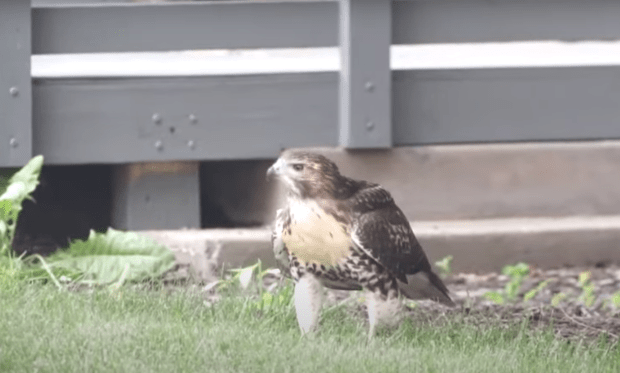
Ferris found K1 on a window ledge. How she got there is anyone’s guess. My goodness she is so cute. Whoever said that she is a mini-Big Red is so right. Her plumage is such a deep brick red and she has a full red-feathered belly band, too, with lots of peach on her chest.

Look at the image below. Notice the feathered area that extends above K1’s eyelid. It starts at the beak and goes to the back of the head. It is called the supercilium. The supercilium helps keep the glare out of K1’s eyes! It is often simply called a bird’s eyebrow.

Hawks can turn their heads 270 degrees. Sometimes it looks like they can do the complete 360 but they can’t.

You can see in the image below, despite it being blurry (rain at started), the peach on the chest and the low very dark feathers of the belly band.

The cere is the area around the nostrils above the beak. You can easily see it in the image of K1 above and below. It is light yellow. Notice that the eyes are a green-gray. When K1 is an adult they will be brown getting a deeper brown the older she gets.

Last year, Big Red and Arthur’s fledgling, J3, was born with deep brown eyes.

Ferris did some close ups of K1’s back so that we could see the scapular ‘V’. When both wings are held tight to the body it is the ‘V’ on the upper back. Examine K1’s scapular V. It has its own pattern. Some people use this along with the tail and the belly band to try and identify hawks that are not banded.

You can think of the scapular V as being the way the hawk’s back looks when the wings are closed.

K1 has a white terminal band on her tail feathers. In fact, it is rather wide. Notice the dark bands. When hawks fledge, we want them to have five, preferably six dark bands, so that they get lift and control and will be successful. K1 now has at least eight dark bands. We know that she is also an excellent flier.

The tail feathers help the hawk to do controlled manoeuvres. This is why it is so much better if they are longer at the time of fledge. The wing feathers – you can see the tips of them in the image below- are the most useful for flying. Did you know that the wing and tail feathers of the fledglings are actually longer than those of the adults? This is to assist them when they are learning to fly. After their first moult, they will grow in the standard length of an adult hawk (return to a normal length). Another interesting fact is that at the time of fledging, the feathers actually weigh more than the bird itself!

At the beginning of their second year, when they moult, the fledglings will get their red tails. When Big Red and Arthur bonded, Arthur did not yet have his red tail! Lots of people questioned Big Red’s intentions. She had many suitors but I think we can all agree that Big Red knew best. She has a wonderful mate in Arthur.

Ferris found K3 in one of the pine trees near to Rice Hall’s parking lot. What gave K3 away? Robins vocalizing!

K3 is looking at something intently.

K3 was doing a lot of preening. The preen or the oil glands are at the base of the tail. These oils reinforce or condition the surface of the feathers. Just like the oil you put in your car, the preen oil changes composition during the year. This oil, once it is exposed to sunlight, has been found to contain vitamin D.

Big Red was over on the ledge at Bradfield. I almost did not recognize her. In the summer when Big Red begins to moult, she starts becoming Big Blond. It looks to me like this process is starting.

But why do hawks moult? Feathers are made out of keratin, just like human fingernails. But unlike our fingernails, feathers do not continually grow. Once they are fully formed, they stop growing. Over time the feathers get damaged. This damage comes from normal wear and tear, the sunlight, parasites, and from injuries. These feathers have to be renewed. Hawks do not moult or change their feathers all at once. They would be unable to fly or function and would die. Moult is a gradual process. Big Red does not begin her moult during breeding season. It is too hard on her. The birds deplete their calcium producing eggs and Red tail hawks can lose approximately 20-30% of their body weight by the time the chicks fledge. Big Red will spend the summer and fall getting back into condition and replacing her feathers.

Feathers help the birds fly, they offer camouflage, and they also keep the birds dry.

Arthur was on ‘the throne’ on Bradfield. Neither Big Red nor Arthur moved from their locations during Ferris’s visit. Both Ks appeared to have a crop and neither were food begging. The crop is the first stage of digestion. It is like a pouch under the beak and the mouth. The crop expands with the food. The undigestables are rolled around in the crop to form a casting which the hawk throws up or ‘casts’. The rest of the food that can be digested enters the digestive system proper. The only raptor that does not have a crop is the owl. Owls have gizzards. If you watch Ospreys you will have looked to see if the chicks have crops. That way you can tell if they have had food recently.

It was an absolutely wonderful surprise. There is nothing nicer than spending the end of the day with Big Red and her family. I hope you enjoyed seeing them, too.

This is a great shout out to Ferris Akel. Thank you Ferris for taking your time to go and check on ‘the family’. It is wonderful to know that they are all fine and well.

What is gorgeous in Ospreyland?

This entire day has been ‘weird’. It started with only four hours sleep after checking on Tiny Tot’s nest all night. I have no idea what I was thinking. Tiny wouldn’t have flown from wherever she was just to be bounced about, would she?

And then there was the intruder on the nest. This intruder is just giving me a headache. I think I want Tiny Tot to show up on that nest so bad that I forget that there have been a number of visitors to the nest, several that Tiny Tot fought off valiantly. Still there is some kind of family resemblance.

This bird is still bugging me. It is nearly 4:30 pm. I know that I took a screen shot similar to the top one where you could see the white ‘V’ and the scalloped white of the crest making the heart. Tiny Tot had that. This bird has the thick short legs of Tiny and the sweep of the feathers is long BUT it is not elegant like Tiny Tot. The eyes are not the same. But then who knows what your eyes would look like after a hurricane.

This picture of Tiny was taken on 4 July the day before she ‘seemingly’ left the nest permanently for broader horizons. You will notice the white line above the wing is the same. Each of the birds have some dark on their legs, a little strip like a band but not a band.

And this is Tiny mantling her fish on 4 July.

Sadly, these birds are not banded and we only have images to compare that aren’t always sharp and from the same angle. What do you think?

Now, I think every bird is extraordinarily beautiful, but some more so than others. Today, the Dyfi Osprey Project posted an image taken by the individual who ringed two Ospreys in a nest in the Lake District in Cumbria England. They are females, Blue 460 and Blue 461. I took a deep breath and knew that I had to redefine what ‘gorgeous’ means when looking at an Osprey chick.

These are Monty and Glesni’s grandchildren. Their father is Merin. He hatched at Dyfi in 2015. They have Monty’s piercing orange eyes! Gosh I hope they do not lose them to become yellow. Look at the crest with the peach, the soft little white beards. I will be staring at these two beauties for days.

There are reams of files, both analog and digital, tracking UK Ospreys. And this again shows why it is important to get these birds banded. It is now known that at least four of Monty and Glesni’s chicks have returned to successfully breed. Of course, there could well be others. There is Aeron (Z2) who has been chasing intruders away from his PC nest at Glaslyn, then there is Tegid (Z1), one of my third hatch wonder children, who has a nest in Snowdonia, and Clarach in Aberfoyle, Scotland. Gosh, I would love to get a close look at the chicks of Tegid and Aeron!

Mama and Legacy were both asleep when I checked in at the Fortis Red Deer Osprey Nest.

There are both parents on the nest with Legacy yesterday. She is really growing now that the hot weather is gone.

There has been a lot of bad weather going around Alberta and there are dark clouds still around the Fortis Osprey nest at Canmore today. You can just see the two Bobs if you squint. Everything in the nests seems stabilized after a turbulent period of heat and storms. Warm wishes that it stays this way.

Here is a quick check in of a few of the nests. The Two Bobs at Rutland Manton Bay continue to perfect their flying skills after fledging. The Only Bob in the Clywedog Nest in Wales has been doing some wingersizes and the Two Bobs up at Loch of the Lowes are starting to think they might like to hover and fly. There could be a number of fledges coming up in the nest week. Mrs G has been catching fish and so has Aran. The overzealous two year old, Blue 022 has been bonding some more with CJ7 at the Poole Harbour Nest. If they both return from migration it will be great to see some chicks on that nest – the first chicks in 200 years born in Poole Harbour. Will that be the headline? The eldest fledgling of Big Red and Arthur, K1, the Red tail hawks at Cornell, probably caught her first prey item today – a little vole – witnessed by the Hornings. K3 enjoyed observing! Those two are excellent fliers. Can’t wait to take another tour with Ferris Akel to see how they are doing. Will be sure to let you know.

My friend, ‘R’ knows more about Albatross and Petrels than I will ever know. She is curious about the Goony Albatross that ended up in Bempton Cliffs in the UK. He should be in the South Atlantic. Maybe he thinks he is a yellow headed Short-tailed Albatross of the North Pacific? or a gannet? ‘R’ and I will try and put our heads around this one over the coming week. Here is the story on the BBC:

https://www.bbc.com/news/uk-england-humber-57683184

And what is this about the fish being addicted to meth? What happens to the birds that eat the fish? I will be following up on that along with a tribute to Tiny Tot and a story of a Sulphur-Crested Cockatoo in a Renaissance painting. Those are coming up this week.

Thank you for joining me today. Have a really enjoyable rest of the day no matter where you are.

Thank you to the following for their streaming cams where I grabbed my screen shots: Fortis Alberta Red Deer, Fortis Alberta Exshaw, and the Achieva Credit Union. I also want to thank the Dyfi Osprey FB Page where I took the screen shot of Merin’s chicks.

Saturday Evening with the Ks and a Door Dash for Tiny

I cannot tell you how delighted I am that Ferris Akel has been taking his tour to the campus of Cornell University. Ferris has a gift for finding the fledglings and an attitude of pure innocence and joy as he watches them with us. This evening K1 and K3 could not have been any cuter. There they were on the top of the Rice Building together. It was their interaction with one another that was so precious and extraordinary.

I am going to let you make up your own story as you look through the images. K1, the bigger female and the mini-me of Big Red, is on the left. K3, the little brother whose tail might be muddy but sure looks reddish, is on the right throughout the sequence. Enjoy!

Aren’t they adorable? Big Red was sitting calmly on the light stand and Arthur was on Riley Robb Hall making his way later to another light stand. For awhile, K3 was food calling. As well all know, Big Red’s kiddos never go hungry. K3 was just wishing for a bedtime snack! All is wonderful in the world of Cornell’s most famous family, Big Red and Arthur, the Red Tail Hawks, and their Ks.

Jack who will possibly forever be known as Daddy Door Dash to me brought Tiny Tot a fish at 6:47:12 on the Achieva Credit Union Osprey Nest. Again, I have a sequence of images. The facial expression of Tiny Tot is incredible. Feel free to make up your own story – but as you do, imagine Jack, at least a couple of times, as a ballet dancer with those legs of his.

Tiny Tot has gotten really good at holding its fish! Remember when he used to lose them to sibling #2? I don’t think that would happen anymore. Actually, I don’t think either of the siblings would mess Tiny about anymore either. If they tried, they might wish they hadn’t.

I hope you enjoyed these few images tonight. It is always reassuring when Big Red, Arthur, and the fledglings are located – as it is when Tiny Tot goes to bed with a nice fully tummy.

I have just received a new book, Queen of the Sky. It is the story of a rescued Peregrine Falcon by a fabulous woman in Wales, Ffion Rees. I can’t wait to read it and tell you about it! I will continue to monitor Tropical Storm Elsa as it passes over Cuba on its way to Florida.

Thank you so much for joining me. Take care. Stay well.

Thank you to the following for their streaming cams where I took my screen shots: Ferris Akel’s Livestream on YouTube and Achieva Credit Union.

Friday Night fun with Ferris and the Ks

I did not expect Ferris Akel to be over on the Cornell Campus tonight finding Big Red and Arthur and showing us what the Ks were doing but, he was there and I am terribly grateful. I want to share some of the images from this evening so you have an idea what our favourite Red Tail Hawk family was doing today 2 July 2021.

The event began a little earlier with Arthur dropping off a chipmunk on the nest at 17:47:08.

Here comes Arthur with that tasty little snack.

Arthur is looking around to see if any of the Ks saw him with the chippie and will follow him to the nest tower.

Time to get out of the way because here comes K1! And she is obviously hungry.

This gives you a really good view to K1’s gorgeous tail. Doesn’t it look like white scallops on each feather? I can count nine dark stripes. No wonder she is such a good flier.

At some point K3 comes over to the nest tower and finishes up the chippie that K1 had left. And then they are both off on their adventures.

One of the things I love to watch are the hawklets playing soccer with the pinecones. It is really good training for gripping their talons and holding on to prey. K1 found something that she was gripping and tossing – turns out it was a piece of asphalt. Yuck!

K1 had such a fun time playing. She is certainly good at entertaining herself.

When she finished playing, she flew and landed in one of her favourite trees.

Ferris had been able to locate everyone except K3. Ferris decided to check behind the Rice Building and then he heard Robins alarming. There sitting quietly in the pine was K3.

K3 remains in the pine trees provoking the Robins and K1 flies to the nest tower. Here is she is below. Maybe K1 will stay there as it is actually getting quite late.

Big Red, on the right, and Arthur, on the left, are clearly ready to call it a day. Good Night everyone!

Thank you for joining me. It is always wonderful to watch what Big Red, Arthur, and the Ks are doing. It is magic how fast they learn and grow!

Thank you to Ferris Akel for his love of the birds, his knowledge, and generously sharing his time with us. If you would like to follow the Ks or go on other Ferris Akel tours, everything is free. Just go to YouTube, do a search for Ferris Akel Tours and subscribe. Hit the bell for announcements. You will get an alert to when Ferris is livestreaming. Ferris will be on the Cornell Campus tomorrow. His tour normally starts at noon on Saturday, Eastern Time.

I have had several letters asking me about why certain nests get help from the wildlife rehabbers and others do not. I hope to have a complete answer formulated for my Sunday blog. It is a very complicated question that deserves a very considered answer.

Bird World News: Rescues, a fledge, and a Hurricane?

I want to give a shout out to Fortis BC for helping the South Okanagan’s only birds of prey rescue centre, SORCO, retrieve two baby Ospreys from a nest in Penticton. People saw the babies hanging over the sides of the nest panting and looking very dehydrated. The parents were unable to feed them because of the extreme heat driving the fish to the bottom of the rivers and lakes.

The Osprey platforms are out in the open – in the direct sun – and the chicks took a real hit by the heat when temperatures in the area rose into the high 40s on Wednesday.

@ CastaNet News Kelowna
@CastaNet News Kelowna

The babies are being fed and rehydrated. SORCO says they are doing well. They will be kept in care for approximately six weeks. SORCO says they have rescued 23 raptors during the extreme heat wave.

Elsa is now a hurricane and is expected to impact Florida and the region of the Osprey nests in St Petersburg early next week. The National Hurricane Centre is advising everyone to keep an eye on the hurricane as it now develops and what happens after it passes over the Antilles. You can follow the news here:

https://www.nhc.noaa.gov/graphics_at5.shtml?start#contents

All of our eyes will be on that system now that it has strengthened from a Tropical Storm to a hurricane because of our beloved Tiny Tot at the Achieva Osprey Nest in St Petersburg. The hurricane is currently located over Barbados (the white circle in the purple area).

Electra did not spend the night perched on the Cowlitz PUD Osprey nest but she has returned sometime this morning before 7am nest time.

The female chick, Blue 095, at Rutland Manton Bay has fledged today, 2 July, one day after her brother, Blue 096. Here is that flight:

It is definitely getting harder, at first glance, to tell who is who on the Foulshaw Moss Nest in Cumbria where Tiny Little Tot lives on the nest of White YW and Blue 35. Indeed, Blue 35 is testing the kids self-feeding skills today!

The male claimed the fish that arrived and didn’t do a bad job with the self-feeding. Tiny Little was right there hoping he would share! or feed him!! I do hope Blue 35 feeds Tiny Little today and doesn’t just let the bigger ones grab all of the fish.

The last time I saw Tiny Tot on the Achieva Credit Union nest she was waiting for a fish delivery. K1 and K3 had been fed and were over together on the Rice Building. So all is well in Ithaca.

Take care everyone. That is our early morning nest round up for Friday, 2 July.

Thank you to the following for their streaming cams where I get my screen shots: Cumbrian Wildlife Trust and the Foulshaw Moss Osprey Cam and the Cowlitz PUD.

Featured image is FortisBC and SORCO going up to rescue osprey chicks in Penticton.