Little E3 eaglet is strong!…Ron is settled but how about Gabby? and other news in Bird World

27 December 2022

Good Morning,

We are out of the freezer but it is a dull day. -11 but getting warmer – up to -7. Grey. It is so nice to get up and not feel cold even when the furnace is blasting. Thoughts for all those people without power and who have been hit with relentless bad weather as well as for our bird friends who are getting hit by these weather bombs. To our friends in Australia who will be hit with +37 C temperatures today – stay cool!

I had a letter from ‘J’ the other day asking how on earth we manage when it is so cold, like -26 or -35 C. I will try and answer it but, first, a little story. When I first moved to Canada, it was entirely possible to have several months where the weather did not vary during the winter. It was always colder than -25, always. With climate change, we no longer have those very long stretches of being in such dire cold weather. The majority are, however, equipped for it. Our houses are well insulated from top to bottom. The window panes in my home are triple paned with argon gas between the panes and a coating that absorbs the sun for warmth in the winter and sends it back out for the heat of the summer. There are now companies who make nice looking winter clothing rated to -40 C. That includes coats and boots. The majority of cars also ‘plug in’. There is an electric heater to keep the oil warm. —– It is not so bad. Today, we are going to have a warming streak where the temperature will be only -7 C. It is those days that you want to get out and go for those walks in the forest and that is precisely what I hope to do on Wednesday!


A couple in Perthshire have a nesting Brown Honeyeater on their high-rise balcony! Oh, how super. Such an adorable little bird. They are abundant throughout Australia.

To bring a sense of excitement to your day, stop and watch this incredible video by Mark Smith of a young Brown Pelican trying to ‘eat’ an Osprey! Who will win?

Rare leucistic. Red-tail Hawk seen in Mystic, Connecticut. What a beauty!

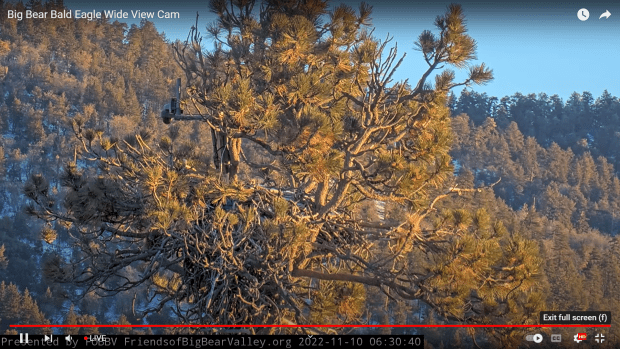
Shadow and Jackie were there at sunrise —-continuing to do some tidying up on the nest. Must admit that I am getting really excited and hopeful that this wonderful couple can pull off another highly spirited eagle like Spirit who hatched in 2022. They are an incredible eagle couple. Wishing them the best.

No obvious eagle activity on the nest today in Minnesota but it looks like Nancy and her new man might have been around at sometime.

There is, however, lots going on at the E3 nest in the Kisatchie National Forest since the first eaglet hatched after 0300 on the 26th. Dad Alex has brought in a Coot and several Crappie. Adorable. The second egg is expected to hatch on the 28th.
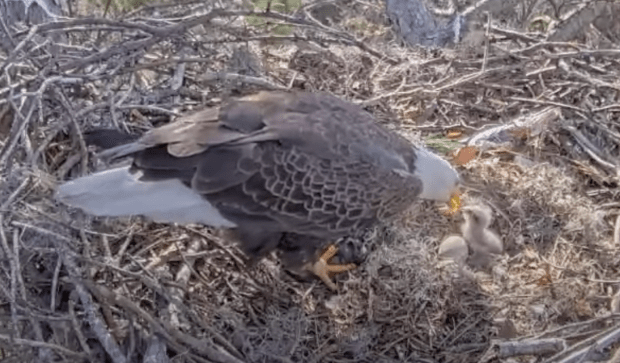
A video of one of the feedings. Gosh this little eaglet is a cutie.

Pepe and Muhlady have been busy bringing in fish and feeding the eaglets but, those two are the best kept secrets. The parents seem determined for us not to get even a peek of them!

PePe brought in a nice catfish and Muhlady took a moment to look down at her growing youngsters.

Indigo had a green parrot today. Did he catch it? was it a prey drop from Dad or Mum? It is not clear but he did jump all around the scrape and guess what? Indigo ate every bite of that prey so when Diamond came in to check the corner for leftovers —- there weren’t any! It seems Indigo likes a parrot as much as his mother does. I wonder if Diamond would have searched if it had been a Starling?

You might well recall an image of Izzy with a green parrot (I think his was a Supreme Parrot) in quite a similar position as Indigo today.

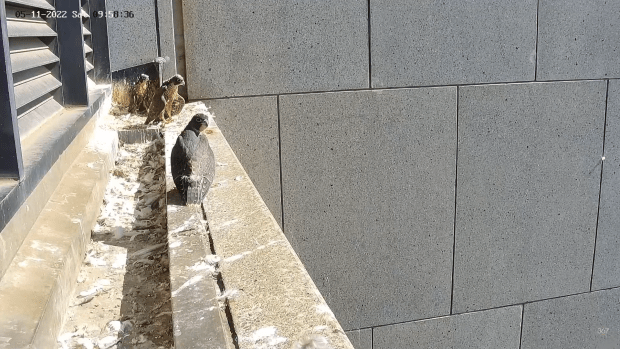
In San Jose, another male was in the scrape box. This time it was Sequoia, the son of Grinnell and Annie, bonding with his mate. Oh, we will have another falcon scrape to watch with little eyases this year. This is wonderful.

It was Annie at The Campanile today. Where was the new guy? I might have missed him!

So who is visiting Gabby today? Your guess is as good as the next person. No one can keep up and there are so many marks that are similar with perhaps new eagles coming in, that it is impossible to keep up. And, last night, I went to sleep thinking this revolving door at NEFlorida was ending. Guess not.

Has she made a choice? Will he stay?

It has not been that long since the male at the Centrepoint Bald Eagle nest died. Mum, however, has a visiting ‘friend’ and she is warming up to this suitor.

The Bald Eagle couple at Fort St Vrain in Colorado lost one of their beautiful eaglets to a raccoon last year and fledged the other. Since then measures have been taken to prevent the raccoons from climbing up to the nest. How wonderful! The eagles are now working on their nest and were there today. Eggs are usually laid in mid-February.

Can you imagine heading out on a nice walk on Boxing Day and finding a river full of dead pheasants? What a horrible sight that must have been. Raptor Persecution UK is investigating. It is believed that the birds are ones that were killed as part of a shooting party on one of the nearby game estates or did they come from a pheasant farm. You can find the entire story at Raptor Persecution UK.

Of course some worry that the birds might have Avian Flu. Surely the proper authorities after having been notified of this travesty will investigate thoroughly.

It does look like Ron has made a choice with V2 female named Rose by the AEF. Heidi followed their courtship in a series of videos that you might enjoy watching. Thank you ‘H’.

A prey gift from Ron on Christmas Eve:

Nestorations and Bonding:

Ron and Rose’s relationship Blossoms:

Keeping your fingers crossed for Gabby!!!!!!!!!!! Ron certainly appears to be settled. Pip watch for Harriet and M15 is 3 January. Second egg at Kisatchie National Forest is the 28th. Must check on the dates for Connie and Clive as well as Missy and Pa Berry.

Take care everyone. Thank you so much for being with me. Stay safe and warm or cool depending on where you are. See you soon!

Thank you to the following for their questions, announcements, postings, videos, and streaming cams that make up my screen captures in my blog: The Guardian, Mark Smith, News Times, FOBBV, MN-DNR, KNF-E3, Superbeaks, Charles Sturt Falcon Cam and Cilla Kinross, San Jose City Hall Falcon Cam, Cal Falcons, NEFL-AEF, Centreport Eagles, Ft St Brain, Raptor Persecution UK, ‘HM’ and her videos of the WRDC.

The Flight of the Osprey and more…in Bird World

21 December 2022

Oh, good morning to you. It is Winter/Summer Solstice depending on where you live. The shortest day/longest night OR if you are in Australia, the longest day and the longest night.

It is cold on the Canadian Prairies. The temperatures plummeted. Yesterday we had beautiful blue skies and sun but it is overcast today and still cold. It is -24 this morning as I write this.

Oh, I do love getting your letters and comments. I learn something new every day. In the mail, ‘V’ asks, “Are you aware that Blue Jays are rare in the PNW? I live in the Seattle area and we have scrub jays and stellar jays but, I haven’t seen a blue jay since I left the midwest.” I had no idea! So, as you are reading this, think about dropping me a line to let me know if you have Blue Jays where you live. I would be very interested to know!

It would be really nice to walk along with the dogs and see all the raptors, to be followed by a Red Kite. How grand!

https://www.theguardian.com/environment/2022/dec/19/country-diary-raptors-are-always-the-most-visible-creatures-up-here?CMP=share_btn_link

Maybe what New York City needs is a lot more raptors. Raptors are proven to get rid of more vermin than any of the modern day rodenticides that if consumed by rats can cause huge secondary poisoning in pets and raptors. Just think of those lovely Red-tail Hawks living around Central Park seeing a slow moving rat because it ate rodenticide! I hope that the individual who has this position considers an alternative and if you live in New York City and love the birds and raptors, who take your pets for a walk, maybe you should write this new rat ridder a letter and let him know your views about using raptors.

https://www.theguardian.com/us-news/2022/dec/19/new-york-rats-eric-adams-meera-joshi?CMP=share_btn_link

K4 at his roost in Guinea

Thank you to geemeff, we have the final link on YouTube for the discussions with the Flight of the Osprey tem. Topics how important tagging is in conservation, finding out the challenges for the ospreys in their winter homes, and this wonderful bird, 4K from Belvoir Castle. Please take the time to listen. You will really enjoy the effort, the villagers, and then the spotting of 4K. You will learn much but, this entire programme sets out to help the conservation of the ospreys at their winter homes, their spring and summer breeding grounds and their migratory routes. It is so heart warming that the visit of Sasha Dench and others to the villages where the UK Osprey winter will help them appreciate the birds and the need to help them if they get caught in the fishing nets. Maybe someone – a kind resourceful individual will figure out a way to remove the garbage from Africa – the plastic bottles and the nets that are no longer useful so that they do not wind up in the rivers, the mangroves and the oceans. It can be done if there is a will to do it.

The Flight of the Osprey is about migration and conservation. Today, Hawk Mountain released its end of the year report for the migration over the mountains in Pennsylvania. Here is that count:

Elain can capture a day in the life of the Peregrine Falcons at Orange, Australia in a few minutes. Thank you! Your editing is so welcome and wonderful. It seems that Indigo is very loud and still at home. Diamond has been sneaking in and taking Indigo’s stashed prey out of the corner and eating it. There is a lesson there: eat everything you can when you can – you don’t know who will steal it and when your next meal will arrive!

At Port Lincoln, Zoe is developing her diving skills. Do not be surprised if she comes up with a fish one day!

Someone spread the word around Ron’s nest that he is now an eligible bachelor according to Sassa Bird and the females are coming from hither and yon to try and win his affections. The WRDC nest is turning out to be like Gabby’s. Who knew so many eagles wanted to be streaming cam stars?

She seems to like him! But does he like her?

At the NE Florida nest of Gabby, we await our ‘Queen of the Nest to return’ and guess who is on a branch waiting for her too? V9. It is nearing 1700 when Gabby returns to the nest. Fingers crossed.

Gracie Shepherd caught V9 and Gabby last night getting closer on the branch.

In Louisiana, it has been pitching rain. Louis came to the nest to protect Anna. What a darling.

Except for Zoe, it is all about the eagles right now. There are so many nests. At this time of year as many worry if Gabby will have a mate, if Ron will settle with one of the females, or if you are worrying about Avian Flu, let us stop. I have posted this thirteen minute video before but, it is good to do it again so that we can be reminded that human intervention can save the lives of our birds and it can also help them in being able to return to the wild. We can make a positive difference!

Look at those faces. Oh, I can’t wait to see little eaglets and osplets again!

Thank you so very much for being with me today. Please take care. See you soon!

Thank you to the following for their questions, posts, videos, and streaming cams that make up my screen captures: ‘Geemeff’ and ‘V’, KNF A-1, Gracie Shepherd and the NEFL-AEF Bald Eagle Cam, NEFL-AEF, WRDC, Port Lincoln Ospreys, Elain and Charles Sturt Falcon Cam and Cilla Kinross, Hawk Mountain, Conservation without Borders, The Guardian, and Stockholms Vildfågel Rehab.

Ron has a mate or two?…and more news from Bird World

20 December 2022

Good Morning to All,

Today is hair cut day in our house and the hairdresser is coming to us! I knew a wonderful woman who started this service when I lived in the UK. It would have been perfect during the pandemic and we wish this young person well. I am thrilled not to have to dig my car out of the snow! Nonetheless, the sun is trying to poke out of the clouds and blue skies are coming. It is now -21 degrees C and either a good day to stay in as planned or a day for a heavy coat and boots!

Nest News:

It seems that we are still waiting to see things settle down for Gabby. However, Ron is looking younger and feistier than ever with his new gal. It was a big surprise when I got a note from ‘H’ in the mail. It seems that Ron in the Miami Zoo was busy courting while we wondered if he was out fishing. Busy working on the nest. We all thought he was pining away for Rita! Well, it appears not. There is a new woman and as ‘H’ suggests, it looks like he has been cultivating the relationship for awhile now.

Here is a short video clip of the female bringing in a stick to the nest. Ron didn’t mind. It was as if he was expecting her. I suspect he has been courting her for some time before asking her home!!!!!! He wants it to go well.

Well, my goodness. You are a sly one, Ron! She is a beauty. We are all so happy for you knowing that we knew Rita could not return. It looks like you knew that as well. Congratulations! I hope she loves your Papadam nest built by Ron Magill and friends! For a long, long time. Some are suggesting her name is Rose. I do not yet know if that is official but, there is talk about banding future eaglets from the nest so we can learn of their dispersal. That would be wonderful.

Well, just when we thought it was settled for Ron there is a new female in the nest this morning! Goodness.

Things still do not seem to have settled at the nest of Gabby. Oh, how we all wish to wake up and see a handsome lad on that nest who can not only win Gabby’s heart but keep all of the other intruders at bay.

Lady Hawk caught the interaction between V4 and V6.

The AEF got it, too:

As night falls, it appears that V6 is back on the nest with Gabby.

There were some chortles happening when the IR camera came on and V6 flew to another branch (or off the tree altogether).

To be continued….Gabby and the Revolving Nest!

Iowa has received its share of snow. The landscape is lovely and the Eagles at Deborah are working on their nest today despite the weather.

This is the nest over at Decorah North today.

Liberty and Guardian were checking on their nest today, too. It was early morning in California! Everyone it seems is starting to think of breeding season! So nice to see you Liberty and Guardian.

Port Lincoln did a 23 minute close-up video of Zoe. She is really beautiful and I hope her and her pink bracelet thrive. Her flights are not going far from the barge. Perhaps in the new year.

I have to give Pepe and Muhlady a big hand. What a great parents they are. Pepe keeps huge fish coming on to the nest and Muhlady continues to care for the eaglets. It seems that even Pepe has turned out to be excellent at feeding those chicks. You can hear them and we are beginning to get better glimpses of their little heads. I am always reluctant to recommend a new nest but, I am going out on a limb and suggesting you might want to watch this one! I will put the camera link below.

Well, that is what it does to me every time I try to copy their link. Go to YouTube and search for Superbeaks Eagle Nest. You will find them!

Pepe has just brought in another one of his sharks and he seems to be quite hungry. The little ones are asking for fish, too and he is happy to oblige.

Connie and Clive have beautiful weather to incubate their two eggs on Captiva Island, part of the Barrier Islands hit so badly by Hurricane Ian.

I didn’t see Jackie and Shadow at Big Bear today but you can hear the snow dripping as it melts slowly up in the mountains east of Los Angeles.

Here is the link to their new cam if you do not have it.

One of my favourite nests is E-1 in the Kistachie National Forest of Anna and Louis. Two years ago this young couple hatched and fledged the first eaglet off this nest since 2013. Louis is a tremendous fisher – Master Class all around. He piles the nest up. They had a fledge in 2020 and another in 2021. Let’s see what happens this year. We can be sure that Louis will bring in a lot of fish (our there is something seriously wrong) and Anna will be equally hungry – she loves her fish, too. There is a chat and a great team of moderators including Tonya Irwin and the rangers, Cody and Steve.

From the Mailbox:

‘G’ sent me a link to a nest in South Africa that has new babies, just hatched. The nest was built for Bush Babies but the feathered friends took it over.

So what is a Green Wood Hoopoe? I didn’t know and this is what eBird says, “An elongated, metallic-green-black bird with red feet and a long, decurved, red-orange bill. Juveniles have dark bills but are often in the company of adults. It flies heavily, with the long floppy, white-tipped tail dangling behind. Pairs and groups of up to 14 birds are highly social, occupying savanna, woodland, riverine forest, and gardens, where they nest and roost in natural cavities. Clambers in trees, probing bark and crevices for insects and small vertebrates. They communicate using a strong cackling chatter that sounds maniacal. The almost identical Grant’s and Violet woodhoopoes (with which it sometimes hybridizes) differ from Green Woodhoopoe only by having a coppery-purple (not glossy greenish) metallic sheen.

This nest will be fun to watch. Great timing too.

Migration News:

Checking on Karl II and his family. There has been no news from Karl II and Kaia since they arrived in Africa. Kaia was in Chad and it is assumed that Karl lost contact and is safe in his winter grounds. All contact was lost with Bonus when he flew over the Eastern Desert. The only one of the Black Storks from Karl II’s family still transmitting is Little Waba who continues foraging around the Nile River. The joke is he went down one side and is going back up the other. The fear is he will land in Khartoum.

Still, he is safe, he is eating, and he is moving. That is what counts right now!

The area is near the eastern shore of the huge Merowe Reservoir.

Let us hope that the entire family of Karl II has a good winter and returns safely to their nests in Estonia in the spring.

‘J’ wrote to ask me how the book was going. Well, Slow Birding is highly recommended! I was not distracted to go to one or another projects and I am about a third to a half finished with it. The writing is excellent and covers birds such as the Blue Jay, Cooper’s Hawk, European Starling, Cedar Waxwing, Northern Flickers, White-throated Sparrows, and American Coots amongst many others. I had no idea that there is not a State in the US that does not have a Blue Jay for its ‘bird’. How could this be? The author, of course, asks the same question. Just watching Junior and the three nestlings grow to fledge this year with the little ones tapping on the window when the peanuts were gone was incredible. They brought laughs and big smiles every day. Their noise does not bother me. Indeed, like the Crows, they are most loud when the cats come around wanting to harm the other birds. The author obviously loves her garden birds and did, when she was teaching, have her students undertake slow birding. There are activities within the book but, I promise you will never look at a House Sparrow the same way you did before reading this volume. I do highly recommend it and if you have a birding friend that needs a gift, it would be a welcome one to their library. There are no beautiful coloured photographs which is fine. I prefer a good read. There are some lovely black and white drawings and it is the text that is so remarkable!

For those who have marvelled at Alden and Xavier helping out with the eyases or the new M2022 at Melbourne, many scientists did DNA tests on quite a large number of nests of the different birds in the book. Many males were found to be caring for the chicks of another! This includes European Starlings. The book is full of similar findings that are quite intriguing. There is something to learn on every page.

It is a lovely sympathetic book bringing out things about the most common of birds that are relatively unknown. I think you will appreciate these garden birds much more after reading it. Sadly, it focuses on the US and I know my friend, ‘J’ who has never seen a Blue Jay in Germany would love to! Maybe someone will do a backyard study of European birds. I would enjoy learning about them, too. Perhaps it is you. But please do not think, for a second, this book would only be useful or of interest to Americans. There is plenty of science and cultural traditions weaving their way through the pages and mention of other countries that I think anyone would find it a great read – and useful to return to as a reference. There are few volumes I can say that about.

Speaking of books, here is an announcement that might be of interest to some of you:

Thank you to everyone for being with us today. Take care all. See you soon!

Thank you to the following for their posts, their videos, their notes, streaming cams, etc that make up my screen captures: ‘G’ and ‘J’ for their notes and suggestions, Pacific Rim Conservation, Looduskalender Forum, Live Nest Cam and the Green Wood Hoopoe, KNF-A1, Window to Wildlife, FOBBV, Superbeaks, Port Lincoln Ospreys, Redding Eagles, Deborah North and Deborah, Explore.org and Raptor Research, Lady Hawk, WRDC, NEFL-AEF, and J Strassman, Slow Birding.

Gabby and V3, Hen Harrier chicks stomped to death…and other news in Bird World

15 December 2022

Good Morning Everyone!

My goodness. Can you believe that we are 16 days away from 2023? Did we blink and 2022 flew by? The good news…it seems that Gabby might have been persuaded by V3’s charms. They were in the nest together and on the branches this morning!

In the garden it is snowy wonderland. About 17 cm fell – or should I saw blew in from Colorado with some more to come today. The birds do not like the heavy wet snow any more than I do. Mr Crow flew in and complained along with 27 European Starlings and a host of Sparrows.

The Starlings also knocked a solid seed cylinder to the ground and have been trying to eat it. I don’t think they like getting their feet in the snow.

The lone Blue Jay, Junior, has decided that eating the soft suet like the Starlings is a delicacy. So happy to see him enjoying it. Of course, Dyson is busy working away at the brand new solid seed cylinder that I put out this morning. Apparently Dyson & Co can eat a whole one in two days. That surprised me. They must have been eating all night!

In the World Cup of Birds, it is the French Gallic Rooster versus the Argentinian Rufous Hornero.

João de Barro / Rufous Hornero (Furnarius rufus)” by Wagner Machado Carlos Lemes is licensed under CC BY 2.0.

Cockerel, The golden Gauloise, whose male is named Gallic Rooster, (51650492815)” by gailhampshire is licensed under CC BY 2.0.

In Vancouver, a rare Warbler has been found and rescued in a parking garage.

Endangered bird not native to B.C. found in Vancouver parking garage

Channel Islands eaglet seen. San Miguel is the most remote of the islands and in this article Dr Peter Sharpe says he has not been there since 2017. The spotting of the eagle is excellent news.

Deborah North Eagles caught mating. New season. New Hope.

Goodness. That Pepe at the Superbeaks Bald Eagle nest in Central Florida had some good fishing today. Just look at the size of the fish he brought in for the family! Incredible.

At the California-Berkeley Peregrine Falcon scrape of Annie, the new guy continues to come and try to wow her. However, twice he has brought prey and twice he has eaten it! I don’t think he read the ‘courting’ manual carefully. Annie is too much of a treasure. Let’s hope that this new guy shapes up or ships out!

In Louisiana, there was severe weather and tornadoes. Tonya Irwin reports on the nests in the Kisatchie National Forest:

It looks as if the male at the Metro Aviation Nest in Louisiana got hit by flying debris on his head ?? or had some other injury. It seems he will be alright.

This is a long but, a good eye-opening read from the Raptor Persecution UK. It has been suggested by Geemeff that I give you a warning before reading this. It is distressing to the extreme. Baby Hen Terriers stomped to death by humans!!!!!! Having just read Bowland Beth and a stack of books on the plight of the Hen Harrier and the Red Kites, I find this article distressing. How can we convince people that all of the animals have as much right to life as we human animals do?

Early morning at Port Lincoln and Zoe is wishing for a fish!

We will miss that amazing Indigo when they leave the territory of Xavier and Diamond. Indigo is adorable. He has been stashing his leftover prey in the corner and Diamond has been taking it – obviously to teach Indigo many life lessons. He retrieved his prey from Mum. Look at how proud he is!

As Wednesday ends at The Hamlet, Gabby and V3 are on the nest tree together.

This image of Gabby with V3 is from this morning, Thursday 15 December. It seems Gabby might have made up her mind!

Two other love birds…Samson and Jackie. Oh, stay safe you two!

And last, some very good news sent by Geemeff —especially if you have been following The Flight of the Osprey! A live event…

https://m.facebook.com/photo.php/?fbid=471505791824836

Thank you so much for being with me today. Wherever you are, take care. See you soon!

Thank you to Geemeff for the heads up on the Flight of the Osprey live discussion. Thanks to the following for their postings, videos, and streaming cams that make up my screen captures: FOBBV, Port Lincoln Osprey, Charles Sturt Falcon Cam and Cilla Kinross, NEFL-AEF, Raptor Persecution UK, Tonya Irwin and Raptors of the World, Cal Falcons, Superbeaks, Raptor Resource and Explore.org, and Vancouver City News.

Gabby’s new man, wind farms in Tasmania and more…in Bird World

8 December 2022

Good Morning Everyone!

Thank you for all your comments and mail. I am very behind in responding and I apologise but, I will before the middle of next week! Keep them coming!

Oh, it is another beautiful day in the Caribbean. Hot. There was little wind and the water was as smooth as glass. It is hard to imagine huge traffic jams and security guards everywhere, that was what happened here today. The Cuban Diplomatic delegation is here to discuss all manner of things with the new Prime Minister of Grenada. There is also a medical conference with a lot of Cuban doctors. So, we spent the day away from the main area of St George’s at the ‘family friendly marina’, Le Share Bleau. The couple that run the restaurant are excellent chefs and they are from Manitoba! The young man grew up in the area of the city where I live.

At the same time I got to check on that Great Egret that has his own private pond!

Everything is cared for here and is beautiful to the eye as well as to the soul.

Christmas decorations began going up last weekend.

There is no reason for this Great Egret to ever leave. It has an entire pond with fish to itself!

An incredibly beautiful bird.

A Coconut Tree. One of the best ice creams on the island is Coconut. The second really good one is Nutmeg.

The Tropic Mockingbirds love to eat the fruit of the palm tree.

This Tropical Mockingbird sat still long enough for me to get a good photo!

It is a gorgeous island that is trying to be good stewards. Plastic bags were outlawed awhile ago but you can still see them. Plastic drinks bottles are a problem – what do you do in an area where the water is not always good to drink and there is a growing number of tourists? Do you put up water stations and everyone has their own recyclable bottle included in their ticket price? Plastic imports carry a higher import duty than other materials that can be recycled. The upmarket shops have lovely jute bags for their customers. Many groups work on shore clean ups. They are trying – there remains a lot to do like there is everywhere.

One of the biggest pollutants does not occur in Grenada but in Brazil where the fertilisers used in the fields runs off the land and into the ocean where it mixes with the seaweed. That seaweed finds its way to the Grenadian coast and then rots giving off noxious gases.

Coming out of the COP 15 Biodiversity Conference in Montreal is the statement: “Humans are instruments of mass extinction”. There has been nearly a 70% decrease in wildlife since 1970. What will be the next Dodo bird? And why aren’t we ready to tackle this and start b being good stewards?

Here is that story:

https://www.theguardian.com/environment/2022/dec/06/canada-leads-calls-to-reverse-nature-loss-as-cop15-opens-in-montreal?CMP=share_btn_link

And another one on two birds that are now thought to be added to the extinct list – the Rook and the Swift. The number of birds added to the Red List – which I was including in all my blogs before the holiday – has doubled. This is just so sad. As a world population we need to stop what we are doing and have a reckoning with ourselves on what is really important to us – what is essential. Not a want but a need.

https://www.theguardian.com/environment/2022/dec/07/rook-and-swift-added-to-threatened-bird-species-list-in-wales?CMP=share_btn_link

One of the good things that the hotels in Grenada do for the birds is maintaining beautiful gardens. The fruit from the trees and the nectar from the flowers feeds multitudes of birds. The ponds – if stocked – attract the herons. Off the beach this morning were a pair of Frigatebirds. The tourists like the birds and the flowers. While I was taking photos of the hummingbirds last evening, a big crowd stopped. They had not see the little one flitting around. Everyone had a smile. Now to spread this love elsewhere!

So tomorrow is my last day here. I will not be back in the cold of the Canadian Prairies until Friday afternoon. Oh, the cold. I am not looking forward to that but, having a week away was a gift.

So, let us see what is happening in Bird World.


Just look at that face. How incredibly cute! Just know that the only time you could cuddle with this little one is when it is not feeling well or is under anaesthesia. After you look at the eyes, move down to that killer beak and well, we can’t see the talons but Victor Hurley calls falls ‘all blood beaks and bloody talons’. The fastest flying predators in the world.

Oh, if they could only market a plush toy as cute as this guy. Hi sweetie.

First up is a question from ‘O’: ‘What is happening at the Melbourne Scrape?’

Well, nothing. The Melbourne Four all fledged. One was lost early in a flying accident and had to be euthanised. The little male was recently taken into care and released with a comment that he was really healthy. The parents lay the eggs and raise the eases to fledge at the scrape box on the ledge of 367 Collins Street. They will teach them to fly and hunt prey around the CBD area. The camera is normally turned off until the following breeding year. Whether or not the parents return with the chicks to the scrape is unknown because of this.

Here is the announcement from Wildlife Victoria:

Annie and Grinnell’s 2020 fledgling, Sequoia, is making news with his meetings with a female at San Jose City Hall, BA24. There is a streaming cam and all are hoping that the pair will form a bond and raise eases. But, will they?

News on Glen, the last surviving Osprey fledgling from Tweed Valley made the news:

Sharon Dunne aka Lady Hawk gives a look at Harriet and M15’s eggs for this year and some of the daily activity at their nest in Fort Myers, Florida.

‘D’ sent me this screen capture making the rounds. This is V2, the visiting male at the NEFlorida nest, who has mated with Gabby. Yes, he does have the most gorgeous soft blue eyes. ‘Celadon eyes’. Celadon was a 9th and 10th century glaze perfected in China for use on porcelain. Celadon glazes ranged in colour but one was like water…that is like the eyes of this eagle.

Some are wondering if there is any possibility that he could be another offspring of Romeo and Juliet and thus, Samson’s full brother. Samson hatched in 2013. The tragedy at the nest occurred in 2018. So, is there a possibility? Perhaps. Like males do, Samson returned to his natal nest so, could this be a 2017 fledgling?

V2 got introduced to the problems with owls.

Jackie and Shadow are working on their nest. They were there today. The California Big Bear Valley could do not normally lay their eggs until January and as late as March.

There have been many times that Indigo has not been able to finish his prey so, like a good little falcon, Indigo stashed it in the corner as he had seen his parent’s do. Well, Diamond has been snatching that prey! So Indigo has been staying in the scrape much longer keeping an eye on his lunch.

Zoe has been diving and flying. Dad delivered his beautiful girl a nice little fish this morning.

At last some intelligence about wind farms and how they impact birds — and a compromise in Tasmania.

For all the eagle lovers, ‘N’ sent me this image…it is perfect for all of us. Smile!

Thank you so much for being with me. My next blog will come out Saturday morning so there is a break on Friday. Please take care. See you soon!

Thank you to the following for their letters, questions, photos, videos, postings, and streaming cams included in my screen captures: Friends of Big Bear Valley, Port Lincoln Ospreys, Elain and the Charles Sturt Falcon Cam and Cilla Kinross, NEFL-AEF, Sharon Dunne/Lady Hawk and SWFL-Bald Eagles and D Pritchett, San Jose City Hall, STV News, Wildlife Victoria, ABC News, The Guardian, and ‘N’, D’ and ‘O’.

Zoe flies more, rare Albatross incubate their egg…and more news in Bird World

24 November 2022

Good morning to everyone and the best of Thanksgiving to those celebrating in the US today.

It has been wonderfully warm on the Canadian Prairies. I do not know if it is atypical for this time of year but, it certainly feels like it. The birds in the garden had some of their feeders rearranged and thanks to a lovely friend I swopped out some old feeders for some she gave me yesterday. One of the visitors today was a beautiful Starling. It’s an immature non-breeder. Note all of the white spots on his breast and it has yet to get its oily black head. The males and the female Starlings look alike. Did you know that? One difference is that the beaks of the males are a deep blue while those of the female are a pink colour. This then looks like an immature non-breeding male.

Look closely and you can see their rose coloured legs. It is also a pair of non-breeding adults. They are really loving this soft suet.

The Starlings will not perch on the metal. I do not know why. They want to lean down from the branches to get to the suet. You can see this behaviour in the image above also. So the feeder below was moved so they could more easily reach it! Who says I am a softie?

Junior was grateful for a bowl of corn today.

One of many varieties of the Sparrow family that visit the garden. They are particularly enjoying the Butter Bark Balls on these damp days.

The kittens have had great fun watching the birds and the squirrels. They continue to find places in the house to get into mischief. And they do not always come when they are called setting in a panic that they have miraculously gotten outside in the cold. Of course, they are somewhere laughing (do cats laugh?) while I panic!

Missy has discovered a Rodney Mott sculpture that is just perfect for hiding in. Lewis is in the overturned basket not even showing a whisker.

At the Australian nests, Zoe took off for her first flight of the day at 0901. It was an absolutely perfect take off and her landing at 0907 was spot on, too. She is a very strong osplet. I do hope she gets some nice fish. It has been 24 hours since she last had some food.

While the camera was down for a couple of yours, Dad brought in fish. We are only seeing the tail of the fish but I hope that Dad had some nice fish – the entire head – and that it was big enough for Mum and Zoe to also have a good feed. This family would really enjoy a day with several deliveries but, I am grateful to know that there was a delivery mid-afternoon.

Zoe had a nice crop.

At the scrape in Orange, things were decidedly low key. Xavier and Diamond in and out of the scrape box and Diamond enjoying sleeping in the box all by herself at night. They have busy days chasing after Indigo and Rubus. Little Rubus is, apparently, doing more flying and getting much better.

This was the news from Orange: “Rubus and Indigo both seen within the last hour. Rubus is exploring the campus, going from building roofs to trees etc. He fledged on 20th November. Indigo is way ahead getting flight training from parents, visiting the box etc. He fledged on 11th November at 41 days.”

If you haven’t checked out the FalconCam site in a few days, I urge you to do so. Someone is really adding historical data and you can go back to 2007 to see earlier chicks and read about the big events at the scrape. Here is that link if you lost it.

https://science-health.csu.edu.au/falconcam/home

Oh, it is stormy up near Jacksonville. Samson and Gabby have been on the nest today working despite the wind and the bad weather that looks like it is moving in.

I put this image in not so you could peer at the fluffy bottom of a big Bald Eagle but, rather, for you to see the colour of the legs and feet of Gabby. Then look at their beaks. This is a bright chrome-yellow. This is a very healthy bird.

Harriet and M15 are sleeping at the nest and so far no eggs, just like at NEFL.

At the E-3 nest in the Kistachie National Forest, they have their second egg today. Congratulations Andria and Alex.

There is also news coming out of the Midway Atoll about a very rare pair of Albatross.

As we give thanks for all the birds that bring our lives joy, remember that we are the cause of much of their suffering. Please spread the word to anyone you know – or where you work – that there are solutions other than using rodenticide to get rid of mice and rats. Also teach them about secondary poisoning. It could be their dog or cat but, it is often one of our beautiful raptors.

At small islands in New Zealand, Dr Digby and his team care for the rare non-flying parrot, the Kakapo. In 2016, they hand-raised more than a dozen of these precious little birds. Today they continue to do that work when it is required. The work that Digby and his team do to restore the health of these birds and to keep them safe and try and increase their numbers is remarkable. So thankful.

No 13. The Red List. The Marsh Tit

At first I thought these were out Black capped Chickadees. The Marsh Tit is small, it is mainly shades of a soft grey-brown or taupe with a shiny black cast, a black bib, and a pale ivory underbelly. The bill, eye, and legs are black. They are not plain by any means, look closely at the plumage patterns. Simply lovely.

The woodlands of the United Kingdom – and elsewhere – are changing and that it causing a huge decline in the number of this very small song bird, the Marsh Tit. The woods are more fragmented now, separated by grazing pastures, a growing number of introduced deer. Marsh Tits, according to Mike Toms, “favour woodlands with a complex understory and require surprisingly large patches of suitable habitat in order to breed successfully.” And they’re like their woodlands to be “wet”. Climate change has meant that they are now laying their eggs at least ten days earlier than they were 50 years ago. This change has had a decided impact on available or peak food supplies for the chicks which is also contributing to a decline in population numbers. The Marsh Tit is also known to visit older gardens, copses, and parks, and has sometimes been seen on feeders.

Marsh Tit” by Vine House Farm is marked with Public Domain Mark 1.0.

They feed mostly on insects, seeds and berries, and often cache food over winter if they find a good supply. They nest in existing tree holes, rather than excavating their own, and produce seven to nine eggs.

Their song sounds like a sneeze “pitchoot”.

Here is their range.

Thank you so much for being with me today. I hope that each of you had a wonderful day no matter where you are — or will have a great day if you are just waking up reading this. Take care. See you soon!

Thank you to the following for their posts and streaming cams where I took my screen captures: Port Lincoln Ospreys, Charles Sturt Falcon Cam and Cilla Kinross, NEFL-AEF, SWFL Eagles and D Pritchett, KNF, Friends of Midway Atoll National Wildlife Refuge, A Place Called Hope, Kakapo Recovery and Dr Digby Twitter, Openverse, and RSPB.

Falcons and Football…and more in Bird World for Tuesday

22 November 2022

Good Morning to Everyone!

It has warmed up on the Canadian Prairies – and because of that the heating is not on as much and it is damp and cold. Believe me, we always grumble about the weather. It is to be 0 degrees C today! It will cause things to melt a bit and get all slushy – there is nothing worse than chills to the bone. It will be a good day to go to the pond and see if there are any of those Wood Ducks still hanging about. Images (sadly I do not have permission to share them – yet) have been coming in that are showing 50 or 60 Bald Eagles just south of our City in the trees alongside the Snowy Owls. It is quite incredible.

In the Mail:

There are times when we just need something to put a smile on our face. When I lived in Norman Oklahoma and went to the University of Oklahoma, it was impossible not to be an OU Sooners Football Fan. I can still smell the damp leaves in the fall covering the sidewalks on the way to the stadium. When ‘B’ found out about this, he sent me the most fabulous image. As we all remember – too well – there was a time in 2020 and 2021 when large gatherings of people were forbidden due to Covid. One of those was, of course, the popular football games in the US. So, the University of California at Berkeley, put up cardboard cut outs of viewers. Guess who got the prime seat? Look!

That is fabulous. Our own Grinnell. Alden is wonderful but there was just something about Grinnell that made him ever so special. It is hard to lose them.

Thank you ‘B’.

The other day Annie and Alden attended all the celebrations for the latest football game at Berkeley when the Cal Golden Bears beat the Stanford Cardinals 27-20. Our adorable Peregrine Falcon couple went up to the ledge, spent some time there recuperating (was it 3 hours?). ‘H’ sent me a link to the video of them sitting and leaving together that she made for us to enjoy. Thank you ‘H’.

Making News:

There is news coming in about the streaming cams and nests on Captiva Island -the Bald Eagle nest of Connie and Clive and the Osprey nest of Andy and Lena.

The Dfyi Osprey Project in Wales is reporting that there are two beautiful Red Kites on the Dyfi Osprey nest of Idris and Telyn. Aren’t they ever so beautiful? Just look at that plumage. I don’t know about you but I am simply mystified at how beautiful these raptors are – the falcons, the kites, the kestrels, the Merlins, and the Harriers. You can take the same colours and shake them up and each one is slightly different than the other. I have to admit that the Red Kites are quite stunning with those icy blue heads and amber eyes, bright chrome-yellow cere and short hooked beaks with its black tip. The terracotta or rusty sort of Corten Steel colour of the tails (reminiscent of the Red-tail Hawk) set against the dark chocolate trimmed with white is outstanding.

You can check on all the birds that use this nest by going to dyfiospreyproject.com

There is no rest for Dr Peter Sharpe of the Institute for Wildlife Studies. Those who watched the Channel Island’s Bald Eagle nests will remember Dr Sharpe climbing up to rescue Lancer at Two Harbours, getting a chick of the cliff at the West End, and going in and taking Victor to the Ojai Raptor Centre last season. He is now busy working on the cameras. Here is the announcement from the IWS.

Everyone is getting ready for the Bald Eagle breeding season. Speaking of that, Samson and Gabby were caught mating on the nest today just like Harriet and M15 were a week or so ago. Eggs should be coming shortly. Will there be holiday eaglets?

Philippe Josse reports that progress is certainly being made on the Notre Dame Eagles nest – the natal nest of dearest Little Bit ND17. Please join the FB group Notre Dame Eagles for up to date information on this family.

Terry Carman is keeping track of the Bald Eagle eggs on the streaming cam. Here is the latest report — and all bets are on Harriet and M15 having their first egg today at SWFlorida! If you are looking to track Bald Eagle laying, please head over to this great FB group. There you will always have the latest information.

Checking on the Australian Nests:

Zoe is 66 days old today. She could fledge at any time. She is doing some good hovering and has nailed stealing the fish when Dad brings it to the nest! And you know what? She is gorgeous. When the wind whips her crest up it accents those focused piercing eyes and that very sharp hooked black beak. The dark black eye line just makes her that more gorgeous.

The winds are at 26 kph right now. Gusty for our girl. I hope she does not get swept up when she is practising her hovering. Zoe is getting better each day at that hover but, still. We saw what wind gusts can do with Rufus. I prefer that they take off on their own!

In Orange, Xavier and Diamond seem to be having prey drops with Indigo. She is really doing well!

Look carefully over at the trees!

Yesterday Shines found Rubus on the ground next to the road and put the little fella back up in the Waddle Tree.

I have to admit that I am a wee bit worried about Rubus and that is only because there have been no reports of any feedings. That is not to say they have no occurred. Diamond and Xavier are cracker parents and I think they are decidedly trying to lure Rubus back up to the scrape. It is possible that he does not feel confident to fly. Has anyone seen Rubus flying since he fledged/fledged?

Some more photos of Rubus higher in the Wattle Tree.

Every once in awhile one of the parents goes up to the scrape. I think they are really trying to lure Rubus back into the box.

Xavier is keeping an eye over everything happening with his two fledglings from the ledge of the box.

At 1540 Indigo comes up to the scrape box prey calling, very loudly, and Xavier immediately takes off. Indigo stays in the scrape looking for prey amongst the feathers. Will Xavier return with something from the storage vault?

Indigo spent the night in the scrape box last evening.

I urge you to check out the wonderful website that has gone up at Orange. Cilla Kinross and her great team have put together cracker content and you can get up to date information on our falcon family there with their photographs.

That link is: falcon cam.csu.edu.au

No 12 The Red List: The Merlin

Merlin Falcon” by minds-eye is licensed under CC BY-NC-ND 2.0.

Oh, it is hard to imagine that this lovely little raptor is on the vulnerable list in the UK. But, if it is happening there, it is possible that there are declining population numbers elsewhere. Ruth Tingay, writing in Red Sixty Seven, describes the birds as feisty and dashing with their “rapid fire kek, kek, kek, kek, kek” that demands everyone’s attention. Tingay first saw Merlins in the wilds of the Hebrides, those remote islands off the west coast of Scotland. She then saw them again in an urban setting in Idaho and said she was shocked because she always associated them with great open spaces.

Look at the colour of the plumage! They are smaller than a Peregrine Falcon measuring at most 30 cm or 12 inches in length or the Red Kits who grow to approximately twice their size. The male Merlin has dark steel blue grey upper wings, tail and top of the head. The underwing – the primaries and the secondaries are the same dark grey barred with a lighter grey. There is a fine white eye line, magnificent rusty-orange with dark chocolate barring on the underneath, on the legs and the upper part of the wing. The deepest dark 70% cocoa eyes, a white beard and throat. The beak has a black tip fading into that grey blue and a yellow cere. The legs are chrome-yellow with deep black talons.

Merlins are described as “our smallest falcon, male smaller than the female, not much bigger than a Blackbird.” They live on the moors and open fields where they breed but travel to the south and the coasts of the UK for their wintering grounds. Here is their map.

Seriously adorable but, in the sky and hunting, they are formidable for the smaller birds.

Falcon” by Terry Kearney is marked with CC0 1.0.

The Merlin was a popular hawk of Mary Queen of Scots and became known as the Queen’s Falcon or Lady’s Hawks. Royalty and women of the aristocracy would use them to hunt Sky Larks. They are a fierce hunter capturing their prey from the air, high up meaning that they have to have a very calculated effort. They normally hunt small to medium sized birds bit have been known to take pigeons, ducks, and even plover.

Sadly, they are quickly losing their habitat, pesticides and secondary poisoning, and of course the shooting by the keepers of the estates where Red Grouse hunting takes place. Other causes of death are collision and cat predation. There are many other threats. Corvids, such as Crows and Jays, will eat the eggs and the nestlings if they find them and, indeed, Merlins do not build their own nest but reuse the nests of others including Crows. Larger Raptors such as Peregrine Falcons, Great Horned Owls, and even Goshawks are a threat but all others tend to steer clear of this small falcon because of its aggressiveness.

Climate change will impact this small spirited hawk. Audubon has set up a programme to try and predict the changes to its breeding habitat. As you can see they will be pushed further north to where it is cooler. With the polar ice melting and the seas warming, I wonder how long it will be cooler in the north?

Some new books have arrived and I will be anxious to tell you about them as I work my way through. For now I am trying to scout out all the birding sites on the island of Grenada in the West Indies so that I can – hopefully – send you some images of birds that are either old friends or new ones. My son will probably never invite me again! He gets another location or two each day – . I was told tonight to bring my gum boots and lots of mosquito repellent. So for dear ‘L’ who was worried that the newsletter might stop while I am away, ‘no’ it will not. You are all going on my birding adventure with me!

Thank you so much for being here today. It is so nice to have you with us. Please take care of yourself – and I will see you soon!

Thank you to the following for their letters, their posts, their videos, and their streaming cams where I took my screen captures: ‘B’ so grateful for that image of Grinnell, ‘H’ for her great videos, Captiva Island Eagles and Ospreys FB, Dyfi Osprey Project FB, IWS, Notre Dame Eagles, Bald Eagles Live Nest Cams and News, Port Lincoln Ospreys, Charles Sturt Falcon Cam and Cilla Kinross, the Falcon Cam Blog, Open Verse, and Audubon.org.

Harriet and M15 weather Nicole together…and other news in Bird World

10 November 2022

Good Morning Everyone,

I hope that this finds you well. The kittens are very active this morning. The Starlings have discovered the Butter Bark! And the Blue Jays are eating peanuts and what better entertainment for the kittens than watching birds safely behind glass!

Lewis is a charmer.

Oops. Turn your head! Missy is sideways smelling the orchids and moved quickly to see the Blue Jays.

They are adorable and are tied at the hip to one another. It doesn’t matter what they are doing, they must be together – eating, sleeping, and being a poopinator.

Late Wednesday, Nicole was upgraded to a Hurricane. As she went over Florida last night, Nicole was again down graded to a Tropical Storm. These are the latest images.

I will be posting my blog when it is approximately 1000 Thursday the 10th of November. This system will not be moving out of the region of Samson and Gabby’s next until much, much later in the day. Harriet and M15 got a right soaking. Continue to send your good wishes to all in this region.

_________________________________________________________________

The real news of the day is ‘waiting’. Waiting for fledging in Australia and waiting for Hurricane Nicole to pass in Florida. Yes, Nicole is now upgraded to a hurricane from the previous tropical storm. Winds and rain are increasing across the state of Florida.

Before I go any further, we all love Harriet and M15. They are weathering Hurricane Nicole together – in the nest! Talk about love and devotion. They have rebuilt after Hurricane Ian and they are staying together Wednesday night as Nicole approaches. Send them all the love you have! These two are amazing.

It is starting – the winds are swaying the nest. Harriet and M15 are both still in the nest together. Oh, my heart just goes out to them. They need that nest to hold. It will not be long until Harriet is laying eggs.

Early Thursday morning. Together and wet. Oh, did I tell you? Harriet is 28 years old!

In the News:

I am so happy. The wildlife rehabbers who cared for the Pitkin County Osplet did not have staff to deal with messages after the osplet came into care. Pitkin County gave me their name and I wrote to them a couple of days ago and now they have posted the information for the public. This is really important. I want each of you to remember because pre-fledge osplets really do well in care! They survive and they have a second chance at life. The image of the beautiful osplet below is the evidence.

Birds of Prey in Colorado has two waiting for release in the spring. Let us all debunk this urban myth.

Last June, the female at the Pitkin Open Spaces and Trails pulled her two osplets off the nest accidentially. One died, this one went into care and is waiting to be released in the spring.

I have been slowly gathering up evidence of successful treatments for pre-fledge Ospreys or any Osprey that has been taken into care. If you are aware of any ospreys in care or that were in care and released, would you please contact me with any details that you know. It will really help make my case to Port Lincoln that there is good evidence – hard evidence not anecdotal – that pre-fledge ospreys do well in care. By poking a hole right in the middle of the rumour that has spread and established itself as fact, it is possible that ospreys like Middle can survive. For Little and Middle, let’s work to change this to: Pre-fledge Ospreys do as well in care as do Post-fledge Ospreys!

Let’s take another look at Coots. Do you have Coots in the ponds or wetlands where you live? Sometimes called the ‘black duck’, the author of this article fell in love with them when he was a wee child.

https://www.theguardian.com/environment/2022/nov/09/birdwatch-coots-gadwall

Why is Bird Flu so important and, what happens if it mutates causing another pandemic?

https://www.theguardian.com/commentisfree/2022/nov/09/bird-flu-mutation-h5n1-virus-strains-pandemic

The Melbourne Four, those precious babies, made the news!

3 Red List Bird:

Roseate Terns” by MyFWC Florida Fish and Wildlife is licensed under CC BY-ND 2.0.

The Roseate Tern is the most rare of all the sea birds that breed in the UK. There has been a lot of interest in the migration of the Roseate Terns from the UK and from Ireland. Satellite trackers have discovered that they migrate to the West African coast and spend their winter in the Gulf of Guinea. Those Roseate Terns from North America also have an impressive migration. They travel to the eastern part of Brazil. These journeys are more than 15,000 km return made across the open seas.

They are such beautiful sea birds. They are called Roseate because of the pink tint to their gorgeous plumage. Their beak is slender they have a long forked tail, a white cap with grey wings and white under belly. Their legs are longer than other Terns. This means that they can walk through higher and thicker undergrowth and this is where they make their nests so they are not in competition with other terns.

The Roseate Tern is globally threatened. One of the greatest challenges these beautiful birds face is the human disturbance of their nesting sites and the collecting of their eggs. Climate change, flooding, and frequent storms are also major contributing factors in the decline of the species.

The following contains information on the threats to these amazing sea birds.

https://wildlifepreservation.ca/roseate-tern/

http://roseatetern.org/threats.html

Australian Birds:

The camera turned and all of the Melbourne Four were still home! Gosh, if you didn’t know it, at a glance, these look like fine full grown Peregrines.

Hot in Melbourne. Some are looking for shade!

It is raining in Melbourne and ‘A’ tells me that it is not a good day to fledge now and won’t be for a few days more. Hopefully the Melbourne Four will stay put!

According to my eagle-eyed and ears friend ‘A’, the Melbourne Four were on the ledge when Mum brought a prey item in at 181203. They ran down to the other end where the 4th eyas was.

A small fish came on the Port Lincoln Opsrey barge. Mum took control and then gave it over to Big. I think Mum was hoping for the tail but Big took it, too.

Big is as big as Mum now. Look at those legs. Here the pair of them are prey calling Dad who is on his way with breakfast.

Big is not going without food. Dad brought in the small fish this morning and then, seeing Dad over on the ropes, Mum decided she best get out there and bring in the afternoon meal. Big might have thought she would get the whole thing to herself but Mum had other ideas and started out feeding her girl. She managed to get some bites. Big will take the fish and would take all fish if left to her own now.

Dad will bring in another fish. There were three delivered on Thursday in Port Lincoln. Those times were 09:33, 15:01, 19:22.

If the weather is good, Big will be banded, measured, and named sometime between the 12-14th. That is a few days away. I hope to find an announcement with the specific day for you.

Lots of Starlings and other prey coming into the scrape. Both Indigo and Rubus are excellent self-feeders. It is wonderful to see. Indigo continues to look out at the world beyond and poor Rubus, he still has so much flu that it will be a bit of a wait. Don’t worry Rubus, Mum and Dad will feed you – they won’t forget!

Indigo is adorable.

It is just after midnight on Thursday and this is the recap of Thursday up until late afternoon at Orange: RECAP 6 02 26 D w/grebe, Rubus takes; 08 45 13 X w/juv starl, leaves; 10:17:16 X w ER, Indigo takes; 10:24:23 D in, feeds Rubus; 14:50:29 X w/prey, Indigo takes.

At one point, Indigo was running around the scrape flapping her wings and chasing Rubus. Remember. Indigo does not have the room that the Melbourne Four have to run off some of the energy and to really get the wings and legs going.

Rubus had no idea what on earth was going on with Indigo. There was a piece of prey stuck between her talons. Was that the cause of all the restlessness? or is it that Indigo will be fledging soon?

Indigo was able to get the piece of prey out from her talons and she settled. Look at Rubus watching everything that she is doing. He will miss her when she flies. If she does what the others have done, she will fly down to the trees where she sees the parents. They will also lure her with prey items and begin teaching her how to hunt. They will do this for 4-6 weeks until Indigo leaves their territory. Now that I say that we must not forget that Izzi did not leave home until Diamond would no longer let him in the scrape many, many months after she should have left.

Indigo will not fly back to the scrape box. She is not strong enough to undertake that steep upward flight yet but, she will get those muscles really going once she is down chasing after Diamond and Xavier.

Rubus will either love having the prey all to himself or miss Indigo or both.

In other news:

Continue to send your best and most positive wishes to the nests in Florida. Ron and Rita’s human designed nest on the grounds of the Miami Zoo is really beginning to rock and sway. You can see the movement of the palm trees caught in the image below. There are so many, many nests in Florida and it is the wintering grounds for some of the birds from the north.

Gabby and Samson’s nest near Jacksonville is really blowing and rocking. It is in one of the areas that is expecting the highest winds.

The record snow and wind has caused power outages at Big Bear Valley. The cameras for Jackie and Shadow are offline at the moment. We will wait and see if they are up tomorrow. Thursday. The camera is up over the valley but the nest camera remains offline. The storm has passed. Yippee.

Thank you so very much for joining me today. Please take care of yourselves. See you soon.

Thank you to the following for their posts, videos, and streaming cams where I took my screen captures ‘A’ and ‘H’ for their eyes and ears on Collins Street, National Hurricane Centre, SWFlorida Bald Eagles and D Pritchett, Pitkin County Open Spaces and Trails, ABC News, Port Lincoln Ospreys, 367 Collins Street by Mirvac, Charles Sturt Falcon Cam and Cilla Kinross, WRDC, and NEFlorida-AEF.

Sunday Morning in Bird World

6 November 2022

Good Morning All!

Thank you so much for joining me this morning. It is lovely to have you here. I want to say, right off the top, how inspiring each of you are to me. Osprey season, for me, begins in Australia and it has been a particularly devastating start after the great breeding year of 2021 that produced Bazza, Falky, and Ervie. Fortunately, I did not share that sadness alone and I thank you again for being such an empathetic and caring community.

As migratory season winds up in Manitoba, the wetlands and estuaries that were teeming with ducks, geese, swans are silent. There are no skeins of geese flying over my conservatory and already, I am missing their loud honks. Soon our time will ‘fall back’ and it will be dark by 1615. It appears, however, that the Blue Jays and Crows are staying on. Today, one of the Crows was able to tap hard enough on the bird bath to get some water. I must now find the water heater for them. It is very important to have water when you are giving seeds. Here, during the winter, the birds and squirrels will eat the snow but, they do not get the quantity needed so a heated source is very helpful.

It is 5 degrees. There are European Starlings in the trees in the back. Last year they came and ate and filled up before moving South. This year I wonder if they are intimidated by the Blue Jays. The weather report is for snow to arrive in three hours. It has been falling north of the City for hours.

Lewis and Missy are never apart. You would think they were litter mates. I just looked down and each was eating out of their hard food dish with Lewis straddling the water bowl so they could be parallel with one another. I have not seen kittens behave like this. It is literally like they are joined at the hip.

In the Mailbox:

‘C’ sent me a very long discussion with lots of good links from the Looduskalender English Forum about siblicide or cainism. I have skimmed some of the contents and have several parts thoroughly. The information provides good definitions and also alerts you to species that practice ‘obligatory’ siblicide. It is extremely stressful to watch a nest with two healthy chicks that have hatched knowing that the eldest will kill the youngest. If this troubles you, then please avoid those species or wait to start watching.

It is, perhaps, too early to read about this particular type of avian behaviour having lost Middle but, put the link aside and educate yourself.

Making News:

This late summer, we were blessed with a Great White Egret in our City – indeed, eight or nine of them on a single tree at dusk. Here is a lovely story coming from the UK about walking in the marshes and discovering this amazing bird.

https://www.theguardian.com/lifeandstyle/2022/nov/02/a-walk-on-the-wild-side-explore-the-avalon-marshes-somerset

It is unclear if was fireworks that frightened F22 at the 367 Collins Street scrape last week but, something loud that sounded like fireworks echoing between the tall buildings of the CBD in Melbourne, scared this first time Mum off her perch.

Today, The Guardian is carrying an article demonstrating how fireworks causes geese to become stressed.

https://www.theguardian.com/environment/2022/nov/03/bonfire-night-fireworks-cause-major-distress-to-wild-geese-study-finds

Many are choosing to use drones to light up the sky but, has anyone looked into the direct damage hundreds and hundreds of drones might have on birds? If you see anything, please let me know.

Sharon Dunne has posted some information about the new season at Taiaroa Head. It is getting off to a great start!

Pentobarbital Poisoning. There is at least one Bald Eagle in the US struggling for its life because it found a euthanized prey. It laid unresponsive but not dead and was taken to a rehabber who is posting information and working hard. How did this eagle get in contact with the euthanized animal?

https://www.knowledgefun.com/pdf/secondary_pentobarbital_poisoning_of_wildlife.pdf?fbclid=IwAR3xBTkh1FlmePDXANfrSQAljI8f08LCDAwxsq-_qj83gPgjq0px38JXzVA

Here is an article about Bald Eagles surviving eating euthanized cats. Are the vets not responsible for properly disposing of the animals?

https://archive.jsonline.com/news/wisconsin/bald-eagles-recover-from-eating-euthanized-cats-ns5ah7v-150542725.html/?fbclid=IwAR1vtNBYxADyL7PhOOTOGELhRLvPIISvcthjOSQnpbqmCqA2myfsk9137PY

Australian Nest News:

So far, it has been a relative quiet day in Bird World. Every nest had prey deliveries in Australia and the last time I checked there were still four eyases on the Collins Street ledge.

At the Orange scrape of Xavier and Diamond, it appears that Cilla Kinross has changed her mind and believes Indigo to be a male. Is this size? legs? lack of aggression? I have not seen her statement and only noticed this latest information when one of the chat moderators included it today.

An unplucked Starling was dropped off inside the scrape box. Indigo began plucking it. It appears that Indigo’s very active plucking frightened little Rubus for a few seconds. Rubus ran and stood on the Cilla stones and then, watching and well, Rubus is always hungry, s/he begins to think about helping.

Rubus decides s/he will go and help.

The chicks made a good effort. Indigo was very good at plucking and little Rubus helped her by holding down a part of the Starling with the talons. But they did eventually give up despite their early morning hunger.

Rubus was really working on that Starling’s head.

Rubus twisted and turned and pulled getting some bites.

Looks like Diamond came and saved the day! Both chicks reasonably aggressive but, squealing Rubus slightly more so.

When I finished watching 367 Collins Street today, there were still four eyases on the ledge.

Oh, this one wants to fly so much!

They have been watching the adults fly. It is to lure them off that ledge. ‘Hey, look, you are a bird. Flap those wings and fly’ – Mum and Dad are telling them. ‘You can do it!’

It is 12:21 and all of the Melbourne Four are accounted for – there is one that is blending in well with the scrape box and one in the gutter looking like a piece of prey!

Sometimes Mum – who is now slim and trim – can look like one of the eyases. To tell the difference between an adult and a juvenile Peregrine Falcon, look at the bars on the chest. If they are vertical, the bird is a juvenile. If they are horizontal, they are an adult.

All present and accounted for at 1417. Just look at how much the youngest one has changed. You can easily see which one or ones are hungry. See the sunken crop of the one on the ledge and the full crop of the one in the gutter. Falcons do not need to eat every day and…of course, all of us want them to have banquets but, a day will not harm them. These four have learned how to pluck and are preparing for what they are meant to do – fly! So proud of these first time parents. They overcame so much to be able to fledge these four healthy eyases – and that fledging will be soon. I hope they all wait and fly off together.

Here is a very short video of a pigeon delivery to the Melbourne Four. They are sooooo loud. Once you know that sound you will never mistake it for anything else! Poor parent. Besieged.

Mum and Big have been eating. All of the nests have had food – at least one prey drop or more.

Big is big.

Big had a monster sized crop.

Big is very aware of her surroundings and around 1322 pancaked in the nest. A few minutes later she was looking around as if there was ‘something’ or ‘someone’ about.

Mum got a chance to eat some fish on her own — in the middle of the night while Big slept. Thank goodness. Big will eat everything unless the fish is huge. We are now within 5-7 days of banding.

Brief Eagle News:

If you are a Decorah North fan, Mr North and DNF were working on their nest this morning! There is hardly a Bald Eagle nest in the US that is not now going through nestorations.

Muhlady laid her second egg. Pepe was there at the Superbeaks nest in Central Florida giving support. Muhlady was the first Bald Eagle to lay an egg this breeding season. She will have the clutch finished before most even consider an egg!

Migration News:

Waba is still in the Sudan feeding at the Nile River while Bonus remains in Turkey. There will most likely not be any transmissions from Kaia or Karl II as they were already at their wintering grounds. This is typical. In past years there has been no transmission from Karl II until he began his return journey to Estonia. This is the first year that Kaia has a transmitter.

Thank you for joining us today. I hope that your weekend has been good. Please take care. See you soon!

Thank you to the following for their posts, videos, articles, and streaming cams that make up my screen captures today: Raptor Education, Royal Albatross Cam and Sharon Dunne, The Guardian, Looduskalender Forum, Port Lincoln Ospreys, 367 Collins Street by Mirvac, Charles Sturt Falcon Cam, Decorah North, and Superbeaks.

Peace at the Port Lincoln Osprey Barge and other news in Bird World

26 October 2022

Good Morning to Everyone!

Oh, gosh, golly. Tomorrow I will be telling you what a wonderful day it is but today, it is another grey, cloudy, and miserable day. The joy is seeing all of the birds in the garden this morning. There is a row of lilac bushes about 13 metres long. Every branch is moving a little. If you look long enough, you can see the birds. (There are still leaves on those bushes). So happy that you could be with me and the birds.

Little Red and I hope that you have a fantastic day today!

Making News:

Lori Covert posted an image of the new Osprey platform for Lena and Andy. Oh, my goodness. Isn’t this wonderful! Thank you Lori and Connor at Windows to Wildlife.

There she goes!

It is always nice to have a really good news story and this is one of those. Thinking back on the eaglets from last spring, you might well remember the eaglet from the US Steel Nest, that ‘fludged’. Rosie was taken into care and on the 21st of October, after being in care for 5 months, this beautiful eaglet was released into the wild. Read the full story here:

https://triblive.com/local/shes-a-big-girl-now-rehabbed-steel-mill-eagle-rosie-released-with-a-7-foot-wingspan/?fbclid=IwAR1_oN5Jh-Lolusjh8w3fT–bsAPgl597KbzTHy5OGx_NdH-x63SkqtEhCI

https://www.observertoday.com/news/latest-news/2022/10/audubons-bald-eagle-liberty-dies/?fbclid=IwAR0mVfXhkw59mBB1xiw3a68JL63yA40RVVTbDcK431cB95pMfa4d9qBDvRA

The Audubon Centre’s beautiful Bald Eagle ambassador, Liberty, has died. She is going to be sadly missed by all the visitors and the staff she has delighted for decades.

Here is her story:

Liberty, Audubon’s Bald Eagle has passed

One of the things that I am looking forward to, when I next visit the UK, is a murmuration. There are many places to travel to see these amazing images of Starlings (and others) – hundreds if not thousands – flying and changing direction is a distinct coordination. A murmuration will take your breath away the first time you see one. Check to see if there are any local happenings near you!

https://www.theguardian.com/environment/2022/oct/22/country-diary-a-vast-murmuration-of-lapwings-and-starlings

If you are unfamiliar or just want a refresher on murmurations, here is a very good to the point short article by The Woodland Trust.

https://www.woodlandtrust.org.uk/blog/2018/11/starling-murmurations/

I would add Gretna to that listing.

Australian Nest News:

Checking on the Australian nests later in the day, another nice fish landed on the Port Lincoln barge at 12:04:11. Oh, I thought Big was going to be a bit grumpy but, she wasn’t. She always demands to be fed first and Middle began his snatch and grab and eating – he is behind Mum – about half way through the fish. Oh, Middle is getting so smart! He is now eating very well in part because Big has calmed, there are big fish arriving on the nest, the pair eat more at a sitting but require less feedings…and also Middle being clever. He can really read the environment and he watches and listens and knows when to stay out of Big’s way!

Middle is behind Mum enjoying the last half of that fish. Big will, like usual, want some late fish but there is lots.

Big decides she wants another bite!

Mum gives Middle some fish scrapes but she also gets to eat a few bites herself.

There is absolutely no discord. All is going well. Dad brought in a bedtime snack late in the day. It was 1953.

The cam operator took some lovely close ups of Big and Middle earlier.

If you have been avoiding Port Lincoln for fear of further beaking, now is the time to return. The nest is very harmonious. These two are getting their beautiful juvenile plumage and they are beginning to be much steadier on their walking. They will be measured, weighed, banded, given names and their genders will be revealed at a time to be determined from the 12-14th of November. Here is the link to their streaming cam:

At Orange, Diamond picked around through the scrape finding tidbits of scraps to feed to Indigo and Rubus around 1050. At 10:54:36, Xavier arrives with what looks like a well prepped parrot. Indigo got the first of many good bites but, then, all of a sudden, Rubus, who had been standing on the Cilla stones, decided he was famished. My goodness is Rubus aggressive when there is food around!!!!!!!!!!!

Here is a cute video of the 1530 feeding at Orange yesterday. There are some great images of Rubus! It is nice to hear the sounds and see the eyases moving and wanting food!

This video was shot from the side cam but ‘A’ is telling me to make sure we look at the ledge cam often as it covers the corner that Indigo and Rubus are liking for sleeping.

Melbourne’s pigeon population is dwindling — OK. I doubt if the number of pigeons will even be noticed but, normally, on an Osprey nest with three chicks, anywhere from 450-500 food items are eaten. I wonder how many on a Falcon nest? Five feedings a day?? Yesterday was an interesting one. At 0834, there was a tug of war and a small prey item was taken and the eyases were self feeding.
After breakfast, there was another pigeon delivery at 1013:07 and then another one at 13:51. The 1013 feeding lasted 10 minutes with Mum and Dad feeding the eyases. The 1351 lasted 18 minutes.

Food is such a great motivator. The eyases will, eventually, get themselves up out of the gutter where they have been running and sleeping for that lovely pigeon.

The Melbourne Four will have another two meals before the day is over. At 1437 there is a terrifically short feeding of two minutes with the longer evening meal lasting seventeen minutes at 1849. Thank you to ‘H’ for providing those feeding lengths and confirming my times.

Just look at those wings!!!!!!!!!!!!!!!!! This image is from that self-feeding frenzied moment earlier in the day.

Thank you so very much for being with me this morning. Take care everyone. See you soon!

Thank you to the following for their streaming cams, posts, and videos that make up my screen captures: Liz M and Charles Sturt Falcon Cam, Charles Sturt Falcon Cam and Cilla Kinross, Lori Covert Instagram Post, Observer Today News, Tribilive, Port Lincoln Ospreys and 367 Collins Street by Mirvac.