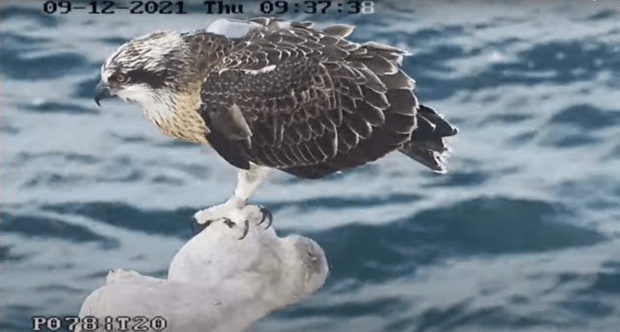
Thursday Happenings in Bird World

It has been a very difficult time for all of us since the Ravens destroyed Daisy’s nest. Things had gone so smoothly that most of us began to believe that those eggs would hatch. Sadly, it was not to be. I so wished that the male Pacific Black ducks had the instinct to go to the nest and relieve their mates! Daisy was quite distraught, understandably. A friend that is around the Discovery Centre has offered to take a photo for me of Daisy paddling around the canal after the holidays. There are not that many ducks there so she is confident she will recognize her again this year. Before I move on to other bird news, I am reminded that Daisy rushed to the big WBSE nest to lay an egg. She did not prepare the nest and it is possible that she had a nest elsewhere and something destroyed those eggs and, as a last resort, she came to the WBSE nest. There might well not be a safe place for our Daisy and that could account for so few ducks in the water there. If a duck hatches a normal clutch, it is normally 47 days before the pair mate again and this will only happen twice a year. If the eggs are broken, it can be as few as 10 days, a reliable source tells me. I hope that we do not see Daisy again – as much as I would like to see her and know she is safe! The WBSE are often at the nest in January and it would be wonderful if later Daisy was seen with little ones in the canal. We wait.

I needed ‘something lighter’ and that turned out to be the boys at the Port Lincoln Osprey barge. It seems that Bazza picked off the first two fish deliveries. At some time Ervie got mad at him and kicked him off the nest. Falky continues to perfect his diving skills hoping to catch that elusive fish one day. They are so lucky that they have parents that continue to provide these big strapping lads with food!

Here is Falky diving off the ropes and coming out of the water in sequence:

No fish but, Falky tried! If you look at the time stamps you will see how quick that dive was. This family is just doing great. That is a wonderful thing! Falky is really trying.

Ervie’s satellite tracker indicates that he has been visiting the local boat ramps. The owner of PLO is wondering if Ervie has discovered places where he can get fed! Here is Ervie’s latest tracking:

Port Lincoln Osprey FB Page posted some great shots of Ervie and Falky. They were taken by Bazz Hockaday. I hope they don’t mind my sharing them with you. You can see how stunningly handsome and – well, these are just great Osprey fledges. A success story this year that gives us a lot of hope. I understand that Falky followed Ervie to the beach. Bazza stayed on the nest and cleaned up on all the fish. I am certain that Bazza will never leave home!

Ervie
Falky
Falky
Ervie

Port Lincoln also posted a picture of the barge from the other side. It really helps us visualize where the nest is.

This is dad delivering a fish dinner to the nest. What an amazing shot! Thank you Port Lincoln!

The hatching and fledging of the three males at this beautiful barge with its Osprey nest made history for this mated pair. For years they have had issues relating to siblicide and they have never fledged three. Everyone was cautiously optimistic and it happened. It is one of those great moments of 2021 that no one will forget!

I urge you to check in on this nest and also the Port Lincoln Osprey FB Page. You don’t have to be a member of anything to find out what the lads are doing. And this is such a happy site – we need it, we truly do.

There are lots of mothers incubating eggs. Two of my favourites are Harriet and Gabby.

Harriet and M15 have been taking turns at the SWFlorida Eagle Nest. It has not been easy for the male, M15. He has continual strikes by the Great Horned Owl whose nest is 900 metres away. M15 had an injury the other day. The GHOW also strike Harriet on the nest and will do the same to the hatchlings. Sad.

Samson and Gabby have been taking turns incubating their two eggs in the NE Florida Bald Eagle nest near Jacksonville. They have had a sub-adult intruder but nothing like the issues with the owls that Harriet and M15 have endured. As nests and trees become more precious – with growing numbers of eagles and owls – these fights for territory could come more often and many times the owls usurp the eagles from the nest. I continually remind everyone that they might be cute – the owls – but they are a formidable Apex predator.

Gabby – you can always tell the ‘shag look’.
Samson with his slick backed head.

Hatch watch for Harriet! Bobble heads coming real soon. I can’t wait.

I want to leave each of you with something that is just full of joy! Perhaps you have discovered this wonderful girl that loves squirrels. If you haven’t, then you are in for a real treat. Please enjoy -.

Thank you so much for joining me today. Thank you for all the letters and comments about Daisy. It was a very difficult time for the community of people from all over the world that loved her. I hope that we get a picture soon of her paddling away and that if she should lay more eggs, we don’t see them but they hatch and we get news of Daisy on the canal being a Mum. Take care everyone. See you soon.

Thank you to the following for the streaming cams and their FB pages where I took my screen shots: Port Lincoln Osprey, SW Florida Eagle Cam and D Pritchett Family, and NE Florida Bald Eagle Cam and the AEF. I also want to thank Bazz Hockaday for those amazing images of Ervie and Falky.

The Daisy Chronicles Day 17, continued

Despite the presence of the Sea Eagles, Lady and Dad, at the River Roost on the Parramatta River, Daisy has been blissful since she returned from her morning foraging trip at 07:11:00

The Sea Eagles have not come to the nest. The wind is beginning to really pick up. I have not seen any predators on the nest. That said, the sound is off on the main camera and the Ravens could have been in the branches above like they have been lately or simply flying by. The strong winds might keep them at home!

It is currently 30 degrees in the forest and the winds are blowing at 19 km/h with gusts up to 39 km/h. It is hot and humid for Daisy with the confirmation of thunderstorms (90% chance) from 15:00-18:00. Hopefully Daisy will wait til the rain and winds have calmed before going out for her evening foraging. I am not concerned about her. She has been through many storms but, rather, for the priceless down covering those eggs.

It is nearing 11:30 on the old Ironbark Nest. The wind is rocking the tree but Daisy does not seem bothered. I have no noted any predators around and it is unclear if the Sea Eagles are still at the River Roost. The sound is still off line.

Other Nest News. A video has been posted of the thunderstorm that hit Orange last evening. Lightning, hail, thunder, and high winds. Diamond is in the scrape. You can see she is frightened. This morning Xavier arrived on the ledge of the scrape box and there was much relief he was alright. You can imagine that was this type of storm that also hit Daisy in Sydney.

Need an Osprey fix? Lena can see Andy in the distance and she is fish crying. Here is that video:

Samson is so happy that him and Gabby have their first egg as of yesterday. Just look at those two!

Over at the Port Lincoln Osprey Barge, Ervie picked up the first delivery of the morning -despite the choppy water and winds – from dad at 06:30:41.

Falky got the 07:39:44 fish.

Last time I checked Bazza was alone on the nest wishing for a fish.

Thank you so much for joining me. There is not much to report about Daisy which is, after all, a good thing. Hopefully the weather will not be as bad for her as it was for the Peregrine falcons, Xavier and Diamond, at Orange. I will monitor her throughout the rest of the day. Take care everyone. Stay safe! Look to the birds for joy!

Thank you to the following for their streaming cams where I took my screen shots: the Port Lincoln Osprey, the NEFlorida Bald Eagle Cam and the AEF, and the Sea Eagles@Birdlife Australia Discovery Centre Sydney Olympic Park.

The Daisy Chronicles, Day 13

Ever since Daisy landed back on the nest this morning, I have been more than curious. Her neck was ‘huge’. This image is later but squint and see that floppy large ‘crop’! It is so big that it is catching the light and looks like a shiny ball almost in the centre of the picture. She looks like she is sleeping on a puff pillow.

Over the time Daisy has been on the nest, I have had conflicting reports about whether or not ducks have crops. I was told that they have an expanded esophagus as well as a gizzard.

I continued to research this because I was completely dumbfounded about Daisy. She has obviously foraged very well during the three hours she was away before dawn. That bulge looks like a crop – a term used with raptors – for a place to store food before it goes to the main stomach. So I found this image by Murray State University. The vet students were dissecting a wild duck. Do you see what I see? The arrows for the Empty Crop and the Esophagus point to the same place. If we look at our live duck, Daisy, I think it is safe to say that an extended esophagus is also a crop. Mystery solved. Daisy is literally ‘full to the brim’. Hopefully she will be quite content to wait til sunset not have to leave. It seems that the Ravens check at least twice a day to see if she is on the nest.

So far, it has been another wonderfully uneventful morning on Daisy’s nest. I just want to pinch myself. Could our little duck actually fledge those 8 ducklings to be?

A Noisy Miner came to visit. It is right on the branch that is illuminated – look right above Daisy. This bird will not harm Daisy – it doesn’t have the nicest voice but it will not hurt our Duck or her eggs!

Last clutch, everyone wished that Daisy had come to the nest earlier – in December – because that is when Lady and Dad seem to spend the most time on Goat Island. Lady loves Goat Island. Dad’s former mate liked a different location after fledging the eaglets. No sign of Dad or Lady at the River Roost so far today.

Daisy is just sleeping away with the warm sun shining down on her and her 8 eggs. Oh, what a little sweetheart.

It is after noon for Daisy. I cannot tell you how quiet the forest has been. It is positively wonderful. There is a gentle wind that rocks Daisy and her eggs. You can hear a plane fly over once in awhile. Blissful.

Here are some images that I enlarged so we can see Daisy better. She is so camouflaged in those images above that you can hardly make her out from the sticks.

Other Bird World News: Wow. Ervie, that incredible third hatch at Port Lincoln Osprey barge, is really flying. Fran Solly, Take2Photography, reports that Ervie’s tracker shows he is following Dad to go out when he goes fishing. ​Solly says that “He (Ervie) went around the corner to the main Bay and along the wharf. I’ve seen Mum and Dad both fish there.” Oh, Ervie, you are a survivor! At the Kisatachie National Forest Bald Eagle Nest, Anna broke one of the two eggs while landing today. While that is very sad, hopefully the other one will stay safe and hatch. One healthy eaglet is good! Last I checked there was not an egg on Samson and Gabby’s Bald Eagle nest in Jacksonville, Florida. We wait. Anxiously.

Oh, I wish the NE Florida nest used a 24 hour clock!

Ferris Akel has cut down his streaming tour of last Saturday to show the Snowy Owls. For the people around the Finger Lakes of NY, Snowy Owls were a rarity. In Manitoba, you can often see 25 or 30 within a short distance during the winter. If you want to see these fluffy owls, here is the link:

Everything is alright in the world of Daisy. This is so wonderful. I will continue to monitor her until she leaves for her evening foraging. I hope this time is as quiet as the morning has been!

Thank you so much for joining me today. Take care everyone. Stay safe!

Thank you to the following for their streaming cams where I took my screen captures: Sea Eagles@ Birdlife Australia Discovery Centre, NE Florida Bald Eagles and the AEF, and Murray State University.

Catching up with Ervie

I have spent so much time watching Daisy, recording the happenings on the nest, and sleeping at odd hours that many of the other nests have been neglected. One of those is the Port Lincoln Osprey nest in Australia. I stopped in today to check on Ervie’s movements by the Sat-Pak and there were some gorgeous images of this juvenile male Osprey by Take 2 Photography, Fran Solly.

Ervie has been all over the place. Many are expecting him to leave the area of the barge. I wonder how far Ervie will go?

These were Ervie’s movements yesterday. Oh, he does love to fly.

Fran Solly went out and took these images of Ervie flying around the coast. Isn’t he just such a handsome bird?! My goodness, Ervie. You are doing Mum and Dad proud.

Male Ospreys tend to return to where they hatched to make their nests. I wonder if all three lads will show up at the same time? And I learned a new word today ‘Dust Up.’ Do you know this word? Remember when Ervie and Bazza were knocking one another about the nest – or off it – that is apparently a ‘Dust Up.’ Love it. Sounds so much better than saying Bazza just knocked Ervie off the edge of the nest! or Vice Versa.

Other Bird News: Gabby and Samson continue to have a sub-adult intruder coming around. No eggs on that nest yet. Aren’t they gorgeous?

Samson on the left and Gabby on the right.

We could be less than 2 weeks away from the first hatch at the Southwest Florida nest of Harriet and M15.

I have seen no weather warnings for Florida – like the disturbances going through the Midwest and the winds up in the Finger Lakes area of upstate New York.

Harriet is alerting. There is a predator around. Is it the Great Horned Owl (GHOW)?

Anna is incubating two eggs at the Kistachie National Forest Bald Eagle Nest in Central Louisiana. Louis continues to be so exciting. He is great for bringing in the fish but he is also softening up that nest with tonnes of Spanish Moss.

Connie is incubating two eggs over at Captiva, too. Her new mate is Clive. Hopefully this nest will have some luck. That said, local pelicans are being brought into care for red algae.

All of the Bald Eagle nests outside of the tornado and storm areas in the US are fine. More Ospreys are being spotted on the Iberian Peninsula and in Africa which is a grand sign. Ferris Akel was thrilled to see three Snowy Owls today on his tour. One even flew for him. I should invite him to Manitoba for the winter. One of our birders spotted 25 Snowy Owls in a short drive around the agricultural fields. — And a reminder. The owls in the Central US have been found to be thin and dehydrated. They are blaming this on photographers trying to get images and scaring away their prey. As you know I am a raptor lover – they often do not eat for several days so when you see one hunting or eating – leave it alone, please. Stay way, way back. Invest in a long lens!

It is very quiet morning at Daisy’s nest. A couple of times I have heard the cawing of the Ravens but Daisy has been peaceful, unfluttered would be a good word. There will be a late night catch up on her nesting activities.

This is not a Raptor Time: Watch this Titmouse modify its nest, bring in nesting materials, and hatch and fledge 11 chicks in Japan. Seriously it will put a smile on your face. I wish I could transport Daisy and her eggs into a box like this! Oh, she even wiggles her little bottom like Daisy. Here is the link:

Happy Saturday everyone. Take care. Thank you so much for joining me.

Thank you to the following for their streaming cams, their photos, or their FB Pages where I took my screen captures: Port Lincoln Osprey, Port Lincoln Osprey FB Page, Fran Solly, SWFlorida Eagle Cam and D Pritchett Family, NEFlorida Eagle Cam and the AEF, KNF Bald Eagle Cam, Captiva Bald Eagle Cam.

Wednesday in Bird World

Daisy has laid her 7th egg in the nest of the White-Bellied Sea Eagles in Sydney’s Olympic Forest. She has spent the morning trying to get more down from her breasts and sides – without a lot of luck – and looking for more natural materials to cover her nest. She may have to dig around on the other side of the nest. She seems reluctant this year to cover the eggs and leave them to go over and root around.

So much down last year so little this year.

Here is a video of Dad, the WBSE that owns the nest, flying in at night. Oh, so lucky none of Daisy’s eggs were not broken.

The Port Lincoln Osprey fledglings have been neglected. It was so fantastic to go and check on them and have some great close-ups of Ervie! Oh, he is a handsome young man.

That is a gorgeous crest. That white V that we looked for when he was small is so prominent. He has a nice crop.

Janet Forster says that the trio have been flying circles around the barge. They have also been seen chasing the parents screaming for fish! Good lads.

Here is Janet waving to everyone on camera. She is on the shore with her long lens. You can just make her out about 3/4 of the way over in the background. Thanks Janet for all you do so we can enjoy the Ospreys!

So far everyone is doing fine including Daisy. It is a long haul for our little Duck compounded with the predators and the lack of material on the nest. Still, we hope. The three Osprey lads are magnificent. I am so proud of this nest. Bald Eagles continue to lay eggs and work on nests. And, of course, the Great Horned Owls are looking for nests. There is a pair on the Savannah Osprey nest thinking pretty hard about using it for their breeding season.

There are a lot of people waiting to see if the GHOWs will also use Farmer Derek’s Bald Eagle nest. Will keep you posted!

Take care. It is nearing noon on Daisy’s nest and so far all is well. Thank you for dropping by.

Thank you to the following for their streaming cams where I took my screen shots: Port Lincoln Osprey Project, Sea Eagles@ Birdlife Australia Discovery Centre, and Cornell Bird Lab and Savannah Ospreys.

Happenings in Bird World

Holly Parsons, the administrator for the Orange Peregrine Falcon FB group, has posted the following from Cilla Kinross regarding Yurruga:

I took some images of beautiful Diamond throughout the day.

We would expect the parents to visibly be supplying prey to Yurruga. Many of you will have seen the adults at 367 Collins Street bringing in prey. You might recall how the Dad tried so hard to feed the little male when he was too sick and could not eat or swallow anything. Just pause and remember the healthy chicks at that nest and the noise they made even prior to fledging when food was around. Then remember Yurruga and how he behaved when prey came to the scrape. The falcons are loud in their food begging just like the four lads at Port Lincoln. The little ones simply cannot go without eating and while they are learning to fly they are also being taught how to hunt. It is unclear how instinctive hunting is. For example, the adult Ospreys do not teach their fledglings how to fish. They simply are hardwired to do it. Peregrine Falcon parents spend much time passing prey around, dropping it for the wee one to catch, etc. Certainly Yurruga had at least a days training because he was seen flying around with the parents prior to the big storm. There would be several prey drops during a day. No one has anything confirmed after last Thursday in Australia, 9 days ago now. I know that each of us wants this outcome to be different and I would like nothing better than for someone a mile away to phone Cilla and tell her that Yurruga is on their roof or in their garden. The long sessions in the scrape together may be Xavier and Diamond bonding in grief. There is also the additional issue of the absence of the eggs. Diamond has spent an inordinate amount of time scraping where the eggs were. My heart really goes out to her.

Sad news is also coming out of California. The California Condor chick #1075 died at the Los Angeles Zoo on 12 November. He had sustained injuries from adult male condor #247 during a territorial dispute. I know that many of you watched that streaming cam. Their lives are so very very fragile and to have a death of a promising chick due to fights is extremely difficult to process. There seems to be a lot of territorial disputes. You might remember that California Condor #1031 Iniko who survived the Dolan Fire was actually injured when an adult male came to the nest tree. —— Which reminds me! Iniko will be released back into the community of condors where he hatched on Saturday along with two others. This is great news coming on the heels of grief.

We really need some good news in Bird World. Iniko’s release is, of course, one of those. I really hope it is OK to cut and paste this amazing story from that Valerie Webber posted on the Loch Garten and Other Ospreys FB page. It is a marvellous tale of German Osprey Black 1FO seen in Portugal in Dec 2005/Jan 2006 and again in September 2021. So the question that is being asked is where has this bird been? It is more than 16 years old and this is truly remarkable – 3 sightings only in all those years. He really is a very handsome bird.

More good news come in the form of a Pacific Black Duck named Daisy who has now laid her first egg in the Sydney White-bellied Sea Eagle nest. An earlier blog today gave more images and some details. So nice to have her back! I am so excited about Daisy’s return that I can’t sleep! You can catch her on the Sydney Sea Eagle Cam. She laid her first egg today. She must have rushed to get to the nest OR she had made a nest elsewhere and predators came. We might not know. She will begin lining the nest with the down from her breast. That down will not only make it soft for her and the eggs but also will help cover the eggs when she has to go forage. She will also mix the down with leaves on the nest and cover the nest with those leaves. I hope there are lots of them!

Every one of the lads on the Port Lincoln Osprey Nest has had a fish today. Port Lincoln also says that the three have been seen at the shore going for a bit of a swim or a bath. Fantastic.

The three are over on the perches and ropes near Mum. What a beautiful image. I wish that Dad was there, too. The fledglings are gradually spending more time on the perches and ropes and flying around. They are growing up and shortly might be off on their own. I need to check and find out when Solly permanently left the barge. That might give us some clue.

I know that many of you are familiar with the Welsh Ospreys, Aran and Mrs G at the Glaslyn Nest. You might also know that one of Monty and Glesni’s sons, Aeron Z2, and his mate Blue 14 have their nest close by at Pont Croesor. Glaslyn has announced that the new hide is finished and visitors will be able to observe the nest of Z2 and Blue 14. That is great news.

That is it for me. I am sufficiently exhausted from the excitement of Daisy that I might be able to sleep. This is my Friday newsletter. I will bring updates later tomorrow (Friday the 3rd) evening.

Take care everyone. Thanks for joining me.

Thank you to the following for their streaming cams or FB pages where I took my screen captures: Loch Garten and Other Ospreys FB, Orange Peregrine Falcon FB, Port Lincoln Osprey Project, Sydney Sea Eagles @Birdlife Australia Discovery Centre, and Charles Sturt University and Cilla Kinross.

Oh, for the love of Ervie

It is no secret that my long-term research project on third hatch Ospreys that survive can cause a whole lot of heart ache. The opposite side of that is the sheer joy in watching these ‘thirds’ come into their own. Some suffer much more than others. In 2021, one of the worst was Tiny Tot Tumbles on the Achieva Osprey nest in Florida.

There is Tiny Tot Tumbles beside sibling 1. I often called her ‘Big Nasty Sister’. She is the reason that many people do not like to watch the Osprey nests. That said, sibling 1 stopped a lot of the beating on Tiny Tot because sibling 2 started. That nestling would purposefully eat and eat and eat so that Tiny Tot had no food.

Beaten and starved. It was hard for anyone to imagine Tiny Tot Tumbles surviving. There she is all submissive, literally starving, while the others eat.

What a beautiful bird Tiny Tot Tumbles became.

Elegant. Tiny Tot Tumbles is one of the most striking juvenile ospreys I have ever seen. Before she left the nest, her plumage was super espresso with only the thinest of white scallop revealing she was not an adult. She was smart. She remained on the nest honing her flying skills, getting stronger, learning how to fight off intruders. It is a shame she is not banded but she has a very distinctive pattern on her crown.

At Foulshaw Moss in Cumbria, no one expected Tiny Little Bob to survive more than a couple of days. The weather was miserable and the two older siblings were 4x her size.

The size difference increased. That is how she got the name ‘Tiny Little Bob’ because she was just so small.

I love this image. Tiny Little Bob really wants some of the flounder that Mum, Blue 35 has. She has watched and waited til the older siblings are full. Then she will make her move. She exhibits all of the hallmarks of a third hatch survivor – patience, fortitude, and ‘focused watching’. They can read the nest.

I wish I had this video recorder earlier so that I could have captures Tiny Tot Tumbles ousting the intruders from the nest! Or more of Tiny Little Bob. I did get it in time to show you Blue 463 in the nest. It is the third week in August. All three of the Foulshaw Moss chicks have fledged. White YW is an incredible provider and he will stay until Tiny Little Bob migrates before he leaves. She will be the last one to leave. Smart girl. She really fattened up for that migratory trip. I only hope that she survived. Few British Ospreys have been spotted in The Gambia and Senegal. There are lots without bands along the coast of West Africa but not the ringed British. Where are they?

Tiny Little Bob is banded as Blue 463. She is the bird on the back of the nest on the right. She is food calling. I want you simply to notice how big she is. Tiny Little Bob became the dominant bird on the Foulshaw Moss nest for 2021. She could fight for the fish with the best of them. Most of the time she used her patience and ‘snake eye’ to get the siblings off their lunch!

At Port Lincoln, Bazza aka Big Bob, tried several times to dominate but, Ervie aka Little Bob wasn’t having it. If you have been following me most of the time you will know that when the three males were banded, Little Bob got the sat-pak because he was the biggest of the three. Unlike Tiny Tot Tumbles who missed 12 full days of meals in the first five weeks of her life, Tiny Little Bob made sure he was right up front by Mum’s beak. I don’t think he ever missed a meal and he would certainly stay til he was full. On the morning of the banding, Little Bob had landed the breakfast fish. That probably helped a lot with that weight in!

There is Little Bob in front with his beak wide open. Just look at those little wings. Oh, my goodness is there anything cuter than a recently hatched osplet?

The thing about the third hatch survivors is that they have lived out of sheer willpower and cleverness. I can almost hear Ervie say, ‘I am not taking anything from you, Bazza!’ They become kinda’ street wise. They watch, assess, and attack. Does anyone remember Tiny Little Bob staring down both of her big siblings? They were not going to get anything by her. You might also remember that Tiny Tot Tumbles took on any intruder protecting the nest. She was fierce. That is how they survive — and I believe that they are actually better able to cope out in the world of Ospreys far away from the nest than their siblings.

Ervie sure showed us what he is made of today.

Bazza had the fish and had been eating. Ervie really likes the back portion and the tail. So he is watching Bazza. I could have made this into a video but what I want you to do is focus on the ‘look’ on Ervie’s face and his actions.

Ervie is the bird on the right. Bazza is in the middle with the fish tail. Falky is on the left and is not interested.

Look at Ervie’s eyes and his open beak as he lands on the nest. He is telling Bazza he wants that fish tail now. Ervie means business.

Ervie is twisting his body. He is not looking at Bazza’s face. He is looking at the fish tail.

Ervie moves up and over pushing Bazza’s head. Ervie raises his wings.

Ervie is totally in front of Bazza. Notice that Bazza is not looking at the fish.

Ervie turns his head around. You can draw a line from his eye and beak to the fish. Ervie is completely focused.

He goes for it.

Ervie dives down to get the fish tail.

He has it. He turns his body and raises his wings. Bazza is being pushed out of the way so Ervie can turn.

He’s got it. Wow. Just look at the impressive wings of Ervie.

Ervie moves over to the other edge of the nest where he finishes the fish tail. The entire take over bid took 19 seconds.

Bazza does not seemed phased and Falky probably wishes he were somewhere else!

These three have just been a joy to watch. I wish each of them had been given a sat-pak so that we could watch their lives unfold. I hope that the hydro poles in South Australia have their protective covers placed on them just as quickly as it can happen. The loss of Solly was a tragedy in terms of understanding the dispersal and long term survival of these Eastern Osprey.

I hope that I have not bored you too much with these third hatches. Each is really a miracle and for me, remembering them helps honour the pain and suffering that they went through to live.

Thank you for joining me. Take care everyone. See you soon.,

Thank you to the following for their streaming cams where I took my screen shots or my video clips: Achieva Credit Union, Port Lincoln Osprey Project, and Cumbrian Wildlife Trust and Foulshaw Moss Osprey Nest.

Wednesday in Bird World

Let’s start off with what is on everyone’s mind: Has there been a confirmed sighting of Yurruga? Yesterday, Dr Cilla Kinross was inspired by a very quick prey drop at the scrape. Diamond flew into the trees. Cilla was in the trees looking half an hour later – she only saw Diamond. Diamond returned to the scrape with quite a large crop also. Some believed they had heard Yurruga calling but, Cilla is unable to confirm that. So the answer is – we simply do not know. Yurruga has not been seen since last Thursday when he was on a building during a storm. We can only wait.

My goodness that little one was such a cutie.

October 20. Yurruga and Diamond

Diamond was really beautiful this morning as the soft glow of the sun worked its way through the fog.

Both parents, Xavier and Diamond, have been inside the scrape – scraping. They also had some bonding moments this morning at sunrise.

My heart aches for them.

The second question of the day is what is going on with Grinnell, the male Peregrine Falcon of the Campanile, mate to Annie, that was injured by a male intruder that is trying to cosy up with Annie? Here is the latest news.

The New Zealand Department of Conservation rangers on Taiaroa Head are shutting down the streaming cam so that they can move it to the site of the Royal Albatross family for 2021-22. There are lots of guesses as to who the couple might be. The announcement is due tomorrow.

One of my favourite Bald Eagle couples, Samson and Gabby, at the NE Florida Bald Eagle nest near Jacksonville have been putting the finishing touches on their nest. They are perfecting the Spanish moss lining the nest cup. Now all we need are some eggs!

Gabby doing some final inspections this morning.

The three lads at the Port Lincoln all had fish yesterday. Falky had more than Ervie or Bazza. Falky has become a master at slipping the fish out of Dad or Mum’s talons. A magician.

There is a lovely shot of the PLO Mum. She has done an extraordinary job raising these three boys to fledge this year (with Dad’s good help). Yesterday she even spent some time feeding Bazza. He is definitely a Mum’s boy!

Bazza can be a bit naughty. I know that the banders were certain that there were three males. Someone looking at Bazza’s legs and that beautiful necklace in the image below might mistake him for a lovely female.

Bazza and Falky sleep with their heads tucked under their wings – adult style – standing on the nest. Ervie is sleeping over on the perch or the ropes. They are all doing well. I continue to pinch myself. This Osprey nest really turned itself around this year to fledge all three hatchlings.

There are many articles coming out in international newspapers and academic journals on the effect of warming oceans on the seabirds including the beloved Osprey. I picked one of those for you as some are frustrating. They allow me to embed the article but then want you to subscribe to read it! That is a major irritant to me – like Subarus are to Ferris Akel!

https://www.downtoearth.org.in/news/climate-change/climate-change-threatens-survival-of-albatross-60906

It is a grey damp day, 3 degrees C. The snow is melting. There are lots of birds at the feeders. A large European Starling is sharing the peanut and bark butter feeder with some cute little House Sparrows.

The tiny suet balls called Bark Butter by our supplier are a really big hit since winter has set in. Junior has been around to get the corn while Dyson was busy elsewhere. Nice to see all of them.

One of my former students posted this today on FB. It is a perfect little giggle for all of us!

Thank you so much for joining me today. Take care everyone. Stay safe.

Thank you to the Port Lincoln Osprey Project, Charles Sturt University Falcon Cam and Cilla Kinross, and NE Florida Eagle and the AEF for their streaming cams where I took my screen captures.

New Zealand’s falcon, the Karearea

It is almost the end of November and in about 25 days there will be at least one bobble head, if not two, on the Fort Myers, Florida Bald Eagle nest of Harriet and M15. Bald Eagles are strikingly beautiful – the gorgeous pure white head of the adult with that large bright yellow beak, espresso brown body plumage and watery light blue eyes. The hatchlings are just as adorable with their light grey down. They are called ‘bobble heads’ because they do not have the strength

While we are waiting for those eggs to hatch in Florida, there is a new streaming cam focused on a small New Zealand falcon, the Karearea.

Wikimedia Commons

They are adorable. Thanks Sharon Dunne for mentioning this new cam. The chicks are delightful! Here is the link:

Here is a short video of the chicks trying to get settled in the nest cup.

The Kareara are indigenous to New Zealand. At present, they are very vulnerable. They believe that there are between 5-8,000 birds in the whole of New Zealand. Their threats are loss of habitat, cats, mustelids (they are like wolverines), and hedgehogs. Hedgehogs like their eggs.

The falcons have also been found on several islands but, the area with the highest population is the Kaingaroa Forest between Rotorua and Taupo on New Zealand’s central North Island. You can see Taupo on the map above. The Kaingaroa Forest is the largest forest plantation in New Zealand and is the second largest forest in the Southern Hemisphere. It is 190,000 hectares. The first trees were planted in the early 1900s. They are harvested for the construction industry.

“Kaingaroa Forest” by russellstreet is licensed under CC BY-SA 2.0
Wikimedia Commons

The adults are 40 cm and 50 cm in length. Like almost all raptors, the females are larger than the males.

Wikimedia Commons

In fact, the female can weigh almost twice as much as the males who weigh between 240 g and 350 grams. The females are between 410 g and 720 grams. They cannot fly nearly as fast as the Peregrine Falcons but the Karearea do reach speeds of up to 100 kmh. They are also capable of catching prey that is larger than they are. Wow! They do not eat carrion (dead animals). Their diet consists of mammals, lizards, birds, and insects. These small falcons hunt by watching from a high point flying fast, grasping the prey with their talons and then killing it with a bite to the neck.

Wikimedia Commons

Oh, I hope that you enjoy these adorable little falcons. It is a perfect time to watch them. The Port Lincoln lads will be taking the fish deliveries off the nest to eat them soon. Ervie has already tried fishing and last night he slept on the post not in the nest. He is growing up! No word yet on who will be the Royal Cam family and Cilla Kinross is planning to hunt in unexpected places for Yurruga. And one of my favourite Bald Eagle couples, Gabby and Samson, have been working on their nest. Oh, they are a stunning pair.

Gabby on the left and Samson on the right. Northeast Florida Bald Eagle Nest, Jacksonville.

Thank you so much for joining me. Take care. See you soon.

Thank you to the following for their streaming cams or their FB pages where I took my screen captures: Northeast Florida Bald Eagle Nest and the AEF and Southwest Florida Bald Eagle Nest and the D Pritchett family.

From Port Lincoln to Kauai to Juneau

Oh, gosh. We really are going to miss these three boys when they finally leave the Port Lincoln barge. Ervie was wet this morning. He has been focusing very hard on finding a fish and catching it. We might never know, sadly, when that moment occurs – unless he brings it up to the ropes like Dad. Wouldn’t that be wonderful?!

Bazza seems to have landed the first fish this morning on the nest. Falky doesn’t seem bothered and Ervie had flown off earlier.

Port Lincoln gave us a nice image of Bazza over on the ropes. These three males are quite handsome.

When Ervie flew back to the barge he was really keen on preening those feathers.

You can really see that sharply hooked beak that helps to tear the fish so they are easier to eat. Unlike Peregrine falcons, Ospreys do not have a tomial tooth. In my images it is a bit difficult to see that valve which seals the Osprey’s nostrils when they dive for their fish but, it is there.

Looking at that beautiful image of Ervie below you will notice that the Ospreys lack that very heavy eyebrow of some of the other raptors. Instead, they have that incredible black line which passes from the eye down to the neck. That black line helps them with the glare.

Ervie missed the the 8:14:14 fish that Dad brought in. Falky claimed in.

Port Lincoln has reported that Ervie has been flying farther. They also note that he has been checking out the coast. Here is the latest map of Ervie’s movements from the barge.

Ervie and his siblings will get their adult plumage at their first moult which is fully completed by the time they are a year old. That change in plumage does not indicate Ervie’s sexual maturity. Osprey do not normally breed until they are three years of age. The 2019 fledgling from Port Lincoln, Calypso, has been spotted sitting on a branch with a male. Might there be chicks next year? That would be marvellous!

When Penny Olsen’s book on the raptors of Australia was published in 1995, the map of Australia indicated that the Eastern Ospreys were located only around the coast. Ironically, that map did not indicate any ospreys in the Eyre Peninsula. This is one of the things that has changed since its publication. We have to look no further than the Port Lincoln Opsrey Barge and Thistle Island. We also know from Solly being the first tracked Osprey that the birds do go inland. Not all that far but further inland than anyone had understood previously. We are fortunate that Solly was able to provide so much information to us in the 14 months that she was alive. Port Lincoln can now compare the dispersal of a female to that of a male with the tracking of Ervie.

There are many threats to Osprey. I imagine that everyone reading my blog can name at least four. I want to add warming seas and the decline in fish numbers as yet another.

As you know, I highly recommend Dr Marc Bekoff’s book, The Emotional Lives of Animals. He also wrote The Ten Truths with Jane Goodall. A very moving story is coming from the island of Kauai, Hawaii. Some of you might recognize the name of Hob Osterlund. She posted a very moving story that can be added to the cornucopia of evidence that Bekoff and Goodall have that support animals having emotions which they express. Once you have read those two reasonably priced books, you will never ever apologize again for anthropomorphizing animals again.

Here is that posting:

Tears.

One of my readers ‘B’ asked me if I had seen the snow at Glacier Gardens. I had not! So I went to check. Oh, my goodness, it is so beautiful. If you close your eyes you can see that beautiful Kindness using that nest and those branches like a trampoline. What a magnificent juvie Kindness was. She is off eating Salmon along the river.

On Taiaroa Head, 122 birds have been seen so far and there are 36 eggs laid. No mention yet on who the Royal cam stars for 2021-22 will be! Soon. And there has been no update on Grinnell. No further updates on WBSE 27 either.

Thank you so much for joining me today. Take care. See you soon.

Thank you to the following for their streaming cams where I took my screen shots: Glacier Gardens Bald Eagle Cam, Port Lincoln Osprey Project, and to Hob Osterlund and her FB page for that moving story. Much appreciated.