Friday in Bird World

15 March 2024

Good Morning Everyone,

Spring is coming and with it the arrival of Canada Geese, songbirds, and Ospreys amongst other raptors.

Today, more than a thousand Canada Geese turned the sky black at Fort Whyte Alive in Winnipeg. Most landed on the Bison fields while a few went to the open water on Devonian Lake and others decided to peck at the ice inside the nature centre.

As the Ospreys arrive at their nests around the world, laying eggs, and hatching osplets, I begin to be a ‘little more scattered’ than I might normally be. Last year, the total number of eggs that ‘H’ and I observed was 338. This year we hope to bring that total to 500. It is an enormous task. I am extremely grateful to those who have reached out to me, offering to send me information on the nests that they are watching. So, as a reminder, if you watch a particular osprey nest, please feel free to send me the date the eggs were laid and the dates of the hatch, and please do tell me if you are observing the chicks bashing the daylights out of one another. This could be ‘dominance play’, or it could be serious and result in siblicide. Even if you miss all of the major events but tune in to a nest and notice aggressive behaviour or something worrisome, do let me know. I appreciate any and all messages!

Let us go back to Dr Alan Poole’s talk. In my last blog, I talked about his first main topic—issues related to fish and the problems that the Ospreys face with the Chinese fishing trawlers taking huge nets of surface fish such as Manhadan and Mullet along the Atlantic and Gulf coasts of the US and West Africa. The other three topics were Problem Nests, Restoring Osprey Populations, and Streaming cams.

Problem Nests: Dr Poole pointed out that not having enough nests for ospreys is a ‘positive’ problem when you have too many ospreys. He notes that Greece has not a single osprey. Poland is shooting all of theirs, the Balkans have none, etc. There are 8-10,000 Osprey pairs in the Chesapeake Bay Area of the US alone. Imagine. There are 5000 nesting pairs in Florida. So, what do they use? Ospreys have adapted to use human-made structures because there are not enough good trees. In fact, this is becoming a serious problem for Bald Eagles. One human-made structure that Ospreys use are the hydro or power poles. The power companies don’t like this. They try to kick them off. It is, in fact, easy for the power companies to add an auxiliary appendage or put up an additional pole for the birds. But it takes time, employees, and money – something the companies either don’t have or don’t want to use. So when you see a power company that actually helps the ospreys, thank them! Poole is trying to find ways to get the power companies on board. In Florida, a lot of ospreys are using cell towers. So far, there has not been a problem. Of those 8-10,000 pairs in the Chesapeake Bay region, 20-30% use channel markers. The Coast Guard needs an award, according to Poole, because they allow the birds to have their nests there as long as they do not interfere with the markers. Some people put up very short poles with predator guards in salt marshes. It was pointed out that salt marshes might be a good place to try and locate some of the birds. In Finland, there are very few suitable trees for the ospreys, so the Finns cut off the top of the conifer trees and put up human-made platforms for them. It is brilliant. This could be done for the eagles and ospreys in various parts of North America, too. In the UK, we know that artificial platforms are being built, which is also happening in France.

Restoring Osprey Populations: Poole calls Ospreys “the stay-at-home birds”. Most of the time they stay within a region around the nest where they fledged. We know that this is especially true for the males. But this behaviour causes issues with overpopulation, especially where there is a lack of fish, bad storms, etc. So what do you do? You try to relocate some of the population to places without food and birds. The Roy Dennis Wildlife Foundation is well known in England for translocating ospreys to places like Italy, Spain, and the UK. Poole mentioned that Massachusetts ospreys are now being flown to Illinois to try and get them to populate along the Mississippi Flyway. If you move ospreys where you want them, you must provide them with nesting platforms. This is imperative. Switzerland is currently trying to reintroduce the raptors. They have released 50 young in the last five years. Starting a breeding population in a new area takes at least a decade.

There was a slight move off topic before looking at streaming cams but it was an important one – one of the most important in my mind. That is getting people knowledgeable about the history, the persecution of ospreys, their behaviour, what makes me different from other birds, etc. Poole noted that various places have set up visitor centres where people can watch the ospreys on a monitor or at hides. One is Loch Garten in Scotland, which had 2 million visitors look at their birds. These visitors paid to see the raptors. In Finland, the visitor centre, which is quite small compared to Loch Garten, had enough visitors that it paid for all of the Osprey research. One way to create awareness is through education. Tim Mackrill was not mentioned, but he has set up the Osprey Leadership Foundation and, like Sacha Dench and The Flight of the Osprey, they have forged links between individuals in the UK and West Africa. It is fundamental to have the youngsters in both countries (their parents and teachers) appreciate the birds they share. Poole also noted that some places have fairs and events and there are osprey mascots to encourage interest.

The last topic was streaming cams, and I felt that while quite knowledgeable, Poole knew less about the current number of streaming cams and the amount of research that is going on using them. Perhaps I am wrong. He suggested that one way to understand the ‘fish problem’ was to monitor the fish species brought to a nest, the number, how those fish were divided up in terms of feeding the little ospreys, etc. ——– I sighed because I knew that so many of you have counted the fish, the bites, have cried, pulled your hair out, etc at many of the nests including Achieva and Patchogue – just two examples from 2023. Citizen scientists are doing it every day. Your work – meaning each of you -needs to find a way to channel itself to the researchers who need more time, the funds, or the staff to monitor enough nests. I know this from personal experience. Various other species have individuals watching, and we now have observation boards set up at several Osprey cam sites thanks to Bart Molenaar. I can think of three he has established – Rutland Manton Bay, Seaside, and Port Lincoln. Every aspect of the life of the nest was recorded through observations and the chat. It’s a really valuable archive.

At Loch of the Lowes, Blue NC0 is eating well and working on her nest. She awaits the arrival of Laddie, her mate (LM12).

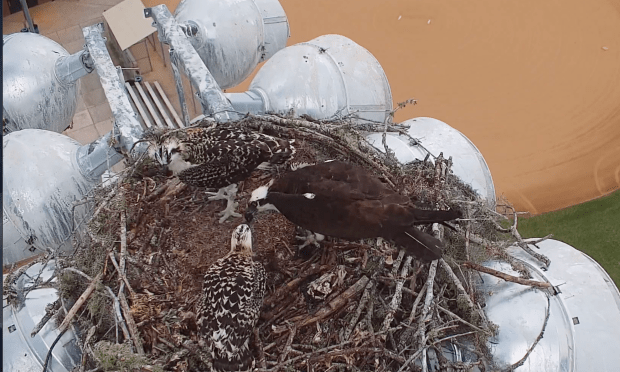
At Achieva Credit Union’s osprey platform in St Petersburg, Florida, Jack brought in a nice fish and Diane gently fed the wee babe often. Jack was also kept busy being security guard for the nest.

Dad was so excited. ‘MP’ observed Dad listening and walking around Diane. Part of the shell was out from under Mum, but the little one was still partially in the shell, with Mum being very secretive. You could tell Dad was quite happy to have a wee babe in that nest.

Mary Kerr put in some interesting notes about Maya and Blue 33 on FB today. As you know, Maya arrived a couple of days ago with Blue 33 returning Wednesday on Rutland’s Manton Bay platform. On Thursday, Blue 25 came to the nest and Maya sent her packing.

Blue 25 does cause some mischief. However, Geemeff reminds me that she is the mother of Blue 4K, the subject of Simon Curtis’s book, If you build it, he will come, the story of waiting 200 years to have ospreys at Belvoir.

First Osprey sighting at Forsythe! Thanks, ‘H’,

Was there an Osprey at Patchogue? There was!!!!!!!! They have a lot of work to do but thankfully much of the harmful debris is ‘under’ the nest.

It is extremely difficult to watch the West End nest of Thunder and Akecheta today because he wind was really whipping it about. The majority of the time I could only see two heads getting fed. That said right after 1106 you can see the blur of the third and it appears to have eaten.

That 1106 feeding.

Others.

There is plenty of food and Thunder and Akecheta are experienced adults.

Dixie and Mason are scooting all over the Superbeaks nest. It won’t be long til they are walking on those big clown feet.

The kids at Johnson City are both eating well. Boone has lots of fish in the nest and Jolene is a great Mum to these two.

Leaper and Jersey both had crops at Duke Farms today. At one point, Leaper was so full she looked like she would burst!

Swampy and Blaze are huge compared to these bobbleheads.

At Captiva, Cal flew off the nest on Wednesday. He flew around the area constantly observed by Clive and Connie. Today, he flew back to his natal nest. Well done, Cal!

Nothing like a lot of flying to make you want to go home to your bed and sleep duckling style.

Ron brought R6 a fish in the early afternoon. So cute. R6 had been working his wings Thursday morning. Not ready for fledge yet and still working on the self-feeding. No hurry, R6.

A lot of people thought E23 had fledged but he was up above the camera on Thursday. He could fly anytime!

Caught Gabby at the NE Florida nest today. She’s a beauty. We adore her and I am so glad that her and Beau are so bonded. Next year!

Chase and Cholyn’s only egg at Two Harbours was laid on February 22nd, making itay. In a fortnight, we should be expecting a pip/hatch on March 28th. 22 days old todMark your calendars.

Liberty and Guardian had three eggs. One was broken in the nest and it is unknown which of the three was lost. Those eggs were laid on Feb 15, 18, and 21. That would make them: Egg #1, 29 days, #2 26 days, and #3 would be 23 days old. We have at least a week to find out if egg #1 is alright.

It is now officially confirmed that Frederick and Betsy are back at the Carova Beach, North Carolina Outerbanks Osprey platform. — Don’t get me started. Look at those plastic carrier bags on the nest and around the foot of one of the adults!

I thought Annie might be ready to lay her first egg today. She was napping in the scrape when Archie, Daddy Door-Dash, came in with dinner.

There are currently three Peregrine Falcon eggs at the scrape in Eden, Netherlands. The third was laid on the 13th of March.

Waiting for Duke and Daisy to return to Barnegat Light in New Jersey. The couple lost 2 out of 3 chicks to starvation/siblicide during the Nor’easter of June 2023 and it was feared, for some time, that Duke might have died also. His return some weeks later was such a great relief for everyone.

Lucy was on the Lake Murray platform on Thursday.

Did Spirit visit her natal nest at Big Bear on Thursday? Cali Condor thinks it could have been her.

I am so looking forward to the Cornell RTH season. Big Red and Arthur were both checking and tweaking the nest and spending time on the light stand. Eggs could come any time.

Thank you so much for being with me today. Remember to go outside and smell spring! It will lift your spirits more than you ever will know. Take care. See you soon!

Thank you to the following for their notes, posts, presentations, and streaming cams that helped me to write my post today: ‘H, J, MP’, Alan Poole, Scottish Wildlife Trust (LOTL), Achieva Credit Union, Mary Kerr, LRWT, Forsythe Osprey Cam, PSEG, IWS/Explore.org, Superbeaks, Johnson City-ETSU, Duke Farms, Eagle Country, Window to Wildlife, WRDC, SW Florida Eagle Cam, NEFL-AEF, FORE, Carova Beach Osprey Cam, SK Hideaways, EDE Peregrine Falcon Cam, Lake Murray Ospreys, and Cali Condor.

Late Monday in Bird World

16 May 2022

I was waiting to see if Big and Middle got any fish today. Then I had to go out but when I returned, at 14:44:15 Mum delivered a ‘piece of fish’. It looked like a 4 or 5 inch catfish steak. Seriously? These chicks have not eaten since yesterday and they are growing and big. Of course, Big was acting up and a couple of times lunged at Middle — but not enough to keep Middle from trying to get some bites right away. The only hydration the chicks get is from the fish – it must be hot on top of that nest. That piece of fish lasted until 15:56:37 and that it includes the time Mum ate some bites and moved the fish to the other side of the nest. So, less than 12 minutes. Big got the tail and Middle got some bites. Did I ever mention that the Peregrine Falcon Mum at the Manchester NH nest feeds the five eyases for an hour? Everyone gets fed. What is up with this nest at the University of Florida at Gainesville? Does it have anything to do with that ‘other’ nest that was shown on the pan around the practice field nest that ‘R’ alerted me to? I wonder. Thanks, R!

The two chicks were really hungry.

Mum settles down. Big is on her right and Middle is on the left.

Big decides she wants to walk over to the other rim and flap her wings so Mum gives Middle a bite of fish.

Well, Big did not like that. She took a very aggressive stance and Middle went into submission. Mum just put her head down.

When Mum moves to the other side you can see the size of the meal – seriously, this is a snack. This nest needs an entire catfish or two, maybe three, not a snack.

Notice the difference in the length of the tail between the two.

Middle sneaks around and under Mum and this manages to get him some bites.

It started pitching down rain towards the end of the feeding. Mum finished the feeding as quickly as she could and took off!

It’s nearly 18:00 and I have seen nothing on the nest but that one chunk of fish. If you see the two get fed, let me know!

Do I dare hope that these two might more fish? So that is one Bird Mum at the UFlorida-Gainesville Osprey nest.

It was an entirely different story at the nest of Red-tail Hawks Big Red and Arthur. Big Red knows that a storm is coming. She can tell in her hollow bones. So what does she does she do? She fills the chicks up with food first. She finishes feeding just about the time the storm hits. Then she does everything she can to wrap those chicks in the safety of her wings!

There are four and she is holding them as tight and close as she can.

Just look at that – Mumbrella!

Check the time. Four hours and counting. Big Red will not let anything – weather or an intruder – harm her chicks if she can possibly help it!

I wonder if you were a bird which Bird Mum you would want to be caring for you?

I went back to check on Big Red. At 18:47 she was still hunkered down over her chicks.

At 19:08 Big Red was off the chicks; the system has passed. She flew off the nest a couple of minutes later to take a break and get some prey. The four eyases are, of course, fine. They are extremely lucky to have Big Red and Arthur – utterly devoted parents. I should point out that Arthur dropped some prey onto the nest around 16:00 in the middle of the storm. If you picked the UFlorida-Gainesville male and female as parents, would you like to change your mind? Just sayin’.

Wow. Lucy laid her fourth Osprey egg on the nest she shares with George on Long Island. Oh, gosh, golly. Would I want to be the 4th hatch? I don’t think so despite George being a fabulous provider. (Note: Blue 33 (11) and Maya did successfully fledge four one year – it is rare).

Lucy did not start hard incubation until after she laid the third egg. Fingers crossed for this great couple. We will be checking on them as hatch approaches which won’t be until mid-June.

Here is the link to their Osprey cam.

The five eyases at the Manchester, New Hampshire scrape had a nice dinner at 18:00. They should almost be set for the night now.

There is a cracking article on the BBC site on Dr Peter Sharpe traveling to the Chanel Islands to save the eaglets.

https://www.bbc.com/travel/article/20160602-a-man-who-saves-eagles-by-helicopter

The balloon story struck a nerve in a few people. ‘B’ writes that every time he goes out on a wilderness backpacking trip – far from other humans – he inevitably finds balloons on the ground. ‘B’ points out that if you drop a deflated balloon on the ground it is littering but if you allow it to float into the sky it is considered ‘fun’. Back down on the ground the balloons cause havoc along with many other things – mesh fruit and vegetable bags along with face masks. Why do humans just feel they can make the planet their garbage bin? I wonder if educating at the elementary level might have a lasting change in the future? Thanks B!

‘S’ sent me a link. The Big island of Hawaii, Oahu, is banning the release of balloons in January 2023 but ‘S’ feels that they should just ban balloons period. Agreed! ‘S’ also notes that two of the Hawaiian islands, Kauai and Oahu, had trouble with wind turbines and the Shearwaters. ‘S’ hopes, like all of us, that more research into location and bird deaths are undertaken before anymore are put into position especially on migratory bird paths. Thanks S!

The eaglets in the Dale Hollow nest are still on the nest. Keisha Howell posted their age as 79 days old today. I had it as 78 (if they hatched on 28 Feb) but, hey – the point is they could fledge anytime.

It was a hard nest to watch at times. I know that each of us is thrilled that there will be two healthy eaglets fledging from this nest near Dale Hollow Lake on the Obey River.

The Barnegat Light Osprey nest is one that is a favourite of many including ‘S’. This Osprey nest is located in Barnegat Light, Long Beach Island, Ocean County, New Jersey. It is 19:00 nest time and there is a big storm – a quick mover – that is going to plow through the area. It should all be over by 20:00. This nest is very exposed – just the way that Ospreys like it! But it can get super windy and rock the nest and the camera making the wind appear worse than it is.

Duke and Daisy have three eggs on this nest. The last was laid on 27 April. The couple have had good past seasons. They fledged two in 2018, three in each of 2019 and 2020. In 2021, three hatched but only two fledged.

Duke is extremely handsome. He arrived on the nest on the 8th of April this year just like he does every year (he must be related to Iris). Daisy was waiting on her sixteen year old mate even though some younger males had been trying to court her! He quickly brought Daisy a fish and got rid of the youngsters.

Here is the link to their camera.

I want to close with a cute image of Alden trying to brood the two chicks. Like all the others, the two at Cal Falcons have grown too big and do not fit under the adults very well anymore! Alden is helping out in every way that he can. Sweet.

I received my long sleeve shirt with Annie and Grinnell on the front. It is fabulous! If you wanted one but didn’t order, there are still some remaining. Go to the Cal Falcons website: falcons.berkeley.edu I am going to wear mine tomorrow as I put the finishing touches on Little Red’s new condo! Stay tuned.

Thank you so much for being with me this afternoon. We continue to wait for a pip for Richmond and Rosie. I hope that each of you has a lovely, lovely evening and a wonderful morning. See you soon.

Thank you to the following for their streaming cams where I took my screen captures: UFlorida-Gainesville Ospreys, Cornell Bird Lab RTH, Osprey Zone, Peregrine Zone, DHEC, Conservation Wildlife Foundation of NJ, and Cal Falcons.

Friday Morning in Bird World

6 May 2022

The five peregrine falcon eyases at the Manchester, New Hampshire scrape have been fed four times before 0930. Meal times were 0531, 0627, 0712, 0917. Mum doesn’t get finished quick. She will wait til there are no beaks open wanting food. Just look at the youngest right up there!

There are five eyases in the scrape at the Walburga Tower in Oudenaarde, Belgium, too.

Here is the link to the camera in Belgium:

There is still one eyas at the scrape box on The Campanile on the grounds of UCalifornia-Berkeley. The wee one hatched on 5 May. There are two more eggs. One appeared to have some cracking of the egg but that could have been light or debris.

Bingo!

A really nice fish arrived for the two soggy eaglets at the Dale Hollow Nest at 0813.

It is not clear to me which of the eaglets claimed the fish. Note: the cam is flickering (or was) in and out of IR mode).

There was some headway made on the self-feeding and later both decided to sit it out on the rim of the nest.

Lessons are still being taught at the WRDC Bald Eagle nest in the Miami Zoo. Rita arrived with a nice fish at 0926.

She waited eating morsels. It was not until 1024 that a fledgling arrived on the nest.

Mum left them empty taloned. Wonder what lesson she was giving out today????

Both R1 and R2 seem to be hanging around the nest. Hi there.

The three eyases at the Weissenburg scrape in Bayern are really growing. Look at the change in their plumage. The soft dow gives way to a rather matty looking cotton that reveals feathers!!!!!! Pink beaks begin to change colour.

Louis is an amazing partner. I adored him with Alia and so sorry she did not return last year. He has settled in with Dorcha and despite the pelting rain in Scotland landed a nice fish for her. Well done, Louis.

Dorcha is so dark. She reminds me of Mrs G at the Glaslyn nest.

We might be checking in on the Osprey nests scattered about the UK but all eyes are on one nest – that nest belongs to Blue 33 (11) and Maya at Manton Bay. They should be having a pip and a hatch today or tomorrow.

Maya is not giving anything away! Gosh she is beautiful.

If you are looking for a solid Osprey nest to watch, one that fledges all their hatches then this is the nest to watch. Here is the link to the streaming cam.

It is raining a lot of places in the US and much of that rain is really welcome especially up in the Pacific Northwest. You will notice that I do not list any of the Osprey nests in that region. The ones I know have suffered from the extreme heat.

It is also raining on Long Island at the PSEG Oyster Bay Osprey platform. Did you know that there are over 2000 Osprey nests on Long Island? Most are located on the eastern end. PSEG has two platforms. The one at Oyster Bay in Nassau County and the other at Patchogue. The Ospreys return each year with the arrival of the Menhaden. It is a species of fish in the herring family. They travel south in the fall and winter and north in the spring in slow moving tight schools. Sadly they have been over fished.

Brevoortia patronus Goode, 1878 – Gulf Menhaden” by Crabby Taxonomist is marked with CC BY-NC-SA 2.0.

There are two falcons and two eggs at the Indiana and Michigan Power Company scrape. You can help them name the chicks. Information below.

Here is the link to this camera.

The Boys & Girls Club of Fort Wayne, Indiana provided a list of ten names for a Survey Monkey. You can vote here once before May 16.

https://www.surveymonkey.com/r/LN776TF

We are waiting for hatch at the new scrape box mounted on the top of the Spartan Stadium at the University of Michigan. It is raining there today, too.

Dad has come to relieve Mum but she isn’t budging. Will we have a hatch today? Maybe. Here is the link to this new streaming cam and scrape.

These falcons made the news!

Some images from this morning at the nest of Big Red and Arthur on the grounds of Cornell University in Ithaca.

Nancy has fed E1 and a cherry picker has gone up to the nest. It is banding day!

E1 properly defended the nest he shares with Mum. Sadly, Dad Harry has not returned to the nest. He disappeared on the evening of 26 April. Once Nancy realized what was happening, she started bringing food to the nest. As we know, it was too late for E2.

Despite early worries by some watchers when there were four eggs, Big Red has shown that this is not a problem. Indeed while it might be one extra to her norm, you can see by some of the peregrine falcon nests that it is possible for five to do well. Life is so different on the hawk and falcon nests than it is for the eagles and the ospreys.

It is going to be a gorgeous 21 degree C day in Manitoba. It is a good day to get outside – before the next rains come – and go and see some of the new arrivals in the City while I wait for the second hatch at Cal Falcons and for their Q & A at 5pm Pacific Time.

The Dark-eyed Juncos that arrived in mass during the horrible storm a few weeks ago seem to have departed. The numbers of birds at the feeders are returning to the norm. Even Mr Blue Jay dropped by this morning.

Take care everyone. Thank you for joining me. See you soon.

Thank you to the following for their streaming cam where I took my screen captures: Cal Falcons, WRDC, Woodland Trust and People’s Post Code Lottery, LRWT, Cornell Bird Lab RTH, Spartan Stadium Falcon Cam, I & M Falcon Cam, PSEG Oyster Bay, Weissenburg Falcons, DHEC, Oudenaarde Falcons, MN-DNR, and Peregrine Falcon Networks.

Thursday Morning in Bird World

14 April 2022

Dyson sends his love to everyone and he wants you to know that he is doing what he does best – getting seeds off the hard seed cylinders!

Thank you so much for your kind notes. The snow storm did precisely what had been predicted. There was a lull yesterday in the late afternoon and then the snow began with earnest around midnight. The forecast is now at the higher end of the snow accumulation at 80 cm or 2.62 feet. We continue to clear periodically and put down a line of seed that extends across 9 metres or 30 feet of decking and keep the feeders full and check on the hard seed cylinders as they need replacing. It has been a challenge. The sheer number of birds in the garden speaks to the recent arrival of thousands of birds during spring migration. Rain is set to start shortly turning to snow in the afternoon. Could it get worse for our feathered friends? The winds continue to bring some white out conditions. Hopefully the storm will taper off, as predicted, late Friday. Sadly, it brings out the worst in the birds who are hungry and fearful that they will starve to death. It is not unlike the beaking in the streaming cam nests when a weather event or diminished prey delivery sets off the ‘survival’ instinct in the biggest bird. Difficult to watch.

When you think you have absolutely ‘had it’ – you ‘are done’ with the birds and their beaking and bonking, stop and watch this piece of archival film that Charles Puleston shot in one of his Osprey nests on Long Island in the 1950s. It is called ‘My Turn’.

I can promise you that there is nothing more joyful, more tearful, and more satisfying than having a third hatch almost die in front of your eyes and then to have them turn around and become the most clever and dominant bird on the nest! It happens! Those are the nests you never forget.

A few of you have written to me in the last week about your need to pull back from the streaming cams and the chats that go along with some of the nests. The last note came this morning from a reader and I thought it would be a good time to discuss this. Watching the streaming cams can often bring about a sense of utter helplessness and frustration instead of the joy you anticipated. Instead of shutting the birds out of your life, I would like to make a couple of recommendations. The first is to educate yourself about the species you are watching. You do not have to purchase the books, go to your local library and if they do not have a copy see if they can order one in for you to borrow. The second is to arm yourself with emergency call numbers. Last year when a fostered Osprey chick fell off the nest at Patuxent River’s nests, the nature centre was closed. No one was answering the phone. People watched in horror hearing the chick splashing in the water. A number of us began to call leaving messages. One of the staff heard these and took their canoe back out to the park and found the chick – just in time – and literally tossed it back on the nest. This was a perfect outcome. That said frantic phone calls came from Hawaii, Canada, and the US to anyone who would listen. Every streaming cam needs the number of the local wildlife rehabber. Sadly, they do not post them. So it is up to you to find those numbers and have them ready if something happens. You also need to understand that most times help does not come. That is why Patuxent was simply so fantastic.

OK. Back to educating yourself. If you want to understand how the use of DDT caused the large Apex predators such as Eagles and Osprey to become almost extinct, get a copy of Rachel Carson’s Silent Spring. Here is an article that speaks to the importance of this book.

Find out who Dennis Puleston was to the environmental movement and how he signalled the decline in Ospreys. Who was Charles Broley to the Bald Eagle community? These are people who fought the good fight to protect and restore the populations of Ospreys and Bald Eagles. You should know who they are. For a specific UK approach, any of the books by Mark Avery who headed the RSBP for 25 years are excellent.

The current threat is often from climate change and for eagles it is heat. Many eagles went into care last summer as did Ospreys particularly in the Pacific Northwest. One of the newest additions that David Hancock (Hancock Wildlife) is adding to the artificial nests for the Eagles in British Columbia, Canada is a shade screen. Ground breaking. How fantastic! Indeed, you might have noted the artificial nest in the Miami Zoo for the WRDC nest. These human-made nests will become more common as trees fail just as artificial platforms are now common for Ospreys.

How many times have you seen individuals belittled and having to apologize for putting human emotions on birds? This especially happens in some chats. I suggest that you read Marc Bekoff, The Emotional Lives of Animals. Good solid research. You won’t apologize again! Jennifer Akerman’s The Genius of Birds and The Bird Way are also very good.

My library is mostly full of books on Ospreys and the smaller raptors, Peregrine Falcons and Red-tail Hawks.

Falcons: The Peregrine by J.A. Baker, Falcon by Helen Macdonald, and H is for Hawk are some good starters. Winter’s Hawk speaks to the persecution of the Red-tail Hawk where I grew up, in Oklahoma. The Kings and their Hawks gives a particular historical perspective. These are a few to get you started.

Ospreys: Alan Poole’s Ospreys is a good solid introduction to the birds. I am particularly fond of David Gessner’s Soaring with Fidel: An Osprey Odyssey from Cape Cod to Cuba and Beyond for a good look at the issue of migration, particularly the New England ospreys. It is a good read. Gessner’s other books speak to various environmental issues impacting birds. There are others: Scottish Ospreys by Philip Brown, Lady of the Loch by Helen Armitage amongst others. I will try and bring one up now and then.

If you want to understand migration, A World on the Wing. The Global Odyssey of Migrating Birds is a great start!

If you want a good laugh, Zarankin’s Field Notes from an Unintentional Birder is excellent!!!!

I did a quick check on some of the nests. The third hatch is hanging in there at the UFlorida Gainsville Osprey nest! Good for it. Spunky little thing.

Here is the link to the UF Osprey cam. It is not on YouTube.

https://wec.ifas.ufl.edu/extension/ospreycam/

The sun is coming out on Little Middle and Big at the Dale Hollow nest. They will be anxious for some fish to arrive on their nest.

Deb Stecyk did a short video of Big and Little Middle in the storm.

I found a new Peregrine Falcon nest this morning! It is in the UK at the Chichester Cathedral. There are four eggs.

When people get burnt out of watching Bald Eagles and Ospreys – where there is often a lot of beaking – I highly recommend both falcon and hawk nests. They are often overlooked because they are smaller raptors but the way that they take care of their young is reassuring that life is good.

There is also a Kestrel nest in Yorkshire. Eggs soon!

I highly recommend the streaming cam of Big Red and Arthur at the Cornell Campus in Ithaca, New York. Good solid nest. Big Red is 19 and Arthur is 6. Big Red has been raising little hawklets for 17 years – for ten on camera. Only one did not fledge and that was K2 in 2021 due to a beak injury and infection. There is also a good respectful moderated chat for a couple of hours in the morning.

The Queen of the RTHs, Big Red incubating four eggs on the Fernow Light Tower. This is the first time she has laid 4 eggs since the camera was set up in 2012.

Indeed, you will notice a lot of nests of falcons and hawks with four eggs this year. It could be nature’s way of adjusting for the quickly spreading Avian Flu.

Half way around the world, Lesser Spotted Eagles will be nesting in Latvia. The nest of Anna and Andris is now happy as Andris returned from his migration yesterday. Anna came home on the 12th.

And because incubation can be so boring to watch, Cal Falcons has done a really fast day in the life of Annie and the New Guy incubating! So funny and a good way to end this blog.

All of the nests seem to be doing fine. The first egg at Llyn Clywedog was laid at 10:27 this morning UK time. That is the nest of Dylan and Seren. I will be checking on those UK Osprey nests later today.

Thank you so much for joining me and for all of your good wishes, prayers, and warm thoughts for us and the garden birds and animals in the storm. It is much appreciated. Take care everyone. See you soon!

Under the Feeders. 14 April 2022

Thank you to the following for their streaming cams where I took my screen captures: DHEC, UFlorida Osprey Nest, and Cornell Bird Lab and RTH.