Wednesday in Bird World

17 July 2024

Good Morning Everyone!

As promised, I am including a review of the latest children’s book on ospreys by Connie Dennis from Nova Scotia, Canada. Calico and I have read it several times since its arrival last week and Calico gives the book her Golden Paw Award! The cover below gives you a good idea of the quality of the images and the other page shows the great layout.

I am going on a little holiday to Toronto from Wednesday evening through Saturday. I will take you to some of the City’s parks where I will be ‘birding’. The blog will be much shorter on Thursday than usual – I arrive in Toronto late, late Wednesday night. However, we will have Heidi’s reports, Geemeff’s, and a few nests Thursday morning! Things will be back to usual Sunday. In the meantime, I hope you enjoy my little excursion.

BOOK REVIEW:

Connie Dennis and her husband, Don, are more than just residents of Nova Scotia. They are privileged observers of the lives of the Osprey couple, Ethel and Oscar. Their home provides a front-row seat to the incredible fish-eating raptors, and they have used this unique perspective to create Pickles the Osprey. An Osprey’s Journey in Nova Scotia.  This children’s book is beautifully illustrated with Don’s photographs, offers a rare glimpse into the life of these majestic birds, a perspective that only Connie and Don could provide.

Pickles the Osprey is a delightful book. It has Calico’s seal of approval, which is very hard to earn! Pickles gives us a first-hand view of his life as an osplet in a nest in Nova Scotia.  He introduces us to his parents, who work hard to provide their chicks with a nice nest and fish. We learn what kind of fish ospreys consume in Nova Scotia, which differs from fish hawks in other parts of the world.  Connie provides useful scientific facts in a manner that is not dull to young people.  She also peppers the story with ‘Fun Facts’ alongside the humour of Pickles.  Children will learn about the unique talons of the osprey that allow them to grasp fish and carry them back to the nest.  They will learn about fledging and migration.  In addition, Dennis brings up one of the main challenges of our raptors – hydro poles.  The couple worked tirelessly to ensure the ospreys in Nova Scotia were safe.  They have provided images of the help that Nova Scotia Power has given to the raptors such as Oscar and Ethel. 

The book has stunning close-up images of Pickle’s nest and great graphics.  Included are photos of Canadian currency with ospreys and some fun photoshopping with Pickles sharing a meal of fish tacos with his parents after migration. I had no idea that ospreys appeared on our paper currency!  And I did not know that Ospreys are the provincial bird of Nova Scotia.  This proves that there is always something for us to learn. Grandparents, parents, and teachers will find this an excellent resource to help young people understand the life cycle and the challenges that ospreys face in a contemporary world—highly recommended!

All profits from the sale of Pickles the Osprey: An Osprey’s Journey in Nova Scotia go to Hope for Wildlife. Connie will also sign and mail copies anywhere. This way, ALL profits go to Hope for Wildlife.  The address for ordering is below.  Copies can also be obtained from Amazon and Indigo.

https://morningdovepress.myshopify.com/products/pickles-the-osprey-by-connie-dennis

[Thank you to Morning Dove Press for the images!]

For slightly older youngsters, I highly recommend Belle’s Journey. An Osprey Takes Flight by Rob Bierregaard and Kate Garchinsky. This book gives you an excellent glimpse at osprey migration using a GPS satellite-tagged bird and twenty years of research into bird migration. Belle takes her first flight from the nest and travels down the coast of the United States all the way to South America. Through her trials and tribulations, we learn about the great challenges and why so many do not last the journey. It is another Calico favourite, and Heidi tells me it suits adults, too.


It remains hot with no break in sight for some of our Pacific Northwest nests. Let’s check and see how a few of them are doing:

At Charlo Montana, Lola’s posture says it all.

It is much nicer for the ospreys in the early morning and evening. Iris is hot like Lola and keeping her babies cool. These poor females.

Iris doesn’t know but Finn has a big fish coming in if he doesn’t lose it!

Finn ate on the fish for nearly an hour and delivered a huge headless piece to Iris. She is delighted as are the chicks.

‘PB’ sent me the Owl cam view of this feeding!

Dunrovin. It is hot there for Swoop and Winnie.

At McEuen Park, Mm continues to try to keep her only surviving baby safe and fed as best she can. She often alerts that intruders are near. Did they harm her mate? Will they try a nest takeover?

Cowlitz PUD: The one remaining osplet, not taken by the eagle, is getting to be a fair size. Maybe the eagle will give up. That would be wonderful for Electra. It started out promising until the heat hit the nest and the eagle. Take a breath.

Steelscape:

The Only Bob at Minnesota Landscape Arboretum continues to appear to be thriving.

Expecting fledges at Field Farm any time!

Hoping Beaumont and Hope keep up the good work with their two osplets. Knocking on wood!

For those birds in the area where Menhaden is their main source of food – and it is being scooped up by the millions of pounds, let’s stop this.

Bailey isn’t the only raptor donating blood. Connick did and saved a Red-tailed Hawk. Thanks, ‘J’!

A great Osprey rescue.

Geemeff’s Daily Summary for Loch Arkaig and The Woodland Trust:

Daily summary Tuesday 16th July 2024

A slow day today, no fish arrived on the nest but Louis did bring a very impressive ten foot pole, and spent some time positioning it on the nest and doing some nest-scraping. Despite Dorcha calling loud and long for fish, he decided to attempt mounting her but a wayward breeze put paid to that by blowing him away. LizB says: The mating attempts, along with coy mantling, skydancing, nest scraping and bringing in nesting materials are all normal bonding behaviours to reinforce their bond after what they see as a nest failure following the loss of their chicks. No Ospreys visited Nest One, just a Thrush visited and perched for a few moments. The light rain and light winds of tonight’s forecast were already in evidence when night cam switched over much earlier than usual, and thundery showers are expected tomorrow.

Night cam switches on (day cam): Nest One 23.24.45 (03.27.14); Nest Two 23.10.47 (03.40.54)

Today’s videos:

https://youtu.be/b9ycwbSrAqQ A Thrush visits and perches for a while 11.34.21 (zoom)

https://youtu.be/bcctn-mHR5s Comedy moment: the wind blows Louis away during a mating attempt 13.03.11

https://youtu.be/tmvFGPHenBo How does Louis manage to fly with a 10 foot pole? 18.35.27

Bonus read – Scottish Ospreys translocated in 2023 to the place in Spain where our chicks are now:

https://euroweeklynews.com/2023/07/15/twelve-scottish-osprey-chicks-arrive-in-pego

Watch the Loch Arkaig Osprey livestream 24/7 and join in the conversation here:

https://www.woodlandtrust.org.uk/trees-woods-and-wildlife/osprey-cam

‘H’ reports:

7/16 Osoyoos osprey nest:  The live stream was offline until 0930, so we may have missed a couple of Olsen’s early fish deliveries.  It was another very hot day, with a temperature of 102F/39C at 1600.  We did not see a fish delivery until 1759, and it was a very large whole fish brought by Soo.  After such a long time without a meal, I was concerned that there might be some aggression, but there wasn’t.  It was a peaceful, 41 minute feeding, and Soo and her two remaining chicks had a nice meal.  At 2113, Olsen dropped off a small partial fish, and there was some slight intimidation from Big toward Middle.  This feeding lasted for 7-minutes, and Middle was able to eat during the last 2 minutes.  Weather for 7/17: Partly cloudy, high 99F/37C, light winds.

7/16 Audubon Boathouse osprey nest:  As you know, Dory and Skiff’s two young chicks were killed by a Great Horned Owl in the early morning hours.  There was some light rain in the evening.  Dory dropped down from the perch and tried to cover her chicks’ bodies to protect them from the rain.  In 2022 Dory and Skiff fledged three chicks.  They have had 6 chicks over three seasons, and half of them were predated by a GHO. 

7/16 Mispillion Harbor osprey nest:  Della and Warren have done a wonderful job raising their two 49 and 50-day-old chicks.  The chicks have both been doing some major wingercising.  They have not achieved any significant lift as yet, but it won’t be long!

7/16 Chesapeake Bay Foundation osprey nest (Annapolis):  This is a cam without rewind.  Three eggs were laid, and three hatched.  The two youngest nestlings died within days of hatching.  The oldest chick seems to be doing very well, and is estimated to be 37 days old.

7/16 Patuxent River Park osprey nest:  It is still difficult for Little to acquire food because of his aggressive fledgling sibs.  Mom doesn’t even get enough to eat.  It has been extremely hot at the nest area (101F on Tuesday), and the fish count to the nest has dropped.  Little’s only meal of the day was at 0515 from a large leftover fish, but it was a good, long feeding from Mom.  For the first time, Little was performing some high hovers that were completely out of our sight.  I think the kid may be ready to fly…but he needs a good meal first. 

7/16 Colonial Beach osprey nest:  This area reached at least 97 degrees today.  Once again, there were only three fish brought to the nest.  The chicks are 21 and 22 days old.  Chick #1, Big, has just started to become aggressive during meals over the past couple of days.  At 0720 David dropped off a large flatfish, and Big prevented Little from eating during the meal.  David delivered another large fish at 0900, and Little was finally able to eat for about 5-minutes at the end of the meal.  More than 8 hours passed, and finally Betty arrived with a medium sized fish.  Due to aggression by Big, Little was only able to eat two bites of fish and the fish tail.  I am worried for Little.    

Sweet Baby Blue at the HWF-BBC Central Nest in British Columbia. I am so glad that you have been enjoying seeing the fish pieces fly to the nest! They all deserve our help.

Kristel had a Raven and, consequently, a huge crop on the 15th. Kristel was 10 weeks old. She is waiting for more prey deliveries this morning.

Cute little Dorsett Hobby Mum is learning!

Mr Crow would like you to learn more about Crows so that you will consider feeding them! Just as the creator of the video states – the Crows know our car! And there is nothing shy about them when it comes to telling us their food trays are empty. Just like all the other birds living in an urban environment, their habitat is being destroyed as I wrote and there are little food choices for them. Please help if you can. You will be rewarded much more than you give.

Thank you for being with us. Take care everyone. See you soon.

Thank you to the following for their streaming cams, videos, images, screen captures, posts, comments, and letters: ‘Geemeff, H, J, PB’, Connie Dennis, Don Dennis, Morning Dove Press, Charlo Montana, Montana Osprey Project, McEuen Park, Dunrovin Ranch, Cowlitz PUD, Pam Breci, MN LA, Field Farm, Newfoundland Power, Lesley the Bird Nerd, SK Hideaways, Hancock Wildlife Foundation, Eagle Club of Estonia, Looduskalender, Osoyoos, Audubon Boathouse, Mispillion Harbour, Chesapeake Bay Foundation, Patuxent River Park, by Rob Bierregaard and Kate Garchinskyand Colonial Beach.

Monday Morning in Bird World

1 August 2022

Good Morning Everyone!

Oh, one half of the sky is blue with cottonball-like clouds. The other side is a solid mass of heavy grey clouds. It is 22 C and more rain forecast for 1700. The Crows are already in the bird bath eating their ‘sandwiches’ and peanuts. Given a chance tens of sparrows gather in there after they have left. The squirrels are running about and the birds are flitting in and out. Dyson came to drink out of the bird bath yesterday and all the rabbits have been here. The weather is hot for here and having water out for the animals is, hopefully, helping them to cool down. It is so reassuring – just like when we check on the streaming cams and everyone is home!

The three young Crows are constantly with one another. Their flying is improving. The bird bath water is in constant change for one reason – everything is washed by the Covids. I wonder if it was to soften the shell of the peanut??

One of the fledgling Blue Jays waited its turn until the Crow departed.

This Blue Jay is yelling at Dyson! The squirrels do not wait in line – they just go and grab the peanuts. It is too funny. The juveniles are just getting their crests.

Poor Junior. He is moulting. If you see a Cardinal or Blue Jay looking scarce on top, they are not ill, just replacing their feathers.

Hello Dyson. Thank goodness the new bird bath is heavy enough that Dyson doesn’t go flying when he jumps up for a drink.

Adorable Hedwig. He spent about an hour eating the spilt seeds under the feeder. Hedwig was discovered under the Peony bush. He was such a wee rabbit. He never left the garden but ate the seeds as the birds flitted around him. He is never frightened by them. His burrow is somewhere else now but you can always count on his arrival around 1730 rain or shine, winter or summer. He’s an Eastern Cottontail.

Olsen really seems to have outdone himself on Sunday. As I begin to write this, there are two partial fish sitting on the nest. The chatters have been keeping close tabs and ‘H’ provided detailed time stamps. These are invaluable for viewers coming on line. Much appreciated. By 0900, Olsen had delivered 8 fish of varying sizes. Everyone was chock full of fish. It appears that there was some nibbling on the old fish (gosh they must be like dried fish now!) with another fish delivery at 18:33.

Soo has done a fabulous job keeping the chicks shaded. It is currently 37 C but rose to 40. Or 98.6 F to 104 F.

The nest still has horrific temperatures tomorrow. They seem to just keep adding on an additional day of heat. When did I ever believe I would say that 34 C was a welcome drop in temperature? The night will be welcome cooling off periods. The Osprey parents are doing the best they can and thank goodness those two chicks are feathered nicely this year.

Send positive thoughts, please. Soo and Olsen deserve success. In 2020 they lost a chick and one fell out of the nest and in 2021 the three died in the heat dome that stayed over the area. This year we have had one fall over the nest so let us keep fingers crossed. I think Soo and Olsen will succeed this year.

It is now Monday morning and Olsen has already brought at least five fish according to the chatters and here he is at 0656 feeding his babies fish number six!

I do not know if you have read the history of this nest but it is one of those great cooperative measures. FortisBC worked with the Town of Osoyoos put up a separate de-commissioned hydro pole for the Osprey and also donated the funds for the camera – the nest and streaming cam you are watching. They were proactive – indeed, it is in their best interests not to have the local power knocked out but, grateful, so grateful.

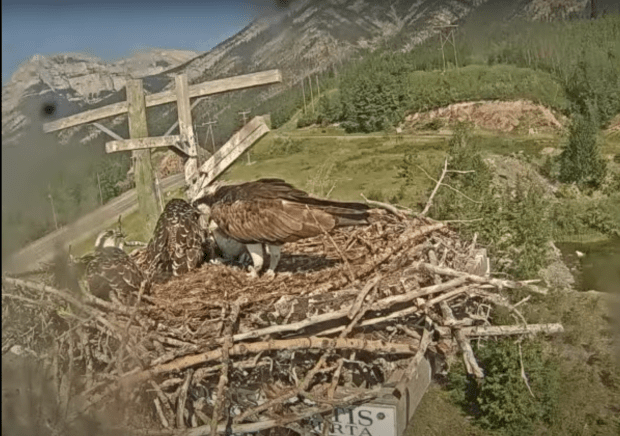
It is cooler at the Fortis Exshaw Nest in Canmore, Alberta. Mum and the trio are doing very well it seems.

Because it is in the same heat warning area, I have been checking on and off at the McEuen Park Osprey platform in Coeur d’ Alene, Idaho.

There were two of the fledglings on the nest when I popped in.

With all the heat warnings, it is nice to have something to laugh at and it is provided by Bukacek and the adult only nest. You might well remember that Bukacek had built a second nest for him and Betty. Having four large White storklets on the natal nest gets a little crowded. Now that the storklets are flying – they have taken over the new nest! Bukacek will have to build another!!!!!! Betty meanwhile lures them back to their own nest with food. Perfect. Ooops….they ate and left. Oh, goodness.

Beautiful Betty.

There has been some concern about a blood spot near the wing of SE30 on the Sydney Sea Eagles nest. What was the cause? Often the eaglets get fish blood or bird parts on their body but this does not seem to be that. It looks instead as if some feathers have clumped together either with fish juice or ps and they were, perhaps, pulling and it annoyed the eaglet who pulled them out and left a small bloody spot. The eaglet appears to be fine.

You can clearly see the spot on the right wing- and that enormous crop of SE29’s. 30 is eating well. No worries. Lady sometimes feeds it so much that 29 gets itself in a little knot. With the amount of prey coming on the nest there is no need for food competition – and even with feedings spreading a bit, everything should be fine. The eaglets are getting older. Getting ready to get some really itchy pin feathers soon. As long as food continues and Lady keeps up her remarkable feeding schedule..these two are going to grow and fledge.

There will not be any ringing or DNA tests unless one or both wind up in rehab after fledge. But I might be already inclined to guess that we have a really big sister in 29 and a little brother in 30.

We can always use good news in our lives. Here is another story of an eagle rescue that will warm your hearts! Thanks, ‘L’, much appreciated.

Our beautiful Victor. I love this photo of him standing on a low perch. You are progressing, Victor. Keep up the good work!

Since the rescue of Victor, some of us have been more than perplexed about where the zinc came from that poisoned his body. I have rattled my brain with several of you – flakes coming off of anything galvanized, warnings on garden hoses about zinc, the shale in the area contains zinc, etc. I really do not think our dear Victor sat and ate pennies knowingly. ‘C’ sent me the findings of a study by a Brazilian researcher. It has been translated by Google from the Portugese. If you are interested in how Victor might have gotten the zinc and how our contamination of the planet spreads to birds 10,000 miles away even…have a read.

Thank you, ‘C’. Much appreciated.

Title: “Not even the “end of the world” is free from human-caused pollution”

Animals that live in the waters of the Kerguelen archipelago, 3,000 km from the nearest inhabited region, are contaminated by metals such as cadmium and mercury.

Not even the “end of the world” is free from the pollution generated by humanity. Located in the south of the Indian Ocean, 3,300 km from Madagascar, the nearest inhabited region, the Kerguelen archipelago, formed by about 300 islands and islets, is contaminated by metals such as cadmium and mercury, copper and zinc. The observation is made by Brazilian researcher Caio Vinicius Cipro, a postdoctoral fellow at the Oceanographic Institute of the University of São Paulo (IO-USP), in two studies he carried out at the University of La Rochelle, in France, in partnership with scientists there.

Of volcanic origin, Kerguelen is 4 thousand kilometers south of India and 2 thousand kilometers north of Antarctica. The archipelago belongs to that country and is administratively part of the French Southern and Antarctic Lands (TAAF). There is currently a scientific station and structures associated with it. “There is also fishing activity due to France’s exclusive economic exploitation zone”, says Cipro. “Biologically, there are countless species of birds and marine mammals that have established colonies on the island and many others, in addition to significant amounts of fish and invertebrates thanks to the high primary productivity of local food. There are also several species introduced by humans, such as mice and reindeer, and some plants.”

He says that the idea for the study came during a period when he worked as a guest researcher at the University of La Rochelle. “My supervisor at the time, Professor Paco Bustamante, had told me about a dataset he had obtained years before, which he began working on during his own doctorate, and whose publication he never had time to pursue,” he says. “I volunteered to carry out the task and write the publication.”

Cipro then went on to study the occurrence of four chemical elements (cadmium, copper, mercury, zinc and selenium) in more than 30 species of invertebrates and fish, most of them at a lower trophic level (of the food chain). The objective was to understand how the concentrations of these inorganic pollutants behave at these lower levels that will influence organisms above them in the food chain.

Cipro’s first study was carried out in 2014, shortly after he arrived in France, on samples that had been collected by Bustamante’s team in the southern summers of 1997 and 1998. The Brazilian scientist analyzed metal contamination in a species of bird, the black shearwater petrel (Procellaria aequinoctialis). “We found contamination by cadmium, copper, mercury, selenium and zinc”, he says. “An article about the work was published in 2016 in the scientific journal Polar Biology.”

The second research was carried out in 2018 and yielded another article, published in the same journal. “In this case, we analyzed the levels of contamination of the same metals, with the exception of selenium – there were no conditions at the time to do this with this element in the laboratory at the University of La Rochelle – in 18 species of fish and 11 of invertebrates”, explains Cipro . The result of the work also pointed to the contamination of animals by metals.

According to Cipro, what can be concluded from the results of his research is that in this specific case of Kerguelen, cadmium values ​​varied much more than mercury values ​​(four orders of magnitude against one) and depended more on specificity in food ecology. and in the habitat than at the level of the food chain plain and simple.

In other words, the results of the studies showed that, contrary to what happens in most cases, the concentrations of pollutants found in animals depended little on their position in the food chain, but more on specific mechanisms of physiology and exposure, in such a way that predators from lower trophic levels could be more subject to some contaminants than others from higher positions.

This means, according to Cipro, that work with species of higher trophic level or sentinels needs more in-depth food ecology studies before reaching certain conclusions and that the food chain by itself does not mean much in this environment. “Furthermore, my research provides solid foundations on the exposure to which predators are subject, as in most cases this discussion remained on hypothetical terrain due to lack of field data,” he explains.

The work also showed a possible influence of a local secondary source of contaminants, probably the bird colonies themselves, a hypothesis confirmed in the Antarctic environment during his current research project. Going into more detail, Cipro explains that the analyzed metals have natural sources, but human activity certainly plays a bigger role than them in general. For mercury, for example, current emissions are estimated to be three to five times higher than before the industrial age. This element can reach the Kerguelen archipelago from dumps made by factories located 10,000 kilometers away.

Nevertheless, locally, in addition to bird colonies, some other natural sources may be significant, such as certain rocks and fossil fuels. “In the case of bird colonies, some studies that I proposed suggested and later confirmed their role as a local and relevant source of some elements and also of organic pollutants”, says Cipro. “In Kerguelen, we raised this hypothesis, comparing mussels from inside and outside the Gulf of Morbihan, and it seemed to be confirmed by the results obtained.”

The Dad at the Janakkalan Nest, Red CCL, continues to deliver the fish. The chatters have nicknamed the pair. Boris is the oldest and Titi is the youngest. The fish are so big that they take turns with no need to squabble. Titi is on the left. He has not figured out – yet – to hold the fish down with its talons.

Dad arrives with another fish at 1805. Titi is in the back with the huge crop from eating the fish in the image above. Boris is going to claim this one and Titi is absolutely too full to care! Lovely. Thanks, Dad.

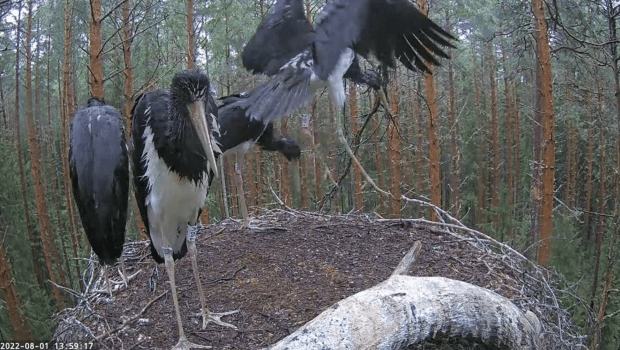
The four Black Storklets on the nest of Karl II and Kaia are really wanting a food delivery. While they wait it is raining – they shake off their feathers, flap about, and jump on and off the perch. Kaia arrives with food at 16:58, the last image.

Just look at this beautiful juvenile Red-tail Hawk, L4. Stunning. L2 and L4 will probably be soaring in the thermals soon and leaving the Campus. Every moment with them is special as it is with Big Red and Arthur.

The latest update on L3 from the Cornell Lab:

L3 is gorgeous. Looking forward to her release when she is all healed.

Thank you so much for joining me today. It is wonderful to have such good news in Bird World. To my knowledge, all of the UK Ospreys have fledged. They will be eating and gaining weight as will their mothers for migration. Soon these flights will be charted. In the meantime continue to enjoy them. The same with the storks! Take care everyone. See you soon!

Thank you to the following for their streaming cams, websites, and postings where I took my screen captures: Osoyoos Ospreys, McEuen Park, Coeur d’Elene, Idaho, Sydney Sea Eagles@Birdlife Australia Discovery Centre, Sydney Olympic Park, Cornell Bird Lab, Finnish Osprey Foundation, Mlade Buky Storks, Eagle Club of Estonia and Looduskalender, Ojai Raptor Centre, and Fortis Exshaw.