Tuesday in Bird World

It is a grey and windy day. As the weather channel promised, our summer heat wave in October seems to have come to an end (for the moment) with the arrival of single digit temperatures. The recent rains have caused the ground and old tree stumps to come alive and the sparrows and thrashers are thumping the ground having a good old time. It reminds me – continues to remind me – why we should not be raking our leaves or mowing the grass. Gently rake them into a corner if you have to. The birds really will thank you!

It is also nearing Halloween and all around me I can see the windows and doors decorated – many have elaborate displays outside.

I believe Halloween was the favourite holiday of my children – you got to dress up, get candy, and have parties at School. I recall pulling the two oldest in a sled one year as the snowflakes fell faster and faster. We did not need to go more than a block. Their pillowcases were full because they were the only ones out on such an incredible wintery night. The grandchildren enjoyed decorating the trees and, sadly, I remember using some of that web material with little black plastic spiders. That was a long time ago when I did not know better – but I do now. As a reminder to everyone, please be careful if you decorate. It will be a tragedy if animals get caught and have to be euthanized just for a bit of fun.

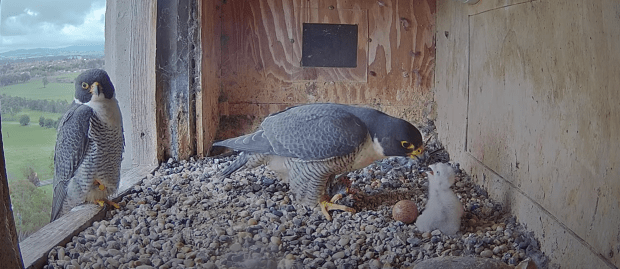
Oh, gosh, golly. Xavier and Diamond’s little chick just took its first steps!

Meanwhile, the Collins Street Four – which are a week older – are now standing up. They are also getting curious about the outside world and one nearly gave several streaming cam viewers a heart attack when it walked up to the edge of the ledge.

The Collins Four having some fun. Look at the size of the wings!

In case you are wondering why the scrape box is so messy this year, it is because the wind does not blow through it like it did at the other end. On a positive note, the chicks have been supplied with some shade and neither them or Mum have been as hot and panting as much as last year.

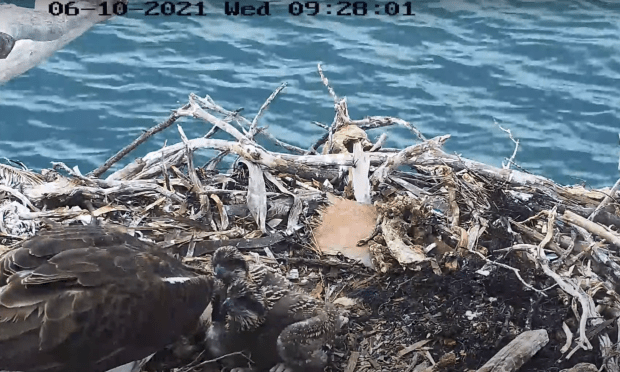
At the Port Lincoln Osprey Nest, the osplets had, at least, five fish yesterday – probably a couple more. I could not rewind the camera prior to 16:00 and all had big crops at that time. One of the most interesting interactions was between Little Bob and Mum. They had a tug-o-war with the fish tail. Mum won!!! It was very cute. that fish tail was from the 18:02:17 fish Dad brought in.

The osplets are doing really well walking around in that twig lined nest, too. They are covered more and more with feathers each day. Those feathers seem to be pushing out of those quills right before our eyes.

Dad brought in a bedtime fish for the family at 19:39:16. It is difficult to tell one from the other but there is Little Bob in its usual spot, right up by Mum’s beak.

Where is Solly, the first hatch of the Port Lincoln Osprey Barge in 2020? She seems to have decided to take a quick trip to Streaky Bay before heading back to her special tree in Eba Anchorage. It is such a relief to see the movements of the birds – to know they are safe, living their lives well.

If you were following some of the Montana Ospreys, a map of their locations has been released on the Montana Osprey FB page this morning. It shows that all of the Ospreys arrived in Mexico or Central America. Such good news. Their satellite trackers are working splendidly.

Both of the little sea eagles, WBSE 27 and 28, were still on the nest early this morning. That doesn’t mean that they will be there in a couple of hours.

I am a huge fan of Gabby and Samson’s at the Northeast Florida Bald Eagle nest near Jacksonville. The morning was just starting. The couple spent the night on the branches and as the sun came up, Gabby could be seen working on the nest.

At various times during the day, Samson, Gabby, or both, can be seen preparing their nest for the new breeding season. Here is a link to the streaming cams (there are several but this one looks directly into the nest), so you can check on them.

Tiaki, the 2021 Royal Albatross Cam Chick, is making really good time on her way to Chile. She was well beyond the International Date Line this morning. So, with that news, everyone in Bird World is doing well today. Smile. It is all good!

The sun is out and the Slate-grey Juncos are on the deck and the sparrows are having a drink out of the bowls. I wonder what other garden critters will show up? No Halloween candy for them! But they are getting extra dry corn cobs.

Thank you for joining me. Take care each and every one of you. See you soon.

Thank you to the following for their streaming cams where I took my screen captures: Port Lincoln Osprey Project, NEFlorida Bald Eagle Cam and the AEF, Sea Eagle Cam@ Birdlife Australia Discovery Centre, and the Montana Osprey Project and the Port Lincoln Osprey Project FB Pages for the sat-pak maps showing the location of the migrating Montana Ospreys and Solly.

Thursday Late in Bird World

It might still be drizzly and cold on the Canadian Prairies but the rain has stopped on the Port Lincoln Osprey nest – Thankfully! The kids had a last feed at 19:44:28 yesterday. Today, two fish were delivered before 08:30.

Dad is eating his share before the delivery to the nest.

The second fish that arrived, in the image below, is a flat fish. The previous one was a round. You can check the difference quickly. There are Leather Backs and Mullets in Australia. But, sadly, while my father and sons and grandson could tell you the names of most fish, I can’t.

Little Bob is the only one left eating.

Little Bob is usually first to the table and the last to leave. That may be the only way that we recognize him in the future.

Even Little Bob finally got full down to the tip of his talons and Mum was able to enjoy some of that nice fish. Beautiful.

Yesterday, Xavier delivered a food item to the scrape box at Orange. Diamond was not home! He looked at his little one and went over and fed it some of the bird. What a sweet moment.

There have been several feedings already this morning. Diamond and Xavier’s Only Bob can see them – its eyes are wide open.

Peeking out!

Remember that very tired little one that could not hold its head still so you could count to 3? Look today! Those eggies will turn out to be props and toys to play with for this little one other than competition in the nest.

It looks like the Collins Street Four were treated to having a pigeon plucked in the scrape box. Here is the before. The scrape isn’t all that tidy but…

Did Mom make this mess? Or was it Dad?

That is the little one that look so hawk like with that bulging crop. Cute. Everything that they see they imprint. By plucking the pigeon in the nest they will quickly learn the method.

Everything is alright in Bird World and there is still most of a day to come.

This is a quick check on everyone. Thank you so much for joining me. Take care!

Thanks to the following for their streaming cams where I took my screen shots: 367 Collins Street Falcons by Mirvac, Port Lincoln Osprey Project, and Charles Sturt University Falcon Cam and Cilla Kinross.

Port Lincoln chicks ate well!

The streaming cam has been down at the Port Lincoln Osprey barge most of the morning. It was also a dreadfully wet and miserable start to the day. Mum tried as she might to snuggle up with her three babies (can we call them babies anymore?). At 10:30 they were wet, cold, and probably hungry.

The first fish arrived at 11:09:12. Even the sun came out for the occasion. Mum was still feeding the trio at noon.

In the image below, Dad is eating his share and making certain the fish is dead before he delivers it to Mum and the chicks.

Mum has the fish and she is getting ready to feed the three hungry chicks. It is late for the breakfast fish.

There is Little Bob at the end. What is he looking at so intently?

I wonder if it is Dad flying away. Look at the expression on his little face.

Whatever it is, Little Bob is more interested in what is happening off the nest than eating his first fish of the day. That is pretty incredible. Little Bob is always the one who wants to be fed first!

Oh, two of the chicks are watching instead of eating. Is Dad giving a flying demonstration? These chicks are developing just as they should. They are becoming much more interested in things happening outside of the world of the nest. They are standing more and beginning to flap their wings. Think they are dreaming of flying? Little Bob is 29 days old today. The two older siblings are 31 days.

For those that are worried, Little Bob has stood up to ‘sometimes nasty’ Big Bob. Little has done that twice that I am aware. This nest is really calm and the chicks are so big that we should all expect them to fledge with their satellite packs. I understand they will be ringed, get their sat paks, and get their names in early November. Oh, I cannot wait to find out what the names will be this year.

When the three fledge, this will be a historic moment for this nest. Perhaps with the first fledgling of all three hatches, the curse of this nest will be lifted. These two adults have demonstrated clearly that they are highly capable parents and can easily raise a nest of three chicks from hatch to fledge.

Oh, look at Little Bob and look carefully – there is another chick looking up in awe, too. What an expression!

Now down to the business of breakfish!

After eating for 40 minutes, the chicks are beginning to get nice filled crops.

By noon, the fish is finished. Everyone is full and ready for a bit of a snooze.

The three osplets had no more than settled down when the second fish arrived on the nest at 12:35:28. Little Bob is on the right. He is turning around and probably cannot quite believe what he is seeing – another fish!

The role of the crop is to grind up the food before it enters the stomach. It also serves as a storage tank. The chicks can ‘drop their crop’ when they need nourishment. The reality of a raptors life is that they might eat well one day but not have any food for another two days. They need to eat as much as they can when they have the opportunity.

There they are lined up very politely for Mum again. I do not believe I have ever seen such a civil nest of growing ospreys. They might have their spats but not at the table. They line up and Mum feeds them. She is very fair. I have not noticed her favouring one over another. She does, in fact, often feed them as they appear in the line – one bite each and then back to the beginning. The other thing that is noticeable is the chicks do stop eating when they are full allowing the line to close so the other two are only being fed.

Is this behaviour down to the simple fact that they are so close in age? There is only 51 hours separating Big Bob from the time Little Bob hatched.

Just look at how close they are in size.

One of the chicks has left the table. Little Bob (see the roundish spot on the top of his head?) is still hungry. Of course, he is.

The second fish was done and dusted by 13:02. Little Bob is still looking. Maybe he sees some fish skin? or is there a piece of tail? He has a very nice crop.

In terms of size, I can no longer tell Little Bob from the other two. If the roundish spot disappears I will no longer be able to identify him as easy. He is growing so much. Wonder if Little Bob is a female?

Ah, it is silly to try and guess the genders but we all do it. They will measure the chicks when they are ringed. Of course, the measurements are not foolproof. Only DNA or an egg or mating can confirm.

Once the three are fed and all is well, it is much easier for me to sleep. The wee eyas of Xavier and Diamond’s have also had several meals today. You can clearly see that it has more than doubled in size from hatch.

Xavier is on the ledge while Diamond feeds the chick the prey he delivered. Look at the size of the wee one’s wing. Is it looking over to Xavier?

When Xavier turned around, I thought it was last year’s chick, Izzi.

Only Bob is looking directly at the beak and eyes of Diamond. Diamond is so delicate with the tiny little bites she feeds her baby.

The chick’s neck is now so much stronger. It can hold its head still for longer so that Diamond can feed it. The bobbling days are pretty much over. Notice, at times, that the chick instinctively keeps its balances by placing its wing tip on the gravel.

I absolutely love this image of Xavier looking so tenderly at his baby.

All full. The little one has now had four meals. Unlike the Ospreys, Only Bob needs many meals and fewer bites. Her crop is tiny. She is now collapsing into a food coma.

Awww. I wonder if Xavier wishes that Diamond would let him brood the chick? Perhaps she will in a few days but the falcon mothers are extremely protective in the beginning.

The Collins Street Four have been eating, sleeping, growing, and decorating the walls around the scrape. Their world is that of the scrape box. They are not as interested – yet – in what is happening outside of their world. They will become more interested, just like the Osplets at Port Lincoln, in a couple of weeks.

As the days pass, we will begin to notice a difference in size. This is not due to the amount of food the eyases eat individually. It will be because some of them are males and some are females. The females will be approximately 30% larger than the males and they will consume about 25% more food (nothing staggering). When fledge time comes, it is normally the males that fledge first. Their feathers will have covered them quicker because they are smaller! It is that simple.

Last year we did not notice a difference in size in the triplets. That is because they were all females. I do hope Dad gets a break this year and has a couple of males. I cannot even imagine what it would be like to try and feed four large females!

They are beginning to look slightly different in their faces. Notice the one facing the back who looks more ‘hawk’ like.

These eyases are more than full. Look at that shiny big crop. My gracious.

If you missed the live streaming of Iniko 1031 arriving at the pre-release containment area at Big Sur, here is the video of that moment. The condors are so endangered and there is no telling how many more wildfires will rage. Fingers crossed!

It is late on the Canadian Prairies. Our damp is supposed to go away on Saturday. Meanwhile, it is the annual birdseed sale at our nature centre this weekend. It is a great time to get high quality feed for a big discount and help out the centre as well. You might check and see if your local nature centre does this. The savings can be substantial. I will also continually remind people that if you have a local feed and seed store, you might be able to find Millet, corn, Black Oil seed, peanuts in their shells at a substantially lower price point. My neighbours introduced me to this years ago but, sadly, the big feed store moved. The distance makes it no longer viable as a source.

Thank you for joining me. It is always a pleasure to receive your notes and letters. I appreciate the time you take to write to me whether it is an e-mail or a public comment. You take care. See you soon. All of these nests are doing so well that we can all rest easy. Life is good!

Thank you to the Port Lincoln Osprey Project, Charles Sturt University Falcon Cam at Orange and Cilla Kinross, and Collins Street Falcons by Mirvac for their streaming cams where I took my screen shots.

Bird World Happenings

For those of you hoping for a second hatch at Diamond and Xavier’s scrape box, it is not to be. Either the eggs were not viable or the second chick died trying to hatch. What we have, however, is one really healthy eyas whose eyes will open in the next few days and what a delight that will be. One healthy baby is just fine!

A video was made of one of the chick’s feedings. I cannot wait til it can see its parents! How wonderful.

It is pitching down rain in Port Lincoln. Mum and the three osplets are absolutely soaked to the core.

Mum is the best. She is trying as hard as she can to keep her three babies from catching a chill. Sadly, Melbourne’s weather says it is to have rainy periods through Saturday. I do hope the nest gets a chance to dry out for this incredible Osprey family.

To my knowledge no breakfast has come in yet. Mum is really tired and would appreciate the sleep. She has a smelly wet pillow!

It is an hour later and Mum is beginning to dry out just a little. Hopefully Dad will be in with a fish soon.

The Melbourne Four have already had three meals today – before 8:30! These parents are working overtime. It has to be exhausting. Look how big that little one is and how big its crop is. These four are also healthy and strong. Well done Mum and Dad.

Skipping over to the US, those who fell in love with Anna and Louis during their first year as Bald Eagle parents will be excited to know that the streaming cam is up and running. Here is the link to that nest at Lake Kincaid in the Kisatachie National Forest. Last year, Anna and Louis had one eaglet fledge, Kisatachie. It was wonderful to watch the parents grow into their roles as parents. One time Louis was so eager to provide food early on that he had 18 fish in a pile. I can sure imagine quite a few nests that would have liked some of that! Kisatchie grew big and strong and honoured this old Bald Eagle nest that had not had an eaglet hatch or fledge in 13 years. Incredible.

Cody, Steve and the gang are handling the chat to answer any of your questions.

I have not checked on the Black Storks from Latvia and Estonia for some time. There is some troubling news, perhaps. regarding Julge. This latest report is on Birdmap.

“In the morning September 8, Julge crossed border between Germany and Belgium and from next overnight there was not long distance up to France border, anymore. 20-30 km, depends in what direction Julge continues migration. But perhaps, there is time to improve energy sources? Interesting, if quarry is good place to find food for stork…. Anyway, Julge flew south in September 12. That means France is next country Julge visits. And stayed in a village called Saint-Hilaire-le-Petit. Nor dare not fear the closeness of people. He could be seen picking up insects from the lawn in the parking lot of the nearby Pontfaverger supermarket … But on the afternoon of September 21, Julge flew some 30 km in direction of Paris. On 22 September, Julge reached a stopover between Paris and Reims, where the latest data were received on the morning of 25 September. Next behaviour of Julge is unknown. A local newspaper is also involved in the searches of Julge.”

You can check the migration status of the Ospreys, Black Storks, White-tailed Eagles, Eurasian Cranes, and the Lesser Spotted Eagles here:

http://birdmap.5dvision.ee/EN

I also wanted to check on Karl II and his three children and on their migration status.

First is Udu. This is from the Forum: “It is now becoming unlikely that Udu will find/follow the ‘usual’ eastern migration route, I fear. All other options to cross the Mediterranean Sea are far more complicated, difficult and dangerous. Unless Udu will winter in southern Italy, or in Greece?” Udu is now in Kosovo.

Here is the map showing the three members of the family: Karl II, his daughter, Pikne, and son, Udu . They are making wonderful progress!

You can follow the Black Stork family whose nest was in the Karula National Forest in Estonia here:

This was just a quick check on the developments at the Orange Australian scrape box of Xavier and Diamond. I am certain that chatters and followers would loved to have seen two eyases hatch but, it was not to be. We can, however, wait with wonder to see the little one open its eyes and see its parents for the first time – and grow, thrive, and fledge. Send positive wishes for a fish to arrive at the PLO and for the rain to let up so the nest can dry.

Thank you for joining me. It will get chilly on the Canadian Prairies tonight – down to 4 C. It will certainly feel more seasonal. Take care everyone. See you soon.

Thank you to the following for their streaming cams or Forums where I took my screen shots: the Port Lincoln Osprey Project, 367 Collins Street Falcons by Mirvac, Charles Sturt University at Orange Falcon Cam and Cilla Kinross, the KNF Bald Eagle Cam, the Latvian Fund for Nature, the Estonian Eagle Club, and BirdMap.

Checking on Chicks

There was a lot of chatter over the Melbourne Peregrine Falcon scrape at 367 Collins. The concern was because the Mum had not been ‘seen’ since 19:06:24 when she left the little ones after feeding them.

The chicks at Melbourne are enormous! I honestly can’t even find the small one anymore. Underneath the fluffy down that remains there are pin feathers coming in and if you look closely, those sweet pink little beaks are turning into a rather adult looking beak.

There is no need for concern for Mum. The problem is that the eyases are simply too big for her to brood anymore because there are four of them. Can you see where Mum is?

The image on the left is a week ago. The one on the right was yesterday.

I haven’t reported on Port Lincoln Ospreys for a day. These were the feeding times for yesterday: 6:52, 10:02:43 (small), 10:43:15, 14:43:39, 14:55:50, 16:11:51, 16:23 (mum caught this one), and another fish delivery somewhere around 17:59:58. It was hard to differentiate when the osplets started eating one fish and began on another during the afternoon.

The Mullet that came on the nest at 10:43:15 was still alive and Mum flew off with it, killed it, and returned at 10:44:30. When Mum brought the 16:23 fish onto the nest, part of the fish that dad had brought earlier was still there. This could have been the 17:59 feed. It is not clear. What is certain is that the chicks had massive crops throughout the day. With Mum fishing – and she seems to catch the bigger fish these days – the nest is eating well. The supplementary fish she brings in is making a huge difference to all including Mum who also needs to eat. And Dad.

One thing that I found very interesting was our dear Little Bob. Later in the evening on the 10th, the Middle sibling had caused a bit of a spat between Big Bob and Little Bob. Middle Bob seems to do this and then it ducks to get out of the way. Little Bob was not having any of it and well, we might begin to believe that Little Bob is the ‘boss’ of the nest. This was the second time that I have seen Little thwart any attempts by Big to be the dominant one in the nest. (The other was awhile ago0. I say this because Little Bob took the fish tail at 10:02 yesterday and ate it with no problem. The fish tail is a bit of a prize in an Osprey nest.

These are just some shots from the various feedings. Notice that they all line up and eat very civil!

Little Bob has the fish tail!

Little Bob had no difficulty eating the fish tail. Well done, number 3.

By the time the last fish arrived, many were so full they couldn’t even think of eating much more. Mum had a really nice feed. How grand!

Diamond and Xavier’s Only is growing well.

Today will sort out if there was a pip or not in one of the eggs. It is simply not clear. For the chick to survive, it would need to hatch today. Diamond rested better last night and wasn’t shuffling the eggs around so much. Perhaps we will have another Only Bob like Izzi last year and that is just fine. Cilla Kinross says they have never had three hatch at this nest despite three eggs being laid. In many ways raising one is so much less stressful than four. The Melbourne parents have to be worn out!

Everything is fine for the nest and the two scrape boxes. I will check in with the White-Bellied Sea Eagles later today. I understand that they are fine but that the Pied Currawong continues to be a nuisance. The Bald Eagle couples are restoring nests from last season and the Albatross for the upcoming breeding season are landing on Taiaroa Head. The world is working as it should be.

Thank you so much for joining me this morning. Take care. See you soon.

Thanks to the following for their streaming cam where I took my screen shots: 367 Collins Street Falcons by Mirvac, the Port Lincoln Osprey Cam, and Charles Sturt University Falcon Cam at Orange and Cilla Kinross.

Dad brought in a whopper

At 8:56:34, Dad brought in a massive fish (despite having eaten his fair share) to the Port Lincoln Osprey Nest.

The image below shows the size of the fish a little better despite much of it hidden under mom. Imagine that the top part is up at her beak where she is feeding one of the chicks to get an idea. Little Bob is in the middle. You can see the white lace on his cere and the black circle on top of his head.

Dad returned at 9:11:33 to see if Mum was finished feeding the chicks. She wasn’t and she did not let him take the fish.

The trio lined up again. Big Bob, who had eaten first, is full and is moving away from the feeding line. She is letting the two younger siblings have their share.

Middle and Little are right in there. Their feathers are growing so quickly. Look along the edge of Little Bob’s wing. They are beginning to look like fringe.

Oh, goodness. Dad is rather anxious this morning. He returns a second time at 9: 28:20.

Mum is still feeding Middle and Little Bob. Oh, and look. Big Bob is waking up again. Is he ready for another round of fish?

You can see that there is still lots of fish left. The chicks have now been eating for 34 minutes and it looks like half the fish is left. Dad is really having a close look. Mum does not give the fish to him, again. She seems to have decided that he is not going to rush her today.

Ah, Big Bob is back up at the end of the line wanting some more. This is such a polite nest. Big Bob does not push his way to the front of the line, she waits.

By 9:29, Mum decides to move the fish around to the other side. Maybe she thought Dad was going to take it. She continues to feed the chicks and herself.

Despite the fact that the chicks have moved so that they can pass out in their respective food comas, Mum continues to feed Little Bob.

Little Bob is ‘stuffed’ and has turned away from any more bites of fish. Mom is doing a good job eating that nice fish near the tail. She needs to eat, too! Dad seems to have nodded off waiting! In the end, I do not think Dad even got a nibble of the tail. We have to remember that he did have a big chunk before he brought the fish to the nest.

The trio and Mum finished off that extra large fish in 47 minutes. Amazing.

Dad brings another fish to the nest at 13:29:38. Everyone is fed and it is not even the middle of the afternoon. This is a good example of how the feedings change. When the three were wee, they needed more feedings with less fish at each one. Now they will eat much more fish but, there will be less feedings. They are really, really growing. Little Bob is 24 days old today while Middle and Big are 26 days old.

Xavier watches from the ledge of the scrape box as Diamond feeds their wee babe. So far there appears to be no pip or crack on a second egg. It is unclear if there is even a pip.

It is the middle of the afternoon and Xavier is again resting on the ledge. He was seen limping and he is probably resting that leg. Instead of Starlings and Parrots, Xavier has been bringing in pigeon which is a much larger prey item. He might have strained his leg when he was hunting.

I also wonder if he can hear the second chick? or if he just wants to be there with Diamond in the scrape? or wants to brood the chick and incubate the eggs?

The waiting must be frustrating for these two. Big Bob (or Only Bob) is poking its head out from under Diamond to the right of the egg. Cute.

At the nest of the White-Bellied Sea Eagles in Sydney’s Olympic Park forest, a Pied Currawong will not leave WBSE 27 and 28 alone. It has been harassing them on and off all day. It is the Pied Currawongs who are intent on chasing the little sea eagle fledglings out of the forest. Normally, eagles fledge and return to the nest for the parents to feed them while they strengthen their flying skills. Many will return to the nest for feedings for up to a month. If they are rushed away, the ‘map’ or return to the nest might not be imprinted in their memory.

27 and 28 are smart. They can hunker down duckling style and watch but the Currawong cannot harm them. These birds can knock them off if they were standing on a branch or injure them if they were standing up.

These two will be branching so soon and then fledging. They can walk and stand and both are self-feeding. We are entering the 11th week. From hatch to fledge for the Australian White-Bellied Sea Eagles is 80-88 days. The median is 83.1.

Here is a video of WBSE 28 stealing the prey from 27. Fantastic!

At the 367 Collins Street Peregrine Falcon scrape, Mum has left the scrape box and is off for a break and to retrieve prey for the eyases. Look at how much room they take up today!

They look like a large white Persian cat if you squint.

Time for your mid-afternoon pigeon everyone!

Dad had it prepared and ready for Mum to bring and feed the youngsters.

Yummy.

The oldest two are getting more hawk like in their appearance.

Except for the Pied Currawong’s harassment, all of the nestlings are doing very well. It is, indeed, a pleasure to be able to watch them grow from hatch to fledge. How fortunate we are!

Thank you for joining me. Take care everyone. See you soon.

Thank you to the following for their streaming cams where I took my screen shots: the Port Lincoln Osprey Project, 365 Collins Street Falcons by Mirvac, Charles Sturt University Falcon Cam at Orange and Cilla Kinross, and Sea Eagle Cam @ Birdlife Australia Discovery Centre.

Everything is just fine

I just watched the Dad at the Collins Street Peregrine Falcon scrape trying to feed a huge piece of pigeon to “the four”. He tried several beaks to see if any of them could handle it and then ate some and tried again. Bingo! Then he did it again. Bingo! These two are just amazing – the parents. It is a lot of work to feed 4 instead of the usual 3. I can’t even imagine what it will be like when each one wants their own pigeon! Makes me tired thinking about it.

The eyases are able to eat larger and larger pieces of meat.

Ah, so sweet. Open wide.

Here are some pictures of a beautiful mom a few hours earlier. The eyases have doubled in size. It is getting more difficult to brood them.

Notice how careful Mum is raising her leg to get off of the eyases, turn, and get to the ledge to take a break.

Whew. Oh, just look at how big those the chicks are that are sitting straight. If Victor Hurley could get to the scrape box and weigh and measure the wings of the eyases next week, he might have a good idea which are female and which are male. This, of course, will not happen. He does not wish to disturb them in any way. But a Peregrine Specialist can from those two measurements differentiate between the males and females at that early age. For us, when they are about 24 days old we should be able to tell the males from the females. The females are approximately 50% larger. According to the research, even though the females are so much larger they do not substantially require more food than the males, just about 25% more.

Ah, you will often see them playing with one another’s beaks. Beaks of course mean food! They will not hurt one another. They are much stronger today than they were yesterday and you will continue to see significant growth and strength.

Cutie Pies.

And, yes, all four are there! It is 22 degrees C in Melbourne. That is 71.6 in F. A really nice warm day.

Mom is taking another break. Sometimes if you listen very carefully you can hear Dad calling her. She has to eat, too, and Dad is in charge of filling the pantry. She will often pick up the food for the chicks and bring it to the nest.

You will notice that the parents do not normally leave food in the nest. You will also see Mum eating bits of old food left in the scrape. She doesn’t want to attract insects or anything that could harm the chicks. That level of cleanliness has evolved for millions of years.

Mom has now been gone for 12 minutes (my current screen time). The chicks are nice and toasty stacked up on one another on a beautiful warm Melbourne Day. Rest assured, the adults are not far away. There is someone nearby at all times despite the fact that there really are no predators in the area.

The Port Lincoln Osplets had their first feeding at 9:00:06. It was a really nice fish and very one was stuffed, leaving the table with a nice crop.

Just look at that crop on the chick in the foreground. My goodness. By my reckoning that is Little Bob. He might have had a bit of trouble getting into the right spot yesterday but it certainly looks like he did well this morning.

A half hour later and the chicks are still working on that fish.

Right before 9:30, the fish is completely finished. There is nothing left. One of the older siblings is looking at Mom. You can see their nice crop, too. Little Bob is the one with its head near Mom’s tail.

The second fish of the day arrived on the nest at 12:02. It was entirely consumed and the feeding fished at 12:20. My goodness.

The chicks are all lined up nicely for Mum. Everyone will be fed and the feeding will end with each of the three having a crop. If you are just joining us and are wondering what the word ‘crop’ means, it is like a pre-stomach stomach storage area in raptors. They can ‘drop their crop’ when they need food and energy. It really helps because out in the real world, away from mom and dad feeding them, the birds might not be so successful at fishing or hunting. This way if there is plenty they can eat lots and kind of store it for when there isn’t.

Little Bob is in the middle. You can see the ‘dot’ on his head in the image above and the stripe down his back is not as wide as the two older siblings. The length of the copper-red feathers coming in on the head and neck appears to be the same length now on all three. The tail feathers of the older two are longer.

At the end of the feeding the three were still lined up as they had been. This nest is so civil. Just causes smiles, big ones.

Oh, this has been such a great year to watch. Last year this nest was the one that almost made me stop watching Ospreys altogether. I am mystified but overjoyed. The only explanation is the closeness in the hatch. No one of the osplets is significantly smaller than the other- or the reverse, none is significantly larger than the others. Not like Tapps and Solly. In this instance, Little Bob is also tenacious and has not let Big Bob’s occasional attempts at dominance rattle him in any way.

In this short blog, so far, you have read about two Australian Birds. The Guardian newspaper out of London, UK is holding its voting for Australia’s Bird of the Year. You do not have to be Australian to vote. I will post the link. Please note that the Peregrine Falcon is still in contention! There is no Osprey to vote for but the Galah is still in contention. There are many other birds and you might have a different one you like. It doesn’t cost anything and every day some birds are knocked out of the competition. You can vote every 24 hours til the end. Please take part. It is a bit of fun!

https://www.theguardian.com/environment/ng-interactive/2021/sep/27/australian-bird-of-the-year-2021-vote-now-for-your-favourite

Also mark 9 October on your calendar. That is the big e-Bird count for the fall that helps in understanding where the birds are with regard to migration. Last year Cornell reported that 32,000 people from around the world submitted 80,400 check lists with 7, 128 species observed.

I am certainly curious about this year’s migration because today it was 28 degrees in my City today. That is a temperature that years ago we never even hit in the summer. It has become more normal over the past four years but not digging into October. So please do take part. Here is the information and instructions on how to do so.

https://ebird.org/news/october-big-day-2021

It is hatch watch for the Orange Falcons, Xavier and Diamond. Diamond has been letting Xavier do some of the incubating today. I hope she is spending some time enjoying herself in the sun. These two parents are going to be really busy very soon.

Royal Albatross male, OGK, spent the night on Taiaroa Head waiting for his mate YVR to arrive for the 2021-22 breeding season. Oh, he is such a handsome but sweet male. The amount of time and care he gave to his daughter, Miss Pippa Atawhai, when she was the Royal Cam chick a year ago won the hearts and minds of anyone who saw them together. He never rushed when he came to feed her. Always doing more than a few skycalls, OGK would often sit with his chick for long periods of time preening her and chatting. Sometimes he would even sleep!

It will be a joyous occasion when the two are reunited after being apart since before Miss Pippa Atawhai – their daughter and the 2020 Royal Cam Chick – fledged last September. I think OGK is anxious for his sweetie to arrive. Send all the positive wishes for this amazing couple. Maybe the NZ DOC will decide to have OGK and YRK has the Royal parents again this year. Wouldn’t that be amazing?

Take care everyone. It is getting late and I want to go and check out my book on duck ID. Thank you for joining me. Stay safe, watch the birds and be joyful! Vote for your favourite Australian bird and be sure to register for the big bird count!

Thank you to the following for their streaming cams where I took my screen shots: Port Lincoln Osprey Project, 367 Collins Street Falcons by Mirvac, Falcon Cam at Charles Sturt University in Orange and Cilla Kinross, the Cornell Bird Lab and the NZ DOC.

Fastest on the planet

The arrival of the fourth eyas at the 367 Collins Street Peregrine Falcon nest took everyone by surprise. Looking carefully, viewers proclaimed a fourth head bobbing about – and they were right. I have no idea when during the night this little one entered the world but all are happy. Parents are busy brooding and feeding!

“Wake up everyone. You have to eat some more pigeon so you will grow big and strong.”

Wakey, wakey!!!!!!

“But, Dad, we just ate. That doesn’t matter darling. Your mother told me to feed you often so no one is hungry.”

“That’s right. Open wide.”

Some of the eyases have their eyes open today.

Ah, beautiful mom with her four babies tucked under her.

Those four little fluff balls will become the fastest animal on the planet. They can fly 390 kmh. The chicks will become ‘flying predators’. It is hard to imagine but before we blink, they will have fledged. Their parents feed them til they can hunt successfully. Then Mum and Dad will do what all birds of prey do – send the kids out on their own to establish their own territory. As far as Dr Victor Hurley, head of the Victorian Peregrine Falcon Project, knows, this couple is the only one in downtown Melbourne. Imagine.

Peregrine falcons were used for hunting in the medieval era. In England, they were called ‘falcon gentle’. Frederick II (1194-1250, Holy Roman Emperor, rated the peregrine falcon as being as good as the best gyrafalcon. Peregrine falcons are 35-51 cm long and have a wingspan of 79-114 cm. The females weigh 740 grams to 1.3 kilos while the smaller male is from 550-750 grams. English kings used the peregrine falcon for hunting herons, cranes, ducks, and rooks.

Here is a great video (8 minutes) about the falcons.

To test the speed of a peregrine falcon against a new generation of electric racing cars, a contest was set up. Have a look:

It is such a privilege for us to be able to watch these four chicks grow into masters of the skies. I love falcons!

Updating news on the Port Lincoln Ospreys. Dad brought in a late night feed yesterday at 18:24:55. He had another fish on the nest this morning early, at 6:09:52. Those three are doing just fine!

Thank you for joining me today. Why don’t you check in on the falcons? Here is the link:

Take care everyone! Tomorrow I will introduce you to some of the visitors to the garden today.

Thank you to 367 Collins Street Falcons by Mirvac where I took my screen shots.

Chow time!

As far as can be determined, three of the four eggs at 367 Collins Street have hatched.

Those eyases got their first feed of pigeon!

Oh, look at that little beak wide open leaning over towards the adult wanting some food.

Awwww. Their eyes remain closed for the first 24 hours but, there they are with those little pink beaks open wide wanting food. Great instincts.

Sound asleep. The eyases will, in a couple of days, be jumping up for food when they hear the familiar sounds of their parents telling them it is time to eat.

The information on the Canadian Peregrine Foundation’s website is really good. They have a few fantastic images showing you, visually, how the eyases will develop. If you click on a picture, it will give you information on how these wee ones will change and grow.

http://www.peregrine-foundation.ca/info/ageguide.html

Speaking of feedings, the Port Lincoln Osprey Barge has had quite a few. After my last check yesterday, they had more deliveries at 13:20:31, 14:33:37, 16:03, and another around 18:37ish. Sometimes the chicks were so full from the previous feeding, they were not so interested! Good work Mum and Dad!

You can still see the crops on all three after the previous feeding. Just look at how dark they are today but check out those big white feet!!!!!!!!! I could not possibly tell you which one is Little Bob today.

It was not a huge fish but it did top all of them up and left a bit for Mum and Dad.

Mom enjoying some time alone on the perch.

Oh, just look at those sweet babies trying to tuck themselves under Mum.

They might have thought it was the end of the feeding but Dad brought in a nice fish around 18:37 and this feeding will ensure that their tummies are full for the night. Full osplets are happy osplets!

All is well!

We will have to wait and see if that fourth egg at Collins Street will hatch today. Even if it doesn’t, three healthy eyases are just fine.

Thanks for stopping in. I am so glad you could join me for a short visual stop in to see how things are going at these two nests. Take care!

Thank you to the Port Lincoln Osprey Project and the 365 Collins Street Falcon Cam by Mirvac for their streaming cams where I took my screen shots.

As the Nest Turns 11 Sept

The female on the Port Lincoln Osprey barge woke up to some rain and by mid-day there was rough weather. The moderator of the PLO chat said they hoped that the chick would choose to stay in the egg!

It is currently 12 degrees C with a wind speed of 42 km/h or 26.09 miles per hour. Blustery. Not good for fishing. Best wrapped up in a cosy blanket with a cup of tea and a good book. Hang in there mum.

Aran is still in the Glaslyn Valley. Doesn’t he look grand on one of his favourite perches looking over ‘his’ territory. As much as others might have their eyes on their natal nest, Aran doesn’t intend to hand it over to either Tegid or Aeron, Monty’s boys, Z1 and Z2, respectively.

Some are worried. My notebook just said that ‘Aran migrates after the middle of September.’ That was accurate but not precise enough.

As it happened, Tiger Mozone on the PLO chat and so I was able to ask him. Immediately – literally – there was a link to ‘Tiger and Chloe B’s Osprey Data’.

https://www.imagicat.com/Glaslynstats2021.html?fbclid=IwAR1uxYgOaHJ85Yo7zbbEpttPlKvHn_N4zWrrL-TLutWheHwn_AQQRZPLr8c

These are the dates that Aran was last seen at the Glaslyn nest from 2015-2020:

  • 2015. 25 September
  • 2016. 16 September
  • 2017. 12 September
  • 2018. 22 September
  • 2019. 16 September
  • 2020. 15 September

The average is September 17th. That is six days from now. There is no need for anyone to be alarmed that Aran is still in the Valley, worrying that he is unable to migrate due to his earlier injury. Aran is ‘being Aran.’

Everyone that watches the Royal Cam Chick at Taiaroa Head, Tiaki, you should be giving a shout out to Ranger Sharyn. She located Tiaki 150 metres from her natal nest and the streaming cam. She carried her back to the general area of the nest – and just in time. LGL flew in and fed her daughter shortly after.

Here is Tiaki seeing her mom and coming quickly for that delicious squid shake. These chicks can really move when food is involved — or running away from ‘the dreaded basket’ when the rangers come round to weigh the chicks.

Victor Hurley, the Peregrine Falcon specialist who uses the streaming cam in Melbourne to study the falcons, is looking for some help. He was on the 367 Collins Street Falcons FB page today asking for individuals to accurately provide the time stamp for the incubation hand over duties. Later, he will be looking for time stamps for prey delivery. If you would like to help, please go to the 367 Collins Falcon Watchers and PM Hurley.

Here is a great example of what he is looking for. Mum is getting off the eggs and Cutie Pie ‘Dad’ is falcon walking on the ledge. They are such a good team.

It is windy in Sydney, too. WBSE 27 and 28 had a tiny bird – looks like another gull chick – around 6:29. 28 held back until almost all of the bird had been eaten by 27. That is a bit unusual for the first feeding in the morning. Normally 28 is right up front ready to go.

Notice that 27 stood for its breakfast! Oh, these two are really developing. Both have been standing more and trying to walk.

Another food item comes to the nest around 10:00. This time Lady splits the meal between both of the chicks.

28 is on the left and 27 on the right. You will notice that while the wing and back feathers are growing in nicely on both, 27’s tail is longer and 27 is noticeably larger.

In his book, Soaring with Fidel, David Gessner reminds readers that at the time of migration the juvenile Ospreys are transformed in appearance from when they were first fledglings. Gone is the white scallop on the feathers, gone is most of the down, the eyes are yellow, the dark feathers are darker, and the birds have ‘slimmed down’ somewhat.

So today an Osprey appeared on the Achieva Nest in St Petersburg. Help me out here. Could we be looking at a slightly older Tiny Tot?

The top two images are of the visitor today. The top one looks more like the face of Tiny Tot with the trademark ‘heart’ on the top of the head.

These are the first images that I grabbed of Tiny Tot out of the hundreds that I have. I wish that I could get both of the birds in the exact position.

Of course, it could be my mind playing tricks. I would dearly love for this to be Tiny Tot.

When I was scrolling for images of Tiny Tot, I cam across this one of Tiny Little. The Two Tinys are the stars of survival for 2021. The most amazing, clever, determined to live little birds who beat the odds. What I wouldn’t give for Tiny Tot to have a Darvic ring! Then we would not be guessing who is on that nest.

I will leave all of you with this mystery and a reminder of how inspiring these two little ospreys are to all of us.

Thank you so very much for joining me today. Take care everyone. Stay safe.

Thank you to the following for their streaming cams where I took my screen shots: PLO Osprey Project, Cumbrian Wildlife Trust and the Foulshaw Moss Osprey Nest, Sea Eagles @ Birdlife Australia Discovery Centre, Achieva Credit Union St Petersburg, 367 Collins Street Falcons, and Bywyd Gwyllt Glaslyn.