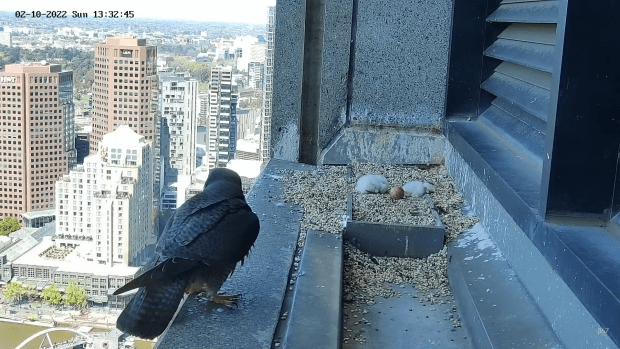
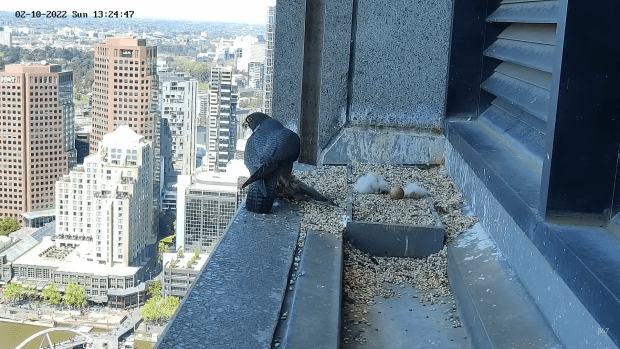
This is a quick check in to see what is happening with a few of our nests.
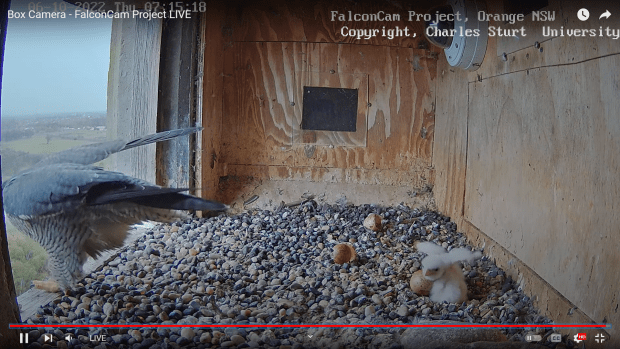
The second hatch of Xavier and Diamond at Orange had its first bites of prey this morning. Goodness, there is certainly a difference in size. Diamond did a great job handling two different heights with one chick who can now see and another than can’t.
Just look at that big sibling flap its wings. Wow. What a strong chick!
The wee one is so tiny.
When eyas #2 connected with Mum’s beak and the prey, the first bite was quite a substantial one.
Both so very cute. It will be exciting to watch Xavier and Diamond with two chicks this year.
This is a video of the big sibling from the other day having an encounter with Dad and flipping over.
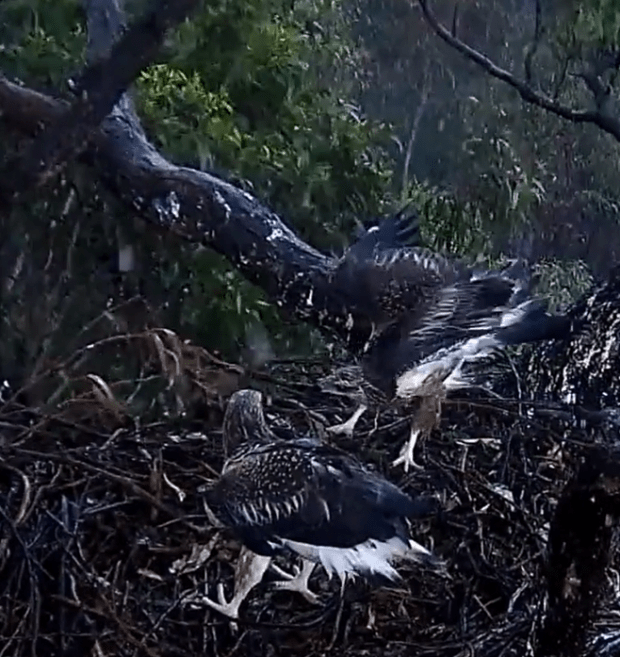
Yesterday it was pitching down rain in the Sydney Olympic Forest. SE29 and SE30 were having a bang-up time flapping in the pouring rain. Today, the camera appears to be down. So, we might not know if SE30 fledges or not. I suggest continually checking as it could come back online anytime.
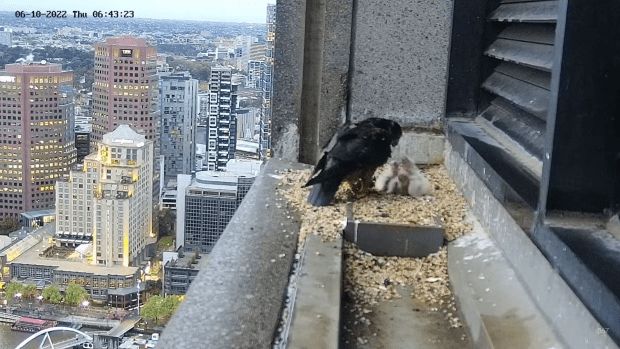
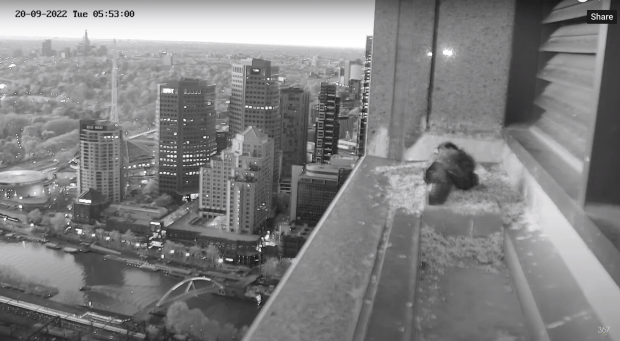
It has been raining in Melbourne. Mum has fed the four eyases and is working really hard at being a great Mumbrella for the little ones. They are warm and dry.
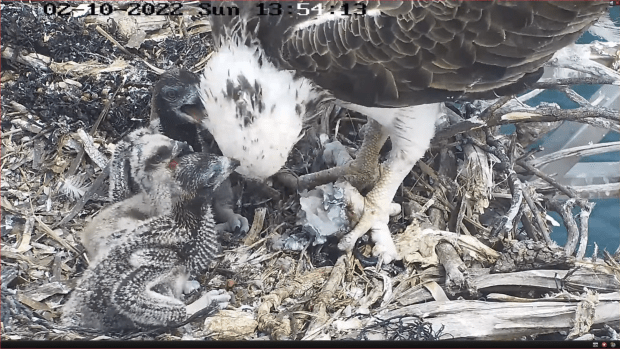
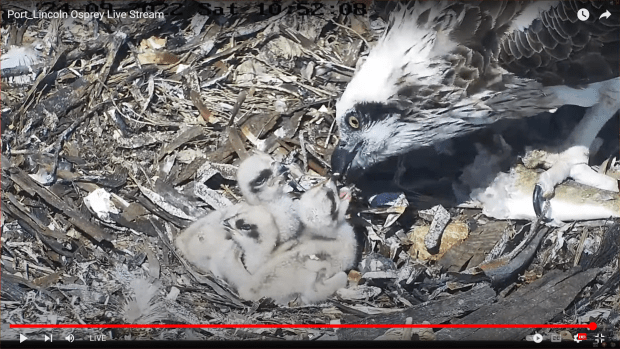
Port Lincoln osplets were waiting for the first fish of the day. It looks like it will be a sunny morning in Port Lincoln turning cloudy with rain arriving around 1600. Hopefully Dad will get some good fishing in before those drops start falling.
In migration news: There is a lot of activity happening at the Mispillion Harbour Osprey platform in Delaware. And it is not necessarily ospreys! You might recall that a banded Peregrine Falcon arrived on the nest the other day drenched to the bone from the rain from Hurricane Ian. ‘H’ has been watching the nest and has been surprised to see at least one Bald Eagle on the nest today, if not two or three. They are not banded. Thank you ‘H’.
When I think of migration, Delaware doesn’t readily come to mind but I absolutely do not know why it doesn’t! After ‘H’ contacted me about the falcon and then the eagle – eagles bringing fish and turtles to the nest – I began to wonder what migration is like on the easter seaboard of the United States. Then I found this article on the birds that fly through there, some of them staying. I would also think that all birds would hug that shore, not flying out in the Atlantic so there would be tens if not hundreds of thousands of birds flying through.
Here is the video that ‘H’ made of the visit and uploaded to YouTube.
For those who are Jackie and Shadow fans, this much beloved Bald Eagle couple were working on their nest in Big Bear today.
Thank you for joining me for this quick check in. Isn’t that little one of Xavier and Diamond’s adorable — and there are two of them! Take care everyone. See you soon.
Thank you to the following for their streaming cams where I took my screen captures: Port Lincoln Ospreys, Charles Sturt Falcon Cam, 367 Collins Street by Mirvac, Sea Eagles@Birdlife Australia Discovery Centre Sydney Olympic Park, and Mispillion Harbour and the Delaware DNR and ‘H’.
It looks like the clouds are breaking up and it feels like another beautiful fall day. Yesterday, the trip to the wetlands was stunning in its fall colour. Most spectacular were the Aspens with their bright yellow leaves flittering in the wind and some that were red – so red – with no other colour. I hope to have taken at least one image to share with you in another blog.
This morning there are more Dark-Eyed Juncos eating the millet. They like it on the wood or carpet. Junior and one of the fledglings is here eating corn and a squirrel has been seen scurrying about. Mr Crow has also been here. There is something so nice about seeing the birds eat their breakfast even if they do fight with one another over one of the cobs of corn. It is like seeing the chicks in the nests eating first thing – the reassurance that no matter what else happens that day, they have had one good meal. Over and over again I am struck about how challenging the life of a bird actually is.
Sometimes I start my blog for the morning in the early evening before. That is when I have moments free and really get to sit down and enjoy watching all of the chicks on the nest. October 5 in Australia was particularly interesting because of the crack clearly seen on one of the eggs at Xavier and Diamond’s scrape and the antsy pants of SE30 in the Sydney nest.
This evening though, I am glued to the screen as Diamond works that egg to help that eyas hatch. Who would have thought? The one thing that many did notice was just how healthy Xavier and Diamond are this year. If you want to know how healthy a falcon is look at the colour of its cere, the ring around the eyes, and the legs. You want a bright orange-yellow in the adult. Not a light yellow a bright yellow with an orange tint. Both Xavier and Diamond have that this year. Last year, both seemed a wee bit tired to me. Perhaps it had not been a good year for a lot of prey. This year it appears that there is lots of good prey, not just Starlings. The lead researcher, Dr Cilla Kinross, says the amount of prey is because it is a La Nina year. She also adds that the hunting is more difficult. So, it is a good year for two little eyases!
It was a pip and then at 12:03 you could see the crack. Diamond is wiggling around helping that egg shell come apart!
Some raptor mums will not, in the least, help the chick out of the shell. Others, when hatch is coming roll around and help loosen the shell so that the little one can get out easier. Many remove half a shell to help the process along. I wonder if they can tell if the chick has been trying to hatch for a long period of time and could be tiring?
Diamond is really turning around in the nest rubbing and working that shell for that wee chick.
At 1252, you can really see the hole and the crack!
Xavier brought in a Starling for Diamond and Big chick at 13:50. There was some confusion. Xavier took the prey over to Diamond but, he thought she didn’t want it. Then there was a bit of tug-o-prey. I am not sure that Xavier was, initially, aware that another eyas was making its way through the shell to hatch.
Diamond fed the wee chick while a wet Xavier readied himself to go out into the rain.
Xavier got some brooding/incubation time in the late afternoon when Diamond took off with the prey delivery. Look at that sweet little one. Not going to be an Only Bob much longer. Xavier and Diamond fooled everyone!
The empty shell was first noticed at 22:20 in the scrape. All are sound asleep.
You can vote for the name of the chicks! Join the fun. Remember that is Australian time. Here is the information: Voting for the chicks names is open until Oct 9, 5pm, link is in News section https://science-health.csu.edu.au/fal…
More feedings at 367 Collins Street. Nice big fat pigeons being brought in with at least 3 or 4 feedings since dawn. I normally do not worry about hawklets and eyases getting food but the 4th hatch is having some difficulty simply because it cannot see yet. It faces the wrong way – sometimes backwards, sometimes to the side. The other three are so far advanced and they are beginning to lose their baby down and look like chicks that are getting their pin feathers – not in the least attractive!
Dad came in with another fish at Port Lincoln. All of the osplets were full and it looked like Little Bob was going to get left out but, wait! Little Bob got right up there at the front and gosh, golly, did that kid get a lot of nice fish bites. Then Middle woke up and wanted some fish. Little and Middle ate. There was some fish left for Mum. One of the nice things about this osprey nest is that the three do not fight during meal times. This is seriously important. It means that Little Bob gets fed. In most instances where there is food competition, the little one is prevented physically from eating by one or more big siblings. That is not a worry at this nest, so far, this year.
More fish later. You can really see how much bigger Big Bob is than Little and Little’s wing size to Middle.
All full and some fish left for Mum.
Mum has to spread her wings like a Mumbrella to cover the kids and keep them warm and dry.
SE29 flew to the nest after SE30 had been fed a small fish. The pair of them together reminded me so much of SE25 and SE26…25 showing and encouraging 26. For several minutes, it looked like SE29 was going to get 30 to fly off the tree with her/him. It didn’t happen but at this very moment, which is around 11:00 nest time in Australia on Wednesday, it looks like 30 would really like to go. Dad ? arrived on the nest and pulled a fish out from some twigs and fed 2+30 on and off. 30 would eat then go look at the branch, then eat. You can tell immediately that 30 is antsy. Every family member is flying but her/him.
It is a bittersweet moment when both of the eaglets fly. We cheer them on triumphantly and secretly we try and hold back the tears. These have been two beautiful eaglets. Yes, there were some ruffles at the beginning and then, they became best friends. No competition. No disturbance.
Is it possible this year that birders on the ground near the Discovery Centre will be posting images of the pair of them flying around the Parramatta Riber and Dad and Lady’s River Roost? Wouldn’t that be wonderful? I am terribly impressed with 29’s flying in and out. No torn wings on bushes, just good strong take offs and landings. Hoping that it is that easy for 30 when it takes to the air.
SE30 spent the night alone on the nest. No doubt SE30 will show up for breakfast!
In the News:
Do you read the Country Diary in The Guardian? If not, I want to share this lovely story so evocative, and it is about Ravens. I have grown to love the Crow family that visits my garden and the Blue Jays. Only once has there been a Raven.
Today is Izzi’s 2nd birthday and someone put a video together to remember this fabulous character brought to us by Xavier and Diamond in 2020!
Migration News:
Karl II fed well at the Danuke River in Ukraine then flew across Romania and is now in Bulgaria. Awesome.
This is the area where Karl II is fishing.
There was no tracker information for Kaia. It is assumed that she is in Syria and transmissions there are sketchy.
Bonus was still in Romania while Waba remained in Moldova. Udi, one of the 2021 fledglings of Karl and Kaia, continues to be in Italy around the Po Valley. Here is their location:
This is the BirdCast migration map for 5 October. Note that the most birds moving continue to be down the centre of North America. That corresponds directly with what we are seeing in Manitoba.
I hope that today’s blog finds each of you well and enjoying all that life and the birds have to offer. We are so fortunate to be able to watch these glorious feathered creatures raise their families. They bring us so much joy! Thank you so much for being with me. You take care. See you soon!
Thank you to the following for their streaming cams and posts where I took my screen captures: Charles Sturt Falcon Cam, 367 Collins Street by Mirvac, Port Lincoln Ospreys, Sea Eagles@Birdlife Australia Discovery Centre Sydney Olympic Park, Looduskalender Forum, and BirdCast.
It is going to begin to be a rainy week across Australian raptor nests and this is going to impact the birds and their feeding as well as their flying!
There is welcome beginning to come out of Captiva. Lori Covert’s house (Captiva Ospreys and Eagles) survived but the brand new camera and pole with perch did not. Connie and Clive have been seen and are rebuilding their nest and, if they are safe, then I am going to presume that Lena most likely is too. She just has no nest!
In the Mailbox:
‘P’ would like to know when Peregrine Falcon eyases can see?
Peregrine Falcon eyases are normally born with their eyes closed. The eyas at Orange has its eyes open as do the ones at Collins Street but they will not be able to completely ‘focus’ until they are about a week old.
This will be a really short update. The weather at Port Lincoln is horrible. As predicted, Dad brought in a very large fish but the rain was coming down so hard that Mum did not risk feeding the osplets. She is really having to spread herself out. Oh, I see Mum shaking off the rain at 0909. Poor thing. This lot are going to be in a right grumpy mood once they get some more fish even if they went to bed with huge crops. Poor Mum is hungry, too.
The forecast shows that it is supposed to continue raining all day at Port Lincoln. Fingers crossed that Mum will find an opening so she can feed the kids – and herself. These Osprey mothers – all raptor mothers – work so hard in bad weather to protect the chicks.
The little one at Orange has been well fed this morning. Xavier brought the prey and then went and ‘talked to his baby’ before departing. Diamond was really enjoying whatever it was that Xavier brought. Yesterday someone said that he brought in a Honeyeater and she was particularly delighted.
The four at Collins Street are doing marvelous. The wee one had some bites this morning and all seem to be thriving with a pair of parents that are trying their best.
Both 29 and 30 slept on the nest last night.
SE29 took off on a flight about 0748. I wonder if SE30 will follow today?? 30 is really flapping those wings. It would not surprise me.
In migration news, our little Black Stork Mum, Kaia, is now on the edge of the Mediterranean! Bonus is in Romania and Karl II is still feeding at the Danube River in Ukraine. How amazing. Little Kaia has flown so much!
Thank you for joining for me for this quick check in with our Australian raptor families. Wish for Mum to be able to feed some fish to the osplets and for continued safe flying for the Sea Eagles! Take care everyone. See you soon.
Thank you to the following for their streaming cams where I took my screen captures: Port Lincoln Ospreys, Sea Eagles@Birdlife Australia Discovery Centre Sydney Olympic Park, Charles Sturt Falcon Cam, and 367 Collins Street by Mirvac.
It is going to be 21 degrees C on the Canadian Prairies. Just a fabulous autumn day to be outside checking on the geese and the ducks and other birds that are migrating through the area. That is where I am headed shortly. It is so rare to get this kind of weather in October that it has to be enjoyed.
I want to thank everyone, before I forget, for all their letters and comments. Much appreciated!
In the Mailbox:
I have had word that it will be a long time before anything can be confirmed about the eagles and ospreys on Captiva/Sanibel. Individuals have seen both eagles and ospreys flying in some of the news broadcasts from the area. The area was more or less completely destroyed I was told. So sad for everyone’s property but thrilled that the raptors appear to be around.
Several have written in to ask if there is something wrong with Mum’s eye at the Port Lincoln Osprey barge? Thank you, ‘M’ for the image of Mum!
What you are seeing is the nictitating membrane or third eye lid. This thin membrane helps the Ospreys to see under water and instead of lowering this third eye lid, it raises up from the bottom. You will often see the birds pull up the nictitating membrane when they are resting. Some people call them a windshield/windscreen. Their function is to hold in the lubricating fluids of the eye. — So there is absolutely nothing wrong with Mum’s eyes!
Making News:
A recent poll in the UK reveals that the majority of individuals believes that nature is in need of protection! While I do not have a crystal ball, it seems that this might be the sentiment in most countries in the world. So why is there not being more done to protect the land and the wildlife – not just words – but action?
Mr Kes at the Robert Fuller nests in the UK has a new mate!
Nest News:
If you are a fan of Big Red and Arthur, the Red-tail Hawks on the Cornell Campus, then you will be thrilled to hear that L4 was caught on Karel Sedlacek’s streaming cam catching a squirrel yesterday. This is the longest that any of this popular couple’s fledglings has ever been seen on campus. It is fantastic.
The osplets at the Port Lincoln Osprey barge just seem to be ravenous. Big Bob is 2 weeks old and they are entering their big growth spurt and consuming more and more fish will help that. Dad brought a small-medium fish in at 1334 and it was completely gone by 1400. At first Big Bob was right up there followed by Little Bob. Little Bob got a couple of good bites and then Middle joined the line. Middle had the advantage in terms of position with Middle and Little seemingly getting all the bites. I wondered when Big would tear into them but s/he didn’t and all left the table with crops. I wondered about the heat – it is 19 degrees C in Port Lincoln and they are in the direct sun. They had a nice meal and that is all that counts. What was interesting was that both Big and Middle made attempts to pick at the fish themselves! Keep the fish coming in, Dad!
The three had another fish and finished it off around 1900. Look closely. Little Bob is losing his soft light grey downy coat. Oh, he will be a reptile soon!
It was really hot up in the scrape box at 367 Collins Street. Mum was just panting and it appears that both Mum and Male2 provided the eyases with some much needed shade until the sun was no longer on the scrape.
Yesterday I said something that confused one reader and I presume more, so my apologies. The couple at the Melbourne 367 Collins scrape are both new parents. I had been watching the old couple for about 5 years -.
What I ascertained from the 13:13 feeding is that it is possible the male has now served as a umbrella to shade the chicks, is bringing in prey for the female and the chicks, and has fed them. I admit to being completely confused by these two unless they are side by side and I can see the line of black in the white at the neck of the male. Both have extremely dark heads. The be all end all of this is that we should not be worrying. These first time parents are working this out and it seems that male2 will be another ‘saviour’ like Xavier.
They are soooooo cute!
Everyone is wondering whether or not Xavier and Diamond will have a second hatch at the scrape box on the water tower in Orange. Big Bob (or Only) is only a day old. Yes, many times falcon eggs hatch within 24 hours of one another but, that not happening in Orange does not mean it can’t. The last two years Xavier and Diamond have had only one hatch out of three eggs – Izzi in 2020 and Yurruga in 2021. It is common for not all of the eggs to hatch – there is one egg still in the 367 Collins Street scrape that hopefully will not hatch!
Mum and Dad have done wonders with SE29 and 30 this year. Big beautiful eaglets ready to fly.
I love this image of SE29 up on the parent branch with Lady. SE29 has ‘officially’ been declared as branching at 1445 on Saturday. Thanks, ‘J’.
Thank you for being with me this morning as we check on all the action that happened late Sunday in Australia. Please take care. See you soon!
Thank you to the following for their streaming cams and posts that make up my screen captures: Cornell Bird Lab, Robert E Fuller, Port Lincoln Ospreys, 367 Collins Street by Mirvac, Charles Sturt Falcon Cam, and Sea Eagles@Birdlife Australia Discovery Centre Sydney Olympic Park.
I hope that the start of your week has been a good one. It is 10 degrees C this morning and the birds in the garden are not happy. The men have come to put the skirting on the conservatory and they have a big saw. It is not very appealing! I did work outside and have moved in the some hot pink trumpet plants to reside inside along with the Hibiscus. Perhaps it will feel like a tropical paradise on the coldest days of winter. It is supposed to be excellent weather for the goose and duck flight arrivals as migration truly gets underway this week. Sandhill cranes have been spotted south of me and the honking and quacking at the ponds around the City is louder each night.
In the Mailbox:
‘L’ sends us a joyful little video she found showing ducks, swans, geese, flying.
‘A’ wonders if there are any raptors unique to Australia.
That is a great question since we are primarily looking at nests with eggs or youngsters pre-fledge in Australia right now. I cannot, at the first instance, think of a single raptor that is unique to Australia. One might think of the largest eagle, the Wedge-tail as living in Australia only it doesn’t. I have pulled out Penny Olsen’s Australian Birds of Prey to scour over today and this evening with hopefully an answer tomorrow.
If you are looking for information on Australian raptors, you can do not better than Penny Olsen. The book is sadly out of print and should be revised and reissued. If you happen to be able to find a copy, it is worth gold so hang on to it. The information is detailed and Olsen has a very interesting way of making data seem quite interesting. Very informative book and there seem to be a couple available at a very decent price on an on-line Australian bookseller. Just Google the name of the book if you are interested. Should be in everyone’s library – and not just those interested in Australian raptors as it covers raptors that reside around the world.
Many of you will have watched the MN-DNR Bald Eagle nest of Harry and Nancy. Harry did not return to the nest and Nancy raised one eaglet to fledge. The other was pushed off the nest by its older sibling and subsequently had to be euthanized. Well, Nancy has been photographed on the nest with a new male interest. Congratulations, Nancy!
Another study for the reintroduction of the White-tailed Eagle to Cumbria:
Farmers are putting out water in the UK for all manner of wildlife. For us, living in other places, it is essential that the birds – songbirds, raptors, all of them, have water. They need it to rehydrate themselves while they are feeding so that they can have a safe and healthy flight – so please, keep the water out!
The Swiss were set to be the first European country to ban factory farming on the 25th of September. Instead, they voted to retain the practice.
Nest News:
I could watch Samson and Gabby working on their nest in Northeast Florida all day. The moving the big sticks, the negotiating (or not) where they should go, and then moving them again. What an absolutely privilege to be able to see these two prepare for another breeding season.
They are an absolute riot – these two -you can laugh yourself absolutely silly for 10 or 15 minutes in one of these sessions especially if Samson brings in one of his huge twigs.
Thunder visited her nest at the West End Bald Eagle nest in the Channel Islands Sunday morning. She brought in a fish, ate it, and sunned herself on the rock. Isn’t she gorgeous?
SE29 has walked up to the branch of the White-bellied Sea Eagles in the Sydney Olympic Forest. This is not ‘branching’ – the eagles need to fly up to the branch but, we are getting close!
Dad brought in an enormous fish that has supplied the fish from Mum and the three osplets at Port Lincoln for four meals! Little Bob did miss a meal and sometimes he just gets turned in the wrong direction but, when he is up there he is getting full. Mum is fantastic at figuring out the feeding order.
Dad brought in more fish and at the end of the day, Little Bob had eaten so much fish and his crop was so big he could hardly stand up. Now isn’t that incredible.
Look carefully at the top image. There is Big Bob. Notice the head. After the chicks lose their fine light grey down they move into the reptilian phase. To me, they look like they have attended Carnival in Grenada and been out the morning when people throw oil, paint, or mud at one another as a way of freeing themselves from the past and in celebration of the new. That day is called J’ouvert and it marks the beginning of Carnival. Sometimes people dress as red and blue devils as they parade through the streets — and I always remind myself that it is in this phase that the older siblings can become unruly and domineering. Fingers crossed for Port Lincoln. Mum and Dad are doing fantastic and Little Bob is eating – not always at every meal – but, well.
It appears that the female at the 367 Collins Street scrape is accepting food gifts and that the bearer of those gifts is also on the ledge, sometimes in view of the camera and sometimes not. It appears that this is male 2. I stand to be corrected. The ID of the male falcons is very difficult unless you can see their neck!
The male arrived with a prey item when the female was off the eggs. He waited and then flew off with it. The exchange, if it took place, was off camera. Mum did not return for a few minutes so it is possible she was munching away on that nice food gift.
He is clearly looking for the female and he has made no indication of any attempt to try and harm the eggs. All of this is good news especially if the old male is no longer ‘in the picture’ and if those are the ‘old male’s eggs’. I will happily be corrected that this is the old male….
Peregrine Falcon males are, thus, quite interesting in their behaviours. If this is male 2 accepting the eggs and helping to raise the eyases (yet of course to be seen), then he grows a growing list of males that will help a female raise a clutch in order to gain the female and the territory. We know of both Alden and Xavier and studies in the UK have indicated that even fledglings of another year have worked to help with a clutch. These falcons get more unique. I would love to hear your stories if you have any examples.
Earlier in the day a male – I still cannot see the neck and the line that male 2 has – is on the ledge.
This is male 2 in the image below with the female. I believe then it is also male 2 in the image above that frequented the ledge several times on Monday (in Australia).
Diamond gave us a good look at the eggs when she left for a break today. Wonder where Xavier is??? He is missing eggie time.
1at the Captiva Osprey Nest in Florida, Lena is having nothing to do with the young male who keeps showing up. He has been dubbed ‘Romeo’ because of the small heart on his chest.
Migration News:
I want to begin with the news from the family of Karl II, the Black Storks from the Karula National Forest in Estonia. There is good news over the past couple of days. The father, Karl II, normally spends much time in the area around Odessa in Ukraine. When we last had a signal transmission from him, he was known to be in the area of heavy fighting on the Dnipro River in Kherson Oblast. Karl II survived! he flew 361 km after deciding he did not wish to stay in Odessa to Olanesti in Romania. He is very near where his mate, Kaia, is. Tears are flowing.
Bonus, the foster storklet from the nest of Jan and Janikka, is also in Romania! So three from the nest – Karl II, Kaia, and Bonus – were safely in Romania, out of Ukraine, on the 25th. Waba is in Moldova.
Here is a crazy colourful map to show you where they are in relation to one another.
It is hard to imagine how dangerous it is for the birds that must migrate back and forth to their winter and spring homes.
You can see what I am talking about in the bright white going right down the centre of North America. Where I live we are in the yellow area. Those light areas are beginning to spread eastward.
Oh, it is joyful to hear that Karl II and his family are safe. I find it very interesting that they flew west and got out of Ukraine. We must be watching for hatch at Melbourne. The eyases can be heard, close to hatch, and I have noticed – and perhaps you have also – that the female is looking at the eggs sometimes. Today is the 27th and it is the first day of hatch watch for these urban falcons. We will mark down the 1-3 of October for Xavier and Diamond. The Sea Eagles will be jumping up and down on the branches but let’s see which one flies up there first – and they must be working on self-feeding. These two truly do love Lady to feed them. By the end of the week all three of the osplets will look different – enjoy the last of that light grey fluff for now.
Thank you so much for being with me this morning. Everything seems to be going very well everywhere. What a relief. Perhaps I should not have said that! Take care of yourselves. I look forward to seeing you soon.
Thank you to the following for their streaming cams and posts where I took my screen captures: NEFL-AEF, Explore.Org and IWS, Sea Eagles@Birdlife Australia Discovery Centre Sydney Olympic Park, Port Lincoln Ospreys, 367 Collins Street by Mirvac, Charles Sturt Falcon Cam, Captiva Ospreys and Window for Wildlife, Looduskalender, Stepmap.com, and BirdCast.
Our thoughts go out to all that are being lashed about by tropical storm systems and hurricanes.
It is a quiet drizzly grey Saturday morning in the garden. Little Red has been eating at the solid suet cylinder and the Blue Jays are pecking away at the cob of corn left for them. The sparrows have not really been around much. I hope to have some photos of Little Red cleaned up for tomorrow. But, so far, the gang is all here – Junior and the 3 fledgling Blue Jays and the 3 fledgling Crows plus Little Red, Dyson, and Scraggles. Dyson’s two from the summer come and go as well. There has been no sightings of Little Hedwig and the neighbours and I are beginning to fear the worst about those cats. Fingers crossed we see a bunny shortly.
The temperatures are dropping at night. All of the Grape tomatoes have been picked and will turn green in the lovely Birch basket. All of the plants to come inside are here but one which means a trip to the garden centre today for soil. Even so, we have not had a hard frost in the garden and this is absolutely remarkable considering it is now the 24th of September.
In the Mailbox:
The other day I was asked if non-parental male peregrine falcons could harm the eyases in the scrape. I told a story of an Osprey that had kicked the eggs out of the nest when he suspected they belonged to another male. Today, a cartoon that Chloe Baker did of Odin and EJ showed up on FB.
It was Loch Garten, 2013, and here is the video of that egg being kicked out of the nest. Odin waited til EJ went for a break! (not HD) I wish some of these great old videos could be cleaned up. They are fantastic. Of course, Odin was not the only male. Some of us waited to see if Aran would go after Mrs G’s eggs this season but, he didn’t. Presumably they were his and not the Pont Cresor Aeron Z2.
This also happened at Dunrovin a couple of years ago – much clearer image.
And here is another a couple of years ago. There are many examples. We do not know what will happen if the young male totally ousts the old male at Melbourne. Indeed, we do not even know if that will happen this year. My fingers are crossed that he goes and sits and waits til this breeding season is over! But, we also have to prepare ourselves for the worst. It is much better when the males get rid of the eggs.
Making News:
Some additional images were released of Victor taking his flight to freedom. He sure must have been so excited to be back in the wild. Victor is a magnificent eagle! Thanks to Paul K for cleaning these up!
Nest News:
It is all about life lessons at the Sydney Sea Eagles nest. The parents are deliberately branching, demonstrating how to ward off the Currawong, and then how to eat a fish. It is really a privilege to be able to watch the daily lives of these amazing raptors.
Xavier looking at the eggs. Hatch watch is 1-3 October! Xavier is one of the most devoted male Peregrine Falcons that I know. This is an incredible nest to watch and there are several cameras and a chat.
Xavier has been doing some of that enfluffing in the scrape.
I wonder how many of you are counting the number of fish flakes that Little Bob is getting at Port Lincoln. Big Bob is bigger and will need more and Mum is smartly feeding it several nice helpings before moving on to Middle and Little Bob. Dad, for his part, brought in a whomping size fish that will last the day.
Oh, Little Bob you are going to have to push and figure out how to get to the front with Big Bob in the front line!
Little Bob got himself in the right position for the next feeding at 10:50. Big Bob has a super crop and Middle is laying down. Little is going to get some really nice bites.
The camera operator gave us some fabulous close ups of the three after the 1415 feeding so we could see that each had a nice crop. Little Bob is holding its own. You can really see the egg tooth of each of the osplets – that hard piece of white beak used like a pick axe to get out of the shell. Enjoy this soft fluffy down. We will not realize it but time passes quickly and soon they will be in their reptilian phase.
Incubation continues at the 367 Collins Street scrape box. It is now the 25th in Melbourne and we are on hatch watch for the 27th.
For everyone who cannot wait for the Bald Eagle nests to be full of little eaglets, the first on streaming cam mating of the year occurred at the Northwest Florida nest of Samson and Gabby!
Migration News:
Do you know about EuroBirdPortal.org? It tracks all of the European Ospreys movements during the migration period.
I will be checking on Karl II and his family for tomorrow.
Thank you so much for being with me today. Little Bob is doing well. He isn’t our Ervie – no one could ever be Ervie but, I hope he holds his own against Big Bob and thrives. Mum and Dad are doing a great job. I fear that when Dad is late with fish it is either the wind or the gulls. Let’s blow those gulls away! Take care of yourselves. See you soon!
Thank you to the following for their posts and streaming cams that form my screen captures: Chloe Baker, Loch Garden RSPB, Dunrovin, Castnet, Bald Eagles 101 and the Ojai Raptor Centre, The Wonderful World FB, Sea Eagles@Birdlife Australia Discovery Centre Sydney Olympic Park, Charles Sturt Falcons, 367 Collins Street by Mirvac, Port Lincoln Ospreys, EuroBirdPortal, and NWFL-AEF.
Oh, goodness. The sky is the most beautiful blue this morning without a single cloud. The tree tops have been kissed and they are all turning slightly golden but, we have not yet had a frost. Decades ago, there was always a frost in August and people lost their tomatoes still growing in the gardens. This year the mint has eclipsed its pot and the tomatoes are still growing and turning red. Thankfully, my three-year old neighbour loves those little grape tomatoes – there were 1000s this year!
Dyson has already arrived along with the Blue Jays who let me know that there are absolutely no peanuts to be had. It was the first time that I really examined those nuts. No wonder the Jays are picky eaters. Some of those nuts are not good – dry or with only one peanut. I don’t blame them for giving them a shake to find the fullest heaviest one.
Scraggles loves peanuts and always tries to take two! Notice her tail. It is growing back after she used part of it for her nest this summer.
Dyson looks great. Her tail has grown in and it is so nice to see her in the garden every day. Dyson stayed and ate quite a few nuts before leaving with a couple. It is so good to see her looking so well. It is hoped that by providing good food and water the animals might live better and longer.
In the Mailbox:
A number of you have asked: “What happened to the old Mum at 367 Collins Street?”
That is a question on probably hundreds of mines watching that scrape. The old Mum had a really formidable face but she was a great female and raised many eyases. Mum and Dad had been there since 2016 so, like Dad, she was at least 8 or 9 years old with the average life expectancy of six years according to Victor Hurley. So let us rewind for a minute. Last year the camera went off right when the 4th chick died of trichomonosis.
Trichomoniasis is a disease that is transmitted between birds through direct contact and therefore can spread relatively easily. One characteristic of this disease is the lesions that will present on your bird’s crop and esophagus. Trichomoniasis is a disease caused by the protozoa trichomonas gallinae. This condition is highly contagious among birds. There is a loss of appetite and general inability to eat, they have difficulty standing and keeping their balance, etc. This year we saw the female at the Janakkulum Osprey nest in Finland contract what was believed to be trichomonosis and probably died. Luckily her two chicks did not contract the disease. I mention this disease because it is possible that the Mum did get trichomonosis.
The other possibilities include dying naturally from old age, severe injury or death caused by the urban environment, severe injury or death caused by the new female or another female.
Sadly, the camera was off and we have no clues. Indeed, what happened to the female might have taken place on the other side of Melbourne. We miss her and Dad together and the stability on the ledge. The life of an urban falcon is difficult at best and even more so when we have grown to love them as individuals.
“What is going to happen to the egg shells at Port Lincoln. Why doesn’t Mum get rid of them?” This certainly is a question on a lot of people’s minds as we sit and wait for the third hatch. It is a very good question, too!
The females make the egg shells using calcium from their bodies. As a result, their calcium levels are lower. Some females eat the egg shells to help replenish their stocks while others will kick the shells out of the nest or just allow them to break up and become part of the nest. At 0:40:40 Mum at Port Lincoln is seen eating some of the small pieces of egg under the chick.
In the News:
‘N’ sent me a lovely article and it is so appropriate – the challenges that urban raptors face appeared in The New York Times. It is a good read and continues to remind us of the importance of the wildlife rehabbers that care for the raptors we love after they leave the nest. I wonder what the gender % is at wildlife clinics? The ones where I live are more than 90% women, like those in this story. Thank you ‘N’ for sharing with us.
A Scottish Osprey, Glen, misjudged GPS for migration and wound up on two ships!
The second osplet hatched at 19:11:32 at Port Lincoln. The third is working on making its appearance. Here are a myriad of shots from yesterday. It is amazing just how strong the first hatch is. I have not counted how many feedings that chick has had. Mum is hungry and Dad is getting the fish to the nest. Adorable Dad. He has gotten to see the babies and Mum looks tired. Perhaps it was only because she went without any fish for so long while Big Bob was hatching.
Dad was drying off after being out fishing. Thanks, Dad, for all the fish!
What a beautiful picture with the sun shining down. It is lovely to see Dad and Mum on the nest with the new hatch. I guess Dad has news for Ervie now!
Oh, this first hatch always wants to eat. I sure hope it is nice to its siblings and shares.
Snug as bugs in a rub those two osplets are!
Rumour has it that Little Bob is making good progress. Oh, I hope so. Big Bob has eaten so much s/he will be twice as big by the time little one gets out of that shell.
‘A’ writes that SE30 has managed to get the good prey items but has, in turn, shared with 29. Fantastic. What a wonderful civil nest this has turned out to be – very similar to the last two years. I do have a warm spot for those Sea Eagles. Lady and Dad have done a fantastic job with these two!
While the little sea eaglets were having their breakfast, Xavier was trying his best to get Diamond to get up off the eggs so he could have some time and she could have her breakfast. Diamond was buying it! Poor Xavier went off to the ledge dejected.
I really hope that all is well at Melbourne. This morning, if you listen, you can hear one of the males calling from the ledge out of view of the camera and I saw a feather fly into the air. Breakfast for Mum is being provided by someone — and I hope it is old Dad. It would be good for him to raise his eggs!
I wish I could capture the feathers flying.
A male flies in to relieve Mum. I have not been able to get a good look to see which it is.
He will give us no clues. I hope that someone grabs a quick look when he leaves. But let us all send warm wishes to this nest for a successful outcome. We are a week from hatch.
On the Bookshelf:
This book is from Deborah Lee Rose and Jane Veltkemp who brought us the book, Beauty and the Beak. The pair combine the stories of raptor rescues into moving tales. If you are a science teacher or have children aged 7-11 both of the books are for you. They are filled with information and amazing images – really good ones – along with stimulating ideas for students at the end. This one is about a nest that was blown down and the fostering of two little osplets from Idaho where Veltkemp has her practice. Thinking of holiday book gifts already? This is a good one!
Thank you so very much for joining me today. Everything appears to be going splendidly at the nests. Port Lincoln is going to be busy today. Remember the feedings occur almost every hour so you will be in luck during the daylight hours whenever you sign on. Take care all.
Thank you to the following for their streaming cams where I took my screen captures: The New York Times, Port Lincoln Ospreys, 367 Collins Street by Mirvac, Charles Sturt Falcon Cam, and Sea Eagles@Birdlife Australia Discovery Centre Sydney Olympic Park.
It was the perfect day to go out to the industrial area looking for ducks – and shorebirds. And then it wasn’t. Things to remember: empty the memory card in the camera after downloading all of the images to your computer or to an external hard drive and – take an extra battery, one that is fully charged! As a result of not following such advice, it became a great morning to just relax and watch the shorebirds!!!!!!!!
I am becoming quite attached to these Greater Yellow Legs (or are they Lesser?). Their movements are quick and they bob their heads up and down like falcons and hawks getting their prey into focus. So cute.
The geese have certainly been making a ruckus everywhere for a couple of days. Because there are so many of them, it is like they are taking over all the ponds and vacant fields.
Once the geese had left the area, the two Greater Yellow Legs rushed to the other end of the pond where there was a nice muddy shore. Don’t let anyone ever tell you ducks and shorebirds are ‘slow’ – they are decidedly not!
Once home, it was a real treat to see Junior. Last time we saw the Dad of the three Blue Jay fledglings, he was moulting and had lost his beautiful crest. Junior is not longer bald on the top of his head. The bright blue is coming in and it is easy to imagine what he will look like once that crest grows longer! Like the Greater Yellow Legs staying away from the geese, Junior seems not to like coming around when the Crows are about. Those three fledglings have really grown and they can be quite intimidating. Junior has also decided that he likes the Black oil seed and the White Millet that is on the ground. If you look you can see two brown legs. they are four legs to a little feeder with a roof but, this morning our dear friend Dyson & Co decided to make the feeder go sideways and everything dumped all over the place. It will not take them long to clean it up.
Look at Junior’s tail. He has kept enough to fly and has moulted the others which will grow in and replace any damaged feathers.
Have you ever heard of the term ‘fright moult’? A fright moult is when a bird’s tail feathers all fall out at once. This normally happens when a predator grabs the bird’s tail feathers. In order to save its life, the bird being attacked moults all of its tail feathers at once!
Another interesting and strange fact about Blue Jays. Their feathers are actually brown but appear to us as being the blue colour we identify with the birds because of light interference from the feather structure. If the feather is crushed, the blue colour disappears (https://www.thoughtco.com/blue-jay-birds-4692850.
I am so grateful being back in the sunroom where I can watch the birds go about their daily lives without causing them any stress. Hopefully our dear Dyson will slow down and let me get a picture of her soon. She is sooooo beautiful. Her fur is all back to normal and is bright and shiny. Did I tell you that Little Red is around, too? He loves the new fence because he can now run from his new home in the neighbour’s tree along the top of their fence to the new one here and then with a single jump he can land in the square hanging feeder and dump every seed everywhere!
In the Mailbox:
‘A’ has been watching the Sea Eagles carefully and believes that SE30 is a female. “SE30 has always been a feisty eaglet, except for a short period about three weeks ago where she seemed fearful of SE29 at feedings. Since then, she often seems to have been getting most of the food and nearly always grabs any fish tails, mantling if necessary to keep them! Size and temperament point to female. What do you think?”
Alison, I totally agree with you. SE30, at 8 weeks plus a few days, is showing every sign of being a dynamic female. She takes charge of the food and is really growing and no longer ‘takes grief’ from 29. It is unfortunate that the eaglets are not tested and ringed!
Making News:
Holly Parsons posted one of those great intervention stories of an Albatross who had had hook caught in its beak. Always happy to have a success story – and that hook just makes me ache. Poor baby.
Here is the announcement:
Thank you, Holly, for also making everyone in Australia aware of the petition for banning the release of helium balloons. This should be a world-wide effort but, it should be to ban all balloons other than those required for weather research. This is, however, a start!!!!!!!!!!
It is an ad for a camera but, for us, what is interesting are the beautiful images of the Peregrine Falcons!
Nest News:
The California Condor chick in Tom’s Canyon is 4 months old today!!!!!!!!!! Fantastic.
Ron and Rita continue to work on their artificial Bald Eagle nest in the Miami Zoo designed by Ron McGill. Gosh, the eagles seem to be busy making nestorations everywhere. Is it going to be an early season? We haven’t even said goodbye to the last UK ospreys yet!!!!!
The cameras will be coming on soon at the Southwest Florida Bald Eagle nest in Fort Myers. Harriet and M15 have been diligently working to get their nest into shape after E19 and 20! In the meantime, here is a video of M15 and Harriet working on the nest yesterday.
Shadow is at the Big Bear Valley nest starting to bring in those whoopers of sticks that only Shadow seems to find.
In Australia, the ‘little’ (not really sure that term is applicable anymore) Sea Eaglets 29 and 30 are continuing to practice their self-feeding. They are standing so much more and at least one of them is standing on the very rim of the nest. This always makes me nervous! Both Dad and Lady are also stepping in and feeding both of them. All is well in the Sydney Olympic Forest.
Diamond and Xavier continue to take turns incubating the eggs. There are a couple of weeks to go til we have hatch watch at Orange. Sadly, Diamond is also having to deal with an intruder female at Orange this year. Neither Diamond or Xavier are ‘young’ falcons but rather, slightly older.
I adore little Xavier and here he is bringing Diamond a yummy lunch.
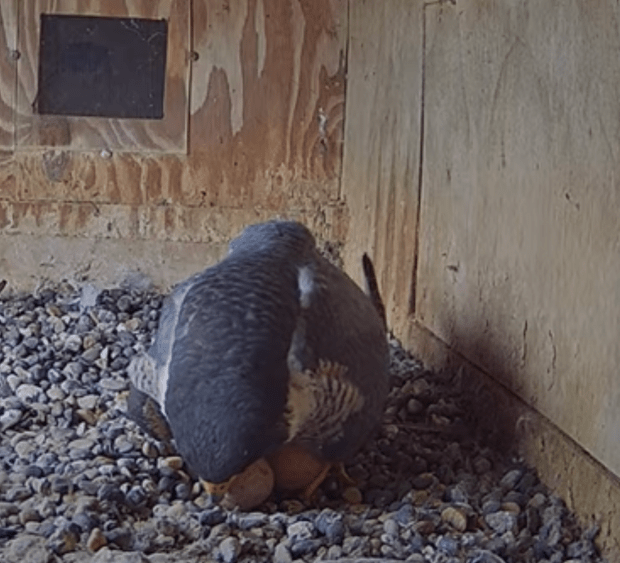
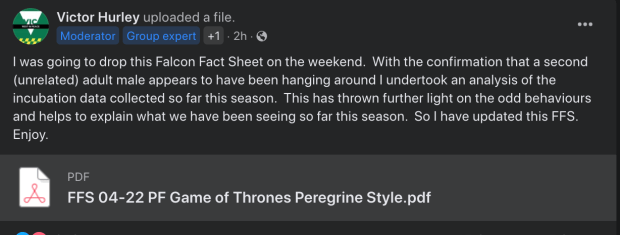
Thank you, ‘H’ for letting me know about Victor Hurley’s posting on the 367 Collins Falcon Watchers FB Page. Hurley is the key researcher for the Victoria Peregrine Falcon Project that includes the Melbourne falcons. He has now stepped in to comment on what is happening at Melbourne. Please read carefully to the end…
The new female arriving to incubate the eggs after a meal.
Victor Hurley has also included another fact sheet on the 367 Collins Falcon Watchers FB and has changed some of the data based on this new knowledge. (It is formatted so I cannot just post it here so you can read it, you must go there). A great article!
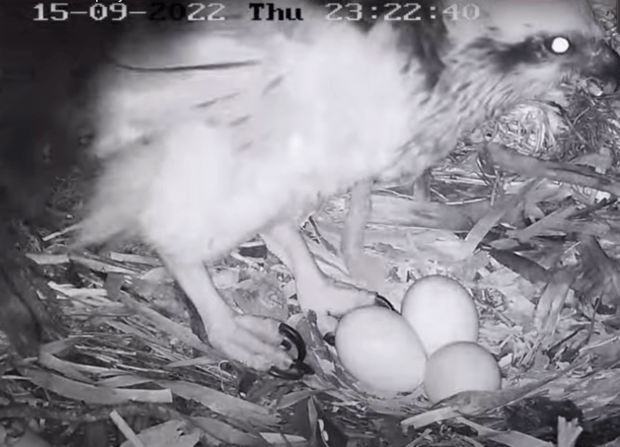
At Port Lincoln, the eggs are 38, 35, and 33 days old. On the 19th, egg 1 will be 41 days. Time is going to pass quickly. Hatch watch should begin on Monday.
Migration:
Things are just going quiet with the Ospreys in the UK. The last two lingering nests seem to be empty. No one appears to be home at the Glaslyn nest – Aran and Blue 497 both seem to have started their journey south. Padarn was last seen on the 12th of September at 19:20 with Idris last seen on the Dyfi Osprey nest 24 hours later on the 13th of September at 19:41. Safe travels, full crops. See you in the spring!
‘H’reports that there are still family members at the Boat House Osprey platform in Bremen, Maine. Sloop, the third hatch and reluctant fledge, is eating well having had at least 3 deliveries yesterday! She has sent a photo of Sloop excited for a delivery! She has not seen Schooner or Skipjack on the nest for 5-6 days but other osprey calls have been heard so it is unclear who remains as of today.
I am finding this very interesting. This nest is one of the most northern of all the US nests. It is migration season and we continue to have ospreys on the nest. Let’s watch and see when they depart.
Karl II and family:
All of the family members transmissions show them in the same areas that they were previously. There is no transmission for Karl II. He is believed to be at his favourite nature reserve in the Kherson Oblast region of Ukraine. I found several active reports on the current activity in the region yesterday.
Stay safe Karl II!
If you are following the new Osprey family at Belvoir Castle in Lincolnshire (my old haunt), Tim Mackrill has posted news!
From the Archives:
Do you remember: who are the storklets? what is their story?
Thank you so very much for joining me this morning. Please take care! See you soon.
Thank you to the following for their streaming cams, posts, tweets, etc that make up my screen captures: Holly Parsons and Albatross Lovers, Orange,Australia, Peregrine Falcons, Sony A1, WRDC, Condor Cam, SWFL Eagles, FOBBV, Sea Eagles@Birdlife Australia Discovery Centre Sydney Olympic Park, Charles Sturt Falcon Cam, Victory Hurly and the 367 Collins Street by Mirvac, Port Lincoln Ospreys, Tim Mackrill, ‘H’ and Audubon and Explore.org, Ukinform.net, and Dr Madis and the EMC plus the Eagle Club of Estonia.
The Black Storks of Estonia are rare and treasured. When Jan did not return and was deemed injured or dead, Janika had to try and feed her storklets. She could not manage even with the fish basket she found that Urmas, the Ornithologist for Estonia, provided. It was decided that the three surviving storklets would be taken into care at the Vet School in a stunning attempt to keep them alive by feeding with a decoy male and having a decoy female. In the image, Bonus is the largest of the three. The stotklets thrived. Two were placed with Eedie and Bonus was placed to be fostered with Karl II and Kaia. A goshawk attacked Eedie’s nest killing all the storklets. Bonus is now on migration and in Ukraine where he appears safe. Bonus is the only one of Jan and Janika’s six storklets of 2022 to survive.
Good Morning Everyone! I hope that you had a fabulous beginning of the week. Here we are at the middle. My calendar tells me that thing are going to begin happening in Bird World soon. First up will be the Port Lincoln Ospreys who should have a hatch in 4 days. Then it should be the Melbourne Peregrine Falcons on the 27th quickly followed by Xavier and Diamond. By the time those nests have feathered osplets and eyases, we will be fledge watching for SE29 and 30. It is going to be wonderful!
Tuesday was a big ‘T’ day but that doesn’t stand for Tundra Swan but, ’tiler’. It was fantastic to see the floor tiles in the sunroom being grouted today with the news that tomorrow I can move back in and watch my beloved garden birds. Oh, how I have missed seeing them from that perspective. A new book arrived in the post, too. Having purchased Crosley’s Guide to Waterfowl – well, logically, it seemed to me that the volume would cover Shore birds but, no. Definitely not. The new book is The Shorebird Guide by O’Brien, Crossley, and Karlson and it is wonderful. Most appreciated are the excellent images of the plumage during the seasons. It still is missing the inclusion of the females in great numbers just like all of the other bird guides who continue to focus on the more colourful plumage of the males. Yes, I am growling. LOL. Quiet and monochromatic can be viewed as ‘classic’ beauty. It certainly is with many of the female Sparrows.
Just like the ducks, my mind has been taken over by the Greater and Lesser Yellow Legs and Willets at one of our local ponds. If I close my eyes I am transported to the marsh where the shore birds are tapping away at the mud with those long long bills. Incredible. If you stay quiet and don’t move, they will completely ignore you, going on with their deep quick probing for food. They are really quite lovely. Learning to identify them is going to take some time.
The Greater Yellow Legs from the other day.
The plumage on the Mallard is really lovely.
It is overcast and cold at 13 degrees C this morning. The Crows have been for their morning hotdogs, the sparrows are wanting a bath, the Blue Jay has been flitting in and out (only one), and the cat has already been chased once. Meanwhile Little Red has been running back and forth on top of the new fence which now meets up with that of the neighbour so he never has to get on the ground to get to his new home. Yes! Little Red has found a place to live since his penthouse was torn down. So thankful. The torrential rains this year and saturated ground meant that all of the trees literally tripled in size. He found a hole in the big tree and if I look carefully, I can see him going in and out. So relieved after feeling so quilty about the shed. With my chair back in the sunroom this morning, I can watch over them and hopefully get some good images of Dyson who is looking ever so healthy and fluffy these days. Gosh, that squirrel is quick. I wonder if the Crows frighten her?
In the Mailbox:
‘A’ writes that I have awakened a love of ducks for her. That is fantastic. They are often very unappreciated, like the geese, in my City but, there is nothing so peaceful as sitting on a clean bit of lawn or blanket and watching them go about their daily paddling and preening. This is wonderful news. Thank you for letting me know! In honour of this, I have used one of our favourite ducks for ‘From the Archive’ today.
Making News:
There is growing disillusion within the environmental and raptor groups in British Columbia, Canada at the decision by the Department of Forests and the University of British Columbia to cone a long standing Bald Eagle nest on the campus of the University. Their are ongoing campaigns to stop the coning which is due to take place today, the 14th of September.
Also in British Columbia, this time in Surrey, the David Hancock Wildlife Foundation is attempting to stop the cutting down of a Bald Eagle nest on the property of a Costo in that city–or get the owner to agree put up a platform nest for the eagles.
British Columbia is home to more Bald Eagles than any other area in North America. Because of this their conservation status and threat is very low – often cited as an excuse to cone the trees or cut down the nests — some 140 Bald Eagle nests were destroyed at the Site C Dam project by the province this year. Of course, what is the real count? With Avian flu still with us and in Manitoba nests and eggs destroyed by flooding with few goslings, perhaps we should be re-thinking our approach to preserve. Declines can begin to happen and spiral.
If you are in Southern Manitoba, Wildlife Haven is having its annual Open House on 23-24 September. Tickets can be pre-purchased and space is limited. It was gorgeous weather last year and the event was sold out. I can’t think of a better way to spend a few hours on a fall afternoon than getting to meet the ambassadors, tour the new flight training buildings, and check out the great vet facilities. These are the people giving our wildlife a second chance.
Do you live in New York? do you love Bald Eagles? Here is a fundraiser event you might not want to miss.
Would you like to be an Albatross detective and help get a true worldwide count of these sea birds? Here is the information.
The Bald Eagles have been returning. Yesterday it was Gabby returning to the Northeast Florida nest to Samson.
NEFlorida Eagle Nest
Samson and Gabby love to ‘kiss’ just like Alden and Annie.
Anna and Louis are back at the Kisatchie National Forest and now Mr President and Lotus are at the National Arboretum Nest in Washington, DC.
National Arboretum Nest
They are really coming home. If you see a return, send me a note!
Thunder and Akecheta were caught sitting together on the cliffs of the Channel Islands yesterday. Oh, goodness. What an incredible year we had with Ahota, Star, and Kana’kini.
Thunder flew into the West End nest with a super fish yesterday, too… Ah, it would have been grand if one of the kids swept in and took it! Everyone misses those three amigos.
Andor was at the Fraser Point nest. I haven’t seen any new updates on Victor. We can all presume that he is doing lots of flying and strengthening those wings!
The nest that our dear Little Bit ND17 grew up on had dwindled down to only a bit of mud and straw at the joint of the branches. Everyone has been concerned that the adult eagles would not return and rebuild – knowing that if they didn’t St Patrick’s County Park in South Bend, Indiana, would not be moving the camera. Well, guess what? Dad has been caught returning to the nest! This should be a ray of sunshine for everyone. It will take work but each of us has marvelled at how quickly the raptors can whip a nest into shape. No, it will not be huge like a decade old nest but it will be a new beginning.
In the image below you can see what little is left.
It appears that Idris is finally alone to enjoy his fish and that Padarn has left the territory for her migration.
At Glaslyn, however, Aran is still bringing fish for Blue 497. It won’t be long, Aran!
497 is an incredibly beautiful osprey.
To my knowledge, Blue 497 is the only fledgling left on an Osprey streaming cam in the UK to migrate.
Did I mention mantling (when a raptor spreads its wings over its prey to conceal and protect) was one of the development stages coming quickly for the Sea Eaglets in Sydney? Well, guess which of the two was the first to demonstrate this stage of growth?
If you said SE30 you would be absolutely correct! Both eaglets held the prey down with their talons and pulled. Eventually they were fed but this is very good training. So proud of 30! Go baby. Don’t you just love the look on 29’s face? (squint)
The sea eaglets have been well fed and have been sporting crops on and off for a few days now.
Watching incubation and expecting a hatch in less than a week can be nerve wrecking.
The beautiful Mum at Port Lincoln. It is the 15th. Oh, so soon we will be having little osplets –. Cannot wait.
For Melbourne, mark your calendars for the 27th of September.
Xavier and Diamond will follow after Melbourne!
Migration News:
Into Hawks? Aren’t we all? Here is a new tool to follow the counts.
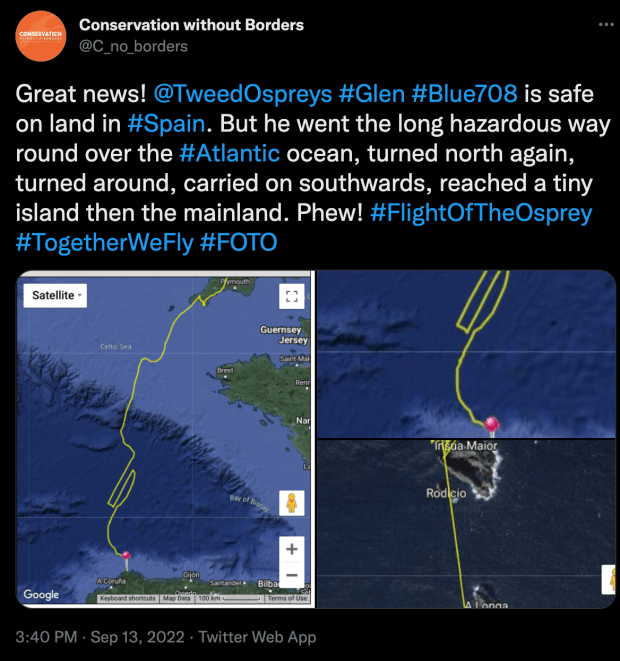
Some good news on one of the Tweed Osprey fledglings, Glen. (Sadly it appears that Kirk who had gone West and was in Ireland continued west over the Atlantic and is probably lost).
From Karl II’s family, the Estonian Black Storks from the Karula National Forest nest.
Bonus is really flying and remains in the same area he has been for several days now-the Prypjat River. He is safe. Relief as always.
Waba is at the Hrabarka River in Ukraine.
I see no transmission for Kaia or Karl II.
Audubon scientists are using data from hawk Mountain to monitor the places that raptors migrate.
I am not a cartoon character but, for many raptor watchers in Australia (and elsewhere), I am the most famous duck in the world. Do you remember me? What is my name? What kind of a duck am I? Whose nest did I lease? And do you remember what happened?
Thank you so much for joining me today and for your lovely notes. It is actually relatively quiet in Bird World but soon…so soon, there will be action in Australia – at Port Lincoln and Melbourne. Meanwhile, we can all enjoy the antics of the little Sea Eagles who are jumping, flapping, and learning to mantle and eat their own prey. Take care of yourselves. I look forward to seeing you again soon.
Thank you to the following for their tweets, their posts, videos, and streaming cams where I took my screen captures: Wildlife Haven, Bald Eagles of Centreport, Albatross Space, Channel Islands Eagle Lovers, Notre Dame Eagles, NEFL-AEF, NADC-AEF, Dyfi Ospreys, Bywyd Gwyllt Glaslyn, Sea Eagles@Birdlife Australia Discovery Centre Sydney Olympic Park, Port Lincoln Ospreys, 367 Collins Street by Mirvac, Charles Sturt Falcon Cam, Conservation Without Borders, and Looduskalender.
From the Archive: Daisy is a Pacific Black Duck. She first appeared on the nest of the Sydney Sea Eagles in December of 2020. She attempted three clutches of eggs – all predated by the Crows, sadly. The last clutch in 2021 almost made it to hatch. We were all cheering! Daisy stole our hearts and taught us many lessons about the challenges the female ducks face in being both incubator and security guard. The couple came this year to check on the nest. Oh, it was delightful to see Daisy and her mate but, equally, there was relief that she decided to lay her eggs elsewhere in the forest. Did you know that less than 15% of all duck eggs laid make it to hatch?
Good Morning Everyone! It is 11 degrees C (51.8 F) and will only rise to 17 C (62.6) – a great day for a long walk! As the temperatures begin to fall and the summer clothes make way for sweaters, it is a reminder to enjoy every moment outside that we can – here on the prairies of Canada. Winnipeg has been known to actually be colder than Mars in the winter so every precious minute outside is a gift.
Oh, it was a nice day yesterday. The best treat was I found the little duck. It is the tiniest wild duck I have ever seen in my life. There is still a lot of down and its wings seem ‘small’.
5 September:
12 September. The head is larger and it appears that some more feathers on the back have grown in. The little one was so busy scooping up what looks like confetti made out of leaves. It is called Duck Weed and is not the best thing to have growing on the ponds but – the ducks love it!!!!!!! In fact, ducks will eat whatever food is in front of them including pondweed, sea weed, reeds and flowers as well as berries and seeds and we have seen them eat frogs, too.
The Canada Goose couple that had lost one another the other day and were honking up a storm had taken possession of the only island in the pond. It seems that the water level is rising due to the staff at the centre draining one area to move the water to another. The geese were sharing with some Mallards but they were not moving and giving up their lease!
Aren’t they a gorgeous couple?
In past years there seem not to have been as many juvenile American Coots. They are everywhere at the nature centre – hiding in the reeds, riding on pieces of branches, or just standing quietly around a corner this year and I have seen others at ponds around the city.
You can see how thick that duckweed is on the pond. Someone of it should be cleaned with a filter – and maybe that is what the staff are doing.
Over the years the Mallards have just gotten more beautiful to me. They are common and often over-looked because of it. So many sweet little females around the edge of the pond.
Most looked nice and full from their foraging. It was bottoms up everywhere!
Oh, look at those beautiful primary and secondary feathers. Let us all hope that our wee one will have as many by the end of October.
In the Mailbox:
No questions just outpourings of love for Izzi who was the subject of yesterday’s archival photo. Oh, what a character he was and each of us that watched Xavier and Diamond’s scrape and Izzi so intently has so many stories of his antics.
Making News:
A Bald Eagle death in Canada attributed to Avian Flu. This is very sad. It was believed that the H5N1 was slowing down. Now it might be spread again by migratory birds.
The EU is being heavily criticized for not protecting marine life from overfishing. Why is this in a bird blog? Well, the birds that eat fish need them so the setting up a moratorium for fishing for human consumption might help.
One of my favourite books, Goshawk Summer, has won the Wainwright Nature Writing prize. James Aldred spent the early part of the pandemic in the New Forest. His assignment was to document the life of a Goshawk family. Written like a daily diary, Alden captures the solitude of the forest and the magical experiences of the chicks. “The wood holds its breath, the only sound the begging of the chicks and the gentle breeze through trees. The forest hasn’t been this peaceful for a thousand years.” Despite Aldred being a wildlife photographer there is not a single image of the Goshawks in the book but, they are not necessary. Through his words their presence is evoked as clearly as a newly cleaned window.
Two lucky Bald Eagles were helped in Maine when they were relieved from being entangled with one another. They were mid-air and crashed into the water. Both could have died with out the help of the kind couple.
I wasn’t quite sure where to put this wonderful news. Many of you will have already heard that Iris – thought, perhaps, to have migrated from her spring and summer home in Montana – was eating an enormous fish she had caught on the Owl Pole today in Missoula. The oldest Osprey in the world looks magnificent.
Here is a 4 minute video of this magical event.
12 September is a very special day. It is the day that Gabby normally returns to her nest near Jacksonville, Florida that she shares with her partner, Samson. Out of 4 years, 3 of the returns have been on the 12th of September. How incredible. Samson has been waiting and looking and bringing in some sticks. Gabby did not disappoint! She arrived today!!!!!!!!!!!!! The couple got busy working together getting ready for the wee eagles this year. Oh, it is so wonderful to see you home, Gabby.
Good night Samson and Gabby. All is well with the world. See you tomorrow.
Lady Hawk caught the reunion on video!
Padarn appears to still be with Idris at the Dyfi Osprey nest in Wales.
Blue 497 is still on the nest at Glaslyn and Aran delivered a really nice fish for tea time.
Did you know that both Padarn and Blue 497 hatched on the same day? It was 26 May. 497 is the oldest and Padarn is the middle chick. Both, as we can see, are still at home.
Idris brought a flat fish later and is looking around for Padarn. Is she gone?
Everything seems to be fine on the Sea Eagles nest in the Sydney Olympic Forest.
The eaglets had an early breakfast. Looks like one of the Silver Gull chicks from the old barge down the Parramatta River.
Even with a great big nest SE29 and 30 prefer to snuggle together. Lady keeps watch.
A lovely family portrait.
At the Port Lincoln Osprey barge, Mum has been rooting around in the nest and rolling those three precious eggs. It is the 14th of September in South Australia. Is it really possible that in 4 more days we could have a hatch? At times it felt like it has taken forever and on other days it seems like we just had the last egg laid. Does it feel that way to you?
At the 367 Collins Street scrape, Mum got up to stretch her legs. Gosh these birds must get stiff sitting on those eggs for so long —- yes, I am projecting human needs on them! If they had a little buzzer to remind them to stand up and get the circulation moving it might help. Oh, she made me ache as I watched her raise off those eggs. She was hardly gone…someone played a trick on this female. They told her that she had to do all the incubating herself. Hopefully she will give Dad some more time.
Oh, just when you say the birds eat off camera, someone brings a nice juicy pigeon and there you go – eaten on the nest! It is like having a sick child and taking it to the doctor and your little one is immediately well on arrival!
Migration News:
Just imagine 428 million birds making their migration flights tonight.
Remember it is time for lights out. If you want to check your own area of migration, go to this link and put in your postal code or the name of your city – sadly lower mainland US only.
Karl II’s family migration – Waba is still around the area of Manachyn and has flown a short distance south where he has discovered a little lake.
Bonus is still in the wetlands along the Prypjat River south of Makarichi.
Kaia is still around the Desna River. So all three appear to be doing well. What a glorious relief. No news from Karl II.
From the Archive:
Do you know my name? I was the only eaglet on an enormous nest. My parents names are Liberty and Freedom. When I branched and started jumping and flapping my wings, your got very worried.
I hope that your day is as lovely as ours on the Canadian Prairies. Thank you so very much for being with us today. Take care. See you soon!
Thank you to the following for their blogs, tweets, videos, and streaming cams that make up my screen captures: Charles Sturt Falcon Cam, Wreckhouse Weekly News, The Guardian, Bangor Daily News, Montana Ospreys and Cornell Bird Lab, NEFL-AEF, Lady Hawk, Dyfi Ospreys, Bywyd Gwyllt Glaslyn, Sea Eagles@Birdlife Australia Discovery Centre Sydney Olympic Park, Port Lincoln Ospreys, 367 Collins Street by Mirvac, BirdCast, Looduskalender, and Glacier Gardens.
The eaglet was Kindness who hatched in Glacier Gardens, a large botanical garden within the Tongass National Park, Juneau, Alaska. The year was 2021.