I am so happy that Toby and Hugo Yugo’s little kissing/licking fest touched your hearts. It is really easy to see why they bring such joy to our lives! SP wrote, “Mary Ann, you are my Santa! The Toby-HY love fest… I’ve only watched it three times… so far. xoxo”
Brock reminded me today that it is ‘essential’ to find a way to have water for the outdoor animals that we feed. This is easy if you live in an area where it never gets below freezing. Here, it can be problematic. You MUST be careful so as not to cause the little birds to freeze their feet and feathers. Because of these issues, I am reluctant to use a heater in the bird baths if there is any chance their little feet will stick and be pulled off! Luckily for Brock, there are two dishes in his heated feeding station – one for wet food and the other for water. He had several long drinks today!
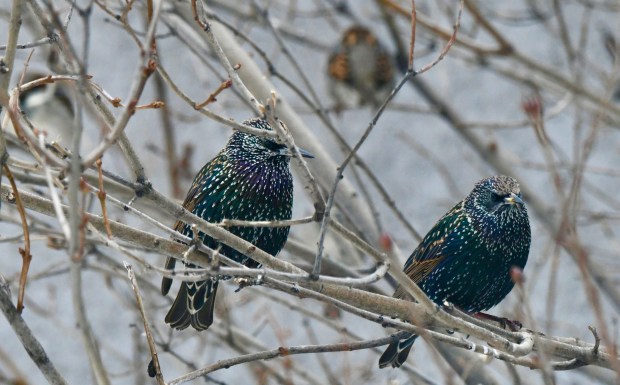
The small sparrows and Starlings were busy eating snow. They don’t get as much as they would if there were a bird bath for them, but they do get some hydration, which is really important if you are feeding them.
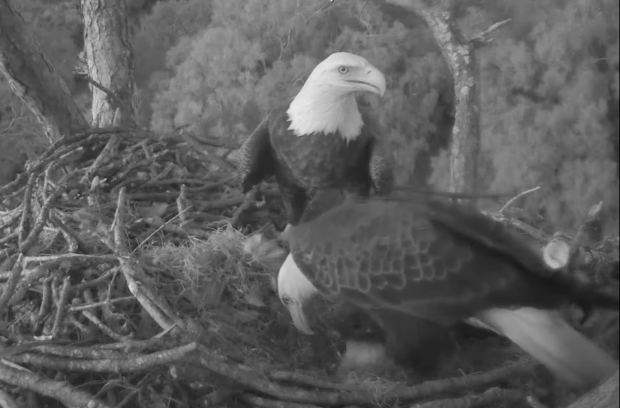
I hope you did not worry about Gabby being away from her nest and leaving Beau to incubate for approximately 24 hours. This is ‘Gabby’s Way’. Every year, she takes a break before the eggs hatch. The first time I saw this panic set in, I thought she had died, leaving Samson to care for their family, but no. Gabby was having a ‘spa time’ – I liked to call it. Gabby is now home, and Beau was so happy to get off those eggs, he flew off the nest when he caught her flying in!
Beautiful Gabby back in the nest.
I decided to take a sheet out of Gabby’s playbook today while Anne was caring for Don, Toby, and The Girls.
You probably know someone who was or is a caregiver to another individual – their partner, a parent, another family member, or a friend. It is stressful. There is no ifs, ands, or buts about it. Caregivers are often ‘tired beyond belief’ and rarely take time for themselves. You might know someone who cared for another person and actually died before them. It happens more often than you might think. As Don’s illness progresses, I am trying hard to make sure that my life is a bit more balanced. So, going back to Gabby…I gave myself a ‘treat’ today. I spent the afternoon at the Dior counter today getting a ‘refresh’ from a wonderful woman who has worked for this French cosmetics company for 35 years. It was fun – and a reminder that each of us needs to create time to relax and laugh!
Moving back to our birds. As you know, Heidi and I have been monitoring osprey nests for mortality numbers and causes. Heidi sent this to me today and I thought that you might be interested, too.
“This was the presentation held yesterday on Virginia Eastern Shore by Dr. Watts and Ben Wurst. The presentation itself is only about 67 minutes long, and is very informative.https://youtu.be/bR8byYABd8s?s
A lot of takeaways. VV’s nests all had abandoned eggs. But, Watts’ data indicated the majority of nest failures were from brood reduction due to a lack of menhaden. Most of the eggs hatched, but most chicks didn’t survive. Interesting.”
Overfishing has led to the death of 60,000 penguins! The Guardian gives us the details. “More sustainable fisheries management could improve the penguins’ chances of survival. Conservationists are taking action on the ground, by building artificial nests to shelter chicks, managing predators and hand-rearing adults and chicks who need rescuing. Commercial purse-seine fishing, which involves encircling a school of fish with a large net and then trapping them by closing the bottom, has been banned around the six largest penguin-breeding colonies in South Africa.
It is hoped this will “increase access to prey for penguins at critical parts of their life cycle”, said the study co-author Dr Azwianewi Makhado, from the Department of Forestry, Fisheries and the Environment in South Africa.”
I don’t know about you, but my calendar is counting down to the arrival of the ospreys in the UK! Of course, there is a big gold star at the beginning of April to remind me to be on the lookout for Iris’s return to Missoula, Montana.
Lots of couples are incubating. Eagles and Albatross.
You can watch the Royal Albatross Royal Cam Pair, BOK and WYL, in New Zealand. If you are not aware, the letters relate to the coloured identification bands on their legs. BOK (female) is Blue-Orange-Black with ‘K’ being for Black. WYL (male) is White-Yellow-Lime.
Today, the couple were reunited as they switched incubation duties. The note under the video reads: “WYL returns to the Plateau nest site to give his mate BOK a well-earned break from incubation. Watch him enter from the left of the frame to greet her, and after a brief reunion, BOK lifts off and hands over nest duties. Following a few vocal exchanges with the neighbors, she heads back out to sea. Join us live as we follow their journey through the 2025–26 breeding season! RoyalCam was set up in January 2016 by the Department of Conservation and the Cornell Lab has been collaborating with DOC since 2019 to bring the cam to life. To learn more while watching, view the cam at https://www.doc.govt.nz/royalcam“
At Port Lincoln, Dad was on the barge during the early morning hours having a nap. The camera panned to the old barge but no ospreys were visible.
Girri is such a character. She has even been incubating the remaining egg in the scrape on and off!
Just look at those juvenile feathers coming in!
Girri is a BIG girl.
There has been no news of any peregrine falcons from the CBD of Melbourne coming into care. This is great news!
Liberty and Guardian have been at the Redding Eagles nest.
More eagle news on Monday!
Signing off with Hawk Mountain’s migratory count for the week of 3 December. Osprey count way down. Bald Eagles up. Sharp-shinned Hawks down along with many others. My goodness…but a growth in Broad-winged haws.
It isn’t just at Hawk Mountain that some species numbers are beginning to plummet. In the UK, recognizing this horrific act, people are opting to name streets after our amazing birds in order that they not be forgotten.
I don’t need to tell you that Toby and The Girls make my life worth living.
After a day of frolicking in the snow, there is nothing nicer than napping on a toy duck.
Thank you so much for being with us today. We hope to have you with us again tomorrow!
Thank you to Heidi for sending us the link to that presentation on the Ospreys with Dr Watts and to SP for allowing me to quote them. I am also grateful to the owners of the streaming cams – Charles Sturt University, Port Lincoln Osprey, American Eagle Foundation, and NZ Dept of Conservation/Cornell Bird Lab – where I took my screen captures today and to the authors of the articles on providing water for wildlife in winter, The Guardian for covering the death of the African Penguins or OpenVerse for the image of the African Penguins.
‘A’ is keeping me on tenterhooks as we waited to see how long it would take that little sea eaglet to get out of what appeared to be a crushed egg!
“No time to chat now but the hatch was well underway this morning when Lady got up from the eggs. The little one can be seen working away (see 09:58 this morning, 13 August) but the shell is very crushed and it is looking like it could be a long hatch. By 10.20 the top half of the egg looks to be crushed almost entirely. At 11:11 not much progress appears to have been made. A glimpse at 13:06 and still no hatch. Another glimpse at 13:23 and the little one has still not made an appearance though nearly half the shell has been crushed.
At 13:46 the eaglet appears to be breaking out through the crushed shell. It is now 2.30pm and I am hoping to see a hatch very soon. The wee one has been working for quite a while now and it appears to be getting very tired, though I hope I am wrong. Mum has remained on the nest during the day so far, though Dad has been nearby a lot of the time, ‘singing’ his half of a duet, though Mum is preoccupied and has not joined in.
I will let you know when we have a hatch – as I said, I’m hoping it will be free within the hour or even sooner. It is so close to breaking out.
14:50 and we can see a large hole in one side of the egg. But I can’t see the chick working inside the egg and it can’t have broken out of that hole yet. I do hope the little one is alright. I suppose it has plenty of oxygen and mum is keeping the egg and chick warm, so there is no reason why it can’t take a bit of a rest without it being a disaster. But I didn’t like the look of that eggshell. There has been so much rain during the incubation of these eggs, and they have got wet on several occasions though they haven’t really been soaked. The chick was working hard from inside the shell this morning, so we know it was fine at hatching time. There should be no reason for concern here, so why am I feeling so worried? I suppose it’s the first hatch on the Australian cameras for this season so it’s all a bit nerve-wracking. I will keep you posted.
15:27 and still no hatch. The shell is completely crushed on one side and the shell is ‘breathing’ so we know the chick is alive inside. But still it hasn’t managed to get out of the shell. The crushing has not pushed inwards onto the chick, so it has plenty of room. It is just tired, I think. But it’s been working for a long while now. Theoretically, it should be fine. Enough oxygen. Enough warmth. Still absorbing the last of the nutrients from the yolk sac. So all should be good if it just has a bit of a rest and then completes the hatch. Of course the nights have been very cold and it would have been better if the wee one had been able to dry and warm up and perhaps even have a snack before dark but there’s plenty of time for all of that. I just want to see the eaglet safely out of that shell. It’s nearly 4pm here (and in Olympic Park) so it’s been a long day for mum and chick. There has been a close-up of the second egg that suggests the beginnings of a pip. In this nest, it’s always hard to tell because of the thinnish long dark damp leaves which can look like a crack or pip (and which can also stain the egg), but there was some delayed incubation practised so it’s possible that the second egg is no more than a day behind the first. Fingers crossed for two safe hatches close together. “
Thank you to ‘A’ and to the Sea Eagle Cam for the screen captures above.
Thank you for checking in. Head over to the cam and watch the action in the Olympic Park. Let’s hope Dad catches those fish and other prey on that nest. These are going to be close hatches, we hope.
If you are a Royal Albatross fan, who isn’t???? RLK came in to feed the Royal Cam chick! Cornell Bird Lab shares that moment with us: https://youtu.be/Bpv85jcHWf4?
Well, after three irritating days, the end of the ads is nigh. Thank you again to everyone who helped me spot those pop-up ads. WordPress assures me there should not be any, but…
At 1900, 38 Canada Geese flew over the conservatory in a line, not a wedge or V. Normally, geese fly in a V or wedge to conserve energy. When the leader gets tired, s/he falls back, and the next one takes its place. Being the leader is hard work; they are breaking the wind – creating a slipstream – for the other geese so that they can fly without expending so much energy. As they flap their wings, each bird helps to create a ‘lift’ for all the other geese in their formation. Research shows that flying in this type of formation also allows the group to communicate better. Talk about teamwork and cooperation. Humans have something to learn from our honkers.
Those V formations are quite extraordinary. You can’t tell from the ground, but the lead goose is the lowest of the bunch. Each goose behind is slightly higher than the one in front of it, all the way to the last goose, which is flying the highest. They do this because of the aerodynamics of their wings. The only goose that is using all its wing power is the lead goose… the point-man, so to speak. When that goose flaps its wings, it causes a certain turbulence of the air that’s following the wing. The next goose in line benefits from this swirling air, and doesn’t need to apply 100% of its wingpower. The next goose, again benefits from that one, and so on down the line. Flying in formation this way adds 71% more distance that they can fly than when flying alone!
So who gets chosen to be point-man? You’d think the one with the map! Or the leader? Or the new-guy? No. None of these. They actually take turns. When one gets tired, he will drop back so he can rest a bit and benefit from another goose’s turbulence. When migrating in good weather with favorable winds these guys can make up to 1,500 miles in a single day! That’s crazy, man! Hard to imagine, but it’s been done. They are migration masters.
So the flying at night thing … I’ve already touched upon one of the reasons they prefer the night. It has to do with that turbulence I just mentioned. You see, many other large birds (and these are large birds!) use thermals to gain altitude and to soar on. Raptors do this. Hawks, eagles, etc. During the day, the landscape is riddled with all kinds of thermals rising from the ground, all depending on what the surface looks like below; how much heat was absorbed and stored from the sun; if it’s dark or light … or even water. These thermals are great for raptors! Lots of vertical air movement all over. But geese don’t soar, and they don’t have need to fly in circles. They have somewhere to go. And all those daytime thermals are a pain in the butt; they don’t make for smooth sailing. Plus, they interfere with the aforementioned wing turbulence that they use to keep from tiring. At night, several hours after sunset, the Earth cools and those pesky vertical thermals disperse.
So that’s one reason they like the night. Another reason for night flight is to prevent over-heating (makes sense, right?) Nights are cooler, so birds that expend a lot of energy with constant flapping (as opposed to soaring) take advantage of the cool of the night.
A third reason is also something I’ve already mentioned. Hawks! And eagles! And falcons! All those guys are diurnal hunters, meaning they hunt during the day. Which goose in its right mind would want to share the not-so-friendly skies with something called a “raptor”? Now, if you’ve ever seen flocks of geese on the ground and tried to get among them or feed them or something, you may already know how mean and nasty they can get. People have used geese instead of watch-dogs. They are tough! Especially on the ground. But falcons, hawks, and eagles, hitting them from the air often spells doom. In other words, their goose is cooked. During the day, they often rest and feed and rejuvenate in the water where they are safe from raptor attack. As long as they stay in the water.
So given the choice, they take the red-eye.
Why Do Canadian Geese Fly At Night?, Forbes Magazine, 1 March 2018 (updated).
So why were the geese flying in a straight line over my house? I can’t find an answer. Maybe you know. Perhaps they were readying to land at Fort Whyte or at the river a few blocks away???
The other day Calico and Baby Hope watched ‘The Boyfriend’ as he ate at the feeder. I wonder what Calico was thinking. This was her little friend when she lived in the wild. They would come and eat together, but he always let her eat first. They would often rest under the lilac bushes. He will not come into the house; he runs away. I have tried frequently to get him to soften to me. So we make sure his food is out by 0900 and, again, at 1700. He also comes at other times, including in the middle of the night. Another animal, a raccoon, comes at night, eating everything still available and dumping the water from the bird baths. That means we must ‘jump’ in the morning to prepare everything for The Boyfriend’s arrival.
Dr Erick Greene and others around Missoula are keeping a close eye on Iris, Finnegan, Sum-eh, and Antali. It appears that all four are still fishing in the Clarke-Fork River. As far as I am aware, this is the latest that Iris has ever remained in the area. Her usual date for departure is 8 September. She must relish being a mum again to two such fine fledglings and having a mate like Finnegan.
Iris came to the nest at 0838 without fish. I did not see a delivery at the nest by 1100 on Sunday despite Antali’s persistent calling.
This person had a first hand view of Iris and family — have a read!
Iris was at the nest at 0738 Monday morning. She was calling loud and seemed to have a piece of fish in her talons (??). She is looking for Antali and he did not come. She waited three minutes and when Antali did not arrive, she flew off towards the river.
At Charlo, is C16 catching its fish? Our fledgling observes the water below the nest and has returned wet, once, perhaps, with a fish. This is one gorgeous fledgling! That full crop sure makes me think he had an excellent breakfast.
C16 is always watching that water – unless he is sleeping! Can’t see those stunning eyes.
When I checked on the nest of Junebug at Dunrovin Ranch – which was several times including re-wind – I did not see anyone. Did you?
Just look at the fish that Beaumont delivered at the Newfoundland Snow Lane nest. Good gracious. There is enough for both of the fledglings. Will the winner share?
Still eating three hours later!
Niagara Bee Dad still delivering!
River was at the Sandpoint nest, but I saw no fish deliveries from Keke. Perhaps Keke is feeding River off the nest. River has been seen ‘wet’, and he flies back and forth to the river. Is s/he catching their fish dinner?
At the Golden Gate Audubon nest in SF Bay, Tully was last seen on the 14th of September.
Some more great information from the Dyfi Osprey Project in Wales, home to Idris and Telyn.
Hartley and Monty continue to bond – and then bond again – at the San Jose City Hall scrape. Love is in the air. https://youtu.be/pjskOK2DcNc?
Xavier. What can we say? Isn’t he the cutest little Peregrine Falcon? He always wants time to incubate his eggs, but…Diamond often has different ideas. They have been together for nine years. Today, he demanded squatter’s rights on those eggs!!!!!! https://youtu.be/fygxtkCjkwA?
Beautiful Sea Eaglets.
‘A’ remarks: “Both chicks did well out of that breakfast, and afterwards, they settled down together, side by side, to rest their giant crops (especially SE34!) and do a bit of preening. They are very companionable, the best of nest mates, and even when food is around, they have been behaving beautifully. Observing the pecking order seems to ensure peace at meal times – Lady is aware of the need to feed SE33 first if both chicks are at the table, although SE34 is now confident enough to accept food before its sibling has eaten if their relative positions create this situation. They are pretty much equal in size now and SE34 is confident and able to get himself fed. He moves forward if he needs to get closer to mum’s beak and he is not showing any behaviour that suggests that he feels intimidated at meal times. So all is going swimmingly at WBSE. “
And more from the morning of the 16th from ‘A’: “Lady was up early this morning (05:29). She found a substantial piece of feathered prey on the nest, so started feeding the littles, who roused themselves and got to the table despite the fact that it was still dark. Lady started by feeding a bite to SE33, as per pecking order, while SE34 found which direction the table was in (he had his back to it and turned around very clumsily, inconveniencing SE33 in the process). Once both eaglets were settled in their places, breakfast proceeded peacefully, with both nestlings behaving beautifully.
Oh, I adore these two. I love what good nest buddies they have become, sometimes even allopreening and nibbling gently at each other’s facial feathers. They are so cute. I love these few short weeks on the nest, being cared for by doting parents and having little to do other than eat, sleep, grow and play. Their lives will be very hard, and their chances of successfully managing as juvenile sea eagles are not great based on previous years. Although of course they don’t realise it yet, these peaceful days in the nursery, as it were, probably represent some of the happiest of their lives. It is lovely to share them. “
I love storks. Even if you can’t speak German, you can enjoy the amazing images in this documentary. Click on the link above the image or copy and paste into your browser.
There is news from Portugal. I have signed up, but this file is thanks to UK Osprey Information and Jeff Kear, who kindly attached a translated version. Please scroll down and see the map showing where the ospreys have their spring and summer breeding grounds and travel to Portugal for the winter.
Real Saunders Photography has posted some images of M15 and F23. There is action at the SW Florida Bald Eagle nest. The streaming cameras are to be operational on 1 October. https://youtu.be/3wJeooaW6oI?
‘A’ comments on the Royal Cam chick: “At Taiaroa Head, both TF and TFT are still there, though TFT in particular has been moving around a lot, going down the hill and perhaps seeking out a suitable spot from which to fledge. He may just be exploring – he’s always done a lot of that. No parents came in today, as far as I am aware, but of course the chicks will be emptying their stomachs before their big take-off. (That doesn’t make sense to me – surely they would want to keep any remaining nutrients they were given by their parents, as they have never done any fishing of their own and the next meal they get once they do fledge may be some time away – I have no idea how they understand where and how to find their own food, having never been taught how to do so nor even witnessed the adults doing it. So to leave home with an empty stomach seems to me a risky thing to do. I suppose getting and staying airborne is the most important thing, and that, too, they will be doing for the first time. It’s an awful lot of difficult things to be doing for the first time when their survival depends on getting it all right on the first try essentially. The thought of it worries me terribly.”
I caught a feeding. How wonderful!
‘A’ also checks on the falcons incubating on the ledge of 367 Collins Street in the CBD of Melbourne: “At Collins Street, Mum left the eggs just before 11:17 for a morning break, but she is back quickly, at 11:18, and repositions herself on the eggs. Dad flies up to the middle of the ledge, chupping as he arrives, soon after 12:47. He has not brought food, though he may have stashed some for her somewhere nearby. He’s such a cutie and so chatty. F24 chats back as she gets up from the eggs, so hopefully, he is telling her where he has left her breakfast. But no. He dives off the ledge, which she watches with some shock it seems, gazing after him for a while before settling back onto the eggs. I’m still not sure about food deliveries at this scrape, tbough mum does not appear to be starving so there must be some (or, more likely, she is eating off camera from a stash spot where dad is depositing food).
Dad is back at 14:46 to relieve mum, who flies off the ledge. Again though, he brings no food. He doesn’t settle down to incubate, instead flying off the ledge at 14:46:30. The eggs lie uncovered in the mid-afternoon. sunlight.”
Calico’s got two Tips for the Day: Help Stop Bird Strike and if you find a bird that has hit a window, helpful tips on how to help them.
Migration is a time for bird strike, sadly. Calico wants everyone to protect the birds from breaking their necks on windows. The most economical way to do this is by using window paints available where crayons, markers, etc. are sold. We found the white worked the best. Just scribble. After migration season, you can easily clean the window paint with white vinegar. We purchased Feather Friendly dot strips. The company says they last ten years. Calico wonders about that but they have been very effective in preventing any birds hitting our conservatory or the windows in the sitting room.
Calico asks that you read this helpful advice:
The Geese that have been breeding in northern Canada and in Winnipeg are starting to migrate. They face many challenges but the other one is BREAD. Do not feed waterfowl bread!!!!!!! It causes ducks to get ‘Angel Wing’ and that also impacts Geese. If you see others feeding ducks and geese bread, be kind, but educate them. There is nothing more fun for children than feeding bread to ducks and geese, but that is not what they should be eating! It will kill them in the end. So, please help my beloved geese. Thanks, ‘PB’ for this article. It is so timrely.
If you have the time, please check out Amy Tan’s talk on line about backyard birds. I have so enjoyed her book and her journey to learning about the feathered friends that visit her garden and her creation of special areas for them.
Thank you so much for being with us today. Have a fantastic week! See you soon.
Thank you to the following for their notes, posts, comments, reports, videos, articles, and streaming cams that helped me to write my post today: ‘A, J, PB’, Forbes Magazine, Montana Osprey Cam, Montana Osprey Project, iNaturalistUK, Owl Research Project, Dunrovin Ranch, Newfoundland Power, Pam Breci and The Joy of Ospreys, Golden Gate Audubon SF Ospreys, Dyfi Osprey Project, SK Hideaways, Olympic Sea Eagles, SOS Tesla Maria Marika, Jeff Kear and UK Osprey Information, Real Saunders Photography, 367 Collins Street by Mirvac, Virginia Wildlife, Kelli Knight LeVan, NZ DOC, and Amy Tan.
Yesterday, the 26th, I ate a very special cake for my late Dad. It is his birthday. He had two favourite cakes – a fresh Coconut and, the other, a fresh Orange Cake. Some who live in the Southern US might be familiar with these – a nice white layer cake (sturdy and only handmade) filled with either freshly grated coconut with a buttercream frosting or freshly grated oranges mixed with some sugar, spread liberally between 5 or 6 layers, and let to sit. If anyone is responsible for my feelings for abandoned animals, it is certainly him. Happy Birthday, Dad.
Hugo Yugo would have loved to have some of that cake. My goodness that little cat can get into the most trouble without even trying. She is sooooo curious. This coming week, she goes back to Dr Greene for her check-up. I think the vet will be pleased.
Watching bird videos with Hope.
Hope is very patient with her little sister.
‘The Boyfriend’ enjoyed the Friday evening feast of organic roast chicken. The neighbourhood rallied around and showed their love for him – and the others – when it appeared that one individual would call the pound. I am joyful and grateful to live in an area with such compassion for animals.
Congratulations to the John Bunker Sands Wetland eagles on their first hatch of the season!
‘M’ sent me the video of Mum joyously calling Dad to tell him about the egg.
Jackie has been taking good care of the first egg at Big Bear laid on Thursday the 25th. Shadow brings his gal a nice fish lunch at 11:01. Mark your calendars for a Leap Year pip/hatch. Shadow actually brought in three fish on Friday for Jackie. Way to go….the reason nearly 10,000 people love this couple and wish them success this season. They are adorable.
If Gabby’s egg is to be the miracle of the breeding season, it should show signs of a pip Friday and hatch on Saturday or Sunday.
There seems to be a prey problem at the WRDC nest. For unknown reasons hunting seems to be difficult. Ron has not brought prey for a week, and Rose seems to be having a prey drought the past couple of days herself. Both parents seem healthy, but I’m sure they are hungry. We have not seen Rose with a crop, and Ron ate some of the fish on the nest yesterday. They have run out of scraps for Rose to feed R6. The eaglet ate well Thursday, and had a small crop after a morning scrap feeding early Friday. PS are still okay.
Late afternoon on Friday. There is still no food delivery and everyone is getting worried, even if they are not saying it. Something is very much amiss here.
Rose flew in after dumpster hunting with a child’s pull-up nappy and what appeared to be a piece of red meat (an organ) attached. R6 was fed. We must remember that eagles are carrion eaters. Their stomachs are made to digest the most horrible dead, maggot-eaten prey. Hopefully, this will keep R6 from starving, but imagine that the eagles have to eat garbage in one of the wealthiest neighbourhoods in Florida. Rose was plucking the plastic off the nappy. Then Ron flew in with a partial fish at 1730. What a relief. It was left on the nest and rightfully so – Rose doesn’t know when the next meal will come and R6 did eat – whatever it was.
We all need to learn something from Port Lincoln. They dared to provide fish for the family during the crucial period when one or both of the osplets might have perished. Their plan worked. It did not stop the adults from bringing fish to the nest. Five fish have been arriving daily, on average, for the fledglings, Gil and Brad. Three individuals with big hearts realised that it was time to help – so I say to those who are the administrators of the WRDC nest: the feral cats in my neighbourhood have more empathy and food than these beautiful eagles at the WRDC. Tonight ‘The Boyfriend’ had his normal organic chicken dinner. So, please, Help the eagles! Get them over the hump.
When we know there is a crisis, it is our duty, if we can in any way, to help the animals through the rough patch. Weather, overfishing, loss of habitat and thus loss of prey can now be linked to humans. There is your cause for intervention.
Rose appears to be feeding R6 some of the fish. Remember – these parents are hungry, too. They will protect the territory, feed themselves, and then feed the eaglets. Let us hope that tomorrow is a much better day and that the wind, or someone, gets this nappy and its plastic off this nest.
Here is the incident in question in video.
It appeared that R6 ate some of the plastic from the nappy…those stomach acids should do the trick. At the same time, the darling almost choked.
We know that our beautiful birds around the world hunt in landfills. The storks of Western Europe, the General Adjutants in Assam, etc. What a testament to our mismanagement of the land that the animals and fish they need to survive are not abundant. One of the big threats to all of our birds, eagles included, is the growing abundance of plastic – as trash, as microplastics, fishing lines, etc. and now nappies.
The live stream went down at 2050 Friday night and returned at 0915 Saturday morning. The plastic has been removed from the nest with permission from USFWS. I hope that some fish were delivered as well.
It appears that Ron has been able to deliver a fish Saturday morning. Let us hope that the dry spelling in prey at this nest is over. And then Rose brought in a big fish. Lovely!
Royal cam chick is being fed and weighed.
Unfortunately, the amount of food the Royal Cam chick is getting is not sufficient and the Rangers – doing great diligence – have switched chicks with another family. They do amazing work, the NZ DOC rangers – everything they do is to ensure that these chicks survive to fledge. Swooping chicks, supplemental feeding, misting, you name it, they do it. Let us hope this attention to the care of these endangered seabirds spreads to other nests throughout the world.
The Royal cam chick was returned to the nest!
No shortage, so far, of prey items at SW Florida. E23 does get impatient and wishes Mum would get those bites a bit quicker to its beak!
Clive keeps the fish coming in at Captiva. These two are adorable, Cal and Lusa. Some think the plumage patterns on their backs look like turtle shells while others see them as bulls eyes.
Do you know what Doris Mager’s contributions to Bald Eagles was? If you do not know the name, have a read – and even if you do, refresh your memory!
Here is Condor Chat in case you missed it on Thursday. The missing birds will be added to the Memorial Page for 2023 in the new few days.
Dr Sharpe is out fixing cameras at the Channel Islands nests! Retired? Doesn’t seem so.
Please join various wildlife groups – such as Cornell and Audubon – for the great Bird Count on the 16th of February. The more that count, the more we know about the declines and gains in bird populations.
Bird Count is on this weekend in the UK and will there be winners such as the Waxwing? We wait to see.
We are 7 weeks and counting til the Ospreys return to the UK.
Thank you so much for being with me today. Please send positive wishes for a good prey day at the WRDC and if you can produce a miracle for Gabby and Beau, please do so! Take care everyone. See you soon.
Always free. You can unsubscribe anytime. Normally one post a day. No ads, no spam.
Thank you to the following for their notes, posts, articles, zoom chats, photographs, videos, and streaming cams that helped me to write my blog today: ‘A, M’, John Bunker Sands Wetlands, FOBBV, Marylu Pitcher, WRDC, Eagle Goddess, NZ DOC, Lady Hawk, Sharon Dunne, SW Florida Eagle Cam, Window to Wildlife, Saturday Evening Post, Audubon Magazine, Ventana Wildlife Society Condor Chat, Gracie Shepherd, National Audubon Society, and The Guardian.
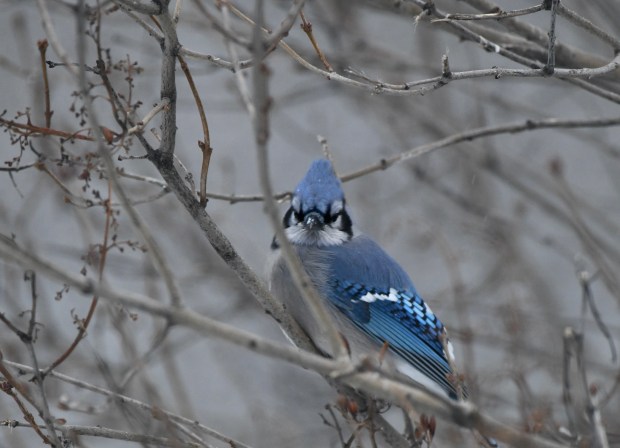
With the warm weather, the garden has been a busy place. The European Starlings do not like the butter bark suet cylinders when they are frozen. They sure don’t know Canadian winter weather! Today, with the warm weather they softened up and the Starlings, the Crows, the Blue Jays, and the squirrels were out in full force filling up in case it gets really cold again soon. The weather says it is going to be a mild -8 or -9 as a high with -10 to -21 as lows for the next five or six days. Splendid.
I did manage to get some images of the garden animals to share while Lewis was on the table watching. Now, Lewis read the manual: when your mother makes that certain sound, turn and look cute! Missy is still reading the chapter in the Maine Coon manual about ‘affectionate and loving’. She certainly doesn’t like to pose for me today!
Lewis wants you to know that his nose is not dirty. His big sister likes to scratch the sides of his nose and the lines are from her nails. Ouch.
Mr Blue Jay was all puffed up today and so happy to have peanuts in the shell.
Little Red found a stash of peanuts in the snow and was enjoying them. Look how healthy he is and that beautiful red chestnut colour on his tail lined with the black. He is coming and going from the insulated boxes that we fitted in with the wood in the big wood storage unit. I think it is possible he has moved in. That would be brilliant. I have felt exceptionally guilty since his penthouse in the garden shed was torn down to make way for the conservatory this summer. But..he looks good. Beautiful ear tuffs. He is here every day foraging as well.
Elain’s wonderful video summaries of the adventures of Indigo! Be sure to have the sound loud so you can hear Indigo’s prey calling.
The AEF seems to feel that it is V3 that has been in and around the nest today and for the last 3 or 4 days and nights. He flew in with a big fish (after bringing in other prey items including a squirrel one day). Of course, how frustrating is it when you make the effort and despite calls, Gabby doesn’t show up? I hope he doesn’t give up on our girl (whichever V you are).
It is a big fish and it still has its head!
The male calls and calls. Eventually he gives up and eats the fish.
Gabby on the left. The male V on the right.
They flew in together – landing on the nest seconds apart – Wednesday evening at 1744. They did some restorations and went off to their own branches. Looking more like a couple – Gabby and V3 (who has an injury according to the AEF but it will heal).
There is any question down in Miami. Rose seems to have used all her feminine powers and won Ron over. She will be a good mate for him. I am assuming she is young with a few of the feathers in her head needing to turn white. Please yell at me if this is wrong!
It does seem to me that they need to get a little more nesting material in this nest if there will be eggs this breeding season. Maybe there won’t be – perhaps next year. We wait to see.
It is absolutely silly. Ron has a duck in his talon for breakfast. If you watch, he flies in from the bottom left corner to the back and around to land on the nest with Rose chasing him.
They need a good rain on the camera at Superbeaks! That would help with the view. The eaglets are now large enough that we could easily see them during feeding times when they are stretching their necks.
They are sure cute and there is still some soft dandelion fluff on their heads.
Pepe has just flown in and is getting a good look at the two eaglets. They have just finished a nice fish dinner.
Jackie and Shadow were working on their nest right before 1100 Wednesday morning.
Here is a video of their efforts even as the winds are increasing and a storm is approaching.
Alex continues to bring in the fish to the E3 nest. You can see them and many are buried underneath the nesting material. It looks like it is causing a lot of flies. Poor little E3-1.
The second egg at the E3 nest has hatched! Let us hope that the first hatch is a little darling to this one! 02:07:03.
The morning feeding at the Kisatchie E3 Bald Eagle nest on Lake Kincaid. Strong eaglets.
There was a posting that there was a pip at the Captiva Bald Eagle nest but that cannot be right. If you go to the Captiva Eagle cam, they have a clock counting the days from the egg is laid. Egg 1 is only 25 days old as I write this blog meaning that there is at least 10 days remaining if not more. Bald Eagle eggs take 35-40 days to hatch with many coming in on the 37-38th day.
Let’s all give a shout out to all these great Bald Eagle Mums. Here is Liberty – of Liberty and Guardian at the Redding Eagle nest in California – flying high. She is 24 years old. How many other female eagles can you think of that are in their late 20s? Harriet at SWFlorida for one. Cholyn at Two Harbours for another. Any more?
Meanwhile, the ospreys continue to visit the new platform nest on Lori Covert’s property on Captiva, one of the barrier islands just off the coast of southwest Florida.
If you are wondering, the Port Lincoln camera on the barge is offline. I do not know if it has been turned off intentionally, if there is maintenance, or if it is a technical or weather issue.
More and more eagles are being taken into rehabilitation for lead poisoning. It is simply outrageous that this is still an issue – one that can be easily solved by the simple outlawing of the manufacturing and sale of lead for any hunting and fishing equipment. There are alternatives.
Most of us are familiar with the Bald Eagle nest of Mr President and Lotus at the National Arboretum in Washington, DC. The staff have discovered another nest. Is it another couple? or have Mr President and Lotus built a second nest? We wait to see.
It looks like L4 has a squirrel this morning at Cornell. Did Arthur deliver it? or did L4 catch it? My money is on L4 catching it since this was the first fledgling at Cornell to catch prey after fledging.
It is a shout out to the NZ DOC who take excellent care of the Royal Albatross at Taiaroa Head in New Zealand. It has been scorching hot in the south of Australia and in NZ and the rangers have set up misters for the nesting birds. Wow. How many of us wold like to see this type of ‘intervention’ on those scorcher days at the Osprey nests in the PNW and western Canada???
If you have been wondering about Annie and the ‘new guy’, he has been bringing prey into the scrape area. Is it for Annie? It is anyone’s guess but if he wants to win our Annie’s heart, he best be able to be a good provider!
Thank you so much for being with us this morning, Take care everyone. See you soon.
Thank you to the following for their videos, their posts, their tweets, and their streaming cam where I took my screen captures: Elain and the Charles Sturt Falcon Cam and Cilla Kinross, NEFL-AEF, WRDC, Superbeaks, FOBBV, KNF-E3, Window to Wildlife, Redding Eagles, Ventura Wildlife Society, @CornellHawks, Sharon Dunne and the Royal Cam Albatross Group NZ, SK Hideaways and Cal Falcons.
What a blistery week it has been. The garden animals are all poofed trying to keep warm in the chill winds and -21 degree C temperatures. It has gotten a little warmer!!! And by next week, it will be absolutely balmy at -2 on Wednesday. Crazy. We can adjust our clothing and footwear. These poor babies.
We have called Dyson the ‘monk’ for a long time. When she comes to the window with her little paws folded, it is a sign that all of the food for her is gone. Time to refill! No pressure, right? Just look at that sweet face.
I continue to be impressed with the book, Slow Birding. The chapter on House Sparrows really opened my eyes. They live where we live and the first sentence of the chapter asks, ‘Who Doesn’t Love House Sparrows’? I surely do and get quite irked at those who try specifically to feed other prettier birds (to them) and thwart the sparrows. Like falcons, they exist on every continent but, Antarctica. There are fossils dating back 400,000 years in the Middle East where the sparrows followed the progress of agriculture. They would eat the seeds left in the plowed fields. Today, the planting seasons have turned topsy turvy and they are on The Red List. They were traditionally planted in the fall not in the spring and that single change would help the birds survive in the UK. To add to that, the cessation of using pesticides and herbicides would benefit the ability of the parents to feed their young. No insects, no food for the little ones. Did you know that once they hatch, the chicks need 3000 to 4000 thousand insects to eat til they fledge. This is approximately 200 to 300 trips a day, in and out of the nest, to feed the wee ones. This will continue for two weeks. Today, in North America we are lucky to have them and their beautiful songs in our gardens. Feed them! And don’t use chemicals on your lawn. Promote insects by leaving your leaves in the fall. Help these wee ones out whenever you can!
I know that many of you will remember that one or the other of Diamond and Xavier have brought in a Green Parrot to the scrape at Orange. Here is an interesting story from The Guardian about them and the numbers that have flown to Tasmania for breeding season.
Today, Samson would be nine years old ——way too early to be gone ——and a YouTube video honouring his hatch day is making the rounds. Thanks ‘J’ for bringing it to my attention.
It is so difficult to catch a peek of the two little eaglets at Superbeaks but, that said, everything seems to be going just fine. Food is plentiful and both parents, PePe and Muhlady, are extremely attentive.
Glad to have a final and definitive word on the status of Rita. Things get carried away in chats and on FB. Terry Carman gives us the latest:
Always so happy to have one of Elain’s videos of the Orange Peregrine Falcon scrape to share:
A brief look at one of the Audubon Center’s Ambassadors who lived their life in car for 31 years. Incredible. And still going strong. If you ever get near enough to Maitland, Florida – on the west coast near Fort Myers – stop in and visit the Audubon Center for Birds of Prey. You will sadly not see Smedley but you could see Bailey, his long term Osprey mate. You might also see many of the other ambassadors.
So here is Francis from a wee nestling in care to being all grown up. Oh, I miss those little eaglets. Can’t wait for Harriet and M15’s two to hatch. Let the beaking begin!!!!!!! And it will. There is no doubt about it but, it will stop.
Oh, what a delight. Andor and Cruz were on the Fraser Point nest today. You might remember that these are the parents of Victor who went into care and Lillibet from 2022. So good to see you!
They refused to pose nicely but who cares. So lovely to see both of them together at the nest!
With that luck, I thought I would check on Thunder and Akecheta and there they were together! What a great day with our Channel Islands Bald Eagles. There they are, sitting together, looking out over the water into the sunshine on that high cliff to the left. I believe it is called Tor.
I ran out of luck at Two Harbours. No Chase or Cholyn when I checked.
The cams came back up at the Northeast Florida nest. V9 flew in and chortled but no Gabby. He waited for ten minutes and flew off. I wonder if they will both return to the nest tonight? We wait. Lady Hawk caught V9 flying in.
Gabby has been at the nest and she has brought some new greenery in. We wait, watch, and hope for our girl.
‘A’ sends word that there has been a changeover at the Taiaroa Head Royal Albatross nest. These two are doing so well. The sky calls are like nothing else. Oh, how I loved the little ones doing sky calls with OGK. Tears.
Zoe is certainly developing her diving skills and it is only a matter of time before an unlucky fish comes along and she snaps it up. It would be fantastic to see her bring one in to the nest that she caught right from the natal barge. Her love of fish will certainly be a motivator!
Speaking of fish, Dad is doing an amazing job feeding Zoe. Today she had no more than finished one fish than he flew in with another quite nice one. Her crop will pop!
You can see Zoe’s crop. I sure hope that Dad is eating himself!!!!!! He is really taking excellent care of his ‘little’ girl.
Thank you so very much for being with me today. Please take care. See you soon!
Thank you to the following for their notes, their videos, their posts, and their streaming cams that make up my screen captures: ‘J’ and ‘A’, Port Lincoln Osprey, NZ DOC and Cornell Bird Lab, NEFL-AEF, Institute for Wildlife Studies and Explore.org, Audubon Center for Birds of Prey, Elain and Charles Sturt Falcon Cam and Cilla Kinross, Superbeaks, Bald Eagles Live Nest Cam and News and Terry Carman, and The Guardian.
Good morning to everyone and the best of Thanksgiving to those celebrating in the US today.
It has been wonderfully warm on the Canadian Prairies. I do not know if it is atypical for this time of year but, it certainly feels like it. The birds in the garden had some of their feeders rearranged and thanks to a lovely friend I swopped out some old feeders for some she gave me yesterday. One of the visitors today was a beautiful Starling. It’s an immature non-breeder. Note all of the white spots on his breast and it has yet to get its oily black head. The males and the female Starlings look alike. Did you know that? One difference is that the beaks of the males are a deep blue while those of the female are a pink colour. This then looks like an immature non-breeding male.
Look closely and you can see their rose coloured legs. It is also a pair of non-breeding adults. They are really loving this soft suet.
The Starlings will not perch on the metal. I do not know why. They want to lean down from the branches to get to the suet. You can see this behaviour in the image above also. So the feeder below was moved so they could more easily reach it! Who says I am a softie?
Junior was grateful for a bowl of corn today.
One of many varieties of the Sparrow family that visit the garden. They are particularly enjoying the Butter Bark Balls on these damp days.
The kittens have had great fun watching the birds and the squirrels. They continue to find places in the house to get into mischief. And they do not always come when they are called setting in a panic that they have miraculously gotten outside in the cold. Of course, they are somewhere laughing (do cats laugh?) while I panic!
Missy has discovered a Rodney Mott sculpture that is just perfect for hiding in. Lewis is in the overturned basket not even showing a whisker.
At the Australian nests, Zoe took off for her first flight of the day at 0901. It was an absolutely perfect take off and her landing at 0907 was spot on, too. She is a very strong osplet. I do hope she gets some nice fish. It has been 24 hours since she last had some food.
While the camera was down for a couple of yours, Dad brought in fish. We are only seeing the tail of the fish but I hope that Dad had some nice fish – the entire head – and that it was big enough for Mum and Zoe to also have a good feed. This family would really enjoy a day with several deliveries but, I am grateful to know that there was a delivery mid-afternoon.
Zoe had a nice crop.
At the scrape in Orange, things were decidedly low key. Xavier and Diamond in and out of the scrape box and Diamond enjoying sleeping in the box all by herself at night. They have busy days chasing after Indigo and Rubus. Little Rubus is, apparently, doing more flying and getting much better.
This was the news from Orange: “Rubus and Indigo both seen within the last hour. Rubus is exploring the campus, going from building roofs to trees etc. He fledged on 20th November. Indigo is way ahead getting flight training from parents, visiting the box etc. He fledged on 11th November at 41 days.”
If you haven’t checked out the FalconCam site in a few days, I urge you to do so. Someone is really adding historical data and you can go back to 2007 to see earlier chicks and read about the big events at the scrape. Here is that link if you lost it.
Oh, it is stormy up near Jacksonville. Samson and Gabby have been on the nest today working despite the wind and the bad weather that looks like it is moving in.
I put this image in not so you could peer at the fluffy bottom of a big Bald Eagle but, rather, for you to see the colour of the legs and feet of Gabby. Then look at their beaks. This is a bright chrome-yellow. This is a very healthy bird.
Harriet and M15 are sleeping at the nest and so far no eggs, just like at NEFL.
At the E-3 nest in the Kistachie National Forest, they have their second egg today. Congratulations Andria and Alex.
There is also news coming out of the Midway Atoll about a very rare pair of Albatross.
As we give thanks for all the birds that bring our lives joy, remember that we are the cause of much of their suffering. Please spread the word to anyone you know – or where you work – that there are solutions other than using rodenticide to get rid of mice and rats. Also teach them about secondary poisoning. It could be their dog or cat but, it is often one of our beautiful raptors.
At small islands in New Zealand, Dr Digby and his team care for the rare non-flying parrot, the Kakapo. In 2016, they hand-raised more than a dozen of these precious little birds. Today they continue to do that work when it is required. The work that Digby and his team do to restore the health of these birds and to keep them safe and try and increase their numbers is remarkable. So thankful.
No 13. The Red List. The Marsh Tit
At first I thought these were out Black capped Chickadees. The Marsh Tit is small, it is mainly shades of a soft grey-brown or taupe with a shiny black cast, a black bib, and a pale ivory underbelly. The bill, eye, and legs are black. They are not plain by any means, look closely at the plumage patterns. Simply lovely.
The woodlands of the United Kingdom – and elsewhere – are changing and that it causing a huge decline in the number of this very small song bird, the Marsh Tit. The woods are more fragmented now, separated by grazing pastures, a growing number of introduced deer. Marsh Tits, according to Mike Toms, “favour woodlands with a complex understory and require surprisingly large patches of suitable habitat in order to breed successfully.” And they’re like their woodlands to be “wet”. Climate change has meant that they are now laying their eggs at least ten days earlier than they were 50 years ago. This change has had a decided impact on available or peak food supplies for the chicks which is also contributing to a decline in population numbers. The Marsh Tit is also known to visit older gardens, copses, and parks, and has sometimes been seen on feeders.
They feed mostly on insects, seeds and berries, and often cache food over winter if they find a good supply. They nest in existing tree holes, rather than excavating their own, and produce seven to nine eggs.
Their song sounds like a sneeze “pitchoot”.
Here is their range.
Thank you so much for being with me today. I hope that each of you had a wonderful day no matter where you are — or will have a great day if you are just waking up reading this. Take care. See you soon!
Thank you to the following for their posts and streaming cams where I took my screen captures: Port Lincoln Ospreys, Charles Sturt Falcon Cam and Cilla Kinross, NEFL-AEF, SWFL Eagles and D Pritchett, KNF, Friends of Midway Atoll National Wildlife Refuge, A Place Called Hope, Kakapo Recovery and Dr Digby Twitter, Openverse, and RSPB.
I hope that you have had a great day! I am here just checking in on the breakfast arrivals down at the nests in Australia. I wonder what is on those silver platters today?
The morning walk has reminded me of something very important. In some countries, Halloween is quickly approaching. It appears that my neighbourhood has decided to go quite fancy with the decorations but, are they aware that some of those are absolutely deadly to the birds with their tiny little legs?
This inexpensive Halloween decor can be deadly. Please pass the word. It is no different than the birds getting their legs caught in those mesh bags that companies insist using for oranges, lemons, avocadoes and other fruit.
One of the adults is awake at 367 Collins Street! The eyases, those cute little cotton ball running machines, are still sleeping, all in a puddle. Adorable.
Oh, it looks like the adult (I cannot tell which from this angle) has only a small leftover piece of pigeon. Not sure that will satisfy those ravenous eyases. Just look at them. They are so big! This new couple has done well despite our initial worries.
It is…you guessed it – a European Starling for Indigo and Rubus. I had no idea that they had such gorgeous orange beaks in Australia. They really are quite beautiful birds with their iridescent feathers. Xavier arrives with breakfast and begins giving the two chicks a plucking demonstration. It is not long until Diamond arrives. Rubus is never interested in this part. It looks like he is thinking about going over to the Cilla stones but changes his mind.
What little darlings. Indigo is getting much steadier on her legs and little Rubus wants to walk just like his big sister. He is still using his ankles but trying to walk straight up. Adorable. Look at that sweet face.
At 0648 Xavier lands on the ledge again. This time with a prepared prey that looks like a parrot of some kind. It is so hard to tell when the feathers are mostly gone. At first Indigo and Rubus just watch. Xavier would have been so happy to feed them. Diamond arrives. Indigo goes over to the other side to do a ps and returns for some of this delicious breakfast dessert.
Diamond continues to offer Indigo and Rubus occasionally taking a piece. Notice that her chest is sunken. Diamond needs a good breakfast – she needs to fill up her crop, too!
Someone has post a sweet video already! Enjoy.
Big and Middle are still waiting for their breakfast fish to arrive. It looks like there is some rain or drizzle. Their backs appear to be a little wet.
Big and Middle are still waiting but they are not showing signs of being impatient. Thankfully.
Oh, those two are so beautiful. You can see the wind is blowing. Mum’s crest is sticking right up. Stay nice you two!
As I sign off it is 0837 in Port Lincoln and no breakfast yet. They had a big late dinner last night so hopefully neither are ‘starving’.
I belong to the American Society of Ornithologists and the US Government has just issues their ‘State of the Birds’ Report for 2022. It is 17 pages long with some good graphics. It shows some encouraging news for waterfowl where wetlands are being developed but an overall trend downward in bird populations.
Here is that report if you would like to have a read. It will really help you understand the urgency in taking care of our environment for our feathered friends.
For those of you getting super excited about the beginning of Royal Albatross season, here is the latest news from Sharyn Broni. Thanks Holly Parsons for the post! Holly is the Admin for the Albatross Lovers FB Page.
Thank you so much for being with me this afternoon. Take care everyone. See you soon! Wish for fish for Big and Middle.
Thank you to Holly Parsons and the Albatross Lovers FB, Port Lincoln Ospreys, 367 Collins Street by Mirvac, and Charles Sturt Falcon Cam and Cilla Kinross for their posts, videos, and streaming cams where I took my screen captures.