The Birds ‘Down Under’

As people in North America wait for the Bald Eagles to begin preparing their nest and breeding, much of the ‘bird’ action is in Australia. I pulled up a map so that we can locate the nests that are on streaming cams in Australia – fondly known as ‘Down Under’ here in Canada.

I made the map a little larger just so it is easier to see. Or is it just me that is having trouble reading all that small print?!

The White-Bellied Sea Eagle Nest is in Sydney. On the map it is in bold letters on the lower right hand side. The Peregrine Falcon Nest of Xavier and Diamond is in Orange. Orange is just outside of Sydney. Trace your finger to 10 o’clock from Sydney and you should see Orange in grey letters. The 367 Collins Street Falcons are in Melbourne. It is at the very bottom in black letters. The Port Lincoln Osprey Barge is in Port Lincoln. This is a small place. Locate Adelaide which is up the coast from Melbourne on the left. Take your finger and move it over in a straight line to the left from Adelaide to the bottom of the second peninsula. There is Port Lincoln. I am also going to include Solly’s Location so you can see where she is relative to where she hatched and fledged at Port Lincoln. Solly is currently staying the majority of the time at Eba Anchorage. Solly is 311 km from the place she fledged. Prior to Solly, the general understanding was that Eastern Ospreys stayed much closer to their natal nest. The evidence from the satellite tracking is changing the understanding of how far these fledglings might travel upon fledging.

Time flies. It was only a blink and Pippa Atawhai, the 2020 Royal Cam chick, had fledged — BUT, that was a year ago. Now we are waiting for Tiaki to fledge soon. It seemed like the month of August just melted. It was on the 3rd, the 6th, and the 9th that Mum at the Port Lincoln Osprey Barge laid her eggs for the 2021 season. At this very moment, the PLO FB Page is taking guesses on when the eggs will hatch. Yes, we will be moving into hatch watch within a week. Baby Ospreys are coming. Oh, those lovely little reptiles!

Dad continues to bring in materials for the nest. They are all over the place – big strips of bark and moss – even some more rope. He is a bit of a pack rat. Thank goodness he hasn’t been bringing in toys like Richmond and Jack in the US. It would be awfully crowded if that were to happen.

Watching this nest is not for the faint of heart. Siblicide is a regular occurrence.

The dominant hatch of 2021 was Solly. She is 352 days old on 7 August, Australian time. Solly was considered, out of the two surviving chicks, to be the one that would succeed. We have no news of DEW and unlike Solly, DEW was not equipped with a satellite transmitter. Solly has, however, demonstrated that she can survive and today she flew rom her normal home tree in Eba Anchorage to Perlubie to check out the fish. This is the graph from the satellite transmission.

The Port Lincoln Osprey Project is taking guesses as to the date of the first hatch on their FB page. You don’t need to be a member to pick a day – go and have some fun!

The White Bellied Sea Eaglets are doing fine. They are well fed and protected and they are growing so fast. Those beautiful juvenile feathers are coming in changing their appearance almost daily. They had a good fish feast the morning of the 6th and the wee ones slept and then woke up and began picking up sticks and leaves on the nest moving them about with their beak. They are not yet steady on their feet but they are standing more and 27 was attempting to walk today.

Both still had big crops after the fish breakfast. 28 got the majority.

Just look at those beautiful colours coming in. 27 is on the left and 28 is on the right.
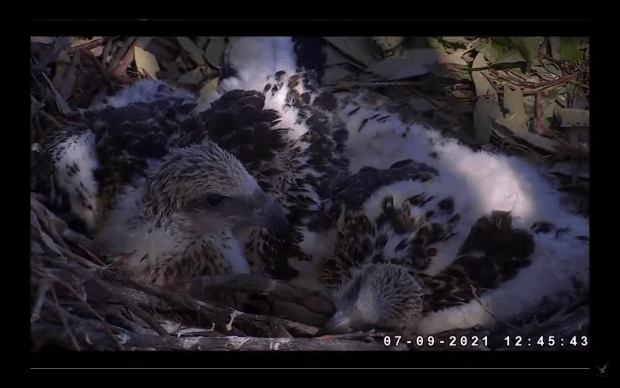
Here 27 is standing watching 28 play with some sticks with its beak and talons. The sea eaglets are developing at a normal pace. It is all good.

The golden glow of morning fills the scrape box of the Peregrine Falcons, Xavier and Diamond, in Orange.

Each parent takes turns incubating the eggs so that the other can have a break. Diamond will do the overnight incubation and Xavier will be the security guard.

Here is a short video of the hand over of incubating duties from Diamond to Xavier:

Remember that the males are about 30% smaller than the females. Xavier works with his feet and wings to get those three large eggs under him so they can all be warm.

It is even harder for the tiny male at the 367 Collins Street nest who has four eggs to warm!

Mom arrives for her turn.

She is working her wings too to get those four eggs under her.

Looked at how poofed out all those feathers are. Wow.

Here is Dad. His feathers are all poofed, too. He is so tiny compared to mom. My goodness – he really does have to work to get all four under him properly.

After wiggling about he gets everything settled. We will be looking for hatch towards the end of September.

Thank you so much for joining me. All of the birds in Australia seem to be doing just fine. We will watch the sea eagles change colour before our eyes and anticipate the arrival of the Ospreys. It’s a few weeks before falcons start hatching. Take care everyone.

Thank you to the following for their streaming cams where I took my screen shots and video clips: The 367 Collins Street Falcons, The Falcon Cam at Charles Sturt University and Cilla Kinross, Sea Eagle Cam @ Birdlife Australia Discovery Centre, and the Port Lincoln Osprey Project and FB Page.

PLEASE NOTE: I am taking my computer in for servicing. I hope to have it returned to me sometimes on Thursday so I will be back with another newsletter Thursday or Friday.

Diamond laid her first egg

Diamond and Xavier now have their first egg of the 2021 Peregrine Falcon season in Orange, Australia. The time was 10:39:50 on 31 August. It is a Tuesday in Australia.

The latest Diamond has ever laid an egg was 31 August.

Oh, she must feel so much better. She went to sleep sitting up while the egg dries. Well done, Diamond.

Congratulations Diamond and Xavier. If you would like to join in the fun and wait for egg number 2, it should be here on 2 September. Here is the link to the streaming cam on the grounds of Charles Sturt University in Orange, Australia.

Thank you to the Falcon Cam Project, Charles Sturt University and Cilla Kinross for their streaming cam where I took these screen shots.

Late Saturday and early Sunday in Bird World

Everyone at the Sydney Sea Eagle Cam, Birdlife Australia, and The Discovery Centre are working hard to provide videos and updates on the White-Bellied Sea Eagle Cam in the Sydney Olympic Forest. A number of days ago I simply had to quit watching the live camera feed. The level of prey had dropped coming into the nest and WBSE 27 was overly aggressive to WBSE 28. It appears that the current delivery of prey items is quite good and, 28 has figured out how to wait and watch and then get fed. These are all good things and helped our Ospreys, Tiny Tot Tumbles and Tiny Little survive.

In the image below, both WBSE 27 and 28 are full to the brim. This is excellent. Soon WBSE 28 will be too big and any worries of siblicide should evaporate. Fingers crossed for this little one.

Gorgeous light on these two. 27 is quite large compared to 27. But both are full and clown feet are coming!

Diamond, the female at the Peregrine Falcon nest in Orange, Australia continues to think about laying that first egg. It is Sunday morning in Canada and I just checked on Diamond. Still waiting for that egg.

If you missed it, the female at 367 Collins Street laid her fourth egg.

My goodness what a beautiful morning in Wales. I wonder what impact the streaming cams will have on tourism when the world can travel again?

I love seeing the cows going in from the fields. It is all so serene.

These little birds seem to be all around the nest. Do you know what they are?

Aran came to visit the nest before the mist was gone.

He looked around every direction and then left. Yesterday he was on the perch with Mrs G. This morning, Sunday, Aran was at the nest around 6am. He will probably leave when Mrs G does. They may be staying longer to make sure Aran is fit for migration – every day of healing helps – or they may still be protecting that nest against Monty’s kids. Maybe they will wait for them to leave!

Yesterday, both of the boys, Idris and Dysynni, were on the nest at Dyfi. Dysynni was 100 days old. This morning all is quiet. Are they still around? Telyn migrated on 21 August with Ystwyth following on the 24th. There are sure lots of people including Emyr Evans watching the Dyfi nest this morning to see if either Idris or Dysynni or both show up.

Idris has arrived with a nice fish for his son. He is looking around. Doing his duty. Idris flies off the perch with the fish looking for Dysynni. Will he find him? has he left? It is about 6am.

Idris arrived back in Wales on 29th of March. He is reputed to always be one of the last Ospreys to leave Wales. What a fabulous dad he has been. With all the sadness this year, Idris raised one-quarter of all Wales’ hatches to fledge. You are a great dad, Idris. I remember those whoppers you brought in this year. Incredible. You deserve your break now.

It is equally quiet up at The Loch of the Lowes. The Scottish Wildlife Trust has issued their official statement that Laddie, LM12, Blue NC0, LR1 and LR2 have departed for their migration. Stay safe all.

Rutland Manton Bay’s Osprey nest seems very lonely as well.

Are you interested in Goshawks? Here is a lovely six minute video I found of a compressed breeding season. It is quite nice. I love when the three are learning to self-feed. So cute.

We have Northern Goshawks that live in Manitoba year round. They only come down to the southern areas of our province if prey is limited in the north.

My heart skipped a beat. There is an Osprey on the Foulshaw Moss nest! Is it Tiny Little? No. It is White YW also doing his duty, like Idris, to make sure that his chick has breakfast. White YW has been looking about and calling. There is no Tiny Little rushing to the nest to tear at his toe or grab the fish. While he waits, White YW decides to do some nestorations. Gosh, it must be hard trying to figure out if they are just over at the river or have left.

White YW flies away from the nest. Will this be his last visit to check on Tiny Little? Blue 463 – our fantastic Tiny Little – could be in Brittany by now.

My garden is filled with birds this morning. It is a roar to go out to the feeders. Today we may have to fill them up four times. The delight, however, came in the form of a male Ruby-throated Hummingbird at the Vermillionaires. Did you know they are capable of speeds up to 100 km per hour. Their wings beat up to 1200 times a minute – which is precisely why it is hard to get decent photographs of them.

We are just so delighted to see them.

If this is a normal year – and so far it has been anything but, the hummers will be gone by 3 September.

We did not put our the sugar water for them this year because of the wasps. Our City has been consumed with them and they take over the feeders. The wasps do not, however, bother with the Vermillionaires.

Soon all of the Ospreys in the UK and Europe will be making their way to Africa. We wish them good winds, great feeding places enroute, and a safe arrival. Thank you so much for joining me today. I hope you have a fabulous Sunday or start to the week depending on where you are. Take care everyone.

Thank you to the following for their streaming cams where I take my screen shots and video clips: Bywyd Gwyllt Glaslyn, Dfyi Osprey Project, Cumbrian Wildlife Trust and Foulshaw Moss, 367 Collins Street by Mirvac, Charles Sturt University Falcon Cam and Cilla Kinross, Sydney Sea Eagle Cam, Birdlife Australia, and The Discovery Centre FB Page, LRWT Manton Bay Ospreys, and the Scottish Wildlife Trust and Friends of Loch of the Lowes.

It’s number 4 for Collins Street

Mom was in labour for about seven minutes. This is a short clip of the last minute. You can see how she is contracting.

The time was 10:20:11 on 29 August 2021.

Dad, you are going to be so busy!!!!

Oh, Dad, you are the cutest. Look at you incubating those three eggs just half an hour before the 4th arrives.

You can watch all of the action in Melbourne here:

If this is the last egg to be laid, Mom and Dad will begin hard incubation.

Last year Mom and Dad at 367 Collins Street hatched three big females – triplets born within a single hour. They all fledged. Poor Dad. He was mobbed by them when he brought prey.

Congratulations Collins Street Peregrine Falcons. We can’t wait.

Thanks for joining me on this quick announcement. I am soooooo excited. I love this falcon family and you will, too.

Thanks to 367 Collins Street by Mirvac for their streaming cam where I took my screen shots and video clips.

Early Friday in Bird World

The Scottish Wildlife Trust has confirmed that the female, NC0, has left the Loch of the Lowes for her migration after receiving a fish from LM12, Laddie, on Sunday 22 August. This is a late departure. The female fledgling, LM1, migrated on 15 August, a week prior to her mother which is also unusual. The Scottish Wildlife Trust says that is only the second time in the history of the nest that a juvenile has left prior to the female adult. Laddie, LM12 and the male juvenile, LM2, are the only ones left at Loch of the Lowes. Here is the video of that last sighting of NC0:

Tiny Little was still on the Foulshaw Moss Nest this morning, 27 August, around 07:00 as confirmed by this image taken by my friend ‘SS’. I have tried to catch her on that nest so many times – even late in the night from the Canadian prairies but those efforts were to no avail. So glad to see this. Is it my imagination or does that crop look full? Maybe she is just hunched down.

Mrs G and Aran were still on the Glaslyn nest. For a bit of time, Mrs G was enjoying a flounder. However, there was other action around. It appears that KA3, Hesgyn, and Z2 Aeron, have been over at the Glaslyn nest.

Here is Aeron, Z2, one of Monty’s boys at the Glaslyn nest caught on camera:

Aran has been dealing with intruders. Are Monty’s lads helping? or are they the intruders Aran is dealing with?

You may recall earlier in the summer before Aran’s wing injury was much better that there was a suggestion that Z2 was the Osprey that Aran battled with over the river. Z2 even spent some time sitting on the Glaslyn Nest as you can see from the image above.

Z2, Aeron, occupies the Pont Cresor nest with 014 nearby. I would not draw the conclusion that Monty’s lad is being a friendly neighbour to Aran – you might be humanizing the situation too much. Perhaps Z2 would like that piece of prime real estate and Mrs G to go with it.

Hopefully Aran and Mrs G will put an end to that nonsense if it is true.

Watching over the territory.

Mrs G and Aran remained on or around the nest for some time. I wonder if Mrs G is waiting for Aran to be fully healed and ready for migration before she leaves? I just love seeing them together!

A quick check on the Black Storks in Latvia and Estonia. At the Jegova County Nest of Jan and Janika, one of their storklings, Julge, was on and off the nest during the day. This image was taken right before 20:00 as you can see from the time stamp.

There is now concern rising for Tasane. This is the most recent message from Urmas: “looking data I suspect problems with 7183, probably killed last evening quite near the nest. I can go there maybe afternoon, but depends how other duties can be solved. It is only warning, yet. … “

Karl II’s daughter, Pikne, is in the Ukraine, on 26 August according to her tracker. This is good news.

On 26 August, Karl II was in a small forest near Hlusk in Belarus. He is headed towards the Black Sea.

I seem to be unable to find data for Udu on the 26th.

There has been no sightings of the storklings at the Latvian nest. People are anxious and hoping that Jan Kuze will go and check around the nests just to make sure. This is such a very difficult time for all. The deaths of Jogeva’s Malbe and Karula’s Tuul have really hit the hearts of so many. The fear that another, Tasane, is lost is just spiking anxiety. Will Julge be the only one to survive? My thoughts go out to all the people who loved these storklings so much. Seeing them perish after thriving and all the efforts to feed them, drains everyone of what energy they have left. And that brings me to the end of this updating, almost.

As I said many times, the circumstances of Malin’s death ‘rattled’ me because they pointed out how governmental agencies like the Department of Natural Resources are more concerned with selling hunting licenses than protecting wildlife. That is the precise reason that Rosalie Edge bought Hawk Mountain – to get rid of the hunters and protect the birds! Malin’s death has showed me that any person can put the title ‘naturalist’ behind their name. It means nothing. Malin’s death has raised so many issues. Sexism has been revealed to be alive and well in Wisconsin! I could go on and on. It feels like Malin was a ‘canary in the mine’ – my canary. As the layers of the onion are peeled away, more is revealed and the more that is exposed the more troubling it is. And so, I have been slightly distracted and there was a misunderstanding that led to my reporting that Diamond laid her egg yesterday. She laid her egg on 27 August last year.

Diamond looks like she is about to pop. She must not feel so good. Today, Xavier brought her an Eastern Rosella for her lunch. Diamond would be delighted!

I hope while I have been writing that she lays that egg. She is starting to make me uncomfortable!

Word has come that WBSE 28 has had some food and remains with us. 28 needs to get large enough but, for now, it is learning to stay clear of 27 until it is so full it doesn’t care and goes into a food coma.

Take care everyone. Keep all the Black storklings in your heart. Indeed, keep all of the birds in your heart especially those that are migrating or beginning their migration.

Thank you to the following persons or the streaming cams where I took my screen shots: To ‘SS’ and the The Cumbrian Wilife Trust and the Foulshaw Moss Osprey Nest for the snap of Tiny Little, ‘S’ and the Falcon Cam on the grounds of Charles Sturt University in Orange, The Latvian Fund for Nature, The Eagle Club of Estonia, and Bywyd Gwyllt Glaslyn.

The First Egg for the Collins Street Falcons

Oh, my goodness. The male at the Collins Street Peregrine Falcon nest is nothing short of adorable. I spent all last year wanting to scoop up this stealth fighter in my arms and cuddle with him. Or dreaming of a Peregrine Falcon onsie. Wouldn’t that be cute on a toddler?

The first egg of the 2021 season has been laid on 21 August. Wow. It is eggciting.

You might be asking why the female is not incubating that egg. The female will not start incubating the eggs until the last one is laid. This is because the adults want the nestlings to be about the same size for the first fortnight so that there is no rivalry over food. Last year, the three big girls all hatched within a 24 hour period. There was never any sibling rivalry – that is what I love about falcons and kestrels. Once the last egg is hatched, they will be incubated for 32-40 days.

Mom looks so proud of herself!

These are some images from last year:

Mom brooding the triplets.

Dad feeding the girls when they are a little older – before they lose all that fluffy white down.

This year Mirvac, the property owners, are in charge of the streaming cams of the Victorian Falcon Project. You can watch these falcons from the very beginning.

Telyn at the Dyfi Nest, Wales. 20 August 2021

Some more great news. The Season of the Osprey will premier on PBS October 27 at 8pm! Please check your local stations for the exact time in your area. This is what they are saying about this documentary:

“Birds of prey exist in myriad shapes and sizes. Scores of eagles, hundreds of hawks and countless kites and falcons have all adapted form and behavior to fit diverse habitats. But in all the world, there is only one osprey. Following a single evolutionary path, it has conquered every continent save Antarctica. One bird, one design, unchanged. It is the only truly aquatic raptor, the sole member of its own taxonomic family. This one-hour, blue-chip special brings viewers into the life to this incredible raptor with a depth and intimacy never before attempted. Shot in and around Great Island Marsh, where the Connecticut River meets the Long Island Sound, cameraman Jacob Steinberg has achieved unlimited access to an osprey nest and captured the struggles, failures and triumphs of a single osprey family.”

Oh, I can’t wait!

I am afraid that I am having Malin withdrawal. A week or more ago I took a few video clips of Malin being fed by Marsha. I would like to share one of those with you now.

And another one of Malin exercising his wings.

It is so much easier when you know that the little one fledged, returned to the nest for food for 36 days or so, and then flew off to find their life. There is a level of anxiety when it doesn’t happen that way. I sure miss that little one. I have not, as yet, received any images of the two Osprey chicks found or any other news. I am hoping for tomorrow or Monday. It is a busy time of year for the wildlife rehabbers.

Two of the storklings have fledged at the nest of Grafs and Grafiene near Siguldas – the youngest was first and then the oldest yesterday. Only the middle remains. All have returned to the nest safely. The one that had its wing up against the far branch seems to be alright as well. That is good news. I have heard of no feedings since Grafs came in with some very small fish for the trio on 19 August. That means that if the storklings did not find the feeder – the two that fledged – they have had little food but nothing for two days. This is critical. There is concern that Grafs has left for his migration — it was the very initial concern. I want to remain hopeful.

Jan has fed his storklings but the meal was only tiny fish or worms. Urmas has not brought any more fish to the nest. Since he has fed them once and they accepted the fish, I hope that Urmas will do this again (he also left fish when he banded them and put on the trackers). It is not clear whether the anxiety of starvation is worse than having a human bring food to the nest.

These are very difficult times for everyone but they are especially difficult circumstances for these six starving Black Storks – rare Black Storks!

At the Black Stork Nest in the Karula Forest in Estonia, Karl II was still in the nest area. His transmitter told us. The two early fledges, Tuul and Udu, headed the wrong direction due to weather concerns and then turned south. Pikne travelled south from the beginning. New tracker information should be coming in soon. Safe travels all of you!

Oh, this youngster can really scream for food on the Loch of the Lowes nest. What a beauty. This is another good example of a ‘normal’ fledge. The chicks return to the nest to be fed and fattened up for migration.

I really want to put a plug in for the administration of the lochs in Scotland. No one is allowed on those lakes from April to the end of September so that humans do not disturb the birds. It means that motor boats with their leaking fuel are not chasing the Ospreys and making the water toxic. Gosh, I hope that only human powered boats are allowed. What a great idea – leave the lakes to the birds during breeding season. Three cheers for Scotland! This could well be the case throughout England and Wales also. I will try and find out.

And look what is on the Foulshaw Moss Nest. It is a flounder for the lucky chick that makes it to the nest first. Tiny Little!!!!!!!!! Where are you Tiny Little?

It’s a few minutes later and I missed that lucky fledgling that snagged that flounder! It’s gone. That leads me to believe that it was probably Blue 464, the male, the first to fledge. He likes to take the fish and eat it on the branch of the parent tree.

Thank you so much for joining me. I hope that you are looking forward to those falcons hatching as much as I am. Take care. See you soon.

Thank you to the following for their streaming cams where I took my screen shots and video clips: Scottish Wildlife Trust and Friends of Loch of the Lowes, Mirvac Corporation and the Collins Street Falcon Cam, The Cumbrian Wildlife Trust and the Foulshaw Moss Osprey Nest, The Eagle Club of Estonia, The Latvian Club for Nature, Collins Marsh Nature Centre, and The Dyfi Osprey Project.

What is better than a Peregrine Falcon Kiss?

Lots of people keep track of hurricanes and tropical storms. Most watch because they or their loved ones, or both, live in the line of the storm. Bird watchers also track weather systems. There are currently two systems that might impact our beloved Big Red and family as well as the birds that are migrating over Hawk Mountain, PA.

Henri is going to give some heavy rain and wind. Ithaca is west of the darkest green band but could get some rain.

Tropical Disturbance Fred will also give some heavy rain in the same area. There were flash flood warnings for Ithaca last night. It is 1:03 am Thursday morning in Ithaca and there are rain drops dripping off the metal supports of the light stand that Big Red and Arthur’s nest is on. The rain does not look heavy at the moment. There is also a peculiar corn plant growing out of the centre of the nest!

Heavy rain will impact the hawks ability to hunt. They would have felt the pressure system coming and hopefully caught more food yesterday.

This isn’t the beginning of the season. Hurricane season runs until 30 November.

Baby Kindness (I wonder if she would mind if I call her that?) is not worried about hurricanes. Today, she is 83 days old. Kindness branched yesterday and all she has on her mind is ___________________. If you said flying you are 100% correct. She has really been putting on a show for the people watching the live stream today.

Oh, she really gets some nice air under those wings going back and forth from the branch to the nest.

Wow. Look at those wings. Magnificent.

Kindness has spent a lot of time considering what is below that branch she is sitting on. Sometimes she gets the branch to bouncing a bit and that seems to unnerve her slightly and she flies back to the nest.

For several days, I have been talking about the migration of Ospreys in Wisconsin, like Malin, or those living in the United Kingdom or in Northeastern Europe. The Bald Eagles in Alaska do not migrate south of Alaska unless there is no food. In 1972, the State Legislature established a long stretch of the In Chilkat River as critical bald eagle habitat. The goal was to protect the birds, some 4000 of them, that move from the interior to the Chilikat River Valley where they feed on the Chum Salmon run during the late fall and winter. The juveniles normally eat spawned and dead salmon or the carcasses left behind by bears.

The Glacier Gardens Rainforest Adventure is located in the Tongass National Forest just fifteen minutes away from Juneau. This is where Liberty and Freedom have their nest and where Kindness will fledge. There are meadows, forests, and glaciers. What a spectacular place to be a Bald Eagle!

“Tongass National Forest” by markcbrennan is licensed under CC BY-SA 2.0

One of the features of the park is the Mendenhall Glacier.

“Mendenhall Glacier – Tongass National Forest” by jcsullivan24 is licensed under CC BY-NC 2.0

Liberty, Freedom, and Kindness are not far from the Chilikat River Valley and the Alaska Chilikat Bald Eagle Reserve.

In the spring, many of the Bald Eagles will head to areas rich with Herring and Eulachon. These include the Stikine River, Copper River Delta, Silka Sound and Kenai Bend. You can see some of those on the map below. The Copper River flows from Prince William Sound while Silka Sound is closer to Juneau on the far right bottom.

Kindness is fortunate to live in such a beautiful state with what we all hope are abundant resources for her and all the wildlife forever.

There are so many worries in the world. The birds bring so much joy to each of us filled with nail-biting anxiety and that bittersweet moment when our friends fledge to begin their lives off the nest.

Malin is beginning to feel the wind beneath his wings. For so long I did not believe that Malin’s feathers would develop and he would fly – but here he is preparing just for that. Joy.

Like other birds, Malin is doing much more wing strengthening flapping as fledge approaches. The energy from the fish he is eating gives rise to lots of exercising after a feed.

For tonight though, Malin is sleeping like a duckling dreaming of fish.

While Kindness and Malin are dreaming of fish and flying, Xavier and Diamond are constantly pair bonding while preparing for their 2021 eggs and hatches. After doing their courtship dance in the scrape box today, they sealed the deal with a kiss – peregrine falcon style.

Can you think of a better way to end this newsletter? I can’t!

Want to catch the adventures of Xavier and Diamond, here is the link:

Well, what could be better than a Peregrine Falcon kiss? Three Black storklings eating the fish that Urmas brought them. That is actually cause for a big celebration!

When the storklings woke up at dawn and found the fish gift from Urmas, they began to eat.

The feeding of the storklings is a success! Congratulations.

Thank you for joining me this morning. Have a wonderful Thursday. Take care all.

Thank you to the following for their streaming cams where I took my screen shots: Cilla Kinross and the Falconcam Project Charles Sturt University, Collins Marsh Nature Centre, Glacier Gardens Rainforest Adventure, Google Maps, Cornell Bird Labs Red Tail Hawk Streaming Cam, and the National Hurricane Centre.

Things are happening in Bird World

Oh, just look who showed up on the NorthEast Florida Eagle’s nest in Jacksonville today – none other than the resident male, Samson! It was 7:23. So very nice to see you, Samson.

Samson is the son of Romeo and Juliet. Samson hatched on this very nest on 23 December 2013. Samson fledged and left the area on 22 April 2014. He was 120 days old.

At the end of the summer in 2019, in August, Samson arrived at the very nest he hatched from and began bringing in sticks. His mate, Gabrielle arrived on the nest on 12 September. In May of 2020, their two chicks, Jules and Romey, named after Samson’s parents, Romeo and Juliett, fledged. In 2021, they fledged their only hatch, Legacy.

The picture below is of Mama Gabby and baby Legacy in February 2021.

Samson has been seen at the nest earlier this month when the technicians came to do the maintenance on the streaming cam. Samson remains in the area of the nest year round while Gabby migrates to a cooler place – although, as I have often said, I don’t know where that would be this year! She will return about the middle of third week in September. It will be wonderful to see her back. Can’t wait.

Samson may be working on a nest but the Peregrine Falcon couple, Diamond and Xavier, are expecting eggs in the nest week or a week and a little bit. Their scrape box is high on a water tower, 170 steps up, on the campus of Charles Sturt University in Orange Australia.

This is Diamond on the ledge of the scrape box today.

Diamond and Xavier’s 2021 fledgling, Izzi, was the joy of everyone. As the only little falcon he was loved and spoiled by his parents. There was some concern he would not leave the scrape box before this year’s eggs are laid. This is the latest message from Cilla Kinross, the head researcher on the Falconcam Project:

“Izzi has not been in the box now for 12 days, but we think he is still around from calls. Parental behaviour continues as normal, with up to three prey a day being delivered to Diamond and preparation of the scrape. Eggs are expected soon (within a week or two). Generally, Diamond starts to spend more and more time in the scrape and her backside looks large and fluffy.”

You can watch Diamond and Xavier here:

Peregrine falcons are nothing short of amazing. Bald Eagles are big but Peregrine falcons are fast.

“Peregrine Falcon” by Jon David Nelson is licensed under CC BY-NC-SA 2.0

The cere is the yellow part above the beak. Now look at the nostrils in the cere. There are small keratinous tubercules – they look like small little bumps inside the nostril. Can you see the one on the right nostril of the falcon above? Those are what help the Peregrine Falcon fly so fast. They serve as a baffle against the wind driven in so forcefully into the lungs of the falcon as they do their high speed dives. Otherwise, their lungs would burst.

“Faucon pèlerin / Peregrine Falcon / Falco peregrinus” by FRITSCHI PHOTOGRAPHY is licensed under CC BY 2.0

Most Peregrine Falcons that you will see on a streaming cam lay their eggs in a scrape box like the one of Diamond’s, above. Some make their nests on the side of cliffs like this one in Japan on the island of Hokkaido.

“Peregrine Falcon Nest” by Ken-ichi is licensed under CC BY-NC 2.0

Peregrine Falcons do not make their nest out of twigs. It is believed that this helps to stop the spread of disease from twig nests pests like flies and parasites.

Here is a short 8 minute video to introduce you to the speed and hunting methods of the Peregrine Falcon:

It’s a great day for Malin! We do not know Malin’s exact hatch date. There were three chicks and the youngest hatched on 18 June. Two chicks perished in the heat. So Malin is either celebrating his two month hatch today or his two month hatch and a couple of days, more or less. His first delivery came around 9am and the second was at around 10:14. Malin is really growing.

Here is Malin next to mum, Marsha, this morning. You can see that Malin’s feathers are growing in nicely. Look at the crossing of those wing feathers. Yippeeeeeee. This chick has really grown with the increase in feedings.

And look at all of the bands on those tail feathers – looks like a clean 7 – while, at the same time, there are no spaces in the wing feathers.

Oh, Malin, aren’t you beautiful?

Malin has gotten very good at self-feeding.

Malin is off to a great start on Wednesday. Terrific.

It is raining heavy in Latvia at the nest of Grafs and Grafiene. There are some concerns on the amount of energy used to keep warm by the nestlings.

This is the nearby ditch. It is 200 m long. A portion of the ditch has been closed off and fish have been placed in there along with the decoy of Grafiene. The decoy of Grafiene was painted by an active chat participant and installed by Janis Kuze, the ornithologist.

I hope you don’t mind if I correct just minor details. The beautiful decoy was painted by the active chat participant B.K. and installed by the ornithologist Jānis Ķuze.

These are the size of fish being put into the feeder for Grafs. So much effort. Now we need Grafs to find this spot for his three storklings. It is a very, very difficult time for everyone especially with the rain. If you would like to check on the Latvian Forum for progress, please go to this link:

The situation of the Black Storklings in the nest in Jegova County, Estonia appears to be better than in Latvia. Jan has come to the nest to feed the storklings 3 times today. The storklings have not almost completely depleted the fish that was brought on the 13th when they received their transmitters and bands. They appear to be healthy and doing well. It is not raining on this nest today.

The three storklings are 63 and 64 days old today. The average for fledging appears to be 71 days but then the young storklings are dependent on their parents for another two to three weeks before leaving the nest area. That only puts us at the end of the first week of September for these three to be totally independent of Jan — but, of course, those numbers are only averages. It appears there is time! We all must hope for these birds. They are very rare and very special and there has not been a lot of studies done on them.

The Forum with ongoing information on the Estonian Black Stork nest is here:

Karl II has been in to feed the one fledgling on the Black Stork Nest in the Karula National Park in Estonia. Oh, that fledgling was so happy. That was at 18:33. It is Urmas, the only chick still being fed by a parent. Kaia has left for her migration and the other two siblings appear to have left the nest area and might be travelling as well.

I know that there is much sadness and anxiety in the region for the two Black Stork nests that had late hatches. But, we must also celebrate the happiness of this nest in Estonia, that of Karl II and Kaia. Three fledglings, all healthy! We need to send the most positive wishes for Kaia and the other two siblings as they make their way through Europe trying to get to Africa. And, then, of course, for Karl II and this storklet when they begin.

I have tried to catch the number to confirm this storkling but it is nearly impossible.

The smudge is right in the way!

For those of you watching the North American migration, it kicked off Sunday, the 15th of August at Hawk Mountain in Pennsylvania. The first over the ridge that day was a Broad-winged hawk. There was a strong wind that day and the count was 4 Bald Eagles, 2 Cooper’s Haws, 25 Broad-winged Hawks, and 3 American Kestrel. If you would like to check on the migration in North American on the route over the mountains with all their thermals, here is the place to go for a day to day check in:

https://www.hawkmountain.org/conservation-science/hawk-count

It’s 17:16 in Cumbria in the UK and our second great Osprey chick survivor this year – Tiny Little Bob on the Foulshaw Moss nest – is waiting for dad, White YW, to bring her the teatime fish! Every day is a blessing to see you on the nest, Tiny Little (Blue 463).

Thank you so much for joining me today. Please send all your positive energy to our friends in Latvia and to Grafs for him to find the feeder and for the safe migration of all of the birds. Take care everyone. See you soon.

Thank you to the following streaming cams and forums where I grabbed my screen shots: The Forum for the Latvian Fund for Nature and the Sigulda Black Stork Nest, The Eagle Club of Estonia and the Black Stork Nest at Jergova County, The Eagle Club of Estonia and the Black Stork nest in the Karula National Park, Collins Marsh Nature Centre, Northeast Florida Bald Eagle Cam and the AEF, Cumbria Wildlife Trust and the Foulshaw Moss Osprey Nest, and Cilla Kinross and the Falconcam Project at Charles Sturt University in Australia.

What’s happening in Bird World?

I don’t know a person watching a nest on a streaming cam that doesn’t get anxious if food is not brought to the nestlings and fledglings on a regular basis. Most of us start doing a bit of nail biting. Today, for example, Malin had 4 feedings. It isn’t as good as five but it is better than nothing! And last Sunday Malin had nothing. We are all hopeful for tomorrow. The weather is cooling off – Malin we are wishing for six fish tomorrow!

Malin 13 August 2021
Malin 13 August 2021 after a feeding

Jake Koebernik of the Wisconsin DNR did a great job answering a lot of questions that some of us have had about Malin’s nest. One was ‘why are the fish that are delivered are so small?’ and the other was ‘why do fish deliveries drop at the weekend?’ This is his answer, “As for the nest at the Collins Marsh NC, the streams and marshes around that territory probably only offer smaller species such as bullhead, bluegills, small bass and northern pike. There aren’t large lakes or real productive rivers in that part of the state, so they are going after what is abundant and available.” Jake’s answers cleared up a lot of the mysteries. —— And tomorrow, when Malin wakes up, Malin will have its official name! Fingers and toes crossed for it to be Malin!!!!!!!

My friend ‘S’ sent a screen shot of a delivery that Telyn made to the Dyfi nest this afternoon. We both agreed that Malin’s eyes would pop out if he saw a fish this big land on the nest at Collins Marsh. That fish is bigger than Blue 491! Wow.

And if you did not hear, Idris had been missing since Wednesday and he was on the nest today, albeit with a completely sunken crop. He brought a nice fish to one of the chicks. Hoping he gets his own fill of fish. Where in the world could he have been? It is worrisome.

Telyn delivered a whopper for 491, Ystwyth who is 82 days old on 14 August

Oh, if only places that have ponds could stock them for the birds. The Pritchett Family in Fort Myers has a stocked pond for Bald Eagles Harriet and M15 and their kids and the water also allows them to cool off and clean their feathers.

We are told by the IPCC that we can expect the droughts and extreme heat to be with us. Since these changes to our climate are known to be directly caused by human activity, maybe it is time to figure out ways to help the wildlife. Providing water and food is a start.

These two little sea eaglets are just adorable and a little spunky, too. They are growing like the sunflowers in my garden that the birds planted.

Both had nice crops after this feeding.

Judy Harrington, the researcher observing the WBSE Nest in the Sydney Olympic Park forest, just released her report on what these two have been eating during the last fortnight (14 days). In fact, it is the first two weeks of their life. Harrington also records the amount of time spent feeding by both the male and the female has been recorded. Lady took on 109 feedings for a total of 21 hours and 20 minutes. Dad did 8 feedings for a total of 42 minutes. Dad has been providing most of the food – he brought in 25 items and Lady brought in 5. These consisted of the following in total: 16 Bream, 4 catfish, 2 fish, 1 Mullet, 2 Whiting, 1 Yellowtail, 1 Ibis chick, 1 nestling, 1 pigeon, and 1 bird. They have now morphed into sea eagles, the second largest bird in Australia.

Sadly, it appears that Lady was hit during the night by Boo, the BooBook Owl that lives nearby in the forest. Despite its very small size the BooBook Owl has caused injuries to the large sea eagles in the past.

It is thought that Boo, as the little owl is so fondly called, has a nest near to the Sea Eagles. To my knowledge, the WBSE have never bothered their nest but, – hey. Every parent is afraid of a larger predator and wants them to leave the area.

“Boobook owl” by jeans_Photos is licensed under CC BY 2.0

Legacy on the Fortis Red Deer Nest has fledged. She has been on and off the nest a few times today. One was to get some fish! Here she is with Mum. After all the nestling deaths during the heat wave, this is just one of the happiest moments from that nest. Look how big Legacy is next to mom. Congratulations.

It is almost impossible to see what is happening on the Fortis Alberta Exshaw nest up at Canmore. Both chicks appear to be on the nest and calling for food. It is unclear to me if one or both have fledged.

The love story of the two Canada Geese has gone viral. It warms our hearts to see these two devoted birds – Amelia finding and waiting for Arnold during his surgery and recovery and now their reuniting. My friend, ‘R’ found two more stories on them and I want to share with you what she sent to me. You could read about these two all day – and you will always walk away with a smile.


https://boston.cbslocal.com/2021/07/15/goose-surgery-visit-mate-new-england-wildlife-center-cape-cod-branch/
Female reporter admits to being teary eyed! 

https://whdh.com/news/goose-who-underwent-emergency-surgery-released-back-into-the-wild-to-be-with-his-devoted-mate-on-cape-cod/Shirts for sale: “Honk If you Love Arnold!”

The story of Arnold and Amelia has taught us all something. If you find an injured Canada Goose and are taking it into care, please take the time to find its mate! The outcome might be much more positive. If you live in an area where there are Canada Geese – let your local wildlife rehabber know about the story of Arnold and Amelia. They will understand why it is important to keep bonded mates together (and their goslings if necessary).

And news about Kona. It is nearing 100 F or 38 C on the nest in Montana. The foster mother, Scout, has been shading Kona. Everything is going well with this foster. How grand.

@ Montana Osprey Porject

Leaving you with a gorgeous image of Loch of the Lowes. It just looks so still and peaceful in the early morning hours of 14 August.

And a last peaceful image of Diamond on the ledge of her scrape box on the water tower at Charles Sturt University in Orange, Australia. We will be looking for eggs before the end of the month. Izzi was last in the scrape box of Xavier and Diamond 6 August. He was photographed on 10 August and someone thought they heard him this morning.

Thanks for joining me today. I am off to try and find some hawks tomorrow so this is coming out early. I will bring you some late Saturday news in the evening. Take care. Stay safe! If you hear of interesting bird stories – and in particular, raptors – let me know.

Thank you to the following for their streaming cams where I took my screen shots: Collins Marsh Nature Centre, Sea Eagle Cam, Birdlife Australia and the Sydney Discovery Centre, Dyfi Osprey Project, Scottish Wildlife Trust and Friends of Loch of the Lowes, Falcon Cam Project at C Sturt University, Fortis Alberta Exshaw and Fortis Alberta Red Deer. Thank you to ‘R’ for sending me the links on the coverage of Arnold and Amelia and to ‘S’ for the information on Telyn and her whopper of a fish delivery. It is much appreciated! Thank you to the Montana Osprey Project FB page for the image of Scout and Kona.

Friday Morning in Bird World

Have you ever started looking for something and found something else, equally as interesting? As it happens, yesterday I was looking for a short film about a Japanese man living in Hokkaido with his falcon. What was found was a new film released on 1 June 2021.

The documentary is the story of the only African American falconer, Rodney Stotts. Stotts says falconering for him is all about second chances – for people and for the birds. Have a look at the trailer for The Falconer:

Yesterday there seemed to be no news in Bird World and then there was. Do you follow the Welsh Osprey Nests? If you do, you will recognize the name Aran immediately because he is currently Mrs G’s mate. Aran injured his wing (primary flight feathers) at the end of May or beginning of June. He had been battling crows around the nest and then the storm came. No one knows how he got his injury. No one saw. But he was unable to provide fish for the nest while Mrs G was hatching the chicks. The volunteers and people of Glaslyn set up a fish table for Aran and Mrs G. They lost their chicks and both have been rebuilding their strength.

Yesterday, Aran was in a ferocious battle with a blue ringed bird a distance enough from the nest that it caught the attention of Elfyn Lewis of the Glaslyn FB group who posted the following image that made the rounds of several groups so I am reposting it here. Aran is the bird on the bottom. The white is the injury he sustained earlier. Are there birds attempting to usurp Aran from the Glaslyn nest? Always it would seem.

@ Elfyn Lewis

Other news comes out of Hawaii. The State of Hawaii bans the release of ‘Albatross Killing helium balloons’. It seems they are not banning the balloons but the intentional release of them. Here is that announcement through the AP:

https://apnews.com/article/hawaii-environment-and-nature-government-and-politics-fb9c1cd959ffaad608f08610be548428

What child does not love a balloon? and how many young women did I see lined up at a shop with balloons in hand for a party the other day? The question is how to dispose of them properly — and it isn’t sending them off in the air with wishes attached! Release the air, put them safely in a scrapbook, etc. Or eliminate balloons from festivities altogether. It is not only the helium balloons that injure the birds, it is also the normal ones that blow away in the wind. It is a good way to educate your children about the many challenges the birds face and that balloons and strings can kill them.

Speaking of Albatross, the Royal Cam chick, Taiki, is now 165 days old (nest time). On 5 July she weighed 8.3 kg or 18.3 lbs. She will be stabilizing her weight so that she can fledge in mid-September. Her dad, Lime-Green-Black (LGK) has now travelled over 42,000 km or 26,000 miles in total since he received his satellite tracker in February to feed his precious chick. (The mother is alive but her tracker stopped working).

It is still two months until Taiki fledges in mid-September. She is just getting her beautiful black wings, she is building play nests, and the parents are flying in to feed her. It is all very interesting and it is such a calm nest to watch. The Rangers weigh all of the chicks on Tuesday morning and that is fascinating to watch also. Humiliating for such a beautiful girl to be stuffed in a laundry basket but – it is necessary. Supplementary feedings are given should any of the chicks require it. NZ really takes good care of their birds! As North American streaming cams wind down for the breeding season, why not have a look at some of the amazing birds in the Southern hemisphere?

Taiki stretches her wings and flaps them to help them get strong.

Here is the link to the Royal Cam chick on Taiaroa Head New Zealand:

Lady and Dad will be on hatch watch in about two weeks time. This is the only White Bellied Sea Eagle Cam in the world. These beautiful birds are the second largest group of eagles in Australia. The nest is in an old Ironbark Tree in Sydney’s Olympic Park. It is not always an easy nest to watch because their can be sibling rivalry but the sea eagle chicks are so cute and the juvenile plumage is simply gorgeous.

If you are a lover of Ospreys, there is still plenty of action in the UK nests where the nestlings have fledged or are getting ready to fledge. They will be around for another five weeks or so until they leave for their migration to Africa.

In Australia, the Osprey couple on the barge in Port Lincoln have just finished lining their nest with soft materials and the streaming cam is now live. These are the parents of Solly and DEW. Solly is the female Osprey with the satellite tracker. This is also not an easy nest to watch because of siblicide.

There are two falcon cams in Australia. One is on year round and the other, the CBD Peregrine Falcons in Melbourne, will start once the falcons are back in the scrape box. Here is the link to Xavier and Diamond’s scrape box on top of the water tower on the campus of Charles Stuart University. No one knows what will happen this year. The couples’ 9 month old son, Izzi, still continues to come to the scrape box and might even believe it is his own home. In the UK, chicks from an earlier hatch have helped the parents raise their new brood. In Australia, we watch and wait!

In Eastern Europe, there has been some concern over the amount of prey being brought in to the little Golden Eaglet in Buconovia, Romania. Lady Hawk was able to capture the delivery of a hare by the father and a really good feeding yesterday. That is excellent news! When the camera was first installed he was afraid of it and he is becoming more comfortable day by day.

That’s it for Friday. The Achieva Osprey Nest has not return visit from Tiny Tot and Electra is at the nest less and less. The Canadian chicks in Alberta seem to be doing fine as is Kindness up in the Glacier Gardens Bald Eagle Nest. Fingers crossed for continuing good health to all the birds.

Thank you for joining me today in Bird World. Have a wonderful Friday. Take care, stay safe.

Thank you to the following for their streaming cams where I take my screen shots: Port Lincoln Osprey Project and the Cornell Bird Lab and NZ DOC Albatross Cam.