WBSE Release

Here is an image of WBSE 27 being released last week. It was determined by the scale lines in her toes that the bird was in fact, 27 not 28. So happy that ID was solved! The day the bird was released was the first day that the parents were not at their River Roost. I hope the three connect! There is a video of the release and it shows 27 as a really strong bird. I hope she thrives in the wild for eons. What a gorgeous bird.

The following was posted on the FB page of the Sea Eagles:

Here is a news report:

https://www.9news.com.au/videos/national/incredible-moment-sea-eagle-returns-to-wild/ckwd1mylj000n0go2tpq6dkcs?fbclid=IwAR1LEfr-N1vKUIgUAawVmy477RlTUb7sTU0yFDQwedhjs2gAW9t_FQQJva0

The Kakapo Recovery are doing their annual fundraiser. As many of you know, we started out the pandemic with 208 Kakapo in existence. There are now 202. Dedicated individuals do wellness check ups which mean they have to find these elusive non-flying parrots. The only way to do that is with a transmitter. The transmitters and batteries require check ups and replacements (batteries) on a regular basis. Medical treatment, etc. If urgent and life threatening, the bird is flown to Dunedin, NZ for veterinary care.

Many are considering doing one special gift on behalf of their family to help wildlife and the planet (as opposed to fast fashion that winds up stacked in the deserts of Africa). The Kakapo Recovery is hoping you might choose them.

Last year we adopted Rangi! He happily lives in the living room plants when he is not cuddling up with Pippa the Albatross or Big Red the Red-tailed Hawk!

It is something everyone needs to think about even if it is $5 to a streaming cam that you love. It can make all the difference. You can also adopt other types of birds. Last year there was a huge rush to help Aran and Mrs G at the Glaslyn Bywyd Gwyllt. You might recall that two horrific events came together in the perfect storm at Glaslyn. A heavy rain storm with cold temperatures hit the area when the chicks hatched and Aran got in a territorial fight and injured his wing and he could not fish. The community came together and provided a fish table for the family. Sadly the chicks did not survive but Mrs G and Aran did and Aran got his strength and migrated on time. To help that cause many went to the website and adopted Aran and his family.

You will have your own list as well. Other ways that you can help is to check with your local wildlife rehabilitation clinic. They often post a list of items that they need. You would be surprised but clean old towels are usually at the top of the list! So next time you are looking at a pile of towels and old sheets, think of your local clinic for wildlife! It doesn’t cost anything but getting the items there and often the clinics have volunteers that pick up for them.

Books for children and teens on how to help wildlife thrive are, of course, invaluable in building the next generation to care for our beloved birds.

Holly Parsons posted an update on Yurruga on the FB page for the Orange Australian Peregrine Falcon:

“Post from Cilla approx. 5pm 24 November:I haven’t seen Yurruga since I placed him in the tree, but I’m pretty sure he is still there as the parents have been coming and going with prey and giving me warning calls if I approach too close. I only check once a day and the foliage is really thick so hard to find him if he’s quiet.”

That is great news coming out of Orange! That is the kind of news I wish were coming out of Sydney with WBSE 27 – that the parents have been feeding it. Fingers crossed.

This is a short update. It is extremely quiet in Bird World now that the falcons and ospreys and WBSE in Australia have fledged. Eggs are happening in the Bald Eagles nests in the US and there will be lots of action around the holidays in December.

Take care everyone. Thank you for joining me.

Thank you to the following for their streaming cams or FB pages where I took my information: Orange Australian Peregrines FB, Kakapo Recovery FB, and Sydney Sea Eagle Cam.

Updates from Bird World…or, oh, gosh…WBSE released 6 days ago!

Holly Parsons posted an update from Dr Cilla Kinross on the FB page for the Orange Peregrine Falcons. Thank you Holly!

(Nov 23):”I had a look at the eggs. One was clearly unfertilised. The other was, I think fertilised, but there was no chick inside. It exploded (big POP) all over me and it was just yellow liquid. No chick remains. I’ll do updates later. I’ll also try to get some confirmation from the museum where there are candling experts (I am not).”

One great report that was featured by Sunnie Day on FB is this. Just look at those numbers. Now how do we take care of these amazing birds – our Osprey?

Osprey Report for 2021, USA

The entire report on the Ospreys for the 2021 season can be read here:

https://www.ctaudubon.org/wp-content/uploads/2021/11/Osprey-Nation-Report-for-the-2021-Season.pdf?fbclid=IwAR3gLbtstZokgb5Ii6EVTE6gj5_ifSVGCQQGaUiFUUmj61p3SMgUJy-WkUQ

If you want to protect our Ospreys, The Observer focuses on them this week. They say:

“A growing cause of death for ospreys is entanglement:  If adults incorporate monofilament or other discarded non-natural twine into their nests, these can end up wrapped around chicks’ feet, injuring or trapping them.  And, as food specialists, with one main food source, a grave threat to our osprey populations is contamination of their aquatic ecosystems; our Sarasota waterways.  As top predators, they’re exposed to the highest concentrations of toxins (such as mercury) in our environment. 

To protect these beautiful birds, who are key members of our ecosystem, we can keep toxins out of our waterways, and plastic litter, including twine and fishing-line, out of our environment.”

White Bellied Sea Eagles. 28 on the left and 27 on the right.
Is this WBSE 28 and not 27?

And great news coming out of Sydney, Australia. Someone let the cat out of the bag. The juvenile WBSE that was grounded by the Pied Currawongs was released six days ago on 18 November. I am using the term ‘juvenile WBSE’. There is no proof that it is either 27 or 28. It is a juvenile WBSE.

Just like we compared the Peregrine Falcons on the ledge yesterday, I want you to look carefully at the two images above. Someone that I trust very much indicated to me that the juvenile taken into care was not WBSE 27 but, rather, it was WBSE 28.

Dr Christian Sasse is one of my favourite people. He is so dedicated to the wildlife of British Columbia and in particular the Bald Eagles. Have a look at this beauty!

https://fb.watch/9t2vM9rY8t/

It is 14:47 and Harriet and M15 appear to still have one egg in the nest at Fort Myers, Florida on the Pritchett Farm.

Falky scored the 06:37 breakfast fish. At that point, Ervie took off flying behind Dad. Maybe Ervie is gonna go and see if he can get a fish himself.

The Eastern Osprey in Australia do not migrate. Unlike the Northern fish eagles that do shift to warmer climates during the winter and catch their first fish when they migrate, the Eastern Osprey will fish before they leave the parent’s territory.

There goes Ervie off the perch. I sure hope he learns to fish. He can get his own breakfast and eat it somewhere away from the brothers!!!

I have seen no further news coming out of UC-Berkeley on Grinnell and Annie.

It is not late in the day but it feels like it. It will be totally dark in less than an hour and a half. So I am off to clear up things outside.

Thank you for joining me. Take care!

Thank you to the following for their streaming cams where I took my screen captures or for their FB Pages: Port Lincoln Osprey Project, Sea Eagles@ Birdlife Australia Discovery Centre and their FB Page, Sunnie Day and Holly Parsons.

Who is in the scrape?

At 13:13:01 on 22 November an adult peregrine falcon landed on the Southwest ledge of The Campanile on the grounds of UC-Berkeley.

Annie visited the ledge early this morning just as the pink of dawn covered the horizon.

Oh, Annie, you are so beautiful. Look at your gorgeous patterned chest with that soft almost cotton-like collar.

The bird appears anxious. Is it Grinnell returning to his scrape but worrying about the interloper? Is it the interloper? or is it Annie and I am just reading the situation incorrectly?

Grinnell has two bands – the one on the left leg is either a dark blue or black with white letters and numbers. Then there is the standard metal band on the right with Grinnell’s federal number. I just can’t see bands on this birds legs!

That said, this is a comparison between Grinnell and the interloper male posted on the twitter feed of the CalFalconCam on 5 November 2021. Grinnell is on the left and the interloper is on the right. The angle makes the interloper on the right appear much larger than Grinnell but the UC Falcon team confirmed that both of the males are a similar size.

There is a hint. Look at the beautiful striped breast of Annie and how far it goes up her chest. We know that Grinnell doesn’t have a lot of stripes. The interloper does but it does not go up high enough for the bird on the ledge. (See images below).

Using the images of the three birds, it appears that the bird on the ledge after lunch should be Annie. But, why is she so nervous?

Sean Peterson of UC Falcons solved the mystery and confirmed that this is Annie for me. He says that “She might be a bit nervous about all the activity over the last week or so.” Thanks, Sean!

She is looking around everywhere and doing a little chumping. Oh, how I wish Grinnell would have landed on that ledge at that very moment. Maybe he doesn’t know the interloper has not been seen since Grinnell came back to his territory on Wednesday.

Annie jumps down from the ledge.

With a hop and a little flight she lands in the scrape box.

Gosh, Annie, you are beautiful.

Oh, I wish that Grinnell would fly in and join her in the scrape! Come on Grinnell!!!!!

We wait and hope.

Cal Falcons has a fundraiser going to thank Lindsay Wildlife Experience. T-shirts for $20 US plus postage. If you are interested, go to the falcons web page and click on the hoodies. The fundraiser will pop up immediately. In order to keep down costs, the shirts will be printed once the fundraiser is over. Estimated delivery time to Canada is 27 December.

In other Bird World news, both Diamond and Xavier have visited the scrape box in Orange today. The issue of the missing eggs does not seem to be an issue. At Port Lincoln, Bazza scored the breakfast fish at 07:37. Dad arrived with another at 08:28 and Ervie got that one. Once Bazza was full with his fish, Falky took over. I just checked and Bazza was eating again. Gosh.

For the fans of Jack and Diane at the Achieva Osprey Nest in St Petersburg, Florida, Jack delivered his first fish to Diane today. Don’t expect eggs for awhile.

The couple have been renovating their nest on the parking lot of the Achieva Credit Union. They have a massive egg cup! Here is the link to that camera:

I also want to remind you of the African desert cam at the bolt hole. A meteor shower was caught on camera and there were three Cheetahs that visited today. The beautiful birds arrive around sunrise.

The link to this camera is here:

It is pretty quiet these days. The Eagles are working on their nests and eggs are being laid but it will be a bit before we see some bobbles.

Take care everyone. Be safe. See you soon.

Thank you to the following for their streaming cams where I took my screen captures: UC Falcon Cam, Achieva Credit Union, and the Namibia Cam.

Annie and Grinnell

I included a brief note about Annie and Grinnell in my news about Diamond and Xavier. The news is very good so I think it warrants a quick posting.

According to Cal Falcons, Annie has been seen for the first time on The Campanile this morning since Grinnell was released. These are some screen shots of her on the ledge that I took.

In a message from Cal falcons, they have stated that the new male interloper who injured Grinnell has not been seen since Wednesday. This contradicts a posting that said Annie had been soaring with the interloper. I am going to assume that was earlier. Remember Grinnell was released on Wednesday and he flew straight to The Campanile from Lawrence Hall.

For the past few days Grinnell has been perched on and off The Campanile. I believe that Annie is looking for Grinnell.

You can watch Annie and Grinnell on three cameras. Here are the links:

Join me in sending positive wishes that Annie and Grinnell will be united soon!

Thank you to Cal Falcons for their streaming cam where I took my screen shots of Annie.

Diamond, Xavier, and the eggs

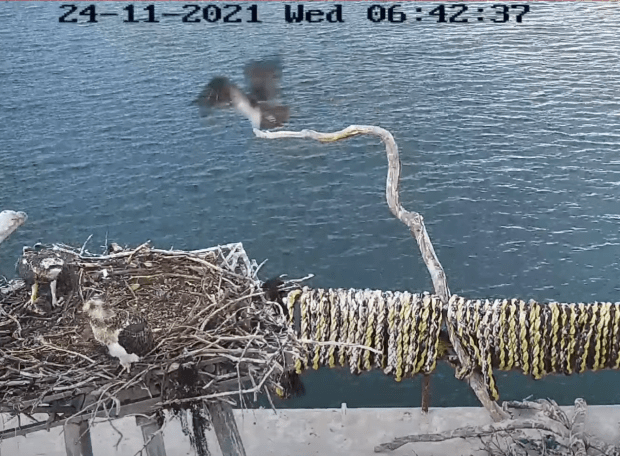
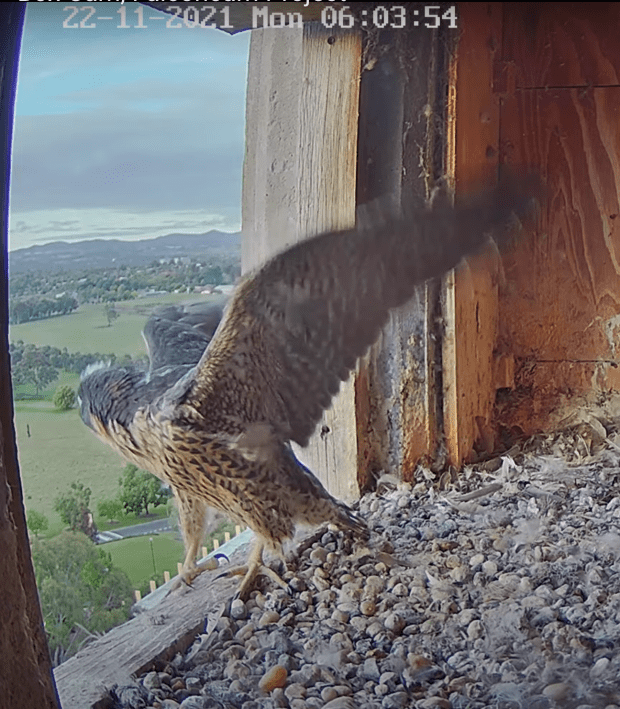
Whew! It was a terrifically busy day yesterday in Bird World and it was all good. To recap Yurruga did a beautiful fledge at 6:03:54 Monday 22 November (camera time). Bazzy officially flew a little over three hours later at 09:25:45. If that was not enough, Cornell’s Red Tail Hawk couple, Big Red and Arthur, were spotted on a branch together at BeeBee Lake. It was all together amazing. Bazza did cause a search party to go out but, in the end, he returned safely to the nest at 10:24:48. Ervie had left quite a large piece of fish and Bazza was very happy to finish it off.

Cilla Kinross posted this news about Yurruga.

Dr Kinross also posted this video of the event.

Everyone has been concerned about Diamond and her eggs. It seemed the closer Yurruga came to fledging, the more broodier Diamond became. We know that one egg was unviable. There is indication that the other egg had a chick that tried to break out of the shell but was just not strong enough as evidenced by the egg-tooth make a hole in the shell and seeing the beak.

Diamond used up a lot of her good health making those three eggs. She would have depleted her calcium and lost about 20-30% of her weight. Now that Yurruga has fledged it is time for Diamond to get herself back into tip top form.

Around 11:47, Dr Kinross removed the two eggs from the scrape box. She is going to check to see if the National Museum would like them for their collection. Diamond was not happy hearing voices inside the tower.

It seemed each time Cilla tried to get one of the eggs, Diamond would come calling loudly. Cilla tried to shooo her away. In the end both eggs were retrieved. Diamond returned to her scrape now devoid of eggs and began ‘scraping’ the area.

It is difficult not to feel sorry for Diamond. Her chick has fledged and she is still feeling the urge to mother.

Even Xavier has returned today to the scrape box to look for the eggs.

It is very sad trying to understand what Xavier and Diamond are feeling. I am busy reading Jane Goodall and Marc Bekoff’s Ten Truths and Bekoff’s The Emotional Lives of Animals. Can the actions of Diamond and Xavier be anything but a sense of confusion – where did the eggs go, they were here? and sadness. They were ‘potential chicks’.

Decades ago there was a guinea hen that arrived at the little acreage in Southern Manitoba. Having not see her in the attic of the barn for some time she was found incubating at least two dozen eggs. She had made a nest cup in the grass. There was no mate; the eggs were infertile. She would have risked her health or life as she was broody. They had to be broken. This past spring we witnessed Milda, the White-tailed Eagle in Durbe County, Latvia try and incubate eggs after her mate, Ramsis, had not returned. For eight days she remained much to the detriment of her health. It is with delight that Milde is back with a new mate Mr L working on her nest.

This is the latest report on Annie and Grinnell. It is from the Instagram Feed for Cal Falcons:

Oh, I so hope that Grinnell will come to the scrape. He might not feel 100% secure in taking on the interloper. Only time will reveal what will happen with this love triangle. I am reminded when I say that of the very happy Bald Eagle Nest on the Mississippi River with Star and the two males, Valor I and II. For several years that nest has benefited from having three parents. I wonder?????

And with that thought I am off. It is a horrible grey white day on the prairies. It is -8 C.

Thank you so much for joining me. I will continue to monitor the news on both of these peregrine falcon nests. Take care everyone. Stay safe. See you soon.

Thank you to Charles Sturt University and Cilla Kinross for their streaming cam where I took my screen shots and the Instagram account for Annie and Grinnell.

A Perfect day in Bird World. 2 fledges and a discovery

What a day it has been. Yurruga fledged from the scrape box in Orange, Australia and is doing well. Will she come back to the scrape box? Maybe she will put in an appearance, maybe not.

Bazza has been down on the deck twice and has flown to the nest. I must admit I thought flying over the nest counted as flying but apparently it isn’t quite for some. So today, at 09:25:45, Bazza flew.

Ervie has been cleaning up on the fish. Falkey is looking at the fish and Bazza is over in the left hand bottom corner.

That really is a nice fish Ervie has and, unlike yesterday, he is eating first thing.

Bazza spreads his wings.

So it is an ‘official’ fledge.

There are boots on the ground and probably out in boats looking for him. He had to land somewhere!

Whew. Bazza landed back on the nest at 10:24:48. You could see the family looking and chirping. And guess what? He even got to eat a nice big piece of fish that Ervie left on the nest. Fantastic.

Even Mum and Dad are looking up.

Last but not least, Cornell Bird Lab posted an image of Big Red and Arthur taken by Boggette at BeeBee Lake. BR had not been seen since 16 October. They were together on a tree obviously fed up with the construction noise on Campus. They are alive. BR has been located. That is all that matters.

It just cannot get any better. Congratulations again to the Port Lincoln crew on a historic moment. First time all hatched and all fledged from this nest. Incredible. I am positively giddy.

Thank you for joining me. Take care. See you soon.

Thank you to the Port Lincoln Osprey Project for their streaming cam where I took my screen shots.

Yurruga Fledges

It was a beautiful flight. Xavier was outside taunting Yurruga. Diamond was at her side. Then Diamond flew. Yurruga was watching everything. She took off like a pro with perfect form. It was a beautiful Monday morning in Orange, Australia. 06:03:55.

Diamond and Yurruga are watching Xavier. That beautiful golden glow of the morning sun touches the scrape.

Diamond is off!

Yurruga joins her parents flying around the water tower. It was brilliant. No fludge for this young man or lady.

She has perfect flying form.

Yurruga leans down and out she goes. Magnificent.

This is the view of Yurruga leaping out to chase her destiny from the ledge cam. Look at Yurruga go! Beautiful and strong legs.

Fly safe, Yurruga!

Diamond returns to the scrape box ledge. Her job is mostly over.

Diamond watches from the ledge cam. Xavier and Yurruga are flying by. Xavier will teach Yurruga to fly and hunt along with team teaching with Diamond.

Congratulations to Dr Cilla Kinross, the lead researcher on the Peregrine Falcon Project, to Diamond and Xavier bravo! You did an amazing job. May Yurruga bless you with children, grandchildren, and great-grandchildren!

Thank you to Charles Sturt University and Cilla Kinross for their streaming cam where I took my screen shots.

Saturday in Bird World

Sometimes you don’t need any words to go with the images. It was 13:30 Saturday 20 November at Diamond and Xavier’s scrape box in Orange, Australia. Yurruga is 44 days old.

Some of the volunteers at the Lindsay Wildlife Hospital are on the grounds around UC-Berkeley in case there is a falcon that needs to go in care. So far nothing. Annie has been seen soaring with the intruder that injured Grinnell. Despite Grinnell returning to his and Annie’s territory there is no certainty that he will be successful in winning his mate back or keeping his territory. Will bring all news to you when I hear it.

Bazza ‘finally’ got a portion of a fish at 12:36 yesterday. Here is a parent delivering.

The boys and their wings.

You can see Bazza’s red leg band – he has the portion of fish. Good job, Bazza. Look at Dad’s nice crop. My goodness. He has delivered so many fish to this nest I wonder if he had any portions for himself. We know the answer now.

It is so funny. Falkey is mantled like he has a fish too. Ervie is full and doesn’t care. Bazza enjoyed every morsel. Now – everyone has eaten and it is only the middle of the day. Dad has brought in at least three fish in 6 hours. Gold star.

Falkey will go on to get the 17:15 delivery from Dad. Falkey is really getting good at grabbing those fish. He seems to have ditched his nickname ‘Mellow Yellow’.

At 19:13 Bazza is going to steal what is left of Falkey’s fish right from under him. Good work, Bazza. He’s catching on. That is grand.

Bless his heart, Dad brought in yet another fish at 19:50. Bazza and Ervie fought for it. Lost it and then Ervie found it. Dad is really taking care of his boys. Thanks, Dad. If you are wondering, Bazza has hovered but has not done any flying other than the day he had the fight with Ervie and landed on the deck of the boat in Dad’s area.

Other News:

For those of you wondering about the Cornell RTH camera of Big Red and Arthur, there is a power outage at the Alumni Fields that is affecting the camera.

Poole Harbour Osprey Friends will be holding a free on line talk about the importance of bird life. Here is the information:

https://www.birdsofpooleharbourbookings.co.uk/event/osprey-project-talk?fbclid=IwAR0E886G-XBU-n5Q20cVXARlKaUNeaAxSsneJslHavl1Wjuza_EkqjSY1SQ

Bruce Yolton who writes the blog Urban Hawks and takes amazing images of the raptors in New York City, has been looking at the 86th Street Peregrine Falcons. Have a look.

I have been lucky to have stayed in Southeast Asia many times. I am particularly fond of Cambodia and Laos. The rice farmers in Cambodia have started planting a new type of rice to attract the birds back to their fields. It is a good little read.

It has been a great morning. We have not seen the garden rabbit, Hedwig, for some time. We were afraid that the construction of new condos about three blocks away destroyed the rabbit burrows. Perhaps the rabbits have moved. I was delighted to see him. He must have been under the feeders eating seed for some time because I didn’t have time to get my camera before he left.

Thank you so much for joining me. Take care everyone. Enjoy your Saturday. I am going to step back and listen to Ferris Akel’s Tour until it is time to feed all the birds.

Thank you to the following for their streaming cam where I took my screen shots: the Port Lincoln Osprey and Charles Sturt University Falcon Cam and Cilla Kinross.

Friday the 19th in Bird World

It has been a bit of a day in the bird and wildlife world. Coming hot on the heels of the banning of trail hunting on Natural Resources Wales land and the National Trust properties in the UK, the State of Washington in the US has suspending bear hunting. It was well known that the adults were killed right when they came out of hibernation leaving cubs to fend for themselves, often dying. People, like you and me, called for these archaic practices to halt. The government listened. Remember that because every person can make a difference! You want hunting suspended in your state or province, phone and find out who to talk to. Write an informed letter. Demand change. Ask like-minded people to join you.

I am not going to start off with the streaming cams just yet. It was a grey damp day – with a little sunshine at times – on the Canadian prairies. The garden was full of birds, mostly sparrows and some Starlings. Mr Blue Jay came and went quickly. He does not seem to like the frozen corn cob. And, of course, there was Dyson & Company, along with Little Red.

All these years I have pondered the sheer amount of ‘bird’ seed that we go through in a week. It is true that there are normally 250-300 birds singing and eating daily but, how much can they eat? It appears that not all that new seed – seedless chipped sunflower and peanuts – is going to birds!

Dyson didn’t like the frozen corn either and didn’t bother to even take it for later. He has discovered how to vacuum out that new bird seed. I think I now know who broke my other feeder. Dyson has no shame. He lives to eat.

Dyson looks a little thinner in the image above but the one below is more of a likeness of this little one. Dyson brings us so much joy that we are thrilled he is healthy going into what might be a very bad winter.

With Dyson occupied on the sunflower/peanut feeder, it meant that Little Red could sneak on the tray feeder and eat all the cashews, fruit, Brazil nuts, and peanuts. If you are wondering, yes, the birds and animals possibly eat better than I do! Little Red is so cute.

Little Red lives in the penthouse. It is a ‘shed’ the size of a garage that is taxed like it is a new garage by our City. We haven’t had the heart to evict the little fellow even thought he fills everything up with Maple seeds and knocks everything off its hooks and generally makes a complete mess of the space.

There were a few European Starlings still in the garden. They will migrate returning next April but they are lingering just like some of the ducks and the Northern Cardinals. Who knows? Maybe they know what winter will be like better than anyone. They certainly have enjoyed eating the suet cylinder.

Others felt like Black Oil Seed today.

Isn’t she cute with her rosey legs and slightly pink tinted beak? Female house sparrows get short shift in the bird guides. It is a pity. They are quite lovely.

Last year I planted Scarlett Runner Beans and at the end of the summer the sparrows went wild shredding all of them and eating the greenery. What you are looking at below is a Flame Willow shrub. In winter the branches are red – super beautiful in a world of grey, white, and beige. There is some little vine or plant growing on that shrub. The sparrows have discovered it and they are doing the same thing – shredding and eating. Has anyone seen this behaviour?

And now back to the streaming cams for a quick update.

Port Lincoln Osprey Barge: By 09:30, three fish had been delivered to the nest. Bazza initially got the first fish when it arrived at 06:23. Ervie took it away from him. Bazza did nothing to try and get it back. Falkey got the 06:49:38 fish. The third fish arrived at 09:11:09 and Falkey got it, too. Ervie had a huge crop. He wasn’t bothered. Yesterday Cilla Kinross of the Orange Peregrine Falcons said that “Shrinking violets will not last long in the real world.” Bazza is hungry and he needs to challenge his brothers despite that he might be fearful of another incident like he had with Ervie.

Falkey has the fish. Bazza is crying to Mum and Ervie with his big crop is looking out to sea on the right. Will Mum take the fish and feed Bazza?

The White Tailed Eagle Nest in Durbe, Latvia. Milda and Mr L were at the nest working on more renovations. It was getting ready to rain and the image is a little ‘foggy’. Sorry about that. It is nice to see Milda. I hope that this will be a successful year for her after the tragedy of spring 2020.

The Minnesota DNR has turned on its Bald Eagle cam. Here is a video of that amazing couple – the sub-adult male who fathered his first chicks at the age of four last year – and the older female. This video was made on 18 November. It looks like Dad has his adult plumage this year! How wonderful. He will have turned 5.

Cornell Red Tail Hawk Cam at Ithaca. The camera has been frozen for awhile. I wrote to the Cornell Bird Lab to inform them and to also ask them if there have been any confirmed sightings of Big Red since the last one on 16 October. I will keep you informed.

Annie and Grinnell. I have not seen any updates. As well, nothing on the WBSE juvenile.

You might remember Tiny Little Bob from the Foulshaw Moss Osprey nest in Cumbria. That little one is a fine example of a third hatch so tiny everyone thought it would die and well, she became the dominant bird on the nest. Her number is Blue 463. I am watching all of the announcements for her arrival in warmer climates. Today, however, the 2016 hatch from Foulshaw Moss, male Blue V8, was spotted in Tanji Marsh in The Gambia. He was seen there in January 2021 and was in Cumbria during the summer of 2021. This is the good news you want to hear. Survival.

And on that wonderful sighting, I will close. Take care everyone. Enjoy the end of the week and the beginning of the weekend. Stay safe. Thank you so very much for joining me.

Thank you to the following for their streaming cams where I took my screen captures: Port Lincoln Osprey Project, The Latvian Fund for Nature, Charles Sturt University at Orange and Cilla Kinross, and to Lady Hawk for her video on the arrival of the two Bald Eagles to the MN DNR nest.

Yurruga

Yurruga is 43 days old.

Yurruga is a Peregrine Falcon whose parents, Xavier and Diamond, have their scrape on the water tower at Charles Sturt University in Orange, Australia. Soon this beautiful fully feathered falcon will take its first flight out to that world that it is becoming increasingly interested in.

There are, according to Helen MacDonald in her book, Falcon, “60-odd species of the falcon family Falconidae…Those species are subdivided into four groups: the largely insectivorous hobbies, the tiny, bird-killing merlins, the kestrels and…the large falcons which are divided into two groups, the peregrines and the desert falcons.” The Falco Pereginus or the peregrines are fast flying hunters in the open air whose physical traits have developed over millions of years.

In the world of falconry, the female peregrine is called a falcon while the male is called a tiercel. In French, tiercel means a third indicating that the male is roughly 1/3 the size of the female.* This is called sexual dimorphism. Many also believe that the third hatch is always a male, a tiercel.

Yurruga has incredible vision. In The Peregrine by JA Baker, he says, “The eyes of a falcon peregrine weigh approximately one ounce each; they are larger and heavier than human eyes. If our eyes were in the same proportion to our bodies as the peregrine’s are to his, a twelve stone man would have eyes three inches across weighing four pounds.” * White goes on to say that the whole retina of a hawk’s eye records objects “twice as acute as that of the human retina…with a resolution eight times as great as ours.” Helen MacDonald states that while humans have one fovea and falcons have two enabling them to have two images of the same object fused in their brain.*** Humans have three receptors – red, green, and blue but falcons have four. We have three-dimensional colour vision, falcons can see four. In other words, these magnificent slate grey birds with their streaked chests, yellow cere and legs are far superior in their vision than we could ever wish to equal.

Southern falcons, such as Yurruga, are said to have significantly larger beaks than northern birds. Historically it was believed that these evolved for killing parrots. Researchers today are not quite sure of the discrepancy in size between the two geographical locations.

Peregrines also have a tomial tooth. This is a razor sharp point shaped like a triangle on the outer edges of the upper mandible that fits into a slot in the lower mandible. They use this tooth to bite into the neck of their prey to cut the vertebrae killing the bird instantly.

Sometimes Yurruga sits on the ledge of the scrape box with her mother, Diamond, looking out on the family’s territory.

Once Yurruga fledges, her parents, Diamond and Xavier, will teach her to hunt and will supply her with prey until she makes her very first kill. Yurruga will normally leave the parent’s territory after 4-6 weeks of training.

In the image below, you can clearly see Yarruga’s tomial tooth and her large eyes. She looks so much like a falcon today as opposed to a nestling. She is a gorgeous bird. Some viewers and chatters have gotten upset when Yurruga is aggressive with either Diamond or Xavier. Cilla Kinross said, “Shrinking violets won’t last long in the real world.” So true. Sadly, the survival rate of falcons in their first year is low. We know that Yurruga’s brother, Izzi, was thriving and we hope that she will, too.

One last observation. Diamond has been broody lately. She has incubated or fiddled with the eggs on numerous occasions. This could just be hormones or the physical eggs being there triggering Diamond. But, I wonder if she understands that ‘her baby’ will only be in the scrape a little while longer and she wants to ‘mother’?

In the middle of the night, Diamond was looking at her beautiful daughter.

As winter sets in, we are all looking for some good reads. There are many field guides that feature falcons but it is difficult cuddly up with a field guide. Looking at my bookshelf, I can see any number of them. If, however, you are looking for a really good read to understand the cultural history of falcons and their mythology, I highly recommend (and have done so many times) Helen MacDonald’s Falcon. MacDonald is an excellent and knowledgable writer that easily draws you into her respect and love for these birds. If you have exhausted the guides and have all three of MacDonald’s books, then there is another one. It is a small book illustrated by Welsh artist, Jackie Morris. She is incredibly talented. It is called Queen of the Sky and tells about the rescue, rehabilitation, and release of a peregrine falcon in Wales. An enjoyable read. Morris has a great website full of her wonderful animal stories and bird images.

https://www.jackiemorris.co.uk/

Thank you so much for joining me today. Stay warm! and safe!

Thank you to Charles Sturt University Falcon Cam and Cilla Kinross for their streaming cam where I took my screen captures.

*The males are 7.62- 10 cm or 3-4 inches shorter than the females who are 43 to 50.9 cm or 17 to 20 inches long.

** 12 stone is 76.20 kg or 168 lbs

*** The fovea is the tiny pit located in the macula of the eye’s retina. It allows light to fall directly on the cones to give extremely sharp images.