It is always heart warming to find that individual effort can really move people to action to help wildlife. We have been fortunate to see this happen many times this year and it gives us hope.
Some of you might remember Carrot the Deer. Everyone knew her and then she showed up with an arrow in her head last year. The community of Kenora, Ontario were devastated. Carrot got help! Well, meet ‘Christmas with the broken leg’ – and the woman who saved Carrot goes into action and will not take ‘no’ for an answer until she gets help for another deer in Kenora, Ontario!
I wonder why Harriet is such a popular name for Bald Eagle females???? Does anyone know? News is out that the Hilton Head Bald Eagle Mum, Harriet, has a confirmed pip today. Congratulations Mitch and Harriet. That is one substantial pip.
Oh, can you tell I am really missing these Bobble heads? The Pritchett Family has confirmed that there is no pip or Harriet and M15 yet. Perhaps tomorrow – 26 December, Boxing Day!
I can’t think of a better way to end this newsletter than with this beautiful tribute to adorable Yurruga. It’s lovely. Please have a look.
Take care everyone. Thank you for joining me this evening. See you soon!
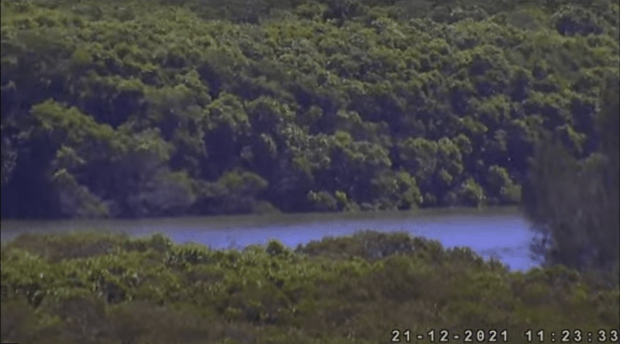
It is a gorgeous Christmas morning over Big Bear Lake in San Bernadino County, California. This is the home of Bald Eagle couple, Jackie and Shadow. What a beautiful view as the sun rises to wake up the forest and the animals that live around the lake.
A little later the camera operator gives us a treat by panning around the area where Jackie and Shadow live.
Jackie and Shadow have been delivering some nice (some large) twigs to the nest. This wonderful couple live in the hope of hatching eaglets and we send them positive energy as we hope with them.
Harriet and M15 might be wishing for a little bit of the cooler northern Californian weather in Fort Myers. The couple began ‘listening’ to their eggs last evening. It is pip watch!
About four days before hatching, the eaglets will grow their egg tooth. Imagine it as a sharp spike facing outward towards the shell on the tip of the beak. The little ones will chip away at the shell. They will take their first breath and continue picking away until they have broken through and hatched. This whole process can take up to four days.
Last year Harriet and M15, fledged E17 and E18 – the twins that won all of our hearts from their first bobblehead days, to going into care for conjunctivitis, to their return. Beautiful fledglings. Best friends.
I am so glad that Samson and Gabby did not lay their eggs at the same time as Harriet and M15. This way we will get to enjoy having two nests of bobble heads independent of one another! Last year, Gabby and Samson had one hatch, Legacy. S/he turned out to be a beautiful and formidable juvenile.
Gabby is on incubation duties.
Anna and Louis are also incubating two eggs and have a wait similar to that of Samson and Gabby. Their nest is in the Kisatchie National Forest in Louisiana. This is the couple’s second breeding attempt. Last year they fledged Kisatchie, the first eaglet hatched and fledged on this nest in central Louisiana since 2013. Wow. Cody and Steve have installed sound at the nest this year.
It was fun watching Anna and Louis last year figure out what to do as new parents. Louis is a fabulous provider. When he is not loading the nest down with fish, he is aiming to give Anna the softest Spanish Moss he can find for the egg cup! Just look at it.
Clive and Connie are incubating two eggs over at Captiva. They have had some terrible weather there lately and this image is from yesterday. The camera appears to be down this morning.
Clive is a new mate for Connie. Last year, Connie and Joe hatched two eaglets, Peace and Hope, who died on the nest from rodenticide poisoning.
One of the ospreys over wintering at Urdaibai in the Basque Country of Spain waking up to Christmas morning.
While many of the Ospreys are opting to stay on the Iberian Peninsula instead of making the long journey down to The Gambia or Senegal, there are still celebrations as the December count along the Senegal coast was 1100 birds this year. Jean-Marie Dupart did an amazing job going out and counting all of the beautiful fish eagles. Thank you!
German Osprey along the coast of Senegal.
Closer to home, Jack and Diane have been working on their nest. Some really nice strips of bark have been brought in. Last year, the pair fledged three for the first time: Sibling 1, Sibling 2, and the miracle bird who survived against all the odds and became dominant, Tiny Tot Tumbles.
Cilla Kinross is celebrating the third camera at Charles Sturt Falcon Project. There is a ledge and box camera and now one that shows the falcons flying around the outside of the water tower. Congratulations, Cilla.
Here is the link if you wish to check out the new tower cam:
Big Red and Arthur have been spotted out hunting so all is well with the Red-tail Hawks on the Cornell Campus. Hope to have images I can post for you shortly.
The countdown is on for all the hawk and osprey fans…three months til Big Red is incubating eggs and three months til the first arrivals of the Western Ospreys back in the UK. Oh, and the beautiful storks of Latvia and Estonia. May they all stay safe until then.
Wishing all of the birds who bring us such joy, extra prey items, good weather, and safe flying.
Thank you for joining me today. No matter what holiday you celebrate, I hope that you have a peaceful, joyful day, with something a little special. For those birds not with us today, we thank them for the happiness they gave to us – and as one of my readers ‘B’ so eloquently said, ‘and all they taught us.’ So true. Take care. See you soon.
Thank you to the following for their streaming cams where I took my screenshots: Friends of Big Bear, NEFlorida Eagle Cam and the AEF, SWFlorida Eagle Cam and D Pritchett Family, KNF Eagle Cam, Captiva Eagle Cam,Urdaibai Biosphere Osprey Cam, Charles Sturt University Falcon Cam and Cilla Kinross, and the Achieva Osprey Cam.
Note: Port Lincoln Osprey Cam is down or we would all get a look at those lads!
As all of you know, Daisy the Duck has occupied my mind for some 20 days now without much of a break. She has just arrived home to the nest – it is the Summer Solstice 22 December in Australia – and I am going to take some time to check in on the other nests that are normally watched.
It has been a horrible day for Gabby who is incubating two eggs on the Northeast Florida Bald Eagle nest called The Hamlet. It is just outside Jacksonville.
Bald Eagles generally have 35 days of incubation. Gabby and Samson were really wise. They did not start hard incubation until the second egg was laid meaning that the two eaglets will be born close together with no older sibling advantage. They will just bop each other taking turns! This means that the hatch date is 19 January. Mark your calendars.
For me, this is great timing. Harriet and M15s eaglets are set to hatch in 3-4 days. We won’t be watching two bobble head nests at once. Oh, those high winds are really hitting Fort Myers. You can see Harriet’s feathers blowing.
It is a beautiful day over in Decorah, Iowa with the Decorah Bald Eagles. No eggs – it is winter! But the Eagles are around. The nest is at a trout hatchery – lucky raptors. Smiling. Everyone should have a source of fish for their Ospreys and their Raptors. Takes about 350-400 a season. Not bad for giving life to these beautiful birds and their family.
The Bald Eagles in Iowa generally lay their eggs in mid-February.
The Decorah Eagles are not to be confused with the Decorah North Eagles!!!!! It is home to Mr and Mrs North.
The camera is live at Duke Farms in New Jersey. No eggs yet. In fact, it should be about a month until we see eggs on this nest. I hope this Mum has better weather this year! She was encased in ice and snow most of incubation in early 2021.
Diamond is starting the day in the scrape box at Charles Sturt University in Orange. Both her and Xavier have been examining the new gravel that Cilla Kinross provided awhile ago. They have also had bad weather with torrential rains but it looks like they will have a nice day today. Fingers crossed.
Jackie and Shadow at Big Bear Bald Eagle Nest in Big Bear, California are doing nestorations. It looks like they are going to have a white Christmas.
Last year Bonnie and Clyde, the Great Horned Owls, took over a young Bald Eagles couple’s nest on Farmer Derek’s property. They raised two owlets. The nest is currently unoccupied but one of the Bald Eagles did a fly by at 07:19 this morning. Will there be a battle over this nest?
The eagle is right at the horizon line with the blue sky. You should be able to see it.
Anna has taken over incubation duties of the two eggs on the Kisatchie National Forest Bald Eagle nest. This is her and Louis’s second breeding attempt. They fledged Kisatchie last season.
Clive is on incubation duty at the Captiva Bald Eagle nest. Another storm is really starting to churn in that area. It will effect the eagles as well as the ospreys – and, of course, it is the same storm that is hitting Harriet and M15 in Fort Myers.
It is a beautiful winter’s day – perfect for the Winter Solstice – at Glacier Gardens. I wonder what Kindness is doing? She was such a special juvie.
Alaska is a perfect place for Bald Eagles, too. When Dave Hancock put the satellite trackers on the 7 or 8 fledglings in British Columbia that survived that horrific heat wave, all of them flew north to Alaska.
Lena is waiting for Andy to bring her some fish at the Captiva Osprey Nest. This couple was really hit hard – along with Connie and Clive at the Captiva Bald Eagle nest – from the storms the other day. It is good to see that all had no problems. There is another storm brewing today.
Ervie got the morning fish and Bazza is not happy. Apparently, Ervie woke up in the middle of the night and kicked Bazza off the nest. I can understand why he is grumpy.
Ervie is doing a great mantling job. Third hatch turned out to be the ‘King Pin’. Wonder if Bazza remembers how he tried to treat Ervie? Do raptors have a memory like elephants?
Daisy is fine. Wishing for a quiet day for her.
This is a wee bit of a catch up with some of our other favourite nests. Cal Falcons raised $3500 through the sale of t-shirts to support Lindsay Wildlife for treating Grinnell. That is fantastic! There is no news of who Annie will pair with for the 2022 breeding season. Watching birds is all about patience. Sometimes I don’t have any!!!!!!
Thank you so much for stopping in to check on the nests. The birds will weather the current storms in Florida. They are used to them but, still, we worry. Wishing all of you a very happy Winter solstice. Take care. See you soon!
Thank you to the following for their streaming cams where I took my screen shots: NEFlorida Bald Eagle and the AEF, SWFlorida and the Pritchett Family, Captiva Osprey, Captiva Bald Eagle, KNF Bald Eagles, Glacier Gardens, Charles Sturt University Falcon Cam and Cilla Kinross, Farmer Derek, Friends of Big Bear Eagles, Duke Farms, the Raptor Research Project at Explore.org, and the Port Lincoln Ospreys.
Daisy flew off the nest at 05:07:04. Then the camera went offline. Thankfully Dasha moved the Twitch streaming cam so that we could see Daisy instead of a wide view of the nest tree. It is unclear when Daisy returned precisely but she was on the nest and dry at 07:29.
The cam operator (I think it was Dasha – thank you) gave us some beautiful close ups of our favourite duck. Daisy is just so beautiful.
This first image with the wee bit of sunlight falling really shows off Daisy’s plumage and that amazing down.
That blue bill really differentiates the Pacific Black Ducks from the ones in North America.
There is that beautiful distinctive creamy tan line from the bill above the eye and then the wider one below.
Oh those bits look like twinkle stars. I never knew Duck down was so beautiful — just warm!
Sometimes you can hardly see Daisy on the nest.
It has been a very quiet morning for Daisy as it nears noon. I can hear the Noisy Miners in the forest but, there appear to be no Sea Eagles over on the River Roost.
What a blessing! I do not believe the Sea Eagles will harm Daisy and I don’t even think that they will mess with the down because Lady doesn’t like it. But Daisy would leave quickly and she would not be able to cover her eggs leaving them in view of predators.
Of course, Daisy being a very intelligent duck would wait in a nearby tree for the WBSE to leave and then she would fly over quickly, right?
Daisy doesn’t often stay in the same position for a long time. She is twisting and moving about, turning the eggs, tucking in down.
You can see the shadows moving over the nest at noon. It will be a hot day for our girl and those eggs. Hopefully she will not leave the nest too early this evening.
Daisy has moved a little. It is noon and all is well.
It is a little after noon. Daisy is rolling eggs and reaching out to find leaves underneath the branches and twigs. I really hope she is not thinking of a break. Oh, please, Daisy. Just stay put for six and a half more hours, please.
I will continue to monitor Daisy til she leaves for her evening foraging and then will check on her periodically. I am hopeful that nothing untoward will happen. Fingers crossed.
In other nest news, OGK has flown in and replaced YRK on the Royal Albatross Cam in New Zealand. Also a 2017 hatch, Royal cam chick, Tumanko, landed on Taiaroa Head. This is amazing. He is four years old and has survived. As a chick he was not always well so this gives us all hope for all the birds. Over at the Port Lincoln Osprey Nest, Falky has been trying his hand at fishing. He made two dives off the barge this morning. The first was at 07:04:41 and the second at 07:20:07. In the image below, you can see the nice form Falky has. It will not be long until he catches his own fish. Mum looks on proudly while Bazza is on the nest waiting for his fish. Is it really Bazza Baby??? Ervie is off flying!
Here are a couple of lovely morning views of Diamond, the Peregrine Falcon female at Orange. She is adorable.
It has been a good day in Bird World. M15’s injury from the GHOW is improving and we wait for Gabby’s second egg — oh, and it is getting close to hatch watch at SWFlorida with M15 and Harriet. Oh, I am in dire need of some bobble head action! And if you are missing the Ospreys, her is a great image of Aran, the male at the Glaslyn Nest who was injured during the storm that hit Wales at the end of May. The community was so generous. They brought out a fish table for him and Mrs G – allowing them to grieve the loss of their three osplets and heal. Oh, Aran is a handsome one – and he is also a good fisher. Three and a half more months – Osprey action in the UK!
Take care everyone. Thank you so much for joining me. See you soon.
Thank you to the following for their streaming cams where I took my screencaptures: Port Lincoln Osprey Project, Sea Eagles @ Birdlife Australia Discovery Centre Sydney Olympic Park, and Charles Sturt Falcon Cam and Cilla Kinross.
Despite the presence of the Sea Eagles, Lady and Dad, at the River Roost on the Parramatta River, Daisy has been blissful since she returned from her morning foraging trip at 07:11:00
The Sea Eagles have not come to the nest. The wind is beginning to really pick up. I have not seen any predators on the nest. That said, the sound is off on the main camera and the Ravens could have been in the branches above like they have been lately or simply flying by. The strong winds might keep them at home!
It is currently 30 degrees in the forest and the winds are blowing at 19 km/h with gusts up to 39 km/h. It is hot and humid for Daisy with the confirmation of thunderstorms (90% chance) from 15:00-18:00. Hopefully Daisy will wait til the rain and winds have calmed before going out for her evening foraging. I am not concerned about her. She has been through many storms but, rather, for the priceless down covering those eggs.
It is nearing 11:30 on the old Ironbark Nest. The wind is rocking the tree but Daisy does not seem bothered. I have no noted any predators around and it is unclear if the Sea Eagles are still at the River Roost. The sound is still off line.
Other Nest News. A video has been posted of the thunderstorm that hit Orange last evening. Lightning, hail, thunder, and high winds. Diamond is in the scrape. You can see she is frightened. This morning Xavier arrived on the ledge of the scrape box and there was much relief he was alright. You can imagine that was this type of storm that also hit Daisy in Sydney.
Need an Osprey fix? Lena can see Andy in the distance and she is fish crying. Here is that video:
Samson is so happy that him and Gabby have their first egg as of yesterday. Just look at those two!
Over at the Port Lincoln Osprey Barge, Ervie picked up the first delivery of the morning -despite the choppy water and winds – from dad at 06:30:41.
Falky got the 07:39:44 fish.
Last time I checked Bazza was alone on the nest wishing for a fish.
Thank you so much for joining me. There is not much to report about Daisy which is, after all, a good thing. Hopefully the weather will not be as bad for her as it was for the Peregrine falcons, Xavier and Diamond, at Orange. I will monitor her throughout the rest of the day. Take care everyone. Stay safe! Look to the birds for joy!
Thank you to the following for their streaming cams where I took my screen shots: the Port Lincoln Osprey, the NEFlorida Bald Eagle Cam and the AEF, and the Sea Eagles@Birdlife Australia Discovery Centre Sydney Olympic Park.
Since the Melbourne Peregrine Falcons fledged along with dear little Yurruga a week later, many of us have been really wanting to see some more falcons. What is so wonderful about falcons? is it the cute antics of the little dads? the gentle but stern look but deep affection by the Mums? is it that there is no sibling rivalry? or is it everything rolled up into a cute fuzzy white ball with a pink beak and legs that turns into the fastest bird in the world in 37 days?
I have been upset about the behaviour of the Ravens on Daisy’s nest today. They returned for a third time at the eggs. The pair of them began rattling and pecking at sticks on the nest. It was a very threatening performance. So, I needed something to divert my attention for awhile. As it happened, the streaming cam went off line and has been off line for more than 7 hours now. Like magic, however, a video that I had bookmarked on 29 November popped open.
Daisy right before the camera went off line on 10 November around 11:49.
On 29 November I wrote a blog about these little falcons. I have included some information for you in case you missed that one but I have added a number of videos for those that did read about New Zealand’s smallest raptor. With winter here it was even nice just to see some green plants!!!!!!
Here is the link to the streaming cam:
The Karearea is the smallest falcon found in New Zealand. Its other names include Bush Hawk, Sparrow Hawk, Bush Falcon, Southern Falcon, Western Falcon, or Quail Hawk. It is also called the New Zealand falcon. It measures 40-50 cm in length. Males weight 205-340 grams (a half to 3/4 of a pound) while the females exhibit reverse sex dimorphism and weight 420 to 720 grams (or nearly a pound to 1.7 of a pound).
At first glance, the Karearea might look like a Peregrine Falcon.
They have “broad wings, long tail, long yellow legs and toes, yellow eye-ring and cere, dark eyes, and a distinct moustache stripe from the base of the strongly hooked bill down the face. Adults are brown-backed with a streaked cream breast and a rufous under tail and thighs; fledglings and juveniles are dark brown, lack cream streaking, with blue-grey legs, eye-ring and cere.” (https://nzbirdsonline.org.nz/species/new-zealand-falcon) I will also add they have a tomial tooth.
The falcons are listed as being ‘rare’. The most common threats include habitat destruction, degradation, or modification, cats, other animals including pigs and possums that take their eggs and chicks as well as hedgehogs. Electrocution due to uninsulated power lines as well as shooting by humans are common. We had hedgehogs in our garden when we lived in England. They ate the fruit that fell from the apple and plum trees in our garden and had lots of fleas but I have never thought about them as predators. Have a look:
The chicks have begun taking short flights so the camera operators have some trouble finding them. Soon they will be gone but for now, we can enjoy them a bit. Be patient. Here are some video clips of earlier feedings, etc. Enjoy!
These very small falcons are adorable. I hope you enjoy spending some time with them.
Sometimes it seems that everything is going ‘wrong’. That nothing positive is happening. Everyone reading my blog loves birds – birds of all species. And we are all aware of some of the human created ‘things’ (for a better word) that cause great harm. These include longline fishing, rodenticide, monofilament fishing line, and lead in hunting and fishing equipment. There is some great news coming out of Hawaii, SW Florida, and Massachusetts that is positive. First to those beautiful islands in the Pacific who voted to save the sea birds like the Albatross from longline fishing boats by using torii lines.* Have a read. This is just wonderful news because it might influence everyone else to join in.
Because of the large number of sea birds including the American Pelican, the Conservancy of Southwest Florida is moving on several interventions to stop the birds from getting tangled in monofilament line from fishing. These include patrols, cutting down on the places and times and dates that people can fish, etc.
In Massachusetts, State Representative Jim Hawkins is introducing a bill to ban rodenticide use in the state. Fingers crossed after hearings, it will pass. It is a beginning for a huge problem. The raptors taken into care that are poisoned will definitely consume more rats and mice than the poison kills.
These are just incredibly positive steps that can give each of us hope that we can make the world a safer place for our feathered friends.
I will be sending a report on Daisy some time tomorrow but it will probably be 18:00 CDT – very late for me. The streaming cam remains offline. There is very little that we know: it is currently raining, Daisy is unable to cover the eggs properly so they will get wet which could damage the pores, the Ravens know there are eggs, and Daisy has to eat. It is not clear if Daisy is finished laying eggs or if there will be another in the morning. I know that each of us wants Daisy’s little ducklings to jump off and everything to be right with the world but I fear that will not happen. My hope is that Daisy is not harmed in the process of her trying to protect her eggs. And on that note, I will say goodnight. It has been a worrisome day.
Thank you so much for joining me. Take care everyone. Stay safe!
Thank you to the following for their streaming cams where I took my screen shots: Falcon Cam NZ and Sea Eagles@Birdlife Australia Discovery Centre.
Our beautiful little Pacific Black Duck, Daisy, laid her 4th egg in the old Ironbark Tree in Sydney’s Olympic Forest at 06:19:36. She was more nervous today than usual. Something had caused her to be overly cautious today. Still, the little duck worked with as many leaves as she could find to cover her eggs and stayed for almost the entire 2 hours that she has done on previous days. She flew off at 08:15:17.
Daisy covered the nest really well— as best she could bringing in leaves from behind her this morning. There is no indication that she has used any of her down and that is a good thing. The predators would smell it and find the eggs!
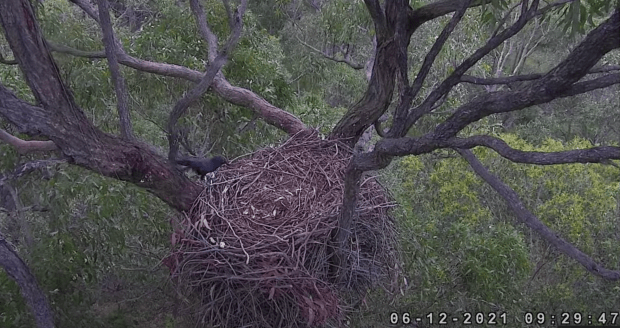
Did the Raven see Daisy on the nest? or did he just happen by and was curious?
The Raven lands on the nest at 09:29:30. He actually looks like one of the Crows we have that come to our garden as opposed to a Raven in North America. I know that it is difficult to identify between the Australian Raven and Crow. It is not a Pied Currawong – there is no white.
Whatever – a very dangerous bird has landed on Daisy’s nest of the variety that consumed her eggs last year.
The Raven looks right at the nest cup but cannot see anything. Daisy did do a good job covering those four eggs.
The Raven almost steps on the nest cup! But he doesn’t, thankfully.
He jumps over to the rim of the old Sea Eagle nest.
All the while the Raven is on the nest it is making very strange calls.
I wonder if it was calling the other members of its family. Last year several arrived but not today.
He stares but obviously cannot smell those eggs and he certainly cannot see them. Oh, Daisy, you little Duck. You did do a great job covering them.
It simply felt like he was going to tear that nest up but he moves over to the parent branch of the tree where the juvenile sea eagles often branch.
And then he is gone. I think my heart sunk to my toes. It is too early for the predators to be sniffing around Daisy’s nest. —— Any day is too early until the ducklings hatch and jump!
At 09:31 ‘something’ chased ‘something’ out of the forest from the top centre to the lower left side. It happened very fast and I could not decipher what it was. I wonder if our little Duck chased that Raven? Has Daisy been watching?
I hope that Daisy only lays one more egg. If there are fewer she will be able to cover them adequately or maybe a big wind would come and rain down leaves on that nest. Wouldn’t that be wonderful?
Everyone send all your good wishes to our little Pacific Black Duck, Daisy. She needs all the positive energy she can get as she continues to try and keep her eggs safe.
Other Bird World News: There is no further news on Yurruga. Ervie picked off the first fish of the day at 06:33. If you watch Jackie and Shadow, the Bald Eagles at Big Bend, they have been working on the nest. Yesterday Connie at Captiva laid her first egg at 05:55:37.
There have been two welcome visitors to our garden. Hedwig, the short tailed Cottontail Rabbit, has been photographed.
Shortly after lunch, Sharpie, the Sharp-shinned Hawk dropped by.
The European Starlings, the Black capped Chickadee, and numerous varieties of Sparrows, mostly House Sparrows, filled up the feeders. I think that each of them knew that there was a weather advisory out and that they would be hunkered down by snow and blowing snow with little visibility in the late afternoon.
Oh, I hope that Raven forgets about Daisy and her eggs!
Take care everyone. Thank you for stopping by to check on the birds. It is nice having you with us.
Thank you to the Sea Eagles @ BirdLife Australia Discover Centre for their streaming cam where I took my screen shots.
We are going to start off with a check on what is happening in San Francisco – before moving on to Daisy.
An absolutely adorable 4 min 16 sec radio discussion on The Love Story in the Sky at The Campanile.
Did you know that Peregrine Falcons were virtually wiped out in California? In the late 1970 there were only two nesting pairs? This was the result of DDT. There is lots of literature but reading Rachel Carsons, Silent Spring, is a very good start.
DDT might have been banned after the revelations of Rachel Carson and others but it remains in the soil in various places. One of those is Big Bear California where DDT was sprayed on Big Bear Lake to kill the mosquitoes. It is still a contributing factor in thin egg shells which may be part of the problem with Jackie and Shadow, the Bald Eagles that have their nest at Big Bear.
Daisy the Duck did not spend the night on the White-Bellied Sea Eagle nest.
She arrived before sunrise to check on the nest. No one else was there. Daisy will be very cautious. She does not want to draw attention to the egg cup where her first egg was laid.
She goes over to where her egg is and checks. It is still there. Safe.
We can see where Daisy’s egg is because we know it is there but it is nicely covered with leaves and nest material so the predators cannot find it.
Daisy leaves right as the sun is rising and the forest is waking up.
Daisy carefully waits on a branch when she returns an hour and a half later. Can you see her?
She is checking and rolling her egg.
Daisy is very still. When she is in labour, her tail will move up and down.
There are now two eggs! Look you can see them both. Daisy is holding herself up so as not to break the second egg. When the eggs are laid they are soft. The air will dry off the surface and make them hard.
Daisy has settled on the eggs nicely. She is having a rest. Daisy will not do hard incubation until all of the eggs are laid. That is so they will hatch at the same time.
This last image of Daisy was taken a few minutes ago. It is nearly 08:30 in Sydney, Australia.
So far Daisy has been lucky. Lady and Dad did visit the nest tree a week ago and then on the day that WBSE 27 was released from care, they were not at the River Roost. They will often go to Goat Island if there are no eaglets to look after. Still, we know that they do come to check the nest.
Someone asked me why Daisy does not stay on the eggs now all the time. If she did they would not all hatch on the same day. Secondly, she is a very smart little duck. Her presence on the nest makes all of the other forest animals and birds curious. Last January they had never seen a duck on the big sea eagle nest — and neither had anyone else! I think Daisy will try and protect her eggs really well this year from the Ravens. She is almost a year older and she is ‘wiser’ now. Her breeding and the laying of eggs normally coincides with plenty of food and water. Her mate, who came to inspect the nest last year, only takes part in the mating ritual. The rest is up to Daisy. That is why she is so vulnerable. Only 20% of Pacific Black Ducks live to be 2 years old. Indeed, the average life span is only about two years. Oh, I so hope that she is successful this year! There are so many people hoping for Daisy!
You can join in and become a real Daisy fan. She needs all the love and positive energy we can all send her. Soon the name of the streaming cam will be changed from Sea-Eagle to Duck Cam! Here is the link to the streaming cam. Daisy arrives about 13:15 CDT or around 05:15 Australian Time. I am not expecting her to stay all day but she might surprise me.
Once Daisy lays all of her eggs (there could be 11), she will begin her hard incubation. Incubation will last for 29 days after the laying of the last egg. This is the difficult time. Daisy still has to eat and have some relaxing time. Last year she even went out during the night. It is then that the eggs are vulnerable. As long as she is incubating them, the Ravens seem not to bother. Our fears of the sea eagles proved to be nothing. They could behave differently this year but they were not a threat last save for the fact that scattering the down nesting material allowed the eggs to be seen. Fingers crossed.
Thanks for joining me. Take care everyone. See you soon!
Thank you to the Sydney Sea Eagle @ Birdlife Australia Discovery Centre for their streaming cam where I took my screen captures.
Holly Parsons, the administrator for the Orange Peregrine Falcon FB group, has posted the following from Cilla Kinross regarding Yurruga:
I took some images of beautiful Diamond throughout the day.
We would expect the parents to visibly be supplying prey to Yurruga. Many of you will have seen the adults at 367 Collins Street bringing in prey. You might recall how the Dad tried so hard to feed the little male when he was too sick and could not eat or swallow anything. Just pause and remember the healthy chicks at that nest and the noise they made even prior to fledging when food was around. Then remember Yurruga and how he behaved when prey came to the scrape. The falcons are loud in their food begging just like the four lads at Port Lincoln. The little ones simply cannot go without eating and while they are learning to fly they are also being taught how to hunt. It is unclear how instinctive hunting is. For example, the adult Ospreys do not teach their fledglings how to fish. They simply are hardwired to do it. Peregrine Falcon parents spend much time passing prey around, dropping it for the wee one to catch, etc. Certainly Yurruga had at least a days training because he was seen flying around with the parents prior to the big storm. There would be several prey drops during a day. No one has anything confirmed after last Thursday in Australia, 9 days ago now. I know that each of us wants this outcome to be different and I would like nothing better than for someone a mile away to phone Cilla and tell her that Yurruga is on their roof or in their garden. The long sessions in the scrape together may be Xavier and Diamond bonding in grief. There is also the additional issue of the absence of the eggs. Diamond has spent an inordinate amount of time scraping where the eggs were. My heart really goes out to her.
Sad news is also coming out of California. The California Condor chick #1075 died at the Los Angeles Zoo on 12 November. He had sustained injuries from adult male condor #247 during a territorial dispute. I know that many of you watched that streaming cam. Their lives are so very very fragile and to have a death of a promising chick due to fights is extremely difficult to process. There seems to be a lot of territorial disputes. You might remember that California Condor #1031 Iniko who survived the Dolan Fire was actually injured when an adult male came to the nest tree. —— Which reminds me! Iniko will be released back into the community of condors where he hatched on Saturday along with two others. This is great news coming on the heels of grief.
We really need some good news in Bird World. Iniko’s release is, of course, one of those. I really hope it is OK to cut and paste this amazing story from that Valerie Webber posted on the Loch Garten and Other Ospreys FB page. It is a marvellous tale of German Osprey Black 1FO seen in Portugal in Dec 2005/Jan 2006 and again in September 2021. So the question that is being asked is where has this bird been? It is more than 16 years old and this is truly remarkable – 3 sightings only in all those years. He really is a very handsome bird.
More good news come in the form of a Pacific Black Duck named Daisy who has now laid her first egg in the Sydney White-bellied Sea Eagle nest. An earlier blog today gave more images and some details. So nice to have her back! I am so excited about Daisy’s return that I can’t sleep! You can catch her on the Sydney Sea Eagle Cam. She laid her first egg today. She must have rushed to get to the nest OR she had made a nest elsewhere and predators came. We might not know. She will begin lining the nest with the down from her breast. That down will not only make it soft for her and the eggs but also will help cover the eggs when she has to go forage. She will also mix the down with leaves on the nest and cover the nest with those leaves. I hope there are lots of them!
Every one of the lads on the Port Lincoln Osprey Nest has had a fish today. Port Lincoln also says that the three have been seen at the shore going for a bit of a swim or a bath. Fantastic.
The three are over on the perches and ropes near Mum. What a beautiful image. I wish that Dad was there, too. The fledglings are gradually spending more time on the perches and ropes and flying around. They are growing up and shortly might be off on their own. I need to check and find out when Solly permanently left the barge. That might give us some clue.
I know that many of you are familiar with the Welsh Ospreys, Aran and Mrs G at the Glaslyn Nest. You might also know that one of Monty and Glesni’s sons, Aeron Z2, and his mate Blue 14 have their nest close by at Pont Croesor. Glaslyn has announced that the new hide is finished and visitors will be able to observe the nest of Z2 and Blue 14. That is great news.
That is it for me. I am sufficiently exhausted from the excitement of Daisy that I might be able to sleep. This is my Friday newsletter. I will bring updates later tomorrow (Friday the 3rd) evening.
Take care everyone. Thanks for joining me.
Thank you to the following for their streaming cams or FB pages where I took my screen captures: Loch Garten and Other Ospreys FB, Orange Peregrine Falcon FB, Port Lincoln Osprey Project, Sydney Sea Eagles @Birdlife Australia Discovery Centre, and Charles Sturt University and Cilla Kinross.
I had a lovely note form ‘M’ asking about other peregrine falcon cams. Thank you for your letter, ‘M’.
Each one of us feels a little ’empty’ when the eyases fledge. Without trackers, we have no idea what happens to them. We just wish them well and I know that everyone is working hard to make their environment better. The only birds on the nest who have fledged and not left permanently are the PLO Lads – Ervie, Bazza, and Falky. It is winter in the Northern Hemisphere and the birds have migrated to warmer climates. I will, however, be checking on nests in Asia to see if there are any for you to watch.
This is not an exhaustive listing but it is a beginning and I will be adding to it for all of you as the camera streams return. We have streaming cams on the falcons in Winnipeg as part of the Manitoba Peregrine Falcon Recovery. I will post those at the beginning of the summer. Most of our birds are in southern Texas or Mexico right now.
So here goes – and if you have a favourite falcon or hawk cam, let me know!
One of my favourites are the Peregrine Falcons in Melbourne. They are known as the CBD or 367 Collins Street Falcons. The cam is currently not live. Will come back on line September 2022
Cornell Red-tail Hawks (Big Red and Arthur), Ithaca, New York. The construction work at Bradfield has caused a power outage on the Athletic Fields. Those building works are winding down and this camera should be live shortly. Big Red and Arthur will be very busy once late February and March roll around. There are only two Red-tail hawk streaming cams in the world and this is the best. Big Red is 19 this year. Arthur is 5 or 6 years old. They are a fantastic couple that normally fledge three eyases a year. There are birders on the ground that keep track of the fledglings so you get to see the parents do team training in hunting, etc. Highly Recommended.
Charles Sturt University Falcon Cam in Orange, Australia. Yurruga has fledged. Look for egg laying in the fall of 2022. This is the scrape box of Diamond and Xavier. They are a well established couple. For the past two years three eggs laid but only one fledgling each year which is fine. It is a nice comparison with the Melbourne falcons who fledge 3 consistently. Orange is more rural and, of course, Melbourne is urban. The camera is left on and the falcons come and go regularly.
The Campanile Falcons on UC-Berkeley. This is the scrape box and cams for the Peregrine Falcon Couple, Annie and Grinnell. Grinnell was injured by a male interloper on 29 October. He was in care, as a result, and has been returned to his territory. The male interloper is still at The Campanile. It is unclear which of the males Annie will choose. Nesting activity late March, 2022. Annie and Grinnell are incredible parents who traditionally fledge three adorable babies.
The following are falcon cams that I have watched ‘on and off’ and that have come highly recommended to me from viewers:
Illkirch, France:
Great Spirit Bluff, Minnesota
Anacapa Island, California. There are current a large number of Pelicans to watch.
I will definitely be posting more including a couple of streaming cams from the UK. All of that action will begin when spring arrives. I also want to post some sites in Asia which I will do over the weekend. There will also be the Northern Hemisphere Ospreys, White-tailed Eagles, Golden Eagles, as well as the returning storks to Latvia and Estonia.
For now, things are really pretty quiet except for the Port Lincoln Ospreys, Diamond and Xavier coming in and out of the scrape box in Orange, and the Bald Eagles laying eggs in the US. There are two nests that you might wish to consider and if you have never watched a Royal Albatross nest then you definitely need to check out the Royal Cam Family in New Zealand who are incubating an egg laid on 9 November. They are very experienced and adorable parents, OGK (Orange Green Black) and YRK (Yellow Red Black). They are already grandparents. I often suggest this site to individuals who have a difficult time watching any nest if there is sibling rivalry. The Albatross lay one egg every two years. Parents rotate all of the duties. Last year the Royal Cam chick, Tiaki, had a sat-pak attached to her. We are currently watching her fish off the coast of Chile.
It is a bit wet in NZ this morning. This is YRK’s 6th day on the nest. OGK will be flying in soon and they will switch. Should something happen, the NZ DOC rangers are there to step in and intervene. No one goes hungry, injuries are taken care of, etc. It is a great site and in the process you will bear witness to a country that really protects its wildlife!
There are way too many Bald Eagle streaming cams to list them all. For now, I am only going to recommend one. These are experienced parents Harriet and M15 at the SWFlorida Bald Eagle nest on the property of the Pritchett Family. Their eggs are due to hatch soon – December 25-28. Once Gabby lays her egg in NE Florida I will post that information. For now, you can have fun watching Harriet and M15 change places. The only un-fun thing is the GHOW that attacks the eagles regularly.
There is no word on Yurruga. Cilla says she will look for a few more days. Just so you know the building that Yurruga was last seen on is a gabled (triangle) pointed roof, a bit steep. It is a single story building with clay tiles. Yurruga is not there – not alive, not dead. He was there on Thursday – seen twice during a big storm. I would expect to hear this fledgling screaming for food. Falcons are loud! Is it at a distance from the tower? is Yurruga injured? is Yurruga somewhere else? There are no answers I am afraid. If I hear anything you will be the first to know. Now, it is time for me to go and take care of all my feeders. The gang will be here soon!
Thank you so much for joining me. Take care everyone. See you soon.