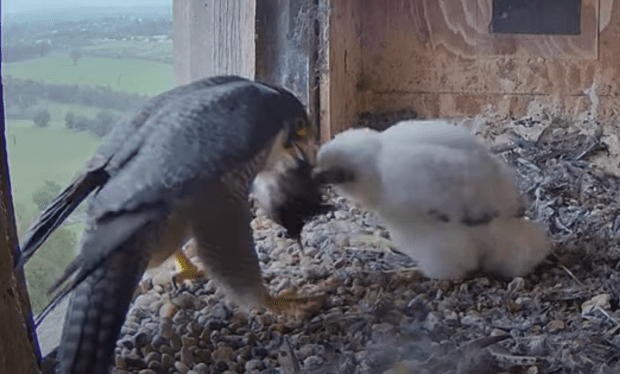
Lindsay Wildlife Clinic in Walnut Creek, California just posted an update on Grinnell. Grinnell is one of the UC Berkeley Peregrine Falcons. His mate is Annie and their natal nest is on top of the Campanile. Grinnell was involved in an altercation, protecting his territory, with an intruder male. He was found on the 29th sitting on a trash can unable to fly with multiple injuries. He was taken to the Lindsay Wildlife Clinic where he underwent surgery.
This is their update today:
GRINNELL UPDATE, AND THANK YOU: Grinnell the Peregrine Falcon continues recovering from his injuries in our wildlife hospital. The surgical site on his wing is healing and he underwent additional radiographs on Nov. 2 to check the bruising on his right leg. He is eating well (he’s pictured here with a full crop after dining on a quail) and our veterinary team expects it will take 10-14 days to heal from his injuries. On Grinnell’s behalf, we would like to thank everyone for their well wishes and for their donations and support as we work to return him to the wild, where he belongs. Photos by Dr. Krystal Woo, Lead Wildlife Veterinarian.
So glad he is doing well. Hang in there, Annie. Grinnell will be home shortly. If you wish to make a donation, go to the Lindsay Wildlife Clinic FB Page. There is a donate button.
Thank you to the Lindsay Wildlife Clinic FB Page where I took this screen capture.
I know that some of you have watched birds fall out of nests including Silo Chick at Patuxent River Park last summer. Remember that feeling when you saw that little osplet fall into the water, heard the splash, and saw the others looking down? Felt helpless? Of course. Thankfully that story ended well. I have no idea how many called but the osprey was located and literally tossed back into the nest. It was an enormous relief. Others are not so lucky.
I posted a new owl box streaming cam in Joburg, South Africa just the other day. An orphaned Spotted Eagle owl was put in the box with two other owlets. The mother accepted it! Fantastic. The adopted owl is 5 days older than the other two and it got curious about the outside world today and fell out of the nest box!
What no one knew, at the time, was that the owl landed on a huge platform under the box. If it doesn’t get back into the box on its own, it will be placed back inside the box. Relief.
Yarruga was starving this morning. There were two prey deliveries at the scrape box and there was not a scrap left of either meal.
Yarruga was so excited when the second meal appeared that she could not stand still to eat. She literally ran around the scrape box as in the images below.
Xavier was certainly glad when that feeding was over! There is not a drop left for either of the adults. Yarruga was soooooo hungry after having only 2 feedings yesterday. She does love her food! And she is certainly growing. Look how big she is next to Xavier!
In fact, Yarruga should have had a nice tasty little duckling yesterday but Diamond saw it and quickly took it from Zavier and flew out of the scrape! One has to imagine that this is quite the delicacy (as opposed to the dreaded Starling!). After her injury, I am actually glad that she got it.
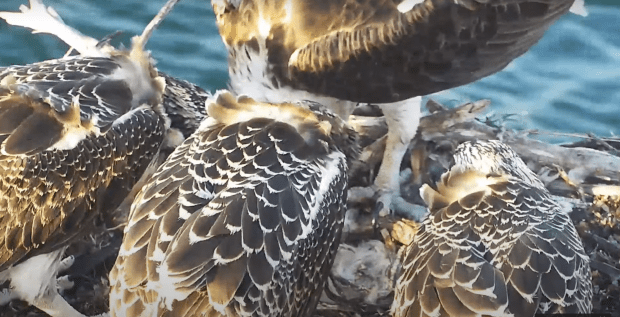
Port Lincoln did a nice close up of the juvenile feathering of the three osplets this morning. Just look at the variations in the depth of the white juvenile feather banding. Little bob is in the middle.
As the dominant bird, Little Bob often gets the first bite. She is full and letting the other two have their turns as she looks out to the water in the image below. Of course, I am saying ‘she’ because of her thick legs. Wait til Monday when the banders declare she is a he. How funny! Whatever gender, that bird is gorgeous and I will continue to celebrate the times that she put Big Bob in his place.
There she is below.
Victor Hurley, the main researcher for the Peregrine Falcons in Victoria has been posting information on the 367 Collins Street FB Page. The last posting was on ‘Dispersal’ because, as we know, the falcons will be fledging shortly. I imagine that there are many things in this column that would be of interest to many of you. This is what he wrote:
First Flight Normally, this is not such a serious undertaking as that from an inner city high rise ledge. Normally pre-fledgling Peregrine Falcons will scramble around across their natal cliff for quite some time before taking their first flight. Mostly this is successful and they land high on another ledge or small perch. In a city location they will land on the roof top of another building nearby. If the winds are tricky then things can go south pretty quickly. Once they have mastered their first flight then they will spend increasing time “on the wing” and following and learning from the parents how to hunt. As soon as each youngster achieves their first kill the adults (parents) will stop providing any more food and that youngster is on their own to find food. Once all young are successfully hunting then depending upon the experience and ruthlessness of the adults they will all be chased with serious determination out of the territory altogether. In some cases this may occur in December or even early the nest year. Either way the young tend not to return again to the nest ledge that we have been observing. Maybe occasionally, but then only briefly.
Plumage differencesLeading up to this first flight the adults restrict the level of food resources they bring to the nest. This explains the weight loss of the nestlings. The wings of the nestlings are still growing but they are also losing weight. This makes them lighter with larger wings which provides for a “lower wing loading” which makes their first flight easier. Neat, huh! The other point I thought I would raise here is that of the plumage differences. Peregrine Falcons as with most raptors and many other bird species have a juvenile plumage phase and an adult plumage phase. The juveniles are in essence a brownish colour with vertical splotchy stripes over a “dark milk tea” fawn base colour on the front and dark brown wing, back and head. Whereas the adults have a near black hood for the head, slatey grey wings and back with a soft cream bib and base colour overlayed with fine dark grey-black horizontal stripes. The tail and main wing flight feathers are also longer in the juveniles and they moult shorter feathers with each year as they get older.
Natal dispersal This is the ultimate question. Where and how far do Peregrines disperse to find a place of their own in which to breed. Natal dispersal is the distance (and direction for those interested) in how far fledgling Peregrine Falcons ultimately move to find and establish (read take over for the most part) their own breeding site. Amongst Peregrine Falcons in Victoria, as with most bird species the world over, the females disperse further from their fledging site to breeding site then do males. Based on observing 127 breeding adults with leg bands (placed on them as nestlings) the females dispersed on average 64km (range 6-280km) and males average 25km (rang 1.6-90km). This differing dispersal distance minimises the likelihood of siblings interbreeding. The average age at first breeding is as follows: females 2.6 years (average) and for males 3.3 years (average). Another way of presenting this same data includes presenting the direction as well as the distance males and females disperse. No bias in dispersal direction was recorded.Victoria is a relatively flat area of the planet, its highest point above sea level is Mt Bogong (1,979m) and~80% of Victoria is <200m ASL. So for a predatory species like the Peregrine Falcon that doesn’t migrate annually due to milder winters and having the highest wing loading of any Peregrine sub-species globally, in a state (Victoria) with limited high altitude cliff faces with an abundance of low lying wetlands and associated birdlife and a very diverse range of parrot species what is a cliff nesting raptor to do? A look at all (256) of the Peregrine Falcon nests ever described in Victoria provides the answer to this question. The Peregrine Falcon in Victoria has overcome these obstacles by adopting a range of novel nesting situations (by nesting in stick nests of other birds, tree hollows and of course buildings (a growing trend globally). So this leads to another interesting question. Do those birds raised in one type of nest only adopt others of the same “nest type”? or will they readily disperse to a different type? That is to say, do they become behaviourally “imprinted” on the nest type they are raised on? Again thanks to the long term banding of nestlings and resighting of adults (with telescopes) by volunteers with the Victorian Peregrine Project the natal dispersal patterns of 127 Peregrine Falcons have been identified so far showing that 30.2% have adopted a different (novel) nest type from the one they were hatched and raised in. Between the sexes dispersal patterns are similar with 26% of females and 23% of males adopting different or “novel” nests in which to breed. Combined 30.2% of Peregrines undertake novel natal dispersals to find a place to breed. So the myth of nest type imprinting has been pretty thoroughly exploded with these bird banding results.Further to this, slightly counter-intuitively, novel dispersal events (dispersing from one nest ‘type’ to another) were less dispersive with no sex bias. That is those individuals who adopted a ‘novel’ nest type did so by dispersing a shorter distance on average than those undertaking a typical natal dispersal. Presumably they are doing this in order to exploit a familiar (geographically closer) food/prey resource by adopting a novel nest type in order to remain close by to that prey resource.So back in 1991 when Peregrine Falcons were first identified breeding at 367 Collins Street, Melbourne it was one of only two or three nest sites on built structures that were known. Since then over 20 new sites have been discovered and the number continues to grow. Nest site selection is driven by its proximity to food resources as well as the security (from predators and human disturbance) and how protected the nest is from rainfall and water runoff.Surviving the first two years…The third question (although not chronologically) is what is the survivorship of young Peregrine Falcons in their first two years prior to breeding. Generally, it is accepted that there is a ~a 66% die-off of Peregrine Falcons within their first year. Given the youngest breeding is at two years post hatching I have trawled the VPP database again to investigate causes of mortality of ~240 banded Peregrine Falcons in their first two years post banding. Most banding occurred at or around 24 days post hatching. When considering the various incidents there was no sex bias. That is neither sex is more prone to any cause of death compared to the other. Rock falls, cliff collapses or storms bringing down trees or stick nests have been a surprisingly regular threat to young of this species. The constant and ever present shooting of Peregrine Falcons continues to this day. The first ever band recovery of a Peregrine Falcon in Australia was in 1958 in Victoria. Disease of course is Trichomoniasis and predators varies from Red Foxes, Brown Falcons and even Peregrine Falcons in limited circumstances. Secondary poisoning has generally been a result of pigeon control campaigns.”
This information would, in general, apply to all falcon populations. And if you read all that – it is a ‘Double Whew’ for today. I have been reminded that Victoria Hurley is doing a Q & A tomorrow. I cannot find the link to it. If I do I will send it out later.
Thank you for joining me. Everyone has been fed at least once if not twice already. Diamond is looking much better. No news on WBSE 27 yet and nothing on Grinnell. Take care!
Thank you to the following for their streaming cams where I took my screen captures: Port Lincoln Osprey Project and Charles Sturt University Falcon Cam and Cilla Kinross.
Oh, how they have entertained us. How we waited to see if that fourth egg would hatch. How we watched as Dad was incubating during the earthquake. It has been quite the season with the Melbourne Peregrine falcons. Today, there is another nice article on the 367 Collins Street Falcons today. I have attached it in case you missed it!
We are so lucky that the four of them have decided to come out so that we can see them. Those downy feathers are disappearing quickly and they look like grown up falcons capable of taking on the skies of Melbourne -for awhile – til Mom and Dad boot them out. Certainly Mom and Dad have been doing flying demonstrations trying to lure them into thinking about taking the leap! They are a little over 5 weeks old today. Forty days and onward is approximate for fledging.
Over in Orange, or should I say ‘up’ in Orange, Yarruga was one hungry chick waiting for supper that did not arrive. S/he had two feedings yesterday so she is going to be ravenous when breakfast arrives. There is no need to worry, though. She had a nice crop, larger than Diamond’s and Yarruga will not starve. In the world of raptors there are days of plenty and days of naught. Little ones need to learn that, too. Yarruga is 28 days old today. Four weeks.
Diamond was seen putting her entire weight on her right leg in the middle of the night to clean her talons. This is very good news. She has moved over to the ledge to grab some sleep before dawn and Diamond seems to be doing much better. How grand.
The Port Lincoln osplets are sound asleep. Little Bob is 50 days old today – while the two big siblings are 52 days old. We will be keeping an eye on those numbers because last year Solly fledged at 65 days (in the Northern Hemisphere it is 49 days onward). Solly was banded at 47 days and DEW at 46. On Monday, 8 November, these three will be banded, named, measured, and at least one will get a tracker. They are just wonderful – the three of them. I am surely going to miss this nest – perhaps the most civilized brood I have ever seen.
There is sadly some commotion going on at Taiaroa Head. Our beloved OGK may have realized that his mate, YRK, is not returning. He tried to mate – rather vigorously – with BOK who is also waiting for her mate to return. Being the gentleman that he is, OGK, returned to apologize in the Albatross way by doing a sky call with BOK later.
If it happens that YRK, Pippa Atawhai’s mum, does not return, it will not be from old age but from being caught in the lines of the fishing trawlers. I hope that you will think about our beloved Pippa and what a horrible death that would be – and it is entirely preventable! I feel rather gutted because these are all useless deaths that never have to happen. An albatross does not need to be decapitated every 5 minutes! The fixes are really easy. They include setting the lines at night, line weighting, and bird scaring lines. Some organizations are supplying these measures for free to the boats. The deaths are preventable. There needs to be international laws. Every country needs to stand up and demand that the fishing factories take these simple steps or not be able to fish. Write letters, phone your political representative – do it for Pippa. Then check out what the RSPB is doing. They are working alongside the Albatross Task Force to help end bycatch. Check out their website, ask who to contact. And remember – writing e-mails does help. Public pressure helps.
The Bald Eagles are really busy working on their nests in the US while the ones who came to Manitoba for their summer breeding are very slowly making their migration. Images of 30 or 40 along the river in my City have been posted locally the last few days but are not available to share beyond the Manitoba Birding and Photography FB page. I still have a few Slate Grey Juncos and today that meant a trip to the seed seller to get some more Husked Millet for them. The day is just starting in Australia and New Zealand so no telling what will happen. I long for YRK to fly in and just land on OGK’s head! That would be a rather dramatic entrance fitting for this very patient male who has been working on a nest for about six weeks now. No doubt Yarruga is going to be screaming for breakfast! I will post the updates on Grinnell tomorrow afternoon. In the meantime, thank you for joining me and take care everyone.
Thanks to the following for their streaming cams where I took my screenshots: Port Lincoln Osprey Project, 367 Collins Street Falcons by Mirvac, Charles Sturt University Falcon Cam and Cilla Kinross, and Cornell Bird Lab and NZ DOC.
Diamond slept in the scrape box last night. She continues to limp and her wing feather was drooping a bit this morning when she was feeding Yarruga. That said, the fact that she fed Yarruga instead of having Xavier undertake it seems, in my untrained eyes, to indicate that she is feeling a wee bit better.
It is a bit foggy in Orange. Diamond and Yarruga are waiting for Xavier to deliver breakfast.
Here comes Xavier! Yarruga is 28 days old. She knows when the parents make certain sounds that a prey delivery is coming. Look, she is calling with Diamond.
Xavier has arrived.
Sweet Xavier. Diamond is pulling the breakfast over. Yarruga doesn’t think she is going fast enough and wants to help! Diamond did not stumble nearly as much as she did yesterday. That is so good to see.
Bye Dad. In the image below you can see that the right wing is a bit droopy.
However, in the image below, taken 5 seconds later, the wing tips are crossing as they should. This is very good.
Breakfast is over. Both need to clean their beaks.
Ah, Yarruga has found some scraps on the gravel. It will not be long until she is wanting to self-feed all the time. She is really growing fast.
Is there another word for cute? Maybe it is Yarruga.
At this stage she reminds me of a Christmas ornament I have that is a fluffy sheep.
Grinnell who is 8 years old and has been the mate with Annie for 5 years on University of California at Berkley’s Campanile had to undergo minor surgery and is being treated with antibiotics. One of the spokespeople said, ““Raptors heal relatively quickly … so Grinnell might be fit enough to start working on moving and flights so that he can be released,” Schofield said. “He will need to put on some extra weight to make sure he can fly strong enough to be released.” The clinic at Walnut Creek will release Grinnell back on the UC-Berkeley Campus but not at the Campanile as the intruders are there.
I have quoted ‘intruders’ as indicated in the news bulletin. This morning UC Cal Falcon cam is only stating one male falcon and that it went into the scrape and is wanting to court Annie.
UC Cal Falcons will hold a Q & A session giving updates on Grinnell’s condition and the territory issue on Friday at 2pm. If you are interested, you can set a reminder on the link below.
I will be reporting on the announcement as soon as the session is over if you cannot attend on line.
Send good positive energy out to these two amazing birds. Swift recovery and back home with Annie, Grinnell.
It is sunny and just a lovely cool day on the Canadian Prairies. All of the Slate Eyed Juncos are gone from the garden but 3. Junior got to enjoy the corn cob this morning without Dysons’s interference, and there are still some Canada Geese on the golf course nearby. Most of the migrating birds have now left despite the fact that it will be 10 degrees C on Friday.
Take care everyone. Thanks for joining me.
Thank you to Charles Sturt Falcon Cam and Cilla Kinross for their streaming cam where I took my screen shots.
I am so grateful to one of my readers (Thank you, B) for reminding me about Grinnell. Sadly, I had been monitoring Diamond and my note about Grinnell had gotten lost in the pages. I feel really bad because we all care so much for Annie and Grinnell.
Everyone loves Grinnell! Grinnell is the partner of Peregrine Falcon, Annie. They have their scrape at the UC-Berkeley Campanile in San Francisco. I know many of you watch the streaming cam of the couple raising their eyases. This season Annie and Grinnell raised three male hatches to fledge: Wek-Wek, Fauci, and Kaknu.
This is part of the original announcement appearing in the UC Berkeley News:
“Grinnell, the UC Berkeley campus’s beloved male peregrine falcon, was found injured southeast of campus on Friday following a fight with a pair of peregrine falcons and is being treated at the Lindsay Wildlife Rehabilitation Hospital in Walnut Creek. The incident is raising questions about whether he and Annie, his longtime mate, who likely also was there during the attack, can hold onto their home atop the Campanile, where they’ve raised their young for five years.
It is possible that the new pair is trying to take over the territory,” said Mary Malec, a member of Cal Falcons who monitors local raptor nests for the East Bay Regional Park District. “In other territories, sometimes the fight ends with one skirmish, and sometimes the fights last over many days.”
It is very fortunate that Grinnell did not break any bones. However, the tip of his top beak is broken. There is also a wound on his head, an injury on his left wing, feathers missing under his chin, and various abrasions on his body, according to the wildlife clinic.
Sadly, territorial fights are not unusual especially when the real estate is as prime as it is at the Campanile.
The Campanile at Berkeley. Grinnell and Annie raise their chicks above the bell.
The UC Falcon FB page has reported that the male intruder has gone into the scrape box and is trying to court Annie. Here he is on the streaming cam. So it appears that it is a lone male as opposed to a couple.
Grinnell will be kept until he is fit to return to the wild. It is not easy for the birds to live in the wild….human causes and territorial fights often mean death or major injuries. We will have to wait and see what happens.
Please send your most positive thoughts out to Grinnell, Annie his long time mate, and also to Diamond who is healing in Orange, Australia today.
Thank you for joining me today. Please take care everyone.
Thank you to ‘B’ for reminding me of Grinnell’s injury and sending me the link to the reports and to UC Cal Falcons streaming cam and FB Page where I took my screen captures.
Diamond is the female at the Charles Sturt University Peregrine Falcon scrape box on the University’s water tower. Her mate is Xavier and their only chick this season is Yarruga. Yarruga is 27 days old today. Its name means ‘Sunny’ in Maori.
Several days ago Diamond injured herself, probably in a hunting incident. Her right wing was a bit droopy and she continues to have difficulty putting all of her weight on her right foot. Her mate, Xavier, has often taken over the feeding duties of Yarruga because feeding requires putting pressure on the feet to hold the prey and pull up to get the bites off for the chick.
Yarruga was particularly hungry this afternoon. Diamond was on the ledge of the scrape watching over her baby, trying to get some sleep, and also attempting to keep the weight off the right leg.
Instead of writing how Diamond is doing, I thought it was just best to take a few video clips so you can see for yourself. They do say a picture is worth a 1000 words.
Here is the first one. Diamond has been resting on the ledge of the scrape. She has kept her right leg slightly elevated and has been able to sleep some. Yarruga is hungry and, since this is the big growth spurt for Yarruga, she sees a parent and thinks it is dinner time. Poor Diamond. Yarruga is prey begging.
Xavier brings in the Starling that was left over from an earlier feeding. The falcons have a place where they stash food. It is a great idea. They never waste a single bit of the prey they kill for food. (We could all take a lesson from them!). Diamond wants to feed Yarruga. The following two clips are from later in the feeding.
The feeding went on for some time. This is the last bit of where Diamond finishes feeding Yarruga and then flies off with the rest of the Starling. Despite the fact that she doesn’t like Starling (prefers pigeons and parrots), it would not be easy for her to hunt now while she is healing so she will happily eat the Starling leftovers.
It still appears that Diamond is in a lot of pain. She is really limping but her wing appears to be better. It must be difficult because she wants to take care of her baby. I think that is why I actually believe she is improving. She could have flown out and let Xavier feed Yarruga but she chose to do it herself. It is going to take some time for her to heal and we need to continue to send her our best and most positive wishes.
A quick glance at other nest news:
The 367 Collins Street ‘Four’ decided to run along the gutter and let us have some really good glimpses of how they are growing and changing today. Remember when you look at them that they are precisely one week older than Yarruga. It is hard to imagine that they were mostly covered with white down a week ago! Here they are wanting to fly – and way too soon, they will.
The down is really coming off. They are so curious about the world outside of the scrape. Mum and Dad have been doing aerial demonstrations for them. This is something that the adults do to try and entice the eyases to fledge.
The Port Lincoln Osplets will be banded, named, and at least one will get a sat-pak on Monday 8 November, Australian time. Remember! It is possible that we will only get to see the event on tape. It is exciting. I cannot wait to see if Little Bob is a female with those thick stubby legs!
Just look at the size of Dad’s wing. Together they would be wider than the nest! He is bringing in the second fish of the day. Now when Mum begins calling the chicks join in. It is really sweet.
Mum is so quick to pull that fish off Dad’s talons. I often wonder if the males ever get injured when this happens.
Today, Little Bob is more interested in watching Dad go down to his man cave on the deck of the barge than being first in line to eat. That is almost shocking.
The trio are pancaked. They have eaten so much. Mum brought another fish in at 13:50 – their third of the day. On average, the osplets have 7 feedings a day so far. Fantastic parents. Can’t say enough good things about how well they have worked together this season.
There has been no new updates on WBSE 27 since 1 November, Australian time. When I hear anything, I will let you know.
Thank you for joining me and checking in to see how Diamond is progressing. We just have to be patient – and that is hard when we see her in pain. Take care everyone. See you soon.
Thank you to the following for their streaming cams where I took my screen shots: Charles Stuart University Falcon Cam and Cilla Kinross, 367 Collins Street Falcons by Mirvac, and Port Lincoln Osprey Project.
Diamond, the female at the Charles Stuart University scrape box in Orange, Australia, was away from the scrape for ten hours a few days ago. When she returned her right wing was droopy and she was limping slightly. Xavier, the male, has been doing the hunting and feeding little Yarruga, their three week old plus 2 day chick, its meals. Xavier is getting more proficient with each feeding!
Diamond slept in the scrape box last night with little Yarruga. She was standing on ‘her’ rocks in the corner.
When she went to go to the ledge to fly out for a break, she could not put weight on her right foot and stumbled.
She fell down, got up and stumbled some more.
Just watching her trying to make it to the ledge to fly off made you realize how difficult it is for her to heal. It will be a long process. She doesn’t have the ability to put a lounge chair in a tree or in the scrape box and elevate that leg. Anyone who has sprained an ankle or hurt their foot can have great sympathy with this devoted Mum. Of course, Yarruga had no idea what was going on.
Xavier arrived at 07:03:06 with a very prepared fat pigeon for little Yarruga. He might have been expecting Diamond to be in the scrape and feed their baby. He hesitated.
All Yarruga wanted was breakfast and she began to make her way over to Dad.
At that point, Xavier realizes he is on feeding duty and dragged the carcass into the middle of the scrape, away from the ledge so the baby wouldn’t accidentally fall out.
Yarruga was delighted. Dad is getting very good at this!
Little Yarruga is so cute. She will go into the corner when she is full to the brim. Xavier always has to check to make sure she doesn’t want anymore!
Xavier makes his way over to the ledge. I am hoping that he shares that lovely breakfast with Diamond.
Send Diamond your warmest wishes.
Port Lincoln has confirmed that the trio will be banded Monday, 8 November – Australian time. The bander is arriving from Adelaide. I do not know the time.
Thanks for joining me. I knew that you would want to know how Diamond is doing. We all hope that she is well soon but, in reality, it will take some time. There is no need to panic. Xavier is doing a wonderful job. No worries for little Yarruga. Dad is definitely up to the job.
Take care everyone.
Thank you to Charles Sturt University Falcon Cam and Cilla Kinross and the Port Lincoln Osprey Project streaming cams where I took my screen captures.
One of the most wonderful things about the time I spent teaching university classes is the students you meet. Often you get to see them grow up from being first years to graduating and, at other times, you are lucky enough to follow them through adulthood. I often think I was so blessed as I continue to stay in contact with so many watching their extraordinary lives unfold. One of those students is an artist living in northern Manitoba who treated me to a late Halloween treat – images of the Northern lights or the Aurora Borealis from where she lives in Northern Manitoba. These colourful dancing lights are energized particles from the sun slamming into our atmosphere. They say that this happens at 72 million kmh (or 45 million mph). My mind cannot even comprehend how fast that is. When this happens, Earth’s magnetic field redirects those same particles toward the North Pole. That redirection is what causes the Aurora Borealis. I would like to share them with all of you.
Aren’t these incredible? When my children were little, living on the acreage in southern Manitoba, you could look out over the flat landscape of the prairies and see them so clearly.
Oh, what a wonderful treat. Thank you!
The moderators on the chat at the scrape box of Diamond and Xavier have confirmed that Diamond was also limping and had a droopy wing the day that she was away from Yarruga for ten hours. She appears to be getting better. Yesterday little Yarruga was so hungry. Yarruga is definitely as loud as big brother, Izzi. If we ever worried, right after hatch, that Yarruga might have trouble feeding, we do not have to anymore. Here is a clip of Yarruga trying to take the prey and self-feed! Yarruga is 3 weeks old. S/he is going to be a formidable falcon.
Xavier is doing all of the hunting. This morning Diamond fed Yarruga early.
The sun is casting a golden glow on the trio of the Port Lincoln Osprey barge. It has been confirmed that they will definitely be ringed, named, and at least one of them will receive a sat-pak on either 8 or 9 November. When I hear the precise time I will let you know. Last year PLO posted a video of everything later. I do hope they will do that again this year.
I am also told that the two chicks at Thistle Island are a bit younger than the PLO trio. I am so selfishly hoping that Little Bob gets a tracker.
There is going to be a live-streamed Condor release tomorrow. The Zoom event will start at 9:30 am Pacific time (that is 11:30 CDT) with the release pen opening at 10 am PT or 12 noon CDT. Every year young condors are released into the wild on the Central Coast of California. This year they will release six which includes #1031 Iniko, the daughter of Kingpin and Redwood Queen, who survived the Dolan fire. Iniko will be released on 4 December but three other birds will be released tomorrow. If you would like to watch this event – and any release into the wild of a condor is fantastic – then you need to sign up. Here is the link to do that:
I am so very grateful for these Zoom events. It is one of the good things to come out of the pandemic. I hope that every group continues using them so that those of us far away can join in.
A report on the Ospreys in Finland has been published. It is in Finnish but you can cut and paste and use Google Translate. There are a few images of the nests, etc. They are lovely. Here is that link as I know that some of you watch the Finnish Osprey nests faithfully.
There have been images of a pair of Ospreys on the Achieva nest in St Petersburg, Florida. At this point, I cannot confirm they are Jack and Diane. They certainly could be but as one loyal watcher has said, “They do not behave like Jack and Diane.” There is time yet. Last year eggs hatched the first week of March which means they were laid the end of January/early February. If they are not Jack and Diane, Jack will surely run them out of town!
The only confirmation on WBSE 27 is the following from yesterday:
We all hope that WBSE 27 will be kept until it is completely healed and flying well so that it can be released with some hope that it will be able to survive. What a beautiful bird. Those Pied Currawongs are quite dangerous. It is not always safe to be the juvenile of the Apex Raptor on the block! Get well soon WBSE 27.
There have been no new transmissions from Karl II, Udu, or Pikne. It is assumed that Karl II has reached his wintering grounds in the Sudan since his last GPS showed that he had arrived there safely. Pikne was along the waters of the Red Sea. There are real worries for little Udu. He crossed the Mediterranean Sea which would have been exhausting. He will need food and water. His last location was an oasis but they use hot sulphur water for the crops and this is not good for Udu. It is hoped that he made it to the Nile River. Send positive energy to him and also to WBSE 27.
Thank you so much for joining me today. Everyone is fine. You cannot see the Collins Street Four unless they are running down the gutter but they are doing well. More down is being shedded off those wings every hour. Take care all. See you soon.
Thank you to the following for their streaming cams where I took my screenshots and video clips: Port Lincoln Osprey Project, Charles Sturt University Falcon Cam at Orange and Cilla Kinross, Eagle Club of Estonia Forum, and for the FB Page of the Sea Eagle Cam@Birdlife Australia Discovery Centre for the image and announcement about WBSE 27.
We patronize the animals for their incompleteness, for their tragic fate of having taken form so far below ourselves. And therein we err, and greatly err. For the animal shall not be measured by man. In a world older and more complete than ours, they are more finished and complete, gifted with extensions of the senses we have lost or never attained, living by voices we shall never hear.
Henry Beston, The Outermost House, 1928
If you have not read Henry Beston’s book, TheOutermost House. A Year of life on the Great Beach of Cape Cod, you might want to check and see if your local library has a copy. Or, like me, you might want to check out the many on line used book shops unless, of course, you happen to live close to one. It is also very reasonably priced new at $17.99
Beston is entranced by his surroundings. His intent was to spend only a fortnight in the cabin on the windblown dunes but, as he became more and more enthralled with the seaside, the migrating birds, the blowing sand and the waves that surrounded him day in and day out, he could not leave. Beston spent a year living on the shore. He listened, observed, and began to understand the natural world. Beston would sit and write, often looking out a west window, observing the Terns and the Hawks. His descriptions of their lives is nothing short of vivid. You can almost reach out and hear the splash of the waves as a storm approaches or feel the warmth of the sun on a summer’s day or hear the birds.
As an art historian (at least in another life), I appreciate Beston spending some time reflecting on how the ancient Egyptians depicted the birds and animals in their art. He said, “The longer I live here and the more I see of birds and animals, the greater my admiration becomes for those artists who worked in Egypt so many long thousand years ago, drawing, painting, carving in the stifling quiet of the royal tombs.” Beston believed that the Egyptians were the only ones who were able to portray their true psyche. “A hawk of stone carved in hardest granite on a temple wall will have the soul of all hawks in his eyes. Moreover, there is nothing human about these Egyptian creatures. They are self-contained and aloof as becomes folk of a first and intenser world.”
Indeed, the Egyptians covered the inner chambers of their burial tombs with images of hawks, carved statues out of stone, painted their portraits on papyrus, and cast small amulets.
Horus is the son of Osiris and Isis. Osiris is the God of the Dead as well as the God of Resurrection. His partner, the goddess, Isis , helps the dead through the afterlife. Together with their son, Horus, who is depicted with a falcon head wearing a crown with a cobra, they are to Egyptians, the holy family.
The name Horus means ‘the one who is above’ or ‘the one who is distant’. The eye of Horus, the Wedjat, is depicted in many works of art. It is said that the god’s right eye held the sun while his left eye held the moon. They represented power and healing and appear on many works of art and amulets as protective devices.
The Eye of Horus, seen in the centre of the tomb painting above, became a powerful amulet in Old Egypt. The notion that Horus can protect a person continues today. Talismans of all types appear at the stalls in the old markets throughout Cairo and even on running shoes worn by teenagers.
Horus is a falcon. All one has to do is look at the profile of the peregrine falcons to see the similarity between the Egyptian representations of Horus. Peregrine Falcons are Apex Predators. That means that there are very few animals that will harm them – they are at the top of the food chain, so to speak. They are capable of flying at 390 kmh making them the fastest bird or animal on the planet. The falcons would have been known, of course, to the ancient Egyptians. There are written records of the falcons as early as 10,000 BCE in the Middle East.
There are many books on falcons. One that I particularly like was released in 1967. It is The Peregrine by J.A. Baker. There is a recent reprint with an excellent introduction by Robert MacFarlane, British nature writer and critic. If you are into falcons, I highly recommend it.
I have been thinking a lot about falcons. Yesterday when Diamond did not return to the scrape box at Orange for nearly ten hours, Xavier just stepped in and took care of their eyas. Just watching Yarruga or the 367 Collins Street Four in Melbourne gives me pause to contemplate Beston’s quote at the beginning of this blog. I can also ‘hear’ the falconer, Laura Culley, answering someone who asked if Big Red, the Red-tailed Hawk at Cornell, would know that one of her fledglings had died. Laura fired back, “And why wouldn’t she?!” One of the ways that we can move forward to find a balance between humans and the natural world is for us humans to stop thinking that we are superior. Beston is right – we aren’t. For so many people that I know, the birds continue to be the messengers of the gods giving us signals and warnings – if only we could recognize them.
Xavier did a top notch job of taking care of little Yarruga. This morning he brought in a Starling for Diamond to feed the little one. Diamond’s right wing was still a little droopy then.
Diamond gave the chick part of the bird and left with the remainder. A little later Xavier flew into the scrape box with a nice plump pigeon. He stuffed Yarruga til the wee one could hold no more.
Xavier is getting the hang of feeding Yarruga but he gets anxious the more Yarruga begs for food (or screams for it) as he finishes plucking the prey. So today, once again, Xavier fed Yarruga lots of feathers and, also, one of the legs of the pigeon. It had to have been larger than the one the other day. Yarruga struggled for awhile. Then bit the leg into two parts and Xavier then continued to feed her pigeon.
Yarruga’s crop was getting bigger and bigger. Xavier is doing a fantastic job feeding his chick. Do you remember all those days Xavier wanted to feed the newly hatched Yarruga and Diamond wouldn’t let him? Oh, he is making up for that desire to care for his baby now.
At the end, he is still wanting to make sure that Yarruga is no longer hungry. Diamond would be proud.
Diamond rested herself in one of her spots – possibly a nearby tree or on top of the water tower. Her shoulder or wing might just be bruised or sore. However, by the early afternoon, her wing was looking better and was back in place. You can see that in the image below.
The 367 Collins Street Four are losing down and losing down. They now look like Peregrine Falcons instead of fluffy little samurai warriors running up and down the gutter.
Here they were a few days ago:
Here they are today:
They have really changed. Just look at the one in the background standing on the ledge outside the scrape. What beautiful juvenile plumage.
All of the falcons seem to be just fine – including Diamond. She just needed to rest. With only one chick in the scrape and not four, Diamond can let Xavier be more active in both hunting and feeding. Having one is certainly less stress. It is, however, such a relief to have Diamond and her wing back to normal.
The following is an update on WBSE 27:
Thank you so much for joining me. Falcons are wonderful birds. I hope you enjoy them as much as I do. Take care everyone. See you soon.
Thank you to the following for their streaming cam where I took my screen captures: the 367 Collins Street Falcon Cam by Mirvac and Charles Sturt University Falcon Cam at Orange and Cilla Kinross. I would also like to than the Sea Eagle Cam FB Page for the update on WBSE 27 which I have cut and pasted here.
Please note: The blog for Monday, 1 November may not appear until late evening. I hope the weather is not too bad so that I can get out and catch up on the ducks and geese and there is, apparently, an influx of Robins in our City.
Yesterday, Diamond, the female Peregrine Falcon at Orange, flew out of the scrape box at 7:44:33. Xavier was watching for Diamond from the ledge as well as looking out for Yarruga. Xavier was such a sweetie. He fed Yarruga three times, getting better with each meal.
After eight hours and Diamond had not returned, worry was setting in.
I am overjoyed to tell you that Diamond returned at 17:21 after being away for almost ten hours. What a relief! One of her wings is drooping and she might have been involved in ‘something’ but hopefully, she will be back to herself when she wakes up today, 1 November, in Australia.
Diamond stared at the two eggs but she did not incubate them. She slept upright on her stones in the corner.
Yarruga was so happy to see Mum. Sadly, you can see that right wing drooping in the image below.
Send all your positive wishes to Diamond for a quick recovery.
If you love Peregrine Falcons, Xavier and Diamond are a great family to watch. I do adore the Melbourne ‘Four’ but, I want to add that because this falcon family is in this scrape box and there are two cameras, you can always see what is happening.
Please check them out. Here is the link to the streaming cam:
This is just such a relief. I knew you would want to know!
Thank you for joining me. Take care everyone. See you again soon!
Thank you to Charles Sturt University Falcon Cam at Orange and Cilla Kinross for their streaming cam where I took my screen captures.