
By 18:30, the smoke and the temperatures were cooperating and it seemed like a good time to go and check on the Cooper’s Hawk family in Assiniboine Park. When I arrived at the Park, there were several cricket games going on, families were meeting and sharing a pot luck outside – many for the first time since spring 2020, there were birthday parties and children running around.

When I found the spot and knew where the hawks had their nest and were hunting for bugs and chipmunks the other day, there were children running around. I could see the hawks in the sky circling. They never went to the nest tree or came to the ground. It is the life of a birder. It would be wonderful to see them a few more times before migration. The Canada Geese do not usually begin leaving until the middle of September through to the end of October. I have seen some miss the group and wind up walking about on an early snow. Weather is such a significant factor in the challenges our birds face.


For those who are not sure what migration actually is. Our feathered friends Move from one area for breeding during the spring and summer to another area for winter. They have adapted to the pattern of coming and going in order to survive. It is based on food supplies.
Different species travel different routes to their winter homes. These are long journeys. For example, the Ospreys in the United Kingdom will travel some 8,000 kilometres or 5,000 miles to places in Africa. The birds will fly over land, sea, and desert to reach their destinations. People wonder why the birds just don’t live in Africa all the time. The answer is rather simplistic: there would not be enough nesting sites or food for all of them plus their chicks. There are also a lot of very hungry predators ready to take those lovely fluffy little ones. So they disperse from Africa to sites in the United Kingdom and Europe.
The birds decide when it is time for them to migrate. The hormones in their body begin to change. Unlike spring when this hormone change leads to breeding, the autumn sees the birds restless until they know that it is time to depart. These hormones trigger a lot of eating. Fat begins to gather under their skin. They gain weight. It is that fat that will see them through their migration. Still, they stop and feed along the way. Normally they hunt for food in the early mornings and late afternoons. High pressure systems are good for flying but low pressure systems bring winds and rain. When the birds get into a low pressure system, they will normally stop flying, if they can, and wait til another high pressure system comes through. Migration times vary because of the winds and the weather. Birds that soar and ride the thermals can travel as much as 465 km or 300 miles in a stretch. Some gather in flocks like the storks in Latvia and Estonia. Sometimes birds pair up to migrate. For the Ospreys, the female leaves and the male stays behind until there are no fledglings crying for food.
Not all birds migrate. Even I have a sedentary Sharp-shinned Hawk that defies all logic to stay on the Canadian prairies for the winter. The Osprey in Australia do not migrate. The birds in the Amazon Rainforest do not migrate. There is plenty of food and nesting sites for them year round. This past spring and early summer there was much discussion over the migration of birds from Florida. In Jacksonville, Samson, the father of Legacy, stays in the area of the nest year round. Gabrielle, on the other hand, migrates north – yes north – to cooler summer climates. This year she might have discovered it is hotter up north! Even some of the Ospreys in Florida do not migrate; they stay year round. There are plenty of fish for them as well as nests.
Birds take different routes. The White Storks from Latvia either taken a western route or an eastern route. Dr Erick Greene and his team in Montana study the migratory movements of the Ospreys from the Clark Fork River area with satellite transmitters. In the United States, some fly over Hawk Mountain where there is an annual count. In fact, you can go to this site to see the number of birds traveling over this marvellous area with its thermals. Here is the link for you for their autumn migration count that will being in about a week!
https://www.hawkmountain.org/conservation-science/hawk-count
Migration is extremely challenging and we hope that all of the adults will return to their nests the following spring and that we will see the juveniles who take their first flight to Africa in a couple of years.
And now for some birding and nest news
Poole Harbour: Blue 022 and CJ7 who were so visible until a few weeks ago sky dancing, mating, and working on the nest with the streaming cam are now working on another nest in the area. There is no camera. They are still doing everything together and everyone is looking forward to the first hatches in Poole Harbour for 200 years.
Dahlgren: A large part of the nest in King George, Virginia, collapsed today. It will be fixed in the fall well after Jack and Harriet’s migration.
Kielder Forest: All 16 of the 2021 juveniles have fledged successfully. Everyone is elated. This is 6 more fledglings than their previous best year. Congratulations everyone!
Mlade Buky: Bucachek and his new love spent the night on the nest in Mlade Buky, Czechoslovakia. Oh, how sweet! Just as the dawn is beginning to appear, they are both preening.

Balloons, something that impacts all birds: Virginia, Maine, Maryland, and Delaware have or are going to pass shortly the release of balloons. Hawaii has already passed a law on helium balloons.
Port Lincoln Ospreys, Australia: Dad and Mom have been taking turns incubating the eggs. Here is dad on the nest. A little earlier he had been pestering Mom. He kept pulling on that turquoise rope wanting his turn. It was too funny. The Port Lincoln Ospreys are an example of sedentary birds. They do not migrate. There is no need.

Loch Arkaig: The two juveniles of Louis and Dorcha have now fledged. I have not heard anything about the chosen names yet.
Collins Marsh: Malin was a little wet off and on during Saturday. S/he is sleeping on the nest alone tonight. There is no perch – let us hope that the parent or both parents are in a nearby tree in case there are any owls about. It seems like a pattern. Does mom always spend Saturday night off the nest?

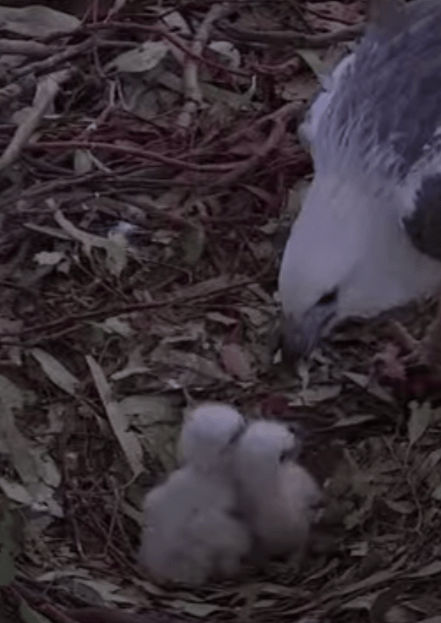
WBSE, Sydney Olympic Forest: 27 and 28 continue to eat until their crops almost burst and sleep. Meanwhile there has been an intruder today and Lady and Dad were honking in alert.
And last but very special, A Place Called Hope. Along with other wildlife centres, they are receiving quite a number of starving Great Blue Herons and other herons. Why would they be starving? It has been raining in the Connecticut area and all the herbicides and pesticides that people put on their lawns and gardens makes its way into the environment, into the water table, into the ponds. It is poison. If your gardening centre or lawn care person tells you that the chemicals they use are ‘Green’ – well, think again. Whatever they are using kills. So sad. It is OK if your lawn doesn’t look emerald green.

Thank you so much for joining me today. Have a lovely Sunday. Take care of yourselves. I look forward to seeing you soon.
Thank you to the following for their streaming cams and their FB pages where I grab my screen shots: A Place Called Hope, Mlade Buky White Stork Cam, Collins Marsh Osprey Nest, Port Lincoln Osprey Project, and Sea Eagles, Birdlife Australia and the Discovery Centre.
The featured image is Dad at the Port Lincoln Osprey Barge taking his turn incubating his two eggs.


