Saturday in Bird World

23 April 2022

UPDATE: All of the Denton Homes nestlings are now deceased. Sending positive energy that the parents do not also die from Avian Flu as well as the other nests in the area. Condolences to all at Denton Homes on the loss of these three precious eaglets.

Thoughts go out to all of the nests in the area including Mother Goose on the abandoned eagle nest and Mr and Mrs North at Decorah North and their two eaglets.

The three eaglets of Thunder and Akecheta still cause us to hold our breath when they go near the edge of the nest. In their discussions yesterday, Sean Peterson and Lynn Scofield of Cal Falcons said that there is no Avian Flu present on the West coast (yet).

Thunder and Akecheta brought in 9 small fish for the trio yesterday. They have all learned how to ‘hork’ – eating the prey whole almost choking it down! I hope they continue to bring in fish to the nest – no more Coots!

Baby has a full crop and is getting shade from the adult on the nest of Chase and Cholyn at Two Harbours. Blink and the wee fuzzy one turned into an eaglet!!!!!!!! with thermal down. Gosh.

Middle (Little) had a fish tail and a pin fish this morning. He is on the nest being extremely vocal about wanting more food.

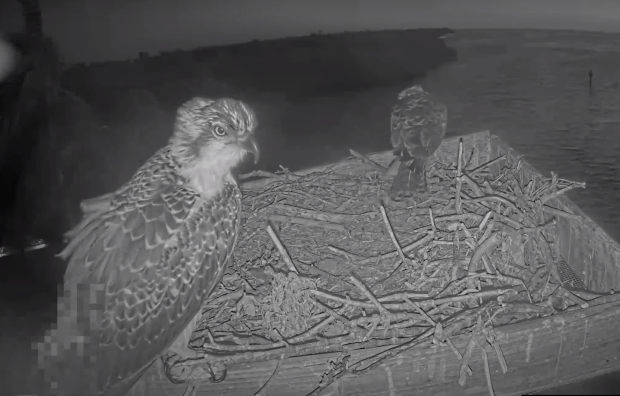
Little or MiniO fledged on the 22nd of April at 06:46:14. It is not clear if this was intentional or the wind gust took her off the nest. She has not been seen since fledging. The moderator of the chat said that Lori Covert intends to look for Little MiniO when she returns (I do not know when that is).

The hatch of L2 at the nest of Big Red and Arthur is proceeding nicely. This image is now about 3 hours old. That little one is almost out then. A good shove to the shell might do it. Earlier it appeared that a third egg might have a pip.

Arthur is keeping the pantry stocked.

The arrival of a Robin prompted Big Red to get up and eat a bit. You can see the crop on L1. Both L2 and L3 are now hatching. You can see the progress in the front two eggs. This nest is going to get super busy – and exciting – as these chicks hatch. Notice the bright yellow cere on L1. How gorgeous. The cere is the fleshy covering at the base of the upper beak.

L1 can hear its sibling and is mesmerized by that beak chipping away at the shell. If you look lower L2 has cracked its way around the egg. It will not be long.

There is some exciting news (for me anyway) coming out of the UK. Mrs G and Aran’s 2017 third hatch, Z8, was spotted at Loch Gruinart.

Z8 hatched just before midnight at the Glaslyn nest on the 29th of May 2017. He fledged at the age of 54 days on the 22nd of July 2017. This is the first official sighting of him! Excellent. I hope that we hear more about Z8 now that he has been spotted in Islay. He was a third hatch osprey!

Here is the FB announcement:

Other good news is that chick 3 who had remained in the crumbling eagle nest and nicknamed ‘Velcro’ has been reunited with chick 2 in the temporary nest in Illinois. These folks worked long and hard for these amazing eaglets who have not fledged but are the size of a Canada Goose. Congratulations to everyone at the Illinois Raptor Centre for this incredible effort.

To read about this journey, please go to the FB page of the Illinois Raptor Centre and scroll down – read from the bottom up – from when the nest collapsed.

The two Dale Hollow Eaglets have done so well. The sibling rivalry or food competition is all over between Big and Middle. They are now 55 days old and one of them is standing on the rim of the nest today.

They may have had some lean days but today was feast day and both have eaten so well and have such filled crops that they are ignoring a fish on the nest! Does it get more wonderful than that?

Everything seems to be fine other than being damp and getting potentially more rain later at the MN-DNR nest of Harry and Nancy.

It is 15:04 on the UFlorida Osprey nest. Little Bit continues to cry for food. The older siblings have no crops. It is very hot on the nest and all are food crying now. Wish for a miracle! That is what it is going to take – a miracle. The pattern has been for only one more fish to come in before bed and the two big ones are already ravenous.

As I wrap this up we are still waiting for fish to drop from the sky on the UFlorida Osprey nest, a hatch at Cornell (or two), and Little or MiniO to return to the Captiva Osprey Nest. Some believe they might have heard her calling. Send positive wishes to all the wildlife struggling on the Canadian Prairies with the torrential downpours and the flooding.

Thank you for joining me. Take care everyone. See you soon.

Thank you to the following for their streaming cams and/or FB pages: Loch Garden and Other Ospreys FB, Illinois Raptor Centre, Captiva Ospreys and Window for Wildlife, Cornell Bird Lab RTH, UFlorida-Gainesvlle Ospreys, MN-DNR, DHEC, and Explore.org.

Late Friday and early Saturday in Bird World

22-23 April 2022

Friday was drawing to a close. Big Red had been restless all of Thursday and it was a wonderful relief when L1 hatched and was deemed ‘perfect’ after a worry over some blood coming from the egg earlier. Tonight (Friday late) Big Red is trying as best she can to get some sleep while L2 is hatching. The cracking is such that we now have gone beyond a mere pip.

If all four of the eggs hatch, Big Red s going to need to grab those naps as much as she can.

Big Red is not giving away any hints Saturday morning. But you can see the more than pip in the back right egg and a pip in the back left egg. L1 is doing fine. Being an Only Child – even for a short time – has its advantages.

Arthur brought in another starling in the morning. There are now 2 Starlings (one partially eaten), 1 grey bird, and a partially eaten snake in the nest.

Dawn is just breaking in the Tucholskie Forest in Poland. You can hear the songbirds singing as the sun rises through the pine trees. This just reminds me of a fairy tale forest. White-tail Eagles are so beautiful with their lighter heads and darker bodies – all seemingly touched with a bit of silver.

Mum left to take a wee break. Both of the eaglets are still alive and appear to be doing well.

Mum returns to brood the chicks in the soft morning light.

Do you know the Anacapa Peregrine Falcon Nest? This couple have been together since 2013 raising chicks on the cliff face on the remote Anacapa Island in California. They are known as Mr and Mrs A.

Anacapa is part of the Channel Islands where we have a couple of familiar Bald Eagle Nests, Two Harbours (Chase & Cholyn) and West End (Akecheta and Thunder).

Two chicks have hatched this year. Just look like white fluffy little teddy bears with big pink beaks and pink toes and feet. So cute. They are 3 days old. It is hoped that the third egg is non-viable. It is typical for not all of the falcon eggs to hatch. These chicks are big and strong and that chick would be behind.

Here is a feeding from yesterday.

This is a feeding from today.

This is the link to the streaming cam for all you falcon lovers!

https://explore.org/livecams/falcons/peregrine-falcon-anacapa

I want to check on the status of the Black Stork nest that was the home of Grafs and Grafiene last year. The very late arrival of the female last year caused issues at the nest. The male returned earlier in April this year. Many on the Forum are wondering if it was Grafs or another male. The male worked away bring twigs and moss to prepare such a nice nest. Now it is the 22nd of April and there is no female yet. The male sings and looks around. Fingers crossed for a quick arrival of a female to this gorgeous nest in Sigulda County. Come on Grafiene!!!!!

Here is the link to the nest:

Karl II is working very hard on the nest he shares with Kaia. He is very handsome!

Karl II and Kaia have had a male intruder land on the nest. Kaia helped magnificently in defending the nest. Unlike other species, the males and females will defend the nest against opposite genders. There are apparently a lot of single male floaters due to a lack of female storks. They are causing problems with established nests. We are waiting for an egg at this nest!

Here are the couple defending their nest.

Mum and Dad returned to Glacier Gardens yesterday! Looking forward to another great year up in Alaska. Kindness was the sweetest little eaglet. It was a great name and touched the heart of so many. It is so nice to see Mum and Dad.

There are now three eggs at the Llyn Clywedog nest of Dyland and Seren Blue 5F. Dylan is a great fisher but he also loves to incubate and he wasn’t wanting to give up that spot Saturday afternoon!

Mrs G and Aran have two eggs now.

Cheers are happening in Poole Harbour because CJ7 and Blue022 have their first egg. There will be more. The first hatch will be historic – the first Osprey in Poole Harbour in over 200 years!!!!!!!!! Incredible. The community worked hard to relocate Ospreys to the area and it looks like they will have success this year.

This is such wonderful news for this couple that began bonding last breeding season.

The very first osprey of the 2022 season has hatched in the Diaccia Botrona Nature Reserve in Maremma in Tuscany, Italy yesterday.

The situation at the Florida-Gainesville Osprey nest is not improving. I captured a couple of images of Little Bit taking a few bites of a fish on the nest before Middle went after him. You have to look carefully. Its tiny head is in the very centre of the nest under the tail of that fish.

The minute the older sibling notices Little Bit move it attacks despite it having a full crop.

The two large siblings prevented Little Bit from getting any food even though they were clearly full.

Feeding and any movement by Little Bit triggers their aggressive behaviour. The ability of both Big and Middle to dominate the food coming into the nest is directly seen in the growth progression of the three nestlings. I often smile when I see people in chat rooms saying not to call the dominant birds bullies but in his 1979 article “Sibling Aggression among Nestling Ospreys in Florida Bay” in The Auk (vol. 96, no 2, 415-17) Alan Poole says just that in discussing the difference in size of the nestlings “however, 3 days after the first sibling bullying was seen, nestling A was 165 heavier than B…” (416). The older two are simply that – bullies. What I did find interesting about Poole’s study was that he did not find the same level of aggression in the Ospreys in the Chesapeake Bay area. Some of you will have observed, as I have, sibling competition and aggression at several Florida Osprey nests such as Achieva Credit Union (2021), Captiva (2022), Pink Pearl (2022), and Gainesville currently. You might well know of others in the last couple of years.

Little Bit mustered the courage to get to the beak but there was no fish left.

In the image below you can see the size difference between Big, Middle, and Little Bit. The older ones will continue to have the advantage unless this chick gets fed – it had a few bites yesterday and some fish later on the 21st. Tiny Tot lasted for 72 hours before getting some fish at Achieva in 2021. Indeed, that chick had – in a month – the equivalent of 12 full days without food. She went on to become dominant. It remains unclear to me if Little Bit will survive the weekend, sadly.

Little or MiniO fledged yesterday morning early (the 22nd) and has not returned to the nest. It is unclear to me whether she is in a tree or is grounded. Middle (or Little) is in the nest with Lena fish calling to Andy.

I never like to close with sad news but I have just heard that two of the eaglets at the Denton Homes nest have died. It is suspected that it is Avian Flu. We will see if the third survives but it is doubtful. The Dad is there and is very confused. The surviving chick is in the nest with the two deceased ones. — It was thought that Avian Flu was mostly staying on the East coast. This is a move into the heartland being triggered by migrating birds? There will be concern for other nests in the region. Please send them your warmest and most positive energy.

We have had rain since the wee hours of the morning on Friday. It has filled several of the low areas of the garden with water. The worry is that they are reporting a drop in temperature that would freeze the ground surface causing the rain not to soak in (the ground is already saturated) and create wide scale flooding. We worry about the animals. All of the squirrels, Hedwig, Mr and Mrs Woodpecker along with a myriad of Juncos, Sparrows, Grackles and Starlings have been trying to eat. It is difficult to convince Hedwig that we have special food for him on a plate that is relatively dry!!!!!!

Thank you for joining me. I hope to have some happy news on Big Red and Arthur’s L2 later this evening. Take care all. See you soon.

Thank you to the following for their streaming cam where I took my screen captures: UFlorida-Gainesville Ospreys, Brywyd Gwyllt Glaslyn, Poole Harbour Ospreys, Captiva Ospreys and Window for Wildlife, Cornell Bird Lab RTH, Biehki Online Bory Tucholskie, Estonian Eagle Club, Diaccia Botrona Nature Reserve, CarnyxWild, Explore.Org, and the Latvian Fund for Nature.

Late Friday in Bird World

22 April 2022

There is so much news in Bird World. I simply cannot keep up. At the same time, most of it is all wonderful! That is a good thing. My report will be short. Many things to do after listening to the wonder session with Cal Falcons.

Jackie and Shadow are amazing. While we have rain warnings here on the Canadian Prairies, our beautiful Eagle family in the Big Bear Valley had a horrific snow/ice storm.

Here is a video clip of Jackie and Spirit. What a great Mum Jackie is!!!!!!

This image was taken at 13:45 and things are much improved.

Cal Falcons. Mark May 5-6 as hatch days. Gosh, the Q & A with Sean Peterson and Lynn Schofield was really and truly informative. I learned so much! And I am posting it for you so you can listen if you wish. There were a couple of takeaways from this session that I found quite interesting. The first was that Alden was known to both Annie and Grinnell and was accepted by Annie and Grinnell. He had been seen for 1 or 2 months. Neither of them ever tried to chase Alden off the Campanile. On at least one occasion, Alden brought a prey delivery to Annie while Grinnell was alive. Again, no action by Grinnell. There is speculation that Alden was going to be a ‘nest helper’ for Annie and Grinnell and that is why neither of them were antagonistic or aggressive to him. The second was that a falcon has super eye sight for about a mile. They can spot a prey item. Grinnell was killed within a mile of The Campanile. Annie might have seen Grinnell being killed and that would contribute to her bonding with Alden so quickly.

Here is the link to this session.

Another fish came to the UFlorida-Gainesville at 16:11:37. The feeding finished at 16:47:55. Little Bit got nothing. The problem is that the two big siblings are now requiring more and more food and both are intimidating the wee babe. If another extremely large fish comes on board before night, finger’s crossed. I am not hopeful, however.

In part, one of the biggest issues is how the female stands to feed the chicks. If she would point her head at the rim so that Little Bit could get between her legs or on the opposite side, he might have a chance of some food.

Lena has been calling for a fish delivery. I wonder if she is hoping she can get Little (MiniO) who fledged this morning back up to the nest for some food.

There is absolutely nothing more beautiful than Big Red looking down at her new baby and it looking up to its wonderful Mum.

Iris has been spending time today at the nest just like she seems to do every afternoon.

The winds are roaring around the Channel Islands Bald Eagle nests. Everyone at the West End nest of Thunder and Akecheta are holding on!

It is not nearly as breezy but the wind is blowing and it is wet and dreary at the MN-DNR nest of Nancy and Harry and their two eaglets.

Big and Middle shared a fish at 09:38. These two are looking really good and there is absolutely no rivalry. It is truly wonderful – even when there are not a lot of prey items.

It is Earth Day and this is a very good reminder from Rosie and Richmond!

Wishing Everyone a Very Happy Earth Day. Take care. See you soon.

Thank you to the following for their streaming cams or FB pages where I grabbed my screen captures: SF Ospreys and Golden Gate Audubon, DHEC, Friends of Big Bear Valley, UFlorida-Gainesville Ospreys, MN-DNR, Cornell Bird Lab and Montana Ospreys, Cornell Bird Lab RTH, Captiva Ospreys and Window for Wldlife, Explore.org, and Cal Falcons.

Early Friday in Bird World

22 April 2022

The beginning of what sounds like deplorable weather has arrived in parts of Manitoba for the third weekend in a row. The American White Pelicans have returned, the Golden Crowned Kinglets are here, the Garter snakes are waking from their winter hibernation, and the weather is supposed to be problematic. We currently have rain which is supposed to turn to snow and ice on Sunday. Apparently the amount of rain is an issue with creeks and rivers full and the ground saturated. They are saying 50mm or 1.9 inches. We wait. We are prepared for just about anything. There are birds eating away in the garden and going into the wood boxes to get dry. The Juncos, the Sparrows, the Grackles, and the Blue Jay have visited so far. It has been a lonnnnnngggggg winter on the Canadian Prairies for all of us.

There is so much happening and a problem nest to check on. It is fantastic but I need 3 or 4 of me to keep up!

Breaking News: Little (or MiniO) the female nesting took flight this morning at 06:46:54. She has yet to return to the nest.

Very nice. It is thought that Little (Mini) has done some flybys and that she has been heard. She is fine. She will get back up to the nest or the parents will deliver some fish to her off camera. For me – I want her to return to the nest box so we can see her flying again!

Big Red and Arthur would be thrilled if their nest was in Southern Manitoba (if the weather were nice) because all of our Garter Snakes are coming out of hibernation (mentioned above). L1 hatched at 21:46 last evening and the first meal that Big Red her fuzzy little chick this morning was snake!

Oh, such a cute little eyas. Look carefully. Red-hawk nestlings have pink legs, black talons, black beaks with a yellow cere and are white. When the Peregrine Falcons hatch they will have pink legs, feet, and beak.

But what a gorgeous image. Big Red looking so lovingly into L1’s eyes. “Hi, Mama”.

Oh, this little one is so strong and healthy. What a cutie pie. Poor Big Red, the years have certainly taken a toll on her feet. They are really showing their age.

There is a second egg that is pipping. It is the one in the very front with the dark splotch. Soon there will be two!

Red-tail Hawk FACT: Digestion: A hawk’s digestive system is much different from ours. In addition to the Crop, their “stomach” is actually divided into two parts. The proventriculus (glandular stomach) is the next stop after the crop. The proventriculous is where food is mixed with digestive enzymes before it passes to the gizzard or ventriculus – a strong muscle pouch that contracts to crush and mix the food (RTH Chat moderator).

How old do Red-tail Hawks live? “The oldest known wild Red-tailed Hawk was at least 30 years, 8 months old when it was found in Michigan in 2011, the same state where it had been banded in 1981.” – (Hibbie, RTH chat from AAB site). The US Govt says the oldest banded hawk was 29 years and 8 months. Sadly, many of the bands were taken from birds that had been shot. They could have lived longer if the shooting of raptors was halted!

Cornell made a short video of the first snake feeding:

Some more snake was fed around 11:00.

How often is prey delivered to a RTH nest? Generally, prey is delivered to nestlings ten to 15 times a day, starting just before sunrise and ending just after sunset.  How often food is delivered, as well as how big the prey is, varies among individual hawks and is affected by the number of young, as well as prey availability. In one study in Canada, researchers estimated that an average of between 14.4 oz, (nearly a pound) and 1.6 pounds)of food per day were brought to broods of 1 and 3 nestlings, respectively. That’s 410 grams a day and 730 grams a day. (Cornell RTH moderator, Deron). This does not include the parents’ food!
Summarization of 11 studies showed that RTH diet was made up of 68% mammal, 17.5%other birds, 7% reptiles and amphibians (mostly snakes), and 3.2% invertebrates. 

Last bit of information. Researchers have learned so much by watching streaming cams which often changes the information found in older texts that used observation of nests only. Do raptors assist their chicks in hatch? Until yesterday, I have noticed Akecheta helping this year at the West End nest. It surely happens more often! And, yes, Big Red assisted L1 by rolling the egg gently so that super hard shell (no lingering DDT issues here) to help break it up.

The Cornell RTH chat which is open M-W-F from 12-2 and T-Th from 10-12 Ithaca NY time. It is a great way to learn about the hawks. Go to the link below and click on chat (scroll down as it will be under the image of E3):

https://www.allaboutbirds.org/cams/red-tailed-hawks/

The oldest of the siblings at the UFlorida-Gainesville Osprey nest woke up on the wrong side of the bed again this morning. He pecked at both Middle and Little. The breakfast fish came in around 9ish. Little Bit got a few bites. This nest needs another fish soon.

In the first image you can see the size difference of the three osplets easily. Big is at least 4x the size of Little Bit now with all the food it has been getting. At least 4x, possibly 5x.

Big goes after Middle. Little is staying out of the way.

Big will eat for a good 20 minutes before Little Bit gets the courage to go up and get a few bites – and yes, it was only a few. The fish was gone at 09:30.

As Mum was cleaning her beak, Little and Middle were up hoping that there was some more fish. You can hear them fish crying. Meanwhile Big is full past the brim and sleeping.

For those watching this nest, please be cautious. Middle attacked Little bit ferociously when the Mum moved. There was nape pulling and at a point I thought he was plucking. Little Bit might not make it if it continues to be kept from food and –well, it is the attacks.

Mum left the nest and returned around 12:17. Little Bit is looking up at her wanting food.

This once lovely nest has turned. Bonk and get bonked. What Big does to Middle, Middle then does to Little Bit. How sad! Send positive wishes to this nest. We need lots of fish brought in to turn this behaviour around and even then, it might not work but we hope.

It is 13:27 nest time and Little Bit is constantly prey calling. Oh, I wish this nest would turn around for the good. I wondered this morning if this stage of plumage development makes the nestlings more anxious and cranky. They are constantly preening those itchy feathers. That along with being hot and dehydrated and little fish…???????

Aran and Mrs G are celebrating the arrival of their second egg today. Yipppeeee. Let us all hope the weather and the intruders cooperate so these two have healthy hatches and they all fledge this year.

Everyone is busy laying eggs. Idris and Telyn now have three eggs in their Dyfi Nest as of 17:07.

Buckachek and Betynka at the Mlade Buky White Stork nest have their second egg as well.

I went to check on the two eaglets at the Dale Hollow nest. Because you can only go so far back on rewind it is difficult to state with some precision what the two have had to eat but they have had some fish that was brought in and there could be more. The amount that each got is unknown. They are both doing well and it is beautiful and green in the forest around the nest.

This has been a very long blog! There are so many nests with so much happening. Will try and do a nest hop later this evening for everyone who is missing out on hearing about their favourite nests. Yes, we do have our favourites. We will also be looking for another hatch for Big Red and Arthur.

Thank you so much for joining me. I hope that the weather is grand where you are. Get out and go for a walk and take me along. If you are waiting for the UCal Falcon Q & A, that is currently about 45 minutes away. Take care everyone. See you soon.

Thank you to the following for their streaming cams: Dyfi Osprey Project, Brwyd Gwyllt Glaslyn, DHEC, UFlorida-Gainesville Ospreys, Cornell RTH Cam, Capri Mlade Buky, and Captiva Ospreys and Window for Wildlife.

Late Thursday in Bird World

21 April 2022

Today, the American White Pelicans began arriving in Manitoba. Groups of about 30-40 flew over a couple of hours ago heading north. The Juncos and Robins are here and the other song birds are arriving in large numbers. Do I dare tell them we might have more snow tomorrow?

There is a really nice article on the naming contest for Alden, Annie’s new mate. Did you know that they received 3x the amount of votes for the name choice than any previous chick naming contest? That is fantastic. We love the growing interest in the raptors and their stories.

This is a reminder that the Q & A tomorrow, April 22, is at noon Berkeley time. There will be another one on 6 May when it is expected the eyases will hatch.

The two White-tail eagle chicks in Poland at the Tucholskie Forest nest have eaten well and both had nice crops before night.

Akecheta and Thunder worked together to bring three small fish to the nest today- one for each of the eaglets today! Talk about team work. In the image below, the eaglet on the right has a fish while the one in the middle is looking on at the self-feeding.

The eaglets are 44, 42, and 40 days old today.

There is lots of activity at the Captiva Osprey nest with birds flying by. Middle (Little) has been flying in and out and Little (Mini) has been getting some height under its wings. Both have been home with Lena anxiously awaiting some fish deliveries from Andy.

Two beautiful Ospreys with their Mum, Lena.

Here is a video clip of both chicks calling for fish and Middle (LittleO) getting some air under the flapping of its wings. Those wings are beautiful. It won’t be long!

Big Bob and Middle Bob at the Dale Hollow nest are doing fantastic. I used to be able to tell by the white at the edge of the tail but now I have to look more closely. It is Big on the right and Middle on the left. Beautiful raptors.

I missed the feeding but both have nice crops and there is evidence of a delivery and feeding in those bones. The two eaglets are 53 days old today if you count hatch day.

Iris has spent a bit of time at her nest this afternoon. There is some precipitation falling and people are about. They do not seem to bother her in the least.

Iris loves to give you the ‘snake eye’.

At 19:59 we get a good look at the hatch on the Cornell Campus Red-tail Hawk nest. Progress is definitely being made. Hope this wee one doesn’t get tuckered out. That was one hard shell and membrane to get through!

Here is the progress at 20:48. You can clearly see the beak! Oh, this is so good. The wee one can breathe and surely it will not be much longer now.

Big Red appears to be assisting somewhat in the removal of that shell.

It has been quite the day. From previous pips and hatches I really did expect L1 to be dried off and fluff this morning. It has been a long slog for it and Big Red who has not left the nest. It will be such a relief when this chick is completely out and eating some of that bird tomorrow. L2 could be with us and by then there could be another pip. Little Bit had a good feed – finally – at the UFlorida Osprey nest and all the others including this hatch seem to be fine.

Thank you so much for joining me this evening. I had hoped to just remind you of the chat with Cal Falcons tomorrow and announce L1’s hatch – but, never mind, all is well. Take care. See you soon.

Thank you to the following for their streaming cams where I took my screen captures: Explore.org, Cornell Bird Lab and RTH, DHEC, Tucholskie Forest Eagles, Montana Osprey Project, Captiva Ospreys and Window for Wildlife.

Thursday morning in Bird World

21 April 2022

The snow that was forecast did not materialize in southern Manitoba and Winnipeg. That is wonderful! We needed a break from the last storm to melt the snow and to be outside. The birds needed a break in the weather, too. Sadly, there is another special weather advisory for the southern part of Manitoba starting tomorrow morning through Sunday. Perhaps we will only get the wintery rain. Oh, the poor Wood Ducks. They have just arrived.

IMPORTANT INFORMATION: The Q & A session on Cal Falcons is at noon in Berkeley! When you go to the YouTube site and set the alarm reminder, it will confirm your local time – hence the confusion. Thanks ‘B’ and ‘S’.

You can tell by Big Red’s demeanour that ‘something’ is happening. She does a little wiggle and then you catch her with this focused look as if she can see the eyas advancing in its pecking. Of course, she can hear it cheeping and, apparently, so can the other three. Some believe that this encourages them to hatch faster so they can join their sibling. That would be grand.

Arthur revealed the progress of the hatch when there was a shift change.

Hatching!

The White-tailed eagle nest of Tula and Borek in the Tuchola Forest had three eggs. The eaglets hatched on 8, 12, and 14th of April. There are only two surviving eaglets today. Siblicide is not as widespread in White-tail Eagle populations as it is in Golden Eagles. That said, when the third eaglet hatched the eldest at this nest began immediately to beak it. There was 6 days difference in their age and size. I believe the two surviving are hatches 1 and 2. I will refer to them as Big Bob and Middle Bob to try and keep things straight.

Today, Middle was clever and crawled up leaning half in and half way out of the nest cup so it could get some food. This is a very determined youngster. The eldest had eaten and so the youngest was not tormented. I hope that these two survive just like the two oldest hatches at the Dale Hollow Nest.

The nest is 25 metres above ground on a 140-year-old pine tree. The White-tailed eagles have been using the nest for four years. At another place in the forest, eagles had been nesting since the late 1990s on a 160-year-old pine near to one of the fish lakes. So for 25 years eagles, at some location in Tuchola Forest, WTE have been breeding. There is a year round protection area around the nests extending 200 metres in any direction.

The nest is located in this large, 46 sq kilometres, nature reserve in northern Poland. The two main types of trees are the Pine and the Oak Bartek. It is the oldest oak tree in Poland believed to be 686 years in age.

Polek i Bartek w jednym lesie stali” by Polek is marked with CC BY-NC-SA 2.0.

The park is full of rabbits, deer, and 80 species of birds. There are also nearby rivers for fish. It is anticipated that there should be plenty of food for the adults and both of the chicks.

There are about 1200-1500 pairs of White-tailed Eagles in Poland. Their conservation status is ‘very scarce breeding bird’. Most of the eagles live in the northern areas of Poland.

Here is a link to this White-tailed Eagle nest in Poland:

Both eaglets were being fed well Thursday morning:

Idris and Telyn were watching the train go past the Dyfi Nest in Wales. Two eggs. We will be watching for the third tomorrow.

Little (or Mini) is still on the nest with Lena and has not fledged yet. Middle (Little) took off this morning about 10:05 for a flight and is perched on some greenery near the nest. He is probably going to watch for when Dad delivers a fish. This morning Lena has also had to chase away an intruder, another Osprey.

It looks like the MN-DNR nest is getting a bit of sun this morning. It will help dry out the nest of Harry and Nancy but will they get some of that snow and rain that is coming?

What is enfluffeling?

Jackie and Shadow’s 2022 eaglet, Spirit, sure loves it when the wind blows hard through the nest. She is working those wings today!

For all us worrying aunties and uncles, the cam operator did Zoom out and there are three eaglets on the West End nest. Relief. When the camera is in the normal position, you might only see two.

This is the view of the Glacier Gardens Nest this morning. Oh, it is beautiful. Liberty and Freedom should be returning soon.

It is a bright sunny day for Chase, Cholyn, and the little one at the Two Harbours nest.

The Redding Eagles are asking for you to vote for your favourite name for Liberty and Guardians 2022 hatches. Here is the announcement:

Friends of the Redding Eagles​ NAMING: Step 2: Vote for your favorite pair of names, just ONCE please. Click here to vote- https://docs.google.com/forms/d/e/1FA…

Jasper and Rocket from Samson and Gabby’s NEFlorida Bald Eagle nest have both fledged. They have also returned to the nest. Yahoo. Today they were perched on a branch of the nest tree looking out. I wonder if they might do some tandem flying?

Mum flew in with a hunk of fish at 09:22 at the UFlorida Osprey nest. Look where where that one osplet is positioned for the feed! I believe this to be either Big or Middle. It is not Little Bit.

That chick got a lots of nice big fish bites while the other two were fighting at the back of Mum. It is difficult to tell who is who and the dark shadow is not helping. I first thought it was Little Bit on the rim of the nest but I believe that Little Bit is getting hammered by Big while it is Middle eating. But that is not a 100% certain ID.

The chicks are really, really hungry. Clever of that one to get up there to be fed. It walked away and fell into food coma. Smiling. Ah, is he playing possum? He looked up to see the other two eating. Wonder if he will return for some more fish?

That osplet would certainly like some more fish.

Sadly it looks like Little Bit is lodged between Big and Middle. This is not good especially with less fish coming on the nest and the hot weather dehydrating the little guys.

Little Bit cannot seem to get around the bigger sibling. He will be getting tired and dehydrated.

At 10:00 the Big sibling was laying on top of Little Bit.

I do not believe Little Bit did get any fish. The feeding was over and Mum went to brood the chicks.

I will monitor the UFlorida nest on and off today. What looked good a few days ago has now turned. Let us all hope that another big chunk of fish gets on that nest quickly so Little Bit can have some food.

This is the latest on the hatch for Big Red and Arthur. The image was shot in a change over from Arthur to Big Red. I am really hoping that is blood from a prey item.

Thank you so much for joining me today. Take care everyone. I will be back with what I hope is good news on Little Bit later today along with hatch news from Cornell. See you soon!

Thank you to the following for their streaming cams where I took my screen captures: Cornell Bird Lab, UFlorida-Gainesville Ospreys, Friends of Big Bear Valley, Explore.org, Tuchoskie Forest Eagle Cam, NEFlorida and the AEF, Redding Eagles, MN-DNR, Captiva Ospreys and Window for Wildlife, Cal Falcons, Glacier Gardens, and Dyfi Osprey Project.

Late Wednesday in Bird World

20 April 2022

If you have been checking on the three osplets in the University of Florida-Gainesville nest today, you might have become quite distressed. The first fish did not arrive until 11:11:41 and Big made it known – after Little Bit – made a couple of beaks – that it would eat first. The beaking continued by Big and then Mum got them all lined up and fed peacefully by moving the fish.

There has been no more fish deliveries. It is 24 or 75.2 degrees with winds of 21 kph or 13 miles per hour. It is, of course, hotter up on that high nest with the light reflecting off the shiny metal of the lights.

Big is hot and cranky and very hungry as are the other two siblings and Mum. Hopefully this is not going to set a pattern for the future. If fish deliveries can get more normalized it would be very helpful.

Mum has left the nest. Has she gone fishing?

At 17:40:11, Mum landed on the nest with a fish with a head on it. I am going to presume that in the time she was away from the nest she caught this fish. My reasoning? This dad always brings in headless fish to the nest. I had hopes that the feeding would go smoothly but because it is slow going starting with the head, bedlam broke out with Big taking its frustration out on everyone. So sad that this is happening.

At 18:06 almost an hour after the fish landed on the nest, Little Bit moved up and is being fed. Relief.

There is enough fish left to fill Little Bit up! Mom is pulling the flesh off the skin for Little Middle. She has eaten some along the way and she will eat the skin and the tail for sure. It would be really nice if Dad brought in a second fish. Wonder where he is?

I can tell Little Bit is being fed by the way his body is moving. He sort of spreads his wings out sometimes too. Mum is also feeding Middle at the same time. They will all go to bed with some fish in their tummy.

Give Mum a great big round of applause. She was still feeding Middle and Little Bit at 18:18! I am impressed. Middle got full and moved and Mum was still finding flakes for Little Bit at 18:27. Bravo.

Further chaos evolved when Mum decided she wanted to brood all three of them! Good night little ones. Happy Fish Dreams.

In other Bird World news.

At 14:25 you could see the little beak of L1 chipping away at the egg wanting to hatch!

The Smithsonian Magazine has put out an article about the impact of Avian Flu on the Bald Eagles (US). In Manitoba, we have two confirmed cases of Avian Flu – a Bald Eagle that just migrated and a Snow Goose.

I would not want to get in the way of any of the Eagle parents. They caught the female at the Pittsburgh-Hayes nest protecting her three eaglets from an intruder.

Not only are the hawks and falcons laying four eggs but there is an Osprey nest in the Kielder Forest that now has four osprey eggs. Oh, geez. Can you tell already I don’t want that 4th egg to hatch?? It is at Kielder Nest 1A.

@ Forestry England

The Kielder Web site says, “It is the fifth time in total that there have been four eggs on their nest. 2016 was the first occasion and the pair raised them to fledging, but sadly the eldest was never seen after that. On the more recent occasions a chick has died young or hatches failed. Weather is a key factor, but disruption by intruders can also cause problems.”

No eggs yet at Poole Harbour but Blue 022 did bring CJ7 a nice fish today! Fantastic.

A reminder about the Cal Falcons Q & A. I just had one large laugh when I saw a comment by ‘B’ about the time. ‘B’s’ question is: Can I assume that this is noon Pacific time and not 2pm? Here is the posting! And that is a great question. Did the system automatically set the time for CDT not Berkeley time? I plan to ask and will get back to everyone as soon as hear. The nice thing is that Sean always posts the whole discussion after. The sad thing is that you miss submitting questions. This should be a very informative chat after all that has happened.

It has just been a lovely day and I am going to try and navigate the snowy sidewalks and go for a bit of a walk. There are apparently Wood Ducks back in the City and Canada Geese have been making nests on beaver dams because of the snow. It is rather crazy out there. The snow last night did not materialize. Thank goodness.

Take care everyone. Thank you so much for joining me today. See you soon.

Thank you to the following for their streaming cams and/or web pages where I took my screen captures: Kielder Forest, Cal Falcons, Cornell Bird Lab, UFlorida-Gainesville Ospreys, and Poole Harbour Ospreys.

Pip watch for Big Red and Arthur continues

20 April 2022

Big Red and Arthur have their territory on the Cornell Campus in Ithaca, New York. Big Red hatched in Brooktondale, New York in the spring of 2003. She was banded in Brooktondale as a fledgling Red-tail Hawk on 10 October 2003. It is not precisely know how many mates Big Red has had since she was old enough to lay eggs and hatch chicks. She was observed on the Cornell campus with her mate Ezra prior for two years prior to 2012 when the cameras were placed on the light stands on the campus. When they began to number the chicks, they began with C because of those two years. Ezra and Big Red raised eyases until the spring of 2017 when Ezra was killed defending their territory. Big Red had no chicks in 2017 but she did have a mysterious young visitor to the nest in April 2017. It was Arthur! And Arthur did not even have his red tail yet! After considering several potential mates, Big Red – to the dismay of many human animals – choose a youngster. Arthur has proved himself to be an invaluable mate. He is a fantastic hunter and takes part in all aspects of the breeding season including nestorations, incubation, prey deliveries, and teaching the youngsters how to fly and hunt.

Somewhere in my files I have precisely the number of chicks that hatched. It is likely that she has laid and hatched 54 eggs since she could first breed. It was a large number and everyone of them fledged except for one and that was last year. K2 had an issue with her beak and she was taken into care. The situation was thought dire and she was euthanized.

This is the first year that Big Red has laid four eggs. It seems to be a trend amongst hawk and falcon populations this year. Cornell has already alerted everyone that this is unknown territory and they do not know what to expect.

Red-tail hawks are the most wide-spread hawk in North America. They are medium sized and are distinguished by their beautiful red tail when they are a year old. They normally live in wide open spaces and you can see them sitting on top of poles hunting. Indeed, Big Red and Arthur often spend time on the poles along Highway 366 near Cornell. You might commonly hear that Big Red is sitting on the 366 pole. That is what it means. There are fields across the highway still in Big Red and Arthur’s territory where they hunt and where they teach the eyases to hunt.

You can watch the hatching of the chicks and the daily lives of Big Red, Arthur, and the Ls here:

When the chicks hatch they will be covered with white soft feathers with a black beak and the cutest fat little pink legs and feet.

The image below is K1 hatched and K2 pipping.

There are several video clips of highlights from 2021. Here is one of those that will give you an idea of what to expect this year.

It is going to be an exciting season on the Cornell Campus particularly if all four eggs hatch. Boy, Arthur start stacking up the chipmunks and the squirrels!

Thank you so much for joining me. I am eggcited! Take care everyone. See you soon.

Thank you to the Cornell Bird Lab for their streaming cam where I took my screen captures.

Late Tuesday in Bird World

19 April 2022

Right now it is hard to believe that snow will be arriving again in about 4 or 5 hours. All of the garden animals are out and about running around on the hydro lines and poles and checking to see if there are any corn kernels hidden in the wood in the little sheds. Dyson knows it is there! He will find it for sure.

Sharpie seems to have some competition in the garden now with a Cooper’s Hawk (note the curved tail). This hawk is much larger than Sharpie. I wonder if it is a female. Certainly didn’t need to worry about birds at feeders!!!!!!!! They took off but a few went down under the deck and Cooper knows they are there.

Besides the garden chaos with Cooper, there has been a mini-kerfuffel going on in my City today. To feed the songbirds or not? to put out feeders or not? in times of Avian Flu. I decided to ask the Cornell Bird Lab and also sent a question to Dr Thijs Kuken at the University of Erasmus in Rotterdam who is a virologist and studies Avian Flu. I have not heard from him. But the Cornell Bird Lab did send the following information:

“Hello,

Thank you for reaching out to the Cornell Lab of Ornithology.

We are paying attention to the situation. Avian influenza viruses occur naturally among wild aquatic birds worldwide and can infect domestic poultry and other bird and animal species. Wild aquatic birds can be infected with avian influenza viruses in their intestines and respiratory tract, but usually do not get sick.

There are no suggestions to take bird feeders down unless you have backyard poultry or work with poultry or other domestic birds. Of course, this may change as birds begin their migrations north.

Below are some resources that should help.

Fact Sheet from the Cornell Vet School: https://cwhl.vet.cornell.edu/system/files/public/cwhl-fact-sheets-ai.pdf

I hope this helps.

Thank you.”

Sarah Wagner, PhD
Public Information Specialist
Cornell Lab of Ornithology

It is recommended that you clean your feeders with a very mild mixture of dish soap and either white vinegar or bleach (very, very mild). You should allow everything to fully dry before using them. There are also recommendations that you clean your feeders every 48 hours. But do note, if you have feeders near poultry – as in a back yard poultry area), those feeders should be removed!

Checking on the UK Ospreys, Mrs G and Aran have their first egg. It arrived at 19:37! Aran saw the egg and went to get Mrs G some more bedding. Sweet.

Telyn and Idris welcomed their second egg at the Dyfi Osprey nest at 18:01.

Sweet. A nice fish for Telyn. Oh, Idris. You are a darling.

A small piece of fish with the tail arrived at the Dale Hollow Eagle nest late in the day. Big and Little Middle were decidedly hungry! It was nice to see the adult feed them both.

I know that the parents slow down the delivery of fish as the eaglets get older providing them with plenty one day and nothing another so they learn about living on their own. However, it sure was nice to see a piece of fish show up for these two!

Martin and Rosa’s eaglet at the Dulles-Greenway Bald Eagle nest is doing great. They have had some bad weather and it is still really windy there.

Akecheta has been busy protecting his three eagles at the West End nest on the Channel Islands. It looks like he was concerned about some gulls that were overhead this afternoon.

I did not see it but ‘B’ sent me a video clip of an intruder getting right in the scrape box at Cal Falcons. I am glad I did not see that event live. Thank you, ‘B’.

Sadly, the successful breeding and relocation programmes often cause a lot of floaters looking for nests that can be quite disruptive to established pairs with eggs or chicks. Or, sadly, cause fatalities.

Little Bit has a nice crop. You can see it in the ‘cuddle puddle’ on the nest. That fuzzy light grey marble looking thing is its crop! The nest has done well today. Mum has tried to keep those osplets cool.

Jasper at the NE Florida Bald Eagle nest took its first flight and has since made several others. Rocket is ‘thinking’ about flying. Jasper, however, seemed to have everything happen the day he flew for the first time. He roosted during a storm on the nest tree and, as the AEF realized, he was also hit by an owl! Needless to say he was tired and starving when he got back in the nest. Here is the footage of the owl attack.

This has been a very short newsletter. I hope that everyone is doing well. Take care and I will see you again soon – with more eggs being laid tomorrow in the UK! Thank you for joining me.

Thank you to the following for their streaming cams where I took my screen captures: DHEC, Brywd Gwyllt Glaslyn, Explore.org, UFlorida-Gainesville Ospreys, Dulles-Greenway Eagles, Pix Cams, and Dyfi Osprey Project.

Louis brings Iris a fish!

18 April 2022

I thought I was seeing things! I did confuse an ‘I’ for an ‘L’ earlier today in the name of Annie’s new mate – calling him Aiden instead of Alden.

I know the female on the nest in the parking lot at Hellgate Canyon in Missoula, Montana is Iris. No other female would dare to try and take a lease out on Iris’s nest!!!!!!!!!

Who is the male flying in from the left bearing a gift of fish? The time is 15:52:40.

Is it Louis????!!!!!!!!

Tears began pouring down my cheeks. When was the last time that a gift of fish was delivered to this magnificent bird, the oldest Osprey in the world? Can you remember?

My memories are of Louis stealing Iris’s great catches!

Iris quickly grabs the gift – in case Louis changes his mind – and flies off to the pole while Louis stays on the nest alerting.

This was such a special moment that I did a video clip, too.

Iris is back on her nest and that beautiful orange and yellow train that we see so often is going through Missoula.

Iris has spent some time on the nest late today. I wonder if eggs are coming?

At 17:50 Louis returns. It looks like he is on high alert.

Ah, was the fish a gift in case Iris was tempted by another male suitor in the area? I wonder. Louis didn’t bring any fish when Congo was around last season. It is all very interesting.

Whatever the reason, it is nice for Iris that she had a dinner delivery and didn’t have to go out in the wind and catch it herself for a change. This is such jarring news that it warranted its very own blog.

Thank you so much for joining me! Take care everyone.

Thank you to the Montana Osprey Project for their streaming cam where I took my screen captures and video clip.