Brief Bird World check-in

27 July 2022

The presentation about Eagles Dying of Electrocution: What Can be Done? was quite informative. A number of topics were covered including why it is important for utility companies to not have wildlife incidents. Because they boost of having reliable electricity they cannot afford to have too many power outages due to wildlife electrocutions (squirrels, raptors, etc). So while wildlife is not their primary concern, if an eagle gets electrocuted it does impact their goal of ‘reliable’ transmission of power and it is actually in their best interests that their poles are safe. It is also good for their public image.

A PDF of a very large study done in 2006 was mentioned several times. It studied different birds in different countries with various configurations of hydro poles and how electrocution might be mitigated. Christian stated that the solutions are still solid examples. Here is a copy of that large study:

One interesting note in the mitigation is that you simply cannot install insulators or insulated cables. You must also deal with the transmitters.

A question or statement by one of the chatters for the presentation had to do with the lack of responsibility in this situation. If the first electrocution for an eaglet from the Gabriola Nest was accidental, isn’t the second one intentional? Many power companies will immediately move to fix the poles if they know there has been an incident. Florida has so many big raptors and it was mentioned that the power companies are pro-active in protecting the large birds.

An example from Belgium was shown. That is a perch for the eagle that is higher than the pole. The perch is not dangerous to the eagle. To mitigate further, the pointed triangle on the left has been installed making it impossible to create a connection also. Fantastic.
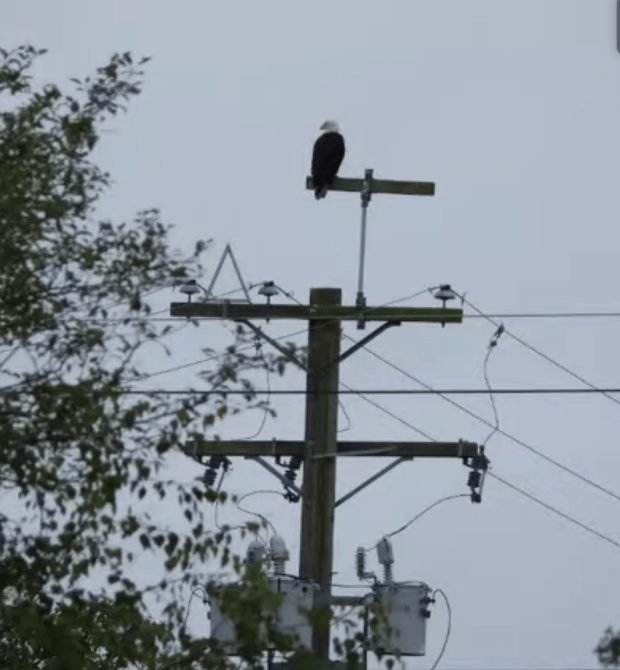
An example of good spacing and bad spacing in terms of wildlife.

Here is the presentation link in case you missed it or would like to listen again. It is about 50 minutes long.

Yvonne Roll Peterson posted the following image on the Notre Dame Eagles page. She carefully took the time to mark out who was where. You can’t see ND16, she is on the nest (of course). ND15 is on one branch and our Little Bit 17 is on another branch behind some leaves. Smile.

My eyes are on the Osoyoos Osprey nest where temperatures are climbing getting hotter and hotter. Olsen brought in a nice sized fish but it has been more than four hours ago. Hopefully they will get another. Soo is doing the best she can to try and keep her panting chicks shaded.

After the presentation on the Eagles and electrocution, I spent some time observing SE29 and SE30. SE30 did two ‘ps’ – one at 0634 and the other at 0713. Both were good. I did manage to capture one. Look carefully below.

Dad brought in what appeared to be a bird – possibly a Silver Gull chick? for the next feeding. Neither chick was that enthusiastic about eating at either feeding.

SE29 did hover but, there were no violent attacks at either the 0634 feeding or the later one right after 0715 ish. After SE30 did his ‘ps’ he did eat some bites.

Lady may have lots of prey items under the leaves. It is hard to tell but I did not see the piles of fish like I did when these two first hatched. So two good ‘ps’ to indicate that SE30 has been eating and its plumbing is working fine. Dad comes down to the nest and flies off – to go fishing from Lady and 29 & 30. Good luck!

At 0745 Dad returns with a large fish. SE29 did take exception when it appeared that 30 was going to get the first bites. In situations where the eldest sibling is trying to establish dominance, most of you will have seen them eating first and once they are full the second eats if there is prey left. It would appear that 29 is asserting that dominance.

It should be sorted out in a few days. Look for good ‘ps’ from 30. Lady continues to feed them almost every hour. All those little bites add up. In a week or a week and a bit, the feedings will show down because the eaglets will be eating more at each feeding.

Things remain really stable and good at the Boathouse Osprey nest in Maine. Dory is feeding the three chicks another good sized fish.

Every once in awhile you can catch one of the Ospreys at Mispillion Harbour on the perch today.

Duke has been bringing some really nice fish to the Barnegat Light Osprey nest in New Jersey. Daisy feeds the kids and winds up with a big crop herself. Oh, I would love to send that fish to Osoyoos! Wouldn’t you?
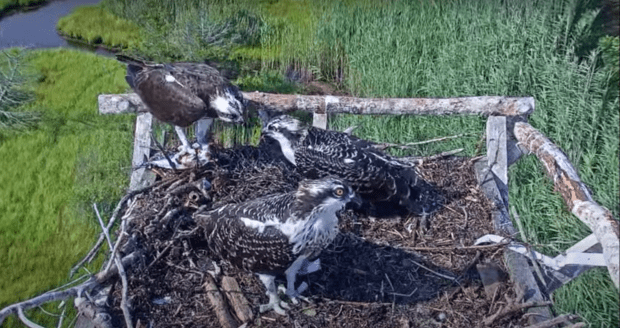
I have seen no news on the cause of Tom and Audrey’s chick suddenly dying at the Chesapeake Conservancy nest. Will continue to monitor. The adults have been on and off the nest.

Aran and Mrs G have been doing a lot of posing on the perches – sometimes with but today without the fledglings.

Notice the difference in size. Mrs G is at least one-third larger than Aran. Check out the difference in size in wings. — It is always good to remember, when watching a raptor nest, that the females require more food in order to grow to the larger size and to also grow all those additional feathers. Often the females are not the first to fledge either even if they hatched first.

The difference in size – where the females are larger than the males – is called reverse sex-size dimorphism.

I hope if you did not get to attend Christian Sasse’s presentation that you will take the chance to listen to it later. Some very good information with a lot of common sense when approaching utility companies. To all who wrote in, thank you.

Thank you for being with me this evening on this quick check. I am just watching two nests – Osoyoos and the Sea Eagles for stability. One for weather and the other for sibling rivalry. Fledge should be happening anytime at the Janakkalan Nest in Finland (or it has – have not checked today so if you know – send me a comment). Take care all. See you soon.

Thank you to the following for their videos, FB postings, and streaming cams where I took my screen captures: Christian Sasse, ND-LEEF, Osoyoos Ospreys, Sydney Sea Eagles@Birdlife Australia Discovery Centre, Sydney Olympic Park, Mispillion Harbour Ospreys and the DDNR, Barnegat Light Ospreys, Bywyd Gwyllt Glaslyn, and Audubon Explore.

Why are female Red-tail Hawks almost always 30% larger than the males?

It is called Reverse Sex-size diamorphism. There are several theories as to why this happens with Red-Tail Hawks.

The first is that the females had to be larger to protect themselves from the feisty males.

The second is that the females selected smaller males to be their mates because the size difference allows each of them to hunt different prey and reduce any competition for food between the pair. Raptors that hunt birds are generally smaller and faster with the female specializing on larger prey. At the beginning of the nesting season, the female becomes an active hunter and again when the nestlings are larger. Generally the adults tend to partition the prey resources in their territory.

Another theory is that the females need to be larger because they must accumulate reserves in order to produce eggs. When they are incubating eggs and brooding young, they rely on the male to feed the family. Red-tail hawks are usually born in April when the prey are sluggish and just coming out of hibernation. Small males can make quick turns. In the case of the Red-tails on the Cornell Campus, Arthur W, the male, is known as the ‘stealth bullet.’ He is quick, fast, focused, and quiet when he hunts. Big Red’s former mate, Ezra, was like Arthur W a great hunter but he was also about 30% smaller than Big Red as is Arthur.

Ezra has his wings spread and his legs tucked tight. If you look closely you will see that he is delivering two items to Big Red. The first is a snake and the second is a flower!
It is very difficult to get Big Red and Arthur to stand up straight at the same time. They certainly do not listen to requests from humans!This is the closest I have come to finding an image that might be able to show you the difference in their size. Big Red is on the left and has her head leaning back preening and she is a little more slumped than Arthur who is on the right.

In terms of the nestlings, the only way to positively known the gender of the bird is through either a DNA sample or you see them laying an egg when they are older. Everyone likes to guess the sex of the chicks growing in the nest cup. Using reverse sex-size diamorphism, we speculation whois a female by their overall size as they grow in the nest and the size of their feet. But again, no one can be absolutely sure. In the past one of the small nestlings was always believed to be a male. This particular bird injured its wing and, as a result, had to be taken to a vet. The bird’s DNA was tested and, to the surprise of many, it was determined to be a female. So not every small Red-tail Hawk is a male!

In terms of the relative size of each J, J1 is the largest of the three. Early in its development, everyone noticed the large size of its feet. Now as a juvenile, J1 remains the largest of the three siblings. But there is something else about J1 that I personally find fascinating. J1 is very much interested in nest maintenance. She can be seen, even today, mimicking Big Red in attempts to vent the nest bowl. She rearranges the nest twigs and on the second day after she fledged, she brought a branch to the top of the Rice patio. There seems to be 100% agreement that J1 is going to be a good mama like her mother, Big Red.

J3 in the front and J1 behind watching J2 fledge. Look at the difference in the size of their legs as a starting point.

J2 on the other hand is also a large bird, not as large as J1 but larger than J3. J2 was actually the first egg to be laid but the second to hatch and is, therefore, actually the oldest. His fledge was more like a fludge when he climbed up on the light box and then slipped but his flight was still remarkable. J2 has continued to be a very, very strong flyer already interested in hunting. The shape of “his” head – you will notice that I continue to use the term “his” – is also different than that of J1. He has an intense focus and besides bugs and insects he has already been interested in small birds in the territory. To my knowledge he has not caught one. He is also very aggressive. A few of us believe he is truly a male and will be a great hunter like his dad, Arthur W.

J3 eating his first prey drop after fledging.

J3 is the problem child that everyone loves. . J3 was born four days after the other two and it was also the last egg to be laid. Taken together, J3 is actually a week younger than its siblings. That is a lot in the life of a Red-Tail Hawk chick. It may also account for the fact that Arthur W brings food to the nest tower in an apparent effort to feed J3 away from the two larger siblings. Let me try to explain what has been happening. Normally the juveniles are spread out being individuals. This trio is quite different according to the people who have monitored all of the broods on camera (since 2012). It is because they tend to congregate together. To hang out. If one is on the Rice patio, all three might be there.

All three on what is called the Rice patio. Arthur W often makes food drops here but it is also a safe and flat site where they can sleep in the sun or practice their skills.

They might all be on one of the towers including the nest tower. Still, on occasion, they go their separate ways.

J1 in one of the oak trees near the Fernow Building looking at a squirrel.

A prey drop is just that – one of the parents dropping lunch. The juveniles will, unless they have recently eaten, fight for the food with the most aggressive mantling the prey. Unless the prey item is too large for the chick to eat all at once, sharing doesn’t seem to happen. So, because of J3s size and a seemingly lack of aggressiveness in comparison to J2, J3 is somewhat at a disadvantage. This is the reason that I believe Arthur W still supplies food on the nest to the little guy.

Arthur has been dropping lunch off to J3 for several days now. This was around 3pm. He seems to be looking for J3 who arrives almost immediately.
J3 mantling the prey that Arthur W dropped on the nest. Remember mantling is a way of protecting the food item so that no one else can steal it.
J3 finishing up his afternoon snack.

For now, the gender of the three juveniles is sheer speculation. There are no banding practices and no GPS monitors on the Js. In other words, no identification. It is only when one of the juveniles might find its way to the vet and be both recognized and tested that the sex would be determined.

Tomorrow we are going to talk about the importance of preening.