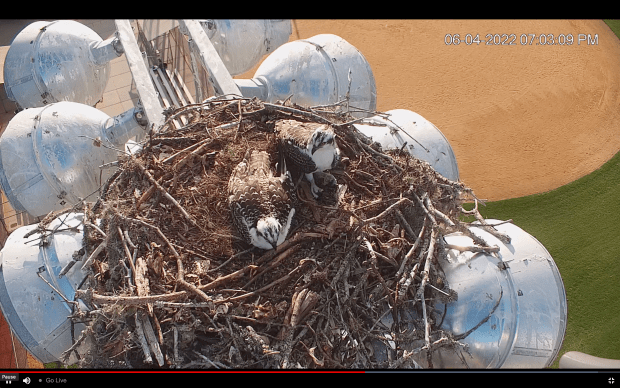
Everyone expected the first hatch of Big Red and Arthur to fledge first. She has been real antsy and jumping all around the railing. Instead, it was L2 the second hatch who took flight this morning at 0531 (very difficult to see the time under the Cornell information).
L2 is 45 days old!
Ready!
Gone!
It was a perfect flight over to Rice Hall.
Congratulations to Big Red and Arthur, Cornell and all those who love these beautiful Red-tail Hawks!
Thank you for joining me this morning. Take care. See you soon.
Thank you to Cornell for their streaming cam where I took my screen captures.
It was a fantastic day on the Canadian prairies. Clear blue sky. Sun shining bright and everyone happy – even smiling and saying ‘hi’ on the trails. Sadly, the birds thought it was beautiful too and they must have all gone sight-seeing! There were some American White Pelicans – 7 to be exact – hanging out with 9 Double-Breasted Cormorant. A female Hooded Merganser. A family of Canada Geese! And many Red-wing Blackbirds protecting territories where there were obvious nests. It was still nice to be outside with the sun beating down even if there had been not a single bird in sight.
There were two females on nests and these three goslings with their parents. This place should be crawling with goslings – everywhere. The flood really did a lot of harm.
The Redwing Blackbirds appear to have sentinels that stand watch or follow humans trying to lure us to one spot or another away from the nests.
There has not been a lot of time to check on all the nests. I wanted to see if Little Bit 17 had any food. He had an entire fish to himself yesterday but he needs food every day! It won’t always get it, sadly. Not on this nest. At 19:02:47 a Bluegill at 19:02:47. Everyone sort of looked at Dad and the fish. Then at 19:04:57 Little Bit stole it! I cannot tell you if he got any fish to eat but he worked on it until 16 – the one who beaks him – stole it from him. Then 15 took it and Little Bit moved over by the porch and did the snatch and grab and got some fish. There could be another delivery later.
It is not a huge fish.
Little Bit was quick! And he took advantage of a good situation. It is too bad that Dad didn’t just block the other two!
16 has the fish and 15 is going to get it away. Little Bit is at the top left watching and listening. Little Bit knows if 15 gets the fish he will get some food.
There is a scab forming over the bad peck that 16 gave Little Bit the other day.
Little Bit is by the tree snatching and grabbing bites from 15 as 16 watches.
At 17:37 Little Bit gets the fish head and moves with it to the top railing where he feeds off it until 17:50! Well done Little Bit 17! You will clean that head of every bit of fish flake like no one else. So happy.
Janika has been regularly feeding the storklets. The last feeding was at 22:54:10. The four have eaten well today. I thought maybe she would stay with them during the night but she is off hunting for food. Urmas has not removed any of the chicks. Perhaps Janika can make this work! I hope so. I wish she would find the fish basket provided for her.
The last two eggs hatched for White Storks Bukacek and Betty at their Mlade Buky nest in The Czech Republic. I cannot help but think that the two smallest will become brood eliminations but, maybe not. That is a lot of mouths to feed.
At the Cal Falcons scrape, Annie and Alden have done the most amazing job raising these two eyases. They are huge – full of energy and life and absolutely healthy. We will be forever grateful that the Avian Flu did not manifest itself in the West so that these two can take flight. Their names could not be more perfect – Lindsay and Grinnell Jr.
Meals happen outside of the scrape now and the chicks run up and down flapping their huge wings. Seriously – look at that wing!
These two have great fun playing with one another. Have a look:
There is something so stunning about the plumage of juvenile Ospreys – the patterning, the beautiful black and white. I do think they are much more gorgeous than the adults. Don’t tell them! Middle has been working his wings since Big fledged.
These two have eaten well. Mum and Dad really filled them up yesterday after getting Big back on the nest for breakfast. And it is nice that the heavy rains forecast for Gainesville as part of the Tropical Storm did not materialize.
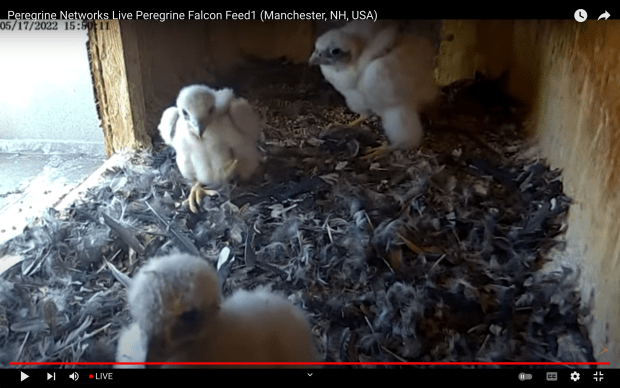
The five falcons at the Manchester NH scrape have almost lost all of their baby down. It is really something when food comes to the scrape. All are fed but oh, my what mayhem!
Aran and Mrs G are doing fine with the osplets. It is a wonderful streaming cam because you can hear rural Wales – the sheep bleating and the cows mooing. It is quite lovely if you live in a city like I do.
Despite the strong winds at the Dyfi nest, Idris and Telyn are keeping the osplets nicely fed and hunkered down. Bobbi Bach has really eaten well. He hatched on the 28th of May and is a week old today. Happy Week Birthday!
Poor Telyn. The wind has done a mess of her feathers.
When the third egg hatched at the Loch of the Lowes, I held my breath. It took Blue NC0 a few days to get it together to feed three. Now just look at them. Unbelievable. Lots of fish and this is what happens – fluffy little Osprey chicks with their soft grey down turn into Reptiles. Little Bob is not having any trouble. There he is in the middle of the pack at Mum’s beak.
All over England they are celebrating the Queen’s Platinum Jubilee but in Poole Harbour everyone continues to be delighted in the first three – yes, the third hatched – ospreys to hatch in Poole Harbour in more than 200 years!
In fact, of the birds translocated from Scotland to Poole Harbour over the course of a couple of years, three are now breeding. It has been an enormous success and a shout out should go to Roy Dennis Wildlife for his steadfast belief that you could re-introduce birds to a location by using hatches from another area (Scotland in this case).
You can read all about CJ7 and Blue 022 on Roy Dennis’s website here:
Roy Dennis writes extensively about this project in his book, Restoring the Wild.
Big Red took a break from parenting to sit on the lights in the sun today. It is quite crowded on that nest now!
The light was not so good to see the eyases but it was good to show the dark bands on the chick in front of the light box. There are five clear dark bands on that chick. From the length of that tail in comparison to the bird to its right, it has to be L1. I would suspect that there are actually 6 clear bands. She is ready to fledge!
What a year it has been for Big Red and Arthur with four eyases on the nest! Even at 19 Big Red continues to surprise us and keep us in awe. She is an incredible hawk and hawk Mum!
Thank you for joining me for this quick look at a few nests today. Take care. See you soon.
NOTE: My Sunday report will come in the late evening.
Thank you to the following for their streaming cams where I took my screen captures: Bywyd Gwyllt Glaslyn, Dyfi Osprey Project, Friends of Loch of the Lowes and the Woodland Trust, Cornell Bird Lab and RTH, ND-LEEF, UFlorida-Gainesville Ospreys, Poole Harbour Ospreys, Cal Falcons, Peregrine Networks, Mlade Buky Stork Cam, and the Eagle Club of Estonia.
I can’t speak for all Canadians but, in Winnipeg when the sky is blue and no rain is falling and the temperature makes it feel like summer, we go outside. We will find anything to do to keep us outside. Today, amidst the roar of songbird vocalizations I planted the Vermillionaires that are going to make the summer hummingbirds very happy. Neighbours were on their bikes, walking up and down the alley in their summer attire being friendly. I did not check a lot of nests as a result.
I am, however, going to start with the bad news first. The highly pathogenic strain of Avian Flu is not in Sitka, Alaska. This is not good news. There is a huge population of Bald Eagles in Alaska that live off the salmon. Our dear Kindness that fledged off the Glacier Gardens nest last year is one of those. For more information go to the link that Terry Carman has posted on the Bald Eagles Live Nest Cams and News today.
How many of you fell in love with Louis and Aila at the Loch Arkaig Osprey nest? was it in 2020? when they fledged Vera, Doddie, and Captain? Captain, a third hatch, was my big celebration that year. Loving parents Louis and Aila made sure that that wee one was fed. Indeed, Louis often fished at night and tandem fed the chicks with Aila. We were devastated when she did not return from migration in 2021.
Doddie has been spotted, photographed and the band number has been confirmed – JJ6. He was diving for a fish on the Shetland Islands. This is absolutely fabulous news! We wait for news about Vera and JJ7 Captain.
That is quite the distance. The males tend to cause some bother around their natal nests. I must check on this. The distance is quite interesting.
The Manton Bay Three continue to thrive. Blue 33 stands guard while Maya feeds the chicks. This is a brilliant strategy on Blue’s part. He is prepared – either to help feed the chicks or to fight off any intruders that might want to take advantage of the situation of three chicks and a single adult on a nest.
I love fat little ospreys. Well, I love fat little chicks on a nest – period. This means they are well taken care of. These three are growing so fast it is hard to believe.
Yeap. No one is going to mess with Blue 33 (11)s family. He even has a better ‘snake eye’ than Iris sometimes!
A nice big fish came on the UFlorida-Gainesville nest around 1:39. Mum fed both of them and by the time she was finished, each had huge crops! I thought it was going to be another day where it was 10 bites for Big and 1 for Middle but, in the end, it seems to have worked out relatively even. These two are seriously gorgeous birds.
The four eyases of Big Red and Arthur are growing and growing. It was a nice day and then it rained and rained on the Cornell Campus. The only ones that seemed to fit under Mum were L3 and L4. Sometimes being the first hatch isn’t all that nice! That said L1 and L2 have some nice feathers coming in.
River and Obey continued to come to the Dale Hollow nest to try and lure their two fledglings, DH14 and DH15 back to the nest. So far it does not seem to have worked. A partial fish was left and one of the adults returned at 1609 to eat it and aerate the nest cup.
This was earlier. The adults have moved the large twig over to the side also.
It was hot in San Francisco today and Alden was working hard to keep the chicks shaded.
Alden helped Annie recover from Grinnell’s horrible death. These two very healthy chicks are a great testament to the hard work that both Alden and Annie have put in to make sure they not only hatched but that they thrived.
We were used to Annie and Alden feeding the chicks 10 or 12 times a day – little tiny meals. Now that they are older they will have fewer meals but will eat more and will have enormous crops. Just look below at the crops and how big their feet are!!!! Perhaps it is the angle but the Little one (nearest us) seems to have longer ‘toes’ talons than the oldest.
For those of you who love that ‘high spirited’ Spirit at the Big Bear Valley nest of Jackie and Shadow, you best be watching her closely! She is branching and flapping and looking out to the world away from the nest. She was their miracle chick this year and Jackie looks on knowing that Spirit will not be throwing her little fits for much longer – we will surely miss them as much as her parents.
I want to close with another wonderful day for ND17. A very large fish landed on the ND-LEEF nest at 1942. Little Bit 17 was in the right place at the right time – indeed, the parent actually oriented themselves so that 17 was on one side and, I believe, it was 15 on the other. Little Bit ate and ate and ate. Another huge crop at bedtime! Get the tissues. This is nothing short of fantastic. Perhaps this female has decided that she should feed her littlest one!!!!!!!
17 is on the nest under the left wing of the adult.
You can see where 17 is clearly now and see the size of that fish. Incredible. That will feed everyone.
17 got right up to the beak. Notice how well he is protected when Mum actually turns to the little ones benefit. The two older siblings are not going to plow through her to get to Little Bit 17. Perfect location.
Little Bit 17 knows how to put the food down. Look at that beach ball crop. Three days in a row. I hope I don’t jinx it. This little one will grow and grow over night. It isn’t going to catch up with the other two – it is six days younger – but it will help with the feather and muscle development – all this fine fish. Such a relief.
Thank you so very much for joining me. Little Bit 17 with a full crop is simply a perfect way to end this blog this evening. Take care everyone. Tomorrow we should have some more UK Osprey hatches!
Thank you to the following for their streaming cams and/or FB pages where I took my screen captures: ND-LEEF, UFlorida-Gainesville Ospreys, Cornell RTH Bird Cam, LRWT, DHEC, Bald Eagles Live Nest Cams and News, Friends of Big Bear Valley, and Cal Falcons.
Thank you to everyone who wrote to me about the balloons. I am not ‘Debbie Downer’ but there are sure lots of ways of having fun other than sending balloons up into the sky as in the image below!
My comment about starting in elementary school reminded a reader, ‘B’, of an incident. Out in the wilderness a balloon was found. There was a note attached to it asking whoever found it to please call the teacher at the elementary school that had released the balloons. The finder did, indeed, contact the school but did inform the teacher about the dangers of balloons to all wildlife. I am certain she had no idea. This got me to thinking. We really need to spread the word somehow.
I know that many of my readers are teachers or individuals who have friends or family who are teachers or group leaders for Cubs, Guides, etc. We do need to start with the children but let us educate them to the dangers. So how do the teachers do this? and how can we create a web of understanding so that people do not feel criticized but who realize the dangers and want to help? Why not have balloons and the environment as a topic for a staff meeting? or a conference? I am certain that a wildlife rehabber would happily come in and educate teachers and students on the dangers of balloons. They might even bring one of their ambassadors. It would be a great topic that could generate lots of interest! If you know of someone who provides children’s parties, talk to them as well. There are many types of decorations that are much more planet and wildlife friendly and who doesn’t want to be on the sustainable and environmentally-friendly side? Most don’t knowingly want to harm birds or other wildlife; they just simply do not know the bigger picture and how a simple act of releasing balloons for a celebration can have a lasting impact on birds causing their death or disability. Spread the word!
I have several other concerns that focus on simple solutions to a huge problem for wildlife. Lead. The Institute for Wildlife Studies – Dr Sharpe and gang that manage the Channel Islands Bald Eagles amongst other projects including Condors have put out an information pamphlet about the alternatives to the use of lead. I am attaching it. They do presentations at various sporting events. Please read it. If you know someone who hunts or fishes and uses lead, please gently inform them of the alternatives. Thanks!
SF Bay Ospreys have posted an image of a crack in egg 2 for Richmond and Rosie. They believe that egg 1 is non-viable and stated that even egg 2 is late. It would be grand if 2 and 3 would hatch close to one another.
Duke and Daisy survived the storm that went through New Jersey last night. It is still windy today, though.
This is the view from the platform to where Duke does his fishing. Gorgeous. Just gorgeous. When you live inland on the prairies, you long for water! and sandy beaches! and mountains!
Middle Little O was on the Captiva Osprey platform with his long, long legs (he could challenge Idris in a couple of years) wanting some fish. Andy brought him a Lizard Fish this morning and later he brought him a Pinfish. Middle Little O is so loud — and always fish crying! So funny. [I could almost swear Middle Little O is a female].
I think the only time that Middle Little and Little Mini were hungry was when Big was alive. Andy and Lena are taking super care of their two surviving juveniles – their first since 2019. So happy for them. Andy is certainly devoted and doing his job getting fish to both the fledglings.
The five walking cotton balls at the Manchester NH scrape continue to do well. Enough food for all – eating,, sleeping, and growing. The fifth hatch is so cute! There he is by the exit to the exterior platform.
There are still serious issues for 17 on the ND-LEEF Bald Eagle nest. Prey comes in and at 14:26:19, he was able to snatch and grab a single bite. 17 has been conserving its energy by sleeping and was gnawing on some bones at various times. This is pretty sad. 17 is 6 weeks old today. Half way to fledge. The chick needs nourishment and the older siblings have always been aggressive and dominant.
17 did have a small PS. Oh, I wish for some food for this little one. It is hard having two great big siblings and being so small.
It is 15:13 nest time at the UFlorida-Osprey platform on the practice field. Middle has quite the crop. I don’t need to go back and check on a feeding. At some point while I was rustling up an electrician at the last minute, Mum came in with enough fish to fill Middle to the brim. That makes me so happy.
The storm left Big Red and the gang a little soggy yesterday. They are all doing fine. The oldest and the youngest have been flapping their wings today. It is like L4 says to the elder sib, “Anything you can do, I can do!” They are so cute. Watch at the end as they see a parent doing a fly by. Precious.
I haven’t seen any prey deliveries on the Dale Hollow nest. Both eaglets are still there. One found something buried in the nest and the other is watching closely as the sib tries to eat it. Hopefully some fish will come in later.
The chick at Cromer Peregrine scrape has been ringed. The measurements are inconclusive so DNA samples were taken to determine gender. The chick is either a large male or a small female!
Just look at the crops on the eyases at the San Jose City Hall Falcon Scrape. Wow. It’s so funny how you can tell if the crop is totally full – the skin looks really shiny where the feathers separate. Gosh they are cute.
Annie has a snooze and later feeds the two eyases. Cute, cute. Gosh. What is it? 8 or 10 days til they are ringed? Unbelievable. I remember when I was waiting to get my driver’s license and my mother assured me that time passed much faster when I got older. She was right. Weren’t we just waiting for a hatch yesterday?
These chicks always look like they are smiling and why not? They have Annie and Alden for parents.
The ND-LEEF nest is still the problem. I sure hope some giant fish arrive so that 17 gets some decent bites of fish. All of the falcon and hawk nests are fine. We are waiting for Osprey eggs to hatch in the UK.
Take care everyone. Thank you so much for joining me today. See you soon.
Thank you to the following for their streaming cams and/or FB pages where I took my screen captures: Cal Falcons, Cromer Peregrine Falcons, DHEC, Cornell RTH, UFlorida-Gainesville Ospreys, ND-LEEF, Peregrine Networks, Captiva Ospreys and Window for Wildlife, Barnegat Light Ospreys, and SF Bay Ospreys.
It was not a particularly nice day in Ithaca, New York. In fact, it was 2 degrees C when Arthur arrived at the nest this morning at 08:16:35. He brought some twigs, tested the nest bowl, and looked around. Arthur has really been bringing twigs at an exhaustive pace recently. According to one of the founders of the FB group, Big Red did once lay her first egg on 13 March. Are we in for an early start this year? Or does Arthur know that bad weather is coming and realize that when it is good to restore Big Red’s nest he should waste no time? Arthur, you are quite adorable.
Arthur was still scurrying back and forth with sticks two hours later.
My very first love was an urban hawk – a Sharp-shinned Hawk that visited my garden one frosty January day. I ran out in my slippers and housecoat thinking that the hawk had killed and was eating the garden rabbit, Hedwig I. The hawk kept eating until I got within 15 cm or 6 inches of her. I have learned so much since that early morning and I would never ever go out and interfere with Sharpie having some breakfast or lunch now. She was not eating the rabbit but a sparrow. We looked into one another’s eyes for several minutes, not moving. She was the most beautiful creature I had ever seen. And how blessed I was – looking into her eyes that morning changed my life. Thankfully, I quietly returned to the house and Sharpie finished.
As a result of this beautiful, close encounter, I have an interest in urban raptors that has grown over the years. Sharpie still comes to visit the garden. Of course, I now also know that Sharpie is a male! He is very cheeky – always pausing to see if I am watching from the window he will turn his head til our eyes meet and then he flies away. I always wonder where he roosts and how far his territory extends. It seems that the peregrine falcons are in the centre of the downtown area which is between 4 and 4.6 km away from where I live. So it would seem that their territories do not overlap. It is curious. I think he has a route and I know that he is ‘mad’ at me for removing a twenty-foot tall cedar tree. The little birds would get inside that tree filling it up. Sharpie would come ripping through a small space between my house and the neighbour’s making a sharp right angle turn into the tree. He was always successful at hunting – always. Sadly for all of us, we had a four year drought and no matter how much water the tree was given it simply was not enough and wasn’t the heavy rains that nature provides. It died and had to be removed. Now, Sharpie really has to work for his lunch. And if you are wondering, yes, I have thought about planting another large conifer for Sharpie! It isn’t a cat or dog that rules our house but the garden animals!
Sharpie was very puffed to stay warm on his last visit. It was -32 that day. He is sitting on his plucking post and if he raises his head slightly, he can see me watching him from the kitchen window. I do not go outside when Sharpie is hunting so all of the images are through glass – and he is fast. Not as fast as a Peregrine Falcon, of course, but fast enough for me not to be able to grab my good camera — unless, of course, he is eating lunch which takes about 35-40 minutes.
He glances back to me and is gone in a blur. Such a beautiful much loved raptor.
Robert Yolton writes a great blog on urban raptors. His focus for years has been the Red-tail Hawks that live in and around Central Park in NYC. While he writes about other birds in the area, I really enjoy this time of year when he begins to report on the hawks preparations for spring breeding season. On 16 February, five days ago, he has lovely images of the couple whose nest is on a balcony of a high rise apartment at 84th and East End Avenue. He wonders if they are merely working on the nest or if the eggs will be laid early this year. And that, of course, is what we are wondering about Big Red and Arthur. Yolton’s reports are always accompanied by beautiful photographs. One other recent one has images of hawks, Kestrels, and a Great Horned Owl in Central Park. I urge you to take a look at his blog: urbanhawks.com You will not be sorry!
I have checked in on the three Osplets at the Captiva nest in Florida on and off today. It was actually wonderful to see my daughter today which meant that I was not sitting and counting the bites Little Bob got in a feeding! Here they are all lined up from the eldest on the far end to Little Bob on the end close to us. They look like a choir. I hope this continues. It reminds me of the three Port Lincoln lads (until they fledged).
Speaking of Port Lincoln lads, if you missed it, Ervie visited the barge yesterday. He was there from 19:15-20:31. He missed seeing Dad who arrived half an hour after he left.
Port Lincoln has asked everyone along the north shore to kept an eye out for Ervie. This is his latest tracking in the area. The green pin indicates his position at the time of the tracking. Continue to notice that Ervie goes back to the nest on the barge. For several weeks I have said that I felt Ervie would continue to stop in. Let us all hope so! It was lovely to see him yesterday. He is in good form.
One of Ervie’s greatest fans is ‘A-M’. She believes that Ervie stopped by to see Dad and to tell him, “ I found a place, it’s cool. I need help moving sticks and nest stuff. Come visit and bring fish!” It brought tears to my eyes. This is the first time I have been able to watch the interaction between the adults and the juveniles after they have fledged other than the adult bringing a fish and getting out of the way quickly. There was something very heartwarming about seeing Ervie and Dad just sitting around the sticks, as if it could be a campfire, with one another.
So keep watching the Port Lincoln Osprey barge. You might catch a glimpse of our handsome Ervie.
After seeming to be missing in action for two days, the male GHOW at the Savannah Owl nest has returned. The Mum was so excited. His return is on video when he brings a nice fat rodent for her to feed the owlet. The sounds from the owls is adorable.
That is excellent news. With all the intruders at that nest, including that Red-tailed Hawk, it would have been almost impossible for the Mum to raise the owlet alone. Cornell did a very cute video of the female GHOW feeding the two-day old owlet Dad’s prey. Have a peek:
Gabby and Samson are doing a great job trying to entice NE26 and 27 to self-feed. Fish are brought to the nest unzipped and left for the two hungry eaglets. So far NE27 who learned to feed itself more than a week ago has done the best. After the eaglets work on the fish then either Gabby or Samson comes in and fills the two up! This nest is doing so well. No one is hungry.
That old saying is knock on wood. And that is what I am doing. It seems that the nests are doing well. If you are a fan of the National Arboretum nest, Lotus laid her second egg yesterday – the 20th of February – at 18:39. Bella and Smitty are both working on the NCTC nest. Another eagle has been seen soaring and both Bella and Smitty have taken to easing it out of the territory.
The couple at the new Bartlesville Oklahoma Bald eagle nest are incubating two eggs laid on 15 and 18 February. I grew up in Oklahoma and it will always hold a special place for me. I hope this couple are successful and have to great fledges. The link to the camera is:
Look closely at the image below. Do you see a ‘meadow muffin’ or a ‘cow pie’? Looks like the Oklahoma eagles have a unique item that they are going to line their nest with!!!!!!! Can I say ‘only in Oklahoma’?
Thank you so very much for joining me today. Take care everyone. See you soon!
Thank you to the following for their streaming cams and FB where I took my screen captures: The Sutton Group, Port Lincoln Osprey Project, Window on Wildlife, Cornell Bird Lab, and NEFlorida Bald Eagles and the AEF.
If you have watched Kindness, the Bald Eagle nestling at Glacier Gardens, then you might have caught her nipping at her mum’s beak. It looks like she is trying to kiss mum. A couple of days ago a video was made showing Kindness interacting with her mum. My goodness, Kindness, you are lucky your mum is so patient! Have a look.
At the Port Lincoln Osprey barge, it looks like the final touches have gone on the nest renovations. The egg cup is now lined with very soft pieces of bark. Mom decides to try it out!
Dad flies in with something else on his mind! No eggs yet but mating is taking place. Season will begin soon!
As we approach fledging at all of the Northern Hemisphere Osprey nests and migration in a month to six weeks, if you fear Osprey withdrawal, here is the link to this nest. Just a warning. This nest has had instances of siblicide in the past.
The Port Lincoln’s eldest chick from the 2020 season, a female named Solly, was fitted with a satellite tracker. Solly is 301 days old and she is still hanging out at Eba Anchorage and Kiffin Island. It sure seems that Solly has found her forever home at Eba Anchorage. For those of you unfamiliar, the movements of Solly changed what everyone understood about Ospreys in Australia. It was believed that ospreys stayed near to where their natal nest was located. Solly travelled over 200 km to Eba Anchorage and Perlubie giving the researchers fresh insights to the behaviour of these ospreys.
To my knowledge there has been no sighting of DEW, her younger brother. He did not receive a tracker but he did get a metal ring and a Darvic colour band.
Suzanne Arnold Horning was on the Cornell Campus again this evening. How lucky she was to get some great images of Big Red with a squirrel down on the ground – and it wasn’t raining. (Send the rain to the Canadian Prairies when you get tired of it, Suzanne!).
It was wonderful to see Big Red with prey that she was going to eat herself. She needs to build up her strength after laying eggs, incubating those eggs, and feeding and caring for the three Ks until fledge. Even now she is doing some prey drops and is busy training the Ks to hunt.
Big Red with Squirrel. @ Suzanne Arnold Horning
The Robins were giving Big Red a lot of grief. Could it be because Arthur has been up at their nest eating their babies? Or the fact that K1 caught a bird today and it was rumoured to be a young Robin?
Robins being rather assertive around Big Red. @ Suzanne Arnold Horning
Big Red and her squirrel also attracted another visitor – a Turkey Vulture!
Would you mind sharing asks the Turkey Vulture. @ Suzanne Arnold Horning
The pair also attracted a human who was said to have tried to interfere with the situation. Both of the birds were fine. Big Red was eating and the Turkey Vulture appeared to be waiting to see if she left anything.
One of the things that I have learned is that hunting is difficult and prey is not abundant always. Raptors can wait for hours, half a day, or even a day to catch prey to eat. It is estimated that only 1 out of 3 juveniles live to the age of two years – mostly due to starvation. Humans should not interfere when a raptor is eating. As a result of the human intrusion, Big Red chose to fly away from the human who was interfering. This also caused her to leave part of her meal. The vulture did eat the rest – so in the end everyone ate- but it was a situation that should never have happened. Remember if you see a hawk hunting or eating, please leave them alone. Finding their meal is not that easy.
Turkey Vulture at Cornell. @Suzanne Arnold Horning
The scientific name for the Turkey Vulture – Carthartes Aura – means ‘cleansing breeze’. They are scavengers, eating mainly carrion. They have dark espresso coloured feathers, red legs and head, with a white beak. Like the condor, there are no feathers on their head. This is a great evolutionary trait so that pieces of the dead do not stick to them causing disease or parasites. The Turkey Vulture’s sense of smell is so great that they can find a fresh killed animal a mile away! The only raptors larger than the Turkey Vultures are the Eagles and the Condors. What I find interesting is that they are the only raptor that cannot kill their own prey. They simply do not have the right talons to do this – their feet are more like that of a chicken. That said they can tear through really tough hides with their beak. In other words, the Turkey Vulture was never a threat to Big Red.
As I prepare to settle in for the night, Tiny Little is waking up. The early morning fog over the marsh is just starting to clear. You can see the parents, or siblings, or both back on the parent tree. Tiny Little is still sleeping like a duckling on the nest. Good Morning Tiny Little! Let’s get that gear box into forward today.
Tiny Little is also checking the nest for any little tidbits of leftover fish. And just like Tiny Tot he has found some lurking under those sticks.
Tiny Little was doing some prey calling and looking up in the sky. The morning fog doesn’t seem to be clearing. What a beautiful colour it is – that sort of golden pink gradually fading into the grey-blue-green. Lovely.
Update: Tiny Little had a huge breakfast. It is now mid-afternoon and Blue 462 is working on a fish that arrived. 464 is standing next to that fish and Tiny Little, 463, is ignoring it right now. She is probably still full enough from the morning not to bother. Unclear if Tiny Little has taken a second flight today. I stayed up waiting! But had to give in to being tired.
This is the image of the afternoon line up for a fish! 462 is eating, 464 is pretending to be Tiny Little and bugging his big sibling. Tiny Little is over at the side duckling style. Tiny Little is full from breakfast and knows that Mum will come to the rescue later if she gets hungry.
There is a beautiful peachy almost coral sky as the morning begins at the Poole Harbour Osprey nest. CJ7 and Blue 022 are roosting elsewhere.
Golden diamonds are falling on the nest of Blue 33 and Maya at Rutland Manton Bay. No one is home. They are all perched elsewhere. Blue 33 does make food drops at the nest for the two Bobs.
A little later, Blue 095 flies into the nest and settles down and then flies out again.
Blue 095
Oh, wow. Just look at that sun coming up over the Dyfi nest of Idris and Telyn in Wales. It is so bright you cannot see the perch!
A very short video of Ystwyth fledging at 7:59 am on 17 July is here:
It is serene up at The Loch of the Lowes. No one is home but it sounds like there is a fledgling on the camera perch.
What you don’t see here is that later, NC0 is on the nest, spots a fish, goes out and gets it, and gives it to LM2.
Early Morning at Loch of the Lowes. 18 July 2021
The only thing you can hear at Glaslyn are either bees or wasps on the microphone! Oh, it is so beautiful and green. It has been hot at this nest, 26-29 degrees C – and the birds are staying cool in the shade of the trees. Even with the heat the landscape looks so lush. What a gorgeous way to begin the day.
Early morning at Glaslyn. 18 July 2021
Thank you so much for joining me today. I so enjoy hearing from all of you. Stay safe! See you soon.
Thank you to the following for their streaming cams where I took my screen shots: Byrwd Gwyllt Glaslyn, Dyfi Osprey Project, Scottish Wildlife Trust and Friends of the Loch of the Lowes, Cumbrian Wildlife Trust and the Foulshaw Moss Osprey Nest, Poole Harbour Osprey Project, LRWT and the Manton Bay Ospreys. I would also like to thank the Port Lincoln Osprey Research Project and the PLO FB page where I took a screen shot of Solly’s recent tracking. And last but never least, I would like to say a huge thank you to Suzanne Arnold Horning for allowing me to use her images on my blog. She holds the copyright on them so please do not use elsewhere. Thank you.
It is called Reverse Sex-size diamorphism. There are several theories as to why this happens with Red-Tail Hawks.
The first is that the females had to be larger to protect themselves from the feisty males.
The second is that the females selected smaller males to be their mates because the size difference allows each of them to hunt different prey and reduce any competition for food between the pair. Raptors that hunt birds are generally smaller and faster with the female specializing on larger prey. At the beginning of the nesting season, the female becomes an active hunter and again when the nestlings are larger. Generally the adults tend to partition the prey resources in their territory.
Another theory is that the females need to be larger because they must accumulate reserves in order to produce eggs. When they are incubating eggs and brooding young, they rely on the male to feed the family. Red-tail hawks are usually born in April when the prey are sluggish and just coming out of hibernation. Small males can make quick turns. In the case of the Red-tails on the Cornell Campus, Arthur W, the male, is known as the ‘stealth bullet.’ He is quick, fast, focused, and quiet when he hunts. Big Red’s former mate, Ezra, was like Arthur W a great hunter but he was also about 30% smaller than Big Red as is Arthur.
Ezra has his wings spread and his legs tucked tight. If you look closely you will see that he is delivering two items to Big Red. The first is a snake and the second is a flower! It is very difficult to get Big Red and Arthur to stand up straight at the same time. They certainly do not listen to requests from humans!This is the closest I have come to finding an image that might be able to show you the difference in their size. Big Red is on the left and has her head leaning back preening and she is a little more slumped than Arthur who is on the right.
In terms of the nestlings, the only way to positively known the gender of the bird is through either a DNA sample or you see them laying an egg when they are older. Everyone likes to guess the sex of the chicks growing in the nest cup. Using reverse sex-size diamorphism, we speculation whois a female by their overall size as they grow in the nest and the size of their feet. But again, no one can be absolutely sure. In the past one of the small nestlings was always believed to be a male. This particular bird injured its wing and, as a result, had to be taken to a vet. The bird’s DNA was tested and, to the surprise of many, it was determined to be a female. So not every small Red-tail Hawk is a male!
In terms of the relative size of each J, J1 is the largest of the three. Early in its development, everyone noticed the large size of its feet. Now as a juvenile, J1 remains the largest of the three siblings. But there is something else about J1 that I personally find fascinating. J1 is very much interested in nest maintenance. She can be seen, even today, mimicking Big Red in attempts to vent the nest bowl. She rearranges the nest twigs and on the second day after she fledged, she brought a branch to the top of the Rice patio. There seems to be 100% agreement that J1 is going to be a good mama like her mother, Big Red.
J3 in the front and J1 behind watching J2 fledge. Look at the difference in the size of their legs as a starting point.
J2 on the other hand is also a large bird, not as large as J1 but larger than J3. J2 was actually the first egg to be laid but the second to hatch and is, therefore, actually the oldest. His fledge was more like a fludge when he climbed up on the light box and then slipped but his flight was still remarkable. J2 has continued to be a very, very strong flyer already interested in hunting. The shape of “his” head – you will notice that I continue to use the term “his” – is also different than that of J1. He has an intense focus and besides bugs and insects he has already been interested in small birds in the territory. To my knowledge he has not caught one. He is also very aggressive. A few of us believe he is truly a male and will be a great hunter like his dad, Arthur W.
J3 eating his first prey drop after fledging.
J3 is the problem child that everyone loves. . J3 was born four days after the other two and it was also the last egg to be laid. Taken together, J3 is actually a week younger than its siblings. That is a lot in the life of a Red-Tail Hawk chick. It may also account for the fact that Arthur W brings food to the nest tower in an apparent effort to feed J3 away from the two larger siblings. Let me try to explain what has been happening. Normally the juveniles are spread out being individuals. This trio is quite different according to the people who have monitored all of the broods on camera (since 2012). It is because they tend to congregate together. To hang out. If one is on the Rice patio, all three might be there.
All three on what is called the Rice patio. Arthur W often makes food drops here but it is also a safe and flat site where they can sleep in the sun or practice their skills.
They might all be on one of the towers including the nest tower. Still, on occasion, they go their separate ways.
J1 in one of the oak trees near the Fernow Building looking at a squirrel.
A prey drop is just that – one of the parents dropping lunch. The juveniles will, unless they have recently eaten, fight for the food with the most aggressive mantling the prey. Unless the prey item is too large for the chick to eat all at once, sharing doesn’t seem to happen. So, because of J3s size and a seemingly lack of aggressiveness in comparison to J2, J3 is somewhat at a disadvantage. This is the reason that I believe Arthur W still supplies food on the nest to the little guy.
Arthur has been dropping lunch off to J3 for several days now. This was around 3pm. He seems to be looking for J3 who arrives almost immediately.J3 mantling the prey that Arthur W dropped on the nest. Remember mantling is a way of protecting the food item so that no one else can steal it.J3 finishing up his afternoon snack.
For now, the gender of the three juveniles is sheer speculation. There are no banding practices and no GPS monitors on the Js. In other words, no identification. It is only when one of the juveniles might find its way to the vet and be both recognized and tested that the sex would be determined.
Tomorrow we are going to talk about the importance of preening.
Little J3 spent the night of June 14 on Rice, apparently alone. He flew back to the nest hoping to have breakfast at 7:46 am on June 15. Arthur quickly awarded him with a squirrel which he mantled with both feet. The little guy was really hungry and no one was there to steal his food! Great hawk reflexes though. A couple of hours later Arthur returned with a chippie. Full to the brim J3 spent the day lounging on the grating or the natal nest, sometimes sleeping on his favourite leaves. At sunset, he flew back to the Rice building where he spent the night. He was just waking up this morning, stretching, and sleepy.
J3 on the nest tower thinking about flying over to the Rice building to spend the night. J3 getting into the line backer position to take off. He is really getting his flying skills down.J3 getting in position to fly off of Rice to head back to the nest where he will spend his day eating the food drops from Arthur. He will fly out and over to Rice to spend his second night there. J3 is figuring out how to tuck up his landing gear!Arthur delivering breakfast to J3 over on the nest tower. A nice reward for all the effort of his fledging the previous day.This is an excellent example of mantling prey – protecting it so no one else can get it.The rear view of J3, now relaxing with no sibs about, eating his lunch chippie.
J1 also spent a bit of time on the nest rearranging the oak leaves that Big Red had brought in but most of her day was spent on top of Rice where her and J2 received prey drops from Big Red.
Around 5pm she made her way to the trees in front of the Fernow Building. At one point it looked like she wanted to get to the nest and she began breaking branches to aid her flight. Very intelligent. She then changed her mind. When I left her last night at 7pm she was in the Oak tree preening and this morning she was with a squirrel in one of the Oak trees in front of Fernow.
J2 is harder to keep up with as he is our “stealth bullet baby”. J2 has amazing flying abilities. It is like he skipped the learning stage and went to advanced intermediate. Yesterday he was aggravating a bunch of robins near the old coop buildings on the Cornell campus.
It is now the morning of June 16 and all is well with the J family. They are fed by the extraordinary hunting skills of their father, Arthur, aged 4. Their mother, Big Red, aged 17, keeps a close eye on the chicks. I wish I was on the ground chasing them about in Ithaca but, sadly, not. Postings about their development and happenings will appear daily albeit they could be short.
In the meantime preparations are ongoing, around the world, for the very first World Albatross Day on June 19. Stay tuned for information on that event as well as the challenges that both the Red Tail Hawks and Albatross face living with humans and machines.