Monday Morning in Bird World

25 February 2022

It is a beautiful morning on the Canadian Prairies. The sun is out a little bit and white snow fell overnight. The birds are very happy. They do not like the 45 kph gusts last night or the torrential rain on Saturday. I am also feeling lucky that we are not flooding and sad for the people and wildlife that are struggling with continuing flood waters in southern Manitoba and at various parts of Winnipeg.

I am going to begin with the sad news.

I wanted to make sure before I provided any more incorrect information about Little Bit. I have been monitoring the nest for many hours at UFlorida. Despite being fed Sunday after 86 hours without food, Little Bit lost its struggle to live. The precise time is unknown. The tiny wee one was almost delirious eating fish yesterday. It was such a joyful ten minutes watching Little Bit have some fish. It made us hopeful. At the time, the little one had not had a ps in a long time and at what point are its internal organs damaged? The heat at the top of the nest is hugely problematic in terms of hydration if fish are not consumed for that is where the osplets get their water. Little Bit got to eat because three fish came on the nest in quick succession. With the arrival of the third one, Big beaked Little Bit and fought with Middle. After some fish, the older two finally collapsed. It was only on their collapse that Little Bit got to eat and eat it did for ten minutes. I bet fish never tasted so good. Then another fish arrived, a 4th one, at 18:32:45. The female dragged that fish right across Little Bit’s head. It looks as if that is the precise place where Little Bit passed on. I had hoped for a miracle for this third hatch who wanted to live and who had such a wonderful start to life. This nest truly looked promising. The turn came on 10 April and for the past two weeks the baby suffered great abuse. There was a bit of a reprieve on the 18th and then the programme of siblicide began again on the 19th. — Those are a summary of the facts as we know them of Little Bit’s struggle to live on this nest. I had so hoped you would be alive and eating this morning, Little Bit. It was not meant to be. Fly high, Little One. Fly high. Soar.

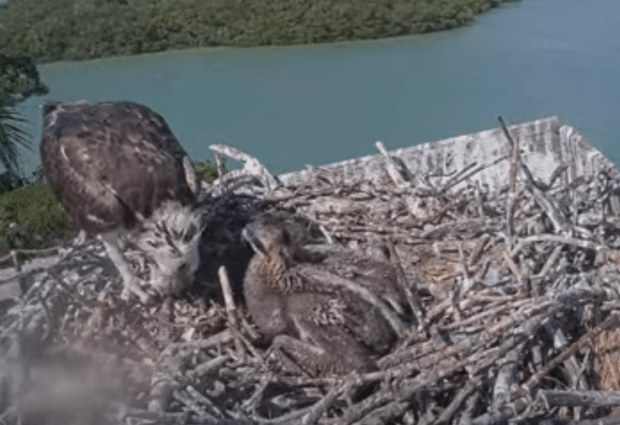
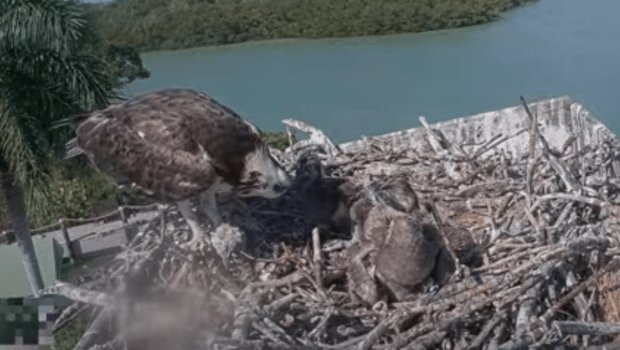
The Osprey nest at Captiva is vacant this morning. Middle (or Little) was there yesterday. The parents should be feeding the chicks off camera. There has been no word on Little (or MiniO) since she fledged. If you look at the tree closest to the shore to the left of the scrape box you will see what I believe is an Osprey. This was Middle (or Little’s) tree that it liked to sit on. Perhaps it is him.

If you are in the market for a property at Captiva with an Osprey and Eagle nest, Lori Covert’s property is for sale.

The falcons and the hawks have been ignored, at times, in favour of the eagles and the ospreys so I want to check on some of these other nests while returning to a couple of Osprey nests that are normally very stable.

There is a Red-tail Hawk nest streaming cam in San Francisco at The Presidio. I had no idea. What a surprise in the wee hours of the morning when it just appeared. There are two chicks. They still have their white down and they are feisty!

The Presidio’s resident Red-tailed Hawk pair have been hard at work preparing their nest 100 feet up in one of the Presidio’s blue gum eucalyptus trees. The information tells me that “The Presidio is an important stop on the Pacific Flyway, the major north-south flyway for migratory birds, which means it’s a hotspot for birdwatching with 323 different types of birds spotted (so far!) in the park.”

The two eggs were laid the middle of March. The site does not state when they hatched but they look to be less than a week old but slightly older than Big Red’s chick, L1.

I do not know anything about this nest but I am quite excited. With only two chicks in this nest, both of them should grow happily. In general, it is easier to watch the hawk and falcon nests than the eagles and Ospreys as food competition and sibling rivalry are much less frequent.

Breakfast Monday morning. So well behaved like little falcons normally are.

This is simply fantastic news. Here is the link to follow this Red-tail Hawk family in California!

Early morning at the Buckinghamshire Council offices in the UK and there is that beautiful Peregrine Falcon. No eggs yet. Predicting soon!

We also have Peregrine Falcons in Manitoba. There are several streaming cams as part of the Peregrine Recovery Project. Ella and Pip have their scrape on the top of the Radisson Hotel in downtown Winnipeg. The couple have three eggs. Check out The Peregrine Chick on Twitter for news.

The last of the three eggs were laid on the 22nd of April and now it is hard incubation. Egg 1 was laid on the 17th with egg 2 on the 20th. Ella was tucked up tight as the cold weather returned to the ‘peg.

One of the great things that the local group has done is to compile a listing of Peregrine Falcon cameras in North America as well as world sites. It is not comprehensive as I see it does not include the Utica, New York scrape. Utica, you might want to send them a note and ask to be included. On that same page as the listing are a number of books related to Peregrine Falcons and other links. For the cameras, you just have to click on the site and presto – another cam with falcons to keep you awake!

http://www.species-at-risk.mb.ca/pefa/r-resources.html

I cannot find the live feed for the Utica cam of Astrid and her mate but, an article was posted on on the 24th on Falcon Watch Utica FB page.

It was a gorgeous morning at the Cape Henlopen Osprey Nest in Lewes, Delaware this morning. Mum and Dad were both on the nest. Dad kept coming to see if he could have a turn at incubation and Mum kept refusing!

The site will not let me embed their camera link so search for the nest at YouTube.

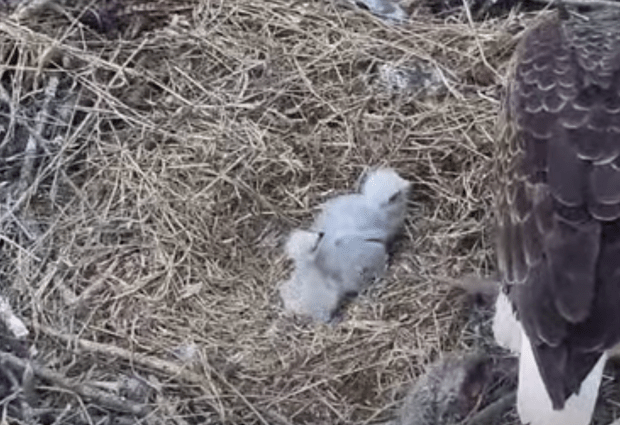
L3 has hatched for Big Red and Arthur at the Cornell nest in Ithaca. That happy event happened at 06:03 this morning. Lined up from left to right: L3, L2, and L1. Big Red is trying to convince them that they want an early morning breakfast!

It looks like it is hard to keep 3 moving chicks and an egg comfortably under you, Big Red.

It is hard to see from the glare but Rhett and Scarlett are back making nestorations and mating on the Savannah Osprey Nest that was previously leased to the Great Horned Owls. I wonder how the season will go. It is late Osprey eggs in the region but, I guess we will find out!

Here is the link to this camera. Note that the Ospreys are not always on the nest.

Annie and Alden at the UCalifornia-Berkeley’s Campanile scrape are doing fantastic. What a great team they are! During the Q & A a question was asked about Alden’s personality or character. We learned some very intriguing things about Annie’s new mate. The first is that he ‘sings or talks’ a lot more than Grinnell. Alden also likes to hunt at night. The raptors are asleep but the other birds are awake and flying. The light pollution aids in hunting but the falcons have good night vision. This could also help Alden with his hunting since he has a badly healed injury in his left ankle area (this is what CalFalcons believes observing him). Alden has no trouble killing his prey but he might have difficulties holding on to it so if he dropped it at night there is less chance that a predator would get it! Smart one, Alden. It might surprise you but Cal Falcons noticed that Alden is much more aggressive in his defence of Annie and the eggs and the territory than Grinnell. For now, Alden is working hard for Annie and those three eggs. That is his only focus!

Hatch watch is May 5-6 and Sean and Lynn will be holding another Q & A at that time. These are great opportunities to learn about falcons! If you miss them, the couple are great to archive them on YouTube for you. Here is the link to the CalFalcons cam:

If you are wanting to watch an Osprey nest, I cannot recommend one more highly right now than Richmond and Rosie at the Richmond Shipping Yards in San Francisco Bay. They are a solid couple that has no trouble raising three osplets! This year they have three eggs that hatched on April 5, 8, and 11.

Here is the link to the camera of the SF Ospreys and Golden Gate Audubon:

Home

Do you love kestrels? The first egg has been laid in the Yorkshire Dales kestrel nest! It arrived yesterday, the 24th of April at 12:50.

The Jackdaws have been a problem for this raptor couple. I hope they do not return! Here is the link to the camera which is operational from 08:00-20:00 daily, nest time.

The Cornell Bird Lab also has a kestrel nest that has four eggs. The fourth was laid on 23 April at 12:11 and it appears that hard incubation may have begun. This nest has not had a problem with Jackdaws that I am aware of!

Here is the link to this Kestrel nest in Wisconsin:

At 10:39, Mum and the two eldest surviving chicks on the UFlorida-Gainesville Osprey nest all had large crops. It is very possible that like the Dale Hollow Bald Eagle nest, this Osprey nest will settle down and there will be no more food rivalry. Only time will tell if the fish deliveries can keep up with the demand.

Thank you for joining me today. This has been a hop and skip around some familiar nests with some new ones added. I will check on all our favourites later today. Take care everyone. See you soon.

Thank you to the following for their streaming cams and/or FB pages or Twitter feeds: UFlorida-Gainesville Ospreys, Captiva Ospreys and Window for Wildlife, Presidio RTH SF, Buckinghamshire Council, Peregrine Chick, Utica Peregrine Falcons FB, Cape Henlopen SP Ospreys, Cornell RTH, Landings Savannah Osprey, and Cal Falcons.

Friday at the Captiva Osprey Nest

08 April 2022

As Ospreys return and eggs are laid in the UK and northern areas of the US, it is time to stop for a second and congratulate Andy and Lena, Lori Covert, and the team at Window on Wildlife for a very successful year at the Captiva Osprey Nest.

Lena and Andy incubated three eggs. The hope was that the Crows would not predate them. All hatched. Big Bob hatched at 21:24 on 16 Feb while Middle Bob came along about five hours later at 02:02 on the 17th. Little Bob joined the pair on the 19th at 16:29. Sadly and without any notice, Big Bob died on the morning of 15 March; he was 27 days old. Middle and Little Bob (affectionately known as Mini) have thrived. Today, Middle is 50 days old and Little is 48. The average nesting period of Western Ospreys is 50-55 days. We are now approaching fledge at Captiva. After fledge, the fledglings return to the nest to be fed and to work on their flying before leaving the parent’s territory.

Here is an assortment of images of Lena and her babies from 08 April 2022. There is still lots of fish arriving on the nest. It seems Lena is always feeding the chicks.

Lena is a very devoted mother.

Little Bob still loves to look over the side of the nest!

Food coma.

Seriously look at how big Little Bob is standing up so straight.

Soon Lena will be able to rest her vocal cords! Here she is reminding Andy that the kids would like to have a fish before bed – and so would she!

What a gorgeous image as the sun sets and sends that beautiful rose-gold tint over Lena and the babies.

Lori Covert is an excellent steward or custodian for the wildlife that have their nests on her property. Last year, Connie and Clive lost their two eaglets, Hope and Peace, to rodenticide poisoning. In that same year, fishing line was noticed on the nest and Lori promptly had CROW out to remove it. This year fishing line was noticed on the Captiva Osprey nest. Lori and Window on Wildlife posted the following on the information below the streaming cam:

3/28 Update: There seems to be a bit of fishing line in the nest. If it is causing significant issues, and we can document it, we will ask permission to retrieve it. The line seems to be embedded in the nest and would be a major operation to remove without damaging the nest or putting the chicks in danger. Will monitor it very closely. If it becomes an immediate danger, we can act within hours, as we have a ladder on site ready to go.

There is still time to enjoy watching these two Ospreys. What a great vantage point to see them begin to hover and fly! If you have never ever seen an Osprey hover, you are in for a real treat. Little helicopters. Here is a link to the streaming cam:

I want to thank Lori Covert and Window on Wildlife for their love and care of this wonderful Osprey family. The mods on the chat have been excellent and information has been passed on to those watching as it becomes available. Window on Wildlife also had a streaming discussion session after Big died. It was awesome. The Captiva Osprey Nest has and will continue to be a joyful nest to watch for the rest of the season! Check it out.

Thank you for joining me today. It is always such a treat to talk about a successful nest. Take care everyone. See you soon.

Update on Karl II: Karl II is on the nest in Estonia. The camera should be operational shortly. Relief.

Thank you to Lori Covert and Window on Wildlife for the streaming cam where I took my screen captures.

Ervie visited the Port Lincoln Barge today!

31 March 2022

It was actually the morning of 1 April in Port Lincoln, Australia. Our favourite Osprey, Ervie, arrived at the barge at 09:04:55. Mum and Dad had been down in the shed for quite some time and they had spent the night on the nest.

Here comes darling Ervie.

Ervie stayed on the nest until 09:07:47 when he flew down to the shed and joined his Mum.

I am sorry Ervie missed Dad. I am imagining him telling Mum all of his adventures with the Puffer fish and where he spends his time.

He flew off at 09:40:27.

Ervie seems to have his roost in a Norfolk Pine that he was photographed in awhile ago. That tree is located between Bligh Street and the Axel Stenross Museum. According to Port Lincoln Ospreys FB, people are constantly talking about seeing Ervie. He is certainly a Port Lincoln icon!

Here is Ervie’s latest tracking:

It has not been a good day in Bird World. Grinnell was found dead in downtown SF and Annie will eventually leave their eggs not ever knowing for sure what happened to her mate of six years. Little Middle now has the monofilament and nesting material around his right toe/s. And neither River or Obey brought Big or Middle Little any food since leftover fish in the early morning.

So, Ervie you gave us some sunshine and a smile. It is wonderful to see you in such good shape. It is so reassuring. Thank you for your visit today – we all needed it! Take care of yourself.

Thank you for joining me this evening. I am still stunned by the announcement of Grinnell’s death. Take care of yourselves. If you are a fan of Ervie, go to YouTube and see him. Check the time stamps above. See you soon.

Thank you to the Port Lincoln Ospreys for their streaming cam and FB page where I took my screen captures.

Tuesday Afternoon in Bird World

08 March 2022

I was very concerned about Middle and Little Bob at the Captiva Osprey nest after Big Bob’s bopping. Big has certainly caused a fright in Little Bob that really causes him to hang back now instead of getting up there in front, no matter what, like our sweet Ervie.

Well, a Sheepshead came on the nest and after Big got his fill there looks to still be enough to give a good feed to both Little and Middle with some for mum Lena.

Middle is certainly getting its fill but what about Little?

Shadow and Jackie are such an amazing couple. I love how they chit chat to one another. Shadow has been bringing in lots of fresh fish to the pantry for all three of them to eat.

Jackie and Shadow are such proud parents. They are not only making certain that the little one is fed often and there is plenty in the pantry but also that any would be predators do not get even close to their nest. Very protective of this only little eaglet – their miracle.

Jackie has taken care of the feedings today giving the wee chick a chance to try and eat bigger bites.

Open wide! That little chick nailed that big bite. Four days old almost. Doing great.

Simply adorable. Just look at Jackie’s eyes. Such a very proud and happy mama.

Sooner than we think, this yet to be named eaglet at Big Bear will be branching just like OC9 at the Osceola Bald Eagle nest of Starlight and Skyler in Florida.

At the WRDC nest of Ron and Rita in Miami, the parents have been giving branching demonstrations to R1 and R2.

“Now look. It is really easy! Just do like I am doing. Soon you will be flying!”

Thankfully the nest of River and Obey at Dale Hollow Lakes is drying out. My goodness they must have been inundated with rain. The three little ones, the twins and the baby, are doing fine. From the time they were a couple of days old, River has had them working their legs scooting around the nest. They are all doing really, really well.

If you look carefully, the baby, at the back, has a crop from an earlier feeding.

Still it is going to crowd up to the front with the twins and it is going to get some of that fresh new fish, too.

River is a really laid back Mum. She reminds me of my grandmother. I wonder how many chicks she has raised? She is at least 23 years old so chicks for the past 21 years?? Very experienced! Nothing seems to rattle her.

The snow is melting at the MN DNR nest of Harry and Nancy. Look closely. You can see the tinge of spring green beginning to appear. What a beautiful day. You could hear flocks of geese flying overhead.

I still worry about the youngest one at Duke Farms. It is just so much smaller than the eldest. It has had trouble getting up to the table and, yet, just about the time I am ready to wring my hands, a good feeding comes along.

It is also a really gorgeous day at the Redding Bald Eagle nest of Guardian and Liberty in California. Golden Rays falling down on this nest. They have lost one egg to breakage but, hey. Two healthy eaglets will be just fine.

While eggs are being incubated at Redding and chicks fed elsewhere, Big Red and Arthur continue to work on their nest on the Cornell Campus. This morning Arthur brought in some nice bark to line the nest cup. He worked hard at placing it precisely where he thought Big Red would want it. Of course, when he flew off she rearranged the whole thing! Arthur tries hard. We could be within five days of eggs! That would match the earliest Big Red has laid her first egg. I am realistically thinking another week to ten days.

Talk about working together quickly to save an Osprey. Desy got caught on a TV antenna and the Port Lincoln Osprey group were called into action!

Desy is improving and he now has his own special fresh fish tank in front of Bazza’s house. Apparently Desy, like most Ospreys, prefers eating live fish! This news is good. Ian Falkenberg hopes to put a satellite tracker on Desy once he is ready to be released in the Lough Bay area. It will be a first for Port Lincoln (the tracker on an adult bird) and should provide much needed information on their dispersal.

Sadly, Meg, the Osprey from Thistle Island has been found dead. She has been sent for an autopsy. There were no outward injuries and she appeared quite healthy. My condolences go out to everyone with Port Lincoln Ospreys who work so hard to increase the numbers and care for these amazing birds.

I went back to check on the Captiva chicks. Andy, thank you. Another fish has come on the nest. Big is full. Little, Middle, and Lena are going to enjoy most of this fish. What a relief!

Middle Bob passes out.

Little would like some more but he has eaten well. Lena really needs some fish and she is going to finish this one off. Meanwhile, look at the image above. That is Middle Bob’s fat little bottom sticking up in the centre of the image. Cute. You can also see that Big Bob is really getting those copper-red feathers at the back of his head near the neck.

Wait! There’s another fish delivery and look who is up front!

There is some major crop action going on. And it is a bit confusing with the extra fish on the nest – the one in front of Little Bob above. Lena moves the fish she is working on to the middle of the nest and begins feeding the chicks and eating herself leaving the new fish in the back corner.

Little Bob is at the far end. You can see his head in front of Middle Bob. Big Bob, despite its enormous crop, seems to be thinking of a third or fourth helping.

Lena is feeding Middle Bob and Little is trying to snatch some bites.

At 15:24 Little Bob is getting fed and will have a nice crop just like its sibs. That is wonderful. It has been really hot and Little has often suffered when Big eats most of the fish. I suspect that Little will crop drop shortly.

Andy seems to have good fishing today. Nice to see Little Bob full.

I cannot think of a nicer ending to a blog than having Little full to the brim late this afternoon.

Take care everyone. Thank you so much for joining me. Send all of your positive wishes to the little ones struggling and all those birds migrating to their spring and summer breeding grounds. See you soon!

Thank you to the following for their streaming cams and FB pages where I took my screen captures: Captiva Ospreys and Window on Wildlife, Osceola Bald Eagles, Dale Hollow Lakes Bald Eagles, Redding Eagles, Port Lincoln Osprey Project, Cornell Bird Labs and RTH, WRDC Bald Eagles, the MN DNR, Duke Farms, Explore.org, and Friends of Big Bear.

Adorable -Jackie and Shadow

Jackie and Shadow are the most adorable Bald eagle couple. For me, they rank right up there with Blue 33 and Maya, the Osprey adults at the Rutland Manton Bay nest.

If you do not know them, Jackie and Shadow have their nest high in the San Bernardino National Forest, west of Los Angeles. This nest has been actively used by Bald eagles since 2012. The first occupants were named Ricky and Lucy. It is believed that Jackie is their hatch from 2012 – indeed, the first Bald Eagle chick to hatch ever in Big Bear Valley. Jackie remained in the Big Bear Valley. At the time the lake froze over in the winter, so the eagles were only resident during the summer months for breeding.

In 2017, Jackie, took over the abandoned nest of Ricky and Lucy. Her mate at the time was Mr B. They mated but no eggs produced as Jackie would have just been turning 5. In 2018, Jackie successfully hatched 2 chicks, BBB and Stormy. The weather was cold when the chicks were too large to get under her for brooding. BBB died but Stormy survived. Stormy was banded. The band was purple with the code JR1. Stormy fledged on April 26, 2018 leaving the area.

A rather tenacious male intruder showed up at the nest of Jackie and Mr B before Stormy fledged. That male refused to leave. Onlookers at the time believe that this male is Shadow, another one of Ricky and Lucy’s fledglings. Mr B left and that male was Shadow. Is it Jackie’s sibling? The Friends of Big Bear believe this Shadow to be a year older because of its plumage than the Shadow that hatched in Big Bear would have had at the time. Without tags or DNA tests (if samples were available), it will not ever be known for sure if the couple are or are not siblings.

The following year, 2019, Jackie’s two eggs hatched. The chicks were called Simba and Cookie. Cookie died during a rain and snowstorm. Simba was banded ZJ1. Both chicks were males. Simba fledged on 23 July. He was last seen in the area on 18 August, 2019.

In 2020, Jackie and Shadow’s eggs failed to hatch. They incubated them for more than 60 days. The eggs were eaten by Ravens with onlookers not seeing any chick development inside.

Sadly, in 2021, Jackie and Shadow laid two clutches. None of the eggs survived to hatch.

This year the couple have laid two eggs and have been very conscientious about incubation and security. The world watches with them, 6789 persons at last count on line, hoping for two miracles.

Jackie gets up to inspect the egg and listen to the chick.

Shadow joins her to share in this precious moment.

Incredibly touching. I am sure that both of them marvel at the thought that just maybe this baby will survive.

The pip is much larger.

It is so hoped that this wee one will have the energy to get through that shell and hatch. Send warm wishes to this couple who literally deserve ‘a break’ – a big one in that shell right now so that baby can get out. I hope that the weather stays warmer and none of the chicks experience the cold rain and snow that has plagued this nest high in the mountains.

Thank you to the Friends of Big Bear Valley and their streaming cam where I took my screen captures.

Wednesday in Bird World

2.23.22

We have a terrible problem in our neighbourhood. But, before I begin, let me say that for most of my life, I have had a cat or two or more. My Dad had a ‘warm’ spot for animals. Today he would be known for feeding feral cats and caring for them. More often than not, we adopted the strays, fed them, and found homes for the kittens. He taught me that they deserve love and respect as he went about rescuing puppies abandoned and starving cats. In other words, I grew up loving animals and am particularly fond of cats. I have not had a cat since last July when my dear Honey died of kidney failure. I do adore them.

Honey was a Sorrel Abyssinian. We rescued her from an apartment where she had been locked in for a month with no one home. She was amazing. She was a lap cat and loved to be into everything that was happening.

Our City has a by-law that cats must be kept inside. It was instigated so that the large feral cat population in the City would decline. The problem is that certain people do not adhere to the by-laws and, of course, no one does anything about it if they don’t. So that is the very back story to today.

The bird feeders were full and one of the small squirrels -either Dyson or Scraggles- was eating away in the square feeder when I left to go and get the produce for the week. Everything ‘seemed’ fine. When I returned an hour later, there were few birds at the feeders. I decided to refill the one for the Starlings. They do love the Meal Worms and Butter Bark for some reason. When I did, I noticed fresh blood under the Black Sunflower feeder and frozen blood in the centre of the square feeder where the squirrel had been. Something injured one of the squirrels while I was away. It was not Sharpie – he only takes a Sparrow once in awhile and there were no feathers flying about. The cats are the likely culprit. You will often find me chasing them away from the feeders. I could not see blood anywhere else. Did the cat actually carry the squirrel away? or did the squirrel escape? We wait to find out. I have looked everywhere for clues and nothing.

None of the squirrels are in the garden not even Little Red and there remain few birds. Events like this are traumatic for them. They can smell the blood and might not know what happened but they would not that something was harmed. Sadly, the wildlife rehabbers will not take squirrels for fear of rabies. So we just hope that whichever squirrel was harmed, it heals properly. It is normally Scraggles that gets in the way of the cats. He is called ‘Scraggles’ because of his shaggy tail and torn bits of fur when he came to the garden more than half dead a couple of years ago. He sat and ate black oil seed for days hardly moving and in a few weeks he was looking good. Fingers crossed for whoever is injured. Please send your warm wishes!

Why am I telling you this when I know you keep your cats inside? Because cats are the major predator to birds at feeders, bunnies, and squirrels. While people believe they need to be outside, most vets will tell you that cats are safer inside watching the wildlife from the window. They will not get injured, hit by a car, lost, or become prey to something larger. Spread the word to those that do let their cats roam.

Bird behaviour is very interesting. You might have read my blogs mentioning Jennifer Ackerman. She is the author of The Genius of Birds and The Bird Way. I picked The Bird Way up again last night to read through a section and was reminded how good Ackerman’s writing is on the topic. So if you are looking for insightful books on our feathered friends and why they do what they do, when they do it – these are excellent choices.

The pattern of feeding at the Captiva Osprey nest is holding. Three good feeds in the morning with the last of the three around lunch time and the first right after dawn. The final feeding – the fourth – is around 16:00. Andy arrived with the fish at 15:56 and by the time Lena got it and the chicks were situated they were right at 16:00. You could almost set your watch by this nest.

One of the things that keeps chicks from having food competition is stability. This nest is regular and stable. Fantastic. There are no surprises. No long period without food save from the last one to the morning feed.

Turn around Little Bob!

Andy is being very vigilant.

The feeding lasted for forty minutes! Lena filled up those chicks so full but, remember, this will be their last meal for the day if the pattern these two adult Ospreys have been following holds. One of the chatters commented that, “Minibob’s got a crop so full that it’s not just getting fatter it’s getting longer as well!” (BJ). That is always good to see.

You can see a bird flying behind the palm tree. There are predators around the nest. It did not go unnoticed by Andy and Lena. Andy is being careful. No one will harm his family if he can help it.

The trio are slowly falling into a sleep coma. There was no fish left for Andy and even Lena didn’t get a lot. The osplets are demanding more and more each feeding as they grow. They will all be entering their second week by the end of this week and that is a big growth period for nestlings.

Andy is off to get his fish. Lena might be wishing he would bring in another one so she could have some more fish, too. Meanwhile she is trying to get the full and sleepy puddle of chicks settled.

Big Bob is not being very cooperative! Get to sleep Big Bob.

Finally! It is a cuddle puddle.

Spring is in the air for all of the California Condors at San Simeon and The Pinnacles. Ventana Wildlife Society just posted this beautiful image with an announcement of a Zoom session. You might want to check it out. I have attended several of these. They are free and very informative.

There is a pip at the home of the Duke Farms Bald Eagles!

Here is the link to their camera. I saw the announcement on FB but the view from the cameras is not good enough for me to get an image capture.

One of our readers, ‘S’ from Latvia reports that the swans are returning. They have been flying over her house and foraging in the nearby fields. Isn’t that wonderful. Next week I will include a discussion on all the nests in Latvia and Estonia – White-tailed Eagles and Storks – that you can watch. Eggs will be laid on some of the nests, such as Milda’s around the beginning of spring. It gives me hope – hope that warm days are coming.

All of the nests are doing well. NE26 and 27 ate so much today they could hardly walk! I have not seen Ervie but his tracker shows he is exploring the area around the bay where the barge is located. Hopefully we might get a glimpse of him, soon.

Take care everyone. Thank you so much for joining me today. See you soon.

Thank you to the following for their streaming cams where I took my screen captures: Window on Wildlife and Captiva Osprey Nest and Duke Farms.

Friday in Bird World

The Lost Words is a book by Robert MacFarlane, Fellow at Emmanuel College, Cambridge. Its focus is on the words that the editors of the Oxford Children’s Dictionary removed. Its 128 pages, 27.9 x 37.6 cm in size, are gorgeously illustrated with the watercolours of Jackie Morris, writer and illustrator, who lives in Pembrokeshire, Wales. The missing words that concerned MacFarlane are the following: acorn, Adder, Bluebell, Bramble, Conker, dandelion, fern, heather, heron, Ivy, Kingfisher, Lark, Magpie, Newt, Otter, Raven, Starling, Weasel, Willow, and Wren. At a time when our focus as adults should be to strive to install the wonder of the natural world and our responsibility to it in the children, why, then, would anyone choose to remove words that are directly connected with our environment.

I mentioned this book awhile ago. I have returned to it many times always admiring the illustrations, such as the images of the Ravens on the forest floor amongst the fallen conkers. Conkers are the fruit of the Horse Chestnut Tree, Aesculus hippocastanum. Horse Chestnut trees can grow quite large. Ironically, the conkers are poisonous to horses and I believe, all other animals. The type of poison is called esculin.

That illustration conjured up a beautiful memory of the time my family spent in England. Up on the gorse was a Conker Tree. We had never seen conkers – it was something wonderful and new. The children played a game with them. First you had to drill a hole and run a cord through the conker and secure it with a nice big knot at the bottom. The children would then ‘conk’ their conkers trying to see whose would break first! It was free entertainment and kept them busy for hours.

“Conkers on a string” by MrsEds is licensed under CC BY-NC-SA 2.0

Creative Commons had this historical picture of two young lads trying to break the others’ conker.

“Its conker time” by theirhistory 

The rolling hills with their public paths were marvellous places for the children and the adults to take walks and breathe in the air. We were fortunate to have a ‘gorse’ within 50 or 60 feet from where we lived. It was full of butterflies and birds and the most delicious blackberries. It was a time when children played outside with their mates. No one set in front of the telly or spent hours looking at screens. Bikes were ridden and trees were climbed. In the three years we lived in Lincolnshire, it snowed once. There was about 4 cm on the ground – just enough. Still, everything stopped. Children stayed home from school and anything and everything that could be used as a sled was used to slide down the hills of the gorse. I wonder what all those children would think about the snow in my garden today?

The nice thing about snow is that it can cause people to slow down. To enjoy a cup of hot tea and a book. To stop running around worrying about things that are not always that important, to pause long enough to take in the moments.

It seems like it is rather quiet in Bird World but, is it really? Eaglets are growing bigger by the day all the while their plumage is changing. Thankfully, none are ready to fledge. E19 and E20 spend time flapping their wings as does the Osceola eaglet. Other eagles are incubating eggs. It is not time for Osprey season unless they are in Florida. Diane is incubating 3 eggs at Achieva in St Petersburg while Lena, laying hers a month early at Captiva, will be on hatch watch this weekend. Annie and Grinnell are only dreaming of eyases. Today Grinnell had to tell a 2 year old juvenile female to get off the ledge of The Campanile. Cal Falcons posted a video of that encounter.

Ervie continues to fish call off the barge at Port Lincoln. We can hear him but we cannot see him.

Kincaid is 29 days old today. He is starting to walk. It is so cute to see those first ‘baby steps’. Louis brought in what looks like an egret (or a part of an egret). When it looked like Louis might want to eat some of it, Anna promptly arrived at the nest. To Anna, prey brought to the nest belongs to her and Kincaid, not Louis who brought it! Anna is pretty strict in that regard. Not all female Bald Eagles behave that way. Anna proceeded to try and remove one long leg while Kincaid, with an already large crop, waited patiently.

Kincaid is mimicking what Anna is doing as he grabs the other leg and pulls on it. So cute. Kincaid also keeps himself busy moving around nesting material. These little eaglets learn from watching the adults.

Kincaid is already making attempts at self-feeding.

Kincaid is, of course, not the only one trying out eating by itself. I posted an image of R2 at the WRDC nest a week ago eating a fish. The eaglets of Harriet and M15 are also attempting eating on their own. E20 has become a bit of a pro. It seems like all of the eaglets grew up faster than they have ever done previously. Does it seem that way to you?

At the White-tailed Eagle nest of Milda and her new mate near Durbe, Latvia, the snow has melted. Milda will be laying her eggs about the same time as Big Red in Ithaca, New York – the third week of March – if all goes to plan.

There is more snow forecast for Big Red’s territory. The temperature in Ithaca is 1 C.

What I like about the image below is that you can see the nest cup area that Big Red and Arthur have been working on. In Milda’s nest sprigs of pine with their cones line the area of the egg cup. It is so fascinating watching the couples prepare for the upcoming breeding season. It is so intriguing. I would love to ‘speak hawk’ and sit by Big Red and Arthur when they discuss what needs to be done!

At least five eagles poisoned, one dead, four in serious condition in Manchester Maryland. Was this lead poisoning? or was this something else more sinister to impact all of the birds at the same time? There is an investigation underway.

Here is a short informative video of why eagles eat carrion in the winter.

https://fb.watch/b6jnYJByKa/

There is good news coming out of Australia about WBSE 27. You might remember that twice, after fledging, 27 was taken into care. 27 was not taught by the parents to take care of itself. Once 27 fledged, it was taunted and chased by the Pied Currawong. Both times 27 was extremely dehydrated. The last time the Currawong had gathered and had pecked 27s head. When 27 was taken into care the last time, I hoped that rehabilitation would include flight training as well as training for getting prey. This takes longer than a two week stay in a clinic. Some wildlife rehabbers keep birds for 2 years to make certain they are capable of caring for themselves with confidence. It looks like 27 is getting that great training. The news is excellent!

Isn’t she lovely? And – yes – 27 is a she!

I wish that all of the sea eagles that fledge from the WBSE nest in the Sydney Olympic Park would not be harangued by the Pied Currawong. They chase them out of the forest. They never learn to fly or to catch prey. How many of them survive, if any, unless they wind up in care?

The camera is now working again at Port Lincoln. Ervie was on the nest and, at various times, in the shed with Dad. Sometimes he was in the shed alone. I cannot tell you if he had a fish but there was definitely a lot of fish calling.

Checking in on Jack and Diane at the Achieva Credit Union Osprey nest and Jack is busy delivering fish and helping incubate the eggs.

If you are into garden animals and song birds, with a few surprises, you might want to check out Wildlife Kate. She has several wildlife cams and is featured on Springwatch in the UK. Have a look. You might find something really interesting like Yew Pond, or the Kestrel Box, or the Woodland Pond.

This is Woodland Pond. The cameras are live with no rewind. Enjoy.

https://www.wildlifekate.co.uk/

I haven’t posted anything about the eaglet at Berry College for a few days. Thermal down is coming in nicely. Pa Berry did a great job feeding the little one this morning. B15 is still walking around on its tarsus (not yet with its feet) and doing a lot of preening. B15 is doing great. Missy and Pa Berry are doing a great job raising this baby.

B15 is a sweet little eaglet. You can see how its plumage is beginning to change.

I will leave you with a gorgeous image of Jackie incubating her eggs at Big Bear Bald Eagle nest in California. Fingers crossed for a great season for her and Shadow!

Thank you so much for joining me today. Take care. See you soon!

Thank you to the following for their streaming cams where I took my screen captures: Friends of Big Bear, Achieva Credit Union, Wildlife Kate, Cornell Bird Lab and RTH, Berry College, Port Lincoln Osprey Project, KNF, Latvian Fund for Nature, and Sea Eagle Cam FB Page.

Late Wednesday in Bird World

Ever since our big storm with all the snow and -35 temperatures the number of birds visiting the garden feeders has decreased. The European Starlings that once graced the Lilac Bushes and all the neighbouring trees are down to a handful from a record number of 58. The regulars are here along with about 40 Sparrows. That is also a huge decline. I wonder what is going on?? It is -9 and the wind has ranged from 23 kph to now 16 kph. It was the first time that my fingers felt like they were freezing when I was on my walk. One bird and lots of squirrels running around, a few people walking dogs. The garden was so peaceful.

Diane at the Achieva Osprey Nest laid her third egg this morning, 9 February, at 07:36. She has been incubating the other two eggs since the second was laid. 37 days is the average for hatching to begin. So the middle of March there should be bobbleheads on this nest. My intention will be to stock up on all manner of ‘calming’ teas should sibling 1 turn out to the brute that it was last year.

The third hatch survived only by its sheer determination not to die many times over and finally, Diane recognizing this and she began to go and catch catfish and made sure it ate. Chatters dubbed #3 ‘Tumbles’ because it was tripping over its feet. I called it Tiny Tot and then merged the two names together. Turns out that Tiny Tot Tumbles became the most formidable chick on the nest, taking over control and staying to even help Jack defend the nest. She was an incredible bird.

The nest is located in a parking lot of an Achieva Credit Union in St Petersburg, Florida. There is a chat connected with the streaming cam but there has been no moderator. Here is the link to the Achieva Camera:

This morning Big Red and Arthur paid another visit to the Fernow Tower Light Stand. This has been Big Red’s nest choice for the past few years. The nest is on the grounds of Cornell University in Ithaca, New York. The hawks live on their campus territory year round.

The couple will continue to refurbish this nest for at least another 5 weeks. The earliest Big Red has laid her eggs as on 13 March and she did that only once. She laid the first egg on 14 March once and the 16th twice. I tend to think of her as laying on average around the 23rd but, the birds are surprising everyone this year.

Arthur flew in with a stick at 09:56:36.

Getting the right placement of the twigs on the nest is important as Big Red is very particular.

Here comes Big Red to join Arthur with her own big stick.

Oh, there is our beautiful Big Red, the Queen of all Red-tail Hawks, in good form landing on her nest. She is 19 years old. Hatched in 2003 in Brooktondale, NY, just down the road from Ithaca. Banded on 10 October of that same year. Arthur is from a nest adjacent to Big Red’s territory. Arthur is 7 years old this year. Big Red and Arthur became a bonded couple after Big Red’s first mate, Ezra, was killed in 2017. This will be the 5th breeding season for Big Red and Arthur! Can’t wait.

Both are carefully looking at what needs to be done to whip this nest into shape for this season.

If you look carefully, Arthur has already had breakfast. The evidence is on his talons. Oh, I hope this is a good year for chipmunks for the Ls. Yes, they will be the Ls.

Arthur flies off to get more twigs and Big Red settles in to work on that nest cup.

And here is Arthur. Big Red has flown off and he is giving this nest cup a once over, too. Look at that magnificent tail. That is what makes the Red-tail Hawks ‘red tails’. The hawks do not get their red tails until they are a year old. Until then they have to settle with two colours of grey stripes. In fact, when Big Red picked Arthur out of other possible mates, he did not yet have his red tail! That tail is almost like a badge of honour. If you survive your first year, you get the mark of the red tail. In reality, only 1 out of 3 eyasses survive their first year. The challenges for the youngsters are enormous.

I am going to start marking the days on my calendar. There are two cameras and a dedicated team of moderators on the chat. You will learn everything you wanted to know about hawks and more. Once the chicks fledge there are birders on the ground (BOGs) that submit photos and videos so that we can keep up with them til they leave the territory.

Here is the link to one of the cameras:

Sadly, the streaming cam to the Port Lincoln Osprey Barge is still off line. Oh, I wonder how Ervie and Mum and Dad are doing.

The Netherlands is reporting the third White-tail Eagle killed by a wind turbine. This is 3 out of 15 specially banded birds. There is an easy fix for the birds – install bird alarm systems and/or paint one of the blades black so that the birds can ‘see’ the moving blade. It is well known that this really helps in diminishing the numbers of birds deaths. As we build more and more wind farms, measures must be taken to protect all of the birds, not just eagles. Painting one blade black is a cheap easy fix that can be done in the factory that has been known about for a number of years. So why isn’t this being done?

There was another ground search for Bella at the NCTC Bald Eagle Nest with no luck in finding her. Meanwhile, Smitty and the new female have been working on the nest and mating. I hope that Bella is somewhere recovering from her injuries.

Harriet and M15s eaglets continue to change into juveniles right before our eyes. They sure love to eat! And they have gorgeous juvenile plumage with only a few dandelions lurking about. The top image is E20. What a crop. Don’t need to worry about this one getting its share anymore.

Harriet and M15 keeping the babies full.

Things are going alright on the WRDC in Miami. Both R1 and R2 are progressing in their feather development. Both are getting much more steady on their feet and there is a nice big fish on the nest for dinner. R2 has survived. Worry time is past (for me anyway).

NE26 and 27 are doing great. They survived all the torrential downpours in Jacksonville two days ago. Gabby was such a trooper keeping those kids dry and fed. I was ever so impressed.

Still on egg watch at the Pittsburgh-Hays nest. The adults are busy watching a train pass on the upper tracks at the moment.

Here is a link to their streaming cam:

There is egg watch for Liberty and Guardian at the Redding, California nest. My goodness the wind is just blowing and howling there.

Here is the link to their streaming cam. Also watch out for those very informative videos by Gary.

This coming weekend it is hatch watch for Lena and Andy at the Captiva Osprey Nest on Santibel Island, Florida. I cannot find that streaming cam live anymore. The owner of the property said that he would cut the power once the eggs hatched so maybe it is just offline. I will check again later and report back if i find it operative tomorrow.

Everything is just fine at the Kistachie National Forest nest in Louisiana. The pantry has food and Kincaid is growing like crazy. This is the best set up to actually hear Eagles chitter with one another. Yesterday little Kincaid joined in. It was precious. Highly recommended. There is not a lot of action since the feedings are spread out but it is a great nest ‘to listen’ when the parents are about on and off the tree.

This is not even a dent into all the on line nests. B15 at Berry College is doing great as are the pair of eaglets at Hilton Head. Jackie and Shadow continue to incubate their eggs. So far so good. The same with Thunder and Cheta. While we wait for Big Red to get her clutch started, the wait is also on for the return of all the European birds from African to their spring and summer homes in Europe and the UK. In addition, Lady and Dad have been visiting their nest in the Sydney Olympic Park. Expect eggs around the beginning of June. Wow. Time melts.

Take care everyone. Thank you so much for joining me today. I am so happy to have you here with me and the birds.

Thanks to the following for their streaming cams where I took my screen captures: Cornell Bird Lab RTH, Achieva Credit Union, SWFlorida Bald Eagles and D Pritchett, WRDC, KNF, Pix Cameras, and Redding Eagles.

Friday in Bird World

Where is Ervie? I cannot tell you. Yesterday he spent the day with Dad. Right around 17:25, Dad left the barge and flew out to fish.

Ervie moved up to the nest to receive the fish from Dad about a minute or so before he lands. Fabulous eyesight!

There’s Dad. The day before he brought Ervie 3 fish – yesterday, as far as I know, it was only one.

That was a nice fish and Ervie was still eating quite awhile later.

Ervie was still on the nest and had a nice crop as the sun was setting. The camera has tipped and at the time of my writing this blog, it was positioned so you could not see anything but part of the barge.

Ervie does not expend much energy sitting. That nice big fish would do him just fine – our home-body boy.

Just had to check. The Port Lincoln Nest is up and running and there were a few really good close ups of Ervie on the nest. He has flown off of it and I bet he is down in the cave with Dad.

The snow is really hitting the nests in PA and NY. Big Red and Arthur’s Red-tail hawk nest on the light stand of Cornell University has had a lot of snow. They were even in a snow fall warning area. That snow is due to taper off in the next hour. It is currently -7 C in Ithaca.

Yesterday I kept checking on Pittsburgh-Hays and US Steel Bald Eagle nests. They had lots of rain and now that has turned to snow.

It looks pretty peaceful at the US Steel Nest. One of the eagles is looking out over the territory.

We are still on egg watch for the Pittsburgh-Hays nest. No Eagles seem to be about.

In Hillsborough, New Jersey, the female at Duke Farms is incubating two eggs. It is rainy with some sleet.

In contrast, Missy and B15 are having a not so bad day!

The two eaglets at the Hilton Head Island Bald Eagle Cam are really changing. Those juvenile feathers are quickly coming in on top of that dark thermal down. Both had huge crops. It is not a great image. There is no re-wind on that camera and it is difficult to get good images. .

These two have changed so much since I last checked on them! They are also walking around – not completely steady but getting there. They are adorable. You can see that the one standing has many more dark feathers coming in than the smaller, younger eaglet being a duckling.

Speaking of growing, NE26 and NE27 are changing. Look closely and you will see that they are no longer round fluffy balls. Enjoy them while you can!!!!!!!

Gabby and Samson are both experts at feeding the babes. A bite for you and one for you. Things have been very civil on this nest and the pnatry is kept full. Devoted parents. And the weather is grand. It is 27 C in Jacksonville, so warm on the nest. Quite a contrast with Ithaca, NY!

I decided to check into a few of the nests without eggs. There was snow on the Denton Homes nest in Iowa.

There is still snow on the nest at Decorah Eagles also. Iowa has been hit with a lot of storms this year. Thankfully, it is not time to be thinking about eggs on these nests – not just yet. Soon enough.

The male Bald Eagle is on the Dulles Greenway Nest at the moment. They are anticipating the second egg will be laid there today. We are now over the 72 hour mark from the laying of the first egg. The weather looks good.

Here is the link to this Bald Eagle streaming cam in case it is not on your list.

The Bald Eagle community is saddened by the continuing deaths of the eagles by lead ammunition. Lead ammo is outlawed for waterfowl why not just outlawed? Those that keep track of Bald Eagle numbers anticipate a drop because of the large number of deaths. The hunters could take the entire carcass with them and dispose of it instead of leaving the innards with all the lead shot in the woods. Or they could by all of the various non-lead ammunition. What humans do not realize is that the lead actually gets absorbed through their skin by handling the bullets and the lead expended at sport shooting ranges gets absorbed into the ground – the spent ammo is, apparently, never cleaned up!

Raptors are also dying because there are people who actually shoot them. Someone just shot and killed a Bald Eagle in Iowa. Here is the notice on the Bald Eagles Live FB Page:

I want to leave you with something a little more light-hearted. Can you figure out where Grinnell is and what he is doing? That is Annie on the ledge.

It is a bright sunny cold -27 C day on the Canadian Prairies. I am happy to report that for some reason the Starlings were away from the garden for quite awhile. They have just returned but this gave the Sparrows and the Chickadees a chance to feed in peace. Oh, and yes. Dyson. Dyson was complaining that the large suet cylinder needed replacing. I must go and do that right away! I hope to get some good images of him and the other birds this weekend.

Thank you so much for joining me. Take care everyone! See you soon.

Thank you to the following for their streaming cams or FB pages where I took my screen captures: Explore.org, Pix Cameras, NEFlorida Bald Eagles and the AEF, Port Lincoln Osprey Project, Berry College, Hilton Head Island Bald Eagles, Dulles Greenway, Duke Farms, Cornell Bird Labs, and Bald Eagles Live Nest FB.

So where is Ervie?

You guessed it! Yes, he is still down in the cave with Dad. He has been there for several days, sometimes flitting back and forth to the nest. Will Dad feed him again today? Dad brought him three fish yesterday!

One thing I noticed was how interesting Dad’s plumage is. We never get to see him other than flying in quickly with a food delivery and out as quick as he can to save his talons. His feathers are gorgeous.

Ervie and Dad seem to be enjoying one another’s company immensely. Maybe this is the first time that Dad has had a chance to spend time with one of his children.
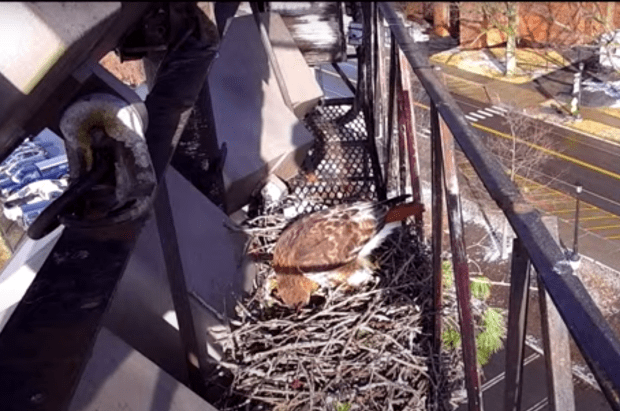
They move a little. Both flew off this morning as if an intruder was in the area. I was told that there are some Cormorants nearby. Wondering where Mum is? She was last seen on camera on 22 January. I suspect she is over on the Old Barge and letting the boys have the nest barge for male bonding. Smart.

Ervie is fine. He is decidedly a home body.

Thank you so much for joining me today. I hope you are all very well. Stay safe. See you soon. My Friday newsletter may be late. I am hoping to get out and get more birdseed before more snow arrives!

Thank you to the Port Lincoln Osprey Project for their streaming cam where I took my screen captures of Ervie and Dad today.