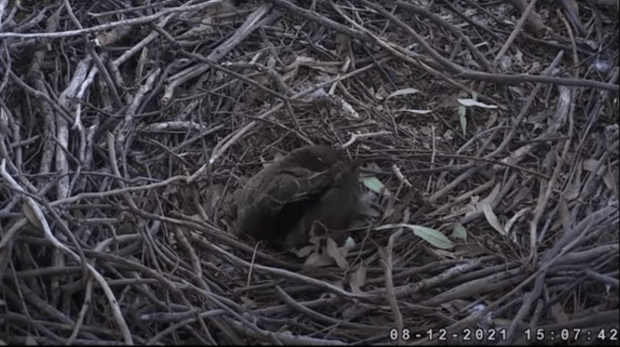
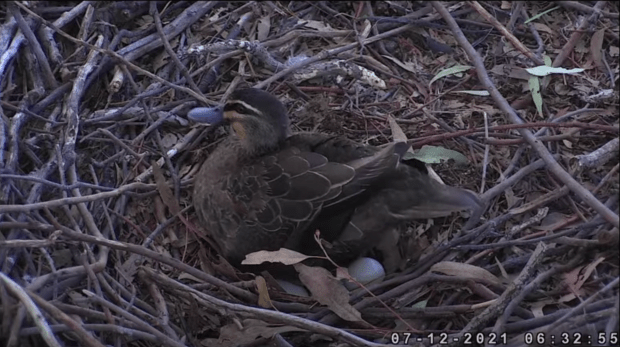
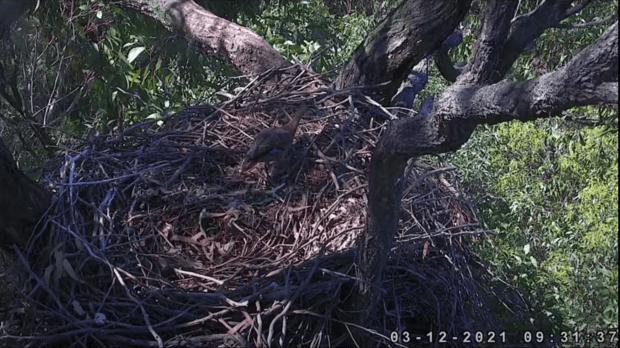
Daisy has laid her 7th egg in the nest of the White-Bellied Sea Eagles in Sydney’s Olympic Forest. She has spent the morning trying to get more down from her breasts and sides – without a lot of luck – and looking for more natural materials to cover her nest. She may have to dig around on the other side of the nest. She seems reluctant this year to cover the eggs and leave them to go over and root around.
So much down last year so little this year.
Here is a video of Dad, the WBSE that owns the nest, flying in at night. Oh, so lucky none of Daisy’s eggs were not broken.
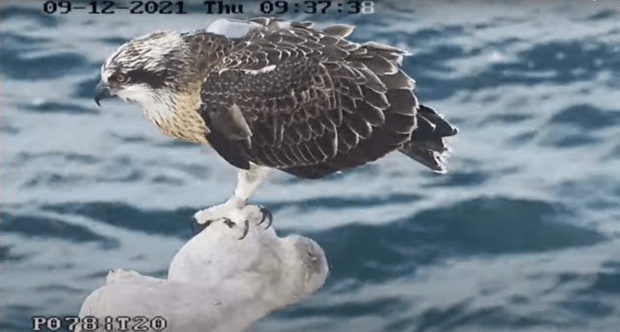
The Port Lincoln Osprey fledglings have been neglected. It was so fantastic to go and check on them and have some great close-ups of Ervie! Oh, he is a handsome young man.
That is a gorgeous crest. That white V that we looked for when he was small is so prominent. He has a nice crop.
Janet Forster says that the trio have been flying circles around the barge. They have also been seen chasing the parents screaming for fish! Good lads.
Here is Janet waving to everyone on camera. She is on the shore with her long lens. You can just make her out about 3/4 of the way over in the background. Thanks Janet for all you do so we can enjoy the Ospreys!
So far everyone is doing fine including Daisy. It is a long haul for our little Duck compounded with the predators and the lack of material on the nest. Still, we hope. The three Osprey lads are magnificent. I am so proud of this nest. Bald Eagles continue to lay eggs and work on nests. And, of course, the Great Horned Owls are looking for nests. There is a pair on the Savannah Osprey nest thinking pretty hard about using it for their breeding season.
There are a lot of people waiting to see if the GHOWs will also use Farmer Derek’s Bald Eagle nest. Will keep you posted!
Take care. It is nearing noon on Daisy’s nest and so far all is well. Thank you for dropping by.
Thank you to the following for their streaming cams where I took my screen shots: Port Lincoln Osprey Project, Sea Eagles@ Birdlife Australia Discovery Centre, and Cornell Bird Lab and Savannah Ospreys.
My news of Daisy the Duck who has taken over the nest of the White-Bellied Sea Eagles in Sydney’s Olympic forest left off at noon on Day 6. Daisy had laid her 6th egg at 06:42:50. As I begin writing it is 15:56. Periodically, Daisy has taken down from her breast, rolled the eggs, pushed the egg cup with her paddles to enlarge it, and pulled tiny twigs and some leaves closer to her.
The weather forecast is not favourable. It says, “Severe Thunderstorm Warning for Large Hail from Wed 15:46-Wed 18:46.” damaging winds, large hailstones, heavy rainfall that could lead to flash flooding was part of the warning. No wonder Daisy did not want her nest by the edge of the Parramatta River. This forecast is not good but it might, again, work in Daisy’s favour. The tree canopy might protect the eggs and Daisy, if she remains. Lady and Dad are not at the River Roost. But, they, too might want the protection of the forest. We will have to wait and see. Several times I thought Daisy was leaving and she hasn’t. Here are some images from the afternoon of Day 6. Oh, this little duck is so vigilant. I continue to say that I want to dump a basket of leaves on that nest. Oh, it might make all the difference in the world. If the down gets wet and inevitably it will, it shrinks. Indeed, it shrinks like dryer lint which is why they do not recommend you leave dryer lint for the birds to line their nests in the spring.
We are now within the weather warning zone. The old Ironbark Tree is swaying a little and the wind is picking up as evidenced by the leaves on the nest blowing a bit. The Ironbark Tree is strong and flexible – like bamboo. No worries there. They have changed the warning to extend to 19:36. It is currently 17:07. Either a large drop of rain or a hailstone has just hit the camera. Daisy is wet. She is still on her eggs. Loud bird noises from the forest.
I have just received a note from a friend that says that there could be duck boxes in or around the Olympic Forest. If so, I wonder why Daisy didn’t use one of them?
I am curious about something, however. Daisy has been vigorously trying to get down from her chest and from the back of her body under her wings. I went back to look at Daisy’s nest from a year ago on Day 6. Here are three images of that nest. Please notice the amount of down.
To me, this nest was a beautiful work of art. Daisy could fold the down and leaves in on themselves when she left and cover with more leaves.
Notice the covering over. This is Day 6 in winter 2021.
Daisy was approximately a year old last January. She has pulled more down off for the nest. Notice it fluffying around here. You can see the down that Lady tossed around the nest. Last year there was more down and more plant material.
So, I will be watching. I am wondering if Daisy did, in fact, prepare a nest elsewhere and laid some eggs. Something happened to that nest and she decided to try the Sea Eagle’s nest even though it wasn’t her first choice. Did she use most of her down on the other nest? and how will this impact the likelihood that these eggs can be hidden? Just questions tossing around my head as I compare the egg cup from last year, day 6 to this year.
There were no intruders for Daisy on Day 6. She covered her eggs as best she could starting at 18:02:34 flying off the nest at 18:04:04.
The rain had been coming down for awhile and everything was wet.
It continued to rain after Daisy left. You can see one egg and you might also see the down which is wet and has shrunk.
No one has disturbed Daisy’s nest since she left. That is a big plus. She is going to have to pull leaves on other part of the nest and twigs if she lays more eggs which seems likely now.
Daisy is due to arrive back at the nest in about 2 hours and 15 minutes. I will post my next report after she has laid her egg on Day 7. You can watch Daisy here:
Thank you so much for joining me. Send all of your best wishes to Daisy, our adorable little duck.
Thank you to the Sea Eagles @Birdlife Australia Discovery Centre for their streaming cam where I took my screen shots.
Daisy, that little Pacific Black Duck, arrived at the old Ironwood Tree deep in the Sydney Olympic Forest at 05:10:31 on 7 December. She is due to lay her fifth egg today.
Little is Daisy aware that a Raven came to the nest on Day 4, yesterday, and became curious. It did not, however, disturb the eggs. I am led to believe that this is because they cannot smell them. So if Daisy is able to gather more leaves – these are large eggs – she will be able to thwart the Ravens until such time she runs out of leaves and twigs and must use her down.
Also unknown to Daisy is the fact that Lady and Dad have returned to their River Roost from Goat Island. The streaming cam picked them up today roosting. Will Day fly into the nest to check today? He often does a quick security run.
See the two white dots on the tree in the middle. That is Lady and Dad.
The camera could not focus in on them but it is definitely the White-Bellied Sea Eagle couple that own this nest!
Last year Dad broke one of the eggs and ate it. He did not like the taste. Neither sea eagle likes the down – it sticks to their beak. They simply do not understand it – it is foreign to them. They were curious as to who was using the nest and Dad understood that eggs are not bothered. Indeed, one time I thought Dad was going to incubate those eggs of Daisy’s!
Daisy arrived at 05:10:31. Once again she was very cautious approaching her eggs.
Look who has come to see Daisy! Last year 8 or 9 Rainbow Lorikeets would come and visit Daisy every morning. They were all over the tree surrounding her. It was simply beautiful.
The bird coming down on the top right is called a Noisy Miner. Noisy Miners are members of the Honeyeater family. They are grey with a black head, a yellow-orange beak and feet with a light yellow patch behind the eye. There are also white tips on the tail feathers. They will not hurt Daisy or her eggs. They are curious but it is possible that they could draw the attention of other birds, like the Ravens, that could predate Daisy’s eggs.
The Lorikeets seemed to come every morning like they were saying hello to Daisy. And here they are today. The one must have told the others that their friend, the little Duck, was back in the nest of the sea eagles.
I don’t know about you but I had to run and get a tissue.
No words necessary as the Lorikeets continue to gather around Daisy.
We are nearing the time that Daisy laid her egg yesterday. I can still hear the Lorikeets and the Noisy Miner.
Oh, how grand it was to see the Lorikeets come to welcome Daisy!
Yesterday Daisy laid her 4th egg at 06:19:36. Egg 3 was laid at 06:55:07. I am hoping that it is earlier for Daisy today so that she can wait for the egg to harden, cover the eggs well, and get away from the nest before the Raven or the Sea Eagles arrive. Fingers crossed they stay away!
Daisy began gathering leaves around 06:23.
With the Sea Eagles back at the River Roost, I am so nervous for Daisy. Last year Dad visited often – curious to find out who was using his nest. I do not believe they would harm Daisy but Daisy and Dad certainly played tag with one another. I hope it is more peaceful for our little duck this year but who knows! Wonder when Dad will come and check on this nest?
It is 06:28 nest time. Daisy hasn’t laid her 5th egg. You can still hear the Lorikeets in the tree. Last year they seemed to be around when the larger predators weren’t. Come on Daisy, hurry! Lay your egg and get out of the forest.
At 06:32:55, Daisy lays her 5th egg!
Daisy moves around in the nest bowl clockwise.
She is moving the eggs about but she appears also to be using her paddle feet to enlarge the egg cup. How smart is that?! She needs those eggs to sink down low especially if she is going to lay several more. Notice how big those eggs are. It takes a lot of nutrients out of Daisy’s system to lay all those eggs.
Daisy has settled down lower than on previous days. She has also brought in some more leaves closer to the egg cup.
Daisy is trying to rest. If today, follows what has happened on the previous four days, Daisy will stay on the eggs for about 2 hours, cover them and depart. Let us hope that she is not disturbed and has time to get those leaves over so that nothing seems out of place if Dad or the Raven come calling.
At 06:42, there was only one Sea Eagle at River Roost. Is Dad fishing? or is he coming to the forest? We wait.
Daisy is way down on the eggs, her head tucked in. So far no Sea Eagle coming. Sometimes last year Daisy just got away in the nick of time. She needs to cover those eggs well though and not be in a rush.
Thank you for joining me today. I will continue to monitor Daisy until she departs and check on the nest throughout the day. If anything happens, I will let you know. Take care. Keep sending your positive wishes to our little duck, Daisy!
Thank you to the Sea Eagle@BirdLife Australia Discovery Centre for their streaming cam where I took these screen captures.
Going back to Day 3, Daisy duly stayed on the three eggs for a bit. The third egg was laid at 06:55:06. Daisy began preparing to depart, moving leaves and twigs over the eggs at 08:17. Within two minutes, she was gone — after checking that no one was around watching.
Oh, she is such a beautiful brave little duck!
This programme seems to have put the images backwards! The top row and one on the second shows Daisy covering up her precious eggs.
Day 4: 6 December 2021
Everyone’s favourite duck, the Pacific Black Duck, Daisy, flew into the nest at 05:21:51. You might be able to see her fluttering and flying up in the image below. She is the blurry mark above ‘2021’.
Daisy landed on the nest a second later.
Daisy seemed a tad more nervous this morning. She is extremely cautious taking almost two minutes before she waddles over to the egg cup.
I wonder what sounds from the forest Daisy is hearing that are making are nervous? Are Lady and Dad back from Goat Island? Has Daisy seen them?
Daisy was still nervous after she settled. She did not remove the leaves. She laid down on them and used her paddle feet to stir them around and the eggs.
At precisely 06:19:36, Daisy laid her first egg – about half an hour earlier than the day prior.
There it is. You can see that it is wet and shiny. It will need to harden and Daisy will hope that predators stay away so that she can cover up her clutch of four eggs completely today.
Daisy is allowing the air to harden the egg as she stands over her clutch. If she follows the same routine of previous days, she will remain on the nest for not quite two hours.
So far Daisy’s luck has held. We hope that the Sea Eagles remain on Goat Island. And Daisy may resist putting down with the eggs until there is hard incubation so as not to attract the Ring-tailed Possums who have made a nest also in the sea eagles’s tree.
Good Luck today, Daisy! Cover the eggs really well. You have hundreds of people watching you and sending you much love and luck!!!!!!
Thank you for joining me today. I will bring updates for other nests later today that will include a final check in on Daisy. Take care all.
Thank you to the Sea Eagle@Birdlife Australia Discovery Centre for their streaming cam where I took my screen captures.
Daisy is a Pacific Black Duck. This past January Daisy laid her second clutch of eggs in the old Ironbark Tree used by the White-Bellied Sea Eagles for their nest. She has now returned to lay her first clutch for the 2021-22 season. She laid her first egg today!
Last year we held our breath watching Daisy pick the nest with her mate, lay her eggs, be frightened off by Dad and Lady only to find out their were curious – not harmful. WBSE do not like duck down! It sticks to their bills and must feel ‘fuzzy’. The Rainbow Lorikeets came to visit Daisy every morning. The culprits were the Ravens.
The female Black Pacific Duck normally lays their nest on the ground. Daisy might believe or know for certain that is unsafe. So she tried this high tree deep in the forest. I wrote blog after blog about this brave little Duck that outwitted the big sea eagles. Sadly, the WBSE scattered the down lining the nest cup that had come from Daisy’s chest. She was able to replace it once but then it rained. When she got up off the nest to get food for herself (her mate does not help her at all), the Ravens saw the eggs and ate them. They were within a couple of days of hatching. It appears that Daisy wants to take her chances again using the nest of Dad and Lady. My goodness. Welcome back, Daisy!
Can you see her?
There it is!
You will notice that Daisy has not lined the egg cup with the down from her breast. She will. It seems she was in a hurry to get into this big nest and lay that egg. I wonder if she laid eggs elsewhere and was frightened away? Isn’t she beautiful?
This is so exciting. Daisy renewed my love for ducks last year. The camera operator at the Sea Eagle nest is very good at getting close ups of the beautiful nest cup she will make. The image below is from day 13 of incubation. Daisy was half way to hatch. She is listening for the sea eagles. You can see the mess that Lady made with the duck down – that precious lining and covering, scattered.
Daisy’s beautiful lined nest in early 2021
Daisy was always very cautious when she returned to the nest. She would listen and look around for a long time. She did not want anyone to see where her clutch of precious eggs was.
Satisfied that no one is around, Daisy sits on her eggs.A friendly Rainbow Lorikeet curious about the little duck in the big sea eagle nest.
This morning I wrote that there wasn’t much happening in the Australian nests and wow – Daisy, you just changed all of that. So everyone even if you think you do not like ducks you will want to watch The Chronicles of Daisy – the little duck that thwarted the great big sea eagles! Here is the link to the camera. Oh, I am so excited I can hardly sit still. Seriously, this is better than ice cream or your favourite mystery thriller.
Just a note. Daisy will not do hard incubation until all of the eggs are laid. There will be between 7-12 normally. The ducklings will all hatch at once and jump off the nest when they are 24 hours old. They will then follow Daisy quickly to the Parramatta River where she lives and where they will immediately forage for food.
Thank you to the Sea Eagles @ Bird Life Australia Discovery Centre for their streaming cam where I took these screen shots.
Here is an image of WBSE 27 being released last week. It was determined by the scale lines in her toes that the bird was in fact, 27 not 28. So happy that ID was solved! The day the bird was released was the first day that the parents were not at their River Roost. I hope the three connect! There is a video of the release and it shows 27 as a really strong bird. I hope she thrives in the wild for eons. What a gorgeous bird.
The following was posted on the FB page of the Sea Eagles:
The Kakapo Recovery are doing their annual fundraiser. As many of you know, we started out the pandemic with 208 Kakapo in existence. There are now 202. Dedicated individuals do wellness check ups which mean they have to find these elusive non-flying parrots. The only way to do that is with a transmitter. The transmitters and batteries require check ups and replacements (batteries) on a regular basis. Medical treatment, etc. If urgent and life threatening, the bird is flown to Dunedin, NZ for veterinary care.
Many are considering doing one special gift on behalf of their family to help wildlife and the planet (as opposed to fast fashion that winds up stacked in the deserts of Africa). The Kakapo Recovery is hoping you might choose them.
Last year we adopted Rangi! He happily lives in the living room plants when he is not cuddling up with Pippa the Albatross or Big Red the Red-tailed Hawk!
It is something everyone needs to think about even if it is $5 to a streaming cam that you love. It can make all the difference. You can also adopt other types of birds. Last year there was a huge rush to help Aran and Mrs G at the Glaslyn Bywyd Gwyllt. You might recall that two horrific events came together in the perfect storm at Glaslyn. A heavy rain storm with cold temperatures hit the area when the chicks hatched and Aran got in a territorial fight and injured his wing and he could not fish. The community came together and provided a fish table for the family. Sadly the chicks did not survive but Mrs G and Aran did and Aran got his strength and migrated on time. To help that cause many went to the website and adopted Aran and his family.
You will have your own list as well. Other ways that you can help is to check with your local wildlife rehabilitation clinic. They often post a list of items that they need. You would be surprised but clean old towels are usually at the top of the list! So next time you are looking at a pile of towels and old sheets, think of your local clinic for wildlife! It doesn’t cost anything but getting the items there and often the clinics have volunteers that pick up for them.
Books for children and teens on how to help wildlife thrive are, of course, invaluable in building the next generation to care for our beloved birds.
Holly Parsons posted an update on Yurruga on the FB page for the Orange Australian Peregrine Falcon:
“Post from Cilla approx. 5pm 24 November:I haven’t seen Yurruga since I placed him in the tree, but I’m pretty sure he is still there as the parents have been coming and going with prey and giving me warning calls if I approach too close. I only check once a day and the foliage is really thick so hard to find him if he’s quiet.”
That is great news coming out of Orange! That is the kind of news I wish were coming out of Sydney with WBSE 27 – that the parents have been feeding it. Fingers crossed.
This is a short update. It is extremely quiet in Bird World now that the falcons and ospreys and WBSE in Australia have fledged. Eggs are happening in the Bald Eagles nests in the US and there will be lots of action around the holidays in December.
Take care everyone. Thank you for joining me.
Thank you to the following for their streaming cams or FB pages where I took my information: Orange Australian Peregrines FB, Kakapo Recovery FB, and Sydney Sea Eagle Cam.
Viewers of the Port Lincoln Osprey Barge are starting to wonder if Bazza isn’t eating so much fish that he can’t get lift off the nest. He sure does love his fish.
At 08:00 Dad flies in with the first fish of the day. Falkey gets that one fighting off Bazza who would just love to have breakfast. At 8:50, Falky is full and he walks away leaving a beautiful fish tail on the nest. Ervie spied it immediately and finished that off quick.
They remain such a civil trio. There is Falkey getting to enjoy his breakfast.
Ervie turns around and probably doesn’t believe his luck – a nice fish tail just in front of him. He was there claiming it in the snap of a finger.
Ervie made quick work of the fish tail. Falky is full and Bazza really doesn’t seem interested.
At 09:36:53, Dad flies in with another fish, quite a large one this time. He puts it right at Bazza’s feet. Talk about luck. Bazza was still eating on that fish an hour and a half later. I don’t think he will be leaving too many scraps.
Just look at the size of that fish!
Bazza is still eating. My goodness. It could be true. Maybe he is too big for take off. Bazza certainly seems to be wider than the other two lads.
Do you follow the falcons at Orange? If so, then you probably know that this is the one year anniversary of last year’s chick, Izzi’s fludge. For those unfamiliar, Izzi was the only hatch of Diamond and Xavier in 2020. He dozed off on the ledge and literally fell out of the scrape box. Cilla had to find him and carry him back up the 170 steps to the box. When he did fledge, the first time, Izzi flew into a window and went into care. Cilla returned him to the scrape to do it properly the third time. Isn’t that what they say? The third time is a charm. It worked. In memory of the fludge, someone has put together a video clip of it and Izzi being returned to the scrape.
As for ‘Little’ Yurruga, Xavier delivered three prey items for his daughter before 06:45! Diamond will come in later and help Yurruga but she is doing a good job of the self-feeding. I love how she watches Diamond so intently when she is plucking and eating – memorizing / imprinting it all.
Rumours are circling that the WBSE Juvenile will be released from care into an area around the Newington Armoury by the Discovery Centre in the Sydney Olympic Park. The juvenile injured by the Curras is believed to be 27. (There are some that believe it is 28 and with no bands and no DNA who knows.)
There is really not a lot going on in Bird World. Waiting for Bazza to take the leap, waiting for some of the first Bald Eagles to lay their eggs, waiting to find out who is the Royal Cam Albatross family this year. Feels like a lot will happen at once!
Oh, I had to just go and check on the lads one more time to see if it is possible Bazza has flown. Nope. It is an hour later and Bazza is still eating!!!!!!!! Bazza has been eating for two hours. I kid you not. Did someone get Little Bob mixed up with Big Bob?
Flying uses up a lot of calories. Look at the difference in size between Falkey and Bazza. Gracious.
Thank you for joining me. Take care everyone. See you soon.
Thank you to the Port Lincoln Osprey Project and Charles Sturt Falcon Cam and Cilla Kinross for their streaming cams where I took my screen shots.
The last update that we had on White-Belled Sea Eagle fledgling 27 was on 5 November. That was a week ago and despite the fact that it was not that many days, it was easy to get restless waiting for some news. I am delighted to bring you some really good news.
Here is the posting:
“An update on the progress of SE27 in care “The Sea Eagle is doing very well under veterinary care and will soon be released back into the wild in Newington Nature Reserve. It has been identified as a male. He is eating well and strengthening his wings in a flight aviary. “
Oh, we just needed some good news. This is fantastic. Others were out and about today and there is still no sighting of WBSE 28.
There is a lot to celebrate in Bird World this evening. Everyone on the Taiaroa Peninsula and perhaps the whole of New Zealand are celebrating the arrival of the 2021 Royal Albatross Cam Princess, Tiaki, at the feeding grounds just 70 km off the coast of Chile – safely! This really is amazing. As was pointed out on the Royal Albatross FB page, this young bird fledged on 25 September and arrived in the waters off the coast of Chile, 8500 km away, in 35 days. Incredible. Congratulations!
For those watching the return of the Royal Albatross to Taiaroa Head for the upcoming breeding season, OGK has flown off the peninsula to feed. He continues to wait for his mate, YRK. I have asked and been told that OGK is not the only male still waiting for its mate. That gives me some hope that this adorable couple will still be reunited. They were the parents of last year’s Royal cam princess, Pippa Atawhai.
There has been no new tracking data for Karl II but, on the 28th of October, he had reached Umm Harazat in the Sudan close to where he winters. Udu was at the Farafa Oasis in Egypt on the same day and Pikne was along the Red Sea. I expect that Udu and Pikne could be further into Africa by the time the next transmission comes in.
The Farafa Oasis is an area known as the White Desert.
Udu made a splendid flight across the Mediterranean Sea. The White Desert is home to a number of wells and there is farming in the area. It is most know for its white rock figures.
Pikne’s position:
Karl II’s position:
Moving away from the migrating birds back to Australia, little Yurruga took some big steps today. What a sweet little falcon! Here is a short clip I made of this momentous event.
Yesterday, Dad fed the 367 Collins Street Four in an area that could be viewed easily. There are, of course, concerns that the falcons will fledge from the end where there is no camera view. The owners of the cameras have stated that they will not change the direction of the camera again as it is too disturbing for the birds. That is quite understandable at this stage. No one wants to frighten these lovely eyases and have them fly and fall to their doom. And there is no telling which end of the ledge they will fledge. We just simply wait. They are so strong and healthy. Mum and Dad have been heroic in their efforts to sustain them. So please keep feeding the pigeons in Melbourne – our falcons need them!
There has been no word from the vet team about the condition of WBSE 27 since it was attacked by the Pied Currawong and found on pavement near to the Sydney Olympic Forest.
The Sydney Sea Eagle Cam FB page had originally posted WBSE 27 on the pavement unconscious. This disturbed some people so it was replaced with the image below. I have said that no news is good news but this has been several days since the incident. Send all the positive energy to this beautiful bird that you can!
There is good news at the Kakapo Recovery. The team has discovered that the eggs that are laid but do not hatch are not always infertile. Since the beginning of trying to help the Kakapo to recover numbers, it was always believed that the eggs were simply infertile and that is why there was no chick to hatch. The chicks are dying at an early stage. If they can figure out what is the cause, they might be able to assist these lovely non-flying parrots to have more successful hatches. Here is the posting on the Kakapo Recovery FB page. It talks about their efforts with the University of Sheffield to understand the issue and be able to have more live births of this critically endangered bird. Bravo!
The ospreys on the PLO barge are doing great. Little Bob is 45 days old today. Fledging is coming soon. Oh, how I am going to miss this wonderful trio. They have delighted hundreds and hundreds of people this season. Pure joy!
Look at Little Bob showing off! Besides loving to eat Little Bob really does like to give those wing muscles a go. I don’t think Big Bob is very amused.
In the image below, from left to right: Middle Bob (2), Little Bob (3), and Big Bob (1). If I were to have to base a guess on their gender due to the legs, I am afraid that I would have to change my prediction.
Middle Bob’s legs are definitely shorter and stockier than either Little Bob or Big Bob. Big Bob’s legs look like those of a male. That leaves us with Little Bob that I continue to believe is a female. Oh, I cannot wait for those measurements. They are not 100% certain but, perhaps, they will also do DNA testing on the three when they ring them!
Little Bob gives its two older siblings a big hug.
There is Little Bob looking off to the left after the morning breakfast. Three gorgeous nestlings. Ringing, naming, and measuring will take place the week of 8 November. I will keep you posted to the more exact date when I find out.
Thank you so much for joining me today. I hope that you are all well. Take care!
Thank you to the following for their streaming cams where I took my screenshots, video clips, and maps: Port Lincoln Osprey Project, 367 Collins Street Falcons by Mirvac, Charles Sturt University Falcon Cam at Orange and Cilla Kinross, Birdmap, Kakapo Recovery FP Page, Wikimedia Commons, and Wildlife Computers.
Ranger Judy Harrington posted the following on the Sea Eagles FB:
“Tuesday afternoon – such a lot has happened and we are having sightings from time to time. Sunday afternoon, Chris, Rohan and I, joined by Neil, found SE27 on the ground, just outside the forest area. Swooping by other birds as we have seen all the time. This morning, one juvenile was seen in the saltmarsh area and wetland called Main Lagoon – photo to come. This was possibly SE28, hopefully to be confirmed. This area is quite close to the river and not far from the favourite roost spot for our adults., RR. Also one was seen in the forest area and just outside the fence, by Dave, one of the Landscape contractors. This was probably SE27 as well and was quite close to the area where we saw it the other day. Dave reported it flew off strongly.Hopefully the juveniles have been sighted and heard by the parents and maybe food has been brought.So we are not sure yet if we have confirmed sightings of both birds or if they have been fed. This is probably quite normal for newly fledged birds that have strayed from home, their nest area. The protected areas are extensive and we hope the juveniles will be well protected there until they gain strength and experience. We may even see them down on the river with the parents.15:45 – one adult just brought prey to the nest – and left straight away. We shall post news when we have it and keep everyone updated. So please read the posts .Thanks to all watching and listening from the ground.”
Included were some images including this one of the Salt Marsh area.
The sightings are hopeful. I know that many of you watch the nest but do not go to FB so I hope this is of some help. It is a constant worry when birds fledge and cannot return to the nest to be fed til they get their flying skills in order. Oh, those Pied Currawongs! There were no sightings of WBSE 25 last year so people seeing and hearing and reporting on 27 and 28 is fantastic.
Thank you to the Sea Eagles FB Page and Ranger Judy for their message onFB and the image of the salt marsh area.