Late Thursday in Bird World

22 September 2022

Good Afternoon Everyone. I hope that this finds each of you well whether you are starting or ending your day. It remained a glorious day on the Canadian Prairies – a crisp fall one. There are so many songbirds in the garden now all wanting to eat and have baths. It is impossible to differentiate between the hundreds of sparrows and what looks like a few Grosbeaks but, they all seem happy and the two bird baths this year are really making a difference. They are so thirsty. The usual group comes around 1800 so these are the early birds.

Mr Blue Jay is here. There is a cob of corn for him as well as some individual kernels. Let us see if he gets it or if Dyson does! Dyson should be here in about an hour. It is amazing how they have their own timetables and really stick to them. Oh, two of the three Blue Jays have arrived. This will be interesting. One is eating from the cob of corn and the other is taking the corn kernels that I broke off a second cob.

This is Junior. He is the Dad of the three fledgling Jays that remain in the garden and at their nest tree across the lane. Junior still needs to grow in his crest. He is easy to spot.

He knows I am watching and he also knows that I am the one that puts out the corn. No, Junior. It is not just to take your photograph! Junior is 5 years old this year.

A little female squirrel has arrived.

One of the Crows just flew in to check out the evening’s buffet.

Our wildlife rehabilitation centre has its annual open house this week. If you live in Southern Manitoba or Winnipeg and want to go out and see the amazing facilities including a brand new surgery and our super flight training buildings, go to line to Wildlife Haven and order your tickets. Remember, too, if you go out – check for clean old towels and sheets. They can never get enough of them. And if you have some spare savings or are in need of a tax donation, every wildlife rehabilitation clinic will thank you and give you a receipt for your donation. It is the only way they survive.

Australian Nest News:

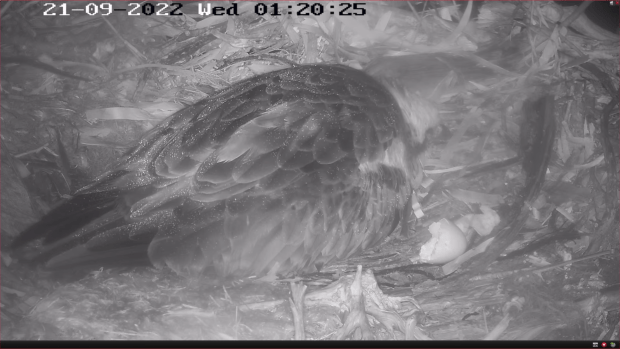
Oh, what a glorious day it was to wake up to a brand new osplet – and, so, as all of you probably know, the clutch at Port Lincoln is complete. Congratulations to everyone! Dad came in with a really nice fish for the brood. It is unclear if Little Bob got much or any – he has to be tired from working so long on that egg but, you can bet the other two got their fish!

Let us hope that the fish keep coming. We are off to a good start with that big fish. The key will be for Big and Middle to get full and then Little Bob to eat but let us see if it works out that way! Our dear Ervie had to be right up there preferring to thwart any attention Bazza wanted to pay on someone to Falky.

Just look at that nice fish. It is incredible to me that birds of all makes and models are hardwired to hold their heads up high and their beaks wide open for food from the git go.

You can watch all the action at Port Lincoln here:

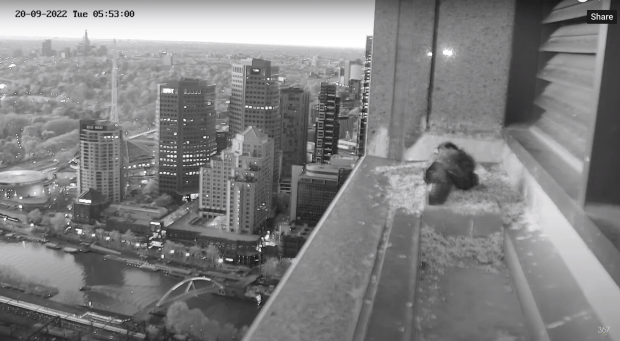
It looks like a super day starting in Melbourne. I hope it is as it is the 23rd of September and gosh, golly, we are looking for a hatch on the 27th. Four days. Fingers crossed that the second male – who Mum is not interested in – is thwarted. I know. It is wishful thinking but, let’s all send good wishes out to our wonderful old dad. This could be his last clutch and he is remarkable. One of the great Peregrine males out there and so ever funny in his pjs.

Mum left for a break. Food is being brought in and stored elsewhere but not near the nest and this probably won’t happen til the chicks arrive. The falcons like, for some reason, to keep that scrape box really clean while there are eggs. Then when they begin feeding their eyases it can be mayhem with blood, bones, and feathers flying everywhere. The old dad used to love to pluck and feed the fresh pigeons right in the scrape. I don’t think the former Mum appreciated that at all.

Xavier has arrived early at the scrape box hoping that Diamond might want a break. He is such a devoted Dad. We are looking at the first week in October for hatch. For the past two years only one of the three eggs has hatched. I am wishing for one strong eyas! Two would delight Xavier to no end. Three might be overwhelming but these two very seasoned parents would manage.

Some of you might be wondering what is going on at the Sydney Sea Eagles. Yesterday, Mum flew in with a fish and stood on the nest eating it while 29 played with its tail. Lady wanted to see if the eaglets would fight for that fish and take it from her. That is what they will need to do in the wild. They did not. Eventually she offered and 30 got some nice bites. It was a very interesting educational moment. And so, here we are today.

The sea eaglets are up looking around in their beautiful plumage. Those feathers are almost all completely in.

One of the parents is in the tree watching every move the eaglets are making with that fish on the nest.

Both parents are now on the branch watching the eaglets. Do not ever think for a second that these parents do not know what they are doing. They do. They are letting go – and they are trying to provide their two kids, SE29 and 30 – with the skills so that they can survive in the wild. They need the eaglets to be hungry, to need to get that fish and eat and they need them to know how to hold it down and pull off the flesh. At some point in time Dad might bring them a live fish to see how they respond.

Making News:

The new Kestrel Ambassador for the Ojai Raptor Centre has a name. It is Topa and the word comes from a mountain range near to the wildlife centre called the Topa Topa. What a lovely bird to help teach youngsters and us about the challenges raptors face daily.

The new Osprey cam is now installed and working at Captiva in Florida. Just look – we have an adult. Last year Andy and Lena managed to end their years of not having chicks due to predation by Crows. How did they do it? They laid their eggs one month early. Very smart Ospreys. We had three magnificent chicks – and we ended with two, Middle and Little Bob, who turned out to be a male and a female. Big Bob died of an indeterminate cause but he did have enlarged organs similar to some other ospreys lost this year. That was determined to be salmonella in one case. Big Bob had also been ruthless in his eating claiming all the fish for nearly 72 hours before he died. The other two thrived and were very civil fledging with the male staying around Captiva and the nest for us to enjoy for some time.

In the Mailbox:

EJ sent us a great video of a juvenile sea eagle fishing. It is short and quite amazing. Thanks, EJ!

From the Book Shelf:

In a few of my blogs I have been writing about the campaign by Chris Packham, Mark Avery, and the Raptor Persecution Group in the UK to get rid of sport hunting and killing. In this instance I am referring to Grouse Hunting and Killing on large estates for sport. The problem is that the game keepers of the properties kill the raptors. Raptors such as the Hen Harrier who covered the wet lands and moors and heath was a common sight in England during the Mesolithic Age, ten thousand years ago. It has really gone into decline with the advent of the Enclosures Act in the eighteenth and nineteenth centuries. Now, sadly, heath burning, the escalation in killings and diseases brought in by the imported birds has caused a swift and rapid decline in the number of breeding pairs of Hen Harriers in the UK. In 2012, there was only one breeding pair left.

David Cobham has set out and written an incredible little book on the history and decline of this amazing low flying raptor. It is based on the promising life of Bowland Beth and the title is, Bowland Beth. The Life of an English Hen Harrier. You are drawn into Bowland Beth from the minute her father returns to his natal nest in the Bowland Forest to find a mate. You will discover this amazing and most promising bird and her daily activities (she is tagged with a sat pack). And you will come to understand so fully why the grouse hunting and the killing of all the raptors that find their prey on the wrong piece of land need to be kept safe. It is essential that the law be changed. I rarely head deep into politics but this is an archaic practice that needs to end for the sake of the wildlife. They need to thrive without fear of catching a vole and being shot.

$18.40 CDN for the hardback at your local on-line book seller.

Thank you so much for joining me this afternoon. I hope that you are well and that you will enjoy watching the sea eaglets and those cutie pie osplets. Take care. See you soon!

Thank you to the following for their streaming cams, videos, and postings that made up my screen captures: Sydney Sea Eagles@Birdlife Australia Discovery Centre Sydney Olympic Park, Charles Sturt Falcon Cam, 367 Collins Street Falcons by Mirvac, Ojai Raptor Center, Robert Full and ‘EJ’, David Cobham, Captiva Ospreys and Windows for Wildlife.

Wednesday in Bird World

21 September 2022

Good Morning!

It is early (for me). The garden birds are very quiet. It is starting out to be a beautiful day as I work on getting to know this computer but, rain is to start today and be with us again on Friday and Saturday. It is always good to get the trees that have grown so much over the summer with all the torrential downpours a good soaking before frost.

One of the things that was lost were the images that I took yesterday at one of the ponds. So I want all of you to use your imagination. I could not believe my eyes. There before me were seven young ducklings just like the singular one at the nature centre. No feathers just fuzz on their bodies. They were all cuddled up together keeping warm. Today it is 10 degrees C. We are at the time of migration. All of the nature centres are opening up for special events as the birds from the north make their way to the wetlands and the big ponds enroute to their winter homes far south of us. Will the arrival of winter be late? What will happen to these wee ones? I have never seen small ducklings like this at this time of year. The spring floods and destruction of eggs has certainly caused issues. There are ducks that overwinter on our Assiniboine River near to where my daughter lives but…what about these little gaffers?

Making News:

Victor at his release. 19 September 2022.

For all of those wondering, the site where Victor was released is at the coast right across from the Channel Islands. Great choice! Let us all hope to see Victor near Fraser’s Point in a couple of years! Wouldn’t that be grand. It appears it was the best site for release like the Channel Islands but the closest point to his nest without breaking any regulations. Isn’t Dr Sharpe the best?

It seems that once we get a good population of birds established we then want to take their habitat away. This is what is happening in Albania wit the pelicans!

https://www.theguardian.com/environment/2022/sep/21/albania-dalmatian-pelican-colony-narta-faces-threat-vlora-airport-aoe

Nest News:

So far, there are still only two osplets at Port Lincoln. The third egg is 37 days old and there is still time for it. Some chatters are wondering if there is any movement inside. We will have to keep our eyes opened! The other two and Mum seem to be doing splendidly.

The streaming camers (3) at the SWFlorida Bald Eagle nest of Harriet and M15 will be going live during the first week of October.

Xavier brought an Eastern Rosella, well prepared, for Diamond who was excited and got off the nest. Xavier is a lovely! Hatch not expected til the first week in October but we are getting there…2 weeks?

Beautiful Diamond.

Xavier gets some ‘eggie time’. Yes! Can you tell how much I love this cute little falcon who is no longer in his prime but gosh, he is a fantastic mate and he loves his chicks. I sure hope this season turns out well for these two.

So many of you are marveling at the plumage colours of the little sea eaglets. They are gorgeous. A friend laughed at me for loving the feathering of the Red-tail Hawks. “Just wait til you see the Sea Eagles!” Oh, she was so right. It is hard to see the colours when the sun is at a certain angle but have a good look at them.

Our eagles are approaching their 10th week. They are still growing some feathers under their wings. Their wing flapping and jumping around is going to continue to get every more vigorous. Just breathe. They can scare the wit’s out of you when they start jumping on and off the rim of the nest and the branches . In week 11 you will see them gain some real height in their hovering. They will begin to sleep more and more with their head tucked into their wings rather than duckling style although fledglings also prefer duckling style on occasion. It must be much more comfortable! Self-feeding is getting better.

We do not want to talk about fledging but, after 70 days it is possible. And we are at that point. So spend your time watching these two and the hatches at Port Lincoln. SE29 and 30 will be gone in a blink and the osplets will be growing and changing so fast it will be hard to recognize these sweet fuzzy babies in a week!

Victor Hurley is going to post a pre-recorded session where he answers your questions about what is going on at Melbourne on Thursday, Australia time. That will be in a few hours. If you have questions, you can submit them on the 367 Collins Falcon Watchers FB page. Dr Hurley asks that you read the PDF that he posted on the top of the FB site before submitting questions.

We are all very curious to see what will be happening. The second male does some quick on and off mating which – well, we are now nearing hatch which should be 5 days away. Mum’s hormones will not be in breeding but incubation and caring for young. It appears that the old male continues to provide food for Mum. Oh, I hope that this clutch makes it but we are going to just have to wait and see.

Migration News:

Checking on the Black Stork family from the Karula National Forest in Estonia. There has been no transmission for Karl II since the 4th of September. Bonus and Kaia were still in their respective areas with their last report coming in on the 20th of September. Hopefully this evening there will be some new news.

Birdmap is showing tremendous progress for the Ospreys and, one, in particular, flew across Europe to Spain instead of going directly South. Brilliant! The Ospreys are already heading into central Africa! You can go to BirdMap and get the animated version of their journeys.

Did you know:

How long do Bald Eagles live?

https://birdfact.com/articles/how-long-do-bald-eagles-live?fbclid=IwAR28ZeEq0BVJMgSX852wOBP7kcICCL6iKHdzvl0FIB7TUUxGNZSliJdQBFk

Thank you so much for being with me today. We are looking forward to the third hatch in Port Lincoln but, for now, in the night, Mum is getting some much needed rest! Take care of yourself and I will look forward to seeing you again real soon.

If you are sending me e-mails (which I love), please use this new address: maryasteggles@outlook.com Thanks so much!

Thank you to the following for their streaming cams where I took my screen captures: Ojai Raptor Centre, Port Lincoln Ospreys, Sea Eagles@Birdlife Australia Discovery Centre Sydney Olympic Park, 367 Collins Street by Mirvac, Charles Sturt University Falcon Cam, and BirdMap.

Tuesday in Bird World

20 September 2022

Good Evening or Good Morning to you!

I hope that this newsletter finds you in good spirits and good health. I continue to appreciate your good wishes and today, I can tell you that I am back to 90%. Was its Victor’s release that caused my system to soar? One will never know but, I did get out for two walks at two different ponds. To be able to do this at the end of September, without there ever being a frost, is ‘different’ and, of course, harks at changes to come.

At the first pond the temperature was 17 degrees C but the wind was blowing at 23 kph. There were not a lot of birds around it seemed. Then I heard their call – the Greater Yellow Legs. There were two of them in the marsh area flying out to the shore.

Please note. I had to switch to the lowest quality of image as my card was filling up! So even my non-wildlife photographer images are not as crisp as they could be when blown up. You can see the normally mirror-still pond’s waves lapping.

Across the road, in this industrial area of our city, the recent rains have created two other water areas and there were a few geese and a couple of ducks – one in each pond! No sharing there.

So what are they? There is a distinctive white eye ring, a long sloping forehead and grey-blue bill. a gorgeous rusty head with a mottled back. I was unable to see the colour of the legs but its eyes are brown. The sloping shape of the forehead to the beak is very distinctive and what appears to be a white eye ring could be throwing me off a quick ID. It appears to be a Canvasback.

There it was on page 160 of the Crosley! Crosley says it lacks a forehead. Yes, he is right – the head just slopes into the bill. The shape is a wedge. Don’t forget it! Those south of me will see these gorgeous waterfowl flying by. Crosley calls the colour of the head and neck ‘chestnut’ – what a lovely word for that description. The eye should be a vivid red if it is a male but either the camera did not get that or it was the angle of the light or this is a female fooling us because of her not pure white back or a juvenile. I will keep you posted!

I will bring you news of the other pond later. My laptop decided to emit smoke and I have kindly been loaned another computer so I can finish the blog today. What troubles me about the second pond is that there are no less than 8 small fluffy ducks – with less feathers than the small one at the nature centre. So, if we have no frost and it is now 19 degrees C – do these ducks have a chance?

Making News:

I cannot tell you how fantastic it was to see Victor released by Dr Sharpe yesterday – and from the mail pouring in – he touched all of our hearts. We will never forgot those adorable images with Lillibet, when Victor could not stand to eat and the entire eagle family tried to comfort him, to his rescue, to his walking in a towel with holes held up by a staff member at the Ojai Raptor Centre, to his release. What a time this juvenile eagle has had.

Images provided by the Ojai Raptor Centre FB this morning:

This image has an empty alt attribute; its file name is 307133153_10159085394581453_2304853790248402682_n.jpg
This image has an empty alt attribute; its file name is 307341384_10159085394606453_8936664518710999867_n.jpg
This image has an empty alt attribute; its file name is 307309290_10159085394726453_8147611667506775357_n.jpg

One of the letters in the mailbox was ‘Where is Hollingsworth Ranch’. Here it the information on where Victor was released:

This image has an empty alt attribute; its file name is screen-shot-2022-09-20-at-11.36.39-am.png

The Hollingsworth Ranch

This is the Ventura River running through the rugged mountainous area. Those in California might know its status better now because of the droughts the last few years. I hope it is the same. It looks like a great place for an eagle named Victor.

This image has an empty alt attribute; its file name is 2319878242_ba63a50a55_b.jpg
Ventura River, one” by …-Wink-… is licensed under CC BY-NC-ND 2.0.

Every day there are thousands of raptors – and other wildlife – saved by the wildlife rehabbers. I often say the streaming cams get all the glory (and donations) because they are the first place we learn to leave these bird families but it is the rehabbers that love and care for and put the birds back together if they get into trouble. Their time, effort, and expenses often last years.

Another little eaglet made the rehab news because it was released, too, by the Raven Ridge Wildlife Centre in Pennsylvania. I love the pictures. They give you a real behind the scenes look at what goes into caring for a wee one who is well but has no nest or family. Notice that stuffed eaglet plush toy. When you are clearing up and you look down and see the stuffies that you have collected – and you don’t know what to do with them – the wildlife rehab centre is your answer!!!!!!!!!!!! They bring comfort to the birds.

This image has an empty alt attribute; its file name is screen-shot-2022-09-20-at-11.18.12-am.png
This image has an empty alt attribute; its file name is 307100274_462926395870708_8776787193193903584_n.jpg
This image has an empty alt attribute; its file name is 307298605_462926412537373_1788372428230233508_n.jpg
This image has an empty alt attribute; its file name is 306992135_462926399204041_1110098907117793956_n.jpg
This image has an empty alt attribute; its file name is 307089140_462926695870678_2502442713803080517_n.jpg
This image has an empty alt attribute; its file name is 306331071_462926599204021_2504802476909499040_n.jpg
This image has an empty alt attribute; its file name is 306834287_462926619204019_5814899631025685081_n.jpg
This image has an empty alt attribute; its file name is 307094035_462926765870671_3635125037051743098_n.jpg

http://ojaihistory.com/the-hollingsworth-ranch/embed/#?secret=jzkIzleQDS#?secret=NzEkoT3MUb

Nest News:

This will be short with a longer analysis of what is happening tomorrow.

The second male at the Melbourne nest has been trying to mate with the Mum while she is incubating the eggs. She is having nothing to do with him but, the old male is holding back providing food. I wish the young male would leave and allow them to raise this clutch but his ideas are otherwise. We are 6 days from hatch!

We are still waiting for the third hatch at Port Lincoln as the sun is rising soon. It was raining in the middle of the night – not much but, Mum kept those chicks nice and snug. No doubt #2 is going to be hungry and up there to eat today. I wonder how #1 will treat its sibling? Fingers crossed. It seems they do not get too rowdy until day 8.

At Orange, the hatch dates range from 36-39 days so we are not expecting any action until after 1 October. We have a ways to go. Melbourne is ahead. Xavier has been getting Diamond out of the box with prey and getting some good time with the eggs. This scrape is very stable, thank goodness. But not this morning. Xavier brought a Starling, Diamond left without it and Xavier took it away minutes later. Diamond is extremely picky – poor Xavier. I hope the parrot population is good this year!

They have been together for a long time. Xavier probably is over feeling completely dejected by Diamond when he brings her breakfast. She does much prefer the fat already plucked and prepared pigeons too.

The Sydney Sea Eaglets are simply marvellous – what an incredible civil nest. Two females? Two males? Let’s watch their size as they leave their 9th week and into the 10th. It is refreshing not to see discord on a nest – no, the word is sheer relief. Last year’s breeding season was horrific. It was NOT at this nest. Last year and the year prior were fantastic. Lady and Dad are doing really well. Other nests did not fare so well.

Let’s keep an eye on Melbourne and, of course, Port Lincoln for this third hatch. I hope it comes soon! I am now off to investigate and agonize over what new computer to get. I use one all the time as you know but I like portability. You don’t get the lovely big images I am looking at with portable though!

Thank you so much for being with me today. Please take care of yourselves. See you soon.

Thank you to the following for their posts and streaming cams where I took my screen captures: Sydney Sea Eagles@Birdlife Australia Discovery Centre Sydney Olympic Park, Charles Sturt Falcon Cam, 367 Collins Street at Mirvac, Port Lincoln Ospreys, Ojai Raptor Centre, and Raven Ridge Wildlife Centre.

Adorable osplets at Port Lincoln and more news in Bird World

19 September 2022

Good Morning Everyone,

Oh, goodness. The sky is the most beautiful blue this morning without a single cloud. The tree tops have been kissed and they are all turning slightly golden but, we have not yet had a frost. Decades ago, there was always a frost in August and people lost their tomatoes still growing in the gardens. This year the mint has eclipsed its pot and the tomatoes are still growing and turning red. Thankfully, my three-year old neighbour loves those little grape tomatoes – there were 1000s this year!

Dyson has already arrived along with the Blue Jays who let me know that there are absolutely no peanuts to be had. It was the first time that I really examined those nuts. No wonder the Jays are picky eaters. Some of those nuts are not good – dry or with only one peanut. I don’t blame them for giving them a shake to find the fullest heaviest one.

Scraggles loves peanuts and always tries to take two! Notice her tail. It is growing back after she used part of it for her nest this summer.

Dyson looks great. Her tail has grown in and it is so nice to see her in the garden every day. Dyson stayed and ate quite a few nuts before leaving with a couple. It is so good to see her looking so well. It is hoped that by providing good food and water the animals might live better and longer.

In the Mailbox:

A number of you have asked: “What happened to the old Mum at 367 Collins Street?”

That is a question on probably hundreds of mines watching that scrape. The old Mum had a really formidable face but she was a great female and raised many eyases. Mum and Dad had been there since 2016 so, like Dad, she was at least 8 or 9 years old with the average life expectancy of six years according to Victor Hurley. So let us rewind for a minute. Last year the camera went off right when the 4th chick died of trichomonosis.

Trichomoniasis is a disease that is transmitted between birds through direct contact and therefore can spread relatively easily. One characteristic of this disease is the lesions that will present on your bird’s crop and esophagus. Trichomoniasis is a disease caused by the protozoa trichomonas gallinae. This condition is highly contagious among birds. There is a loss of appetite and general inability to eat, they have difficulty standing and keeping their balance, etc. This year we saw the female at the Janakkulum Osprey nest in Finland contract what was believed to be trichomonosis and probably died. Luckily her two chicks did not contract the disease. I mention this disease because it is possible that the Mum did get trichomonosis.

The other possibilities include dying naturally from old age, severe injury or death caused by the urban environment, severe injury or death caused by the new female or another female.

Sadly, the camera was off and we have no clues. Indeed, what happened to the female might have taken place on the other side of Melbourne. We miss her and Dad together and the stability on the ledge. The life of an urban falcon is difficult at best and even more so when we have grown to love them as individuals.

“What is going to happen to the egg shells at Port Lincoln. Why doesn’t Mum get rid of them?” This certainly is a question on a lot of people’s minds as we sit and wait for the third hatch. It is a very good question, too!

The females make the egg shells using calcium from their bodies. As a result, their calcium levels are lower. Some females eat the egg shells to help replenish their stocks while others will kick the shells out of the nest or just allow them to break up and become part of the nest. At 0:40:40 Mum at Port Lincoln is seen eating some of the small pieces of egg under the chick.

In the News:

‘N’ sent me a lovely article and it is so appropriate – the challenges that urban raptors face appeared in The New York Times. It is a good read and continues to remind us of the importance of the wildlife rehabbers that care for the raptors we love after they leave the nest. I wonder what the gender % is at wildlife clinics? The ones where I live are more than 90% women, like those in this story. Thank you ‘N’ for sharing with us.

A Scottish Osprey, Glen, misjudged GPS for migration and wound up on two ships!

https://www.thenational.scot/news/21870390.scottish-osprey-found-hitched-lift-boats-migration/?fbclid=IwAR0nfVtGDTADEoI1zms4EiWN3MgwBmf2P9zrA5X0I-BQEtNqeetnBinPdsw

Nest News:

The second osplet hatched at 19:11:32 at Port Lincoln. The third is working on making its appearance. Here are a myriad of shots from yesterday. It is amazing just how strong the first hatch is. I have not counted how many feedings that chick has had. Mum is hungry and Dad is getting the fish to the nest. Adorable Dad. He has gotten to see the babies and Mum looks tired. Perhaps it was only because she went without any fish for so long while Big Bob was hatching.

Dad was drying off after being out fishing. Thanks, Dad, for all the fish!

What a beautiful picture with the sun shining down. It is lovely to see Dad and Mum on the nest with the new hatch. I guess Dad has news for Ervie now!

Oh, this first hatch always wants to eat. I sure hope it is nice to its siblings and shares.

Snug as bugs in a rub those two osplets are!

Rumour has it that Little Bob is making good progress. Oh, I hope so. Big Bob has eaten so much s/he will be twice as big by the time little one gets out of that shell.

‘A’ writes that SE30 has managed to get the good prey items but has, in turn, shared with 29. Fantastic. What a wonderful civil nest this has turned out to be – very similar to the last two years. I do have a warm spot for those Sea Eagles. Lady and Dad have done a fantastic job with these two!

While the little sea eaglets were having their breakfast, Xavier was trying his best to get Diamond to get up off the eggs so he could have some time and she could have her breakfast. Diamond was buying it! Poor Xavier went off to the ledge dejected.

I really hope that all is well at Melbourne. This morning, if you listen, you can hear one of the males calling from the ledge out of view of the camera and I saw a feather fly into the air. Breakfast for Mum is being provided by someone — and I hope it is old Dad. It would be good for him to raise his eggs!

I wish I could capture the feathers flying.

A male flies in to relieve Mum. I have not been able to get a good look to see which it is.

He will give us no clues. I hope that someone grabs a quick look when he leaves. But let us all send warm wishes to this nest for a successful outcome. We are a week from hatch.

On the Bookshelf:

This book is from Deborah Lee Rose and Jane Veltkemp who brought us the book, Beauty and the Beak. The pair combine the stories of raptor rescues into moving tales. If you are a science teacher or have children aged 7-11 both of the books are for you. They are filled with information and amazing images – really good ones – along with stimulating ideas for students at the end. This one is about a nest that was blown down and the fostering of two little osplets from Idaho where Veltkemp has her practice. Thinking of holiday book gifts already? This is a good one!

Thank you so very much for joining me today. Everything appears to be going splendidly at the nests. Port Lincoln is going to be busy today. Remember the feedings occur almost every hour so you will be in luck during the daylight hours whenever you sign on. Take care all.

Thank you to the following for their streaming cams where I took my screen captures: The New York Times, Port Lincoln Ospreys, 367 Collins Street by Mirvac, Charles Sturt Falcon Cam, and Sea Eagles@Birdlife Australia Discovery Centre Sydney Olympic Park.

Ervie does a fly by to say ‘hi’ to Mum and other news in Bird World on Friday

16 September 2022

Oh, the best of the morning to all of you!

Thursday was a gloomy day on the Canadian Prairies with delightful periods of sunshine popping in and out – like the squirrels and the Blue Jays gathering peanuts to store for the winter.

One visitor, in particular, managed to let me get her photo – Dyson. It is difficult to tell if she is still nursing babies but, she is in good form. So grateful.

I do not know where her nest is precisely. It used to be in the century old Maple tree in the front of the house until the City cut it down this summer. Now she runs along the back lane to the West. Her tail is beginning to grow out.

Squirrels are like the Blue Jays. They can also let part of their tail break away if they are being attacked in order to survive.

One of the other garden surprises today was the visit by at least two different Blue Jay fledglings and Junior. Everyone is stashing peanuts. It is said that September is the month when the Jays do the most gathering. As a result, the pile is always large. Some Blue Jays over winter while others migrate. Will wait to see what happens.

It’s Junior. How can we tell? As the adult, he is the only one of the Jays moulting as the three youngsters only hatched in the spring. Notice that he is just getting a hint of his new crest and he does not have all of his tail feathers. The feathers that he has are nice and healthy, brightly coloured. Blue Jays can live to be 7 years old. Junior is now about 5. His parents are not longer with us as of this year. He has a mate and they were so lucky to have the 3 fledglings – they outsmarted the Crows and the Cooper’s Hawk!!!!!!! And even the GHOW. Their nest is across the line in a Maple tree. Like Samson, the Bald Eagle, Junior took over his parent’s nest.

The Sparrows find the 17 degree C a little chilly. There is a nip in the breeze and many perch on the ends of the lilac branches to get warm in the sun.

And here it is Friday mid-morning and it continues to rain. The trees and plants are loving it – the birds not so much! I see only two brave souls at the bird bath…oops, no…about 60 now!

Making News:

Ervie was flying close enough to the barge this morning to say ‘hi’ to Mum! Oh, cheeky Ervie. You just wanted Mum to remember that you are a year old now. Oh, and you were thinking she would invite you home for a fish dinner?? Oh, poor Ervie. You almost have brothers and sisters. Mum is busy. Hopefully you can have some fishing time with Dad.

The Ojai Raptor Centre reports that our beloved Victor continues to make progress and his zinc levels are normal. Oh, gosh. Isn’t that wonderful? Look how handsome this Two Harbours fledgling is!

A new subarctic seabird is breeding on the Diego Ramirez Islands. Have a read — oh, and they are using the Grey-headed Albatross’s nests!!!!!!! Thank you to Holly Parsons for posting this on the Albatross Lovers FB Group.

https://www.acap.aq/latest-news/4440-a-newly-described-landbird-the-subantarctic-rayadito-recorded-breeding-within-an-active-grey-headed-albatross-nest-on-islas-diego-ramirez?fbclid=IwAR1mfwMeFd1zXQ1cxLcegs3A6G3gR2BBVDap7uiD4VQ9p0eluDSTtFKdGDw

With Idris having departed the evening of the 13th and not seen since, the staff at Dyfi Osprey Centre will turn off the streaming cam in just a few hours. Here is that pastoral view.

The view at Glaslyn

At Loch Arkaig.

At Loch of the Lowes.

One of my friends in the UK said that it is best if we start knitting Osprey toy lookalikes until the end of March or beginning of April when the Ospreys return. That would actually be a great charity idea!

Travel safe and always with full crops our dear UK Ospreys. Full crops over the winter and safe and swift winds home in the spring.

New News:

Well, SE29 has been getting the fish deliveries on the Sydney Sea Eagles nest but, Lady, always keeping a watchful eye makes certain that SE30 gets some! Lady has blossomed over the past four years into a fantastic Mum.

The sea eaglets jumping and flapping at 0644 in anticipation of breakfast arriving.

Look at how clean the eaglets feet and talons are compared to those of Lady.

Attempts at self-feeding will continue until these two will remarkable appear that they have always been able to hold the fish down and pull with their bodies to get the flakes off. Early days of training.

SE30 waits very patiently. Remarkably civil these two. Both females? Both males?

Lady lets SE29 try and then feeds both of her babies so that each gets a good start to the day.

The second male at the 367 Collins Street Peregrine Falcon nest in Melbourne continues to make his presence felt by continuing to land on the ledge but, is he actively wanting to be involved in the raising of these eyases? or is his presence going to harm? It remains unclear as we are now 11 days from hatch watch.

His presence is clearly causing the older male whose scrape box this was to be reluctant to incubate the eggs. So what will happen when prey is needed for the eyases and Mum needs a break in feeding them? Who is actually protecting this Mum and the scrape box?

This is an image posted on 367 Collins Falcon Watchers of the two males. The original male – father of the clutch we believe – and the visitor on the right. Don’t worry! It is the camera angle that makes the one on the right appear larger.

Our cute little dad has very large yellow circles around the eye. The oneon the right does not and has a line on the right of black on white. Note: Most male Peregrine Falcons have a prominent yellow eye line like Dad 1 here and Xavier.

A close up of beautiful Mum has been posted accompanying a link to the tracking data for the nest if you are interested.

Let us all hope this works out well.

It is raining and about 11 degrees C in Port Lincoln. Rain is good but let us all hope it dries up before hatch watch on Monday!

Diamond was busy rolling the eggs before the IR camera came on Friday evening. Less than 2 weeks!

The Bald Eagles in Florida and the SE US are working on their nests – Pa Berry and Missy have been doing so for over a week now, Samson is happy Gabby is home – and those on the Channel Islands are busy, too. Oh, and I thought we would have a break after all the Ospreys migrated. BUT not all the Ospreys have migrated. ‘H’ caught Dory on the Hog Island nest in Maine! So Dory, Skiff, and at least Sloop are all still at home with no hint of starting their flight south!

‘H’ and I both think Sloop is a female from all her behaviour over the year. She can join the club of being kept home and fed well so that she is fully developed like Sarafina, Blue 497, and Padarn.

In the image below, Dory has flown onto the nest in the late afternoon on 15 August. Sloop has also been fishing – seen returning to the nest empty taloned but wet twice. Thanks ‘H’ for keeping us up to date on this nest. Much appreciated.

Migration News:

One of the Finnish Ospreys has spent a week in Ukraine and has safely departed. This is a good sign. Warm thoughts for Karl II and his family who continue to be feeding at various parts of the country.

Bonus remains in Belarus near the Pripyat River. He must really be getting a lot of nice fish and frogs there.

This is an image of the area that Bonus is fishing.

Kaia remains near the Desna River in Ukraine. No word from Karl II.

From the Archive:

I am ‘the most’ famous Red-tail Hawk in the world. Who am I? Where is my nest? Who is my current mate? and do you know how old I will be in 2023?

Thank you so very much for joining me today. I hope that each of you is well. Please take care. Looking forward to seeing you again soon.

Thank you to the following for their posts and streaming cams where I took my screen captures: Port Lincoln Ospreys, Ojai Raptor Centre, Dyfi Ospreys, Bywyd Gwyllt Glaslyn, Friends of Loch Arkaig and the Woodland Trust, People’s Postcode Lottery, Friends of Loch of the Lowes and the Wildlife Trust, Sea Eagles@Birdlife Australia Discovery Centre Sydney Olympic Park, 367 Collins Street Falcon Watchers, Charles Sturt Falcon Cam, Audubon and Explore.org, LAJI-FI, Looduskalender, and Cornell Bird Lab.


I am Big Red. My nest is on the campus of Cornell University in Ithaca, New York. My original mate was Ezra and my current mate is Arthur. I will be 20 years old in 2023. I was banded as a juvenile at Brooktondale, New York only 7.5 miles away form my nest now in the fall of 2003.

Bald Eagle nest coned, other nests destroyed…and more news on Wednesday in Bird World

14 September 2022

Good Morning Everyone! I hope that you had a fabulous beginning of the week. Here we are at the middle. My calendar tells me that thing are going to begin happening in Bird World soon. First up will be the Port Lincoln Ospreys who should have a hatch in 4 days. Then it should be the Melbourne Peregrine Falcons on the 27th quickly followed by Xavier and Diamond. By the time those nests have feathered osplets and eyases, we will be fledge watching for SE29 and 30. It is going to be wonderful!

Tuesday was a big ‘T’ day but that doesn’t stand for Tundra Swan but, ’tiler’. It was fantastic to see the floor tiles in the sunroom being grouted today with the news that tomorrow I can move back in and watch my beloved garden birds. Oh, how I have missed seeing them from that perspective. A new book arrived in the post, too. Having purchased Crosley’s Guide to Waterfowl – well, logically, it seemed to me that the volume would cover Shore birds but, no. Definitely not. The new book is The Shorebird Guide by O’Brien, Crossley, and Karlson and it is wonderful. Most appreciated are the excellent images of the plumage during the seasons. It still is missing the inclusion of the females in great numbers just like all of the other bird guides who continue to focus on the more colourful plumage of the males. Yes, I am growling. LOL. Quiet and monochromatic can be viewed as ‘classic’ beauty. It certainly is with many of the female Sparrows.

Just like the ducks, my mind has been taken over by the Greater and Lesser Yellow Legs and Willets at one of our local ponds. If I close my eyes I am transported to the marsh where the shore birds are tapping away at the mud with those long long bills. Incredible. If you stay quiet and don’t move, they will completely ignore you, going on with their deep quick probing for food. They are really quite lovely. Learning to identify them is going to take some time.

The Greater Yellow Legs from the other day.

The plumage on the Mallard is really lovely.

It is overcast and cold at 13 degrees C this morning. The Crows have been for their morning hotdogs, the sparrows are wanting a bath, the Blue Jay has been flitting in and out (only one), and the cat has already been chased once. Meanwhile Little Red has been running back and forth on top of the new fence which now meets up with that of the neighbour so he never has to get on the ground to get to his new home. Yes! Little Red has found a place to live since his penthouse was torn down. So thankful. The torrential rains this year and saturated ground meant that all of the trees literally tripled in size. He found a hole in the big tree and if I look carefully, I can see him going in and out. So relieved after feeling so quilty about the shed. With my chair back in the sunroom this morning, I can watch over them and hopefully get some good images of Dyson who is looking ever so healthy and fluffy these days. Gosh, that squirrel is quick. I wonder if the Crows frighten her?

In the Mailbox:

‘A’ writes that I have awakened a love of ducks for her. That is fantastic. They are often very unappreciated, like the geese, in my City but, there is nothing so peaceful as sitting on a clean bit of lawn or blanket and watching them go about their daily paddling and preening. This is wonderful news. Thank you for letting me know! In honour of this, I have used one of our favourite ducks for ‘From the Archive’ today.

Making News:

There is growing disillusion within the environmental and raptor groups in British Columbia, Canada at the decision by the Department of Forests and the University of British Columbia to cone a long standing Bald Eagle nest on the campus of the University. Their are ongoing campaigns to stop the coning which is due to take place today, the 14th of September.

https://www.ubcproperties.com/news/eagles-nest-and-wesbrook-place-development/

Also in British Columbia, this time in Surrey, the David Hancock Wildlife Foundation is attempting to stop the cutting down of a Bald Eagle nest on the property of a Costo in that city–or get the owner to agree put up a platform nest for the eagles.

British Columbia is home to more Bald Eagles than any other area in North America. Because of this their conservation status and threat is very low – often cited as an excuse to cone the trees or cut down the nests — some 140 Bald Eagle nests were destroyed at the Site C Dam project by the province this year. Of course, what is the real count? With Avian flu still with us and in Manitoba nests and eggs destroyed by flooding with few goslings, perhaps we should be re-thinking our approach to preserve. Declines can begin to happen and spiral.

If you are in Southern Manitoba, Wildlife Haven is having its annual Open House on 23-24 September. Tickets can be pre-purchased and space is limited. It was gorgeous weather last year and the event was sold out. I can’t think of a better way to spend a few hours on a fall afternoon than getting to meet the ambassadors, tour the new flight training buildings, and check out the great vet facilities. These are the people giving our wildlife a second chance.

Do you live in New York? do you love Bald Eagles? Here is a fundraiser event you might not want to miss.

Would you like to be an Albatross detective and help get a true worldwide count of these sea birds? Here is the information.

https://phys.org/news/2022-09-albatrosses-space-wildlife.html?fbclid=IwAR2f-pbgS3RwmaNjlKRkHTidHqeg3x3ugsiu2u1TRGNoXRCHw3Z4ljbt78I

Nest News:

The Bald Eagles have been returning. Yesterday it was Gabby returning to the Northeast Florida nest to Samson.

NEFlorida Eagle Nest

Samson and Gabby love to ‘kiss’ just like Alden and Annie.

Anna and Louis are back at the Kisatchie National Forest and now Mr President and Lotus are at the National Arboretum Nest in Washington, DC.

National Arboretum Nest

They are really coming home. If you see a return, send me a note!

Thunder and Akecheta were caught sitting together on the cliffs of the Channel Islands yesterday. Oh, goodness. What an incredible year we had with Ahota, Star, and Kana’kini.

Thunder flew into the West End nest with a super fish yesterday, too… Ah, it would have been grand if one of the kids swept in and took it! Everyone misses those three amigos.

Andor was at the Fraser Point nest. I haven’t seen any new updates on Victor. We can all presume that he is doing lots of flying and strengthening those wings!

The nest that our dear Little Bit ND17 grew up on had dwindled down to only a bit of mud and straw at the joint of the branches. Everyone has been concerned that the adult eagles would not return and rebuild – knowing that if they didn’t St Patrick’s County Park in South Bend, Indiana, would not be moving the camera. Well, guess what? Dad has been caught returning to the nest! This should be a ray of sunshine for everyone. It will take work but each of us has marvelled at how quickly the raptors can whip a nest into shape. No, it will not be huge like a decade old nest but it will be a new beginning.

In the image below you can see what little is left.

It appears that Idris is finally alone to enjoy his fish and that Padarn has left the territory for her migration.

At Glaslyn, however, Aran is still bringing fish for Blue 497. It won’t be long, Aran!

497 is an incredibly beautiful osprey.

To my knowledge, Blue 497 is the only fledgling left on an Osprey streaming cam in the UK to migrate.

Did I mention mantling (when a raptor spreads its wings over its prey to conceal and protect) was one of the development stages coming quickly for the Sea Eaglets in Sydney? Well, guess which of the two was the first to demonstrate this stage of growth?

If you said SE30 you would be absolutely correct! Both eaglets held the prey down with their talons and pulled. Eventually they were fed but this is very good training. So proud of 30! Go baby. Don’t you just love the look on 29’s face? (squint)

The sea eaglets have been well fed and have been sporting crops on and off for a few days now.

Watching incubation and expecting a hatch in less than a week can be nerve wrecking.

The beautiful Mum at Port Lincoln. It is the 15th. Oh, so soon we will be having little osplets –. Cannot wait.

For Melbourne, mark your calendars for the 27th of September.

Xavier and Diamond will follow after Melbourne!

Migration News:

Into Hawks? Aren’t we all? Here is a new tool to follow the counts.

https://www.hawkcount.org/index.php?fbclid=IwAR3LRTBRBWRYUa0Fg8KoXz4OqH4Fz1t8COL4lIMb4qXRVz1F3LuxIyMcNAE

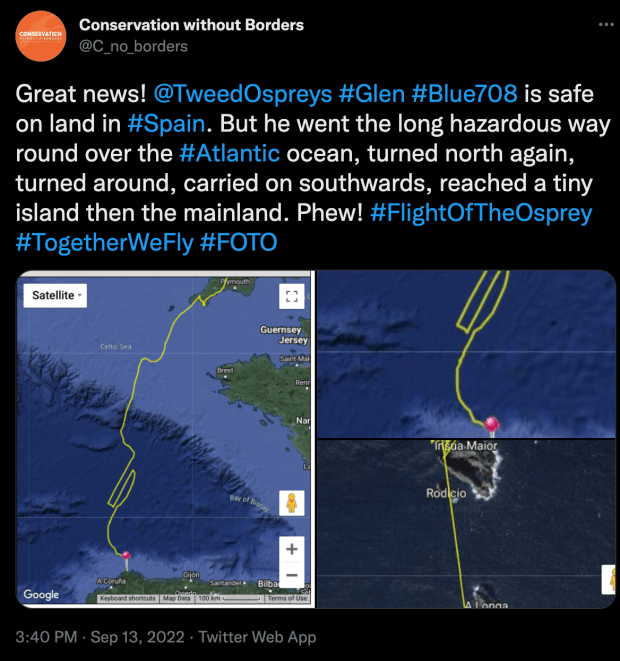
Some good news on one of the Tweed Osprey fledglings, Glen. (Sadly it appears that Kirk who had gone West and was in Ireland continued west over the Atlantic and is probably lost).

From Karl II’s family, the Estonian Black Storks from the Karula National Forest nest.

Bonus is really flying and remains in the same area he has been for several days now-the Prypjat River. He is safe. Relief as always.

Waba is at the Hrabarka River in Ukraine.

I see no transmission for Kaia or Karl II.

Audubon scientists are using data from hawk Mountain to monitor the places that raptors migrate.

https://www.hawkmountain.org/news/science/audubon-scientists-use-hawk-mountain-data-to-develop-a-new-method-for-mapping-bird-migrations

Here is the current data for Hawk Mountain in terms of this autumn’s migration.

https://www.hawkmountain.org/conservation-science/hawk-count

From the Archive:

I am not a cartoon character but, for many raptor watchers in Australia (and elsewhere), I am the most famous duck in the world. Do you remember me? What is my name? What kind of a duck am I? Whose nest did I lease? And do you remember what happened?

Thank you so much for joining me today and for your lovely notes. It is actually relatively quiet in Bird World but soon…so soon, there will be action in Australia – at Port Lincoln and Melbourne. Meanwhile, we can all enjoy the antics of the little Sea Eagles who are jumping, flapping, and learning to mantle and eat their own prey. Take care of yourselves. I look forward to seeing you again soon.

Thank you to the following for their tweets, their posts, videos, and streaming cams where I took my screen captures: Wildlife Haven, Bald Eagles of Centreport, Albatross Space, Channel Islands Eagle Lovers, Notre Dame Eagles, NEFL-AEF, NADC-AEF, Dyfi Ospreys, Bywyd Gwyllt Glaslyn, Sea Eagles@Birdlife Australia Discovery Centre Sydney Olympic Park, Port Lincoln Ospreys, 367 Collins Street by Mirvac, Charles Sturt Falcon Cam, Conservation Without Borders, and Looduskalender.


From the Archive: Daisy is a Pacific Black Duck. She first appeared on the nest of the Sydney Sea Eagles in December of 2020. She attempted three clutches of eggs – all predated by the Crows, sadly. The last clutch in 2021 almost made it to hatch. We were all cheering! Daisy stole our hearts and taught us many lessons about the challenges the female ducks face in being both incubator and security guard. The couple came this year to check on the nest. Oh, it was delightful to see Daisy and her mate but, equally, there was relief that she decided to lay her eggs elsewhere in the forest. Did you know that less than 15% of all duck eggs laid make it to hatch?

A new supporter for the Albatross? has Mrs G left for migration…early Friday in Bird World

9 September 2022

Thursday was truly a bit of an uneventful day mostly spent waiting on a parcel delivery that came much, much later than anticipated! It was a good time to just watch the garden to see what was happening. For Dyson fans, she is back to her normal self since having the babies. She was flying off branches today, landing on the deck, grabbing peanuts and running so fast I could not catch her on camera! Two of the Crows alerted me to the presence of the cat under the bird feeders. My goodness, they are quite remarkable and were given ‘extra treats’ – cheesy sausages – for their good work in protecting the rabbit and the songbirds. It has also been quite in Bird World, pretty much. These images have been shot quickly through a screen!

The Crows on the line cawing very loudly and looking at the cat below the feeders.
The culprit – a well fed pet!

In the Mailbox:

A couple of days ago, ‘B’ asked which gender migrated earlier – males or females? I have spent time asking Osprey experts and have uncovered some preliminary data using the Dyfi charts. It seems that gender is always discussed with regard to fledging but is only a footnote when it comes to migration. With a very small sample, males are 75% more likely to migrate first than females 90 days and under.

The chart below is of the Dyfi chicks. So those who fledged at 90 days, 75% more males than females. As you can see the older the chicks get, there are more females that take longer in the nest to migrate after fledging. I cannot assume that this is the same for other nests but, for now, this is the clearest data chart I have found for us to interpret. I will be looking for others in the days to come.

‘L’ wrote to me about the new climate bill in the US. The Audubon Society had posted an article on the 12 ways that it will help birds – and other wildlife. Thanks for sending me that article, ‘L’. I am certain others will find it of interest, too.

Making News:

The Osprey lost at sea that hitched a ride on a boat is making news in Scotland.

https://www.scottishdailyexpress.co.uk/news/uk-news/boaty-mcboatface-rescue-osprey-lost-27938175

Mississippi Power is putting up some Osprey Poles. How wonderful! Maybe they will place some more nests and other utility companies will follow suit. Sitting on the Canadian Prairies it is easy to imagine the number of Ospreys that might choose to winter along the Gulf or in the Gulf States.

The Royal Albatross and the campaign to change the long line fish trawling practices may have a new champion in King Charles III.

Nest News:

Based on their size and weight, the wildlife rehabber believes that Big Red and Arthur’s L3 and L4 are both female! Nice. That explains a lot about L4’s behaviour in the nest — not afraid of anything, just barreling over the others to get to the beak. Is it possible they were all females?

L4

At the Osprey nest of Aran and Mrs G in the Glaslyn Valley in Wales, all three of this years fledglings have joined the 100 Club. This means that they have been on the nest for over 100 days and counting before migrating. Today they are 106, 105, and 102 days old! Aran might be wondering if everyone has decided to over winter.

This was early Thursday morning. Mrs G is in the second photo. It was the last seen of her. The time was 08:58. If she isn’t hiding down in the Oaks or trying to fool us, Mrs G has now left for her migration. She took a piece of fish off one of the fledglings just to top up her tank! If you have left Mrs G, safe travels, lots of fish, and return again next spring – you remain the oldest osprey in the UK and what a lovely group of offspring this year!

Idris continues to deliver fish to Padarn. It looks like some are very happy to stay in Wales!

Padarn this morning. She is still in Wales!

Louis still has Sarafina fish calling!

The Melbourne scrape seems to be getting a lot of attention lately. First up, the building number is 367 Collins Street. There are now 36.7 members of the FB group. That is an incredible number of supporters. Here is the announcement:

There has been much concern over the incubation time and whether or not there was another male falcon present at the building. Victor Hurley, the chief researcher of the nest for the Victorian Peregrine Falcon Research group posted this today on FB:

The images that I have taken today appear to me to be the same male that has been at this nest since I began watching some years ago. Dad is relieving Mum so she can have a break this morning.

Later the couple were having a conversation.

In Orange, there is heavy rain falling. Diamond watches it from inside the scrape. Xavier has been in and out helping with incubation duties. I hope he is somewhere trying to stay dry.

At the Sea Eagles nest, it was chilly and the two eaglets wanted nothing more than to be able to shrink so all of them would fit under Mum.

Dad brought a little fish in for their breakfast so that Lady could feed the two.

Both SE29 and SE30 are really getting much more steady on their feet and they are spending more time walking on top of this twig nest. That surely cannot be easy!

At the Port Lincoln Osprey barge, Mum has been hungry. Dad has been known to bring in a fish, eat a large portion of it before bringing her a piece. Today he brought her a really nice sized larger fish for her tea. How wonderful. Thank you, Dad! Mum was really excited for that lovely dinner.

Looks like Alden’s funny quirks have rubbed off on Annie who was caught ‘loafing’ on the ledge of The Campanile on Thursday.

Oh, how I love Samson. He was at the NE Florida Bald Eagle nest today waiting for his mate, Gabby, to arrive from her migration. Like Richmond, the SF Bay Osprey, Samson stays in the area of the nest and does not migrate. Both Rosie (Richmond’s mate) and Gabby, do. Gabby is usually home by the 12th of September.

Migration News:

There is information from Bonus, Jan and Janika’s Black Storklet that was fostered by Kaia and Karl II. Bonus remains in Belarus near the Pripyat River where he has been feeding for some time.

Kaia remains in the general vicinity she has been in Ukraine.

Karl II is still believed to be in the area of Kherzov. We now know that the telecommunications in the area is down. Storks should, unless shelled by accident, wish to stay away form the people and there are the many nature reserves in this area where Karl II stayed for long periods in previous years. I am trying to remain positive for him!

Waba has had trouble with the tracker so there is no conclusive report.

From the archive:

Do you know which nest this was? The year is 2020. The older sibling supported the younger. The Magpie helped ‘this eaglet’ when the Pied Curra were attacking? The third image is the last one at the nest.

Thank you so much for being with me on this very quiet Friday in Bird World. Take care everyone. See you soon.

Thank you to the following for their posts, videos, tweets, and streaming cams that make up my screen captures: Dfyi Ospreys, Cornell Bird Lab, The Scottish Daily Express, Mississippi Power, Royal Cam Albatross Group NZ, Bywyd Gwyllt Glaslyn, Friends of Loch Arkaig and the Woodland Trust, 367 Collins Street by Mirvac, Charles Sturt falcon Cam, Sea Eagles@Birdlife Australia Discovery Centre Sydney Olympic Park, Port Lincoln Ospreys, Cal Falcons, NEFL-AEF, and Looduskalender.

From the Archive Answer: That is SE25 supporting SE26 after its little leg was broken. Lady is feeding both of them. SE26 struggled in the forest after fledging. After 6 days returned to the nest massively hungry and exhausted. Lady and Dad fed SE26. When 26 had recuperated, she flew to the camera branch where she was attacked by the Pied Currawong. A Magpie came to help 26. That is the last picture we have of SE26 in the forest. She flew out, chased by Curra, during the time of a storm and landed on the balcony of a 22nd floor condo some 1.5 km away in Horn Bush. SE26 was taken into care and euthanized, sadly. It was believed the damage to her leg would cause extensive pain and could not be repaired properly. It was a very, very sad day. SE26 was inspirational to all you watched her struggles to ‘be an eagle’…she flew. That is one consolation. What we learned was that the Pied Currawong are unrelenting in chasing the Sea Eagles out of the forest. This has caused extensive difficulties which have been noted in recent years with SE27 going in and out of care and requiring training to fly and hunt prey.

QT will get a name, photos of Victor and more in Bird World

7 September 2022

Good Morning Everyone. The first part of the week has flown by. I hope that you had a lovely long weekend (if you had a holiday) and that Tuesday was good.

The Crows continue to alarm every time “THE cat” comes into the garden and, in particular, when the rabbit is visiting and eating under he bird feeder. Today it happened twice. That bunny doesn’t know he has three guardian angels! How lucky.

Meanwhile Junior, the male Blue Jay, is moulting. Poor thing. He has lost his beautiful crest and he looks so out of proportion. He has finished up all of the peanuts and has decided to try some of the seed spilled when filling the feeders.

At sunset, hundreds if not a thousand gulls flew low to the ground looking for their evening resting area. The sky was simply full of them in every direction moving and looking like a swarm of mosquitoes. Several ‘V’s of Canada Geese could also be seen. The expectation is that the majority of duck and geese migration will take place starting the third week in September. If so, I hope to get some great images for you.

In the Mailbox:

‘G’ wonders how on earth an osplet could get salmonella poison and die? The necroscopy tests have revealed that the Loch Garten chick died of salmonella poisoning. The chick was lethargic several days before dying on the nest. A number of studies and several reports and articles such as “Incidence of Salmonella in fish and seafood” published in 2000 states, “Field laboratories of the U.S. Food and Drug Administration collected and tested 11,312 import and 768 domestic seafood samples over a 9-year period (1990 to 1998) for the presence of Salmonella. The overall incidence of Salmonella was 7.2% for import and 1.3% for domestic seafood. Nearly 10% of import and 2.8% of domestic raw seafood were positive for Salmonella”.

The study was, of course, related to the risk of food poisoning in humans but this would be the same way that osplets would get salmonella is by eating raw seafood that contains the bacteria.

https://pubmed.ncbi.nlm.nih.gov/10826714/#:~:text=Nearly%2010%25%20of%20import%20and,and%20one%20shark%20cartilage%20powder.

Making News:

The NZ DOC has done an 180 degree turn and has decided to hold a naming competition for the Royal Cam Quarry Track chick. QT, instead of leaving her with her code name. Here is the announcement:

Some additional images of Victor in the large flight area have been posted by the Ojai Raptor Centre. Oh. Victor is doing so well. I wonder if he is still rejecting the Trout and only wanting to eat Whiting??

Victor is getting stronger every day! Oh, how lucky this beautiful juvenile is to have such good care.

If you are intending to donate and/or purchase some items from the Ojai Raptor Centre’s shop, remember to include that it is for Victor! I might have mentioned that they have included a shopping option for Canada in addition to the US. If you live elsewhere, send them a note and they will set up the shipping. I received the two t-shirts and the tote bag today. They are super!

There is a wildfire in the Big Bear Valley. It is being called the Radford Fire. Many were concerned that it might bring harm to Jackie and Shadow and their nest but they are safe. The fire is on the SE part of the lake. We all love Jackie and Shadow and many of you might have heard about the fire and were worried. Here is that confirmation:

University of Louisiana grounds keepers saw the hawk tangled in fishing line and acted quickly in order to save its life. Remember and spread the word – be responsible. Clean up monofilament line both yours and that of others if you see it. Make the shores, lakes, and rivers safe for the birds and fish.

Nicola Sturgeon, the First Minister for Scotland has announced a draft bill on grouse moor licensing to be introduced in this year’s parliamentary legislation. Many like Mark Avery and Chris Packham have lobbied to end the senseless killing of the raptors on the driven grouse moors. This is a huge step forward and is coming none too soon.

The Guardian carried an article, “Dark matter and lithium water: 15 big issues poised to affect oceans and coastlines” today. You will already be aware of some of the concerning actions and issues including the dumping of toxic chemicals into the oceans. The example came from Senegal but it could easily have come from large westernized countries! My biggest disappointment was the glossing over – no, not just glossing over – not even acknowledging what will ultimately happen to the sea birds that depend on the oceans for food.

https://www.theguardian.com/environment/2022/sep/06/water-issues-oceans-coastlines-marine-coastal-biodiversity

Nest News:

Mrs G and the three fledglings remain at the Glaslyn nest with the male, Aran. They are the only ‘full family nest’ still resident in the UK.

All three siblings lined up waiting for Aran and fish.

Mrs G is hiding!

News coming out of the Dyfi nest other than Idris continuing to feed Padarn is that Pedran, the first fledgling, did not fly straight south from the nest to begin migration but, rather hung around the UK and has been spotted! So remember this – the birds do not always fly directly south but can spend time flying and perfecting their fishing while getting strong! (Note- all three were deemed to be female. Disregard the use of the words he/him below).

Bella has arrived at the NCTC Bald Eagle nest waiting for her mate, Smitty.

An unknown female Peregrine Falcon interrupted Alden’s ‘loafing time’. Let us hope that this is not the female intruder that Grinnell had chased away from The Campanile scrape.

After an encounter with a female intruder at The Campanile, Annie and Alden renew their bond in the scrape.

All is well at the Australian nests. The only one with chicks is, of course, the Sydney Sea Eagles and SE29 and 30 are growing and changing and, like clockwork on the development chart, getting all of their juvenile feathers. It may be difficult to tell them apart soon!

It is incubation duties at the other three nests – the two Peregrine Falcon scrapes at Orange and Melbourne and the Port Lincoln Osprey barge.

Sunny in Melbourne.

Beautiful Diamond.

The sunshine gave way to rain later in the day at Port Lincoln.

Dad eating his portion of fish before taking it to Mum. Thanks, Dad. We don’t want any more flapping fish on those precious eggs!!!!!!

Migration News:

No tracking news for Karl II or Kaia. Karl II is in the most dangerous area of Ukraine at the moment. Their transmitters could be jammed. The only news is of Waba and he is doing fine and has found a small area to fish. We wait.

Memory Lane:

Do you remember these two cutie pies? Who are they? what is their natal nest? and what are the names of their parents?

Thank you so much for joining me today. I will be pulling out photos from the archives for the next week or so to see if we can tell who is who! Take care everyone. See you soon!

Answer to Memory Lane: This is E17 and E18 from the SWFlorida Bald Eagle nest. They were removed to CROW for conjunctivitis and safely returned to Harriet and M15 after a successful treatment. Known for their early sparring the twins became best buddies.

Thank you to the following for their posts, their streaming cams and videos that make up my screen captures: Cornell Bird Lab and the NZ DOC,, Ojai Raptor Centre, Friends of Big Bear Valley, Bald Eagles 101, Bywyd Gwyllt Glaslyn, Dyfi Ospreys, NCTC, Cal Falcons, Sea Eagles@Birdlife Australia Discovery Centre Sydney Olympic Park, 367 Collins Street by Mirvac, Charles Sturt Falcon Cam, Port Lincoln Ospreys, and SWFlorida Bald Eagles and CROW.

Flapping fish, pip dates and…more in Bird World for Tuesday

6 September 2022

The families are back at work and the children will be in school. There will be no more loud yelps when a grasshopper has been found and checked off the list of treasures in the ‘Nature Scavenger Hunt’ at the nature centre or toddlers trying to pull the tails of the ducks. It will be quiet.

it was 26 degrees C on a sunny Sunday afternoon as I set about trying to find that dear wee duckling at Ft Whyte. Originally there were two. I did not see the second one today either when I went around the final bend but I did find the tiny one sleeping in the sunshine. Now that the water level is falling all manner of little islands are appearing in the ponds. They are nice places for ducks to sun themselves in the middle of the day.

The wee darling even had its eyes closed. You can see the downy fluff on its back. I am so worried that the feathers are not developing correctly – a little bit like Yurruga last year at the Orange scrape of Diamond and Xavier. Will they fill in, I wonder.

Have you had experience with ducklings? Can you offer advice. The little one has grown since I was there a couple of days ago.

Sibley tells us that the wing feathers of the Mallard require 60 days to fully grow so that the duck can adequately fly. This little one is about 3 weeks old or 21 days – the closest I can guess from my visits and seeing it – at the nature centre. We need 40 more days. This duckling will make it. That would be the 15th of October! Help me cheer it on.

This beauty looks so gorgeous in the sun between the springs of plants. I love how the tail feathers are fanned out and look like lace with a beautiful satin blue ribbon trimmed with black and white. Mallards are lovely. The more I see them, the more special they become.

All of the ducks seem to have been eating rather well and filling out. They will need all of that energy for their long flights.

The plants are beginning to change adding some oranges, reds, and browns to the green leaves. The ducks can melt into the landscape if you do not look closely. These three were characters. Just look at their crops, especially the one facing us nearly straight on. Well fed I would say!

Sometimes it is nice to be able to look down and see the gorgeous orange legs paddling – it means that the water is no longer murky. This duck seemed to be smiling at me.

This one was tucked up nice and tight on one of the islands. It took some time to see her.

One of the silliest things that happened today was between two Canada geese. They were both on the boardwalk. On stayed put while I tried, as quietly as I could, to pass. The other decided to walk in front of me going around the corner out of sight of its partner. They then started ‘talking’ to one another. This went on for nearly 6 minutes without either moving to go to the other…I left to go and check on the wee duckling that I had spotted ahead of me. I wonder if those geese are still honking?

This morning I woke to the alarm calls of the three Crows in the garden and sure enough, there was the cat – and the rabbit. They are protecting little Hedwig by calling me out to chase the cat away. I do wish that people would be responsible for their pets.

In the Inbox:

‘J’ wrote to tell me the story of the two Sea Eagles and the fish tail. I had not seen it. ‘J’ said, very appropriately, “It seemed more educational for them both than anything.” I missed this specific occasion and I am terribly grateful that ‘J’ gave me the time stamp because I was able to catch a few minutes of SE29 and SE30 doing some friendly exchanges with that tail – they even got a few nibbles of fish, too!

‘R’ writes: Why do the Magpies continually dive bomb the sea eagles? Anyone who has been watching the Sea Eagles nest in the Sydney Olympic Forest will have seen the most recent attacks by the Magpies on the Sea Eagle nest. There will be others such as Boo Book Owl, too. The Magpies have their own nests. It is believed that there are about 50 breeding pairs of Magpies in the forest. The Sea Eagles are the top predator in the forest. The Magpies have no hope when it comes to a challenge with them but they dive bomb them hoping if they are such a nuisance the eagles might leave the forest. Of course they will not! That said, the smallest owl has inflicted injury to Lady in the past. They are silent when they attack and have hit Lady and hurt her eye. You might also have seen the Great Horned Owls attacking the SWFlorida eagle nest of M15 and Harriet. The GHOWs are formidable enemies to the eagles but Boo Book is so much smaller. Still he can do harm and any of them might want a tasty eaglet for dinner. The sea Eagles must be careful with the owls. The Magpies are a nuisance to the adults but can and do drive the youngsters from the forest when they fledge, like the Pied Currawong do. You will often see larger predators being constantly attacked by smaller birds. The Mockingbirds continually follow Big Red and Arthur on the Cornell Campus.

‘A’ asks: “Why don’t the Osprey parents just kick their fledglings off the nest or stop feeding them?” That is a great question and I am certain that there are a lot of people wondering the same thing. I am going to use the term that is often employed ‘good parents’, if you will excuse me for that. The goal of the breeding season is to raise healthy chicks and to either increase the population of the species or, as one researcher noted, hope to have a replacement for each parent when they die. Not feeding the chicks or kicking them off the nest is counter to all of that. The adults might begin to limit the feedings encouraging independence but the chicks will depart for their own territories or for migration when they are strong enough. When that day comes, nothing will hold them back! Until then, ‘good parents’ continue to feed their chicks as best they can while also building up their own strength. Louis and Idris are great examples. Everyone has left but Sarafina and Padarn. They will continue to feed their girls until such time as they leave. Both are excellent dads. Aran and Mrs G are doing the same. None of the fledglings have left. Fish is continually supplied. Mrs G would normally leave before the fledglings. Let’s keep an eye out and see what happens.

Padarn is one of the most beautiful fledglings I have seen!

Making News:

You may recall that Loch Garten’s Osprey chick 1C1 died after being unwell for several days. It was believed that she had an infection and it was confirmed today through the necroscopy that it was a case of salmonella. It is unclear how the little osprey got salmonella.

Do you know the term ‘war wilding’? Ukraine re-flooded the Irpin River so that the Russian army could not get to Kyiv. What is fascinating to me is that this has created a wonderful wetland for the birds that could last for years creating new opportunities out of war.

https://www.theguardian.com/environment/2022/sep/05/warwilding-a-new-word-to-describe-the-startling-effects-of-using-nature-as-a-weapon-ukraine-korea-aoe

The author cites cases where warWilding has been used to create biodiversity hotspots and bring new hope for wildlife such as in Mozambique but, he also tells us how this can be turned against wildlife – when water is drained to cause harm to people and, as a result, to the birds and animals. It is a good read. Check it out when you have time. There is a link to another very good paper within the article on the same topic, if you are interested.

There is a new book, Peregrines in the City by Andrew Kelly and Dean Jones. Do you recognize the scrape? More to follow after I have had a chance to read this book on such an interesting topic!

Nest News:

It appears that there might be only one Osprey nest in the entire UK that has both adults and all the fledglings still at home. That is the nest of Aran and Mrs G in the Glaslyn Valley in Wales.

The sun is just starting to show. You can hear the songbirds, the cows mooing, and the sheep bleating. One chick is already fish calling!

It might have been the one that was calling from the perch as the sun was setting on Monday!

It has been a wonderful year for Aran and Mrs G, one that certainly made up for the loss of their three nestlings last year and Aran’s injury. Everyone is really healthy and getting strong.

At the Charles Sturt scrape box on the campus at Orange, we will be on pip watch for the first of Xavier and Diamond’s eggs on the 29th of September with hatch watch from 1-3 October. Mark your calendars!

Handsome Xavier got some eggie time!!!!!!!!!

If pip watch is the 29th for the Orange Peregrine falcons, then we have to be checking on the Melbourne falcons earlier. I am going to mark my calendar for the 23rd for pip watch at 367 Collins Street!

At Port Lincoln, if all goes to plan, we are less than 2 weeks away from the first hatch!!!!!!!!!! In the meantime, Dad had everyone a little anxious when he brought a live whole fish on to the nest for Mum’s breakfast. Let us all hope that the eggs are OK.

At the Sea Eagles nest, it looks like an eel was brought in – or was it a fish? – at 1330.

In Florida, Samson has delivered at least one stick to start rebuilding the nest in NEFlorida and Harriet and M15 have returned to the SWFlorida Eagle nest in Fort Myers.

Blue 022 fooled everyone. Believed to have left for his migration after his family, he shows up at another platform in Poole Harbour. Is he scouting for another nest after the goshawk attack? or just resting?

Migration:

No tracking news for Karl II. It could be that his tracking signal is being jammed as he is in the location of Cherson (Kherzon), Ukraine. Bonus is still in Belarus near the River Pryjpat. Kaia flew a short distance but remains near the Desna River in Ukraine. Waba is between two rivers, the Buzhok and Slutsch. Please keep this beautiful Black Stork family from the Karula National Forest in Estonia in your warmest thoughts.

From the Book Stack:

Bill McGuire’s, Hothouse Earth. An Inhabitant’s Guide, minces no words when it comes to the destruction of our planet and the inability of anyone to stop the warming. McGuire is Professor Emeritus of Geophysical and Climate Hazards at University College, London. He accepts neither climate deniers or climate doomists and insists that we must be prepared for what is currently happening and for what will come in the future. We have not been able to halt the 1.5 degree C rise in temperature that was thought to be the tipping point. “How Bad can things get?” is a complex and intertwined question surrounding the relationship of the climate, the natural world, and human society and economics. McGuire says, “…what we can be certain of is that climate breakdown will be all-pervasive. Insidiously worming its way into every corner of lives and livelihoods, no one, anywhere – not even the tech billionaires in their guarded redoubts – will be immune” (143). He warns against all of the geoengineering methodologies and climate hakes being proposed including volcanic cooling and the refreezing of the poles. Instead, McGuire is very pragmatic. If we want to limit the worst effects of climate chaos til the end of the century, then there are some things that humans must do immediately: 1) methane emissions is a top priority; 2) the scraping of subsidies for the oil and gas industry; 3) the ceasing of new exploration licenses for gas and oil must stop forthwith; 4) banks must be made not to invest in gas and oil ventures; 5) damaged and desecrated land must be restored by reforestation and rewilding; 6) progressive phasing out of beef and dairy farming; 7) the restoring of peatlands and wetlands – places that store more carbon; 8) cutting back on flying and shipping consumer goods around the planet; 9) massive investment in home insulation and green domestic energy. I note that he questions the cost and value of electric vehicles (replacing world’s 1 billion fossil fuel vehicles, the lithium farming, etc) and focuses instead on green public transportation, journey based car pools, and car shares and more cycling and walking. ————Of course, it is not just humans that are impacting by the escalating heating of the planet but our beloved wildlife – and our dearest feathered friends, many who are struggling now. McGuire says his intention is to frighten people into the reality of what we are facing.

Tomorrow a look at Birds. A Complete Guide to their Biology and Behavior.

Thank you so much for joining me today. It is so nice to hear from so many of you. Stay safe. See you soon!

Thank you to the following for their tweets, postings, and streaming cams where I took my screen captures and video clips: Sea Eagles@Birdlife Australia Discovery Centre Sydney Olympic Park, Dyfi Ospreys, Loch Garten RSPB Abernathy, The Guardian, Bywyd Gwyllt Glaslyn, Charles Sturt Falcon Cam, 367 Collins Street by Mirvac, Port Lincoln Ospreys, SWFlorida Eagle Club, and the Birds of Poole Harbour.

Early Sunday in Bird World

4 September 2022

Oh, Good Morning Everyone. I hope this newsletter finds you well and happy.

It is a beautiful holiday Monday on the Canadian prairies. The sun is shining bright but the temperature is not going above 24 C today – a great day to go out and continue checking on the ducks and geese. Autumn is one of my most favourite times of year despite the fact that it leads us directly into winter and is often too short!

Yesterday the Cormorants and American White Pelicans were enjoying time in the shade near the dam at Lockport, Manitoba. The image below is one tiny section. There were more than 60 pelicans and 45 Double-crested Cormorants swimming and drying off in the sun.

If you live in or around Winnipeg, Fort Whyte will begin staying open Wed-Sunday beginning 21 September so that you can watch the Canada Geese arrive in the thousands at dusk. It is an amazing sight. There will be food trucks or you can bring your own picnic. The cafe might be holding its Goose Flight dinners but this is uncertain due to the same staffing shortages that are hitting the hospitality industry worldwide.

From the Mailbox:

‘H’ writes to ask me if I am familiar with moon_rabbit_rising on Instagram? Oh, yes, I am and if you love the Cal Falcons then you need to head over and see Bridgette Ahern’s incredible – and I do mean incredible – images of Annie and Grinnell and their family and now Annie and Alden and their family.

‘D’ wrote as did several others following my UK Osprey postings and information about the female departures: “Are the Dads usually the last to leave the nest?” Yes, the males are normally the last ones that leave the nest. The females usually depart about two weeks prior to the fledglings leaving and then the male stays, eats well getting his strength back, and then departs. There are always exceptions to the rule! I just had a couple of notes from ‘N’ who comments that the nests she normally watches generally have the males leaving first! It is a very poignant moment when the male arrives with a fish and waits – and waits some more – and no one comes to collect it. By now, Louis is wishing that Sarafina would fly in the same way that Idris would like to see Padarn off the nest.

Making News:

There are many times that I am proud to be a Canadian and today, it is so reassuring to see that the people in Callander, Ontario care about their Bald Eagle and its nest!

https://www.cbc.ca/news/canada/sudbury/callander-bald-eagles-1.6568714?fbclid=IwAR28VsUDKWDWjy5S-uop8h2WKVcyL8DVLdS-cV5llN-id623Kb0QHuE-hvg

If you missed the video that Ojai Raptor Centre posted of Victor flying – here it is. It is also worth a second or third viewing. Victor is doing so well.

Another juvenile eagle – this time caught up in fishing line is saved!

https://www.uticaod.com/story/sports/2022/09/03/eagle-rescue-canadarago-lake/65470809007/?fbclid=IwAR1CnT1OpPF1U68N8_S3q017q5b8WjnF56qr1ElgZt-RgvVTg9E0JePjfpk

The citizens living in the NE of England are demanding answers from the government on why hundreds of thousands of lobsters, crabs, and sea birds wound up on the shore dead.

https://www.theguardian.com/environment/2022/sep/03/we-just-want-the-truth-british-coastal-towns-fight-for-answers-over-mystery-sealife-deaths

Raptor Persecution UK is calling out Natural England as being compromised in the handling of the killing of Asta, the Hen Harrier. This is their description of the crime:

“The level of depraved brutality involved in this crime is quite shocking, even to those of us who have become hardened to the relentless illegal killing of birds of prey in the UK. It’s virtually impossible not to look at these images of Asta and imagine the horror she faced at the hands of her killer.

The calculated deviousness of whoever committed this crime deserves the full attention of the statutory regulator, Natural England, and widespread publicity about the lengths these criminals will go to hide their ongoing, appalling violence towards this species and other birds of prey.” After 18 months nothing has been done and birds of prey continue to be killed over the grouse moor hunting estates. It is not just the brutality of the killing of this single Hen Harrier but also the other 72 that have been killed and the lack of accountability that is worrisome.

Along this same theme, the Countryside Alliance is waging an all out campaign to get Chris Packham removed from the BBC because of his views about ending grouse hunting and thus, the illegal killing of raptors. If you live in the UK and have a view on this matter, please make it known.

The raptors are moving and Cape May, New Jersey likes to call itself the ‘raptor capital of North America’. See what is happening and why people are getting excited.

A win for all the sea birds comes as a South Africa court refuses to give Shell permission for offshore gas and oil drilling.

https://www.theguardian.com/environment/2022/sep/01/south-african-court-bans-offshore-oil-and-gas-exploration-by-shell

Nest News:

It is the 10th anniversary of the Bald Eagle nest at Berry College. Who didn’t love Ma Berry? and who of us did not lose their heart to B15 this season? The Bald Eagle experts take you on a trip down memory lane with the Berry Eagles but, you have to go to the Berry College FB page. They will – despite saying I can embed the link – well, it doesn’t happen! Regrets.

Suzanne Arnold Horning posted some great images of our lovely Red-tail Hawks on the Cornell Campus over this past season on the FB banner! I have not seen a new update on L3 or L4 and in this case, no news is good news.

This is one of the last shots Suzanne took of L2 before his/her migration. L2 has not been seen in a week and so she/he is off to find their own spot in the world. L2 was the first to fledge and the second to catch her own prey. Often noted as being a ‘mini’ Big Red. Beautiful hawk. Soar high and always have a full crop!

Following Karl II’s family on their migration:

Waba is in Ukraine where he has been exploring the banks of rivers for food.

Kaia remains in Ukraine in des Desna near Vovchok. She only flew 47 km – around the area feeding.

Bonus is still in Belarus in the Prypjat wetlands near Makarichi.

There is no current tracking news for Karl II.

Thunder visited the West End Bald Eagle nest in the Channel Islands at 10:38 Saturday morning. Listen to her calls. You will notice another bird flying around – you can just see the silhouette.

The Sydney Sea Eagles did not have to wait until afternoon for their breakfast today. I caught several feedings for these fast growing eaglets. Notice how well behaved they are!

It had rained and Lady is offering some comfortable out of the rain for SE29 and SE30’s heads. Poor things. They are too big to fit under her.

Dad brings in a nice fish. Lady jumps down from her parent branch to feed the wet youngsters.

Dad comes in with another prey item. It looked like a small bird but I am not entirely sure.

Ranger Sharyn posted the following information for viewers of the Royal Albatross streaming cam on Taiaroa Head, NZ after the fledgling of the Royal Cam chick QT yesterday.

It should be relative quiet while birds are incubating eggs but yesterday, there was an intruder at the scrape on the Charles Sturt campus in Orange. Cilla Kinross caught it in slow-motion:

Xavier has spent some time on the ledge protecting Diamond and their eggs.

At Port Lincoln, all is well. Mum is sleeping and incubating the eggs and Dad is down in his shed, a place he spent having some good old’ chats with Ervie. It is the 5th of September with hatch expected in a fortnight (2 weeks).

It is quiet in Melbourne at the 367 Collins Street scrape. Where is Dad you ask? He will be perched nearby – sometimes on the camera.

The amount of detail that people keep on the UK Osprey nests is truly impressive. If every nest in the world had a dedicated group keeping every single detail for each season what an impressive amount of information we would have on the breeding and behaviour of Ospreys. Llyn Clywedog just posted the number and type of fish and what this means in comparison to average deliveries elsewhere. Well done, Dylan!

Peace and Love, the two fledgling Bald Eagles of Liberty and Freedom at the Glacier Gardens nest, were on the natal nest this morning watching the traffic along the road. How lovely to see them.

Thank you so much for joining me today. Please take care. Looking forward to seeing you soon.

Thank you to the following for their streaming cams and their posts that made up my screen captures today: moon_rabbit_rising, CBC, Ojai Raptor Centre, Cape May Hawkwatch, Cornell Hawk Chatters and Suzanne Arnold Horning, Looduskalender, Explore.org and IWS, Sea Eagles@Birdlife Australia Discovery Centre Sydney Olympic Park, NZ DOC, Charles Sturt Falcon Cam, Cilla Kinross, 367 Collins Street by Mirvac, Port Lincoln Ospreys, Llyn Clywedog Ospreys, and Glacier Gardens.

Featured image is L2 taken by Suzanne Arnold Horning.