Ervie, rare spine surgery for a Bald Eagle and more… Thursday in Bird World

1 September 2022

The temperature in Winnipeg rose to 32 degrees C Wednesday evening. It was unbelievably hot and the birds were making full use of the layers and layers of vines and the thick lilac bushes to keep cool. They would occasionally come out for a drink and a bath.

I saw a photograph of a converted wading pool. It was covered with a coated mesh pulled taut – small enough so that the birds could not get their feet caught and they could not drown in the water. A pump with a sprinkler system was positioned in the centre…it was full of little birds having a party. What a great idea. I have just the place for one of those for next summer so the garden visitors can cool down even more. I wonder if the Crows will try it out? or Dyson?

Making News:

Vet team in Canada performs rare spinal surgery on Bald Eagle, Buddy.

https://www.cbc.ca/news/canada/prince-edward-island/pei-eagle-spinal-surgery-1.6565558?fbclid=IwAR1JFvPcwTJYalzVwZp7cbqMgJUJI7BFifSdNEY73mcu4E_7ItO2FmDzURo

Did someone say Ospreys do not do well in care? Smedley did great at the Audubdon Centre. Now there is Charley!

https://www.abcactionnews.com/news/region-pinellas/charley-the-osprey-finds-a-new-home-at-moccasin-lake-nature-park-in-clearwater?fbclid=IwAR2BPuhQgSbMuGj2m3EUV2JJijZzEAO_06oKhp1bmX7qa-wB8xYnogWmJLQ

BirdCast has all the information on migration. You can go and find out how many birds flew over your region at any time in the United States. I checked on Minnesota because it is close to Manitoba – gosh I wish this map worked for the entire planet! They also tell you the birds that are migrating.

For your own information, go to birdcast.info

The Stellar’s Sea Eagle was first seen in Newfoundland/Labrador Canada some time ago. It made its way down the eastern coast of the US causing a stir in Maine. It is back up in Canada now! Some images were posted by Wade Jones. It will surely be making the news here again. Everyone was excited — and yet, there are more and more birds ‘far from home’. I often wonder if they are scouts for the species testing out new locations for living.

James Lovelock died on the 26th of July. Trained as a scientist and known as an early environmentalist and futurist, Lovelock suggested in 2007 that “we might actually choose to contaminate land to keep people out and make it safe for wild animals and birds” (quoted in Marren 274). Marren notes that there has been no mass movement to take up Lovelocks suggestion but that areas around Chernobyl and Fukishima Exclusion Zones are showing promise in this regard.

Jean-Marie duPart counted 54 ospreys fishing at the Langue de Barbarie Park. He will travel to the other areas in Senegal shortly. He says the 54 is the same count as he had in June. Thank you Jean-Marie!

Nest News:

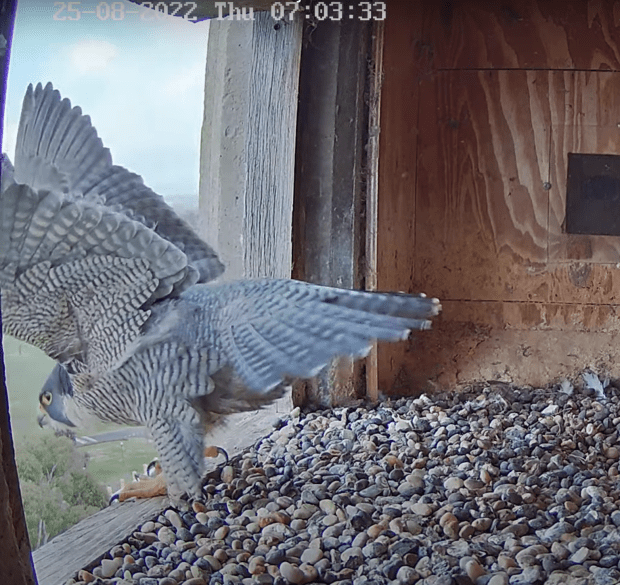
So thrilled that the intruding male did not bring any harm to this beautiful Peregrine Falcon family. Annie and Alden continue to bond…and their little delicate kisses are just lovely.

Llyn Brenig says goodbye for the season. It is an empty nest!

https://www.northwaleswildlifetrust.org.uk/blog/kim-and-giuseppe-boccato/their-wintering-grounds?fbclid=IwAR2fo5Cv8K_Ba8nMrEcW5h0DKgg0ovxO-KiFDzBjCHLwFhmADHe6PhgaYQQ

The entire Glaslyn clan is still at home! Mrs G, Aran, and the three kids.

Aran hasn’t lost any talons yet.

Mrs G had her own fish over at the Oak Tree perch. Eating in quiet is important. Mrs G is the oldest osprey in the UK and she has had a busy year with those three fledglings. She needs her strength for her own migration.

Louis is still feeding Sarafina at the Loch Arkaig Nest.

Is Iris still with us? These are the departure dates for past years at the Hellgate Canyon nest in Missoula, Montana. Based on her past history, even thought she has not been seen, it is believed she is still around. Keep checking the nest!

Xavier and Diamond are so cute. Xavier cannot wait for the eggs to turn into chicks. He even brought prey to try and feed them this morning! What a darling. Then he stashed it for Diamond in the corner and she enjoyed it after a full mating ritual on top of the water tower.

Golden sun over the scrape as morning breaks in Orange, Australia.

Diamond flies off for a break.

Xavier arrives with some prey.

Would you like some pigeon?

Decides the eggs aren’t hungry so he will enjoy a few bites before stashing the snack in the corner for Diamond.

Diamond finds Xavier’s treasure.

Xavier loves to incubate the eggies and often, you will have noticed, Diamond does not give him a lot of time. Was it on purpose then that he brought the unprepared Black-faced Cuckoo Shrike in for Diamond’s tea? Imagine the time it will take her to prepare the bird and consume it? Meanwhile Xavier is in Daddyland Bliss.

So what is a Black-faced Cuckoo Shrike? These large grey birds with their distinctive black masks are a protected species in Australia. They belong to the passerine family, eat mostly insects, and are found just about everywhere in Australia.

2010-08-19 15-10-21 – IMG_0359 Black-faced Cuckoo-shrike” by Degilbo on flickr is licensed under CC BY-NC-ND 2.0.

It is after 1200 noon and I still have not seen any prey items brought to the nest. An adult has landed twice with nothing in the talons? Are there intruders? are the prey deliveries arriving later in the day? what particular reason?

Only one fish was delivered yesterday. Dad brought it in at 1508. Both eaglets were fed, according to my source, but 29 got more than 30. It was thought that Lady might start fishing but she didn’t and the spotters on the ground saw Dad at the River Roost. He flew to the nest and the kids started telling him they needed food. It has happened in the past – “feast or famine” ‘P’ calls it. They had eaten lots but 30 had cast a pellet and its crop was completely empty so the little one was really hungry. It is like their life in the wild but sometimes, worrisome to us watching.

The Sea Eagle chicks are now in week 6 and entering week 7. They continue to develop quite well despite my worries about prey deliveries. I hope this worry is for naught. I have written to my contact. One of the adults is in the tree looking out and I think it is Lady. I hope to find out if there are worries also in Sydney. If you do see a prey delivery from Dad, please do let me know.

During this time you might still see a few of the fluffy feathers. The eagles are doing a lot of preening, wing flapping and sitting and spreading themselves. They are standing slightly more steady and they continue to move the twigs in the nest about. By the end of week 8 – coming soon- they should have all of their juvenile feathers even covering their head, chest, and tail. They will be mantling and attempts at self-feeding will continue.

Dad is on the nest on the Port Lincoln barge while Mum has a much needed break and some fish. We can start counting down now…18 more days!

Ervie is out and about doing what Ervie does! Just look at his travels. Oh, just imagine. You will be one year old soon, Ervie. No balloons but we will make you a fish cake.

Hi there handsome, Ervie.

Your talon is slowly, ever so slowly growing back in but look at that green band. Soon you might be two silvers!

Little Dad watched over his new mate and the four precious eggs at the 367 Collins Street scrape in Melbourne.

In California, the Condor chick in Tom’s Canyon is doing fantastic! I don’t often write about the condors and that is a ‘shame on me’. Just look at how big and healthy this chick is.

Karl II remains in Estonia at the nest getting his strength and having some rest from feeding the four fledglings. Bonus remains at the Priyapat River in Belarus. Here is his tracker and an image of the area.

I am worried beyond belief for Kaia who entered The Ukraine near Chernobyl on the 30th. No updated tracking information for the past two days. Data due at 19:45. Will see if anything comes in. as of September 1, then no word on Kaia after landing, for the second time, in The Ukraine. Waba has sent in no data tracking. Karl II remains in the Karula National Forest in Estonia. Bonus was last in Belarus. Send them your warm wishes on their travels.

Thank you so much for joining me this morning. It is going to be another 32 C day here in Winnipeg which means it could go a little higher. The tropical plants on the deck are doing marvellous. So strange. Take care of yourselves. See you soon!

Thank you to the following for their streaming cams, videos, and posts where I took my screen captures: CBC, BirdCast, Wade Jones, Cal Falcons, North Wales Wildlife Trust, Bywyd Gwyllt Glaslyn, Friends of Loch Arkaig and the Woodland Trust, Montana Ospreys, Charles Sturt Orange Falcon Cam, Sea Eagles@Birdlife Australia Discovery Centre Sydney Olympic Park, Port Lincoln Ospreys, 367 Collins Street by Mirvac, Ventana Wildlife, and Looduskalender.

It’s 3 for Diamond and Xavier and Bonus and Kaia were 25 km apart…Early Wednesday in Bird World

31 August 2022

Good Morning Everyone.

The sun is once again shining bright on the Canadian prairies. There is not a cloud in the sky and it is getting hot. By tea time the temperature will have risen to 29 degrees C from the current 22. It is a day to make certain that there is plenty of water for the birds in the garden — and lots of food. The migrants are moving through.

Yesterday, I went for a ride to check the birds in the countryside. The gulls were enjoying the fields that the farmers had just plowed and a single Ring-billed gull thought that it could share my lunch.

There was a quiet stillness over the wetlands at Oak Hammock Marsh. A few geese, a handful of ducks and shore birds were around but nothing like what will begin to happen as September begins. Migratory birds will be landing at dusk and taking off in the early morning hours.

In the Mailbox:

This letter comes from a local friend but, it could be from anyone: “Every time I reach out to help the wildlife, I get told to leave nature alone (in the rudest way), nature will take care of itself. What is your advice?”

I wonder what you would say to this individual?

My advice is to ignore the negative comments. Lead by example. We have destroyed the habitats and, thus, the lives of the wildlife. We poison their water and have caused the oceans to warm. We throw our garbage into their ponds. We have destroyed their food supplies…we shoot them. It is time to embrace caring and understanding. Wildlife – the whole of it – are sentient beings, they have feelings and emotions. They deserve the best we can give them. We need to become selfless and put wildlife first, not ourselves. Putting humans first has caused us to be in the present state we find our planet in. Peter Merren says, ‘Care for Nature begins at home.’

Making News:

The plans to stop two pairs of Bald Eagles from being able to access their nests is causing a lot of outrage in British Columbia. You can sign the petition, too, by copying the link into your browser!

BirdGuides finds many human-induced changes to the environment that are killing the migratory birds. Of these infra-structure, hunting, and earth warming are the top three.

https://www.birdguides.com/articles/conservation/built-infrastructure-hunting-and-climate-change-linked-to-huge-migrato/

Nest News:

The birds are on the move and I found a super guide to Osprey migration. Everything you wanted to ask and were afraid to…It will give you some great insights as to what is happening at all the nests.

https://birdfact.com/articles/osprey-migration

Loch of the Lowes has an announcement:

While Loch of the Lowes is empty, the Glaslyn nest of Aran and Mrs G still has three chicks yelling at Dad to bring in the fish!

Louis has delivered a nice fish to Sarafina at the Loch Arkaig nest this morning.

Idris brought a nice fish to Padern who appears to be the only fledgling at the Dyfi Nest. Paith was last seen at 1700 on the 29th.

I got a little emotional when I saw that Bonus and Kaia were just 25 km apart in Belarus. My heart beat a little faster wondering if it was possible that they would fish together along the shores of the Priyapat River. It was not meant to be…Kaia flew into the Ukraine again and then set a trajectory quickly east. Meanwhile Karl II remains in Estonia enjoying an empty nest (yes, parents do love their children but it is also nice to have some quiet and fish to one’s self). I want to give a real shout out to those that are posting the maps and images on the Looduskalender site for Karl II and his family’s migration. I have included their comments and image notes so you can see where Bonus and Kaia are in the image below.

Moving forward, on the 31st, here are the locations of the individual Black Storks.

The other big nest news is that Diamond has now laid her third egg. It happened at 0525 on 31 August 2022. Historically, Diamond has only laid 3 eggs and for the past two seasons, only one of those has hatched.

You could tell things were happening. Diamond was focused and standing.

Xavier comes into the scrape box and he is so excited!!!!!!!!! Diamond is happy to show him the three precious eggs. The bowing and the rituals fascinate me…oh, to be able to speak falcon!

In celebration, Xavier brought Diamond a very nice breakfast. Now we can get a good look at those three beautiful eggs.

Diamond took a break and Xavier comes into the scrape to incubate the eggies…he loves doing helping out. Diamond does not always oblige him but he can incubate those eggs with the best of them!

“Oh, she’s back….maybe she won’t see me here!”

The Sea Eagles are picking up sticks and 29 is standing stronger and doing some wingersizing. Both are fine.

The light on SE29 really shows off the variation in plumage colours. One year I was thinking that everyone should go to their stylist and ask for a 26…the little eaglet at the time but, this year, right now, it could be a 30. They just get more and more beautiful.

As many know, my first love was hawks. There is nothing cuter than a precious Red-tail juvenile. One of the moderators of the Sea Eagle cam who also was the admin on the Cornell Chatters kept poking me and telling me that I would change my mind the minute I saw a sea eagle juvie. ‘TCR’ you were positively right, of course.

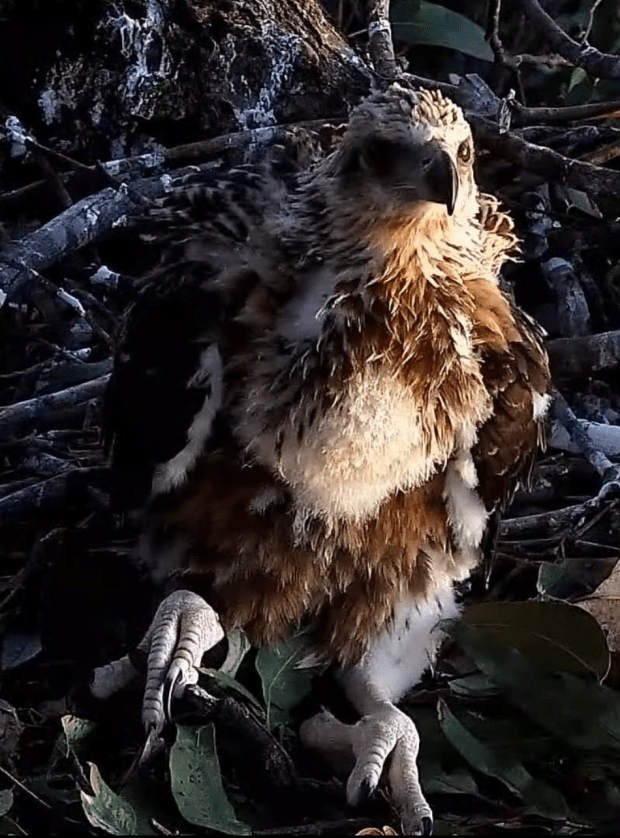
This eaglet just makes me melt. So gorgeous. Talk about clown feet! Whoaaaaaa. Did I hear someone say they would like to cuddle with this cutie pie??? Now before you hold up your hand, just look at those very sharp talons and think about your answer carefully.

This image shows the difference in the back plumage. SE 30 is on the left and SE29 is on the right. Plumage progress is going well for these two.

But if SE30 sits differently, it is hard to tell them apart!

SE 29 flapping those wings! SE30 is watching carefully.

I should warn you…when they both start flapping on that nest -at the same time – you are going to need some worry beads!

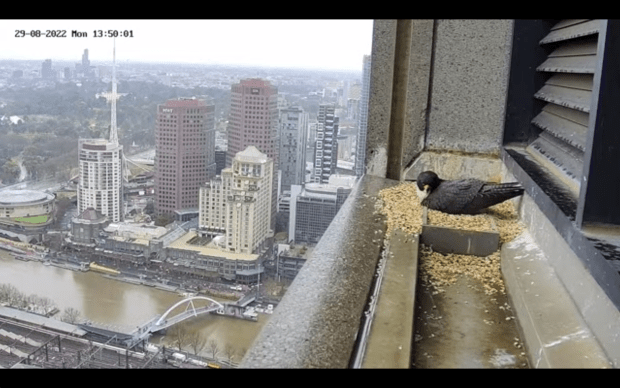
Everything is fine on the ledge in the CBD of Melbourne. Dad is really enjoying getting some incubation in the warm Australian sun.

All is well at Port Lincoln. As the month changes from August to September, we are now only two and a half weeks away form hatch. It has just been too long since we have seen a little osplet with its back stripe in a nest.

Just like it was at the marsh, it is pretty quiet in Bird World today. Everyone is on the move, incubating eggs, or enjoying a time not raising chicks and getting strong again.

Thank you so much for joining me this morning. Take care of yourselves wherever you are. See you soon!

Thank you to the following for their streaming cams, posts, and videos which make up my screen captures: vancouverisawesome.com, LOTL Visitor Centre and Wildlife Reserve, Bywyd Gwyllt Glaslyn, Friends of Loch Arkaig and the Woodland Trust, Dyfi Osprey Project, Looduskalender, Charles Sturt Falcon Cam at Orange, Sea Eagles@Birdlife Australia Discovery Centre Sydney Olympic Park, 367 Collins Street by Mirvac, and Friends of Osprey.

Eggs, Electrocutions, Migrations and more…Tuesday in Bird World

30 August 2022

Good Morning Everyone,

We are nearing the end of August. I keep saying the month has disappeared and it surely has! It is simply hard to believe. We had a magnificent rain that brought the garden back to life. There is nothing like a good soaking – watering from the tap doesn’t seem to do it. The garden also had a visitor this morning. I know the hawk has been around but, with all of the foliage it is hard to spot him. The new fence has, however, attracted a lot of attention and today it got approved to be the new plucking post! The image is not good. I got so excited that I hit the silly video button on the phone and not the photo. It is also from a distance through a screen -I was hiding in the shadows hoping that she would not see me inside the house taking her photo – hawks have to eat, too.

By now you will have noticed that I have added some sub-titles to my blog. There will not always be questions in the post to answer – that is up to you! But if you are wondering something, ask. I will absolutely not always know the answers but I have friends and colleagues to ask that do and they are happy to share what they know with all of us. There is generally some news and there are always things happening at the nests despite it being quite slow the end of August. I hope also to incorporate a book review section once in awhile —- when there is time to read a new book. I am currently working on two: Birds. A Complete Guide to their Biology and Behaviour. It is excellent so far – a great reference that includes topics such as Anatomy and Physiology, Flight, Food and Feeding, Breeding… The second is After They’re Gone. Extinctions Past, Present and Future by Peter Marren who tackles some of the very uncomfortable truths that we have to face. It is time, after all, to get our heads out of the sand and listen to what individuals like Marren have to tell us. Full review to follow in a few weeks when I have had time to digest and reflect the latter.

In the Mailbox:

‘B’ writes: “I have been watching Osprey nests for years. Why do the siblings attack one another after fledging when they have been nice on the nest?” Oh, this is such a timely question as the nests begin to empty themselves of parents and fledglings in the Northern Hemisphere.

Some of you will remember that the three osplets on the Port Lincoln Osprey barge in 2021 – Bazza, Falky, and Ervie – were sweet to one another as nestlings. Bazza tried a couple of times, early on, to boss Ervie but, even as little as he was, Ervie wasn’t having any of it. So the nest was very peaceful. Then they grew up. They fledged and even became interested in fishing. When Dad would bring a fish, they would descend on the nest and fight – or, rather, let’s use the Australian term, “a dust up” would occur. If you are watching the Dyfi nest of Idris and Telyn, two of the three girls remain in Wales. Whenever a fish comes on the nest, they practically knock each other about to get to that food. This is perfectly normal behaviour. They no longer see one another as siblings but as rivals who might take the only food supply. Soon, they will go their separate ways and no would have been hurt-normally -although Bazza and Ervie did get pretty rough. Please note that the PLO nest had 3 males and the Dyfi had 3 females – same gender on the nest. Same sex nests tend to be very civil after a brief set to at the beginning.

‘S’ sent me some news and included in it is a video/PowerPoint on what to expect at the Royal Albatross Taiaroa Head Colony in September. I know that many of you are fans of the albatross and watch Quarry Track chick, this year’s Royal cam chick, faithfully. I do not cover her but I look in on her. Sharon Dunne does an excellent job of providing all the information needed! This is a great information packet – have a peek. Thanks, ‘S’.

Making the News:

Drought and hydro poles killing off Europe’s White Storks. Only 10% of the hydro poles in Hungary are insulated and yet 150,000 beautiful White Storks are electrocuted each year. This well done video shows the birds, where they live, the deaths, and the fix that is required. It is now time for humans to step up to the plate and take care of the wildlife instead of doing what we have always done — put ourselves first.

And, of course, Hungary is not the only country that has this issue. We saw it in Canada when Junior was killed near the nest on Gabriola Island, in The Czech Republic, and elsewhere.

https://www.bbc.com/news/av/world-europe-62690344

A Polish Photographer has been stirring up real interest on the Internet with his image of an Osprey fishing. His name is Krzysztof Stasiaczek and the image was taken in August 2022 in Eastern Masuri, Poland.

Hancock Wildlife Foundation in British Columbia used their GoFund Me and some other private donations to build a new sun-shaded nest for Ma and Dad at Delta 2. Why? Rising temperatures in the area of the nest due to the increased heating of our planet. They released the images today. That is David Hancock with the light blue long sleeve shirt working tirelessly to continually improve the lives of the Bald Eagles…he has been doing this for at least 65 years!

Somehow we all knew that the numbers of Bald Eagles on the Channel Islands is growing – thanks in large part to Dr Sharpe ensuring the eaglets do not tumble into the sea or die under a nest from zinc toxicity.

News is coming out of the Channel Islands Eagle Lovers group that there is the possibility of a new Bald Eagle pair spotted on Santa Cruz! Sauces 2016 hatch A-63, a male named Whisk, has been seen at the old Fraser Point nest with a subadult female of approximately 3 years. Fingers crossed.

A blog by Rosie Shields who monitors the Borders nests in the UK found its way into my inbox today. You might not be interested in these Ospreys but, it is the behaviour of the female that is important. She left a nest with three chicks she was feeding to begin her migration, landed on a nest she had visited before, and sat herself down now for 9 days being fed by the resident male who is willingly catching fish for her. It is always good to learn more and more about the behaviours of Ospreys – they never cease to surprise and amaze me.

Nest News:

Annie and Alden decided it was a good idea to renew their bond in the UC-Berkeley scrape on The Campanile after the sudden visit of a mysterious male falcon. Alden initiated the bonding session. “Annie, do not look at another male falcon. Alden is a keeper!”

Alden was caught loafing in the setting sun last evening. How adorable.

Everyone is sitting waiting really impatiently to see if Diamond will lay a third egg at the Charles Sturt Orange Falcon cam in Australia. Diamond’s average between eggs is 56 hours. The second egg was 57 hours this year. Will there be a third? and will it be on time?

Xavier loves his ‘eggie’ time and Diamond was obliging this morning to let him take a turn.

Xavier left and returned around 0700 with a Horsfield’s Bronze-Cuckoo (IDed by Holly Parsons). Xavier always brings something special on egg laying day. What a sweetheart.

Xavier waits for one and a half hours to incubate those precious eggs…it is caught on video.

Diamond looks pretty contented. Let’s see what is happening in a couple of hours.

There are still only 2 eggs at Orange. It is the middle of the night. If Diamond is to lay a third egg I would surely think that it will come before 0800 on the 31st.

In Melbourne, the little Dad is getting his turn, too and those four eggs look awfully big as he wiggles and squiggles to get them under him. Yesterday he looked down and noticed one was outside!

You can almost hear him saying he hopes the new mate doesn’t lay 5! She could. Keep hoping the population of pigeons is bursting at the seams in Melbourne!

Everything seems to be going well with the Sea Eagles. They are six weeks old and standing sturdier by the day and changing their appearance with those gorgeous feathers coming in.

At Port Lincoln, Dad took over incubation and Mum is enjoying a really nice dinner time fish before tucking it in for the night.

Updates on Tweed’s three fledglings from yesterday’s post.

A Tweet from County Cork with a great photograph of an osprey believed to be Kirk. Fantastic. He has had quite the adventure. Glad Kirk is safely on land. Now to get his GPS coordinates polished.

In the UK, Louis and Sarafina are still at Loch Arkaig. Dorcha was last seen on 18 August and it appears that Willow, LW5, began her journey on the 28th of August.

Louis delivered a lovely Mackerel to the nest for Sarafina today. She has been seen down at the loch attempting to catch a fish, too. Isn’t that splendid?

Louis brought a lovely fish to Sarafina at 16:16:33 on the 30th. She is still with us as of today.

The last sighting of Willow was on the 28th.

Maya is still at the Rutland Manton Bay Osprey platform. She flew in with a fantastic fish this morning at 0619. While many of the females have now departed, Maya raised three very large and strong female chicks with Blue 33. She is taking good care of herself so she is in good shape for migration. Normally we can expect to see her and her mate, Blue 33, back in the UK at the end of March. The first eggs and the first hatches!

Seren, Blue 5F, was with Dylan this morning at the Llyn Clywedog nest looking around their beautiful territory.

It appears that Mrs G from the Glaslyn Valley nest is now on her way south. Aran was on the nest earlier and one of the fledglings was shouting out for a fish.

At the Dyfi Nest, Telyn was last seen on the 25th of August. Pedran left before Mum, and Padarn was still at the nest today. Paith has not been seen on the 30th that I am aware of so it could just be the second hatch, Padarn, and Aran left at Dyfi.

Stephen Basly posted another great image on the Notre Dame Eagles FB Group of our Little Bit 17! It was the 25th of July and is such a great image. I think Stephen worked to get it cleaned up well for all of us. Thanks Stephen!

I have not been able to access Looduskalender today for updates on the Black Storks, Karl II and his family, as they migrate.

Thank you so much for joining me today. It is a gorgeous day here – I hope it is for you, too and that you have been able to enjoy being out in nature, if possible. Take care of yourself. See you soon!

Thank you to the following for their tweets, videos, streaming cams, and blogs that make up my screen captures: NZ DOC, BBC News, Krzysztof Stasiazek, Hancock Wildlife Foundation, CIEL Rosie Shields, Cal Falcons, Charles Sturt Falcon Cam, 367 Collins Street by Mirvac, Sea Eagles@Birdlife Australia Discovery Centre Sydney Olympic Park, Port Lincoln Ospreys, Conservation without Borders, Dave McGrath, Friends of Loch Arkaig and the Woodland Trust, LRWT, CarnyXWild, Bywyd Gwylld Glaslyn, Dyfi Ospreys, and Notre Dame Eagles.

4 eggs for Melbourne, Victor is moved outside and other news in Bird World…Monday morning

30 August 2022

What happened to August? It seems as if we blinked and it flew by. Despite the heat there is a look about the leaves on the trees and the wilting of the tomato plants despite their being well watered that is alerting us to the end of summer, not just the calendar. There is another 9 or 10 days before the teachers and students are back to their classrooms in Manitoba. It is a reminder that it is time to get a small delivery of firewood. There is something so cosy about a wood fire on a crisp autumn morning and if August is any indication, autumn will be here in two blinks.

The colour of the light and the water of the pond seemed to be taking on the hues of autumn.

The rain started in the early morning hours of Monday and everything has turned green in the garden again…it is raining so hard! And for once, I am so glad to see it! Monday will be a good day for reading the small pile of books accumulating on my desk.

In the Mailbox:

‘N’ writes: “Do all falcons incubate the eggs the same no matter where they live? Do all ospreys?” Oh, what an interesting question! I am not a specialist on incubation, the term used for the behaviour whereby adult birds keep the eggs warm until they hatch. My experience watching the nests of different species is that birds are very individualistic and even within a single species, the attention that they give to their incubation duties varies. I found a paper that actually discusses the different approaches to this important task. It is not a recent one but it is quite interesting. The author covers some birds that are unknown to me but, I believe the findings and the data can enlighten us as to the full answer to your question, ‘N’.

In the News:

RSPB created an extremely short video about Avian Flu killing the White-tail Eagle chicks on the island of Mull. What is so intriguing is the landscape of the island and the beautiful chicks so alive in the nest. It is clearly not the be all- end all informative presentation but it was nice to see where these eagles live.

Just a couple of months before Avian Flu began killing the White-tailed Eagles on Mull, this beautiful 7 minute video was made showing them on their island setting. Have a watch:

The attempt to rid Gough Island of its House Mouse problem has hit a wall. The eradication of the mice that were biting and killing Tristan Albatross chicks and adults is now being viewed as a failure. Everyone had such high hopes that the island would be rid of these invasive mice but an unknown problem presented itself – the slug. Have a read:

https://www.acap.aq/latest-news/4427-alien-slugs-thought-to-be-the-cause-of-failure-of-the-house-mouse-eradication-on-gough-island

I found an excellent story dealing with the tragedy of the mice and the Tristan Albatross and why the eradication attempt is so important.

In his newsletter, David Hancock of Hancock Wildlife just posted the following information about the Delta 2 nest in British Columbia, Canada: “Firstly, both Ma and DM have gone on their migration. Ma was last seen at the Delta 2 nest/territory on July 25th. DM (taking his new role as Ma’s mate very seriously) hung around for another week keeping an eye on things. He was last seen there on August 1st. Thanks to all who donated to the GoFundMe campaign, as well we received a a few private donations which are greatly appreciated. These donations are going to cover the costs associated with the installation of a sturdy new nest pole and two (2) new cameras at Delta 2.”

Nest News:

It is egg 4 for the Melbourne Peregrine Falcon couple on the ledge of 367 Collins Street! Oh, my goodness. Dad you are going to so hope that the pigeon population of the city is very plentiful!

Here is a video of that last egg being laid:

It was a prey drop and a chance for Dad to get himself acquainted with how you have to wiggle around to get 4 big falcon eggs under so they can stay warm.

It is a lot easier for Mum to get those four eggs tucked in tight. Do you think there will be a 5th?

We have a ways to go before hatch for Melbourne and Diamond might not be finished laying eggs. Incubation is a time for the females to rest. It is going to be very hectic if all the hatch at Melbourne! And exciting.

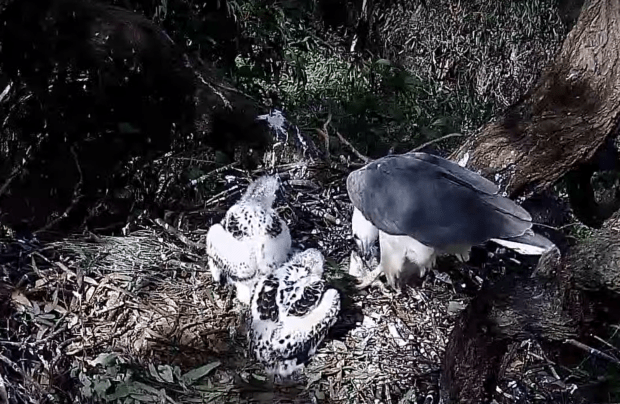
The Sydney Sea Eagles are developing right to schedule. Their plumage continues to come in and they are picking up sticks in the nest and preening. SE29 is standing and walking better each step. They really are gorgeous. The Monday morning feeding saw both 29 and 30 with nice crops full of fish. I have seen no concerning aggressive behaviour on the part of 29 to 30 that would cause me to worry.

We are about 3 weeks away from hatch watch at Port Lincoln. Mum and Dad continue to take turns incubating. That said, Mum will always have night duty and Dad will provide Mum with her meals.

You would think that Mum would be very stiff incubating the eggs all night. Dad has arrived and is nudging her off so he can have a turn. Mum goes away for her breakfast and a break, returning in about half an hour.

You are doin’ good, Dad.

There has been an unknown male visit Annie in the tower.

There is a notable change in the behaviour of the female Ospreys in the UK this year. Normally they would depart the nest about 10-14 days prior to the fledglings leaving on their migration. This year it appears the majority are choosing to remain on the nest while some or all of the fledglings depart. While we will not know the specific reason, I wonder if it is, in part, due to the raising of these large female chicks and the Mums needing more time to get in top shape. Or could it be that prey is plentiful, the weather is nice in the UK, and they just want to be home for a little longer?

Idris, Telyn, Padarn and Paith are still at the Dyfi Osprey nest in Wales as of Sunday the 28th. Idris has stayed on the perch all night. Pedran was last seen on the 11th of August at 0905.

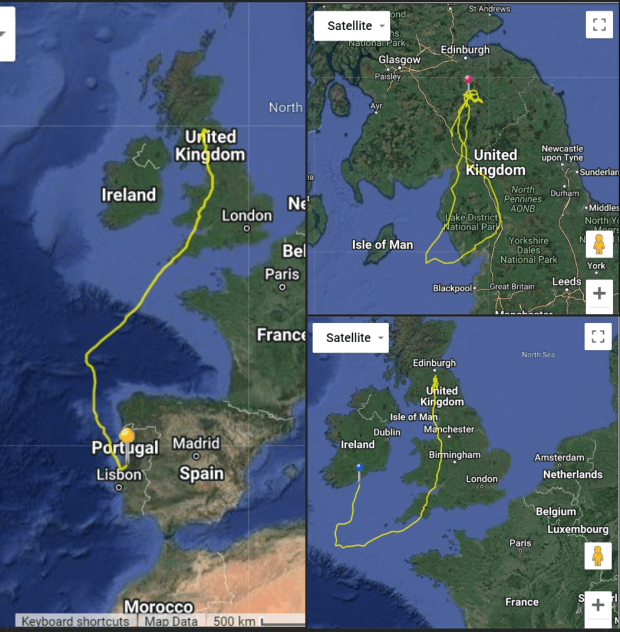
If you follow Tweed Valley, the three fledglings are going in very diverse directions including Glen who remains on the nest. Kirk is in Ireland having flown south and turning back to the land. Tweed is nearing land in Portugal.

Ruthland is updating us on their second hatch at Manton Bay, 1H2:

Tiger Mozone says that the fledglings need good DNA and luck. 1H2 certainly has great DNA. Let us all hope she has some awfully good luck, too.

1H2’s parents, Blue 33 and Maya, along with older sibling 1H1 were all still at the Manton Bay Nest at Rutland on the 27th and there is no news of either 1H1 or Maya departing since.

Seren was on the Llyn Clywedog nest early this morning and Dylan even popped in for a few minutes to join her later.

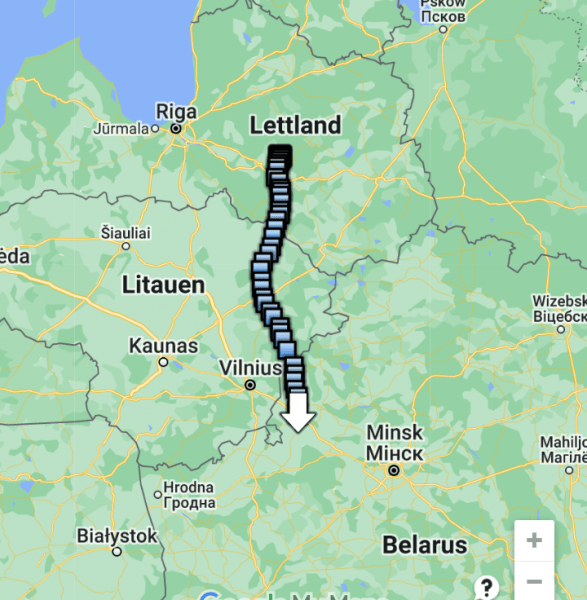
It is just incredible. Bonus continues to prove that he is a very special Black Stork! He flew from the nest in Estonia and spent the night in Latvia on the 27th. He has now flown through Lithuania and is in Belarus near Minsk. That was a total of 279 km.

Kaia, Bonus’s foster mother, remains in Belarus in the Prypjat Wetlands near Shestovicy.

So what intrigues me is this. If Kaia remains where she has been for the last several days since she flew north out of the Ukraine, is it possible that Bonus might also wind up in the same wetlands? Or will Bonus fly into the Ukraine? and remain there? or turn back north like Kaia? We should have our answer in a day or two.

Here is the distance shown by Google Maps:

Waba has begun the journey also and the tracker shows that he crossed into Latvia from Estonia on 28 August. He then flew a short distance.

I have received word that Karl II has left the nesting area in the Karula National Forest and has begun his migration. More on that to come tomorrow.

Victor has done so well since Dr Sharpe travelled to the Two Harbours nest on the Channel Islands to take him to be treated for zinc toxicity at the Ojai Raptor Centre. He has now been moved out to the big flight area! It just doesn’t get too much better than this until he is released. Wow. Victor. Way to go!

Looking forward to Lena and Andy at Captiva next year? or Connie and her mate? Window to Wildlife posted a 7 minute video about updates changes to the cameras, etc with some lovely pictures of Lena feeding the wee nestlings last year.

Thank you so much for joining me today. Please take care of yourselves. See you soon.

Thank you so much to the following for their streaming cams, their videos, and their posts that make up my screen captures: RSPB, 367 Collins Street Falcons and Mirvac, Charles Sturt Orange Falcon Cam, Sea Eagles@Birdlife Discovery Centre Sydney Olympic Park, Port Lincoln Ospreys, Cal Falcons, Dyfi Osprey Project, Tweed Valley Ospreys, Rutland Osprey Project, LWRT, CarnyxWild, Looduskalender, CIEL, and Window on Wildlife.

A Victor update and more news in Bird World, early Saturday

27 August 2022

Good Morning Everyone!

Friday turned out to be one of the best birding days I have had in my City because of the birds and the three people that I met — and, of course, an Osprey story. No, I didn’t add lots to my life list but, I will add a few when I can get some help doing the IDs. It was hot in the afternoon for the walk at the nature centre. The little Mallard mother that had 11 ducklings still has the 9 she had the other day. She has moved them to a different pond where the water and plants appear to be a little healthier.

In some areas the algae is just stifling the life out of the pond. The geese were all resting in the shade and only the song birds were exerting themselves. In particular, 5 or 6 Black-Capped Chickadees were around the ‘winter’ feeding area. I had the most glorious chat with a woman about the fate of insects and she mentioned a book, The Insect Crisis.

This lovely woman spent a few minutes explaining the concept behind the book – the collapse of the insect population and the shocking collapse of everything from birds to crops. I suspect that almost everyone who reads my blog is aware of the domino-effect that is or will take place as the insects die. The rest of the population has surely heard about what is happening even if they don’t understand it — or worse, choose to ignore it. Why then do people still hire companies to come and ‘kill’ the weeds on their lawn so that it is pristine all the while what they believe the company is using a green chemical is actually toxic! or the spraying of roses and other flowers? the use of pesticides used in farming? It is time to put a stop to these practices and embrace companion planting or the use of certain birds and animals that will weed but not kill the crops or flowers.

All the while we were talking, the lovely lady, perhaps in her 90s, was pulling out sunflower seeds for the Chickadees.

An hour before dusk I went to another site where a Bald Eagle had been spotted. OK. I am not the luckiest birder on the planet – far from it. All I could find were some Mallards resting….

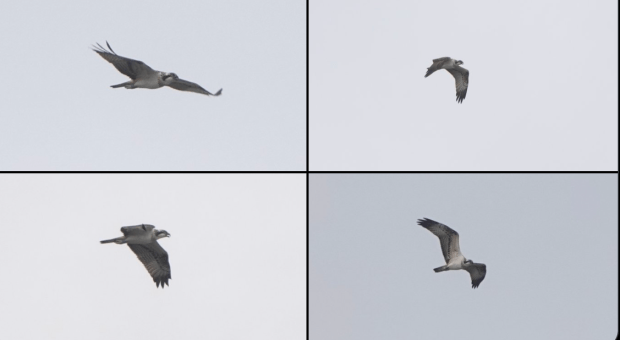
and then, I didn’t hear it but something caused me to look up. There was an osprey flying overhead. My heart stopped for a second. An Osprey – sorry Bald Eagle people but this was fantastic. I have been trying to find the Osprey living in this area of my City and have always failed…and there it was.

It has been a good year to be surprised by Ospreys flying overhead. I only know where one nest is but that is fine…seeing them flying at dusk is very special.

The sun was nearly setting but, just on the chance that the Egrets were landing near the pond on the other side of the City, I took off…

As the sun set, 7 Great Egrets descended on the pond and their night time tree.

They continued to arrive as the sun set lower and lower in the sky. It was just a calm, beautiful summer evening spent looking at a ‘sedge’ of Egrets – a most unusual sight for a Canadian Prairie city.

I am not a wildlife photographer. Let’s be clear about that. There are people who are and two of them spent time with me taking photos of the Egrets, talking about where the birds might be spending their days and the anticipation of the arrival of ‘THE’ Green Heron this year (he was really lost last year when he landed south of our city in a small little river). Quite the celebrity that heron was! Of course, everyone is looking and comparing the ‘kit’ each of us had….I take photos because I love the garden animals and the birds – to show you! So they are taken with love not great technical expertise although there are many times I wish I had that level of talent.

In the Mailbox:

The Ojai Raptor Centre updated Victor’s progress in an e-mail posting today: Just look at this magnificent eaglet. This is a very special day. His zinc levels are normal!!!!!!!!

Here is the announcement from ORC:

Bald Eagle patient 22-635, who was rescued from Santa Cruz Island with zinc toxicosis on July 11, continues to make progress. The most recent test for zinc showed the patient within normal levels. This means the eaglet no longer needs to go through chelation therapy to remove the toxic metal from the bloodstream. The eaglet’s ataxia (lack of balance) seems to have resolved as well!

‘L’ sent me a lovely screen capture she had in her archives of Ma Berry. The year is 2018. Do you know who she is?

Berry College is located in Mount Berry, Georgia. Ma Berry was the mate of Pa Berry until 2020 when she was last seen the 17th of November. Ma Berry had a injury to her left talon – she was easily recognized. She had no difficulties fishing or catching prey with her injured foot. She was dearly loved despite there being a heavy loss to the chicks on the nest. In 2017-18, two eggs hatched with one chick fledging and the other sadly died from falling off the nest. The following year, 2018-19 both eggs hatched again but the chicks died within a week. The following year one egg cracked and the second was not viable. Ma Berry has a huge fan club and as one article at the time said, “There’s been a scandal brewing behind the Cage Center at Berry College.” A new female and Ma Berry had a bit of a stand off. For awhile many worried that Ma Berry had been injured or killed but on the 21st of January 2021, Ma Berry was seen at a lake (again easily recognizable by her injured and twisted foot). She is enjoying her retirement. The new female named Missy had two eggs in 2021. One was not viable and the other baby died – both of starvation and hypothermia. Missy just didn’t know what to do as a Mum. However, this year Missy and Pa Berry fledged B15 – a fine strong eagle. Pa Berry must have been very pleased.

https://www.northwestgeorgianews.com/rome/news/local/new-female-at-berry-eagle-nest-has-observers-buzzing/article_30c90372-3e2e-11eb-85f9-c717a7baead0.html

Three questions came in from ‘G’: What would have happened to the female at the 367 Collins Street Falcon nest? Did she find a new mate? Second question: What is a scrape? The third question: Why do falcons use gravel for nests and not twigs like eagles? OK. Let’s start at the beginning. I have included some images of the male at 367 Collins Street and his mate from previous years below with their four eyases from 2021. You will often hear that Raptors mate for life. From reading the information about Ma Berry above, you will then know that this is not always the case. Some females get usurped from the nest as do some males. Some are injured and die. Some leave and are discovered elsewhere. Some Ospreys have had two mates. A good example is Seren, Blue 5F in the UK. From 2015-2020, she was Aran’s ‘other woman’ at Glaslyn while Mrs G was his primary mate. In 2020 she decided not producing chicks and have a faithful mate was reason enough to pack her bags and leave. She did. She flew to Llyn Clywedog and became the mate of Dylan! So the saying mate for life is not always the case but it is more the standard than anything else. It is presumed, however, that the female at 367 Collins street has died and a new female has taken her place. If this is her first year as a Mum, let us wish both a very good year.

Scrape is the name of the ‘nest’ that Peregrine falcons use to lay their eggs and raise their eyases. Eyas is the proper term for the chick.

Peregrine Falcons traditionally made their nests on cliffs. There the sand and gravel would be gathered and a small indentation made for the eggs so they would not slide out of the nest cup. It is believed that by using this kind of nest insects and diseases that often form in twig nests – especially if it is cold and wet – would, thus, not impact the falcon chicks. That said, there are some stick nests being used by falcons in Poland that have been very successful.

An early morning question from ‘T’: Why aren’t the falcons in Australia sitting on their egg and eggs all the time? Great question! You can see them leaving the eggs in the images below today. Some raptors practice delayed incubation. They will keep the eggs warm for a few hours a day but will not begin 24/7 incubation known as ‘hard incubation’ until all of the eggs are laid. This ensures that there is not such a discrepancy in their dates of hatch. This lessens the chance of siblicide. In addition, many times the eyases hatch within 24 hours of one another like those at Collins Street the last few years.

In the News:

Hen Harriers remain in the UK news. As their populations begin to recover at 100 birds the illegal killing of the raptors remains a huge problem for the reintroduction programme.

https://www.theguardian.com/environment/2022/aug/26/more-than-100-hen-harriers-fledge-in-england-for-first-time-in-a-century

In Australia, there is dismay as to the protection of the forest industry and the lack of concerns from some of the wildlife going extinct. In 2022, people are starting to get upset and angry. Will the government respond?

https://www.theguardian.com/australia-news/2022/aug/25/swift-parrot-recovery-plan-changes-downplay-logging-threat-experts-say

Nest News:

Holly Parsons has posted the links to the four Falcon cameras at Orange along with a link to FAQs. Thanks, Holly! Here it is:

Diamond has been the female at the Charles Sturt Falcon scrape at orange since 2015. Xavier has been her mate since 2016. This means that they are at least 9 years old for Diamond and 8 years old for Xavier. Peregrine Falcons have been known to live for nearly 20 years in the wild.

Diamond is looking out the window of the scrape at Orange. Galahs, a pink and grey parrot, are flying by the tower. Do they not know they would be a remarkable mid-morning snack for Diamond? If Xavier sees them, she will have one!

Later Pied Currawong were observed doing flybys while checking out the scrape box. They eat eggs! Diamond and Xavier are going to have to be vigilant.

There is no hard incubation yet at 367 Collins Street in Melbourne. Does this mean that Mum and Dad Peregrine Falcon are thinking of a 4th?

For those of you who have watched the Melbourne nest in previous years and, perhaps, did not notice or know. This is a new female this year with Dad. My first thought was is it possible that Mum died from trichomonosis like the 4th eyas last year? We might never know – unless Victoria Hurley does, the researcher at this nest.

Dad has the biggest eyes. Oh, such a cutie with one of his prepared pigeons for the kiddos.

It would be very difficult to forget these four. They were incredible. The year before Mum and Dad had 3 girls…they towered over little Dad.

Mum and Dad with the four eyases for the 2021 season. Mum was amazing. She often appeared to be gruff but if you are having to chase after four eyases with independent minds, she seemed to have to be to keep them from falling off the edge of that ledge. Thankfully birds are afraid of heights (or so I am told). Soar high, Mum. You took such great care of your little ones.

The new female shows Dad the third egg early on a misty Melbourne morning. It arrived at 22:18 on the 26th of August.

Oh, I adore the little male falcon at Collins Street. Sometimes he looks like a toy in his cute little pajamas.

A few more images today of Dad and the new Mum taking turns incubating the eggs. You will get to know Dad rather quickly with the thick yellow around his eyes and if he is next to New Mum, he will be quite a bit smaller

Neither Diamond or the Melbourne Mum will begin ‘hard’ incubation until all of their eggs are laid. This is one of the reasons that there is less competition between all the eyases as they are close in size and birth date. Some Ospreys and eagles begin hard incubation immediately and this means that the third catch could be several days difference in size and development than the first.

Just look at SE 29 and 30. 29 is standing so tall with its big crop while 30 is enjoying a private feeding from Lady. Look very carefully at 30 since we can see the top of the head, the chest, the wings and back and – of course those pink legs standing so tall. Weeks 5 and 6 show the biggest change from the fluffy chicks with their down to the stage of an eaglet. There is now down left on the head (maybe a dandelion or two on 30). Dark feathers are starting to show everywhere – they are the most gorgeous espresso brown. The chicks are spending a lot of time preening now as feather growth is said to be itchy (how does a human know that?). They are now able to stand like 29 is doing without the aid of the wing tips. They will begin flapping and might make some attempts at self feeding.

Notice that beautiful light rust that is appearing on both of the eaglets. If you have never seen a juvenile Sea Eagle you are going to be so surprised at how stunning their plumage is. Notice also how those beaks continue to grow long and strong.

Dad was nudging Mum at the Port Lincoln Osprey nest to get up and give him a turn. It was 23:42!

Andor visited the Two Frasers Bald Eagle nest in the Channel Islands. It looks like he now has some time to regain his strength after helping Mama Cruz raise Lilibet and Victor. He certainly must have had a nice lunch!

The streaming cam at the Minnesota DNR Bald Eagle nest is now offline until the 17th of November. Mark it on your calendars. I wonder if Nancy will have a new mate for the next breeding season????

Both eaglets at the Glacier Gardens Bald Eagle nest have now fledged. Congratulations to Liberty and Freedom for another successful year. Believe it or not, the Bald Eagle season will be getting underway in Florida in the next 4 weeks or thereabouts. Goodness.

Kielder Forerst posted that one of the 2022 fledglings, Frankham, is now in Spain enjoying himself on the llobregat River in Catalonia. His ring number is Blue 439 and he was the first to leave Kielder this season. Frankham was from nest 1A where Mrs YA raised the chicks after Mr YA did not return after they had hatched. Congratulations Kielder Forest!

Did you know that there are 10 Estonian Black Storks with trackers on them this year? Kaia and Karl II along with Waba and Bonus from the Karula Nest are amongst the ten. It is going to get busy once they start moving. Kaia remains near Liaskavicy in Belarus in the wetlands of the Priyjpat River.

A new book, Birds. A Complete Guide to their Biology and Behavior by Jonathan Elphick has arrived on the desk. Review to come.

Have a lovely Saturday everyone. Take care of yourselves. I look forward to seeing you soon….and remember, if you have a question, send it in. There could be 50 or 100 people wondering about the same thing!

Thank you to the following for their streaming cams, posts, and videos that form my screen captures: Ojai Raptor Centre, Berry College and ‘L’, Charles Sturt Falcon Cam, The Guardian, Orange, Australia FB, 367 Collins Street by Mirvac, Sea Eagles@Birdlife Australia Discovery Centre Sydney Olympic Park, Port Lincoln Osprey, Explore.org and the IWS, and Looduskalender.

Early Thursday in Bird World

24 August 2022

Good Morning Everyone! Do you feel like autumn is coming? It is chilly in the house this evening (Wednesday), The evening temperatures are dropping on the Canadian Prairies but, it will be 28 C this week during the day. I watched the squirrels in the garden fetching peanut after peanut – storing them away in their nests and around the garden for the winter. They do not remember that there are plenty of peanuts and solid seed cylinders during the winter for them. In a week and a half many of us will be traveling to birding hotspots outside Winnipeg to see the beginnings of the arrival of large numbers of birds from the North. Already there are postings about long lines of Canada Geese flying South. Thursday turns out to be a crisp morning – sweater weather now but that will be shed shortly.

A young Least Chipmunk comes to visit. Least Chipmunks are the smallest of all chipmunks. They have five dark and four light stripes along their sides and three dark and two light stripes on the face. Their fur is orange-brown, and their underside is greyish-white. Their habitat in our neighbourhood was destroyed with the building of large condos and they are finding new places to live.

In the Mailbox:

From ‘P’. “We are always told that Ospreys do not respond well to being in care. Is this true?” The first example that I think of when I hear this question is Smedley, the Osprey with the droopy wing who lived in care for 28 years at the Audubon Centre. One of the care givers at the Audubon Centre, ‘L’ answered the question this way for us: “Many times, people assume Ospreys do not do well in care. They do overcome the nervousness that is characteristic of osprey. They’re known to be the lovers and not fighters of the raptor world but they show the same adaptation, feisty spirit and will to survive as all species do. We have had so many here at Audubon with injuries from the short term to severe long term….adults to juveniles to fledgling. I walked into the clinic a couple of weeks ago and saw half a dozen with hoods on so they stay calm just stood around waiting to be hand fed. You definitely can’t do that with hawks, eagles and owls.”

Many have written to ask what happened to the Osplet on the Finnish nest that was always attacking its mother? As a reminder that was the chick on nest #3. The parents are Ahti (male) and Nuppu (female). FYI: Nuppu had on a couple of occasions taken the fish arrival and not fed the chick which might have just prompted that aggressive behaviour.

Here is that famous video:

That very healthy chick fledged and here is a video of Tuulos returning to the nest to get a fish meal two days ago. Lovely juvenile Osprey. Oh, I hope this one is a survivor – he sure has the drive.

A Sparrow Hawk visited nest #3. As it happens everyone in the Northern Hemisphere is getting empty nest syndrome right now.

In the News:

Worrying news coming out of the UK this morning. A white-tail Eagle on the Isle of Mull has tested positive for Avian Flu. A number of eaglets have died on the nest or right at fledge. This is terrible news for the WTE population. Here is the article on the impact from the RSPB:

https://www.rspb.org.uk/about-the-rspb/about-us/media-centre/press-releases/mull-white-tailed-eagle-chick-dead-from-bird-flu/?fbclid=IwAR0ae5Qd6FSGEI9MFj5zxbPL4bIDracUna3nkCqj-dH7ktFu8CxO6V6cu1g

Port Lincoln Ospreys has made its mark in Australia for its efforts to save the Ospreys. They need no introduction on my blog for their tireless efforts to get platforms up and nests off the shores so that predators do not get the eggs, chicks, or the adults.

They shot the hen harrier. In order that its killing would go undetected, its wings were cut off with the tag and tracker attached to a Crow. It is not know if the wings were ripped off the raptor when she was alive or dead. Her name was Asta. “She vanished from a known raptor persecution hotspot, in an area managed for driven grouse shooting – an industry with an acknowledged filthy history of persecuting birds of prey, and particularly hen harriers, as demonstrated by decades of prosecutions, convictions and endless scientific evidence.” I have never suggested that violence was in any way the right choice in any conflict but I often do wonder what if the individuals who tear the wings off a helpless bird, or shoot an arrow through the head of an innocent goose or other bird or animal were to have the same treatment done to them – would it help stop this inhumanity! I am happy to attach the short blog that explains this story in full. We are at a time when we are celebrating the successful fledge of two hen harriers in the reintroduction programme in the UK. Will they also be shot over a grouse hunting estate ——or can we begin to hope that that archaic sport is pasts its sell-by date?

There are growing calls to ban the killing of wildlife in the United States. Can you hear me saying, ‘thank goodness’! What happens in the US often has a reciprocal impact on us in Canada. Indeed, one of the wetland areas that I visit just sent an invite for a Zoom talk on this years numbers and how this will impact hunting!!!!!! No thank you.

https://www.nationalgeographic.com/animals/article/how-killing-wildlife-became-a-game?fbclid=IwAR2kwKSzHZXKlUpFN7RqWymrwbqz4WmXO0-40zkmdK3xNNy1YmV6FUik-9I

The BBC is asking people in the UK what it will be like where they live as our planet continues to heat up. I would love to see this for the rest of the world. My concern is – of course – the raptors. Will they arrive earlier? Will the intensification of rain along the coasts cause issues with osplet health and survivability in Wales? The whole story is here:

https://www.bbc.co.uk/news/resources/idt-d6338d9f-8789-4bc2-b6d7-3691c0e7d138

Alongside this news I am always asking how can we help our raptors and other wildlife mitigate or adapt? One of my dear friends lives in Singapore and before the pandemic, I visited this area often. Her father was the second President of Singapore from 1971-81, Dr Benjamin Sheare’s. Sheares’s predecessor, Lee Kwan Yew launched Singapore as a garden city in 1967. The idea was carried further in 1992 with the sustainable blueprint, Singapore Green Plan (SGP). This was updated in 2021. Today, half of Singapore is gardens and this is set to increase. Every family will live within 10 minute walk of a green space, cycling areas are being extended while car licenses will only go to clean green aka electric cars. The ash from the garbage collection will be used as an alternative for sand in concrete. Water, green spaces, and even more trees will provide a richer environment for the birds that live in this island City. Further clean ups of the environment will also benefit all of the large raptors that live by the docks and the marina such as the White-bellied Sea Eagles.

https://www.greenplan.gov.sg/

I have been increasingly concerned about heavy metal toxicity in our raptors since Victor tested positive for zinc. As many of you know our world seems to be full of galvanized materials. Yesterday my galvanized chain link fence put here by the previous owner in 1991 was removed. For those of you that have bird cages, last week I posted an article that ‘C’ had sent about the bars being zinc and Cockatiels showing a high level of zinc when tested. ‘C’ has sent me another article on the impact of lead. Thank you ‘C’.

https://rsdjournal.org/index.php/rsd/article/view/12701

Nest News:

In Winnipeg, there are some really late hatches. You have already been subjected to my concerns over the late-hatch ducklings at the nature centre where I walk and at a few other manmade ponds in the City. Last year I was taking photographs of the Cooper’s Hawk fledglings in late June at our Zoo. This year they had to wait for the owls to fledge their owlets (they used the hawk nest) to lay their eggs. The hawklets are so little. There are 5 of them. The crystal ball foresees some sleepless nites come October!

At Glacier Gardens, Peace has yet to fledge. Sibling Love as been flying around, on and off the nest early showing how it is done.

I have a new osprey nest for you with what appears to be a good camera. Put it on your list for next year as it seems the female has already left on migration from Maryland (30 July). The information page includes the history of the nest for the past 2 years.

It is the Blackwater National Wildlife Refuge Nest and they raised two chicks this year. Here is all the information:

https://www.friendsofblackwater.org/river-osprey-cam.html?fbclid=IwAR1oRNIiMjuYO8SgfVnAJV-jB-CaEBqLq_cJZ7qzIfgU53igmdIct-0xeuE

You might remember that Harry, the male at the Minnesota DNR nest was injured or died. Nancy had to raise the two eagles alone. The youngest was pushed over the nest by its elder sibling when food was in short supply and had to be euthanized. The eldest fledged. Now there is a new male suitor for Nancy. Lady Hawk caught him in a video with Nancy on the nest.

Rosie was on her perch this morning in San Francisco. Any day she will depart for her migration leaving Richmond behind who will be waiting for her return on Valentine’s Day.

The Birds of Poole Harbour posted a fantastic tweet. The one surviving historic fledgling from the Poole Harbour nest in 2022 was seen in the harbour fishing!!!!!!!!!!

Anyone that has ever watched the Loch Arkaig Osprey nest knows that Louis is quite amazing. Today he delivered two big fish – 9 minutes apart – so that both Sarafina and Willow would have their own. Incredible. Is this a record? Willow on the left and Sarafina on the right — two great fledglings for 2022.

Dorcha, Louis’s mate has left on her migration but Mrs G is still at Glaslyn. She was spotted eating a fish in the trees today. Aran continues to keep the fledglings fed. Today Blue 499 has had at least two very large fish!

Idris is not only keeping Padarn and Paith in fish but also himself as well as chasing off intruders today.

Blue 022 continues to deliver fish to H51 at the Poole Harbour nest. Happiness still abounds at the presence of their own ospreys despite losing one to the goshawk attack. CJ7 and Blue 022 did an amazing job as first time parents…a dream come true for CJ7 who waited several years to find a mate.

It is impossible to see the band but at least one of the female fledglings is still on the nest at Rutland waiting for Blue 33 to bring in the tea time fish.

No worries about SE30 getting enough to eat. Goodness. That crop is so full it isn’t even making a nice soft pillow! You don’t look very comfortable 30!

Lots of Kissy-Kissy going on early in the morning between SE 29 and 30.

When the pair turned around you can see some dramatic changes. Look at the plumage on the heads, the chest, and then notice…some of that incredible rusty brown is showing on SE29 under the wings and moving over the chest. Gorgeous.

Bets continue to be made on when Diamond will lay her first egg. If the number of mating attempts is anything, that nest should be full to the brim this year! Moderators are saying in less than 5 days. That would be 29 August. I will say 28 August. What do you think?

Bonding in the scrape…then mating on the tower and then Xavier returns with a nice juicy pigeon. Doin’ good today Xavier!

Diamond got out quick before Xavier could change his mind and want it for his breakfast.

You did really well Xavier – a nicely plucked and prepared fat pigeon for Diamond.

A video of a prey transfer between Diamond and Xavier.

Suzanne Arnold Horning caught Big Red and Arthur on the Cornell Campus Wednesday evening — and she also spotted L2. So L2 is still living with Mum and Dad in their territory.

Big red is moulting. 23 August 2022
L2. 23 August 2022
Sweet Arthur. 23 August 2022

So many things going on in Bird World but for the Northern Hemisphere, the birds are on the move…while many of us turn our attention to Australia. Thank you so much for joining me today. Please take care. See you soon!

Thank you to the following for their videos, streaming cams and posts that made up my screen captures: Finnish Osprey Foundation, Port Lincoln Ospreys, CBC, BBC, Glacier Gardens, Blackwater Ospreys, MN-DNR, SF Ospreys and Golden Gate Audubon, Friends of Loch Arkaig and the Woodland Trust, Bywyd Gwyllt Glaslyn, Dyfi Ospreys, LRWT, Poole Harbour Ospreys, Sea Eagles @Birdlife Australia Discovery Centre Sydney Olympic Park, Charles Sturt Falcon Cam, and Suzanne Arnold Horning.

Early Tuesday in Bird World

23 August 2022

Today turned out to be a very special day (22 August). OK. It is always special when I can go out to the nature centre and do my long walk. It is also a good way to check every nook and cranny for the geese and ducklings. A few had moved from where they were yesterday but many stayed in or close to their normal pond area. I continue to be fascinated that there simply are no Wood Ducks at the nature centre. It is like the two species – Mallards and Wood Ducks – sat down and signed a truce and decided who would go where! There were a lot of birds at the ‘winter’ feeding stations — they must fill the feeders year round. There were several Downy Woodpeckers, two American Goldfinches, a number of Black-capped Chickadees and then a bird sitting in the squirrel feeder that I did not recognize. After going through the birding book, it appears that the little lovely below is an immature female Rose-breasted Grosbeak. I certainly welcome any help with this ID.

The most excitement came this evening, however. It is hard to imagine sitting next to a pond which is about 6 metres away from, perhaps, the busiest highway in our City and seeing a Great Egret fly to a tree to join two others. They are part of the heron family but they are very large. In North America they have black legs and a yellow bill. They gather in groups near ponds and wetlands if there is plenty of food. Otherwise, if food is relatively scarce, you will see them alone.

What a magnificent creature.

In the mailbox. Following up with the question about Titi and Boris and the reason for the Janakkalan nest cam in Finland to go offline. We have answers. Thank you ‘S’ for getting back so quickly to us. Boris was seen on the nest two days after Titi’s fledge. It was the morning of 12 August. Titi did not return to the nest while the camera was still operating.

There is a video of Boris’s nest visit.

There were difficulties with the camera and it completely broke down. It will be fixed and will be up and running again next year. ‘N’ did receive a response from the Finnish Osprey Foundation stating that there were a number of Osprey fledglings in the Muonio in Northern Finland. Thank you ‘N’.

Can you help? There is a new book on Peregrine Falcons being written by Richard Sale in the UK. Susan Sale writes with the following information and a question. “My husband is self-publishing a book on the Peregrine Falcon and I am trying to source the following Peregrinus Casini, Japonensis and Pealei. Do you have any photographs of them or perhaps give me some contacts who may and if you or they would be willing to allow use in the book.” If you have any images of any of the three sub-species of Peregrines or you know someone who might be able to help, please contact Richard and Susan at this e-mail address: Richard@snowfinch.co.uk

Several have been wondering about Big Red and Arthur’s L3 and L4 that are currently in care. They ask “Will they, if ever released, be placed near their family so BR and Arthur can find them? If not, Who and How will they learn to hunt after all these WEEKS in the clinic???” L3 and L4 are in very good hands. Just like they would if they were patients in my local wildlife rehabilitation centre, they will learn to fly and they will also be taught how to hunt and catch their own prey. I do not know where they will be released.

‘B’ sent a note and wondered if I had seen Thunder and Akecheta on the West End nest together. I had not and went quickly to rewind and there they were. Thanks ‘B’. We are always happy to see the parents on the nest as well as the fledglings!

‘L’ wrote: “When I grew up in the north of England, along the Pennines…near the Lake District….I never saw an Osprey, Kite, Goshawk, Golden Eagle that were native to our islands as we had eradicated them… I thought all was lost .it wasn’t and these efforts wipe away the despair that can overwhelm you when you ask how can we make a difference. WE make a difference.”

‘L’ you will then be thrilled to learn that the National Trust, RSPB, and the Peak District RaptorGroup just announced two successful Hen Harrier nests this year! And, as you know, the Ospreys are thriving and so are the Goshawks. Isabelle Tree’s re-wilding at Knepp is taking off…there will be more raptors.


Nest News. It is hard to imagine sitting in the heat of summer in the Northern hemisphere but, the forecast is for snow in Orange, Australia. Holly Parsons who heads up the FB group was posting an image of Xavier and Kelli HissiFit Walker, one of the new mods on the streaming cam chat, dressed Xavier for the occasion. I chuckled so loud – I hope you enjoy it. If I were Diamond I would not want to lay eggs in that cold!

Thanks Holly and Kelli for letting me share!

Like Titi at the Janakkalan Osprey nest, LC at the Osoyoos nest doesn’t seem that much interested in fledging — yet. LC is 66 days old today.

As of the 22nd, Telyn was still at the Dyfi Osprey nest. She has not begun her migration yet. There is no rush and the females need to be in top form before they depart. Taking care of three big female chicks really has to be draining because they require much more food.

I went to check on the Sydney Sea Eagles and Lady was feeding SE29 and 30. It was very civil. SE30 did a few quick grabs and kinda looked to make sure 29 wasn’t going to do anything. Lady had it all in hand – a bite for you and then one for you. Back and forth. How lovely.

Sometimes 29 did seem to get more bites than 30.

and then 30 would get a few more…

There is plenty of fish. Both will be full. Just look at the ‘blood feathers growing in on SE29’s back and wings. Oh, they are changing so quickly — and the are simply adorable.

It rained later in the day and Lady spread her big wings and covered those babes who do not, as you can see above have their feather covering.

Dad was in the nest and on alert to any intruders that might be around,

Migrating tracking. Kaia flew in a big loop today staying in the same area that she flew to after she flew north out of the Ukraine.

There is considerable worry for Kaia’s mate, Karl II, and migration has not begun. He normally spends much time at a nature reserve on the Black Sea near Odessa. The area is currently a war zone.

A lovely image of Little Bit 17 was posted by S Basly on the Notre-Dame FB page. It was taken on the 28th of July.

What a wonderful way to end today’s blog with a look at Little Bit 17. He is, of course, a prime example of what an intervention and wildlife rehabilitation can do to give a raptor a second chance at life. Little Bit deserved it and he is living it. Such a beautiful juvenile.

Thank you so much for joining me today. Please take care. See you soon!

Thank you to the following for their streaming cams and/or posts that made up my screen captures: Notre-Dame Eagles, Looduskalender, The Eagle Club of Estonia, Sea Eagles@Birdlife Australia Discovery Centre Sydney Olympic Park, Osoyoos Ospreys, Dyfi Osprey Project, Raptor Persecution UK, Explore.org and the IWS, Finnish Osprey Foundation, and the Orange Australia Falcon Cam FB.

Featured image is Thunder and Akecheta on the West End Bald Eagle nest in the Channel Islands. 22 June 2022

Monday morning in Bird World

22 August 2022

Good Morning Everyone! The sun is out and it promises to be another hot day, 28 C. No rain forecast until tomorrow — and they might well change that. I am delighted to report that Dyson was seen in the garden this morning. One of the juvenile Blue Jays was screeching so loud – at Dyson – who was helping herself to ‘his peanuts’. The three juvenile Crows were in the garden on Saturday and again this morning. The little female was cooling her feet off in the bird bath.

I have also been out checking on the ducklings. Some are really growing!

Last week, there were 11 with this female. I am now counting 9.

This little sweetheart watched me quietly walk towards and around her. She never moved. How delightful.

If you are a duck and it is hot and humid, what do you do? Try to find some shade and/or a breeze. Duck Siesta time.

Then I found these two ducklings. They do not have their tails and are still sporting their downy fluff. Oh, I am going to worry about them and, hopefully, I can find them today or tomorrow when I am out checking again.

Update. There was some concern about the situation with AX6, Axel, at the Loch Garten nest. Yesterday, I posted that AX6 had not been seen on the nest and was feared to be ousted by the intruder, KL5, injured, or worse since 15 August at 0635.  Good news arrived from ‘DV’ who wrote to tell me “AX6, Axel, was seen on the Loch Garten nest this morning (Sunday), according to watchers.” Oh, fantastic. I checked on the Loch Garten FB page and they confirmed the time as 0835. Axel remained on the nest for 5 minutes. There is YouTube video confirmation. Thank you so much DV! Now has he been feeding the sole surviving chick from the nest 1C2 off camera? That is the question. He looks good!

The nest was empty later.

From the mailbox. There are several nests that many of you might have been wondering about. First up, Titi and Boris at the Janakkalan Nest in Finland. I have heard nothing since the camera shut down quickly and abruptly. I do not know why a decision was made to go offline at that time.

The streaming cams operate for many reasons but research and education/entertainment seem to be the main categories. The owners of the streaming cams often do not take into account the impact that watching a family of raptors has on viewers. Each of us has our favourite nests. Some may be the same for all of us but there are always nest surprises. We have our favourite nestling and we cheer them on and yell at the screen, fret when the weather is bad often staying up with them. We worry when there is not enough food. We clap and jump when they fledge and then we worry about where they are and if they are alright Sometimes (and it was a lot this year), we cry when one or another or all die.

For me the streaming cams have always been a way for us to connect with nature. They became particularly important during the pandemic as shown by Loch Arkaig having over 400,000 viewers watch Louis and Aila raise JJ5, JJ6, and JJ7 in 2020. Many have written to tell me that they are in hospital dying and it is the birds that are keeping their spirits up. One of my readers who became a good friend had cancer. Anyone on the Sydney Sea Eagle chat will remember Phyllis. The sea eagles and the chatters kept Phyllis going much, much longer than the doctors could ever imagine. The birds enrich our lives. I have had people say why not go outdoors and watch the birds, why on screen. I always tell them that it is like going to a sporting event or a Formula 1 race – you actually get a better view on the telly. Of course we go outside and see the birds if we are able! But where could you see up close an Osprey, an Eagle, a Peregrine Falcon raising their chicks? I surely couldn’t! They have brought us joy and touched our hearts so when that camera is suddenly turned off without an explanation or warning, we wonder why. It is shocking.

And so it was with Titi and Boris. They had lost their mother and their sibling. Dad continued to bring food and the goshawk was around. We worried about Titi who waited so long to fledge and then boom…nothing. We never got the opportunity to see if Titi would return to the nest. Some of you have written to ask the Finnish Osprey Foundation why did they turned the camera off so early. You have not received an answer. I have written to one of my Finnish contacts and readers to see if they know anything. I will certainly post any news here for everyone if I should hear.

My inbox has been full of letters about Malalam the little Red-tail Hawk adopted by the Bald Eagle family on Gabriola Island, British Columbia. When her nest mate turned sibling, Junior, was electrocuted on a pole owned by BC Hydro, GROWLS posted all manner of information so that a campaign could be directed towards BC Hydro. Many groups joined in. I carried their request to you. Malala is not ringed. The Red-tail Hawks and hawks in general are beginning their migration. Will we ever know what happened to Malala? is anyone watching the nest to see if she returns? She could be heard on the cam on the 30th of July. That same day, GROWLS FB said that the season was closed and the camera was immediately turned off. No information has been posted since. It felt abrupt especially after so many wrote to BC Hydro on their behalf after the call to do so on July 22, ‘Justice for Junior’.

I am fortunate to have a friend and former student in the area. They have confirmed for me that there are a number of red-tail hawks and without any method for identification no one will know unless they happen to see Malala at the nest or eating fish. If I do hear anything – or if you do – please let us know.

Many of you fell in love with this family and the story. That is the missing link in the streaming cams that I am trying to emphasize. If we are to try to make any positive impact in the lives of wildlife, then it would be good if the administrators of the streaming cams would agree to post any updates and warn individuals when and why cameras are being turned off. Annual maintenance is one of the biggest reasons and well established cameras with high traffic always warn their viewers. I am thinking of SWFlorida Bald eagles. In this instance so many of you wrote to BC Hydro and it would be reassuring if we heard that the pole that killed Junior had been made safe for any future fledglings. I would love to see a FB post about that and if GROWLS had their new camera. I think you would, too.


Just when we should be expecting the nests to be so empty, there continue to be surprises. Lancer visited the old Two Harbours nest and the cam operators were simply fantastic, getting great captures.

The Channel Islands just look like a perfect place for Bald Eagles to live. What a magnificent view of the water.

A video was put together of Lancer’s visit to the original Two Harbours nest. No one is sure why Chase & Cholyn decided to move their nest. Here you go:

Thunder visited the West End nest with a fish today, too. She must be lonely without any one of the three fledglings not rushing her to grab that fish out of those talons!

I decided that perhaps there might be some luck checking on the other nests. There was no one to be seen at the Fraser Point nest of Andor and Mama Cruz. I have had quite a number of letters asking about Trey and what happened to her after Mama Cruz winged her. I have heard nothing and there seems to be no mention on any of the normal sites associated with the Institute for Wildlife Studies. This time it would seem that no news is good news – she has gone on her way. If I should see or hear anything otherwise, I will definitely let you know. I will also add that this is not the first time that Trey -who hatched and fledged from the Fraser Point nest – has returned home. She fledged on 6 June 2019. Her first return to the nest tree was 15 July 2021. She returned again on 25 July 2021 and then again this year on the 16 August 2022.

There was no one about the other nests in California that I could see. I then went over to Florida to the nest of Samson and Gabby at Jacksonville and got a pleasant surprise – it was a Red-shouldered Hawk having a rest.

Migration has begun, of course, and there will be many raptors (and other birds) stopping to rest along the way. What a beautiful, beautiful hawk this one is! And what a delight to get to admire the gorgeous plumage for a bit.

Karl II is still feeding the four Black Stork fledglings at the nest in the Karula National Forest. Bonus was there so all four are still around and have not left.

Meanwhile Kaia remains in Belarus near the fields and marshes near Lake Veluta.

If you are a fan of the Kielder Forest Ospreys, here is a full up-to-date report on each nest! It was joyful reading that Mum had managed to fledge her two chicks after losing her mate, YA. They flew on 9 and 13th of August. She remained another 11 days fattening up for her big trip.

Dorcha has not been seen at the Loch Arkaig nest for several days. I am presuming that she has begun her migration, too. Louis is keeping Willow and Sarafina satisfied with fish — as he always does. What a fantastic mate he is. Louis delivered a fish to both this morning.

At the Foulshaw Moss nest in Cumbria, Blue 35 and fledgling Blue 480 have not been seen for a number of days and, like Dorcha, are believed to be in the midst of their migration. White YW is supplying fledglings Blue 481 and 497 with fish at the nest.

Dylan is delivering nice trout to the Llyn Clywedog nest…and the fledglings are not always holding on tight enough and oops…off it goes. As long as the fledglings are around, Dylan, like all the males, will continue to bring fish to them. Then they will feed and go on their way to their winter home. Seren Blue 5F was still seen fishing on the 21 August.

Mrs G is still at the Glaslyn Valley nest she shares with her mate, Aran.

It is a little soggy at the Dyfi nest of Idris and Telyn. The information below the camera states that Telyn was last seen on the 20th. As it happens, however, Telyn was seen on camera at 16:08 today and there were great views of the second hatch, Padarn.

Here is a lovely video of Telyn bringing a Mullet to the nest with Padarn and Paith doing some loud fish calling!

It is raining with some wind at the Mlade Buky White Stork nest in The Czech Republic. I have seen only one stork on the second nest that Bukacek built. Awaiting confirmation that Betyhka has started migration along with the four fledglings.

In the UK Raptor Persecution news, the Moy Estate in the Scottish Highlands has lost its license (in an appeal) for the poisoning of a Red Kite on its estate.

There will be more and more prosecutions of estates where grouse hunting takes place and when the wildlife estate managers kill the raptors that the UK is working so hard to reintroduce. Indeed, there is a growing movement to end the practice of grouse hunting.

Dad brought Lady and SE 29 and 30 a nice big chunk of fish yesterday. All ate and then, surprisingly, Lady decided to brood the chicks. This nest appears to be doing very, very well this season.

Waiting for eggs at the scrape of Xavier and Diamond. The rejected Starling in the corner appears to be ‘past its sell-by-date’. If the amount of mating that these two have been doing is any indication of the number of eggs, this scrape should be full from top to bottom and side to side. I am hopeful that we might have the first egg in a few days!

367 Collins Street in the CBD (Central Business District) of Melbourne has not gone live so no eggs there yet either.

It is pouring down rain in Port Lincoln this morning. Mum is really tucked in so those precious eggs do not get wet.

It’s a wrap! Thank you so much for joining me today. I hope that the start to the week is a wonderful one for each of you. Please take care. See you soon.

Thank you to the following for their streaming cams, posts, and videos that form my screen captures: Loch Garten RSPB, GROWLS, Explore.org and IWS, NEFlorida-AEF, Eagle Club of Estonia, Looduskalender, Kielder Ospreys, Friends of Loch Arkaig and the Woodland Trust, CarnyxWild, Bywyd Gwyllt Glaslyn, Dfyi Ospreys, Mlade Buky, Sea Eagles@Birdlife Australia Discovery Centre Sydney Olympic Park, UK Raptor Persecution, Charles Sturt Falcon Cam, and Port Lincoln Ospreys.

Featured Image: Thunder at the West End Bald Eagle nest, 21 August 2022.

Idris..Little Bit..Ervie..eggs in Melbourne?? Early Saturday news in Bird World

20 August 2022

Good Morning Everyone! It’s Saturday and the sun is shining down golden this morning in Winnipeg. There is no forecast for rain. Everyone living here wishes we could have shared some of the moisture with those places that need it. It is going to be 26 degrees. Friends have seen trees full of Turtle Doves south of me. That is a hint that fall is coming. They are on their way home for the winter. The plan will be to go out and check on the ducklings later today when they are all out paddling. The garden animals have been quiet – or I should say the Crows and the Blue Jays. Are they still mad at me for going away for two days? or have the Blue Jays already left? and the crows, too?

I grew up in Oklahoma and although I have not visited since 2014, at that time, you could drive 100 mph on the turnpikes. The State of Oklahoma is proposing more turnpikes – and there is growing opposition because of the harm it will bring to wildlife. Here is the story:

Kenneth Kujawski posted a video of our Little Bit ND17 perched at the St Joseph River. You really have to look closely to see him – but all images much appreciated. Below the top video is a second. I believe you can hear Little Bit 17 wheeing….because he doesn’t like 16 sitting beside him. This time 17 flies off the perch.

In mid to late August each year the ospreys migrate from the UK to their wintering grounds in west Africa. It has taken just 14 short weeks for the osprey chicks to hatch, fledge and grow to a point where they are ready live independently. The chicks leave one at a time without their parents and make their own way south to the rivers of Gambia, Senegal and Guinea Bissau.

It is unusual to be seeing so many birds visiting their nests at this time but, it is always special to see them as we have no idea when they will leave their territory and head to their winter homes. Today the camera operator at the Dyfi Osprey Platform in Wales, home to Idris, and Telyn, zoomed in to give us some magnificent images of Idris. Idris continues to bring fish for Paith, the third hatch, and Padarn, the second hatch. Telyn is the daughter of Maya at Rutland. Telyn hatched in 2013. Idris’s history is unknown. He has been breeding with Telyn at Dyfi since 2020. There is some thought that Idris was usurped at the ON4 nest in Wales by Monty’s son Z1, Tegid (2016).

Each is just slightly different. Idris is a grand fisher and he is often called ‘Daddy Long Legs’ for his extremely long legs that help him with his catch. What a magnificent male you are, Idris.

Telyn was last seen a week ago. His oldest daughter, Pedran, was last seen on the 11th of August. It is ‘assumed’ that they have both left the territory to go south. Idris will remain at the Dyfi Nest until all of his daughters have left for migration. He will absolutely not leave until then.

This is 7B1, Padarn. Just look at that amazing crest!

Padarn has decided to rest while she waits for Idris to bring her lunch.

That is Paith, 7B2, on the right with that great big mullet that Dad delivered. No fear, there will be something left for Padarn.

How cute.

A friend sent me an image from the Patuxent #1 nest today. The male is certainly keeping this osplet well fed! Goodness. I am not certain that isn’t the largest crop I have ever seen on a juvenile. And just look! Dad has another fish. I sure hope he gets to enjoy it! But no. He will leave it on the nest for later.

Many chicks were waiting and calling for food today – they would have loved to have had that fresh fish from the Patuxent nest.

The two at Loch of the Lowes called and called but Laddie LM12 did not appear with a fish. The one on the nest does not look to be starving!!!!!!

This young lady, the eldest of the three girls, 1H1, was hoping that her dad, Blue 33, might get a fish to her right away if she sat and called and called. Blue 33 will not leave his gal hungry. Never. Maya was still at Rutland as of the 18th. I did not see her today.

The procedure that seems set in 60 million years of development with Ospreys who migrate is always this: the female leaves a few weeks ahead of the fledglings. Then the fledglings who are now fit fledge. Then Dad. So then, this brings me to a number of very serious questions regarding the Loch Garten nest. AX6 Axel has not been seen 15 August at 0635. The female, Asha, unringed, was last seen on 14 August at 1018. The male chick, 1C2 is still coming to the nest to be fed. Why would the male leave before the chick? Has he been usurped by an intruder? There has been a constant intruder who is now arranging the twigs on the nest. It is KL5, a two year old, hatched at Loch Ness. Is the chick being fed off the nest by an injured dad? is it possible 1C2 is catching its own fish in the loch?

While the Uk, European, and North American Ospreys are preparing to take their winter break, the nests in Australia are getting busy. Everyone is watching Xavier and Diamond very closely – hoping for eggs! Diamond was in the scrape box on the water tower at Charles Sturt University in Orange today putting the final touches on the indentation in the stones.

For those of you that do not know Xavier and Diamond, they are quite the pair. Neither is young but I do not believe anyone is sure of how old they actually are – or how young! Xavier is tiny and cute and tries so hard to please Diamond. There is one thing that Diamond does not like to eat and that is a European Starling. She will if she is starving but, normally, she will refuse the prey offering from Xavier if it is a Starling. She much prefers the parrots and a nice fat pigeon if Xavier can find one in the country. They are plentiful in a city like Melbourne but rarer in Orange. Parrots on the other hand are somewhat plentiful.

Xavier has brought Diamond a Starling and stashed it in the corner for her.

Xavier comes in and removes the Starling – hopefully it will enjoy the nice meal! I never thought of birds as ever being picky eaters but Diamond doesn’t like Starlings and Victor doesn’t like trout. I wonder which others have quirks?

You can watch Xavier and Diamond on this streaming cam. There is also a cam looking directly out front and one on the water tower.

Mum and Dad are incubating three eggs at Port Lincoln. In the image below, Mum has returned from her break and is urging Dad to get up!

Port Lincoln posted two images of Ervie showing that his talon is growing – ever so slowly. Little stub on left foot of our dear Ervie. Thankfully he watched Dad and got the hang of fishing in the right spots and that talon no longer means he can only catch puffers!

Isn’t this the most magnificent image of Ervie?

The Sea Eagle nest is the only one with little ones. Port Lincoln is incubating and the falcons are ‘thinking’ about eggs both at Orange and in Melbourne, I presume. This is the latest from Melbourne CBD-367 Collins St Falcons and this is early!!!!!!!!! So excited.

The Sea Eaglets are getting around all over the nest now.

Lady makes sure that 30 gets fed.

Look at SE30 stand on its feet. I am not supposed to comment on the fat little bottoms and legs of the chicks! I did this last year with an image of the Melbourne falcons and caused quite the stir. Apparently the largest supplier of chicken legs and other parts is a company called Steggles. One of the FB comments said she couldn’t stop laughing and almost choked. — But seriously. Look at that tail and little bottom of 30…precious.

Thank you so much for joining me this morning. Have a wonderful Saturday. Stay safe! Take care of yourself. We will see you soon.

Thank you to the following for their streaming cams and/or posts that make up my screen captures: State Impact Oklahoma, Notre Dame Eagles, Dyfi Osprey Project, Patuxent River Park, Friends of Loch of the Lowes and Scottish Wildlife Trust,, LRWT, Charles Sturt Orange Falcon Cam, Port Lincoln Ospreys, and Sea Eagles@BirdLife Australia Discovery Centre Sydney Olympic Park.

Victor is a picky eater, Little Bit Soars, and Ervie tests out spikes – early Thursday in Bird World

18 August 2022

I have started writing this with the news of Wednesday the 17th that some of you might not have seen. It has been raining and raining with tornado warnings for a couple of days now and it is expected to continue. As a result I am scooting out to the nature centre and local ponds to continue the duckling and gosling counts whenever I can. Good thing. The skies opened up in the middle of the night – many friends had pets who were frightened by the fierceness of it all.

It always puts a smile on my face when I go out and all the waterfowl families are where they normally are. It is true that they develop an area to their liking and it is equally true that some wander from one place to another. I hope that some images might brighten your day, too. I did not do any colour adjustments. The water looks like pea soup – the surface is made up of tiny little leaf like bits.

This Mallard family lives in a particular spot. I have been following them since June.

I always know which pond to find them. Today, I saw them coming around a bend. Ducks paddle fast. The female kept a watchful eye but seemed not to be bothered by my presence. She has seen me so many times that it seems she just goes on about her business as if I am not there.

You can see the leafy bits easier in the image of the Mallard below. It is clearly a different surface from the much-needed-to-be-cleaned-full-of- human-debris pond at one of our other parks.

I found this bunch lounging under one of the benches in the shade trying to stay cool.

What has been most interesting to me is that the Mallards are thriving – what ones that survived – at the Nature Centre with their ever growing ducklings while the Wood Ducks have taken over a park and there are only 5 or 6 Mallards. I do know that they do not like one another!

The Ojai Raptor Centre has given us an ‘excellent progress’ update on our dear Victor.

Look how tall and handsome Victor is – remember when he could not stand and he required physiotherapy by being held by a towel with holes for his legs? What an amazing transformation! (At this point, it is perfectly permissible to shed a tear or two).

I wonder if Victor is yelling for fish?

Now, it turns out that Victor is a very picky eater!!!!!! He only likes Whitefish so the Ojai Raptor Centre has sent out a call for the fishermen to bring in fresh Whitefish. It is costly. If you have been thinking about donating or making a shop purchase in aid of Victor, maybe now is a good time to do this. He has really made fabulous progress with their great care.

There is very sad news coming out of the Arboretum in Minneapolis. The only osplet on the nest was near fledge. It had leapt off of the nest – and survived a couple of times – due to human activity below the platform. Two days ago the little one jumped off again in fright. Searchers have not found the youngster and it is assumed that it was predated. #85 on the list of feathered friends departed. I will happily delete that entry if the osplet turns up!

This was the announcement:

Of course, I have an opinion! (And I am certain you do, too) It won’t help this osplet but protocols need to be developed and put into best practices everywhere there is a raptor nest. Areas near Osprey platforms need some separation from human activity. This chick was known to leap out of the nest due to its fear of humans below. It was nearing fledge. Two options: Once a near fledgling has leapt out of a nest due to the fear of human activity, Kept the chick in care til it could fly OR stop the human activity around the platform until such time as the chick fledges. It really is that simple. When do non-emergency human activities take precedent over the safety and concern for wildlife?

Little Bit ND17 has been caught perched on ‘his’ branch and soaring over the St Joseph River near to the natal nest in St Patrick’s park. Oh, he is doing so well. Just brilliant. What a role model Little Bit is for all of us. He ate anything he could find on the nest to stay alive. I will never forget him scurrying back to the part we couldn’t see to eat something – normally the pelt of a squirrel or a raccoon so 16 could not come after him. It didn’t matter to him – it was food and it kept him alive. He kept his wits about him even when he did not have food for a couple of days…and he never gave up! Little Bit wanted to live and to soar like a big eagle — and he is doing just that. Look at him go!

Suzanne Arnold Horning found L2, the first of Big Red and Arthur’s 2022 clutch to fledge and the second to catch its own prey (L4 was first), today after there had been a brief storm. L2 is incredibly beautiful. He is out by the fields and it looks like he is sitting on a pole like a good hawk watching for voles and chipmunks. Red-tail hawks are gorgeous. Like the hawks that visit my garden on occasion during the fall and winter, they are capable of sitting like a statue for extreme periods of time waiting for prey.

Sadly we are entering a period where the raptors will be going into care because of lead poisoning or from being hit by cars. Those that eat carrion are especially at risk as many people will not stop and remove a dead animal from the road and place it safely away from the cars. — If you do see a dead animal, you need to think quickly on your toes because you do not want to be a casualty either. Not everyone carries a shovel and a collapsible pet carrier or cardboard box in their car but it really helps if you have a shovel or piece of wood to remove the carrion to the side of the road. Put your flashers on. Watch so you do not open the door when there is oncoming traffic. Then be bold. Wave your arms to stop cars. Most will but be darn quick to get out of the way if they don’t. Then scoop up the animal and put it away from the road in the ditch — we do not want it close to any cars. Thank you! Tonight, however, the culprit is monofilament line. None of the children at our nature centre, when questioned, realized that ‘fishing line’ was dangerous to wildlife. Education is key.

This little Osprey fledgling was lucky that people were willing to work after hours to give it a second chance when it was found tangled in fishing line.

Oh, what a sweet little thing. It looks like it is feeling better already.

Even the fish get caught up in line – many break the line leaving the hook inside of them. A kind person living in my city found this fish near the shore wrapped in monofilament line. They stopped, cut it off, and worked with the fish for 5 minutes to get the life back in it. That fish got a second chance, too.

Every living thing deserves our kindness.

The Sea Eaglets 29 and 20 continue to thrive. Lady fed them both a nice breakfast – not a crop buster but, a good start to the day.

30 is really starting to have a growth spurt. We can still tell them apart because 29 is just that little bit ahead. you can see the down gone from its entire head to the nape. There are more back and wing feathers.

The feathers are really developing. In a wink these two are going to look so different…and look, hardly any down bits left on those heads.

Cooper’s Hawk

Most of us know Dr Eric Greene from his work with the Montana Ospreys and, in particular, his love of dear Iris, the oldest Osprey in the world. Yesterday he posted a video on the University of Montana website about a very special raptor family on the grounds of the campus.

Our City is home to numerous Cooper Hawk families and I am hoping to get out to see one of them at a park called Bunn’s Creek this weekend with a group. You might recall that a large female Cooper’s Hawk took up residence on my deck early this spring. It appears that they have ousted the little Sharp-shinned Hawk from the territory.

‘H’ sent some great images of Sloop. He doesn’t have his landings perfected — or does he mean to buzz those siblings???? Congratulations to Dory and Skiff – they fledged three beautiful ospreys this year who have ample time to get in form for migration.

The take off – wings up, Sloop!

The buzz. Thanks ‘H’. Great screen captures. Too funny.

The Black Stork, Kaia, continues to stay in Belarus travelling only a few kilometres to find food. Her battery is operating at 99%. Here is her current position.

Mama Cruz has visited the Fraser Point nest this morning. She is showing concern – there is a ‘stranger’ in her territory. It is Trey, her 2019 daughter with Spirit. Trey is under the natal nest in the bushes.

How do I know this is not Andor? There is no wing tag. Mama Cruz shed that tag in April 2021 and she has only one band, a federal silver band on her right leg because when she was ringed Dr Sharpe believed she was a male.

Has something happened to Trey? It is not clear why she is in the bush under the nest and not flying.

Migration is under way and you can go to this link to find an interactive map.

Emyr Evans has posted an image of Pedran, Idris and Telyn’s daughter, who is today 84 days old. She has not been seen at the nest for the last 7 days. Did she undertake the earliest migration in Welsh Osprey history? or will she return to the nest from some adventure? or, sadly, is she lost? No one can answer that question yet.

News coming out of Port Lincoln Osprey is really good. Dear Ervie has demonstrated that certain approaches to keeping birds off poles simply do not work!

And there is a great article about Mum and Dad’s three eggs this season. Osprey are so rare in South Australia.

https://www.abc.net.au/news/2022-08-18/osprey-breeding-eggs-conservationists-thrilled-port-lincoln/101343128?fbclid=IwAR1rd-z0ZeS_zBQQtmLIlTzoPIcoxvN1SWX8X8V-TdZH6claZLhTEBgwV2g

Thank you so very much for joining me today. Please take care of yourselves! We are expecting more and more rain but I hope to get out into nature somewhere — you sleep better. Your mind is refreshed. I hope that you will make an effort, no matter how small, to take in nature’s beauty today.

Thank you to the following for their streaming cams and/or FB posts where I took my screen captures: Port Lincoln Osprey Project, Dyfi Osprey Project, BirdCast, Explore and IWS, Looduskalender, University of Montana, Sea Eagles@Birdlife Australia Discovery Centre Sydney Olympic Park, Bobby Horvath, Suzanne Arnold Horning, Notre-Dame Eagles FB, Twin Cities Metro Osprey Watch, and the Ojai Raptor Centre.