The Melbourne Cuties…Monday in Bird World

6 October 2025

Good Morning Everyone,

The leaves on the trees in the garden are primarily on the ground. We can now see into the previously hidden back area that was obscured during the summer. Brock continues to sun himself on the farthest woodshed. He is cautious now to let me see him when he comes to the deck for food, preferring to grab my attention and hide under the highest decking, waiting to be sure that Toby is not about. Toby ‘guards’ the territory. It is unclear whether he believes he is a cat, like The Girls, but he decidedly does not like any other animals in the garden, including Mr Crow and Mr Blue Jay. Of course, they pay him no mind. Tonight, Hugo Yugo and Toby are curled up in the small dog bed with HY holding Toby’s head firm and washing and washing his neck. I do think they ‘love’ one another in only a way that they understand.

We have experienced torrential rain and storms, primarily characterised by heavy rain and strong winds. This summer, the province posted that we had only 1/3 the average rainfall – hence, all the wildfires. That has corrected itself. This is good news for all the trees and shrubs that require a lot of moisture before winter arrives. All of the trees and shrubs we planted this year are doing very well. The new Amur Cherry stands tall in the front garden while the Wisteria has wound itself around the stairs and is beginning to climb the side of the porch. I hope to post images of huge clumps of beautiful purple flowers one day. The debate is whether or not to bring the Jasmine plant inside. The problem lies with the aphids, and whether they will also infest the inside plants despite the cleansing and soil changes. The Coral Hibiscus (image near the bottom of the blog) is beautiful, but its flowers are toxic to pets. Although it will not be available for purchase, it can be given to someone who can care for it without harming any cats or dogs. Sometimes the first frost comes and surprises me, and that ends all the debate!

Next Monday is Canadian Thanksgiving. It is timed with the harvest and has nothing in common with the underlying motives for the American Thanksgiving in late November. Ours is more simple – a people grateful for the harvest. We will have guests that otherwise would not be with anyone that day. The Girls and Toby will be delighted for the attention.

We hope that you have been having marvellous times watching that terrific trio of fluff balls in Melbourne at the 367 Collins Street falcon scrape. What cuties they are. The female, F23, looks formidable. I would not want to mix it up with her.

Suzanne Arnold Horning caught Big Red on the Cornell Campus today, and it is always a pleasure and a relief.

The videos by SK Hideaways for the last few days with some new offerings:

Diamond & Gimbir  Welcome Their Second Egg (1 Oct 2025)

Diamond laid her and Gimbir’s second egg 59-1/2 hours after the first. Her typical laying interval is between 50 and 60 hours. Congrats, Diamond and Gimbir! 

Videohttps://youtu.be/_D6z7QcqpRE

Courtesy FalconCam Project, Charles Sturt University NSW 

Gimbir Meets and Nibbles First Egg (2025 Sep 30)

In his first inspection of his and Diamond’s first egg, Gimbir did a good amount of nibbling of the shell during each of his 3-4 inspections. There was no obvious harm done, but Gimbir clearly needs a little daddy training, which is no surprise given his young age. He has performed well in all his other lessons, so we have high hopes for his paternal capabilities.

Videohttps://youtu.be/tB6F3H_dYWM

Courtesy FalconCam Project, Charles Sturt University NSW

Channel Island Eagles, California

West End Bald Eagles🦅Akecheta and Haku Sit Not Quite Side-by-Side on Tor (2025 Oct 2)

After Akecheta’s first visit a week earlier, it was unclear whether he was still in the area. Today’s visit left no doubt when he was positively ID’d sitting near Haku on the middle tor. While not behaving like good friends, Akecheta and Haku did seem comfortable in each other’s company. Only time will tell where this fascinating story goes from here. 

Videohttps://youtu.be/k8TpDZyhrAw

Courtesy Institute for Wildlife Studies, explore.org

Nest Low Cam: https://www.youtube.com/watch?v=wfuqjSNXZ14

Other Nest Cam: https://www.youtube.com/watch?v=RmmAzrAkKqI

Overlook Cam: https://www.youtube.com/watch?v=kad6O4nF6bg

Two Harbors Eagles🦅Cholyn & Chase Greet Day in Song🎶22 Years Wedded Bliss (2025 Sep 30)

Cholyn and Chase came together to watch the sunrise and greet the day with their melodious chortles. We never tire of watching this couple’s glorious splendor. 

Video: https://youtu.be/zK7vqAPboh0

Courtesy Institute for Wildlife Studies, explore.org, Two Harbors Eagles Cam Ops 

Eagle Cam: https://www.youtube.com/watch?v=E5T2eHM8tcI

Overlook Cam: https://www.youtube.com/watch?v=2yx7RKxpyzQ

367 Collins St. Falcons ~ F24 & M24

Dad Tries to Feed 5- and 2-Day Old Chicks Whole Prey (2025 Oct 5, 8:22:50)

When Dad M24 arrived with yet another meal for his family, Mum F24 was out. So he did what any super responsible dad would do ~ he tried to feed his chicks. Trouble is, the prey was bigger than the chicks. F24 returned and straightened him out, surely knowing he meant well. (2025 Oct 5, 8:22:50)

Videohttps://youtu.be/02vbdny7Bo0

Courtesy 367 Collins St. Falcon Cam

South Facing: https://www.youtube.com/watch?v=oibsohQ14cY

North Facing: https://www.youtube.com/watch?v=dNKk0ivuWe4

Chick #3 Peeks Out at Dusk ~ Makes Grand Appearance in Daylight (2025 Oct 2-3)

Chick #3 peeked out of its shell 2 days after its siblings, hatching in a fashionably late manner. Here we see its arrival at dusk and then its grand appearance the next morning.

Videohttps://youtu.be/M52OhfOL1Ks

Courtesy 367 Collins St. Falcon Cam

Chick #2 Hatches ~ #1 Rolls Out of Nest with Excitement (1 Oct 2025)

Chick #2 snuck out in the dark of night, but dawn provided a grand entrance for the wee one. Chick #1 was so excited they rolled right out of the nest box. Mum F24 eventually rolled them back in. Another celebratory day for the Collins Street falcon family.

Videohttps://youtu.be/eSNAH1mUR1s

Courtesy 367 Collins St. Falcon Cam

Mum F24 and Dad M24 Welcome 1st Chick! (2025 Sep 30)

Mum F24 was on incubation duty when chick #1 appeared from under her.  Dad arrived 90 minutes later, seeming slightly perplexed about what to do now that one of his beloved eggs had become a squirming chick. After a bit of revelry, Mum and Dad got back to incubating #2 and #3.

Videohttps://youtu.be/k0_PnyHUZ4U

Courtesy 367 Collins St. Falcon Cam

‘A’ sends her commentary on the Australian nests!

“Forgot to send you this – it’s only about ten seconds but it is a fabulous illustration of (a) how these birds work as a team and (b) how incredible peregrine falcons really are – you must put it into the blog (I’m certain readers would be as impressed by it as I was): https://www.youtube.com/shorts/B8xQJaPB4tw.

Meanwhile, that pigeon Dad brought to the Collins Street ledge early this morning was humongous. Mum was already feeding the littles yesterday’s gigantic pigeon, which she had stashed in the pantry, so Dad dragged his new offering into the gutter and subsequently took it off, presumably to the pantry, which is on a floor (or the roof) above the scrape. Rain is forecast for this afternoon, which will bring Mum’s garage door technique into its own, as none of these chicks is yet able to thermoregulate (they have only natal down at this stage) I have zero concerns in that regard, as Mum is just magnificent at using her wings to shelter her chicks. The best I have ever seen in fact. I love this couple. Could you guess?

At 10.38, Dad brings in yet another pigeon (not as large as the last but definitely a decent piece of prey). This Dad is taking his new parental responsibilities extremely seriously. I don’t think these chicks are going to go hungry at this scrape. Ever. Good on you little Dad. What a partner he’s been for Mum this season. 

At WBSE, SE35 is picking at leftovers while SE36 stretches its wings by practising this flapping business their parents seem to utilise to great effect. It’s being very energetic! Go SE36! Oh these two are growing up SO fast. The thought of losing them to their annual battle with the currawongs is worrying me more with every passing day. Lady and Dad have done their usual magnificent job of raising two gorgeous, healthy eaglets, only to have to abandon them to their fate and cross their talons, as it were. And yet they try again each season. I do wish we could get a GPS tracker on these fledglings to see whether any do disperse to an area where they can survive and hopefully breed. As it is, we can only guess (and hope).

At Orange, the ultimate cougar peregrine (Diamond) is incubating her two eggs. Gimbir has done some incubating this morning – he is learning by the day. Here is the summary of the falcons’ activities so far this morning (the time stamps refer to the box cam rather than the nest cam or the tower cam): 3 Oct BONDING 4.47.57, 05.29.55, 05.53.51 (Incubation G 5.05.19, 06:26:19, 7.19.40, 8.30.49)

I think Diamond will whip him into shape very quickly – it’s fascinating to see what instinct drives him to do. He seems to have a very good idea of what he needs to do with these strange things in his scrape but he understands their importance and may even be getting some idea of what’s inside them. But of course we can’t know that. Suffice it to say that Diamond is acting as a strict teacher and Gimbir seems to be an eager student and a quick learner. He is very sweet (like all male peregrines). It will be a real treat to watch him come into his own as a father in front of our eyes. By his second incubating effort of the day (at 06:26:19) he seems to have worked it all out. He knows that if he comes into the scrape and finds the eggs unattended, it is his job to keep them warm and safe. He has also perfected his enfluffling technique and does it perfectly. I am SO proud of our very precocious little man. It’s hard to believe that a year ago,.he was just leaving his own natal nest. And as I said the other day, he has taken on a real challenge in Madame Diamond! (I have to say – and this is NOT for the blog – that he reminds me of my husband when we first met. I was 37 and he had just turned 20 (literally the week before we met). I am a somewhat formidable female but he had no fear of taking that on. Enough said. We had a wonderful ten years. “

From the videos and ‘A’s’ commentary, you can see that all is going well in the Australian nests currently as I wait – rather impatiently – for the hatches at Port Lincoln!!!!!!!

There are still ospreys in the UK who have not left on their migration. This Tweed Valley fledgling is one of them! Thanks, Mary Cheadle!

Want to learn more about White-tail Eagles? You cannot go wrong by listening to this podcast by Dr Tim Mackrill sponsored by the Osprey Leadership Foundation.

At the West End nest (IWS/Explore), Haku has been having trouble with a juvenile coming to the nest! Nestflix Memories caught the battle for the fish on video: https://youtu.be/9rUwR30TjyI?

Do you know what Gabby and Beau are up to at the NE Florida nest? Wings of Whimsy checks up on what has happened during the last week. https://youtu.be/1eSGYv-KPrc?

At Pix Cams US Steel nest, Irvin is really showing off for his lady! https://youtu.be/W5_3bxogDJs?

Time to vote for the Australian Bird of the Year! Remember, New Zealand recently voted the Peregrine Falcon as its Bird of the Year. Maybe we can do this for Australia, too! The Guardian gives us more information.

The image below is the poster and here is the link that will tell you how to vote:

2025 Australian bird of the year voting is open! Here’s how to vote – videohttps://www.theguardian.com/environment/video/2025/oct/06/2025-australian-bird-of-the-year-voting-is-open-heres-how-to-vote-video?CMP=share_btn_url

You might think that these contests are frivolous. Have a read and reset your ideas.

Australian bird of the year: An Avian Popularity Contest with a deeper purposehttps://www.theguardian.com/environment/2025/oct/06/australian-bird-of-the-year-deeper-purpose?CMP=share_btn_url

“It wasn’t until I was in my 20s that I realised birds could have a powerful significance even for people who weren’t bird-nerds like me….One day I got a lift with a friend who was really struggling. As she sped through inner city streets sobbing uncontrollably, things started resembling that scene from Vanilla Sky when Cameron Diaz drives Tom Cruise off a bridge. I persuaded her to pull over, and we parked beneath some trees. As I sat, clueless about how to ease her distress, a white-plumed honeyeater flitted down and started hopping around in front of us, searching for insects.

Watching that sweet little bird go about its business was the circuit-breaker we needed. Completely indifferent to our troubles, it connected us to something bigger, putting our issues into perspective and brought a magic sense of wonder at simply being alive. I’m not so woo-woo as to claim that the appearance of a single bird was an instant cure-all, but its presence brought a moment of peace and grace to what had been distraught hopelessness.

Recent studies have shown that this experience is not unique. Playing birdsong in hospital has been shown to reduce levels of both reported pain and anxiety in patients as well as reducing the average time spent before discharge from the ward. A 2020 European study showed that having 14 extra bird species in your neighbourhood raised general happiness levels equivalent to the same boost people would get if they started earning $150 a week more.”

I know that these articles and the importance of birds to our lives is ‘preaching to the choir’ as all os us understand fully the mystical quality that they have over our lives. Each week I get one or two letters from people, mostly strangers, who stop and send me a note telling me how much the birds on the streaming cams have done for their lives. Many have terminal illnesses and their love for the bird families has helped them through great trauma.

Today, I often advise people not to listen to the news, but to go outside instead. Alternatively, consider getting a small bird feeder and placing it so you can watch it from a window. Put out a bird bath and cheer along all the fun the birds have when they are bathing! I promise that even the most dismal moments — and I am certainly no stranger to those – will melt away.

Calico has a couple of book recommendations – not for the fun of reading aloud to four cats and a dog, but rather for those who might feel like they have lost control of their lives. It reminds us not to be so ‘goal-oriented’, making endless lists so that we are productive and feel good about ourselves. She speaks of restorative time – very important! Not just relaxing but restoring. Finding Focus has, on every other page, advice about putting your devices away and finding time to be outside. There is another chapter on eating well. In the past year, I have witnessed friends whose lives have been shattered by sudden deaths in their family and how that has impacted them. To be mentally alert, you must feed your body well. Not with cookies and processed cakes but whole foods. Every since Don was diagnosed with dementia, probably even before, we have practiced eating the ‘rainbow’ – making sure that our plate had all the colours as best we could. Now it is a game to ensure that we have that and are not eating food that has come from a factory. Dear Toby even eats eggs from hens that run free on a farm. We see them living life to the full every week when we pick up our eggs and vegetables. I want each of you to take care of yourself. Life is extremely stressful for many right now.

I mentioned not watching the news. We turned off the television component years ago and now only have a couple of streaming channels so that we can watch several British series. I do not miss not reading the news or listening to commentary that may or may not be informed. We try to focus on the local and take care and make better, if we can, the lives around us. It really does good for your mental health.

The other book is The Almanac. A Seasonal Guide to 2026 is a real gem for those living in the UK. It is a fantastic almanack focusing on the natural world month by month, featuring planting guides, moon cycles, and a genuine focus on the woods and trees. Beautifully presented along with folklore and even recipes!

Raptor Persecution UK researches the killing and disappearance of raptors in the Yorkshire Dales National Park.

Calico also wants to send you some images from the garden from the last few days when it was 27 °C. There are many more, but I am just learning about this camera and finally found a setting that works for me.

The coral Hibiscus continues to bloom.

One of Dyson’s kits from this past summer.

The European Starlings returned and really have been enjoying a great bath.

Baby Hope is feeling much better after her injury. She is watching one of the Crows cawing on the fence outside the conservatory.

Thank you so much for being with us today. This is going to be a busy week for me, as we had heavy rain for several days during the past week, and there is still much to do to ready the garden for winter. Although we experienced temperatures reaching 28 °C last week, the weather has become considerably cooler. It is now time for warmer coats and toques when we watch Toby – we learned that this evening! Soon, we will be pulling out the winter boots. My point is that all the nests are doing very well. We anxiously await the first hatch with some trepidation at Port Lincoln – we worry every year whether there will be enough fish to sustain the chicks until they fledge. I will post again on Monday, the 13th, our Canadian Thanksgiving, unless we have a hatch or something really significant happens in Bird World. Please take care of yourself. Go outside and enjoy the wonders that fall has to offer – the crunch of leaves beneath your feet and that distinctive autumn ‘aroma’.

Thank you to the individuals and owners of streaming cams and individuals posting for various FB groups listed in Bold. You keep us informed. A particular shout-out to SK Hideaways for their videos and to ‘A’ today for her keen observations on the Australian nests. The Guardian continues to publish great articles on wildlife and the environment, and Raptor Persecution UK keeps reminding us how unsafe it is for raptors in the UK and why. We are grateful.

Diamond lays her first egg with Gimbal…late Sunday instead of Monday in Bird World

28 September 2025

Hello Everyone,

The big news at the moment is that Diamond has laid her first egg with new mate, Gimbir, at the Charles Sturt Falcon Cam scrape in Orange, Australia. Are you teared up? I sure am! Many questioned Gimbir’s youth and his ability. Well, they can stop wondering now!

09:02:16 was the time.

The most recent videos from SK Hideaways including Diamond and her precious egg!!!!!!

DIAMOND LAYS FIRST EGG OF 2025 After Early A.M. Mating x3 (2025 Sep 29)

After dear Xavier’s disappearance on 27 August and Gimbir’s arrival soon thereafter, the breeding season was in question. No one knew if Diamond would remain fertile or whether the mating occurrences between she and Gimbir would be successful. Today’s egg laying answered some questions. 

Videohttps://youtu.be/7GizyOC-VSI

Much gratitude to Cilla Kinross, director of the FalconCam Project, and Charles Sturt University NSW

CHANNEL ISLAND EAGLES

Two Harbors Eagles, Catalina Island California ~ Cholyn & Chase (21 Sep 2025)

Cholyn and Chase enjoyed each other’s company on their cactus perch, chatting, stretching, and peacefully watching the world go by. I celebrate these 27-year-olds and their 22 years of mated bliss every time I’m lucky enough to see them

Videohttps://youtu.be/habH8sTSseo

Courtesy Institute for Wildlife Studies, explore.org, Two Harbors Eagles Cam Ops 

Eagle Cam: https://www.youtube.com/watch?v=E5T2eHM8tcI

Overlook Cam: https://www.youtube.com/watch?v=2yx7RKxpyzQ

🦅💖🦅 AKECHETA RETURNS 🦅💖🦅 (24 Sep 2025)

What a wonderful sight to see!  Akecheta arrived to greet the morning. This West End story remains fascinating and compelling. 

Videohttps://youtu.be/DgFXKDnDrp0

Courtesy Institute for Wildlife Studies, explore.org

West End ~ Catalina Island, CA

May be too soon to say for sure, but it seems that Akecheta’s return may have been a one-day event.

**********************************************

FALCONCAM PROJECT ~ ORANGE NSW AUSTRALIA

A Morning Filled with Bonding and Mating (23 Sep 2025)

Diamond and Gimbir pair-bonded twice and mated thrice all before 11 a.m. Only time will tell if the activities of this new couple have the desired effect, but it’s evident that young Gimbir’s reproductive instinct is fully functional.

Videohttps://youtu.be/yAmNZrzSwz4

Courtesy FalconCam Project, Charles Sturt University NSW (http://www.csu.edu.au/special/falconcam/)

FalconCam Project, Orange NSW ~ Diamond & Gimbir (25 Sep 2025)

Gimbir incorporated the leftovers of a silver gull into a long bonding session with Diamond. It seemed a little rude until Diamond ultimately joined in the nibbling. A strange and entertaining episode!

Videohttps://youtu.be/B914LS9XHiA

Courtesy FalconCam Project, Charles Sturt University NSW

Box Cam: https://www.youtube.com/watch?v=yv2RtoIMNzA

Ledge Cam: https://www.youtube.com/watch?v=adCIawe2WWI

Nest Cam: https://www.youtube.com/watch?v=Xj1Y6ydRl1c

Tower Cam: https://www.youtube.com/watch?v=SFAsJvGPd00

**********************************************

BIG BEAR HAPPENINGS

Jackie & Shadow Chortle Night Away on Favorite Perches ~ Habitat Critters Photo Bomb (2025 Sep 26)

Glorious sounds of Jackie & Shadow filled Big Bear Valley as they chortled throughout the night. They settled on their Roost Tree overnight and convened at the Lookout Snag at dawn. All through the night, habitat critters, Fiona, the Bernardino flying squirrel, and her friend, a wee tiny mouse, visited the nest looking for snacks. A lovely Cooper’s Hawk graced the Cactus Snag to close the morning’s activities.

Videohttps://youtu.be/ARdTGn7QFfM

Courtesy FOBBVCAM, Friends of Big Bear Valley

Shadow Returns to Nest  (23 September 2025)

Shadow returned to the nest after a record-setting 82 days. He and Jackie must really be enjoying their summer vacation. Shadow took in the mess of sticks left by  Sunny, Gizmo, and all the visitors to the nest since the family departed, vowing to return with Jackie after vacation to tidy the place up. The ravens greeted him with an aerobatic display, much to his chagrin. He conveyed the whole story to Jackie  when they met up on their roost tree for the night.  

Videohttps://youtu.be/BIxkSvt4iBY

Courtesy FOBBVCAM, Friends of Big Bear Valley, CA

Jackie & Shadow Return to Nest ~ Reminisce About Sunny & Gizmo (2025 Sep 26)

After 3 months, Jackie and Shadow returned to the nest, taking in their habitat for over 2 hours. I like to think they were reminiscing about the special spring they shared raising Sunny and Gizmo. I’ve interwoven lots of those memories here.

Videohttps://youtu.be/M-vDe1_DUi8

Courtesy FOBBVCAM, Friends of Big Bear Valley, CA

ℹResident Bald Eagle male: Shadow (unbanded) since May 2018. Estimated hatch year: 2014

ℹResident Bald Eagle female: Jackie (unbanded) since September 2016. Estimated hatch year: 2012

Sunny is 207 days old, Gizmo is 203 days old (as of 27 Sept).

🔗Nest Cam: https://www.youtube.com/watch?v=B4-L2nfGcuE

🔗Wide View Cam (Cam 2): https://youtube.com/live/LCGYWfbyBWc

🔴LIVE Recap & Observations https://bit.ly/3Md8TSz

🔠Eagle Glossary + Acronyms +Useful  Links: https://bit.ly/2Ln0GAN

📖Big Bear Eagle History: https://www.friendsofbigbearvalley.org/eagle-history/

On Monday, the 22nd of September, our family said goodbye to our oldest grandson, Zak, who died in a tragic accident on the 15th. He was soon to be twenty-nine years old. His father was our son who was killed in a car accident twenty-six years ago. Zak was enormously funny and very kind; we are so grateful that we got to see him a year ago. A new tree has been added to the garden.

Needless to say, this has not been the most productive time, although distractions were welcome, and the return of Akecheta gave me hope for all manner of things.

We spent Sunday restoring our spirits in the woods of the Birds Hill Park. Toby was so good. We were shocked that he did not even bark when the chickadees came to take their Black oil seed.

Oh, lots of news in Bird World.

We saw him injured and cried. He was photographed several months later near Ojai, California on the mainland and now Akecheta has returned to the West End where he raised eaglets with Thunder. Thunder suddenly left her eggs (Makaio’s) and I still wonder if she didn’t see Akecheta and follow him. We wait to see if she shows up and if they are in camera range.

Akecheta has not been seen since the 25th at the West End. That was Thursday.

On May 18, Akecheta was photographed near Lake Casitas, California on the mainland.

Here is the chronology of the drama from Jann Gallivan around the nest of Thunder and Akecheta:

Cornell Bird Lab has posted the results of the necroscopy on Big Red and Arthur’s O1. She died of West Nile Virus.

The progress of the Royal Cam chick on her race to get to the waters off of Chile and Peru. Thanks, Holly Parsons.

Heavy rain is hitting Gabby and Beau’s nest south of Jacksonville, Florida.

On Tuesday, Charlie was still at Charlo Montana while Dad was last seen at the Boulder County Fair Grounds Saturday morning the 20th. It appears that both have started migration now.

Rosie appears to have started her migration late this week from the SF Golden Gate Audubon Osprey nest.

What happens when glaciers recede? The Guardian tells us.

‘Like walking through time’: as glaciers retreat, new worlds are being created in their wakehttps://www.theguardian.com/environment/2025/sep/13/switzerland-alps-fiesch-aletsch-glaciers-retreat-ecosystems-mountains-culture-aoe?CMP=share_btn_url

Fall is a wonderful time of year to see many wildlife species as the leaves give way and the birds and animals linger feeding before winter. USFWS got some great images of the migrants.

I dream of seeing this number of Pink-footed Geese! Just look at those at the Montrose Basin Wildlife Reserve in Scotland. Oh, I am dreaming.

Sightings of youngsters is always welcome. Those at Threave Ospreys are excited.

Newmann has a visitor at Great Spirit Bluff and Ashley Wilson caught 33/U!

Did this Norwegian osprey go off course, winding up in the UK? Thanks, Mary Cheadle.

It is simply beautiful fall weather on the Canadian prairies, and we have managed to squeeze in some time to go to the nature centre for a much-needed walk during the week. I particularly wanted to see some geese, and was not disappointed.

I am very concerned about the hurricanes in the Atlantic and their impact on the Bald Eagle nests in the NE of Florida like that of Gabby and Beau. Extreme Weather Chaser posted these images.

Keep an eye on the nests as these systems move through. For those of you living in the region of the storms, please stay safe!

Please let your voice be heard on the use of rodenticides in the UK! We know that they do not just kill rodents, and we also know that eagles, owls, hawks, harriers, and all manner of our feathered friends catch the rodents that have consumed these horrible toxins and die. Let the raptors eat the rodents! Raptor Persecution UK gives the details.

‘A’ comments from Australia – (I can’t wait to see what they will say about Diamond’s egg):

“Yes, the spring equinox has ushered in some gorgeous weather – sunny and not at all hot (15C today but it’s been up to 22C in recent days). The trees are blossoming, the bulbs are flowering and everything is energised. The birds are flirting and nest-building. Melobourne is not yet subtropical.

Mr and Mrs Crow are huge birds with huge appetites.They like to grab chicken carcasses and fly it to a flat rooftop over my back fence (a three-storey block of units), where they eat at their leisure. There must be a lot of regurgitated bones and the like on that rooftop! 

Mr and Mrs Magpie definitely have a nest but do they have eggs yet? I suspect they might, as I have been seeing them both but not together. And Mr Magpie has been removing food from the garden, which is unusual. I suspect he is taking it to Mrs Magpie on their nest. It’s nearly the end of September, and the falcons have had three eggs for a couple of weeks now, so I’d be surprised if that were not the situation with the magpies. Interestingly, by summertime, the magpies are sometimes accompanied by a fledgling from the previous year as well as the one from the current year. I have no idea whether the gender of the fledgling has any impact on whether this occurs but it’s interesting to see the family group – mum, dad, and a couple of kids. (I usually see only one fledgling per season – I really should do some reading on magpie breeding because I don’t even know why there’s only one fledgling per season (siblicide/food shortage or only one fertile egg). 

Those sea eaglets in Sydney are so gorgeous as their juvenile plumage comes in. I hate watching them nearing fledge however, based on previous years. I wish I could think of ways to give them a better chance of surviving after fledge – the annual rescue with mixed success and the loss of contact with no way of knowing whether they even survive. It’s an awful end to a season of watching them daily and counting their bites and growing to know and love each one of them. I think it’s the seeming inevitability that makes it so hard. 

At Collins Street, the parents are so patient, sitting on those eggs day and night, rain or shine. Dad has this endearing habit of chatting to the eggs in a tiny, squeaky little voice. It’s adorable. And you are SO right about male falcons. They are the cutest things. Gimbir has learned to deliver the fruits of his hunts (he is a very good hunter) to Diamond – now, all he has to work out are her preferences, though she has very kindly accepted and actually partaken3 of a starling gift, no doubt trying to encourage him. Such an odd couple, with Gimbir so young and tiny and Diamond a matriarch old enough to be his great-grandmother and at least twice his size. But if we had to lose Xavier (and he is dreadfully missed) I am glad that Diamond has found a new mate. 

At Port Lincoln, the incubation continues, with mum doing most of the egg sitting and dad getting in egg time whenever he can (and sometimes being tardy about leaving again – mum has had to apply the foot more than once). Three eggs laid over the course of a week does concern me. I’m sorry to repeat myself but I do wish they had stuck to two. I suppose three eggs at Port Lincoln has far too many memories of Zoe for my liking. Still, the Fish Fairy has arrived since (and perhaps because of) the Zoe season. I keep wondering what that taught us about spoiled first hatches and their survival skills. Zoe certainly seemed to lack them! 

The information about the breeding habits of the albatross was interesting. The updates on some of the birds from previous years were fabulous. I am glad YRK has a new mate, although we always grieve for those who are missing. We must advocate for an end to the eating of tuna!

Of course we check everything for safety before offering it to the birds because they will eat all sorts of leftovers, raw and cooked, so obviously, I don’t want to do anything dangerous through ignorance. In that manner, I discovered that avocado is deadly for birds – it damages their liver. The magpies in particular love a walnut as a special treat – that’s safe for them. 

It is so good to see Gabby and Beau together. And the return of Akecheta is wonderful news. Do we think he has perhaps been recovering from an injury? What else would have kept him away, I wonder. “

The Ventana Wildlife Society has a monthly chat. If you missed the one in September, the link is here. There are other links to the different cameras for watching the condors.

We still have ospreys in Nova Scotia, Canada. At other sites, winter occupants have arrived, including Colin the Cormorant at the Rutland Manton Bay nest of Blue 33 and Maya and Fred the Heron, captured on the nest by Barb and Bob Larsen at Boulder County.

Thank you so much for being with us today. We look forward to having you with us next Monday, when we will be sharing several book suggestions! In the meantime, please take care. Put your devices away and go outside to restore your spirit.

I want to thank our notable contributor, ‘SK Hideaways’ for their videos highlighting the nests we are following, ‘A’ for their Australian commentary, the owners of the streaming cams listed in bold, the individuals who take the time to create videos and the authors of posts such as Jeff Kear at UK Osprey Information, and all others, often too many to name but whom I have tried to cite in bold. I am very grateful to you and to the newspapers and journals that still cover environmental issues as they relate to our precious feathered friends. My blog would not be what it is without your input into the world of birding.

Monday in Bird World

22 September 2025

Good Morning Everyone,

It is the autumn equinox and here is everything you should know.

The Autumnal Solstice, or equinox, marks the first day of astronomical autumn in the Northern Hemisphere and occurs on September 22, 2025. At this precise moment, the sun is directly above Earth’s equator, resulting in days and nights of roughly equal length, though atmospheric effects make them not perfectly equal. This seasonal milestone also brings winter to the Southern Hemisphere and concludes summer in the Northern Hemisphere.  

What is the Autumnal Equinox?

  • A Moment of Balance: The term “equinox” comes from Latin, meaning “equal night”. While day and night are close to equal in length, the Earth’s atmosphere bends sunlight, making days appear slightly longer than nights. 
  • Orbital Position: The equinox occurs when Earth’s axis is tilted neither toward nor away from the sun, and the sun is positioned directly over the equator. 

When is it?

  • Date: The autumnal equinox falls on September 22 each year. 
  • Time: In 2025, it will occur on Monday, September 22, at 2:19 p.m. EDT. 

What it means for the Hemispheres:

  • Northern Hemisphere: The autumnal equinox ushers in the start of fall and signals the end of summer. 
  • Southern Hemisphere: For those in the Southern Hemisphere, this day marks the start of spring and the end of winter. 

Additional Facts

  • Harvest Moon: The full moon closest to the autumnal equinox is known as the Harvest Moon, which historically allowed farmers to harvest crops for longer into the evening due to its earlier moonrise. 
  • Cultural Significance: The autumnal equinox is a significant date in various cultures, such as the Mid-Autumn Festival in East Asia, which is often celebrated around this time. 

Late updates:

Dyfi Osprey Project:

Little Buckaroo or Eeny at Dunrovin appears to have started its migration. Last seen eating breakfast on Thursday, the 18th of September.

Charlie is still at Charlo, Montana on the 21 September (Sunday). Gail Woodstock posted some lovely screen captures of this dedicated male.

At the Boulder County Fairgrounds, it appears the male is still present, too! Thank you for the screen capture and post – Barb and Bob Larsen. The ospreys are staying later. Does this mean a late and milder winter? I wonder. We still have ospreys in Canada, too.

SK Hideaways latest videos!

Two Harbors Eagles Cholyn and Chase (2025 Sep 19)

Chase brought a late lunch, having to dodge ravens during his meal. He managed to quickly finish his fish and then departed. Cholyn arrived later with a whopper fish, which she took her time to eat. She lingered into the late afternoon, chatting remotely with Chase, who we could hear off camera. It was a special treat to see them both. 

Video: https://youtu.be/vvXeaSus5M0

Courtesy Institute for Wildlife Studies, explore.org

Eagle Cam: https://www.youtube.com/watch?v=E5T2eHM8tcI

Overlook Cam: https://www.youtube.com/watch?v=2yx7RKxpyzQ

367 Collins St. Falcons Dad M24 Boycotts Changeovers Till Mum F24 Sets Him Straight (2025 Sep 20)

After a typical morning of clockwork-like changeovers, Dad decided he wasn’t going to relinquish his egg time when Mum returned. She waited patiently for nearly 10 minutes before gently persuading him it was time to give up his boycott. He left without incident.

Videohttps://youtu.be/xeJOumxQUDE

Courtesy 367 Collins St. Falcon Cam

South Facing: https://www.youtube.com/watch?v=oibsohQ14cY

North Facing: https://www.youtube.com/watch?v=dNKk0ivuWe4

FalconCam Project, NSW Australia ~ home of Diamond and  Gimbir (2025 Sep 17)

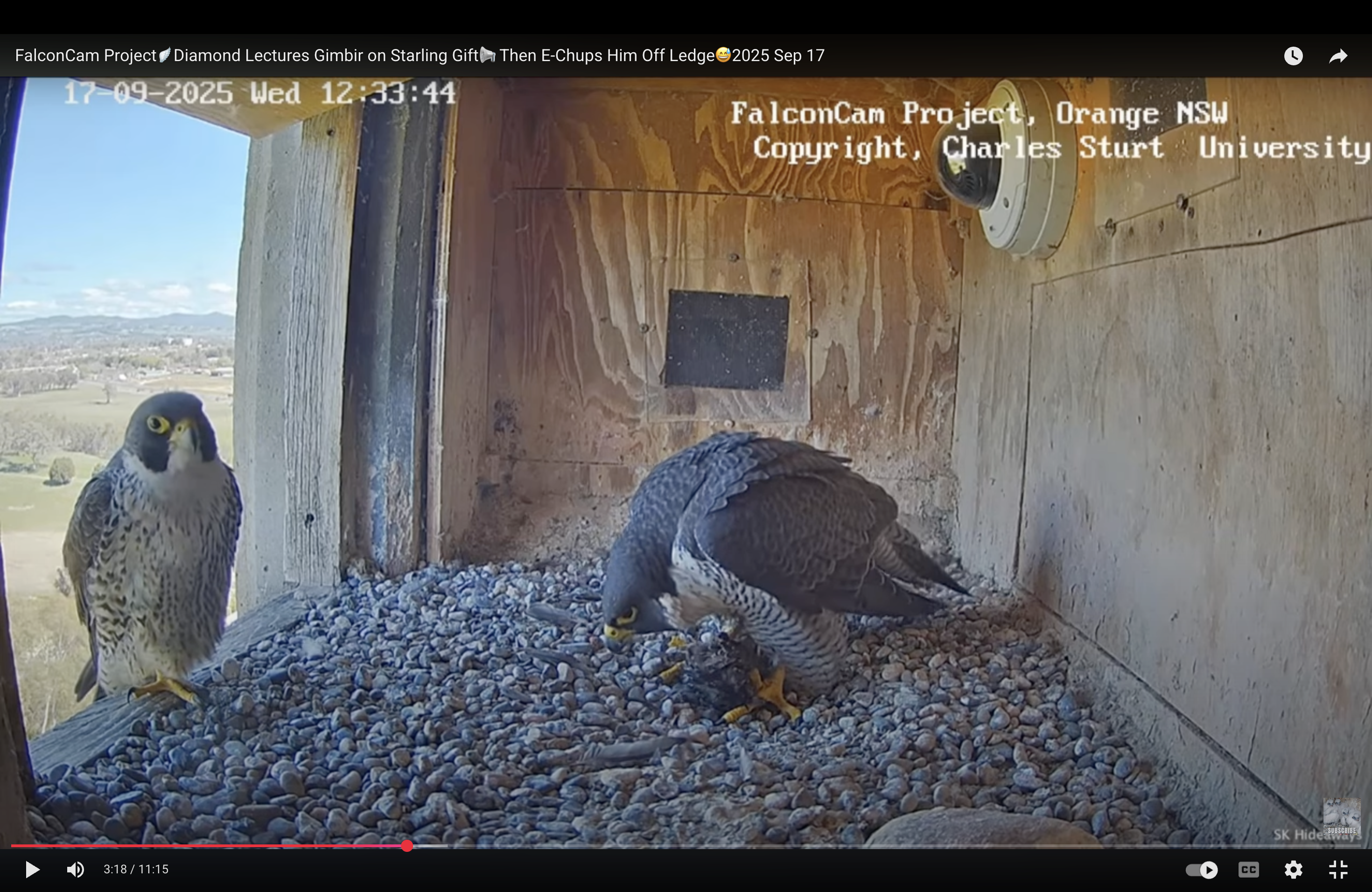
Gimbir was proud of his starling gift ~ the first time he’s brought one to Diamond, who historically has refused starling gifts except to feed growing chicks. She gave him quite an earful, about which he seemed somewhat confused. In the end she e-chupped him completely out of the nest box and proceeded to eat some of the starling. Maybe Di’s taste’s have changed.

Videohttps://youtu.be/7Fibnk3qEt4

Courtesy FalconCam Project, Charles Sturt University NSW (http://www.csu.edu.au/special/falconcam/)

Box Cam: https://www.youtube.com/watch?v=yv2RtoIMNzA

Ledge Cam: https://www.youtube.com/watch?v=adCIawe2WWI

Nest Cam: https://www.youtube.com/watch?v=Xj1Y6ydRl1c

Tower Cam: https://www.youtube.com/watch?v=X4332mBQdnc

Sydney White-Bellied Sea Eagles Lady, Dad, SE35 & SE36 (2025 Sept 22)

After Lady and Dad woke the neighbourhood with a duet, SE35 and SE36 entertained themselves till breakfast arrived. Between beaky kisses, wingers, twig swapping, and napping, they were well occupied for the few hours till Lady returned with a nice, big breakfast.

Videohttps://youtu.be/j5_brVPp7XE

What’s happening? SE35 Steps Aside as SE36 Eats a HUGE Breakfast! (22 Sep 2025, 9:47-10:29 a.m.)

When Lady arrived with a whopper fish for breakfast, SE36 stepped right up to receive the first bites. SE35, typically, the dominant eaglet sat back and watched SE36 eat…and eat…and eat. The meal lasted for more than 40 minutes with SE36 getting most of that big fish.  There was no aggression between the eaglets, which was a welcome sight to see.

Videohttps://youtu.be/tzy323L7v2g

Courtesy Sea-EagleCAM@BirdLife Australia Discovery Centre, Sydney Olympic Park (https://www.sea-eaglecam.org/video.html)

Nest cam also at https://www.youtube.com/@SeaEagleCAM4/streams

Ventana Wildlife will be releasing condors! You can go to their website and sign up for this live event. No costs. I always watch these events. You learn so much and it is so exciting to see the youngsters go out into the world.

“`Carefully transferred from the Los Angeles Zoo to our San Simeon Release Site, seven (1.5-year-old) condors are preparing for their highly anticipated release into the wild in late October.

Condor Release – Saturday, October 25, 9AM-12PM (PT).
– Six female condors126512891300130213071312
– One male condor:1290

Here is all the information:

I want to thank each of you for taking the time out of your busy lives to check on how our feathered friends in Bird World are doing. I would also like to welcome the more than 5,500 readers from China who have joined us recently. It is so lovely to have you with us in Bird World! Welcome.

To celebrate, here is a lovely article in 10,000 Birds on the Raptors of Nanhui, Shanghai, with some beautiful images. Please check it out and see how many of our feathered friends you knew were in China. I am particularly fond of the Chinese Sparrowhawk.

Tuesday -Great news. The Royal Cam chick fledged on the 17th of September!

Cornell Bird Lab has this maiden flight on video! https://youtu.be/zYqzddsT6pA?

Elain also has a video of that initial flight! https://youtu.be/1JhCsH0JTO4?

Albatrosses forage at sea for an extended period after fledging, typically remaining at sea for 3 to 7 years or more before returning to their natal colony to find a mate and eventually breed. During this time, young albatrosses, known as juveniles, learn to forage and socialise in groups called gams to develop their courtship rituals.  

Post-Fledging Journey

  • Years at Sea: After leaving the nest, young albatrosses will spend several years at sea, some for as long as 5 to 8 years, continuously foraging and only returning to land for breeding. 
  • Socialization: Young albatrosses gather in groups of potential mates, known as gams, to learn complex courtship dances and develop their unique “language” for finding each other later in life. 
  • Maturation: This period allows them to mature, molt their juvenile plumage, and gain the energy and experience needed for their first breeding attempt. 

Return to Breed

  • Colony Return: Eventually, the adolescent birds return to their natal colonies. 
  • Finding a Mate: They then begin the lengthy process of finding a mate and developing a pair bond before their first breeding attempt. 
  • Breeding Frequency: After a successful breeding attempt, many albatross species take a year or more off from breeding to regain their energy and condition before their next breeding season

All the information that you could ever want to know about Albatross by New Zealand’s Department of Conservation:

The latest post from Ranger Sharyn Broni posted by Sharon Dunne.

Holly Parsons has posted some additional information:

‘A’ now has the latest: “Since our baby girl fledged on 16 Sepember, she has been steadily making her way towards South America. The tracker tells us that she is about 200 kms from the headland, heading north. She has stopped off in an area where she probably found food and is progressing well. She is a strong girl. She’ll need to be – her journey is 9000 km long. Safe travels beautiful albie. “

Many of you have been fascinated by the great prey gifts that Gimbir has been bringing Diamond. None of them were Starlings – we know that Diamond does not like Starling. Well, our poor little lad made the mistake of presenting a Starling gift to Diamond and she rebuffed him. SK Hideaways has it on video: https://youtu.be/7Fibnk3qEt4?

Gosh, is there anything cuter in the adult raptor world than a male peregrine falcon? Gimbir has certainly been winning hearts and minds with his generosity and excellent hunting skills. Will there be any eggs? Maybe not this year, but we will wait.

Tuesday afternoon was also magical on the Canadian Prairies. I sat in my friend’s garden, surrounded by the yellow leaves from the trees falling gently around us. Fall is truly here. It is one of the most loved seasons, yet each of us knows what follows. Winter should be a time of relaxation, sitting by the fire, reading a book, sipping hot chocolate or the best leaf teas wrapped with a soft blanket.

We are looking forward to spending several hours in the nature centre on Wednesday, checking out the geese and ducks while Toby is being groomed. There are places where dogs cannot go (understandably), and this is one of them. We have not been there for several months, so I am really looking forward to spending time on those very familiar paths.

The geese are still fattening on the golf courses and at the nature centres. They were in an area of our City that had been abandoned when one of the military bases closed. Now it is a building site. Where will those geese, who have returned to this same place each year, go now? What are humans leaving our wildlife?

We are taking away habitat minute by minute. The City I live in is no exception. For over a hundred years, the population remained stable at approximately 600,000. Now our City is a construction site with the population soon set to reach one million. It sprawls, and many city planners have, for decades, criticised this practice as it is now taking away good agricultural land, along with woods that are perfect for wildlife and birds. It makes me quite angry – the City should be safe, built up, not out, with good public transport. As it stands, things are so spread out that cars are almost a necessity, and every morning, the traffic jams reveal automobiles with a single person in them! I’d best not get started on my soapbox, or we could be here all day.

Humans to push further into wildlife habitats across more than 50% of land by 2070 – studyhttps://www.theguardian.com/environment/article/2024/aug/21/humans-to-push-further-into-wildlife-habitats-across-more-than-50-of-land-by-2070-study-aoe?CMP=share_btn_url

Researchers at Cornell, along with colleagues worldwide, are searching for missing birds. Here is one of the webinars that was posted, so we can join in their discoveries as well. https://youtu.be/sri3ciYgCS4?

It was an extremely sad year for the Black Stork nests in Latvia as reported by Maria Marika. As we know, we must mourn but also celebrate the success. As we take over habitat, the planet and oceans warm, there will be fewer successes unless we radically change our human behaviour.

Border Ospreys latest newsletter:

‘A’ reflects on the Australian nests:

“It was another windy day at WBSE and the chicks were left alone on the nest for most of the day. They are really developing their juvenile plumage now, especially SE35, whose feather development is well ahead of its sibling’s. One reason for this is probably the lack of food SE36 gets in comparison to SE35. I saw only one food delivery today, a gull, and SE36 was fed four or five bites of this (beause it happened to be in the right place at the right time) before SE35 intimdated it into a cowering defensive position, which it maintained until the food was gone. There were no late food deliveries as there have been on previous evenings and little SE36 went to bed with an empty crop. SE35 did relatively well, although would have preferred another two feedings. It is fortunate indeed that both eaglets were well fed on the previous two days. Here are the three reports, from today, yesterday and Sunday:

September 14: another fine day. Last night Lady slept on the rim of the nest, or just by them – disturbed at one stage by the possum passing. Early duets and she was off, returning after 6am and trying to settle in the bowl with the nestlings – but off again a after a short time. When Dad brought in a gull carcass at 7:50 she grabbed it and fed them both –for an hour. Dad came in and took off some of the scraps, with Lady very protective. He fed 36 a couple of bites, then Lady came in again and fed them a little more – protecting the food from him. Then Dad returned and fed them a little himself – and more when Lady took over and fed 35, then 36 – a massive feeding session. As the nest warmed up, chicks were panting – full crops too. They rested, sprawled out in the nest at times, moving into the shade when they could. Dad came in a couple of times and took off a scrap of bone. Late afternoon, Dad came with a whiting, claimed and fed by Lady, to SE35 first. Both ate – full and peaceful at end of day.

September 15: Lady spent most of the night on the nest rim, coming in very early to the bowl, then away. She returned as Dad brought in a Red Rock Cod at 6:15am, claimed by Lady and fed it to both chicks. Both chicks are calling now as the food comes in. A very warm day then, with both of the eaglets moving into the shade when they could. The parents were in and out a few times, with leaves – or nearby – but the chicks were mainly left alone on the nest. Lady came in at last light, but there was no more prey until just after 6pm, when Dad brought a fish. Lady then fed both nestlings before settling for the night.

September 16: Lady slept on the rim last night. She was off very early, then duets, with the nestlings joining in. Dad came and started feeding SE35 a fish scrap early, offered a bit to Lady, then she took over – though there was not much left. The eaglets then waited all morning until Dad brought a gull chick just after 2pm, on a windy afternoon. Lady claimed it and fed both, with SE35 getting most. SE36 has been venturing right to the nest rim, then returning safely to the nest bowl. Both chicks are calling on the nest now – begging for food or parental attention. They were waiting for more food all afternoon. Lady came to the nest just before 6pm, but with no food, then left again, flying to the perch branch. She returned to the nest bowl, settling on the nest next to the chicks. Will there be a late prey delivery again? (Spoiler alert: No, there wasn’t, and poor SE36 went to bed with an empty crop and a hungry tummy.)

At Collins Street, the three eggs are being carefully tended by both falcons, though mum is doing most of the shifts. 

At Taiaroa Head, we are told, Miss SS Trig is further down the hill. However, I am not convinced she has not already fledged today because there is an albatross sleeping on her nest and according to Ranger Sharyn Broni, that albatross is her father, who is waiting to feed his girl. (I wondered why, if it is him, he has not called for her at all, though he has looked around and he is sleeping on her nest – also I believe Ranger Sharyn has actually confirmed his identity on her recent travels.So we will have to take her word for the fact that Miss SS Trig has not yet fledged and that there is a goodbye breakfast with dad awaiting her if she decides to head up the hill early tomorrow morning (17 September). The wind will determine her schedule, in all likelihood, but we are hoping she will stay at least another week, until her tummy mohawk (it really is most distinctive) has been shed. 

I thank you so much for reminding me that the birds in our own gardens are the interface between ourselves and the natural world. We don’t need to filter these experiences through streaming cams from the other side of the world, although the chance to share the experiences of birds like the red-tailed hawks is something extra special (and a bird like Angel is something too precious for words). 

Meanwhile, all appears well at Port Lincoln, where the night herons are doing well with the fish light it seems. They caught two fish in rapid succession the other evening. With three healthy-looking eggs, I do have some fears about the upcoming season – there is an aggressive quality to ospreys.”

“Wednesday: The littles were up and stretching at 6am and the breakfast fish arrived at around 06:08 courtesy of ever-reliable Dad. Lady was quickly in to take control of the feeding, with SE36 finding itself in prime position at the table. It was too intimidated though by its older sibling and went into submission pose, allowing SE35 to push past and take the front spot and the first of the food. But SE36 was still closest to the fish, and had the courage to turn its head and take occasional bites when Lady offered them. It was a good-sized fish and eventually, both nestlings ate a large breakfast. 

When I checked back at lunchtime, SE35 was in a food coma and SE36, despite sporting the most gigantic of crops, was still eating like a small feathered machine as Lady fed him still more fish. Oh my goodness those eaglets were full. After yesterday’s lean pickings, I’m sure they both enjoyed the food overload they got today. They have become very vocal in recent days, chittering away to each other on the nest and vocalising to their parents whenever food approacheth. Oh they are the cutest small people. SE35 is starting to show caramel colours on its breast and head feathers and will soon begin to resemble a juvenile sea eagle. SE36 is still a huge ball of fluff with some feathertips on its wings – at least two or perhaps three days behind its older sibling. 

At Collins Street, dad brought in such a large pigeon (I think) at 15:24:20, he could hardly get it up onto the ledge. It was as big as he was. Mum was less than impressed, after all his hard work, and stayed on the eggs, so he dived off the ledge again with his prey, at which mum looked rather surprised but still didn’t move. I presume he ate it himself, or stashed it on a floor above the nest (he glanced up there before diving off the ledge). At least there appear to be enough workers back in the Melbourne CBD to feed a good crop of pigeons for the falcons to feed their chicks once those eggs hatch. Dad is obviously a good hunter – that really was a very large catch. 

Dad returned with empty talons soon after 16:28, and the pair had an animated conversation before mum dived off the ledge and presumably headed off to the pantry for the pigeon remains. Finally! Egg time for dad. He is such a cutie. A very neat little falcon. And his sweet little voice is adorable. Mum is back at 17:27:30. Another changeover at 18:02:30. “

The cam operator gave us some great closeups of the little sea eaglets and their gorgeous juvenile plumage coming in.

“Here is yesterday;s ranger report:

The eaglets both ate a large breakfast at around 10am this morning, with SE36 doing particularly well at this feeding. Both chicks finished the meal with huge crops, and spent the rest of the afternoon resting in the sunlit nest. The weather has improved, with the winds dying down and no rain today, so things are drying out and the fishing is easier. 

September 21: A lovely sunny day. Last evening, Dad brought in a last prey offering, another young gull, and Lady fed them, though SE35 ate most. SE36 found a last scrap itself. Lady spent most of the night beside them on the nest rim. A quiet morning until Lady herself brought in a young gull. SE36 did quite well at this feeding. Both are picking at things in the nest. Then, in the late afternoon, Dad brought part of a fish, having already eaten himself. He fed them a little first, then Lady took over until all was gone. As the eagles called, the youngsters joined in too at  the end of the day. Both adults settled nearby.

And today (22 September), the eaglets both ate a large breakfast at around 10am, with SE36 doing particularly well at this feeding. Both chicks finished the meal with huge crops, and spent the rest of the afternoon resting in the sunlit nest. The weather has improved, with the winds dying down and no rain today, so things are drying out and the fishing is easier. 

These two are starting to look so grown up (especially SE35). It is scary to think that they are nearing the time when their privileged life on the nest will be exchanged for their annual losing battle with the currawongs.It seems so futile – all the hard work the parents have put in and yet it is destined to be fruitless, with the fledglings unlikely to survive without human intervention (and even with that assistance, their futures are very uncertain).  

At Collins Street, the incubation continues, with the three eggs looking good and being well looked after by both parents. Mum headed off at 06:14 this morning to get herself some breakfast, and little Dad quickly arrived to take over, making his tiny chirping noises. The way he talks to the eggs is so adorable. He loves these chicks before they’ve even hatched. 

At Port Lincoln, mum is still waiting for food – nothing has been brought in so far today. There are usually two fish (or one huge fish) brought in per day, but I am not confident that this is going to increase sufficiently to feed a family of five when these eggs hatch. I do hope the Fish Fairy is ready for action because I fear she is going to be needed on this nest this season. I do wish they would stick to two eggs. 

Mum is doing the vast majority of the incubating at Port Lincoln – some days, dad spends less than an hour in total on the eggs, with mum taking care of the rest. She is doing a great job, but as I said, I’m hoping the fish supply will step up when the eggs hatch – as things stand, mum isn’t getting enough for her own needs. “

Pat Burke got the cutest screen capture of the little sea eaglets, who are a month old now.

TE3 is still hanging around the natal nest in Tempeauleau Wisconsin. This gorgeous juvenile was raised by her Mum basically single-handedly. Many thought the eaglet would not survive, but she did and what an amazing eagle she is going to be. Thank you Bud Whillock for these great images that you shared on FB.

The American Bird Conservancy announces a huge win:

ABC is celebrating a much-needed win for seabirds with the announcement that the U.S. Department of the Air Force (DAF) has suspended its proposal to use Johnston Atoll National Wildlife Refuge as a site for commercial rocket landing pads. ABC was among the first organizations to raise concerns about the plan and request further study on the potential impacts on the more than one million seabirds that nest on the tiny Pacific Ocean atoll each year. The DAF’s pause on their plans gives seabirds like the Brown Noddy and Red-tailed Tropicbird breathing room and keeps this important site a safe refuge for birds, for now.

As our population grows, the impact on wildlife is enormous.

The ospreys are almost all gone on their journeys to their winter quarters. Iris is no longer at Hellgate Canyon, and Charlie is no longer at Charlo, Montana. A few linger in Nova Scotia, and one of CJ7 and Blue 022’s fledglings was photographed in Poole Harbour.

It appears that the male at the Boulder County Fair Grounds osprey nest is still at home, too.

Swoop continues to deliver to the fourth hatch, known fondly as Eenie or Little Buckaroo, at Dunrovin Ranch. Lin Lawson did a physique comparison between the father and the juvenile.

Connie Dennis reminds us that this is the number of days we have until they return in Nova Scotia:

Each of us will be sitting on pins and needles waiting for Iris to return to Montana next spring! Lovely montage Lucille Powell, thank you.

There are still some ospreys in Manitoba! Marlene Mitchell caught this one where we go to see the Pelicans.

At the Golden Gate Audubon nest site – lamp and crane – one fledgling and the parents that remain are Beacon, Rosie, and Richmond. “At 128 days old, Beacon has now lingered the longest of any of Rosie and Richmond’s offspring. And apparently her calls for more fish are working, as she received two separate deliveries today, after visiting the Whirley Crane several times. Rosie also visited the crane. http://www.sfbayospreys.org”. https://youtu.be/sT1WdpdP4-Q?

Rosie is still there on Thursday. Thanks, Lucille Powell.

Cumbria Wildlife Trust gives us the remarkable story of White YW and Blue 35 at Foulshaw Moss, who raised three chicks, with White YW now 17 years old and Blue 35 fourteen years old. And then, White YW feeds and cares for another’s fledgling. A good read. White YW and Blue 35 are two of my favourite osprey couples in the UK, often overlooked.

It is that time of season when there are summaries and highlights. Cornell Bird Lab takes us through the life of the Barred Owls. “Relive five unforgettable moments from our 2025 Barred Owl Cam, sponsored by Wild Birds Unlimited! This season was full of fun and heartwarming memories as this feathered family raised their two adorable owlets, Moss and Maple, in a nest box nestled in the backyard of WBU Founder and CEO Jim Carpenter. Here is the link: https://youtu.be/HfW9vYw2HSY?

It is also cam maintenance time for both the ospreys and the eagles.

Gabby and Beau continue to work hard on their nest in NE Florida, with Gabby even trying out the egg bowl. Will we have eggs early this year? We wait to see.

Duke Farms nest is waiting for its eagles.

There was an eagle at the ND-LEEF in South Bend, Indiana, on Tuesday.

Hawk Mountain’s Migration chart for this week:

Robert Fuller‘s six kestrel chicks have fledged! https://youtu.be/Fqc19QvkE-k?

Reports from Raptor Persecution UK.

Welsh government is in trouble as Avian Flu spreads.

While the news from Wales is worrisome, there is some good news. Hen Harriers will not be introduced into the south of England. I am delighted.

The American Bird Conservancy Bird of the Week is the Belle’s Vireo. Don’t know this bird? Have a read.

The Maori, along with North American Native Tribes, along with many other cultural groups, believe that birds carry messages, especially when someone dies. A lovely short read from The Guardian:

In the days after my mum died, a blackbird lingered like a messenger of solace | Mark Saunokonokohttps://www.theguardian.com/environment/commentisfree/2025/sep/18/in-the-days-after-my-mum-died-a-blackbird-lingered-like-a-messenger-of-solace?CMP=share_btn_url

Toby wants to know how many people remember Murphy the Bald Eagle who incubated the rock and then got to raise an eaglet? Thanks National Geographic!

Thank you so much for being with us today! Take care of yourself. We look forward to having you with us again next Monday.

I want to thank our notable contributor, ‘SK Hideaways’ for their videos highlighting the nests we are following as well as the owners of the streaming cams listed in bold, other individuals and institutions who create videos and the authors of posts such as Jeff Kear at UK Osprey Information, and all others, often too many to name but whom I have tried to cite in bold. I am very grateful to you and to the newspapers and journals that still cover environmental issues as they relate to our precious feathered friends. A special thank you to Raptor Persecution UK for keeping us well informed about what is happening to the raptors in the UK. My blog would not be what it is without your input into the world of birding.

Calico wants me to add an essay, “The Thin White Line,” from Emergence Magazine. She thinks it is thought-provoking.

Thank you so much for being with us today! Take care. See you next Monday.

I want to thank our notable contributor, ‘SK Hideaways’ for their videos highlighting the nests we are following, ‘A’ for their Australian commentary, the owners of the streaming cams listed in bold, the individuals who take the time to create videos and the authors of posts such as Jeff Kear at UK Osprey Information, and all others, often too many to name but whom I have tried to cite in bold. I am very grateful to you and to the newspapers and journals that still cover environmental issues as they relate to our precious feathered friends. My blog would not be what it is without your input into the world of birding.

Monday in Bird World

15 September 2025

Good Morning Everyone,

We are one week away from the autumn solstice. It is a beautiful Saturday on the Canadian prairies. It is 24 C. The sky is a hazy light blue with the sun beating down on the garden. The cranberry bushes are turning flame red, the leaves have been turning for some time, and early in the morning, sitting on the deck with Toby and a coffee, we can hear the geese far above us honking.

Time passes too quickly. Not two blinks ago, the children were getting out of school for the summer holidays, and now they are back. We are even having our annual street party tomorrow. It felt as if the last one was just months ago. Do you ever feel this way? Like time is melting between your fingers? Still, it will feel like aeons until Gabby and Beau have their first egg. Time will drag til the ospreys return, and then it will fly again!

I am happy to report – thank you to all the good energy you sent – that Baby Hope is completely healed and new fur is growing over her injury! I cannot tell you what a relief this is. We worried that she would continue to scratch at the injury so that it wouldn’t heal. Toby is also fine. He is a little ‘stiff’ going down the stairs but he is back to wrestling some with Hugo Yugo. They continue to sleep together in the big dog bed. It is so sweet. Missey and Calico are well, too. I cannot ask for more.

So what is happening in Bird World? For the most part, the ospreys are gone. Tiger Mozone reminds us it is approximately 178 days til they return in the UK. What will we do without them? — Watch Port Lincoln! And the Bald Eagles, right?

We will start with two video offerings by SK Hideaways to get us excited! None other than Monty and Hartley and, of course, our favourite Big Bear Valley Eagles – Jackie and Shadow.

San Jose City Hall Falcons Hartley & Monty (2025 Sep 14)

Monty arrived to tidy up the nest prior to Hartley’s arrival. Their meeting was a veritable beaky kiss fest. Guess three successful broods is the key to a successful relationship.

Courtesy San Jose City Hall Peregrine Falcon Cam

Nest Cam: https://www.youtube.com/watch?v=VBSxPjy5sow

Ledge Cam: https://www.youtube.com/watch?v=-pp9TisLmLU

Roof Cam: https://www.youtube.com/watch?v=RQLhmV6bP6o

Facebook https://www.facebook.com/SanJoseCityHallFalcons/

Wiki https://sanjoseperegrines.editme.com/

Big Bear Eagles Jackie & Shadow (2025 Sep 12-13)

Jackie and Shadow perched on their Roost Tree overnight and Lookout Snag at dawn. Such peaceful, soothing scenes.

Courtesy FOBBVCAM, Friends of Big Bear Valley

Resident Bald Eagle male: Shadow (unbanded) since May 2018. Estimated hatch year: 2014

Resident Bald Eagle female: Jackie (unbanded) since September 2016. Estimated hatch year: 2012

Nest Cam: https://www.youtube.com/watch?v=B4-L2nfGcuE

Wide View Cam (Cam 2): https://youtube.com/live/LCGYWfbyBWc

LIVE Recap & Observations https://bit.ly/3Md8TSz

There are a few ospreys still at home. Dinas is one of those in the Glaslyn Valley with Oscar still in Nova Scotia.

Others are being spotted as they move through the UK on their way to the coast and off to the Iberian Peninsula or West Africa.

The last hatch, the fourth, remains at Dunrovin Ranch in Colorado with Dad, Swoop.

Looks quiet at Charlo Montana.

Rosie is still at Golden Gate Audubon. She migrates while Richmond remains in the territory over winter.

Iris was still eating fish at Hellgate Canyon on Saturday! Lucille Powell caught her on camera on Sunday. Iris is staying late.

Fledgling White Tail Eagle, Leo, is still at Milda’s nest in Durbe County Latvia! https://youtu.be/H-0dVRE5nfg?

Heidi reports that the male is still at Field Farm feeding his two juveniles who fledged mid-August.

It has gone quiet at Rutland Manton’s Bay Osprey platform.

Making the departure of Blue 33 and Maya complete, Colin, the Cormorant has moved into the nest!

As I shift the blog to Mondays until the first hatch at Port Lincoln, I hope to fill you in on some of the books that Calico and I have been reading. Yes, it has been more than two years, and we are still having story time – four cats and a dog! Here are our first offerings. Some will make great holiday gifts.

The Naturalist’s Notebook for Tracking Changes in The Natural World around You by Nathaniel T Wheelwright and Bernd Heinrich (2017).

It is a beautifully illustrated book with gilt edges and just the right size to hold and read comfortably. The authors discuss their ancestors and how they learned to observe the changes in the natural world, day by day and month by month. In the back is a five-year calendar divided by the seasons, reminding us to be present in our lives. I am particularly fond of the extensive calendar, which allows me to easily compare the arrival of the Starlings, the fledge of the Blue Jay babies, and the first honks of the geese flying overhead to their winter homes. It would make a lovely gift for someone just beginning to learn about the world around them, or for someone like me who wants to keep track of what is happening in my garden. $24.95 CDN.

The Company of Owls by Polly Atkin.

This is a review on Goodreads – and it is spot on! Atkin, like Wheelwright and Heinrich in The Naturalist’s Notebook for Tracking Changes in the Natural World around You, observes owls that live near her. She doesn’t travel far and wide, and like so many, she is not a professionally trained expert in the behaviour of owls. She is a person, just like all of us, who loves animals and birds and is a keen observer of their lives. That review reads: “Polly Atkin does not profess to be an expert on owls or anything else. This refreshing book brings the love of birds, especially owls, right from her heart to yours. It also brings the sights, sounds, and weather (oh, the weather!) of England’s Lake District right into your sitting room.

In The Company of Owls, we are treated to the author’s observations of the owls that choose to live near her. This nips off to other places she’s lived and visited, which adds richness to her descriptions, but it is her ‘home’ birds, and particularly one year in their lives, that is the primary focus.

The author has wonderful descriptive powers, and it is no surprise to glean her interest in poetry from her tale. Her description of the bog habitat where she went looking for short-eared owls is superb, although given the daily walks that provide the basis for her writing about her local owl family as they grow, it is amazing that there is no hint of repetitiveness.

Atkins supports her story with solid research, comparing owl numbers now with the records since Victorian times. These details tend to slip in as anecdotes, and more narrative quotes combine to give a really good picture of how owls have fared over the last century or so.

It’s a very personal record, and she isn’t afraid to reveal her own mistakes, which brought me back after a slight dip in attention in the middle of the book. On the whole, I think this is a really good book for the cosy bird lover, and people who like to know all the birds on their patch, rather than the twitching variety. I’m a patcher, of course.”

Both of these books take a very personal look at the natural world that is around them. They are inspirational to each of us to look just outside our back door – we don’t have to travel the world checking off lists – great things are happening beside us – now.

The power couples of Florida’s Bald Eagle streaming cams are returning to their nests and restoring them for the new season.

M15 and F23 have been home at SW Florida working on their nest.

Beau was absolutely delighted when Gabby arrived home to their nest in NE Florida early.

Ron and Rose are at the WRDC nest near Miami.

Now what is going on with Connie and Clive at Captiva?

In California, Andor and Cruz are at Fraser Point.

‘A’ is keeping a close eye on the Royal Cam chick for us as well as the others in Australia.

“Dad came in a couple of hours ago and fed his big girl breakfast. She was very excited to see him, and watched him closely as he took off after the feeding. It is hard to think this may be the last time they see each other. We (the viewers) hope not because Miss SS Trig still has what the viewers are calling a belly mohawk, with quite a bit of tummy fluff we would like to see gone before she leaves. Her feather development when compared with dad’s this morning was obviously still a week or so away from being ready, so we do hope she doesn’t get overexcited (or caught in a storm Lillibet style). Miss SS Trig is 229 days old today (Lillibet fledged at 219 days, the second youngest ever, the youngest being 218 days old a few years ago). And that number I was trying to read the other day wasn’t 555 at all – her number is YE55 (so the E looked like a five and the Y was further around her leg and not readily visible). This may become important later on, as she will lose the GPS device with her first moult, I presume. I did read something about this being a better GPS device but can’t remember what it was.”

Wow. Doesn’t SE35’s feather development over the last few days astonishing? So much more advanced than SE36, who is still a fluffball with few discernible black lines along its wings. This afternoon, the pair have been left alone on the nest in the dappled sunshine, working as hard as they can at converting fish into eaglet feathers. The effort is obvious, as they are flat out like a lizard drinking (sorry – old Australian saying). SE36 has a huge crop so has obviously eaten well today. SE35 is never hungry so there’s no need to update you there! Oh they are exquisite at this age, are they not? Every bit as gorgeous as they were last week and probably just as beautiful as they will be next week when their plumage will be completely different to what we see today. (In other words, they are absolutely lovely every single day of their growth, from the moment they hatch to the day they fledge, and even then, their plumage has many stages to go through before (hopefully) they finish up looking like Lady and Dad. 

I did mention to you that the juvenile red wattlebird in my garden has breast plumage that reminds me of the young falcons but from doing a bit of reading, I think those vertical striations (in either greys or caramels with cream) must be common to many (perhaps most) young birds – the red-tailed hawks have a similar pattern. Obviously, it is an excellent camouflage because it is very similar to the way objects appear when struck by the rays of the sun glinting through leaves. 

But I digress. I came here to Olympic Park to say that the littles are doing fabulously well, as usual. Lady is such a devoted mum, and Dad, despite or perhaps because of his advancing years, is an incredibly reliable provider, even in difficult conditions. I have to believe that is the result of his experience – he must know exactly where he can fish when the winds are coming from a particular direction or when there is prolonged rain or whatever the prevailing conditions are. These are the advantages of old age I suppose. And Lady is no slouch herself – she often brings in a late afternoon fish when she has the chance to stretch her wings. It’s easy to forget how old these two actually are. Their fertility appears stable – two fertile eggs per year.”

Incubation continues at Port Lincoln Osprey barge.

It has been a wonderful year at the Osprey House Environment Centre. If you didn’t follow the nest, the fledgling from 2024, helped the parents to care for the little ones in 2025. It turned out marvellous. The babies thrived and now the first one has fledged.

Incubation is still going well for the falcons in the CBD of Melbourne at 367 Collins Street.

Little Gimbir is winning hearts and minds as he has proven to be an exceptional hunter and provider for Diamond at the Charles Sturt Falcon scrape in Orange.

The Wedge-tailed Eagle is the largest in Australia. This is a short film, 18 minutes by Filming Wildlife, of this large raptor hunting! https://youtu.be/TEJ7gSYUOek?

Meldrs, the Golden Eagle fledgling of Spilve and Grislis, no longer comes to the nest in Latvia but is out following the adults, learning to hunt.

‘L’ from South Carolina sends me the most gorgeous images of a Cooper’s Hawk that visits their garden often, drinking at the bird bath. It is a reminder that we should all put out water for the birds that stay and those, so thirsty, that are passing through on migration. (The hawk is enjoying a Shrike lunch).

Emergence Magazine is launching its next volume, Seasons. I am attaching a link to a film, Crying Glacier by Lutz Stautner. The author says, “In the trickling, creaking, and gurgling heard through hydrophones and contact microphones, sound artist and composer Ludwig Berger listens for the voice of Switzerland’s dying Morteratsch Glacier. Directed by Lutz Stautner, this short film follows Ludwig on one of his many visits to the glacier, where he gathers its hidden sounds, the pop of centuries-old air bubbles and the groan of ice, inviting us into the intimacy of listening to more-than-human voices. One hundred years from now, we may only be able to hear the sounds of glaciers through recordings like these.”

https://emergencemagazine.org/film/crying-glacier/?utm_source=Emergence+Magazine&utm_campaign=5f28ad1708-Newsletter_20250914&utm_medium=email&utm_term=0_-0be9b497cf-356972785

Dedicated individuals continue to fight to end the industrial fishing of Menhaden if the osprey and other species are to survive in the Chesapeake Bay and region.

It’s migration. Please encourage everyone to turn off their lights!

One lucky little gosling.

Your smile for the week comes from Toby who is busy excavating peanuts in the flower pots where the squirrels have hidden them!

Very pleased with himself.

Toby had his operation on Tuesday. He can’t have a bath for another week and a half! He is so dirty and stinky!!!!!!!!!!

Thank you so much for being with us today. We hope that you had a lovely weekend and were able to get outside and enjoy lots of fresh air and bird song. Take care. We will be back with you again on Monday the 22 of September. Fall will have officially begun!

I want to thank our notable contributor, ‘SK Hideaways’ for their videos highlighting the nests we are following, the owners of the streaming cams listed in bold, the individuals who take the time to create videos and the authors of posts such as Jeff Kear at UK Osprey Information, and all others, often too many to name but whom I have tried to cite in bold. I am very grateful to you and to the newspapers and journals that still cover environmental issues as they relate to our precious feathered friends. My blog would not be what it is without your input into the world of birding.

Who’s Home? …Monday in Bird World

8 September 2025

Hello Everyone,

Late Update

From ‘PS’ on the Seattle Osprey Platform:

Perhaps one final update from Seattle – 25B (as I have come to call the last-to-fledge) is still mostly hanging around the nest and as of yesterday, dad is still delivering fish (pictured). I have not seen 25A in over a week – perhaps he/she is in the area but fishing on their own already, maybe headed out to points south? I hope that B will start fishing on its own soon, too. 25A – one of the last times I saw it – was practicing on some land mammals (pictured) in a very cat like way, including losing interest once the mouse stopped moving. I also trust that dad knows what he’s doing – and isn’t waiting too long to head south. What a summer it’s been with these birds! Can’t wait to see them again next spring. https://www.flickr.com/gp/193514804@N08/xqa8vrBiT4

Teifi has been seen at the Glaslyn osprey nest and area on Monday. KL5 is still at Loch Garten. Female 1H1 from Poole Harbour nest 2 was seen catching fish on Sunday late.

Usk Valley sent a newsletter:

Despite a couple of torrential downpours, the weekend was not ‘half bad’. We love fall and the energising winds that it brings. Summer clothes are being packed, with sweaters being made ready. Scarves, toques, gloves, and winter coats are at the ready. I really hope we do not need them for several more months!

As I write this, it’s a beautiful Friday evening, quintessentially fall, with a gentle breeze and golden light flooding the backyard. The birds have been eating and eating since early morning. Anne even had to put out more food mid-afternoon. So, today, they have had 9 gallons of seed. It is just after 1820, and almost all of it is gone. Even the Crows are coming in for nuts.

Saturday morning, the sky was out and there was a clear breeze. We had lots of migrating birds in the garden, heard by Merlin but mostly unseen. They included our usual Blue Jay family, the Crows, the House Sparrows along with American Goldfinch, Grey Catbirds, the Hairy Woodpecker, and House Finches! Merlin recorded a GHO, but I didn’t see it, so was it wrong or loud at a distance? We do have one that lives in the area. The squirrels were in abundance, and Toby enjoyed the idea of trying to catch a butterfly that was high above his head. It is a ‘crisp’ day, and in the oven is the last of the rhubarb in a crisp to be enjoyed with ice cream shortly. I love autumn. The cooler, clear air is refreshing from the heat and humidity, as well as the wildfires of summer. It gets down to 6 °C at night. Toby and I sleep under my grandmother’s quilts that she made as a young woman. The logs are stacked next to the log burner for use on a cool evening.

Sunday brings us the Blood Full Moon. Our day was up and down, no doubt thanks to the influence that it flexes.

‘PB‘ sent us the latest news on the necroscopy completed on MO, the Dunrovin first hatch that died recently.

Soar high, little one!

I haven’t switched from osprey season to eagle season in my mind so I more than likely will miss many arrivals. One of those was Rose at the WRDC nest. She and Ron are busy preparing the nest. It looked like they were putting up the rails on Friday.

The cam operator at the NE Florida Nest of Gabby and Beau gave us some fabulous close ups of our couple on Friday.

Eagles are coming to the Kisatchie National Forest nest in Louisiana! Hello Alex. Thanks Tonya Irvin.

Bella and Scout are at the NCTC nest. Thanks, Deb Stecyk, for the video: https://youtu.be/8YhYtp-1NNw?

Jackie and Shadow need your help to stop a development in Big Bear. Please read.

Haku and MV working on the West End nest in the Channel Islands.

At the Dyfi Osprey Platform in the UK, Brianne is now 112 days old and she is still home. Idris continues to deliver fish!

Idris and Brianne were still at Dyfi on Saturday.

Dyfi dates: Dyfi Osprey Project​​: Idris and Brianne both seen today 06/09. Telyn last seen 23/08. Cwellyn and Honddu last seen 21/08.

At Glaslyn, Aran was seen on Friday. It seems that no one was seen on Saturday. The winds might have been perfect for a departure.

It looks as if Harry and Forest have started their migration leaving the Alyth SS osprey platform. Marlow flew earlier and poor little Oakley soared high before all of them.

Kids are still at home in Finland’s Ilomantsi osprey nest.

At Rutland Water’s Manton Bay osprey platform, both Maya and 8 began their migration on Friday, 5 September. This leaves Blue 33 to eat some fish to help him fatten up for his journey. He was still at Rutland on Sunday eating a fish in a tree.

The winds must have been perfect. Harry and Forest appear to have left the Alyth SS Osprey platform in the UK on the same day as Maya and 8 – 5 September.

9K5 is still at the Usk Valley nest in Wales along with Dad. Seen on camera Friday evening. No action on the nest on Saturday and things were really quiet on Sunday.

Sad news, but hopeful for a recovery for these ospreys!

A feeding for the little sea eaglets posted by Nesting Bird Life and More.https://youtu.be/l6YJo-k-KiU?

Look at the migration map that Sunnie Day posted — get outside, yes, that is right. Go out and see them live!

Tiger Mozone recommends that everyone watch the 2004 film “Living the Dream” on YouTube. It is about the Loch Garten ospreys. Not giving anything else away. https://youtu.be/3JFZvHqM8po?

T3 is still around the vicinity of the nest in Trempeauleau, Wisconsin. Locals continue to take beautiful images of her sitting atop light poles, in trees, etc. Check out their FB page!

Heidi is reporting that Dad is still bringing fish to the two juveniles at Field Farm!

C20 and Charlie remain at the Charlo Montana nest on Saturday – Charlie came with a fish, and C20 has it at Roger’s Place. C19 was last seen on 1 September and assumed to have begun its journey. C20 was last seen on Saturday as was Charlie. Have they departed? The clean up crew is on the nest.

The baby is still at Dunrovin along with Swoop.

SK Hideaways sends us their video offerings:

Sydney WB Sea-Eagles: SE35 & SE36’s Tug-of-Scrap, Cuddles & Clown Feet Complications (2025 Sept 6)

After SE36 joined in Lady and Dad’s duet, the two eaglets had some time to themselves. They enjoyed a robust game of tug-of-scrap, worked on coordinating their balance in the face of giant clown feet, cuddled, and stretched their wings and talons. It was a serious cuteness overload morning.

See video description on YouTube to jump to these highlights, if you want:

00:00 SE36 joins Lady & Dad’s duet

01:15 Playing tug-of-scrap

06:10 Coordinating clown feet

07:05 Cuddling cuteness

07:50 Wing & talon stretches

Courtesy Sea-EagleCAM@BirdLife Australia Discovery Centre, Sydney Olympic Park (https://www.sea-eaglecam.org/video.html)

Nest cam also at https://www.youtube.com/@SeaEagleCAM4/streams

Diamond & Gimbir Mate Twice ~ Much Merriment Follows (7 Sept 2025)

Second year Gimbir (2024 hatch) and Diamond successfully mated twice. If completely successful, Diamond will lay eggs in the next few days. 

Courtesy FalconCam Project, Charles Sturt University N

Gimbir Cornered on Cilla Stones ~  Makes Great Escape ~ Brings Prey to Empty Nest (2025 Sep 8)

Diamond and Gimbir continue their courtship at full speed. During the day’s second pair-bonding, Gimbir got cornered on the Cilla Stones. When he got an opening, he exited the nest at full speed. Later, he brought prey, but Diamond was out. He waited a good long time before departing with the gift. Maybe he’ll try to gift it again later. 

Courtesy FalconCam Project, Charles Sturt University

Gimbir is ‘very cute’ and he is beginning to take good care of Diamond.

FalconCam Project, Orange NSW Gimbir Brings Diamond First Food Gift ~ It Wasn’t Starling (5 Sept 2025)

An important next step in Gimbir’s courtship of Diamond ~ a food gift. She happily accepted the offering.

Courtesy FalconCam Project, Charles Sturt University

Jenny Powell caught Iris at home at the Hellgate Canyon, Missoula on Saturday.

Iris came to her nest with a stick for the rails shortly after 7pm on Sunday! Hello, Iris. So good to see you.

Some falconry history from The Archives of Falconry:

Geemeff’s Woodland Trust daily summary for Loch Arkaig Sunday 7th September 2025
One little songbird and a lot of rain, with a goodly helping of wind too, was today’s action. However, there’s plenty of interesting content on the rest of Woodland Trust’s website, once you can tear yourself away from the Osprey FAQs and behind the scenes info, 

and it’s always worth a trawl around. On this day in 2017 Louis & Aila’s very first chick Lachlan JH4 was still around, and Louis & Dorcha’s fourth chick Sarafina LW6 likewise in 2022 – both were still coming to the nest and Louis was still bringing them fish, links in the blast from the past section.
Night cam switches on (day cam): Nest One 20.44.58 (

05.53.18); Nest Two 20.42.04 (

06.02.19)
Today’s videos: none

Bonus read – the vital role of managing the Woodland Trust’s estate for wildlife conservation: 

https://www.linkedin.com/pulse/vital-role-managing-woodland-trusts-estate-wildlife-sam-tarrant-z3spe

Blast from the past, this day in previous years:

https://youtu.be/MLfW-peV_XQ  N1 Lachlan’s first landing 2017 (thanks Scylla)

https://youtu.be/I0uoAC0dlUQ  N1 Louis brings fish for Lachlan 2017 (thanks Scylla)

https://youtu.be/_FLrEFyGezQ  N1 They’re all gone: nest is empty except for a songbird 2020

https://youtu.be/aeXz-KzosR4  N2 Sarafina, Hoodies, Louis, a fish and a flypast 2022

https://youtu.be/MG1nx4CSbgE N2 Four types of little birds visit the empty nest 2022

https://youtu.be/o7A0pWVlZuk  N2 Louis brings Sarafina a mackerel 2022

https://youtu.be/z7eY4ch5_7g N2 Louis’ crop is full when he brings the first fish 2022 (slo-mo)

https://youtu.be/vp8aULxjQAY  N1 Great Tit (Parus major) investigates the empty nest 2023

https://youtu.be/39uwe2TbACQ  N1 Arachnophobes beware!  Spider gets up close and personal 2023

https://www.woodlandtrust.org.uk/trees-woods-and-wildlife/osprey-cam

Geemeff’s Woodland Trust daily summary for Loch Arkaig Saturday 6th September 2025
A visit by a Tawny Owl to Nest One and a Robin visiting Nest Two was the extent of the action today but in previous years Louis and some of his female chicks were still around, links in the blast from the past section.
Night cam switches on (day cam): Nest One 20.56.10 (

05.50.12); Nest Two 20.47.50 (05.57.58)
Today’s videos:

https://youtu.be/sCb2ipoH3K8 N1 Tawny Owl (Strix aluco) visits 02.22.09

https://youtu.be/VRxbEZsSP8Y N2 A Robin (Erithacus rubecula) visits 06.00.02Bonus read – are migration patterns for UK Ospreys changing?
https://scottishwildlifetrust.org.uk/2023/09/osprey-shortened-migration/

Blast from the past, this day in previous years:

https://youtu.be/Xl_8AxlIfkc  N1 Cheeky Hoodie invades the nest despite Rannoch nearby 2019

https://youtu.be/poMrwR2FX_w  N1 Confirmed: Final sighting of Rannoch on the nest 2019

https://youtu.be/hL6JazzmUEg  N1 Confirmed: Vera’s final visit to the nest (short version) 2020

https://youtu.be/I0aAo6YU6F8  N1 For fans of Vera: her final visit (long version) 2020

https://youtu.be/Y3XChI4pFV4 N1 Small raptor (Sparrowhawk?) visits the empty nest 2020

https://youtu.be/rkJolVwk_Y8 N2 Business as usual for Louis and Sarafina 2022

https://youtu.be/HHXIj2ufC50  N2 Hoodie alert! Sarafina exits hastily with her fish 2022

https://youtu.be/o5NcT2J4KTc  N2 A Hoodie targets Sarafina and her fish 2022

https://youtu.be/n85DjMBiPQY N1 September sunshine tempts a Coal Tit onto the nest 2024

https://www.woodlandtrust.org.uk/trees-woods-and-wildlife/osprey-cam

Geemeff’s Woodland Trust daily summary for Loch Arkaig Friday 5th September 2025
Breac’s sighting in Spain got an article in West Coast Today (

https://walkingwithdaddy.com/osprey/?ht-comment-id=27886985) and the usual handful of songbirds visited, otherwise no action on the nests today. But there’s plenty of action to look back on, all contained in Woodland Trust’s 2025 Osprey cam clips playlist: 

https://www.youtube.com/playlist?list=PLbKmvYI09ziwqjG5qfUnNdty4hB4uSFXT
Night cam switches on (day cam): Nest One 20.57.26 (

05.45.31); Nest Two 20.50.26 (

05.49.33)
Today’s videos: none

Bonus recipe from our very own Woodland Trust Scotland George – make some bramble whisky!

https://www.woodlandtrust.org.uk/blog/2019/08/bramble-whisky

Blast from the past, this day in previous years:

https://youtu.be/LEMJm8XBfas  N1 Lachlan eats one fish, departs with another 2017 (thanks Scylla)

https://youtu.be/o-WY7x6x5Xc  N1 Whose nest is it anyway? Rannoch and a Hoodie 2019

https://youtu.be/VOXzZ-0vTSo  N1 Confirmed: final sighting of Louis 2019  

https://youtu.be/1310c1jFxaU  N1 Who’s on the nest before Vera gets breakfast from Louis? 2020 

https://youtu.be/7pj8uTDrCKc  N1 Confirmed: final sighting of Louis 2020

https://youtu.be/j4z65mVcjkI  N2 Sarafina departs and the Hoodies move in 2022

https://youtu.be/BV2mAedbJ9o  N2 Hoodies on the nest force Louis to abort landing with his fish 2022

https://youtu.be/vPO_llkryLo N2 Mobbed by crows, Sarafina loses her fish! 2022

https://youtu.be/4ekm0Uf7r7c  N1 Misty morning sunrise 2023 (Artistic Ospreys timelapse)

https://youtu.be/C5w-9s869M4  N2 Juvenile Sparrowhawk visits 2023 (zoom)

https://www.woodlandtrust.org.uk/trees-woods-and-wildlife/osprey-cam

They are calling it a dry autumn in the UK. Something similar is happening in Manitoba despite the rain we have. It is still drier than normal in our province.

https://www.theguardian.com/environment/2025/sep/06/country-diary-the-river-runs-dry-in-this-false-autumn?CMP=share_btn_url

While we openly back protection for nature, things are not going as smoothly as they should – up in the NE of the US and other parts of the USA and now in Asia.

Public strongly backs aim of 30% of land and sea set aside for nature, poll findshttps://www.theguardian.com/environment/2025/sep/05/30×30-biodiversity-target-protecting-nature-land-seas-survey-public-support-aoe?CMP=share_btn_url

If the bays, the oceans, and the seas are drained, there is no food for the seabirds, like the Albatross, that depend on these fish to survive. Please work to protect the water ways.

https://www.theguardian.com/environment/gallery/2025/sep/05/fishing-south-east-asia-in-pictures-thailand-philippines-indonesia?CMP=share_btn_link

The fledgling at the Black Eagle nest at Sellati flapped its wings and then hit the rock face before sliding off. Did it fly?

Mum arrives and the eaglet clamours to get back on the nest. It is fine!

Fledge could happen any time!

From the Norway Osprey nest – thank you Anna-Liisa Heleniemi:

We have our second leg for Mum and Dad at Port Lincoln barge in South Australia.

Giliath stays close to Port Lincoln like dear Ervie did for years.

But where is dear Ervie and did he find a mate? Well, it seems he is staying around Port Lincoln and the barge, too. No word of a mate. Do we need PL to translocate some Scottish lasses?

Have you seen how an Osprey catches its fish lunch? Cornell Bird Labs has a great little film for you – it is amazing! https://youtu.be/doYuBVUUXZg?

They are the most amazing raptors.

American Bird Conservatory’s Bird of the Week: The Double-Crested Cormorant.

How can Puffins fly in the air and in the water? Want to find out? Cornell Bird Lab shows us: https://youtu.be/nz4kPuRjqOI?

Keeping an eye on the Hellgate Canyon nest of Iris. Iris had a fish early morning Sunday. Lucille Powell caught Iris for us:

9/7/25-08:02,08:13am MT- Owl Pole Cam- I am thinking this is Iris. She likes to perch on that branch of her favorite tree. If so,She had a lively fish that she enjoyed.❤️🥰. Good morning.❣️

Thank you so much for being with us today. Please enjoy your week! We will be back with you on Friday.

I want to thank our notable contributors, ‘Geemeff, PB, SK Hideaways, ‘, the owners of the streaming cams listed in bold, the individuals who take the time to create videos and the authors of posts such as Jeff Kear at UK Osprey Information, and all others, often too many to name but who I have tried to cite in bold. I am very grateful to you and to the newspapers that still cover environmental issues as they relate to our precious feathered friends. My blog would not be what it is without your input into the world of birding.

Wow! Everyone loves Gabby and Beau…Friday in Bird World

5 September 2025

Good Morning Everyone!

It has been rainy and grey for most of Wednesday and all day Thursday. I am so tired of rain. Please let the sun and warm weather return for a bit!

Toby spent the afternoon with his friend Nellie while I took Don to a doctor’s appointment. Toby and Nellie are besties.

Don has Hemachromatosis, and we have been working hard to get those Iron levels in his body down, along with ‘phlebotomies’—such a funny name. Well, we went from the high 160s to 13 Iron. He doesn’t even have to have any blood taken out until 2026. We are pleased, and his doctor is a ‘sweetie’. She lives in our neighbourhood and also feeds all the wildlife, including four baby raccoons. She kissed Toby’s picture on my phone, and she has eight rescue cats while driving a Mojito Lime coloured Jeep. I adore her!

The overwhelming response to Gabby’s arrival filled my inbox – it lit up with over 300 emails. Has it been such a sad year for the ospreys that the safe arrival of this iconic Bald Eagle has given us hope? She is gorgeous, looks fit, and Beau was undoubtedly happy to see her!!!!!!!

I will keep you informed as this has always been one of my favourite nests.

SK Hideaways video offerings on some of our favourite nests!

While Jackie & Shadow are Away, the Critters Do Play ~ 24-Hours in Their Habitat (2-3 Sept 2025)

It’s a veritable menagerie in Jackie and Shadow’s paradise habitat. Over a 24-hour period here are just a few of the critters we saw:

~ Band-tailed Pigeons

~ Lodgepole Chipmunk

~ Mountain Chickadee

~ San Bernardino Squirrels Fiona & Fast Freddie

~ Cooper’s Hawk

~ Common Raven

~ Juvenile Red-tailed Hawk

~ Stellar’s Jay

Courtesy FOBBVCAM, Friends of Big Bear Valley

Diamond and Gimbir ~ 3 Bonding Sessions + 2 (Sort of) Mating Attempts (4 Sept 2025)

Diamond’s new suitor, Gimbir, has been very keen to impress and getting very familiar with the nest box over the past 3 days. This morning, they bonded three times before 6:00 a.m. and even shared a beaky kiss. They then met on the tower for one decent mating attempt and one miss. It’s fascinating to watch this new relationship unfold, while we humans still struggle with the loss of Xavier. We do believe that falcons have emotions, but they are certainly nothing like the human variety, which bodes well for their survivability.

Courtesy FalconCam Project, Charles Sturt University NSW

Revolving Changeovers with Dad’s Lullaby and Mum’s Melbourne Shuffle (2 Sep 2025, 5:15-9:16 a.m.)

Dad arrived early for the first changeover. The next four came in relatively quick succession. Dad sang his chirping lullabies and Mum did her magnificent Melbourne Shuffle atop the eggs. These chicks will know who’s who when they hatch.

Courtesy 367 Collins St. Falcon Cam 

South Facing: https://www.youtube.com/watch?v=oibsohQ14cY

North Facing: https://www.youtube.com/watch?v=dNKk0ivuWe4

Geemeff’s Woodland Trust daily summary for Loch Arkaig Thursday 4th September 2025
Not much activity today, a few songbirds visited and an RAF Atlas transporter was seen on both nest cams but the most interesting event today is a post from George with some season wrap up statistics. The Osprey cam page is the most visited of the entire Woodland Trust website –  of course! – with over 100,000 visitors clocking up 1,000,000 web sessions, and along with the Friends of Loch Arkaig and Morag Hughes’ big swim, has generated £25,000 in donations. Let’s give ourselves a pat on the back, and big thanks to George for moderating this forum which along with the nest cams is the best entertainment around. Thanks to Postcode Lottery for sponsoring the cams. Link to George’s post: 

https://www.woodlandtrust.org.uk/trees-woods-and-wildlife/osprey-cam/?ht-comment-id=27858631
Night cam switches on (day cam): Nest One 21.03.53 (

05.41.38); Nest Two 20.57.38 (05.50.52)
Today’s videos: noneBonus retail opportunity – 

Woodland Trust tree calendar 2026 includes a stunning photo of Loch Arkaig:05.26.28

https://shop.woodlandtrust.org.uk/woodland-trust-tree-calendar-2026Blast from the past, this day in previous years:
https://youtu.be/f9xGkReEs2o  N1 Three fish one after another for Lachlan 2017 (thanks Scylla)
https://youtu.be/TjCNVR0D0dA N1 Rannoch gets a fresh flapping flounder 2019 (thanks Scylla)https://youtu.be/ghdrU4ka5_U N1 Good grief – more fish! Number five arrives 2020
https://youtu.be/K03sHXEtezg N2 Ouch! Louis gets his leg pulled 2022
https://youtu.be/XusFfpEKwHA  N2 Sarafina leaves as the Hoodies move in 2022
https://youtu.be/3sGLsMZX-Yk  N2 Fish number four causes a bit of a fankle 2022

https://youtu.be/tQhK-KB1690 N2 Little bird looks tiny on Dorcha’s perch 2023

‘A’ brings us the latest commentary on the Australian nests- and I do love this personal take on nests in the country where she lives:

“Breakfast was early at WBSE this morning, with Lady feeding some leftover fish to the littles before 6am. Little SE36 woke up in the prime position so was offered the first couple of bites and was brave enough to take them, despite the looming of SE35 from behind. It decided not to push things, however, and allowed its larger sibling to eat then, until it had taken the edge off its early morning appetite. Both are getting enough to eat and are looking good. Preening is the order of the day today, with both obviously feeling very itchy as they learn about feathers. They are just too adorable for words. And so sweet. 

Meanwhile, in the course of comparing last season to this, I notice that this year’s chicks are being called by the same numbers as last year’s (SE35 and SE36). Is this an oversight? I am confused (though it is worth noting that this is an almost constant state and it is particularly easy to confuse me, so that’s not exactly a measure of anything whatsoever). Why are this year’s chicks not SE37 and SE38? Surely they should be. 

We will probably not see SSTrig chick fledge and her absence from the hilltop will be our only hint that she is no longer on the headland. The rangers do a daily sweep of the area and the nests in an attempt to pinpoint the departures, but they cannot be sure whether an individual chick has left the building or whether it is just exploring potential take-off points (as SSTrig has been doing of late). They do a regular head count and estimates are based on that (and of course on the rescue of birds who ditch in the bay and have to be given a second attempt at fledging). What a wonderful thing it is to know that these rangers devote their lives to helping these exquisite birds and that they are being given every bit of help they can possibly need. Supplementary feedings, hydration, sprinkler systems in the heat of January and February, weekly weighings to monitor their weight gain and vet checks where needed, not to mention the incubators that allow these eggs to hatch in a perfect environment, untouched by flies or other pests. It truly is a beautiful thing, and the closest thing to a worry-free live stream you’re ever likely to find. The fact that these birds are the stuff of seafaring legends and can live (and breed) into the seventies (thinking of Wisdom of course, although she is a Laysan albatross rather than a royal northern albatross, but the distinction is largely irrelevant from the perspective of adoring the albatross) is just awe-inspiring before you even consider their amazing endurance and their incredible inbuilt GPS allowing them to negotiate journeys covering thousands of kms with such precision that they return to within 50 metres of their natal nest. Just beyond belief. No wonder they are perhaps the most fascinating of birds. Certainly they are one of the most loveable, with their gentle nature, their grace and their beauty. Their dedication to raising their one chick per season is awe-inspiring, sitting for days and days, even weeks, as they await the return of a mate to take over incubation. But there is no need to go on. You know exactly why I adore the albatross so much. Such a very special bird.

SSTrig chick is either becoming better acquainted with the camera or attempting to eat it. Whatever she is doing, she is making a racket and is in such exxtreme close-up that it is difficult to tell which bit of her we are seeing. She really has been a very adventurous albie, building herself a new nest and constructing several play nests during her months on the headland. Obviously, curiosity is a big feature of this chick – she has been fascinating to watch as she has explored her surroundings. She has even reconoitred some of the take-offs her parents use when they leave after feedings, as if she is planning her departure and plotting her path to the skies. Seriously. Why else would she be exploring those particular pathways down the headland? Whether it’s intelligence or some inner GPS, these birds circumnavigate the globe, and the fact that they return to within 50 metres of the nest in which they hatched after a journey of several thousand kms is absolutely mind-blowing. This little one’s big day is rapidly approaching. In fact, she could leave pretty much at any point now. September has arrived and with it two important things: football finals and the first flight of the Taiaroa Head albatross chicks. Both are events filled with equal parts joy and fear. Anticipation and trepidation. Godspeed, gorgeous birds. Return safely. 

Just an update on Taiaroa Head. The beginning of the end has arrived, with the most recent sweep of the nests revealing that when the winds came up on Monday (1 September), we saw the departure of the first of this year’s chicks. She was 223 days old. Usefully, she happens to be one of the chicks to be given GPS tags this season, so we can track her progress as she heads towards South America. It appears obvious that SS Trig’s parents are aware that their offspring is on the verge of her own great journey, coming in very frequently over the past week or so to feed her. She has had two feedings today (4 September) and was also fed twice yesterday I believe. There are obviously a couple of other chicks on the headland who are  readying  themselves for departure, with rangers finding three boluses so far, two of which contained plastic. SS Trig chick has been practising her hovering and getting some good air under her wings, but she has been lighter than average pretty much throughout her life so far, and I hope she is strong enough for her big adventure. It seems strange that they empty their stomachs before leaving when their next meal will also have to be their first catch. Yes, I know they are trying to remove any excess weight, but if they are using wind currents rather than wing flapping for most of their flight, then surely having the caloric buffer would be the wiser choice. It just goes to show how little we humans know, eh? 

And a reminder that it was on 3 September 2022 that Royal Cam chick Lillibet fledged, the first of that season’s chicks to do so. I cried and cried that day. I still believe it was a fludge – the winds associated with that storm were so strong, and she had been practising her hovering and slipped on the ultra-slippery headland and up she went. And headed off into the storm. I was watching it live at the time, and could hardly believe my eyes. She lost her footing, ended up in the air and decided to keep going. At least that’s what I saw. Little Lillibet. Named after the Queen, a great lady who will be tremendously missed.

As I type, the open tab from Orange is suddenly a burst of e-chups as a bonding session begins between Gimbir and Diamond. Gimbir is becoming more confident around her, though making sure his exit from the box is secured at all times. This is a lengthy bonding session. Both birds have gigantic crops – Gimbir’s is particularly huge. He certainly is a good hunter but so far has not been observed sharing his bounty. Certainly, they are very interested in each other, and their bonding sessions are frequent (at least a dozen a day). This one is continuing, having lasted several minutes already. I am so glad Diamond is not alone. ” 

And more from A: “I’m sure you’re aware that we have the first egg at Port Lincoln. Dad is proving a good provider and brought in a niced celebratory fish for mum. He also took over incubating while she ate her fish. 

He’s also brought in some nesting material, which she approved of and has incorporated into the nest structure. These two seem to chat a lot and appear to have a very convivial relationship. I’m never certain that the birds we are seeing are the same two as last year – I can never tell, despite the fact that the pattern on their heads is apparently as distinctive as a fingerprint so some of the viewers have surely done a computer comparison of photos from last year’s stream with those from this year. But certainly, the behaviours of the birds (both individually and in their interactions with each other) appear different year to year, and certainly this year’s pair seem much more relaxed and much more closely bonded than last year’s. So make of that what you will. 

At WBSE, little SE36 (or is it SE38 and if not, why not) is so much smaller than its sibling. It simply has to be a male with a big sister, surely, given their identical sizes 24 hours after the second hatch. And again, I wonder what research has been done on the relationship between gender and hatch order, because it certainly seems as though the first hatches are more often female and the second hatches male. There could be many very good reasons for this in terms of species survival, and I could definitely speculate along those lines. But it could be purely illusory – we are more aware of those nests because we become attached to the smaller male eaglet and therefore we tend to remember the female first hatches with little brothers. I would like to know though. I’m sure work has been done on it. 

Spring has sprung here in Melbourne – the sun is out and the trees are beginning to blossom, while the birds are flirting and nest building – a lovely time of the year and my personal favourite.”

Do you live near St. Louis? Why not travel to the World Bird Sanctuary for International Vulture Awareness Day this weekend?

What are vultures and why are they important?

For the kid in all of us: https://youtu.be/P0si5myKEfA?

Why are vultures important? https://youtu.be/kwZKP3idR70?

And a longer one from Audubon – Vultures, the Unloved Bird: https://youtu.be/Tmzla2KarFk?

Look at this amazing King Vulture!

King Vulture” by Me in ME is licensed under CC BY 2.0.

Another beauty you might know: the Maltese White Backed Vulture

In search of the Maltese Falcon #13 – White Backed Vulture, Malta Falconry Centre” by foxypar4 is licensed under CC BY 2.0.

There is an army of women in India protecting the General Adjutant. They are known as the Hargila Army. The Hargila Army is an all-women grassroots conservation movement in Assam, India, founded by Dr. Purnima Devi Barman to save the threatened Greater Adjutant Stork (Hargila). This group of thousands of women educates their communities, installs protective nets for nests, and plants trees to restore the storks’ habitat. Through weaving stork designs into traditional clothing and other cultural activities, they have successfully changed the negative perception of the bird, increased local pride, empowered women, and even helped move the stork from endangered to “near threatened” status.
 

  • Community Engagement:The army, named after the stork, consists of thousands of women who go village to village to raise awareness and educate others about the storks. 
  • Habitat Protection:They plant trees to create better nesting sites and install nets to protect chicks from falling from their nests. 
  • Rescue Efforts:Members also care for injured chicks at wildlife centers and work to free rescued birds back into their natural habitats. 
  • Cultural Integration:The women weave the Greater Adjutant into their traditional clothing and create folk songs and celebrations featuring the bird, transforming it from a disliked bird to a symbol of pride and a source of income. 
  • Pioneering Conservation:Dr. Purnima Devi Barman’s community-led approach, which incorporates traditional practices and empowers local women, has been crucial to the program’s success. 

Impact of the Hargila Army

  • Population Growth:Thanks to the efforts of the Hargila Army, the population of Greater Adjutant Storks in Assam has significantly increased. 
  • Status Improvement:The bird’s population growth has led to its reassessment by the IUCN from “endangered” to “near threatened”. 
  • Women’s Empowerment:The movement has provided thousands of women with a new identity, a sense of pride, and an opportunity for economic empowerment through weaving and garment sales. 
  • Global Recognition:The conservation model has been shared and is being replicated in other regions, including Cambodia. 

Protection for the General Adjutant (Greater Adjutant) involves community-led conservation efforts, including nesting site support, raising awareness, and cultural integration, especially in areas like Assam, India, where local groups like the Hargila Army have significantly increased nest numbers.The species is listed as Near Threatened by the IUCN Red List with a recovery trend but remains dependent on continued efforts to prevent population decline.
 

Key Conservation Measures 

  • Community Engagement:Local communities, particularly women in Assam, have become active participants in conservation through initiatives like the Hargila Army, which involves cultural programming, educational programs, and local pride in the birds.
  • Nest Protection:Conservationists have implemented strategies to protect young birds, including placing nets below nests to prevent injuries from falls and raising fallen chicks for several months before their release.
  • Habitat Improvement:Conservation efforts focus on protecting the nesting trees and surrounding habitat, a key factor in the species’ recovery.
  • Cultural Integration:The importance of the Greater Adjutant has been integrated into local culture through songs, art, and even prayers, shifting public perception from seeing the birds as pests to valued residents.

Challenges and Current Status 

  • IUCN Status:The Greater Adjutant’s conservation status has improved from Endangered to Near Threatened due to dedicated conservation work, though it remains a species dependent on ongoing support.
  • Population Size:The global population of mature Greater Adjutants is still moderately small (around 1,360-1,510 individuals), making it vulnerable to declines if conservation efforts weaken.

Examples of Success 

  • In Kamrup district, Assam, the number of Greater Adjutant nests has grown from 27 to over 210 in just thirteen years, a significant increase attributed to the community’s involvement.
  • A scholarship program for children whose families host nests has been established, and a Hargila Learning Centre and museum have been created, further empowering local communities to protect the birds.

My friend Michael St. John cannot stop seeing birds in the wrong place. Today, he was off to try and spot some raptors, including the elusive Blue KW0, a UK osprey that wound up in Barbados two years ago. Michael saw him first and caused an international discussion! Today, he spotted a Eurasian Spoonbill casually standing in the water. Michael is very humble. His e-bird list is long and he has only been watching birds for a few years. I think he is inspirational to all of us to get out and look! Congratulations, Michael, on this and the Hen Harrier sighting a few weeks ago! You deserve a medal. And now confirmed, it is the first sighting of a Hen Harrier in the Americas! Michael got this note confirming:

From: Andrew Dobson <andrewdobs@gmail.com>

Subject: Re: First Hen Harrier for Barbados?

Date: 5 September 2025 at 2:38:11 AM GMT-4

To: Michael St John <mstjohn@glacialpure.com>

Dear Michael

Not just for Barbados, but for the Americas! This is amazing news. I know Richard Porter very well and I have met Mark Avery. I wouldn’t argue with any of the raptor experts, especially Richard and Dick Fosman. I think you should amend your eBird record.

I’ll amend my seasonal report to NAB immediately. Are you able to send me your best photos? It might even knock the Pallid Harrier off the front page. About time you had a Northern Harrier to complete the set!

Best wishes

Andrew

‘The Girls’ are doing very well! Toby loves them and has learned to play gently with Missey. Hugo Yugo and Toby are real circus performers leaping, running, tumbling, and playing hide and seek. Hope sits and watches. Calico can be pretty cranky and she will push Toby back. I was told Calicos are different. These two are but I adore them. As of today, Baby Hope has been with us for two years. It was two years ago that she came to the feral feeder and we were able to trap her almost immediately. If you have forgotten the story of Calico and Hope or are new to my blog, here is their story:

In an effort to make more ‘higher’ spaces for The Girls, instead of rushing off to buy another cat tree, we moved this old Asian dresser to the garden window when we moved the large cat tree for Hope to the sitting room. Each of the cats has decided it is pretty nice on that quilt. This time it was Hugo Yugo’s turn.

Missey wanted to be on that soft quilt but Hugo Yugo wasn’t prepared to move. She has just jumped on the island and is in a bit of a snit.

Baby Hope is feeling so much better.

Calico took over the top of the little cat tree and isn’t moving either. Calico is very sweet. I cannot imagine not having her and her only surviving baby in our lives. It has been just over two years since Calico decided to step into that cat carrier and join our menagerie.

The deer near my friend on the way to drop off Toby.

I am enclosing this posting from Wildlife Haven today, not for your to donate, but for you to see one of the rare animals they are caring for – a baby lynx. This is my local rescue and they do amazing work – remember the turtle with the soft shell and the invention of the device by Dr Tess to raise the shell off the back and get it hard again. That turtle was released after a year of care. If you live in Manitoba, Wildlife Haven has its Open House on September 20 and 21 this year. Go to their website to purchase tickets. You will have the opportunity to meet all the ambassadors and see the surgeries, the new flight wing, and more. It will be $10 well spent as it goes directly to the care of the wildlife they rescue.

Toby is attaching the latest post from the blog, Walking with Daddy. Beautiful images of a Sparrowhawk encountering a Magpie. Enjoy!

Just some notes. Idris is still feeding Brianne at the Dyfi Osprey Platform breaking all manner of records.

At Rutland, 8, Maya, and Blue 33 are still home. 9K5 is still on the Gilestone nest in the Usk Valley in Wales along with dad. Ron is back at the Dade County nest and has been for a few days. Nova Scotia Ospreys are still home. O2 was spotted on the Cornell Campus along with Big Red. – Will catch up with all of them on Monday.

We can make a difference. Wild Justice is happy to announce that an adventure playground is illegal in Wales.

Thank you so much for being with us today. We will check on our favourite raptors again on Monday! Take care. Enjoy the weekend – get out and look for birds migrating through your area and remember to ask people to turn off their lights and if you can pursuade the powers in your community who control lighting, tell them why it is important for migrating birds to have the skies dark. Plus it saves money with high energy costs. We will look forward to having you with us!

I want to thank our notable contributors, ‘A, Geemeff, and SK Hideaways’, Michael St John for sharing his birding adventures, the owners of the streaming cams whose information and images we used, the individuals who take the time to create videos ande post them on YouTube, and the administrators of FB groups such as Jeff Kear at UK Osprey Information, and all others, often too many to name. I am very grateful to you and to the newspapers that still cover environmental issues as well as the rescues such as Wildlife Haven who give our friends a second chance. My blog would not be what it is without your input into the world of birding.

TE3 added beauty to our year…Bird World on Monday August 18

18 August 2025

Good Morning Everyone,

Oh, my goodness. The weather has turned. We have had some nice rain, much needed. Not enough to quell the fires raging in the north of our province, sadly. As we look out to the garden with the golden rays of dusk settling on the tops of the lilac bushes, we can see the leaves beginning to change colour in the large trees about a block away. While I welcome the cooler temperatures which are much nicer for walking and sleeping – and much easier on the wildlife – it only reminds me that in a few months winter will be setting in. I have already said that I am dreading this season this year.

The rhythmn in our lives has changed for the good. I told my husband’s doctor that ‘knock on wood’, life is boring. Boring is good. It is calm, routine, life is anticipated. We had a big hiccup around a trip that turned out to be rather hilarious. We went to Pelican Lake. It was gorgeous. Don associated ‘pelican’ with the pelicans we see at Hecla Island and things began to unravel. Ever since those revelations came ‘out’, something changed. This coming week, in an effort to check on the pelicans and see some amazing Golden Eagles migrating through, this coming week we will be at Hecla Island. That was where Don thought we were going when we went to Pelican Lake – so again, something familiar is best! We will stick with Hecla Island for now!

The Guardian reports that the UK is set to reintroduce Golden Eagles into the landscape:

Golden eagles poised for reintroduction in Englandhttps://www.theguardian.com/environment/2025/aug/17/golden-eagles-poised-reintroduction-england?CMP=share_btn_url

I want to start off with something that is beyond sad and if you live near Virginia, I want you to reach and help if you can. There are wildlife rehabbers who have rescued starving osplets but cannot get any fish to feed them! Debbie Campbell posted the link in the FB group Menhaden – Little Fish, Big Deal: https://www.facebook.com/groups/765772041406313/permalink/1484585112858332/?mibextid=W9rl1R

I have corresponded with the rehabber, who is not the only one in Virginia struggling to feed these babies. In the comments of several posts, Ben Wurtz, who you will know from the Wildlife Conserve of New Jersey, has said that they are also having difficulty. Maybe Omega Protein – who is taking all of the Menhaden they can find in the region should step up and provide some fish!!!!!!!!

Or maybe someone to organize a ‘fish train’ to Virginia to feed the ospreys in care that might draw national attention to their plight that would embarrass those individuals who could help but aren’t. Oh, how I wish I lived closer and could take this on. Anyone reading this want to help?

Ospreys are being photographed taking needlefish – not a great substitute but when you are starving, you have no choice.

In other areas, the ospreys that are surviving are dying due to human garbage. Unbelievable. In each instance, the deaths of these amazing fish hawks is at the hands of humans.

Are we truly the only animal that destroys its own home? APCA reminds us about the tragedies associated with fishing.

That one didn’t make it but, there is one at Christine’s Critters that will survive fishing line! Thanks, ‘J’. I really need some good news. Please check out the video in the link below.

Christine’s has a young osprey at the moment that was hurt by fishing line.

https://www.facebook.com/reel/763677599586928

S/he is beautiful.

When the cam went off at the Tremealeau Eagles Live Stream and highlights came back on, I am certain that more than half of you shed a tear. What a year it has been – the most bittersweet I remember. TE3 was certainly one of the highlights. A single mum, Mrs T, raising such a beautiful eaglet to fledge. How many doubted this miracle would happen? I sure did at times!

We will never know the fate of this much-loved fledgling. There is no Darvic Ring. If several things could change on these streaming cams, it would be the will to try and band every raptor – eagles, ospreys, falcons, etc., so that the thousands of watchers (and those studying the birds) could track their migration and their longevity and breeding. We are only lucky that Iris is so distinctive, or we might never know that she is getting close to being 30 years old and still much in love with her new man.

SK Hideaways sends us some great videos!

Southern UK Hobby Falcons ~ banded female, unbanded male 

In their short, 30-day life, CT and CV captured our attention and our hearts. The adorable hobby falcons were vibrant, energetic, adorable chicks, whose fans cheered them on to thrive. Tragically, their lives were cut short when a goshawk took them both from their nest. 

This tribute attempts to help us remember the good times with CT and CV with scenes from each week of their lives. Fly high and rest in peace (16 July – 15 August 2025).

With gratitude to and courtesy of Dorset Raptor Study Group (https://drsg.co.uk/),

SK Hideaway’s second video showing our beloved Eagle family from the Big Bear Valley:

Big Bear Valley, CA, home of Jackie & Shadow

A juvenile eagle roosted on Twin Pine until a Great Horned Owl struck in the wee hours. It’s possible that it could be Sunny or Gizmo, but a positive ID cannot be made. Jackie and Shadow settled on their roost tree overnight. They gifted us with long and loud chortles and snortles before traversing separately to the lookout snag at dawn. After they departed, cam ops found a beautiful red-tailed hawk first on the cactus snag and then on the headless tree. It was a busy morning in the habitat.

Sunny is 165 days old, Gizmo is 161 days old. 

WBSE 35 and 36 have had fish and bird prey in their feedings. We also have a video installment from SK Hideaways about these two adorable fluffly little snow people…seriously, watching these two, even with the expected bonking, makes you smile. So far prey deliveries have been good.

E35 & SE36 Feedings and Fluff ~ Parents Deflect Marauding Magpies

Sydney White-Bellied Sea Eagles, Lady & Dad (17 Aug 2025)

In this video, SE35 is 3 days old, SE36 is 2 days old. Their jobs are to eat, sleep, and try to stay upright at this point. They’re both doing a brilliant job, as are Lady and Dad. In addition to caring for their chicks, the parents are dealing with swooping magpies ~ a common nuisance at this nest. 

Courtesy Sea-EagleCAM@BirdLife Australia Discovery Centre, Sydney Olympic Park (https://www.sea-eaglecam.org/video.html)

Nest cam also at https://www.youtube.com/@SeaEagleCAM4/streams

Beautiful family portrait at the Olympic Park nest.

‘A’ catches up with the Australian nesting season: “These two are just so cute. They are eating strongly and the bonking has begun. Fortunately, they are very close together in size and ability – both can hold their heads up and both are keen to get to the table. Lady is such an experienced parent – she is so skilled at putting small pieces of fish into tiny swaying beaks, although these two are better than most hatchlings at keeping their heads still. Once they can see properly, they will be all over this feeding business. 

Dad is a wonderful provider, although his diligence has not really bought him much in the way of chick time or even glimpses of his offspring. Lady is very protective indeed, and so very gentle with those sharp talons around the littles when she is positioning herself and enfluffeling. (I did love your blog mentioning that this is a real word. It’s long been a personal favourite of mine.) 

So far, so good. I do worry that there is bonking on day three for SE35, but there is no real size discrepancy and SE36 does not appear intimidated, plus Lady leans across SE35 to feed SE36, who is in the safer position when it’s behind its sibling! They have no strength to hurt each other yet nor the eyesight to aim with any precision, so hopefully, they will be sweet with each other. Neither will go hungry if Lady is brought enough fish to feed them with. She really is so good at feeding newly hatched chicks. Such a vital but difficult task. 

We are nearing egg time for the ospreys at Port Lincoln AND the falcons at Orange – it is just 10 days until 27 August, which is the date Diamond laid egg number one last year, and nine days until 26 August, when the first egg was laid at Port Lincoln Ospreys last season. 

It’s still about six weeks until we can expect to see the breeding birds beginning to return to Taiaroa Head. Eggs are laid from about mid-November, with a 77-day incubation period and hatches around Australia Day (26 January), which means that courting should be getting underway by early October. 

So within a fortnight, we should be watching eggs at two Australian nests as well as the adorable pair of sea eaglets, and waiting for a New Zealand fledge (our precious princess at Taiaroa Head, SSTrig chick). Of course any progress in the 2025 breeding season of the Collins Street falcons will not be revealed to us until a second egg is laid, assuming the falcons return to their scrape on an upper ledge of the Mirvac building in Melbourne’s CBD. “

Rutland is looking at their connection with Poole Harbour.

Knowing who is returning and breeding is so important! Cannot be done without those Darvic Rings.

While the owner of this camera had great luck seeing CJ7 with her fish, our dynamic Mum, who has now raised several clutches of four, including another this season, lost her fish en route to feeding those babes. It will not be long til she has departed for her migration, but, being the great female she is, it might mean she remains til September to help Blue 022 get their four on their way in good health.

It isn’t wildlife stealing from wildlife in Canada but the wild fires that rage from one end of my country to the other that are causing serious issues.

A Dyfi Osprey Project fledgling who appears to be drying off after trying his luck at fishing.

Poole Harbour: 5R3 had three fish on Sunday!

Harry was sky dancing and delivering flounder to the nest at Alyth SS hoping that Flora might show up. She has not been seen and it is believed she has left for migration.

All of the Danish ospreys have left for migration.

J Castnyer catches Zeus working on the nest at Goitzsche Wildnis, but it appears that Fjona has started her migration.

At Escherbach, J Castnyer catches Hermine. She writes, “Hermine is still in the nest territory, although she doesn’t show much. Today she came perhaps because she saw that there was no one there and that Herbert had just taken a fish out of the water. She gave us a few minutes, but she left as soon as one of the young ones arrived. The teak for the boys, she must think. She can fish by herself, although it’s beautiful when your partner does it for you.”

Runi, 13L, continues to get some nice fish at the Fru Rauer nest in Norway.

Beau continues to wait for Gabby at the NE Florida Bald Eagle nest (in fact he is more than a week early on his arrival). It wasn’t Gabby but there was a visitor – a Black Vulture!

There are two Turkey Vultures! Wonder what Beau thinks.

Charlo, Montana: Lola and Charlie are still at the nest with C19 and C20 getting fish at the nest.

Dunrovin: The 4th hatch, commonly known as Little Buckaroo, is getting some height and should be fledging soon.

Hellgate Canyon: Iris and the NM continue to visit the nest.

Boulder County: Osprey fledglings continue to get fed well at the nest.

Golden Gate Audubon Ospreys with Richmond and Rosie: Fledglings fly about! https://youtu.be/z0HKZsf1bbA?

Dyfi Osprey Project:

Not Ospreys. These are Black Eagles at the Selati Wilderness Nest: https://www.youtube.com/live/AW4oNVgjYb4?

Black Eagles or (Verreaux’s eagles) practice siblicide. This behaviour, where one sibling kills another, is particularly prevalent in nests with multiple chicks and is often driven by competition for limited food resources. This gorgeous youngster is already jumping about the nest and will hover like we see in the osprey nests as there is no place on the side of this cliff for it to branch.

An article on siblicide in Black Eagles:

Geemeff’s Woodland Trust daily summary for Loch Arkaig Sunday 17th August 2025

Louis only brought one fish to the nest today, taking the nest tally to four hundred and thirty, and Darach 7P0 was there to get it. No sign of Breac 7P7, last seen 15th, nor any of the other Arkaig Ospreys, and no visitors to Nest One other than a Great Tit. Darach entertained us with a barrel roll as he left the nest, but his manoeuvre, lovely as it was, was nothing compared to the heroics of Morag Hughes who completed her epic swim down the eleven miles of Loch Arkaig in 10 hours, 6 minutes and 37 seconds. Congratulations Morag! She even got to see an Osprey during her swim, and was seen by the nest cam watchers as she swam through the nest view, albeit as a tiny white dot, you can see it in today’s videos. Link to photos on Woodland Trust’s blue sky social media (you don’t need an account to view them) in the bonus section along with the fundraiser link. So far she’s raised nearly £5,000 for Woodland Trust, and her just giving fundraiser is still open for contributions. The weather cooperated – it was sunny and the loch was calm, and after some overnight mist, tomorrow’s forecast is for more of the same.

Night cam switches on (day cam): Nest One 22.07.34 (04.36.51); Nest Two 22.22.38 (04.57.06)  

Today’s videos:

https://youtu.be/z3xqSXc15mY N2 Aerial antics: Darach does a barrel roll 06.05.33 (zoom)

https://youtu.be/jGdaIym_CQM N2 Darach gets a mackerel from Louis 14.02.49

https://youtu.be/82sO7EuH77Q N2 Morag Hughes seen on Osprey Cam during her Big Swim 17.07-17.17 (zoom)

Bonus read and / or action – photos of Morag on her epic swim, and donation link:

She has done it!Massive thanks and congratulations to Morag Hughes of Fort William who swam 11 miles along the length of #LochArkaig today, raising funds for our restoration of the forest. Morag completed her big swim in 10 hours, 6 minutes and 37 seconds.🧵 1/2

Woodland Trust Scotland (@wtscotsocial.bsky.social) 2025-08-17T20:33:59.913Z

https://www.justgiving.com/page/mary-cheadle-3

Blast from the past, this day in previous years:

https://youtu.be/u6uN8ZibHro  N1 Aila gives her fish to Lachlan (2017)

https://youtu.be/-_FoOMH8mkc N1 Finally! Vociferous Vera gets a fish (2020)

https://youtu.be/3_bmzl48f7I  N1 Go away, this is mine: Vera pushes Captain off the nest (2020)

https://youtu.be/jlBKU00ODG8 N2 Sarafina crash lands and makes Willow depart (2022 slo-mo)

https://youtu.be/lmkgO09bCrg N2 Willow’s turn to crash land! (2022)

https://youtu.be/x73ZF4gTIHo N2 Would-be thief Willow gets what for (2022)

https://youtu.be/6Vlp-KsbJLo N2 Dorcha waits in vain for fish 2023

https://youtu.be/RPwIVtERtIk N1 Little birds and a Tree Creeper visit 2023 (zoom)

https://youtu.be/bVpNB4iHLPY N2 Handsome pair – father and son 2023 (zoom)

https://youtu.be/K86m0Q234Sc N1 Something scares Garry and Affric off the nest 2024

https://youtu.be/_qwTc6b2sdY N1 Affric wants to see Garry’s fishing skills, not nest-building ones 2024

Geemeff’s Woodland Trust daily summary for Loch Arkaig Saturday 16th August 2025
It was a three fish day and all for Darach 7P0 as there was no sign of younger brother Breac 7P7, last seen leaving the nest at 

09.11.28 yesterday. Has he headed south, or is he still in the area, either attempting to fish for himself, or being fed off-nest, or both? As always, the answer is wait and see. Darach didn’t appear very grateful for the fish, he launched a sustained attack on poor old Louis, grabbing him firmly by the leg and then lunging at him with open beak when Louis didn’t leave the nest after delivering the fish. Darach probably didn’t realise that Louis was unable to leave due to being firmly held in his talons. It made for uncomfortable viewing, but experienced adult that he is, Louis just tried to duck away from the worst of the attack and didn’t retaliate. He returned later with two more fish, taking the nest tally to four hundred and twenty nine. Darach was harassed by marauding Hoodies and stood up to one persistent individual, forcing the crow off the nest and away from his fish which he’d left unattended, luckily it was too big for the crow to carry off and Darach was able to rescue it. Garry LV0 brought a stick to Nest One and did a bit of tidying during his brief visit but there was no sign of Affric 152 today. The weather was sunny and the loch was mirror calm today and forecast to remain the same tomorrow, which will aid Morag Hughes in her epic fundraising swim. Link to the details and her just giving page in the bonus section. With luck, we might be able to make out her escort of kayaks as she passes through the nest view.
Night cam switches on (day cam): Nest One 22.14.47 (04.48.40); Nest Two 22.28.33 (04.52.56)

Today’s videos:https://youtu.be/Sd4KB7rZLmU N1 Spring Sonata sunrise 04.50.39 (Classic Ospreys – Beethoven time lapse)https://youtu.be/uLFmU8IPOag N2 Poor Louis suffers a sustained attack by Darach 07.18.51 (zoom)https://youtu.be/HLhGx6GKPyk N2 Darach gets rid of a Hooded Crow who’s after his fish 08.05.11

https://youtu.be/45pZ-bgAsDE N2 Louis brings a second fish and gets away unscathed this time 10.07.35https://youtu.be/UQAvIJ9oiAE N1 Garry LV0 flies in with a long thin stick and does a bit of tidying 10.40.39  https://youtu.be/mzaHv6MUFtY N2 Darach rescues his fish from a marauding Hoodie 17.59.51

https://youtu.be/IrYYqCnBBDc N2 Louis brings a third fish and waits patiently for Darach 19.27.46 
Bonus action – you can still support Morag who’ll be swimming Loch Arkaig tomorrow to raise funds for Woodland Trust:

https://www.woodlandtrust.org.uk/trees-woods-and-wildlife/osprey-cam/?ht-comment-id=27390542

https://www.justgiving.com/page/mary-cheadle-3

Blast from the past, this day in previous years:

https://youtu.be/plpQ3BYG-Rc  N1 All grown up: Rannoch defends her fish 2019

https://youtu.be/K4Kbj7NQ0q8  N1 Aila brings fish but looks like she needs it most 2020

https://youtu.be/qcBatA6qgTY N1 Size matters! Split screen 2020

https://youtu.be/hiFrQx0H8TQ  N1 Captain steals Vera’s fish 2020

https://youtu.be/XaxM2NwNUCg N2 Dorcha stays on the nest until Sarafina gives her a nip! 2022

https://youtu.be/5hvJRi33SFM N2 Sarafina practises flying with fish but isn’t quite there yet 2022

https://youtu.be/F0ys6FiFeeM N2 Cleaning crew arrive too early 2022

https://youtu.be/7XYT94gy-Ig  N2 Louis and Dorcha do a rapid fish handover 2023

https://youtu.be/bLzUfkvwasE  N1 & N2 USAF flypast 2023 (zoom)

https://youtu.be/rW3CJVJqZLU  N2 Ludo waits ready to grab the fish 2023

https://youtu.be/RnY54XNtci8 Spain: more photos and tweets of 1JW and the other ten translocatees

https://youtu.be/rQYUcsjAKB0 N1 Affric joins Garry but he brings sticks not fish 10.51.20

https://youtu.be/lD-oLI2NjpA N1 Garry and Affric return later but there’s still no fish 16.20.59

Geemeff’s Woodland Trust daily summary for Loch Arkaig Friday 15th August 2025

Fish deliveries were the main event today – Affric 152 turned up on Nest One and received a nice sized trout from Garry LV0, whose tally, after stagnating since 4th August, finally moves up a notch to one hundred and forty one. Louis delivered three fish today, all mackerel, and the nest tally now stands at four hundred and twenty six including two deliveries by Dorcha, who was last seen a full week ago on 7th August. The three fish were all taken by Darach 7P0 as apart from a brief visit lasting 26 seconds this morning, Breac 7P7 hasn’t been seen on nest cam today. In his eagerness to get the second fish, Darach locked talons with Louis and got pulled off the nest! But returned unharmed a few moments later and claimed the fish before the Hoodies showed up. The weather was settled and sunny today, the overnight forecast is for mist and light winds with a low of 12°C changing to sunny with a high of 24°C tomorrow.Night cam switches on (day cam): Nest One 22.13.44 (05.04.19); Nest Two 22.34.20 (05.13.40)
Today’s videos: 

https://youtu.be/LTj4hQvEr7Q N2 Both Breac 7P7 and Darach 7P0 visit the nest, fish calling 09.11.02

https://youtu.be/KBRLr1auvUQ N2 Darach gets the first fish, a whole mackerel 15.07.58

https://youtu.be/xPi3XmjMIZ0 N1 Fish for Affric! Garry brings a whole trout 15.22.35

https://youtu.be/SXP2ua3CrHA N1 Affric & Garry spend time together, leave in opposite directions 15.40.14

https://youtu.be/S2U6mrELCwg N2 Darach locks talons with Louis and gets pulled off the nest! 16.45.28 (zoom)

https://youtu.be/AOvludmDLRM N2 A third mackerel arrives and again it’s Darach who’s there to get it 18.18.10 
Bonus action – support Morag Hughes who’ll be swimming Loch Arkaig this weekend to raise funds for Woodland Trust:

https://www.woodlandtrust.org.uk/trees-woods-and-wildlife/osprey-cam/?ht-comment-id=27390542

https://www.justgiving.com/page/mary-cheadle-3

Blast from the past, this day in previous years:

https://youtu.be/2EqB8ZLlLNQ  N1 Get a grip, Mallie! (2019)

https://youtu.be/q4v0VblhLDE  N1 Confirmed: final sighting of Doddie on the nest (2020)

https://youtu.be/JNjzfsGJMd0  N1 Stramash over the first fish (2020)

https://youtu.be/Btn2GxS_waQ  N1 Fish delivery from Aila (2020)

https://youtu.be/41z2mZ9rRNI  N2 Dorcha chases crows but they return to plague Willow (2022)

https://youtu.be/N-Z7Z-WV_1U  N2 The Mystery Fish makes its appearance! (2022)

https://youtu.be/GOsbIENNolA  N2 Spotted Flycatchers visit (2022)

https://youtu.be/_KZr32ZVd74  N2 Dorcha’s fish calls get no response 2023

https://youtu.be/3ReQ1_Bhj0I N2 Ludo does a faceplant 2023

https://youtu.be/mwUhXluhRss N2 Great Tit catches Ludo’s attention 2023

https://youtu.be/pL-09gIw4A8 N1 Garry LV0 brings moss, tidies, and has a preen 2024 

https://youtu.be/1mt2ZZZhteM N1 Affric 152 arrives followed shortly after by Garry LV0 2024

https://youtu.be/U9CxLSmhoTM N1 Noisy RAF flypast doesn’t faze Affric & Garry 2024

https://youtu.be/-c3lZKY7Blc  N1 Garry brings Affric a teeny tiny fish 2024 

J’ sends us a good news story about a Black Vulture release from the World Bird Sanctury:

https://www.facebook.com/WorldBirdSanctuary 

“Released after over a year in care!

Turkey Vulture 24-380 originally came to our hospital on July 7th, 2024 as a fledgling that had either been orphaned or abandoned due to his numerous health issues. Even with the July heat, 380 was hypothermic. His feather condition was poor, with several flight feathers having broken and the rest covered in heavy stress bars that made them weak and prone to breakage. Despite being nearly full grown, 380 was severely emaciated and weighed less than half of what he should. 

He had recently gotten into some feed corn and bird seed and stuffed himself full with it despite these items not being something that he could digest and get nutrition from. We used tongs to manually remove as much of the corn and seed from his crop as possible and got to work rehydrating 380 and giving him some easily digestible liquid diet. Emaciated juveniles are usually able to process solid food relatively quickly compared to adults, but when we tried to introduce some, it just sat in 380’s crop and ended up having to be manually removed.

It took 3 weeks of tube feeding liquid diet before we were finally able to transition 380 to solid food. In that time, 380 battled other illnesses including an infection with a protozoan parasite called trichomoniasis (which causes thick lesions in the mouth), intestinal parasites, mild lead toxicity, and a West Nile Virus infection that started causing his feathers to pinch off and fall out.

Between the West Nile Virus and 380’s initially poor quality feathers, he ended up with no intact flight feathers and had to remain with us until it was time to molt. He’s spent the last year with our foster dad, Volo, whose presence has been essential in keeping 380 from imprinting or becoming too comfortable around humans. 380 started his molt in April, but it took 3 months for him to grow a full new set of flight feathers. Thanks to a year of quality nutrition, this round of feathers came in healthy and structurally sound.

380 was released in late July. He wasted no time before spreading his wings to soak up the sun from a high tree branch. When he realized that he was partially shaded, he moved to a higher branch above the canopy to maximize his sun exposure. Turkey Vultures are known for their love of sunning and can be regularly seen exhibiting this pose.”

How many times do you happen to be heading to an appointment early in the morning and you see cars – so many cars – with only one person in them? or homes that could benefit from grants to help insulate them to save energy costs? Our use of fossily fuels and the growing decisions internationally to open coal mines are putting wildlife in further jeopardy.

Plan to extend Queensland coalmine would bulldoze ‘critical’ koala habitat https://www.theguardian.com/australia-news/2025/aug/15/plan-to-extend-queensland-coalmine-would-bulldoze-critical-koala-habitat?CMP=share_btn_url

Spilve and Grislis’s Golden Eaglet, Melders, has fledged but returns to the nest for prey. What a beautiful season it has been.

Speaking of Golden Eagles, they are arriving in the area of Hecla Island. We will be there this week and hope to see some of the migrants! That would be unbelievable.

Hurricanes and tropical storms are beginning to form for the Atlantic season which will run until the end of November. This is Erin.

The eye Saturday afternoon by Storm Chaser. Thankfully, our raptors and other migrating birds can sense the weather and will be able to take shelter. Erin went from a tropical storm to a Category 5 in a mere 24 hours. The storm has now settled down and as of the time of writing, Sunday afternoon, it has been downgraded to a cat 3.

Wind Turbines. There are a number west of where I live in the hills that provide the thermals for the migrating birds coming in the spring and departing in the late summer. They do not have to die. There is a simple solution. If you live in an area considering wind farms, please enter the conversation about how to make them safe for our raptors.

Lots of waterfowl rescues. Wildlife Haven, near to where I live, have just cleaned some Canada Geese that got into a ‘substance’ in the northern part of our City. They will be released just like these mallard ducks at another Canadian rescue.

Please put out water and/or food for the migrating birds, volunteer if you can, donate if you can, but please leave out water!

Thank you for being with us today. The osprey season is winding down. The Bald Eagles will begin to arrive slowly, with eggs expected in the US in November-ish. Focus will switch to the raptors in Australia, and we wish every raptor on their way to their winter home good winds and a bursting crop.

I will not be posting on Friday as we will be on our break at Hecla Island but I will be back on Monday the 25th of August. Please take care. We look forward to having you with us in a week.

Toby hopes that everyone has a great week and something wonderful to chew on like his Blueberry-Yak Milk Bully stick!

I want to thank our notable contributors, ‘A, Geemeff, J, SK Hideaways, PB’, the owners of the streaming cams listed in bold, the individuals who take the time to create videos and the authors of posts such as Jeff Kear at UK Osprey Information, Debbie Campbell at Menhaden-Little Fish, Big Deal and all others, often too many to name. I am very grateful to you and to the newspapers that still cover environmental issues as they relate to our precious feathered friends including The Guardian. My blog would not be what it is without your input into the world of birding.

Tuesday in Bird World

13 May 2025

Good Morning,

Set your clocks if you can and watch Monty and Hartley’s chicks get their bling this morning!

San Jose City Hall: Chicks will be ringed live on streaming cam today!

Thanks ‘PB’ for sending the announcement:

Hi all,

Zeka Glucs from PBRG here with some more details on the San Jose City Hall Banding Day. We are looking forward to banding the four chicks and reporting back to this group on check sexes and overall health. They are looking quite active for their age (~20-21 days today) so I expect they are developing well.

Tomorrow morning we will likely arrive to the roof at around 10:30am and then rappel to the nest ledge soon after that. We will be keeping the cameras running during the nest entry and try to arrange ourselves so that you can see the process of measuring and banding the chicks. Each chick gets one metal identification band per leg: a black band with a large alphanumeric code and a silver US Geological Service band which we will cover with temporary colored tape for more identification ease in the nest and during fledge watch. Once they are measured and banded we will be able to discern if they are male and female. Then we collect a wing feather clipping for contaminant stable isotope analysis and three newly emerged body feathers for genetics before returning them to the nest. During the nest entry you may see and hear the parents defending the nest. This is normal and expected, and quite convincing in person! We will complete our work as quickly and safely as possible, then leave the chicks in the nest box for the parents to discover are all well and accounted for so they can know that they successfully chased us off and can resume their job of parenting the young.

Thank you all for your interest and investment in this peregrine family. If you miss the live banding there will be a recording of the nest entry posted on youtube at a later date as well for you to observe.

Zeka”

Today’s blog is relatively short. It is the Full Flower Moon, and any full moon means that my life, as well as Don’s, is turned upside down for about four days. This is despite the fact that this is the last micromoon of the year. The others will be larger and more, thus, more concerning. The lunacy of ‘luna’ is quite real. Be gentle with anyone with mental health issues during this time.

It is also stifling hot on the Canadian prairies, and any plants left outside yesterday were rushed in and placed in a tub, soaked. It is expected to be a hot and dry summer. A wildfire broke out in a northern part of Winnipeg, and fires are burning throughout our province. The fire ban continues. We brought the dill and rosemary plants into the house, where it is cool. I cannot imagine what it will be like this summer. Perhaps it is time to get one of those enormous umbrellas!

I keep reminding myself- and you – that we have had some miracles this year. Several continue to unfold and we need to remember and rejoice in their struggles and survival.

Against all the odds, the female at White Rock has incubated her eggs, alone, and raised two eaglets so far, alone. The two are doing well and there is fish on the nest.

This is an incredible story unfolding and if there is no other news today, well, this is gold! The one is at the White Rock Bald Eagle nest. I have no images and the other at Trempealeau.

Trempealeau Bald Eagle Mum is doing amazing, too. These two really deserve some kind of gold medal this year!

More Miracles. Sunny and Gizmo.

Jackie knows it isn’t long now. What a beautiful year it has been for her and Shadow to be parents again. Monday night she slept in the nest with the ‘babies’. https://youtu.be/ff5x80cJdJ0?

Sauces: Another Miracle. Betty Lou is preparing for ledge just like Sunny and Gizmo.

NEFlorida: Bodie fledged. The nest is pretty empty without that big presence of her and her adopted sibling, Juvie.

Bodie dancing before fledgling: https://youtu.be/uje9p0LAZoQ?

Fort St Vrain: It isn’t over til they fly off the edge of the nest, but it looks like the two surviving eagles at Fort St Vrain will do just that.

Cornell Red-tail Hawk: I thank all of the stars that Big Red is still with us. Here she is with her two surviving O1 and O2 from this year.

Hellgate Canyon: The male visited the nest. I did not see Iris. She is off somewhere in the hills fishing and enjoying her summer without the need for little ones. If she returns next year and forms a strong bond with this male, then we may see another family. For now, Iris is living the spa life and this fellow is wondering where she is.

Rutland Manton Bay: Both chicks doing well.

Latvian Golden Eagle Nest: Two days ago, Spilve was feeding two of the sweetest little eaglets. https://youtu.be/2ANQ-FoirgE?

Nizhnyaya Kama National Park in Tatarstan: Chulman feeds chick on the 11th! https://youtu.be/qYSslwIatZE?si=4sNVYvfnppXPzVyY

Black Stork Nest Jogdeva: The intruder ate the last two of the chicks (they were already dead as the female did not cover them). Sad ending what was hoped to be a return of the Black Storks to the area.

Worcester Cathedral: Due to the stress of losing two of their chicks this year, with one surviving, a decision has been taken not to ring the chicks as it could be too stressful.

Norwich Cathedral: Three beautiful little eyases.

Michigan State Spartan Scrape: Three eyases and one egg.

Salinas Falcon Cam makes the news: https://youtu.be/WlCr5g_hHO8?

Tweed Valley 2: This amazing threesome, two females and a single male, are doing fantastic. These chicks will be truly blessed.

Geemeff Woodland Trust daily summary for Loch Arkaig Monday 12th May 2025

An interesting day, with two fish brought to each nest by the respective males. However, Garry LV0 made Aurora 536 wait for the first fish, by showing it to her then flying off with it and not returning for several minutes. He didn’t pull that stunt with the second fish, she moved in and took it as soon as he landed. His tally now stands at forty nine. Louis brought the season’s earliest breakfast for Dorcha, and followed it up with a trout for lunch, and his tally rises to eighty three. He and Dorcha joined forces to see off an intruder Osprey who buzzed the nest several times but wasn’t given an opportunity to land, and the eggs are safely making their way towards hatching, we’ll be on pip-watch in under two weeks. The weather was sunny and settled and is forecast to continue like that for the rest of the week. Fingers crossed tonight’s clear skies and light winds don’t attract the owls who’ve been heard nearby.
Night cam switches on (day cam): Nest One 22.53.24 (04.05.00); Nest Two 23.05.18 (04.11.38)
Today’s videos:https://youtu.be/ylEhZH07-eY N2 Season’s earliest breakfast for Dorcha 04.56.06

https://youtu.be/yVlU4fGjDEw N2 Dorcha leaves with lunch as soon as Louis delivers it 13.40.47https://youtu.be/AImTtGwHR64 N1 Aurora gets Garry’s fish the second time he brings it 14.38.05https://youtu.be/PwjwvCqeWYg N2 Louis & Dorcha join forces to see off an intruder overhead 16.48.40https://youtu.be/H1uWYmgtyhE N1 This time Garry doesn’t make Aurora wait for the fish 17.52.48

Bonus watch – how tough are Ospreys? Check out this valiant female across the pond on Mother’s Day: 

https://youtu.be/tziVm7AIHPY

Blast from the past, this day in previous years:

https://youtu.be/BFfBZitcjv0    N1 Haven’t you forgotten something? 2020

https://youtu.be/_rGpAZaTjmQ N1 Oops! Where’s it gone? Aila loses her fish! 2020

https://youtu.be/7fjub6AqXts  N1 Stickgate! Louis lands a stick on top of Aila then perches on it! 2020

https://youtu.be/Ah7wghdmEsA   N1 Look who’s back bringing moss! 2021

https://youtu.be/x9ltb4rsX-w   N1 The Stranger nestorises while Blue 152 calls for fish 2021

https://youtu.be/Kdo-dxeZv3Y  N1 That technique needs work! Amusing mating incident 2021

https://youtu.be/Avbi8BbEvC4  N2 Intruder Osprey flyover 2023

https://youtu.be/bLMSoIgb1Yc   N2 Another year, another stickgate!! 2023

https://youtu.be/IR7bJxY7AsE  N2 Louis brings a fine flapping trout 2024

https://youtu.be/0bNLIxCelsw N1 Female Chaffinch visits 2024 (zoom)

Everyone’s welcome to join the lively community at Woodland Trust’s Osprey forum, it’s friendly, fun, and free:

https://www.woodlandtrust.org.uk/trees-woods-and-wildlife/osprey-cam

Duke Farms: On Fledge Watch. Thanks, PB.

Oak Hammock Marsh: One of my favourite places to wander and look for birds of all species is set to reopen after an extensive refurbishment that has taken 2 years!

As I end this there is some concern that the second hatch at Venice Golf and Country Club is unwell. Heidi is keeping a watch. The symptoms sound an awful lot like Molate at the Golden Gate Audubon Nest of Richmond and Rosie. Molate did not receive a necroscopy so the cause of its death is unknown.

Eagle Country will be shutting down their cameras for maintenance very soon.

Thank you so much for being with me today. Please take care. If it is as hot where you are living as it is on the Canadian Prairies, please drink lots of water. Don’t go outside during the heat of the day and leave a bowl of water for the birds and animals outside. They will thank you for it. See you soon!

Thank you to the following for their posts, notes, comments, videos, and streaming cams that helped me to write my post today: ‘Geemeff, Heidi, PB’, White Rock (Hancock Foundation), Trempealeau Bald Eagles, WI, FOBBV, NE-Florida, Lady Hawk, IWS/Explore, Cornell Bird Lab Red Tail Hawk Cam, Montana Osprey Project, LRWT, LDF, Liznm, Nesting Bird Life and More, Looduskalender Forum, Geemeff and The Woodland Trust, Norwich Cathedral, Tweed Valley Osprey Project, Ashley Wilson Hawks and Falcons, Cali Condor, Oak Hammock Marsh, Eagle Country, Worcester Cathedral, SK Hideaways

Wednesday in Bird World

7 May 2025

Good Morning Everyone,

You are all truly amazing! I absolutely cherish your questions, and I want to apologise for not being able to respond to each one personally. Time often slips away from me, but please know that every letter and comment you send means the world to me. Keep those questions coming! I promise to do my utmost to address the latest inquiries before we shift our focus to our beautiful feathered friends.

Hugo Yugo’s Fan Club is eagerly awaiting updates on her upcoming surgery and her dental health. I truly appreciate all the love and concern you’ve shown! Hugo Yugo is set to undergo surgery and extraction on June 11, but to be honest, I’m uncertain about what will actually be done.

I’m thrilled to share that we’ve been diligent in brushing her teeth twice a day, sometimes even three times. Recently, we’ve noticed a positive change: Hugo Yugo has started eating kibble instead of her usual chicken and rice wet food. I believe this shift has been beneficial in helping to clean her teeth.

At the moment, I can only spot a very tiny red area, with no signs of extensive redness in her gums. I want to remain hopeful and cautious—so I’ll knock on wood that I’m seeing accurately and not just what I want to see. We have an important follow-up in five weeks, and I’m optimistic about what we’ll discover!

The second most frequently asked question is: How are The Girls adjusting to Toby? As of Tuesday evening, Toby has been with us for 72 hours, or three days. Initially, The Girls were filled with curiosity; they simply can’t comprehend what “a tiny bundle of energy” means. While Toby isn’t a cat, he has certainly intrigued them. There have been a few hisses as they navigate this new presence. Baby Hope, in particular, prefers to keep her distance from Toby. Meanwhile, Hugo Yugo is always on guard, closely observing him, while Calico has surprisingly become more focused on Toby and is leaving Missey undisturbed. Missey, for her part, quietly watches from a distance.

Despite these initial adjustments, The Girls gradually returned to their familiar routines. Hugo Yugo continues to demand food with his usual enthusiasm, and Calico was extra affectionate with Anne today, vying for her attention. Overall, they are settling back into their typical behaviours. We’ve devoted ample time to engaging with them in our usual activities, ensuring they feel cherished and not sidelined.

The third question everyone seems to be asking is: How is Toby doing? Anne had the pleasure of meeting Toby for the first time today, and she was thoroughly impressed—she gave him the thumbs-up! Toby’s role as a therapy dog is already taking shape, and while he will receive formal training soon, he is truly stepping into that role exceptionally well.

During a walk, Anne and Don expressed some concern about leaving Toby home alone. However, when they returned, they found him peacefully asleep in his little bed, completely undisturbed. It’s heartwarming to see how much joy he brings, especially as he energetically shakes his new toys like a bull in a ring. It’s amazing to think how strong a 1.5 kg puppy can be!

Toby is now sporting a brand-new collar; we had to hunt for an extra extra small size, but we finally found the perfect fit. Today was also a success because we discovered his ideal food at a charming family-owned shop that specializes solely in pet food—no beds or toys. The shop is just a few blocks away and offers free delivery, which will be incredibly convenient for me in the future. Toby is truly settling in wonderfully! I feel blessed and every day I am just so grateful. I feel surrounded by very supportive individuals, including yourselves. That means the world to me.

I have exciting news to share! The young man who provided invaluable help with snow shovelling this winter will now take on all our gardening responsibilities. I’ve come to a realisation about my capabilities and limitations, and my top priority is to ensure Don remains comfortable at home without completely depleting my energy.

While I’m still searching for someone to assist with house cleaning, my strategy is to save the funds I would have spent on a regular cleaner and hire a professional service for a comprehensive deep clean twice a year. Besides, the floors need cleaning once or twice a day with four cats and a puppy. How much fur (hair?) finds its way into the corners is amazing! This way, I can maintain a comfortable environment for Don while hopefully managing my well-being as effectively as possible.

Spring has arrived. Green is popping up everywhere. It was cooler today. 16 C instead of 28. What a change! We are now under a fire ban because it is so dry so no outdoor fire pits or barbecues. Plants ordered on a fundraiser for the feral kittens arrive next Saturday so we will begin to have some colour and there are plans for seven 8′ tall cedar trees (I think they look like Lebanon cedars- very upright). We have a pen to put together so Toby can be outside when we are working in the garden. Hopefully The Girls don’t decide they want to go out too! They can’t.

Toby plays really hard for about 30 minutes and then instantly goes to sleep for at least 2 hours. And I am sleeping well!!!!!! Can’t believe it.

The most fun is playing chase and soon, I think that The Girls will join in. For now they know to get up higher than the ‘little yapper’. Hugo Yugo watching Toby – will try to get a chase scene soon!

Well, a major break through. Both Toby and Hugo Yugo slept together in my left warm pit last night. Yippeeee.

I truly appreciate your kindness, and I think of you every day. I hope you’re in great health and making the most of the outdoors whenever possible. Getting outside is essential for our mental well-being and for keeping our bodies active for as long as we can! Even taking a moment to sit and listen to the birds can rejuvenate a tired spirit almost instantly.

Spark Bird: There is a lovely little book by a similar name about birds that inspired people to become involved in birding. For many of us, the birds that catapulted us into wanting to know more, to help preserve, and to educate ourselves came through the nests on the streaming cams. So many of you responded to ‘LS’s’ comments about Harriet being her spark bird, and it brought back tearful memories. Indeed, so many of our much-loved birds are no longer with us. Still, we need to keep them alive in our memories, and they are, of course, alive in the DNA of their children, grandchildren, and great-grandchildren, should they have been lucky enough to have survived those treacherous early years. Tens of thousands of people certainly loved Harriet – if not more.

For ‘CL’, a local bird sparked her love of everything with feathers. She writes: ‘I grew up on The Orkneys. At the weekend, my parents would take me and my brothers and sisters to the shore to tire us out looking for ‘pirate treasure’. I was captivated by the Purple Sandpipers that populated the shore especially when the tide went out.

I had never heard of a Purple Sandpiper so I had to look them up! This is the RSPB’s description: “The Purple Sandpiper is a medium-sized wading bird that is larger, stockier and darker than a Dunlin. It is mainly dark grey above and whitish below. It has a downcurved beak and bright orange legs. In flight, it shows a white wing-stripe. A couple of pairs nest in Scotland, but this species is mainly a winter visitor to almost any rocky coast in the UK. Most are found in Orkney, Shetland and along the east coast of Scotland and northern England – it is rare south of Yorkshire, except in Devon and Cornwall. The breeding areas in Scotland are kept secret to protect the birds from egg thieves and disturbance. It is listed on Schedule 1 of The Wildlife and Countryside Act.”

Purple Sandpiper ( Calidris maritima ) … Filey Brig , Yorkshire (53266204391)” by peterichman is licensed under CC BY-SA 2.0.

Time to move on….I could ramble all day. Life is beautiful and being surrounded with kindness comforts me more than anyone could ever know. It is calming and reassuring. I am also grateful for many of you who are providing fish for the raptors. I know that several have created koi ponds near to the platforms while others are placing fish – these generous outpourings might prove to save chicks that otherwise might have succomb to heat and starvation. We have taken their land, their resources, and their food supplies. Giving back is a good thing.

Let’s start with Geemeff’s Woodland Trust daily summary for Loch Arkaig Tuesday 6th May 2025 

Louis started the day by bringing the earliest fish of the season at 5am, and followed it up with a second at tea time, taking his tally to seventy fish, not bad since his season only started on 2nd April. Apart from a few minor alarms, no low-flying owl or Osprey intruders bothered Dorcha or the eggs today, and steady progress is being made towards first hatch. Over on Nest One, the new Arkaig Osprey pair are also making steady progress. No intruders bothered them although Garry LV0 was scared off the nest by a piece of bark. He brought two fish for Aurora 536 which seems to have satisfied her as she didn’t appear when he brought a third fish, and his tally now stands at thirty nine. The promised sunny spells materialised, the weather was settled and due to stay that way with more sunny intervals due tomorrow.

Night cam switches on (day cam): Nest One 22.28.43 (03.50.45*); Nest Two 22.18.01 (04.19.19)

Today’s videos:

https://youtu.be/Ap8s269oY3g N2 Season’s earliest fish 05.00.02

https://youtu.be/xG3Lh8YLrE8 N1 breakfast for Aurora and a bark surprise for Garry 09.23.59

https://youtu.be/oLDAq_ILX7Y N2 Dorcha’s calls finally quieten as fish number two arrives 15.15.09

https://youtu.be/gvIrP6Pu5Q4 N1 Garry brings a second fish and watches a jet go by 16.10.25

https://youtu.be/vtp8n5kldRU N1 Garry brings a third fish, Aurora’s not there so he has a nibble 18.36.00

Bonus read – the many facets of the strong partnership between WT and the People’s Postcode Lottery:

https://www.woodlandtrust.org.uk/partnerships/our-partners/peoples-postcode-lottery

Blast from the past, this day in previous years:

https://youtu.be/rDDH4Z8zHEc  N1 Health and safety first, says Louis 2020

https://youtu.be/2ULJmAe1b5E  N1 Louis bashes Aila with a big stick 2020

https://youtu.be/B5w5Yemqvyo  N1 Social distancing is for the birds! 2020

https://youtu.be/hOnID1xMcys  N2 Coronation Day –  breakfast fit for a queen arrives 2023

https://youtu.be/usB2iBz2BQM  N2 Ringed Osprey visits 2023 (super slo-mo, zoom)

https://youtu.be/Dfmo_U46rCY  N2 Dorcha has a stretch and a squirt  2024

https://youtu.be/oI3R7TrjVHA  N1 A little Passerine visits 2024

https://youtu.be/sa-_Txps92s  N2 Throwing shapes – Louis and Dorcha are winging it 2024 

*day cam switched on during cam reset, mid point time used

Why not come and join the lively community at Woodland Trust’s Osprey forum, it’s friendly, free and everyone’s welcome:

https://www.woodlandtrust.org.uk/trees-woods-and-wildlife/osprey-cam

Heidi’s Osprey News:

Smallwood State Park:  Their first baby hatched the evening of 5/6.  

Patuxent River Park (nest 1) –  Mom and Dad have their first hatch.  The hatchling was first seen the afternoon of 5/6.

Patuxent River Park (nest 2) – They also have their first baby, seen the evening of 5/6.  The egg cup is very deep and we have not been able to see any eggs.  We can just barely see the new baby’s head.  

OBX (Outer Banks):  Betsy laid her second egg early on 5/7.  It was laid almost 5.5 days after she laid egg #1.  

Audubon Boathouse at Hog Island:  5/7, Dory laid her second egg early this morning. 

Big Red and Arthur: Pip is getting bigger on O2. Just look at how many squirrels Arthur is already bringing to the nest – soon those babies will have a squirrel bed. https://youtu.be/gTDiCN_px-E?

Border Ospreys: Recent update on everything!

Trempealeau Eagles: A beautiful scene – Mum guarding her only surviving baby who she is caring for alone.

Denton Homes: If the weather will continue to cooperate, this family will be just fine. Look at those gorgeous eaglets getting their juvenile feathers.

Kistachie National Forest E3: The surviving eaglet is gorgeous and returns to the nest for all to see how well s/he is doing.

Little Miami Conservancy: Two beautiful eaglets squeeing their heads off when food arrives.

Duke Farms: These three look ready to fly!

Fort St Vrain: Chucking down rain on the two surviving eaglets.

NEFlorida: Stunningly beautiful Bodie.

Big Bear Valley: Family Portrait.

Sauces: Betty Lou is gorgeous and much, much loved. She has been standing on the cot rails!

Fraser Point: Lovely.

Tweed Valley Ospreys:

Latest news from Tweed: On 6th May Newboy brought a good- sized fish back to nest 2 where Mrs O was sitting on eggs. She instantly stood up and pounced on the fish and took it in her talons. She began to eat at the nest but a hungry F2 returned and tried to grab the fish. When food is involved, it seems that this is the only time that any aggression between the birds is evident, Mrs O was fiercely holding on to the fish and had no intention of letting F2 take it. A slight squabble broke out and she then launched into the air taking the fish with her. F2 then settled on to the four eggs and the male took off from the nest too. Ten minutes later Mrs O returned to the nest with the remaining leftovers of the fish and she let F2 take it from her.

Loch of the Lowes: Second egg has arrived for the new couple

Loon Preservation Monthly News:

Hellgate Canyon: Louis is busy providing fish for Star as she incubates her eggs and there is now a persistent male visitor at Iris’s nest. There is considerable ‘wonderings’ if this is Finn. Did Finn return earlier and was chased away by Louis? Did Finn bring the fish earlier? Remember. I keep saying it. Tim Mackrill and Roy Dennis will tell you. The only two places on an osprey where the plumage pattern does not change is the top of the head and the underwing. It is extremely difficult to get good images of the underwing unless you are lucky enough to be directly under the bird in flight. Images have been posted of Iris and the new male and of Finn. ‘PB; sent me copies for your consideration (and my pondering).

I would like it to be Finn – I would liked it to have been Finn a month ago. I am not sure. It would be nice for Iris to be courted with fish- for her to feel special and I believe that these intelligent raptors know the difference. To Iris and all the love that might come her way still!

Port Lincoln Ospreys: Beautiful Mum was at the barge! Be sure to renew your membership. Every membership (very reasonable) goes to erect platforms for the growing osprey population in South Australia. The Friends of Osprey Sth Australia is incredible – what they do with the funds they have. They have motivated community members and in doing so, everyone protects these endangered raptors.

What cute faces! Monty and Hartley’s little ones lined up for breakfast.

Take care everyone. thank you for being with us today. See you soon.

Thank you to the following for their notes, posts, comments, videos, articles, and streaming cams that helped me to write my post today: ‘CL, Geemeff, Heidi, PB’, RSPB, Openverse, Geemeff and The Woodland Trust, Cornell Bird Lab Red-tail Hawk Cam, Rosie Shields and Border Ospreys, Trempealeau Bald Eagles, Denton Homes, Kistachie National Forest E3, Little Miami Conservancy, Duke Farms, Xcel Energy, NEFL-AEF, FOBBV, IWS/Explore, Tweed Valley Osprey Project, Loon Preservation Society, Hellgate Osprtey Cam, Port Lincoln Ospreys, Smallwood Osprey Cam, Patuxent River Park, OBX, Audubon Boathouse, Loch of the Lowes, San Jose City Hall

Saturday in Bird World

3 May 2025

Good Morning All,

Morning Update: The first hatch of Big Red and Arthur comes in some pouring rain – last I checked the little one is almost free of the egg. BR is keeping it dry!

My Friday newsletter was hacked. Ads originating with Facebook appeared where the information images and posts from the White Rock Eagles should have been. I have sent this to WordPress. At the same time, I am so sorry. I will be removing all information other than my own wording about White Rock today in the event that their posting is ‘infected’ as WP thinks it could be. Please let me know if you see other ads. They should not appear. Thank you, Geemeff and Heidi, for calling this to my attention.

Calico and Hugo Yugo are helping me write to you today. Calico is a typical toddler – the minute their parent gets on the telephone, they want attention and will do anything for it including walking all over the keyboard! Hugo Y is more interested in a large basket that has appeared in the conservatory and Missey has decided, along with Baby Hope, that the best thing to do today is have a nap. The sitting room is clean enough a baby could eat off the floor. There is positively nothing that could go into a puppy’s mouth including the much loved peants in the shell that the girls like to use for hockey late in the day. The deck has been cleared and the feral feeder has been moved. No need for heated bowls anywhere but water will be very welcome as it is to be – yes, hold it, 25 degrees C tomorrow when we pick up Toby. He might need a cooling pad even with the AC in the car. Unbelievable. Winter to what would have been the very heat of summer and it is just May. I fear for our birds this year.

The biggest news of the day is that Bodie flew. Our first miracle of the year has flown. Friday morning. Bodie just up and flew off the nest like a professional.

As I write this, the bird that I love the most, Big Red, the Cornell 22 year old Red-tail Hawk, has her first hatch of the 2025 season underway.

It started raining in Ithaca. I ‘hate’ rain and hatchlings. Yes, to be sure, Big Red and Arthur are perfectly capable of keeping the eggs warm and dry and any hatchling the same. What I dislike is when the cold and the damp set in and take over the next and little ones die of what we might simply call a ‘cold’. It is harder to feed them when it is pitching rain and prey scrambles to keep itself dry, too, so might not be as abundant. Let us hope that the rain subsides.

What was your ‘Spark’ Bird when you first started watching the streaming cams? If you are inclined, I would love to include your initials and your comments in my blog.

‘PB’ wrote that she is enamoured with the little eyases at the San Jose City Hall falcon cam.

What about the little falcons at Lincoln Cathedral? They are darlings!

Most of what I hear, over and over again and in my own head, is the silence at The Campanile and the difficulty in realising that Annie is gone. Those were such beautiful years that she gave us with her mates always raising beautiful fledglings. DDT took them and now it appears HPAI is destroying the remaining numbers.

Will my grandchildren even get to hear the beautiful songs of birds? I wonder.

We have falcons in Canada, too!

There are four little falcons at Union County now! https://youtu.be/Bw1fUWiVJOc?

Salisbury Cathedral:

Tewkesbury: So cute. It has been a very rough year for the eagle families, and the ospreys will have a difficult time. Is it time for us to step up and watch the smaller raptors – the hawks and the falcons?

Duke Farms: Just look at them looking out to their world.

Xcel Energy, Fort St Vrain: Eaglets in heraldic pose. Tried to shade under Mum today. Appear to be doing well.

Two other miracles at the Big Bear Valley nest of Jackie and Shadow are preparing to fly.

Sauces: Betty Lou is one ‘big’ gal! She has done so well and is another of the miracles from 2025 that we should never forget.

Farmer Derek GHO nest of Bonnie, Clyde, and Starr: As you will remember, Starr fludged unexpectedly. She returned to the nest. Androcat has it all on video in case you missed it earlier. https://youtu.be/7A4kOTOF1kg?

Geemeff’s Daily summary for Loch Arkaig and The Woodland Trust:

Woodland Trust daily summary for Loch Arkaig Friday 2nd May 2025  

Today was mainly quiet apart from Louis & Dorcha being buzzed by a low-flying intruder Osprey. The ringed intruder didn’t land nor did s/he give us a good look at its blue Darvic ring but as it was worn on the left leg, we know it’s a Scottish Osprey. Louis brought two fish to the nest taking his tally to sixty five, and two fish were brought to Nest One taking that tally to thirty three. However, the second fish unusually arrived carried in by Blue 536 rather than by Garry, although it’s suspected he handed it to her off-nest. The weather forecast states light rain and light winds overnight, but keep in mind the nests are exposed at the tops of tall trees so the conditions might not be that light. However the forecast for tomorrow is brighter and drier with light clouds, a gentle breeze, and a few sunny spells.
Night cam switches on (day cam): Nest One 22.08.52 (04.39.22); Nest Two 22.02.14 (04.44.57)
Today’s videos:

https://youtu.be/J5_6QOg7l8I N2 Sweet birdsong greets fish number one  05.23.07

https://youtu.be/WLLCALZOinI N1 Blue 536 gets the first fish from Garry LV0 the second times 05.34 20

https://youtu.be/Cp3WkBSAZ_I N2 Intruder Osprey buzzes Louis & Dorcha10.05.54 (zoom)

https://youtu.be/oKoy1bMp2AY N2 10-second handover for fish number two 15.00.36

https://youtu.be/vF0HagQMSb8  N1 fish number two but it’s B536 who brings it! 16.336.56

Bonus read – what do Rhizocore, Woodland Trust and magic mushrooms have in common?https://www.rhizocore.com/blog-3-1/500000-rhizopellets-planted

Blast from the past, this day in previous years:

https://youtu.be/0Rw_H0C8-SE  N1 Owl strike on unsuspecting Aila 2020 (Slo-Mo)

https://youtu.be/JJRPS8QYvpY  N1 Lockdown Ospreys star on BBC Breakfast 2020

https://youtu.be/rwa2_9rR24Q  N1 WT’s Dr Jessica Maxwell discusses the nest on BBC Breakfast 2020

https://youtu.be/1syQj_jjjxw  N2 Golden variation: Dorcha is bathed in the setting sun 2022 (Classic Ospreys Bach)

https://youtu.be/efwVjBqAYpA  N2 Gerroff and go fishing! 2023

https://youtu.be/bdcOT9JEGB8 N1: Garry LV0 brings moss, flies to Pole Tree then away 2024 (zoom)

https://youtu.be/GioCl06202I N2: Fish number one and only for Dorcha 2024

https://youtu.be/EKAjiNbY3A0 N2 Shadows seen near the nest at the time of the Eagle encounter 2024 (zoom)

Why not come and join the lively community at Woodland Trust’s Osprey forum, it’s friendly, free and everyone’s welcome:

https://www.woodlandtrust.org.uk/trees-woods-and-wildlife/osprey-cam

White Rock, BC. It is a wonder the two little sweeties are still alive. When food is present, they fight and don’t eat getting only a few bites and then one of the intruding males takes the food. ‘PB’ writes of an incident Saturday evening: “WR 20:18-20:22 the male was on the nest moving material on top of the babies and was pecking them. He did this several times, and on his last peck on the baby’s head, mom yelled at him, and he backed off and then flew away. I’m scared this guy will kill the babies.”

Rutland Manton Bay: We will be on pip watch by the end of the week.

One of the things I am learning about having a puppy is precisely how much I do not know. At the same time, as I read Louise Glazebrooks’s book, One of the most eye-opening experiences of having a puppy is realizing just how much I have yet to learn. As I delve into Louise Glazebrook’s insightful book, “Everything Your Puppy Wants You to Know,” I can’t help but draw parallels to my husband’s journey with dementia.

Here are some essential insights that have significantly shaped my approach:

  • Never allow people to jump or lean into the carrier with the puppy—it’s crucial for their safety and comfort.
  • Ensure a calm environment for your puppy; a tranquil setting fosters a happier pet.
  • Establish a consistent routine; this creates a sense of security for your new furry friend.
  • Refrain from scolding for accidents; instead, offer praise for good behavior to encourage positive habits.
  • Invest in high-quality food for your puppies; nutrition is key to their development and health.
  • Pay close attention to your puppy’s cues—understanding their needs strengthens your bond.
  • Always ensure they go to the bathroom before breakfast; a simple step that can make a big difference in your day.
  • Be prepared to sacrifice some sleep; the rewards of companionship and unconditional love are worth it.

These lessons not only enhance my understanding as a pet owner but also serve as reminders of patience, care, and the importance of nurturing relationships.Everything your puppy wants you to know‘, I am reminded of my husband with dementia. Don’t let people jump and lean into them in a carrier. Keep the puppy calm. Establish a routine. Do not scould for accidents. Give praise for things well done. Feed the puppies good food. Listen to what your puppy is saying. Make sure they go to the bathroom before breakfast! Be prepared to lose sleep.

I am smiling. My father always had a dog. Surely I have told you this many, many times. The first was, of course, the three-legged terrier, Trixie. Then there was a Manchester Terrier. Somewhere in the mix was a poodle that my dad just knew I would love. His last dog came from a family that dumped three Doberman puppies next to our fence in a box. People knew my dad would feed any animal or person – he could not stand for anyone to be hungry. Besides the dogs we also had cats. He stayed home from his position at Tinker Airforce Base to help with one female have her kittens. She would press her back legs against the palm of his hands. He would make sure that they were all well and that the garage was secure so the males could not come in and kill the kittens. It was a different time. No one took dogs and cats to the vet to be spayed or neutered. Later, of course, he did. The Doberman’s name was Daisy and she was the most gentle dog I ever met. She rode in the passenger seat of his car and they were never separated until he broke his hip and had to go into hospital. Daisy would have killed anyone who tried to harm my father. Thankfully no one ever did. I tear up just thinking about the two of them together. They were so peaceful, calm, and quiet together. Daisy would sit right next to my dad as he handed the Cardinals and Eastern Bluebirds in his garden. Which reminds me why I started on this – puppies, I now understand, as well as people with demential, also require lots of calm quiet time. No drama. Well, as it turns out nesting birds also need the same!

Country diary: Capercaillies need peace to survive, let’s give it to them | Amanda Thomsonhttps://www.theguardian.com/environment/2025/may/02/country-diary-capercaillies-need-peace-to-survive-lets-give-it-to-them?CMP=share_btn_url

I hope that Toby is as happy with our family as Daisy was with my father.

Thank you so much for being with us today. Please take care. See you soon!

Thank you to the following for their notes, messages, posts, videos, articles, and streaming cams that helped me to write my post today: ‘Geemeff, Heidi, PB’, NEFL-AEF, Cornell Bird Lab Red-tail Hawk Cam, San Jose City Hall, Lincoln Cathedral, Canadian Raptor Conservancy, UCFC, Peace, Roger Smith and Salisbury Cathedral, Teweksbury Abby Peregrine Falcons, Duke Farms, Xcel Energy Fort St Vrain Eagles, FOBBV, Geemeff and The Woodland Trust and Loch Arkaig, IWS/Explore, The Guardian, Farmer Derek Owl Cam