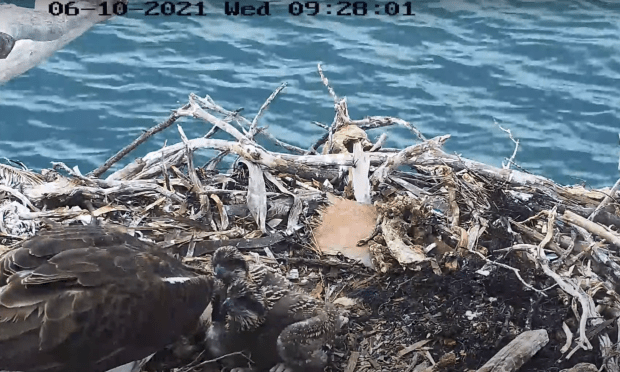
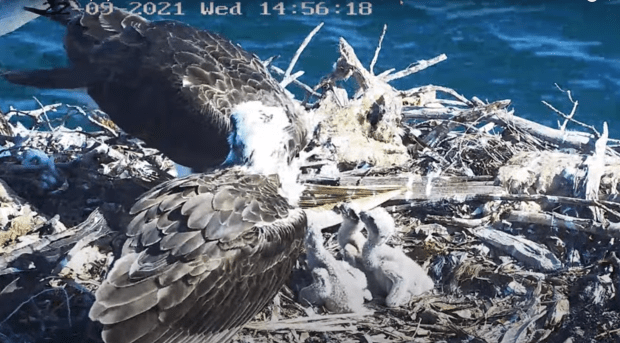
The Guardian is hosting its 2021 Australian Bird of the Year competition and the Peregrine Falcon has made it to the final 20. The voting started out with 50 birds with 5 eliminated each day. The falcons are down to the wire! Here is the link to cast your vote for your favourite bird but Xavier and Diamond really hope that you will vote for the Peregrine Falcon!
Oh, Mom, Dad, and the four eyases on Collins Street in Melbourne really hope that you will also vote for the Peregrine Falcon! No pressure. LOL.
It is not even dawn in Orange, Australia. Diamond has been restless all night. Is there a hatch? a pip? Most bets were for a hatch on 7 October and that is today!
Xavier always arrives around 06:00. Today it was 05:56. He approached Diamond cautiously. She is not going to budge. Something is happening! Diamond is sure not giving away any hints. Xavier is making sounds like a squeaky door. I wish I could speak falcon. Must be an eyas under there breaking out of its shell. Yippee..confirmation to come later.
Remember, you can watch the action here:
WBSE 27 and 28 are awake as dawn approaches. Both have been joining in the morning duet with their parents. Just precious. Both are healthy. WBSE 27 will be 10 weeks old on Thursday and WBSE 28 will be 10 weeks old on Saturday.
In the 10th week, the sea eaglets are fully feathered. There could be some downy feathers still developing under their wings. All of the feathers should be out of the blood quill and hard pinned now. The two will do much more wing flapping. Watch for them to stand more on one leg. The eaglets can self-feed but Lady does love to feed them, too. Flapping up to the branches is called branching and this can occur at any time as can fledging, the first flight.
I hope that the Pied Currawongs do not chase them out of the forest. They need to imprint the way back to the nest so they can get their flying better. Fingers crossed.
There appears to be a problem with the streaming cam of the Port Lincoln Ospreys. I can tell you that three fish had been delivered to the nest before I went to bed last night. The first was at 9:00:06, the second at 12:02, and the third was at 14:09:33. Everyone was really full with that last feeding. Based on the past history of fish deliveries that would have been at least two more fish deliveries if not three before the day was over. The nest is doing really well.
All three had big crops like these two. The third osplet has passed out behind the two still looking hopefully at mom to see if there is anything left.
Wonder what those brown things are in the nest?? What has Dad brought in?
Remember to vote for your favourite bird and also mark on your calendar 9 October for the Big Bird Count. I will remind you again how to participate the day prior.
Thank you for joining me. We are definitely in for a hatch or two or three today at Orange. Xavier is waiting anxiously! Take care. Stay safe!
Thank you to the following for their streaming cams where I took my screen shots: Port Lincoln Osprey Project, the 367 Falcons by Mirvac, the Falcon Cam by Charles Sturt University at Orange and Cilla Kinross, Sea Eagle Cam @ Birdlife Australia Discovery Centre.
I just watched the Dad at the Collins Street Peregrine Falcon scrape trying to feed a huge piece of pigeon to “the four”. He tried several beaks to see if any of them could handle it and then ate some and tried again. Bingo! Then he did it again. Bingo! These two are just amazing – the parents. It is a lot of work to feed 4 instead of the usual 3. I can’t even imagine what it will be like when each one wants their own pigeon! Makes me tired thinking about it.
The eyases are able to eat larger and larger pieces of meat.
Ah, so sweet. Open wide.
Here are some pictures of a beautiful mom a few hours earlier. The eyases have doubled in size. It is getting more difficult to brood them.
Notice how careful Mum is raising her leg to get off of the eyases, turn, and get to the ledge to take a break.
Whew. Oh, just look at how big those the chicks are that are sitting straight. If Victor Hurley could get to the scrape box and weigh and measure the wings of the eyases next week, he might have a good idea which are female and which are male. This, of course, will not happen. He does not wish to disturb them in any way. But a Peregrine Specialist can from those two measurements differentiate between the males and females at that early age. For us, when they are about 24 days old we should be able to tell the males from the females. The females are approximately 50% larger. According to the research, even though the females are so much larger they do not substantially require more food than the males, just about 25% more.
Ah, you will often see them playing with one another’s beaks. Beaks of course mean food! They will not hurt one another. They are much stronger today than they were yesterday and you will continue to see significant growth and strength.
Cutie Pies.
And, yes, all four are there! It is 22 degrees C in Melbourne. That is 71.6 in F. A really nice warm day.
Mom is taking another break. Sometimes if you listen very carefully you can hear Dad calling her. She has to eat, too, and Dad is in charge of filling the pantry. She will often pick up the food for the chicks and bring it to the nest.
You will notice that the parents do not normally leave food in the nest. You will also see Mum eating bits of old food left in the scrape. She doesn’t want to attract insects or anything that could harm the chicks. That level of cleanliness has evolved for millions of years.
Mom has now been gone for 12 minutes (my current screen time). The chicks are nice and toasty stacked up on one another on a beautiful warm Melbourne Day. Rest assured, the adults are not far away. There is someone nearby at all times despite the fact that there really are no predators in the area.
The Port Lincoln Osplets had their first feeding at 9:00:06. It was a really nice fish and very one was stuffed, leaving the table with a nice crop.
Just look at that crop on the chick in the foreground. My goodness. By my reckoning that is Little Bob. He might have had a bit of trouble getting into the right spot yesterday but it certainly looks like he did well this morning.
A half hour later and the chicks are still working on that fish.
Right before 9:30, the fish is completely finished. There is nothing left. One of the older siblings is looking at Mom. You can see their nice crop, too. Little Bob is the one with its head near Mom’s tail.
The second fish of the day arrived on the nest at 12:02. It was entirely consumed and the feeding fished at 12:20. My goodness.
The chicks are all lined up nicely for Mum. Everyone will be fed and the feeding will end with each of the three having a crop. If you are just joining us and are wondering what the word ‘crop’ means, it is like a pre-stomach stomach storage area in raptors. They can ‘drop their crop’ when they need food and energy. It really helps because out in the real world, away from mom and dad feeding them, the birds might not be so successful at fishing or hunting. This way if there is plenty they can eat lots and kind of store it for when there isn’t.
Little Bob is in the middle. You can see the ‘dot’ on his head in the image above and the stripe down his back is not as wide as the two older siblings. The length of the copper-red feathers coming in on the head and neck appears to be the same length now on all three. The tail feathers of the older two are longer.
At the end of the feeding the three were still lined up as they had been. This nest is so civil. Just causes smiles, big ones.
Oh, this has been such a great year to watch. Last year this nest was the one that almost made me stop watching Ospreys altogether. I am mystified but overjoyed. The only explanation is the closeness in the hatch. No one of the osplets is significantly smaller than the other- or the reverse, none is significantly larger than the others. Not like Tapps and Solly. In this instance, Little Bob is also tenacious and has not let Big Bob’s occasional attempts at dominance rattle him in any way.
In this short blog, so far, you have read about two Australian Birds. The Guardian newspaper out of London, UK is holding its voting for Australia’s Bird of the Year. You do not have to be Australian to vote. I will post the link. Please note that the Peregrine Falcon is still in contention! There is no Osprey to vote for but the Galah is still in contention. There are many other birds and you might have a different one you like. It doesn’t cost anything and every day some birds are knocked out of the competition. You can vote every 24 hours til the end. Please take part. It is a bit of fun!
Also mark 9 October on your calendar. That is the big e-Bird count for the fall that helps in understanding where the birds are with regard to migration. Last year Cornell reported that 32,000 people from around the world submitted 80,400 check lists with 7, 128 species observed.
I am certainly curious about this year’s migration because today it was 28 degrees in my City today. That is a temperature that years ago we never even hit in the summer. It has become more normal over the past four years but not digging into October. So please do take part. Here is the information and instructions on how to do so.
It is hatch watch for the Orange Falcons, Xavier and Diamond. Diamond has been letting Xavier do some of the incubating today. I hope she is spending some time enjoying herself in the sun. These two parents are going to be really busy very soon.
Royal Albatross male, OGK, spent the night on Taiaroa Head waiting for his mate YVR to arrive for the 2021-22 breeding season. Oh, he is such a handsome but sweet male. The amount of time and care he gave to his daughter, Miss Pippa Atawhai, when she was the Royal Cam chick a year ago won the hearts and minds of anyone who saw them together. He never rushed when he came to feed her. Always doing more than a few skycalls, OGK would often sit with his chick for long periods of time preening her and chatting. Sometimes he would even sleep!
It will be a joyous occasion when the two are reunited after being apart since before Miss Pippa Atawhai – their daughter and the 2020 Royal Cam Chick – fledged last September. I think OGK is anxious for his sweetie to arrive. Send all the positive wishes for this amazing couple. Maybe the NZ DOC will decide to have OGK and YRK has the Royal parents again this year. Wouldn’t that be amazing?
Take care everyone. It is getting late and I want to go and check out my book on duck ID. Thank you for joining me. Stay safe, watch the birds and be joyful! Vote for your favourite Australian bird and be sure to register for the big bird count!
Thank you to the following for their streaming cams where I took my screen shots: Port Lincoln Osprey Project, 367 Collins Street Falcons by Mirvac, Falcon Cam at Charles Sturt University in Orange and Cilla Kinross, the Cornell Bird Lab and the NZ DOC.
The weather in Port Lincoln, Australia deteriorated further with winds blowing at 47 kph around noon with even stronger gusts. The humidity is 74% and it is 14 degrees C.
The little ospreys were fed at 7:00:33 and again with the same fish returned at 8:09:50.
Dad delivered a whopper of a fish at 11:20:11 for the third feeding. Just look at the size of that nice fish. Little Bob is staring. It looks like his eyes are going to pop out! I bet he is already calculating where to get in the feeding line. Right now it looks like Big Bob is eating first. That is Middle Bob kinda’ slumped over. He still has a crop from the earlier feeding and he looks like he would rather sleep than eat.
That is an amazing fish. Thanks, Dad.
Nothing has changed in those three seconds. Little Bob is still staring and Big Bob is still eating.
Well, you can see from the image below, taken 29 minutes later, that not only did Little Bob figure out where to sit at the table but he has already been fed enough to make a nice sized crop. Middle Bob seems to have woken up and is ready to eat, too. Of all the chicks, Middle Bob seems to be terribly laid back for a raptor.
Thirty-eight minutes later and the only one remaining at the table is – yes, you guessed it – Little Bob. This kid can sure pack away the food. And he doesn’t seem to stop when he is full but keeps on going if there is fish to be eaten.
Speaking of fish. Look! There is hardly any fish left. What a feeding.
It had to be difficult trying to feed the chicks in such wind gusts. Can you believe it? Little Bob is still at the table, still eating.
Little Bob has one of those nice big crops that looks as if it would feel rock solid if you touched it. Of course, Little and Big are still waiting to see if there is any fish left. Middle Bob is out! Meanwhile, Mom has also gotten to eat some good pieces. She needed fish. That huge fish fed the entire family very well.
Little Bob is certainly doing well and can hold its own on this nest as long as Dad keeps getting the food in. He is certainly growing.
Everyone is full. Mom is holding those babies down tight on that nest – as tight as she can. The trouble is trying to get them all under! Look at that tail and those big feet. These osplets are doing well.
Let’s keep their hatch dates in mind. Big Bob on 13 September 22:03, Middle Bob on 14 September 02:30, and Little Bob 16 September 00:51. Little Bob is 51 hours younger than Big Bob. Today, Big Bob is three weeks old.
As you can see the chicks are getting their feathers. The rusty-gold-coppery ones (I often call them peach) are coming in nicely on the head and neck. You can see in the image above, the feathers starting on the wings and the little tails. Those feathers are often called ‘blood feathers’. Feathers need blood to grow. The blood quills will disintegrate once the feathers push through that quill. The flight feathers on the wings and tail will be the last to appear. The chicks are already doing some preening and, indeed, will spend a substantial amount of their time cleaning those feathers. Some researchers say as much as 70% of their time is spent working on their feathers. Right now we are in a rapid growth period where the size of the chicks is continually doubling with the feathers growing and the muscles in the legs and the wings developing. They seem to change their appearnance almost before our eyes. Most times it is hard to differentiate one from another.
The Collins kids are doing well, too. Here is a good look at all four of them from this morning:
This is an image from their last feeding about a half hour ago. No worries here either. Eyes are all open, everyone keeps their head up nice and high for food, and Dad is really cutting down on the number of pigeons in the area.
It is early afternoon for these Australian bird families. It is late on the Canadian prairies. I always sleep better when I know that all of the ‘babies’ have eaten. Take care everyone. Continue all those powerful positive thoughts you have been sending to Port Lincoln during this period of bad weather. It is obviously working!!!! See you soon!
Thank you to the following for their streaming cams where I took my screen shots: the Port Lincoln Osprey Project and 367 Collins Street Falcons by Mirvac.
The males have been working overtime it seems making sure that there is food for all of the nestlings.
As many of you know, the weather in Port Lincoln has been anything but ideal. The winds were blowing from 40-50 kph and there were white caps on the water. At one time the barge and nest appeared to be rocking around quite a bit. Still, a miracle happened. Having been hunkered down, Dad brought in the first fish for the osplets at 8:37:58. It was truly remarkable. But what was more outstanding was that he delivered a second fish at 8:38:02, a third at 10:14:25, and a fourth at 13:53. It is just now turning 15:00 on the nest. This is simply joyous. Everyone has eaten, they have had crops, and there has been complete civility.
I put in the image below for two reasons. The crops of the two osplets on the front row are getting bigger. Secondly, because that is Little Bob who is on the front left. I want you to have a very good close look at his cere, the lighter bits below the beak and the black line through his eye. Look at its thickness. It is thinner than the other two. additionally, his head is just a wee bit lighter, for now.
I believe that it is Little Bob and Big Bob eating with Middle Bob holding back. It will get fed. Do not worry!
You can almost lose them on the nest these days. Little Bob has decided to flap his wings a bit while Middle Bob eats some fish.
Just look at Little Bob. Chubby tail, wings, fat little bottom and those soft pantaloons to go with the big white clown feet. They are so adorable. I never knew pin feathers could be so strikingly beautiful.
Oh, dear, watch out Mum!
Ah, look at those legs! These osplets are nice and healthy.
In Melbourne, the eyases are being fed just about every hour. Birds, mostly pigeon, arrived at 6:12:50, 7:10:34, 8:07:39, 9:12, 10:20:07, 12:42:14, 14:40, and 15:51:06. Everyone who was hungry got fed until they fell asleep. We will be seeing some remarkable growth for these little fluff balls. Tomorrow their eyes will be open wider, their necks will be getting more stronger and the amount of space they take up in the scrape box will be larger. Of course, we are only mid-afternoon, and already eight feedings. There will be quite a number before it is time for these wee ones to tuck it in for the night.
Oh, wonderful. They are ready for a snack.
Oh, relief. It is not a pigeon.
Here I come with another Melbourne Blue Plate Special kids.
Wake up everyone! It’s tea time!!!!!
Open wide!
Sleeping babies.
Let us all remember the great joy that the birds brought us last year and now. Hopefully you had an opportunity to take a deep breath. Maybe you were able to enjoy your garden or the wildlife in your area. Perhaps you came to love many of the bird and animal families on the streaming cams. I know that I felt more joyful just by becoming more connected with nature. So when someone asks you if you are ready for things to return to normal, think about your answer carefully.
Chris Packham and Megan McCubbin remark, “Under a dark cloud of fear and confusion people all over the world found solace and respite in nature; it improved the quality of their lives and their physical and mental health.” I believe that everyone reading my blog finds joy and inspiration in birds. You also do whatever you can to make their lives better. Each and every one of you has either aided or is aiding birds in one or in many ways. We all do what we can. The simple act of providing water during migration can be a huge help. Making sure your windows are left dirty or have deflectors so the there is no bird strike is another. Writing to people who can lobby for laws that ban lead in hunting and fishing equipment as well as the designer poisons such as rodenticide help tens of thousands a year. Educating people and working with your local parks authority to eliminate the feeding of bread to ducks can keep the waterfowl healthy. Donating even the smallest amount can keep the streaming cameras running for some not-for-profit nature centres and bring joy to hundreds of others. The list is endless.
Thank you for popping in to check on these two nests. Take care of yourself and enjoy the rest of the weekend!
Thank you to the following streaming cams where I took my screen shots: 367 Collins Street Falcons by Mirvac and the Port Lincoln Osprey Project.
Many will disagree with me about whether or not birds getting pin feathers are ‘cute’. When I went back to check on the Port Lincoln osplets and their feeding times yesterday, there was this moment when all are so full they are in ‘food coma’ – passed out on the nest.
Just look at those fat little bottoms and those stubby tails! Now what is that if it isn’t cute?
The Port Lincoln kids had the following food deliveries on 2 October: 6:09:52, 9:16:15, 13:10:09, 13:59:11 (?), 16:10:51, 17:14:02, and 18:41:50.
Here are just a few images from those feedings.
This is the second delivery of the day.
Here is number three. Mom is sure being kept busy this year feeding the trio.
All lined up behaving themselves.
All lined up nicely waiting their turn, once again. No shoving, no beaking. Polite kids. This time Little Bob is in the middle but, often, now, it is difficult to tell who is who! Remarkable.
This is the way it should be and this is why everyone watching this Osprey nest in Australia should be overcome with joy. These parents are working so well together and so hard this year to ensure that each one of these chicks is successful.
Dad has been fantastic to bring in the fish. He always has a nice crop. Hoping that mom is getting enough fish from the feedings. These three sure can pack it away!
All of the chicks went to bed quite full. Dad and Mum are really helping them during this ‘big’ growth period with lots of fish. If there has been beaking, I have missed it. This nest just feels happy – and it should – everyone is doing well.
A quick check on the Melbourne Peregrine Falcon nest. I am only going to show you one image. You can see that the parents are ready with additional pigeon if it is needed.
That is Dad in the scrape and Mom behind just in case. It must have been a little overwhelming to see ‘four’ mouths instead of the usual three.
If you are not familiar with Peregrine Falcons, it is safe to say that the incidents of siblicide are minimal. That is because the chicks hatch so close to one another. It is the same with other hawks. There is always concern for the little one but, in this instance, there should be no worries. These four will be fed – a mouth open and it will get food.
There they are singing like members of a choir. The last hatch will not yet eat as much as the bigger ones and it will go into food coma quicker but the parents will make sure all get food. No worries!
I am trying to read three books at once. They are all good. Still, I hope to finish Chris Packham and Megan McCubbin’s Back to Nature. How to Love Life – and save it, soon. While the focus is definitely on the United Kingdom during the first year of the pandemic, the central core of the book can be applied to all of us. During the lockdowns we discovered our gardens, the birds, and our love for nature. Packham challenges us to take those interests and concern and bring them forward: if wildlife and the wild helped us through that abyss, then we need to help them now! Wise words.
It is another beautiful fall morning on the Canadian prairies. The sky is blue and the sun is shining bright and it is a good day for a walk around the wetlands. Hopefully there will be some interesting bird images for you later today. Meanwhile, Grey Squirrel would like his morning peanuts.
Take care everyone. Thank you so much for joining me. And to those who have written lately, thank you. You are never an intrusion – never!
Thank you to the following for their streaming cams where I took my screenshots: the Port Lincoln Osprey Project and the 367 Collins Street Falcons by Mirvac.
The arrival of the fourth eyas at the 367 Collins Street Peregrine Falcon nest took everyone by surprise. Looking carefully, viewers proclaimed a fourth head bobbing about – and they were right. I have no idea when during the night this little one entered the world but all are happy. Parents are busy brooding and feeding!
“Wake up everyone. You have to eat some more pigeon so you will grow big and strong.”
Wakey, wakey!!!!!!
“But, Dad, we just ate. That doesn’t matter darling. Your mother told me to feed you often so no one is hungry.”
“That’s right. Open wide.”
Some of the eyases have their eyes open today.
Ah, beautiful mom with her four babies tucked under her.
Those four little fluff balls will become the fastest animal on the planet. They can fly 390 kmh. The chicks will become ‘flying predators’. It is hard to imagine but before we blink, they will have fledged. Their parents feed them til they can hunt successfully. Then Mum and Dad will do what all birds of prey do – send the kids out on their own to establish their own territory. As far as Dr Victor Hurley, head of the Victorian Peregrine Falcon Project, knows, this couple is the only one in downtown Melbourne. Imagine.
Peregrine falcons were used for hunting in the medieval era. In England, they were called ‘falcon gentle’. Frederick II (1194-1250, Holy Roman Emperor, rated the peregrine falcon as being as good as the best gyrafalcon. Peregrine falcons are 35-51 cm long and have a wingspan of 79-114 cm. The females weigh 740 grams to 1.3 kilos while the smaller male is from 550-750 grams. English kings used the peregrine falcon for hunting herons, cranes, ducks, and rooks.
Here is a great video (8 minutes) about the falcons.
To test the speed of a peregrine falcon against a new generation of electric racing cars, a contest was set up. Have a look:
It is such a privilege for us to be able to watch these four chicks grow into masters of the skies. I love falcons!
Updating news on the Port Lincoln Ospreys. Dad brought in a late night feed yesterday at 18:24:55. He had another fish on the nest this morning early, at 6:09:52. Those three are doing just fine!
Thank you for joining me today. Why don’t you check in on the falcons? Here is the link:
Take care everyone! Tomorrow I will introduce you to some of the visitors to the garden today.
Thank you to 367 Collins Street Falcons by Mirvac where I took my screen shots.
Yesterday I waited until the trio at the Port Lincoln Osprey nest had their morning feast before I headed off to read and sleep. There was a smile on my face. The chicks had a huge fish to share with mum at 8:57:45. They looked like they were going to pop those crops! I did one last check and goodness gracious, one of them was having some extra bites at 10:20:16. I hope Mum got some good fish! Where in the world are these osplets putting all this food?
Here is an image of that breakfast fish. It is a nice one and all of the chicks ate well and behaved themselves.
Nice crops.
It’s clown feet time! Just look at how full Little Bob is – and the size of those feet.
Mum offering a chick some more bites. Just in case they might still be hungry. What a great Mum she is!
Dad made another delivery at 13:32:17. The chicks still have some crop left from the morning ‘whale’ of a fish.
Bigger crops. These three should sleep for the rest of the afternoon.
There is another small fish delivery at 17:00:36.
That little fish was gone very quickly.
And another fish was delivered at 18:18:57.
No one went to bed hungry.
It has been raining in Orange and Melbourne. There is no indication that there is a pip in any of the eggs at the 367 Collins Street scrape. That said it is really hard to see because the couple chose to use the scrape at the far end of the ledge away from the camera.
You can see the rain gathering in the gutter area. Stay dry falcons!
It is supposed to rain for the next couple of days. Maybe the eyases will wait. What lousy weather to hatch if you do not have any protection from the rain like the scrape box of Xavier and Diamond in Orange. It is about 8 days for hatch there.
Xavier arrived with a full crop and soaking wet to see if Diamond wanted him to take a turn incubating. While Diamond made up her mind, Xavier caught a little sleep. Oh, what a sweetie. Look at his crop – wow.
But look at how dry it is for these two. I wonder if anyone in Melbourne would consider putting some kind of a cover over those two scrapes for next year? Can’t do it now as it would stress out and disturb the birds but, maybe next.
Lady Hawk recorded WBSE 27 and 28 doing the morning duet with their parents. Oh, I remember when WBSE 26 sang with its parents. That was such a delight. Now we have these two joining in the family tradition. As you can see they are both doing fabulous.
There nest is quite dry. Sleeping duckling style!
That is the morning check in with our Australian nests and scrapes. Let’s hope that the forecast for rain in Melbourne is wrong! Otherwise, every bird is doing great. No worries here.
Thank you for joining me. It is another blue sky sunny day on the Canadian Prairies. We are blessed. Take care everyone. Stay safe.
Thank you to the following for their streaming cams where I took my screen shots: the Port Lincoln Osprey Project, Sea Eagle Cam @ Birdlife Australia Discovery Centre, The Falcon Cam Charles Sturt University at Orange and Cilla Kinross, and 367 Collins Street Falcons by Mirvac.
The sun is bright and it is another blue sky day on the Canadian prairies. By evening, the temperature will be the same as the islands in the Caribbean — 29 C. It is hard to even imagine it and yet, day after day, this has been the story of 2021.
Just as remarkable as my weather is the parenting on the Port Lincoln Osprey nest. The historical information only goes back to 2015 so we know the couple have been together for six seasons, at least. In that time, they have fledged 10 chicks. In 2015, the eldest killed the two younger ones and went on to fledge. In 2016, it was a repeat of 2015. In 2017, the eldest tossed the youngest from the nest. 2 fledged that year. In 2018, two fledged. In 2019, two fledged. They were Calypso and Star. In 2020, the eldest killed the youngest. Solly, the eldest and DEW, the middle, fledged.
2021 will be a record for this nest if all three survive and all three fledge. It is looking good but, anything can happen to change this.
Yesterday, there was a fish delivery at 9:37:58. That was the one where Little Bob was running to the table. Everyone was full after and as far as I could determine no fish was left. There were two other deliveries.
The second delivery came at 14:49:57. The angle of the camera meant that it was difficult to see the chicks being fed. That said, each and every one of them had enormous crops when the third fish arrives at 18:19:09.
Mom sees Dad coming with the fish and starts doing her calling. Look at how the trio blend in so well with the dark material that has been brought to the nest. Also notice that they are now beginning to appear like old charcoal coloured rugs with light grey stripes! These three are doing so well. It is glorious.
Thank you, Dad!
Mom reaches over, carefully, to get the fish without stepping on the chicks.
Look at all of them lined up so nicely. There is no nonsense. Each gets fed til they are full or there is no more fish. There is definitely food security going on and it is shown in the civil way that the chicks react to a fish arrival.
The sun will be going down soon and these chicks are going to sleep with huge crops. They look like they could pop! Dad will have to go and get another fish for him and Mum.
Dad is spending a bit more time on the nest when he delivers a fish. Has this been a tactic by him and Mum to keep the kids lined up like a choir eating and not fighting? Whatever they are doing, it has been a couple of days since Big Bob tried to reinforce its dominance. Indeed, it has been a wonderful Osprey nest to watch!
One other check in. The two adults at the 367 Collins Street Peregrine Falcon scrape are going to be busy soon. They are incubating four eggs and the first one laid is now 38 days old. It is definitely hatch watch for this couple!
Thank you for joining me and checking in on the Osprey chicks. It is so nice to have you with me. Enjoy your day. Take care. See you soon.
Thank you to the following for their streaming cams where I took my screen shots: 367 Collins Street Falcon Cam and the Port Lincoln Osprey Project.
I have heard the name but have never seen the bird – or, at least, I do not think I have. With my lousy shorebird IDs, I might have even confused this beautiful long-legged shorebird with a Greater Yellowlegs. Of course, everyone would have laughed.
Godwits are ‘very’ long legged shorebirds but their legs are not yellow! Their beak is ‘very, very’ long and is bi-coloured – light rose and espresso -and ever so slightly upturned at the end. They are called waders because they live in the mudflats and the estuaries. See how their legs go deep into the mud, too. They feed by sticking that very long beak into the mud, rooting around for worms and small shellfish.
The breeding adults have a chest that ranges from a deep terracotta for the males to a brighter orange for the females. The wing and back feathers are more brown and white overall with a touch of the breast colour, sometimes. They have gorgeous dark eyes.
What is so miraculous about these shorebirds is their migration. They breed in Alaska and fly in September to New Zealand! They make only one stop, normally. And they do the trip in record time. It is an 11,265 kilometre journey or 7000 miles. They accomplish this in eight days! Yes, you read that correctly, eight days.
Neils Warnock, the Executive Director of Alaska Audubon in 2017, remarked, “These godwits are epic migrants. We had a bird, E-7, that we had tagged, and she left New Zealand in the spring. She flies non-stop seven days, ten thousand kilometres, to the Yellow Sea. All of the Bar-tailed Godwits of Alaska, they stop at the Yellow Sea.”
The Yellow Sea is located between mainland People’s Republic of China and the Korean Peninsula.
Historically the mudflats of the Yellow-Sea have been rich with food for the Bar-tail Godwits so they can fatten up and make the rest of the journey to their winter homes in New Zealand without having to stop. Today, the mudflats of the Yellow Sea are under threat – they are disappearing with coastal development. This could prove to be a major challenge for these beautiful shorebirds. There have been many studies and the researchers have seen a drop in the number of shorebirds by 30% in the last few years because the mudflat areas have been reduced by 65%.
Today the Pukorokoro Miranda Shorebird Centre in New Zealand reported that Bar-tailed Godwit 4BYWW made his flight in 8 days and 12 hours arriving home at 03:00 on 26 September. He flew 12,200 km. His average speed was 59kph. 4BYWW may have set a new distance record for the Bar-tail Godwits. We will know when the others return home. Isn’t that amazing?
What I found most interesting was her route. She does not appear to have gone via the Yellow Sea. Is this because of the decline of the mud flats? Have the birds adapted their migratory route? I definitely want to look at this more closely.
This was the satellite tracking image posted by the Pukorokoro Miranda Shorebird Centre FB page:
The Centre was tracking another four adults and 3 juveniles on their journeys home. One of those, 4BWWB, has been reported as flying non-stop for 163 hours and over 10,000 km. Seriously, my head can’t comprehend what that must be like. I am also truly amazed at what these sat-paks can tell us about the birds and their amazing resilience. Just incredible.
Tiaki officially fledged on the 25th of September. The Royal Albatross cam chick of 2021 is foraging off the coast of New Zealand at the present time. She will eventually make her way to the waters off of South America near Chile. We wait for her return in four to six years to Taiaroa Head where we will hear that beautiful Sky call, again.
While millions and millions of birds are moving from their summer breeding grounds to their winter homes, others are waiting for eggs to hatch. Holly Parsons posted a table of Diamond’s incubation history.
Xavier and Diamond’s first egg was laid in the scrape box on top of the water tower at Charles Sturt University in Orange, Australia on 31 August this year. Cilla Kinross, the main researcher, is expecting a hatch from 6-9 October with the most promising day being the 7th. Can’t wait!
Diamond was catching some sleep this morning. If all of the eggs hatch, her and Xavier are going to be very busy!
If the hatch is expected around the 7th of October at Orange, then what about those Melbourne Peregrine Falcons? The first egg was laid on the 21st of August – yes, that is right. Ten days before the Orange falcons. So, I am going to be looking for a hatch at Melbourne starting in two days!!!!!! This means that all of the Melbourne eggs, if viable, will hatch before those in Orange. It will be nice to get to enjoy them without trying to watch both at the same time!
For those of you wondering about those beautiful White-bellied Sea Eagles, 27 and 28, here they are. Talk about gorgeous.
Things will really be starting to ramp up shortly. Bald Eagle breeding season in the United States begins in a few days. Looking forward to checking on some nests to see if the birds have returned – such as Anna and Louis who had the first hatch on a nest in the Kisatchie Forest last year since 2013. His name was Kistachie – very appropriate.
Then there is always the trio at Port Lincoln. They had two feedings this morning and a third at 11:31:27 when Dad brought in a very small fish. All of the chicks were well behaved – quite civil to one another. And, of course, Little Bob is right there in front! Look carefully you can see him.
Life is good. Everything seems to be going really well for all the nests.
Thank you so much for joining me today. I hope you enjoyed learning about the Godwits as much as I did. Incredible birds. Take care everyone!
Thank you to the following for their streaming cams where I took my screen shots or for postings on their FB pages that I have shared with you: Port Lincoln Osprey Project, 367 Collins Street Falcons by Mirvac, Falcon Cam Project at Charles Sturt University and Cilla Kinross, Pukorokoro Miranda Shorebird Centre, Sea Eagle Cam @Birdlife Australia Discovery Centre, and Cornell Bird Lab and NZ DOC.
One of the problems with the streaming cams is the ‘chat’ feature. There, I have said it. The same persons come on at different times of the day, every day or every other day and say the same negative things. There is one on the PLO chat that always says, ‘The mother never feeds the youngest’. ‘Mama feed in order never feeds youngest.’ Seriously! Either they can’t rewind, they don’t watch, or they just want to stir the pot of negativity. I think that it is all three. So I go back to an old cry out of mine, Streaming cams need 24/7 knowledgable moderators. They need them to stop the bots coming in and they need them to stop the negative chatter. Even more so, if something happens on the nest they need to have emergency numbers to call or place them on the streaming cam site at the top.
The Port Lincoln Osplets are doing fine! And it is something to celebrate. One of the most exciting things is to watch them grow and grow they are. these chicks are losing their light grey coat to get their second, darker grey down. You can see the little pin feathers starting. still, each retains a tiny bit of its egg tooth. The feet are getting bigger, wings are growing and the tiny tails are starting. If you didn’t know the different species at this age of 9-10 days, just look at that beautiful dark mask going from the cere to behind the eye. that is the distinctive bandit mask of the Osprey!
Dad comes in with another fish. the big one that arrived earlier is all gone.
The chicks are getting bigger and they don’t like sleeping under Mum like they did when they first hatched. Indeed, these little ones seem to be tumbling around underneath her much of the time.
Awwww. Such sweeties.
Because it is winter in Australia, the light changes early. Mum and dad are on the nest and the little ones are getting another feed. Notice how much they have grown. It is as if someone took them and stretched them in the last couple of days. They no longer appear like short fat little chicks but they are entering another phase where they will begin to look like thin reptiles with long necks.
Each is doing fine. There were not as many big fish yesterday as during the high winds but everyone was fed and no one was left out.
I literally checked into the White Bellied Sea Eagle nest to see how WBSE 27 and 28 are doing. Lady was feeding them.
That is WBSE 28 at the front of the nest with its big crop. 27 is practicing its self feeding with a small piece of prey.
This nest will have two fledges this year. I so hope the Pied Currawong do not chase them out of the forest so they can fly and return to the nest for more meals while they get their piloting in order.
Lady Hawk did a video of 27 learning to self-feed and 28 nibbling at her toes. Have a look:
The strongest earthquake in recorded history hit Melbourne, Australia yesterday.
The first thing many thought of were the four eggs of the Peregrine Falcons at 367 Collins Street.
Dad was on the eggs at the time and stepped off wondering what was happening.
Everything appears to be fine. Some buildings were damaged but no one was killed. Thankfully! We are nearing hatch watch for this couple.
In Orange, the running joke has been Xavier wanting his time to incubate the eggs.
Xavier doesn’t want to give up his incubating time!
Do you know why the male Peregrine falcon is called Xavier? It is one of those heart wrenching stories that makes you love this little male bird even more.
Diamond’s eggs were ready to hatch. Her mate, Bula, disappeared and was presumed dead. As we all know, the chicks would have died. Instead, enter a new male who starts helping with the chicks and raises them as if they were his own. Because he was a ‘saviour’ of the family, he was named Xavier.
The researcher at Orange is Cilla Kinross. She did a cute video of the negotiations between Diamond and Xavier over the incubation duties.
Everything is changing at these four nests in Australia. The White-Bellied Sea Eagles are exercising their wings, jumping, and hopping about. They are getting more adept at self-feeding although 27 still is the one that gets to the prey first it seems. Lady does come in and feed them. Branching will be next but not for a bit, thankfully. We will be watching for the four at Collins street to hatch in about four or five days. Diamond and Xavier’s chicks will follow but not for a week or a little more. And, of course, the change in the Osplets at Port Lincoln will be significant. They will look like skinny reptiles all wound around one another. The key is that everything, at this moment in time, is just fine. There are no worries. So enjoy them!
It is another beautiful fall day in Manitoba. The Green Heron has departed and I always missed it. Perhaps another will come next year! The Blue Heron is also gone but I hear there are waves of Dark-Eyed Juncos headed towards the city. I cannot wait. They love to pick apart my red outdoor carpet. Such cuties. I am going out for a long walk and to check on the Wood Ducks. Perhaps they will cooperate and there will be some good photos for me to share with you.
Thank you for stopping by. Check out the streaming cams – the birds are doing great. And, if you feel up to it, shut down the negativity. There is already enough in the world. The birds bring us joy. Take care all. See you soon.
Thank you to the following for their streaming cams where I took my screen shots: Port Lincoln Osprey Project, 367 Collins Street by Mirvan, Falcon Project Cam at Orange, Sea Eagles @ Birdlife Australia Discovery Centre.