New Year’s Day in Bird World, late edition

New Year’s Day started off wonderfully with the uniting of Annie and Grinnell. Cal Falcons posted a note that the interloper that had injured Grinnell and sent him into rehabilitation on 29 October has not been seen in the past two weeks. It appears that our little Grinnell watched, got stronger, and got rid of him! That is a good thing. Grinnell is far too experienced a mate and knows how to take good care of the eyases – that is invaluable to Annie. I only wish Daisy had a mate half so invested in the eggs and nestlings!

10,600 people have watched Annie and Grinnell ring in the New Year together! Look closely at the image. Notice just how much bigger Annie is than Grinnell. That is reverse sex-size dimorphism – in raptors, the female is normally 30% larger than the male.

These little falcons like to live on the highest buildings so they can have a great view if anyone larger than them should want to arrive at their scrape box. Thousands of years ago they lived on the highest cliffs (some still do in certain geographical regions) but, like other birds they have adapted as humans take over their space. They have adapted to our skyscrapers like this perfect building on the University of California at Berkeley, The Campanile.

Oh, what a beautiful sight first thing in the morning. So happy. This is just such a relief.

The White-Bellied Sea Eagles were up on the branch together to sing the morning duet. They had a rough night of it. They were chased and harassed by the Pied Currawong first. The Curra are the birds that injured WBSE 27 – gathering in a group to fly and hit its head. The Curra are also the birds that chase the eagle fledglings out of the forest before they have learned from Lady and Dad how to fish and survive. I really do not like them and their numbers have grown in the forest over the past few years. They are more than a nuisance. They can be deadly.

As soon as the Curra were in bed, it was not long until BooBook Owl and its mate started their silent attacks. They spent five full hours harassing the WBSE. They are also dangerous. One injured Lady’s eye last year and she could have been blinded.

Here is a video of the attacks with the eagles falling off the branch.

To my knowledge, the WBSE do not eat the hatchlings of either the Curra or the Owls. These little birds just want the big Apex raptors out of the forest and they will do everything they can to accomplish this.

The pair sang The Duet and promptly left the forest. I wonder if there is another nest location for them? The old nest of Dad’s collapsed but there could be other suitable sites.

I made this video clip a few months ago in mid-September. I love the beauty of Lady and Dad singing their song to wake up the forest. Scroll your mouse or tracker over the left hand corner and then click on the arrow to play.

I have never liked this nest because of the Currawongs and now Boo and his family are older and bolder. It is not good for the eaglets who hatch or for Daisy. My eyes in that area tell me that the Ravens have also been coming to the nest to check for eggs every couple of days. So sad. If Daisy does return, I have no hope for her eggs hatching. I just do not want her to get injured if a large number of Ravens would come at the same time.

This morning on the Port Lincoln Osprey Barge Bazza was on the nest when the fish arrived at 08:09. Falky flew over from his perch hoping to get it but Bazza was the clear winner and kicked Falky off the nest! You will remember that yesterday Bazza flew in and took the fish right when Dad brought it in. Bazza is going to be called Bold Bazza for sure. He is getting street smart for sure – all good survival skills.

Here comes Dad with the fish. Bazza can see him and he is prey calling louder and louder.

Bazza is starting to mantle the fish (on the left side of the nest). Mantling is when a raptor spreads their wings over the food item so that others cannot get to it. It is almost like hiding it. Falky is on the right edge of the nest. Ervie is up on the perch and Mum is on the ropes.

What interested me was not Bazza getting the fish or Falky trying to take it but, Ervie’s behaviour. Ervie did not move off the perch. He did not care. He was not hungry. This tells me that Ervie had already been out fishing for his morning breakfast. He will continue to get more and more independent.

E19 was being a bit of a stinker today. His attacks on E20 were frequent and sometimes brutal.

So what do Harriet and M15 do when this happens? Well, often, they will ‘sit’ on the chicks but, at other times, they will do a tandem feeding. That is precisely what happened today. M15 stepped in to help Harriet with the cantankerous two.

Just lovely. Both eating at once. They will learn, over time, that everyone gets fed. No one goes hungry in Harriet and M15’s house.

Ferris Akel held his tour today. Viewers were treated to the sightings of five Snowy Owls at the Finger Lakes Airport.

Snowy Owls are moving south from their home in the Arctic to find food. They mostly eat rabbits, grouse, mice, weasels and small waterfowl and marine birds. Open fields, golf courses, or small airports like this one are perfect for them to find food.

Not far away were what seemed like a thousand Sandhill Cranes. Some were feeding in the fields, some were in the marsh, and some were flying from the fields to the marsh. There seemed to be Sandhill Cranes everywhere!

The adults have grey bodies with a distinctive crimson red cap. Their long legs and necks immediately tell us that these are ‘wading’ birds. They stand 90-122 cm tall or 36-48 inches. They have long pointed beaks for finding food in the muddy waters of wetlands. They also have a ‘bustle’ or tufted tail. You can see those tufts on the cranes in the image below.

The Sandhill Cranes migrate during the winter leaving their summer feeding grounds in the Arctic and Northern Canada in large groups. They will gather in the thousands in staging areas.

With their long beaks they probe in the waters feeding on plant tubers, roots, seeds, and small invertebrates. In the image below you can see how their long legs and neck really assist them in finding food.

Oh, these cranes are so gorgeous. Sandhill cranes have been the subject of Japanese art for centuries. They are a traditional symbol of immortality because it is believed that the cranes live for a thousand years.

The panel below is called Cranes in a Winter Landscape. This is clearly a good wish for longevity.

The screen below is part of a series of two six-panelled screens done in the 1700s. Typically the backgrounds would have been painted gold. Both the old twisted pine and the crane signal immortality or wishes for a long life. These would have typically folded and divided rooms.

Thank you so much for joining me. Stay warm, stay safe. See you soon.

Thank you to the following for their streaming cams where I took my screen captures and video clips: SWFlorida Bald Eagle cam and D Pritchett, Port Lincoln Osprey Project, UC-Berkeley Falcon Cam, and Ferris Akel.

Grinnell and Annie Unite – and other Bird World News

In North America it is the first day of the New Year. We remain under an Extreme Cold Warning. It is -30. Yesterday, it was reported that there are nearly 200 ducks still in the open waters of our Assiniboine River. When it is warmer I will go and check for all of us! And get a photo.

It is incredible that the waterfowl can tolerate such extreme temperatures. The ducks apparently swim very close to one another. That mass creates a large area of heat which keeps the water melted so they are able to eat. They just have to keep moving. They will swim in one direction in unison and then turn and swim the other direction keeping the water flowing so that it does not freeze. Their down – remember all that down that Daisy removed from her breast for the nest? – keep them warm along with their waterproof feathers. This is impressive in terms of adaptation.

I am so excited. Annie and Grinnell bonded on the ledge of the scrape box together first thing New Year’s Morning. Tears. Grinnell is back. Annie has picked him over the interloper that injured him! Oh, I could hardly believe it. Grinnell arrived calling Annie last night. What wonderful news for everyone. Congratulations UC-Cal Falcons.

Wow. Remember I said that E20 was a pistol? Meaning that this little one is full or surprises. Well, guess you wanted the first bite and climbed out of the nest bowl to get it? E20!!!!!!!

Here is a very short video showing E20 climbing up the nest bowl. At first, 20 did not get any food because the angle was wrong. It is an advantage to not be right under Mum or Dad’s beak. Notice that the adults have to turn their head in order to feed the chicks. That is so the eagle can see the beak of the eaglet. It is often why first time Bald Eagle mothers have difficulties feeding – they do not tilt their head. In the image above you can see the tilt of Harriet’s head in order to feed the babies. And, yes, E20 does get fed. This little eaglet has lots of spunk.

Harriet will make sure that they are both fed. Sometimes she fills up the one that is causing all the mischief so it will go to sleep and then she will feed the other one. Harriet is very experienced. She had this nest with her mate Ozzie before M15. There has never ever been a chick lost on this nest to siblicide or hunger. Ever. It is a really good nest for everyone to watch.

The other streaming Bald Eagle cam with two eaglets is Hilton Head. Deb Steyck put together a video of the Dad, Mitch, feeding the pair. They will, eventually, both get fed. Now sure how much experience Mitch has feeding his babies!! They are such darlings.

Dear Ervie was on the nest at the Port Lincoln Osprey as the sun was setting on New Year’s Day in Australia. Happy New Year PLO!

Yesterday, Mr and Mrs Daisy visited the nest of the White-bellied Sea Eagles. What Daisy doesn’t know is that the crows have been visiting the nest almost daily looking for eggs. If they see her sitting on eggs they will go after them. Then, like clockwork, Lady and Dad returned to the nest to spend the night on thee first night of the New Year. As much as we all love Daisy, I hope that when she comes back the Sea Eagles are there and she will choose a different place for her nest!

First, it was the Currawongs bothering the Sea Eagles.

Then BooBook Owl came calling in the middle of the night.

Maybe this time we should collectively blow Daisy off the nest?! I feel so sorry for her. I wish she had a safe place to raise her ducklings. This nest is not that safe place! And, it is possible the Sea Eagles will have trouble with the Ravens now. I hope not.

I want to wish you and all the birds every happiness and success for the New Year. It is so nice to have you here with us. Take care of yourself. See you soon.

Thank you to the following for their streaming cams where I took my screen shots: Port Lincoln Osprey Project, Sea Eagles@Birdlife Australia Discovery Centre Sydney Olympic Park, UC-Cal Falcons, SWFlorida Eagle Cam and D Pritchett.

Late Thursday in Bird World – horrific storm hits Bald Eagle nest at Berry College

It could be early Friday, Old Eve Night, if you are in Australia.

Our beloved birds never cease to amaze me. For so long I have worried about Bazza, the oldest juvenile on the Port Lincoln barge. Bazza just never seemed to have that drive that he needs to take and protect his fish in the wild that he needs to survive. Well, this morning Bazza surprised everyone. And I do mean everyone – including Dad, Falky, and Ervie. I wonder if Mum was watching?

Ervie and Falky are waiting for the first fish delivery of the day on the nest. As Dad flies in with it, Bazza appears out of no where flying in behind and stealing the fish. His older brothers surely wondered what happened! It took less than 30 seconds. Have a look:

As much of a kerfuffle as that was, we don’t need to worry about Bazza anymore. What is that old folktale about the tortoise and the hare? That surely is what is happening here on this nest.

Last night there was a horrific storm at the Bald Eagle nest at Berry College. It was all caught on camera. There is no editing (so you see the entire 30 minutes) but I guarantee that you have probably never seen an eagle nest twisted around live like this one. Missey is incubating 2 eggs when the rain begins. The rain changes to hail and the worst of the wind and hail begins around 10:27. Cameras have gone out. I did see Missey’s wing raised once. All cameras are off today and with it being a holiday we might not find out the fate of Missey and her eggs for awhile. If you hear anything, please let me know. Send this nest your most positive energy.

There is no news coming out of Cal Falcons about the love triangle with Grinnell, Annie, and the interloper. Looks like we will have to wait a little while longer for that to sort itself out. There is, however, fantastic news of one of Annie and Grinnell’s fledglings, Sequoia. Every sighting of a fledgling is a reason to celebrate. They survived!!!!!!!!! They are not part of the 60%. Well done, Sequoia.

There are the two little stinkers melting everyone’s hearts! Looks like we are waiting for a prey delivery at SWFlorida.

E19 and 20 are definitely the cutest with those little wings and fat pink legs and talons. They will keep Harriet and M15 very busy! And thank goodness. They are healthy and strong.

Adorable.

That is just a short catch up on some of the nests. There is some really good news and – well, what can I say? That tree at Berry College is strong and seeing that wing flap from Missey gives me hope that all is well. Fingers crossed.

Take care everyone. Thank you so much for joining me. See you soon.

Thank you to the following for their streaming cams where I took my screen shots and video clips: Port Lincoln Osprey Project and SW Florida Bald Eagle Nest and the D Pritchett Family. Thanks also to Cal Falcons for the information and images of Sequoia on their FB Page.

Bird World 13 December 2021

Samson and Gabby, the resident Bald Eagles on the nest in ‘The Hamlet’ near Jacksonville, Florida have been working on their nest all day. Yesterday, Samson brought in a really nice meal for Gabby – an American Coot. While they are a large waterbird breeding in the shallow marshes, ponds, and wetlands of my province and others in Canada, they are also what is called an ‘all terrain bird’. They are equally at home grazing in water or on the land looking for small fish, aquatic invertebrates, and plants. They can reach 40 cm in length and 70 cm wide. They are black with a white bill, red eyes, and yellow green-blue legs. Notice their lobed feet in the image below. Wow, those are different than Daisy’s!

“American Coot Feet 2” by bruce_fulton is licensed under CC BY-NC-ND 2.0

Here is a video of that breakfast delivery:

I have been spending so much time with Daisy that I have neglected all those other amazing birds that we all love.

Gabby and Samson continue to work on their nest. They have been mating and many hope that eggs will be laid today or tomorrow. Gabby continues to tease everyone!

Samson is delivering another large stick for the walls of the nest.

What a gorgeous couple. Gabby is on the left and Samson is on the right.

The Mississippi River is home to many species of birds. Did you know that there is a live camera? The types of birds vary by the season, the day, and the time of day. Right now there are loads of Sandhill Cranes!

There has been an update for WBSE 27. You might recall that 27 was taken into care twice. The Pied Currawongs were unmerciful to the beautiful fledgling. I am thrilled beyond words for the latest announcement. To my knowledge none of the fledglings over the past two years – 25, 26 (deceased), 27 (in care). and 28 have been trained by their parents to ‘be a sea eagle’ – in other words, how to hunt prey, fish, and have the time to hone their flying skills. Without these skills, they simply cannot survive. WBSE 27 will receive this training and hopefully will emerge a confident bird who can live in the wild.

I have seen no update on Annie and Grinnell and the interloper. We will wait until breeding season starts and see who Annie is with!

The Kakapo Recover posted a humorous cartoon about some of the male Kakapo. I needed a giggle. Maybe you do, too?

Sadly, the time to adopt a Kakapo is over. If you missed it, make a note for next year. Those Kakapo stuffies are really quite sweet and blend in with all your indoor plants.

Daisy has had a seemingly uneventful morning. Her first break of the day and foraging – before sunrise – did not happen because the Ring-tail Possums were crawling all over the nest. She has been sleeping most of the morning. There are lots of birds in the forest but I have not heard the Ravens yet and the cam operator did not find the WBSE on their River Roost earlier but she did capture several sea eagles flying. Fingers crossed. So far the WBSE have not been an issue. So all is well with our wonderful duck. It is 08:29. The Daisy update will be later this evening unless something untoward should happen.

Thank you so very much for joining me today. Take care everyone. See you soon.

Thank you to the following for their streaming cams or their FB pages where I took my screen shots: Sea Eagles@Birdlife Australia Discovery Centre, NEFlorida Eagle Cam and the AEF, Kakapo Recovery, and Explore.Org

The Daisy Chronicles, day 2

We are going to start off with a check on what is happening in San Francisco – before moving on to Daisy.

An absolutely adorable 4 min 16 sec radio discussion on The Love Story in the Sky at The Campanile.

Did you know that Peregrine Falcons were virtually wiped out in California? In the late 1970 there were only two nesting pairs? This was the result of DDT. There is lots of literature but reading Rachel Carsons, Silent Spring, is a very good start.

DDT might have been banned after the revelations of Rachel Carson and others but it remains in the soil in various places. One of those is Big Bear California where DDT was sprayed on Big Bear Lake to kill the mosquitoes. It is still a contributing factor in thin egg shells which may be part of the problem with Jackie and Shadow, the Bald Eagles that have their nest at Big Bear.

Daisy the Duck did not spend the night on the White-Bellied Sea Eagle nest.

She arrived before sunrise to check on the nest. No one else was there. Daisy will be very cautious. She does not want to draw attention to the egg cup where her first egg was laid.

She goes over to where her egg is and checks. It is still there. Safe.

We can see where Daisy’s egg is because we know it is there but it is nicely covered with leaves and nest material so the predators cannot find it.

Daisy leaves right as the sun is rising and the forest is waking up.

Daisy carefully waits on a branch when she returns an hour and a half later. Can you see her?

She is checking and rolling her egg.

Daisy is very still. When she is in labour, her tail will move up and down.

There are now two eggs! Look you can see them both. Daisy is holding herself up so as not to break the second egg. When the eggs are laid they are soft. The air will dry off the surface and make them hard.

Daisy has settled on the eggs nicely. She is having a rest. Daisy will not do hard incubation until all of the eggs are laid. That is so they will hatch at the same time.

This last image of Daisy was taken a few minutes ago. It is nearly 08:30 in Sydney, Australia.

So far Daisy has been lucky. Lady and Dad did visit the nest tree a week ago and then on the day that WBSE 27 was released from care, they were not at the River Roost. They will often go to Goat Island if there are no eaglets to look after. Still, we know that they do come to check the nest.

Someone asked me why Daisy does not stay on the eggs now all the time. If she did they would not all hatch on the same day. Secondly, she is a very smart little duck. Her presence on the nest makes all of the other forest animals and birds curious. Last January they had never seen a duck on the big sea eagle nest — and neither had anyone else! I think Daisy will try and protect her eggs really well this year from the Ravens. She is almost a year older and she is ‘wiser’ now. Her breeding and the laying of eggs normally coincides with plenty of food and water. Her mate, who came to inspect the nest last year, only takes part in the mating ritual. The rest is up to Daisy. That is why she is so vulnerable. Only 20% of Pacific Black Ducks live to be 2 years old. Indeed, the average life span is only about two years. Oh, I so hope that she is successful this year! There are so many people hoping for Daisy!

You can join in and become a real Daisy fan. She needs all the love and positive energy we can all send her. Soon the name of the streaming cam will be changed from Sea-Eagle to Duck Cam! Here is the link to the streaming cam. Daisy arrives about 13:15 CDT or around 05:15 Australian Time. I am not expecting her to stay all day but she might surprise me.

Once Daisy lays all of her eggs (there could be 11), she will begin her hard incubation. Incubation will last for 29 days after the laying of the last egg. This is the difficult time. Daisy still has to eat and have some relaxing time. Last year she even went out during the night. It is then that the eggs are vulnerable. As long as she is incubating them, the Ravens seem not to bother. Our fears of the sea eagles proved to be nothing. They could behave differently this year but they were not a threat last save for the fact that scattering the down nesting material allowed the eggs to be seen. Fingers crossed.

Thanks for joining me. Take care everyone. See you soon!

Thank you to the Sydney Sea Eagle @ Birdlife Australia Discovery Centre for their streaming cam where I took my screen captures.

Falcon and Red-Tail Hawk Cams

I had a lovely note form ‘M’ asking about other peregrine falcon cams. Thank you for your letter, ‘M’.

Each one of us feels a little ’empty’ when the eyases fledge. Without trackers, we have no idea what happens to them. We just wish them well and I know that everyone is working hard to make their environment better. The only birds on the nest who have fledged and not left permanently are the PLO Lads – Ervie, Bazza, and Falky. It is winter in the Northern Hemisphere and the birds have migrated to warmer climates. I will, however, be checking on nests in Asia to see if there are any for you to watch.

This is not an exhaustive listing but it is a beginning and I will be adding to it for all of you as the camera streams return. We have streaming cams on the falcons in Winnipeg as part of the Manitoba Peregrine Falcon Recovery. I will post those at the beginning of the summer. Most of our birds are in southern Texas or Mexico right now.

So here goes – and if you have a favourite falcon or hawk cam, let me know!

One of my favourites are the Peregrine Falcons in Melbourne. They are known as the CBD or 367 Collins Street Falcons. The cam is currently not live. Will come back on line September 2022

Cornell Red-tail Hawks (Big Red and Arthur), Ithaca, New York. The construction work at Bradfield has caused a power outage on the Athletic Fields. Those building works are winding down and this camera should be live shortly. Big Red and Arthur will be very busy once late February and March roll around. There are only two Red-tail hawk streaming cams in the world and this is the best. Big Red is 19 this year. Arthur is 5 or 6 years old. They are a fantastic couple that normally fledge three eyases a year. There are birders on the ground that keep track of the fledglings so you get to see the parents do team training in hunting, etc. Highly Recommended.

Charles Sturt University Falcon Cam in Orange, Australia. Yurruga has fledged. Look for egg laying in the fall of 2022. This is the scrape box of Diamond and Xavier. They are a well established couple. For the past two years three eggs laid but only one fledgling each year which is fine. It is a nice comparison with the Melbourne falcons who fledge 3 consistently. Orange is more rural and, of course, Melbourne is urban. The camera is left on and the falcons come and go regularly.

The Campanile Falcons on UC-Berkeley. This is the scrape box and cams for the Peregrine Falcon Couple, Annie and Grinnell. Grinnell was injured by a male interloper on 29 October. He was in care, as a result, and has been returned to his territory. The male interloper is still at The Campanile. It is unclear which of the males Annie will choose. Nesting activity late March, 2022. Annie and Grinnell are incredible parents who traditionally fledge three adorable babies.

The following are falcon cams that I have watched ‘on and off’ and that have come highly recommended to me from viewers:

Illkirch, France:

Great Spirit Bluff, Minnesota

Anacapa Island, California. There are current a large number of Pelicans to watch.

I will definitely be posting more including a couple of streaming cams from the UK. All of that action will begin when spring arrives. I also want to post some sites in Asia which I will do over the weekend. There will also be the Northern Hemisphere Ospreys, White-tailed Eagles, Golden Eagles, as well as the returning storks to Latvia and Estonia.

For now, things are really pretty quiet except for the Port Lincoln Ospreys, Diamond and Xavier coming in and out of the scrape box in Orange, and the Bald Eagles laying eggs in the US. There are two nests that you might wish to consider and if you have never watched a Royal Albatross nest then you definitely need to check out the Royal Cam Family in New Zealand who are incubating an egg laid on 9 November. They are very experienced and adorable parents, OGK (Orange Green Black) and YRK (Yellow Red Black). They are already grandparents. I often suggest this site to individuals who have a difficult time watching any nest if there is sibling rivalry. The Albatross lay one egg every two years. Parents rotate all of the duties. Last year the Royal Cam chick, Tiaki, had a sat-pak attached to her. We are currently watching her fish off the coast of Chile.

It is a bit wet in NZ this morning. This is YRK’s 6th day on the nest. OGK will be flying in soon and they will switch. Should something happen, the NZ DOC rangers are there to step in and intervene. No one goes hungry, injuries are taken care of, etc. It is a great site and in the process you will bear witness to a country that really protects its wildlife!

There are way too many Bald Eagle streaming cams to list them all. For now, I am only going to recommend one. These are experienced parents Harriet and M15 at the SWFlorida Bald Eagle nest on the property of the Pritchett Family. Their eggs are due to hatch soon – December 25-28. Once Gabby lays her egg in NE Florida I will post that information. For now, you can have fun watching Harriet and M15 change places. The only un-fun thing is the GHOW that attacks the eagles regularly.

There is no word on Yurruga. Cilla says she will look for a few more days. Just so you know the building that Yurruga was last seen on is a gabled (triangle) pointed roof, a bit steep. It is a single story building with clay tiles. Yurruga is not there – not alive, not dead. He was there on Thursday – seen twice during a big storm. I would expect to hear this fledgling screaming for food. Falcons are loud! Is it at a distance from the tower? is Yurruga injured? is Yurruga somewhere else? There are no answers I am afraid. If I hear anything you will be the first to know. Now, it is time for me to go and take care of all my feeders. The gang will be here soon!

Thank you so much for joining me. Take care everyone. See you soon.

Wednesday in Bird World

Let’s start off with what is on everyone’s mind: Has there been a confirmed sighting of Yurruga? Yesterday, Dr Cilla Kinross was inspired by a very quick prey drop at the scrape. Diamond flew into the trees. Cilla was in the trees looking half an hour later – she only saw Diamond. Diamond returned to the scrape with quite a large crop also. Some believed they had heard Yurruga calling but, Cilla is unable to confirm that. So the answer is – we simply do not know. Yurruga has not been seen since last Thursday when he was on a building during a storm. We can only wait.

My goodness that little one was such a cutie.

October 20. Yurruga and Diamond

Diamond was really beautiful this morning as the soft glow of the sun worked its way through the fog.

Both parents, Xavier and Diamond, have been inside the scrape – scraping. They also had some bonding moments this morning at sunrise.

My heart aches for them.

The second question of the day is what is going on with Grinnell, the male Peregrine Falcon of the Campanile, mate to Annie, that was injured by a male intruder that is trying to cosy up with Annie? Here is the latest news.

The New Zealand Department of Conservation rangers on Taiaroa Head are shutting down the streaming cam so that they can move it to the site of the Royal Albatross family for 2021-22. There are lots of guesses as to who the couple might be. The announcement is due tomorrow.

One of my favourite Bald Eagle couples, Samson and Gabby, at the NE Florida Bald Eagle nest near Jacksonville have been putting the finishing touches on their nest. They are perfecting the Spanish moss lining the nest cup. Now all we need are some eggs!

Gabby doing some final inspections this morning.

The three lads at the Port Lincoln all had fish yesterday. Falky had more than Ervie or Bazza. Falky has become a master at slipping the fish out of Dad or Mum’s talons. A magician.

There is a lovely shot of the PLO Mum. She has done an extraordinary job raising these three boys to fledge this year (with Dad’s good help). Yesterday she even spent some time feeding Bazza. He is definitely a Mum’s boy!

Bazza can be a bit naughty. I know that the banders were certain that there were three males. Someone looking at Bazza’s legs and that beautiful necklace in the image below might mistake him for a lovely female.

Bazza and Falky sleep with their heads tucked under their wings – adult style – standing on the nest. Ervie is sleeping over on the perch or the ropes. They are all doing well. I continue to pinch myself. This Osprey nest really turned itself around this year to fledge all three hatchlings.

There are many articles coming out in international newspapers and academic journals on the effect of warming oceans on the seabirds including the beloved Osprey. I picked one of those for you as some are frustrating. They allow me to embed the article but then want you to subscribe to read it! That is a major irritant to me – like Subarus are to Ferris Akel!

https://www.downtoearth.org.in/news/climate-change/climate-change-threatens-survival-of-albatross-60906

It is a grey damp day, 3 degrees C. The snow is melting. There are lots of birds at the feeders. A large European Starling is sharing the peanut and bark butter feeder with some cute little House Sparrows.

The tiny suet balls called Bark Butter by our supplier are a really big hit since winter has set in. Junior has been around to get the corn while Dyson was busy elsewhere. Nice to see all of them.

One of my former students posted this today on FB. It is a perfect little giggle for all of us!

Thank you so much for joining me today. Take care everyone. Stay safe.

Thank you to the Port Lincoln Osprey Project, Charles Sturt University Falcon Cam and Cilla Kinross, and NE Florida Eagle and the AEF for their streaming cams where I took my screen captures.

Friday and Australian Raptors

The FB of the Orange Australian Peregrine Falcons posted an interesting article with the vocalizations of Peregrine Falcons. Want to understand what those falcons are doing or saying?

When Victor Hurley did his Q & A session about the Melbourne Collins Street Falcons, he mentioned a book. That volume, Australian Birds of Prey by Penny Olsen is one of the most informative and beautiful books. Published in 1995 most of the information remains relevant today. The statistics on how many birds exist will change but the information on all of the falcons, size, ID, brooding, etc remain the same. One of the things I love about it are the drawings of the raptors.

Note: Do not be fooled by books of a similar name. Check and make sure it is Penny Olsen 1995.

Images from old print collections. In this instance it is the Wedge-tailed Eagle, the largest raptor in Australia, in a hand coloured drawing from the early 19th century.

The stories of how these early drawings came to be made just wrenches your heart especially when foreigners to Australia would injure the birds and hope to take them back to England. This bird managed with a wound to claw its way through a rope and escape, thankfully. Our ideas of the rights of animals are changing but we still have much much more to do!

The image below is of a Hobby. Olsen comments that young raptors spend much more time lying down than they do standing. The photographer has caught this small falcon resting. What a lovely capture!

The Hobby is also known as ‘The Little Falcon’ or the ‘Little Duck Hawk.’ It is a member of the Falconidae family of diurnal, day time hunting, raptors.

One of the things that I like about the book are the tables that compare the various raptors in Australia to one another and the topics that cover everything from ecology (habitat, dispersion, , mortality), predators, reproduction, health, raptors and humans as well as conservation.

This is an impressive book and if you can get your hands on a copy – there are no reprints – it is, as Victor Hurley says, ‘essential for a library’.

Continuing on with the raptors from Australia, Cilla Kinross posted a video of a bonding session between Xavier and Diamond. Listen for the vocalizations (after you read and listen to the first article today).

There is no current update on Yurruga. He was seen day before yesterday on a roof. It rained hard and steady yesterday and Orange and I imagine our wee fledgling was hunkered down somewhere wanting to stay dry. Not good to try and hone your flying skills in a down pour!

I have not seen any updates or sightings of the 367 Collins Street fledglings. If something comes up I will let you know! It is still bittersweet looking at the four of them and the wee male not making it. But, on the brighter side, we could have lost all of the eyases this year. “Be thankful for what we have and don’t wish for what we don’t” was a common mantra of my grandmother.

The season in Australia is winding down as our lads on the Port Lincoln Osprey barge continue to get stronger and stronger and will become more independent and learn how to fish soon. It is wonderful that we will be able to follow Ervie on his adventures with his sat-pak. Let’s see if PLO has posted anything today!

This is the last posting when Ervie flew over land on 23 November. To the surprise of many, Solly also flew over land and into the interior a bit which will go a long ways to informing the power companies where they need to put those protectors on the hydro poles.

All three are sleeping adult style, standing up with their head tucked under a wing.

As to the situation with Annie and Grinnell and the interloper, the interloper male flew in to the Campanile and was greeted by Annie. UC Falcons have not seen Grinnell and Annie together as yet. Challenges and conflict over territory could happen. Fingers crossed.

As things go quiet in Australia, I will begin to list some of the Bald Eagle and Osprey nests in North America that you can watch. If you have a favourite, let me know and tell me why you like it so I can pass that along to others. Thank you!

Thank you for joining me today. Stay safe. See you soon!

Thank you to the following for their streaming cams or FB pages where I took my screen captures: Orange, Australian Peregrine Falcons, Charles Sturt Falcon Cam and Cilla Kinross, 367 Collins Street Falcons by Mirvac, and Port Lincoln Osprey Project.

Updates from Bird World…or, oh, gosh…WBSE released 6 days ago!

Holly Parsons posted an update from Dr Cilla Kinross on the FB page for the Orange Peregrine Falcons. Thank you Holly!

(Nov 23):”I had a look at the eggs. One was clearly unfertilised. The other was, I think fertilised, but there was no chick inside. It exploded (big POP) all over me and it was just yellow liquid. No chick remains. I’ll do updates later. I’ll also try to get some confirmation from the museum where there are candling experts (I am not).”

One great report that was featured by Sunnie Day on FB is this. Just look at those numbers. Now how do we take care of these amazing birds – our Osprey?

Osprey Report for 2021, USA

The entire report on the Ospreys for the 2021 season can be read here:

https://www.ctaudubon.org/wp-content/uploads/2021/11/Osprey-Nation-Report-for-the-2021-Season.pdf?fbclid=IwAR3gLbtstZokgb5Ii6EVTE6gj5_ifSVGCQQGaUiFUUmj61p3SMgUJy-WkUQ

If you want to protect our Ospreys, The Observer focuses on them this week. They say:

“A growing cause of death for ospreys is entanglement:  If adults incorporate monofilament or other discarded non-natural twine into their nests, these can end up wrapped around chicks’ feet, injuring or trapping them.  And, as food specialists, with one main food source, a grave threat to our osprey populations is contamination of their aquatic ecosystems; our Sarasota waterways.  As top predators, they’re exposed to the highest concentrations of toxins (such as mercury) in our environment. 

To protect these beautiful birds, who are key members of our ecosystem, we can keep toxins out of our waterways, and plastic litter, including twine and fishing-line, out of our environment.”

White Bellied Sea Eagles. 28 on the left and 27 on the right.
Is this WBSE 28 and not 27?

And great news coming out of Sydney, Australia. Someone let the cat out of the bag. The juvenile WBSE that was grounded by the Pied Currawongs was released six days ago on 18 November. I am using the term ‘juvenile WBSE’. There is no proof that it is either 27 or 28. It is a juvenile WBSE.

Just like we compared the Peregrine Falcons on the ledge yesterday, I want you to look carefully at the two images above. Someone that I trust very much indicated to me that the juvenile taken into care was not WBSE 27 but, rather, it was WBSE 28.

Dr Christian Sasse is one of my favourite people. He is so dedicated to the wildlife of British Columbia and in particular the Bald Eagles. Have a look at this beauty!

https://fb.watch/9t2vM9rY8t/

It is 14:47 and Harriet and M15 appear to still have one egg in the nest at Fort Myers, Florida on the Pritchett Farm.

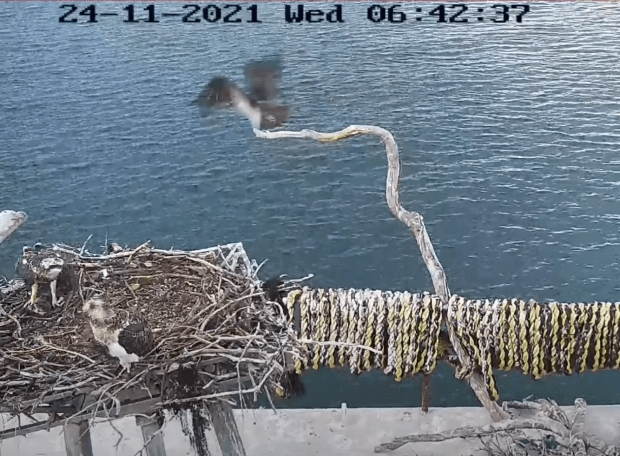
Falky scored the 06:37 breakfast fish. At that point, Ervie took off flying behind Dad. Maybe Ervie is gonna go and see if he can get a fish himself.

The Eastern Osprey in Australia do not migrate. Unlike the Northern fish eagles that do shift to warmer climates during the winter and catch their first fish when they migrate, the Eastern Osprey will fish before they leave the parent’s territory.

There goes Ervie off the perch. I sure hope he learns to fish. He can get his own breakfast and eat it somewhere away from the brothers!!!

I have seen no further news coming out of UC-Berkeley on Grinnell and Annie.

It is not late in the day but it feels like it. It will be totally dark in less than an hour and a half. So I am off to clear up things outside.

Thank you for joining me. Take care!

Thank you to the following for their streaming cams where I took my screen captures or for their FB Pages: Port Lincoln Osprey Project, Sea Eagles@ Birdlife Australia Discovery Centre and their FB Page, Sunnie Day and Holly Parsons.

Who is in the scrape?

At 13:13:01 on 22 November an adult peregrine falcon landed on the Southwest ledge of The Campanile on the grounds of UC-Berkeley.

Annie visited the ledge early this morning just as the pink of dawn covered the horizon.

Oh, Annie, you are so beautiful. Look at your gorgeous patterned chest with that soft almost cotton-like collar.

The bird appears anxious. Is it Grinnell returning to his scrape but worrying about the interloper? Is it the interloper? or is it Annie and I am just reading the situation incorrectly?

Grinnell has two bands – the one on the left leg is either a dark blue or black with white letters and numbers. Then there is the standard metal band on the right with Grinnell’s federal number. I just can’t see bands on this birds legs!

That said, this is a comparison between Grinnell and the interloper male posted on the twitter feed of the CalFalconCam on 5 November 2021. Grinnell is on the left and the interloper is on the right. The angle makes the interloper on the right appear much larger than Grinnell but the UC Falcon team confirmed that both of the males are a similar size.

There is a hint. Look at the beautiful striped breast of Annie and how far it goes up her chest. We know that Grinnell doesn’t have a lot of stripes. The interloper does but it does not go up high enough for the bird on the ledge. (See images below).

Using the images of the three birds, it appears that the bird on the ledge after lunch should be Annie. But, why is she so nervous?

Sean Peterson of UC Falcons solved the mystery and confirmed that this is Annie for me. He says that “She might be a bit nervous about all the activity over the last week or so.” Thanks, Sean!

She is looking around everywhere and doing a little chumping. Oh, how I wish Grinnell would have landed on that ledge at that very moment. Maybe he doesn’t know the interloper has not been seen since Grinnell came back to his territory on Wednesday.

Annie jumps down from the ledge.

With a hop and a little flight she lands in the scrape box.

Gosh, Annie, you are beautiful.

Oh, I wish that Grinnell would fly in and join her in the scrape! Come on Grinnell!!!!!

We wait and hope.

Cal Falcons has a fundraiser going to thank Lindsay Wildlife Experience. T-shirts for $20 US plus postage. If you are interested, go to the falcons web page and click on the hoodies. The fundraiser will pop up immediately. In order to keep down costs, the shirts will be printed once the fundraiser is over. Estimated delivery time to Canada is 27 December.

In other Bird World news, both Diamond and Xavier have visited the scrape box in Orange today. The issue of the missing eggs does not seem to be an issue. At Port Lincoln, Bazza scored the breakfast fish at 07:37. Dad arrived with another at 08:28 and Ervie got that one. Once Bazza was full with his fish, Falky took over. I just checked and Bazza was eating again. Gosh.

For the fans of Jack and Diane at the Achieva Osprey Nest in St Petersburg, Florida, Jack delivered his first fish to Diane today. Don’t expect eggs for awhile.

The couple have been renovating their nest on the parking lot of the Achieva Credit Union. They have a massive egg cup! Here is the link to that camera:

I also want to remind you of the African desert cam at the bolt hole. A meteor shower was caught on camera and there were three Cheetahs that visited today. The beautiful birds arrive around sunrise.

The link to this camera is here:

It is pretty quiet these days. The Eagles are working on their nests and eggs are being laid but it will be a bit before we see some bobbles.

Take care everyone. Be safe. See you soon.

Thank you to the following for their streaming cams where I took my screen captures: UC Falcon Cam, Achieva Credit Union, and the Namibia Cam.