Wednesday in Bird World

2 March 2022

Annie’s return to the Campanile warmed all of our hearts. A ray of sunshine in a weary world. I imagined that the researchers at CalFalcons were completely dumbfounded when they looked on the screen and saw her sitting on the ledge. We have seen female eagles disappear for a day or so right at the height of breeding season but this is not common in falcons. Thanks to ‘B’ who sent me the note about Annie’s return, we have an interview with CalFalcons about how it felt to see her return and what might have prompted her absence.

Mark your calendars. Cal Falcons will have a live Q & A session on Annie and Grinnell on 4 March at 2pm nest time. Here is the link. You can set the timer as a reminder. This should be a really interesting session.

The osplets at the Captiva Osprey platform have had their morning fish at 09:32. You can count on Little Bob to be right up front at the table – a mini-version of Ervie! Little Bob will do well in the world.

There is some condensation on the camera and their appear to be boats and some other animal ? in the water under the platform at times. This must make it difficult for Andy to get fish.

There’s our Little Bob right up front. Good for him.

The fish actually arrived several minutes before Lena started feeding at 09:32. It was very difficult to see the size of the fish or the species. All continue to do well.

Nearly 4000 people are watching and waiting for any news on a pip at the nest of Jackie and Shadow at Big Bear Valley.

Beautiful Jackie at first light.

Oh, I so hope these eggs are viable.

Shadows wears the same tight black jeans as Samson. Look at him. What a cutie. He would very much like some incubation time. I don’t know if Jackie is going to give in!

Pa Berry and Missy’s eaglet is walking strong and has most of his contour and wing feathers coming in or in. What a beautiful little eagle B15 is. S/he has been amusing itself by playing with one of the feathers in the nest.

B15 has really been working its wings lately – getting those muscles stronger and stronger by the flap.

No matter how big they are, thee aglets still like to be fed by a parent. Self-feeding is hard work when you are first learning.

Speaking of self-feeding. Remember when we worried about how dominant Jasper was at blocking NE27 from eating? We know that NE27 became the Little King of the snatch and grab. This morning a fish was delivered to the nest. NE27 went over to feed itself. Jasper sat next to it watching – not having a single clue how to go about eating. Jasper also did not beak NE27. I was thinking Jasper might be hoping that NE27 would feed her!!!!!! LOL.

Lots of preening with the first glow of the sun in the morning at the NEFlorida nest of Samson, Gabby, Jasper, and soon to be named NE27.

Beautiful image of our hero.

This is one beautiful eagle. Reminds me a lot of Legacy.

I couldn’t decide whether to cry with joy or laugh at loud. NE27 will be able to take good care of itself when it is out in the world. Yesterday, NE27 did not hesitate to steal food right out of Gabby’s talons. It was hungry and she was ignoring it and just feeding Jasper. I shouted ‘hoorah’ when that happened.

In the image below it looks like Jasper is wondering what in the world 27 is doing.

NE27 has learned to turn its back to Jasper, hold down the fish with its talons, and pull. This is an amazing little eaglet. And look at those beautiful wing and contour feathers coming in with the thick grey thermal down underneath.

Gabby is keeping a watchful eye. It won’t be long before 27 grabs the fish out of the talons again!
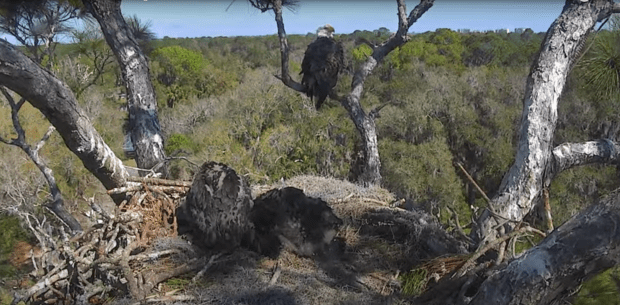
I have not been checking in on them but the WRDC nest with Ron, Rita, R1 and R2 seems to be just fine. We are going to have a lot of eaglets branching and fledging around the same time. At this point in time, I am not certain who is who on the nest.

Ron is feeding one of the chicks after the other was self-feeding.

I believe it is R1 self-feeding.

It is 2 degrees C and partly cloudy in Ithaca, New York. Our favourite Red-tail Hawk couple, Arthur and the Queen of RTHs, Big Red, are working and working on their nest. Since the problems at the Achieva Osprey nest with the squirrels and the eggs falling down into a dark abyss, I have noticed that there are layers of soft material alternating with twigs so as to build up a strong and tight nest cup on this light stand where…in two weeks, we could have eggs!!!!!!! I will be deliriously happy as will thousands of others.

You can see how much this couple has been doing. That nest is nice and deep now with a well defined egg cup.

Here comes Arthur. He is an amazing mate for Big Red. As this couple moves into their 6th year being together and their 5th breeding season, Arthur has proved that he is really up to the task.

Putting on the brakes. Once I was privy to watching Arthur flying through the buildings at Cornell to catch some prey. He was like a jet going between and around the buildings. Very impressive.

Arthur carefully arranges the twigs as he thinks Big Red would like them. She will, of course, come and finish the fine tuning and decorating.

The birds carry on with their lives. They give me solace and hope.

Thank you for joining me today. My granddaughter is coming over later and the plan is to cook for her. You might not well hear from me until tomorrow unless something extraordinary happens – like a pip at Big Bear! Take care everyone. Stay safe.

Thank you to the following for their streaming cams where I took my screen captures: Cornell Bird Lab, Captiva Osprey and Window on Wildlife, NEFlorida Bald Eagles and the AEF, Berry College, the WRDC Bald Eagles, and Friends of Big Bear Valley.

Annie is home!

I had just sat down at my desk – probably for less than 30 seconds – and ‘B’s’ note came flying across my inbox. ‘Annie is Back’. Tears of joy are rolling down my face. Thank you so much ‘B’ for thinking of me and all the other readers. We will all sleep much better tonight.

This was the Twitter posting from Cal Falcons with the joyous news:

For those of you watching other bird streaming cams, we know that Gabby often disappears for a 24 hour period at the peak of breeding season and that scares the wits out of us. This year Bella was injured – how bad is unknown – and she returned to take her territory 17 days later. Perhaps Annie needed a break? Maybe she had been in an altercation and needed some R & R. It is very probably that we will never know. What is important is that she appeared on The Campanile and is in fine shape. Grinnell must be so delighted. Certainly their fans are glad that they are both back together!

Thank you to Cal Falcons for their Twitter feed where I took my screen capture.

Tuesday in Bird World

01.03. 2022

I was in great need of a giggle and a smile and Jackie and Shadow provided it. This couple is incredible. Now that pip watch is upon us, Jackie is less and less prone to letting Shadow do any incubation duties. In the short video below, I captured the moment that Jackie returns from her break and wants Shadow to relinquish the nest.

I have re-figured my math (never a strong subject of mine). The first egg was laid on the 22nd of January with the second on the 25th. If we do not count the day the egg was laid, that means that egg 1 is 36 days old today and egg 2 is 33 days. At an elevation of 2058 metres or 6751.9 feet, Big Bear Lake is within the Bear Mountain Ski Resort area.

Because of the elevation of the area, it takes eagle’s eggs longer to hatch than those in nests at much lower sites. It might be, then, that Jackie and Shadow’s eggs will take the full 40 days to start pipping. Each of us and the more than 3000 fans needs to keep up the positive energy for this much loved eagle couple.

News has come that the second Hilton Head Island Trust eaglet of Harriet and Mitch has died. The bodies of both HH3 and HH4 have been sent for a necroscopy. It is believed that both have died from avian flu but this has to be confirmed. Our thoughts go out to Mitch and Harriet and all the people at Hilton Head Island Trust eagles.

The first fish of the morning came in at 08:44 to the Captiva Osprey nest. Lena fed the chicks for nearly an hour. She finished off the skin at 09:44.

Just look at Andy’s long legs or tarsi. These allow him to reach quickly and deep to get his fish. You will notice that the legs of other raptors are not quite as long.

It looks like a different fish than the Sheepshead Andy normally brings to the nest.

Turn around Little Bob!

Little Bob still sports his fuzzy down which is actually unbranched feathers. Alan Poole describes them as being “almost furlike”. Little Bob is changing though. His head is not as soft looking as it was.

Awww. There you are right, Little Bob, up there with that long neck of yours. Dinosaurs. Tomorrow or Thursday you will all look like dinosaurs!!!!!!

These nestlings still cannot regulate their body temperature. It will be another week or 10 days. Until then it is Lena’s job to protect them from the heat of Florida and the rain.

They are, however, quickly entering the period of their fastest growth – between two weeks and a month when they will gain an average of forty grams or .09 lb a day, according to Poole.

From this angle you can clearly see the change in the plumage between one of the older Bobs on the left and Little Bob with its still fuzzy lighter down on the right.

At the Dale Hollow Lake Nest in Tennessee, the third hatch, DH16, is eating along with its twin siblings, DH14 and 15. They are so cute. Here are the fuzzy bobbles everyone loves. Precious.

The nest can only be seen from the water. In May, there is a large group picnic with opportunities to go out and have a view of Obey and River and their eaglets. Check the Dale Hollow Lake website if you are interested.

The second egg has hatched at Duke Farms. Congratulations everyone!

1 March is the first day of meteorological spring. The followers of UK Osprey nests bring out their UK Arrival Sheets and start keeping track of who arrives where and when. The first official sighting of a returning came today from the hide in the Holkham Fresh Marsh in Norfolk. Of the public nests where there are streaming cams, I am hoping for Blue 33 and Maya to get back to Rutland Manton Bay quickly!

Loch of the Lowes is gorgeous. This nest fledged two last year. It is the home of Laddie LM12 and Blue NC0. I adore Blue NC0. She is a great angler and she is not shy about getting a huge fish up on the nest for her chicks if Laddie isn’t delivering food quick enough!

Everyone is hoping that 2022 will be a fabulous year for Aran and Mrs G at Glaslyn. What a serene pastoral setting. Last year their three chicks perished.

There are, of course, many people who fell in love with Ospreys because of this nest, Loch Arkaig. We continue to hope for a miracle to happen and Aila to return after not being seen since August of 2020. That year her and Louis fledged the JJs – they stole our hearts and I personally cannot wait to see if JJ7 will be seen in Scotland this year.

The JJs, July 2021

Last year Louis bonded with another female at a close nest and fledged two beautiful chicks but not with the one he shared with Aila.

There are many, many more Osprey streaming cams in the UK and as the birds arrive I will be posting those. One of my favourites is the nest of White YW and Blue 35 in Cumbria at Foulshaw Moss. It is the home of Tiny Little, a third hatch so wee compared to the two older siblings, no one thought she would survive but, survive she did thanks to the ingenuity and hard work of the parents and her very own cleverness and determination.

The sun is out and there is a hint of blue in the sky today. Yesterday it was -8 and today it is a little colder at -13 C. I had a lovely walk accompanied by seven Black-capped Chickadees, a White Breasted Nuthatch and a Red Squirrel. They all knew I had seeds in my pocket!

They were so cute and it was a nice warm day for them, too.

There is still no sighting of Annie at The Campanile. It is very sad to say goodbye to her. She gave us and the world 13 beautiful chicks in the five years she was at the scrape as Grinnell’s mate. I hope by some miracle she returns and is only away quietly healing from an altercation. Send her your warmest wishes.

Thank you so much for joining me today. Take care everyone. See you soon.

My sincerest thanks go out to the following for their streaming cams where I took my screen captures and video clip: Glaslyn Bywyd Gwyllt, Friends of Loch of the Lowes and Woodland Trust, Loch Arkaig, People’s Post Code Lottery, Duke Farms, Dale Hollow Eagles, Friends of Big Bear Valley, Captiva Ospreys and Window on Wildlife.

Where is Annie?

If you think of Cal Falcons, you immediately say Annie and Grinnell. On October 29, Grinnell was injured in a territorial battle and was taken into care. Everyone was so joyous when he returned to The Campanile after his release.

Today Cal Falcons has just announced that Annie, Grinnell’s long time mate and fabulous Mum, is missing, been ousted from the territory, or is dead.

This was just posted:

It was only three weeks ago that we saw this beautiful courtship display between Annie and Grinnell:

Everyone’s heart is broken. It is hard to imagine “Grinnell and Annie” without the Annie.

I sincerely hope that Annie is taking a break to recover out of the spotlight just like Bella did when she was injured in a territorial battle at the nest she shares with Smitty.

Please send all your warm wishes and positive energy to Annie so that she might return quickly to The Campanile and Grinnell.

Thank you to Cal Falcons for their FB page where I took my screen captures.

Friday in Bird World

The Lost Words is a book by Robert MacFarlane, Fellow at Emmanuel College, Cambridge. Its focus is on the words that the editors of the Oxford Children’s Dictionary removed. Its 128 pages, 27.9 x 37.6 cm in size, are gorgeously illustrated with the watercolours of Jackie Morris, writer and illustrator, who lives in Pembrokeshire, Wales. The missing words that concerned MacFarlane are the following: acorn, Adder, Bluebell, Bramble, Conker, dandelion, fern, heather, heron, Ivy, Kingfisher, Lark, Magpie, Newt, Otter, Raven, Starling, Weasel, Willow, and Wren. At a time when our focus as adults should be to strive to install the wonder of the natural world and our responsibility to it in the children, why, then, would anyone choose to remove words that are directly connected with our environment.

I mentioned this book awhile ago. I have returned to it many times always admiring the illustrations, such as the images of the Ravens on the forest floor amongst the fallen conkers. Conkers are the fruit of the Horse Chestnut Tree, Aesculus hippocastanum. Horse Chestnut trees can grow quite large. Ironically, the conkers are poisonous to horses and I believe, all other animals. The type of poison is called esculin.

That illustration conjured up a beautiful memory of the time my family spent in England. Up on the gorse was a Conker Tree. We had never seen conkers – it was something wonderful and new. The children played a game with them. First you had to drill a hole and run a cord through the conker and secure it with a nice big knot at the bottom. The children would then ‘conk’ their conkers trying to see whose would break first! It was free entertainment and kept them busy for hours.

“Conkers on a string” by MrsEds is licensed under CC BY-NC-SA 2.0

Creative Commons had this historical picture of two young lads trying to break the others’ conker.

“Its conker time” by theirhistory 

The rolling hills with their public paths were marvellous places for the children and the adults to take walks and breathe in the air. We were fortunate to have a ‘gorse’ within 50 or 60 feet from where we lived. It was full of butterflies and birds and the most delicious blackberries. It was a time when children played outside with their mates. No one set in front of the telly or spent hours looking at screens. Bikes were ridden and trees were climbed. In the three years we lived in Lincolnshire, it snowed once. There was about 4 cm on the ground – just enough. Still, everything stopped. Children stayed home from school and anything and everything that could be used as a sled was used to slide down the hills of the gorse. I wonder what all those children would think about the snow in my garden today?

The nice thing about snow is that it can cause people to slow down. To enjoy a cup of hot tea and a book. To stop running around worrying about things that are not always that important, to pause long enough to take in the moments.

It seems like it is rather quiet in Bird World but, is it really? Eaglets are growing bigger by the day all the while their plumage is changing. Thankfully, none are ready to fledge. E19 and E20 spend time flapping their wings as does the Osceola eaglet. Other eagles are incubating eggs. It is not time for Osprey season unless they are in Florida. Diane is incubating 3 eggs at Achieva in St Petersburg while Lena, laying hers a month early at Captiva, will be on hatch watch this weekend. Annie and Grinnell are only dreaming of eyases. Today Grinnell had to tell a 2 year old juvenile female to get off the ledge of The Campanile. Cal Falcons posted a video of that encounter.

Ervie continues to fish call off the barge at Port Lincoln. We can hear him but we cannot see him.

Kincaid is 29 days old today. He is starting to walk. It is so cute to see those first ‘baby steps’. Louis brought in what looks like an egret (or a part of an egret). When it looked like Louis might want to eat some of it, Anna promptly arrived at the nest. To Anna, prey brought to the nest belongs to her and Kincaid, not Louis who brought it! Anna is pretty strict in that regard. Not all female Bald Eagles behave that way. Anna proceeded to try and remove one long leg while Kincaid, with an already large crop, waited patiently.

Kincaid is mimicking what Anna is doing as he grabs the other leg and pulls on it. So cute. Kincaid also keeps himself busy moving around nesting material. These little eaglets learn from watching the adults.

Kincaid is already making attempts at self-feeding.

Kincaid is, of course, not the only one trying out eating by itself. I posted an image of R2 at the WRDC nest a week ago eating a fish. The eaglets of Harriet and M15 are also attempting eating on their own. E20 has become a bit of a pro. It seems like all of the eaglets grew up faster than they have ever done previously. Does it seem that way to you?

At the White-tailed Eagle nest of Milda and her new mate near Durbe, Latvia, the snow has melted. Milda will be laying her eggs about the same time as Big Red in Ithaca, New York – the third week of March – if all goes to plan.

There is more snow forecast for Big Red’s territory. The temperature in Ithaca is 1 C.

What I like about the image below is that you can see the nest cup area that Big Red and Arthur have been working on. In Milda’s nest sprigs of pine with their cones line the area of the egg cup. It is so fascinating watching the couples prepare for the upcoming breeding season. It is so intriguing. I would love to ‘speak hawk’ and sit by Big Red and Arthur when they discuss what needs to be done!

At least five eagles poisoned, one dead, four in serious condition in Manchester Maryland. Was this lead poisoning? or was this something else more sinister to impact all of the birds at the same time? There is an investigation underway.

Here is a short informative video of why eagles eat carrion in the winter.

https://fb.watch/b6jnYJByKa/

There is good news coming out of Australia about WBSE 27. You might remember that twice, after fledging, 27 was taken into care. 27 was not taught by the parents to take care of itself. Once 27 fledged, it was taunted and chased by the Pied Currawong. Both times 27 was extremely dehydrated. The last time the Currawong had gathered and had pecked 27s head. When 27 was taken into care the last time, I hoped that rehabilitation would include flight training as well as training for getting prey. This takes longer than a two week stay in a clinic. Some wildlife rehabbers keep birds for 2 years to make certain they are capable of caring for themselves with confidence. It looks like 27 is getting that great training. The news is excellent!

Isn’t she lovely? And – yes – 27 is a she!

I wish that all of the sea eagles that fledge from the WBSE nest in the Sydney Olympic Park would not be harangued by the Pied Currawong. They chase them out of the forest. They never learn to fly or to catch prey. How many of them survive, if any, unless they wind up in care?

The camera is now working again at Port Lincoln. Ervie was on the nest and, at various times, in the shed with Dad. Sometimes he was in the shed alone. I cannot tell you if he had a fish but there was definitely a lot of fish calling.

Checking in on Jack and Diane at the Achieva Credit Union Osprey nest and Jack is busy delivering fish and helping incubate the eggs.

If you are into garden animals and song birds, with a few surprises, you might want to check out Wildlife Kate. She has several wildlife cams and is featured on Springwatch in the UK. Have a look. You might find something really interesting like Yew Pond, or the Kestrel Box, or the Woodland Pond.

This is Woodland Pond. The cameras are live with no rewind. Enjoy.

https://www.wildlifekate.co.uk/

I haven’t posted anything about the eaglet at Berry College for a few days. Thermal down is coming in nicely. Pa Berry did a great job feeding the little one this morning. B15 is still walking around on its tarsus (not yet with its feet) and doing a lot of preening. B15 is doing great. Missy and Pa Berry are doing a great job raising this baby.

B15 is a sweet little eaglet. You can see how its plumage is beginning to change.

I will leave you with a gorgeous image of Jackie incubating her eggs at Big Bear Bald Eagle nest in California. Fingers crossed for a great season for her and Shadow!

Thank you so much for joining me today. Take care. See you soon!

Thank you to the following for their streaming cams where I took my screen captures: Friends of Big Bear, Achieva Credit Union, Wildlife Kate, Cornell Bird Lab and RTH, Berry College, Port Lincoln Osprey Project, KNF, Latvian Fund for Nature, and Sea Eagle Cam FB Page.

Birds and Drones Do Not Mix

If I say the word ‘drone’, I am certain that you can conjure up a likeness in your mind. You probably know more about these remote controlled flying machines that can be equipped with everything from cameras to laser guided missiles than I do. The subject of this blog is the impact of drones on birds!

This morning I received a note from a reader (Thank you, ‘B’) telling me of an incident with Annie and a drone that was flown illegally over the UC-Berkeley campus. ‘B’ thought it was a good idea that everyone becomes aware of the dangers to Annie and Grinnell – and all our other wildlife – from these flying objects.

The individual flying the drone at UC Berkeley sent the machine very close to The Campanile where Annie has her scrape box. Annie went into defensive posture chasing after the machine. She could have been fatally injured by such an encounter. She could also be frightened away from her scrape abandoning breeding season which has just started or eggs, if laid.

UC-Berkeley is trying hard to locate the individual responsible. There are news reports and everyone is trying to spread the word. I hope that that individual cares and will stop their behaviour.

There are Bald Eagles trained and being trained to deal with drones.

Annie and Grinnell are not the size of a Bald Eagle. They could easily be injured or killed.

But Annie and Grinnell, Peregrine Falcons, are not the only birds having problems with illegal drones. In June, 2021, 3000 Terns and their nests of eggs were wiped out because of a drone. The Terns abandoned their nests on Huntington Beach, California after a drone crashed.

https://www.latimes.com/california/story/2021-06-07/thousands-of-eggs-abandoned-after-drone-crash-at-orange-county-nature-reserve

Here is the information on Annie and the Drone.

If you have a drone or if you know someone who does, perhaps it is time for a chat about responsibility. Wildlife can be seriously injured, killed, or frightened. There is a place for drones but it is not anywhere around the nests of birds!

Thank you for joining me and thank you ‘B’ for letting me know about this drone violation and its impact on Annie. Take care everyone. See you soon.

Sunday in Bird World

The wind has not let up at the NEFlorida Bald Eagle nest of Gabby and Samson. Gabby has gotten up twice to make sure the little NE26 and 27 are fed. Thank goodness that Samson filled up the pantry because he would not be able to go and fish in these winds.

The babies are growing and need more food. You can see the white dot of the ear on NE26 standing up.

These two still do not have their thermal down and Gabby has to be very careful to keep them warm and dry.

I feel for all of the birds who have these intense storms. They, on the other hand, just get on with life as best they can!

There are now two eggs on the Achieva Osprey Credit Union in St Petersburg, Florida. Congratulations Jack and Diane. Jack has been bringing fish to the nest and taking his turn at incubation. That nest looks a little wet, too.

It is hard to believe it, sitting here in frigid Canada, but the first Red Kites have begun their northerly migration from Africa passing over Poole Harbour today! Gosh, golly. Red Kites are beautiful raptors. They are about 66 cm or one foot in length with a very distinctive forked tail, angular body, and reddy-brown body.

“Flying red kite” by Tambako the Jaguar is licensed under CC.

Just look at this gorgeous under carriage.

“Flying red kite” by Tambako the Jaguar is licensed under CC BY-ND 2.0

I am getting excited for the streaming cam to come on line in the Taiwan cemetery that has a Black Kite nest. That should be about the middle of March.

It is a gorgeous day in Pittsburg. We continue to be on egg watch at this nest.

Liberty and Guardian have both been on the nest in Redding, California and there is egg watch there, too, just like at Pittsburgh-Hays.

Thunder has three eggs at the West End Bald Eagle nest. Her and Cheta keep taking turns incubating them. Oh, I so hope these two have a successful season but they are going to have to be diligent! Those Ravens are intelligent and they sit back and wait and watch. We know this from Daisy the Duck’s experience on the WBSE nest.

Connie and Clive, as mentioned in an earlier blog, have buried their last unviable egg. The first broke. Both have brought greenery into the nest and covered the place where the egg is buried. Will there be a second clutch? or is this greenery a way of bringing closure to a lost season for this new pair?

It is a gorgeous day over at the Duke Farm Bald Eagle nest in Hillsborough, NJ. Gosh, I bet everyone was glad that storm was gone!

There is a really beautiful Snowy Owl over on the Mississippi Flyway Streaming Cam today.

Lena is on the eggs over at the Captiva Osprey Nest on Santibel. There are fire trucks in the background and oh, she is loud! You can easily hear human voices over the nest microphone, too. That is really something folks should be aware of when they walk by these nests!!!!!! If they know they are by a nest.

The eggs were laid on 8, 11, and 14 January. Can you believe we could be on hatch watch? To my knowledge, the streaming cam on Andy and Lena will be turned off if the eggs hatch. It will be kept off until such time the owner believes that the Crows are no longer a threat. I will try to keep you posted.

It is early Monday morning in Australia and it looks like Ervie is the only one on the barge. Individuals continue to ask where Mum is. Traditionally, in migrating Ospreys, the Mum leaves the nest and the Dad feeds the chicks til they leave. At that point he begins his migration. Australian Ospreys do not migrate. That said Mum has done her job and is probably over on the Old Barge resting and getting her strength back. There is no need to worry! She probably got tired of Ervie’s very loud prey calling. Dad hangs out on the barge with Ervie some of the time. Dad definitely provides food for Ervie.

I want to leave you today on the happiest of notes. It is a courtship display by our two favourite North American Peregrine Falcons, Annie and Grinnell, on The Campanile today.

Thank you for joining me today. Take care everyone. See you soon.

Thank you to the following for their streaming cams where I took my screen shots: Port Lincoln Osprey Project, Captiva Osprey Cam, Mississippi Flyway, Duke Farms, Explore.org, Captiva Bald Eagle Cam, Pix Cams, Redding Bald Eagles, Achieva Credit Union, and NEFlorida Bald Eagles and the AEF.

Bay Area Birds

I will only say it is ‘freezing’ once. First it was the snow and now we are -31 C. for all day Wednesday. The sky was blue and the sun was shining Wednesday morning signalling the extreme cold. Staring at the birds outside just makes me marvel at how they can survive a Winnipeg winter. It has now warmed up to -26 Thursday morning but we remain under an extreme cold warning.

https://www.cbc.ca/news/canada/calgary/how-birds-survive-winter-1.4465936

The Black-capped Chickadees take so much time getting a single black oil sunflower seed, then finding a place to crack it. They do not seem to prefer – at all – the ones already shelled and broken. Yesterday they were flitting around in the blizzard coming into the vines and under the eave to get away from the wind.

I caught this little fellow cracking the seed on that tiny branch the other day.

I have a large tub of spreadable bark butter. The Woodpecker family will be delighted. I wonder if these chickadees might like it as well??? I have to say that while I am so happy to have the Starlings around, they can be intimidating. A friend has suggested that I get a feeder with a suction cup that goes on the window. They said the small birds like the chickadees will come to it while the big birds will stay away. I worry that a bird will injure themselves flying into the window. I wonder. Have you had any experience with these types of feeders? If so, I would love to hear from you.

There was a super surprise in the post today. The t-shirts from the fund raiser for Lindsay Wildlife arrived. Lindsay Wildlife treated Grinnell, the male Peregrine Falcon at The Campanile at UC-Berkeley, when he was injured on 29 October. These were part of a fundraiser by Cal Falcons to thank them.

The last posting on the falcon’s FB page. So happy Grinnell was able to be released so quickly and took his place back with Annie.

I can’t help it. Whenever I am checking on Annie and Grinnell, I think of Richmond and Rosie. Is it because one of Annie and Grinnell’s daughters has a nest on Alcatraz? I don’t know.

If you are looking for a stable Osprey nest, you need look no farther than that of Richmond and Rosie at the Point Potreto Whirley Crane in San Francisco. Richmond and Rosie are nothing short of incredible. They are entertaining and steady as you go parents. Richmond is known for bringing in quirky items to the nest – stuffed toys, aprons, and hats.

Rosie is in front and has the streaked breast.

Richmond has been at the Whirly crane for three days in a row. Oh, yes, the nest is on a Whirly Crane that belongs specifically to the Ospreys! Does Richmond think Rosie might come home early? You see, Richmond never leaves the area. He spends his time around the island of Alcatraz and fishing in the Bay. Rosie migrates and she typically returns around Valentine’s Day. Oh, they are always so excited to see one another!

The couple have been raising chicks on this nest since 2017. This will be their sixth breeding year. In the past 5 seasons, they have fledged a total of 13 chicks.

Here is the actual crane:

This is detailed historical data on all aspects from egg laying, banding, to fledge. Last year, Rosie and Richmond again fledged triplets like they did in 2020. Rosie, Sage, and Poppy were their names in 2021.

This is Richmond two days ago on the crane. He often visits during the winter just to check on the nest and protect his territory. There are currently 50 Osprey nests in the San Francisco Bay area.

Here is a link to one of the streaming cams for Rosie and Richmond:

https://hdontap.com/index.php/video/stream/golden-gate-osprey-1

Here is a link to historical and current videos of Rosie and Richmond:

https://www.youtube.com/channel/UC1gn6yIRa_cBKExVmHdg3jQ

The weather in the US is amping up. Here is the latest NOAA national map. If you are in this area which covers a huge population of the US, you take care!

There is a line of rain that includes Louisiana at an angle going NE that includes NYC and Duke Farms Bald Eagles in Hillsborough, NJ. Ice is in Southern Ohio and moving eastward and will impact the PA birds. Heavy snow for upstate NY. It is currently raining at the KNF nest in Louisiana and rain, or is it freezing rain?, at Berry College.

Anna and Louis were both wet. the little eaglet is dry. You can see that they are alerting. The cold has hit the nest. It is 3 degrees C or 18 F and it is set to fall to 0. Stay warm Anna, Louis, and the baby!

Missy is keeping B15 dry. It is 13 degrees C but the weather report is saying thunderstorms for the Berry College Bald Eagle nest. Stay safe everyone.

You can barely tell but snow is starting to fall on Big Red and Arthur’s nest in Ithaca, New York. It is currently 2 degrees C at the nest. It will get down to -6 C before this storm is over. This area of upstate NY is set to get pounded with snow. Keep Big Red and Arthur in your thoughts.

All of the nests in PA are set to be hit with ice and/or snow. There could be significant tree loss if the ice continues to build up like it is doing in southern Ohio at the moment.

Thank you for joining me. My thoughts go out to everyone and all the nests in this storm area. Please take care. See you soon.

Thank you to the following for their streaming cams where I took my screen shots: Golden Gate Audubon, Cal Falcons, Cornell Bird Lab RTH, KNF, Berry College, and NOAA.

Wednesday in Bird World

Oh, gosh, golly. Just when you think the day is going to be quiet, Missy at the Berry College Bald Eagle Nest in Mt Berry, Georgia, has a pip. The announcement of the pip was posted on FB this morning.

I just took this image a few minutes ago. The chick is making good progress! That is not a video. That arrow just shows up when you try to take a screen shot on their camera.

Speaking of cameras, Berry College has three – an approach one, one above the nest, and one closer to the nest. If you want to see thee action on hatch, I think the camera closer to the nest is the best. Their cameras are not on YouTube.

https://www.berry.edu/eaglecam/nest2

What spells Bald Eagle Fluff Ball better than cute? Be prepared to melt. Anna and Louis’s 15-hour-old chick is adorable.

Oh, the fluff balls grow too quick and get pin feathers in a blink. Soak them in when they are like this. So precious.

Bald Eagle parents work on instinct. There isn’t a manual on eagle parenting tucked under the nest. This is only Anna’s second chick. Last year I almost had a sore throat yelling at Anna to get closer to Kisatchie to feed him and for Kisatchie to turn around, face Mum (or Dad, Louis feeds his babies), and open that beak wide. Anna and this little one are struggling too. The little one is ready to eat and opens its beak wide and tries the grass in the nest! It has its back to Anna who is trying to feed it. She gets closer and the little one takes its first bite. This will only improve as Anna remembers and the little one figures out its part in the feeding-eating process.

Wildlife Rehabilitation Clinics work on donations and the sweat, tears, and love of volunteers. Our local clinic, Wildlife Haven, put out a call for donations to help a Snowy Owl in December. Today they were joyful in sending out a short video on its release. So happy to have been a small part of this success story!

There is currently no pip at the Captiva Bald Eagle nest. Waiting for Friday!

There is also no Daisy the Duck on the Sea Eagles nest in Sydney and that is a good thing!

Down at the Port Lincoln Osprey barge, Ervie is on the nest crying for a fish delivery. Twice now he has flown off the nest as if he saw an adult with a fish. He returned quickly the first time. Let’s see if he comes back with a fish the second time. No, empty taloned!

In Durbe, Milda and Mr L have returned to the nest to move around some sticks. There is still lots of snow in Latvia, just like Manitoba! I am really looking forward to Milda laying eggs and having a successful fledge of chick or chicks this spring. That would be so wonderful. Losing her long term mate, Raimis, last spring just sparked more and more sadness.

Just like Milda and Mr L, Annie and Grinnell are hanging out on The Campanile. Their scrape box is ready and waiting for those precious eggs in a couple of months. Cal Falcons posted this on their Twitter site today. So happy it will be Annie and Grinnell. The interloper has not been seen for a month! Yeah!!!!!!!

Annie is still there several hours later. Can you see her by the camera, perched on the pipe?

For other baby eaglets, it looks like it is fish dinners in Miami-Dade County and over in Fort Myers. R2 and R3 really seem to enjoy the fresh fish that Dad brings in. There have been several other varieties of prey items including a parrot and a coot. Did you know that Bald Eagles fish in both fresh and salt water?

E19 and E20 are also having fish. It is so hard to tell them apart. There is a white line under the cere of one of them but E20 does not seem to be that much different in size from its older sibling, E20. It is difficult to tell who is who sometimes. I ‘think’ it is E19 at the bottom of the screen and E20 in the middle.

Oh, tomorrow, the chick at Berry College will have fully hatched, the little one at the KNF nest will be stronger with its eyes more focused, and then there should be a pip coming at Captiva. Goodness.

There has been more snow on and off all day on the Canadian Prairies. There were 57 European Starlings in the Lilac Bushes and back trees this morning. They are still here. The feeders were filled twice. It is now 16:08 and it will not be long til every bird goes off to roost. It is normally dark here by 16:45. It is now 16:25 and all the birds are gone. It is absolutely still in the garden as new snow falls.

Thank you for joining me today. Please take care. See you soon.

A big thank you to the following for their streaming cams, Twitter, or FB pages where I took my screen captures: KNF Bald Eagle Nest, Port Lincoln Osprey Project, Berry College Eagles, Cal Falcons, Sea Eagles@Birdlife Australia Discovery Centre Sydney Olympic Park, WRDC Bald Eagle Nest, SWFlorida and D Pritchett Bald Eagle Nest, Wildlife Haven, Bald Eagles Live Nest Cam News, and the Latvian Fund for Nature.

Sunday in Bird World

Hi Everyone!

It is another cold day on the Canadian Prairies. The European Starlings were sitting on the tips of the Lilac branches on a bright sunny morning. It is -30. Notice how blue the sky is on a cold, cold day.

The Starlings puff up all their feathers. They seem more interested in sunning themselves than eating today.

Little Red was leaping from the fence to the feeders and back again, collecting nuts as quick as he could. It looks like Dyson & Co have decided to hibernate during this week or two of extreme weather. I do not blame them!

M15 found a possum that had been killed on the road and brought it to the nest in Fort Myers. That is one of the ways that Eagles get killed – removing carrion from the roads and taking it to the nest OR sitting on the road and eating the prey item. Our wildlife rehabbers suggest carrying a shovel in your car and stopping and removing dead animals from the road and placing them way back in the ditch. It will certainly help all the raptors.

In a late Sunday afternoon feeding, E20 got smart for a bit and stood behind E19 when Harriet got up to feed them.

If you are wondering which one is which, it is easy to identify them. Currently, E19 has a bit of PS and food on its back and it is slightly bigger. E19 is in front. E20 is a fluffy clean white ball. A sweetie.

So far their eyes are looking great. No sign of any infection.

The other day when E20 climbed out of the nest cup for a feeding, it was too close to Harriet’s beak making it difficult for her to feed it. By standing behind E19, E20 is at the right place for food and away from E19’s beak. So the first bites go to E20.

The next bite goes to E19. Harriet is such a good mother. There should never been any feelings of food insecurity on this nest.

Adorable.

I was a bit shocked to see an individual on the FB group of the SWFlorida Eaglets write expecting E19 to kill E20. Siblicide in Bald Eagles is very rare. I include below some information from a study. You will see that storms cause more deaths. There has never been a death due to siblicide on this nest in SWFlorida. Everyone can rest easy.

From the researcher in Maine:

“I studied 62 webcam Bald Eagle nests with direct observations of the nest bowl recorded over a period of up to 8 years. The total number of nest seasons was 240. Of that number, there were 91 with just one hatch or none, 105 nestings with 2 hatches, 42 with 3 hatches and 2 with 4 hatches. (These are all direct observations of egg-laying, hatch, eaglet development and fledge.)

Of the 105 nestings with 2 hatches, both eaglets successfully fledged 77 times (73%), 1 eaglet fledged and 1 died 22 times (21%), and both died 6 times (6%). Of the 34 who died, the cause of death was parent neglect (6), killed by intruder (4), storm (4), failed in the first day or two (3), accident (5), illness (1), unknown (7), possible siblicide (1), and known siblicide (3). Based on these figures (including the possible siblicide), the incidence of siblicide on a nest with 2 eaglets is 3.8%.

Of the 42 nestings with 3 hatches, all 3 eaglets fledged 35 times (83%), 2 fledged and 1 died 3 times (7%), 1 fledged and 2 died 2 times (5%), and all three died 2 times (5%). Of the 13 who died, the cause of death was storm (eight), poison (2), accident (1), unknown (1), and siblicide (1). Based on these figures, the incidence of siblicide on a nest with 3 siblings is 2%.

Of the 2 nestings with 4 hatches, all 4 eaglets successfully fledged on one, and 2 on the other. The cause of death of the 2 who died was storm (1), died in the first day or so (1).

The known incidence of siblicide on these 62 random nests of 396 hatched eaglets was 4 eaglets, 3 of whom were from the same nest in Maine, and all were attributed to lack of food and/or parent neglect. That’s 1%. It would be less than 0.3% if I discounted that one nest in Maine.”

That should put everyone’s mind to rest when they are watching the Bald Eagle nests.

And as I close, E20 is eating again and E19 is looking at something else. It was a good feeding!

Lady and Dad, the White-Bellied Australian Sea Eagles, did not return to their nest in the Sydney Olympic Park after having been harassed by both the Currawong and the BooBook Owls the previous night.

It has been confirmed that there are boxes for ducks at the Duck Pond but our Daisy seems to prefer nests to them. Let us all hope she changes her mind.

Samson is giving Gabby a break at the Northeast Florida Bald Eagle Cam near Jacksonville. He is incubating NE26 and 27. (Legacy was NE24 and the unviable egg was considered NE25). We will be on hatch watch in about 12 days. How wonderful.

It is an interesting morning at the Port Lincoln Osprey Nest. Ervie is the one who has been on the nest and who is prey calling – very loudly.

Falky has landed on the nearby ropes and is hoping for a chance at the breakfast fish this morning, too. I wonder how much fishing Ervie is actually doing??? He has been sitting on that nest a long time prey crying instead of fishing….

The other Bald Eagle nest that currently has two little eaglets is Hilton Head. The eaglets are doing fine. I will include the link to the camera since they are not on YouTube. They are adorable and I urge you to stop in and have a look. There is no rewind function, however!

The link to the camera is here:

https://hdontap.com/index.php/video/stream/hilton-head-land-trust-eagles

Someone asked me what nest I am looking forward to the most in 2022. That is a real hard one! In the United States, it would have to be Big Red and Arthur, the Red-tail Hawks at Cornell University. Here are K1 and K2 from last spring’s nest. K3 will hatch the day after. They are just super parents. Big Red will be laying her eggs in March.

Unlike Bald Eagles who hatch with grey soft natal down, Red-tail Hawks have the most beautiful soft white down and white spikey hair on the top of their heads! They melt my heart instantly.

5 May 2021. K1 and K2.

I love Peregrine Falcons so Annie and Grinnell will be at the top of my list and as for Osprey Nests in the US, you can’t get better than Richmond and Rosie out in California. I try to keep track of several Osprey nests in the UK, the Black Stork nests in Latvia and Estonia, and for this year, the Osprey nests in Finland. Then there is the Black Kite Nest in a Taipei Cemetery. That should keep me out of trouble!

Thank you so much for joining me today. It is wonderful to have you here. Take care. See you soon.

Thank you to the following for their streaming cams where I took my screen captures: SWFlorida Bald Eagle Cam and D Pritchett, NWFlorida Bald Eagle Cam and the AEF, Port Lincoln Ospreys, Hilton Head Eagle Cam, Cornell Bird Lab, and Sea Eagles@Birdlife Australia Discovery Centre Sydney Olympic Park.