Oh, goodness, Sunday was a day full of surprises! Two of them welcome and the other two, just shattering.
I had not anticipated sending out the newsletter this morning. The news coming out of NZ and Melbourne today would overwhelm this wonderful story of birds and emotions that I am working on. So tomorrow I will introduce you to Wolke so that you can enjoy reading about her incredible journey through grief to find love.
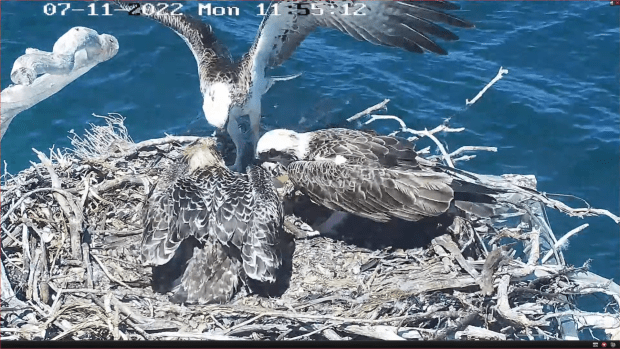
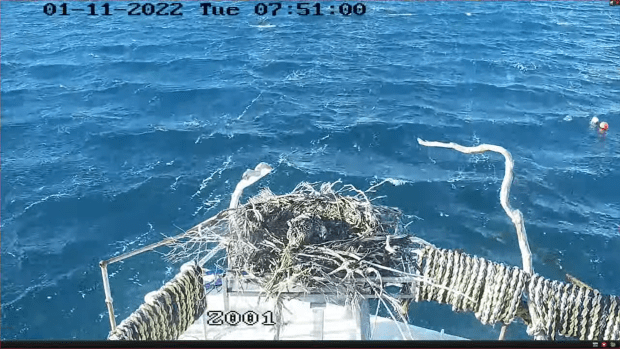
I don’t think anyone was shocked to discover that Big Bob at the Port Lincoln Osprey barge was a girl. I am not sure that anyone was surprised that she was the largest osprey ever hatched and ready to fledge either. Big is a BIG girl. The pink band is fantastic and what a super tribute to Janet Forster’s granddaughter to have the 2022 osplet named after her, Zoe. What was surprising was the determination of the local gulls to steal the fish right off the nest on the barge as Zoe was pancaked!
This really opened my eyes to what Dad might have to go through when he is fishing. We have seen the gulls steal a fish right out of his talons but, imagine them swarming him when he is fishing. That makes me sad.
Dad came in with a fish at 132824. He brought an earlier fish at 064935.
Mum prevailed and fed herself and her big Zoe.
It was a good fishing day for Dad who flew in with another fish at 1900. We have all been worried about Dad. Is the lack of fish due to weather? sediment so he could not see clearly? or him just feeling unwell? We probably will never know but, he did manage 3 fish and Mum and Zoe had the fish that were left after banding that the gulls did not get. (I think the gulls only took 1 of the 3 fish).
Zoe screaming loud with Mum as they see Dad approaching with the fish.
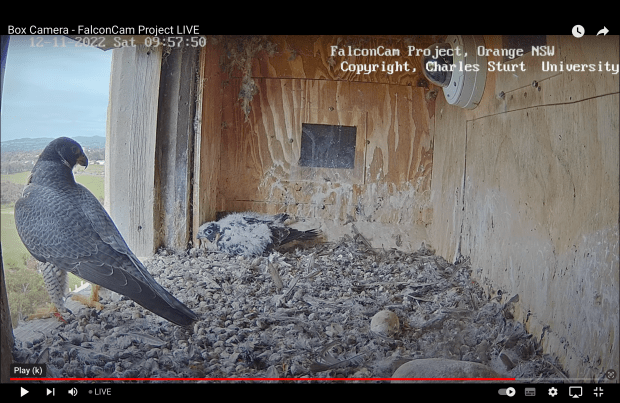
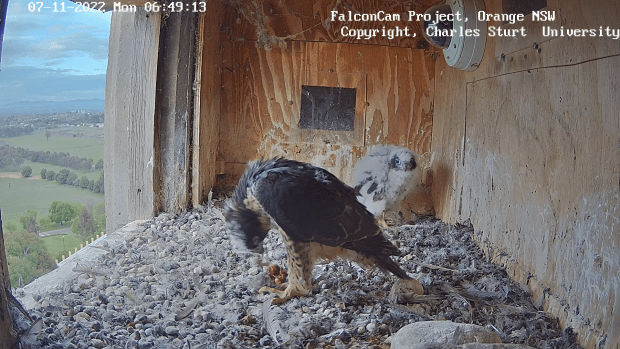
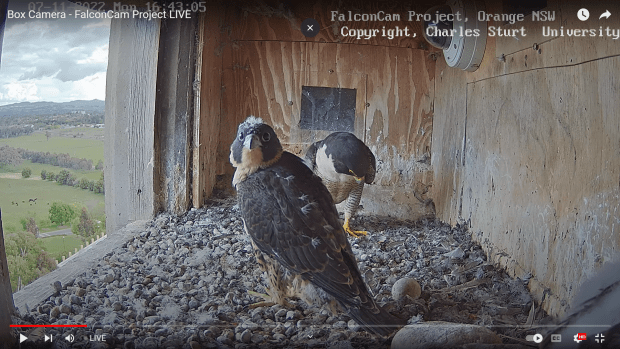
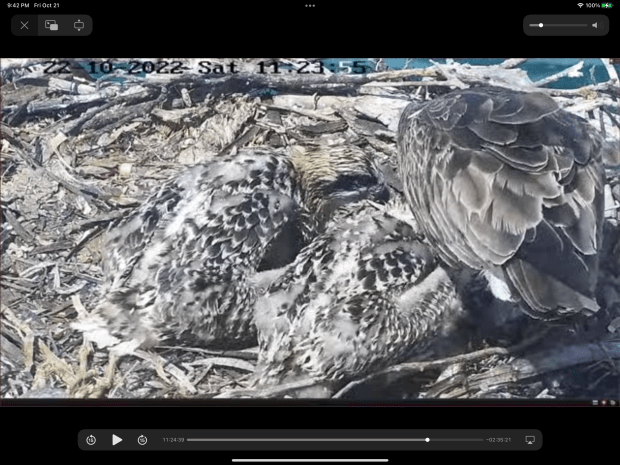
The shock of all shocks was Indigo being physically strong enough to fly into the scrape box and scare the wits end out of Rubus and Diamond who were enjoying a nice meal!
What great form! She landed in that scrape safely and took control of that prey. The in climate weather for the past day must have meant she had not had food and was famished.
Indigo stayed in the scrape with Rubus. He was there when they turned the IR off. (Cilla has done this to keep the numbers of mosquitoes down).
Dusk is coming.
Two specific incidents come to mind. One was Legacy, the 2021 fledgling of Samson and Gabby at NEFL. Legacy flew off the nest. I would have to check but, she was gone about a week. Everyone presumed she was being fed by the adults. She was seen flying into other eagle’s nests and it appeared to birders on the ground she was looking for her natal nest. She was caught on camera flying close by and then one day, she landed on the nest. She was famished and she did not fly off that nest for another month! Samson and Gabby were so glad to see her they provided so much fish! The second was WBSE 26. 26 was in the forest for about a week being harassed by the Currawongs and Magpies after fledging. She made it back to the natal nest, exhausted and hungry. Again the parents happily took care of 26 – you could almost see Lady’s delight that her baby was home. 26 stayed, ate, and got her strength up for about a week before being chased out of the forest. That was 2 years ago today that the Magpie helped 26 fight off the Currawongs.
I was also thinking about Izzy who returned to the scrape at Orange for so long. Diamond had to block the door finally for Izzy to get the message to move on. I suspect that Indigo is tired. Flying is a lot of work and the birds have to build up those muscles. Indeed, Indigo did go to sleep eating! Indigo might have been flying around the campus not connecting with the parents for a prey drop during the stormy weather the day prior. It will be interesting to see what happens when Rubus fledges. For now, isn’t it a delight to see Indigo safe and back in the scrape knowing he has had a meal?
The third surprising event was just a shattering. Four eggs from the Royal Albatross that are now breeding at Taiaroa Head have been stolen! There is no evidence to suggest that predators took the eggs and the NZ DOC is working with the police and going over footage to try and determine what has happened. Unbelievable.
Hearts are breaking.
Whenever something really terrible happens, I think of Ervie and today, thank you Friends of Osprey for posting more pictures of our beloved lad. Now notice Ernie’s lovely necklace. We know he is a male so, let this image guide us. Males do have necklaces. Blue 022 has a stunning one. It is not a foolproof method of determining gender in Ospreys.
Just look at Ernie’s nice crop. I wonder how his talon is coming along. I could not tell from the images but, he certainly is a most handsome osprey.
Speaking of Ervie, Friends of Osprey posted another image of Ervie with his satellite tracker and an explanation about trackers and why they are important.
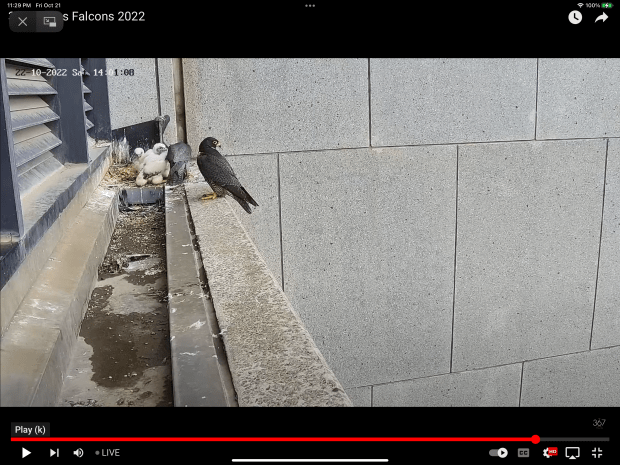
Sad news is coming out of Melbourne. This is the fourth event – another shattering one. One of the fledglings has been found on a footpath near 367 Collins Street. Send all your positive wishes, please.
Just about the time we think things are going quiet, events that we might not have imagined take place. Our thoughts go out to the fledgling from Collins Street so that it will improve quickly and be able to be released. Life is very challenging for the urban birds. While there is generally a lot of prey – pigeons – there are also lots of buildings with glass that are difficult to manoeuvre when one is just learning to fly.
Thank you so much for joining me today. Take care all. If you get a chance stop in and check on Indigo, she might just stay at the scrape today. See you soon!
Thank you to the following for their posts and streaming cams that made up my screen captures: Friends of Osprey FB, Port Lincoln Ospreys, 367 Collins Falcon Watchers FB, Royal Cam Albatross Group NZ FB, Port Lincoln Ospreys and Charles Sturt Falcon Cam and Cilla Kinross.
I hope that everyone has had a wonderful start to their Saturday. It is -8 degrees in Winnipeg, heavily overcast with some flakes of snow drifting down. The Blue Jays have been scurrying back and forth for peanuts since dawn.
The following quote is from an article that ‘K’ sent me and I wanted to share it with you. I do so treasure these feathered friends of ours. They have brought me so much love and joy. I cannot imagine – for a single instant – life without them. When I park my car on the street and walk to my house, I can hear them. Singing. What happiness that brings!
“All is an Ocean. All flows and connects so powerfully that if, in this life, you manage to become more gracious by even a drop, it is better for every bird, child, and animal your life touches than you will ever know.” (Dostoyevsky’s, The Brothers Karamazov)
The pictures are from the day before the snow. Mr Crow is here, Junior and one of the three siblings, a White-breasted Nuthatch came to visit, too.
This is Junior. He is the Dad of the three fledglings this year. Junior normally stays all winter. How do I know it is Junior? His feathers are a little duller but it is the thin eye line that extends further back. You can compare them. Junior is sitting on the edge of the bird bath while one of the fledglings is down getting a peanut.
Black isn’t just Black but depending on the light it is a green black or an iridescent purple blue with green as in the second image. Mr Crow is beautiful. My heart warms every day that he comes as it does for all the others.
It was the first time ever I have seen a White-breasted Nuthatch at the feeders in a long time. The last was on the 13th of October in 2019. A little over three years. According to the recent bird surveys, the Nuthatch population is on the rise in Canada and the rest of North America. We normally recognise the Nuthatch because it moves along the tree branches with its head facing downwards.
The squirrels have all been here, too. They have not cooperated for photos! Most of the time they are trying to get as many nuts off the solid seed cylinders as they can!
Making News:
Oh, we all love those shy flightless parrots who are more than vulnerable. There is new research that might help in caring for these marvellous characters. Adorable. Simply adorable.
Halfway around the world, a much anticipated California Condor release took place a week ago. The Condor is as vulnerable as the Kakapo is. These releases are always great moments, full of emotion and excitement. I missed this event and am so grateful that the release of these four birds back into the wild has been archived so that we can see it at our leisure.
In the Mailbox:
‘N’ writes: Today this was posted by one of the moderators at one of the streaming cams: “We’ve been trying to discourage anthropomorphic stuff for years, I’m afraid. It’s a losing battle. people project human emotions on the birds all the time.” You have mentioned this subject several times. Is it possible for you to repeat what you have said?
I would be happy to, ‘N’. First I would like to introduce Dr Marc Bekoff who is the international authority on animal emotions. He is Professor Emeritus of Ecology and Evolutionary Biology at the University of Colorado in Boulder. I am extremely impressed with the work that Dr Bekoff and other Cognitive Ethologists are conducting. Cognitive Ethology is the comparative, evolutionary, and ecological study of animal minds. This includes their emotions, their beliefs, their reasoning and processing, their consciousness, and self-expression. The keen interest, ‘N’ in animal cognition is not new and it is extremely important for animal welfare and protection. Bekoff sees the field as all encompassing in terms of understanding the subjective, emotional, empathic, and moral lives of animals.
In his research, Dr Bekoff has consistently said that as humans the only language we have is our own and it is the only thing we have to describe animal emotions. If we do not look at them and use the words joyful, grieving, then what words would we use to describe what we are seeing? We have nothing more than what we have. Dr Bekoff continues in his book, The Emotional Lives of Animals, by saying that he knows no researcher who, when working with their animals, “DOES NOT FREELY ANTHROPOMORPHIZE. THIS ANTHROPOMORPHIZING IS NOTHING TO BE ASHAMED OF, BY THE WAY; AS ALEXANDRA HOROWITZ AND I HAVE ARGUED…THESE SCIENTISTS ARE SIMPLY DOING WHAT COMES NATURALLY. ANTHROPOMORPHIZING IS AN EVOLVED PERCEPTUAL STRATEGY…IT IS NOW LARGELY ACCEPTED AS FACT, THAT ANIMALS, SHARE THE PRIMARY EMOTIONS, THOSE INSTINCTUAL REACATIONS TO THE WORLD WE CALL FEAR, SURPRISE, SADNESS, DISGUST, AND JOY.” (10). The capital bold letters are mine.
I could continue on for pages ‘N’ but, it is upsetting when someone makes the statement that you have written. I am sorry but they are not informed by the current science. There are many who believe that animals do not feel pain or fear. It makes it easier to kill them! We know animals feel pain. I have seen eagles and other raptors grieving along with the Corvids in my own neighbourhood. I have seen Grackles celebrate the fledge of one of the chicks in my garden (they invite the extended family) and we have all heard and some have been blessed to witness the rituals associated with Crows when one of their group dies. I hope this answers your question and provides you with a beginning from someone expert in the field, Dr Bekoff, to rebuff those statements. I also urge everyone who is interested in this topic to get a copy of this amazing book. It is paperback and can be ordered through library loan as well. It will provide you with a clear foundation on this subject backed up by clear examples, not anecdotes.
In other mail, ‘K’ sent me a wonderful letter and an article, “Cherish This Ecstasy” by David James Duncan from The Sun written in July 2008. I want to share the topic of that article with you – bringing back the Peregrine Falcons from extinction. It seems so appropriate as we just watched Indigo and 2 or is it now 3 of the Melbourne Four fly and await Rubus’s triumphal departure.
Now do you know what the invention was that brought the Peregrine Falcons back from sure extinction? It was the Peregrine Mating Hat invented by one of Cornell’s Ornithologists. The ornithologist would put on the hat. He would sing Chee-up! while, at the same time, bowing Buddhist style. You have seen our falcons do this in their bonding rituals. The male falcon copulates with the hat. The scientists remove the sperm and inject it in the few females they had at the time. The hatchlings were raised in a DDT free environment – and that is how we now have Peregrine Falcons living almost everywhere.
Here is an example of the hat and the process. Turn your sound down a wee bit.
While we are talking and thinking about everything falcon, it is a good time to mention some of the really good books that are out there. They are in no particular order but each is loved and well worn and I pull them off the bookshelf often.
Falcon by Helen MacDonald. I love MacDonald’s books. That is not a secret. This little paperback volume is the social history of falcons from the gods of the Ancient Near East and Egypt to the hunting falcons of Europe and the Middle East. Everything you wanted to know about falcons and more including their use in the military. It really is a good read particularly if you want to known more about falcons than just scientific data – their entire cultural history of falcons in a wonderful narrative. My first pick always for a book on the subject of falcons (not just peregrines) other than a guidebook.
On the Wing. To the Edge of the Earth with the Peregrine Falcon by Alan Tennant. Ever wanted to fly? to understand how falcons migrate? This is the view from Tennant’s flying and tracking of the falcons as they migrate. Tennant narrates the voyages tracking the birds with the tiny little transmitters on their tails. I like it because the science is woven in with the narrative.
Queen of the Sky by Jackie Morris is a beautiful little book. It not only includes the stunning watercolours of Morris and gorgeous photographs of Hiss and her friend, Ffion Rees, who rescued this dying falcon from the sea and nurtured it back to health. This is a profoundly personal and moving book. There is a deep connection between Ffion Rees and Hiss that develops over time but which began the minute Rees looked into the eyes of that raptor. They looked into the souls of one another. Highly recommended for the art work alone but the story will certainly move you.
The Peregrine by JA Baker. Baker tracks a pair of peregrine falcons during their daily lives. He is transfixed by them. You get to know their habits – everything about them – through the eyes of Baker. Many consider this a ‘must have book’ for the shelf.
There are more but these would get you started – but, as I said, out of all the MacDonald is first. Since I love the paintings of Morris and the positive story of a falcon rescue and release the Morris is second.
And one last falcon bit. Dr Cilla Kinross (the researcher at Orange) went out looking for Indigo today. Xavier and Diamond saw her. I imagine they did not want her to get too close to their beautiful fledgling. The video will not win any awards but it does give you a fantastic idea of the sounds the adults can make if they are anxious about someone being near their offspring.
Before we check on any of the other nests, let’s see how Rubus is doing in the scrape alone. It would appear that some of those dandelions are shedding but there are lots to go. Rubus also appears to be only interested in the visits by parents if they have prey! My goodness Rubus is ferocious when there is prey about. Diamond has been flying up and checking on Rubus quite a bit this morning.
The beautiful golden glow of dawn falls over our dear little one, Rubus, who now looks out to the wide world of Indigo and the parents. Rubus, you will fly too but…it is going to be awhile. You need to get rid of most of that fluffy down. Flap those wings and shake, shake, shake.
Dare I say that Rubus is missing Indigo?
Rubus would love another prey delivery.
Diamond goes over to check on Rubus.
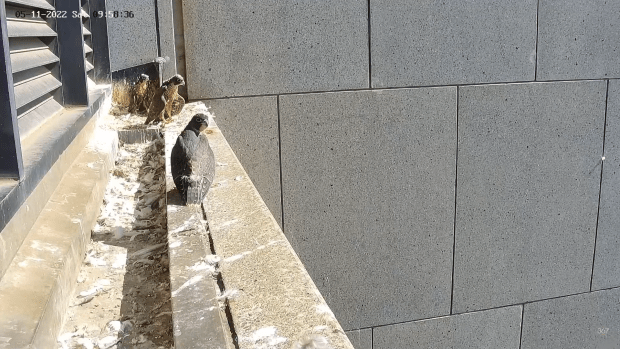
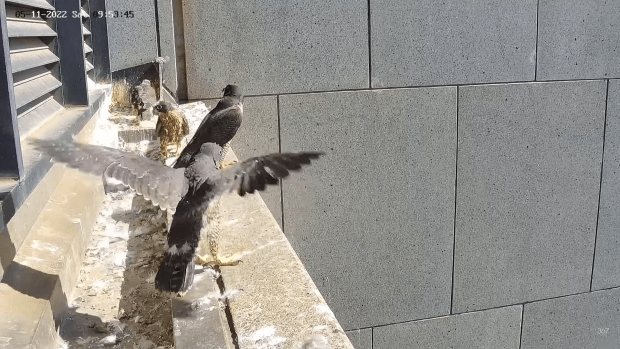
At 367 Collins Street, it is anyone’s guess as to how many of the eases are now fledglings. We know from a video clip from ‘Bathroom Guy’ that at least one has fledged. It is now believed that there are two. This morning very early there were three erases on the ledge waiting for a prey delivery – or at least hoping for a prey delivery! Did one return for breakfast? We know that the eyases can easily reach this height.
Here is a group of photos of the erases on camera this morning. Looking, listening, eating, and loafing.
Loafing has spread around the world…starting with Alden at UC-Berkeley. What an influencer he is!
It seems as if two have fledged and two remain to fledge – but, in truth, we have no idea! That is the nice thing about the scrape at Orange. You can be absolutely certain when the eyas flies for the first time!
The streaming cam remains off at Port Lincoln. This morning when it was back on there was a note that Big had two fish meals both of them brought in by Mum. Thank goodness Big is older and Mum is a good fisher. It is difficult to determine what is going on with Dad but, whatever it is could be linked to his two seizures seen on camera during the early incubation stage.
5 Red Listed Bird: The Mistle Thrush
Mistle Thrush (Turdus viscivorus) captured at Borit, Gojal, Gilgit-Baltistan, Pakistan with Canon EOS 7D Mark II
I first saw an image of this lovely bird after the ospreys had started their migration to Africa. For the life of me I cannot remember if it was the Glaslyn or the Dyfi nest in Wales but, on one of them was this stunning little bird, the Missile Thrush. The scientific name Turdus viscivorus means ‘devourer of Mistletoe’. It is a large songbird with a grey-brown head, back, and wings. Its breast is spotted with the same grey-brown on ivory. Piercing deep espresso eyes with an ever so slight eye ring. The pop of colour comes in the pinky-peach legs. One can only imagine that this combination in haute couture would land it on the Paris runways. In its behaviour, this Thrush is powerful and aggressive. It eats insects, invertebrates, and loves berries. They do love mistletoe but will also eat hawthorn or holly berries. The largest of the warblers in the UK, their son is loud and is carried for a distance from their perch high in trees. Actually, it isn’t a song but a rattle.
These lovely birds are globally threatened. Their numbers have declined dramatically, as much or more than 50%. The cause is a lack of habitat. Hedgerows where the find food and wet ditches because of the drainage of farmland has led to a lack of earthworms and other invertebrate that the Missile Thrush relies on for its food. Cow pastures and woodland have also been lost or degraded.
Research conducted by the RSPB suggests that ‘Farming measures likely to help song thrushes include sympathetic hedgerow management (with tall, thick hedges), planting new woodlands on farmland, and planting wild bird seed mixtures including leafy cover.’ In addition, the RSPB found that preventing the soil from drying out during the summer would be of great benefit to the thrushes. Hotter summers have brought more rain so perhaps, there is some hope here.
Migration News:
Bonus remains in close proximity to the area he has been in Turkey for the last little while. Waba is still in the Sudan feeding at the Nile but has moved slightly south.
It is so wonderful to have you with us. Thank you so much for being part of this marvellous international family of bird lovers. Take care of yourselves. See you soon!
Special thanks go to the following for their posts, videos, and streaming cams that make up my screen captures: Kakapo Recovery, Ventana Wildlife Society, Charles Sturt Falcon Cam and Cilla Kinross, and 367 Collins Street by Mirvac.
I hope that this finds you well. The kittens are very active this morning. The Starlings have discovered the Butter Bark! And the Blue Jays are eating peanuts and what better entertainment for the kittens than watching birds safely behind glass!
Lewis is a charmer.
Oops. Turn your head! Missy is sideways smelling the orchids and moved quickly to see the Blue Jays.
They are adorable and are tied at the hip to one another. It doesn’t matter what they are doing, they must be together – eating, sleeping, and being a poopinator.
Late Wednesday, Nicole was upgraded to a Hurricane. As she went over Florida last night, Nicole was again down graded to a Tropical Storm. These are the latest images.
I will be posting my blog when it is approximately 1000 Thursday the 10th of November. This system will not be moving out of the region of Samson and Gabby’s next until much, much later in the day. Harriet and M15 got a right soaking. Continue to send your good wishes to all in this region.
The real news of the day is ‘waiting’. Waiting for fledging in Australia and waiting for Hurricane Nicole to pass in Florida. Yes, Nicole is now upgraded to a hurricane from the previous tropical storm. Winds and rain are increasing across the state of Florida.
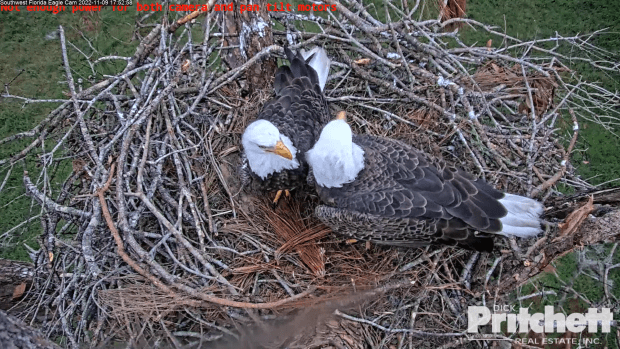
Before I go any further, we all love Harriet and M15. They are weathering Hurricane Nicole together – in the nest! Talk about love and devotion. They have rebuilt after Hurricane Ian and they are staying together Wednesday night as Nicole approaches. Send them all the love you have! These two are amazing.
It is starting – the winds are swaying the nest. Harriet and M15 are both still in the nest together. Oh, my heart just goes out to them. They need that nest to hold. It will not be long until Harriet is laying eggs.
Early Thursday morning. Together and wet. Oh, did I tell you? Harriet is 28 years old!
In the News:
I am so happy. The wildlife rehabbers who cared for the Pitkin County Osplet did not have staff to deal with messages after the osplet came into care. Pitkin County gave me their name and I wrote to them a couple of days ago and now they have posted the information for the public. This is really important. I want each of you to remember because pre-fledge osplets really do well in care! They survive and they have a second chance at life. The image of the beautiful osplet below is the evidence.
Birds of Prey in Colorado has two waiting for release in the spring. Let us all debunk this urban myth.
Last June, the female at the Pitkin Open Spaces and Trails pulled her two osplets off the nest accidentially. One died, this one went into care and is waiting to be released in the spring.
I have been slowly gathering up evidence of successful treatments for pre-fledge Ospreys or any Osprey that has been taken into care. If you are aware of any ospreys in care or that were in care and released, would you please contact me with any details that you know. It will really help make my case to Port Lincoln that there is good evidence – hard evidence not anecdotal – that pre-fledge ospreys do well in care. By poking a hole right in the middle of the rumour that has spread and established itself as fact, it is possible that ospreys like Middle can survive. For Little and Middle, let’s work to change this to: Pre-fledge Ospreys do as well in care as do Post-fledge Ospreys!
Let’s take another look at Coots. Do you have Coots in the ponds or wetlands where you live? Sometimes called the ‘black duck’, the author of this article fell in love with them when he was a wee child.
The Roseate Tern is the most rare of all the sea birds that breed in the UK. There has been a lot of interest in the migration of the Roseate Terns from the UK and from Ireland. Satellite trackers have discovered that they migrate to the West African coast and spend their winter in the Gulf of Guinea. Those Roseate Terns from North America also have an impressive migration. They travel to the eastern part of Brazil. These journeys are more than 15,000 km return made across the open seas.
They are such beautiful sea birds. They are called Roseate because of the pink tint to their gorgeous plumage. Their beak is slender they have a long forked tail, a white cap with grey wings and white under belly. Their legs are longer than other Terns. This means that they can walk through higher and thicker undergrowth and this is where they make their nests so they are not in competition with other terns.
The Roseate Tern is globally threatened. One of the greatest challenges these beautiful birds face is the human disturbance of their nesting sites and the collecting of their eggs. Climate change, flooding, and frequent storms are also major contributing factors in the decline of the species.
The following contains information on the threats to these amazing sea birds.
The camera turned and all of the Melbourne Four were still home! Gosh, if you didn’t know it, at a glance, these look like fine full grown Peregrines.
Hot in Melbourne. Some are looking for shade!
It is raining in Melbourne and ‘A’ tells me that it is not a good day to fledge now and won’t be for a few days more. Hopefully the Melbourne Four will stay put!
According to my eagle-eyed and ears friend ‘A’, the Melbourne Four were on the ledge when Mum brought a prey item in at 181203. They ran down to the other end where the 4th eyas was.
A small fish came on the Port Lincoln Opsrey barge. Mum took control and then gave it over to Big. I think Mum was hoping for the tail but Big took it, too.
Big is as big as Mum now. Look at those legs. Here the pair of them are prey calling Dad who is on his way with breakfast.
Big is not going without food. Dad brought in the small fish this morning and then, seeing Dad over on the ropes, Mum decided she best get out there and bring in the afternoon meal. Big might have thought she would get the whole thing to herself but Mum had other ideas and started out feeding her girl. She managed to get some bites. Big will take the fish and would take all fish if left to her own now.
Dad will bring in another fish. There were three delivered on Thursday in Port Lincoln. Those times were 09:33, 15:01, 19:22.
If the weather is good, Big will be banded, measured, and named sometime between the 12-14th. That is a few days away. I hope to find an announcement with the specific day for you.
Lots of Starlings and other prey coming into the scrape. Both Indigo and Rubus are excellent self-feeders. It is wonderful to see. Indigo continues to look out at the world beyond and poor Rubus, he still has so much flu that it will be a bit of a wait. Don’t worry Rubus, Mum and Dad will feed you – they won’t forget!
Indigo is adorable.
It is just after midnight on Thursday and this is the recap of Thursday up until late afternoon at Orange: RECAP 6 02 26 D w/grebe, Rubus takes; 08 45 13 X w/juv starl, leaves; 10:17:16 X w ER, Indigo takes; 10:24:23 D in, feeds Rubus; 14:50:29 X w/prey, Indigo takes.
At one point, Indigo was running around the scrape flapping her wings and chasing Rubus. Remember. Indigo does not have the room that the Melbourne Four have to run off some of the energy and to really get the wings and legs going.
Rubus had no idea what on earth was going on with Indigo. There was a piece of prey stuck between her talons. Was that the cause of all the restlessness? or is it that Indigo will be fledging soon?
Indigo was able to get the piece of prey out from her talons and she settled. Look at Rubus watching everything that she is doing. He will miss her when she flies. If she does what the others have done, she will fly down to the trees where she sees the parents. They will also lure her with prey items and begin teaching her how to hunt. They will do this for 4-6 weeks until Indigo leaves their territory. Now that I say that we must not forget that Izzi did not leave home until Diamond would no longer let him in the scrape many, many months after she should have left.
Indigo will not fly back to the scrape box. She is not strong enough to undertake that steep upward flight yet but, she will get those muscles really going once she is down chasing after Diamond and Xavier.
Rubus will either love having the prey all to himself or miss Indigo or both.
In other news:
Continue to send your best and most positive wishes to the nests in Florida. Ron and Rita’s human designed nest on the grounds of the Miami Zoo is really beginning to rock and sway. You can see the movement of the palm trees caught in the image below. There are so many, many nests in Florida and it is the wintering grounds for some of the birds from the north.
Gabby and Samson’s nest near Jacksonville is really blowing and rocking. It is in one of the areas that is expecting the highest winds.
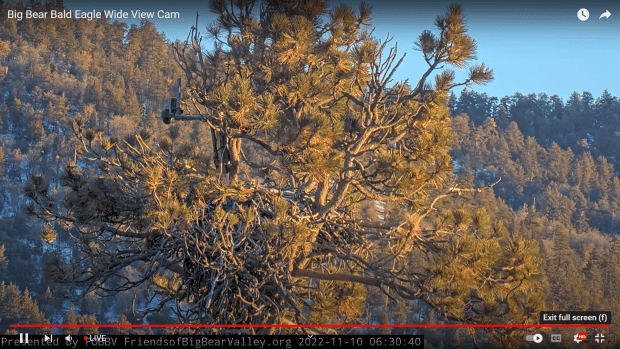
The record snow and wind has caused power outages at Big Bear Valley. The cameras for Jackie and Shadow are offline at the moment. We will wait and see if they are up tomorrow. Thursday. The camera is up over the valley but the nest camera remains offline. The storm has passed. Yippee.
Thank you so very much for joining me today. Please take care of yourselves. See you soon.
Thank you to the following for their posts, videos, and streaming cams where I took my screen captures ‘A’ and ‘H’ for their eyes and ears on Collins Street, National Hurricane Centre, SWFlorida Bald Eagles and D Pritchett, Pitkin County Open Spaces and Trails, ABC News, Port Lincoln Ospreys, 367 Collins Street by Mirvac, Charles Sturt Falcon Cam and Cilla Kinross, WRDC, and NEFlorida-AEF.
I am so sorry that the link I published to the story of WBSE26 did not work. The one under question 1 below works! Thank you ‘J’ and ‘H’ for alerting me to this issue!
It is actually 2030 on the Canadian Prairies, Sunday evening, and the snow that was forecast, arrived. The precipitation goes back and forth between snow and freezing rain so it is like a slushy drink outside. The garden birds will not be happy. Watching them during the torrential rains last spring, it is readily apparent that they prefer the snow (dry snow not heavy wet) to the rain. Their food does not ruin and they can fly easier. So many prefer to eat directly off the deck than from the feeders that I worry about them when it is so wet. Will this snow be here in the morning?
It stayed. The squirrels have run all over the place. Dyson was here early with her two kits.
The miniature weeping Caragana and Japanese lantern look lonely this time of year.
One of Dyson’s kits. The other is in the lilac bushes.
Dyson under the bird bath eating Black Oil seed and peanuts she found under the snow.
On the Bookshelf:
One of my biggest complaints about bird guides is the images. We have a locally published book on Manitoba Birds. It has drawings instead of photographs and they are lovely but, they are only helpful to an extent. Sometimes there is only the image of the adult male. There are never immatures! And definitely not an immature female bird. How are we supposed to learn which is which in the garden? Merlin ID has driven me crazy. My best book for sparrow ID has been the hefty Crosley’s Sparrows. But, what if you want to identify other species? Some have pictures or drawings the size of postage stamps and the layout designer used the size 8 font so that anyone over the age of 30 or someone with poor eyesight cannot read the text.
There is a new book out that will help those living in Europe. You might still need a magnifier to read the text or probe the maps, though. The book is Europe’s Birds. An Identification Guide. It is a weighty volume. You will not be hauling it around with you in the field but, it should be a much used reference for home. The images are far superior to any I have seen in other volumes. In Canada, the hard copy is $36…well below the average of some of the other guides that take up space but do not help one bit with IDing a bird!
In the Mailbox:
Oh, I love getting questions! There were 3 today and all of you might be wondering about one or more of them.
1. ‘J’ wrote about having difficulty opening the link to the former blog about WBSE26. I am so very sorry if this happened to all of you. Here is a link that works. 26 is inspirational and needs to be remembered for all the joy and encouragement she gave to all of us in her short life.
2. ‘K’ wrote: ‘Will the parents continue to feed the chicks on the ledge in Melbourne after they fledge?’
‘K’, that is a difficult question to answer. Normally, the adults would begin teaching the eyases how to hunt when they fledge. They would deliver prey to them in mid-air transfers and would be finding other places to feed their fledglings. The previous couple did not feed the fledgling falcons on the ledge. Mirvac turned the camera off at that time. These are first time parents and we will have to wait and see but I assume the answer is ‘no’, they will not bring prey to the ledge for the falcons if they have fledged. Prey would be taken to those that have yet to fly. You might also have noticed that the adults have begun to reduce the amount of prey that is being delivered. Food is a great motivator!
3. Several asked, ‘Will the Collins Street eyases fledge one by one or will they fledge together?
Like question 2, this is difficult to answer for several reasons. Males tend to fledge before females. The reason is simple. It takes females longer to produce all the feathers for their larger size than the males. At the present time, we do not know the gender of these chicks and it is likely we never will as they are not ringed nor has any blood been taken to determine gender. We should, however, expect the male to fly first. Victor Hurley has said he believes that there are 3 females and 1 male. But is the male the 4th hatch or the 1st? or the 3rd? Hatch order and gender could impact the timing of fledge. So if the male is the 4th hatch he might fly the same time as the 1st if that bird is a female because of the difference in their ages.
I have seen many nests where the eyases get so excited seeing one of their clutch fly that they all fly off within an hour. It has happened at this ledge. Now that the youngest has made it to the window ledge, I am wondering if the eyases might not all fledge within an hour or one another. We should know the answer to this question soon! I know that this does not answer your question. It might even confuse it more and my apologies. We just don’t know! They will keep us guessing until they take off…and then we will wish them safe skies, long lives, and full crops.
Fledglings depend on the parents from 4-6 weeks to help and teach them how to hunt and obtain prey. They will then leave the parent’s territory.
One of the most difficult things about getting close to the birds is not knowing what happens to them. Some people prefer to not know while others like myself, want to know every detail of their life. I think that is why satellite tracking is so interesting to me or a book such as Bowland Beth.
Australian Nests:
You might well have noticed. Mum and Dad at the Port Lincoln Osprey barge don’t seem to be in such a big hurry in the morning to get up and off and find fish. Dad appeared to have a leisurely morning and Mum went and had a spa break. Good for her. She must eat and take care of herself.
Mum and Dad are also spending a lot of time with one another. Mum has fed Dad – a tender thank you for the food he brought when she was so desperately hungry -, they have sat together in the shed, and now they are spending time on the perch. If someone believes that they are not mourning, they need to consider the behaviour of these two beautiful ospreys who have lost two chicks. The loss of Middle had to be particularly difficult, a fully feathered osplet.
Dad flew in with a large whole fish. It looked like Big wanted that fish for itself but Mum prevailed and kept control. She remains in charge of the feeding. Is this on purpose? Big is now the age that she should be self-feeding. Big hatched on the 18th of September. If we count hatch date, Big is 51 days old. She will be ringed anytime between today and Thursday. We should be able then to confirm the gender, the weight, a name, and see Big with her tracker.
I had to laugh. One of the chatters said that, ‘Big is just an eating machine’. That is possibly why Mum still controls the reigns of the fish so that she gets fed properly, too, when an extra nice fish like the one that came in this morning is delivered.
Look at that fish. Wow!
Watchers of 367 Collins Street are having a hard time deciding if any of the eyases have fledged. They are such beautiful eyases. At 1400 all four were on the ledge.
‘H’ did a great compilation of the 4th hatch, ‘little Peanut’ branching up to the window ledge. Watch as the others come down and do a ‘cheer’ for the wee one.
Indigo and Rubus are changing every day. Like Big, Rubus is a bit of an ‘eating machine’. When Rubus hatched and was so absolutely tiny and couldn’t get up to eat – do you remember? -, I felt so sorry for Rubus. Indigo was just tall, stoic, and elegant. At one point it seemed like Diamond didn’t want to bend down to feed Rubus. And then…Rubus started jumping and stretching that neck. What a long neck and well, that is all history. Rubus practically knocks the parent over if there is food. Indigo appears to want to look out to the world beyond and feed herself. Rubus gets fed but is doing quite well at self-feeding, too.
‘Hello Everyone!’
Rubus was very happy that Indigo left some prey.
Rubus is doing a great mantling of the second prey delivery. Indigo is not interested. She ate most of the earlier delivery and is looking out to the world where she will be flying with her parents – the fastest bird on the planet!
Look at Rubus’s wing feathers. Lovely. We will wake up one morning and Rubus will look like Indigo. What a shock that will be!
At 1642 prey was delivered. Indigo expected to get it but, Rubus was quicker grabbing the item and carrying off into the corner by the Cilla Stones.
Indigo is telling Xavier and Diamond about how naughty Rubus was taking her prey!
The adults leave the kids to it…Rubus takes the prey to eat it in the back of the scrape while Indigo comes over and wants the food. Rubus turns quickly to protect his meal and heads back to the Cilla stones. Rubus has had some good fast bites.
Indigo will eventually get the prey from Rubus through the great ‘stare down’.
Need a refresher on falcons? This is a good resource on Peregrine Falcons that includes many helpful links that you might find interesting.
Harriet and M15 have been working really hard rebuilding their nest that was completely destroyed by Hurricane Ian. Lady Hawk has posted a video of their progress. And guess what? Harriet is sleeping on the nest tonight. Eggs might be coming soon!
Philippe Josse posted some super screen captures of Mum and Dad at the Notre Dame Eagles nest in St Patrick’s Park in South Bend, Indiana. This is the home of our beloved Little Bit ND17 – the little eaglet that could. Their nest completely collapsed and many wondered if they would rebuild in the same place. They did and both have been walking around testing the nest to make certain it is sturdy. Thank you, Philippe!
Jackie and Shadow continue to work on their nest in the light snow in Big Bear.
And last but, never least, some great news. I have been tracking down information on ospreys that went into care before they fledged. There is an urban myth that they do not do well in care and, in particular, before fledging. You might remember the two osplets that had not fledged at Pitkin County Open Spaces and Trails. Their mum pulled them off the nest by accident. One died while the other went into care. It is doing great and is being over wintered and will be released in the spring. Urban myth proved wrong. (I have been asked not to publish the name of the wildlife centre as they do not have the staff to answer queries). This is good news and details will be sent to Port Lincoln.
Banding will take place anytime between today and Thursday at Port Lincoln. I have seen no specific time or day indicated yet.
Thank you so much for being with me this morning. Please take care. See you soon!
Thank you to the following for their posts, videos, and streaming cams where I took my screen captures: ‘H’ and 367 Collins Street by Mirvac, Amazon.ca, Port Lincoln Ospreys, 367 Collins Street by Mirvac, Charles Sturt Falcon Cam and Cilla Kinross, FOBBV, ND-LEEF and P Josse, SWFL and D Pritchett plus Lady Hawk.
Thank you so much for joining me this morning. It is lovely to have you here. I want to say, right off the top, how inspiring each of you are to me. Osprey season, for me, begins in Australia and it has been a particularly devastating start after the great breeding year of 2021 that produced Bazza, Falky, and Ervie. Fortunately, I did not share that sadness alone and I thank you again for being such an empathetic and caring community.
As migratory season winds up in Manitoba, the wetlands and estuaries that were teeming with ducks, geese, swans are silent. There are no skeins of geese flying over my conservatory and already, I am missing their loud honks. Soon our time will ‘fall back’ and it will be dark by 1615. It appears, however, that the Blue Jays and Crows are staying on. Today, one of the Crows was able to tap hard enough on the bird bath to get some water. I must now find the water heater for them. It is very important to have water when you are giving seeds. Here, during the winter, the birds and squirrels will eat the snow but, they do not get the quantity needed so a heated source is very helpful.
It is 5 degrees. There are European Starlings in the trees in the back. Last year they came and ate and filled up before moving South. This year I wonder if they are intimidated by the Blue Jays. The weather report is for snow to arrive in three hours. It has been falling north of the City for hours.
Lewis and Missy are never apart. You would think they were litter mates. I just looked down and each was eating out of their hard food dish with Lewis straddling the water bowl so they could be parallel with one another. I have not seen kittens behave like this. It is literally like they are joined at the hip.
In the Mailbox:
‘C’ sent me a very long discussion with lots of good links from the Looduskalender English Forum about siblicide or cainism. I have skimmed some of the contents and have several parts thoroughly. The information provides good definitions and also alerts you to species that practice ‘obligatory’ siblicide. It is extremely stressful to watch a nest with two healthy chicks that have hatched knowing that the eldest will kill the youngest. If this troubles you, then please avoid those species or wait to start watching.
It is, perhaps, too early to read about this particular type of avian behaviour having lost Middle but, put the link aside and educate yourself.
This late summer, we were blessed with a Great White Egret in our City – indeed, eight or nine of them on a single tree at dusk. Here is a lovely story coming from the UK about walking in the marshes and discovering this amazing bird.
It is unclear if was fireworks that frightened F22 at the 367 Collins Street scrape last week but, something loud that sounded like fireworks echoing between the tall buildings of the CBD in Melbourne, scared this first time Mum off her perch.
Today, The Guardian is carrying an article demonstrating how fireworks causes geese to become stressed.
Many are choosing to use drones to light up the sky but, has anyone looked into the direct damage hundreds and hundreds of drones might have on birds? If you see anything, please let me know.
Sharon Dunne has posted some information about the new season at Taiaroa Head. It is getting off to a great start!
Pentobarbital Poisoning. There is at least one Bald Eagle in the US struggling for its life because it found a euthanized prey. It laid unresponsive but not dead and was taken to a rehabber who is posting information and working hard. How did this eagle get in contact with the euthanized animal?
So far, it has been a relative quiet day in Bird World. Every nest had prey deliveries in Australia and the last time I checked there were still four eyases on the Collins Street ledge.
At the Orange scrape of Xavier and Diamond, it appears that Cilla Kinross has changed her mind and believes Indigo to be a male. Is this size? legs? lack of aggression? I have not seen her statement and only noticed this latest information when one of the chat moderators included it today.
An unplucked Starling was dropped off inside the scrape box. Indigo began plucking it. It appears that Indigo’s very active plucking frightened little Rubus for a few seconds. Rubus ran and stood on the Cilla stones and then, watching and well, Rubus is always hungry, s/he begins to think about helping.
Rubus decides s/he will go and help.
The chicks made a good effort. Indigo was very good at plucking and little Rubus helped her by holding down a part of the Starling with the talons. But they did eventually give up despite their early morning hunger.
Rubus was really working on that Starling’s head.
Rubus twisted and turned and pulled getting some bites.
Looks like Diamond came and saved the day! Both chicks reasonably aggressive but, squealing Rubus slightly more so.
When I finished watching 367 Collins Street today, there were still four eyases on the ledge.
Oh, this one wants to fly so much!
They have been watching the adults fly. It is to lure them off that ledge. ‘Hey, look, you are a bird. Flap those wings and fly’ – Mum and Dad are telling them. ‘You can do it!’
It is 12:21 and all of the Melbourne Four are accounted for – there is one that is blending in well with the scrape box and one in the gutter looking like a piece of prey!
Sometimes Mum – who is now slim and trim – can look like one of the eyases. To tell the difference between an adult and a juvenile Peregrine Falcon, look at the bars on the chest. If they are vertical, the bird is a juvenile. If they are horizontal, they are an adult.
All present and accounted for at 1417. Just look at how much the youngest one has changed. You can easily see which one or ones are hungry. See the sunken crop of the one on the ledge and the full crop of the one in the gutter. Falcons do not need to eat every day and…of course, all of us want them to have banquets but, a day will not harm them. These four have learned how to pluck and are preparing for what they are meant to do – fly! So proud of these first time parents. They overcame so much to be able to fledge these four healthy eyases – and that fledging will be soon. I hope they all wait and fly off together.
Here is a very short video of a pigeon delivery to the Melbourne Four. They are sooooo loud. Once you know that sound you will never mistake it for anything else! Poor parent. Besieged.
Mum and Big have been eating. All of the nests have had food – at least one prey drop or more.
Big is big.
Big had a monster sized crop.
Big is very aware of her surroundings and around 1322 pancaked in the nest. A few minutes later she was looking around as if there was ‘something’ or ‘someone’ about.
Mum got a chance to eat some fish on her own — in the middle of the night while Big slept. Thank goodness. Big will eat everything unless the fish is huge. We are now within 5-7 days of banding.
Brief Eagle News:
If you are a Decorah North fan, Mr North and DNF were working on their nest this morning! There is hardly a Bald Eagle nest in the US that is not now going through nestorations.
Muhlady laid her second egg. Pepe was there at the Superbeaks nest in Central Florida giving support. Muhlady was the first Bald Eagle to lay an egg this breeding season. She will have the clutch finished before most even consider an egg!
Migration News:
Waba is still in the Sudan feeding at the Nile River while Bonus remains in Turkey. There will most likely not be any transmissions from Kaia or Karl II as they were already at their wintering grounds. This is typical. In past years there has been no transmission from Karl II until he began his return journey to Estonia. This is the first year that Kaia has a transmitter.
Thank you for joining us today. I hope that your weekend has been good. Please take care. See you soon!
Thank you to the following for their posts, videos, articles, and streaming cams that make up my screen captures today: Raptor Education, Royal Albatross Cam and Sharon Dunne, The Guardian, Looduskalender Forum, Port Lincoln Ospreys, 367 Collins Street by Mirvac, Charles Sturt Falcon Cam, Decorah North, and Superbeaks.
I hope that each and everyone of you has had a wonderful start to this first weekend in November. Here on the Canadian Prairies we are really saying goodbye to autumn as the days get colder and colder. It is now time to put away any light to medium weight jackets and pull out the scarves, toques, boots, gloves and all other paraphernalia such as snow scrapers and shovels. The forecast is for a 70% chance of snow on Sunday!!!!!!!!!!!! Then a further possibility next Wednesday and Thursday. Of course, it is going to rain in between which means icy roads. I dislike winter until we are right in the middle of it and life has settled down to something resembling a hibernating bear with a mug of hot chocolate.
Are there days in your calendar where events coincide? The 5th of November is one of those for me. It is Guy Fawkes Day in the UK. Fawkes was part of a Catholic group that tried to burn down Parliament in 1605. It is now better known as Bonfire Night when effigies of Fawkes are burned on bonfires along with the traditional eating of the ‘jacket’ potato. There are many fond memories of the smell of the leaves, the smoke and the fires, the potatoes with all their fillings, and just the camaraderie of friends gathering on a fall evening. 5 November is also the birthday of my late mother-in-law Vi (she was a real sweetheart), the birthday of my late friend Joanne (who died in a fire), and very much the birthday of my BFF here in Winnipeg who is celebrating her birthday today in Dublin. Happy Birthday, ‘S’.
There are many good things in life – ‘good’ friends, ‘close and loving family’, sunshine warming our face, a soaking forest walk, watching birds, warm cookies from the oven, warm bread from the oven, a smile from a stranger, our wonderful feathered friends with their large beaks and huge talons, and our pets, if we are able to share our lives. Many can’t. Of course, that is not an all inclusive list and everyone will have their own and I can add each of you to that list also. A community of empathetic, caring, concerned individuals. I am so lucky.
My Dad loved all animals. He hand fed the Cardinals and Blue Jays in our garden, took in and found homes for all the stray dogs and cats that mysteriously wound up in our yard and tended a gorgeous rose garden…I am so very grateful to him for opening up the beauty of the natural world to me before I could walk. That is where I turn – the birds, the trees, the animals – when life is at what seems its bleakest.
Lewis and Missy really helped me ‘adjust’ (I never get over) the death of Middle. They could not have come into my life at a better time.
Forget factory made toys, roll up a piece of aluminum foil! Everyone will want to play with it.
Missy likes the in floor heating.
It is not always the little brother that starts all the dust ups.
Lewis just loves toys —————- and food! I don’t know where he puts it.
In the News:
Want to understand more about climate change and its impact on the seabirds of the UK, here is an excellent article from the British Trust for Ornithology. The implications could be applied to other areas as well. It is a good read and it will help us to better understand the challenges that seabirds have and will continue to have only multiplied.
It seems that we need to be careful with our toques (knit caps) in Canada. An owl might just swoop down and take it right off your head! I wonder if it had a pom-pom? or what colour the toque was? do owls prefer cool or warm colours?
This article talks about the prowess of Crows getting carrion off the highway. Want to help them? It wasn’t mentioned but, seriously consider stopping and putting the dead animal off to the side of the road – as far as you are able – to keep the Crows, Eagles, Vultures, etc – birds of prey- from getting killed trying to get food.
At Port Lincoln, the camera will sometimes find Mum along the opposite shore having a bath but I have never seen one close up. Here is a wonderful opportunity to see an Osprey enjoying a bath close up!
There are so many places to adopt birds. Our local wildlife rehabilitation centre will announce their holiday fundraiser shortly – you can adopt one raptor or the whole lot of them. Many of the nature centres connected with Osprey streaming cams in the UK also have fundraising programmes including adoptions. Many rely on calendar sales for 2023 – lovely images of the raptor families from this year to brighten your day and remind you of their bigger than life personalities. If you are looking for a gift that will have a huge impact and not wind up in a landfill, think about these fundraisers.
I have mentioned the Kakapo Recovery last week and I promise this is the last time…but, they do such a fantastic job monitoring, finding, assessing, and caring for this rare flightless parrot. They have limited adoptions available. Every cent goes to the welfare of the birds! (And I promise I do not get a single cent for mentioning them!)
Here is the announcement from the Kakapo Recovery: In case you missed our announcement last week, adoptions are once again open! If you’re ordering for delivery outside of New Zealand by Christmas you have until Monday the 7th to get these in. Kiwis, you have until the end of the month. Please note that if you log in to PayPal to make the purchase it automatically takes the shipping address from your PayPal account details – if your order is a gift then select ‘pay with card’ in order to be able to enter different shipping details!
If you live in the UK, the British Trust for Ornithology has a programme for youth to stimulate learning about birds. They provide binoculars and guidebooks to youth. It is part of their Equipment Donation Scheme. If you live in the UK and have a pair of binoculars to donate, please get in touch with the BTO. You can check out the programme at http://www.bto.org/equipment
If you live elsewhere and are wondering how to help youth get involved with nature and learn to appreciate our feathered friends, why not get in touch with your local wildlife rehabilitation centre or birding groups to see if they would like to start an equipment donation programme for youth. It is a win-win.
Nest News:
Jackie and Shadow, one of the most popular American Bald Eagle couples flew into their nest in Big Bear Valley this morning to find snow. The pair are used to it. Indeed, they could be lucky. Raptors do better in cooler weather! They are working on their nest. You might remember that they fledged Spirit last year – she stole our heart! And theirs. A successful hatch following several years of no chicks. Let us wish them the best of luck again this breeding season.
It is so good to see you, Jackie and Shadow!
Dad came in with a big fish for Mum and Big at Port Lincoln this morning. There wasn’t much time to sit on the nest and get hungry! Look at that time stamp.
I miss Middle. He was like a gentle soul on that nest. But, now, I need to live in the present with the birds, not wishing what could have been. We need to see Big grow and get ready to fledge. Banding and the name giving will take place between the 12th and 14th of November. That is one week away.
It took about 24 minutes for that large fish to be consumed. Wow. I sure hope Mum got enough. She was very careful in the delivery to make sure that she had control of the delivery, not Big. Good for Mum. Once Big starts taking the prey and self- feeding Mum will need fish, too. Wonder if she will just fly out and get them?
Big and Mum saw Dad come in with the fish. He was eating it on the ropes. Everyone had dinner before it was light’s out.
It was a bit of a change this morning at the scrape on the grounds of the Charles Sturt University. It seems that Indigo got a lot of the prey delivery. Goodness. Rubus was a little pouty. Still, they both had plenty. Diamond and Xavier will not let either eyas go hungry.
Rubus decides that if he isn’t going to be fed, he will just eat the prey himself! Remember Rubus has already successfully plucked and eaten a Starling’s head.
Thanks to ‘C’ who sent me this great screen capture of Xavier and Diamond putting on flying demonstrations yesterday. This will be to lure Indigo into joining the fastest raptor on the planet club. There is still fluff and Indigo is about a week behind Collins Street – and the older eyases could fledge there any time! They have their plumage – it is fully developed.
At 131730 Indigo has decided to pull Rubus across the scrape by its toe. Poor thing. You could hear Rubus crying.
A meal came in and all was well. No damage done! It was one of the most pleasant feedings I have seen in a long time at this scrape…equal shares.
When I last checked there were still four eyases living – running, flapping, eating – on the ledge at 367 Collins Street in Melbourne. Just beautiful beautiful eyases. I wonder when we will have our first fledge? It will be soon!
I had to watch and wait for all four heads.
Sometimes we get a tip of a wing showing and we know someone is still home.
There was some confusion surrounding a falcon that flew off the ledge at 0956. It was Mum, not one of the eyases fledging.
There goes Mum. There are 2 eyases in the scrape, one in the gutter, and another on the ledge. It will not be long but it did not happen at 0956. And it is an easy thing to assume until you begin to count bodies. We are all on pins and needles waiting for the first fledge – and it could happen while I sleep tonight!
All four were still present at 1730. Mum and Dad have done a fantastic job raising four healthy – very healthy eyases – for the first time. Just look at the place – what a mess.
Migration News:
There has been no news from either Kaia or Karl II for some time. They had each arrived in Africa and it is assumed that they are in their winter grounds without satellite service. This happens every year. We lose contact until the spring. As always, extremely grateful to the wonderful folks at Looduskalender that report on the transmissions and create the maps and landscape views. It is terrific.
Waba is now in Sudan. He is still feeding along the Nile River – just in Sudan now and not in Egypt.
Bonus is near Baskaraoren in the Turkish Province of Konya. He seems to have found good feeding spots.
Thank you so very much for being with me. It is always a pleasure to have you here. Please take care of yourselves. See you soon!
Thank you to the following for their posts, videos, and streaming cams where I took my screen captures: British Trust for Ornithology, The Guardian, Sprotborough Flash, Kakapo Recovery, FOBBV, Port Lincoln Ospreys, Charles Sturt Falcon Cam and Cilla Kinross, 367 Collins Street by Mirvac, and Looduskalender Forum.
I hope that your beginning of the week has been a good one. We are on the third bad weather day at Port Lincoln and Middle has had little food. It is a very somber day. We wait to see if the weather changes and then to see if Big will allow Middle to eat. Things are not looking good. I wish I had great news for you this morning but ever so sadly, I do not.
Some of you are coming in late to the Alphabet-Name Game. It is for fun but, I have also discovered that it is a really good way to remember our feathered friends. Someone wrote that SE26 needed to be remembered and, well, the tap started running. That sea eaglet was such an inspiration to so many. I am so utterly deflated that she is not with us! — But, back to the fun part. Take a digital or physical piece of paper and put down all the letters of the alphabet. See what names of the streaming cam birds you come up with for each one. E is for Ervie. A is for ______________. Who can come up with a name for U? Anyone watching those Finnish Osprey nests? Send me your list by e-mail before midnight the 2nd of November. I will then set about collating them hopefully with some pictures! I hope to have the list complete over the weekend. Thank you to those that have already sent in their names. I saw so many that I knew and had forgotten! And do not feel bad if you come up with a lot for one letter and none for others, just send them in to me and join the challenge! That e-mail is: maryasteggles@maryannsteggles.com
In the Mailbox and Comments:
‘F’ comments: ‘The Port Lincoln nest is the hardest I’ve seen since I started seeing ospreys at the beginning of the year, very hard, the only thing missing is for the mother to be sick.’
You are so right, ‘F’. Yesterday I thought we had lost Mum and my heart just sank watching Dad try to feed the two osplets, Big and Middle, and failing miserably. It is very difficult to watch a nest that does not have enough fish. As I continue to mention, I have huge concerns over the commercial tuna fishing fleets that are based in Port Lincoln. Are they taking all the fish? I hope to find out more about this later.
NOTE: There was only 1 fish yesterday, 1 November, in Port Lincoln. Big attacked Middle many times. Mum is currently sleeping on top of Middle. I am concerned now that Middle will not survive unless there is a massive amount of fish brought to the nest. There will be no intervention. Port Lincoln would not have permission unless as Ian Falkenberg and others have said they deem the bird to be ‘near fledge’. There have been ospreys taken into care who have done well at Audubon’s Centre for Birds of Prey at Mailand, Florida such as Smedley who lived to be 28 and Bailey. I am attempting to find other factual information on Ospreys in care. If you know of any, please let me know.
Smedley and Bailey at the Audubon Birds of Prey Centre in Maitland, Florida. Smedley passed away in the past year at the age of 28. Bailey is still alive at the Centre and I understand there is another osprey in care…perhaps more. I must check with our friend ‘L’ that works with these amazing raptors to find out precisely how many ospreys have gone through the centre. Some have stayed as ambassadors while others are returned to the wild.
Making News:
Just more research findings supporting birds and nature are good for our health and might, in the future, be prescribed by doctors! Have a read and smile.
There is a new article on birds and pollution by the British Trust for Ornithology. Have a read when you get a chance. We can all learn something new every day!
One of the older siblings of the Melbourne Four looks up perhaps seeing the parents flying about. Next to her in the gutter is the wee 4th hatch, a little boy.
Victor Hurley, the head researcher for the Victoria Peregrine Falcon Research Group, has posted what he believes are the genders of the Melbourne Four on FP. Here is that announcement:
Oh, goodness. Ervie’s tracker has been off line for a few days and last night the camera went down on the Port Lincoln Osprey barge just when we were all getting more than concerned for Middle. Ervie has been seen roosting on a tree near the water so he is fine. He had flown away early probably hoping to find some fish.
The waves are really, really choppy at Port Lincoln. Rain and gales have hit the nest and the number of fish deliveries has been dwindling since the start of the stormy weather. There was only one fish delivered on Tuesday.
This is one gorgeous osprey looking at us with their crest up high.
They are hard to differentiate between unless they are standing up and you can compare size and then see both head’s. Middle is missing feathers from the nape and so is this bird with this gorgeous crest. Is this Middle? or is it Big fooling me?
‘A’ tells me that there is even snow predicted for Port Lincoln. I simply cannot believe this is happening. This nest is ‘fragile’.
Everything is fine at the scrape box on the water tower in Orange. Indigo is really flapping those wings and Little Rubus watches and then he does some precious little flaps, too. He copies everything that Indigo does – my goodness what an utter joy it is to watch these two grow up together.
Indigo works her wings all during the day. Little Rubus often watches closely and if you look, he will give a little flap to his wings.
Xavier brings in a European Starling for breakfast. Indigo gets frightened and moves back toward the wall and then scurries to the Cilla Stones.
Just look at that beautiful Dad, our loving Xavier.
Xavier decides to take the prey and prepare it elsewhere. By this time Indigo is curious and hungry and comes down from the stones. Will that Starling return?
Yes, it does. Xavier returns in about 50 minutes and Diamond flies in to take the prey and feed Indigo and Rubus. Oh, dear. Look at that is left on the stones!!! The Starling Head. Indigo is going to be scared out of her wits when she sees it.
Just look at those beautiful tail feathers now revealed. If you look at Rubus, he is now losing the soft down from around his eyes and on his wing tips.
Every time Indigo really gets to flapping more down flies through the scrape.
The eyases had a Starling feeding but the head was left. Diamond comes in to take it and Rubus rushes over to take it. Poor Indigo. Rubus is going to put it right near the wall where she is sleeping. Will she be frightened when she wakes up and there is that beak and eyes staring at her? Rubus has never been frightened and Indigo is so easily scared. It would be a trick a younger sibling would pay on its older one!
Rubus grabs the head.
He carries it over and places it next to Indigo!
Diamond returns in a few minutes and retrieves the head and feeds it to Rubus. I don’t think Indigo even moved. Rubus is an endless pit when it comes to prey. Where does he put it? Definitely not in his skinny long legs.
Indigo and Rubus had a European Starling and a Large Honeyeater (Noisy Miner) for their morning meals. Rain is forecast for Orange, too. You can see some dark clouds looming in the distance.
The Melbourne Four continue to be fed and to find out when you have to listen and watch them scurry down the gutter towards the adult with the prey. Their legs are certainly getting stronger and the oldest is starting to look like a juvenile falcon!
Just checking on some of the Bald Eagle nests in the US as the couples continue to do nestorations or rebuilding.
Jackie and Shadow’s nest at Big Bear in California.
Gabby and Samson’s nest near St Petersburg, Florida.
Ron and Rita’s nest in the Miami Zoo.
Bella and Smitty have been bringing in nesting materials to the NCTC nest.
Lady and Dad were bonding at the WBSE nest in the Sydney Olympic Forest.
My thoughts go out to the Port Lincoln nest this morning as we wait to see if Middle will survive. I am sure that I speak for all of us when I say that it feels like our heart has been pulled out of us. The turn in the weather and the amount of fish at Port Lincoln has put our beautiful Middle’s life in jeopardy.
The other two scrapes we have been watching are doing just fine. Much of the fluff is now off three of the falcons at 367 Collins Street. There is plenty of food available at both scrapes.
Take care everyone. Thank you for being with me. See you soon.
It is freezing in Port Lincoln tonight. Turned really, really cold. Mum is working hard at keeping Middle warm. Beautiful Mum.
Thank you to the following for their posts, videos, and streaming cams where I took the screen captures: ‘A’ and ‘H’, Audubon’s Birds of Prey, The Guardian, Port Lincoln Ospreys, 367 Collins Street by Mirvac, Charles Sturt Falcon Cam and Cilla Kinross, Victor Hurley and 367 Falcon Watchers, FOBBV, NEFL-AEF, WRDC, Sea Eagles@Birdlife Australia Discovery Centre Sydney Olympic Park.
I hope that you have had a great day! I am here just checking in on the breakfast arrivals down at the nests in Australia. I wonder what is on those silver platters today?
The morning walk has reminded me of something very important. In some countries, Halloween is quickly approaching. It appears that my neighbourhood has decided to go quite fancy with the decorations but, are they aware that some of those are absolutely deadly to the birds with their tiny little legs?
This inexpensive Halloween decor can be deadly. Please pass the word. It is no different than the birds getting their legs caught in those mesh bags that companies insist using for oranges, lemons, avocadoes and other fruit.
One of the adults is awake at 367 Collins Street! The eyases, those cute little cotton ball running machines, are still sleeping, all in a puddle. Adorable.
Oh, it looks like the adult (I cannot tell which from this angle) has only a small leftover piece of pigeon. Not sure that will satisfy those ravenous eyases. Just look at them. They are so big! This new couple has done well despite our initial worries.
It is…you guessed it – a European Starling for Indigo and Rubus. I had no idea that they had such gorgeous orange beaks in Australia. They really are quite beautiful birds with their iridescent feathers. Xavier arrives with breakfast and begins giving the two chicks a plucking demonstration. It is not long until Diamond arrives. Rubus is never interested in this part. It looks like he is thinking about going over to the Cilla stones but changes his mind.
What little darlings. Indigo is getting much steadier on her legs and little Rubus wants to walk just like his big sister. He is still using his ankles but trying to walk straight up. Adorable. Look at that sweet face.
At 0648 Xavier lands on the ledge again. This time with a prepared prey that looks like a parrot of some kind. It is so hard to tell when the feathers are mostly gone. At first Indigo and Rubus just watch. Xavier would have been so happy to feed them. Diamond arrives. Indigo goes over to the other side to do a ps and returns for some of this delicious breakfast dessert.
Diamond continues to offer Indigo and Rubus occasionally taking a piece. Notice that her chest is sunken. Diamond needs a good breakfast – she needs to fill up her crop, too!
Someone has post a sweet video already! Enjoy.
Big and Middle are still waiting for their breakfast fish to arrive. It looks like there is some rain or drizzle. Their backs appear to be a little wet.
Big and Middle are still waiting but they are not showing signs of being impatient. Thankfully.
Oh, those two are so beautiful. You can see the wind is blowing. Mum’s crest is sticking right up. Stay nice you two!
As I sign off it is 0837 in Port Lincoln and no breakfast yet. They had a big late dinner last night so hopefully neither are ‘starving’.
I belong to the American Society of Ornithologists and the US Government has just issues their ‘State of the Birds’ Report for 2022. It is 17 pages long with some good graphics. It shows some encouraging news for waterfowl where wetlands are being developed but an overall trend downward in bird populations.
Here is that report if you would like to have a read. It will really help you understand the urgency in taking care of our environment for our feathered friends.
For those of you getting super excited about the beginning of Royal Albatross season, here is the latest news from Sharyn Broni. Thanks Holly Parsons for the post! Holly is the Admin for the Albatross Lovers FB Page.
Thank you so much for being with me this afternoon. Take care everyone. See you soon! Wish for fish for Big and Middle.
Thank you to Holly Parsons and the Albatross Lovers FB, Port Lincoln Ospreys, 367 Collins Street by Mirvac, and Charles Sturt Falcon Cam and Cilla Kinross for their posts, videos, and streaming cams where I took my screen captures.
I hope that each of you has had a fabulous weekend!
In my earlier blog today, I did not catch the ‘auto correct’ of Samson when I posted that him and Gabby were working on their nest. It is, of course, Samson not Damon!!!! Goodness.
The Sparrows thought it was warm enough for a bath today. And it is. It is a beautiful 14 degrees C – for me the absolute perfect temperature. It could stay like this forever and I would never get tired of it. They had such a good time! For well over an hour, one group after another spent time in the bird bath. They were so excited! I really do love sparrows…and I hope that those that think they will go extinct are wrong! And those that refuse to feed them because they are ‘not special’ will think again. They are so varied that I have a 8 cm thick book on them and still have trouble sometimes with Clay Sparrows and Vesper Sparrows — and I shouldn’t!
During the last month I have seen hundreds of Crows fly over my house around 1700. I did not know what they were doing until ‘N’ posted a YouTube video on Crows flying to join one another at a communal roost. It happens an hour before sunset. Thanks, ‘N’.
But, why did Crows get the moniker ‘Murder of Crows’? Apparently the use of the name goes back to 15th century English literature but, the Crow expert at Cornell University said the term is incorrect. ‘Scientists would call it a flock’. Indeed, Crows are often connected with death because they are black and because they eat carrion (dead animals) like Vultures, Condors, and Eagles. So remember, the next time you see a large group of Crows it is a flock!
As you will know, from reading my blog, I love ‘my’ Crows. Mr Crow has been around the garden for a number of years but, this year, he was joined by three fledglings that grew and grew and grew. (I always say Mr Crow…it could well be Mrs Crow!). This summer they started alerting me to when the wandering well-fed domestic cats were in the garden. They were so loud that their caws could not be ignored. For several days it seemed that they were wanting more food. They must have think I am truly daft. It wasn’t food – it was the cats. I am so grateful to them for protecting the other garden animals. In fact, most of the garden animals live in harmony. There is enough space and lots of food. It is the cats that cause the unhappiness.
But back to the Crows. ‘H’ wrote to me that Crows are signs of bad luck or death in Australia. In North American Indigenous traditions, the Crow and the Raven are good signs. They are signs of protection and often are viewed as messengers of wealth. In Manitoba, the Crow is part of the Creation Story of many of the local tribes just as it is with those in northwestern California. There are ceremonies that use the symbol, the power, and the prayers of the Crow to invoke protections – and these are very sacred, only used and known by those who deal with the Spirits. For the Inuit who live in the far north of Canada, the crow and the raven are often considered the same. You will find the creation stories of the Inuit and the Haida from British Columbia, using the Raven or the Crow, to tell their myths. The myth ‘The Crow Brings Daylight’ describes the moment when the people who lived in total darkness first saw the light that was brought by the Crow.
I hope that the Crow will bring you much luck and will guard and protect you.
All of the nests have had breakfast in Australia early. No one has had to wait for food to arrive despite the ominous clouds that you can see out the window of Xavier and Diamond’s scrape or the rain drops collecting on the camera at Port Lincoln.
Xavier brought in a Starling for Diamond to feed Indigo and Rubus. That was at 063320. Indigo and Rubus watch everything their parents do intently – each is a learning opportunity. The chicks will learn how to pluck and feed through observation. They will watch their parents fly from the scrape and, after they fledge, Xavier will teach them how to hunt. (With hawks and raptors it is often the role of the Dad to teach the fledglings to hunt.) Still, I have seen many, if not most, of the females do this as well. The exception would be the female Ospreys that leave the nests in the UK prior to the chicks fledging.
Notice that Little Rubus is in the corner with Indigo. Everything Indigo does, Rubus copies.
Indigo was so frightened by the Starling head last week. And here is another Starling head dangling! Do falcons have nightmares?
Just about the same time in Melbourne, at 0634, a plump freshly caught pigeon landed on the ledge at 367 Collins Street.
This morning you could really hear the stomping on that metal gutter! The eyases ate and began running up and down getting their legs strong. They are also flapping those little wings. Soon the white dandelions will be covering everything as the down flies off revealing the gorgeous juvenile falcon plumage.
It did not take long for the Melbourne Four to ‘decorate’ the far end of the gutter. Did you know that when falcons are looking for a good territory/scrape box/cliff, they will check to see how much guano is spread all over. The more ‘ps’ the better – it means that the area is rich in prey. An ideal location to have a nest!
Flapping and flapping. The others are almost all the way down to the other end of the gutter. The little one, however, chose to stay in the scrape. Cute wings!
Thankfully, Dad was out fishing early at Port Lincoln (as I am told he always is) and he hauled in a flat Zebra fish at 065757. The feeding was absolutely civil. In fact, it looks like Middle got the largest portion of that early fish.
It is difficult to describe how thrilled I am that Big has settled down and that life on the Port Lincoln Osprey platform is civil. It helps everyone. Middle can now eat without too much fear of reprisal. Still, he should be a wee cautious just in case Big wakes up on the wrong side of the fish one morning.
The nests have had their first meal for Monday in Australia. All is well.
There is no further news on Sea Eaglets 29 or 30 – both are in care. Dad and Lady have been working on their nest. They must wonder where their fledglings have gone. I wonder if they will leave for Lady’s favourite spa location, Goat Island, soon?
Thank you so very much for joining me. Take care of yourself. See you soon!
Thank you to the following for their posts and streaming cams where I took my screen captures: Pinterest, Charles Stuart Falcon Cam and Cilla Kinross,. 367 Collins Street by Mirvac, Sea Eagles@Birdlife Australia Discovery Centre, Sydney Olympic Forest, and Port Lincoln Ospreys.
I hope that you are already having a wonderful weekend by the time you read this update on our feathered friends. Things are really beginning to look up at Port Lincoln. I am cautiously optimistic that Big is moving out of her aggressive stage.
My friend “S’ and I were talking about books – holding books, feeling the paper, turning the pages – a few weeks ago. She is encouraging her graduate students at university to read real books, to go to the library, to feel the pages. Of course, she was talking to a ‘member of the choir’, so to speak, when we had our chat. I love books, good quality books with beautiful images. Today, it wasn’t a book that arrived in the post but Cornell Lab of Ornithology’s Living Bird magazine that arrived. The cover featured a beautiful goshawk. Inside was a treasure trove of information for every species lover. There was a lot of information on migration, loss of biodiversity and what this means alongside reports on projects aimed at mitigating loss. The core of every article is how each of us can help mitigate the issues- sparking action to bend the curve.
As researchers and citizen scientists discovered with the great bird counts, the number of songbirds increased dramatically when ordinary people, just like you and me, began putting out bird feeders. Today, one of the most pressing issues is biodiversity. It is the word of the moment. One of the articles in this edition of Living Bird, ‘The Most Distinct Birds are at Greatest Risk of Going Extinct’ goes straight to the heart of the loss of entire species. On that list of Red Species, to my surprise, was the House Sparrow and the European Starling. The lead researcher, Emma Hughes from the University of Sheffield, said that birds with unusually long or short beaks, long or short legs were more likely to go extinct than others. Climate change and habitat loss is at the heart of the loss of these others such as the Red-headed Vulture, Giant Ibis, Seychelles Scops-Owl, the White-headed Duck, the Bee Hummingbird to name only a few on her list. They are going extinct because of their weirdness and the particular ecosystems that support them are being lost. For Hughes, the only way to stop the extinction is to increase efforts at biodiversity (21). This is precisely what they are trying to do with two species that depend on one another for survival – the White-barked Pine and the Clark’s Nutcracker. As the author of the article in Living Bird states, ‘Some pairings are so iconic that one is not complete without the other: Macaroni and cheese, Abbott and Costello. Peanut Butter and Jelly. In the northern Rockies and Sierra Nevadas, that duo is the white bark pine and Clark’s Nutcracker.’ (28)
There is a lovely video of the work being done on the Clark’s Nutcracker in this latest edition. Be sure to check it out.
I used the term ‘Red List’. Do you know what this means? It is the full name is the International Union for Conservation of Nature’s Red List of Threatened Species. It just so happens that there are two wonderful and exquisitely produced books on these threatened birds. They are Red Sixty Seven and the most recent edition, Into the Red, by Kit Jewitt. Both editions are collaborations between authors and artists whose goals are to call attention to at-risk-birds as well as to raise funds to support conservation work to halt their extinction. The books were published by the British Trust for Ornithology. Go to bto.org for more information, to view some pages and read about the artists, and to purchase. The purchase will go directly to helping. I urge against buying through on line book sellers as the prices on their sites are way too high or they say not in stock.
———————————————————————————————————————————
It is nearly 2300 on the Canadian prairies. There are no stars out tonight but there is one brave little Osprey in Port Lincoln, Australia who needs a round of applause. That ospreys name is Middle.
At 111232 a whole large live fish landed on the nest. Middle is being overly cautious not trying to grab any bites. Letting Big get those precious first bites and get her crop a little full. Meanwhile, Middle is pecking away at the tail of the fish. This is very interesting. You have probably seen, as I have, siblings eating from the tail while the breaking sibling is fed up at Mum’s beak. It is a good strategy once Middle figures out how to unzip that tail. By 112218 Middle is up by Big and is doing the snatch and grab. Sometimes Middle pulls back – he is very cautious. Mum gets to eat some fish. In fact, she is feeding the ospreys a little slower than usual. Big moves away from the fish feeding a couple of times. The first is at 112506. Big has been eating for 13 minutes and is getting full. Mum begins to feed Middle. At 112951 Big moves away. Middle remains cautious and then, at 114139, Middle pecks Big before he moves up to begin getting fish. So to summarize, even thought Middle is afraid and displays this as we watch, he is hungry and he is getting braver in order to get fed. Eating is essential to his survival. Middle is doing well. He will end the feeding with a nice crop.
I also noticed that Big is not as grumpy as yesterday despite there being 5 hours between fish deliveries. Perhaps she is slowing down, hitting that plateau. That would really bring peace to this nest.
By the time the 1637 Zebra fish arrives on the barge, Middle is feeling much better, more confident, and Big is being nicer. That feeding went well and even at 1817 when Mum and the two ospreys saw Dad and were feverishly calling for another fish, Middle (and Big) had enormous crops from the day’s takings. I have spent much time watching this nest as opposed to the two falcon scrapes because the fate of Middle was not quite clear. I will have said it twice today, at least, but, it appears that Port Lincoln has turned a corner.
Look carefully at the bottom image. That is Middle, full to the brim. Just sit and smile. Cry. Life appears to be good at Port Lincoln. Still, send all your best and warmest wishes to this family for continued supplies of fish.
It is getting more difficult to tell the female Peregrine Falcons from the males. You must look closely. Diamond just about fooled me yesterday. They lose weight. All of the females lose approximately 30% of their body mass during incubation and raising their chicks. Diamond now has the look of a male with his tight little striped pants.
The same is true for Melbourne where the camera is now positioned so we can see the happenings at the far end. Mum seems to be enjoying it. She has a nice perch above the chicks so that she can watch them but not have any one or all of the Melbourne Four rumbling around underneath her all night. Like human parents, she can get some sleep now!!!!! Thank you to ‘H’ who watched and clocked the feedings at 367 Collins Street yesterday. Much appreciated. There were 5 of them. At 0650 a large unprepared prey arrived on the ledge. The erases were fed for 22 minutes. Leftovers came at 1153 and that was an extremely short feeding of 4 minutes. At 1358 D arrives with a big prey item and feeds the eyases and then Mum arrives and takes over. That lasted 16 minutes. The final two feedings at 1657 and 1836, were large prey items fed for 24 and 18 minutes, respectively. Four active growing eyases can eat a large unprepared bird in such a short time!
This is just a short catch up. Everything is absolutely fine at the two scrapes in Australia – at the 367 Collins Street location and at Orange. I am cautiously delighted about the happenings at Port Lincoln and extremely proud of Middle Bob who is getting ever so clever. Middle Bob is a ‘survivor’.
Thank you so much for joining me. I hope that you are all well. I am back to normal. it was the flu shot that caused me to feel like I had been hit by a big truck. It is cloudy this morning but it appears to be a reasonable day to go and check on ducks. Take care everyone. See you soon!
Thank you to the following for their streaming cams where I took my screen captures: Port Lincoln Ospreys, Charles Stuart Falcon scrape, and ‘H’ and ‘A’ and 367 Collins Street by Mirvac.