A new supporter for the Albatross? has Mrs G left for migration…early Friday in Bird World

9 September 2022

Thursday was truly a bit of an uneventful day mostly spent waiting on a parcel delivery that came much, much later than anticipated! It was a good time to just watch the garden to see what was happening. For Dyson fans, she is back to her normal self since having the babies. She was flying off branches today, landing on the deck, grabbing peanuts and running so fast I could not catch her on camera! Two of the Crows alerted me to the presence of the cat under the bird feeders. My goodness, they are quite remarkable and were given ‘extra treats’ – cheesy sausages – for their good work in protecting the rabbit and the songbirds. It has also been quite in Bird World, pretty much. These images have been shot quickly through a screen!

The Crows on the line cawing very loudly and looking at the cat below the feeders.
The culprit – a well fed pet!

In the Mailbox:

A couple of days ago, ‘B’ asked which gender migrated earlier – males or females? I have spent time asking Osprey experts and have uncovered some preliminary data using the Dyfi charts. It seems that gender is always discussed with regard to fledging but is only a footnote when it comes to migration. With a very small sample, males are 75% more likely to migrate first than females 90 days and under.

The chart below is of the Dyfi chicks. So those who fledged at 90 days, 75% more males than females. As you can see the older the chicks get, there are more females that take longer in the nest to migrate after fledging. I cannot assume that this is the same for other nests but, for now, this is the clearest data chart I have found for us to interpret. I will be looking for others in the days to come.

‘L’ wrote to me about the new climate bill in the US. The Audubon Society had posted an article on the 12 ways that it will help birds – and other wildlife. Thanks for sending me that article, ‘L’. I am certain others will find it of interest, too.

Making News:

The Osprey lost at sea that hitched a ride on a boat is making news in Scotland.

https://www.scottishdailyexpress.co.uk/news/uk-news/boaty-mcboatface-rescue-osprey-lost-27938175

Mississippi Power is putting up some Osprey Poles. How wonderful! Maybe they will place some more nests and other utility companies will follow suit. Sitting on the Canadian Prairies it is easy to imagine the number of Ospreys that might choose to winter along the Gulf or in the Gulf States.

The Royal Albatross and the campaign to change the long line fish trawling practices may have a new champion in King Charles III.

Nest News:

Based on their size and weight, the wildlife rehabber believes that Big Red and Arthur’s L3 and L4 are both female! Nice. That explains a lot about L4’s behaviour in the nest — not afraid of anything, just barreling over the others to get to the beak. Is it possible they were all females?

L4

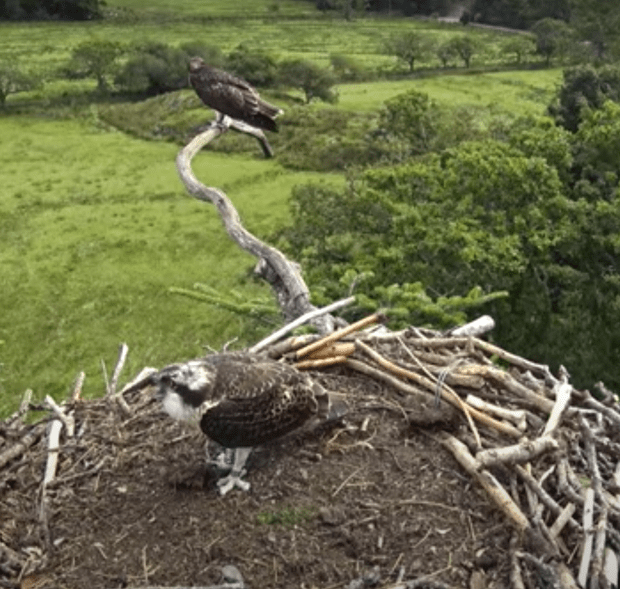
At the Osprey nest of Aran and Mrs G in the Glaslyn Valley in Wales, all three of this years fledglings have joined the 100 Club. This means that they have been on the nest for over 100 days and counting before migrating. Today they are 106, 105, and 102 days old! Aran might be wondering if everyone has decided to over winter.

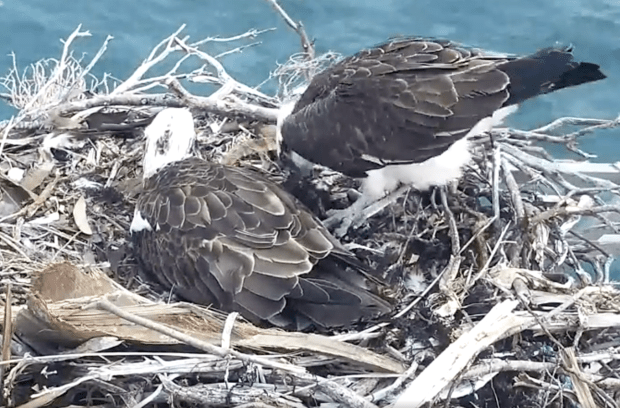
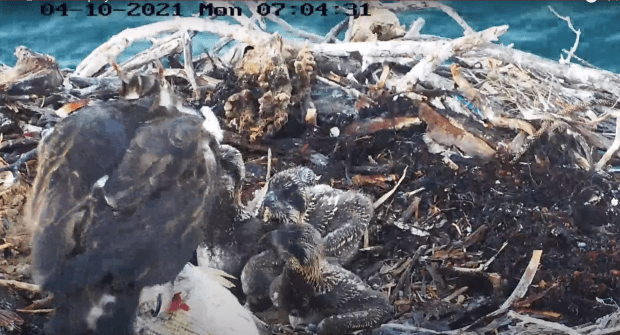
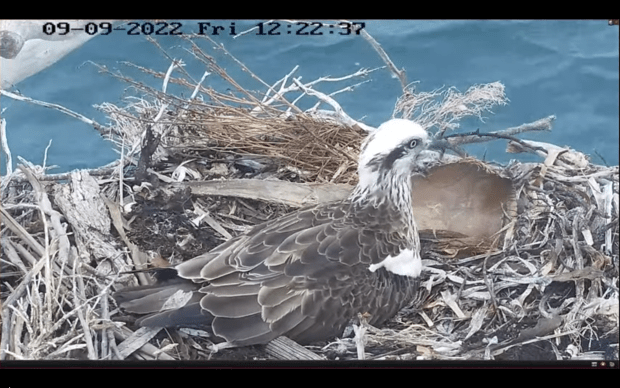
This was early Thursday morning. Mrs G is in the second photo. It was the last seen of her. The time was 08:58. If she isn’t hiding down in the Oaks or trying to fool us, Mrs G has now left for her migration. She took a piece of fish off one of the fledglings just to top up her tank! If you have left Mrs G, safe travels, lots of fish, and return again next spring – you remain the oldest osprey in the UK and what a lovely group of offspring this year!

Idris continues to deliver fish to Padarn. It looks like some are very happy to stay in Wales!

Padarn this morning. She is still in Wales!

Louis still has Sarafina fish calling!

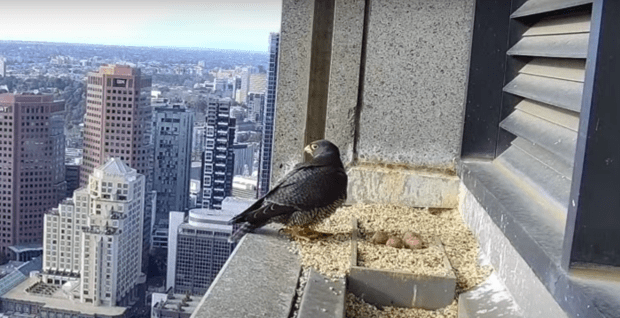
The Melbourne scrape seems to be getting a lot of attention lately. First up, the building number is 367 Collins Street. There are now 36.7 members of the FB group. That is an incredible number of supporters. Here is the announcement:

There has been much concern over the incubation time and whether or not there was another male falcon present at the building. Victor Hurley, the chief researcher of the nest for the Victorian Peregrine Falcon Research group posted this today on FB:

The images that I have taken today appear to me to be the same male that has been at this nest since I began watching some years ago. Dad is relieving Mum so she can have a break this morning.

Later the couple were having a conversation.

In Orange, there is heavy rain falling. Diamond watches it from inside the scrape. Xavier has been in and out helping with incubation duties. I hope he is somewhere trying to stay dry.

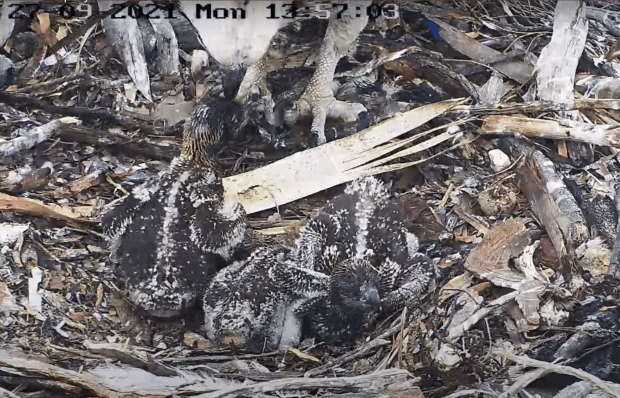
At the Sea Eagles nest, it was chilly and the two eaglets wanted nothing more than to be able to shrink so all of them would fit under Mum.

Dad brought a little fish in for their breakfast so that Lady could feed the two.

Both SE29 and SE30 are really getting much more steady on their feet and they are spending more time walking on top of this twig nest. That surely cannot be easy!

At the Port Lincoln Osprey barge, Mum has been hungry. Dad has been known to bring in a fish, eat a large portion of it before bringing her a piece. Today he brought her a really nice sized larger fish for her tea. How wonderful. Thank you, Dad! Mum was really excited for that lovely dinner.
Looks like Alden’s funny quirks have rubbed off on Annie who was caught ‘loafing’ on the ledge of The Campanile on Thursday.

Oh, how I love Samson. He was at the NE Florida Bald Eagle nest today waiting for his mate, Gabby, to arrive from her migration. Like Richmond, the SF Bay Osprey, Samson stays in the area of the nest and does not migrate. Both Rosie (Richmond’s mate) and Gabby, do. Gabby is usually home by the 12th of September.

Migration News:

There is information from Bonus, Jan and Janika’s Black Storklet that was fostered by Kaia and Karl II. Bonus remains in Belarus near the Pripyat River where he has been feeding for some time.

Kaia remains in the general vicinity she has been in Ukraine.

Karl II is still believed to be in the area of Kherzov. We now know that the telecommunications in the area is down. Storks should, unless shelled by accident, wish to stay away form the people and there are the many nature reserves in this area where Karl II stayed for long periods in previous years. I am trying to remain positive for him!

Waba has had trouble with the tracker so there is no conclusive report.

From the archive:

Do you know which nest this was? The year is 2020. The older sibling supported the younger. The Magpie helped ‘this eaglet’ when the Pied Curra were attacking? The third image is the last one at the nest.

Thank you so much for being with me on this very quiet Friday in Bird World. Take care everyone. See you soon.

Thank you to the following for their posts, videos, tweets, and streaming cams that make up my screen captures: Dfyi Ospreys, Cornell Bird Lab, The Scottish Daily Express, Mississippi Power, Royal Cam Albatross Group NZ, Bywyd Gwyllt Glaslyn, Friends of Loch Arkaig and the Woodland Trust, 367 Collins Street by Mirvac, Charles Sturt falcon Cam, Sea Eagles@Birdlife Australia Discovery Centre Sydney Olympic Park, Port Lincoln Ospreys, Cal Falcons, NEFL-AEF, and Looduskalender.

From the Archive Answer: That is SE25 supporting SE26 after its little leg was broken. Lady is feeding both of them. SE26 struggled in the forest after fledging. After 6 days returned to the nest massively hungry and exhausted. Lady and Dad fed SE26. When 26 had recuperated, she flew to the camera branch where she was attacked by the Pied Currawong. A Magpie came to help 26. That is the last picture we have of SE26 in the forest. She flew out, chased by Curra, during the time of a storm and landed on the balcony of a 22nd floor condo some 1.5 km away in Horn Bush. SE26 was taken into care and euthanized, sadly. It was believed the damage to her leg would cause extensive pain and could not be repaired properly. It was a very, very sad day. SE26 was inspirational to all you watched her struggles to ‘be an eagle’…she flew. That is one consolation. What we learned was that the Pied Currawong are unrelenting in chasing the Sea Eagles out of the forest. This has caused extensive difficulties which have been noted in recent years with SE27 going in and out of care and requiring training to fly and hunt prey.

Victor flies in the aviary…and other news on Friday

2 September 2022

Friday is going to be a much nicer day in terms of weather. It has been sweltering on the Canadian prairies. The high will be 21 and not 32! It is hard to imagine it being 32 degrees at the beginning of September in Winnipeg. The sun is bright and the sky is blue without a cloud in sight. It will be a good day to go to the nature centre for that long walk and to see how those little ducklings have grown this week. The egrets were still in Winnipeg last night. They attracted a few of us to gasp at their beauty as they flew into their roosting tree at sunset.

No matter what is happening today in your life, take the time to marvel at the work of the wildlife rehabbers who are giving our darling raptors a second chance to live out their lives soaring in the skies. Smile. Victor is flying!!!!!!!!!!!!

Making News:

The Ojai Raptor Centre has done an amazing job getting Victor to flying in the large aviary from the patient that arrived with severe zinc toxicity. They posted a Victor of our dear Victor flying so well. So thankful for Dr Sharpe and everyone who gave Victor his second chance! What a wonderful sight to see ——-Victor flying and not having to do physio being supported by a human lifting a towel. Tears.

Whenever you think about intervention and someone says ‘nature will take care of it’ ——think of our dear Victor and tell them about him. Maybe you can gently change their mind. Or you could tell them about Little Bit ND17 – or both!!!!!!

You might remember that one of the two eaglets on the US Steel Bald eagle nest fludged and, in the process, tore many of its feathers. It was taken into care. Here is the most recent news on this lucky eaglet who is getting its second chance!

Rosie’s broken feather on the right.

The new feathers being inserted. They will fall out when Rosie has her first moult. Oh, what a very lucky eaglet! Just like Victor and Little Bit.

Migration counts at Hawk Mountain:

https://www.hawkmountain.org/conservation-science/hawk-count

As hurricane season is with us, researchers are looking at how our warming earth and hurricanes are impacting our feathered friends.

https://www.audubon.org/news/how-bird-researchers-are-tracking-impacts-intensifying-hurricane-seasons

If you are living where Baltimore Orioles will or are passing through, heading to their winter homes, remember to put out the oranges and the jelly (they love other flavours than grape, too) for them to help build their energy.

The RSPB gives us all some ideas about how we can better ‘green’ our lives.

https://www.rspb.org.uk/get-involved/community-and-advice/green-living/

I was extremely interested in their article on how to create a garden that is beneficial for wildlife. It is always good to look for new and better ways to take care of those garden friends that come to us for food, shade, and shelter.

https://www.rspb.org.uk/birds-and-wildlife/advice/gardening-for-wildlife/creating-a-wildlife-friendly-garden/

Nest News:

Who could have predicted that the Hellgate Canyon nest would have a visit from both dear Iris and Louis on Thursday? What a pleasure it is to see her. Like so many of you, I have growled at Louis but, in the end, Iris seems much happier when he is about so…I am going to stop moaning when I see Louis. I wonder if this is the pair together, Iris saying goodbye to all of us until next spring?

Beautiful Iris. If this is the last time we see you this year, travel safe, always have a full crop, enjoy your winter but return in the spring. You give us hope and inspiration.

And she is off, the oldest osprey in the world living in the wild.

Feeding time for the Sea Eagles. Notice how much progress they are making in terms of plumage but also, in standing.

There was another prey delivery at 1200 and SE30 did some impressive mantling on its arrival.

Xavier brought Diamond a nicely dressed pigeon for breakfast. She was thrilled and Dad got to spend some time incubating those three eggs in the scrape at Orange.

At the 367 Collins Street scrape in Melbourne, the little Dad loves taking care of the eggies just as much as Xavier does. Here is an early morning hand over.

The Collins Street Mum just found ‘us’!

Mum and Dad have such a good routine at the Port Lincoln Osprey barge. Mum knows that Dad is coming with a partial fish for her. She would have seen him eating his portion on the ropes before arriving at the nest and transferring the rest of the fish to her. Typically, the males eat the heads of the fish. Then Dad gets a chance to incubate the eggs, too. Great system. Gives Mum a nice quiet time to have her lunch. It sure won’t be quiet in a couple of weeks!!!!!!

Dad brings in some more decorations for the nest later.

The check on Karl II and his family as they migrate shows us that Karl II is following his normal flight path. Everyone hopes that he will be changing his trajectory as this normal path will have him flying directly into Kherson an area that is quite unsafe. Looduskalender posted the different colours for his flight this year and Karl II’s last two years.

Karl flew fast and quick to get into Belarus. Let us all hope that the winds carry him to his favourite tree -safely and quickly- in the very centre of Africa.

Bonus appears to be in Belarus near Makarychy in the Gomel Oblatst. He must be finding a good food source in the Pripyat River marshes.

Kaia’s tracker came on and showed she had traveled 28.8 km. She remains in Ukraine.*

Waba – no data since 30 August.

Thank you so much for joining me this morning. Wishing our Black Stork family from the Karula National Forest in Estonia safe, safe travels. It will be interesting to see what Karl II does as he approaches Ukraine. Take care everyone. See you soon!

Thank you to the following whose posts, videos, and streaming cams made up my news for the day: Ojai Raptor Centre, Hawk Mountain, Audubon, RSPB, Montana Ospreys, Tamarack Wildlife Centre, Sea Eagles@Birdlife Australia Discovery Centre Sydney Olympic Park, Charles Sturt Falcon Cam, 367 Collins Street by Mirvac, Port Lincoln Ospreys, and Looduskalender.

  • I have inadvertently been using the term ‘the Ukraine’. Having lived in the 2nd largest area of Ukrainians many decades prior to the country’s independence, it became a habit to say ‘the’. Now it is not appropriate. Ukraine is, of course, its own independent country. Apologies to anyone who might have been offended by my oversight.

Ervie goes fishing, Egg 2 for Diamond and Xavier and more…Sunday morning in Bird World

28 August 2022

Good Morning Everyone. I hope that each of you had a lovely Saturday. Thank you so much for joining me today!

From the Mailbox:

‘A’ asks: What is the average time difference or gap for Peregrine Falcons to lay their eggs? Diamond looks like she is ready today. Thank you, ‘A’. That is a very timely question as we sit staring at Diamond’s bottom for her tail feathers to begin to go up and down when she is in labour. In the nest notes that Cilla Kinross, the researcher at the Orange Falcon cam compiled, it says that the average time difference is 56 hours. As I write this, the time in Orange is 13:21 on Saturday. That egg is due anytime.

‘L’ asks: What is the purpose of molting? The feathers of our bird friends get damaged just like our clothes from normal living. They break and get tears. Moulting is the annual replacement of the feathers. In fact, think about it. Feathers are so important to birds – they keep them warm and dry and, of course, are needed for flying. They should be in tip top shape which is why birds spend so much time preening. Some birds begin to moult in the spring. Others wait until nesting has finished. Moulting is really hard on the birds and it is normally done when there is an unusually high level of prey so they can keep their energy up.

‘C’ writes: “I’m glad I helped with that information about galvanized steel that contains zinc. But in stainless steel, the component is chromium. Is it also bad for the health of birds? I searched very quickly, and in a very superficial search, I didn’t find anything that chromium is also bad for.” The information you provided was very useful. As one of our other readers ‘L’ writes there are some uses for zinc that are also helpful such as in ‘Zinc Ointment’ for baby rashes. I do not know a lot about chromium. It is also used in ceramics to make certain shades of green glazes and is highly toxic in its powdered form. It is not toxic after the pottery has been fired to a specific degree, however. — We assume that the things that we use for cooking are all ‘safe’. Sometimes it is only later we discover that there could be connections to specific ailments. However, if I had a beloved bird that lived in a cage – the cage wires would be stainless. We have a metal shop in our city that made all the SS backings for my kitchen and my island top. I am certain there are similar facilities in other cities where they could make the wires. I am still finding this whole zinc toxicity that impacted Victor very curious. I wish I knew more!

In the News:

The UK is still celebrating the arrival of more than 100 Hen Harriers.

The New York Times published the following article about how climate change will impact the birds we love and which are more likely to go extinct first. The cover shows the Kakapo and my readers know that the Kakapo Recovery Group is working hard to make sure that the flightless parrots survive. Today there are 205 of them on a couple of mall islands of New Zealand.

Nest News:

Chase showed up with a nice big fish and waited and waited on the Two Harbours nest for Lancer on Saturday morning around 10:38. Lancer never showed up. What a change it must be for the parents from nearly getting their talons torn off to sitting quietly to see if anyone will arrive. If you have left the territory, Lancer – soar high, be safe and always have a full crop!

Such dedicated eagle parents. Did you know that Chase & Cholyn have been together for 19 years?

Ferris Akel had a terrific tour on Saturday afternoon around Ithaca, New York. I was listening and doing other things until he got to the Cornell Campus where he caught Big Red, Arthur, and L2 on camera. Oh, it is lovely to continue seeing L2. According to Suzanne Arnold Horning, the latest a juvenile has been seen at the Cornell Campus is 28 August. L2 looks pretty comfortable. I wonder if she will shatter that record?

Arthur was hunting.

L2 could see Big Red in the distance when she was on the pole and was prey crying really, really loud. Since L2 was the second juvenile to catch her own prey in June I am imaging that Big Red’s answer to that is: “Get your own!”

Big Red looks a little ‘rough’. She is moulting. Like other Red-tail Hawks, Big Red undergoes a complete moult once a year. Normally, hawks begin their moult in spring and every feather has been replaced by September or October. Big Red, however, appears to begin her moult after the eyases fledge.

Xavier has been bringing Diamond some extra special treats during Sunday to help Diamond keep her energy up for the egg laying. One was an Eastern Rosella which is a very colourful parrot and the other was a nicely prepared pigeon. Diamond was excited for both!

The arrival of the Rosella meant that cute little Xavier could have some time with ‘eggie’.

Diamond had a very large crop when the pigeon arrived but she certainly wasn’t going to turn her nose up at that special food gift.

It is 13:57 in Orange and Diamond is sitting on the ledge of the scrape box while we wait and watch for an indication that the second egg might be arriving.

Diamond is back on the egg at 1400.

Diamond is very focused and she looks ‘heavy in the rear’. Egg 2 could be coming shortly. Diamond normally lays 3 eggs. For the past two years, only one egg has been viable each year.

Diamond laid egg #2 at 17:27. Yippppppeeee. Why am I so excited? Well, falcon eggs do not always hatch and for the last two years Xavier and Diamond have had only 1 out of 3 eggs hatch so it makes the chances better of having a successful hatch.

Xavier arrives at 17:33 to see the second egg and to bring Diamond her dinner. Notice that Diamond is being very careful. Falcons lay their eggs standing up. She is protecting the egg while the shell hardens in the air. The gap between eggs is 57 hours.

Diamond did not want to eat. She had already had two big meals. She remained in the scrape box. During the night she would sometimes incubate or, alternatively, stand above the eggs protecting them. Remember the Currawong know there are eggs in that scrape and they will eat them if the opportunity arises!

The Melbourne couple seem to be finished with three eggs and each takes turns incubating. Dad was very anxious to demonstrate that he was well seasoned in incubation. The Melbourne crew even made a video of the persuasion.

It is a very short and cute clip. Oh, do you ever wish you could speak falconese?

Friends of Osprey have posted some photographs of Ervie near the Marina where he had dived and caught the lovely fish he is eating. They were taken by Alex Ditton. Oh, goodness. It is always such a joyous occasion when someone shows us that Ervie is doing very well indeed! Check out the Friends of Osprey for more images of Ervie.

Kaia remains in Belarus around the Priypat River. This is what the area looks like where she is resting and fishing.

Bonus, the only surviving storklet of Jan and Janika that was fostered with Kaia and Karl II has begun his migration. His tracker tells us that he traveled 109 km and is now in Latvia near the village of Vietalva.

Travel safe dear Bonus, fly high, stay out of the war zones, always have a stream full of frogs and fish — prosper.

There should be more news but it appears that all might have left for their winter homes from the Karula Forest nest of Kaia and Karl II. I will confirm this tomorrow.

Bonus was always a very special Black Storklet. He would not have survived without the intervention of Urmas and Dr Madis and his team. They would have died on the nest. Urmas’s foresight to provide fish baskets meant that everyone had lots of fish. A special thank you to all who donated towards the food for the nest.

The Dahlgren Osprey nest in the US has announced that the male, Jack, has not been seen for a few days so that now Harriet, the female, and the sole surviving fledgling from the nest in King George County are on their journey south.

No one has been seen at the Loch of the Lowes since yesterday. Laddie LM 12, Blue NC0 and both of the fledglings appear to also be heading south.

It was another successful year for Ospreys in Wales and John Williams gives us the run down in his last blow of the season for Llyn Clywedog. The numbers of Ospreys in Wales are growing. There are now 7 ‘known’ pairs who produced 17 chicks this year. John catches up with all the nest news.

John also produced a chart for all the chicks hatched at Llyn Clywedog – noting that there is simply too much grey. Were those chicks ever seen or not? Sometimes they do get missed.

Handsome Aran on the perch at the Glaslyn nest this morning. He remains bringing fish to the nest for the fledglings. Mrs G was still home as well today.

Handsome, Aran.

Emyr Evans has provided us with the data of the fledges at the Dyfi nest asking the question: what happened to Pedran? Emyr is great with statistics and this is a good read about migration and young fledglings.

https://www.dyfiospreyproject.com/blog/emyr-mwt/pedran-what-has-happened-her?fbclid=IwAR2nZUelKdPCJFEW-3PIjKlcohXunU9JSBevJA8wFl4XpT1ICR9H8O8bepA

Rosie was still on the perch at the SF Bay Osprey nest this morning! Brooks has not been seen at the nest for some time now – this is not alarming. She is out exploring!

Congratulations to Glacier Gardens. Both Love and Peace have fledged. Here is a video of that moment on 25 August when Peace took to the air. Congratulations for another successful year Liberty and Freedom!

Thank you so very much for joining me this beautiful Sunday morning. I hope that you are doing well and I will look forward to having you with us again in Bird World.

Thank you to the following for their streaming cams, their posts, and their videos that form my screen captures: The New York Times, Explore.org and IWS, Ferris Akel Tours, Charles Sturt Orange Falcon Cam, 367 Collins Street by Mirvac, Friends of Ospreys, Looduskalender, Dahlgren Ospreys, Friends of Loch of the Lowes and the Scottish Wildlife Trust, John Williams and The Clywedog Ospreys, Bywyd Gwyllt Glaslyn, Dyfi Ospreys, SF Ospreys and Golden Gate Audubon.

Migration woes and daily threats to our feathered friends

5 August 2022

Good Morning Everyone! It is a hazy day on the Canadian Prairies. The birds have been up early feeding as temperatures are set to rise to 29 degrees C today. The plants in the garden are looking a little droopy despite watering – we have been lucky to have all that rain. Some areas are really struggling. It is now a little after noon and the Crows and Blue Jays are reminding me that they need more peanuts and want their water changed! They are so smart. Wonder if I could teach them how to use the water hose?

I hope that you enjoyed seeing those beautiful pictures of Brooks back on the nest with Mum and Dad, Rosie and Richmond, at the WWII Whirley Crane. HE is well and beautiful. In case you missed it, Brooks (Blue XA) arrived back to the nest yesterday in the late afternoon and DNA testing has confirmed that Brooks is a male. Molate was also confirmed to be a male. This is a photo of him. He is very handsome.

Richmond does not migrate but Rosie does. Wonder which Brooks will choose? It is much safer to stay put!

Rosie has brought Brooks a lovely fish. Welcome home, Brooks.

Fish hooks and monofilament line are dangerous for all birds that eat fish like Ospreys and eagles. This is a reminder that things on nests can happen quickly — and for us to clean up our environment! Join a riverbank of lake clean up. It will make you proud that you have helped.

As we get ready to begin the great autumn migration, it is perhaps best if we take a deep breath. Migration is extremely dangerous especially for first year fledglings but it is becoming increasingly difficult for ‘seasoned’ birds as well.

I was surprised when I brought home a book from our nature centre, Atlas of bird Migration. Tracking the Great Journeys of the World’s Birds. It has good solid information on species with maps, information on the difference of gender in certain species as to migration —– and, hold on, out of 176 pages, four are devoted to “Threats and Conservation.” Out of those four, two pages had large photographs. The book lists: water (they show an oil spill), field and forest (they show fires), hunting and caging. Can you think of good current examples of these that will impact the birds we love heading to their winter quarters? what are they missing? Send your ideas to me and they will be included in a special blog on migration next Friday, 12 August.

Do you live anywhere near Hawk Mountain in Pennsylvania? You can visit but, you can also take part in the annual count. Here are the dates that the birds fly over. Even if you didn’t help with the count what a special time to see the birds flying with the thermals, soaring over the mountains on their way to South America.

Hawk Mountain has kept track of spring and autumn migrations since 1934. You can go to their link and see population shifts. It is an eye-opener in some cases.

https://www.hawkmountain.org/conservation-science/resources/migration-data

Each of the nests below has faced or is facing challenges like many others. If you looked at the picture of the nest could you come up with issues they have faced? Try it before reading my text!

The two osplets at the Osoyoos Osprey nest have not fledged yet. They are working on some wingersizing. Caught them enjoying an early fish from Olsen this morning. Today will be good but by Sunday the temperatures at the nest will be 36 rising to 38 on Monday and 40 on Tuesday. Extreme heat has been an issue at this nest for several years with the temperatures continuing to rise and rise.

Thanks to the lovely people who live around the Notre-Dame Eagle nest we have more pictures of ND 15, 16, and Little Bit 17. It is always so funny…Little Bit seems to love to hide behind the small branches with leaves. So grateful to all those keeping track of the trio!

Hi Sweetheart.

The Parramatta River and Sydney Harbour have some significant toxins in the water that impacts the fish eaten by the sea birds.

The toxins leaked into the river from a shipping container company as reported in The Sydney Morning Herald on 16 May 2009. The article said, “The Patrick’s site on the Camellia peninsula, near Rosehill Racecourse, has been found to be leaking the chemical Chromium VI, posing a risk to people and marine life.”

In 2017, 2ser 107.3 reported that the Parramatta River was a “toxic time bomb.” They said, “Fifty years of toxic chemical residue is sitting on the bottom of Sydney Harbour and the Parramatta River. It’s a toxic time-bomb and disturbing this sediment could worsen already dire pollution levels. And now sweeping developments along the shore of the River could be bringing more pollution to the already sullied waters.” While many might have hoped to swim in the river before they were too elderly to do so, contaminated storm water was pumped into the river in December 2020 causing more problems.

It is unclear what impact this is having on the White-bellied Sea Eagles who are at the top of the food chain along the river. Despite research being carried out, the direct implication to these WBSE is not normally discussed. If you know of a study with results, please let me know.

Lady with WBSE 29 and 30. They are filling up the nest cup!

Karl and Kaia missed each other by a flap of a wing. The fish basket has been replenished! Karl II rains down fish on the storklets. You can see the fish on the nest in the image below and then in the video. So grateful for Urmas and his fish baskets that have kept this family in good health. Areas where the Black Storks used to fish is becoming too developed and it is becoming more difficult to find fish – so grateful for the intervention. I continue to question whether or not it would work -in nests impacted by human action such as Osoyoos – to place a fish basket for the Ospreys? Would they use it? We are constantly told that the temperatures we are experiencing now are not going to alter but will get hotter. We need to work on plans for the birds.

Kaia has also been collecting fish for the four.

The four were stuffed after the feedings from both Karl II and Kaia. They will not fledge in rainy weather nor will they fledge when they are so full.

Urmas posted this note on Looduskalender yesterday. It has some information about what will happen once the storklets fledge.

The storklets now have names. Bonus will keep his name. The other three are Voog, Wada, and Iks.

The three storklets of Karl II and Kaia are Voog. This is Voog standing up

Waba is on the perch.

Iks is preening Waba. So there are the three!

Last year Kaia left for her migration on 11 August. These storklets should have fledged last week but they have not. Recent heavy rains have halted this or large feedings. The longer they stay on the nest and eat the stronger they will be.

The storks will travel to the centre of Africa for their migration. Have a look at a map and remember that that they often stop west of Odessa at a nature reserve. What particular issues will they face during migration?

The migration threats to the White Storks of Mlade Buky in the Czech Republic are similar to the ones that Klepetan faced when he migrated back and forth from Croatia to South Africa. He would visit his mate, Malena in Croatia for the breeding period. The person who cared for Malena was particularly concerned with the White Storks passing over Lebanon? S Vokic even wrote to the Prime Minister and President of Lebanon. Do you remember what his concerns were?*

Dad continues to provide fish on the Janakkalan Osprey nest in Finland. I have not seen Titi fly.

He can fly. He just does not know it and he has no mother like Nuppu to encourage him. As such he continues to be a target for predators. It is good to remember that Ospreys talons are for holding fish – getting them out of the water and transporting them – not for fighting. They are too curved inward.

Despite concerns over migration or intruders, the birds on the nests are doing fine. Their health appears good and food is coming in on a regular basis – even at Osoyoos where Olsen brings fish in early on the hottest of days and late in the day. Once the birds fledge they can also cool off in the water. Keep sending them your warmest wishes. Life is getting ready to get difficult as they fly, perfect their flying, and set off on their own course in life.

There is some great news coming out of Yorkshire! More firsts for the UK Osprey population. Fantastic.

Sharon Dunne posted an update on when the Royal Cam chick will be banded. They ran out of time yesterday. Here is the announcement:

The Albatross face particular threats that some of the other migrating birds do not face. QT chick will fledge in September. When she flies off Taiaroa Head she will head out to sea where she will spend 4-6 years before ever returning to land. Then she will return as a juvenile with wobbly legs for a bit partying it up with the others hoping to find a mate for future years. What could happen to these lovely birds on the high seas for all those years?

In the Northern Hemisphere, the lovely sea birds around the UK continue to die from Avian Flu. They thought it was over and it has come back with a fury. Dutch scientist, Thijs Kuken says the solution for future outbreaks is to stop the factory farming of poultry. So far the Ospreys in the UK seem to have not fallen victim to the latest outbreak.

https://theecologist.org/2022/aug/01/avian-flu-outbreak-killing-wild-birds?fbclid=IwAR1erpdLzQUUobsxWqc5oQM5e9hURsLjGxXpP0vVS1Eu7HzmlSDPbLXIc1E

Thank you for joining me today. Remember do your research on threats to our feathered friends due to migration. Think about it. Send me your findings by Thursday of next week. That would be 11 August on the Canadian Prairies. Take care everyone. See you soon!

  • If you said shooting for sport you would be correct.

Thank you to the following for their posts and/or streaming cams where I took my screen captures: SF Ospreys and Golden Gate Audubon, Notre Dame Eagles FB, Sea Eagles@Birdlife Australia Discovery Centre Sydney Olympic Park, Finnish Osprey Foundation, Eagle Club of Estonia and Looduskalender, Mlade Buky White Storks, and the Osoyoos Osprey nest.

The King of the Puffer Hunters

2.24.2020

It is the 25th of February at the Port Lincoln Barge.

I would have missed it. My friend ‘B’ sent an e-mail with the subject line: Ervie is on the Nest! My heart skipped a beat and I rushed to get the Port Lincoln streaming cam up on the computer. And there he was – our Ervie!

Ervie arrived empty taloned at 11:03:42. He flew off at 11:31:51. His approach sent the pigeons scurrying. Was Ervie checking to see if Dad was on the nest?

Here comes Ervie!

Ervie returned to the nest at 11:46:45 with a puffer. I remember a line in an old movie that I loved to watch on New Year’s, Year in Provence. It refers to someone being the King of the Truffle Hunters. That is the only part I recall but the rhyme made me think of Ervie, the King of the Puffer Hunters. Are they a delicacy for Ervie? How many Puffers are there? Will he eat up the entire stock?

Incoming.

Getting ready to land.

I wonder if anyone would make an Ervie lamp with the Puffer Fish as the globe for the light? That would be something!!!!!!!!!

That is some balancing act. So glad Ervie didn’t lose that precious catch.

Ervie is still eating on that puffer fish at 12:53:54.

Oh, what a gift to see Ervie! Crazy odd things go through your head as you watch Ervie devour his puffer. Has he developed a taste for this particular fish that no one else wants? Will he tell his future mate that he has a Puffer Fish fetish and his kids will only eat Puffers?

Ervie must know where they are. That was a fifteen minute break between leaving the nest and returning with his catch. Oh, gosh, Ervie. What a darling you are. And just look at you. You look terrific. We have missed you. Thanks for coming to visit.

Thank you ‘B’ with all my heart for taking the time to send me that note. Tears coming down. So happy to see our Ervie in such wonderful condition.

Thank you to the rest of you for joining me tonight. Take care! And if you want to catch Ervie at the nest or rewind to see these great moments, here is the link to the streaming cam:

Thank you Port Lincoln for your streaming cam where I took my screen captures of everyone’s favourite juvenile Osprey – Ervie, King of the Puffer Hunters.

Ervie, you melted our hearts

As a pigeon cleans the nest and a Cormorant dries itself on the perch of the Port Lincoln Osprey barge, Ervie, we are all missing you! You hatched on 16 September at 00:51. You are five months and three days and you have been away from the barge for 48 hours. Are you gone for good? We all wondered until you surprised us returning to the nest at 12:42 and you stayed until 13:30. How wonderful. When you left a couple of days ago, we all worried that we would not see you again. What a real treat, Ervie. Thank you. You are looking really well.

You did your fish calling right before you flew off. Did you see Dad? Will you return later today?

Here the pigeon is looking for scraps and the Cormorant has returned to the perch after you left.

You hatched on 16 September were 51 hours younger than Bazza, the oldest sibling in the nest. As late as 27 September, when you were 9 days old, Bazza was trying to take over dominance in the nest. Yes, he pecked at your head and tried to stand tall to intimidate you but, you never gave in, Ervie. Never.

None of us will ever be able to be precise about what it was that made your melt our hearts but, you did – in spades. Is it the cheering for the under dog? You never felt like an under dog to me, Ervie. You were spirited, you knew what you wanted. You learned early to get where Mum could see you and close to her beak in the sweet spot in order to get the fish. You were a survivor. You never cowered in submission to Bazza or Falky. OK. Maybe one or two times when you were very little, close to hatch, but by the 27th of September, you had the drive and the determination to get what you wanted.

There you are with that fish bladder. All of you were curious about it.

Look how much you have changed in just a few days. In the image above you are still sporting you soft grey down and in the one below, four days later, almost full reptilian.

Look how tiny you are in thee middle of Falky and Bazza.

Ervie, you loved your fish!

All lined up like children in a choir behaving. That was the tone of this wonderful nest at Port Lincoln. No one could believe it. The early angst was gone and each of you just lined up and ate your fish. Dad made sure there was plenty on hand even when it was storm and the winds were blowing at 37 kph. Mum made sure each was fed. You could not have chosen a better family in which to hatch than this one at this time and place.

You are 20 days old Ervie, looking and wanting that fish standing behind the others. Adorable.

You wiggle around and come to the side and you will get fed.

There you are, already sporting a big crop, up at Mum’s beak wanting more fish!

You are 34 days old in the following image. you are the one closest to Mum’s beak. Look at the beautiful juvenile feathering that each of you is getting.

It is 27 October and you are the one getting the fish bites in the image below. Look at how well you are standing. All of you are growing up.

Your eyes never move away from the fish that Mum is feeding. There you are n the back ready to grab a bite!

There you are with your sat-pak, Ervie. You were all banded and given official names. They even put some nice fish on the nest so all of you could eat. There was enough for Mum and Dad, too.

  • Big Bob, first hatch, has a red band, weighed the least at 1280 grams and is named Bazza. The name celebrates Take 2 Photography’s husband, Barry Hockaday, who did so much to bring the Osprey Barge to a reality.
  • Middle Bob, second hatch, has a yellow band, weighed 1330 grams and is named Falky after Ian Falkenberg, the bander.
  • Little Bob, third hatch, has a dark green almost black band, weighed 1380 grams and is named Ervie. It is the name of the Scottish town where Australia’s current Minister of the Environment grew up. This choice focused on the fact that the growth in the Eastern Osprey population and this project would not be possible without the Minister’s support.

And that is how ‘never miss a meal Little Bob’ became the biggest Bob! And got the sat-pak! Well done, Ervie.

Your bling is beautiful and we hope that sat-pak does work for 7 or more years so we know how you are doing.

It seemed that all of you grew up after you were banded. You were feeding yourselves and hovering and then fledging. Once everyone got their bling it was so much easier to identify who was right up at Mum’s beak – as she often chose to feed her boys even though they could easily feed themselves. That is you, Ervie, getting fed with your beak almost touching Mum’s head!

When Mum was not there and Dad delivered a fish, Ervie, you were often the one to get that fish first and mantle it.

On 14 November, you fledged, Ervie.

First to get the fish again.

Falky really wanted the fish Ervie had. Ervie, you were fast as lightning to get those fish deliveries – not always, but often and normally the first one of the day.

As all of you got older and more independent, the dust ups began. There was never any love lost between you and Bazza.

No one will ever forget the dog fight that you had with Falky!

Or your first puffer catch. Did you actually develop a taste for the Puffer, Ervie? You would bring in another one to the nest a few days before you departed.

You are four months old on 16 January and what a handsome fellow you are. You are now the king of the nest.

Super handsome Ervie.

You could hear your loud cry for fish across the cove. We will all miss it. Wonder if anyone tried to make a ring tone for their phone?

Oh, Ervie. You brought such joy to our lives. Every day we waited to see what you would be up to from the moment that you hatched. Thank you for staying with us for five months and for returning today to the barge. We never know when you fly off if you will return.

This is your latest tracking. Port Lincoln confirms that you are enjoying the Boston Bay area and the fishing is good by the National Park. We will look forward to more adventures.

If you do not return, Ervie, each of us wishes you the best life. Fly high. Live well and safe. Never be hungry. Come back to see us! And if for some reason you decide to use the barge as ‘home base’, I am sure no one will mind! At least not until Mum and Dad decide to take over the nest in the late summer.

Thank you to Port Lincoln Osprey Project for their streaming cam and FB pages where I took these screen captures and video clips. Thank you for letting us share in the lives of this beautiful Osprey family.

Ervie catches another Puffer!

Ervie celebrated his 5th month birthday alone on the barge in heavy rain at times. With Dad not around and Ervie hungry, he set off to bring home a fish and he did ——– another Puffer!

Oh, Ervie looked like a wet rat when he arrived on the perch of the barge at Port Lincoln with his prize breakfast.

Can you see the soaking to the bones Ervie on the perch?

Poor Ervie.

When Ervie flew from the perch to the nest he got the Puffer stuck in the corner. He considered it. Flapped his wings, rose up and…

got his prize out and on the nest.

Now how do I unzip this thing?

Poor Ervie. You look like a drowned rat, darling.

It must feel quite odd walking around the nest with a balloon on your talon.

Deflated.

Ervie did a good job eating his fish.

Ervie was cleaning his beak after finishing his gourmet snack at 10:42:37.

I wonder if Ervie is developing a taste for Puffers? or has he found a place on his route around the shore where he finds them easily? Will he bring another one back today?

At 10:44:09 Ervie flies down to the shed waiting for Dad to come and be company with him.

Happy Birthday, Ervie!

Thank you so much for joining me. Take care. See you again soon!

Thank you to the Port Lincoln Osprey Project for their streaming cam where I took my screen captures.

Ervie gets another Puffer!

Watchers of the Port Lincoln Osprey streaming cam have watched Ervie bring a Puffer Fish to the nest and a Toadfish. Ervie ate the Puffer but the spiny appendages and maybe the terrible taste of the Toadfish meant that it was left on the nest – toxic and rejected. Everyone has so wanted to see Ervie dive off the barge and catch a fish – a ‘real’ fish – and haul it to the nest. Soon we hope.

Most of the morning Ervie was in the shed with Dad. However, Ervie flew off when it appeared that Dad was not budging to go and get a fish for his boy.

Out of the skies we see Ervie flying in. At first it looked like a nice fish. It was 12:11:52. As Ervie’s wing moved a bit, we could see that it was another Puffer Fish!!!!!!!! It is his snack size lunch.

Dad was watching his boy from the shed. You can see his head turned up taking it all in.

Poor Ervie. It must have felt funny having a balloon like object under your foot trying to move around on the nest.

Our beloved Ervie was soaking wet. He must be proud of his catch. This one he can eat. That Toadfish was a big disappointment.

Ervie ate and ate.

Ervie ate every morsel of his fish. Good lad.

Here is a short video clip of the event:

I wonder if Ervie has found a special place where he can find the puffers? Perhaps he will go and catch a few more today in the rain.

This is exciting. I know it isn’t a great big ‘real’ fish but it is a fish and Ervie got it all by himself. We are all proud of you, Ervie.

Thank you for joining me. Take care. See you soon!

Thank you to the Port Lincoln Osprey Project where I took my screen captures and my video clip.

Thank you, Dad!

The camera has been offline at the Port Lincoln Osprey nest. It was difficult not knowing what was going on with Ervie!

When the cam came on, I could hear Ervie fish calling. Oh, he is loud! In a few minutes Ervie was mantling the nest.

Here comes Dad with a headless fish. It is a perfect sharing. Dad catches the fish, eats the head, and gives the rest to his son on the nest.

Ervie was hungry!

He is mantling that fish really well.

Ervie has that fish firmly under his talons. It is not going anywhere – head or not!

Dad pauses for a moment on the edge of the nest. Thanks Dad!

Ervie really enjoyed his breakfast.

Ervie was cleaning his beak at 10:57. Ironically, he had left a little fish. It is on the nest just below his tail. Looks like half of the actual fish tail with some meat on it.

Ervie flew off the nest and the clean up crew were grateful for the morsels of fish. There is a pigeon at the middle of the nest on the right side. It blends in with the wood.

Ervie was definitely hungry. With all of the outages it is hard to know when he last had a fish dinner.

After he finished eating and cleaning his beak, Ervie looked off in the distance.

Then Ervie began to fish cry again! He almost started mantling.

Ervie raised his wings and flew off the nest at 11:09, Monday the 14th of February. Did he land on the shed near Dad? Did he go somewhere else?

Port Lincoln Posted the tracker for Ervie and a beautiful photo. It was taken by Keith Daniels. Ervie was on his front fence in the Lincoln Cove Marina.

Isn’t he gorgeous sitting there looking in? What would you give to have an Osprey sit on your front fence? and what if it was Ervie!!!!!!!! How grand.

Before I close, I went to check on Little Bit at the NEFlorida Bald Eagle Nest. It had a really nice crop before bed! Yippeeeeeeee.

So all is right with the world.

Thank you so much for joining me. It was just wonderful to see these two fed. It is very reassuring that everything is just fine. Take care. See you soon.

Thank you to Port Lincoln Osprey Cam and Port Lincoln Osprey FB and Keith Daniels for the photo of Ervie on his fence and the NEFlorida Bald Eagles and the AEF Bald Eagle Cam where I took my screen captures.

Osprey fledgling flies 350 km from natal nest in a week

I don’t think anyone ever expected to get a phone call telling them that an Osprey with a yellow band was seen at Port Augusta yesterday.

The question at the time was: is it Star or is it Falky? Falky was last seen on the 12th of January at 19:40.

On 9 January, Falky took a dive off the barge and caught a fish!

On the 10th, Falky and Ervie have their ‘dog fight’ in the air.

On the 8th of January, Bazza knocks Falky into the water. We held our breath as he figured out how to get. Falky’s confidence must have grown when he kept his cool head and recovered instead of drowning.

The two siblings were not so nice to the middle one who kept himself to himself, most days, looking for fish in the water.

Well, Morgan Palmer Dunn took some photographs and sent them to the Port Lincoln Osprey Project and guess who it is that is 13 km south of Port Augusta, a distance of almost 350 km?

There he is, the middle hatch, Falky flying like a pro. Our keen eyed observer noticed the young Osprey when a bunch of Silver Gulls began vocalizing.

So, in one week, look how far Falky flew. I am smiling and can’t stop saying ‘incredible’.

What is interesting to me is that everyone was startled when Solly flew up to Streaky Bay and then Eba Anchorage. The thoughts at the time were that this 200 km distance from the natal nest was quite far. With this flight of Falky’s, it is time to start looking for Bazza and maybe Star and DEW further afield!

This is why banding birds is important. Look at the information retrieved by a simple coloured leg band and a very keen observant individual – who took the time to get in touch with Port Lincoln!

Some may be asking if the tracker was put on the wrong bird. At the time of the weighing, the naming, and the banding, Ervie really was the star of the nest. He was the male who weighed the most and got the sat-pak. If you go to Port Lincoln’s FB page and look back, Ervie was quite adventurous. Did something happen to Ervie so that he lost his confidence? is he getting his mojo back as some claim? or was Ervie’s goal all along to be the ‘King of the Nest’. We wait to find out. But for now, raise a glass to Falky. What an incredible young Osprey. May he live a long safe life with always a full belly!

Falky, you really are impressing everyone. You look good. You are obviously catching your own dinner. Be careful out there!

Thank you for joining me! This is simply incredible news.

Thanks to the Port Lincoln Osprey Project streaming cam and FB page where I took my screen captures and video clips.