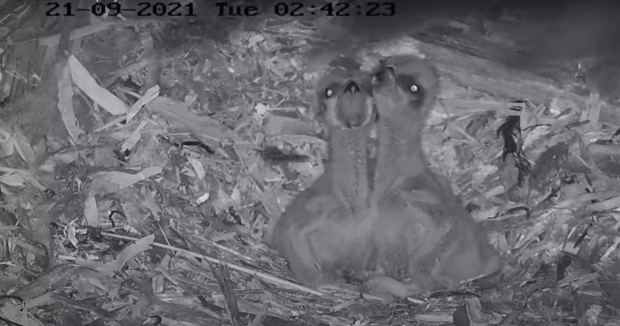
The Port Lincoln Osplets had a good fish day yesterday and I am expecting the same once Dad moves off the ropes and goes fishing.
After I finished my blog yesterday another fish landed on the nest at 12:47. It was a nice one and everyone of the osplets had a really good feed.
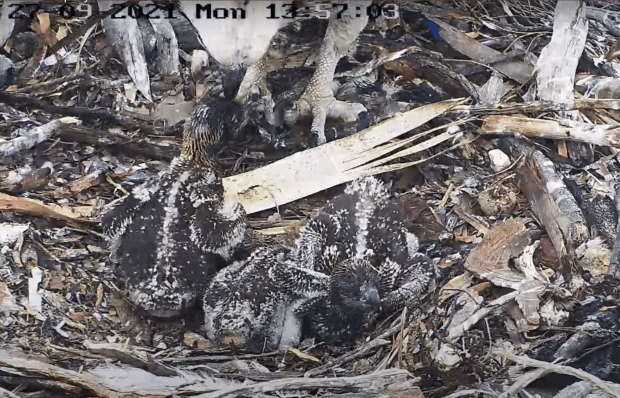
Can you tell which is which? From left to right: Middle, Little, and Big Bob. Middle and Big have more peach on the back of their head and neck and those feathers are slightly longer than Little’s (yesterday).
As is the tradition, Little Bob ate first with Big and Middle waiting their turns.
Last evening Dad delivered a fish at 18:41:15. The kids were sleeping and despite waking and having a look at a fish that close, they were not interested but Mum was. She ate and then Dad took the rest and was eating it on the ropes at 19:10:02.
It’s a new day. Mom has been fish calling and I presume that once Dad gets tired of listening, he will fly off and bring in breakfast.
Everyone is waiting patiently. One of the things I have noticed is that despite the books saying the chicks get interested in what is happening off the nest at four weeks, Middle Bob has certainly been doing some looking around.
There is he is looking off while Little and Big wait for the delivery that Mom believes is coming.
Fingers crossed. I will update your later but for now, everyone is behaving themselves.
A new book just arrived. It is my much anticipated Chris Packham, Back to nature. How to love life – and save it. Will give you a synopsis when I have finished it.
Thank you so much for joining me. Take care everyone!
Thank you to the Port Lincoln Osprey Project for their streaming cam where I took my screen shots.
It was not my intention to send out another newsletter so quickly on the heels of the last one but, I think that this is a joyful event to celebrate. I have seen it several times in the past few days but this is the clearest example I can muster up.
Big Bob on the Port Lincoln Osprey nest has, for the past few days, been trying to establish its dominance on the nest. It spent some time pecking at Little Bob’s neck the other day and a couple of people wondered if Little Bob’s neck was OK. It was.
Today is 27 September. These are the hatch times.
Big Bob hatched on 13 September at 22:03
Middle Bob hatched on 14 September at 02:30
Little Bob hatched on 16 September at 00:51
There is only 5 hours and 45 minutes between Big and Little Bob in terms of hatch times. There is 51 hours (roughly) between the hatch times of Big and Little Bob. Those close hatch times should give the chicks an edge in survival.
The osplets are eating more fish at a meal and the meal times now last for an hour (or close to it) or til the fish is almost totally consumed. So this morning the osplets were hungry.
Dad delivered a fish to the nest at 8:52:42 following much fish calling by Mum. It was not a huge fish but it is a pretty nice fish to start the day.
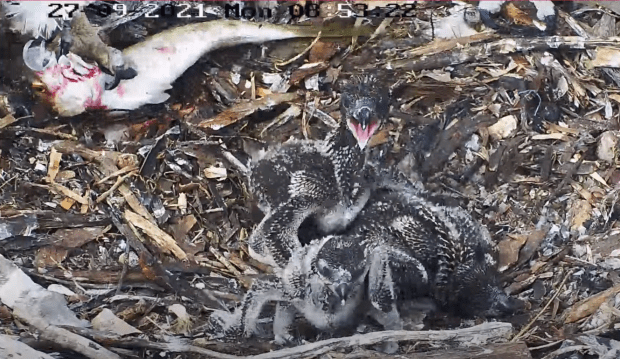
In the line up below, are Little Bob on the left, Middle in the middle, and Big Bob on the right. Little still looks lighter in this light.
Despite the fish being on the nest, Big Bob went after Little Bob several times until 8:56:45. Middle Bob just tries to get out of the way after staring at Big Bob in the image below.
Little moved and Big followed but, it didn’t work! Right after the 8:56:45 incident, all three are lined up to eat breakfast.
And by now you should know who ate first —– if you said Little Bob you are 100% correct. The older two are waiting their turn.
The feeding was stopped by Mum at 9:21:00. The remaining fish was still on the nest.
If Ospreys can ‘feel silly’ like humans, Big Bob wasted precious feeding time while Mum stood on the fish. What if she had eaten it? or flown off with it? I suppose she wouldn’t. Mum is hardwired to feed these chicks and brood them.
What is interesting to me is that Little Bob would not be intimidated by Big Bob. Little went right up there and took its place at the table eating first. Indeed, I did not count the bites but Little got more food than Big. That might account for its growth. Indeed, some of the chatters could not tell Little from Big today. If you look at the back of the three necks, the peachy-copper feathers coming in on Little are slightly shorter than those of Big and Middle. At a certain angle, the overall plumage of Little looks lighter.
Will we be able to tell them apart tomorrow? That is the 64 million dollar question.
Dad brings in another fish at 10:12:28. Mum takes it – it is relatively small.
The osplets are sleeping, sort of. They raise their heads but their crops are still full from the earlier feeding.
Mom offers a piece of fish to Middle Bob at 10:12:45. Middle raises its head and takes it but it is still like a duck and not standing.
Big and Little are still sleepy. Big gets up and starts being fed at 10:13:33.
Middle stops eating and Little does some clever moves to get over by Big and get some bites. I wonder if Little didn’t want Big to notice?
At 10:14:48 Little is being fed.
The feeding ends at 10:22:46. Everyone is full.
The cam operator moved in close. This is Little Bob. Notice that the coppery-peach feathers are very short. Take a good look. Tomorrow they will be longer. These chicks are all in the reptile stage.
Many books will state that the reptile stage begins at week 3 but these osplets are early. Little Bob is only eleven days old – hatched 00:51 16 September. Their pin feathers are definitely developing. You can see those in the close up images below. They are still able to fit under Mum so she can brood them but often you will see their heads sticking out. Big Bob actually slept out from under Mom for awhile. They still mostly sleep and eat. Soon they will become interested in the world beyond the nest — and they are going to spend a lot of time preening! Those pin feathers are itchy or so humans say. I have never had a chat with an Osprey about them!
Enjoy the close ups. Thanks cam op!
What a beautiful Babe. There is still the hint of the egg tooth at the end of the beak. In the image below you can see that the feathers on the neck at the back of the head are longer on the sibling facing away from us. Compare those with Little Bob’s who is in the middle.
You can also see their nice crops. These osplets have been well fed this morning.
There is still some fish from the first feeding on the nest at 2 o’clock. The rest of the second fish is at 8 o’clock.
It has been a good morning on the Port Lincoln Osprey Nest. It is thrilling to see Little Bob thwart Big’s efforts to control the nest. It will be even more intriguing as this next week goes by as to the similarities that come between the three of them.
Thank you for stopping in again and indulging me in my love of Ospreys. I so want this family to succeed this year – and I want another third hatch to be clever and thrive. Take care everyone. Stay safe!
Thank you to the Port Lincoln Osprey for their streaming cam where I took my screen shots.
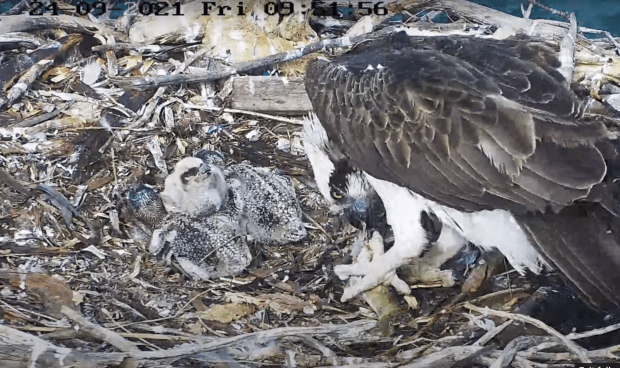
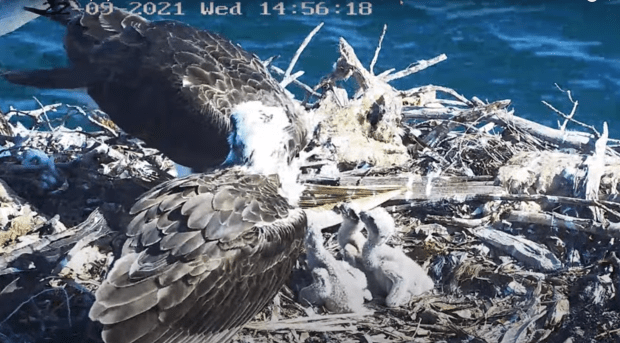
Sometimes it is good to remember and compare. The little Osplets at Port Lincoln have grown so quickly that is seemingly unfathomable that they were like this only a week ago!
There is Little Bob in front the same way that he has been all along. Yesterday Big and Middle Bob waited patiently for their turns while he ate.
Yesterday a very large fish came on the nest at 12:44:16. mom was still feeding and eating at 13:38:39.
This is the beginning of the feeding. You can see the fish. Notice the two older Bobs – Big and Middle – waiting for Little to eat. Then they can have their turns. Little ate a lot and went to sleep. Food coma!
Mom continues to feed Little Bob.
Look at how close in size Big and Middle Bob are to one another!
Little Bob is out for the count and now Mom is feeding one of the older siblings. They waited nicely. No pecking. Just patience. Wow.
You can see how much is left of that big fish – the tail and a bit. Little Bob has woken up and Mum is feeding him again! They will eat the entire fish.
That will give you an idea as to how much has changed regarding their consumption. A week ago that fish would have lasted all day. Now it is only one meal. The osplets are able to eat lots more at a sitting.
Awww. Mum is checking with Little Bob to see if he wants some more bites before she eats. And, yes, of course he does. Why am I surprised? This little one is an endless pit.
They have all passed out and now Mom can eat the last of the fish and the tail. She needs food, too!
At 16:02 they are still asleep or just waking and continue to have large crops.
The cam operator pulls the image out and you can see that the Mom must have had a small piece of that earlier fish hidden. She is topping off the little ones. Remember. They will double their size in four days!!!!!!! Wow.
The golden glow of the sun setting is kissing the Port Lincoln Nest. Everyone is full and happy. It has been a civilized day. All of the chicks are now into their extreme growth period with their reptilian plumage (or lack of).
Did you know that a group of Ospreys is called a ‘duet’? I didn’t. Hawks Aloft published that fact today. They said it is because Ospreys are solitary. They only pair up for breeding season. They also said that it was because the pitch of the male and female is different so when they are calling, it sounds like a duet. Interesting.
I do think that David Gessner and others Osprey watchers in Cuba would disagree with the statement that they only pair up for breeding seasons. The reason I say that is when I first read it, I went ‘wait’. Large flocks of Ospreys have gathered together to fly over the Sierra Maestra Mountains in Cuba. Gessner wrote about this in his book, Soaring with Fidel. So do Ospreys gather together when it helps the group? only in pairs for breeding? and are solitary when it comes to fishing? They certainly don’t seem to help one another like the American White Pelicans who, together, get the fish to swim to a certain shallow spot so they can all feed. It is all curious.
Yesterday Tiger Mozone and I questioned why certain Ospreys are violent. The comment was related to the Port Lincoln Ospreys. Is it in the DNA? is it a result of toxins in the water that have concentrated in the fish and then in the Ospreys? Dr Greene at the University of Montana has studied heavy metals. Is anyone studying the toxins in Australian waters? I have not had time to look into this but will as well as the suggestion of the DNA connection.
It is now 04:49 in Port Lincoln. Mom is trying to sleep. Let us all wish them a great fish day. I will bring updates later tonight.
Thanks for stopping by. These little ones are growing fast and behaving themselves. Thank goodness. Take care everyone.
Thank you to the Port Lincoln Osprey Project for their streaming cam where Itook these screen shots.
I have heard the name but have never seen the bird – or, at least, I do not think I have. With my lousy shorebird IDs, I might have even confused this beautiful long-legged shorebird with a Greater Yellowlegs. Of course, everyone would have laughed.
Godwits are ‘very’ long legged shorebirds but their legs are not yellow! Their beak is ‘very, very’ long and is bi-coloured – light rose and espresso -and ever so slightly upturned at the end. They are called waders because they live in the mudflats and the estuaries. See how their legs go deep into the mud, too. They feed by sticking that very long beak into the mud, rooting around for worms and small shellfish.
The breeding adults have a chest that ranges from a deep terracotta for the males to a brighter orange for the females. The wing and back feathers are more brown and white overall with a touch of the breast colour, sometimes. They have gorgeous dark eyes.
What is so miraculous about these shorebirds is their migration. They breed in Alaska and fly in September to New Zealand! They make only one stop, normally. And they do the trip in record time. It is an 11,265 kilometre journey or 7000 miles. They accomplish this in eight days! Yes, you read that correctly, eight days.
Neils Warnock, the Executive Director of Alaska Audubon in 2017, remarked, “These godwits are epic migrants. We had a bird, E-7, that we had tagged, and she left New Zealand in the spring. She flies non-stop seven days, ten thousand kilometres, to the Yellow Sea. All of the Bar-tailed Godwits of Alaska, they stop at the Yellow Sea.”
The Yellow Sea is located between mainland People’s Republic of China and the Korean Peninsula.
Historically the mudflats of the Yellow-Sea have been rich with food for the Bar-tail Godwits so they can fatten up and make the rest of the journey to their winter homes in New Zealand without having to stop. Today, the mudflats of the Yellow Sea are under threat – they are disappearing with coastal development. This could prove to be a major challenge for these beautiful shorebirds. There have been many studies and the researchers have seen a drop in the number of shorebirds by 30% in the last few years because the mudflat areas have been reduced by 65%.
Today the Pukorokoro Miranda Shorebird Centre in New Zealand reported that Bar-tailed Godwit 4BYWW made his flight in 8 days and 12 hours arriving home at 03:00 on 26 September. He flew 12,200 km. His average speed was 59kph. 4BYWW may have set a new distance record for the Bar-tail Godwits. We will know when the others return home. Isn’t that amazing?
What I found most interesting was her route. She does not appear to have gone via the Yellow Sea. Is this because of the decline of the mud flats? Have the birds adapted their migratory route? I definitely want to look at this more closely.
This was the satellite tracking image posted by the Pukorokoro Miranda Shorebird Centre FB page:
The Centre was tracking another four adults and 3 juveniles on their journeys home. One of those, 4BWWB, has been reported as flying non-stop for 163 hours and over 10,000 km. Seriously, my head can’t comprehend what that must be like. I am also truly amazed at what these sat-paks can tell us about the birds and their amazing resilience. Just incredible.
Tiaki officially fledged on the 25th of September. The Royal Albatross cam chick of 2021 is foraging off the coast of New Zealand at the present time. She will eventually make her way to the waters off of South America near Chile. We wait for her return in four to six years to Taiaroa Head where we will hear that beautiful Sky call, again.
While millions and millions of birds are moving from their summer breeding grounds to their winter homes, others are waiting for eggs to hatch. Holly Parsons posted a table of Diamond’s incubation history.
Xavier and Diamond’s first egg was laid in the scrape box on top of the water tower at Charles Sturt University in Orange, Australia on 31 August this year. Cilla Kinross, the main researcher, is expecting a hatch from 6-9 October with the most promising day being the 7th. Can’t wait!
Diamond was catching some sleep this morning. If all of the eggs hatch, her and Xavier are going to be very busy!
If the hatch is expected around the 7th of October at Orange, then what about those Melbourne Peregrine Falcons? The first egg was laid on the 21st of August – yes, that is right. Ten days before the Orange falcons. So, I am going to be looking for a hatch at Melbourne starting in two days!!!!!! This means that all of the Melbourne eggs, if viable, will hatch before those in Orange. It will be nice to get to enjoy them without trying to watch both at the same time!
For those of you wondering about those beautiful White-bellied Sea Eagles, 27 and 28, here they are. Talk about gorgeous.
Things will really be starting to ramp up shortly. Bald Eagle breeding season in the United States begins in a few days. Looking forward to checking on some nests to see if the birds have returned – such as Anna and Louis who had the first hatch on a nest in the Kisatchie Forest last year since 2013. His name was Kistachie – very appropriate.
Then there is always the trio at Port Lincoln. They had two feedings this morning and a third at 11:31:27 when Dad brought in a very small fish. All of the chicks were well behaved – quite civil to one another. And, of course, Little Bob is right there in front! Look carefully you can see him.
Life is good. Everything seems to be going really well for all the nests.
Thank you so much for joining me today. I hope you enjoyed learning about the Godwits as much as I did. Incredible birds. Take care everyone!
Thank you to the following for their streaming cams where I took my screen shots or for postings on their FB pages that I have shared with you: Port Lincoln Osprey Project, 367 Collins Street Falcons by Mirvac, Falcon Cam Project at Charles Sturt University and Cilla Kinross, Pukorokoro Miranda Shorebird Centre, Sea Eagle Cam @Birdlife Australia Discovery Centre, and Cornell Bird Lab and NZ DOC.
People were thinking that Little Bob was days behind Big and Middle Bob. It was only 51 hours hatch difference between Big and Little. Today, it is hard to tell them apart. They are a pile of black reptilian creatures. Precious still.
Yesterday there were six feedings on the Port Lincoln Osprey Nest: 06:10, 08:39, 12:25, 16:20 17:03, and 18:25. Everyone had crops.
All are doing fine. Yes, Big Bob does want to try to throw her weight around on occasion but, so far Mum has sat on them before it could get bad. I just hope Little Bob learns to protect its neck!
Today, the first feeding is just finishing. The golden rays of the sun fall on Mum and Dad as he delivers the fish at 6:37:35. Thanks, Dad! This is the best way to start off the day!!!
It is 11 degrees C and the wind is blowing at 19 kph. That is up 8 from yesterday. I do wonder if Dad fishes better in choppy weather???? It doesn’t make sense but, hey…he brought in lots of fish when there were white caps and the winds hit 34 kph and less when the wind is below 11 kph. I wonder what is up with all of that??
You can, for the moment, still recognize him a bit. Little Bob is lighter and he is turned around ready to jump over Big Bob to get to be first in line.
Now notice Little Bob’s crop. It is very big this morning but he is going to drop it. The food that he was holding in store will now be processed making room for his breakfast.
With all of the talk and the reactions of Big Bob wanting to dominate, Little Bob got to eat first.
And Little bob is still eating! This little osplet is not shy when it comes to fish.
It is such a relief to see a fish land on the nest so early in the morning. Hopefully this will set the tone for the entire day. All of the chicks are entering the rapid growth period. They will double their size – and by tomorrow, Little Bob will be black. You will really have to look hard to tell which one he is. I don’t know about you but Little Bob looks almost as big as the chick on the right. Maybe it is the camera playing tricks on us. What do you think?
Thanks for stopping in today. Everything seems to be on hold. The Bald Eagles in Florida are working on their nests, 367 Collins Street falcons are still incubating eggs as are Diamond and Xavier. The WBSE 27 and 28 are growing and growing and seem to be getting along fine. Tiaki has fledged. Birds are migrating all over the world. It was a really beautiful day on the prairies.
Take care. See you soon.
Thanks to the Port Lincoln Osprey Project for their streaming cam where I took my screen shots.
Today was a day for me to go outside, walk, and enjoy a beautiful, warm, fall day in the country. I did check on the Port Lincoln Ospreys before I left and Dad had brought in a fish and they were eating. It is now noon in Port Lincoln, Australia and there have been two feedings. Everything is fine. I believe the following images will dispel any concerns. We had great days with 8 to 10 feedings and then they slowed down. The chicks are older and their crops can hold more so they get more food but there are less feedings. The older two are in the reptile phase. Some people love the rubbed oil effect and the bald heads, the dark plumage – I am usually glad when they get through this phase!
So here, with little narration are some images from the first 4 hours of the day. Check out the time stamps as you go through.
I love the golden rays of the morning sun falling on Mom and the nest. She is really beautiful.
First feeding. None of the chicks are fighting and this fish came in much earlier today than yesterday (past noon).
Mum makes sure that everyone is full. You can see, look carefully, that all three chicks have nice crops. She is still checking to see if Little Bob wants any more bites.
Right now it is really easy to tell Little Bob from Big and Middle Bob.
Mum is eating some fish. She deserves to eat just like dad and it is hard to get bites in with these three. But, look, does Little Bob want some more fish?
If anyone says this mum feeds herself before her osplets, they are wrong. She is breaking off a piece above and below she is offering it to Little Bob to make sure that he is full.
Look at the crops and the bald oily looking heads. Oh, dear! These kids are changing right before our eyes.
Oh, gosh. Little Bob just finished and now the other two are up at the table again. Mom is feeding both Big and Middle again.
“Last Call at the Fish Bar!”
Mom lets them fall into food comas and makes sure they are covered and warm. Maybe they will sleep for a few minutes.
Oh, no. They are starting to wiggle their way out. Just look at those pin feathers. These babies are going to be doing a lot of preening very soon.
An hour later and Mom is feeding them again. This is feeding 3 and they still have crops from the earlier feeding. No one is going to feel hungry today.
Little Bob stays up at the table. The other two are full.
Finally – food coma.
Happy, full Osplets sleeping in a pile!
There will be more fish meals today. These three are doing fine. We had one worrisome day. Let us all hope that is the last for this family. Right now – in this very moment – all is well.
Take care everyone. Thanks for stopping in. See you soon!!!
Thank you to the Port Lincoln Osprey Project for their streaming cam where I took my screen shots.
One of the problems with the streaming cams is the ‘chat’ feature. There, I have said it. The same persons come on at different times of the day, every day or every other day and say the same negative things. There is one on the PLO chat that always says, ‘The mother never feeds the youngest’. ‘Mama feed in order never feeds youngest.’ Seriously! Either they can’t rewind, they don’t watch, or they just want to stir the pot of negativity. I think that it is all three. So I go back to an old cry out of mine, Streaming cams need 24/7 knowledgable moderators. They need them to stop the bots coming in and they need them to stop the negative chatter. Even more so, if something happens on the nest they need to have emergency numbers to call or place them on the streaming cam site at the top.
The Port Lincoln Osplets are doing fine! And it is something to celebrate. One of the most exciting things is to watch them grow and grow they are. these chicks are losing their light grey coat to get their second, darker grey down. You can see the little pin feathers starting. still, each retains a tiny bit of its egg tooth. The feet are getting bigger, wings are growing and the tiny tails are starting. If you didn’t know the different species at this age of 9-10 days, just look at that beautiful dark mask going from the cere to behind the eye. that is the distinctive bandit mask of the Osprey!
Dad comes in with another fish. the big one that arrived earlier is all gone.
The chicks are getting bigger and they don’t like sleeping under Mum like they did when they first hatched. Indeed, these little ones seem to be tumbling around underneath her much of the time.
Awwww. Such sweeties.
Because it is winter in Australia, the light changes early. Mum and dad are on the nest and the little ones are getting another feed. Notice how much they have grown. It is as if someone took them and stretched them in the last couple of days. They no longer appear like short fat little chicks but they are entering another phase where they will begin to look like thin reptiles with long necks.
Each is doing fine. There were not as many big fish yesterday as during the high winds but everyone was fed and no one was left out.
I literally checked into the White Bellied Sea Eagle nest to see how WBSE 27 and 28 are doing. Lady was feeding them.
That is WBSE 28 at the front of the nest with its big crop. 27 is practicing its self feeding with a small piece of prey.
This nest will have two fledges this year. I so hope the Pied Currawong do not chase them out of the forest so they can fly and return to the nest for more meals while they get their piloting in order.
Lady Hawk did a video of 27 learning to self-feed and 28 nibbling at her toes. Have a look:
The strongest earthquake in recorded history hit Melbourne, Australia yesterday.
The first thing many thought of were the four eggs of the Peregrine Falcons at 367 Collins Street.
Dad was on the eggs at the time and stepped off wondering what was happening.
Everything appears to be fine. Some buildings were damaged but no one was killed. Thankfully! We are nearing hatch watch for this couple.
In Orange, the running joke has been Xavier wanting his time to incubate the eggs.
Xavier doesn’t want to give up his incubating time!
Do you know why the male Peregrine falcon is called Xavier? It is one of those heart wrenching stories that makes you love this little male bird even more.
Diamond’s eggs were ready to hatch. Her mate, Bula, disappeared and was presumed dead. As we all know, the chicks would have died. Instead, enter a new male who starts helping with the chicks and raises them as if they were his own. Because he was a ‘saviour’ of the family, he was named Xavier.
The researcher at Orange is Cilla Kinross. She did a cute video of the negotiations between Diamond and Xavier over the incubation duties.
Everything is changing at these four nests in Australia. The White-Bellied Sea Eagles are exercising their wings, jumping, and hopping about. They are getting more adept at self-feeding although 27 still is the one that gets to the prey first it seems. Lady does come in and feed them. Branching will be next but not for a bit, thankfully. We will be watching for the four at Collins street to hatch in about four or five days. Diamond and Xavier’s chicks will follow but not for a week or a little more. And, of course, the change in the Osplets at Port Lincoln will be significant. They will look like skinny reptiles all wound around one another. The key is that everything, at this moment in time, is just fine. There are no worries. So enjoy them!
It is another beautiful fall day in Manitoba. The Green Heron has departed and I always missed it. Perhaps another will come next year! The Blue Heron is also gone but I hear there are waves of Dark-Eyed Juncos headed towards the city. I cannot wait. They love to pick apart my red outdoor carpet. Such cuties. I am going out for a long walk and to check on the Wood Ducks. Perhaps they will cooperate and there will be some good photos for me to share with you.
Thank you for stopping by. Check out the streaming cams – the birds are doing great. And, if you feel up to it, shut down the negativity. There is already enough in the world. The birds bring us joy. Take care all. See you soon.
Thank you to the following for their streaming cams where I took my screen shots: Port Lincoln Osprey Project, 367 Collins Street by Mirvan, Falcon Project Cam at Orange, Sea Eagles @ Birdlife Australia Discovery Centre.
Oh, another glorious fall day on the Canadian Prairies. The sun is shining bright and the sky is blue. The leaves of the vines looking like stained glass ranging in colour from rust to orange, light yellow, and chartreuse. Just stunningly beautiful.
I always worry about the third hatches. I have worried about the third at the Port Lincoln nest the minute the egg was laid. Last evening one of the chatters called #3 “Tuffet.” That is a great nickname for Little Bob.
And Little Bob looks like such an angel. If you are having trouble telling who he is, he still has his egg tooth today. That is him wide awake smiling at the camera.
My goodness. I have begun to feel sorry for Mum. She has only to wiggle or get up to stretch and he has his mouth wide open!
Big and Middle are not bothered at all. Little Bob still has a crop but he is sure curious as to whether or not Mom will give him some bites!
“What cha’ doin’ Mom?”
Little Bob is decidedly not hungry. When I last left the family Dad had brought what was left of the ‘whale’ that he had brought in at 12:35:44.
There was another feeding around 13:08.
If you are wondering, yes, that is Little Bob being fed!
By 13:24 Mum has them all tucked and Dad is over on the ropes.
Around 16:00 the chicks are fed again.
With the whale finished, Dad is going to need to go out and fishing. At 16:49 Dad comes to have a consultation with Mom. She puts in an order for a fish as the kids are growing restless.
The delivery comes in half an hour. Well done, Dad. I wonder if he has a stash of these nice large fish?
Notice that all of the chicks have some fish still in their crop from the earlier feeding.
Oh, dear. That fish was flapping. Hope that little one is OK. It sure isn’t stopping Little Bob with his crop from wanting a meal. There he is near that flapping tail.
Oh, these three are really going to be a handful when they are older. Dad is going to have to bring further reinforcements for the walls. Mom finishes feeding them and then…
She moves the fish and starts again! They all line up again.
Look carefully at the back of Little Bob on the end. Can you see the two dark stripes starting to emerge? and just look at how adorable those little wings are. Gosh these kids are cute.
Dad will remove the fish and return it at 18:20:01.
There’s Little Bob flaunting his crop – wondering if his is the biggest or not.
Mom probably thought she could have a few bites in peace and quiet. What do you think? Yes, that is Little Bob with his mouth open! Poor Mom.
Now another wants some fish. You can still see their crops from the 18:22 feeding. But there is also something else we can see. Look, pin feathers are coming. Soon they will look like reptiles. Their light coat of down will be replaced by a darker woolier coat at 10-12 days. That is followed by the reptile phase.
We are entering the second week. Already these chicks have more than likely tripled their body weight. It should, in fact double again in the next three to four days. The fastest period of growth will come at 15-30 days. This is when we need fish on this nest.
It is possible that when Mom got up to eat some fish she fed some of the Osplets around 21:13.
It was hard to tell because Mum swung herself around so we couldn’t see.
Little Bob wiggles his way out from under Mom in the middle of the night and is calling for fish!
And we are back where we started. Around 1:13, Mom wants to stretch her legs and Little Bob thinks it is time to eat again – crop or not.
It is now 2:51 in the morning, 22 September in Australia. Mom and chicks are fast asleep. No doubt Little Bob will be right up front at the table the minute that fish lands on the nest.
This third hatch is anything but shy or afraid. This nest has really turned itself around thanks to the good deliveries of fish by Dad and the continuous feedings by Mom. No one on this nest has been hungry.
The crucial period is not here yet. We need to make it through weeks 3 and 4.*
Looking for hatch watch with the Peregrine falcons in Melbourne in 6 days. That will liven things up a bit. Over at the WBSE in the Sydney Olympic Park, the parents are dropping prey now that the eaglets are self-feeding. Most of the time 27 gets the food. Yesterday, Mom did the feeding. 28 had a nice crop. The first seen in awhile. The pair continue to work their wings.
Thank you so much for joining me today — and thank you for your interest in the Eastern Ospreys at Port Lincoln, Australia. So far, so good. Continue to send warm wishes to all the nests.
Thank you to the Port Lincoln Osprey Project and the Sea Eagles @ Birdlife Australia Discovery Centre for their streaming cams where I took my screen shots.
* Last year, the feedings were not as good at the PLO. Around Day 15 there was a perceived drop in food delivery. Siblicide occurred and sadly, little Tapps died when he was 18 days old.
It seriously does not get better than this: I take a break to check on our federal election results and turn around to check on the chicks at the Port Lincoln Osprey nest and they are being fed —— again!
The whale of a fish that Dad brought in this morning still has some left even after the last feeding. I have genuinely lost count of the feedings but we are up to at least five and I think maybe six. The last one began with Dad bringing the remaining fish to mom at 12:14. The kids ate and it is now 12:36 nest time. They will be fed at least three or four more times before they tuck it in for the night. Fantastic. Like the little songbirds in their nests whose parents fly in and out continually, this trio of osplets are thriving with more frequent feedings at this stage in their development.
It was time for a nap. One of the chatters was worried about Little Bob being out from under Mom. You can also see the heads of Big and Middle Bob sticking out. Little Bob was too warm or he would have been under. And if he got chilled, he would push to get under mom. If she was worried she would have scooped him up. She did look and check on him several times.
There is still some fish remaining that you can see at the bottom right. The chicks were full when mom finished feeding and got them settled again.
Less than an hour later, Dad is back on the nest. Just look at mom’s eyes. You can also see one of the wee babes with its head out.
Mom feeds the babies again! I don’t even know if they were hungry.
Everyone is fed and tucked. Dad is over on the ropes and I bet mum is wanting to catch a little sleep. It looks like the whale of a fish was finished.
During my walk today, I noticed a lovely pine tree. It had three Black capped chickadees on the branches. Then I stopped at another yard and saw no less than 15 bird feeders and various bird baths and watering containers. At the corner was the house with the pollinator garden. Long before it became a stylish phrase ‘I have a pollinator garden’, my neighbour was doing just that. People reported him to the city authorities because, well, his boulevard and yard looked a mess. Today, the flowers are growing in the pots hanging between the trees and the rest are native plants helping the environment. I don’t think anyone looks at that garden with disdain any longer. I mention this because I got a note this evening from a reader asking me what are all the things they can do to help the birds. Gosh, I didn’t know where to start there is so much to be done. So let’s start with the basic principle that everything is connected. Here are a few ideas and we will add to them on a regular basis.
Shrinking your lawn is one of the first one that comes to mind. In their book, Planting in a Post-Wild World, the authors suggest that we think of turf or lawn as an area rug, not the whole floor. Use the grass areas to draw attention to something. Most eco-gardeners suggest having no more than 50% turf. It is suggested that you set your mowers to 3 inches or 7.5 cm. You will not kill your grass by cutting it too short and you will also not kill the turtles or little bunnies that hunker down. Do not mow at sunset as many species come out at that time of day.
Do not treat your turf with anything. No matter how green the companies claim their products to be, if they kill something they will also kill other things. You can also save a lot of money.
If you are doing some fall planting, use native plants and pollinators. These will be good for the insects and small birds.
Plant a native tree.
Do not rake your lawn. Leave it. Just leave it alone. If you must, rake the leaves into areas and spread them being as gentle as possible.
Locally we are recommending leaving out hummingbird feeders. The little ones are still staying in some of our more northern areas. They are migrating through and really can use the energy.
The small songbirds migrating have really been eating my suet cylinders. That fat and those specialized seeds and insects give them fuel also.
I will stop there. There is so much we can do from supporting bird friendly coffee and building bubblers (small fountain areas) and little ponds, window decorations to stop bird strike, etc. A friend of mine wrote to me today and they had been in an area where there were no birds. They said that it was ‘eerie.’ Can you imagine a world without birds?
Thank you so much for checking in with me. It is going so well for the family at Port Lincoln. What a joy! Take care all. See you soon.
Thank you to the Port Lincoln Osprey Project for their streaming cam where I took my screen shots.
In the middle of the night, the osplets were restless. Mom needed to stretch her legs and they all stood up, beaks wide open thinking it was time for yet – another – meal. They were so well fed during the day it is hard to imagine them being hungry at 02:45 but they thought they were.
Mum worked hard and finally corralled Big and Middle back under her wings and chest! But not before they peeked out again and had another try for a feeding! Just look at how wide they can open their mouths. Goodness.
Mum went sound asleep and was looking really comfy when this image was taken at 05:10.
Mom needed another stretch before the sun rose. Oh, goodness. It was mayhem.
Big and Middle started pecking one another and Little Bob ducked! All I could think was get a fish on this nest quick.
Mom was having none of it. She sat on the chicks and stopped all the nonsense in its tracks. I thought she looked rather pleased with herself.
A couple of minutes later, Dad was on the ropes with a whale of a fish. He ate part of the head and got rid of the sharp teeth before transferring it over to the family.
That fish is big enough to last them all day! What a great catch.
They all got themselves lined up nicely in order of age – Big Bob on the outside, Middle Bob, and then, of course, that character Little Bob eating first! Yes, his crop does get full and yes, he does pass out in a food coma. This kiddo isn’t afraid of anything. It was almost slapstick comedy watching him duck when Big and Middle thought they would have a go at one another. Smart kiddo.
Nice crops!
Feeding is over. Dad returns to pick up the fish.
Dad returns the fish. It was so sweet. He waited a bit watching her feed their three healthy little ones.
I don’t know. These two are like a well oiled machine this year, synchronized. I want to knock on some wood. It is like they went to parenting classes or something – a sea change from last year. I want this so much to stay throughout the season to fledging.
Mum decides that feeding is over. Just stop for a minute and look at the size of that fish on the nest. I am still amazed. Everyone is full and the chicks are falling asleep.
Dad returns to the nest. The adults have a chat and they decide that Dad will leave the fish on the nest as Mum will need to feed the little ones again soon.
I sound like a broken record but this year we have seen fish delivered to nests that were described as ‘big’. I am referring to a few that went to the Collins Marsh Osprey nest. This fish is ‘big’. Look at its circumference and length. There is lots of flesh for this family on this one catch. It is not a twiddler.
Isn’t Mum cute? She is hungry and has figured out a way to brood the babes and eat in peace! Enjoy it Mum. You have earned it!
Dad has returned and has removed the fish after Mum had some good bites. He will bring it back, no fear. Look at those two little heads poking out. How cute.
No doubt there will be a lot more feedings throughout the day. This Osprey nest is in excellent shape. Dad has proved that he can fish in high winds and Mom can keep the peace with the youngsters and make them line up and eat properly. I am so impressed.
If you missed it, Lyn Brenig’s proposed all terrain World War II vehicle tours around the nature centre has been scrapped after public protest. If you think your voice doesn’t matter, it does!
This news is not about Ospreys but, we might discover that our beloved fish eagles will also be breeding farther north. Birdguides.com is reporting the successful breeding of the Audouins Gull on France’s Atlantic coast – farther north than has ever happened. Have a read:
Last, but not least, another mention of the documentary on the Ospreys that has been in production for several years. Everyone will have to check their local PBS stations to see when it will be available in their country. I did write them and a DVD will be sold later. Here is that great trailer to get us all excited:
Keep sending your warm wishes to the Port Lincoln Ospreys. Life is good there. We want it to stay that way!
Thank you so much for joining me this evening. Take care everyone. See you soon.
Thank you to the Port Lincoln Osprey Project for their streaming cam where I took my screen shots.