Port Lincoln Lads

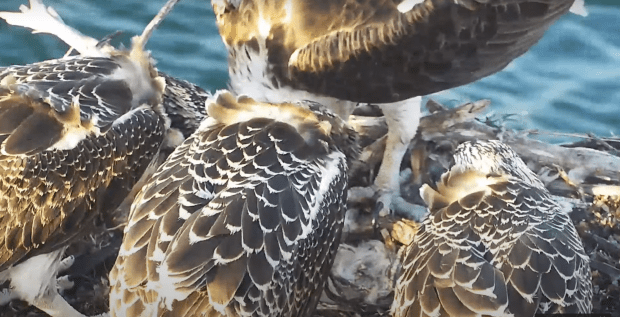
It was really difficult to keep up with the number of fish coming on the Port Lincoln Osprey nest yesterday but, everyone got something to eat. It does not appear that any of the brothers were left out and some, if not all, had two fish.

The winds picked up and the lads were all hunkered down at 18:57:22. It is often hard to tell what the weather is like just looking at the screen but it sure appears to be windy and later on the boys have some rain drops on their wings.

Dad is still out fishing for them. Ervie got the next fish delivery after being hunkered down. He was eating it at 19:49:37. Falky is hungry! Bazza is just watching.

Dad flew in with another fish at 20:22 and Falky got that one. So all the lads went to bed with some fish in their tummies. Dad, you are really amazing.

Bazza had a really nice fish at 14:03:54. He sure had to defend it. Ervie came flying in and the pair had a very short brotherly tussle but, Bazza maintained control. Good for you, Bazza!

It might have looked horrible watching it, these three have been so polite to one another. They may never have the competition for food some regions have but it is good to be able to protect your ‘fish’ and Bazza did a great job handling Ervie.

Bazza enjoying his fish in peace.

Today might just be the day that Bazza joins the skies with his brothers. I wish there were cameras all around the barge to watch them flying and having fun with one another!

The Audubon Society posted an interesting picture of an Osprey named Smedley. Some of you might know the story of Smedley. I didn’t and it is quite heart warming. Smedley fell out of his nest in 1998 and injured himself to the point that he would never be able to be released into the wild. He could not fly. He has remained at the Audubon Centre for Birds and Prey – count it – 23 years! His wing injury began to bother him and a sling was constructed so that he could move about comfortably.

There he is with his sling. What a wonderful story. Just heart warming. If you travel to the Audubon Centre for Birds of Prey in Maitland, Florida you might see Smedley. It is near Orlando.

One of the reasons this is such a heart-warming story is that many Osprey do not do well in care. Smedley is certainly the exception and maybe a look back at what – in particular – the rehabbers did when he arrived could help improve the success rate of Ospreys going into care now.

The Bald Eagles continue to work on their nests. Harriet was hit very hard by the GHOW that has a nest near to hers and M15s’ in Fort Myers. This was a growing problem last year with both the adults and the eaglets. Yurruga continues to grow and develop her self-feeding. She is adorable. There is no news on WBSE 27’s release. One of my eagle friends tells me that the GHOWs have been to visit the nest in Farmer Derek’s field but there is a problem – the raccoons have dug a hole in thee nest. She suggests that he get a raccoon baffle – great idea! Funny thing. We all loved watching those owls hatch and grow but my goodness they can kill everything in sight – and do.

Take care everyone. If I see Bazza fledge I will let you know. If I miss it – let me know. Thank you for joining me today.

Thank you to Port Lincoln Osprey Project for their streaming cam where I took my screen captures and to the FB page of the Audubon Centre for Birds of Prey where I grabbed that image of Smedley.

Victor Hurley answers your questions

If you missed the Q & A with Dr Victor Hurley, the researcher for the Victoria Peregrine Falcon Project, was live last week but if you missed it, here it is on YouTube. It is only audio- great presentation. There are some very good questions and answers that apply to the general population of peregrines.

My interest is in a small part of this discussion whereby corporations would be bound by a simple change in the wording of the law to protect the birds. Listen carefully. Check out your local situation if you can. See if you can help amend laws so that our lovely birds are protected.

There are some lovely books on Peregrine Falcons. Several in paperback. I highly recommend these:

  • The Peregrine by JA Baker
  • Falcon by Helen MacDonald
  • On the Wing. To the Edge of the Earth with the Peregrine Falcon by A Tennant
  • Peregrine Falcon by Patrick Stirling-Aird
  • The Peregrine’s Journey. A Story of Migration by Madeline Dunphy.

There are many others. Some better than others. The top three are my favourites.

For those of you that might have missed it, our darling Osprey, Ervie – the Little Bob who became the Big Bob – continues to be the ‘biggest’ and the leader. Ervie fledged yesterday at 13:17:38. Here it is:

What an amazing bird you are, Ervie.

I am outside for the rest of the day trying to make the garden inhabitable for the birds. The woodboxes have more than 45 cm of snow on top of them and so does the deck and the lawn. I will be checking on our bird families much later.

I hope that your Sunday is a good one. I do urge you to listen to Victor Hurley. It is a great discussion. You can turn it on and cook your dinner or have your tea and listen. Take care everyone! Thank you so much for being here.

Statues for beloved birds, why not?

If you have read my bio, you will know that part of my life was spent studying statues placed in the public realm. I wanted to study the History of Ceramics but, at the time, there was no such programme in existence. The rest is more or less history. My niche was the public statues exported from Britain to the India sub-continent and Southeast Asia. If anyone asked me why, I would tell them that I loved to meet new people and travel and certainly that topic facilitated many adventures. On occasion, I still write an article or two. Public statues to men – there were hardly ever any celebrating women – are always controversial as we have witnessed over the past several years with the toppling of many public figures. Can a statue of a much beloved goose be controversial? I hope not!

Derek was a Snow Goose that arrived in Watchet Harbour in Somerset, UK, a decade ago. There are no other Snow Geese and everyone believed her to be a male until she laid an egg. Derek never migrated like the other geese. The boat owners feed her broccoli and Weetabix every morning. If they are late, Derek would board their boats and honk and honk and honk til she is fed. Charming. Sadly, Derek disappeared with only feathers being found a few weeks ago. The community fears a fox killed her. She delighted people near and far. As a result of the joy she gave there is a collection to have a statue of her made for the wharf. What a lovely idea. You can read about it here.

https://www.bbc.com/news/uk-england-somerset-59252269

David Cohen’s statue to Ezra, Big Red, and chick

You might recall that a wooden sculpture was created to honour Ezra, Big Red’s Mate at Cornell. The work shows Ezra, Big Red, and a chick from their last brood. The detail in the carving is stunning. The artist, David Cohen, used acrylics for the plumage.

https://news.cornell.edu/stories/2021/10/cornell-hawk-family-immortalized-sculpture

It is a lovely work celebrating a much beloved Red-tailed Hawk. It will remain on display for three years.

The only problem with this beautiful tribute to Ezra is that it cannot be placed outdoors. I am hoping that the Rock Star of the group, Big Red, will receive a bronze statue in her own garden in front of the Fernow Building which is across from the nest and where her fledglings always flew to first.

There are many animal and bird statues around the world. They are touching and quite lovely. Why not erect something to celebrate the birds that have brought us so much joy? Seriously, the politicians that find themselves immortalized often cannot make that claim!

Checking on the nests: At Port Lincoln, Dad brought in a fish at 06:22. Guess who stole the fish tail? If you said Ervie aka Little Bob you are 100% correct. Here is our lad finishing it off. Later, he was nosing around the nest looking for leftovers. Quite the guy you are, Ervie.

It is kind of wet in Port Lincoln. Don’t think any of the lads are going to be taking off flying today but…the birds always surprise us! The puffer fish is still being batted about on the nest but the chicks did not touch it. You can see it behind the chick on the far right, Bazza.

Yurruga has also had her breakfast. Oh, she is such a little sweetheart. She is changing every day. The wing flapping is really helping to get the floof off!

Mum and daughter looking out to Diamond’s territory waiting for breakfast delivery. I know that Yurruga is closer to the camera but she is really growing and, well, she is larger than Dad. What does that tell you?

When Yurruga is really hungry, she often picks at Diamond’s talons. See how much floof has disappeared since yesterday. Beautiful juvenile feathers hiding – and what a nice tail. I might not have noticed it because of those fluffy pantaloons. But there it is. Its length will be revealed once that white down is off. I keep saying it but looking at her it is just so hard to imagine her fledging in a week.

Xavier is excellent hunter. The girls hardly ever have to wait in the morning. In fact, most falcons have a place where they ‘stash’ prey. A pantry for those days when prey items might not be sufficient or for leftovers. The birds do not waste anything. We might all take some lessons from them.

Yurruga is doing really well at the self-feeding.

Self-feeding is tiring and Diamond helps get every last piece of meat off the bones – teaching the little one. Look at how carefully Yurruga watches. She is imprinting everything including the type of prey that is alright to catch. Her plucking is getting better, too. Again, she learned that from watching her parents.

The latest news about Grinnell is that he is healing nicely and has specialized home care. He is preparing to be released back into the wild. Send all your warm wishes his way that him and Annie regain their territory together. Oh, Grinnell you are so cute and so tiny with your wings all bandaged. Look at those yellow sticks for legs. Oh, my. You take care little guy.

Everyone seems to be alright. The big snow promised for this afternoon did not materialize. Thankfully. The garden birds have really been eating — and thank you for your kind notes. No, I am not going to get out in this mess. I put on my big boots with great grip and took care of the birds and that is it. I appreciate the concern. So very, very kind of you.

Thank you for joining me today. It is nice to see all the birds doing well today. Take care all.

Thank you to the following for their streaming cams or FB pages where I took my screen shots: Port Lincoln Osprey Project, Charles Stuart Falcon Cam and Cilla Kinross, Lindsay Wildlife Hospital, and Suzanne Arnold Horning for the photo of the Ezra statue.

Three lads and a Puffer Fish

It is time to check on what is happening at Port Lincoln. Too soon these three fabulous males will fledge and oh, how we will miss their antics! Friendly banter amongst brothers.

Mum brought her boys a bit of a puzzle at 12:51:46. It was a Puffer Fish and she just let them go at it while she stood and watched each of the deal with this strange object.

“Puffer Fish” by ciamabue is licensed under CC BY 2.0

Puffer fish belong to the Tetraodontidae family. They are known by various names including blowfish, balloon fish, toadfish, globefish, bubble fish, and puffers. They carry a toxic poison – tetrodotoxin. It is one of the deadliest poisons found in the natural world. They are considered to be the second most poisonous creature in the world. These fish can live up to ten years and are found in tropical and subtropical oceans. Some species (there are 120) also live in fresh water. The puffers inhale air. This turns them into sphere. They also have poisonous spikes to try and keep from being eaten by larger fish. You can see those clearly in the image above. Their skin is also said to be extremely thick making it difficult for any predator to eat them. So why did the Mum bring the three boys a puffer fish? Was it a lesson?

I broke the event into two segments for you:

In the end, the lads left the ‘white football’ on the nest. You can see it on the left.

Ervie aka Little Bob could not stand to see the fish just go bad on the nest. The two other siblings didn’t seem to want anything to do with it so at 13:34:31, Ervie goes over and pulls the now mostly deflated fish over to the rim of the nest.

Ervie tries hard to eat that thick skinned fish.

Ten minutes later, Ervie has caught the attention of one of his siblings. In the end, Ervie lets his brother have a ‘go’ at the impossible fish. That is very unlike Little Bob. It must have been a struggle.

A half hour later the fish was abandoned again. It is lying on its side in the image below.

And it remains there. Possible lesson: Don’t ever waste your time catching a puffer fish, sons!

Thank you so much for joining me. I hope that the three lads at Port Lincoln bring a smile to your face. They do mine. But before I close, we can all use some sunshine – Yurruga style. Oh, my. She reminds me of her brother, Izzi, so much. She is soooooo loud!

Take care everyone. See you soon!

Thank you to the streaming cam of the Port Lincoln Osprey Project where I took my video captures and screen shots.

Collins Street Commotion

This morning at 5:59 one of the eyases at 367 Collins Street started ‘carrying on’. She was quite worked up.

She is calling and running back and forth on the ledge. In fact, she has been doing this and looking up for the past fifteen minutes. She is the last one on the ledge and there is someone on a higher ledge edging her on. You can certainly hear her! Is it a sibling? is it Mum or Dad?

Around 07:59, there was a prey delivery at the other end of the ledge. Our lonely little ‘last one on the ledge’ ran, very hungry. All went quiet! Maybe she got the entire pigeon to herself.

Breakfast has arrived.

Oh, she sure can run when food is involved! Amazing parents.

The last chick on the scrape hatched three days later than the others. This could, of course, be the reason. But it could also be that she is a large female. One year there was a large female left on the nest, the last to fledge. She was Big Red and Arthur’s J1 from 2020. She really did not want to leave the light stand. She didn’t seem to have the confidence to fly but she did once that Little J3, the third hatch, flew. Sadly, J1 flew into a window a week or so later. J2 and J3 survived and left the area for their own territory many weeks later but, I always wondered if J1 had just waited a little longer would it have made a difference? Perhaps not.

Three ringed osplets in nest, Mum on perch, Dad in his man cave. 10 November 2021

Yesterday, the Mum at the Port Lincoln Osprey barge fed the three ringed nestlings for over two hours, from 14:05-16:32. Someone felt sorry for her. I would like to take a different view. Yes, it was a long feeding but she knows that these three wonderful chicks will not be on the nest much longer. Yes, this might appear to be anthropomorphizing but she knows that they are about ready to fly. Just like keeping control of the food so everyone eats, she knows.

There are a lot of people thinking that Ervie is going to be the first to fledge. Here he is winging it right as the sun is coming up on the peninsula.

Mum has just flown off the nest. Ervie is watching her.

She returns with a fish. Mum has control and everyone has eaten. You will notice that Ervie is still up at her beak.

Oh, and Ervie is still getting fed 9 minutes later! What a guy. I really hope he is a good fisher and he remembers all these nice fish that Dad brought to the nest because that is going to be his ‘job’ as a male Osprey. He is the supplier of fish.

There is some very good news coming out of Port Lincoln. The osplets on Thistle Island were ringed, weighed, measured, and named yesterday. Guess what? Two healthy females. The largest came in at 1630 grams – 250 grams or nearly half a pound – large than Ervie on the PLO nest. That female was named Meg and carries a Maroon band. The other female is named Lucy and she has an Orange band. I began to imagine these lads at the PLO nest pairing up with them in a couple of years. Buy some more barges PLO!

There was more excitement on Thistle Island. Two other Osprey nests with chicks were found! Incredible. So happy for the success of the Ospreys in the region. If you want to read more about this or see the images please go to FB and search for Port Lincoln Osprey.

It is a beautiful day on the Canadian prairies. Tomorrow they are promising – 100% rain or snow. The squirrels are busy finding nuts and there are fewer and fewer geese about. It has been so nice for so long that I began to doubt if we were going to have winter. Silly me.

Take care everyone. Thanks for joining me. See you soon.

Thank you to the 367 Collins Street Falcons by Mirvac, and the Port Lincoln Osprey Project for their streaming cams where I took my screen shots and video clip.

YRK lays her egg at Taiaroa

It is still the middle of the night in Australia and New Zealand so not a lot is happening in Bird World.

The rangers at Taiaroa Head in NZ shocked everyone when they announced that OGK’s mate, YRK, laid her egg yesterday. She obviously snuck in and visited with OGK and no one saw her. Chris McCormack shared an image of OGK and YRK at the nest OGK prepared down the hill from where Atawhai hatched. This was on the Royal Cam Albatross FB Page. Thanks, Chris. This will be the couple’s 8th breeding attempt. As most of you know, they were the parents of the Royal Cam chick in 2020.

For all Royal Albatross fans, the rangers also announced that 111 birds are on the island and 15 eggs have been laid. Eggs take approximately two months to hatch.

There are still two Peregrine Falcon chicks to fledge at 367 Collins Street in Melbourne. The first fledged at 06:34 on 8 November and the second at 07:46 on 9 November. Take note that those are early morning times. Falcons typically fledge in the early morning or early evening but not normally during mid-day.

The adults have brought prey onto the ledge for these two. In fact, the parents will continue to provide food to all four of their chicks until the chick makes its ‘first kill’. These two could fledge at any moment.

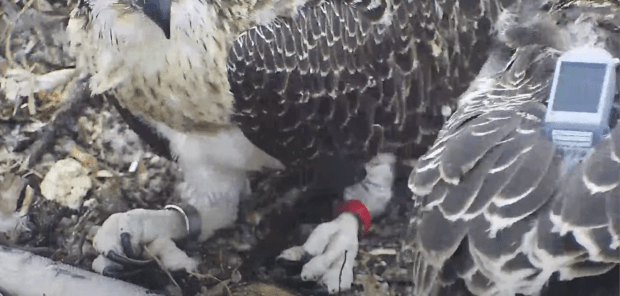
What you are looking at below, is an image of Bazza (Red band) looking enviously at the empty talons of Ervie (Dk Green band). Ervie managed to take the fish tale from Falky (yellow band) and didn’t share a scrap. Bazza was hoping there would be some left. No. Never. Fish tails must be very special – everyone wants them!

There’s Ervie eating that precious tail. Awwww. It is nice to know that having that sat-pak has not changed Little Bob at all!

I am a raptor person but so many enjoy watching the feeders for the Boreal birds. There is one that is just up and running, sponsored by Cornell. It is located in Northwestern Ontario. Here is the link if you would like to check it out.

Last but not least, those pesky Spotted Eagle owlets in Joburg. Yesterday there was only one owlet left in the nesting box. The adoptee and one of the resident owlets are both wandering around in the garden of the owner. Mum, in the meantime, is having to feed the one inside the box and then go and feed the other two. She is busy! Here is a short video of the one in the box. It is really watching its siblings and well, who knows, it could be down there any minute!

It is 17:35, still day light, and the little one is still in the box.

This is just a quick check. There have been no updates on the satellite trackers of Karl II, Udu, and Pikne, the Black Stork family from the Karula Forest in Estonia. It is hoped that they are out of range and enjoying their winter vacation. If so, we will have to wait until next spring to find out if they are alright. There is also no update on WBSE 27. The last one was 5 November. There is, however, going to be a webinar where Ranger Judy talks about her work with the WBSE as well as other guests. It is later in November. If you are interested in joining in, check out this link and follow the instructions.

Thanks so much for joining me. Take care everyone. See you soon.

Thank you to the following for their streaming cams where I took my screen shots: EcoSolutions, Port Lincoln Osprey Project, 367 Collins Street Falcons by Mirvac and to Royal Cam Albatross FB Page and Chris McCormack for the image of OGK and YRK.

Everyone is a ‘Bob’

Oh, what a day!

The banding and measuring of the Port Lincoln osplets began well after lunch once the boat – the Calypso Star (above) – that took tourists out to see the sea lions returned. The entire process took approximately two hours. Mum positioned herself on the boat anchored next to the barge with the nest on it. At various times she expressed her growing dissatisfaction. She wanted her chicks back on the nest. There she is in the image below on top of the mast.

When Mum got tired of waiting, she flew up to the barge pole and began yelling at the banders to hurry up!

There they are in the nest before the banding took place. All nice and calm.

First off, I was wrong! Little Bob is Little Bob. Big Bob is also Big Bob. Middle Bob is also Middle Bob. All three are judged to be male.

It was only after Janet Forster said they were all males on the chat that things began to fall into place. There is only 51 hours separating the oldest from the youngest. That is incredible in itself. I cannot comment on prey deliveries in former years but the fish were consistent this season leading to food stability. To me, this was possibly the calmest, most civil osprey nest with three chicks I have ever seen. Does gender play into that? Is a nest with three males much less prone to aggressive rivalry? than if there is a female on the nest? or two females?

It is almost 4pm in Port Lincoln. We are still awaiting the names and to see who got the tracker. PLO wanted the tracker to go on a male. This was because the tracker was put on Solly, the first hatch and a female, last year. Now they have a choice of three! Oh, I am hoping for Little Bob.

Chicks returned to the nest at 15:41:33 with some fish treats.

The chick on the right has a yellow band and has found a fish and is really doing well at the self-feeding. Some of the images are a little blurry. Everyone loves that Middle Bob got the yellow band – ‘Mellow Yellow’ they are calling him.

One chick is looking out to sea and not quite ready to have fish. And then there is the one right up front, right under Mum’s beak wanting fish. That chick has a black band and there is a sat-pak on its back. Can you guess who loves to be fed by Mum? and who is decidedly the ‘Big Cheese’ on the nest now – for certain? and who is always at the table first? I know you know who that is!

Little Bob got the satellite tracker! Tears are flowing down my cheeks.

The nest started off with seven fish. There are only three left now. Ah, now two. Dad came and took one and joined in the celebration.

Here are a series of close up images. You can clearly see the red band and look, there is also a metal band. It is the Australian Bird and Bat Banding Scheme. Each bird (or bat) has a distinct number. If found, the number is called in to identify it for tracking purposes. There is a similar scheme in North America.

The sat-pak, if it is like the one that Solly has, should last for up to four years. It is going to be fantastic to see how far a male fledgling goes from the natal nest. You might remember that Solly broke all expectations when she moved more than 300 kilometres away from Port Lincoln to Eba Anchorage. No one realized the females would disperse that far. It brought a new understanding to the movements of the Eastern Ospreys.

So typical. Little Bob decided to come back for seconds.

The chicks have had a stressful day. They are doing fine and so are the parents. All that nice fish left by PLO surely helps.

Little Bob is looking through the nest for any leftovers! Typical. He stole a lot of hearts from the time he karate kicked his way out of his shell to putting a big sibling in its place a couple of times when they thought they might push him around a bit. It did not work. If he was hungry, he was always up at the table and ready to eat. No one would stop him. He is a great choice for this tracker.

We are just waiting for the names to come in. It is now in the wee hours of the morning in Canada. Someone just commented that while they will have official names, they think #3 will always be Little Bob. Could be. Someone else suggested Big Bobbie. I hope he lives long – I hope all of them do – and father many healthy chicks to help bring the population numbers of Eastern Osprey up.

This is a momentous occasion. So very happy for the Port Lincoln Osprey Project, all the people behind the scenes, and this amazing osprey family.

Thank you so much for joining me. Next stop at this nest: fledge. Perhaps in 7-9 days. That will come too fast. Names have not been released yet. I will post those tomorrow. It is nearly 2 am and I am zonked. Want to bet they will post the names the minute I publish this blog? Most likely. Take care everyone.

Thank you to the Port Lincoln Osprey Project for supplying the streaming cam where I took my screen captures.

Port Lincoln Osprey, update

It is currently late afternoon in Port Lincoln, Australia. The osplets have been flapping their wings steady all day. At one point, I felt that one or more of them might take flight.

The original timing of the ringing, measuring, naming, and attaching at least one sat-pak to one of the trio was to be Monday 8 November. That timing has been brought forward. It will now take place in the morning Sunday 7 November Port Lincoln time.

It is unclear to me if you will be able to see the process or not. Please check your local time with that of Australia if you wish to check to see what is happening live. The link to the streaming cam is here:

On Monday, the Thistle Island chicks will be banded and one will get a sat-pak.

Oh, I can’t wait! Time to set the alarm.

Take care all. Thanks to Port Lincoln Osprey Project for their streaming cam where I took my screen shot.

Whew!

I know that some of you have watched birds fall out of nests including Silo Chick at Patuxent River Park last summer. Remember that feeling when you saw that little osplet fall into the water, heard the splash, and saw the others looking down? Felt helpless? Of course. Thankfully that story ended well. I have no idea how many called but the osprey was located and literally tossed back into the nest. It was an enormous relief. Others are not so lucky.

I posted a new owl box streaming cam in Joburg, South Africa just the other day. An orphaned Spotted Eagle owl was put in the box with two other owlets. The mother accepted it! Fantastic. The adopted owl is 5 days older than the other two and it got curious about the outside world today and fell out of the nest box!

What no one knew, at the time, was that the owl landed on a huge platform under the box. If it doesn’t get back into the box on its own, it will be placed back inside the box. Relief.

Yarruga was starving this morning. There were two prey deliveries at the scrape box and there was not a scrap left of either meal.

Yarruga was so excited when the second meal appeared that she could not stand still to eat. She literally ran around the scrape box as in the images below.

Xavier was certainly glad when that feeding was over! There is not a drop left for either of the adults. Yarruga was soooooo hungry after having only 2 feedings yesterday. She does love her food! And she is certainly growing. Look how big she is next to Xavier!

In fact, Yarruga should have had a nice tasty little duckling yesterday but Diamond saw it and quickly took it from Zavier and flew out of the scrape! One has to imagine that this is quite the delicacy (as opposed to the dreaded Starling!). After her injury, I am actually glad that she got it.

Port Lincoln did a nice close up of the juvenile feathering of the three osplets this morning. Just look at the variations in the depth of the white juvenile feather banding. Little bob is in the middle.

As the dominant bird, Little Bob often gets the first bite. She is full and letting the other two have their turns as she looks out to the water in the image below. Of course, I am saying ‘she’ because of her thick legs. Wait til Monday when the banders declare she is a he. How funny! Whatever gender, that bird is gorgeous and I will continue to celebrate the times that she put Big Bob in his place.

There she is below.

Victor Hurley, the main researcher for the Peregrine Falcons in Victoria has been posting information on the 367 Collins Street FB Page. The last posting was on ‘Dispersal’ because, as we know, the falcons will be fledging shortly. I imagine that there are many things in this column that would be of interest to many of you. This is what he wrote:

First Flight Normally, this is not such a serious undertaking as that from an inner city high rise ledge. Normally pre-fledgling Peregrine Falcons will scramble around across their natal cliff for quite some time before taking their first flight. Mostly this is successful and they land high on another ledge or small perch. In a city location they will land on the roof top of another building nearby. If the winds are tricky then things can go south pretty quickly. Once they have mastered their first flight then they will spend increasing time “on the wing” and following and learning from the parents how to hunt. As soon as each youngster achieves their first kill the adults (parents) will stop providing any more food and that youngster is on their own to find food. Once all young are successfully hunting then depending upon the experience and ruthlessness of the adults they will all be chased with serious determination out of the territory altogether. In some cases this may occur in December or even early the nest year. Either way the young tend not to return again to the nest ledge that we have been observing. Maybe occasionally, but then only briefly.

Plumage differencesLeading up to this first flight the adults restrict the level of food resources they bring to the nest. This explains the weight loss of the nestlings. The wings of the nestlings are still growing but they are also losing weight. This makes them lighter with larger wings which provides for a “lower wing loading” which makes their first flight easier. Neat, huh! The other point I thought I would raise here is that of the plumage differences. Peregrine Falcons as with most raptors and many other bird species have a juvenile plumage phase and an adult plumage phase. The juveniles are in essence a brownish colour with vertical splotchy stripes over a “dark milk tea” fawn base colour on the front and dark brown wing, back and head. Whereas the adults have a near black hood for the head, slatey grey wings and back with a soft cream bib and base colour overlayed with fine dark grey-black horizontal stripes. The tail and main wing flight feathers are also longer in the juveniles and they moult shorter feathers with each year as they get older.

Natal dispersal This is the ultimate question. Where and how far do Peregrines disperse to find a place of their own in which to breed. Natal dispersal is the distance (and direction for those interested) in how far fledgling Peregrine Falcons ultimately move to find and establish (read take over for the most part) their own breeding site. Amongst Peregrine Falcons in Victoria, as with most bird species the world over, the females disperse further from their fledging site to breeding site then do males. Based on observing 127 breeding adults with leg bands (placed on them as nestlings) the females dispersed on average 64km (range 6-280km) and males average 25km (rang 1.6-90km). This differing dispersal distance minimises the likelihood of siblings interbreeding. The average age at first breeding is as follows: females 2.6 years (average) and for males 3.3 years (average). Another way of presenting this same data includes presenting the direction as well as the distance males and females disperse. No bias in dispersal direction was recorded.Victoria is a relatively flat area of the planet, its highest point above sea level is Mt Bogong (1,979m) and~80% of Victoria is <200m ASL. So for a predatory species like the Peregrine Falcon that doesn’t migrate annually due to milder winters and having the highest wing loading of any Peregrine sub-species globally, in a state (Victoria) with limited high altitude cliff faces with an abundance of low lying wetlands and associated birdlife and a very diverse range of parrot species what is a cliff nesting raptor to do? A look at all (256) of the Peregrine Falcon nests ever described in Victoria provides the answer to this question. The Peregrine Falcon in Victoria has overcome these obstacles by adopting a range of novel nesting situations (by nesting in stick nests of other birds, tree hollows and of course buildings (a growing trend globally). So this leads to another interesting question. Do those birds raised in one type of nest only adopt others of the same “nest type”? or will they readily disperse to a different type? That is to say, do they become behaviourally “imprinted” on the nest type they are raised on? Again thanks to the long term banding of nestlings and resighting of adults (with telescopes) by volunteers with the Victorian Peregrine Project the natal dispersal patterns of 127 Peregrine Falcons have been identified so far showing that 30.2% have adopted a different (novel) nest type from the one they were hatched and raised in. Between the sexes dispersal patterns are similar with 26% of females and 23% of males adopting different or “novel” nests in which to breed. Combined 30.2% of Peregrines undertake novel natal dispersals to find a place to breed. So the myth of nest type imprinting has been pretty thoroughly exploded with these bird banding results.Further to this, slightly counter-intuitively, novel dispersal events (dispersing from one nest ‘type’ to another) were less dispersive with no sex bias. That is those individuals who adopted a ‘novel’ nest type did so by dispersing a shorter distance on average than those undertaking a typical natal dispersal. Presumably they are doing this in order to exploit a familiar (geographically closer) food/prey resource by adopting a novel nest type in order to remain close by to that prey resource.So back in 1991 when Peregrine Falcons were first identified breeding at 367 Collins Street, Melbourne it was one of only two or three nest sites on built structures that were known. Since then over 20 new sites have been discovered and the number continues to grow. Nest site selection is driven by its proximity to food resources as well as the security (from predators and human disturbance) and how protected the nest is from rainfall and water runoff.Surviving the first two years…The third question (although not chronologically) is what is the survivorship of young Peregrine Falcons in their first two years prior to breeding. Generally, it is accepted that there is a ~a 66% die-off of Peregrine Falcons within their first year. Given the youngest breeding is at two years post hatching I have trawled the VPP database again to investigate causes of mortality of ~240 banded Peregrine Falcons in their first two years post banding. Most banding occurred at or around 24 days post hatching. When considering the various incidents there was no sex bias. That is neither sex is more prone to any cause of death compared to the other. Rock falls, cliff collapses or storms bringing down trees or stick nests have been a surprisingly regular threat to young of this species. The constant and ever present shooting of Peregrine Falcons continues to this day. The first ever band recovery of a Peregrine Falcon in Australia was in 1958 in Victoria. Disease of course is Trichomoniasis and predators varies from Red Foxes, Brown Falcons and even Peregrine Falcons in limited circumstances. Secondary poisoning has generally been a result of pigeon control campaigns.”

This information would, in general, apply to all falcon populations. And if you read all that – it is a ‘Double Whew’ for today. I have been reminded that Victoria Hurley is doing a Q & A tomorrow. I cannot find the link to it. If I do I will send it out later.

Thank you for joining me. Everyone has been fed at least once if not twice already. Diamond is looking much better. No news on WBSE 27 yet and nothing on Grinnell. Take care!

Thank you to the following for their streaming cams where I took my screen captures: Port Lincoln Osprey Project and Charles Sturt University Falcon Cam and Cilla Kinross.

How is Diamond?

Diamond is the female at the Charles Sturt University Peregrine Falcon scrape box on the University’s water tower. Her mate is Xavier and their only chick this season is Yarruga. Yarruga is 27 days old today. Its name means ‘Sunny’ in Maori.

Several days ago Diamond injured herself, probably in a hunting incident. Her right wing was a bit droopy and she continues to have difficulty putting all of her weight on her right foot. Her mate, Xavier, has often taken over the feeding duties of Yarruga because feeding requires putting pressure on the feet to hold the prey and pull up to get the bites off for the chick.

Yarruga was particularly hungry this afternoon. Diamond was on the ledge of the scrape watching over her baby, trying to get some sleep, and also attempting to keep the weight off the right leg.

Instead of writing how Diamond is doing, I thought it was just best to take a few video clips so you can see for yourself. They do say a picture is worth a 1000 words.

Here is the first one. Diamond has been resting on the ledge of the scrape. She has kept her right leg slightly elevated and has been able to sleep some. Yarruga is hungry and, since this is the big growth spurt for Yarruga, she sees a parent and thinks it is dinner time. Poor Diamond. Yarruga is prey begging.

Xavier brings in the Starling that was left over from an earlier feeding. The falcons have a place where they stash food. It is a great idea. They never waste a single bit of the prey they kill for food. (We could all take a lesson from them!). Diamond wants to feed Yarruga. The following two clips are from later in the feeding.

The feeding went on for some time. This is the last bit of where Diamond finishes feeding Yarruga and then flies off with the rest of the Starling. Despite the fact that she doesn’t like Starling (prefers pigeons and parrots), it would not be easy for her to hunt now while she is healing so she will happily eat the Starling leftovers.

It still appears that Diamond is in a lot of pain. She is really limping but her wing appears to be better. It must be difficult because she wants to take care of her baby. I think that is why I actually believe she is improving. She could have flown out and let Xavier feed Yarruga but she chose to do it herself. It is going to take some time for her to heal and we need to continue to send her our best and most positive wishes.

A quick glance at other nest news:

The 367 Collins Street ‘Four’ decided to run along the gutter and let us have some really good glimpses of how they are growing and changing today. Remember when you look at them that they are precisely one week older than Yarruga. It is hard to imagine that they were mostly covered with white down a week ago! Here they are wanting to fly – and way too soon, they will.

The down is really coming off. They are so curious about the world outside of the scrape. Mum and Dad have been doing aerial demonstrations for them. This is something that the adults do to try and entice the eyases to fledge.

The Port Lincoln Osplets will be banded, named, and at least one will get a sat-pak on Monday 8 November, Australian time. Remember! It is possible that we will only get to see the event on tape. It is exciting. I cannot wait to see if Little Bob is a female with those thick stubby legs!

Just look at the size of Dad’s wing. Together they would be wider than the nest! He is bringing in the second fish of the day. Now when Mum begins calling the chicks join in. It is really sweet.

Mum is so quick to pull that fish off Dad’s talons. I often wonder if the males ever get injured when this happens.

Today, Little Bob is more interested in watching Dad go down to his man cave on the deck of the barge than being first in line to eat. That is almost shocking.

The trio are pancaked. They have eaten so much. Mum brought another fish in at 13:50 – their third of the day. On average, the osplets have 7 feedings a day so far. Fantastic parents. Can’t say enough good things about how well they have worked together this season.

There has been no new updates on WBSE 27 since 1 November, Australian time. When I hear anything, I will let you know.

Thank you for joining me and checking in to see how Diamond is progressing. We just have to be patient – and that is hard when we see her in pain. Take care everyone. See you soon.

Thank you to the following for their streaming cams where I took my screen shots: Charles Stuart University Falcon Cam and Cilla Kinross, 367 Collins Street Falcons by Mirvac, and Port Lincoln Osprey Project.