Diamond, the female at the Charles Stuart University scrape box in Orange, Australia, was away from the scrape for ten hours a few days ago. When she returned her right wing was droopy and she was limping slightly. Xavier, the male, has been doing the hunting and feeding little Yarruga, their three week old plus 2 day chick, its meals. Xavier is getting more proficient with each feeding!
Diamond slept in the scrape box last night with little Yarruga. She was standing on ‘her’ rocks in the corner.
When she went to go to the ledge to fly out for a break, she could not put weight on her right foot and stumbled.
She fell down, got up and stumbled some more.
Just watching her trying to make it to the ledge to fly off made you realize how difficult it is for her to heal. It will be a long process. She doesn’t have the ability to put a lounge chair in a tree or in the scrape box and elevate that leg. Anyone who has sprained an ankle or hurt their foot can have great sympathy with this devoted Mum. Of course, Yarruga had no idea what was going on.
Xavier arrived at 07:03:06 with a very prepared fat pigeon for little Yarruga. He might have been expecting Diamond to be in the scrape and feed their baby. He hesitated.
All Yarruga wanted was breakfast and she began to make her way over to Dad.
At that point, Xavier realizes he is on feeding duty and dragged the carcass into the middle of the scrape, away from the ledge so the baby wouldn’t accidentally fall out.
Yarruga was delighted. Dad is getting very good at this!
Little Yarruga is so cute. She will go into the corner when she is full to the brim. Xavier always has to check to make sure she doesn’t want anymore!
Xavier makes his way over to the ledge. I am hoping that he shares that lovely breakfast with Diamond.
Send Diamond your warmest wishes.
Port Lincoln has confirmed that the trio will be banded Monday, 8 November – Australian time. The bander is arriving from Adelaide. I do not know the time.
Thanks for joining me. I knew that you would want to know how Diamond is doing. We all hope that she is well soon but, in reality, it will take some time. There is no need to panic. Xavier is doing a wonderful job. No worries for little Yarruga. Dad is definitely up to the job.
Take care everyone.
Thank you to Charles Sturt University Falcon Cam and Cilla Kinross and the Port Lincoln Osprey Project streaming cams where I took my screen captures.
Port Lincoln, Australia is pretty but that is not what I am referring to. Just look at these gorgeous babes in the nest on the Port Lincoln barge. Stunning.
That is definitely a great portrait to go on a fridge magnet. It is as if the owners were standing on the barge asking the trio to turn around and – click! I think I could stare at these three all day. Did I say for the 500th time that this has been an amazing season on the PLO nest? I hope so because it certainly has.
These three are so close together that when one of them does something, another wants to try it or out do the others. And that is what happened on the morning of 2 November in Australia. It was a flapping extravaganza!
I can do that, too!
Watch me again!
They are very entertaining and yet there is this air of cooperation on this nest that is quite astounding given its past history. For those of you that do not know the Port Lincoln nest, its history is one of siblicide with often only one fledging. Last year there were two with one death. So if these three fledge – which there is no reason they won’t – it is a first for this nest. It also goes to show us that the events on a nest cannot always be predicted by the past. I am so very happy for them. These parents worked together brilliantly.
They are 49 days old for Big and Middle Bob and 47 days old for Little Bob. These three are just itching to fly and that nest is getting a wee bit crowded. The ages are interesting. In the UK, the norm is for Western Osprey nestlings to be ringed around the 35th day of hatching and never after the 42nd because it could cause them to prematurely fledge. The Eastern Ospreys which are also not migratory might have different dates after hatch. From the information on the Port Lincoln streaming cam, it appears that Solly, the first to hatch and the female with the sat-pak was 65 days when she took her first flight. Whew! That means we have a little more time with these gorgeous birds.
The first fish delivery of the day arrives at 09:21. There were at least seven yesterday. Here they are lined up eating, waiting their turn. Bliss. Sheer bliss.
Thank you so much for joining me and thanks to Port Lincoln Ospreys for their streaming cam where I took my screen shots and video clips. They are doing an amazing job. If you want to watch this trio, here is the link to the streaming cam.
We patronize the animals for their incompleteness, for their tragic fate of having taken form so far below ourselves. And therein we err, and greatly err. For the animal shall not be measured by man. In a world older and more complete than ours, they are more finished and complete, gifted with extensions of the senses we have lost or never attained, living by voices we shall never hear.
Henry Beston, The Outermost House, 1928
If you have not read Henry Beston’s book, TheOutermost House. A Year of life on the Great Beach of Cape Cod, you might want to check and see if your local library has a copy. Or, like me, you might want to check out the many on line used book shops unless, of course, you happen to live close to one. It is also very reasonably priced new at $17.99
Beston is entranced by his surroundings. His intent was to spend only a fortnight in the cabin on the windblown dunes but, as he became more and more enthralled with the seaside, the migrating birds, the blowing sand and the waves that surrounded him day in and day out, he could not leave. Beston spent a year living on the shore. He listened, observed, and began to understand the natural world. Beston would sit and write, often looking out a west window, observing the Terns and the Hawks. His descriptions of their lives is nothing short of vivid. You can almost reach out and hear the splash of the waves as a storm approaches or feel the warmth of the sun on a summer’s day or hear the birds.
As an art historian (at least in another life), I appreciate Beston spending some time reflecting on how the ancient Egyptians depicted the birds and animals in their art. He said, “The longer I live here and the more I see of birds and animals, the greater my admiration becomes for those artists who worked in Egypt so many long thousand years ago, drawing, painting, carving in the stifling quiet of the royal tombs.” Beston believed that the Egyptians were the only ones who were able to portray their true psyche. “A hawk of stone carved in hardest granite on a temple wall will have the soul of all hawks in his eyes. Moreover, there is nothing human about these Egyptian creatures. They are self-contained and aloof as becomes folk of a first and intenser world.”
Indeed, the Egyptians covered the inner chambers of their burial tombs with images of hawks, carved statues out of stone, painted their portraits on papyrus, and cast small amulets.
Horus is the son of Osiris and Isis. Osiris is the God of the Dead as well as the God of Resurrection. His partner, the goddess, Isis , helps the dead through the afterlife. Together with their son, Horus, who is depicted with a falcon head wearing a crown with a cobra, they are to Egyptians, the holy family.
The name Horus means ‘the one who is above’ or ‘the one who is distant’. The eye of Horus, the Wedjat, is depicted in many works of art. It is said that the god’s right eye held the sun while his left eye held the moon. They represented power and healing and appear on many works of art and amulets as protective devices.
The Eye of Horus, seen in the centre of the tomb painting above, became a powerful amulet in Old Egypt. The notion that Horus can protect a person continues today. Talismans of all types appear at the stalls in the old markets throughout Cairo and even on running shoes worn by teenagers.
Horus is a falcon. All one has to do is look at the profile of the peregrine falcons to see the similarity between the Egyptian representations of Horus. Peregrine Falcons are Apex Predators. That means that there are very few animals that will harm them – they are at the top of the food chain, so to speak. They are capable of flying at 390 kmh making them the fastest bird or animal on the planet. The falcons would have been known, of course, to the ancient Egyptians. There are written records of the falcons as early as 10,000 BCE in the Middle East.
There are many books on falcons. One that I particularly like was released in 1967. It is The Peregrine by J.A. Baker. There is a recent reprint with an excellent introduction by Robert MacFarlane, British nature writer and critic. If you are into falcons, I highly recommend it.
I have been thinking a lot about falcons. Yesterday when Diamond did not return to the scrape box at Orange for nearly ten hours, Xavier just stepped in and took care of their eyas. Just watching Yarruga or the 367 Collins Street Four in Melbourne gives me pause to contemplate Beston’s quote at the beginning of this blog. I can also ‘hear’ the falconer, Laura Culley, answering someone who asked if Big Red, the Red-tailed Hawk at Cornell, would know that one of her fledglings had died. Laura fired back, “And why wouldn’t she?!” One of the ways that we can move forward to find a balance between humans and the natural world is for us humans to stop thinking that we are superior. Beston is right – we aren’t. For so many people that I know, the birds continue to be the messengers of the gods giving us signals and warnings – if only we could recognize them.
Xavier did a top notch job of taking care of little Yarruga. This morning he brought in a Starling for Diamond to feed the little one. Diamond’s right wing was still a little droopy then.
Diamond gave the chick part of the bird and left with the remainder. A little later Xavier flew into the scrape box with a nice plump pigeon. He stuffed Yarruga til the wee one could hold no more.
Xavier is getting the hang of feeding Yarruga but he gets anxious the more Yarruga begs for food (or screams for it) as he finishes plucking the prey. So today, once again, Xavier fed Yarruga lots of feathers and, also, one of the legs of the pigeon. It had to have been larger than the one the other day. Yarruga struggled for awhile. Then bit the leg into two parts and Xavier then continued to feed her pigeon.
Yarruga’s crop was getting bigger and bigger. Xavier is doing a fantastic job feeding his chick. Do you remember all those days Xavier wanted to feed the newly hatched Yarruga and Diamond wouldn’t let him? Oh, he is making up for that desire to care for his baby now.
At the end, he is still wanting to make sure that Yarruga is no longer hungry. Diamond would be proud.
Diamond rested herself in one of her spots – possibly a nearby tree or on top of the water tower. Her shoulder or wing might just be bruised or sore. However, by the early afternoon, her wing was looking better and was back in place. You can see that in the image below.
The 367 Collins Street Four are losing down and losing down. They now look like Peregrine Falcons instead of fluffy little samurai warriors running up and down the gutter.
Here they were a few days ago:
Here they are today:
They have really changed. Just look at the one in the background standing on the ledge outside the scrape. What beautiful juvenile plumage.
All of the falcons seem to be just fine – including Diamond. She just needed to rest. With only one chick in the scrape and not four, Diamond can let Xavier be more active in both hunting and feeding. Having one is certainly less stress. It is, however, such a relief to have Diamond and her wing back to normal.
The following is an update on WBSE 27:
Thank you so much for joining me. Falcons are wonderful birds. I hope you enjoy them as much as I do. Take care everyone. See you soon.
Thank you to the following for their streaming cam where I took my screen captures: the 367 Collins Street Falcon Cam by Mirvac and Charles Sturt University Falcon Cam at Orange and Cilla Kinross. I would also like to than the Sea Eagle Cam FB Page for the update on WBSE 27 which I have cut and pasted here.
Please note: The blog for Monday, 1 November may not appear until late evening. I hope the weather is not too bad so that I can get out and catch up on the ducks and geese and there is, apparently, an influx of Robins in our City.
If you read my blog regularly, you will know that I am nothing but praises for this Osprey nest on the barge at Port Lincoln, Australia. The nest has a history of siblicide and this year, for the very first time (knock on wood), the parents are going to fledge three! There will be many ideas on why this might be the case but, it seems that it could be down to the simple fact that there is only 51 hours difference between Big Bob hatching and Little Bob. Today, they are 47 and 45 days old. (Middle Bob hatched 4 hours after Big Bob).
Dad has really kept up the fish deliveries even in the worst weather with strong winds. Yesterday there were six feedings: 6:41, 8:24, 10:11, 11:19, 15:02, and the last to fill them up for night came at 19:34.
Mum has also really kept tight reigns on the trio. Despite the fact that they are capable of self-feeding and have, on a few occasions tried to snag the fish, she has maintained order. They all line up and leave one another alone. Everyone gets fed. That is food security at its best.
Little Bob is at the top right. You can see that s/he still has a crop from the feeding four hours earlier. This is a nice fish to top them up for the night. Typically, Little Bob will not take its eyes off that fish!
They are really growing. None of the trio have started hovering but they certainly are flapping their wings.
Awww. The little sweeties. They also still sleep duckling style.
They are wide awake as dawn approaches. Each taking turns stretching and wing flapping. Everyone seems to be anticipating the arrival of breakfast. Still, you can see that at least one of the birds has a crop from the late night feeding.
If you have shied away from this nest because of previous years, I urge you to take a peek. These three will fledge in about two weeks. They will then fly back and forth with the parents still feeding them until they finally leave the area. During the week of 8 November, they will be ringed, given names, and measured. One (or all – I am still trying to confirm this) will receive a satellite transmitter. So there is still excitement to come – join in.
It is a beautiful family. Here is the link:
We have had several snow showers on the Canadian prairies today. a few of the birds have ventured out to the feeders. Of course, Dyson is here vacuuming up all the seeds. No sign of Mr Blue Jay and family. I don’t blame them for not coming out. No one is really ready to think about winter!
Thank you for joining me. I will be checking on Diamond and to see if there are any updates on WBSE 27. If there are, I will let you know. Otherwise, I will see you tomorrow. Take care everyone.
Thank you to the Port Lincoln Osprey Project for their streaming cam where I took my screen captures.
Yesterday, Diamond, the female Peregrine Falcon at Orange, flew out of the scrape box at 7:44:33. Xavier was watching for Diamond from the ledge as well as looking out for Yarruga. Xavier was such a sweetie. He fed Yarruga three times, getting better with each meal.
After eight hours and Diamond had not returned, worry was setting in.
I am overjoyed to tell you that Diamond returned at 17:21 after being away for almost ten hours. What a relief! One of her wings is drooping and she might have been involved in ‘something’ but hopefully, she will be back to herself when she wakes up today, 1 November, in Australia.
Diamond stared at the two eggs but she did not incubate them. She slept upright on her stones in the corner.
Yarruga was so happy to see Mum. Sadly, you can see that right wing drooping in the image below.
Send all your positive wishes to Diamond for a quick recovery.
If you love Peregrine Falcons, Xavier and Diamond are a great family to watch. I do adore the Melbourne ‘Four’ but, I want to add that because this falcon family is in this scrape box and there are two cameras, you can always see what is happening.
Please check them out. Here is the link to the streaming cam:
This is just such a relief. I knew you would want to know!
Thank you for joining me. Take care everyone. See you again soon!
Thank you to Charles Sturt University Falcon Cam at Orange and Cilla Kinross for their streaming cam where I took my screen captures.
Diamond is the mate of Xavier who have their hatchling, Yarruga, in a scrape box on the water tower of Charles Sturt University at Orange. This morning Diamond left the scrape box at 7:44:33. She has not returned. It is now 15:12:54. You can do the math.
I asked and the lead researcher, Cilla Kinross, said on the chat, “I have to say that it’s very unusual for her to be away this long while the chick is still quite small. Once they get bigger and start nagging the parents for food, they stay away longer, even night.” Kinross suggests that we should not worry as hunting accidents happen during storms and it is a beautiful day. Maybe Diamond is enjoying the day.
Xavier has really done a superb job of tending to Yarruga. He has fed the wee one three times so far. This means that he is hunting, feeding, protecting the nest box, and keeping a watchful eye on his eyas that is now walking. Bravo, Xavier.
This is the image of the last feeding with Dad and Yarruga.
I did want to let you know that something could be amiss at Orange. Yarruga can thermoregulate – keep itself warm so it does not depend on Diamond to do this. While there are no real predators that would harm Yarruga, normally a parent would be the security guard for the nest. If Diamond does not return, Xavier will have to play all of the roles of both Mum and Dad. I really hope that Diamond is just sunning herself on the top of a tower or in a tree and that she is home soon. It is difficult not to worry when it has been such a long time and when we know that Diamond is extremely protective of her chick. Please send your positive wishes their way.
Thank you to the streaming cam at Charles Sturt University at Orange Falcon Cam and Cilla Kinross where I took my video clip.
There is a lot to celebrate in Bird World this evening. Everyone on the Taiaroa Peninsula and perhaps the whole of New Zealand are celebrating the arrival of the 2021 Royal Albatross Cam Princess, Tiaki, at the feeding grounds just 70 km off the coast of Chile – safely! This really is amazing. As was pointed out on the Royal Albatross FB page, this young bird fledged on 25 September and arrived in the waters off the coast of Chile, 8500 km away, in 35 days. Incredible. Congratulations!
For those watching the return of the Royal Albatross to Taiaroa Head for the upcoming breeding season, OGK has flown off the peninsula to feed. He continues to wait for his mate, YRK. I have asked and been told that OGK is not the only male still waiting for its mate. That gives me some hope that this adorable couple will still be reunited. They were the parents of last year’s Royal cam princess, Pippa Atawhai.
There has been no new tracking data for Karl II but, on the 28th of October, he had reached Umm Harazat in the Sudan close to where he winters. Udu was at the Farafa Oasis in Egypt on the same day and Pikne was along the Red Sea. I expect that Udu and Pikne could be further into Africa by the time the next transmission comes in.
The Farafa Oasis is an area known as the White Desert.
Udu made a splendid flight across the Mediterranean Sea. The White Desert is home to a number of wells and there is farming in the area. It is most know for its white rock figures.
Pikne’s position:
Karl II’s position:
Moving away from the migrating birds back to Australia, little Yurruga took some big steps today. What a sweet little falcon! Here is a short clip I made of this momentous event.
Yesterday, Dad fed the 367 Collins Street Four in an area that could be viewed easily. There are, of course, concerns that the falcons will fledge from the end where there is no camera view. The owners of the cameras have stated that they will not change the direction of the camera again as it is too disturbing for the birds. That is quite understandable at this stage. No one wants to frighten these lovely eyases and have them fly and fall to their doom. And there is no telling which end of the ledge they will fledge. We just simply wait. They are so strong and healthy. Mum and Dad have been heroic in their efforts to sustain them. So please keep feeding the pigeons in Melbourne – our falcons need them!
There has been no word from the vet team about the condition of WBSE 27 since it was attacked by the Pied Currawong and found on pavement near to the Sydney Olympic Forest.
The Sydney Sea Eagle Cam FB page had originally posted WBSE 27 on the pavement unconscious. This disturbed some people so it was replaced with the image below. I have said that no news is good news but this has been several days since the incident. Send all the positive energy to this beautiful bird that you can!
There is good news at the Kakapo Recovery. The team has discovered that the eggs that are laid but do not hatch are not always infertile. Since the beginning of trying to help the Kakapo to recover numbers, it was always believed that the eggs were simply infertile and that is why there was no chick to hatch. The chicks are dying at an early stage. If they can figure out what is the cause, they might be able to assist these lovely non-flying parrots to have more successful hatches. Here is the posting on the Kakapo Recovery FB page. It talks about their efforts with the University of Sheffield to understand the issue and be able to have more live births of this critically endangered bird. Bravo!
The ospreys on the PLO barge are doing great. Little Bob is 45 days old today. Fledging is coming soon. Oh, how I am going to miss this wonderful trio. They have delighted hundreds and hundreds of people this season. Pure joy!
Look at Little Bob showing off! Besides loving to eat Little Bob really does like to give those wing muscles a go. I don’t think Big Bob is very amused.
In the image below, from left to right: Middle Bob (2), Little Bob (3), and Big Bob (1). If I were to have to base a guess on their gender due to the legs, I am afraid that I would have to change my prediction.
Middle Bob’s legs are definitely shorter and stockier than either Little Bob or Big Bob. Big Bob’s legs look like those of a male. That leaves us with Little Bob that I continue to believe is a female. Oh, I cannot wait for those measurements. They are not 100% certain but, perhaps, they will also do DNA testing on the three when they ring them!
Little Bob gives its two older siblings a big hug.
There is Little Bob looking off to the left after the morning breakfast. Three gorgeous nestlings. Ringing, naming, and measuring will take place the week of 8 November. I will keep you posted to the more exact date when I find out.
Thank you so much for joining me today. I hope that you are all well. Take care!
Thank you to the following for their streaming cams where I took my screenshots, video clips, and maps: Port Lincoln Osprey Project, 367 Collins Street Falcons by Mirvac, Charles Sturt University Falcon Cam at Orange and Cilla Kinross, Birdmap, Kakapo Recovery FP Page, Wikimedia Commons, and Wildlife Computers.
WBSE 27 who flew off the nest in the Ironbark Tree in Sydney’s Olympic forest was found lying on the road being attacked by Currawong yesterday. This was the posting on FB:
Ranger Judy provided an update:
The sea seaglet was so fortunate that someone experienced came along and offered immediate assistance. In the picture above it looks like WBSE 27 is awake. However, if you look at the top image carefully you will immediately see that at least one talon is injured as well. We saw these injuries with WBSE 26. Those can get infected quickly. It is really good that 27 is in the care. It can eat, get fluids, and heal.
The challenges that the fledglings have are enormous. These are made more difficult, if not life-threatening, when the Pied Currawong rush them out of the forest not allowing them to return to the nest for food from the parents. They are denied the opportunity to get their hunting skills established and imprint the map of their area.
I was not planning to write anything this morning but I knew many of you watch the nest but, maybe are not on FB. I will keep you posted this evening on any developments. Please send all your warm wishes to WBSE 27 as it recovers.
The birds in my garden are always aware when I am watching them especially Mr Blue Jay and family. Sometimes he will stop and look right in the window and fly up into the lilacs and down to the corn as if he is teasing me. Other days he might sit on top of the deck chair calling to remind me that the corn cob has disappeared. Or maybe he is saying hello! Today, it was the youngest of the trio staring at me as he flew in and out to get kernels off the cob. Dad, Mr Blue Jay, was observing from the lilacs.
How do I know this is the youngest? He is a bit thinner and his legs are a charcoal grey, not black. I can also identify them by their facial markings and I still don’t know, after several years, where they roost or which is the male or the female. All I do know is that in exchange for a corncob, some peanuts, and some seeds, this family of three brings me year round joy.
Of course, the birds on the live streaming cams have no idea there are hundreds of people, sometimes thousands, watching them. Many have caught their reflection in the camera’s dome. I recall Izzi, the peregrine falcon eyas at Orange, and the little Golden Eagle in Romania liking to look at themselves. It is very cute.
Today, Little Bob was having some fun. It is a good thing he is not conscious or caring of anything to have to do with humans!
Yes, that is Little Bob. He is fanning out his tail like a peacock. While we are not able to see it clearly yet, Little Bob’s tail will have stripes, alternating white and espresso. This same type of barring will also be seen on the secondary feathers. The secondary feathers are those after the primary or wing tip feathers.
In studying other birds of prey, those dark stripes are often counted with the understanding that on a Red-tailed Hawk, for example, the nestling needs at least 5 dark bands to fledge. It is simply a way of gauging the length of the tail because tail length is one of the elements necessary for flight.
In the image below, Little Bob has lowered his tail a bit and is stretching his wings in what is known as the ‘W’ pattern. It will be familiar to you as it is the shape that gets tightened up when ospreys dive head long into the water.
The nest on the barge at Port Lincoln is getting crowded as these young ospreys grow. There is Little Bob looking out standing in front of Mum. You can clearly see that dark espresso line (it is neither brown or black) that runs from the beak, across the eye and down to the nape of the neck. This dark strip is your word for the day, it is the auricular. Many believe that this helps to stop the glare of the sun so the birds can see better.
There is a lot of speculation on the streaming cam chat as to the gender of Little Bob. Ospreys need strong legs and feet in order to fish and pull their prey out of the water. They grip their prey with their long black talons using those ‘scratchy pads’ – specialized barbs -on the bottom of the feet to hold the fish secure. They also are the only raptor to have a reversible outer toe which helps them secure their prey. They will, most often, position the fish so that the head is facing in front which is a help with wind resistance.
Ah, but back to telling the males from the females. Measurements will be taken when the three get their Darvic rings. Females tend to have thicker leg bones than males. A good example were the measurements taken of Laddie and NC0’s two fledglings, LR1 and LR2. With females being at least 20% larger than males (normally), the first to hatch and the largest was ringed LR1. The wing measurement of 337mm and weight of 1.51kg led the bander to state that LR1 was a female. The second chick was three days younger and had a wing measurement of 276mm. It weighed 1.4kg and was said to be a male. The differences are slight and the only real way to determine gender is through a DNA test or by seeing an egg laid.
Note: LR2, the male, is the fledgling that has been seen several times over the last week in Spain. Fabulous news!
That said there are a lot of people who believe that Little Bob is really Little Bobbette.
One of the other ways that people believe females are different is through their darker and wider ‘necklace’. Unfortunately, I believe this idea to be unreliable as there are a number of known males with very elaborate and dark necklaces. One good example is Blue 022 the ‘maybe’ mate of CJ7 at Poole Harbour.
It is often difficult to establish which chick is which on the nest. As my concern is in the third hatch, I have paid particular attention to Little Bob. Look at the top of his head. Whether you say Little Bob has a white V or a round circle on its head doesn’t matter – both apply. Look carefully at his head in the image below. One of the things that will not change over Little Bob’s lifetime will be the pattern on its head.
Oops… there Little Bob goes again!
Oh, my. This time he is going to spread his wings, too. Somehow I do not think Big Bob is going to be happy about that. Did I say this nest was getting crowded? Just wait til they all start flapping and hovering at once.
Just like Mr Blue Jay and family, Little Bob continues to delight me. I am so glad that he doesn’t know how many of us are watching his every move.
Take care and thank you for joining me. My newsletter will be late tomorrow. It is time to pick up a large order of birdseed and corn cobs for the garden animals for the winter.
Thank you to the Port Lincoln Osprey Project for their streaming cam where I took my screen shots.
One task I take very seriously is alerting readers to the importance of banding and monitoring the birds, reporting sightings, and examining ways to stop human induced injury or death to our lovely feathered creatures. A few days ago I reported the tragic death of Blue 2AA, a Rutland 2015 hatch, who had killed when it landed on a high voltage wire in Spain where he had wintered for the past six years. Here is a well-written article from Rutland that covers many of my concerns with special regard to Duracell, 2AA:
For those of you waiting word about this fabulous documentary, Season of the Osprey, here is the news for viewers in the US:
This is just two days away!!!!!! Please watch and make sure you check your local stations for any change to the time. I also understand that a DVD will be sold at a later date. That is great for folks like me that don’t have cable television. Thank you PBS!
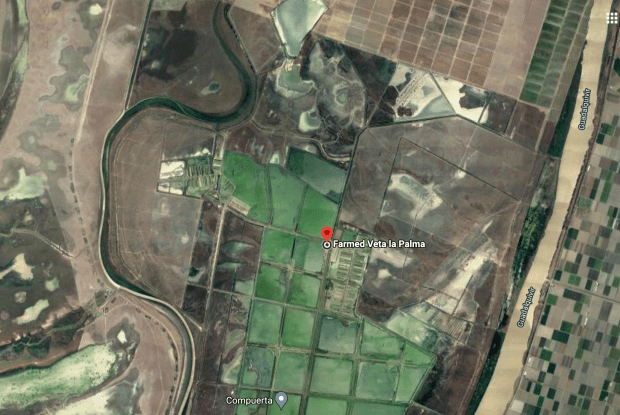
Spotters in Africa and the Iberian Peninsula continue to report Osprey sightings. There are now more than 600 in Senegal alone. I know that each of you will be thrilled to hear that Loch of the Lowes couple Laddie and NC0’s 2021 female fledgling, LR2, has been repeatedly spotted in Spain. She is at the Veta la Palma Espacio Natural Donana, La Puebla del Rio.
This is one of the largest nature reserves in all of Europe. She could not have picked a safer and more appropriate spot for her very first winter. Here are the map images and here is a link to the website so you can see all of the birds and wildlife at this ecological site. I am also posting this in case some of you want to travel at some time to see the birds – all kinds – this time of year – but do not wish to go all the way to Africa.
It is always good news when the first year fledges find a safe place with abundant resources. It is even better when we know about it and can celebrate with them. As you know only about a third of the fledglings succeed so big smiles all around. Laddie and NC0 would be thrilled! Another Rutland bird, Blue 081, a male fledgling of Maya and Blue 33 spent his first year, 2020, and has been seen this year, at Veta la Palma, Cota Donara, Spain. I continue to wait with great hope for news of Blue 463, Tiny Little Bob from the Foulshaw Moss Nest.
It is early morning in Australia. Mirvac has changed the zoom on the camera for the 367 Collins Four but you might find that the eyases are still out of view. I understand that it will not be changed again. You can hear the little ones running around on the metal.
Diamond and Yarruga are awaiting a breakfast delivery.
The trio at Port Lincoln Osprey Barge are still snoozing.
There has been no further word about WBSE 28. WBSE 27 has been seen by several people and photographed near to the Discovery Centre across the river from Lady and Dad’s roost. They will surely know where 27 is and be providing food for it. The eagles first get their flying and landing skills down before fishing and hunting (normally). The parents help them by providing them with food. I sure hope that Lady and Dad also know where 28 is! Ranger Judy reported she has done a walk through the forest adding she did not hear or see anything but that it is a large area.
That is it for today. It is a cool sunny day on the Canadian prairies and it is time to clean up bird seed. The goose flight images were not good last night because of where people had to stand due to pandemic restrictions. I hope to go out to the other nature centre before the end of the month to see if I can catch some of the thousands of Canada Geese making their way south.
Take care everyone. Thank you so much for joining me today.
Thank you to the following for their streaming cams where I took my screen shots: the Port Lincoln Osprey Project, the 367 Collins Street Falcons by Mirvac, and Charles Sturt University at Orange Falcon Cam and Cilla Kinross.