Diamond and Xavier’s little eyas doesn’t seem to care who feeds it – or if it is a Starling or a Parrot – Yurruga just wants food!
Xavier brought in a Starling last evening. As everyone knows, Xavier loves to feed his chick but, he often doesn’t get the chance. Diamond is a very protective Mum.
Xavier arrives at 18:51:01. Diamond is not in the scrape. Yurruga is hungry and starts squealing immediately. It is Xavier’s chance to feed his baby!
“Sssssshhhhhh. Be Quiet Yurruga. Diamond will hear you.”
Yurruga is so hungry it won’t let Xavier pluck the bird before it starts snipping at the feathers in Xavier’s beak.
At one point there were feathers stuck to both Xavier and Yarruga’s beak. They looked like they were putting on moustache disguises.
Oh, dear. At 18:53:06, Xavier feeds Yurruga the leg of the Starling. Diamond is not going to like this.
Xavier realizes what has happened. He watches Yurruga trying to hork (gobble) the leg and foot down its throat.
Oh, dear. Xavier tries to take it back.
Xavier tries to get the leg and foot out of Yurruga’s throat but he can’t. He looks like he is in a panic. The chick will not let go of the leg!
At 18:53:33, Yurruga finishes horking the leg and immediately turns and bites Xavier’s beak.
Yurruga is really, really hungry. It starts squealing and Xavier starts feeding it the meat of the Starling and the organs. Xavier must be terribly relieved that the chick did not choke on that leg! Maybe Diamond won’t find out!!!
Here is a video clip of the incident with its ending.
The morning sun is just waking up and so is Yurruga. It is Monday, 25 October in Orange, Australia. This can only mean another day of adventures with Yarruga, Xavier, and Diamond. No telling what is going to happen! This scrape box is full of surprises.
Here is the link to join in:
This is a great streaming cam and falcon family to watch!
Fact of the Day: Peregrine Falcons are known to lay their eggs and raise their chicks on the sides of cliffs and in human made scrape boxes. It was understood that they did not make or use twig nests because of the chance of disease and pests. At the Knepp Castle, Isabella Tree reports that a pair of Peregrine Falcons have made a nest in a tree. There are, of course, always exceptions to the rule but this might prove interesting if other falcons make the estate their home using trees as nesting sites.
Thank you so much for joining me today. Take care of yourselves.
Thank you to Charles Sturt University’s Falcon Project and Cilla Kinross for their streaming cam. That is where I took my screen shots and video clip.
I thought that it was going to be hectic for Mum and Dad to keep the Collins Street Four supplied with pigeons. I never thought about the parents chasing them all over the gutter to make sure that each one gets fed! I don’t think any of us ever have to worry about the dedication and focus of these Peregrine Falcon adults. This feeding was quite extraordinary!
Did little Yurruga spend the night sleeping in the corner of the scrape box while Diamond tried to incubate her unviable eggs?
The feeding of Yurruga at Orange is so different than that of the Collins Street Four. However, looking ahead one week we should anticipate that Yurruga will be excited and nipping at the prey as the Melbourne falcons.
Yurruga makes some of the cutest faces and gestures.
There was a peanut size fish delivery at the Port Lincoln Osprey barge earlier but the three osplets and Mum are still waiting for Dad to bring in something substantial.
Dad brought the tiniest fish to the nest this morning in the Sydney Olympic Forest. He waited for about half an hour but no eaglet appeared. The Pied Currawongs were a menace to Lady, too, and eventually they ran him off the nest.
I remember Lady and Dad coming to the nest last year trying to lure 26 back so they could feed her. I wonder if one of the eaglets is still in the forest? There have been no reports since 15:30 on the day 28 fludged and 27 had its forced fledge.
OGK continues to wait for the arrival of YRK at the Taiaroa Head Royal Albatross Colony in New Zealand. Send every speck of positive energy his way. I so hope she flies in this week!
Here on the Canadian Prairies the weather has turned quite coolish. The number of birds in my garden have dwindled. Today there were only six Slate-grey Juncos and the House Sparrows. Grey Squirrel loved it because he had more than enough seed to fill him and four others to the brim! Tomorrow I will be at the nature centre to watch the thousands of Canada Geese land at dusk. It is eerie – the garden being quiet. I cannot imagine a world without the sound of the birds.
Thank you for joining me. Do take care. Stay safe and be happy.
Thank you to the following for their streaming cams where I took my screen shots: the Port Lincoln Osprey Project, 367 Collins Street by Mirvac, Sea Eagle @Birdlife Australia Discovery Centre, Charles Sturt University at Orange FalconCam and Cilla Kinross.
Hopefully today’s ramblings will make a point on how to help our birds. Bear with me. I love to tell stories and revisit memorable moments.
More than a decade and a half ago, I was in Beijing teaching some special workshops at the International School and also giving lectures on the history of Chinese ceramics. Yes, you read that correctly. A Canadian was in China talking about Chinese pottery! I had been there several times before and always enjoyed myself and treasured the friendships that I made. This particular visit I was staying in a hutong that had been converted into a small guest house. Hutongs are the traditional courtyard houses, many torn down now. During breakfast I met a very interesting lady whose name was Fanny Farkles. She had retired from owing a restaurant, catering, and cooking school in New York City. I asked her, being terribly curious, what she was going to purchase and take with her as a reminder of her time in Beijing. What she told me has stuck with me. She said, ‘I spent the first 50 years of my life acquiring stuff and I will spend the last 50 getting rid of it’. Instead of ‘something’ she was going for an experience – a 17 course Ming-Dynasty meal fit for the emperor.
It wasn’t until later that I fully grasped the wisdom of what Farkles was saying but when I did, it hit me hard and, like all great insights, you wish you could turn back the clock and start again sometimes. Stuff. This coming year I will be spending much time finding new homes for ‘the stuff’. Thankfully, my resolution for 2021 was not to buy any new books. I almost made it had it not been for Chris Packham’s Back to Nature or Emyr Evans, Monty. Almost any book can be purchased used from a myriad of international sellers but not those two when I checked.
Speaking of Emyr Evans’s book on Monty, the DFYI on line shop is now open. If you are interested, here is the link to their on line shop:*
A signed copy is 15 GBP. If you live in the UK, the postage is a very low flat rate. The round the world flat rate is 11.99 GBP. If you are a fan of the Dyfi’s Monty, the super star of the male Osprey world (by some), it is a great book or gift. It is also a fundraiser for the Dyfi Osprey Project.
One other year a young woman asked women around the world not to buy any new clothes. To wear one thing and switch it up with what was in the closet. It was the year of my black sheath dress. The money saved was given to young women in India to purchase school uniforms because we all know that education is important but you cannot go to school without a uniform in India. It was a brilliant idea.
An article in the environmental section of The Guardian today talks about ‘stuff’ and how to save the environment by not buying. Several months ago, an economist suggested that if everyone in the world cut their spending of non-essential goods by 15% it would have a major impact on climate change. If it is good for the environment then it is good for the birds. Have a read.
A quick check on those adorable feathered creatures that inspire us to leave the world a better place reveals that Middle Bob and Little Bob on the Port Lincoln Osprey Barge had a tug o war over the fish tail this morning. I think Middle Bob won but, that’s OK. Little Bob won when he pulled with Mum!
Despite their amazing growth and those awesome curved juvenile feathers, you can still tell Little Bob from the circle on top of its head. You can also count on Little Bob being as near to where Mum is handing out the food as anyone. They line up and he is there, right at the beak with gleeful anticipation in his eyes.
Mum is happy to oblige!
The feeding is over and Little and Middle are tugging for the tail. The osplet behind Mum is Big Bob. It looks like a circle on its head but it isn’t. It has lines radiating out when you can see the full design.
Middle Bob is eating the tail and Little Bob is checking to see if Mum finds any more food on the nest. Oh, he loves leftovers, too. First up to the table and normally the last to leave. Sounds like Little Bob is a female to me. They need about 25% more food than the males.
Yurruga is currently sleeping off that entire Starling that Xavier fed it for breakfast. It is a wonder the baby didn’t pop but, like a good falcon, when Xavier suggested it eat more and made that chumping sound, Yurruga ate. It is learning to eat when food is available. You don’t always have the luxury of a stash in the corner of a scrape box in the real falcon world.
At least one of the Collins Street Four looks like it wants to try out for one of the local rugby teams. My goodness these chicks are enormous. Look at those feathers coming in. One day we will wake up and they are going to look like their Dad and Mum – it will happen in a blink I am afraid.
No other news from the little sea eaglets that flew off the nest yesterday. Keep them in your positive thoughts.
Thank you for joining me today. Everything at the nests is just fine. What a lovely relief. You take care. See you soon.
Thank you to the following for their streaming cams where I take my screen shots: the Port Lincoln Osprey Project, Charles Sturt University at Orange Falcon Cam and Cilla Kinross, and 367 Collins Street Falcons by Mirvac.
* I might mention books or other things in my blog. I do not make any money if you purchase the items and never will. My purpose is to simply bring news of the birds as they add so much joy to our lives and to alert you to ways that you can help make the world a better place for those birds.
Tomorrow I am going for the annual tour at our local wildlife rehab facility, Wildlife Haven. Every year they do this as a fund raiser but it is a good way to get a really good look at the varied and in-depth work that these people do. There doesn’t seem to be an animal or bird too difficult to try and help mend. I do not know if they will allow photographs but, I will try and take some to show to you.
This video was posted. It is the little ‘waiting to get a name’ eyas in the scrape box of Xavier and Diamond on the grounds of Charles Sturt University in Orange, Australia. Prey items come one after another. The chick already has a fine crop but will be fed more. But, turn the volume up and listen to this little one. Last year’s only chick, Izzi, was know to be such a character and part of it was his very loud voice. Everyone is beginning to wonder if this chick will be even louder than Izzi!
Have a look. It is such a cute clip.
One of the things that you can see are the chick’s ears. Look closely. It is also scooting around, and there are some pin feathers coming. This chick is, of course, doing very well under the excellent care of Xavier and Diamond.
Clearly as Dr Hurley notes, an Only chick gets all the food!
For those fans of Anna and Louis whose Bald Eagle nest is in the Kisatchie National Forest in Central Louisiana, both eagles were working on the nest this evening around 18:54.
Wrestling with sticks seem to be what all the Bald Eagle couples are doing now – as well as trying to keep any would be intruders out of their territory.
It wouldn’t be right not to go and check on those gorgeous osplets at Port Lincoln before I sign off. They are just simply so beautiful in their full juvenile plumage. Here is the trio looking out probably seeing the parent flying in with their lunch.
That lunch arrived a few seconds later.
Everyone lined up and as I write this, they are still eating.
This is a reminder that Xavier and Diamond’s chick needs a name! This is the information as Cilla Kinross posted it under the information for the streaming cam:
VOTE FOR NAME FOR THIS CHICK You have until Friday 5 pm 22nd October to vote. You can only vote once. Note that multiple votes will be deleted. All names are in the Wiradjuri (local indigenous) language and relate to weather terms: cloud etc. Here is the link: https://forms.gle/iPQhxDCLtEh19jp38
Cilla Kinross, Charles Sturt University
I want to note that Cilla would like everyone to cut and paste the link into their own browser. So the time for voting is closing quickly. Why not join in?!
I will not be posting my newsletter until tomorrow late afternoon or evening depending on the tour at the wild life facility. Fingers crossed I can get you some good inside views of what goes on when animals come in needing attention.
Thank you for joining me. Please take care. See you soon.
Thank you to the following for their streaming cams where I take my screen shots: the KNF Bald Eagle Cam, the Charles Sturt University Falcon Cam at Orange and Cilla Kinross and the Port Lincoln Osprey Project.
I am sorry to be so late in sending off my newsletter today. It was not intended and if you have worried, I apologize. The day wasn’t meant to be so busy but it simply turned out that way with a last minute trip to get 200 lbs of bird seed tacked on to the end.
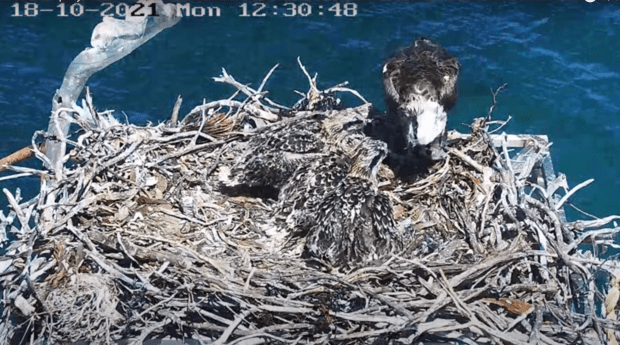
Just look at these beauties. Overnight the three osplets on the Port Lincoln Barge turned into juvenile beauties. Those are serious feathers! Just look, all pushed out from their quills, perfect layering with that gorgeous white line and tip of the juvenile. Each one also seems to have grown a perfectly white beard over night. Their eyes are also that dark amber colour that will, when they are adults, turn to yellow.
Gosh. I can hardly take my eyes off of them. They are stunningly beautiful. If I could look like a bird it would seriously be a juvenile Osprey.
Mum was looking out over the water hoping that Dad was off fishing – and he was. He landed on the nest at 7:46 with a breakfish for everyone.
Little Bob, the closest to Mum’s beak and the front, is 34 days old today while the two older siblings are 36 days old. There is a ways to fledge – thank goodness, but, for now, we can enjoy how grown up they all are and how wonderful this Eastern Osprey nest has been this year. It has brought nothing but tears of joy! It goes to show how having chicks that hatch close together and plenty of food deliveries are a great combination to success.
Dr Victor Hurley heads up the research on the Melbourne Peregrine Falcons. He has been doing this for many years. He wrote a very good article about what the differences are for the two falcon nests in Australia with streaming cams – 367 Collins Street Falcons in Melbourne and Charles Sturt University in Orange and Cilla Kinross. The 367 Collins Street scrape box had 4 hatches this year while the Orange scrape box of Diamond and Xavier had one. So what is the difference to the falcons? is it better to have one or four? Dr Hurley believes for the falcons it is better to have four eyases and be run off your feet feeding them because the chance of one of them surviving to adult hood is greater than a scrape having only one chick. He believes, however, that it is beneficial to the chicks to be the ‘only One’ instead of one of four in terms of food resources. Still, others believe that the stress on the parents to feed four instead of one is immense but, we are looking at it from the chick’s perspective. Anyone watching the scrape boxes just know these growing chicks just want food!
While Dr Hurley did not address other issues, I wonder if being part of a larger hatch group helps in terms of understanding how to live in the real world where there will be pressure from others. Maybe it doesn’t matter? Last year, the male from the Collins Street scrape used to come into the nest and pluck a freshly caught pigeon. It was a terrific mess but those three girls could sure pluck a bird – and do it fast before they fledged – a skill essential to survival. Catch, pluck, eat, and go! I beg to be corrected but it seemed that Izzi had some difficulty with plucking even after an age when he should have had his own territory. So I wonder if they learn quicker and faster as part of a group??? and having plucking imprinted on them so many times?
The little eyas at Orange is 13 days old today while the Collins Street Four are starting their third week. Each is right on track in terms of development. Indeed, the little Orange eyas has been scooting around on its tarsus for a couple of days now and is very strong and healthy. – slightly ahead of the curve The plumage is changing radically on the Collins kids and they are standing and walking.
Kate St John did a wonderful blog on the developmental stages of the peregrine falcons. I want to share that with you.
Dad is trying out larger pieces of pigeon on the four. The prey came in one after another the other day. They are losing the soft down around their eyes and getting the juvenile feathers and they are also getting their wing feathers.
I am afraid that I got a little carried away with the images of Xavier and Diamond’s eyas. Not only is it loud – soon to rival Izzi – but it can also make the cutest faces.
They are all doing well. Last I checked the Bald Eagles in the United States are all still working on their nests. There is some intrigue at the Captiva Nest and the speculation as to who the male will be this season. Joe is gone and it appears Martin has been ousted also. Meanwhile, Harriet and M15 along with Samson and Gabby are steady as you go! To my knowledge there has not been a fledge at the WBSE nest in the Sydney Olympic forest but this could happen any time. And – for the lovers of Jack and Diane – it seems that the couple might be back on the Achieva Osprey nest in St Petersburg together. They have a lot of nestorations to do!
Thank you for joining me for this quick catch up. I will be shaking my head and smiling at just how beautiful three juvenile ospreys look in the PLO nest. Take care all. See you soon.
Thank you to the following for their streaming cam where I took my screen shots: Charles Sturt University at Orange Falcon Cam and Cilla Kinross, the Collins Street Falcons by Mirvac, and the Port Lincoln Osprey Project.
It is a gorgeous day today. 24 degrees C. We still, for at least today, have summer weather. This meant seeing new and old friends today at the park. There were at least 12 male Wood Ducks, as many females, a host of female and a few male Mallards, and, of course, Canada Geese.
This adult male Wood Duck with its distinctive red eye and green helmet thought that I might have some seed for him to eat. He did not seem to want to take ‘sorry’ as a proper answer.
The duck below is all wet from diving around in the park stream.
Their plumage is absolutely outrageously gorgeous.
There were a few adult female Wood Ducks but not nearly as many as the males at Kildonan Park today. Because there are issues with identification between the juveniles and those in eclipse, I have come upon a bit of a foolproof method for me. The duck below is an adult female Wood Duck. She lacks the red iris and eye ring of the adult male; she does have a yellow eye ring and a distinctive white eye patch. Her bill is dark. I do not want the iridescent green on the top of the head to fool me. This bird is lacking in the 2 pale lines from the throat extending around the neck and onto the cheek. To see those, look at the images of the adult male.
There were a number of Mallards, both male and female.
All of the animals were having a wonderful morning around the duck pond. There were many who brought specialty bird seed just for them. Others, like this little Red Squirrel, were finding acorns and seeds in the grass.
As I was sorting through these images to show to you, there were several knocks on the front door. Several times I went out and no one was there. There are times that sounds carry but, then the knocking got louder and louder. This time I caught the visitor! My house is covered with cedar shakes. It looks more like a cottage in a forest but there is someone who loves those cedar shakes. When I opened the door he flew to the apple tree.
Unfortunately the automatic focus set its mind on the leaves and not on the woodpecker! And she was not certain that he wanted his picture taken or not.
I say ‘she’ because that gorgeous read crest would extended all the way down to the bak if this were the male. But, it is not, it is a female.
You can see that its body is mostly covered in black feathers with a flaming red crest. There is a white throat and its beak is a long dagger shape sadly hidden by the leaves. This particular Pileated Woodpecker lives around my garden year round (and the neighbour hood). She will make her nest in the cavity of a dead or dying tree lining it with wood chips. When she is knocking on my cedar shakes she is looking for ants, wood-boring beetles, and insect larvae. She also likes berries and nuts and I have seen her on the large suet cylinder as well as the telephone pole drilling away. The woodpeckers particularly like the bug and nut suet if you are trying to attract them.
I am particularly concerned for both this Pileated Woodpecker and the male and female Downy that live around my garden. My city has sprayed orange dots on two of the 119 year old Maple Trees in front of my house on the boulevard. If they are to cut them down, is one or both the home and nest of the woodpeckers?
The Grey Slated Juncos are still here today along with a few White Throated Sparrows and Song Sparrows.
It is easy to tell the White-throated Sparrow because of that distinctive white patch under the beak forming the throat – hence, the name. There are also two black bands and three white on the crown along with two very distinctive yellow patches above the eye. The White-throated Sparrows come to Manitoba to breed during the summer. By the end of the month, all of them will be gone to their winter homes.
The Song Sparrow comes to Manitoba also for summer breeding. Soon they will also be away on their journey south. For now, a few are in the garden scratching around the grass and leaves for insects and bug larvae. They are beautiful with that plumage of rust and grey with streaks of white.
It has been a lovely day. I have it on good authority that all of the nestling falcons are fine as are the osplets at Port Lincoln. Yesterday, they once again had 7 feedings! Speaking of feedings, the list of what Mum and Dad have brought in for the Collins Four is anything other than 99% pigeon. This year they have averaged 7.4 prey items per day with 3 being the lowest number of deliveries and 11 being the highest. They have had pigeon, New Holland Honeyeater, Rainbow Lorikeets, Quail, Silver-eyed Gulls, Sparrows, Spotted Pardalotes, Starlings, Wattlebirds, and a White plumed honeyeater. This is quite the surprise. Normally the urban falcons exist primarily on pigeon. I wonder if the people in Melbourne are no longer feeding the pigeons so that the falcons have to look to other species? In Orange, the diet is varied with lots of parrots and Starlings.
A late delivery yesterday was a green parrot. I do not specifically recognize the ‘type’ but will try to find out.
The only streaming cam I have not checked on today is the one for the White-bellied Sea Eagles. Indeed, WBSE 27 was jumping all over the tree and it or both might have fledged. I will alert you if this is the case.
Thank you for joining me. I hope you enjoyed the ducks! Take care. See you soon.
Thank you to the Collins Street Falcon Cam by Mirvac where I took my screen shot of the delivery of the green parrot.
It was 19 or 20 degrees C, depending on which weather station you listened to, on the Canadian Prairies this afternoon. Those temperatures are traditional summer ones, not middle of October! As a result, my foray to photograph Wood Ducks went sideways. It was a beautiful Sunday and everyone was outside in their summer clothes with bikes or skateboards, picnic lunches or books or both.
We may get our first frost on Wednesday evening but until then the days are going to be brilliant. No doubt those ducks will still be around awhile longer.
There was a small altercation at the Port Lincoln Osprey barge around 09:24. It is unclear what got into Middle Bob but he had a bee in his bonnet and decided he wanted to take it out on Little Bob. The skirmish lasted three eyelid blinks and it was over. And it did not put Little Bob off in the slightest. He was up front and ready to eat when the next fish was delivered at 12:16:01. Indeed, there had been two fish deliveries and feedings already – at 6:34:35 and another at 8:21:17. All of the chicks have been preening feverishly. Wonder if it is the itch from the feathers that is making Middle Bob out of sorts?
The juvenile feathers are really coming in and depending on the way the light hits the nest you can hardly find the chicks.
Little Bob is up at Mum’s beak with Middle Bob to its right. Big Bob is facing off the nest and has a rather robust tummy and crop.
No one seems to have moved. Little Bob is eating first. Anything Middle Bob have done to try and intimidate him has not worked. I am just going to put it down to Middle Bob waking up on the wrong side of the nest! If Little Bob turns out like Tiny Tot Tumbles from the Achieva Nest, Middle Bob will wish he had not been naughty.
It was a nice sized fish – not a whopper – but, it topped the kids off, all of them. In six hours, three fish. Pretty good, Dad!
That is Little Bob in the middle showing his nice crop in the image below. Look at how the tail is growing on the chick to the right.
Little Bob is 32 days old today. That makes Big and Middle 34 days or if you count the other method – Big is 34, Middle is 33, and Little is 32. There is 51 hours between the time Big and Little hatched. That surely has had a strong impact on the peacefulness of this nest, this year.
There were some very tender moments between Diamond and her baby yesterday evening in the scrape box at Orange. Here is one of those.
What a difference it makes when the chick’s eyes are fully open and they can see their parent and that food coming in that big beak. This chick is 9 days old. Just imagine. A week ago it was hardly bigger than one of those eggs. It is healthy and strong.
One but, probably both, of the White Bellied Sea Eagles is going to fledge really soon. They can hardly contain their wings from flapping and their legs from jumping. Typically, fledges occur in the morning or evening. Keep your eyes open for news from this nest in the Sydney Olympic Forest.
For those of you following the Royal Cam Chick, Tiaki, this season, there were a few tense days when her sat-pak was not plotting her GPS. Today it began working – possibly due to needing to be charged -. She is well past the International Date Line on her way to the waters of Chile. That was such a relief for everyone. When those GPS units quit working everyone fears the worst.
Last year’s favourite Albatross, OGK, Pippa Atawhai’s Dad, has been in and out at Taiaroa Head waiting for the arrival of YRK, his mate. Oh, I hope she arrives soon!
Lady Hawk posted a video showing Tiaki’s location and OGK having to defend his territory.
Apparently, OGK left and the two love birds spent the night on a spot near to Pippa Atawhai’s nest.
First feeding for the 367 Collins Street Four in Melbourne. Everyone has a nice polished crop and that scrape box sure needs a good wind to hit it! They are soooooo big. Three seemed a lot to handle last year with those big females but imagine when they are ready to fledge. These parents are going to deserve a really good rest.
They were the stars of one of ABC’s breakfast television shows yesterday. Melbourne sure loves their falcon family! They also included Diamond and Xavier from Orange. It was wonderful that the Peregrine Falcons made it into the last round of voting for Australia’s Bird of the Year. Maybe next year!
One of the most interesting prey items was a quail that Dad brought in. Everyone is wondering where he found it. I mean, seriously, where do you expect to find a quail in a large city? the zoo?
What a wonderful way to end the day – all of the birds are fed and well taken care of. Life really is good on the nests. We are so very fortunate to be able to watch their lives.
Thank you so much for joining me. I hope to have some good images of the Wood Ducks this week. Take care. See you soon.
Thank you to the following for their streaming cam where I took my screen captures: Sea Eagle Cam @Birdlife Australia Discovery Center, 367 Collins Street Falcons by Mirvac, Charles Sturt University Falcon Cam at Orange and Cilla Kinross, and the Port Lincoln Osprey Project.
There is a superb little video of Dad delivering Mum a pigeon carcass to feed the Melbourne Four. You will notice that the chicks really come to attention when they hear the ee-chupping that signals that a food delivery and meal are eminent.
I wonder how many prey items have been delivered to this nest so far? Awww…cute little dad just melts my heart. He is such a sweetie.
The Port Lincoln Ospreys had 7 feedings yesterday, 7 different fish deliveries. They were getting off to a good start today with a delivery very early in the morning and several quickly following. This nest just amazes me this year. Everyone is doing so well. Just look at those beautiful juvenile feathers growing in and the tails! Those magical tails with their white fringe.
I have been interested in birds since I was a child – enjoying the ones in my family’s garden and feeding them as well as the regular trips to the duck pond. It was not until I was an adult and had an encounter with a female Sharp-shinned hawk that my life catapulted into a different direction. Today I have two very focused ‘bird interests’ – Osprey nests with three hatches and urban raptors.
Today I turned back to thinking about the need for large parks within cities so that there would be a diversity of wildlife. One person who covers the Central Park area of New York City has a great blog with incredible photographs and short videos. His name is Bruce Yolton and he covers all of the birds and sometimes other species that live in the urban parks of New York City. This is the address of his blog, take a look. He has recently written about a beautiful Belted Kingfisher and Great Horned Owl.
Indeed, the very first streaming cam I ever watched was a pair of Red-tailed Hawks raising eyases in a nest on the ledge of New York City University’s library. I learned so much about the challenges that urban wildlife faces watching their daily lives unfold, learning the history of the nest, and chatting with many of the other people watching. Then one year, the female died of rodenticide poisoning. The male tried to incubate the eggs but, as we all know, it generally takes two full time adult birds to raise a nest. It was quite sad. Eventually, I discovered Big Red up at Cornell.
Bruce is an expert on the notorious Pale Male whose nest is on Fifth Avenue across from Central Park. You might have seen the full length documentary The Legend of Pale Male and the fight for this raptor to maintain his nest at this prestigious address. Pale Male is, I believe, coming on 32 years of age. He arrived in Central Park in 1991, thirty years ago. Bruce just uploaded a video of Pale Male hunting in Tupelo Meadow for a Brown Rat.
One of the greatest causes of death to urban raptors is rodenticide. Every time I hear or see a bird of prey eating a rat or mouse I worry that they will die from secondary poisoning. As you well know, raptors kill more rodents than any poisons. So why aren’t the designer poisons banned?
It was, however, Bruce’s video of Chimney Swifts, hundreds of them, flying into the chimneys of New York City that intrigued me. I think it will you, too.
All of the birds are doing well. Really well actually. It is reassuring in a world full of anxieties.
Thank you for joining me. I will put the link to the movie about Pale Male in case you haven’t seen it. If that is the case, grab your favourite snacks and enjoy watching the lobbying for a bird to keep its nest. It is quite remarkable. Take care. See you soon!
Thank you to the following for their streaming cams where I took my screencaptures: 367 Collins Street Falcons by Mirvac and Port Lincoln Osprey Project.
You can find the Legend of Pale Male here. It is free and well done.
One of the last feedings for the little eyas at the scrape box in Orange, Australia was around 18:19:00 yesterday.
This little one is eight days old. It has sure grown!
I took three video clips to cover the entire time Diamond was feeding the chick. Watching the movements and the interactions instead of seeing a still image can give you a more in-depth look at the size of the bites and the sheer cuteness of the moment.
The total number of fish delivered to the Port Lincoln Osprey nest was 7 yesterday. They were delivered at 7:11:22, 8:23:54,12:47:30, 13:52:18, 14:54:09, 16:37:00, and 18:08:37. This is a capture of Dad delivering the fish at 7:11 and Mum coming to the nest from the perch as well as a capture from the 14:54 feeding:
There appeared to be an adult on the Achieva Osprey Nest in St Petersburg, Florida yesterday. The marks on the crown of the bird seem to be that of the male, Jack. Today, another adult showed up at the same nest at 11:16:09.
Jack appears to be alarming.
This is the image of the adult from yesterday (right) and an image of Jack bringing Tiny Tot Tumbles a fish on the left. It seems likely that the adult visiting the nest is Jack. There is a lot of prep work to be done before Diane returns.
The White Bellied Sea Eagles 27 and 28 entered hatch watch the other day! That date range for fledging is 75-80 days from hatch. WBSE 28 was 77 days old on 16 October (yesterday) when it branched! Watch closely to see what 28 uses to make the leap.
Fledging is getting closer for these two. No doubt they will have contests to see who can get higher up on the tree!
Today is starting off as a fantastic day in Bird World. While there are little ones to feed or fledge in Australia, staff at many of the nature centres in the UK are refurbishing Osprey nests. A new pole and platform has been installed at Lyn Brenig and today the work was completed on Pont Cresor, the nest of Aeron, Z2 and Blue 014.
Thank you for joining me today. It is beautiful and sunny. All of the garden animals are having their lunch and the world is simply right with itself. Take care. See you soon!
Thank you to the following for their streaming cams where I took my video clips and screen captures: the Port Lincoln Osprey Project, Charles Sturt University Falcon Cam at Orange and Cilla Kinross, and Achieva Credit Union Osprey Nest in St. Petersburg.
Xavier and Diamond are on a roll to keep their week old chick fed. Xavier came in with a pigeon while Diamond was away. He might not have had long to feed his baby before Mum returned but, Xavier did a splendid job and Only Bob got some very nice bites.
Xavier was very good at connecting with the little one’s mouth.
It is so cute when they can finally see their parents and that beak of food. Look at it opening wide. What a little sweetheart.
Priceless.
Xavier had really been enjoying feeding his chick. He has demonstrated repeatedly that he wants – very much – to be more involved in the care of the eyas. Hopefully, Diamond will be less protective soon.
Bye Xavier!
There were, of course, many more feedings during the day.
Xavier had some time to cuddle with the little one after he brought in the prey for Diamond for one of the evening meals. So sweet, that little one leaning up against Dad.
Only Bob is ready for its 17:30 meal – beak wide open!
Look at how big the little chick’s wings are getting. Yesterday, this wee one was only a week old.
There might be only one but it looks like it is going to be big and strong!
Thank you so much for joining me. So many of you really enjoy watching Xavier and Diamond. If you haven’t ever looked into their scrape box, here is the link. They are fantastic parents – lots of fun with the prey and Xavier trying to get some ‘chick time’.
Take care all. See you soon!
Thank you to Charles Sturt University at Orange Falcon Cam and Cilla Kinross for their streaming cam where I took my screen shots.