Late Thursday in Bird World

For those of us who only have the Internet and not any television or cable stations, it might be a bit difficult to watch the documentary on the Ospreys, Season of the Osprey on Nature PBS. For those of you with cable television, this is a reminder to check your local station for when Season of the Osprey is showing. For the rest of us, I will be checking for the release of the DVD and, also, to see if the documentary will be streaming on the Internet. Will keep you posted! Do check your local stations. You do not want to miss this if you love ospreys!

I am including the URL for the company that is distributing this special. Why? Because, if you scroll down, you will see that there are a host of podcasts that you might be interested in.

https://www.seasonoftheosprey.com/?fbclid=IwAR1Dvhmb2FiSaIBg0VV-ha87ZiCWeq29iYuF2dRKy5sa2bAZNfi6N8RrHIQ

Oh, what amazing birds. I am already getting excited about our local nests and the birds have only been away for two months! This year I will be checking on several nests and submitting information on arrivals, hatches, juveniles, fledges, and departures. It is an honour to add the Ospreys that consider Manitoba their summer home and breeding territory to the lists of nests from around the world.

Speaking of migration and raptors around the world, Jean-Marie Dupart reports that there were 50 birds this morning on the shores at Casamance, South Senegal. He has counted 432 arrivals so far this season and said he has 10 more locations to check. That is fantastic.

Many of you will be members of one or another of the many groups pressing for businesses and residents to stop using rodenticide. You might also be lobbying various levels of government to ban these designer poisons. It is well known that it is not only cheaper financially but also much more effective to use raptors. Raptors will clean up the critters – just don’t poison the mice and rats because, ultimately, they will also poison cats and birds that eat them. It is a horrific way for a raptor to die.

Today, in the Fall 2021 issue of Bay Nature magazine, the leading article is a vineyard that is employing Red-tail Hawks to keep the rodents out of the fields. They are turning away from using rodenticide. Oh, this could seriously be a start of a movement. Here is that article:

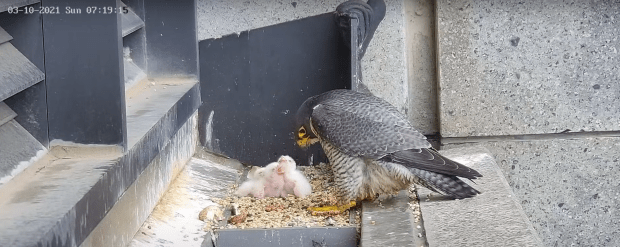
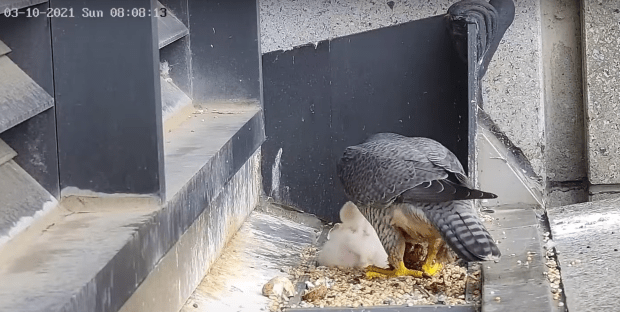
Xavier and Diamond’s only eyas is one week old today. Only Bob can see the world! And Xavier has had some time to spend with his wee one. Here he is brooding Only Bob. How precious.

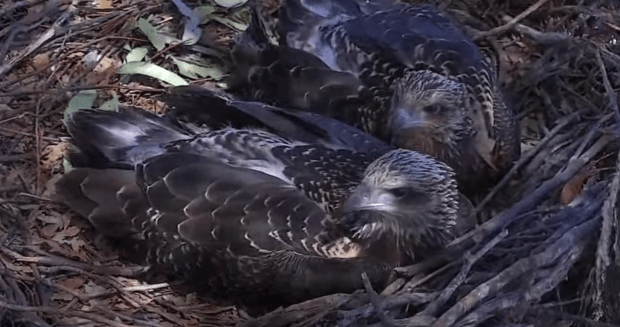
I have not reported on the White-Bellied Sea Eaglets in their nest in the Sydney Olympic Forest for several days, if not a week. It is really interesting watching the two of them interact together. One will do something and the other will try to outdo the first. Here they are flapping their now very large wings.

I really hope that they do not knock one another off the nest. The more they flapped those wings the more energetic they got and the more air they stirred up. It was like the centre of the nest became a trampoline.

WBSE 27 and 28 will have a wing span of 1.8-2.2 metres or 6 to 7 feet. If I remember correctly, the nest in the old Ironbark Tree is 1.8 metres or 6 feet across to give you some idea of the wing size of the pair today.

WBSE 27 hatched on 29 July 2021 and WBSE 28 hatched on 31 July. This makes the little sea eaglets 78 days old (27) and 76 days old (28). The average fledge period for the nest is 75-85 days. We are now in that window. Ideally, the eaglets will do some branching, will make their first flight, and return safely to the nest where they will strengthen their flying and be furnished prey by the parents. In reality, the Pied Currawongs often chase the newly fledged chicks out of the forest. It is hoped that the parents are providing food off nest or the eaglets find a beach area full of carrion (what most juvenile sea eagles survive on til they hone their fishing skills).

This nest has produced two very healthy Sea Eaglets this season. Just look at them spreading their wings, one looking over the rim of the nest. That first flight could happen at any second. It has been a fantastic nest to watch this year and I do hope that these two strong eagles will survive and have very long lives. Lady and Dad have done an amazing job.

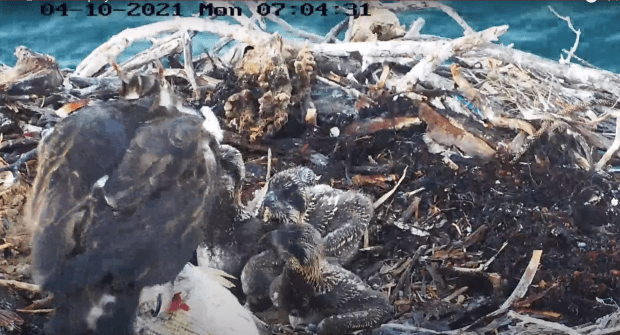
The Osplets at the Port Lincoln Barge nest are not ready to fledge – thank goodness! But they are growing like wild weeds in my garden. The juvenile feathers are now growing in thick and fast. They have had several fish deliveries today. I reported on two and there was a third at 11:28:54 and there will be more during the day.

Mum trying to get the fish off of Dad’s talons.

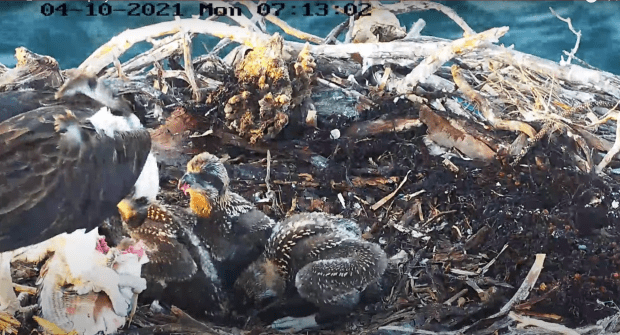
Little Bob is lined up waiting for some more fish. He is on the right. You can see the more circular mark on the top of his head and the white painted effect under his eye. It coats the lower lid a little like white eyeliner might do. From this angle you can also see some of the white on the cere. Little Bob has a rather large crop. It seems to be sagging from the weight.

Now when I write ‘Little’ Bob it seems a bit silly because he is definitely not little! It will be nice when they get their bands, satellite packs, and names in a few weeks. I wonder what they will name these three?

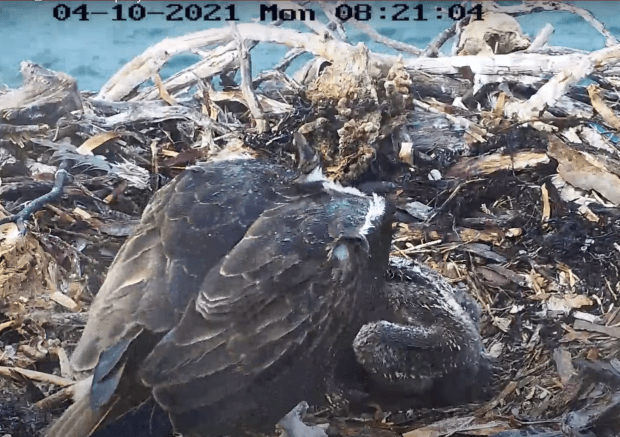
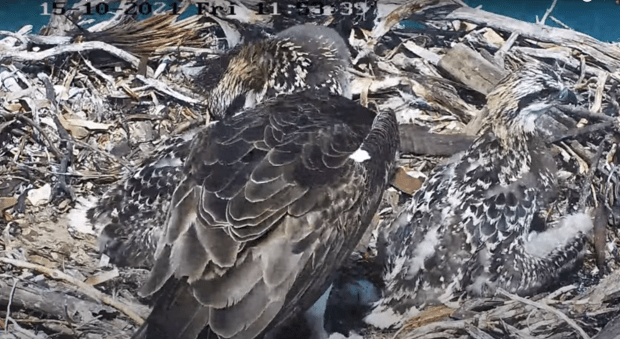
While we can only see two of the osplets, both of them have big crops. Little Bob is looking out from the nest on the right and another is preening, showing off its big ping pong crop, in the middle.

Look at how those lovely dark grey/black juvenile feathers tipped with white are. They are growing fast. Soon they will cover all of that dark grey wooly down. Much of the fish they are eating is helping them produce these beautiful feathers, feathers essential for their success as raptors. They cannot fledge without them.

Everything is looking good. I cannot wait for their measurements to be taken. Little Bob looks like he could be the biggest or close to it. Little Bob certainly does not take anything off Big Bob.
Thank you so very much for joining me. Take care everyone. Have a terrific Friday.

Thank you to the following for their streaming cams where I took my screen shots: the Port Lincoln Osprey Project, Sea Eagle Cam@Birdlife Australia Discovery Centre, Charles Sturt University at Orange Falcon Cam and Cilla Kinross.

Name the chick

It is a miserable 9 degrees C on the Canadian prairies. It is grey and wet. We have yet to have frost but it is certainly feeling like the time has arrived to bring out the jumpers and wool socks and put away the summer linen. A few of those gorgeous Dark-eyed Juncos are still in the garden pecking away at the Millet and Mr Blue Jay is working his way through a cob of dry corn.

A few have written to find out where to get the dry corn. Many specialty bird seed shops carry dried corn. You can purchase it by the cob or by the bag of 25 or so cobs. It will vary by supplier. If you live near a feed and seed store or a farmer who grows corn to feed their livestock, you might want to compare pricing. It is thoroughly dried corn you want. While I just lay the cobs out for the Blue Jays and the squirrels there are also specialty holders that prevent one or the other from taking the entire cob.

Do you have a garden? If so, you might want to plant some corn meant specially for drying. Check with your seed supplier.

Everyone seems to have recovered from the sadness of Xavier and Diamond not having a second hatch. If there was a pip and beak showing, it appears that the chick was simply not strong enough to break out of the shell. As you all realize, life for the birds is challenging. They need to be strong and healthy and that is certainly what that first hatch of Xavier and Diamond’s is. You can hear it today calling and, if you listened to Izzi last year, you will know that they can be very vocal. This one might even rival its big brother!

Today, Dr Cilla Kinross, the chief researcher for the past twelve years on the Peregrine Falcons, has posted a list of names for the wee one. They are all Maori names and relate to the weather. Everyone can have one vote. If you wish to take part, here is the link:

https://forms.gle/iPQhxDCLtEh19jp38

This wee one has amazing parents. A viewer caught a super video clip of Xavier delivering prey and Diamond feeding the chick. Have a look!

The Port Lincoln streaming cam is down this morning and it is not yet dawn in Australia. Fingers crossed it is back working soon. All of the other nests – the WBSE and the Collins Street kids – are fine. In the United States, the Bald Eagles are busy working on their nests. At 07:23 this morning, Anna and Louis were caught on camera at the Kisatchie National Forest Bald Eagle nest. It is wonderful they have each returned safely for a second season. I wonder if Louis will contain his enthusiasm for feeding his family?

Thank you for joining me today. Please vote for the wee one at the Charles Sturt University Falcon Cam. You have until 5pm on 22 October Australian time to tick your favourite. I will bring you an update on the PLO this evening if the streaming cam begins working. Take care everyone.

Checking on Chicks

There was a lot of chatter over the Melbourne Peregrine Falcon scrape at 367 Collins. The concern was because the Mum had not been ‘seen’ since 19:06:24 when she left the little ones after feeding them.

The chicks at Melbourne are enormous! I honestly can’t even find the small one anymore. Underneath the fluffy down that remains there are pin feathers coming in and if you look closely, those sweet pink little beaks are turning into a rather adult looking beak.

There is no need for concern for Mum. The problem is that the eyases are simply too big for her to brood anymore because there are four of them. Can you see where Mum is?

The image on the left is a week ago. The one on the right was yesterday.

I haven’t reported on Port Lincoln Ospreys for a day. These were the feeding times for yesterday: 6:52, 10:02:43 (small), 10:43:15, 14:43:39, 14:55:50, 16:11:51, 16:23 (mum caught this one), and another fish delivery somewhere around 17:59:58. It was hard to differentiate when the osplets started eating one fish and began on another during the afternoon.

The Mullet that came on the nest at 10:43:15 was still alive and Mum flew off with it, killed it, and returned at 10:44:30. When Mum brought the 16:23 fish onto the nest, part of the fish that dad had brought earlier was still there. This could have been the 17:59 feed. It is not clear. What is certain is that the chicks had massive crops throughout the day. With Mum fishing – and she seems to catch the bigger fish these days – the nest is eating well. The supplementary fish she brings in is making a huge difference to all including Mum who also needs to eat. And Dad.

One thing that I found very interesting was our dear Little Bob. Later in the evening on the 10th, the Middle sibling had caused a bit of a spat between Big Bob and Little Bob. Middle Bob seems to do this and then it ducks to get out of the way. Little Bob was not having any of it and well, we might begin to believe that Little Bob is the ‘boss’ of the nest. This was the second time that I have seen Little thwart any attempts by Big to be the dominant one in the nest. (The other was awhile ago0. I say this because Little Bob took the fish tail at 10:02 yesterday and ate it with no problem. The fish tail is a bit of a prize in an Osprey nest.

These are just some shots from the various feedings. Notice that they all line up and eat very civil!

Little Bob has the fish tail!

Little Bob had no difficulty eating the fish tail. Well done, number 3.

By the time the last fish arrived, many were so full they couldn’t even think of eating much more. Mum had a really nice feed. How grand!

Diamond and Xavier’s Only is growing well.

Today will sort out if there was a pip or not in one of the eggs. It is simply not clear. For the chick to survive, it would need to hatch today. Diamond rested better last night and wasn’t shuffling the eggs around so much. Perhaps we will have another Only Bob like Izzi last year and that is just fine. Cilla Kinross says they have never had three hatch at this nest despite three eggs being laid. In many ways raising one is so much less stressful than four. The Melbourne parents have to be worn out!

Everything is fine for the nest and the two scrape boxes. I will check in with the White-Bellied Sea Eagles later today. I understand that they are fine but that the Pied Currawong continues to be a nuisance. The Bald Eagle couples are restoring nests from last season and the Albatross for the upcoming breeding season are landing on Taiaroa Head. The world is working as it should be.

Thank you so much for joining me this morning. Take care. See you soon.

Thanks to the following for their streaming cam where I took my screen shots: 367 Collins Street Falcons by Mirvac, the Port Lincoln Osprey Cam, and Charles Sturt University Falcon Cam at Orange and Cilla Kinross.

First Feeding at Orange

Diamond brought part of a pigeon into the scrape box at 13:37 to see if the eyas was ready for its first feeding. It was not. The little fluff ball continued to sleep, all tired out. The egg was full of nutrients and the chick does not need a feeding til tomorrow morning. Still, Diamond will continually check and when the chick sits and opens its beak by instinct to be fed, she will know it is ready for food.

Diamond first went to the corner in the image below where she considered leaving the pigeon. Then she went to the other corner.

Eventually she decided to fly out with it.

She returned in ten seconds and immediately went over to brood the chick and incubate the two remaining eggs. The eggs were laid on 31 August at 10:40, 2 September at 20:55, and the last on 4 September 6:28. Diamond started incubation with second egg and then hard incubated with the third.

Last year Diamond and Xavier also had three eggs. One did not hatch. The second hatchling was not strong and died and Izzi, that beautiful character, was their only fledge. Xavier is an amazing hunter and this family can certainly provide for three.

Half an hour later, Diamond decides to try and feed the eyas again. She gathers the prey from the left corner pantry. I have taped a portion of that first feeding for you. This chick is very strong. It is approximately 7 hours old. It fell over and lifted itself back up. I was amazed at how long it held its head relatively still and its beak open. This first hatch definitely had some nice bites of the prey.

Just look at that little one. So happy for Xavier and Diamond.

Over in Port Lincoln, Dad brought a fish in at 10:05:13. All three osplets lined up to eat. I noticed several times that Mum fed them in sitting order. It was quite interesting. Food security remains in the positive. It is simply grand. Little Bob is now 22 days old. The other two are 24 days old.

In the image below, the chick at the back has a nice crop from the earlier feed. You can see it clearly.

It is definitely getting difficult to tell who is who unless you can get a glimpse of their beak. Little Bob has on the left side of the cere a kind of white netting pattern.

Dad brought in another fish at 14:17.

Now looking carefully, see the little osprey’s head in the middle of the image below. That is Little Bob. I want to point him out to you because you can clearly see that whitish netting on his cere. It sometimes looks like someone took a white paint brush and went over the cere and under the eye of this third hatch. You will also notice that Little Bob is being himself – getting to the front of the table where Mum is feeding and never taking his eyes off that fish until he is full.

Little Bob is in a very good position to get a lot of fish.

You might also notice that spot in the feathers between Little Bob’s eyes. That pattern might not stay there but for now, it is also helpful in finding him in the group.

In the image below you can see those two indicators clearly.

Little Bob has quit eating. There you can see him on the far right. Just look at that crop. Talking about ready to pop. I think that Mum fed Little Bob most of the fish in the beginning. He should really sleep well. Dad should be in with another fish in a couple of hours! Oh, these three are so well fed and behaving so nicely.

So far, the feedings at Port Lincoln have been at 07:49, 10:05:13, 11:26, and 14:17. That is four and it is only the middle of the afternoon. Well done, Dad.

It is time to call it a night. So happy for Xavier and Diamond that their first hatch is so strong. It ate so well and so did our little Ospreys at Port Lincoln. As I sign off the day continues to look good in Australia. Oh, and I almost forgot. The Superb Fairy Wren was voted Australia’s Bird of 2021. That is an image of a male Superb Fairy Wren below. That plumage is amazing. During breeding season, the electric blue plumage becomes iridescent. They are common across Southeast Australia and are known to sing to the chicks when they are in the egg – the chicks recognize the parents by their voice when they hatch.

“superb fairy wren male” by Ralph Green is licensed under CC BY-NC 2.0

Over 400,000 votes were cast this year. The Guardian said, “The superb fairywren has been voted bird of the year for 2021, narrowly defeating the tawny frogmouth in a nail-biting finish.” Here is the story:

https://www.theguardian.com/environment/2021/oct/08/superb-fairywren-crowned-2021-australian-bird-of-the-year-winner-in-hotly-contested-vote#:~:text=The%20superb%20fairywren%20has%20been,during%20the%2010%2Dday%20competition.

Take care everyone!

Thank you to the following for their streaming cams where I took my screen shots and video clips: The Port Lincoln Osprey Barge and Charles Sturt University Falcon Cam and Cilla Kinross.

Checking on the Aussie Birds

Everyone is still waiting for any sign of a pip or a hatch with Xavier and Diamond’s eggs at their scrape box on the water tower on Charles Sturt University at Orange. It is now mid-afternoon on the 7th of October. Diamond has been restless but she sure is not revealing anything to anyone!

Meanwhile the week-old chicks at 367 Collins Street are growing by leaps and bounds. It was really hot today and Mum was a great ‘Mumbrella’ to keep the heat off their pink skin underneath all that white fluffy down. Mom was panting, too.

Those four are really getting stronger too. Each of them can easily sit with their neck held relatively still. It is so much easier for the parents to feed them.

This is Mom feeding.

The baby or the 4th hatch is doing great too. There it is on the right. Their eyes are open wide. Such cuties. Just notice how much of the scrape box they take up today. We will compare this with them next week. It should be interesting.

This is Dad feeding. If you have trouble recognizing them, one of the best ways is to look behind the legs and between the tail. Mum has lots of long dirty feathers from brooding the chicks. Dad doesn’t. Dad has more yellow on the eyes and is, of course, much smaller. But the feathers behind the legs are a giveaway that it is Mum.

The Port Lincoln Osprey Cam was offline for a good part of the early morning. I do not know when the three osplets were fed but each had large crops when the stream returned. I think they must have had a really good feed.

If you are wondering how Little Bob is doing, well that ‘ps’ of his in the image below says it all.

Everyone is waiting for a fish, snoozing in the sunshine of a beautiful Australian afternoon. It is 17 degrees C and the winds are blowing at 16 kph.

The Sydney Sea Eagles are incredibly beautiful. We are getting near and nearer to branching. This nest has been full of wonderful surprises this year, just like the Port Lincoln Osprey Nest.

Lady Hawk did a 5 minute video of some of the cuteness that these two WBSE have gotten into. Have a look:

I took a drive on a very hot day to check out the number of Pelicans and Cormorants still around and to see the geese come into the fields. They begin around 15:00 and continue to dusk.

Manitoba has one-third of North America’s American White Pelicans during the summer season. There are often 100 or more on our Red River near the dam at Lockport Heritage Park. Today, there were only four Pelicans and two Cormorants. There were, however, quite a few Greater Yellow Legs. The birds were back lit and more than a football field away so the images are not as good as I had hoped.

This is a non-breeding immature Greater Yellowlegs.

The Double-crested Cormorant had just landed on the water and was drying off its wings. There were fish jumping and everyone will eat well today, if they already haven’t.

There are always lots of Ring-billed Gulls.

I have one last thing to share with you. Sandhill Cranes. I missed seeing the hundreds of them when they landed south of Winnipeg about a month ago as they began their migration. On Saturday, during Ferris Akel’s tour, he filmed a number of Sandhill Cranes at Montezuma. They are such beautiful birds. He has posted that edited video. Here is the link:

Thank you so much for joining me. I had hoped to have hatch news for you but we wait, just like Xavier does. Take care. See you soon.

Thank you to the following for their streaming cams where I take my screen shots: The Port Lincoln Osprey Project, The Falcon Cam at Charles Sturt University at Orange and Cilla Kinross, Sea Eagles @ Birdlife Australia Discovery Centre, and 367 Collins Street Falcons by Mirvac.

Tuesday in Bird World 5 October 2021

It is another glorious day. The sky is blue and it is going up to 28 or 29 degrees. Winds are a bit gusty. Still a noon walk around the pond seems to be something to aim for. Will it be too hot for the ducks and geese? Will they be sleeping on Duck Island and not on the water?

Before anything else happens during the day, I always check on a couple of nests, especially those in Australia to see if there are any surprises or if all is well.

The Port Lincoln Dad continues with his good fishing streak. Added to the already 3 or 4 feedings yesterday were two more: 16.41:26 and 18:33:08.

Everyone was fed yesterday. Each of the three is doing well and changing so much. What a magnificent Osprey nest to watch this year and despite some of the chatters fearing the worst (why I ask?), there is no evidence this year to indicate anything other than three successful fledges with their own sat paks.

It is only 6:33 in Port Lincoln. Not breakfast time yet.

There are four! A viewer was worried that something had happened to one of the little eyases. You have to be very creative in recognizing the individual falcons sometimes. They tend to collapse in a pile keeping each other warm. There is the baby looking right out at us. Each is thriving. Those parents are busy stocking the pantry! These kids can eat. This is not a nest that is going to have issues unless a real tragedy hits (like a parent dying). These are well seasoned parents that know precisely how to take care of their little ones. Not a worry at all. Just enjoy them!

How many of you watched the Peregrine Falcon nest at Orange with Xavier and Diamond last year? If you did, I know that Izzi, their only hatchling, stole your heart. Today, Izzi is having his one year birthday. Holly Parsons did a slideshow tribute to Izzi and posted it on YouTube. Here is the link:

Today we are waiting for the first hatch of Xavier and Diamond’s 2021 brood. It will happen anytime! Here is a link to the camera in Orange. You won’t want to miss any of that action.

The best guess on the first hatch is 7 October – tomorrow in Australia. This morning Xavier really wanted to incubate those eggs and Diamond let him! He is not giving us any hints if there is a pip. One happy Dad!

Do you know why Xavier is named Xavier? It comes from Saviour. In 2016, Diamond’s eggs were ready to hatch and her mate Bula went missing. Xavier showed up and helped Diamond raise the chicks that year. He provided all the food for them. Xavier and Diamond are a bonded pair raising their own chicks for the past five years. Xavier ‘saved’ (hence Saviour) the chicks lives that year. He is a very devoted Dad and a great mate.

Speaking of devoted mates, the Cornell Bird Lab has unveiled a Tupelo wood sculpture of Big Red and Ezra and their 2016 nest titled Hello Daddy. The artist, David Cohen, wanted to do a tribute to Ezra as he died the following year. The wood was decorated by burning and acrylics and depicts the first hatch with the other two eggs in various stages of hatching. Ezra wears the real metal band that he wore in life. The sculpture was unveiled today and will be on display for three years.

The trip to the duck pond to see the progression of the plumage changes in the male Mallards and the Wood Ducks was a bit of a bust. It is just too hot and almost everyone was on ‘Duck Island’ staying cool in the shade.

There was one lonely White-breasted Nuthatch foraging on one of the tree trunks as I arrived. They lack the black eye line and the rosy breast of the Red-breasted Nuthatch.

A few of the Canada Geese were out. Perhaps they were hoping that some of the picnickers might share some of their lunch with them. I don’t think it was working. Everyone seems very mindful of the signs saying “Do Not Feed the Wildlife”.

There were a couple taking a bath and flipping themselves over like people in a kayak. It was quite interesting to watch although it would have been much better as a video!

A few Canada Geese were flying in and landing.

What a great landing!

I could watch them all day!

Thank you for stopping in. I hope that you have had a really good day and that it continues that way. Stay safe. See you soon.

Thank you to the following for their streaming cams where I took my screen shots: Port Lincoln Osprey Project, The Falcon Cam at Charles Sturt University at Orange and Cilla Kinross, and 367 Collins Street Falcons by Mirvac. I would also like to thank Suzanne Arnold Horning for allowing me to post her images on my blog. She kindly attended the opening reception of Hello, Daddy.

Gold Star for PLO Dad – again!

It was a gorgeous day to be outside clearing up after the birds and replenishing their feeders and bowls. The gossip around the City is that the Robins are making their way through and stopping over for a bit before heading farther South. I don’t blame them. The wind is hardly blowing, the leaves are now golden, and the sky is blue. It is 24 degrees F. I would enjoy a vacation here if I didn’t live here, too!

It is nasty down in Port Lincoln, Australia. It is 11 degrees with 37 mph winds. Not as bad at the moment as yesterday but, the waves were fairly high and rough a bit earlier. That said I am just gobsmacked by the Port Lincoln Dad. A really nice fish hit the decks of the nest on the barge at 7:00:33. From some of the flapping going on, it appeared to be still alive. Little Bob doesn’t care! He just wants breakfast. I am certain that he currently has no idea of the effort his Dad went to getting that prize on the table.

There is a wee bit of chaos on the nest when the fish arrives. In front, with those lovely light grey stomach markings, and ‘staring’ at the fish is Little Bob. Oh, he does love his fish.

It really helps to get in the right position for Mum to see you. Little Bob keeps his eye on Mum and that fish. He needs to get himself up to the table and Big Bob is in the way.

Ah, Little Bob moves up. He is in the foreground or on the left of the choir but it is not a good place to be. Mom is feeding from the front of the fish. Little Bob really does like to go first. Will he move or stretch his neck?

They are all lined up nicely.

OK. Little Bob has relocated. He wants Mum to see his wide open mouth and fill it with fish. Do you think this is a better spot?

Bingo. The sun shines down on the ‘Golden Child’. The two older sibs look like they would rather lay down and not have the wind hit their faces. Little Bob prefers to eat.

Both Eyes wide open as well as beak open.

Yes! Little Bob is in the perfect spot. The others don’t seem to care. Indeed, they could well be used to him going first. There is always lots of fish to go around.

I wish you could see the smile on my face. Remember the day that Big Bob wanted to push her weight around and try and be dominant? You will recall that it didn’t work. Some of these third hatches are just brilliant. Little Bob is one of those. He doesn’t want to take ‘no’ for an answer so he figures out a strategy. Moving worked today.

Something happens. Mum starts feeding the big sibling in between Little Bob and the fish! Little Bob opens his mouth wide over and over again to try and get Mum’s attention.

It looks like the same image below, it isn’t. Little Bob tries over and over again. “Hey, Mum. Look, my mouth is open. Right here”.

Will his persistence pay off?

Finally!

Little Bob is getting some good bites. You can see the fish on his beak.

Little Bob is still opening wide. He has dropped the little crop he had and he is wanting more fish. Mum and Dad might have different ideas about that.

Did Dad want fish left for another feeding in case he couldn’t catch another one for awhile? It is unclear. At 7:32:57 Dad comes to retrieve the fish.

Every chick ate. Little Bob wanted some more bites but Mum said it was time to stop.

Surprise! Dad ate some of the fish and brought it back to Mum and the kids at 8:09:50.

It is difficult to see but it looks like everyone is crowded around Mom. The nest looks wet and cold. Hopefully that sun will come out and dry it tomorrow.

Is there someone still eating?

There is no telling who got what or how much. It is really windy and I bet chilly on the nest. Mom has them tucked in tight. The worst thing would be to get a chill in that damp nest.

Despite the cool windy weather, the chicks have had two feedings off that nice fish in the space of an hour and a half. Mom has them tucked in and they will be super toasty. Everything is fine on this nest. Just fine.

Mum and Dad are busy getting groceries for the four little falcons. My goodness they are growing and seem to be getting bigger and stronger by the hour. All you need to do is to take a look at the size of that wing in the image below to see the growth in a couple of days. Wow.

Xavier got a chance to incubate the eggs this morning so he was super eggcited.

WBSE 27 and 28 had an early feeding and they are both perfect – strengthening their legs and wings and getting very interested in the world outside of the nest. This has also been a great family to watch this year, just like the Port Lincoln Osprey family. No big dramatic events in either.

That is it for me today. I hope you had a very good weekend no matter where you are or what time it is. Take care everyone. See you soon!

And a last reminder. Mark you calendars. 9 October is eBird count day.

Thank you to the following for their streaming cams where I took my screen shots: Sea Eagle Cam @ Birdlife Australia Discovery Centre, Port Lincoln Osprey Project, 367 Collins Street Falcons by Mirvac, and Charles Sturt University Falcon Cam at Orange.

Late night check in with the PLO and Collins Street kids

The males have been working overtime it seems making sure that there is food for all of the nestlings.

As many of you know, the weather in Port Lincoln has been anything but ideal. The winds were blowing from 40-50 kph and there were white caps on the water. At one time the barge and nest appeared to be rocking around quite a bit. Still, a miracle happened. Having been hunkered down, Dad brought in the first fish for the osplets at 8:37:58. It was truly remarkable. But what was more outstanding was that he delivered a second fish at 8:38:02, a third at 10:14:25, and a fourth at 13:53. It is just now turning 15:00 on the nest. This is simply joyous. Everyone has eaten, they have had crops, and there has been complete civility.

I put in the image below for two reasons. The crops of the two osplets on the front row are getting bigger. Secondly, because that is Little Bob who is on the front left. I want you to have a very good close look at his cere, the lighter bits below the beak and the black line through his eye. Look at its thickness. It is thinner than the other two. additionally, his head is just a wee bit lighter, for now.

I believe that it is Little Bob and Big Bob eating with Middle Bob holding back. It will get fed. Do not worry!

You can almost lose them on the nest these days. Little Bob has decided to flap his wings a bit while Middle Bob eats some fish.

Just look at Little Bob. Chubby tail, wings, fat little bottom and those soft pantaloons to go with the big white clown feet. They are so adorable. I never knew pin feathers could be so strikingly beautiful.

Oh, dear, watch out Mum!

Ah, look at those legs! These osplets are nice and healthy.

In Melbourne, the eyases are being fed just about every hour. Birds, mostly pigeon, arrived at 6:12:50, 7:10:34, 8:07:39, 9:12, 10:20:07, 12:42:14, 14:40, and 15:51:06. Everyone who was hungry got fed until they fell asleep. We will be seeing some remarkable growth for these little fluff balls. Tomorrow their eyes will be open wider, their necks will be getting more stronger and the amount of space they take up in the scrape box will be larger. Of course, we are only mid-afternoon, and already eight feedings. There will be quite a number before it is time for these wee ones to tuck it in for the night.

Oh, wonderful. They are ready for a snack.

Oh, relief. It is not a pigeon.

Here I come with another Melbourne Blue Plate Special kids.

Wake up everyone! It’s tea time!!!!!

Open wide!

Sleeping babies.

Let us all remember the great joy that the birds brought us last year and now. Hopefully you had an opportunity to take a deep breath. Maybe you were able to enjoy your garden or the wildlife in your area. Perhaps you came to love many of the bird and animal families on the streaming cams. I know that I felt more joyful just by becoming more connected with nature. So when someone asks you if you are ready for things to return to normal, think about your answer carefully.

Chris Packham and Megan McCubbin remark, “Under a dark cloud of fear and confusion people all over the world found solace and respite in nature; it improved the quality of their lives and their physical and mental health.” I believe that everyone reading my blog finds joy and inspiration in birds. You also do whatever you can to make their lives better. Each and every one of you has either aided or is aiding birds in one or in many ways. We all do what we can. The simple act of providing water during migration can be a huge help. Making sure your windows are left dirty or have deflectors so the there is no bird strike is another. Writing to people who can lobby for laws that ban lead in hunting and fishing equipment as well as the designer poisons such as rodenticide help tens of thousands a year. Educating people and working with your local parks authority to eliminate the feeding of bread to ducks can keep the waterfowl healthy. Donating even the smallest amount can keep the streaming cameras running for some not-for-profit nature centres and bring joy to hundreds of others. The list is endless.

Thank you for popping in to check on these two nests. Take care of yourself and enjoy the rest of the weekend!

Thank you to the following streaming cams where I took my screen shots: 367 Collins Street Falcons by Mirvac and the Port Lincoln Osprey Project.

Saturday in Bird World

The wind is calm on the Canadian prairies today. The sun is pouring through what leaves are left on our trees, the squirrels are carrying off peanuts while the Dark-eyed Juncos dance around on the deck. It is 22 degrees C. Just a perfect day.

I wish I could trade my day for the one that the Port Lincoln Ospreys are having to endure. The winds at 6am were blowing from 40-45 kph with the promise that they will rise to 50 kmp. That is a horrible storm. There are white caps and rain. Everyone is hunkered down. No fishing for Dad for quite awhile. Mind you, he did well at 34 mph maybe there will be a break for him to go out fishing. The Bobs will be starving when fish does arrive. Or let me put it this way, they will think they are starving. Tiny Tot on the Achieva Osprey nest went without food for 72 hours twice. So it is not like they are really going to starve but, it could destabilize the food security of the nest that these parents have worked so hard to foster. That would be a tragedy so, send positive thoughts to this nest.

In the image below the wind is blowing parts of the nest around and causing them to flap. You can see them hanging over. Dad is hunkered down on his perch. Despite the fact that the osplets can thermoregulate better now, we do not want them to get damp and get a chill. Mom is really down low in the nest so that she can keep them warm and dry. I just bet she isn’t letting anyone poke their head out!

Meanwhile over in Melbourne, the four eyases had their first feeding at 6:12:50. Mom has left the nest for a much needed stretch and break.

Oh, such sweet little fluff balls. Here comes a parent with part of an old stashed pigeon. Doesn’t that sound just yummy?

Breakfast has arrived. Wake up everyone.

At 7:10:34, Dad comes in to check on the babies and feeds them the remaining pigeon left in the scrape box from the earlier feed.

Mom gets a good break. In fact, one of the things you should be noticing is that Dad loves feeding his babies. So instead of just seeing Mom feed them, look carefully because it could just be dad!

Dad is actually very good, just a bit messy for Mum’s liking.

Mum arrives back. Just look at how beautiful she is. She has to be pleased that she chose such a good mate. Dad is an excellent hunter and when he is not feeding his babies he is out hunting for Mum and them. It really makes this family quite magical!

Dad loved getting time to incubate the eggs but he is no so good at brooding them. He seems quite nervous around those wiggly white bodies.

Mom watches from the ledge. Someone made a joke on the FB page of the falcons. It was Dad telling the kids to listen and make a great effort to eat because Mum was watching to see if he did a good job feeding them. Looking at this image it seems really fitting.

Dad is off and Mum is back to brood. They still have their little mouths open. It sometimes seems that it is an automatic reflex when an adult comes around.

Mom is inspecting the nest and wondering what that thing is that Dad has left.

For those of you that have not watched this nest before, you need to know that Dad is a very messy feeder sometimes. On several occasions he has been known to bring a fresh pigeon into the scrape box and pluck it right on top of the chicks. Imagine dark grey feathers everywhere – and I do mean everywhere. Dad pays no mind. He can also make a real mess of the chicks with these really fresh birds. There is no need to worry if you see blood on them after one of his feedings – they are not hurt, just in need of a face cloth!

This is the third feeding of the morning and it has just turned 08:07. Here comes Dad with part of a pigeon he had in the cupboard.

Wakey, wakey. Time to eat again!!!!! You want to grow big and strong.

I noticed some of the FB members wondering what Dad is bringing in for the meals. 99% of the time it will be a Melbourne special – a pigeon. Urban falcons thrive on them. Indeed, one old falconer told me that is the only reason for pigeons – so they can be turned into falcons.

In contrast, the little eyases that will be hatching over in Orange, will have a different diet. There won’t be any pigeons. In fact, they might like a nice fat pigeon. Their diet consists of lots of Starlings and various types of parrots. But the real treat at Orange are the Cicadas. They hold them in their talons like a popsicle to eat them. Such a treat. Last year, Xavier and Diamond’s only hatch, Izzi, at them by the dozen. It is a wonder he did not turn green.

A clump of cuteness.

They keep each other warm but oh, they are so wiggly. I wonder how Mum gets any sleep.

Mom returns from her break. That egg shell seems to have caught her attention. I wonder if she will eat it? Those shells are full of calcium and Mum depleted much of hers making those four eggs.

She sure is beautiful! Have I said that twice?

Over in Orange, they are taking bets on when Diamond and Xavier’s eggs will begin to hatch. Yesterday, Diamond was not wanting to share incubating with Xavier. Many thought this might signal an early hatch. My bets are on the 7th or the 8th.

In Sydney, the two White-Bellied Sea Eaglets have recovered from the horrific storm with its very strong winds and hail. The impact on the nest was caught on camera. Notice the trees whirling in the background. This had to be terrifying for these young eagles. Here it is:

It is still misty in Sydney but the bad weather is gone.

Wow. That little sea eagle is really getting some air under those wings. I think it even surprises its sibling.

Now look. “See, I told you I could do it too!”

27 is standing up on the rim of the nest. It will not be long til there is more flapping and jumping all over the nest – and branching. These two are so healthy. Their interactions are so cute. Both would like a big breakfast delivery!

A last glance at the Port Lincoln Osprey Barge. The winds have not let up but the sun is out. The weather report says they might decrease slightly later in the afternoon. Mum is working hard to keep those three under her, out of the wind and the rain. Oh, let us hope that a break in the weather comes.

Other than Port Lincoln, every nest is doing well. Xavier and Diamond continue to incubate their three eggs while Mum and Dad are feeding the four eyases every hour or so in Melbourne. WBSE 27 and 28 survived the storm and are busy getting their wings and legs strong.

Thank you so much for joining me. Take care everyone. Stay safe. See you soon.

Thank you to the following for their streaming cams where I took my screen shots: the Port Lincoln Osprey Project, 367 Collins Street Falcons by Mirvac, Sea Eagles @ Birdlife Australia Sydney Discovery Centre, and the Falcon Cam at Charles Sturt University at Orange and Cilla Kinross.

Port Lincoln Kids doing well

Many will disagree with me about whether or not birds getting pin feathers are ‘cute’. When I went back to check on the Port Lincoln osplets and their feeding times yesterday, there was this moment when all are so full they are in ‘food coma’ – passed out on the nest.

Just look at those fat little bottoms and those stubby tails! Now what is that if it isn’t cute?

The Port Lincoln kids had the following food deliveries on 2 October: 6:09:52, 9:16:15, 13:10:09, 13:59:11 (?), 16:10:51, 17:14:02, and 18:41:50.

Here are just a few images from those feedings.

This is the second delivery of the day.

Here is number three. Mom is sure being kept busy this year feeding the trio.

All lined up behaving themselves.

All lined up nicely waiting their turn, once again. No shoving, no beaking. Polite kids. This time Little Bob is in the middle but, often, now, it is difficult to tell who is who! Remarkable.

This is the way it should be and this is why everyone watching this Osprey nest in Australia should be overcome with joy. These parents are working so well together and so hard this year to ensure that each one of these chicks is successful.

Dad has been fantastic to bring in the fish. He always has a nice crop. Hoping that mom is getting enough fish from the feedings. These three sure can pack it away!

All of the chicks went to bed quite full. Dad and Mum are really helping them during this ‘big’ growth period with lots of fish. If there has been beaking, I have missed it. This nest just feels happy – and it should – everyone is doing well.

A quick check on the Melbourne Peregrine Falcon nest. I am only going to show you one image. You can see that the parents are ready with additional pigeon if it is needed.

That is Dad in the scrape and Mom behind just in case. It must have been a little overwhelming to see ‘four’ mouths instead of the usual three.

If you are not familiar with Peregrine Falcons, it is safe to say that the incidents of siblicide are minimal. That is because the chicks hatch so close to one another. It is the same with other hawks. There is always concern for the little one but, in this instance, there should be no worries. These four will be fed – a mouth open and it will get food.

There they are singing like members of a choir. The last hatch will not yet eat as much as the bigger ones and it will go into food coma quicker but the parents will make sure all get food. No worries!

I am trying to read three books at once. They are all good. Still, I hope to finish Chris Packham and Megan McCubbin’s Back to Nature. How to Love Life – and save it, soon. While the focus is definitely on the United Kingdom during the first year of the pandemic, the central core of the book can be applied to all of us. During the lockdowns we discovered our gardens, the birds, and our love for nature. Packham challenges us to take those interests and concern and bring them forward: if wildlife and the wild helped us through that abyss, then we need to help them now! Wise words.

It is another beautiful fall morning on the Canadian prairies. The sky is blue and the sun is shining bright and it is a good day for a walk around the wetlands. Hopefully there will be some interesting bird images for you later today. Meanwhile, Grey Squirrel would like his morning peanuts.

Take care everyone. Thank you so much for joining me. And to those who have written lately, thank you. You are never an intrusion – never!

Thank you to the following for their streaming cams where I took my screen shots: the Port Lincoln Osprey Project and the 367 Collins Street Falcons by Mirvac.