It has been ten days and, yet, it seems like yesterday that we lost our beloved Grinnell. His stature amongst the falcon community and the abundance of people that loved this small feathered stealth flyer are, along with the continuing tributes, a testament to how our raptors can touch and melt our hearts.
Megan Fradley-Smith wrote one of the most moving tributes for the Golden Gate Audubon Society. I wanted to share it with you in case you had not seen it.
Thank you for joining me. I wanted to share these tributes as I know so many of you watched Annie and Grinnell from the time they were first raising eyases on The Campanile at Berkeley. It is so difficult when such a beloved bird dies. Grinnell was part of our families, our lives. We looked forward to seeing him everyday. It has been a huge loss to us all since his death on 31 March. Thankfully, there is not a lot going on in Bird World. It is, thus, a wonderful day to reflect on all the joy that Grinnell brought to our lives. Grinnell will continue to live in our hearts forever.
Good Morning Everyone. I had so hoped to have some images of the Tunda Swans landing here in Manitoba for you today but, alas, we have a flooding issue that is causing a bit of a problem for some of the bridges and roads outside the City. So, that will have to wait! We will be back up to a balmy 7 degrees C and I am told to get out and enjoy it. Snow is coming again in a few days. Thinking that somewhere tropical looking at birds in the winter might be a nice change next year, for sure.
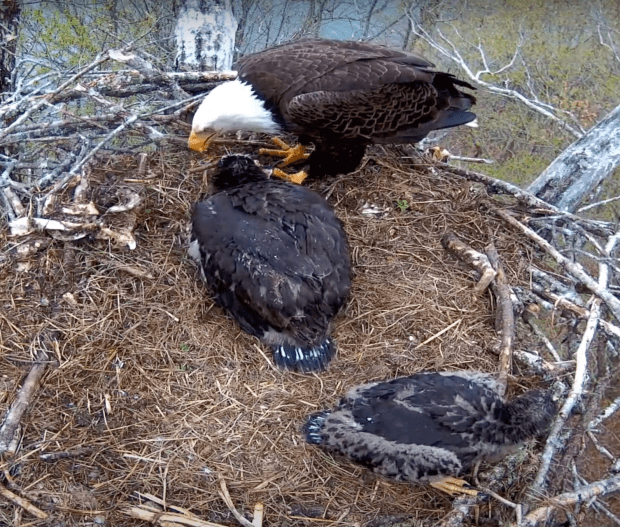
White-tail eaglets are hatching! The British RSPB (and others) have been working to reintroduce the White-tailed Eagle to the UK. The RSPB at Loch Garten in Abernathy Scotland announced the hatch of the very first chick in the Cairngorms Connect Programme happened at 19:42 last night. Congratulations everyone!
White-tailed eagles in the UK became extinct with human persecution. The eagles last bred in England and Wales in the 1830s, in Ireland in 1898, and in Scotland in 1916. This hatching in the Cairngorms is, therefore, a big deal. One current threat to them is shooting. Several of the White-tail eagles introduced to the southern part of England have been shot near hunting estates this year causing wide spread outrage.
Almost simultaneously, the first White-tail Eaglet in Denmark hatched!
Norway has the largest population of White-tail eagles in Europe. That is completely understandable because the birds like to have a territory that is located near to or adjacent to a body of water. Their territory can be as large as 70 km.
The White-tailed Eagle appears in Germany’s coat-of-arms and is Germany’s national bird. The eagle appears on the 1 Euro coin.
The eagles are recovering but they are still in a critically dangerous level. There are only 600 breeding pairs in the EU. Factors causing a decline in the population include shooting, poisoning, nest robbing – eggs and chicks -, the loss of habitat, the loss of wetlands, and the high pollution of water.
White-tail eagles eat fish, birds, and small mammals. They are one of the largest birds of prey in the world with a wingspan of 5.8-8 feet and weighing 9.5-12 pounds. They normally lay 1-2 eggs. The nest in Denmark has 3 eggs this year.
Congratulations to Richmond and Rosie at the SF Osprey Nest at the Richmond shipping yards on their second egg. Here is one of my favourite male Ospreys rolling his eggs — Richmond!
The contest for naming Annie’s ‘The New Guy’ has made the news in California. Be sure to put your suggestion in. Cal Falcons will create a short list for voting on the 13th.
There is another naming contest for the two eaglets at Redding. Here is their announcement:
Everyone hoped that Big at the Dale Hollow nest had moved on from beaking Little Middle. Not so. Perhaps the wet cold weather caused Big to not be so friendly this morning when the breakfast fish was brought in. Big attacks Little Middle at 10:08:01. Little Middle waits and listens and moves up to eat at 10:14:18 doing what he does best – the snatch and grab. Both eaglets were fed. Little Middle stayed and did clean up.
It was not nice. Big can still get a good hold on Little Middle around the neck.
I am so delighted! Karl II was on his nest yesterday. Welcome home, Karl II. Congratulations to everyone who worried so much and did such good tracking of his migration home.
Idris and Telyn are eating, working on the nest, and thinking about eggs and chicks at the Dyfi nest in Wales.
Idris on the nest; Telyn up on the perch eating a fish.
Everyone is still waiting for Aran to arrive. Mrs G, the oldest Osprey in the UK, has been visiting Aeron Z2 over at the Pont Cresor nest which is close by to the Glaslyn nest.
I did not catch it but a male, LJ2 has been sky dancing over at Glaslyn for Mrs G. Will Aran return is the big question on everyone’s mind. I hope that he is arriving as I write this! That would be grand.
All the nests appear to be doing fine. There are some weather systems to be watched for next week. The Dark-eyed Juncos are arriving along with several species of Sparrow. The Canada Geese continue to arrive along with the Bald Eagles. There were 43 of them on the river near to where I live two days ago. They are on their way up to Lake Winnipeg and the good fishing.
Thank you so much for joining me. I hope that you have a lovely Saturday. Take care everyone.
Thank you to the following for their streaming cams and/or FB pages where I took my screen captures: Bywyd Gwyllt Glaslyn, DHEC, Dyfi Osprey Project, Eagle Club of Estonia, Birdlife Denmark, SF Ospreys and Golden Gate Audubon, Redding Eagles, and the RSPB Loch Garten Abernathy.
As Ospreys return and eggs are laid in the UK and northern areas of the US, it is time to stop for a second and congratulate Andy and Lena, Lori Covert, and the team at Window on Wildlife for a very successful year at the Captiva Osprey Nest.
Lena and Andy incubated three eggs. The hope was that the Crows would not predate them. All hatched. Big Bob hatched at 21:24 on 16 Feb while Middle Bob came along about five hours later at 02:02 on the 17th. Little Bob joined the pair on the 19th at 16:29. Sadly and without any notice, Big Bob died on the morning of 15 March; he was 27 days old. Middle and Little Bob (affectionately known as Mini) have thrived. Today, Middle is 50 days old and Little is 48. The average nesting period of Western Ospreys is 50-55 days. We are now approaching fledge at Captiva. After fledge, the fledglings return to the nest to be fed and to work on their flying before leaving the parent’s territory.
Here is an assortment of images of Lena and her babies from 08 April 2022. There is still lots of fish arriving on the nest. It seems Lena is always feeding the chicks.
Lena is a very devoted mother.
Little Bob still loves to look over the side of the nest!
Food coma.
Seriously look at how big Little Bob is standing up so straight.
Soon Lena will be able to rest her vocal cords! Here she is reminding Andy that the kids would like to have a fish before bed – and so would she!
What a gorgeous image as the sun sets and sends that beautiful rose-gold tint over Lena and the babies.
Lori Covert is an excellent steward or custodian for the wildlife that have their nests on her property. Last year, Connie and Clive lost their two eaglets, Hope and Peace, to rodenticide poisoning. In that same year, fishing line was noticed on the nest and Lori promptly had CROW out to remove it. This year fishing line was noticed on the Captiva Osprey nest. Lori and Window on Wildlife posted the following on the information below the streaming cam:
3/28 Update: There seems to be a bit of fishing line in the nest. If it is causing significant issues, and we can document it, we will ask permission to retrieve it. The line seems to be embedded in the nest and would be a major operation to remove without damaging the nest or putting the chicks in danger. Will monitor it very closely. If it becomes an immediate danger, we can act within hours, as we have a ladder on site ready to go.
There is still time to enjoy watching these two Ospreys. What a great vantage point to see them begin to hover and fly! If you have never ever seen an Osprey hover, you are in for a real treat. Little helicopters. Here is a link to the streaming cam:
I want to thank Lori Covert and Window on Wildlife for their love and care of this wonderful Osprey family. The mods on the chat have been excellent and information has been passed on to those watching as it becomes available. Window on Wildlife also had a streaming discussion session after Big died. It was awesome. The Captiva Osprey Nest has and will continue to be a joyful nest to watch for the rest of the season! Check it out.
Thank you for joining me today. It is always such a treat to talk about a successful nest. Take care everyone. See you soon.
Update on Karl II: Karl II is on the nest in Estonia. The camera should be operational shortly. Relief.
Thank you to Lori Covert and Window on Wildlife for the streaming cam where I took my screen captures.
It is raining snow and snowing rain on the Canadian Prairies on Wednesday afternoon, 6 April. The huge mounds of snow that have covered every space available have melted from the inside out and are disappearing causing fears for a spring flood. Grey squirrels, Dyson and Scraggles, have come out only in the last light of the day to find food. Little Red must be tucked in nicely in his penthouse. So far only one of the Blue Jays has returned. I hope the others are just delayed. For years it has been the three of them – of course, birds do not live forever but when I look out and see my friends in the garden you want to believe that they will always arrive to say hello. Wildlife in an urban setting has many challenges. I am happy to report that my little corner of the world has four new families feeding the birds which, by the act of seeds falling, also feeds the rabbits and the squirrels. Individuals are now showing their toddlers the birds outside eating out of their feeders and together, we are building a bigger and bigger corridor for the wildlife. Our City no longer takes care of the boulevards in front of our homes and this year I want to encourage, where possible, the planting of bird friendly shrubs or trees on these sites. Wonder if I can get a grant from the City to help pay for the trees for everyone? It’s a thought! Will keep you posted.
You have asked me about Osprey nests with streaming cams now that the US birds are returning – some already have eggs in the nest. My friend ‘S’ loves Ospreys because they only eat fish. She knows the US nests; I tend to watch the ones in the UK and now Europe also. I asked her for her top list of nests to watch and she sent me quite a few. I am going to start with one or two a day. These nests are known to be successful. First up is the Dunrovin Nest in LoLo, Montana, home to Harriet and Swoop. Harriet is home; Swoop has not returned yet.
Here is Harriet on her nest looking out to the Montana hills.
Do you want to learn more about Ospreys? Then there is a special programme for citizen scientists run by a graduate student in Conservation Biology from William & Mary College. You observe a different nest, take notes, and meet up in a virtual world every Thursday at 14:30. The programme for this year has not started. Check out this link for more information!
One of the biggest challenges on the Dale Hollow nest for Middle Little is Big and her previous intimidation. When food comes to the nest, Little Middle is frightened and becomes defensive. Little Middle is self feeding but there needs to be food on the nest so that it can do this. Wednesday evening at 18:23:23 River brought in a 2 bite teaser. Big shot up immediately, grabbed the tiny minnow, if you like, and horked it down. Little Middle did not, of course, have a chance.
It is Thursday morning and both of the eaglets have eaten well. The nest appears to be drying out, too. Now that Little Middle is nice and full, it is time to go elsewhere and check on all those other nests including Karl II’s movements over night.
While Dale Hollow is drying out, the National Arboretum Nest in Washington DC is getting a bit wet. That little fuzzy ball is sure changing!
Big Red is getting some of that rain in Ithaca, too!
tors
Need another Peregrine Falcon nest? Here is another with four eggs like Utica, like the Red-tail Hawks in Ithaca and Syracuse…Some think that the increase in the number of eggs is to compensate for the loss of birds due to Avian Flu this year.
There is a pip in egg #2 at the US Steel Eagles!
A beautiful image of Jackie and her fast growing baby, Spirit, from yesterday afternoon. It really is a lovely name the children chose.
If you are a fan of the oldest female Osprey in the UK, Mrs G at the Glaslyn nest you might be wondering why – since you know she has returned from migration – she is not on her nest. She is over visiting with Aeron Z2, one of Monty’s boys. She is waiting for Aran and he is waiting for Blue 014. If neither return will these two get together and what nest will they choose, we wait! Aeron Z2 and his brother Tegid, Z1 who has a nest in Snowdonia have been very interested in that Glaslyn nest. Oh, the soap operas of the birds.
I am extremely fond of Idris and Telyn at the Dyfi nest in Wales. If you want to watch an Osprey cam this is one of the good ones in the UK.
Here is the link:
Karl II was near Minsk last night. There is hope that he might be near the Latvian border later today. As well as Karl, his mate and all the other storks in Latvia and Estonia should be on their way and hopefully safe and away from the war. Waiting is hard. Champagne corks will be popping when he lands on his nest!
The Indiana Department of Natural Resources posted an image with a saying yesterday: “Rescuing Wildlife is Legal”. If you see injured wildlife, please notify your local wildlife rehabber. Don’t know who that is? Find out! Because of the spread of the highly pathogenic Avian Flu,, special protocols might be in place. So ask before you help.
The New Guy at the Cal Falcons nest is still doing what he does best — support Annie! Yippeeeee. The romance continues.
Have a wonderful day everyone. Thank you so much for joining me. See you soon!
Thank you to the following for their streaming cams and/or FB or pages where I took my screen captures: Google Maps, Friends of Big Bear Valley, Dale Hollow Eagle Cam, Audubon Society of Rhode Island, Pix Cams, Cornell Bird Lab and RTH, and Dunrovin Ospreys.
First up. The children at the school in Big Bear Valley have picked the name for Jackie and Shadow’s eaglet. It is ‘Spirit’. What a wonderful name! Fly high, Spirit!
NBC – along with dozens of other news outlets – carried the announcement.
I get really excited about the return of the Ospreys to the UK in the spring. There are many reasons for this but the one that stands out the most is the respect and care given to these beautiful fish hawks. Did you know that most of the lochs are off limits to human use of any kind during the breeding season from 1 April to September? Most of the wildlife centres operate on grants and donations and have specially constructed ‘hides’ and monitors inside the buildings so that you can see the birds. Rutland Water and Poole Harbour have ‘osprey tours’ that are guided.
There are currently Ospreys on the following nests:
Rutland Water Manton Bay: Blue 33 (11) and Maya currently have 1 egg waiting for the 2nd any moment.
Loch of the Lowes: LM12 Laddie and Blue NC0. No eggs yet. Some intruders about.
Llyn Clywedog: Dylan is now home with Blue 5F Seren as of yesterday. This couple raised the largest male Osprey chick ever recorded last year.
Dyfi: Idris returned to Telyn yesterday and has been Sky Dancing and mating.
Foulshaw Moss: White YW and Blue 35 both at home working on the nest.
Poole Harbour: CJ7 the resident female hoping for a mate circled the town and has just arrived not long ago.
We are anxiously waiting for the arrival of Mrs G’s partner, Aran. Aran was injured and left late in September for migration. I do hope he returns safe and sound! If not, Mrs G will have lots of suitors. Perhaps even Monty’s boys have some idea that they would like to have nests close to one another. Tegid Z1 (love the guy) and Aeron (Z2) over at Pont Cresor. In the US, all eyes are on the nest in the parking lot in Missoula, Montana that belongs to Iris, the oldest Osprey in the world. Return safe, Iris!
PA Farms has announced that the 4th eaglet on the nest died during the night probably from hypothermia. What a little scraper he was climbing over those big siblings to get to the food.
The weather has been miserable in many areas this spring. It can cause all manner of diseases – the wet damp nests – for our birds.
Some are wondering if Big at the Dale Hollow nest is actually suffering from something. I had an inbox full of notes saying Big is being ‘too nice’ to Little Middle for the second day. Indeed, Little Middle got up first with no intimidation and ate the fish that came in at 08:54. Nice fish andd still scraps on the nest. Little Middle is ready for breakfast!
Little Middle gets up and does a stretch. It is so nice to see chubby legs. Big does nothing.
Little Middle is truly enjoying that fish!
Big moves up later.
Big is ahead in getting its feathers despite the fact that the two hatched on the same day. Notice the tail feathers on Big. You can see them growing out of the calamus or the quill. Some people refer to these structures as the shaft. They are properly known as ‘blood’ feathers. In baby birds, these are the feathers that are growing (not molting). They have a large supply of blood inside them while they grow. This will regress when the eaglet is older. Some of you might well remember that the Captiva Eaglets last year, Hope and Peace, were fed a rat that had died because of rodenticide. In the case of the last eaglet to die, it actually broke off a blood feather and bled to death because the rodenticide caused the blood not to coagulate.
Feathers are so important. They keep our feathered friends warm and dry while giving them the ability to fly as well as their distinct plumage of each species.
Little Middle proudly shows off his large crop at 09:26.
It is official. The chick has hatched at Two Harbours this morning for Chase an Cholyn! Congratulations!
Want to catch the action at Two Harbours? Here is the link:
If you move around the Channel Islands to check on Thunder and Akecheta at the West End, get out your worry beads! Those eaglets are right up to the edge with curiousity!
At the Utica Peregrine Falcon nest, Astrid just laid her 4th egg! Congratulations!
Yesterday I posted the name of the FB group for this streaming cam incorrectly. The correct name if you are searching is Falcon Watch Utica. Thanks ‘MR’ for catching that and letting me know!
Interested in Peregrine Falcons? Cal Falcons just posted information for a free virtual falcon conference for 19 May. There is always something wonderful to learn. Here is that posting:
The ‘New Guy’ continues to impress me. More bedtime snacks for Annie last night who, in her excitement, pulled the NG off the ledge with the prey!!!!!
I have news from many readers of nests opening up. I hope to report on those tomorrow including that of the Imperial Eagles. Karl II, the Black Stork from Estonia, has transmitted from Belarus. Hopefully he will be in his nest in the Karula National Forest in Estonia shortly!
Thank you for joining me this morning. There are so many nests! Will continue to monitor to see if Iris gets home to Missoula Montana and if Aran appears at Glaslyn. Take care all. See you soon.
Thank you to the following for their streaming cams or their FB pages where I took my screen captures: Friends of Big Bear Valley, Explore.org, and Dale Hollow Eagle Cam.
Someone once told me that if you can get people involved in the lives of the birds, get them to see them as the individuals that they are, get them to understand the hardships that they face because of ‘us humans’, then there is hope that the world will be a better place for our feathered friends.
One of my readers, ‘B’ mentioned to me that California loves its birds. He sends me wonderful links to the news stories of Grinnell and Annie or Jackie and Shadow. It was mind blowing to see the sheer mass of press coverage – everything from breakfast news, to the headline news at 6pm, to the printed pages – stories of the lives of the birds from eagles to falcons. What a fantastic way to get the public involved. No wonder the streaming bird cams in California have over 5000 viewers at times.
Today there is another wonderful article surveying the life of Annie and Grinnell, the death of Grinnell, and the rise of the ‘new guy’. Have a read, it is a good one:
I miss Grinnell. There was something about that little falcon that tugged at my heart every time I saw him. For transparency sake, I should say that I feel thee same heart tugs when I see Xavier bringing prey to Diamond or the male at the CBD 367 Collins Street scrape in Melbourne plucking a pigeon for his female triplets. They are tiny up beside the females. If someone could design a pajama onsie like the plumage of an adult male falcon, they would surely make a lot of money. Seriously, these little males are cute. We cannot forget – at the same time – that they are the best aerial predators in the world flying at speeds up to 350 kph, breaking the necks of their prey in the sky. Still…put that altogether with the ritual bonding of the couples and you have a most interesting raptor. I disagree with some who say watching falcons is the ‘gateway’ into watching larger raptors. For me, the falcons and the hawks are just as interesting, if not more, than the eagles. Eagles frustrate me. Falcons can feed three eyases without a problem and have them all fledge. Enough said.
For Annie’s sake and for the two eggs of Grinnell’s in the scrape along with the one of the ‘new guy’, I am glad the NG came along. I like the fact that he brings prey to Annie late at night. If she isn’t hungry she can stash it away and have it in the middle of the night or eat it for breakfast. There is no waiting for food. I like the tenderness that he uses in trying to roll the eggs and get them under his tiny body along with the fact that if Annie calls him – he comes. New Guy isn’t going to win a lot of awards for his jammies – they are a little rough at the edges, something that goes along with his lameness – but he will most certainly win hearts and minds, just like Xavier did at Orange, for rescuing this 2022 breeding season for Annie — and for our dear Grinnell. We must not forget that. He isn’t the male that comes storming in and shattering the eggs of his predecessor. Nope. He is tender and caring. It is a miracle of sorts that he came along, just at the right time, slipped into place. In a month, we will play guess whose nestling belongs to whom – and we won’t know and the new guy and Annie won’t know. They will just take care of all three of them.
I do wish that the falcons wore identity tags. It appears that the ‘new guy’ flew up to the ledge. No prey in talons but obviously working on something. Is it stashed somewhere? The ledge clock says it is 17:16 when he arrives.
Simultaneous with the new guy’s arrival, Annie gets up and leaves the eggs to take a break.
It was only the limp that gave away it was the ‘new guy’ trying to fit the eggs and roll them under him without causing any damage.
Annie returns with some nice YSL red lipstick at 18:08. She obviously had a nice supper. Did I say I was getting to like the new guy? How many times?
Cal Falcons put together this video of the exchange of incubation duties. Enjoy!
Good night Annie and ‘the new guy’. Good night to all of you. Take care. See you soon!
Thank you to Cal Falcons for their streaming cam where I took my screen captures.
Today’s news continues to just get better!!!!!!! If you missed it, the American Eagle Foundation who surely have had their own troubles to deal with concerning the recent fire at Pigeon Forge have sent the following message: “We will reach out to the Army Corps of engineers to see if we gain access to the site. We have some experience in situations such as these and have successfully navigated retrieval, rehabilitation and replacement before. I will keep you updated as the situation unfolds. Thank you for your dedication and support to our native wildlife!” Ervie shows up at the Port Lincoln barge – he always brings sunshine – and hangs around for a long time. He was off around 06:29 but I believe you can still rewind the camera to ‘see’ him. His missing talon is growing in slowly. Many are asking for Cal Falcons to give the ‘new guy’ to Annie a proper name. If you have any suggestions, go over to the Cal Falcons FB page and give them a soft nudge to consider it. (They aren’t asking for names but a lot of people are suggesting they give Annie’s new guy a name). The ‘new guy’ has defended the nest, done lots of incubation, and brought in prey for Annie today. He feels like a keeper. And I am not even over the shock of Grinnell’s death. Things move quickly in Bird World sometimes.
‘B’ sent me the link to a YouTube interview with Mary Melac. She gives us good insight to what happened to Grinnell and what is happening currently on the nest. Thank you ‘B’! Mary is the individual that had to retrieve Grinnell’s body.
The news that had me jumping up and down is that the Black Stork patriarch, Karl II, from the nest in the Karula National Forest in Estonia has crossed the border and is now safe in Belarus on his way home having spent far too much time in the Ukraine.
Yesterday I posted a link to the White tail Eagle nest in Poland. Thanks to one of our sleuth readers, ‘CA’ found out this information: There are two eggs. They were laid on March 3 – start of incubation: https://youtu.be/QmvQWVDEOso March 30 – 2 eggs are visible: https://youtu.be/7wXH98H6CCM
Thank you CA! This is such a gorgeous nest area.
At the Dale Hollow nest of River and Obey, Middle Little self-fed after Big ate and ate and then Little Middl got a chance for a feeding at 12:40 ish.
At 14:27 Little Middle continues to have a nice crop. In an earlier blog I posted two videos of Little Middle self-feeding. In the second one, he figured out to hold down the fish and pull up with his head. He managed to do very well. If you missed those videos, I am reposting them. In terms of survival skills, he might not be big and he might not intimidate Big but he can certainly figure out how to eat – even finding flakes of fish and old pieces on the nest. What a little guy!
Little Middle is full and happy right now.
The four eaglets at the PA Farm nest continue to do well. Keeping those parents busy! The little one just needs to keep its head up – the others are so big. I believe it is 9 days younger than the eldest.
There are so many more nests and so much news but for now, I want to relish the joy that maybe, just maybe Little Middle will be helped. Birds bring us so much joy. It is up to us to protect them from harm when it is something humans have caused. I am so grateful to all of you for your help and concern for the wildlife. See you soon.
A Big special thank you to all those people working so hard today to get help to remove the monofilament line at Dale Hollow. I want to particularly thank Ron Magill at the Miami Zoo for getting the ball rolling fast this morning! A huge shout out will go out to Ron and all the others including the AEF staff —— great people who are eagle experts.
Thank you to the following for their streaming cams or pages where I took my screen captures: PA Game Commission for PA Farms Eagles, Dale Hollow Eagle Cam, Cal Falcons, Looduskalender, and Bielinki On line Bory Tucholskie.
It is a great morning – feedings at Dale Hollow, Ervie at the barge, and the romance continues at The Campanile.
The morning started out with real positive energy in terms of an intervention to get the monofilament line off of DH 15 Little Middle and remove any other line off the Dale Hollow Nest. Approval has come down from the top permit officer so we wait to see if the local officer will assist. Jessica Halls and her team from the AEF are prepared to leave and help the eaglet. We do not know what the tree is like – that is the one very unknown in all of this. But however this turns out, it was a real ray of sunshine to connect with the people who love eagles and move into action when there is a problem.
If you missed the earlier posting with the letters from Ron MacGill who helped get me in touch with the USFWS head permit provider, they are here:
The adults at the Dale Hollow nest have not fed Little Middle since 2 April. Big continues to intimidate – more than twice this morning at 10:17:29 (just got up close and LM went into submission) and wings out at 12:04:20 and again at 12:05:44. There is plenty of fish on the nest – 2 have been delivered.
This morning, very hungry, Little Middle self-fed and in the second video stands on the fish and pulls and tugs developing good neck muscles. This eaglet is a survivor. I sure hope it gets the chance out in the wild.
Really proud of how well Little Middle is feeding itself. At one point the crop was full but, because he had not eaten for so long, he dropped that food rather quickly.
River has not fed Little Middle any of the fish this morning. Big is always threatening.
Big is full. At 12:23:53 Little Middle begins to move over to the piece of fish left to self feed.
As I write this, Little Middle is self-feeding. Hunger and the will to survive are driving this wonderful little eaglet. These are great skills for the wild.
An adult returned to the nest and Little Middle moved and then began to go around the rim to be fed.
Little Middle was being fed and then…Big noticed.
At 12:33, the adult is feeding Big. There is plenty of fish. Stay up there Little til Big leaves. That is all you have to do!
Big’s crop is big enough to pop.
In another golden moment, the adult got between the two eaglets and is turned and feeding Little Middle. If the adult will stay there, Little Middle will really be able to have a good feed. There is plenty of fish.
An adult brought in more fish at 12:48:54. There has been lots of fish on the nest. I wonder if the weekend leisure boat traffic, etc. in any way impacts the fishing for the eagles?
I cannot promise you that the rescue and intervention will happen. What I can say is that the removal of the fishing line is in the hands of the USFWS and the AEF. If it is possible, I believe we will have a good resolution. It clearly depends on many factors including the tree the nest is in. I have not been able to get a proper height for it other than very, very, very tall.
There is also good news coming out of The Campanile and the Cal Falcons. Annie’s ‘new man’ – please give him a great name Cal Falcons – brought her a large prey item which she accepted last night. Despite his lame foot, this fellow is a good hunter and provider. Annie how lucky!
The two changed incubation duties just a few minutes ago! Courting ritual in scrape. Seriously, can there be a better written romance?
And in the midst of everything, Ervie was at the Port Lincoln Barge begging Mum for a fish! I want to thank ‘A’ from Japan for alerting me to his presence. The Port Lincoln Osprey folks did a close up of Ervie’s foot so that they can see how that talon is growing. It is growing in slow.
You might be able to rewind to the times above and get to see Ervie! Here is the link, Ervie is still on the barge!
As I mentioned yesterday, Dale Hollow can be mentally exhausting. The intervention and removal of the line is in the hands of those who have the opportunity to help. I am going out for a long walk in the forest because waiting and watching is agonizing.
Take care everyone. Thank you so much for joining me. See you soon!
Thank you to the following for their streaming cams where I took my screen captures and video clips: Dale Hollow Eagle Cam, Cal Falcons, and Port Lincoln Ospreys.
One of my favourite White-tailed eagle females is Milda. I have mentioned her before in my blog. Her nest is in Durbe County in Estonia. It has been a rough year for Milda since her long-term mate was missing and presumed dead in late March of 2021. Milda heroically tried to incubate the eggs without food for 8 straight days to the point of starvation. Several males offered hope and then didn’t. As if with a miracle the two chicks hatched and we all celebrated only for them to perish because of one of the males taking the food off the nest and then not covering them. But, that was last year, and there was hope for this one but again, disappointment when the eggs laid were broken by an interloper.
The females on the nests need a good strong partner who is working with them cooperatively!
The White-tail Eagle is so rare in Eastern Europe. Latvia, Estonia, and Poland are doing what they can to encourage breeding sites.
The White tail eagles are Haliaeetus Albicilla. They are the largest raptors in Europe and are located from Greenland to Asia. The Eagle Directory describes the plumage like this, “White-Tailed Eagles are almost entirely brown. They have a yellow-gray head, neck, breast, and lesser wing coverts, and the belly, thighs, and rump are dark brown. The flight feathers are close to black and their wedge-shaped tail, as their name would indicate, is white. The tibia are feathered, though the tarsi are not, and the legs and feet are yellow. The eyes, beak, and cere are yellow.”
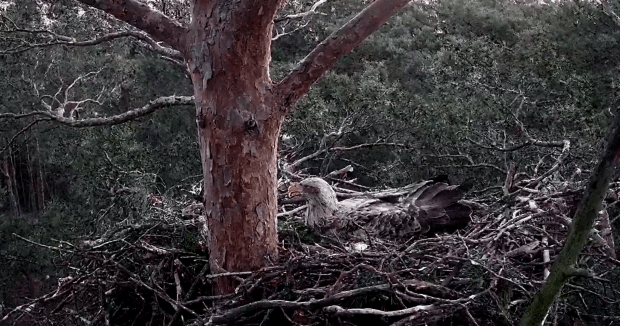
As you can seen from the images of the White-tailed Eagles below, the plumage can vary and of course, we have to take into account the lighting and settings on these streaming cams. These eagles grow to be from 74-92 cm long with a wingspan of 193-244 cm. The females are larger than the males as in most raptor species and weight between 3.7 and 6.9 kg. The males come in at 3.1 to 5.4 kilos. Their life expectancy can be up to 36 years. They eat mainly fish but also hunt mammals such as rabbits and birds. I have seen them also be opportunistic and bring some carrion to the nest. Indeed, it was a crane brought to the White-tailed eagle nest last year that killed two wee chicks because that crane brought with it the highly pathogenic Avian Flu, H5N1. While the birds are listed as not being under threat in some areas, they are very rare in Eastern Europe and the UK is trying to reintroduce them. While they may lay 1-3 eggs, it is most typically 2 eggs that will be incubated by both parents (as you see below) and hatch within 34-46 days. Fledging typically takes place between 77-90 days after which the fledglings are depending on the parents for 4-6 weeks while they learn to fly and hunt.
In older White-tailed eagles, the head and neck can be almost white.
The adults in the images are in a nest in the Woziwoda Forest District. It is a special project of the Eagle Conservation Committee, the Woziwoda Forest District and Polish Radio promotion both old forests and the White-tailed Eagles. The nest is highly protected. There can be no activity within a radius of 200 m. Setting up the camera were problematic and the workers who installed it had to do this cautiously when the eagles were away.
The nest you are looking at is on a 140 year old pine tree at a height of 25 metres. This nest has been occupied for four years. It is known that there was one fledge in 2021.
For transparency, I do not know any of the history of this nest so I do not know whether to give you caution or not. I am attempting to find out. The setting is simply beautiful and if some of you have been watching this nest in the past, please let me know. The chat is in Polish and I understand eggs are being incubated but it is not clear how many or when they were laid by the information provided.
Here is the link:
Just an update on 2 other nests: The adults at Dale Hollow have brought in a teaser 2 bite fish and a small sucker early in the morning. Big ate both of them. No other food has been provided to the eaglets up to 18:30 this evening. I sure wish they would bring a whopper on the nest tonight for both. That said, Little Middle ate well yesterday and is OK. Sadly, Little Middle continues to pull that monofilament line. Thank you to ‘CA’ from Belgium who sent me this 15 second video clip. I could not see him dragging the nesting material, my mistake.
Annie and the new male continue to bond in the scrape box. I have caught him incubating a few times today. I sure hope he is a good guy to our Annie! I don’t think any male will ever fill Grinnell’s shoes – he was a huge character in every aspect of a raptor’s life but any bird who will care for Annie, Grinnell’s eggs and now on of his own is gold in my books!
Karl II has spent his 4th night in the Ukraine not far from Kyiv. Anne7 posted this image of where he was hunting for food this afternoon. I am so grateful for the Looduskalender Forum and their English pages and to the tirelessness of Anne7 to inform all of us of Karl’s whereabouts. I wish him to replenish his energy and get to Estonia! Fast.
You may find yourselves spending too much time looking at the Dale Hollow nest hoping for a miracle. I had to begin to pull back today. It is mentally exhausting. We cannot make the adults bring in more food and legions of you have contacted enough people to get help. ‘L’ has had a promising conversation with Al Cerere who asked the important questions. If help can come, he is the guy to make it happen. We simply have to wait and hope. My heart breaks for both of these eaglets but, of course, most especially Little Middle.
Our weather is set to soar to a high of 8 degrees Celsius. We will all be outside in our summer clothes! Well, not quite but it will feel like that. It was a damp day, cold to the bones British type weather today. Birds are arriving and I really hope to get out to see some of them in the morning tomorrow. My post will likely arrive late in the afternoon.
Thank you so much for joining me this evening. Please take care. See you soon!
Thank you to the following for their streaming cam where I took my screen captures: Cal Falcons and Bieluki On line Bory Tucholskie.
It was cold, damp, and dreary counting Canada Geese this morning. I did not take my camera – it is bulky and heavy – but I will return and take some images for everyone early this week. There are Canada Geese everywhere there is a large puddle!!!!!!
There is lots going on in Bird World – too much to keep straight. I want to start with dear Annie at the UC-Berkley Campanile. When Grinnell was killed we thought all was lost. Turns out Annie has her own ‘saviour’. It is thought that Annie laid an egg on Thursday but not in the scrape box. Cal Falcons felt that she thought she could only take care of 2 by herself. On time, she laid egg 4 and that is the big news. By my reckoning, this egg belongs to the new man since it takes approximately 2.5 days for Annie to make an egg. Oh, I hope this turns out well. It would be wonderful to see the last two chicks of Grinnell be healthy and fledge.
He’s a little raggle-taggled compared to Grinnell. I wonder how old you are Annie’s new man??
He is certainly trying to show Annie he has good intentions and is a good hunter.
Last evening Annie accepted ‘dinner in the scrape’ from the new lad. She stashed it for later and returned to incubate but how sweet was that?! Everyone remains hopeful.
Many of you are falcon fans. I have discovered a new scrape on top of the stadium at Michigan State University. It is brand new as of January 2022 so nothing is known, as far as I know, about the falcon couple. Here is that link – and there are 3 eggs!
Here is the link!
Michigan is working to reintroduce falcons into the state and there is another scrape that is funded by the Lansing Board of Water and Light.
How long do Red-tail Hawks live in the wild? I believe that Pale Male will be 33 this year. Him and Octavia have not had any clutches for the past two years. It will be three this year. Robert Yolton writes a wonderful blog on the wildlife around New York City’s Central Park. He found Pale Male eating a brown rat yesterday and took some video. His feathers appear to be fading a bit but what a legend Pale Male is.
Have you seen the free movie about Pale Male and how the community, including Mary Tyler Moore, lobbied and picketed for him and his mate to keep their nest on one of the nicest pieces of real estate in NYC? If not, watch it or save it for when you need something uplighting. The voices of people can really make a difference to the lives of these fantastic raptors. We just need the right person to hear us!
Pa Berry and Missy at the Berry College Bald Eagle nest have been trying to coax 78-day-old B15 into the nest for some food. Missy has been watching her first fledgling closely making sure that he is learning to fly and land but not venturing far from the nest. Late this morning B15 returned to the nest and Dad flew in with a fish immediately for his boy.
Meanwhile Kincaid is branching higher and higher at the Kistachie National Forest nest near Alexandria, Louisiana. No one will ever know for sure if Kincaid is a male or a female; the eaglet will not be banded. But from the size comparison with Mum and Dad at this stage – right before fledge – most think Kincaid is a female. She is definitely a sweet eagle. Anna and Louis did a fine job this season. Hats off to everyone at KNF who worked so hard to get the two camera system in place, for taking the time to mod the chat and answer questions most of the day.
Closely watching the progress of Karl II, the patriarch of the Karula National Forest Black Stork nest in Estonia, as he flies over a war zone to get to his nest. Isn’t he gorgeous? This image was taken in 2017. He is still as handsome!
Who doesn’t know CROW? and who doesn’t wish we could wiggle our noses and get them to land at the Dale Hollow nest to check on that monofilament line? Made famous for their rescue of E17 and E18 of the SWFlorida Bald eagle nest when they had non-human caused conjunctivitis, CROW this morning cleaned out an Osprey nest full of human garbage. It is a threat to the wildlife – just like all those toys at Dahlgren are, sadly.
Oh, the Osprey chicks of Andy and Lena have been so neglected by me. They are just gorgeous and getting way too big too fast. So happy for Andy and Lena. After two horrible years, it looks like they will fledge two this year.
There was a statement on a FB group about the number of eggs in a Bald Eagle clutch. They said it was ‘rare’ for three and rare for three to survive. (They did not mention the rarity of siblicide twice at the same nest). I dug around and found a very interesting study on the change of clutch size in Bald Eagles in the Chesapeake Bay area of the US. It is really interesting ready. The author, writing in 2017, begins with the age of egg collection and continues to 2011 demonstrating that the size of the clutches has increased significantly since the beginning of the 20th century. It is not onerous reading. Very insightful.
Dave Hancock of Hancock Wildlife in British Columbia did a study and found that the average for that province’s Bald Eagles in terms of clutch size is 2.
There are a number of 3 chick clutches currently being watched by us as well as one with 4, the PA Farm Bald Eagle nest. Pittsburgh-Hayes consistently has three and Redding would once again had three this year had their one egg not gotten broken. One of the most visited Bald Eagle sites is the West End where there are three eaglets this year. I wonder if this varies by region? Will look to see if I can find any solid information for us.
Deb Steyck made a video yesterday of the four at PA Farm being fed.
Meanwhile, Mr President seems to be really loving being a Dad again after 4 years and Lotus is figuring out everything as a first time Mum rather quickly. This is one spoiled little nestling that will grow fast and strong if Mr President’s prey deliveries are any indication of what is to come.
In contrast, nothing arrived on the Dale Hollow Bald Eagles nest until a two-bite teaser appeared at 11:24:55. We all know who ate that! These eaglets hatched on the 28th of February. Jackie and Shadow’s only chick hatched on 3 March. The Big Bear eaglet had been fed 8 times by 16:00 yesterday. The Dale Hollow nest continues to baffle me.
The eaglets are hungry.
At 12:31:34 a small fish was brought to the nest. Almost before the parent landed, Big went and began beaking Little Middle. Big’s beak is large and it can still encase Little Middle with its body hurting him. Big is a big bird.
To survive, Middle Little gets that head down and stays put.
I do not believe there will be enough for Little Middle to have any fish. I hope to be wrong. I also hope that the parent would change the direction they are feeding so Little Middle could move. It appears from the image above that the fishing line could be around some of the right talons??? But that is anything but 100%.
It is 12:44 and Little Middle has made no attempt to move to get any fish.
The fish is all gone at 12:45:24. Little Middle is still maintaining submissive posture. While it had been hoped that the attacks would stop, they continue because of the erratic fish deliveries. Like children, eaglets on the nest need some stability or they go into survival mode. Remember, Big wants to survive so it protects what it sees as a low supply of food. Middle Little protects itself for another time by being submissive and putting its head down. No sense in fighting a sibling that is twice your size.
A nest that is much calmer is that of Big Red and Arthur, the Red tail Hawks at Cornell who continue to incubate their four eggs which will hatch later this month.
Big Red is 19 years old this year and is the most well known RTH in the world. She is an incredible mother.Cute Little Arthur has learned how to puff up his feathers to keep those four eggs warm and dry!
And the last check of the day, the two eagles that hatched on March 20 and 23 are doing remarkably well at the Redding Bald Eagle nest of Liberty and Guardian. They have sure grown out of the cute fluff ball stage now.
Liberty looks down at his two chicks while Guardian is aerating the nest.
It has been a busy day at the nests, many I did not get to check. Hopefully later. Thank you to everyone who has commented or sent me an e-mail. The inbox is full. I plan to have responded to everyone by tomorrow (Monday) at noon. Thank you so much for your patience and for your caring for Little Middle and all the birds. Your kind gestures bright light in a world that feels somewhat dark right now. Each of the nests seems to be doing exceptionally well. Dahlgren needs its garbage cleared, Richmond and Rosie have a good nest structure, West End babies fed well, and I have to check in with Chase and Cholyn to see if Thunder has a sibling. We continue to wait for the arrival of Ospreys Dylan, Aran, and Idris in the UK and for Iris in Montana.
Take care all. See you soon!
Thank you to the following for their streaming cams and FB pages where I took my screen captures: Eagle Club of Estonia, Dale Hollow Eagle Cam, Cal Falcons, MSU Fisheries and Wildlife Club, Lansing Board of Water and Light Peregrine Falcons, Berry College, KNF, Captiva Ospreys and Window on Wildlife, CROW, Cornell Red Tail Hawks, and NADC-AEF.