It is 9 September in Australia. My computer tells me that it is 17:34 on the Canadian Prairies on the 8th of September. In three hours, around 20:00. CDT, the NZ DOC rangers will fit Tiaki with the tracker. She is 228 days old and could fledge any time.
Here is the link so that you can watch. Both LGL and LGK were fitted with trackers. LGK’s is still working providing valuable information on where the adults forage for food for their chicks.
In other nest news, it has been confirmed that Z2 (Aeron) and his family have now all departed for migration. Aeron’s nest is the Pont Cresor in Glaslyn. At the same time, Aran is still at the Glaslyn nest. Many worry about his late spring wing injury but, he most often doesn’t leave until mid-September.
Wales issued a statement that due to the cold spring weather and misfortunes, their six nests produced only six chicks to fledge.
9 October is one of Cornell’s big bird submission dates. This year they are even calling it October Big Day. They want everyone to do a bird count around the world. Mark it on your calendar. I will give you more details closer to the day.
eBird submissions are very helpful. Some recent discoveries, sadly, include bird and plane collision information.
A photo of an adult Osprey yesterday leads everyone in Missoula to think that Iris is still in Montana. The image was taken from the Owl Pole Camera.
Let’s chick on where the Black Storks are today.
Pikne is in Moldova.
Udu is in Southwest Poland.
Udu’s area is full of lakes!
There was no data update for Karl II.
Julge, the only surviving chick of Jan and Janika, has made its way through Germany and looks like he is flying into France. This stork picked the Western Route! Julge is the purple line going into Belgium. It is nice to know he is safe.
The last time that Big Red and Arthur’s K1 and K3 were spotted was 3 September. If they are truly gone and starting their own lives, we wish them and those that are migrating good winds, food, and safe landings.
My original computer issue was fixed but now it seems that some of the keys are sticking. It isn’t fun to keyboard. I will leave you with a couple of images of ducks and geese from my excursion to the park today. It was quiet. Everyone was off tracking down a Green Heron that had flown into town!
A juvenile male Wood Duck.Juvenile Female Wood DuckAdult male Wood Duck,moultCanada Geese
Thank you so much for joining me today. Don’t forget to drop in and see Tiaki get her tracker! My hope is that it is equipped with a 7 year battery. Take care everyone. See you soon.
Thank you to the following for their streaming cams or FB pages where I took my screen shots: Montana Osprey Project, Eagle Club of Estonia, Cornell Bird Lab and NZ DOC, and BirdMap.
It has been several weeks since I travelled to check on the two osprey chicks in their nest at Grand Beach Provincial Park. A friend sent me word on Tuesday that the two chicks were still at the nest with mom. Circumstances kept me away until today. It was a bright sunny day with no chance of rain – seemed like the perfect chance to go and have a last visit with the osprey family if they were still home.
Manitoba is a summer breeding ground for Ospreys. They arrive in April and are usually gone by mid-September. Due to public outcries because many of the birds were electrocuted on hydro poles, our public utility, Manitoba Hydro, began erecting platforms for the birds in the hope that they would build their nests on them and not on the high voltage lines. The place that I visited is Grand Beach Provincial Park. Close to the West Beach is one platform that is occupied. There is another platform near Grand Marais, only a few moments away. It is unoccupied and was not in good condition. The water around it seems to have dried up eons ago and it is very close to the highway.
The nest that I visited is located on the shores of Lake Winnipeg. Locate Winnipeg and then move your eye 45 degrees north-northeast til you see the green type indicating Grand Beach.
Lake Winnipeg is the world’s 10th largest fresh water lake. It is very shallow by most standards. On average it is only 3.6 metres or 12 feet deep although there are a few places where it is 10.9 metres or 36 feet deep. The lake measures 436 kilometres or 270 miles in length and 111 km wide or 68 ft at the widest point. It has more than a 1609 kilometres or 1000 miles of shoreline – many areas with beautiful white sand beaches.
This young lady was the only one home while we were there. She was food calling most of the time despite the crop she had. It reminded me so much of Tiny Little. You could hear her half an American football field away quite clearly! She was not letting up.
What was especially funny was the large chunk of fish she was holding in one of her talons. Did she want mom to come to the nest and feed her?
Along with the food calling this juvenile certainly did a lot of wing flapping but, she never left the nest while we were watching.
The sun played havoc with the lighting casting everything almost in silhouette.
Look at those big beautiful wings. She has no idea what is in store for her but she has imprinted on her brain the fresh water marsh and the lake where she hatched. If she survives, she will visit this nest or a place near to it in the future.
For an area that tends to have lots of water birds, it was relatively quiet. There were only a couple of Canada Geese, a Crow, a duck, and some small birds.
There was a crow who came to see what all the commotion was about with the Osprey and to make sure that I didn’t cross the barrier to get closer to the nest.
There was also this lonely little duck all by itself. My Manitoba birding book suggests that this is a female Common Goldeneye. She is so far away this is the best I could do in terms of an image.
This seems like a perfect place for this little diving duck that is 41-51 cm long. She could be looking for tubers, frogs, insect larvae, or even small fish.
In North America, the Labour Day long weekend marks the end of summer and all of its activities. Everyone will be back in school in a few days. The beaches will be empty and the leaves will continue to turn yellow, orange, and gorgeous shades of red. Meanwhile, the birds who are still here will ready themselves for their long migration south. The seasons are changing. It is in the air and the smell of the leaves when you walk on them. There is no more need for air conditioning but, rather, a light jacket. I love this time of year.
Before I leave, I want to show you the map of the Black Stork’s migration today. I am so proud of little Pikne, the last one to leave Karl II’s nest. She has headed straight and is doing so well. She is in Moldova. Indeed, all of the birds are progressing at a good pace it seems.
You can also see that Julge – the Black Stork that got on the boat heading the wrong direction – is now in Germany. Udu is crossing Poland. Both of them appear to be going the Western route but Udu might correct his course. We wait. Karl II is relaxing on the shores of the Black Sea.
Thank you for joining me on my short visit to check on our Ospreys and the Black Storks. I wish them good winds, lots of fish, safe travels, and a long life. Stay safe everyone!
I want to thank the individuals in charge of the tracking of the birds and their posting of the current maps on the Estonia Eagle Club Forum pages.
It is pretty quiet at the nests these days – that lull if you like between the Ospreys leaving for their migrations in Europe and the US, the Bald Eagles slowly returning to their breeding areas, and the falcons and Ospreys incubating eggs in Australia. The biggest news in Bird World is that Diamond laid her second egg at 20:55 September 2nd.
Xavier taking a turn incubating and rolling the eggs for a bit this morning. Gosh, those are big eggs!
The Osprey was officially adopted in 1994 as the is the provincial bird of Nova Scotia, one of Canada’s ten provinces. Nova Scotia is a peninsula surrounded by the Atlantic Ocean, the Bay of Fundy, the Northhumberland Strait, and the Gulf of Maine. It is one of Canada’s Atlantic or Maritime Provinces. At its widest, 128 km, it is easy to reach any body of water easily. It is said that Nova Scotia has more Ospreys than the United Kingdom in its entirety. Many live on McNab’s Island at the mouth of Halifax Harbour.
@Wikimedia Commons
The lighthouse was built in 1809. In 1852, Dr. Abraham Gesner was given control of the lighthouse. In December, Gester used a fuel that he had just discovered – kerosene – to operate the light.
Ironically, there were hardly any Ospreys in Nova Scotia two decades ago. The use of DDT had weakened the eggs to the point that the birds were virtually going extinct. Since 1979, the Osprey Management Program, operated jointly between Nova Scotia Power and the environmentalists at the Department of Lands and Forestry to relocate nests that are on top of live utility poles to safer unused poles nearby. Each year they partner with the Museum of Natural History to live stream an osprey nest. The Osprey are in Nova Scotia from April to September. At the end of the summer, when the juveniles are old enough, they leave for their winter grounds in the Caribbean and South America.
The first little video is from 2014. Seven years ago, when streaming cams were not so HD. Here is a typical Osprey family of five in Nova Scotia on top of one of the partnership nests.
Here is another short video of 2020 showing the improvement in cameras. It shows the hatch of the second chick at this nest on 9 June.
Speaking of Osprey, Sharon Leigh Miles took this image today of an Osprey at Mt Sentinel in Missoula, Montana. It is Iris’s favourite tree and it is presumed to be Iris, the grand dame of North American Ospreys. Hopefully she will visit her nest before she leaves. She is the oldest Osprey in the world.
In other news, White YW, the male at the Foulshaw Moss Nest, dad of our one and only Tiny Little, Blue 463, is still in Cumbria. He was photographed there today. White YW hatched at Bassenthwaite in 2008. Gosh, he is a great dad. One of the unsung heroes. Chris Wood has received word that the estuaries that the UK Ospreys travel to for their winter season are filling up with water. Wonderful! Yesterday, I saw Cormorants here in Manitoba and today a couple seem to have taken over Maya and Blue 33’s nest at Rutland (at least for part of the day). The two little sea eagles are getting along fine. Food remains plentiful and they are growing, flapping, and learning to walk. Those clown feet are really growing. Just look, with food, 28’s feet are getting huge. Wow.
I am attaching the progress map of the Ospreys and Black Storks:
Pikne, in orange, is really travelling well. She has gone straight south almost beating Karl II in royal blue. You can follow them, too. Here is the link:
Thank you so much for joining me. Take care. Stay well. Look for egg number 3 on 4 September down in Orange.
Thank you to the following for their streaming cams where I took my screen shots: The Falcon Cam Project at Charles Sturt University in Orange, The Montana Osprey Project FB Page, Sea Eagle Cam @Birdlife Australia Discovery Centre, and BirdMap.
The sky is blue, the sun is shining bright and it is 21 degrees C on the Canadian Prairies. Just a grand day for everyone. And it is a good day for our birds. Let’s dig into those good news stories.
Jan and Janika’s Black Stork fledgling, Juleg, is not in Russia! He managed to turn around. It would appear he flew because the speed is faster than a tanker but, does it matter? Juleg is back on course having spent the night at Jaroslawiek in Poland. Fantastic news!
The question now is whether ‘the brave one’ will continue going southwest or try to correct his heading heading through Greece and Turkey? We wait. He is alive and well. That is what matters most.
Hurricane Ida temporarily took out the connection to the streaming cam at the Kistachie National Forest in Louisiana. Everyone was worried. However, the winds and rain did not damage the system that the USFWS has put in place to watch the Bald Eagles, Louis and Anna. This is great news!
If you have been watching the Boulder Osprey Cam and were frustrated that it quit working, it is back on line today. The female is still delivering food to the fledgling. Everything is good.
Remember Only Bob? The only hatch of Dylan and Seren at the Llyn Clywedog Nest? the largest male Osprey ever to be born? Today the researchers issued the list of fish that were delivered to Blue 496. There were 354 of them! Rainbow trout were almost exclusively the fish at the beginning and end of the season with Brown trout making up the middle time slot. There were also 10 Grey Mullet that Dylan took from the Dyfi Estuary 15 miles away! —— Ah, you remember! Dylan is the one that flew 25 minutes one way, got a trout, and flew back 25 minutes with it. What a guy.
Here is Dylan delivering one of those whopper trout to Blue 496, Only Bob.
The arrival of fish at the Llyn Clywedog Nest in the Hafren Forest has puzzled some of the observers. It is now thought that when Dylan chased intruders away he sent them packing and instead of returning empty handed, he would stop and fish. Hence the reason from the Brown trout from Nanty Moch which is 7 km from the nest and the mullet from the Dyfi Estuary which is 12.7 km away. Dylan and Seren, Blue 5F, did a great job with their only hatch. Seren left and will be seen where she always spends her winters – in the Tanji Marsh in The Gambia.
Aran is still at the Glaslyn nest. Mrs G has not been seen since 30 August. Can you see him?
The tiny little birds all over the Glaslyn Nest yesterday have been identified as Mistle Thrushes.
Mistle Thrushes are common and are found all over the United Kingdom. They eat berries, earthworms, and insects. They would have had a grand time foraging in the Osprey nest!
Here is a short video showing the Mistle Thrust eating berries in the winter. Listen for their song.
All you have to do is look at the photograph of WBSE 27 and 28 – yes, that is 28 with that massive crop – to see that things are going quite well on the White Bellied Sea Eagle nest in Sydney. What a relief.
It feels like a good day. It would only be better if someone had a sighting of Tiny Little, Blue 463. White YW was seen on the nest today so he is still around.
Take care everyone. Enjoy the rest of the day wherever you are. I am off to check on the local Ospreys.
Thank you to the following for their streaming cam where I took my screenshots: Sea Eagles, Birdlife Australia, and The Discovery Centre, City of Boulder Osprey Cam, Bywyd Gwyllt Glaslyn, Carnyx Wild and Llyn Clywedog Osprey Cam, KNF Bald Eagle Cam, and BirdMap.
If you are looking to take ‘decent’ photos of Canada geese, if it is a hot day in the afternoon, don’t bother. They are all taking siestas! Best time is in the morning and early evening. The Cooper’s hawks were not about either.
We had a lovely walk through the park anyway. It was just a beautiful end of the summer day i. The flowers are still blooming in the English Garden and there were more than eight people with their cameras cuddled up by the Bee Balm trying to see if they could catch a glimpse of a hummer. They were probably sleeping like the ducks.
Most of the time this pond is full of Canada geese. Not a one. A couple of lonely ducks out on the water.
This is the tower at the Duck Pond at Assiniboine Park in Winnipeg, Manitoba, Canada.
All of the water features and the move from full sun to shade gardens made the stroll delightful. There were a few people wishing they could put their feet in the lotus pond.
So we drove to a different, small park. That is actually where we found the geese sleeping and alerted me to why we could not see them in the big park. Only a few were foraging in the grass.
The juvenile wood ducks are getting bigger! They have tripled in size in a couple of weeks.
The Mallards were so busy digging in the dirt under the bark they hardly noticed me.
What is she looking for?
They are sifting through the mud and bark near the pond searching for bugs, maggots, and anything else that they can feed on including little plants. The behaviour is perfectly normal!
This gentleman got back in the water and cleaned himself off later.
There were a few geese not sleeping. These were hot and stood at the edge of the pond drinking for about five minutes.
Then they decided to do a lot of preening.
Mr Crow was simply upset at everyone today. There were people having picnics not too far away. I wonder if he was looking for some treats? It was actually good to see that no one was feeding the ducks cakes and bread. The signs are working!
Gosh, isn’t this male Wood Duck lovely? What stunning colours and that big red eye.
Another one of the juvenile Wood Ducks.
This little male decided to swim right up so I could get a good shot of him. They have the most gorgeous patterning. The swept back crest and those iridescent feathers are just stunning. He had to be the most handsome male at the pond today.
He swam away.
And then he turned around again.
Male ducks are called ‘drakes’.
This is a male Wood Duck undergoing eclipse during the summer. During this time he will lose his beautiful male plumage but he will get it back in the fall. Some ducks are unable to fly when they molt. The females also molt too.
Oh, isn’t this female Mallard gorgeous?
She might not be as colourful as the male Wood Duck but she is always a beauty. Did you know that female ducks are called ‘hens’?
The Mallards were simply going crazy splashing up and down in the water today. It was like they were trying to shake the plants up from the bottom of the pond so they could eat them.
What a beauty. Just before she flew off.
All of the ducks will hatch their eggs, take care of their babies, molt, regrow their feathers, and everyone will hope to eat well before they migrate.
The ducks in the nature centres and parks are not ringed so that they can be counted if they are shot! We enjoy learning about their life cycles and watching their babies grow. Oh, I would not be popular in places where hunting is popular!
Just a some notes about what is happening in the rest of Bird World. The people running the Sydney Sea Eagle cam have turned it back on. They believe that the danger for WBSE 28 has passed. Both of the little sea eagles have been eating well and prey has been regular. This is fantastic news.
The last of the Black Storklings that was fed on the nest in Jegova County took an unusual flight path when it left for migration. And then,Julge decided not to fly but to get on a boat and it is now heading for Primorsk, Russia. It should be there on 31 August. Julge is the purple line showing in the middle of the sea on the Birdmap tracking. I hope that Julge is OK and corrects his flight path. It would be very cold in that northern part of Russia in the winter.
Diamond even accepted a Starling from Xavier today for her lunch. There has been lots of mating – sounds heard on the camera – but no egg yet.
This morning Idris was on the Dyfi nest defending it. What expressions came on this Osprey! His son, Dysynni has not been seen since Saturday the 28th at 10:57.
I know that lots of people like to plan trips – when we can travel again – to see the Osprey. It seems that those down in Poole Harbour, England have hit the jackpot. All of the migrating birds are stopping there to feed and rest. So think end of August – Poole Harbour!
Thanks for joining me today. Tiny Tot and Tiny Little are out somewhere making their way in the world. We want them to stay safe – all the birds – and all of you. Take care.
Thanks to the following for their screen cams where I took my screen shots:Dyfi Osprey Project, The Falcon Cam at Charles Sturt University, Orange, and Cilla Kinross, the Sea Eagle Cam, Birdlife Australia, and The Discovery Centre and the folks running the BirdMap.
Hurricane Ida has made landfall on the sixteenth anniversary of Hurricane Katrina that wrecked havoc and caused so much destruction to Louisiana. Throughout the day I have been checking on the Kisatchie National Forest, the home of Bald Eagles, Anna and Louis. The Bald Eagles are likely north of the storm area as they do not spend the hot summer, as far as is known, at Lake Kincaid (although they could).
The winds were getting stronger and the waves more choppy as the morning broke into the afternoon. That camera quit working at 15:39:19. You just get a circle. The KNF is in parishes that are northwest of New Orleans. They include Grant, Natchitoches, Winn, Rapides, and Vernon.
Isn’t that just the most beautiful area to raise a Bald Eagle family?
Cody and Steve did a great job running the camera, answering all of the chatters questions, and even held a contest to name the eaglet. Please send them warm wishes to stay safe.
At 18:00, Hurricane Ida just went through Mathews, Louisiana.
There are several other maps that I am also watching today. One of those is just fantastic. If you want to follow the Black Storks on their migration, you need to know this link.
The ‘Birdmap’ has several Ospreys along with the Black Storks who have satellite trackers. They are first sorted into species and then by name of the bird. Click on the name of the bird and you can see where the birds are located. It is magnificent.
I clicked on Karl II’s name. Then I clicked on the player at the bottom and I could see the precise route that Karl II has taken since he left the nest in the Karula National Forest. He is heading to the Black Sea. I wonder if Karl has a favourite spot there?
I owe Karl a big apology, too. I know that Pikne and Udu are ‘his’ storklings and brain keeps telling my fingers to type Grafs. Big apology, Karl!
Oh, how I wish Tiny Little had a tracker. It would be so much fun (well, if everything went well) to watch her journey rather than hoping by mere chance that someone would see her blue Darvic Ring and record the number. Perhaps it would be too much to ask them to take a photo, too?
There is not a lot of news in Bird World. Maya was photographed at Rutland Water today so she has not left for her migration. The Collins Street Falcons have started the hard incubation now that the 4th egg has been laid.
This is mom. She always has a bit of grumpy face and she takes up most of the scrape box.
This is cute little dad. He is much smaller as you can see – he doesn’t take up so much room in that scrape box. If in doubt, he has really neat bright yellow “goggles” around his eyes.
I know that it is hard to see what is going on and you are afraid that you will miss all of the action. There is another scrape box at the other end of the ledge with a camera and these parents have a tendency to move the chicks about. There is nothing funnier than seeing 3 large juvenile females chase after poor little dad with his pigeon. This year it will be 4! I hope the pigeon population in Melbourne is robust!
Diamond is keeping everyone guessing. The latest that she has ever laid an egg is the 31st of August and that is tomorrow, Australia time! At this point I am not even going to guess. Diamond has been fooling me for days on end.
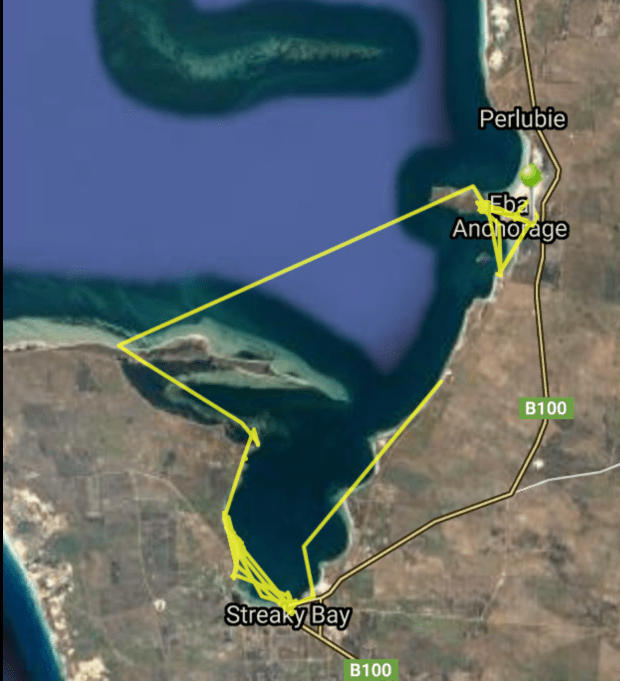
When in Australia, I have to remind myself to check on Solly. She is 344 days old – my goodness, almost a year since she hatched on the PLO barge. Look at this map of her travels. She is so confident now that she is taking the short cut back to Eba Anchorage from the coast near Streaky Bay instead of going the land route. Well done, Solly! So proud of you.
The nest of Mom and Dad looks so much more together than it did after Solly and DEW fledged last year! Oh, I hope that there is lots of food and all three of those eggs hatch and fledge. Wouldn’t that be wonderful? I have to admit that I did not feel so kind towards Solly last year but, in the end, I was glad to see two strong birds fly off that old boat. The satellite tracker put on Solly opened up everyone’s eyes to how far the Eastern Ospreys travel from their natal nest. I do hope they will do this again this year. At the same time, I would like to see trackers on all the birds from this nest. Everyone wants to also know where DEW is. If it is the cost, do some crowd funding up front – there will be people from around the world willing to chip in and help with the costs.
‘S’ sent me some images of the Osprey juveniles in Alberta this morning. My goodness did I ever feel guilty. I checked in on them for the first time yesterday in ever so long – and that was because I had heard of an unmonitored nest fledging two from the interior of British Columbia this morning.
There were three eggs that hatched at the Red Deer Osprey nest in June. Two of the three died on 3 July during the wretched heat and then rainy/stormy weather.
This beautiful juvenile fledged sometime the first two weeks of August when the cameras were down. This is a strong bird, a real survivor. It has been given the name, Little Braveheart, by her fans.
The two juveniles at the Fortis Exshaw nest up at Canmore are doing really well, too. Both fledged and they are waiting, just like the juvenile in Red Deer, for the call to fly south. That is such an incredibly beautiful spot to have an Osprey platform with the Canadian Rockies in the background.
Thank you so much for joining me. Do check the Birdmap and see how it works. Satellite trackers are wonderful tools. And please send your warm wishes and positive thoughts to those in the path of Hurricane Ida. Take care and stay safe. See you soon.
Thank you to the following for their streaming cams where I took my screen shots: Fortis Alberta Red Deer, Fortis Alberta Exshaw, 367 Collins Street by Mirvac, The Falcon Cam Project at Charles Sturt University in Orange and Cilla Kinross, the KNF Bald Eagle Cam, and the Port Lincoln Osprey Project.
The Scottish Wildlife Trust has confirmed that the female, NC0, has left the Loch of the Lowes for her migration after receiving a fish from LM12, Laddie, on Sunday 22 August. This is a late departure. The female fledgling, LM1, migrated on 15 August, a week prior to her mother which is also unusual. The Scottish Wildlife Trust says that is only the second time in the history of the nest that a juvenile has left prior to the female adult. Laddie, LM12 and the male juvenile, LM2, are the only ones left at Loch of the Lowes. Here is the video of that last sighting of NC0:
Tiny Little was still on the Foulshaw Moss Nest this morning, 27 August, around 07:00 as confirmed by this image taken by my friend ‘SS’. I have tried to catch her on that nest so many times – even late in the night from the Canadian prairies but those efforts were to no avail. So glad to see this. Is it my imagination or does that crop look full? Maybe she is just hunched down.
Mrs G and Aran were still on the Glaslyn nest. For a bit of time, Mrs G was enjoying a flounder. However, there was other action around. It appears that KA3, Hesgyn, and Z2 Aeron, have been over at the Glaslyn nest.
Here is Aeron, Z2, one of Monty’s boys at the Glaslyn nest caught on camera:
Aran has been dealing with intruders. Are Monty’s lads helping? or are they the intruders Aran is dealing with?
You may recall earlier in the summer before Aran’s wing injury was much better that there was a suggestion that Z2 was the Osprey that Aran battled with over the river. Z2 even spent some time sitting on the Glaslyn Nest as you can see from the image above.
Z2, Aeron, occupies the Pont Cresor nest with 014 nearby. I would not draw the conclusion that Monty’s lad is being a friendly neighbour to Aran – you might be humanizing the situation too much. Perhaps Z2 would like that piece of prime real estate and Mrs G to go with it.
Hopefully Aran and Mrs G will put an end to that nonsense if it is true.
Watching over the territory.
Mrs G and Aran remained on or around the nest for some time. I wonder if Mrs G is waiting for Aran to be fully healed and ready for migration before she leaves? I just love seeing them together!
A quick check on the Black Storks in Latvia and Estonia. At the Jegova County Nest of Jan and Janika, one of their storklings, Julge, was on and off the nest during the day. This image was taken right before 20:00 as you can see from the time stamp.
There is now concern rising for Tasane. This is the most recent message from Urmas: “looking data I suspect problems with 7183, probably killed last evening quite near the nest. I can go there maybe afternoon, but depends how other duties can be solved. It is only warning, yet. … “
Karl II’s daughter, Pikne, is in the Ukraine, on 26 August according to her tracker. This is good news.
On 26 August, Karl II was in a small forest near Hlusk in Belarus. He is headed towards the Black Sea.
I seem to be unable to find data for Udu on the 26th.
There has been no sightings of the storklings at the Latvian nest. People are anxious and hoping that Jan Kuze will go and check around the nests just to make sure. This is such a very difficult time for all. The deaths of Jogeva’s Malbe and Karula’s Tuul have really hit the hearts of so many. The fear that another, Tasane, is lost is just spiking anxiety. Will Julge be the only one to survive? My thoughts go out to all the people who loved these storklings so much. Seeing them perish after thriving and all the efforts to feed them, drains everyone of what energy they have left. And that brings me to the end of this updating, almost.
As I said many times, the circumstances of Malin’s death ‘rattled’ me because they pointed out how governmental agencies like the Department of Natural Resources are more concerned with selling hunting licenses than protecting wildlife. That is the precise reason that Rosalie Edge bought Hawk Mountain – to get rid of the hunters and protect the birds! Malin’s death has showed me that any person can put the title ‘naturalist’ behind their name. It means nothing. Malin’s death has raised so many issues. Sexism has been revealed to be alive and well in Wisconsin! I could go on and on. It feels like Malin was a ‘canary in the mine’ – my canary. As the layers of the onion are peeled away, more is revealed and the more that is exposed the more troubling it is. And so, I have been slightly distracted and there was a misunderstanding that led to my reporting that Diamond laid her egg yesterday. She laid her egg on 27 August last year.
Diamond looks like she is about to pop. She must not feel so good. Today, Xavier brought her an Eastern Rosella for her lunch. Diamond would be delighted!
I hope while I have been writing that she lays that egg. She is starting to make me uncomfortable!
Word has come that WBSE 28 has had some food and remains with us. 28 needs to get large enough but, for now, it is learning to stay clear of 27 until it is so full it doesn’t care and goes into a food coma.
Take care everyone. Keep all the Black storklings in your heart. Indeed, keep all of the birds in your heart especially those that are migrating or beginning their migration.
Thank you to the following persons or the streaming cams where I took my screen shots: To ‘SS’ and the The Cumbrian Wilife Trust and the Foulshaw Moss Osprey Nest for the snap of Tiny Little, ‘S’ and the Falcon Cam on the grounds of Charles Sturt University in Orange, The Latvian Fund for Nature, The Eagle Club of Estonia, and Bywyd Gwyllt Glaslyn.
All of the storklings from the Estonian nests of Karl II and Kaia and Jan and Janika’s have fledged. In Latvia, the three nestlings of Grafs and Grafiene’s nest in Latvia have also fledged! This is simply fabulous news. Some are finding their own food and others return to the nest at different times to be fed by dad. They could also be self-feeding off the camera – no one can see and be sure.
In Jan and Janika’s nest, there was one unfledged storkling on the nest yesterday. That chick had two meals from Jan – eating alone, how grand. Gosh, they must have been overwhelmed. One sibling fledged and was gone from the nest since 22 August at 17:35. The other fledged yesterday at 09:15. There was some concerns for a storkling yesterday before 11:00. There were growling sounds and stork bill clattering below the new. It is believed that there was an encounter between a storkling and an animal but it appears to have ended well. Today, 24 August, the yet-unfledged storkling had breakfast from Jans at 9.34 am. After spending the first part of the day in the nest, the last, 3rd hatchling fledged today at 13.57 pm. My source tells me that “It sounded like an awkward fledge, probably got entangled in some branches, but we did not see it, since it was out of the camera view. However, judging by the wing flapping afterwards and not seeing the storkling anywhere when the camera zoomed out and did a 360 degree view, he/she managed to fly off unharmed. Based on the transmitter data of the storkling who fledged yesterday, everything is well with him/her.” The adult male, Jan, returned to the nest in Jergova County at 15:56 with a full crop. “He waited an hour for any of the kids to show up, but none did. However, everyone enjoyed seeing Jan in the nest for such a long time, since he seemed to enjoy his rest preening himself and tidying the nest. Until now, for a long time his visits have been super-short and did not allow us to admire this majestic bird in the way that he deserves. As I am writing this, Jan came to nest again at 6.09 pm, the second fledgling (fledged yesterday, 23/08) followed and in a short while got a meal from Jan. Now we know that the second fledgling is still alright. Great news! Two of Jan’s children have gotten fed today. No such luck for our storklings in Latvia which makes me a bit sad, of course.”
I am so grateful to ‘S’ in Latvia for her great descriptions of the latest events on the Black Stork nests in Latvia and Estonia.
Here are some images of the nest of Grafs and Grafiene both empty and with the one fledgling.
This is a reason for having satellite transmitters – to do checks on their migration progress and to provide attention if a problem is noticed. ‘S’ reports about the migration of Karl II and his three storklings since they also have transmitters along with Karl. She says, “Karl II and his storklings have started the migration. According to the today’s data, Karl II was in Belarus, the oldest storkling Udu (meaning “fog” in Estonian) was in Poland, but the middle storkling and last fledgling Pikne (meaning “god of lightning” in Estonian) – in Ukraine. Sadly, it seems that we have lost the youngest storkling Tuul (meaning “wind” in Estonian). Yesterday’s data showed him only 400 m away from the previous location of 17th August. No one is speculating about what may have happened, but it is clear that there are 3 options: 1) Tuul is alive, but for some reason stuck somewhere; 2) Tuul has perished; 3) something wrong with the transmitter. Urmas will probably go look for him soon and report as soon as he knows something.”
This is a map posted of the Karl, Udu, and Pikne locations this morning:
Every bird that is lost leave us with a hole in our hearts. There are as many people attached to Tuul who loved Malin. We know the depth of that sadness. I hope that his transmitter is broken. As soon as something concrete is available, I will update you.
That is it for me on a Tuesday. My mind and body are exhausted over the events surrounding Malin’s death. That energy will return – no fear. I am determined that Malin’s death will not go unnoticed. There are things that must change and there are several, working behind the scenes, to ensure that can happen.
I can’t leave you without giving you a smile. Tiny Little was on the Foulshaw Moss Osprey Nest this morning screaming at White YW for a fish. Everyone thought she would die – just shows them who truly is the fittest.
Thank you for joining me. It is always a pleasure to hear from you and once again – thank you for the hundreds of outpourings for Malin. He was a very special bird who fought to live and was loved by many. Take care all.
Thank you to the following for their streaming cams where I took my screen images and video clips: The Estonian Eagle Club, The Cumbrian Wildlife Trust and the Foulshaw Moss Osprey Nest, and The Latvian Fund for Nature. I would also like to thank ‘S’ in Latvia who gave me the up-to-date information on the Black Storks that I shared with you. I could not have done it without her!
In my last post, Tiny Little Bob or Blue 463 from the Foulshaw Moss Osprey Nest was screaming at White YW (aka dad) for a fish. He could have flown to Wales and he would have still heard her.
What is that about the squeaky wheel always gets the oil first? Perhaps screaming daughters do, too. It is the last fish of the evening probably and Tiny Little is eating it. Blue 462, the other female on the nest, would like Tiny Little to share. Somehow I don’t think so ——- it was, after all, Blue 462 who was such a meanie to Tiny Little when she hatched. Birds have good memories.
These are the areas adjacent to Iris’s nest in Hellgate, Missoula, Montana. It is very beautiful. We always see the nest in the parking lot but just on the other side are trees, grass, and water.
Iris is the oldest living Osprey in the world. Her nest is at Hellgate in Missoula, Montana. After her mate Stanley died, she bonded with Louis. They had one chick survive, Lele, in 2018. Louis has another nest at the baseball park with Starr. They fledged two chicks this summer. When Stanley died, Louis also took over the territory that includes the two nests. Every year Iris returns, goes through the rituals of breeding, lays her eggs, and everything falls apart. People get upset. They think very little of Louis. I am of a divided mind. Right now I prefer Iris taking care of herself, eating well, and bulking up for migration than running around with a nest full of juvenile fledglings. She has done her bit for the DNA of the species. But that is just my opinion. Everyone is entitled to theirs, for sure. But the one solid thing that binds all of us together is our love for this most amazing of Ospreys.
Iris tends to spend more time at her nest before she leaves on migration. Last year she departed on 8 September. Everyone gets a little teary eyed right about now because there is no promise that Iris will return but, we live in hope that this strongest of female Ospreys graces the screens next spring. Along with that hope is that the rains come and there is plenty of food for all.
There have been a number of intruders, both male and female, this summer. Do they want to usurp Louis? take Iris for a mate? Certainly when Dunrovin’s Congo came on the scene everyone was hopeful! or are they just curious and checking out what nests are available? Perhaps all of those things. Today, Louis flew to the nest alarming and Iris flew in and joined him – showing off her big crop!
Erick Greene and his team in Montana are considering many ways in which to commemorate Iris. Stay tuned or check out the Montana Osprey FB page. If you wanted to order an Iris pen and forgot, if you will send me a note I will send you the details. They are gorgeous and made from those sticks she brought to the nest.
In the image below, Rosie, the female adult on the San Francisco Bay Osprey cam at the Richmond Yards, is bringing Poppy, one of two female hatches, a beautiful trout. Poppy is 110 days old today.
The average age for Richmond and Rosie’s female chicks to stop feeding at the nest is 105 days. The longest a female stayed was in 2018 and that was Kiskasit who was 124 days old. Lupine was last seen on Monday. She was 103 days old. Sage, the only male, was last seen on 28 July at the age of 86 days. The average for the males to stop feeding on this nest is 93 days so Sage left a little early. There is no reason to believe that Sage and Lupine have begun any type of migration. Richmond stays in the SF Bay area year round. Mom Rosie will migrate and the female adults normally leave before the fledglings. And whose to say they will migrate! If there is plenty of food and the weather is fine – well, it certainly agrees with Richmond – may be they will stay!
And, of course, just thinking about fledglings returning to the nest to be fed until they are 90-100 days old just makes me think about Malin. Susan, the wildlife rehabber that is over the area where Collins Marsh is located, was to get in touch me later today. She wrote me a long note yesterday and she is also firm in her knowledge that Malin was a forced fledge. As we have learned, normal fledges do not require our attention. The chicks return to the nest, take short flights, and are fed by the parents. Malin was not ready despite his age. He had suffered a lack of food. His forced fledge meant that he was in jeopardy and boots on the ground were needed immediately. This did not happen. As noted earlier, she found two chicks – one dead, one alive. I am hoping that ‘no news is good news’.
Suzanne Arnold Horning was on the Cornell Campus and she found the two Ks. No sightings of Big Red and Arthur but, guess what? Getting to see K1 and K3 on the 22nd of August is a bonus. Here they are hunting. That is K1 on the top. She looks so much like Big Red and has turned out to be such a fantastic hunter. Suzanne said they were not food calling – just being quiet and hunting. These two seem so much more independent this year.
Ah, the little cutie, K3 looking down and hoping to find a chippie.
What a nice treat to get to see the Ks. And, of course, theirs could be a migration dilemma. Big Red and Arthur stay in the area year round. Perhaps with the changes in weather so will the Ks. If someone could put the average date that birds leave for migration this year against last and create a global directory (surely someone does this already), tracking of changes related to climate could be measured. We have seen Poppy stay longer as are many others and now perhaps the Ks.
Thank you for joining me today. I will let you know as soon as I hear about Malin – it is heartwarming to hear from so many around the world who came to love that little nestling. If you are in line with any of the storms hitting the coast of the US, going over Hawaii, or elsewhere, take care of yourselves. Stay safe.
UPDATE: Aug 23 at 17:35:35 No2 (7182) fledged at the Estonian nest of Jan and Janika. Slept as an adult off nest.
Thank you to the following for their streaming cam where I took my screen shots and video clips: Montana Osprey Project, Cumbrian Wildlife Trust and the Foulshaw Moss Osprey Nest, SF Bay Ospreys and Golden Gate Audubon. I would also like to thank Suzanne Arnold Horning who allows me to download her images to share with you.
Oh, my goodness. The male at the Collins Street Peregrine Falcon nest is nothing short of adorable. I spent all last year wanting to scoop up this stealth fighter in my arms and cuddle with him. Or dreaming of a Peregrine Falcon onsie. Wouldn’t that be cute on a toddler?
The first egg of the 2021 season has been laid on 21 August. Wow. It is eggciting.
You might be asking why the female is not incubating that egg. The female will not start incubating the eggs until the last one is laid. This is because the adults want the nestlings to be about the same size for the first fortnight so that there is no rivalry over food. Last year, the three big girls all hatched within a 24 hour period. There was never any sibling rivalry – that is what I love about falcons and kestrels. Once the last egg is hatched, they will be incubated for 32-40 days.
Mom looks so proud of herself!
These are some images from last year:
Mom brooding the triplets.
Dad feeding the girls when they are a little older – before they lose all that fluffy white down.
This year Mirvac, the property owners, are in charge of the streaming cams of the Victorian Falcon Project. You can watch these falcons from the very beginning.
Telyn at the Dyfi Nest, Wales. 20 August 2021
Some more great news. The Season of the Osprey will premier on PBS October 27 at 8pm! Please check your local stations for the exact time in your area. This is what they are saying about this documentary:
“Birds of prey exist in myriad shapes and sizes. Scores of eagles, hundreds of hawks and countless kites and falcons have all adapted form and behavior to fit diverse habitats. But in all the world, there is only one osprey. Following a single evolutionary path, it has conquered every continent save Antarctica. One bird, one design, unchanged. It is the only truly aquatic raptor, the sole member of its own taxonomic family. This one-hour, blue-chip special brings viewers into the life to this incredible raptor with a depth and intimacy never before attempted. Shot in and around Great Island Marsh, where the Connecticut River meets the Long Island Sound, cameraman Jacob Steinberg has achieved unlimited access to an osprey nest and captured the struggles, failures and triumphs of a single osprey family.”
Oh, I can’t wait!
I am afraid that I am having Malin withdrawal. A week or more ago I took a few video clips of Malin being fed by Marsha. I would like to share one of those with you now.
And another one of Malin exercising his wings.
It is so much easier when you know that the little one fledged, returned to the nest for food for 36 days or so, and then flew off to find their life. There is a level of anxiety when it doesn’t happen that way. I sure miss that little one. I have not, as yet, received any images of the two Osprey chicks found or any other news. I am hoping for tomorrow or Monday. It is a busy time of year for the wildlife rehabbers.
Two of the storklings have fledged at the nest of Grafs and Grafiene near Siguldas – the youngest was first and then the oldest yesterday. Only the middle remains. All have returned to the nest safely. The one that had its wing up against the far branch seems to be alright as well. That is good news. I have heard of no feedings since Grafs came in with some very small fish for the trio on 19 August. That means that if the storklings did not find the feeder – the two that fledged – they have had little food but nothing for two days. This is critical. There is concern that Grafs has left for his migration — it was the very initial concern. I want to remain hopeful.
Jan has fed his storklings but the meal was only tiny fish or worms. Urmas has not brought any more fish to the nest. Since he has fed them once and they accepted the fish, I hope that Urmas will do this again (he also left fish when he banded them and put on the trackers). It is not clear whether the anxiety of starvation is worse than having a human bring food to the nest.
These are very difficult times for everyone but they are especially difficult circumstances for these six starving Black Storks – rare Black Storks!
At the Black Stork Nest in the Karula Forest in Estonia, Karl II was still in the nest area. His transmitter told us. The two early fledges, Tuul and Udu, headed the wrong direction due to weather concerns and then turned south. Pikne travelled south from the beginning. New tracker information should be coming in soon. Safe travels all of you!
Oh, this youngster can really scream for food on the Loch of the Lowes nest. What a beauty. This is another good example of a ‘normal’ fledge. The chicks return to the nest to be fed and fattened up for migration.
I really want to put a plug in for the administration of the lochs in Scotland. No one is allowed on those lakes from April to the end of September so that humans do not disturb the birds. It means that motor boats with their leaking fuel are not chasing the Ospreys and making the water toxic. Gosh, I hope that only human powered boats are allowed. What a great idea – leave the lakes to the birds during breeding season. Three cheers for Scotland! This could well be the case throughout England and Wales also. I will try and find out.
And look what is on the Foulshaw Moss Nest. It is a flounder for the lucky chick that makes it to the nest first. Tiny Little!!!!!!!!! Where are you Tiny Little?
It’s a few minutes later and I missed that lucky fledgling that snagged that flounder! It’s gone. That leads me to believe that it was probably Blue 464, the male, the first to fledge. He likes to take the fish and eat it on the branch of the parent tree.
Thank you so much for joining me. I hope that you are looking forward to those falcons hatching as much as I am. Take care. See you soon.
Thank you to the following for their streaming cams where I took my screen shots and video clips: Scottish Wildlife Trust and Friends of Loch of the Lowes, Mirvac Corporation and the Collins Street Falcon Cam, The Cumbrian Wildlife Trust and the Foulshaw Moss Osprey Nest, The Eagle Club of Estonia, The Latvian Club for Nature, Collins Marsh Nature Centre, and The Dyfi Osprey Project.