Early Monday in Bird World

9 May 2022

As citizens of Manitoba, we are really learning about what it means to live on the floor of what was once Lake Agassiz —- in other words, a flood plain. Two more Colorado Lows are set to dump more water on a province that is flooded south of Winnipeg and north of Winnipeg. One big lake save for those communities who spent funds on creating their own dams. The loss is enormous but looking at it from a wildlife perspective, one has to wonder where all the deer, the nests, and the animals have gone. I have seen one image of deer walking along a railroad track that runs from Winnipeg to the US border trying to find dry land and food. That border is now closed as are many highways and even some bridges in my City. Years ago one of our Premiers decided to build what was teasingly called ‘Duff’s Ditch’. Well, everyone should be grateful to Duff Roblin for having that kind of insight. The City is mostly dry and safe.

There are few birds in the garden as the raindrops begin to fall on a grey day.

I am as nervous as Blue 33 (11) is as he comes in and off the nest at Manton Bay checking on Maya and the eggs. There are three. At one point you could only see two, has there been a hatch? So, we wait for confirmation one way or the other! I cannot see any egg shells so I suspect that pesky egg is hiding!

It is certainly time to begin checking on the Black Stork nests in Estonia and Latvia. There is something curious that I noticed which I suspect my friends in Estonia have known all along. Jan and Jaanika laid their eggs a whole month earlier this year than last. In 2020, the eggs were laid on 12 May, 14 May, 16 May, and the 18th of May. Hatch from 14-17 June. This year the eggs were laid on 15, 17, 19, 21 April, 23 and the sixth and final egg on 25 April! This is excellent – the timing. Last year the couple was so very late that Janika started her migration before the chicks had fledged. It was a very difficult time and the food for the chicks was supplemented by fish being brought to the nest by the wildlife specialist, J Kuze.

The Black Stork in Estonia is so rare that every effort is made to help them that is possible.

I am not a stork expert. It would seem, however, that the parents cannot support six storklings very easily and they will probably select the three strongest. But, we wait to see.

Here is the link to Jan and Jaanika’s streaming cam in Jogeva County, Estonia:

I also checked on the nest of Karl II and Kaia in the Karula National Forest in the south of Estonia. The eggs for this year were laid on almost the identical dates as last year. Those days were 24, 26, 29 April and 1 May. Hatch began in 2021 on 28 May.

This is the link to Karl II and Kaia’s nest in the forest.

Sadly, it appears that Grafs and Grafiene did not return to their nest this year in the Sigulda Region of Latvia. Did they not survive migration? or did they decide to locate their nest elsewhere? I do know the answer to this but I will try to find out.

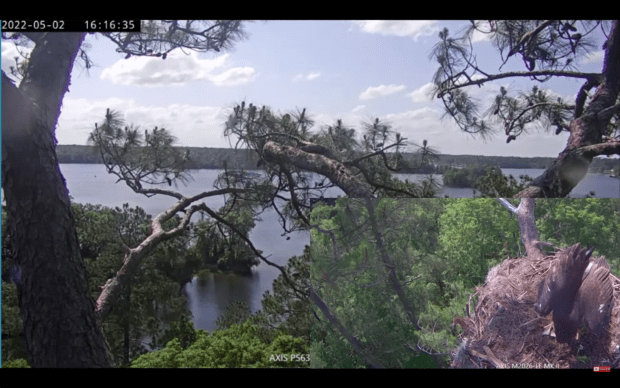
There is only one osprey nest in Latvia. This year only the male returned, Theo. He tried to attract many females to his beautiful nest. It is hoped that a young female, tagged UV and an Estonian female, will stay with them. Mating was attempted this morning but UV was not receptive. Sadly, this nest is a bit haunted. None of the former chicks have survived due to goshawk predation.

Here is the link to the Kurzeme camera of Theo:

In comparison, the Osprey nest of Ivo an Iiris in Tarta County, Estonia has done well. All of the couple’s chicks fledged last year!

Pip watch will begin on the 21st of May. That is only 12 days from now. Here is a link to Ivo and Iiris’s streaming camera:

Gosh, Big Red is gorgeous. It is so hard to believe she is 19 years old. She is in such good shape this year. What a beautiful golden glow on her and the four eyases as a new morning wakes up on the Cornell Campus.

This is a great nest to watch! There is plenty of time to watch these eyases develop, fledge, and then learn to be a ‘hawk’. Arthur will teach them flying and hunting with Big Red joining in. There is nothing better than seeing the parents teach the chicks how to hunt a squirrel in a tree!!!!!!

The two eyases at the Red-tail Hawk at the Presidio Trust Building in San Francisco are doing fine. These two are really growing. Look at the size of that wing. Wow.

Peregrine Falcon chicks are doing well this morning, too. The chicks at the scrape in the tower of Chichester Cathedral just had their afternoon tea.

All five eyases were fed and happy this morning at the Manchester, New Hampshire scrape.

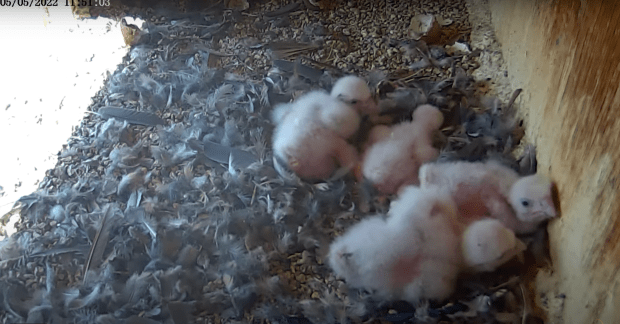
Sleeping babies at Utica, New York scrape. Will the other eggs hatch? We will see.

Henry and Poppy do a great job taking care of their two chicks at the Cromer scrape. If you are interested in their day to day activities, there is a great blog with this nest that has images and comments of everything that happens on the nest. I will post it after the image of the chicks!

https://www.cromerperegrineproject.co.uk/post/cromer-peregrine-activity-log-08-05-2022

If you are wondering about the third egg at the U-Cal Berkeley scrape of Annie and Alden, don’t. It is non-viable. If it were going to hatch it would have happened on Saturday. What will they do with it? Incubate it, roll it around, or break it – or maybe Sean or Lynne will collect it for the museum when they clean the scrape.

Two healthy chicks are good. They are incredibly adorable.

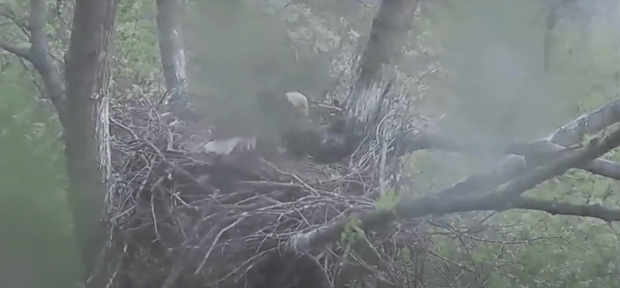
All three eaglets are accounted for on the West End nest of Thunder and Akecheta.

TH1 at the nest of Chase and Cholyn is getting its blood feathers. There are a few lingering dandelions on the top of the head. It will not be long until this wee one looks like its cousins at the West End.

I checked on two nests in the East – PIttsburgh Hayes with its triplets and the National Arboretum nest. They are all awake and looking good this morning.

The three are beginning to fill up the nest!

Breakfast time for DC9. Looking good. There was a little concern earlier for DC9 because a bird had been brought on the nest as a prey item. Everything seems to be alright.

I want to leave you with a smile. A Canada Goose has chosen a planter on the deck of a Calgary, Alberta couple to lay its eggs three years in a row!

https://www.cbc.ca/news/canada/calgary/a-calgary-couple-s-unusual-houseguests-return-every-spring-to-lay-eggs-in-their-planter-1.6445267?fbclid=IwAR0ofbF90vvx29SCgnb-y60yl1bmVOCUlRz_3iiz5Cs_CasPpui7bPNEof0

Lots happening today. Some exciting. Some sad. The youngest golden eaglet has been killed at the Estonian nest. It had been beaked by its eldest sibling earlier and prey became scarce and the oldest killed the youngest today. That was the Golden Eagle nest in the Soomaa National Park in Southwestern Estonia. As I mention often, the rate of siblicide is much higher in nests other than falcons and hawks.

Thank you for joining me on this rainy grey day in Manitoba. Take care everyone. See you soon – hopefully with a news of the first Osprey hatch in the UK!

Thank you to the following for their streaming cams where I took my screen captures: LRWT, Eagle Club of Estonia, Latvian Fund for Nature, Cornell Bird Lab RTH, Presidio Trust, Chichester Cathedral, Peregrine Networks, Utica Falcons, Cromer Peregrines, Explore.org, Pix Cams, and the NADC-AEF.

Sunday in Bird World

8 May 2022

I had a lovely letter from a friend today. Like so many of you, she has tried to watch some of the nests and gotten attached to the birds only to have her heart pulled out when an older sibling shoves them out of the nest or, in other instances, they were starved or killed by beaking or both. It has been a tough year on the nests. Tough even for me.

My friend pulled back and has started watching Big Red and Arthur’s nest on the campus of Cornell and Annie and Alden on the grounds of UC-Berkeley. Her question this morning was simply to clarify that hawks and falcons do not practice siblicide. The answer is that the preponderance of siblicide occurs in eagles (some species more than others), egrets, boobies, herons, pelicans and, I am going to add ospreys to that list. There are lots of reasons, some explored in earlier blogs but, it is safe to say that if you wish to enjoy the birds on the streaming bird cams, falcons and hawks are generally a very safe choice as are ducks and geese. Because the chicks are precocial (are fully feathered, can walk and swim and eat on their own), the ducks and geese need those chicks to hatch all at once. They delay full incubation until the last egg is laid. Robins do that too and so do hawks and falcons. In this way, the older chicks are not that much bigger (normally) than the younger. The ducks and geese and even the raptors need their babies to fledge at the same time. So incubating them so they will hatch together really helps. It is called synchronous hatching (begins hard incubation after the last egg is laid) as opposed to asynchronous hatching where the parent immediately begins hard incubation immediately after the first egg is laid.

Annie makes a kind of chee-up sound when she is ready to put the food in the beak. The chicks learn this. Annie might well give the biggest chick the first few bites but she immediately moves around giving the youngest some. Today, the Peregrine Falcon Mother at the scrape in Oudenaarde, Belgium spent a whole hour making sure that all 5 of her eyases were fed and full. No one left the table hungry. The Mum at the Manchester NH falcon nest also has five eyases. Not one of them went to bed hungry tonight despite their size difference – the smallest had a big crop just like the largest. That is what hawks and falcons do!

A clump of falcons in a feather bed.

The wee one is piled on top of one of the siblings to stay warm.

Here is Annie feeding her two chicks brunch on Mother’s Day! Watch carefully how she feeds the big one several bites, then the small one and then goes back and forth. Annie is a pro. Both are well fed!

And Cal Falcons posted a second feeding just a short time ago. It is really cute. Alden checks in on the babies who see an adult and open their beaks. Alden is so cautious and nervous. He It very happy when Annie arrives with lunch he provided in her beak from the other side of the scrape!

Here is that feeding. It is so cute. Notice how the little one gets full and then gets back up for some more. Falcons eat everything. Nothing is wasted. Some of the first few bites were feathers.

It doesn’t get much better than the Red-tail Hawk nest of Big Red and Arthur at Cornell. Little L4 is growing and surviving and well, I haven’t watched this nest 24/7 but I have not seen any tendencies by the oldest to interfere with the younger ones.

SF Bay Ospreys does not want us to forget about Rosie on Mother’s Day. I adore her and if there is an osprey nest in the US to watch that is stable – Rosie and Richmond in SF are it! —- Oh, and no. Ospreys are not prone to Avian Flu. They eat fish.

Someone dressed Spirit up. LOL. Good thing I don’t have the software to do this!!!!!!! I think Spirit is a Jackie in the making, too.

We all loved Kindness at Glacier Gardens. Many have been watching the nest cam and have been wondering where the eagles , Liberty and Freedom, are. Well, they have built a new nest! Here is the video reveal of that find:

The camera remains off line at the UFlorida-Osprey nest if you have been checking. It is unclear when it will be back on. If it is a mechanical issue it would be difficult since the chicks are older.

The Dale Hollow Eaglets have full crops and are drying off today. These two are doing very well.

Some nest renovations have been going on at the National Arboretum. I don’t think DC9 appreciated some of those branches.

At 2045 there is still no hatch at the Manton Bay nest of Blue 33 (11) and Maya. Maya is certainly restless tonight.

If you are a fan of Lady and Dad at the Sydney Sea Eagle nest in the Olympic Forest, you will know that the couple have been working on the nest. We are about three weeks away from the first egg being laid.

Where’s Ervie? Looks like he still hanging around the barge area of Port Lincoln. Fine by me!

It has been a busy day at all the nests and throughout different regions as the migratory birds continue to move through. My garden was full of White-throated and White-crowned Sparrows again today along with the usuals. The little Chickadee couple love to have a swim!

The Starling was not so pleased when Dyson came along and wanted some of the seeds.

Dyson is trying to try out for the local gymnastics team. Look at her stretch! She is losing her winter fur and the tufts on the end of her ears are gone. Ironically, her tail is much thicker. She is in really good health. Good to see.

I hope that each of you have had a wonderful day today and, hopefully, if you could, got to spend some time outside. It really is energizing – even for a few minutes sitting in the sun. Thank you so much for joining me today. It is a joy to have you here. See you soon!

Thank you to the following for their streaming cams and/or FB pages where I took my screen captures: SF Ospreys, Cal Falcons, Peregrine Falcon Network, Cornell RTH, Friends of Big Bear Valley, NADC-AEF, DHEC, Sea Eagle Cam@Birdlife Australia Discovery Centre, Port Lincoln Osprey Project, and the LRWT.

Mother’s Day in Bird World

8 May 2022

It’s Mother’s Day and every year I send a shout out to all those great bird mothers who don’t know anything about flowers, chocolates, or going for brunch but who, as best they can, as old as some are, keep our skies filled with the sound of hawks, eagles, falcons, Sky Calls, and song. They have brought us great joy, sorrow, and have taught us so very, very much.

Each of you will have your own list. I have discovered that birds are very personal. So pause and thank your favourites!

The first bird mother I always think of is Big Red. She is not a big strong eagle or a fish hawk. No, she is a medium sized hawk that melts our hearts year after year. Big Red, the Matriarch of the Red-tail Hawks is enjoying early morning sunshine and a necklace of eyases – four of them. She surprised everyone with those four eggs. This nineteen year old probably has a lot more tricks up her talon for us.

We know she hatched in 2003 and that she was hatching chicks in 2005 but the camera did not come live until 2012. That is 7 years unaccounted for. Big Red has consistently laid three eggs and the only time since 2012 she did not fledge three was last year because of K2s beak issue. Potentially she has fledged 51 hawks. 51. Incredible.

She is always happy when there are chicks in the nest and she seems energized this year with the four.

Cholyn at the Two Harbours Bald Eagle nest in the Channel Islands gets the thumbs up this morning. At the age of 24, she is still busy raising eaglets. This year her and Chase had the soon-to-be-banded Only Child, TH1, this year. Cholyn is the mother of Thunder at the West End nest and is the grandmother to another generation of Channel Islands eagles.

Redwood Queen is 23 years and 11 months old and is currently either incubating an egg in Big Sur or brooding a chick! She survived the Dolan Fire and is famously known for her chick, Iniko Orange 1031, who also survived that fire to the surprise of many. She has hatched and fledged 6 condors and fostered and fledged 3. She is currently with 477 Phoenix. It is their second season together. Their egg failed last year. Fingers crossed for this year. Fitting that they both survived massive fires to rise again.

Mrs G, the oldest Osprey in the UK, at the age of 21-23 years is currently brooding three eggs with her mate, Aran, at the Glaslyn Nest. They had a rough patch last year so I am really hoping that this year turns out incredibly well for them.

If we count this year, she has laid 57 eggs with 46 hatched and 41 fledged.

There are lots of Ospreys. I can easily put Maya at the Rutland Manton Bay nest at the top of a list – 20 fledglings in 6 years. Is that correct? But I want to give a hat’s off to a much overlooked female at the Foulshaw Moss nest in Cumbria. Blue 35 was smart and sneaky and made sure that her third hatch —–1/8 the size of the other two older siblings at hatch – survived. She removed fish and once the older ones were asleep returned to the nest and fed Blue 463. As a result, 463 thrived and became a huge female and quite dominant on the nest. Thank you Blue 35. She was also one of the only Osprey nests to fledge three in 2021.

Peregrine Falcon Mothers. Hats off to the Mum at the Manchester New Hampshire scrape for keeping those five eyases in tip top shape. Not easy when some are extraordinarily larger than the youngest! The tiniest one is in the front. So small you can’t see it! Mum is doing a great job.

All full and sleepy.

There is one other Peregrine Falcon Mum who is now raising two eyases after losing her mate during the egg laying part of this breeding season. That falcon is Annie at the UCal-Berkeley scrape in The Campanile. She is a grandmother – they know that her daughter is on Alcatraz Island and that this is at least her second year if not more to raise chicks.

There are now too and it appears that Lynn Scofield was completely correct. The last egg is unviable. This means that egg 1 and egg 3 hatched with the potential for one chick to be Grinnell’s and the other to be possibly Alden’s. I hope so! Annie survived the death of her long term mate, Grinnell, to hatch the two chicks. Heart warming.

Why not think about your favourite ‘Bird Mums’ today? It is a great way to thank them ———— each and everyone of them ——— for the joy they bring to our lives!

Have a great Sunday everyone. There will be a nest check in later today. Thank you so much for joining me. Take care!

Thank you to the following for their streaming cams and/or webpages where I took my screen captures: Cornell Bird Lab RTH, Ventana Wildlife Society, Brywd Gwyllt Glaslyn, Cumbrian Wildlife Trust, Peregrine Falcon Network Manchester NH, Cal Falcons, and Explore.org.

Saturday in Bird World

7 May 2022

It is a gorgeous spring or summer day – feels like summer – at 19 degrees C. The Black-capped Chickadee is serenading everyone in the garden after having a bath and the White-throated Sparrows have arrived in large numbers. All are digging and scratching around the wet leaves for insects. That is one of the best reasons not to rake your lawn in the fall and not until the end of May. Not lazy. Helping the birds!

All of the images were taken through a window screen. The birds seem to like to be in a dark area of the garden where there is a lot of dead leaves and a puddle of water from the snow melting.

There are so many White-throated Sparrows in the garden today. They are all enjoying the dark wet areas, having a drink in the remaining puddles, and stomping on the ground for insects. You might think that this is a White-crowned Sparrow like the one below but look at the lovely yellow over each eye.

This is a White-crowned Sparrow. Do you know it? This little guy arrived in the garden just today. The White-crowned Sparrow is a very distinctive bird. Its black and white striped head is the first thing you will notice. Then its grey breast with its brownish and grey patterned wings and back. This little one was digging around through all of the vegetation. Notice the beak. It can be either an orange-yellow or a reddish-brown depending on the subspecies of the bird. This bird, like the one above, is passing through heading to the boreal forests north of me.

The Black-capped Chickadee, who is a regular in our garden throughout the year, really wanted time in the puddle for a quick bath!

It was nice to see Mr and Mrs Purple Finch in the square feeder today. Just lovely.

There are a few European Starlings that still come for the hard suet.

It is so nice when the migrating birds are coming through the garden heading to their summer homes. The songs and their presence are very re-assuring.

If you need a smile, Annie feeding the two chicks in the scrape on The Campanile at UC-Berkeley should do it!

As of 1300 Pacific time, there were still only two chicks hatched for Annie, Alden, and Grinnell.

oh, they are just so perfect with their little pink beaks and feet. Annie and Alden work together like mates that have been together for a long time. Alden keeps the pantry full. You will see Annie go down to the larder on a lower level and come up with something for the wee ones.

Cal Falcons just posted a video of Alden keeping an eye on the chicks while Annie is away. He is a little nervous. Many believe that this is his first time ‘dad’ stuff. He will be a great mate for Annie and dad for the eyases.

It is a pretty nice day when nothing much is going on in Bird World. It is like this sort of lull – some eggs to pip soon, a few eaglets to fledge, but steady. That is a good thing.

It was so nice to drop in and see Kincaid on her branch at the Kistachie National Forest Bald eagle nest in Louisiana. She is going to survive and do really well. Right now all she wants is to see her dad, Louis, flying in with a fish for her.

I wish I could put Kincaid side by side with the MN-DNR female. My goodness. They said she weighed 9 lbs. Eaglets normally grow at the rate of a lb a week. The MN-DNR eaglet is six and a half weeks old. She is 50% more heavy and larger than normal! Formidable is the word. She is at the high end of the large female eaglets. Those legs are strong and she has her wings folded in part way. Awesome.

Cholyn’s only baby, TH1 of 2022, has quite the crop this afternoon. Wonder if she is a big female, too? Cholyn needs to eat that remaining fish!!

Star and Sentry are really looking good at the Redding nest of Liberty and Guardian. Look at their plumage development in comparison to Two Harbours 1 above.

The triplets at the Pittsburgh-Hayes nest were soaked this morning but by afternoon late they were dried out and sound asleep.

There is an afternoon storm with rain, high winds, and what sounds like thunder at the National Arboretum nest of Mr President, Lotus, and DC9.

It is reassuring at a time when the Avian Flu is killing so many Apex raptors to stop into the nests and see that the birds and their parents are doing alright. Here are some images from the nest of Samson and Gabby at NEFlorida. Both Jasper and Rocket have fledged and, like Kincaid, they are hanging around the nest to get those wings strong and their hunting skills perfected before heading out on their own.

I was surprised to see how many fish bones are in the nest!

The same strong winds that are blowing in DC are blowing on the West End Nest of Thunder and Cholyn and the three eaglets – . Thunder came in with a big fish that was still alive. All have eaten well today.

There has been a lot of Bird Flu in the upper Midwest. It is good to check in on the nest of Mr North and Mrs DNF at Decorah. The two eaglets appear to be fine. Relief.

There is a short video clip of these two attempting self-feeding yesterday.

I showed this image in another posting but it is such a rare occasion that she allows her mate to brood or feed the chicks. So it is worth posting a second time in case you missed it.

So many nests to check and so much going on. It was a real relief to find everyone doing so well on these nests. The weather has been miserable in different places and I hope that it all warms up for tomorrow so that all of our bird mothers have a lovely day.

Thank you so much for joining me. Take care everyone. See you soon.

Thank you to the following for their streaming cams where I took my screen captures: Cal Falcons, Cornell Bird Lab RTH, Pix Cams, Explore.org, Friends of Redding Eagles, NEFlorida Eagles-AEF, MN-DNR, NADC-AEF, and Friends of Redding Eagles.

Late Friday and early Saturday in Bird World

6-7 May 2022

The Cal Falcons hatch day was a complete success. One eyas arrived on Thursday and the second hatched during the festivities. You could tell at the beginning of the Cal Falcons Q & A today that both Sean and Lynn were overjoyed. Here are some images from today and at the bottom of them I will put the link to the archived session from today if you missed it.

One of the most remarkable moments for me today was when Annie and Alden were ritually bonding in the scrape with chick 1 chiming in. Adorable.

Feeding and eating take some practice.

Alden checks on the newly hatched chick while Annie goes to get some food and has a break.

They know to hold that pink beak up high and to open wide from the minute they hatch.

Sean and Lynn believe – based on the coloration of the eggs – that the oldest chick was egg 1 and that chick 2 was actually the third egg. They noted that the third egg was darker than the other two. Historically, Annie has never had all of the eggs hatch. If the egg that remains is to hatch it will be by tomorrow afternoon. It is not clear if the second chick is Grinnell’s or Alden’s. They hope to test the feathers to determine paternity and they are looking for someone within the University of California system who would be interested in helping.

Newly hatched falcons can live on the nutrients from the yolk of the egg for approximately 24 hours. This means that they do not need to be fed until then. However, they can eat as soon as 4 hours after hatching according to Sean.

Saturday morning 0611.

It is hard to imagine but these wee babes will have adult size legs when they are 24-26 days old. That is when they will be banded. Falcons fledge from 38-42 days old. This is very quick and is one way that they are very different from the eagles and the ospreys. Their time in the scrape is short. They will spend approximately a month with the parents after fledging learning to fly better and to hunt.

Names? After the banding name suggestions will be taken with a final vote. One of the leading names is Grinnell. I totally agree.

Here is the link to the Q & A session from today.

The banding at the MN-DNR nest is completed. There were no surprises. E1 is a very big robust female weighing in around 9 lbs. Incredible. Sadly, those big females appear to be the ones that cause siblicide more than the males if food appears to be getting short on the nest. Solly at the Port Lincoln Osprey nest in 2021 and E1 this year on the MN-DNR nest. (Confirmed females by testing and/or measurements). Nancy circled around the nest and returned fairly quickly to E1. E1 will be a formidable female just like her Mum.

Iris laid her second egg of the 2022 at 15:14:36 Friday afternoon at her Hellgate Canyon nest. Iris appeared to go into labour a few minutes earlier with the feathers on her back rising and falling.

Maya at the Rutland Water Manton Bay nest in the UK is not giving away any hints – not a single one. Here are the eggs at 20:12. She is very restless during the wee hours of Saturday morning. Do we have a pip on any of those eggs?

Saturday and no obvious pip that I can see on Maya’s eggs, yet.

A beautiful image of Chase and Cholyn’s only hatch for 2022. Just gorgeous. One month old.

Quite a change from the beautiful blue waters of the Channel Islands and the bright sun to the dreary rain of the Dulles-Greenway nest of Martin and Rosa and DG1. They were soggy yesterday, too.

Gosh, Middle Little at the Captiva Osprey nest has such strong long legs. He watches and waits for Andy to come in with a fish for him. Stunning fledgling. Just stunning.

Lori Covert, the owner of the property with the Captiva Osprey and Bald Eagle nests on them went out in her kayak and posted an image of the tree where Little MiniO likes to perch.

It is wonderful to have the two around getting stronger with their flying, figuring out the world, and perfecting their fishing skills.

The two eaglets at the Dale Hollow Lake will make you very nervous as they stand on the rim of the nest and flap their beautiful big wings. They are 69 days old! The date of fledging depends on many factors but 11-13 weeks is good. These two are approaching that early window.

Are you a fan of the eaglet at Duke Farms? Look at the air under those wings Saturday morning early! It will not be long.

Family photo of Arthur brooding, Big Red on the railing and those gorgeous Ls at the Cornell Campus RTH nest. Big Red, like all other raptor females, is very cautious and keeps the chicks close to her after hatch. Now Arthur is getting some great ‘Daddy’ time as the Ls get older. Cute. I don’t know who is cuter – Arthur or the chicks

The engineers who took care of the White Stork Bukacka and his storklings last year have put together a short video clip about the life of Bukacka and his mate, Betynky. It is sweet.

The livestream at the UFlorida-Gainesville Osprey nest is offline Saturday morning. I will be checking in with them, more of the European nests and, of course, with the CalFalcons later today. In the meantime, enjoy your Saturday. Ferris Akel will be having his tour around noon Ithaca time. Google Ferris Akel Tour on YouTube if you are interested.

Take care everyone. Thank you so much for joining me as we wait…pip watch is going to happen at several nests this week including Rosie and Richmond. See you soon!

Thank you to the following for their streaming cams and/or FB pages where I took my screen captures: Cal Falcons, MN-DNR, Montana Osprey Project, LRWT, Explore.Org, Dulles-Greenway Eagles, Captiva Osprey Nest and Lori Covert, DHEC, Duke Farms, and Cornell Bird Lab and RTH.

Cal Falcons Hatch Day Q & A

6 May 2022

The automation of YouTube has once again caused havoc and I am sending my apologies.

The Question and Answer session with Sean and Lynne is set for 3pm Pacific Time. My YouTube automatically set mine for 5pm even showing that on the poster!!!!!! Crazy.

You can type questions into the active chat, too. Or just sit back and listen to two very excited individuals who love Annie, Grinnell, Alden and the chicks.

Here is the link:

If you go to Cal Falcons, you might be able to see the second chick hatching. It is working on that shell!!!!!!

Late Thursday in Bird World

5 May 2022

Tonight, the Audubon Society believes that 380 million birds will be on the move from the south where they wintered to the north to their breeding grounds. Manitoba is set for a huge number of birds flying in especially to the very north near Churchill and to the wetlands in the middle of the province. I draw your attention to the Wapusk area because I want you to see Churchill. Churchill is now as the ‘accessible Arctic’. Here beginning in June you can see many species including Ross’s Gull, the Northern Hawk Owl, Smith’s Longspur, Spruce Grouse. the Three-Toed Woodpecker, and Harris’s Sparrow. Of course, the list is endless for the ducks and geese that make Hudson’s Bay and the area around Churchill their summer home. Raptors include the Northern Harrier, Gyrafalcons, Merlins, Bald Eagles, and Golden Eagles. Lots of other wildlife abound in the area including Polar Bears.

North of Riding Mountain National Park, also in Green to the south and west of Wapusk is Winnipegosis. This is the place to see Osprey. Directly east and north of Gimli near Hecla Island is a large concentration of Bald Eagles. Canada Geese have arrived and the Trumpeter Swans are arriving now along with the American Pelicans and Red-winged Blackbirds. The shores of the two very large lakes, Lake Manitoba and Lake Winnipeg, are home to a huge variety of shorebirds that are beginning to arrive.

It felt like I watched Annie and the wee hatchling all day under a microscope. Alden got to see the chick and brood it and incubate the other two eggs. There is a dent in one of the two remaining eggs.

Alden checked earlier to see if Annie wanted a break and she wasn’t ready yet.

The baby was wanting food so Annie gave Alden a shift. I noticed how extremely careful he was with his lame leg not to stop on the chick. Well, done, Alden.

Annie arrives with a bird for the little one’s first meal. I could not possibly tell you what species this is. It is not familiar to me in Manitoba.

First hatch had a nice meal.

Annie catching some sleep. She is going to need all she can as the next eyas appears to be working on its shell. So happy for Annie. Things feel like they are going to turn out just fine.

Afterwards I went to check on the osplets at the UFlorida-Gainesville Osprey nest. I had been watching earlier in the day but not early enough to catch a morning feed. It was apparent that the chicks and Mum had eaten as all three had crops heading into the evening.

It is good to see the Mum on the nest and the osplets – and her – nicely fed. Middle is the one closest to Mum.

Middle is growing. A few days of good meals makes all the difference in the world.

Big Red has a nest full!!!!!!! She must be in her glory. Oh, I hope the weather holds.

L4, the smallest one, hatched a week after the first, likes to be at the front of the line. Gosh, sounds like another Ervie!

At 19:32, two Crows arrived at the Achieva Osprey nest in St Petersburg, Florida. This is the nest of Jack and Diane. Last year Jack and Diane fledged three – this is the home of Tiny Tot -. Those chicks hatched the beginning of March. Jack and Diane had a previous clutch of eggs that went down a hole in the nest. Diane laid three more eggs but the dates were unknown because the cam was offline. I know that the Achieva nest is a favourite of many but, perhaps this is a blessing in disguise. It is really late to have osprey chicks in Florida due to the extreme heat.

It is doubtful that any of the eggs made it. Crows watch and wait just like they did with Daisy Duck’s clutch. Eggs left alone even for a few minutes will be eaten if there are Covids around.

Bird flu continues to be in the news as 37 million factory farm birds are killed.

https://kdvr.com/news/bird-flu-not-just-affecting-colorado-bald-eagles-other-wild-birds-dying/?fbclid=IwAR21A8vcIZW0WgdOK4c4rYk9prFMvvUbxDm3u6BqNHLQkV4cEq-YYHkkG6k

We are one week away from pip watch for Richmond and Rosie at the SF Osprey nest on the Whirley Crane in SF Bay.

One of my favourite Osprey nests in the UK belongs to Idris and Telyn at the Dyfi in Wales. Idris is know as Daddy Long legs but he is also one of the best fishers amongst all the UK osprey. Look at this one he hauled in today!

Beautiful Maya at the Rutland Manton Bay nest she shares with her mate Blue 33 (11). We are on pip watch for this couple!

Another fantastic Osprey Mum, Blue NC0 at the Loch of the Lowes nest in Scotland that she shares with Laddie. We will be watching for her eggs to hatch after Maya’s. What a beautiful setting for a nest!

The oldest Osprey in the UK is Mrs G. She is believed to be 22 years old. She is incubating the three eggs of her and Aran’s. They will be hatching late as Aran was late returning from migration. Today Aran was busy keeping intruders away from the nest.

Of the nests I have checked, all seem to be doing just fine.

Thank you for joining me. Take care everyone. See you soon.

Thank you to the following for their streaming cams where I took my screen captures: Brywd Gwyllt Glaslyn, Dfyi Osprey Project, LRWT, Friends of Loch of the Lowes and Scottish Wildlife Trust, UFlorida-Gainesville Ospreys, Cal Falcons, Cornell Bird Lab RTH, SF Ospreys and Golden Gate Audubon, and Achieva Osprey.

Falcons here, falcons there, falcons everywhere…

5 May 2022

The scrape boxes across the world have been welcoming eyases for about a week. Besides tulips and the crocus pushing their way up, the hatching in the scrapes is a sure sign that spring is truly here. Cute little fluffy white bundles with pink accessories. So sweet.

Manchester, New Hampshire has a scrape full! For once, every egg hatched. Remarkable.

Salisbury Cathedral! Four.

Cromer is hatching.

Chichester Cathedral has new hatchlings.

San Jose City Hall started hatching this morning! Thanks ‘B’ for letting me know.

Ares and Astrid have been incubating their four eggs in Utica, New York for 31 days today. We are on pip watch!

Want more information on the Utica Falcons, head to this link where you will find historical information, updates, and all the camera views.

Of course, the hatch that warms my heart and brought tears of such joy I was overcome happened in the scrape box at The Campanile on the grounds of UCal-Berkeley. Three eggs. Two presumed to be Grinnell’s, the last one Alden’s. First hatch this morning with what is appearing to be a crack in at least one other egg. The one thing we can say about the falcons is that they don’t waste any time getting out into the world!

Our first good look at Grinnell’s baby, wet and pink skinned.

You can see the crack in the second egg in the image below.

Our beautiful Mum, Annie.

CalFalcons made a short video clip of the first hatch.

At 11:01 Alden comes to check on things and wants to take over incubation.

Everything is going just fine. That cute little one and its precious wing is dried off. Maybe there will be one more this evening!

Thank you for joining me today for a round up on the Falcons! It has been a fantastic day! Take care everyone.

Thank you to the following streaming cams where I took my screen captures: Cal Falcons, San Jose City Hall, Utica Falcons, Salisbury Cathedral Falcons, Chichester Cathedral Falcons, Cromer Peregrines, and Manchester NH Peregrine Network.

Late Tuesday in Bird World

3 May 2022

A very bad storm hit the Pittsburgh-Hayes Bald Eagle nest today. Mum jumped in to stay on the nest with the triplets. That tree was swaying so much and creaking.

Everyone is soaked but those strong winds have passed through the City.

At 15:56, Alden was caught ‘loafing’ on the CalFalcons Cam. In their discussion, Sean and Lynne mentioned this posture when resting as being particular to Alden as an adult. They thought that it might be because of his injured leg and that this rest position was more comfortable.

Alden better rest. Tomorrow is 4 May and in one or two days he is going to be hunting for his and Grinnell’s family. Alden, you are adorable. And so healthy with that bright yellow cere and the lines around your eyes.

CalFalcons made a quick video of Alden when they found him.

Dr Sharpe and his team made another rescue today. On the 19th of April the Bald Eagle nest tree with a single eaglet in it on Santa Rosa Island broke. It was kept from falling into the gulley below by a single branch. The Institute for Wildlife Studies built a new nest for the eaglet and placed it back inside. Another eaglet saved! And, yes, the parents were feeding the eaglet. Apparently many of the eagles have their nests on the ground for lack of suitable trees. The local predator is the fox.

These images are reposted from the Institute for Wildlife Studies FB page. The image below shows the broken tree. The nest is on the ground in the background.

What a happy little eaglet! No injuries and you can see it has been well looked after by its parents. What a cutie.

The newly constructed nest is 1.5 metres or 5 feet off the ground. Dr Sharpe said the adults were around the entire time watching. They know where there baby is and will be right there once the humans leave.

Happy eaglet in its new nest. Thank you to the Institute for Wildlife Studies for their magnificent work at this nest and all the others in the Channel Islands that they oversee. What would these eaglets do without you?

I was doing a nest check and came across R2 at Ron and Rita’s nest in the Miami Zoo. What a wonderful surprise this morning. It was like seeing Kincaid get a fish drop yesterday. Once the raptors have fledged it is so reassuring to see them return once in awhile just to let us know they are doing fine out there.

Nancy landed on the MN-DNR nest at 19:07. Some had worried that something had happened to her. No, she appears to be fine.

Earlier today, at 15:05 Nancy landed with prey and fed E1.

E1 is of the age that Nancy can leave it to go hunting for both of them. Sadly, it appears that Harry might not return. It has been a week.

This is just a quick check on some of the nests to continue boosting our spirits. The day has been going really well with Middle at the UFlorida-Gainesville Osprey nest getting a really good feeding. Positive energy needs to go out to keep those intruders away from all of the nests. What destruction they make!

One last peek at a wee one, L4 who is melting everyone’s hearts.

Well, that little one is not shy. Today he wanted to be first in line and that is precisely where he wound up. I made a short video clip. Enjoy!

BTW. L4 came out of that with a nice big crop! You can see him getting fed by Big Red and the crop is growing every bite. Fearless this little one is.

Oh, we needed some smiles. Too many intruders. Too much sadness some time. Give me a falcon or a hawk nest. They are generally always happy – and have their very funny moments.

If you are a follower of the Port Lincoln Osprey barge and have wanted to make a donation and knew that PLO could not accept the funds, here is an announcement from today. It indicates how you can do this. Fantastic. Please read this carefully. They have laid out a good plan for using the funds received.

The 2019 fledge, Calypso, continues to be seen with her mate where they perch on a dead tree on Tunby Island. PLO have indicated that Tunby is being considered for an artificial platform as there are no good nest trees. Oh, that would be wonderful. Calypso might choose to breed with her mate this season 2022 or next year, 2023. Mum and Dad would be grandparents! How grand.

Thank you for joining me today. Take care everyone. See you shortly.

Thank you to the following for their streaming cams and/or FB pages where I took my screen captures or video clips: Cornell Bird Lab and RTH, The Institute for Wildlife Studies, MN-DNR, Pix Cams, and Cal Falcons.

Monday in Bird World

2 May 2022

Oh, I cannot tell you the level of elation when – just stopping in to check on a fledging that it is there on the nest, yelling at the parent it sees in the distance bringing in a headless fish. Oh, Kincaid, it was so very nice to see you. Thank you Louis for that great meal! The time on the Kistachie National Forest streaming cam was 15:48:36.

There is Kincaid on the branch. Oh, how lovely. I have not checked in on you enough but, it so reassuring that you are still at the nest with your parents, getting food and getting stronger at flying. That is how you will survive! Maybe you won’t ever leave. There is plenty of lake, lots of fish, and an empty eagle’s nest.

Kincaid saw Louis flying towards the nest way in the distance and she rushes down to get her dinner.

Kincaid was sure ‘wheeing’ very loud as the adult approached the tree and landed. Kincaid mantled the nice headless fish perfectly.

Kincaid did a great job feeding. She was still on the nest eating an hour later.

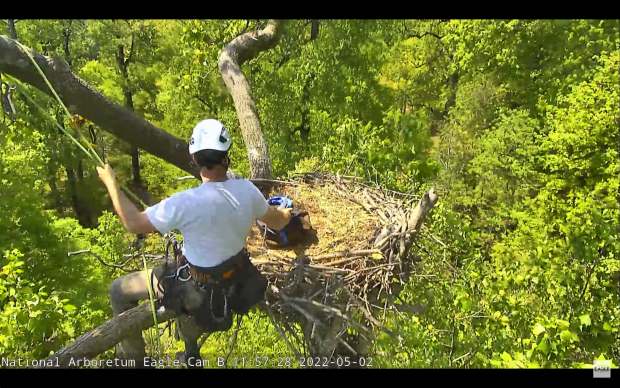
This morning DC9 at the National Arboretum Nest was banded. The eaglet was taken in a pouch down from the tree and returned. It was a very hot day in Washington, DC. 27 degrees C or 80.6. It is hotter on the top of the nest. DC9 was panting. The immediate reaction of the bander was that DC9 was a male. If I hear differently, I will let you know. Here are some images of that event.

DC 9 valiantly defended its nest. It is 10:52. DC9 is 35 years old. The perfect age for banding.

The bander sat very quiet talking gently to the little eaglet and slowly, ever so slowly got him to where he could place him in the sack.

In you go.

Down they go.

Done and dusted. The bander stayed to see that DC9 was alright. Watched his breathing etc.

DC9 is panting due to the heat and probably some of the stress. He is not going to show us his bling either.

Mr President was on a branch of the nest tree called the ‘balcony’ at 15:43. He flew down to the nest and fed DC9 at 16:22. I wonder if DC9 told Dad what a day he had had!

The cuteness factor at the nest of Big Red and Arthur is way up there. L4 is quite the ‘corker’ as my Mum would have said. Yesterday evening he was trying to eat the same piece of rabbit as its older sibling, L1. The wee one isn’t afraid of anything – even attempting to eat a bird leg this morning. It was quite hilarious. At least once Big Red had to rescue the poor darling from choking. Did I say she was a great Mum?

L4 is on the far right with that big piece of meat. Right now it is the only eyas that does not have the grey down coming in. The others are preening and itchy! Soon enough, little one. Don’t grow too quickly.

Everyone is getting a nice crop.

Then it started raining. Poor Big Red. She is getting soaked.

Then the rain stopped. All of the babies are completely dry and kept nicely warm.

It often seems like Big Red never stops feeding them! Adding one extra sure changes things on a nest!

Iris came to visit her nest today at Hellgate Canyon in Missoula. No eggs yet.

Someone commented that they thought raptors bonded for life (meaning if the mate disappears they do not take another mate) today in a short discussion about Nancy and Harry at the MN-DNR nest. Harry has been missing since Tuesday evening. He is Nancy’s second mate. Should Harry not return to the nest, Nancy will have her choice of suitors. She is an experienced female with a beautiful nest and according to the statistics there are too many single male eagles. II really hope that Harry is off healing and will return. Nancy is taking good care of E1. (E2 was shoved off the nest by E1 and subsequently euthanized due to its injuries both from the fall and from the beaking from E1 on the nest).

The oldest eaglet on the Dale Hollow nest branched today. A parent was in with a chunk of fish for Big and was feeding some fish to Middle.

The eaglets are big! Just look at the size of them.

Wow. That big beautiful wing. The eaglets are (counting hatch day) 64 days old today. They hatched on the 28th of February.

Louis and Dorcha at the Loch Arkaig Osprey nest in Scotland now have three eggs. Congratulations.

Male Ospreys are quite funny. Some bring toys and bright objects to the nest. Others land on their mates and use them as a pillow hoping to get some incubation time. At the Dyfi Nest in Wales, Idris pulls Telyn’s feathers when he wants a turn! Telyn is incubating three eggs!

Idris is also known for being ‘Daddy Longlegs’ and for his fantastic fishing abilities!

This is a reminder that Annie and Alden, the Peregrine Falcons at the Campanile on the grounds of the University of California at Berkeley are incubating three eggs which are set to hatch in four days – 6 of May (possibly the 5th). Two eggs are believed to belong to Annie’s former long term mate, Grinnell, and one is thought to belong to Alden. Everyone is very excited. When the chicks are banded, snips of feathers will be taken and a DNA test will happen. We will know the genders and hopefully which chick belongs to which Dad.

Don’t know what to expect from a Peregrine Falcon nest? or need a refresher? or just want 15 minutes of cute? Have a look at a season compilation from Glasgow.

I have not had a chance to check all of the nests! Adding the falcons and ospreys in with the eagles has been running – which is a good thing! Those nests I have checked appear to be just fine.

It is sunny and dry in Manitoba! American White Pelicans are on the river near to where I live. The floodway seems to be regulating the water inside the city the way it was designed. Thankful.

Thank you for joining me this afternoon. Take care. See you soon.

Thank you to the following for their streaming cams where I took my screen captures: Dfyi Osprey Project, Cal Falcons, Cornell Bird Lab RTH, DHEC, Scottish Woodland Trust, NADC-AEF, MN-DNR, KNF, and the Montana Osprey Project.