Early Monday in Bird World

9 May 2022

As citizens of Manitoba, we are really learning about what it means to live on the floor of what was once Lake Agassiz —- in other words, a flood plain. Two more Colorado Lows are set to dump more water on a province that is flooded south of Winnipeg and north of Winnipeg. One big lake save for those communities who spent funds on creating their own dams. The loss is enormous but looking at it from a wildlife perspective, one has to wonder where all the deer, the nests, and the animals have gone. I have seen one image of deer walking along a railroad track that runs from Winnipeg to the US border trying to find dry land and food. That border is now closed as are many highways and even some bridges in my City. Years ago one of our Premiers decided to build what was teasingly called ‘Duff’s Ditch’. Well, everyone should be grateful to Duff Roblin for having that kind of insight. The City is mostly dry and safe.

There are few birds in the garden as the raindrops begin to fall on a grey day.

I am as nervous as Blue 33 (11) is as he comes in and off the nest at Manton Bay checking on Maya and the eggs. There are three. At one point you could only see two, has there been a hatch? So, we wait for confirmation one way or the other! I cannot see any egg shells so I suspect that pesky egg is hiding!

It is certainly time to begin checking on the Black Stork nests in Estonia and Latvia. There is something curious that I noticed which I suspect my friends in Estonia have known all along. Jan and Jaanika laid their eggs a whole month earlier this year than last. In 2020, the eggs were laid on 12 May, 14 May, 16 May, and the 18th of May. Hatch from 14-17 June. This year the eggs were laid on 15, 17, 19, 21 April, 23 and the sixth and final egg on 25 April! This is excellent – the timing. Last year the couple was so very late that Janika started her migration before the chicks had fledged. It was a very difficult time and the food for the chicks was supplemented by fish being brought to the nest by the wildlife specialist, J Kuze.

The Black Stork in Estonia is so rare that every effort is made to help them that is possible.

I am not a stork expert. It would seem, however, that the parents cannot support six storklings very easily and they will probably select the three strongest. But, we wait to see.

Here is the link to Jan and Jaanika’s streaming cam in Jogeva County, Estonia:

I also checked on the nest of Karl II and Kaia in the Karula National Forest in the south of Estonia. The eggs for this year were laid on almost the identical dates as last year. Those days were 24, 26, 29 April and 1 May. Hatch began in 2021 on 28 May.

This is the link to Karl II and Kaia’s nest in the forest.

Sadly, it appears that Grafs and Grafiene did not return to their nest this year in the Sigulda Region of Latvia. Did they not survive migration? or did they decide to locate their nest elsewhere? I do know the answer to this but I will try to find out.

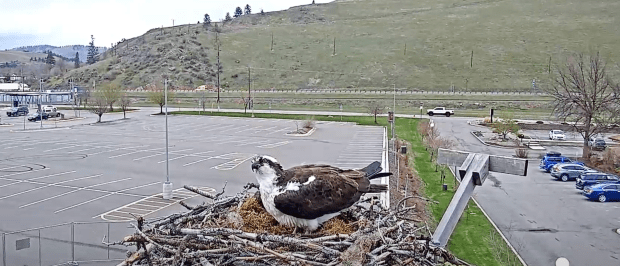
There is only one osprey nest in Latvia. This year only the male returned, Theo. He tried to attract many females to his beautiful nest. It is hoped that a young female, tagged UV and an Estonian female, will stay with them. Mating was attempted this morning but UV was not receptive. Sadly, this nest is a bit haunted. None of the former chicks have survived due to goshawk predation.

Here is the link to the Kurzeme camera of Theo:

In comparison, the Osprey nest of Ivo an Iiris in Tarta County, Estonia has done well. All of the couple’s chicks fledged last year!

Pip watch will begin on the 21st of May. That is only 12 days from now. Here is a link to Ivo and Iiris’s streaming camera:

Gosh, Big Red is gorgeous. It is so hard to believe she is 19 years old. She is in such good shape this year. What a beautiful golden glow on her and the four eyases as a new morning wakes up on the Cornell Campus.

This is a great nest to watch! There is plenty of time to watch these eyases develop, fledge, and then learn to be a ‘hawk’. Arthur will teach them flying and hunting with Big Red joining in. There is nothing better than seeing the parents teach the chicks how to hunt a squirrel in a tree!!!!!!

The two eyases at the Red-tail Hawk at the Presidio Trust Building in San Francisco are doing fine. These two are really growing. Look at the size of that wing. Wow.

Peregrine Falcon chicks are doing well this morning, too. The chicks at the scrape in the tower of Chichester Cathedral just had their afternoon tea.

All five eyases were fed and happy this morning at the Manchester, New Hampshire scrape.

Sleeping babies at Utica, New York scrape. Will the other eggs hatch? We will see.

Henry and Poppy do a great job taking care of their two chicks at the Cromer scrape. If you are interested in their day to day activities, there is a great blog with this nest that has images and comments of everything that happens on the nest. I will post it after the image of the chicks!

https://www.cromerperegrineproject.co.uk/post/cromer-peregrine-activity-log-08-05-2022

If you are wondering about the third egg at the U-Cal Berkeley scrape of Annie and Alden, don’t. It is non-viable. If it were going to hatch it would have happened on Saturday. What will they do with it? Incubate it, roll it around, or break it – or maybe Sean or Lynne will collect it for the museum when they clean the scrape.

Two healthy chicks are good. They are incredibly adorable.

All three eaglets are accounted for on the West End nest of Thunder and Akecheta.

TH1 at the nest of Chase and Cholyn is getting its blood feathers. There are a few lingering dandelions on the top of the head. It will not be long until this wee one looks like its cousins at the West End.

I checked on two nests in the East – PIttsburgh Hayes with its triplets and the National Arboretum nest. They are all awake and looking good this morning.

The three are beginning to fill up the nest!

Breakfast time for DC9. Looking good. There was a little concern earlier for DC9 because a bird had been brought on the nest as a prey item. Everything seems to be alright.

I want to leave you with a smile. A Canada Goose has chosen a planter on the deck of a Calgary, Alberta couple to lay its eggs three years in a row!

https://www.cbc.ca/news/canada/calgary/a-calgary-couple-s-unusual-houseguests-return-every-spring-to-lay-eggs-in-their-planter-1.6445267?fbclid=IwAR0ofbF90vvx29SCgnb-y60yl1bmVOCUlRz_3iiz5Cs_CasPpui7bPNEof0

Lots happening today. Some exciting. Some sad. The youngest golden eaglet has been killed at the Estonian nest. It had been beaked by its eldest sibling earlier and prey became scarce and the oldest killed the youngest today. That was the Golden Eagle nest in the Soomaa National Park in Southwestern Estonia. As I mention often, the rate of siblicide is much higher in nests other than falcons and hawks.

Thank you for joining me on this rainy grey day in Manitoba. Take care everyone. See you soon – hopefully with a news of the first Osprey hatch in the UK!

Thank you to the following for their streaming cams where I took my screen captures: LRWT, Eagle Club of Estonia, Latvian Fund for Nature, Cornell Bird Lab RTH, Presidio Trust, Chichester Cathedral, Peregrine Networks, Utica Falcons, Cromer Peregrines, Explore.org, Pix Cams, and the NADC-AEF.

Saturday in Bird World

7 May 2022

It is a gorgeous spring or summer day – feels like summer – at 19 degrees C. The Black-capped Chickadee is serenading everyone in the garden after having a bath and the White-throated Sparrows have arrived in large numbers. All are digging and scratching around the wet leaves for insects. That is one of the best reasons not to rake your lawn in the fall and not until the end of May. Not lazy. Helping the birds!

All of the images were taken through a window screen. The birds seem to like to be in a dark area of the garden where there is a lot of dead leaves and a puddle of water from the snow melting.

There are so many White-throated Sparrows in the garden today. They are all enjoying the dark wet areas, having a drink in the remaining puddles, and stomping on the ground for insects. You might think that this is a White-crowned Sparrow like the one below but look at the lovely yellow over each eye.

This is a White-crowned Sparrow. Do you know it? This little guy arrived in the garden just today. The White-crowned Sparrow is a very distinctive bird. Its black and white striped head is the first thing you will notice. Then its grey breast with its brownish and grey patterned wings and back. This little one was digging around through all of the vegetation. Notice the beak. It can be either an orange-yellow or a reddish-brown depending on the subspecies of the bird. This bird, like the one above, is passing through heading to the boreal forests north of me.

The Black-capped Chickadee, who is a regular in our garden throughout the year, really wanted time in the puddle for a quick bath!

It was nice to see Mr and Mrs Purple Finch in the square feeder today. Just lovely.

There are a few European Starlings that still come for the hard suet.

It is so nice when the migrating birds are coming through the garden heading to their summer homes. The songs and their presence are very re-assuring.

If you need a smile, Annie feeding the two chicks in the scrape on The Campanile at UC-Berkeley should do it!

As of 1300 Pacific time, there were still only two chicks hatched for Annie, Alden, and Grinnell.

oh, they are just so perfect with their little pink beaks and feet. Annie and Alden work together like mates that have been together for a long time. Alden keeps the pantry full. You will see Annie go down to the larder on a lower level and come up with something for the wee ones.

Cal Falcons just posted a video of Alden keeping an eye on the chicks while Annie is away. He is a little nervous. Many believe that this is his first time ‘dad’ stuff. He will be a great mate for Annie and dad for the eyases.

It is a pretty nice day when nothing much is going on in Bird World. It is like this sort of lull – some eggs to pip soon, a few eaglets to fledge, but steady. That is a good thing.

It was so nice to drop in and see Kincaid on her branch at the Kistachie National Forest Bald eagle nest in Louisiana. She is going to survive and do really well. Right now all she wants is to see her dad, Louis, flying in with a fish for her.

I wish I could put Kincaid side by side with the MN-DNR female. My goodness. They said she weighed 9 lbs. Eaglets normally grow at the rate of a lb a week. The MN-DNR eaglet is six and a half weeks old. She is 50% more heavy and larger than normal! Formidable is the word. She is at the high end of the large female eaglets. Those legs are strong and she has her wings folded in part way. Awesome.

Cholyn’s only baby, TH1 of 2022, has quite the crop this afternoon. Wonder if she is a big female, too? Cholyn needs to eat that remaining fish!!

Star and Sentry are really looking good at the Redding nest of Liberty and Guardian. Look at their plumage development in comparison to Two Harbours 1 above.

The triplets at the Pittsburgh-Hayes nest were soaked this morning but by afternoon late they were dried out and sound asleep.

There is an afternoon storm with rain, high winds, and what sounds like thunder at the National Arboretum nest of Mr President, Lotus, and DC9.

It is reassuring at a time when the Avian Flu is killing so many Apex raptors to stop into the nests and see that the birds and their parents are doing alright. Here are some images from the nest of Samson and Gabby at NEFlorida. Both Jasper and Rocket have fledged and, like Kincaid, they are hanging around the nest to get those wings strong and their hunting skills perfected before heading out on their own.

I was surprised to see how many fish bones are in the nest!

The same strong winds that are blowing in DC are blowing on the West End Nest of Thunder and Cholyn and the three eaglets – . Thunder came in with a big fish that was still alive. All have eaten well today.

There has been a lot of Bird Flu in the upper Midwest. It is good to check in on the nest of Mr North and Mrs DNF at Decorah. The two eaglets appear to be fine. Relief.

There is a short video clip of these two attempting self-feeding yesterday.

I showed this image in another posting but it is such a rare occasion that she allows her mate to brood or feed the chicks. So it is worth posting a second time in case you missed it.

So many nests to check and so much going on. It was a real relief to find everyone doing so well on these nests. The weather has been miserable in different places and I hope that it all warms up for tomorrow so that all of our bird mothers have a lovely day.

Thank you so much for joining me. Take care everyone. See you soon.

Thank you to the following for their streaming cams where I took my screen captures: Cal Falcons, Cornell Bird Lab RTH, Pix Cams, Explore.org, Friends of Redding Eagles, NEFlorida Eagles-AEF, MN-DNR, NADC-AEF, and Friends of Redding Eagles.

Late Friday and early Saturday in Bird World

6-7 May 2022

The Cal Falcons hatch day was a complete success. One eyas arrived on Thursday and the second hatched during the festivities. You could tell at the beginning of the Cal Falcons Q & A today that both Sean and Lynn were overjoyed. Here are some images from today and at the bottom of them I will put the link to the archived session from today if you missed it.

One of the most remarkable moments for me today was when Annie and Alden were ritually bonding in the scrape with chick 1 chiming in. Adorable.

Feeding and eating take some practice.

Alden checks on the newly hatched chick while Annie goes to get some food and has a break.

They know to hold that pink beak up high and to open wide from the minute they hatch.

Sean and Lynn believe – based on the coloration of the eggs – that the oldest chick was egg 1 and that chick 2 was actually the third egg. They noted that the third egg was darker than the other two. Historically, Annie has never had all of the eggs hatch. If the egg that remains is to hatch it will be by tomorrow afternoon. It is not clear if the second chick is Grinnell’s or Alden’s. They hope to test the feathers to determine paternity and they are looking for someone within the University of California system who would be interested in helping.

Newly hatched falcons can live on the nutrients from the yolk of the egg for approximately 24 hours. This means that they do not need to be fed until then. However, they can eat as soon as 4 hours after hatching according to Sean.

Saturday morning 0611.

It is hard to imagine but these wee babes will have adult size legs when they are 24-26 days old. That is when they will be banded. Falcons fledge from 38-42 days old. This is very quick and is one way that they are very different from the eagles and the ospreys. Their time in the scrape is short. They will spend approximately a month with the parents after fledging learning to fly better and to hunt.

Names? After the banding name suggestions will be taken with a final vote. One of the leading names is Grinnell. I totally agree.

Here is the link to the Q & A session from today.

The banding at the MN-DNR nest is completed. There were no surprises. E1 is a very big robust female weighing in around 9 lbs. Incredible. Sadly, those big females appear to be the ones that cause siblicide more than the males if food appears to be getting short on the nest. Solly at the Port Lincoln Osprey nest in 2021 and E1 this year on the MN-DNR nest. (Confirmed females by testing and/or measurements). Nancy circled around the nest and returned fairly quickly to E1. E1 will be a formidable female just like her Mum.

Iris laid her second egg of the 2022 at 15:14:36 Friday afternoon at her Hellgate Canyon nest. Iris appeared to go into labour a few minutes earlier with the feathers on her back rising and falling.

Maya at the Rutland Water Manton Bay nest in the UK is not giving away any hints – not a single one. Here are the eggs at 20:12. She is very restless during the wee hours of Saturday morning. Do we have a pip on any of those eggs?

Saturday and no obvious pip that I can see on Maya’s eggs, yet.

A beautiful image of Chase and Cholyn’s only hatch for 2022. Just gorgeous. One month old.

Quite a change from the beautiful blue waters of the Channel Islands and the bright sun to the dreary rain of the Dulles-Greenway nest of Martin and Rosa and DG1. They were soggy yesterday, too.

Gosh, Middle Little at the Captiva Osprey nest has such strong long legs. He watches and waits for Andy to come in with a fish for him. Stunning fledgling. Just stunning.

Lori Covert, the owner of the property with the Captiva Osprey and Bald Eagle nests on them went out in her kayak and posted an image of the tree where Little MiniO likes to perch.

It is wonderful to have the two around getting stronger with their flying, figuring out the world, and perfecting their fishing skills.

The two eaglets at the Dale Hollow Lake will make you very nervous as they stand on the rim of the nest and flap their beautiful big wings. They are 69 days old! The date of fledging depends on many factors but 11-13 weeks is good. These two are approaching that early window.

Are you a fan of the eaglet at Duke Farms? Look at the air under those wings Saturday morning early! It will not be long.

Family photo of Arthur brooding, Big Red on the railing and those gorgeous Ls at the Cornell Campus RTH nest. Big Red, like all other raptor females, is very cautious and keeps the chicks close to her after hatch. Now Arthur is getting some great ‘Daddy’ time as the Ls get older. Cute. I don’t know who is cuter – Arthur or the chicks

The engineers who took care of the White Stork Bukacka and his storklings last year have put together a short video clip about the life of Bukacka and his mate, Betynky. It is sweet.

The livestream at the UFlorida-Gainesville Osprey nest is offline Saturday morning. I will be checking in with them, more of the European nests and, of course, with the CalFalcons later today. In the meantime, enjoy your Saturday. Ferris Akel will be having his tour around noon Ithaca time. Google Ferris Akel Tour on YouTube if you are interested.

Take care everyone. Thank you so much for joining me as we wait…pip watch is going to happen at several nests this week including Rosie and Richmond. See you soon!

Thank you to the following for their streaming cams and/or FB pages where I took my screen captures: Cal Falcons, MN-DNR, Montana Osprey Project, LRWT, Explore.Org, Dulles-Greenway Eagles, Captiva Osprey Nest and Lori Covert, DHEC, Duke Farms, and Cornell Bird Lab and RTH.

Late Thursday in Bird World

How many weekends have I mentioned that southern Manitoba would be having a weather event? Well, this has to be the 3rd or 4th. Keeping track of them might make me miserable. But yes, we will have another 50mm of precipitation starting late Friday evening and into Saturday. Is it possible we will go straight from winter to summer? Spring and fall seem to be getting eliminated.

Well, let us start with the sad and end with something nicer.

Mother Goose got her 5 babies down from the eagle nest in Decorah, Iowa on the second try. The 6th egg was non-viable and the 5th gosling had only hatched the night before. It was not yet 24 hours old as I understand it.

Three of the goslings were with the parents and a volunteer with the Raptor Research Project found the fourth immediately. Mother and Father Goose called and looked for the 5th baby as did boots on the ground. Sadly, it was found deceased. The remaining four are very healthy and let us wish them a good life.

My friend ‘R’ in Pennsylvania sent me a copy of a poster. Thank you, ‘R’. The more we know, the better equipped we are to deal with situations. This is particularly geared to backyard poultry. As all of you are aware, the H5N1 strain of the Avian Flu is taking its toll on waterfowl and raptors that eat bird. Many have ‘free range’ flocks that sell eggs from chickens and ducks that are allowed to roam free. You might know of someone who could benefit from this information from the PA State Department of Agriculture.

Intruders. The birds in the SF Bay area have been having a lot of intruders – many of them lethal. Richmond and Rosie can hardly take a breath without someone, many times another Osprey, coming to their nest where they are incubating three eggs!

Oh, the female eaglet of Thunder and Akecheta has the most beautiful name. Kana’kini. My possibly poor translation is kana – powerful, and kini is beautiful and gorgeous. If that is correct it fits well with this very stunning powerful female eaglet.

Kana’kini certainly has big powerful legs. Get out the worry beads. She is jumping and flapping on the nest! But I want you to look at the small male to the right. Look at that crop! Apparently it is crab that Thunder brought to the nest. Just look at that!

Big Red is another gorgeous powerful female. I cannot explain it but the last time I checked L4 was still working away at hatching. The time of the first pip had to not so accurate???? Even if L4 does not hatch, just look at our Red-tail Hawk Mama gazing lovingly down at one of the Ls.

It was such a relief yesterday for Lori Covert to confirm that both of the fledglings of the Captiva Osprey nest are alive, flying with their parents, and obviously being fed. Little or MiniO is getting food off camera and well, ‘Lena’s boy’ Middle or LittleO loves to eat at the nest.

TH1 is in the Two Harbours nest tonight! Do you always check, too? Those railings that Dr Sharpe and his volunteers brought and fixed continue to keep the wee one end. It will not be long until Dr Sharpe is back up to the nest banding Chase and Cholyn’s only baby.

It looks like Harry and Nancy at the MN-DNR eagle nest are doing some branching demonstrations for the two big eaglets.

Lady Hawk did a great video of Harriet and M15’s E19 and E20 playing down at the pond yesterday. Oh, they are beautiful strong eaglets.

Port Lincoln has been cleaning up the barge with the Osprey’s nest getting it ready for the 2022 season for Mum and Dad. There is also a new sign for all those people who feel entitled to distress the raptors.

So far, so good with all the nests. Be sure to make a note that 5-6 of May (that is next week) is hatch watch for Annie, Alden, and Grinnell at the CalFalcons scrape. Tomorrow I hope to check on some of the European Osprey and eagle nests.

Take care everyone. Thanks so much for joining me. See you soon!

Thank you to the following for their streaming cams and/or FB pages where I took my screen captures: Explore.org, Port Lincoln Osprey Project, Cornell Bird Lab RTH, Captiva Ospreys and Window for Wildlife, and MN-DNR.

Wonderful News in Bird World

27 April 2022

Yesterday Dr Sharpe rescued Chase and Cholyn’s only eaglet from the side of the cliff face.

Today, Lori Covert, the owner of the property which is home to the Captiva Osprey and Bald Eagles nests saw the entire family flying in the mangroves. Yes! The entire family: Andy, Lena, Middle (or LittleO) and Little (or MiniO). What a relief to know that Little MiniO is fine and well and being cared for and with the parents!

Middle of LittleO flew up to the nest for some fish and this finding means that Andy is finding fish for Little or MiniO and feeding her off nest. Fantastic news.

More good news comes from Wales. Last year someone with a chain saw cut down the platform that LJ2 and LM6 were using for their nest. It was traumatic that they did not have chicks last year. A new platform has been erected and the pair have laid their first egg this morning at 08:24. And, yes, there is heightened security at the site this year.

https://north.wales/news/osprey-lays-first-egg-of-season-after-return-to-llyn-brenig-following-chainsaw-attack-on-nest-37175.html?fbclid=IwAR3FXtR4ewJQ17EOAB6sgOhXoIQ4AoMIQWl0Nvp2vtAc_-PuNrrXk4Burp0

‘B’ sent me a video that is a recap of the season so far at the Cal Falcon nest. You might want to have a look. Even though it is hard, it is wonderful to be able to see and remember Grinnell.

The two eyases at the Anacapa Peregrine cliff scrape are doing fantastic, too.

Here is a link to that cam:

There are at least four goslings, perhaps five, now at the Decorah Mother Goose nest. Everyone is anxious for Mum to fly down and the goslings to join her. There is at least one more egg to hatch and she may wait to see if it will hatch. There are also wind gusts at the site.

She is very patient with that little one.

Each one of the triplets is accounted for on the West End nest. They have been wingersizing in the afternoon and I just checked and they are all home. Relief.

There was a shift change at the Cornell Red tail hawk nest of Big Red and Arthur.

That gave us a chance to see the three Ls and to check on the hatch of L4. You can clearly see the egg tooth working away. And it was moving so the chick is alive. I understand that part of the shell as fallen in on itself. Big Red may do her famous rolling trick to help it once it gets closer to hatch.

The pantry is well stocked. Arthur has been very busy.

Everyone go awwwwwwah. Arthur is so cute and he does just fine brooding the babies. He loves to look after them!

The eaglets at the MN-DNR are alive and the leaves and tree are swaying in the wind. The camera had frozen this morning.

The two eagles at the Dale Hollow nest are also doing just fine. They are sure interested in the world beyond the nest!

That is a quick rap of the good news on the nests today. Thank you so much for joining me. Remember to head over to the Decorah Eagle nest to see the fun with the Canada Goose and her goslings! Take care. See you soon.

Thanks to the following for their streaming cams where I took my screen captures: Explore.org, Captiva Ospreys and Window for Wildlife, Cornell RTH, DHEC, and MN-DNR.

Late Tuesday in Bird World

26 April 2022

It has been a great day in Bird World. When everything seemed so bleak with the ‘Only Baby’ at the Two Harbours nest on the Channel Islands holding on after a fall ten feet below the nest, the sun rose. When daylight came Dr Sharpe and two volunteers hiked for an hour to reach the nesting site. The trio rescued the eaglet, built up the walls of the nest, and placed the wee one back. Everyone held their breath hoping that the parents, twenty-four year old Chase and Cholyn, would appear immediately. They waited almost three hours to return. Everyone was on pins and needles. What if they did not return was the question on everyone’s mind. One did a fly by, and then they both arrived – Cholyn with some nesting material and Chase with the first fish of the afternoon. Baby was home! It was less than 24 hours but, it felt like an eternity. Would the eaglet be able to hold on? That strong brave little one stayed put until help came!

Dr Sharpe and the rescue were interviewed by ABC news:

https://abc7.com/eagle-eaglet-catalina-island-baby/11794228/

“Oh, please, just one more bite,” Cholyn insists. Meanwhile, TH1’s crop is about to pop. Can you see it? The parents were overjoyed to have their chick back on the nest.

Cholyn and Big Red believe that no one should leave the table hungry. Tonight, squirrel was on the menu at the Red-tail Hawk nest in Ithaca, New York.

There are still three for Big Red and Arthur. As you can see, Arthur has really been packing the pantry and I am happy to say that most of it is squirrel and chippy.

There has been little mention of egg 4. It pipped and the chick was alive last night. It is difficult to tell because the other three Ls lay on it. If it is to hatch we should see that wee one in the morning. Personally, three eyases is great!!!!!! The three Ls appear quite healthy.

Liberty and Guardian’s eaglets for the 2022 season now have names. They are Sentry and Star. Well done everyone who took part in the voting for these two at their Redding, California aerie. Just look at them. Aren’t they gorgeous?

Spirit and Jackie shared a meal together today. It is hard to grasp but just look at the size of Spirit. They said that she would be the size of a Canada Goose now!

It is often hard to go back to a nest when the older siblings have been responsible for the death of the younger. It took me a long time to ‘get over’ being upset with Solly at the Port Lincoln Osprey nest when she caused the youngest, Tapps, to die at the age of 18 days due to starvation. It was only after she fledged that I warmed up to her again and I was honestly very sad when she died on an electrical pole in South Australia eating a fish. The two surviving ospreys at the University of Florida’s Gainesville Osprey nest are really doing well. The food competition appears to have dissipated. It is quite sad that the third hatch has to be sacrificed, or so it seems, for the good of the whole in terms of brood reduction.

The two eyases at the Presidio Red-tail Hawk nest in San Francisco are also eating well and growing without much of a problem. Once in awhile the eldest tries to be dominant but things seem to be alright.

It was sunny with wind gusts at the Two Harbours nest. Chase and Cholyn had to hover and approach the nest twice to land. It was dreary and windy just around the corner at the West End Eagle nest of Thunder and Akecheta. Of the three trips up the cliffs in less than two weeks, Dr Sharpe rescued the youngest male from the West End nest who had fallen and then returned a few days later to measure and band the three. It is easy to spot the big sister in the group now with her two little brothers.

On Thursday the 28th, the Ventana Wildlife Society is holding a Zoom-chat. It is free and it begins at 4pm Pacific Time. When you register you can submit questions to the staff. Because Condors eat carrion, I submitted questions related to the current Avian Flu in relation to those beautiful California Condors.

California condor” by USFWS Pacific Southwest Region is marked with CC PDM 1.0.

Here is the link for registration, if you are interested:

https://www.ventanaws.org/zoom-chats.html

In Latvia, the first egg at the Lesser Spotted Eagle nest has been laid. The nest is in a beautiful Spruce forest in Zemgale. The map below was posted on the English Forum, Looduskalender, and shows the area of the nest in green.

The nest is 17 metres off the floor of the forest and from its size, is believed to be at least five years years old. The couple are Anna and Andris. Lesser Spotted Eagles normally lay two eggs. If there is enough food available, both chicks will grow and fledge. If there is not, then siblicide will occur on the nest. It is good to understand this before you begin watching a Lesser Spotted Eagles nest (or a Greater or a Golden Eagle).

Andris is being shown the egg by Anna. Notice how small he is compared to the female in front.

Here is a short video of that first egg.

Here is the link to the streaming cam:

Do you love Iris, the oldest Osprey in the world? She is not only the Queen of the Ospreys but she is also one beautiful bird. Just look what good shape she is in after doing her winter migration. I am very impressed. I wonder what 28 or 29 Osprey years translates into human years??? or is there such a thing? I hope I look that good at the equivalent age!!!!!

Here is Iris this evening on her nest at Hellgate Canyon, Missoula, Montana.

Earlier, at 18:20 her mate, Louis, brings her the second fish of this season! For those who do not know Iris, Louis and Iris have this rather jaded bond. Louis also has a nest with Starr at the baseball park. This is the first year that I remember Louis bringing fish to Iris in several years. And now he has brought two! Wow.

Iris knows Louis is approaching and she does some quiet little fish calls.

Wow. That is a nice big fish. Notice the head is missing. Traditionally, males eat the head before delivering the fish to the nest.

Iris accepts Louis’s gift and flies over to the pole to eat it for her dinner. I wonder if we should be expecting eggs soon???

A marvellous book arrived in the post today. It is called Eagle Man and is about Charles Broley and his dedication to the Bald Eagle. Broley lived in Florida and in Canada. Broley was a banker; when he retired he devoted himself to bird watching. Broley became a world authority on the Bald Eagle. His observations taught us about courtship rituals, nesting, feeding, and even the migratory patterns of the eagles. I landed a copy in very good condition. It was obviously treasured by its owner, D. Gordon, who wrote on the flap that he received it in May of 1956. It is signed by Charles Broley. Inside the binding is the obituary of Broley who died on 7 May 1959 in Delta, Ontario. I am so looking forward to reading this book that inspired many to respect the Bald Eagles as many, like Dr Sharpe today, fought to bring their numbers up after most were wiped out by DDT.

Thank you for joining me. There are so many nests to cover and some will find themselves here tomorrow. Take care! See you soon.

Thank you to the following for their streaming cams or webpages where I took my screen captures: Looduskalendar Forum, Cornell Bird Lab RTH, Montana Osprey Project, Explore.org, Redding Eagles, UFlorida-Gainesville Ospreys, Friends of Big Bear Valley, Latvian Fund for Nature, Presidio Trust, and the Ventana Wildlife Society.

Parents reunite with rescued eaglet at Two Harbours

26 April 2022

Isn’t this the most reassuring image you have seen today? It is Cholyn with her baby, full of fish, nestled underneath her.

At 14:07:02 a parent tried to land on the nest at Two Harbours in the Channel Islands. There were gusts. It took some seconds longer.

Chase immediately arrives after Cholyn.

The eaglet was hungry and Cholyn was so happy to have her little one home.

Look at Cholyn’s face as she feeds TH1. Love. Joy.

Parent and eaglet reunited.

It just doesn’t get much better than this. Cholyn and Chase reunited with their eaglet, TH1, that fell from the nest yesterday when it caught on Cholyn’s talents.

The eaglet was rescued by Dr Sharpe and his team this morning. Now that eaglet is safe under its mother with a full crop of fresh fish!

We can all sleep much easier tonight because of the efforts of everyone at the Institute For Wildlife Studies and the volunteer mods on the chat who kept everyone calm and focused on scientific fact. Yes, the parents would return.

One of the mods was so grateful for the number of viewers which increased, they said, from an average of 20 to well over 1200 today. S/he hoped that everyone watching would learn something and would also be able to compare one nest to another in its treatment and care of the wildlife. What we witnessed today was a generosity of spirit and commitment by Dr Sharpe and his team.

If you would like to express your appreciation to Dr Sharpe, here is his e-mail address at the Institute for Wildlife Studies: psharpe@iws.org

This really is the news event of the day. This evening the winning name pairing for the Redding eagles will be revealed. So far there are only 3 eyases at the nest of Big Red and Arthur. The two surviving ospreys on the UFlorida-Gainesville nest are doing well. Life has moved on and there seems to be no more angst on that nest. To my knowledge all of the other nests are doing fine. Louis and Dorcha have their first egg in the Loch Arkaig Osprey nest in Scotland.

Take care everyone. Thank you so much for joining me on such a joyous occasion!

Thank you to IWS and Explore.org for their streaming cam where I took my screen captures.

Two Harbours Eagle Rescued!

26 April 2022

It has been a long wait since TH1 grabbed onto Cholyn’s talons on Monday afternoon at the Two Harbours nest. Cholyn flew off and the baby fell from her talons – luckily landing on a tiny ledge about 10 feet below the nest. It was the middle of the afternoon. That little eaglet held on until the rescue team could reach it!

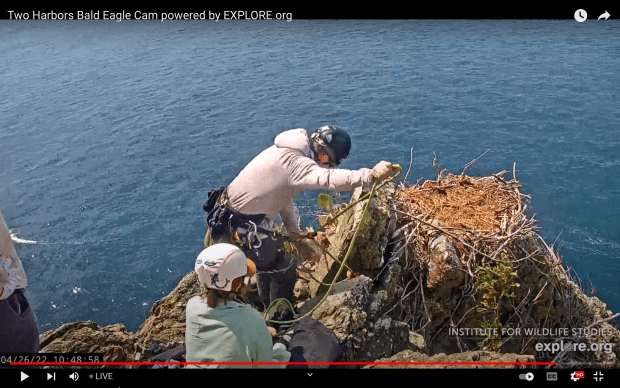
At 10:46 Pacific Time, Dr Sharpe and his two member team prepared to lower Dr Sharpe to retrieve the eaglet. Here are the images from the rescue.

The team prepares to lower Dr Sharpe with a carrier to retrieve the eaglet. Notice the condition of the railings on the nest pre-rescue.

Dr Sharpe descends to remove the tiny eaglet from the cliff edge. You can see the small grey ball above the letter ‘W’ in Wildlife below.

Dr Sharpe goes below the eaglet with the carrier bag.

Dr Sharpe gently removes the little one from the cliff. He will place it in the carrier bag he has over his shoulder.

The precious cargo is lifted back up to the top of the cliff.

The team have brought up twigs to create railings on the Two Harbours nest.

Dr Sharpe is cradling the eaglet in his left arm.

TH1 is home!!!!!!!

People and news stations from around the world were watching this rescue. In less than two weeks, Dr Sharpe has rescued two eaglets this season – one of Thunder and Akecheta’s eaglets fell out of the nest and now Chase and Cholyn’s baby. The world needed a happy ending and we need a hero and Dr Sharpe you and your team are it!

TH1 you are now an international celebrity!

When you consider making donations, think about the Institute for Wildlife Studies and others who actively assist and rescue these amazing raptors when others turn a blind eye.

Thank you to Explore.org and the Institute for Wildlife Studies for their streaming cam where I took my screen captures.

Early Tuesday in Bird World

26 April 2022

Monday the 25th: It is going to be a long nite for the eaglet, TH1, of Chase and Cholyn. The eaglet attached itself to Cholyn’s talons around 14:35 on Monday and fell – thankfully not directly into the sea but, luckily onto a tiny ledge on the cliff face. Dr. Sharpe of the Institute for Wildlife Studies is looking for someone to help him rescue the eaglet in the morning. It just needs to hold on. How easy this is to do is unknown to me. The ledge is not wide. It will also be a long night for all those worried for the eaglet. It is, however, in the best hands that any eaglet could have. Dr Sharpe will do anything for the birds that is in his power.

The wee one lasted through the night. Let us all send positive energy to help it hang on and not tire out until Dr Sharpe and his volunteer can reach it and do the rescue.

The eaglet is on the ledge directly above the word ‘Institute’.

The three at the West End nest of Thunder and Akecheta are fine. The chick that is clinging to the cliff is Chase and Cholyn’s at Two Harbours.

It has, indeed, been a long three weeks that awakens us to all of the perils that our feathered friends face. Grinnell, the male at The Campanile scrape and mate of Annie, was killed within a mile of home probably chasing an intruder, a juvenile female. The three Denton Homes eaglets most likely died of H5N1 on the 23rd.

iThe male adult has returned to the nest and is roosting on a branch above the remains of two of the nestlings. He looks to be in good health. The female consumed one of the carcasses. It is hoped that it has done her no harm.

Little Bit at the UFlorida-Gainesville Osprey nest died from starvation induced by siblicide sometime between 18:32 on the 24th and the morning of the 25th. Little or MiniO fledged or was fludged by wind gusts at Captiva on the 23rd and has not been seen since. The biological chick at the Pink Shell Osprey nest died from siblicide brought on by the addition of a larger foster chick to the nest. The third hatch at the ND-LEEF Bald Eagle nest is small with two big siblings and is being (sometimes) kept from eating even when food remains on the nest (I have not included this nest in my blog). Siblicide is perhaps more widespread than is recognized. The list goes on and on with many, many more eagles, geese, ducks, hawks, and falcons dying daily of H5N1. It is easy to feel completely helpless.

We cannot, however, become complacent. First, we have to savour the good moments and appreciate the birds that are alive and we owe it to them and their children to create a better place. Each of us in our way can help. Perhaps you can help by getting barbless hooks mandated or if you know a fishing friend or family member, ask them to cut the barbs off. When I lived in England no one used barbed hooks. It really does help the fish from enduring pain and suffering. Organize a clean up – get some gloves or a picker and set out to clean up all the pandemic masks that have been tossed at a local park or in your neighbourhood. Remember we should cut the ear loops. Lobby in any way you can the use of lead in hunting and fishing equipment. Make it known how dangerous rodenticide is to domestic pets and raptors – get it banned. Find accurate information about the Avian Flu and how it is spreading. Consider eating less meat or eating locally raised chickens, etc as opposed to factory farmed ones. If you can afford it, drink certified bird friendly coffee. Feed the birds. Plant bird and insect friendly plants in your garden. Keep the cats indoors. The list is endless.

I have not brought recent news from some of the European nests so I want to do a hop and skip through many of them while I am waiting for tomorrow.

The White Storks at the nest in Armenia have at least four little storklets so far.

Here is the link to the camera:

Two things about this nest. There is some plastic sheeting that has been brought in that makes it difficult to see the storklets. Secondly, if it turns out that 7 or 8 storklets hatch or even 4 or 5 and the parents do not feel that they can adequately feed them based on the current availability of food, they do not let them have a prolonged starvation on the nest like Little Bit had to endure (along with the physical trauma that little osplet went through). No, the adult storks will pick out the weakest and drop them off the side of the nest. Death is instant. It often traumatizes viewers but, what is more traumatic? a chick being physically beaked, plucked, thrown about and starved for days? or this? I pick the stork method.

The RSPB has its first Goshaw streaming cam in Scotland. Hatch watch is the 23rd of May. Today, while the female was incubating her eggs, a Buzzard attacked the nest. It lasted less than 17 seconds.

Goshawks are beautiful creatures that live a rather solitary life in the forest. They are large hawks with rounded wings and a banded tail. The eyes of the adults are red. Their bluish slate coloured plumage is gorgeous; they have a dark crown. There is a bit of a white band and then a dark band extending from the beak through the eye to the back of the neck. No doubt this helps with glare when hunting. The raptors are quick often luring their prey into the forest.

The Goshawk returned to its nest after ridding its territory of the Buzzard.

Here is the link to this new RSPB nest.

Are you fans of Idris and Telyn at the Dyfi nest? Telyn has just broke the nest record for the laying of eggs! I adore this couple. In the past five years she has laid three eggs each season for a total of 15 eggs from 2018-2022. The previous record holder was Glesni who laid 13 eggs in a five year period.

At the Glaslyn nest of Aran and Mrs G, Mrs G has now laid her 60th egg. That is going to be a record very hard to beat. Mrs G is incubating and Aran is on the perch.

Mum and Dad have been coming and going to the barge at Port Lincoln.

I have not seen any mention of any Ervie visits lately. His tracking from the 25th of April shows him traveling to the marina and to an area known as Delamere.

It would seem that Ervie has found a very good area to fish and roost. So nice to know that he is alive and doing well.

There has been no more discussion at the Cornell Bird Lab about the pip in the 4th egg. Perhaps it did not make it. The three Ls are doing great and Big Red will not have to deal with trying to get four wee ones under her if the weather gets poorly.

These three are utterly adorable.

Send all good energy over to Two Harbours for strength for the little one and a quick rescue! Here is a link to that camera in case you do not have it.

One last thing before I go. If you go where there are ducks and geese – as at a park – please understand that the Avian Flu can be spread by both footwear and car tires. While this might pertain to factory farming of chicks where delivery trucks and workers go in and out, it is very appropriate to try and help. H5N1 is spread through feces and mouth droolings (or so I am told). It is now in the far western province of Canada where free range chickens have been dying off.

Take care everyone. I hope to be able to bring wonderful news about the West End nest soon. It is nice to have you here with us – with the good news as well as the challenging.

Please excuse any typos or grammatical errors this morning. I have had to write this in a bit of a rush this morning.

Thank you to the following for their streaming cams and/or FB pages where I took my screen captures and video clip: RSPB Goshaw Nest, Cornell Bird Lab RTH, Explore.org, Denton Homes, Port Lincoln Osprey Project, Brywd Gwyllt Glaslyn, Dyfi Osprey Project, and NABU.

Update from Two Harbours

25 April 2022

The only eaglet of Chase and Cholyn attached itself to Cholyn’s feet/talons this afternoon when she flew off the nest on the cliff at Two Harbours. The chick fell off and is on a ledge down about 10 feet from the nest. That happened around 14:35 nest time.

The eaglet has eaten and is fine but probably frightened. It needs to hang on and stay on that ledge til Dr Sharpe can get there tomorrow!

This is the latest update from Dr Sharpe:

“I’m trying to find someone to help me in the morning (my crew has left the island already). It is too late to try to go out today.”

This is the link to the Two Harbours camera:

Thank you to Explore.org for their streaming cam and to all the staff and Dr Sharpe and the chat mods who have had to keep all of us calm this afternoon. Send your most positive wishes to this wee one. I am so grateful that cliff ledge caught it!

Take care all.