Wednesday in Bird World

Let’s start off with what is on everyone’s mind: Has there been a confirmed sighting of Yurruga? Yesterday, Dr Cilla Kinross was inspired by a very quick prey drop at the scrape. Diamond flew into the trees. Cilla was in the trees looking half an hour later – she only saw Diamond. Diamond returned to the scrape with quite a large crop also. Some believed they had heard Yurruga calling but, Cilla is unable to confirm that. So the answer is – we simply do not know. Yurruga has not been seen since last Thursday when he was on a building during a storm. We can only wait.

My goodness that little one was such a cutie.

October 20. Yurruga and Diamond

Diamond was really beautiful this morning as the soft glow of the sun worked its way through the fog.

Both parents, Xavier and Diamond, have been inside the scrape – scraping. They also had some bonding moments this morning at sunrise.

My heart aches for them.

The second question of the day is what is going on with Grinnell, the male Peregrine Falcon of the Campanile, mate to Annie, that was injured by a male intruder that is trying to cosy up with Annie? Here is the latest news.

The New Zealand Department of Conservation rangers on Taiaroa Head are shutting down the streaming cam so that they can move it to the site of the Royal Albatross family for 2021-22. There are lots of guesses as to who the couple might be. The announcement is due tomorrow.

One of my favourite Bald Eagle couples, Samson and Gabby, at the NE Florida Bald Eagle nest near Jacksonville have been putting the finishing touches on their nest. They are perfecting the Spanish moss lining the nest cup. Now all we need are some eggs!

Gabby doing some final inspections this morning.

The three lads at the Port Lincoln all had fish yesterday. Falky had more than Ervie or Bazza. Falky has become a master at slipping the fish out of Dad or Mum’s talons. A magician.

There is a lovely shot of the PLO Mum. She has done an extraordinary job raising these three boys to fledge this year (with Dad’s good help). Yesterday she even spent some time feeding Bazza. He is definitely a Mum’s boy!

Bazza can be a bit naughty. I know that the banders were certain that there were three males. Someone looking at Bazza’s legs and that beautiful necklace in the image below might mistake him for a lovely female.

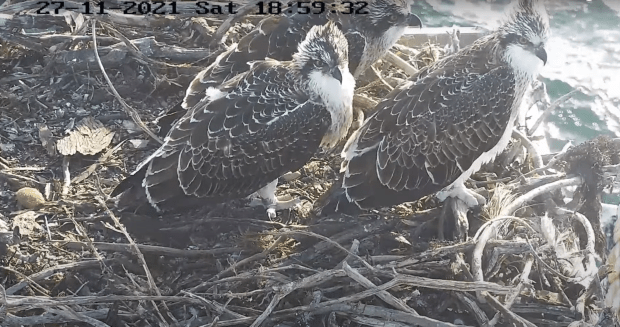
Bazza and Falky sleep with their heads tucked under their wings – adult style – standing on the nest. Ervie is sleeping over on the perch or the ropes. They are all doing well. I continue to pinch myself. This Osprey nest really turned itself around this year to fledge all three hatchlings.

There are many articles coming out in international newspapers and academic journals on the effect of warming oceans on the seabirds including the beloved Osprey. I picked one of those for you as some are frustrating. They allow me to embed the article but then want you to subscribe to read it! That is a major irritant to me – like Subarus are to Ferris Akel!

https://www.downtoearth.org.in/news/climate-change/climate-change-threatens-survival-of-albatross-60906

It is a grey damp day, 3 degrees C. The snow is melting. There are lots of birds at the feeders. A large European Starling is sharing the peanut and bark butter feeder with some cute little House Sparrows.

The tiny suet balls called Bark Butter by our supplier are a really big hit since winter has set in. Junior has been around to get the corn while Dyson was busy elsewhere. Nice to see all of them.

One of my former students posted this today on FB. It is a perfect little giggle for all of us!

Thank you so much for joining me today. Take care everyone. Stay safe.

Thank you to the Port Lincoln Osprey Project, Charles Sturt University Falcon Cam and Cilla Kinross, and NE Florida Eagle and the AEF for their streaming cams where I took my screen captures.

Was it Yurruga?

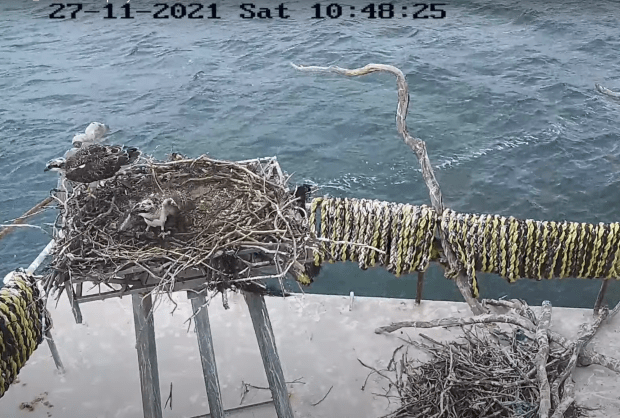
My goodness. It is just past 09:00 on the Port Lincoln Osprey barge and already there have been three fish delivered – one of those was really quite a bit one!

Ervie got the first fish that arrived at 06:16.

There was another delivery at 07:22 and Falky takes that fish. Falky is still eating when Mum flies in with a bit of a whopper. At the time of this delivery, Ervie is on the perch and Bazza is on the nest rail. Falky quits eating the old fish (not much left) and starts eating the big fish.

In the image below you can see Falky with that prize fish. That is a nice one.

Falky is still eating at 8:56! Bazza has given up and has gone down near the mancave to put in a personal request to the parents for breakfast. Ervie has found some leftover fish around the rim of the nest – remember he is really good at that. But I am also thinking that Ervie knows Falky is going to get full and stop eating that fish! He wants to be on hand when that happens.

The only time I have seen a sibling eat and eat so that a sibling could not get food – eating beyond the norm of comprehension – was sibling #2 at the Achieva Osprey Nest in Florida last year. #2 would eat and eat so that Tiny Tot Tumbles did not get anything or there was only a little left.

Ervie is smart. The third hatch survivor. Falky did finally get full and Ervie is now eating that Mullet. Bazza is still on the deck below by Dad’s cave.

It has been snowing in Northern Europe. In Durbe County, Latvia, snow is covering the nest of Milda. Still, her and Mr L have come home to the nest to check on it today. Liz caught it in a video:

There are some concerns about a thin red line on the right ankle of Mr L which you can see directly below the arrow to start the video. Here is another view. Milda needs for this to heal so that Mr L can provide for her this year and their chicks will thrive. Observers say that Mr L appears to be moving fine. Thank goodness.

Oh, it looks so dreadfully cold for the White-tailed Eagles. I hope there is plenty of prey for them that is not sleeping. There should be no worries about any egg laying until spring. It is normally timed so that when the chicks hatch the little animals are coming out of hibernation.

If you research the floods that are happening in Canada’s province of British Columbia or some of the flooding in the eastern provinces recently, there are many causes. In British Columbia the logging of old growth forests has proven to be tragic. In their discussions, Christian Sasse and Dave Hancock talked about the impact to the wildlife of these events. They also mentioned that some of the birds caught in the horrific heat during the summer of 2021 that survived and had trackers put on them —- those birds flew straight to Alaska. As the climate warms, the birds, including my beloved Osprey, will be looking for cooler temperatures where fish and their eggs are not dying from the heat nor are the larvae that the fish eat dying. Look north to Alaska and parts of Canada. These areas need protection.

An article has just appeared that discusses the Tongass National Park in Alaska and the changes in some laws that are coming in to place to make certain that the old growth forests are not logged. If you are interested, here is that article.

Last there is some confusing information coming out of Orange, Australia, about Yurruga. I had received an e-mail this morning from Cilla Kinross where she expressed her concern at not seeing Yurruga since Thursday, her worry and also her love for the wee one. This morning Xavier delivered prey to Diamond in the scrape and she flew out of the box quickly and into the trees. I have personally never seen Diamond eat prey in the scrape unless she was feeding a chick. While we all remember Izzi coming to the scrape, normally the prey deliveries and feeding would take place away from the scrape for the fledglings.

In the chat room, Cilla Kinross said of the delivery and departure, “The prey transfer looked hopeful; I couldn’t hear the calls. I need to get a new speaker.” Individuals have said that at 8:32:55-56 they believed they could hear Yurruga prey calling.

Here is the sequence of images related to that prey drop to Diamond. You can see the time stamp in the corner to understand why Cilla could be thinking that this is very quick and hopeful.

Diamond gets the prey.

In the image above that white spot between the trees right above the ‘s’ in the word ‘trees’ that I typed, is Diamond. Cilla has indicated that she knows the tree Diamond landed in and she is going to check in at work and then go and search that area.

I will bring you any news as I hear it. If you want, you can watch the camera and at least see the chat, if you go to this link. To access the ledge cam – for a better overall view – go to the link below this cam once you get on Youtube.

At 10: 33:55 you can make out a person walking among the trees. It could be Cilla or a helper. Chatters and mods are hoping that they walk further back as that is where they saw Diamond go. We hold our breath. It has been a sheer roller coaster.

In the image below you can see them – that bright white spot. You can see how tiny she is compared to the trees. If Diamond is like the hawk that visits our garden, they can be almost invisible sitting ever so still so as not to be seen.

The person is still looking at 10:49. She is in the whitish coat to the right of the green tree in the centre. Again, look at the height. If Yurruga is in a hole in the tree or somewhere on those trees with leaves it could be difficult to see him. I wonder if Diamond is still there?

We wait for word. That is all we can do. Wait, hope, send warm wishes and prayers. My friend, ‘T in Strasbourg’ reminds me that miracles do happen. Yes, they do. I hope this is one of them.

Thank you for joining me. It is a been a day full of up and down emotions. That is the only thing for certain about this Tuesday – or Wednesday – depending where you live. Take care everyone. If I hear anything at all, I will let you know. Pardon any serious grammatical or spelling mistakes. I am writing this quickly so you will know what is happening on the ground in Orange.

Thank you to the following for their streaming cams where I took my screen shots: Port Lincoln Osprey Project, the Latvian Fund for Nature, and Charles Sturt University Falcon Cam and Cilla Kinross.

New Zealand’s falcon, the Karearea

It is almost the end of November and in about 25 days there will be at least one bobble head, if not two, on the Fort Myers, Florida Bald Eagle nest of Harriet and M15. Bald Eagles are strikingly beautiful – the gorgeous pure white head of the adult with that large bright yellow beak, espresso brown body plumage and watery light blue eyes. The hatchlings are just as adorable with their light grey down. They are called ‘bobble heads’ because they do not have the strength

While we are waiting for those eggs to hatch in Florida, there is a new streaming cam focused on a small New Zealand falcon, the Karearea.

Wikimedia Commons

They are adorable. Thanks Sharon Dunne for mentioning this new cam. The chicks are delightful! Here is the link:

Here is a short video of the chicks trying to get settled in the nest cup.

The Kareara are indigenous to New Zealand. At present, they are very vulnerable. They believe that there are between 5-8,000 birds in the whole of New Zealand. Their threats are loss of habitat, cats, mustelids (they are like wolverines), and hedgehogs. Hedgehogs like their eggs.

The falcons have also been found on several islands but, the area with the highest population is the Kaingaroa Forest between Rotorua and Taupo on New Zealand’s central North Island. You can see Taupo on the map above. The Kaingaroa Forest is the largest forest plantation in New Zealand and is the second largest forest in the Southern Hemisphere. It is 190,000 hectares. The first trees were planted in the early 1900s. They are harvested for the construction industry.

“Kaingaroa Forest” by russellstreet is licensed under CC BY-SA 2.0
Wikimedia Commons

The adults are 40 cm and 50 cm in length. Like almost all raptors, the females are larger than the males.

Wikimedia Commons

In fact, the female can weigh almost twice as much as the males who weigh between 240 g and 350 grams. The females are between 410 g and 720 grams. They cannot fly nearly as fast as the Peregrine Falcons but the Karearea do reach speeds of up to 100 kmh. They are also capable of catching prey that is larger than they are. Wow! They do not eat carrion (dead animals). Their diet consists of mammals, lizards, birds, and insects. These small falcons hunt by watching from a high point flying fast, grasping the prey with their talons and then killing it with a bite to the neck.

Wikimedia Commons

Oh, I hope that you enjoy these adorable little falcons. It is a perfect time to watch them. The Port Lincoln lads will be taking the fish deliveries off the nest to eat them soon. Ervie has already tried fishing and last night he slept on the post not in the nest. He is growing up! No word yet on who will be the Royal Cam family and Cilla Kinross is planning to hunt in unexpected places for Yurruga. And one of my favourite Bald Eagle couples, Gabby and Samson, have been working on their nest. Oh, they are a stunning pair.

Gabby on the left and Samson on the right. Northeast Florida Bald Eagle Nest, Jacksonville.

Thank you so much for joining me. Take care. See you soon.

Thank you to the following for their streaming cams or their FB pages where I took my screen captures: Northeast Florida Bald Eagle Nest and the AEF and Southwest Florida Bald Eagle Nest and the D Pritchett family.

From Port Lincoln to Kauai to Juneau

Oh, gosh. We really are going to miss these three boys when they finally leave the Port Lincoln barge. Ervie was wet this morning. He has been focusing very hard on finding a fish and catching it. We might never know, sadly, when that moment occurs – unless he brings it up to the ropes like Dad. Wouldn’t that be wonderful?!

Bazza seems to have landed the first fish this morning on the nest. Falky doesn’t seem bothered and Ervie had flown off earlier.

Port Lincoln gave us a nice image of Bazza over on the ropes. These three males are quite handsome.

When Ervie flew back to the barge he was really keen on preening those feathers.

You can really see that sharply hooked beak that helps to tear the fish so they are easier to eat. Unlike Peregrine falcons, Ospreys do not have a tomial tooth. In my images it is a bit difficult to see that valve which seals the Osprey’s nostrils when they dive for their fish but, it is there.

Looking at that beautiful image of Ervie below you will notice that the Ospreys lack that very heavy eyebrow of some of the other raptors. Instead, they have that incredible black line which passes from the eye down to the neck. That black line helps them with the glare.

Ervie missed the the 8:14:14 fish that Dad brought in. Falky claimed in.

Port Lincoln has reported that Ervie has been flying farther. They also note that he has been checking out the coast. Here is the latest map of Ervie’s movements from the barge.

Ervie and his siblings will get their adult plumage at their first moult which is fully completed by the time they are a year old. That change in plumage does not indicate Ervie’s sexual maturity. Osprey do not normally breed until they are three years of age. The 2019 fledgling from Port Lincoln, Calypso, has been spotted sitting on a branch with a male. Might there be chicks next year? That would be marvellous!

When Penny Olsen’s book on the raptors of Australia was published in 1995, the map of Australia indicated that the Eastern Ospreys were located only around the coast. Ironically, that map did not indicate any ospreys in the Eyre Peninsula. This is one of the things that has changed since its publication. We have to look no further than the Port Lincoln Opsrey Barge and Thistle Island. We also know from Solly being the first tracked Osprey that the birds do go inland. Not all that far but further inland than anyone had understood previously. We are fortunate that Solly was able to provide so much information to us in the 14 months that she was alive. Port Lincoln can now compare the dispersal of a female to that of a male with the tracking of Ervie.

There are many threats to Osprey. I imagine that everyone reading my blog can name at least four. I want to add warming seas and the decline in fish numbers as yet another.

As you know, I highly recommend Dr Marc Bekoff’s book, The Emotional Lives of Animals. He also wrote The Ten Truths with Jane Goodall. A very moving story is coming from the island of Kauai, Hawaii. Some of you might recognize the name of Hob Osterlund. She posted a very moving story that can be added to the cornucopia of evidence that Bekoff and Goodall have that support animals having emotions which they express. Once you have read those two reasonably priced books, you will never ever apologize again for anthropomorphizing animals again.

Here is that posting:

Tears.

One of my readers ‘B’ asked me if I had seen the snow at Glacier Gardens. I had not! So I went to check. Oh, my goodness, it is so beautiful. If you close your eyes you can see that beautiful Kindness using that nest and those branches like a trampoline. What a magnificent juvie Kindness was. She is off eating Salmon along the river.

On Taiaroa Head, 122 birds have been seen so far and there are 36 eggs laid. No mention yet on who the Royal cam stars for 2021-22 will be! Soon. And there has been no update on Grinnell. No further updates on WBSE 27 either.

Thank you so much for joining me today. Take care. See you soon.

Thank you to the following for their streaming cams where I took my screen shots: Glacier Gardens Bald Eagle Cam, Port Lincoln Osprey Project, and to Hob Osterlund and her FB page for that moving story. Much appreciated.

PLO lads are being lads

Oh, goodness. Things can get a little rowdy on the Port Lincoln Osprey nest. It is almost like the adrenalin is rushing at various times of the day. Today it hit mid-afternoon.

I first checked on the boys and they were still waiting for breakfast at 10:46. No doubt Mum and Dad are hoping that they will at least attempt getting their own fish. For the Western Ospreys that migrate, catching that first fish normally occurs after migration but with the Eastern Ospreys that do not migrate, the lads should be watching, learning, and trying. I know they are genetically hardwired to know precisely how to fish but it sure would help to follow dad and observe where he finds his good catches.

It is tiring just trying to keep up with what is going on so I just want to give you a snippet.

Bazza has a fish from dad at 14:37. At 15:16:36 Bazza thinks that Falky is getting too close to his meal and he shoves Falky off the nest. (Ervie is minding his own business out of the way).

I am thankful that they can all fly. Still a sudden plunge in the water could prove disastrous even now.

Bazza is quickly earning his nickname, ‘Big Bad Bazza.’ Bazza goes back to eating his fish after he gets rid of Falky.

At 15:18 Mum arrives with a fish. Bazza, not content to continue eating his own fish, decides that he wants Mum to feed him hers. Meanwhile, Falky who is looking on, has returned to the nest at 15:28. Mum is going to feed him, too!

Ervie is minding his own business eating a fish that Dad delivered at 15:23.

At some point, however, Ervie even crashed Mum’s party and wanted her to feed him! Then he went back to his own fish.

Poor Mum and Dad. Mum still wants to be motherly and they want to be mothered. Dad is just busy hauling in the fish. Indeed, the three are so loud with the fish calling that they might be heard all the way to Streaky Bay! I don’t believe that we have to worry about any of the boys. By the time they leave this nest for good, each will be more than capable of fending off any interlopers. I am just so glad they saved the rivalry til they were fledglings. It was that beautiful civil nest that allowed for each to thrive and fledge.

Thanks everyone for stopping in. This was just a quick check on this nest as it is one of the only ones with any action happening at the moment. Take care. See you soon.

Thank you to Port Lincoln Osprey Project for their streaming cam where I took my screen captures.

Saturday in Bird World

Are you having Peregrine Falcon withdrawal since the Collins Street kids and Yurruga fledged? Did you know that there are a pair of falcons living in Baltimore, Maryland that do not migrate? Their names are Barb and Boh. Barb will lay her eggs in March (normally) but for now the camera is live every day! The history of the scrape is located on the web cam page.

Urban hawks are very fascinating as are the amount of wildlife that exist in the very large urban parks such as Central Park in NYC. I always recommend this site. There are some good videos on Cedar Waxwings and the Peregrine Falcons as well as the RTH’s. The blog is run by Bruce Yolton who is extremely knowledgable. Check it out if you are interested in how wildlife survives in some major cities like New York.

https://www.urbanhawks.com/

There is also an Osprey streaming cam in Maryland that you should have on your radar. It is the home of Tom and Audrey 2 on the property of The Harrison Family.

This Osprey family, Tom and the original Audrey, were the subject of a book full of wonderful images, Inside An Osprey’s Nest. A Photographic Journey through Nesting Season. The images and text are for year 2015 when Tom and Audrey became adoptive parents – twice! The story is as good as the images showing the arrival of the two chicks to the nest and then, a little later, another chick lands on the nest and wants to be part of the family.

The eggs of Tom and Audrey are determined to be non-viable. The eldest two nestlings are removed from a nest with four chicks. Imagine Audrey’s surprise when she returns to her nest from a break to find not three eggs but two chicks and an egg. It is a very heart-warming story!

One of our readers asked if I would share some information from that big book on Australian birds of prey – and the answer is definitely yes! It is too difficult to find that volume and too expensive to purchase but, oh so wonderful to share! We will work our way through Australian birds of prey!

The latest news on two peregrine falcons that we are watching – Grinnell, the mate of Annie at UC-Berkeley’s Campanile – and Yurruga, the recent fledge at Orange is no news. The last posting from UC Falcons is that the interloper male appeared briefly on the ledge and was greeted by Annie. It was raining in Orange. Diamond and Xavier were about but Yurruga was not seen. He could be in the trees staying quiet out of the weather. Perhaps he will be spotted today.

The boys at the Port Lincoln Osprey Barge are doing fine. Bazza decided to be a little aggressive when he received one of the morning fish deliveries from dad. Afraid that Ervie might steal his late breakfast, Bazza decided to mantle and then thrust himself at Ervie just to make sure Ervie understood.

Bazza was very quick to protect its fish and mantle Ervie. The mantling is not the problem it is that beak. They can do a lot of damage to one another if they decide that is what is necessary.

Bazza finally settles and goes back to eating his fish.

Later. All is forgotten. Simply beautiful fledglings. Falky is on the right, Bazza with his great crest is on the left and Ervie is behind with his sat-pak.

Someone said that Falky had a wing or feather injury but I can see nothing to indicate that in these images. Falky is definitely one beautiful elegant bird. He has really come into himself in terms of flying. I also hear rumours that Ervie is trying his hand at fishing. Wonderful!

Just beautiful. Sometimes I just stare at these three boys. What joy they gave to us this year. I wish each had a sat-pak because we get so attached to them and then – poof. Nothing. What happened? Rather than think things are well, I like to know. If something happens, then we need to deal with it. Like Solly’s electrocution. Put the protectors on the poles. It is simple.

As we prepare for Bald Eagle season, I want to stop and say that there are so many many nests. You have your favourites and I have mentioned mine in the last few days. Some of the first eggs that will hatch belong to M15 and Harriet at the SWFlorida Eagle nest in Fort Myers on the property of the D Pritchett family. Those eggs are set to hatch from the 25-28 of December. They are an experienced family with little trauma – the GHOW being the exception. If you are after an eagle family to watch, SW Florida should be your first go to this season. There are three cameras. You can find the others on YouTube.

Ithaca, New York is the same temperature as the Canadian prairies today, 0. Yes, it warmed up and the sun is out! Ferris Akel’s tour is live at the moment. He is on Wildlife Drive and it is snowing but he did find some beautiful swans.

If you are reading this at the right time you can still join the tour. On Thursday Ferris found Big Red and Arthur on the Cornell Campus. Maybe he will do the same today!

I am also happy to report that so far, knock on wood, Dyson has not found the new feeder for Little Woodpecker! Yippee.

Take care everyone. Thank you for joining me today. I hope you have a marvellous Saturday. See you soon.

Thank you to the following for their streaming cams where I took my screen shots: Port Lincoln Osprey Project and Ferris Akel.

Friday and Australian Raptors

The FB of the Orange Australian Peregrine Falcons posted an interesting article with the vocalizations of Peregrine Falcons. Want to understand what those falcons are doing or saying?

When Victor Hurley did his Q & A session about the Melbourne Collins Street Falcons, he mentioned a book. That volume, Australian Birds of Prey by Penny Olsen is one of the most informative and beautiful books. Published in 1995 most of the information remains relevant today. The statistics on how many birds exist will change but the information on all of the falcons, size, ID, brooding, etc remain the same. One of the things I love about it are the drawings of the raptors.

Note: Do not be fooled by books of a similar name. Check and make sure it is Penny Olsen 1995.

Images from old print collections. In this instance it is the Wedge-tailed Eagle, the largest raptor in Australia, in a hand coloured drawing from the early 19th century.

The stories of how these early drawings came to be made just wrenches your heart especially when foreigners to Australia would injure the birds and hope to take them back to England. This bird managed with a wound to claw its way through a rope and escape, thankfully. Our ideas of the rights of animals are changing but we still have much much more to do!

The image below is of a Hobby. Olsen comments that young raptors spend much more time lying down than they do standing. The photographer has caught this small falcon resting. What a lovely capture!

The Hobby is also known as ‘The Little Falcon’ or the ‘Little Duck Hawk.’ It is a member of the Falconidae family of diurnal, day time hunting, raptors.

One of the things that I like about the book are the tables that compare the various raptors in Australia to one another and the topics that cover everything from ecology (habitat, dispersion, , mortality), predators, reproduction, health, raptors and humans as well as conservation.

This is an impressive book and if you can get your hands on a copy – there are no reprints – it is, as Victor Hurley says, ‘essential for a library’.

Continuing on with the raptors from Australia, Cilla Kinross posted a video of a bonding session between Xavier and Diamond. Listen for the vocalizations (after you read and listen to the first article today).

There is no current update on Yurruga. He was seen day before yesterday on a roof. It rained hard and steady yesterday and Orange and I imagine our wee fledgling was hunkered down somewhere wanting to stay dry. Not good to try and hone your flying skills in a down pour!

I have not seen any updates or sightings of the 367 Collins Street fledglings. If something comes up I will let you know! It is still bittersweet looking at the four of them and the wee male not making it. But, on the brighter side, we could have lost all of the eyases this year. “Be thankful for what we have and don’t wish for what we don’t” was a common mantra of my grandmother.

The season in Australia is winding down as our lads on the Port Lincoln Osprey barge continue to get stronger and stronger and will become more independent and learn how to fish soon. It is wonderful that we will be able to follow Ervie on his adventures with his sat-pak. Let’s see if PLO has posted anything today!

This is the last posting when Ervie flew over land on 23 November. To the surprise of many, Solly also flew over land and into the interior a bit which will go a long ways to informing the power companies where they need to put those protectors on the hydro poles.

All three are sleeping adult style, standing up with their head tucked under a wing.

As to the situation with Annie and Grinnell and the interloper, the interloper male flew in to the Campanile and was greeted by Annie. UC Falcons have not seen Grinnell and Annie together as yet. Challenges and conflict over territory could happen. Fingers crossed.

As things go quiet in Australia, I will begin to list some of the Bald Eagle and Osprey nests in North America that you can watch. If you have a favourite, let me know and tell me why you like it so I can pass that along to others. Thank you!

Thank you for joining me today. Stay safe. See you soon!

Thank you to the following for their streaming cams or FB pages where I took my screen captures: Orange, Australian Peregrine Falcons, Charles Sturt Falcon Cam and Cilla Kinross, 367 Collins Street Falcons by Mirvac, and Port Lincoln Osprey Project.

25 November in Bird World

I hope that anyone celebrating Thanksgiving today had a wonderful meal with friends and family. All of us have so much to be grateful for – including our beloved birds – every day.

So, let’s start with the not so great news and move into the good, shall we?

Everyone has been waiting for Grinnell to step up to the plate and stay in the scrape box on The Campanile or on the ledge waiting for Annie. So far that has simply not happened. Today, however, it was the ‘new male’ that was there. Grinnell may still lack the confidence to engage with the intruder that injured him. Here is that video:

Port Lincoln has posted that the official autopsy on Solly, the 2020 fledgling of the Port Lincoln Osprey Barge and the first Osprey in Australia to have a tracker, was, indeed and very sadly and unnecessarily (my words) the victim of electrocution.

Oh, just look at her. What a beauty. Her necklace would have been the envy of everyone. She reminds me, so much, of Iris. Stunning.

Port Lincoln also posted the following information on their FB page. I am delighted to see that they are going to use the information gathered by Solly’s tracking to understand where to put protectors on the hydro poles.

Thank you to all my readers who wrote to the South Australian Minister of the Environment and Water, David Speirs. You may remember that Speirs travelled to Port Lincoln to help band the chicks there and at Thistle Island. Ervie is named after the town in Scotland where Speirs was born. Every letter and every phone call does help. It is a tragedy and one that did not need to happen!

Blackland Prairie Raptor Rescue posted the following image of a hawk caught up in fishing line. Look closely at the outward damage that line caused and imagine the pain and suffering. This was in Lucas, Texas but it could be anywhere people fish and do not care to clean up after themselves. Please spread the word to anyone you know who fishes. And if you want to do something to help, put bags in your car and pickers (those tools people use to pick up litter) along with gloves. Go for a walk along a shore and clean it up. Take the family. The birds will thank you. They really will!

And now for some really good news.

Port Lincoln has a couple of items. The first is a posting about Port Lincoln fledgling from 2019, Calypso. It seems that she has been spotted a few times with a male. Could this be pair bonding?

And lastly out of Port Lincoln, Ervie is doing more flying and getting stronger. He even flew over houses! The trio – Ervie, Bazza, and Falky – are doing great. All are flying and eating and life is good on the barge.

Ferris Akel’s tour meant a lot to lovers of Big Red today. About a week or ten days ago I posed the question on the Cornell Chatter’s FB page: Has anyone seen Big Red since 16 October? No one had. News came on the Cornell Twitter Page that Karel and Bogette had seen Big Red on 21 November at Beebee Lake. There was a lot of worry.

Everyone on Ferris’s tour were overjoyed to see her back sitting on the building where her ‘throne’ is located.

Oh, she is a beauty and is so dear to everyone. Such joy she has brought to people from around the world. Indeed, at one time, she was said to be ‘the most famous’ Red Tail Hawk. I am certain she still is! Ferris also spotted Arthur so everything is right with the world in Ithaca.

Soon the NZ DOC will select the Royal Cam family for the 2021-22 season. I wonder who they will choose?

And remember to mark your calendars. #1031 Iniko will be released back into the territory where she hatched in Big Sur on 4 December. It will be so exciting to seeRedwood Queen and Kingpin’s daughter return to the wild after surviving the Dolan Fire in 2020. This is one of those events that will warm your heart. No one believed Iniko could survive that fire. Her father, Kingpin, is believed to have perished but the wee one lived. Jubilant is the word I am looking for – everyone associated with the rescue and the release will be jubilant for a long, long time.

Take care everyone. I am thankful for each and everyone of you because you love and care for the environment where our beloved birds live and hunt and raise their families. See you soon!

Thank you to the following for their streaming cams or their FB Pages where I took my screen shots: Port Lincoln Osprey Project, Ferris Akel Tours, Blackland Prairie Raptor Rescue, and Cal Falcons.

Oh, Bazza Baby

The Port Lincoln Lads seem to always be up to something. This morning Falky was flying about and Bazza and Ervie were on the nest. They had to have been full because there was a lovely fish tail on the nest and neither one of them were paying any attention to it.

It was very windy and Bazza entertained Ervie for about half an hour trying to land and stay on the perch. Have a look.

Are you finding that sometimes you could just use a little bit of ‘cute’ as we wait for new bobble heads in the raptor families to be born? What about a Korora?

They used to be called Little Blue Penguins. They are the smallest of the New Zealand penguins. This little one will weigh about 1 kg and be about 25 cm tall when it is fully grown. Their population is in decline due to dog, cat, stoat, and ferret kills. This group of predators has arisen because of the destruction of the penguin’s natural nesting sites for development. Sad.

And I want to give a shout out to ‘TAS’ for introducing me to this cute little non-raptor!

WBSE 27 has been observed being hounded by the Pied Currawong. This report comes from Cathy Cook on the ground:

As is usual in the Reserve, SE27 found herself being escorted & swooped by Noisy Miners, Magpies, Currawongs and Ravens, from the time she hopped out of the carrier. We saw her take 4 seperate flights, with her finally being observed (by credible people in the wharf cafe) to cross over the Parramatta River, just a little west of River Roost. The last picture shows SE27’s individual flights within the first 40 minutes after her release — at Newington Nature Reserve, Sydney Olympic Park.

Cathy posted pictures and a short video. I hope she does not mind my including one for you.

@ Cathy Cook

The saddest part about being a juvenile Sea Eagle is that for the rest of his life, 27 will be hounded by the smaller birds who, as you already know, are very effective in driving the juveniles out of the forest. I hope that Lady and Dad return to the River Roost on the Parramatta River to find 27 so they can feed her.

For all of you celebrating Thanksgiving with your friends, families and/or other loved ones in the USA, have a wonderful day. For those in Canada who celebrated in October, tomorrow is just another day. Take care. Always be thankful. See you soon.

Thank you to the Port Lincoln Osprey Project for its streaming cam where I video captured Bazza and to the Sea Eagles FB Page and Cathy Cook for the update on WBSE 27.

Updates from Bird World…or, oh, gosh…WBSE released 6 days ago!

Holly Parsons posted an update from Dr Cilla Kinross on the FB page for the Orange Peregrine Falcons. Thank you Holly!

(Nov 23):”I had a look at the eggs. One was clearly unfertilised. The other was, I think fertilised, but there was no chick inside. It exploded (big POP) all over me and it was just yellow liquid. No chick remains. I’ll do updates later. I’ll also try to get some confirmation from the museum where there are candling experts (I am not).”

One great report that was featured by Sunnie Day on FB is this. Just look at those numbers. Now how do we take care of these amazing birds – our Osprey?

Osprey Report for 2021, USA

The entire report on the Ospreys for the 2021 season can be read here:

https://www.ctaudubon.org/wp-content/uploads/2021/11/Osprey-Nation-Report-for-the-2021-Season.pdf?fbclid=IwAR3gLbtstZokgb5Ii6EVTE6gj5_ifSVGCQQGaUiFUUmj61p3SMgUJy-WkUQ

If you want to protect our Ospreys, The Observer focuses on them this week. They say:

“A growing cause of death for ospreys is entanglement:  If adults incorporate monofilament or other discarded non-natural twine into their nests, these can end up wrapped around chicks’ feet, injuring or trapping them.  And, as food specialists, with one main food source, a grave threat to our osprey populations is contamination of their aquatic ecosystems; our Sarasota waterways.  As top predators, they’re exposed to the highest concentrations of toxins (such as mercury) in our environment. 

To protect these beautiful birds, who are key members of our ecosystem, we can keep toxins out of our waterways, and plastic litter, including twine and fishing-line, out of our environment.”

White Bellied Sea Eagles. 28 on the left and 27 on the right.
Is this WBSE 28 and not 27?

And great news coming out of Sydney, Australia. Someone let the cat out of the bag. The juvenile WBSE that was grounded by the Pied Currawongs was released six days ago on 18 November. I am using the term ‘juvenile WBSE’. There is no proof that it is either 27 or 28. It is a juvenile WBSE.

Just like we compared the Peregrine Falcons on the ledge yesterday, I want you to look carefully at the two images above. Someone that I trust very much indicated to me that the juvenile taken into care was not WBSE 27 but, rather, it was WBSE 28.

Dr Christian Sasse is one of my favourite people. He is so dedicated to the wildlife of British Columbia and in particular the Bald Eagles. Have a look at this beauty!

https://fb.watch/9t2vM9rY8t/

It is 14:47 and Harriet and M15 appear to still have one egg in the nest at Fort Myers, Florida on the Pritchett Farm.

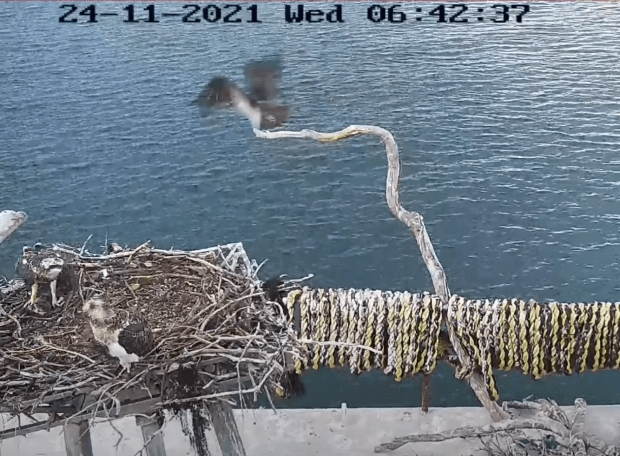
Falky scored the 06:37 breakfast fish. At that point, Ervie took off flying behind Dad. Maybe Ervie is gonna go and see if he can get a fish himself.

The Eastern Osprey in Australia do not migrate. Unlike the Northern fish eagles that do shift to warmer climates during the winter and catch their first fish when they migrate, the Eastern Osprey will fish before they leave the parent’s territory.

There goes Ervie off the perch. I sure hope he learns to fish. He can get his own breakfast and eat it somewhere away from the brothers!!!

I have seen no further news coming out of UC-Berkeley on Grinnell and Annie.

It is not late in the day but it feels like it. It will be totally dark in less than an hour and a half. So I am off to clear up things outside.

Thank you for joining me. Take care!

Thank you to the following for their streaming cams where I took my screen captures or for their FB Pages: Port Lincoln Osprey Project, Sea Eagles@ Birdlife Australia Discovery Centre and their FB Page, Sunnie Day and Holly Parsons.