The severe weather that was heading to the Collins Marsh Osprey nest in Wisconsin swerved and headed SE away from the nest. There was rain but the winds never got to the speed in the severe areas. The lightning kept the chick hunkered down in its comfy spot on the nest.
The little one woke up and was self feeding on a fish delivery.
Then mom arrived and fed the chick. They had no more than finished than dad delivered another fish! These two parents must be proud of their wee one making it through that storm all alone.
It is so wonderful to wake up this morning and see this chick in the nest. Indeed, it was quite a relief in the week hours of the morning nest time when the lightning cam less frequently and the storm cells were out of the area. Relief.
WBSE hatched at 4:57 pm nest time. Here is that video:
Here is the link to the live stream of the Sydney Sea Eagle Cam:
It would have been a perfect 3 for 3 if Tiny Little had been on the nest feeding off a big fish but it is only 16:15 and isn’t quite tea time for the fledglings.
This is a really quick update so that you know the little chick on Collins Marsh was really, really lucky. Everyone is so glad this baby is safe and well. Thank you for joining me. I am hoping to have some local bird images for you tomorrow. Take care!
Thank you to the following for their streaming cams where I took my screen shots: Collins Marsh Osprey Nest and Cumbrian Wildlife Trust and the Foulshaw Moss Osprey Nest.
The weather service in Wisconsin is telling everyone that they are not joking. It is going to be a terrible night. They need to get everything loose out of their yard and get to safety.
The Collins Marsh Osprey Nest is in the red zone. The nest is north of Milwaukee and south of Green Bay near to the Great Lake shore.
The wildlife rehabber, Patricia Fisher, was out checking the Osprey nests in her area this morning. And, this time of year, it is not just the Ospreys but all of the birds nesting. My focus is on one nest in particular. It is on top of a 110 foot retired wildfire tower at the Collins Marsh Nature Centre.
Right now this sweet little one is home alone.
This chick could literally been blow off this nest and land in Green Bay. It is very difficult to understand how deep this nest is and what there is to cling to. I am mostly seeing loose sticks scattered about.
The mother has returned to feed the chick which was a concern this afternoon but, she has left again and not returned.
The storms are expected to move into the area of the nest around 9pm nest time. Please send warm wishes towards this wee one.
In other news the egg tooth of WBSE 27 is visible as it chips away at its eggshell. The eggtooth hammers away at the hard shell. It will eventually disappear but it is a perfect tool for hatching. It has been 12 hours since the first little pip was noticed.
It was drizzling. Tiny Little waited patiently for big sibling blue 462 to finish with the fish and she was rewarded. It is nice to know that this wee babe will have a warm tummy and be safe and sound with its family in the parent tree tonight.
Thank you for stopping in for this quick news update. Send your thoughts and prayers to the humans and non-humans in the area of that heavy storm. Let us hope that the camera does not get blown off and that we wake up to see the wee one on the nest crying for food. Take care everyone.
Thank you to the following for their streaming cams where I took my screen shots: Sea Eagles, Birdlife Australia, and the Discovery Center, the CumbrianWildlife Trust and the Foulshaw Moss Osprey, and the Collins Marsh Nature Reserve Osprey Cam.
My virtual friend ‘S’ and I probably never thought we would be pouring over fish ID charts trying to identify partially eaten fish. OK. I can’t fully speak for her but even growing up with a dad who lived to fish, a son that travels the world to fish and feels more at home in a boat than on land, and a grandson that fishes in all his spare time – I never thought for a second I would spend more than a few minutes looking at the type of fish the Ospreys are eating. Surprise. The fish that comes to the Collins Marsh Osprey nest is making some of us very curious as to what it is and where mum is catching it.
The DNR of Wisconsin is great. They have games you can plan, fish ID charts by name or identifying marks. It was not until I found their posters today that I even believed there was hope of figuring out this fish. It looks like my late mother’s Siamese Fighting Fish but for its colour and size.
Thanks ‘S for this great screen capture.
Seriously I thought that the Mum at the Collins Marsh Osprey Nest had found someone’s ornamental fish pond to raids. This is at least the second fish of this species brought to the nest in a 24 hour period.
These are some of the top game fish in Wisconsin but nope. Nothing on this poster resembles that fish.
It isn’t a Roach but it could be a Rudd. But the Rudd hasn’t got red scales! There are suckers that look like a closer match.
This is beginning to drive me a little nuts. And don’t be shy. If you recognize that fish the mum is feeding her chick – tell me. I will be smiling for a week. Tomorrow I am going to ask the Naturalist at Collins Marsh. To be continued.
Dad was only seen on the Collins Marsh nest once today. Mum was busy bringing in these smaller fish for her and the chick. It is a good thing that she isn’t afraid to get wet – because if she were her baby would not be alive.
The chick will eat this species but it is certainly not its favourite and Mom, on the other hand, seems to like it or is so hungry she leaves hardly any scraps.
Speaking of eating, the female at the Bucovina Golden Eagle Nest brought in an Eurasian Hare for Zenit. Zenit wasn’t close to the nest tree when mum arrived and called but he quickly comes in mantling like crazy. When you see this eaglet or any of the fledgling Osprey aggressively going after prey, the term is hyperphagia. Every bird that migrates needs to eat as much as they can – compulsive overeating – in order to store fat for their migratory journey.
Lady Hawk caught all of the action and Zenit’s enormous crop in a video:
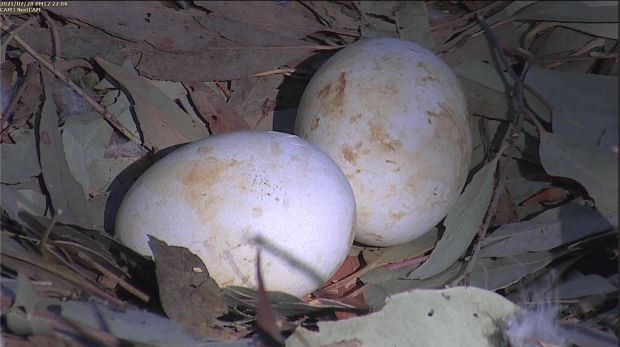
Some of the biggest news of the day is that 8:54 am on 28 July a pip was first noticed in one of the two eggs of Lady and Dad, White Bellied Sea Eagles, whose nest is in an Ironbark Tree in the Sydney Olympic Forest.
This was Lady checking, listening, and gently rolling the eggs about forty minutes later.
There is now a hole in that egg. So hatch is close.
I adore the little sea eaglets but this nest really broke my heart last year with WBSE 26 striving to live, to fly, to be a bird and then to have it end with her being euthanized.
I have seen prosthetic legs made for birds, 3D printed beaks for eagles, sophisticated operations on the webbed feet of Canada geese, and more. I have witnessed pain management programmes for animals in care and wildlife rehabbers like those at A Place Called Hope in Connecticut that not the extra mile – they go ten extra miles. All we have to do is remember the state that The Old Warrior was in when he arrived at their clinic. His lead levels were 48, he had multiple fractures in his leg, and his beak was so damaged that he could hardly eat. That old eagle wanted to live and he was treated accordingly. His lead levels are around 10, he is eating well, his feather condition is improving all the time. He is happy! Today he remains with the clinic as they await a permit for him to be their ‘forever Warrior’. I had hoped, like so many others, that something would be done to help 26.
There are several ways to access the cam for the sea eagles. There is even one with a chat room. I will try and locate those other links for you.
Here is cam 4. The definition is good.
I want to thank a follower from Poland who sent me a note suggesting I look at the beautiful stork nest in Ostroleka, Poland. So I did! There were five storks sleeping on this nest in the northeast of Poland.
What a picturesque village. The farmer’s fields are so lovely. Tranquil is the word I want to use as the sun rises on a new day.
I need to find out more about this nest which I will do in the coming days. I am trying to imagine the challenges for the parents to feed five – or is it four chicks and the parent is off the nest? Here is the link to the camera for this nest:
Tiny Little is not sleeping on the Foulshaw Moss Nest tonight. It is not clear to me whether he had a fish drop later last night or not. But after waiting for big sibling to get their fill of a large fish, Tiny Little is now eating for sure. It is 17:01 on the Foulshaw Moss Osprey Nest.
Of course, big older sister is sitting there waiting in line! Poor things. They always get caught up spending so much time around the cheek and mouth, the bony bits. Hopefully Tiny Little will get full before it gets tired.
I love it when the mother’s get out there fishing. We see that in the mom at the Collins Marsh Nest and here comes NC0 at the Loch of the Lowes.
That fledgling just about tore her leg off! I am looking at those strong thin legs of NC0. She has been diving and bringing in fish to this nest for at least a month. Soon she is going to have to begin bulking up for her flight to Africa. It’s that word: hyperphagia.
It has been a pretty exciting day. So nice to see some of the fledglings on the nests! It is comforting to know that they are surviving.
Thank you so much for joining me. I hope that everyone has a great day. Take care. See you soon.
Thank you to the following for their streaming cams where I took my screen shots: Collins Marsh Osprey Nest and the Neustadlter Nature Center, Cumbria Wildlife Trust and the Foulshaw Moss Osprey Nest, Sea Eagles, Birdlife, and Sydney Discovery Center, Ostrolekas White Stork Nest, and Scottish Wildlife Trust and Friends of Loch of the Lowes. I would also like to thank the Wisconsin DNR for the fish poster files and ‘S’ for sending me that great shot of that ‘gold’ fish.
Oh, so many of us are having Empty Nest Syndrome. It is that time of year. You go and check to see if there are any Osprey fledglings on the nest – and no. Poof. Gone. It suddenly sets in that those precious little fluff balls have grown up. They have fledged and are gaining their flying skills for migration. Osprey breeding season is almost over. There are a chicks few trailing behind – Collins Marsh and Chesapeake Bay to name a couple in North America. There are still chicks on the nest in Manitoba but there are no streaming cameras. The Port Lincoln couple on the barge are only ‘thinking’ about eggs. Those will come mid-August most likely. So what does one do?
One of the first things is to treasure the moments we got to spend with these bird families. It is a privilege to see them living their daily lives. There is a saying in Japanese – Ichigo ichie. It was coined by the great tea master, Sen-no Rikyu. His meaning focused on the sharing of the tea ceremony and the realization that you can repeat the ritual but you can never re-create that moment with the same person ever again. You must live it to the fullest with the deepest respect. In terms of our birds, I would like to think that we must treasure every moment that we can share with them and give them our attention. It truly is a once in a life time encounter. Tiny Little will never again receive a huge fish and fend off its sibling with that same sibling later getting a little tiddler from dad. Those were two precious moments that will never again be repeated. Indeed, I wonder if we will ever see Tiny Little again before her migration. That nest has been awfully empty today.
Some of us began to focus on the few nests that do have chicks. My attention has been on the Collins Marsh Osprey Nest in Wisconsin. It is easy to notice the very odd behaviour of the bonded pair at the Collins Marsh Osprey Nest. It truly is strange. The female disappears for 21 hours! That was when ‘S’ and I began to find other strange tidbits about this nest. The female returns on Sunday morning and Dad spends the day bringing in several fish deliveries. Then on Monday the male brings in the first fish and we don’t see him anymore. It is the female catching the fish and bringing them to the nest. So is there a pattern here? or are we just losing our minds? The female brought in two fish today in the afternoon. One was cream coloured with gold scales but the last one was pink inside and out with gold scales. Any help on IDing these would be much appreciated.
In the image below, it looks like a salmon-red colour. Needless to say the chick went to bed quite full. Every time it started chirping mum was offering fish. She has been very devoted since she returned.
Thanks S for this great screen capture.
A couple of hours earlier Mum brought in this fish. I could not readily identify it either. Regardless of the species, the chick is delighted with the arrival! The faces this chick makes are incredible. Very animated.
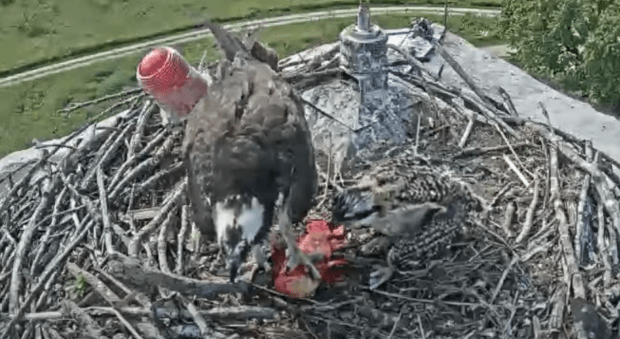
This is the approach to the nature centre that is near the Collins Marsh Reservoir and the Mud River in Wisconsin. Look at the left and you will see the ‘retired’ fire tower which is now home to the Osprey nest on the very top of the glass enclosed space that appears above the ‘red’ in the image. Snowy Owls inhabit the nest in the winter. The tower is 33.5 metres or 110 feet tall. The staff of the Osprey centre access the camera within the glass enclosed area. At one time it was thought that there was a portal from the glassed area to the nesting platform but it turns out that is not correct. There is no ‘easy’ access to the Osprey nest. Getting to the nest physically to do a wellness check on the chick, right now, would mean finding a person with particular skills and then being certain that it was safe for them.
courtesy of Wikimedia Commons
You can see that the nest is slightly off centre and is situated on a sort of cone hat with the camera on the pole at the corner.
Looking at this got me to thinking about access. It is quite true that there are raptor nests that can never be accessed. Eagles and Ospreys love to make their nests in extremely high places away from us! That said I have known or witnessed ‘tree climbers’ in Germany whose skill set is such that no tree defies them unless the tree itself is unsafe. This is an interesting situation at Collins Marsh. The Wisconsin DNR Biologist and the Wildlife Rehabilitator continue to monitor the chick in terms of feather growth, etc. That is great news. The question then arises: if the chick displays in another week or ten days problematic feather growth, what can be done? With the access so difficult, it would seem nothing. So let’s keep our fingers and toes crossed that nothing is wrong with the feathers! It would, however, seem prudent to explore the possibility of a portal access to the nest once the Ospreys have migrated and before the Snowy Owls take over. I hope that it is never needed but, if it were, it would be a win-win for everyone. All of that said, it would require the services of a structural engineer to figure out the best way to do this. Maybe there is someone who is qualified and loves the raptors that might, at least, consider if this was possible and do it as a donation of time to the centre. That would be grand.
Tuesday morning at Collins Marsh Osprey Nest: The day began with rain and then wind.
Mum left later and returned with a small fish/ a twiddler.
Mum leaves the nest three times after this. Very different behaviour than Monday. Dad does come to the nest and delivers a piece of fish. The chick winds up with a bit of a crop.
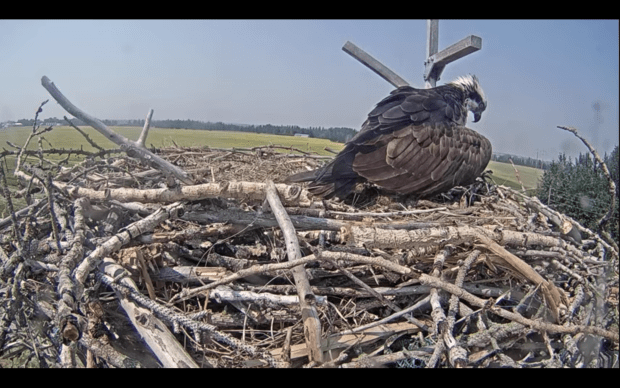
At the moment, the chick is on the nest alone. It is windy and the temperature is currently 24 degrees C going up to a scorching 30 degrees.
Mum returns and the chick joins her in fish calling to Dad. Oh, I hope the fish arrives and mum stays to shade the baby today.
The Cornell University Red tail hawks are still putting smiles on everyone’s faces. Suzanne Horning was out yesterday evening checking on them. I remain ever so grateful that she lets me share her images with you.
K3 and those beautiful celadon eyes just strikes right at my heart. This little one has, according to the boots on the ground, turned into a magnificent flyer.
K3 sees Arthur and immediately starts calling for food. You will notice that when the chicks do not see an adult they generally do not food call but when they do see someone who might bring ‘a food delivery’ you can hear them crying several blocks away!
K1 had a nice spot on top of one of the light stands. These stands have been, in past years, great places for the chicks to eat their prey. They are nice and flat on top.
If you cannot see their tails it takes a few moments to sit and figure out which K you are looking at. In this instance, the belly band has more red than the chick in the image above.
This is such a beautiful close up of K1. Look carefully at that beak – that very sharp point for tearing the food – and then look at how clean it is. You will see the chicks cleaning their beaks on all manner of things – sticks, tree bark, grass. At the same time they are also sharpening them. Like their feathers they need this ‘tool’ of theirs clean and sharp.
Here is a great little article that goes into more depth on the reason you see birds rubbing their beaks. It is short and very informative!
Big Red is doing a kind of hawk walk while she is looking for prey. She is our gorgeous matriarch and every second seeing her reminds us how precious she is.
The Hornings did see Arthur but I don’t have an image for him. Both adults are moulting now and look a little scruffy.
Some of you have been asking about Arnold. Well, look at that picture of Arnold with his mate, Amelia. His wounds have healed enough that he now has a waterproof bootie and can spend some outdoor time with Amelia. If Arnold continues to improve – and why wouldn’t he with Amelia there cheering him on? – he could be released in a couple of weeks. That is wonderful!
@ Cape Wildlife Center
A few nest checks for the UK Ospreys and wow, lucky was with me.
There is one very loud food crying fledgling on the Loch of the Lowes nest. Looks like it is LR2. He wants his breakfast ‘now’!
Telyn is on the perch of the Dyfi Nest in Wales and Ystywth is eating her breakfast. How lucky she is. LR2 is so unhappy. I wonder if his big sister, LR1, took the first fish?
Ystwyth eating a fish on the Dyfi Osprey Nest in Wales. Telyn is o the perch.
One of the reasons for the big smile on my face is that when I checked the Glaslyn Nest of Aran and Mrs G someone was on the perch! And it is Mrs G. The timing could not have been better.
There she sits – the oldest Osprey in all of the United Kingdom – looking out over the territory that she shares with Aran.
Mrs G on the perch at Glaslyn.
Perhaps if I took one more peek at the Foulshaw Moss nest someone might be there having breakfast. Let’s see!
Well, not only is there no one on the nest but there is not an Osprey to be seen on the parent’s tree in the distance. I wonder if White YW and Blue 35 have taken everyone to the reservoir to try some fishing?
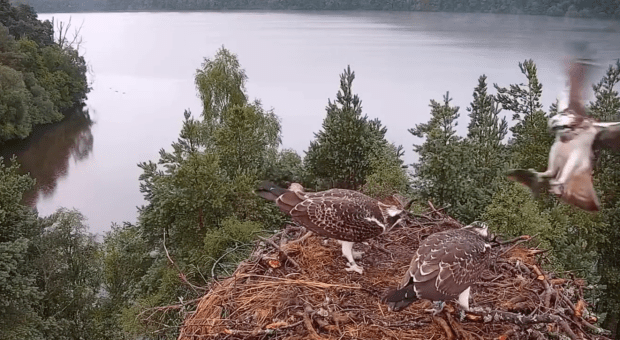
It is now 17:00 on the Foulshaw Moss nest and there are two fledglings hunkered down because of an intruder. “Hello, Tiny Little!”
Ah, maybe there isn’t much of an intruder. Wonder what Blue 464 is hiding? It is a big fish! No wonder Tiny Little is there. I will try and check back later to see if he gets some of it. The fish looks large enough for both as long as 464 doesn’t fly away with it. You can see its tail extending out to the left of the log. Hopefully 462 won’t come around!
Oh, Tiny Little is wanting that fish! She is up to her old tricks. It is a huge fish. Blue 464 will get tired of working at the mouth and walk away if Tiny Little can be patient.
Tiny Little has stepped back. She caused Blue 464 to move the fish a bit and she might be remembering that he did fly away with part of a fish the other day. Just wait, Tiny Little. There will be fish left!
But life throws birds wrenches and today, Blue 464 flew away with that huge fish! Tiny Little is yelling at White YW to go and get another one. Poor Tiny Little!
This is a good overview of what is going on at the nests today. So happy to catch Tiny Little. These moments are very precious.
Thank you so much for joining me today. It is so nice to be with fellow bird lovers. Just a reminder. If you live in a place where it is hot please, if you can, leave out bowls of water for the birds. Old ceramic serving bowls work great. The clay does not get as hot as metal containers. If you leave water for the hummers, make your own. It is 4 cups of water to 1 cup of sugar. Make sure the sugar is dissolved. You can heat it and allow it to cool before putting in the container. Do not use the red commercial hummer food. It actually kills the birds! How sad is that? A company allowed to make a product that actually kills the thing it is supposed to help! OK. It happens with humans, too. Terrible.
Thank you to Suzanne Arnold Horning for allowing me to use her images of Big Red and her family in my blog. Thank you to the following for their streaming cams where I get my screen captures: Cumbrian Wildlife Trust and the Foulshaw Moss Osprey nest, Scottish Wildlife Trust and Friends of the Loch of the Lowes, Bywyd Gwyllt Glaslyn, Carnyx Wild and Llyn Clywedog Osprey Nest, and Collins Marsh Nature Centre. A big shout out to the Cape Wildlife Centre who is caring for Arnold. You are fantastic!
The female Osprey with a chick on the Collins Marsh Reservoir nest in Wisconsin was away from the nest for 21 hours. This is most unusual. At this time, no one is clear about what happened to her or where she was. She remained on the nest all Sunday, without leaving once and Sunday night. She returned Sunday morning around 9:40 and began feeding the chick. She has already fed the chick this morning. There remain concerns for the condition/growth of the chick’s feathers, particularly those on the wings.
Update: I have just heard from Stephen Easterly, the DNR Biologist for the area, and he feels that the chick is progressing fine. It is walking, self-feeding and we will all now look towards a successful fledge. Thanks to everyone in Collins Marsh for their concern for this chick and their quick response to viewer’s calls.
Sadly, it is going to be another scorcher in Wisconsin today.
Did you watch the Barlineck Osprey Nest in Poland? That nest is on top of a 35-meter pine tree with an artificial platform. There were four eggs laid, but only two hatched – the first on 25 May and the second on 31 May. There was a huge size difference (of course) between the two. Despite that, I received word from Michael Zygmunt of the Polish Eagle Committee in Poland this morning that both chicks fledged successfully. Their camera is out of operation. They replaced the router but discovered that the cable connecting the camera and box is damaged. They will not repair it while the nest is active. So please don’t forget about this wonderful Osprey nest next year. And so happy that both of those babies are flying.
Everyone loved Aila, Louis’s mate at Loch Arkaig, that did not, sadly, return this year from her migration. Louis has a new mate on a nest that has no camera. Today, a short video clip of the two chicks was put on YouTube when they were ringed. Both chicks are believed to be males, and their ring numbers are Blue LW3 and Blue LW4.
And, as the Osprey season dies down in the Northern Hemisphere with the chicks honing their flying skills and staying off-camera, things are about to pick up in Australia. The pip watch for the White-bellied Sea Eagles, Lady, and Dad, begins today, 27 July, in Australia.
The White-bellied or White-breasted Sea Eagle is the second largest bird of prey in Australia. They have a wingspan of 1.8-2.2 meters or 6-7 feet. There is the same reverse size-sex ratio in these birds as in other raptors meaning that the female is larger than the male. Sea-eagles, or Fish Hawks as they are called in some places, live along the coasts of Australia, Southeast Asia, and India. You can also see them in New Guinea, and there is quite a number around Singapore.
The adults have a white head and belly, underwing coverts, and tail. The upperparts are the most beautiful slate blue-grey. The juveniles change from a white fuzzy bobblehead to a bird with a light brown head and breast with underwing coverts of rust, a ginger red and dark brown mixed with white. Their tails are white with dark tips (only present in the first year). After several annual molts, the juveniles will change to adult plumage.
The breeding season is from June to January. A clutch of two off-white eggs is laid two to three days apart in a huge stick nest.
There is a nest cup in the middle. Both parents will incubate the eggs. As of 23 July, Lady has incubated the eggs for 215 hours, and Dad has incubated the eggs for 131 hours since the first egg was laid. Both parents feed the chicks, but, in general, the male brings in the prey, and the female at this nest feeds. The chicks will fledge at around 75-85 days. If all goes well, they will remain in the nest area for several months, being fed by the adults as they gain their flying skills.
Lady and Dad have their nest in an old Ironbark Tree in the forest of the Sydney Olympic Park. There is restricted access around the nest during the breeding season.
It isn’t just the Sea Eagles, though. Mom and Dad have been busy refurbishing the nest on the Port Lincoln Osprey Barge. In fact, Dad has been cleaning up the coastline, bringing several plastic bags lately to the nest. Hopefully, someone will remove them. Why do Osprey males like to bring non-bird items into the nest? I wonder if Mom likes the softness of the bags compared to the sticks?
Last year’s fledglings from this nest, Solly and DEW, made the news on Sunday in Australia. The picture is of
Solly has a satellite tracker, and it has really helped with our understanding of Osprey.
The lead researcher, Ian Falkenberg, commented: “Solly has so far traveled about 520km from Port Lincoln. We didn’t expect her to travel that distance because ospreys in Australia are non-migratory,” he said. “The second thing that surprised us was the distance flown inland. They live predominantly on fish so why she would spend time out there in those areas we’re not sure, other than taking exploratory trips.”
Solly has spent most of her time around Streaky Bay and Eba Anchorage. A few days ago, she moved to Smoky Bay, where the fishing is supposed to be very good.
The last check on Tiny Little at the Foulshaw Moss Nest revealed no one is on the nest in the late afternoon in Cumbria! Apparently, Tiny Little no only held off its big sibling from getting its fish yesterday but got upset with Blue 464 and pecked at its head rather hard! Now that is a first, too.
Thanks, everyone, for joining me on a partly cloudy morning on the Canadian prairies. See you soon! Take care.
Thank you to the following for their streaming cams where I take my screenshots: WBSE Cam, Birdlife Australia, and the Sydney Discovery Center, Cumbrian Wildlife Trust and the Foulshaw Moss Nest, Port Lincoln Osprey Project, and the Collins Marsh Osprey Cam.
Well, it looked like Sunday in Ospreyland might have been off to a tricky start but so far, so good.
Tiny Little (Blue 463) of the Foulshaw Moss nest in Cumbria continues to get those street smarts. White YW flew in with a really large and fat fish at 17:11 and Tiny Little claimed it. Sibling 464 arrived too late. Tiny Little mantled that dinner and took it to the other side of the nest. I am so impressed with how this little one is doing. One of the FB chatters caught it and made a video so you can see the action. It is fantastic!
Tiny Little spent an hour eating and then 464 came in to eat the rest.
At the Collins Marsh Nest the mother showed up, after being away for nearly 21 hours, around 9:37 this morning. The chick was ‘starving’ – the little bit that it was able to self-feed just kept it hydrated. The mum seemed a bit strange but she began feeding the baby and has continued to do so. I asked the Wildlife Rehabber and bander, Patricia Fisher, if she had ever experienced a female Osprey being away this long and leaving their chick unattended overnight and she said, ‘no’. I continue to wonder if the mother is ill, was caught in something and couldn’t get away, etc. It is very unusual behaviour.
The male has brought in another fish. It is mid-afternoon in Wisconsin. The mother fed the chick for about eleven minutes before alerting. The chick flattened. It appears there is an intruder in the surrounding area.
Dad has made several deliveries today. This is good as it is hot in Wisconsin.
Mom and chick were both enjoying that nice fresh fish. Mom had fed the chick and herself every scrap on the nest. It makes me believe that something happened to her yesterday so she could not return to the nest and not eat. I wonder if she was tangled in something? While we will never know unless someone comes forward, it is good to have her on the nest and being attentive to the chick.
The chick has a nice crop. Shortly after the chick was down flat and mom was alerting. Stay safe!
Another Osprey caught in baling twine and another one released that had been caught in baling twine. Baling twine and hydro lines are showing up as two prominent dangers for juvenile Ospreys as this week begins.
It is a serene evening in Wales at the Glaslyn Nest of Aran and Mrs G. There continue to be sightings of the two of them on their favourite perches and Aran is improving in his flying and fishing all the time. He should be in tiptop shape for migration. That is good news.
Oh, what a treat to catch the two fledglings on the Loch of the Lowe Nest. One has the fish from the delivery and the other is food begging. There is still time for Laddie or NC0 to deliver another meal. NC0 is very good at fishing!
I can’t read the band numbers well enough to tell who has that fish but my goodness the one who is emptied taloned is awfully loud. You could hear it on the other side of the loch.
Looks like they all have the same tricks up their sleeve to try and get the fish from the sibling. This could have been Tiny Little a few days ago.
The sibling with the fish is finding the prey crying annoying. And now we can see the band. It is LR1 who has that fish. He is going to try and finish it.
What a beautiful setting for a nest. No baling twine. No monofilament fishing line. No boaters. The Scottish Wildlife Associations are making great headway in trying to protect their wildlife and their natural environment. It is refreshing to hear the efforts at restoring the Cairngorms National Park.
Around 1 August many of the streaming cameras on the Osprey nests in the UK will shut down for the season. Most of the activity is off camera. That is why it was such a wonderful surprise to find the two fledges of Laddie and NC0 on the Loch of the Lowes nest this evening. Look how big and healthy they are. Amazing.
I have had and seen questions about when the Osprey parents will teach their chicks to fish. The answer to that question is – Osprey parents do not teach their chicks to fish. Fishing is an instinct that has been developing in the Osprey for millions of years and it is programmed directly into their genetic makeup or their DNA. If they were to see a fish swimming in a lake or a stream, their ‘instinct’ would kick in and they would immediately respond. However, fishing takes practice and they will also learn by doing. Most of the chicks will not have caught a fish before their migration. There are always exceptions, however!
Thank you so much for joining me. Keep sending warm wishes to the Collins Marsh Nest. Hopefully whatever was wrong with the mum is now behind the family. I am very grateful to Patricia Fisher for answering all my questions and for her willingness to take this chick into rehab if it is necessary. I am also grateful to James Downey of the Collins Marsh Centre for his quick response to the concerns of many.
Thank you to the following for their streaming cams where I took my screen shots: Collins Marsh Nature Park, Bywyd Gwyllt Glaslyn, and the Scottish Wildlife Trust and Friends of Loch of the Lowes.
It is really, really hot on the Canadian prairies today. There are dire warnings of water shortages in small towns southwest of Winnipeg. And there are birds in the wrong locations. I wonder if they are scouts sent to check out new locations? Like the Spoonbill on the river near Highway 89 around Montezuma or the Wood Stork? Ferris has his Saturday tour and there will be some images from that tour on Sunday. But, in Bird World, there are some exciting things happening.
First up, Tiny Little on the Foulshaw Moss Osprey Nest successfully defended its fish twice against big sibling 462. I was shocked when Tiny Little used its wings to great effect to keep her from getting its late night meal. You would have thought it was the ‘Rumble in the Jungle’ Heavyweight Boxing match between George Foreman and Muhammad Ali. I say that because it was the strategy of Tiny Little. He put the fish (finally) in a place where it was secure. He could eat and 362 could not take it off the back by pulling. Then he fixed it so that he could eat fast and watch 362 out of his right eye. When 462 started coming close, Tiny Little just opened those great big wings of hers and started flapping. 462 backed off. This is a ‘big win’ for Tiny Little. She took a fish off dad to have it stolen but today she successfully defended her food until she was finished and walked away leaving a nice piece and tail for sibling 462. Tiny Little is getting the street smarts that Tiny Tot had earlier. Give her a round of applause. It is what is going to work in her favour and keep her alive. Well done, Tiny Little. So proud of you. Those big siblings will no longer intimidate you!
Sibling 462 staring down Tiny Little’s fish.
462 using some of Tiny Little’s early strategies: stare down the sibling, move in closer, create a distraction.
“Ah come on and let me just have a little bit. Oh, please. I am sorry for all the horrible things I did to you when you were a wee babe, Tiny Little.”
No!
I told you to get away! This is MY fish!
462 gives up and heads towards the perch.
Peace and quiet.
Tiny Little was able to eat comfortably after keeping sibling 362 at bay twice.
After eating for about forty minutes or longer, Tiny Little cleans her beak. 462 is watching and wondering if there is any fish left. Tiny Little did a great job self-feeding under that pressure. She left her big sibling a good portion of fish by the tail and the tail. It worked out well for both and both went to bed with fish in their crop.
At 20:12:26, 462 flies away with the piece of fish towards the parent tree. You can see her dark wings heading toward the tree between the nest and the tree. Looks like a black line on the fields. That took Tiny by surprise but no matter. You can see his crop is nicely full. You will have sweet dreams tonight Tiny Little. Congratulations. Every day you show us that you are learning to take care of yourself.
The second big event is that Zenit, the little Golden Eaglet, now a Big Golden Eaglet, has branched and fledged on the same day. This is so fantastic. I hope that its life is long and that it has a great nest to raise its own family near Bucovina. My concern is the prey and the spread of Avian Flu H5 N7. The Golden Eagles are opportunistic hunters and when prey is low they eat what is available to them including a domestic cat – which Zenit did on the 23rd of July. He has had fox, roe deer, buzzards, a kestrel, and other small birds along with a host of mammals and parts of other mammals.
Lady Hawk caught the branching and the fledge for us.
Now just to have you know how many fish a great Osprey dad brings in, Richmond had, as of yesterday, brought in 600 fish to the Whirley Crane Osprey Nest in San Francisco Bay. Rosie brought in a Halibut so big that it took the three 4.5 hours to finish it off! Today Richmond brought in a Golden Trout and one of the fledglings was on the nest and grabbed it and dad at the same time. This happened around 3:05 nest time.
Poor Richmond! My goodness. I never thought I would see a chick jump into the air to grab a fish out of the talons. Look at Richmond, how strong he is to hold the fish and the chick. Incredible. Richmond is holding them up with a couple of talons!
I understand from my virtual friend and reader ‘S’ that there have been two fledges at the Patuxent 2 nest – and she believes she got to see one of those happening live. Congratulations! Those chicks did really well. The rangers that decided to put two fosters on a nest with only one chick made a great decision. Everyone is thriving.
It is hot and smoky in Alberta. Mom is shading the two Bobs. Birds need clean air, too. I wonder just how much this impacts their lungs — the smoke from all those wildfires? We have some smoke in our city today but not nearly what it was a couple of days ago but it is hot. And the birds have been emptying the bowls that have been left in the shade and are just now coming to the ones on the deck. It is 5:30 and the shade is covering them now.
It is really hot down in Red Deer and Legacy has a hard time getting in the shade and being cool at all. She had a nice fish meal at 3pm nest time.
It is so nice to see fish on these nests on a hot, hot afternoon!
I am not so impressed with the Collins Marsh Nest. The little one has been on its own trying to find shade for what seems like most of the day. If there was a feeding earlier I have missed it. Sadly, over and over again, these nests remind me of Cowlitz. Now with the extreme heat and the drought and the height of this nest. Well, I wish for a good outcome.
The mother has shaded it a bit. I wonder if she is out fishing – that was what took the life of the last chick on the Cowlitz nest – heat stroke. It had a full crop. This chick, unfortunately, doesn’t have that.
Thank you so much for joining me. It is a hot day out in Bird World. I feel for these beautiful Ospreys as droughts set in areas where they have their nests. Let us hope that cool air will come! And rain.
Take care everyone!
Thank you to the following for their streaming cams where I take my screen shots: Collins Marsh Osprey Nest, Fortis Alberta Red Deer Osprey Nest, Fortis Alberta Exshaw Osprey Nest, SF Bay Ospreys and Golden Gate Audubon, Cumbrian Wildlife Trust and the Foulshaw Moss Osprey Nest.
There is sad news coming out of the Channel Islands Bald Eagle community. The male eagle, A64, Spirit, devoted mate to Cruz, was found floating in the ocean near Fraser Point on 21 July. The report stated that there appeared to be no traumatic injuries. Spirit’s mate, Cruz, has been seen at their nest. Condolences to all.
Deb Stecyk made a great video of this wonderful couple in 2018. Here it is:
The gusts have really been whipping the Fortis Alberta Exshaw Nest around this afternoon. For awhile it looked like the two chicks might get blown off. Mum was food calling and looking in the sky and you sure had a lot of sympathy for dad trying to fish and feed his family this afternoon. The weather station reports that the winds are blowing at 21 km/h. The gusts appear to be more than that. Hang on everyone!
Of course, you can’t even tell there is a breeze in a still photo!
The chicks are doing well on this nest. There seem to be no worries.
The wind was not blowing at the Fortis Alberta Red Deer Osprey Nest. Just look at how big and pretty Only Bob is getting! It really does help to be an only chick.
As the day heats up, Mum is making sure that this little one is good and shaded from the pounding heat of the sun.
The Only surviving Bob at the Collins Marsh Nest had a nice crop this morning. It is really, really hot on the top of that old wildfire tower. Both Mum and chick are really panting.
It was really nice to see a nice big crop on this little one today especially with the heat.
Tiny Little had breakfast and had an evening meal. Mom flew in to help but looks like Tiny Little did a pretty good job cleaning up. Our little one decided to sleep duckling style on the nest tonight. I like to think that all those lines are golden rays shining down and protecting this wee babe.
Other news coming out of Welsh Osprey nests is from Llyn Clywedog, the nest of Dylan and Seren. Only Bob, Blue 496, today flew from the nest with a good sized fish attached to its talons to eat it elsewhere. It is not clear if this is a first for Only Bob but it sure could be. Well done! Another milestone.
This is so fantastic. Dylan and Seren can be very proud of their 2021 fledgling Blue 396. He is doing so well in all aspects – flying, self-feeding, and now flying with a fish in talon. All good prep for migration.
As you probably know, the mothers leave before the fledglings and dad. They normally take off for Africa (or Spain or Portugal) two weeks before everyone else. Seren has been photographed in The Gambia. Dad will stay behind and feed the fledglings. When they take off and are all on their way it is only then that the male will leave. Everyone knows what a treacherous undertaking migration is. This year only 80% of the Ospreys expected to return did so in the UK (according to Tiger Mozone’s data). That is low. Normally it is 90%. We will begin to look for their return the third week in March. Normally Blue 33 and Maya are one of the first couples to get back to their nests. I can’t wait. There is something adorable about these little fuzzy bobble heads turning into reptiles and then getting their juvenile plumage that warms your soul.
My last report comes from Dr Ericke Green at the Montana Osprey Project. Him and his team have now visited 200 Osprey nests along the Clark Fork River. They note that the water in places is less than half the normal amount. The heat has persisted for more than a month, the water is hot, and the fish are dying. This is bad news for the Ospreys. Green noted that the chicks that they ringed were in good shape, regardless. He said that when they were on the Flathead Indian Reserve north of Missoula they found some nice healthy chicks living in nests lined with Bison hair! The nest is close to the Bison Wildlife Refuge. Wouldn’t that be soft and cosy?
Do any of you know what has happened in the Barlinecka Forest’s Osprey Nest in Poland? I have written to the Polish Committee for the Protection of Eagles that ran the camera. It has gone off line. There were two chicks on the nest – chick 1 hatched on 25 May and chick 4 hatched 31 May. Eggs 2 and 3 did not hatch. That is a massive difference in age! If you know anything about the status of these birds please let me know. I haven’t had a response yet from Poland. I will share it if I hear.
I want to thank all of you for joining me today. It is always a pleasure to have you with me. It was helpful to hear Dr Green say that this year’s osprey chicks in Montana have done well despite the drought that is encompassing so much of that area and ours in Canada. Take care everyone. Tomorrow loads of images of Big Red and the Ks.
Thank you to the following for their streaming cams where I get my screen shots: CarnyX Wild and the Llyn Clywedog Osprey Nest, Cumbrian Wildlife Trust and the Foulshaw Moss Osprey Nest, the Collins Marsh Osprey Nest, Fortis Albert Exshaw Osprey Nest, and the Fortis Alberta Red Deer Osprey Nest.I also want to thank the Montana Ospreys at Hellgate FB Page where I grabbed the image of the Osprey chicks in the nest lined with Bison hair. They hold the copyright.
The Royal Albatross ‘Cam Princess’ for 2021, Taiki, was banded on Taiaroa Head, New Zealand on 22 July. Taiki is Maori and means ‘protector of the land and sea’. She now has a permanent metal band with a unique number to her and a white plastic band with the number 60 on it on the other leg. The white designates the chicks that were born this year. All 34 of them will get a white band. When they return to land, after being at sea from 4-6 years, they will receive the adult colour bands. For example, Taiki’s mother is Lime-Green-Lime (LGL). Can you imagine being at sea and only returning to walk on the ground after being away for all that time?
Here is an image of Ranger Sharyn putting on the bands.
And here is the video that the Cornell Labs did of the entire banding session.
It is unclear how many fish came up to the Collins Marsh Osprey Nest today. ‘S’ noted one medium fish. I did check in on the nest and caught the chick standing. That is very good. It is getting its juvenile feathers and it is beginning to get strength in its legs to walk and stand up. Excellent.
One of the most beautiful times of day at the White-Bellied Sea Eagle nest in the Old Ironbark Tree in Sydney is early morning. The forest is waking up. You can hear all the birds singing including the Sulphur-Crested Cockatoo, the Noisy Miners, and the Currawongs. We are just getting a trade off on incubation duty (I believe) when I checked the nest. We should be on hatch alert in a couple of days!
It is so calm and peaceful in the forest. No one is allowed inside this restricted area other than the Rangers and specific staff of the Discovery Centre.
Here is another hand off around 13:30 this afternoon.
The adult plumage is this beautiful slate blue grey with a white head and underbelly. The juveniles are the most gorgeous rusty-espresso.
I want to give you the link to the Sea Eagle camera so that you can start watching. It is very exciting. The little ones are fuzzy white when they hatch. So cute.
It is 4:59 and Tiny Little has already flown off the Foulshaw Moss Osprey Nest.
Just looking at that nest reminds me how grateful everyone was when Tiny Tot stayed around the Achieva Osprey nest for so long. In fact, for four months we got to enjoy seeing that wee one grow up. We saw her change from the beaten, pecked, and starved little one to a ferocious independent fledgling. What a gift we were given! We never know how long we are given with these ‘special survivors’ so we have to savour every minute. Tiny Little will, no doubt, return to the nest when there is a fish drop unless the parents begin to feed the fledglings off nest.
Ah, and before I stopped writing it seemed like a good time just to check on that Foulshaw Moss Nest again and guess what? Tiny Little is there with another sibling waiting for the breakfish drop!
Tiny Little, 463 on the left and 462 on the right.
And they both got their wish!
Some good news was posted today. Seventy eggs of the Black Foot Albatross from Midway Island were transported to Guadalope Island, Mexico. I mentioned this in an earlier blog last week. It has now been confirmed that all 70 of the eggs hatched and all 70 of the chicks have fledged. You can’t get any better than 100%.
One of my friends and readers lives on the Hawaiian Islands. She mentioned the colony of Albatross Hawaii they have. That reminded me to introduce you to a very special person who founded the Kauai Albatross Network.
Her name is Hob Osterlun. In this short clip, she is doing a one person play on her life as a nurse for nurses and doctors and she talks about how the albatross changed her life.
That short video, Kapuna Life, mentions Hob’s book, Holi Moli. I recall the first time I read it. I devoured the pages reading from late in the evening to the wee hours of the morning.
So many of you reading my blog have been moved by ‘the birds’. Whether it was during the pandemic or before, a two legged creature with feathers – that fly or not (we can’t forget about the Kakapo) – touched you in a way that is probably hard to describe. For Hob Osterlund, having that Laysan Albatross touch her foot was extremely powerful.
Here is a beautiful video about Hawaii and the Albatross. It is an hour long. Watch pieces of it or the whole thing when you have time. These are such beautiful birds. Hob never gets tired of talking about them!
It is a scorcher in southern Manitoba and Winnipeg today. Yesterday my daughter and her sons got to see an Osprey dive for its fish at Lake Winnipeg. She saw the nest using binoculars with its two chicks, too. We have a number of Osprey platforms placed by Manitoba Hydro around Victoria Beach, Grand Beach, Grand Marais and on the way to our Iceland city, Gimli. How lucky they were!
Thank you for joining me. Stay safe everyone! Stay cool. Remember to leave water out for the birds.
Thank you to the following whose streaming cams I use to get my screenshots: Cumbrian Wildlife Trust and the Foulshaw Moss Osprey Nest, Collins Marsh Reservoir Osprey Cam, Cornell Bird Lab and NZ DOC, Sydney Sea Eagles, Australian Bird Life, and the Discovery Centre.
It doesn’t really matter what you call him or her, the third hatch on the Foulshaw Moss Osprey Nest in Cumbria has had a really great 24 hours. Everyone was waiting for Tiny Little (aka Little Bob) to do some more flying, to get a little aggressive towards nabbing a fish drop, and for her to sleep like an adult. Well, all of that has now taken place.
Last night, for the first time, Tiny Little slept on the perch, head tucked in sometimes – and sometimes standing on one leg. Grown up style.
Between 6:00 and 18:00 (a long period of time) I did not see what Tiny Little accomplished.
At 18:25:41 Dad, White YW, delivered a fish. 464 grabbed that one. By 18:34 Tiny Little had moved up and was trying to get that fish. Tiny Little is so funny. He was trying to take bites out of 464’s mouth and was doing his usual ‘stare down’. 462 had arrived on the nest but he was hanging back from the action around the fish. At 18:53 sibling 462 moves in for the steal and takes the fish from 464. Tiny Little then focuses its sight on that fish.
In 37 minutes, at 19:02 White YW flies in with another fish! This time Tiny Little fights Dad for control of the delivery.
White YW must be looking down at Tiny Little feeling very proud. These are the lessons these parents want their children to learn and do. It will be a hard world out there for Tiny Little and White YW and Blue 35 need their youngest to be able to survive.
Tiny Little uses her beak to try and tear that fish off Dad’s talon. Dad just wants to get out of the nest!
Tiny Little has moved around and opened her wings to keep sibling 462 from the fish.
Tiny Little did not win the battle but she did not get injured either. Sibling 462 won this one but, it is the very first time that Tiny Little has shown any aggression during a fish drop. Bravo, Tiny Little!
At 19:04, Tiny Little moves over and finishes eating the last of the first delivery. There is still a bit of fish and the tail for her.
Once she finishes that little tidbit, Tiny Little is still hungry. Sibling 462 is chomping away at that big fish dad brought in. So what does Tiny Little do? You guessed it right – she starts doing her antics. She stares, she picks up sticks, she moves around the fish getting right close to the face of her sibling.
Wouldn’t you just like to share a little, 462?
Then Tiny Little tries pulling pieces of fish out of 462’s beak when she is pulling the pieces from the fish to their beak. That must be very annoying. And, of course, that is precisely what Tiny Little wants to do — annoy their sibling to give up the fish without having to have a fight and get injured.
Tiny Little begins to focus more on the location of the fish and the balance of 462. Look at how Tiny Little is staring between the legs of its sibling.
Tiny Little is beginning to remind me of Tiny Tot on the Achieva Osprey Nest. She is getting smart. She is moving in to get that fish. She has spotted that 462 does not have complete control of the fish.
Feeling very confident, Tiny Little steals the fish from sibling 462 at 19:20:49. Wow. Tiny Little, your fan club is cheering you!
Tiny Little gets the fish and pulls it over to the other side of the nest so that 462 will not try and take it back.
Yum!
Tiny Little is focused on eating. She knows that at any moment the other sibling could arrive on the nest and want some fish. Tiny Little is learning to eat fast and not be distracted.
Despite sibling Blue 464 arriving on the perch at 19:32, Tiny Little pays no mind and continues to eat.
Ah, nothing like eating almost an entire fish to warm a little one’s tummy.
It looks like Tiny Little is going into a food coma for the night. Nite nite Tiny Little. Happy fish dreams!
It has been a great day for Tiny Little. That is about as much excitement as one can take in a day! Thanks so much for joining me. Please take care. See you soon.
Thank you to the Cumbrian Wildlife Trust and the Foulshaw Moss Osprey Nest for their streaming cam where I took my screenshots.
You can watch the antics of Tiny Little and her Osprey family here: