Friday in Bird World – the happy and the sad

There were a few people who did not sleep well last night – concerned as we were over the safety of Malin. At the same time, there are great people going out to check on our little warrior. I want to give a shout out to Susan Theys, the wildlife rehabber for the area. Susan searched last night for Malin to make sure that he was OK and is returning sometime today, when she gets a chance, to search again. In addition, I want to thank Jake Koebernik, the Osprey and Eagle DNR staff for area 3, Steve Easterly, the DNR Biologist, and Patricia Fisher, Wildlife Rehabber. Malin had been flapping its wings vigorously yesterday and for a few days. Still, the video footage shows a chick that left because there was an intruder.

Two other really good things happened. The rain has been pouring down for hours on the Canadian Prairies. The ditches are full and it is marvellous. I hope that it rains for a week – putting out all the fires and filling up the water reserves. Instead of being grumpy, people are so happy. This rain might also be falling in Missoula, Montana – in the Clark Fork River tomorrow. Fingers crossed!

The second miracle happened in Latvia on the Black Stork nest of Grafs and Grafiene near Sigulda. For those who do not know, the male, Grafs was having a difficult time feeding the storklings by himself since Grafiene left for her migration. A feeder area was fixed in the ditch and stocked with fish along with a decoy of Grafiene. Grafs had not found this and the concerns grew. Fish could not be delivered directly to the nest because of the condition of it. On 20 August, Grafs made one fish delivery. BUT the miracle happened at 8:39:34. The youngest storkling, at 66 days, fledged. My source tells me that two fledged but I need to confirm the second. Now the storkling/s can find the feeder and supplement any food from Grafs. What a relief! I hope that all of them leave the nest. The oldest is 69 days and the middle is 67 days old. This is the best solution.

Here is the flight sequence of the youngest:

Wheeeee.

In Estonia, in Jan and Janika’s Black Stork nest in Jegova County, the trio have eaten every bit of the fish that Urmas has brought to the nest – for the banding and then the pail of fish the other night. You can see that they are gone in the image below.
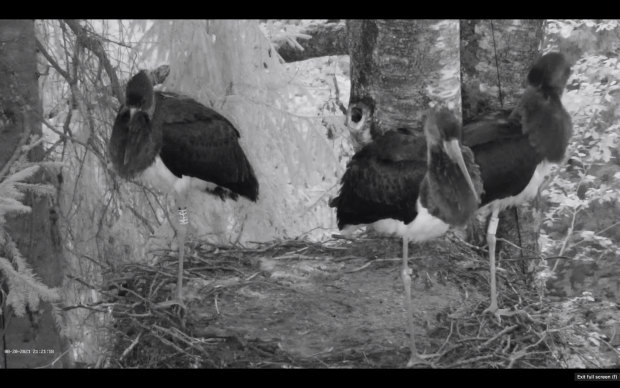
Jan fed the storklings at least once today. These birds, like those of Grafs, are almost ready to fledge. They will, hopefully, find the feeder area set up for them too!

It is essential that we all stay hopeful – for the six storklings and for Malin. Send strong positive thoughts to all these birds.

I took this at the tea time meal. Tiny Little did not have the fish, Big Brother 464 did but, she is waiting and hoping and so far White YW has been a great ‘Door Dash’ delivery.

Oh, this bird has brought us such joy. She is tenacious. I adore her.

Dad wouldn’t leave Tiny Little hungry and screaming her head off! It is three hours later, the last fish of the day probably, and here is Tiny Little filling her crop in the image. Oh, you are going to sleep well Tiny Little!

There have been rumours that some of the female Osprey in the UK – the ones on the streaking cams – have fledged. Today, Telyn, who was believed to have left since she had not been seen since Wednesday, turned up with a fish on the Dyfi Nest. So Telyn is still with us!

Mrs G is still on the Glasyn Valley nest. Oh, she is so stern looking! You can almost tell an Osprey female from the intensity of their gaze.

Disturbing news coming out of Maryland in the US today concerns two workers who needed to replace a light in a Southern Maryland Park. Actually it is outrageous. To do that, they removed two Osprey chicks from their nest and euthanized them. I know how to spell both words ‘disturbed’ and ‘angry’. The incident occurred at Cove Point Park. “County officials said they had a “cooperative services agreement” with the U.S. Agriculture Department’s Animal and Plant Health Inspection Service (APHIS) to have the ospreys and their nest removed. The commissioners said they were “not consulted or informed as to why or how the decision was made to euthanize the juveniles in the nest rather than relocate.” That last word is very significant – relocate. Relocate is not euthanize.

The Washington Post article is here. I hope you can open it. If not, Google the subject. There will be other news agencies picking up this story.

https://www.washingtonpost.com/dc-md-va/2021/08/20/two-young-osprey-were-removed-their-nest-euthanized-so-workers-could-replace-light-southern-maryland-park/?fbclid=IwAR2FK-kl_ATvumaLbvuTcOXd27F7GIywXTafm6Hh2MKm4FwaadqqW_O83PE

When the laws and agreements do not work, who advocates for the birds? The Audubon Society acted as advocates for Pale Male’s nest on Fifth Avenue. Maybe Audubon will go to work for these two?

If you find this as disturbing as I do, take a few minutes and fill out the form telling the Commissioners of Calvert County, Maryland what you think. Here is the link to the form:

https://www.calvertcountymd.gov/FormCenter/Contact-Us-Main-Homepage-8/Contact-Us-49

Always good for a smile or three are the two sea eaglets, WBSE 27 and 28. My goodness these two are so close in size and the bonking was at a minimal this year. They are well fed and healthy….and those pin feathers are coming in and they are both preening up a storm!

I have not been able to spend as much time with this family in the Sydney Olympic forest but I hope that might change. These two are growing slightly ahead of schedule it seems – their big clown feet match those crops. Just stop and look at those crops. They are so full they sag. Crazy. Dad and Lady are doing a fantastic job. So pleased.

The day is just beginning in the forest. Just look how big that sea eaglet is next to Lady! Wow.

I know that many have not watched this nest because of past things that have happened. I encourage you to check in this year. Lady is a more experienced mom and both of the eagles are healthy. There is no one getting the advantage over another. They are delightful.

That is what I want to leave you with this magnificent rainy day – a smile. Those sea eagles are adorable. Why not stop in and check on them? Here is the link:

Thank you to everyone for joining me. Please continue to send your positive energy to the Black Storks in Latvia and Estonia, to those storks and Ospreys migrating, and to little Malin. Malin really needs it. To my knowledge he has not returned and it is worrisome because the parents have been on the nest with fish today trying to lure Malin back. Malin is approximately 2 months and 2 days old.
Thank you to the following for their streaming cams where I took my screen shots: Collins Marsh Nature Centre, Byrwd Gwyllt Glaslyn, Dyfi Osprey Project, The Latvian Fund for Nature, The Eagle Club of Estonia, Sea Eagle Cam, Birdlife Australia, and The Discovery Centre, and The Cumbrian Wildlife Trust and the Foulshaw Moss Osprey Cam.

Malin, the Strong Little Warrior

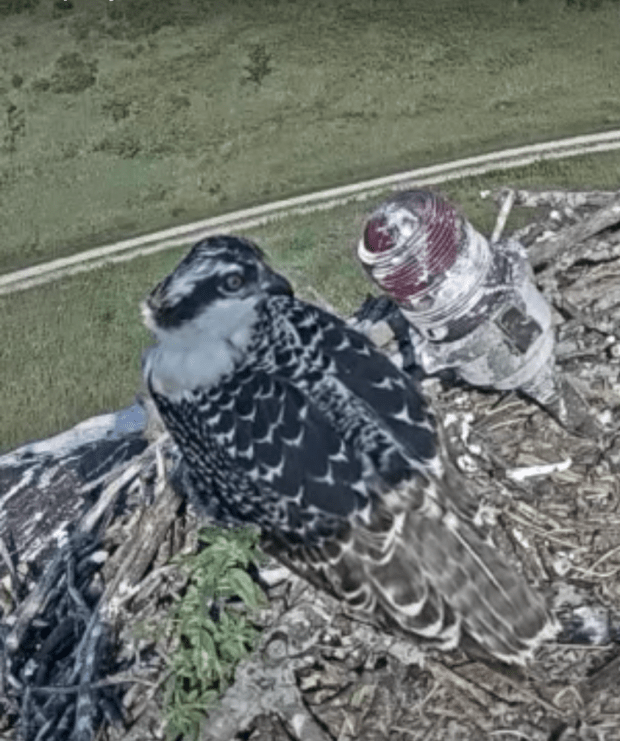
I reported earlier today that Malin, the Osprey chick on the Collins Marsh Nature Centre’s nest, had fledged. Malin flew off the nest at 3:42 pm.

We use the term ‘fludge’ when a bird accidentally falls out of the nest and flies. But what do you call it when a nestling is scared off their nest and flies?

For several minutes before Malin flew, his mother, Marsha, had been on the nest. She was watching and alerting. There was an intruder. Marsha even ducked on occasion. When Mom flew off the nest something happened to spook Malin. He had been pancaked. Malin had done this before. But this time, the intruder must have come near enough to the nest that it spooked Malin. Without thinking and scared out of his wits, Malin flew.

Here is a video clip. You can see the shadow of a bird flying at 10 o’clock – it is impossible to know who it was – at the end.

Malin was not prepared to leave the nest. He had been exercising his wings but he had never hovered. He really needed another couple of weeks to work his wings. His feathers were continuing to grow and he was catching up for his age but he was still behind. Today, Malin was 2 months old and a day – we think. He is the only one of three hatches to survive and it is not clear which hatch he was.

Mom immediately returned to the nest looking for Malin.

Collins, the dad, came in later with a nice piece of fish hoping to entice his son to the top of the tower. Collins did look over in the area of the trees and I am hoping he knew that Malin was there.

The nest is 120 feet up and I am told that flying up is much more difficult for a bird than down. Malin is not a sophisticated flier – could he make it to the top of the tower? Collins seems to think so. I hope he is right. Indeed, I hope that Malin is unharmed and makes his way home so that he can benefit from more food and more wing exercises.

This situation has heightened my call for all streaming cams to have emergency contact numbers immediately after the name of the site and before any historical or current information about the nest. That is so the numbers can be found quickly and easily. The minute this situation happened, the office at the Nature Centre was called. The message went to voice mail. At that instant a flurry of e-mails went out from the US and Canada to try and find someone who could go and look for Malin on the ground. FB Messages were sent. Luckily ‘S’ found the wildlife rehabber for the area, living 25 minutes away. By this time more than thirty minutes had passed, possibly 45. This individual listened to what had happened and got in their car and went to check on Malin. By the time they arrived it was getting dark. They reported that it was quiet around the marsh. Tomorrow this person will return and is hoping that Malin will be close by or food crying. Of course, it would be even better if Malin were sitting up on the nest or sleeping duckling style from all the activity. The three of us that named Malin are hoping that he lives up to the name he was given, ‘Mighty Little Warrior.’ Tonight we are anxious and fearful – all we can do is hope and wait. It will be a very long night.

For the past year I have been requesting that individuals responsible for streaming cams ensure that there is emergency information so that the community of birders watching these nests can contact someone – a responsible person who will provide assistance to the bird or animal – immediately. I realize that individuals do not wish to give out their private phone numbers. The park or nature centre with the streaming cam could have two dedicated cell phones only for emergency calls. Those could be provided to those in charge. Then they would not have to have their own numbers or phones used. The person at the end of that phone line would have their own list of specialists to contact for the specific emergency. It really is that simple.

The alternative is to have a 24/7 chat room with moderators who have emergency numbers. Moderators are volunteers. They do it because they love the birds. That is actually the simplest and cheapest way to handle emergencies.

The vast majority of individuals who watch the nests are bird lovers. If they see a tiny leg tangled in fishing line they want that bird to get help. If they hear a chick fall off a nest into water, they want to help. If they notice nestlings behaving strange, having tremors, refusing to eat, they want to fine someone who will listen and help. This year all of these things have happened, some many times, and it was thanks to the community birders that help came. Sometimes people did not listen to the alarms set off by fifty or more persons watching two eaglets on a nest in Florida. They were behaving poorly. One died. Then the second. The person who set off the first alarm said ‘rodenticide’ – and they were correct. Community birders are not quacks. Many have watched nests for more than a decade. They are informed and they want to help. They do not want to waste anyone’s time.

Thank you for sending your prayers and your warm wishes to Malin and to the boots on the ground who are trying to find him and care for him. Thank you for listening to my call for a solution so that help can come to the birds immediately when something happens. If you are in charge of a streaming cam or know someone who is, please talk to them about having emergency numbers or 24/7 moderators on the chat who can get in touch with the right person if something comes up. It is really important. Thank you!

Thank you to the Collins Marsh Nature Centre and the Cumbrian Wildlife Trust and the Foulshaw Moss Osprey Nest for their streaming cams where I took my screen shots and my video clip.

I plan to bring an updated report on the Black Storks in Latvia and Estonia later tomorrow. There is still someone who can pull at my heart strings even when I am so worried about Malin and that is Tiny Little! It is 6:30 on her nest in Cumbria and there she is having her breakfast fish compliments of White YW. Thank you, dad. Thank you, Tiny Little. You give me hope for Malin tonight.

Send love and positive energy to Latvia and Estonia

I want to begin with the Black Stork nests today. For those just learning about the situation of the Black Storklings in both Latvia and Estonia, here is a very brief summary. The storklings at the nest of Grafs and Grafiene in Latvia and that of Jan and Janika in Estonia are late hatchlings. There was concern from the beginning that both parents might leave for their migration before the storklets fledged. Currently, the mothers have left and the fathers, Jan and Grafs, are the sole providers. Neither male can provide enough food for three storklings to thrive. There is also a question of the supply of the fish. In both Latvia and Estonia, feeder situations have been established with decoy female Black Storks. To date, neither male has found these feeders.

‘S’ in Latvia reports, “The good news is that it seemed that yesterday Grafs had encountered a generous feeding place on the way, not so far away. We were already a bit sad thinking that the storklets will have to spend another day with just one small noon feeding, what a celebrated surprise it was when he came back less than 4 hours later with plenty of food. Many of us bursted into happy tears:) It is good to know that he can still manage to get food elsewhere even if it is not from the feeder. And the most important thing is that he is still here caring for his young.”

aGrafs and Grafiene’s Storklings, Sigulda, Latvia 19 August 2021

At the very beginning, M. Strazds, a Latvian Black Stork specialist, warned that he felt that there was only 0.1% chance that Grafs would find the feeder because birds do not normally search for new feeding spots at the end of the nesting season. Still, as I understand it, the storklings, once they fledge, will find the feeder and it will be very good for them.

In Estonia, Jan has made only one delivery that I am aware of. The storklings have supplemented that with the fish that Urmas delivered last night. I was made aware that the storklings were playing with the fish but, it appears now that they have been eating them as the pile of fish is almost gone as I write this. I am aware that there are controversies about the effect of humans getting close to the nest because of the stress that it causes on the birds. But starving is also a major stressor. I believe that Urmas and his team know what they are doing and I hope they continue to feed these birds.

Jan and Janika’s Storklings, Jegova County, Estonia

There is one other nest with a fledgling, Pikne, the female, still being fed by a parent and that is the nest of Karl and Kaia in the Karula National Forest in Estonia. ‘S’ reports, “The feeder approach has been very successful with Karl’s nest in Karula for the sole reason that he has a transmitter and it is possible to track his usual feeding places.”

Pilkne, the last remaining storkling being fed by Karl II at the nest in the Karula National Forest in Estonia. The other two have fledged.

It has been a very difficult year for those who care for the birds and who watch the streaming cams. Osprey chicks died due to weather related issues and Cooper’s Hawk eyases got so hot on the nests in Canada, they lept off the nests to avoid literally being roasted. Many are dying as they undertake their migrations which are challenging enough without having fires and smoke enroute.

At the same time, there have been some remarkable situations. Around the world, humans have stepped in to save birds of every variety. In the interior of British Columbia, the wildlife rehabbers climbed the Osprey nests and removed the chicks taking them into care because of the extreme heat and fires. At various places around the world, Osprey chicks have been fostered and received a second lease on their life. A Canada Goose named Arnold had his digits fixed so that he could live a full life with his mate, Amelia. A very old Bald Eagle full of lead was given treatments and is now thriving and waiting for A Place for Hope to get its permit so he can be their ‘forever’ bird. Every day I read about a group of people and trying to help fix what many believe is unfixable. I hope that this is just the beginning of a change in intervention and our understanding of what works and what doesn’t. The key is not to give up.

There are, however, three miracles. I am thinking of the three Ospreys that should have died but did not – they have thrived – two of them to become dominant on their nests! Those were Tiny Tot aka Tumbles at the Achieva Osprey Nest in Florida and Tiny Little Bob aka Blue 463 on the Foulshaw Moss Nest in Cumbria. To me these are simply nothing short of a miracle.

Tiny Little Bob aka Blue 463, Foulshaw Moss Nest, 19 August 2021

The third has yet to fledge but has shown remarkable growth. I am aware that many on the chat rooms in Latvia and Estonia are concerned about feather growth. This was also a big concern for Malin on the Collins Marsh Nest in Wisconsin. Malin is our third miracle.

Malin, Collins Marsh Osprey Nest, 19 August 2021

I cannot tell you what happened to make the food deliveries on this nest turn around. All I can say is that they did and there are no more missing feathers, the tail now has 7 dark bands when 3 weeks ago there were 2 with the hint of a 3rd. It has been a remarkable recovery. At one time, there was concern that Malin might survive but not be able to fly. Those concerns have now vanished. Today, Malin has had 3 fish deliveries before 1pm and one of those was a whopper. Malin actually walked away from being fed by mom, Marsha, he was so full.

One of the major concerns for the Collins Marsh Osprey Nest is that the parents would also leave Malin on the nest and begin their migration. So far everything is going smoothly so I will just ‘knock on wood’ that it continues to be that way.

One other good news story is that the fires in Turkey are dying down or are out.

And there is more. Aran, the mate of Mrs G on the Glaslyn Valley Osprey Nest, was injured and was missing a couple of primary wing feathers,. There was a huge concern that he would not be able to fly — and consequently that he would not be able to fish or be able to migrate. Well, look at Aran’s feathers today! Yahoo. He is good to go. Tears. This is an amazing couple who lost their three chicks due to starvation when Aran was injured. The Glaslyn community kept the birds alive with a fish table until Aran was able to fly and fish.

Indeed, I do not want people to think that feeder areas or fish tables do not work. It depends on the circumstance and in the case of Aran and Mrs G as well as the Mlade Buky White Storklings, those fish tables saved the lives of those two families.

Aran at the top sitting on edge of nest! 19 August 2021.

We have a lot to be thankful for – and there is a lot of work to do to figure out how to help our precious birds – all of the wildlife. Humans stepping up to take responsibility and to “try” even if they are met with low odds and negativity should be the norm not the exception.

What can you do today to help the birds and all of the wildlife?

I want to close today with a bit of a giggle. If you watch Ospreys you understand how difficult it is for both the male and female to raise three. Actually that is true of eagles as well. Well, what about five? Now consider the fact that those five are all female. The poor dad would need a set of sound cancelling headphones!!!!!!!!!! You can hear females clear across a lake. Oh, my. The parents of these Westport, MA fledglings will certainly deserve their winter break.

Thank you for joining me on this quick update on what is happening in Latvia and Estonia. Send them all of your positive energy – and take care.

Thank you to the following for their streaming cams where I took my screen shots: Collins Marsh Nature Centre, Cumbrian Wildlife Trust and the Foulshaw Moss Osprey Nest, the Eagle Club of Estonia, the Latvian Fund for Nature, Brywd Gwyllt Glaslyn and the anonymous reader of my blog that sent me the image of these five beautiful female Ospreys. Thank you.

Fish delivered to the Estonian storklings!

There are some very interesting developments going on in Estonia with the Black Storklings of Jan and Janika. On the 18th of June, Jan fed the storklings one time. He has not found the feeding pond, dug especially for him, with the decoy of Janika but, a Blue Heron has!

@Forum of the Jergova Black Stork Nest in Estonia

After dark, Urmas and a helper delivered a pail of fresh fish for the three storklings. You can see the pail that he is holding and all of the fish that have been poured onto the nest. Urmas was hoping to clean up the old fish with a branch but he did not because it could harm the storklings or the storklings might bite him. Everyone is doing an amazing job to make sure that these three rare Black Storklings will live and fledge! I cannot imagine another thing that Urmas and his team could possibly do for these beautiful young birds. Thank you Urmas!

@ Eagle Club of Estonia and the Form of the Black Stork Nest at Jergova

After Urmas has left, the storklings went back to sleeping. They will wake up to a fine meal.

@ Eagle Club of Estonia and Black Stork Nest Forum at Jergova

Grafs has delivered two feedings to his storklings at the Siguldas Latvian nest. They were so hungry and so glad to see him for the second feeding. We can only continue to hope that a miracle happens and Grafs finds the feeder with all of the little fish. This nest is not stable like the one in Estonia so no one can climb with a pail of fish and deliver them.

In stark contrast, Malin, the Osprey in the Collins Marsh Osprey Nest has a crop that is so big that it looks like it could pop. I have seriously lost track of all the feedings today, the size of the fish, and what might have been left from last night.

This Osprey chick has not seen so much food in its entire life! His system has adjusted to eating more fish. Originally, Malin would eat and then stop before he had a crop. Now he eats and eats as much as he can.

Marsha has flown in and is feeding an already full Malin that fish that was on the nest.

A few minutes ago, around 4:20 nest time, Malin still has his crop and Mom is looking pretty good, too. I wish there was someway to measure Malin. He looks like he is twice as big as he was at the beginning of the month with much more feather development.

By the size of the feet most people would say Malin is a little male. I know when the banders ringed Tiny Little on the Foulshaw Moss nest they could not tell if Blue 463 was a male or female. That was because of the lack of food. And that is precisely the problem with Malin – a lack of food might trick us. Malin could be a female but my ten cents worth is on a small very handsome male.

Don’t you just love how those wing feathers are crossing over the tail? This chick has been such a worry but it feels like that anxiety is all gone. Let us hope that the good feedings keep up for all three of the birds – Marsha, Collins, and little Malin. We want them healthy for their migration.

Ha, ha. My friend, S, in Hawaii just sent this picture to me – the one below. She is calling it the ‘Battle of the Bulges’. ‘My crop is bigger than your crop!’ Too funny. It is so nice to be able to relax and laugh. For so long we thought Malin was doomed but wow. I wish this kind of happiness for the Black Stork nests.

There is something troubling brewing. EC from France has posted images on FB of the fire, now four days old, burning the Massif des Maures in France. It is a huge mountain range. This is the worst fire in that area in 20 years he reports.

@ Eric Calvete
@ Eric Calvete

The fire is in the area with the red teardrop marker.

Google Maps

Here is the map showing the two main routes of the European birds. You will see on the top left that the birds from the UK normally fly over France, through Spain and across the Straits of Gibraltar and then the Sahara and Atlas Mountains. This is an extremely challenging journey. If they stay west in France, they will miss the fires currently burning at Massif des Maures. The good news is they should. The Eastern routing through Turkey and Greece still has major fires burning and is causing much difficulty. You can see how the arrows in the dark green – from The Netherlands to Latvia and Estonia converge and go through both Greece and Turkey to reach Africa.

We are told that the heat we are experiencing will now not go away. I hope that if that is the case our birds make adjustments to their schedules.

@ Open University

Some quick news from other nests:

NC0 is still feeding her fledglings at the Loch of the Lowes. LR2 snagged a really nice fish delivery from mom. So this is one female who has not started her migration.

Idris has been feeding Dyssni and Yestwyth at the Dyfi Nest in Wales today. Telyn has been seen so she has not left on her migration despite earlier reports that she might have.

All three chicks were on the Foulshaw Moss Nest. It looked like 464 had snagged the fish delivery with the other two waiting to see what happened. I have not seen Blue 35 and I do not know if she has departed or is just allowing White YW to do the feeding duties while she fattens up for migration.

Maya was caught on camera at the Rutland Manton Bay nest yesterday. Will continue to monitor her whereabouts. Both chicks, 095 and 096, are at Rutland.

There is our beautiful albeit somewhat grumpy looking Tiny Little on the right. It was nearing 7pm at the nest. Her crop looks good. Gosh she is a big bird! That look reminds me of Mrs G. So stern. That also makes me think she is a female!

It is always nice to see Tiny Little with a crop! And that is a good place to close for today. I hope everyone is keeping well. Sending off prayers and warm wishes to the nests and people in Latvia and Estonia and to the birds trying to make their way to their winter homes.

Thank you to the following for their streaming cams where I took my screen shots: The Cumbrian Wildlife Trust and the Foulshaw Moss Osprey Nest, The Scottish Wildlife Trust and the Loch of the Lowes, Collins Marsh Osprey Nest, The Eagle Club of Estonia, The Latvian Fund for Wildlife.

Happenings in Bird Land. 17 August 2021

Our sky is very overcast this morning and, for one of the first days, our temperature will not go over 29 C which is the same as it is in the Caribbean. It is not surprising that the summer flowers, such as Jasmine and Hibiscus, are thriving while the others meant for bees and butterflies are having a difficult time with it even with watering. So far I have gathered 5 one-gallon pails of blossoms off this Hibiscus and dried them for tea. It has been a bumper crop.

Sweet little Malin slept on his fish. Smart little one. Perhaps that is how to keep leftovers if you are afraid that someone will steal your food! Malin ate it for breakfast and then, at 10:17ish, Dad made a delivery.

Sometimes Malin bites Dad’s toes. It is a good idea to drop that fish and get away fast!

Malin protecting his little fish while Dad flies away.

We are keeping a close eye on what is happening with the Black Storks in Latvia and Estonia and I am very grateful to ‘S’ for helping with this. In Latvia, Grafs made a fish delivery at 12:04:43.

The storklings had one feeding yesterday but four feedings on the 15th. It is hoped that more fish will come to the nest today.

One of the birdwatchers in the area and a good friend to this nest, BK, purchased a white decoy and has spent their time painting it to be Grafiene 2. This decoy was installed on the morning of the 17th to try and lure Grafs to the fish table.

Anyone who lives in duck hunting country will know that the use of decoys to attract birds can be very successful. We hope that Grafs smells the fish donations and sees Grafiene 2.

Some of you might be wondering why they do not climb the Black Stork nest near Sigulda. The simple answer is – it is not safe to do so. The nest is mostly made of peat and the birds could from their movements and jumping cause that to break off. Human disturbance would cause the same issues. It is also a very old tree and not strong. Everyone is doing everything that they can. After the feeding at noon heavy rains came to the area.

One development is that the eldest storkling is now branching. You can see that in the image below.

This Black Stork nest is very special to the people of Latvia as are these miracle storklings. ‘S’ tells me that there was no successful nesting here in both 2019 and 2020. This year no one thought that Grafs would attract a mate to the nest – especially so late in the season. No one would dare to think that there might be storklings for fear that something would happen. But there were eggs and they did hatch and look at these beautiful trio. Sadly, around the nest the area of the forest and adjacent areas have changed so much in the past couple of years that finding food for a family here can be difficult. Everyone continues with hope that Grafs will find the fish table. As I have said so very often, human encroachment and human impact on the climate are causing wildlife irreparable harm. Providing food for the birds now and in the future is the least we can do.

In Estonia, Jan has brought in three big fish for the trio at 11:01:17. He made a second trip to the nest at 15:09:18. In between, the storklings have been picking at the old fish on the pile. They were so full that they did not eat one of the big fish that came to the nest. Sadly, that fish fell off.

In other Osprey news, Telyn is still at the Dyfi Nest and has not left for her migration. She delivered a nice size fish and Dysnni was the taker! Some had thought he might have left the area but he hasn’t. Maybe Idris will get something for Ystwyth who looks on – no doubt she had hoped to nab that fish.

And here is Ystwyth, Blue 491, with her fish:

Beautiful Telyn or Blue 3J is a great provider for her two fledglings just like Idris.

Dysynni, Blue 490, flew up to the branch to eat his fish. Everyone always talks about how messy Idris is when he eats well, his son is just like him!

Dysynni has managed to eat the flesh of the fish and leave the tough skin. Bravo – but still messy! BTW. Dysynni is 89 hatch days old today, the average age of the males fledging off the Dyfi Nest in Wales.

You could hear LR2 on the other side of the Loch of the Lowes she was food crying so loud. There is no getting away from the fact that a fish is wanted! NC0 came in with a nice one. So, if anyone is wondering, NC0 has not left for her migration either. Historically, the 18th was the latest that she has left but, perhaps, the birds, hopefully, understand the weather along the migratory route and they will stay in place. As long as there is food, why leave? wait a couple of weeks. LOL. As if I can read an Ospreys mind!! I do hope they can wait.

Lucky! That is a nice fish and this chick doesn’t look like it is starving. That is a pretty nice crop.

These birds have turned out to be strong and healthy. Laddie and NC0 did well.

To close the day off, it was wonderful to click on the Foulshaw Moss Osprey nest and see Tiny Little, Blue 463, eating a really nice size fish! It was 18:40. It could be the last one for the day.

But, the icing on the cake was the receipt of my ‘Iris pen’ just a few moments ago in the post! It is Choke Cherry and is absolutely gorgeous. You can refill with any Cross Cartridge. What a fantastic fundraiser. Thank you Montana Osprey Project! My picture does not do this beautiful pen justice.

Thank you so much for joining me today. Please continue to send your warm wishes and prayers to the very precious Black Stork nestlings in Latvia and Estonia. The people there are doing everything they can to take care of these precious birds. I am continuing to monitor the fires in Greece. There are two new ones. Those fires impact the migration of the birds already on their way. There is a very sophisticated system using magnetic fields and Quantum Mechanics that our birds use to get from one place to another. If you want to read about it, one of the best books is A World on the Wing. The Global Odyssey of Migratory Birds by Scott Weidensaul. I just want them to stay put if they can! Take care everyone. Order you Iris pen if you didn’t! See you soon.

Thank you to the following for their streaming cams where I took my screen shots: Collins Marsh Nature Centre, The Eagle Club of Estonia, The Latvian Club for Nature, The Dyfi Osprey Project, The Cumbrian Wildlife Trust and the Foulshaw Moss Osprey Nest, and The Scottish Wildlife Trust and Friends of Loch of the Lowes.

Monday in Bird World

There is some sad news coming in from the Kakapo Recovery. During routine checks, Tutu was found dead. He hatched in 2019 and the team says he was quite ‘the character’. This brings the total population of Kakapo in the entire world to 201.

Photo of Tutu @ Petrus Hedman Kakapo Recovery FB

The news coming in is not all bad but, it could be a lot better. I reported that Grafs had provided two feedings for the Black Storklings on the nest near Sigulda. As it turns out, after I posted my newsletter, Grafs returned two ore times making a total of four feedings on 15 August. The team are hoping that Grafs will find the feeding table. If Grafs does and accepts the food, this nest could turn around quickly! At the present time the storklings are in a critical condition.

This is the news from Janis Kuze:

“I can report that fish were let into the feeder last night, the place is a few hundred meters from the nest and is easy to see from the air, but the bird still has to find it.
Thanks to everyone who provided support!”
Jānis Ķuze

Grafs arrived with some larger fish for the storklings at 14:47. He has yet to find the feeding table. Some are thinking that it might not be in his territory. There is a discussion about putting a decoy black stork to attract Grafs.

A feeding table has also been set up for the Estonian Black storklings of Jan and Janika. I understand a decoy – a White Stork decoy painted black – is at that table to try and lure the male to the fish for the storklings.

Yesterday I said that the storklings had eaten all of the fish. That was incorrect. They have been stomped into a pile but the Estonian storklings are still eating from them today and they have had a feeding from Jan. You can see the remaining fish today on the back left of the nest. Thankfully the nestlings are eating from them. If you look at their bills they are still a dull colour which is good. They are also not getting stress lines in their feathers like the storklings of Grafs. Stress lines are translucent feathers caused by all manner of stresses not just lack of food. Regular growth in feathers is not translucent.

Here is the link to the streaming cam of the Black Storklings in Latvia:

Here is the link to the streaming cam of the Black Storks in Estonia:

If you want to keep up to the minute with what is happening at either or both of these nests, please look under the information of each streaming cam. You will find the link to the English forums.
Please be mindful that these are extremely difficult times for the moderators and helpers on the chats and the forums. These two nests showed great promise – the best – and as I have said many times — the fate of our birds hangs on a fragile piece of thin thread. It can change any moment. The biologists and vets are doing everything possible. We need for the male storks to find the fish tables. Send your warm thoughts to all. The little ones need a miracle.

UPDATE: It appears that Jan has found the fish table. He has flown in and brought 2 very large fish to the nest in Estonia. There are also fish left there from the bander! Great news. Let us hope this continues and now we just need Grafs to find the fish.

And now on to some rather silly news. Blue 462 at the Foulshaw Moss Osprey Nest in Cumbria, got the breakfast fish. And, of course….Tiny Little was right there making sure her big sibling could not eat in peace. Tiny Little is giving them back what they gave to her as a youngster in the nest!

Tiny Little loves moving around the sticks. It is really disturbing to the one who is trying to eat.

One of the cameras got knocked but what it did was give us a nice close up of all those sticks Tiny Littles moves and returns, moves and returns.

There were others wanting some of that fish – those pesky crows who seem to be around, too.

Tiny Little kept running at the crows to get them to go away but finally, it was 462 that flew away leaving Tiny Little that great big fish all to herself. Do you think Tiny has enlisted the crows to help her? with the promise she will leave some food? Normally, Tiny Little is like a vacuum cleaner removing every piece of fish!!

In the image below, 462 has just flown off the nest. Tiny Little is moving towards that big fish she is going to have for breakfast.

Tiny Little spends some time making sure the siblings and the crows are not going to bother her. At one time or another the crows were climbing and flying around that part of the nest. But never mind. Tiny Little started 16 August off with a nice big crop. Well done Tiny Little.

It’s now 17:30ish on the Foulshaw Moss nest and Tiny Little is there calling White YW for food along with another sibling. It looks like 464 to me but I cannot catch the band number. Tiny Little is the fledgling at the back.

Tiny Little is such a character. She is one of the good news stories of the year for sure! I really hope that when she returns to raise her family it is on one of the nests with a streaming cam.

Do you recognize this view?

That is the scrape box for the Collins Street Falcons in Melbourne! and the YouTube channel is up and running. This is fantastic news to all of us that have waited to see this couple and their eyases again. Dad is just the cutest.

Both parents are working on the scrape box. That is mom in the image below.

Here is the link so you can be in on the action from the very beginning:

It doesn’t get any cuter nor any happier than the little sea eaglets in the nest on the old Ironbark Tree in Sydney’s Olympic Park.

Both of them are thriving! That is 27 facing us with its big crop and 28 is still eating.

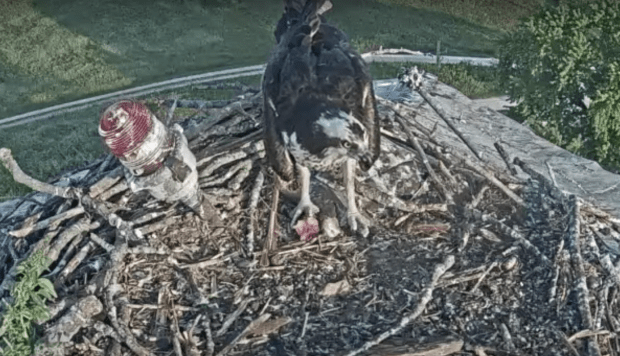
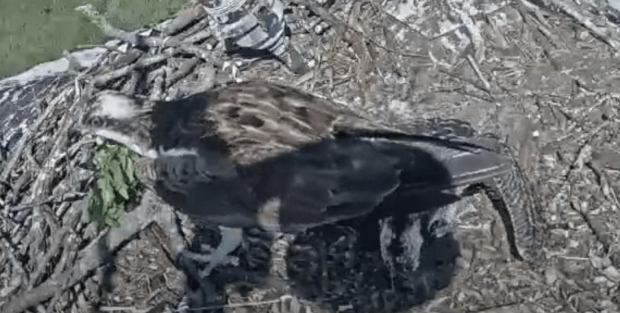
Yesterday, Malin went to sleep with his head on a fish and another whole Bullhead on the left side of the nest. He woke up this morning and finished off the “pillow fish” and Marsha flew in and fed him and ate a lot of the Bullhead herself.

Malin has a nice big crop! Mom is getting some fish and that catch did not go to waste. And that is a good thing.

Thank you so much for joining me today. This newsletter comes about six hours earlier than I expected. It is nearly 100 degrees F on the Canadian Prairies and the birds are in hiding. No photography until later. I will continue to monitor the two Black Stork nests and bring updates. Send your prayers and your warm wishes to those two Black Stork nests. They need a miracle to get the males to accept the fish! Bukacek did so we need Grafs and Jan to do the same!

Thank you to the following for their streaming cams or their FB pages where I took my screen shots: The Kakapo Recovery FB, Collins Marsh Nature Centre Osprey Cam, Sydney Sea Eagles, Birdlife Australia, and The Discovery Centre, Cumbrian Wildlife Trust and the Foulshaw Moss Osprey Nest, 367 Collins Falcons, The Eagle Club of Estonia and The Latvian Fund for Nature.

Fishy Dreams and Fish Tails

Today, the Collins Marsh Osprey chick, Malin, had six fish deliveries. SIX! Feel free to correct me but I don’t ever remember this much fish on this Osprey nest. Ever.

In fact, there was so much fish with deliveries coming in on top of one another that Malin simply could not eat all the fish. There is a bullhead left – it is on the left below the light. Malin is sleeping on half of a bigger fish. What a grand pillow for an Osprey. He can have fishy dreams all night! And, Malin can wake up in the morning and not have to wait for a fish delivery.

Fish. It makes all the difference in the health and well-being of our Ospreys and Storks.

In the image below, the setting sun puts a soft glow over our little one. Please note that the big feathers are now beginning to cross. Malin is also standing and walking more and is flapping his wings much more often to get them strong for flying.

A month ago there was concern that Malin would not develop his plumage and would be unable to fly successfully off the nest. Now just look! Food – the right kind of food and the amount of it – makes all the difference in the world in Malin’s development.

Malin is miracle #3 for 2021.

Here on the Foulshaw Moss nest, Blue 463 or Tiny Little Bob, is eating the fish her dad delivered. White YW would have heard her several miles away screaming for fish. Blue 462 had gotten the earlier fish and Tiny Little wasn’t liking it. Dad came to the rescue! Indeed, White YW and Blue 35 should get a round of applause. They pulled off a nest of three fledglings this year. They did not lose a hatch.

The crows are hoping that Tiny Little will leave some bites for them! I don’t know. She is a bit like a nest vacuum when it comes to food falling between the twigs!

Tiny Little is miracle #2 and, of course, miracle #1 is Tiny Tot from the Achieva Osprey nest in St Petersburg, Florida. I am certain that there are others that will come to mind when I publish this newsletter. For now, however, these three were enough to cause lots of anxiety.

I did a Sunday hop-skip-and-jump through some of the UK Osprey Nests to see if anyone was home. This is the Dyfi nest in Wales of Idris and Telyn. On the nest is Ystwyth, their daughter. Telyn is on the nest perch and Idris is on the far perch.

Idris and Telyn together. How beautiful.

Does he need an introduction? The chick on the Llyn Clywedog Osprey Nest, Only Bob? Only Bob was so big when he was ringed that everyone believed him to be a large female. Nope. It is just all that fish that Dylen and Seren fed him. My goodness did Blue 496 grow.

He has spotted Dylan flying in with a fish. We are so lucky to see this. Indeed, to see so many of the UK fledglings on the nests today is fantastic.

That is a gorgeous fish for dinner. Only Bob looks pretty excited.

Watch out for your toes Dylan.

Only Bob learned well despite the fact that he was the only chick on the nest. He is excellent at mantling. But, stop, and take a look at that tail and the size of those wings. I would be ever so grateful if Malin’s was half that size when he fledges.

Oh, let’s just move this beauty over here so I can eat it!

At least one of the chicks on the Loch of the Lowes has a huge crop. It is so big, it looks like it could pop. The other is hoping for a fish delivery. Of course, neither is showing us their pretty blue bands.

NC0 and Laddie have done an amazing job raising these two. NC0 has really moved up to be one of the females that I want to watch. She is becoming super mom. She can fly and haul fish to the nest just like Iris – and she isn’t afraid to do it!

Grafs was able to find enough fish for two deliveries today. The first was a bunch of small fish at 15:29 and the second came at 19:41 with some bigger fish. The storklings are starving. They are already beginning to show the signs of malnutrition.

Grafs makes sure he moves around so that each one gets a little something.

It was mentioned that not only the sunken bodies but also the fact that the bills are turning a bright colour indicates starvation.

Once the people watching these nests realized what was happening, they became very vocal in their demands that the birds be fed. Everyone knows about the fish table that the two engineers set up for the White Storks in the village of Mlade Buky, Czechoslovakia. The people demanded that their storks be fed and the wildlife staff heard them. After seeing only one feeding by 15:00, Janis Kuze wrote the following on 15 August 2021: “It may be necessary to support the operation of the feeder – to bring live fish there regularly (once a day or two). I will write about it in the coming days.”

Liz01, the moderator of the looduskalender.ee/forum (English forum for the Latvian Fund for Nature and this Black Stork Nest) posted this notice:

“Due to the fact that the female has not been seen in the stork nest for several days, she has probably started migrating, opportunities are being sought to artificially feed this nest. Currently, the only feeder is the male, whose capacity is too small for the young birds to be successfully.
One way of trying to help the inhabitants of this nest is to set up an artificial feeder. There is one ditch near the nest where it can actually be done. Ornithologist Jānis Ķuze is ready to take over the management of this event, but he needs the help of the society. Therefore, we are looking for:
1) people on the Sigulda side who would help to set up a feeder,
2) human or fish feeders on the Sigulda side, which would be willing to donate and / or catch small fish (they must be still alive), with the possibility, to put these fish into the feeder, thus regularly
replenishing fish stocks in the feeder a third person or another link in the chain).
If anyone has the opportunity to help with this event, please send a message to Jānis Ķuze by e-mail: janis.kuze@ldf.lv.
This is currently the only real way you can still try to help the young birds in this nest survive and fly successfully! It is not known whether it will work, but we think it would be better to try not to do anything and just watch.”

Immediately, there were too many offers to help the Black Storklings and Grafs. Tears. People are so generous. All we have to do is ask.

If you wish to follow the discussion about what is happening at this particular nest in English, please go here:

When I have news of what is happening at the Estonian Black Stork nest, I will let you know.

You can watch the Black Stork Nest in the forest near Sigulda, Latvia here:

We all send our prayers and warm wishes to these beautiful birds and the people helping them. We need a miracle like that at Mlade Buky.

Thank you so much for joining me. It is wonderful to bring you such good news. Please send all your positive energy to Latvia and Estonia so that the efforts to save the Black Storklings from starving to death will be successful. It is heart warming to see so many people answer calls for help.

Thank you to the following for their streaming cams: The Latvian Fund for Nature, the Collins Marsh Nature Centre, Dyfi Osprey Project, Cumbrian Trust and the Foulshaw Moss Osprey Nest, Scottish Wildlife Trust and Friends of Loch of the Lowes, Llyn Clywedog Osprey Nest and CarnyX Wild, and Bywyd Gwyllt Glaslyn.

Just a note. My newsletter will be posted late on Monday 16 August. Thank you!

Worries…and Hope for the Black Storklings of Latvia and Estonia

Sometimes the good news in our Bird World gets suppressed by horrific news or concerns – and in that moment, we begin to lose hope that anything is being done to protect our feathered friends. Today, we are going to start off with the worrying news and end with some really positive happenings.

The real worry centres around one word: migration. Normal migration brings enough troubles to the birds – winds, lack of prey, predators but this year underneath that big umbrella of migration are two other concerns: the wildfires that are impacting birds already in the midst of their migration and those who will be starting their journeys to Africa from Europe and the UK and the late hatches. For those of you that do not know, the fires around the Mediterranean are causing birds to fall dead from the sky or to go into care for smoke inhalation. It is heating up in France and Spain with record temperatures. High atmospheric pressure is fanning the heat. It is extremely dangerous for the birds to fly through the fires to reach their winter homes. The second worry are the birds that were born late – some three to four weeks after the others. Will their parents stay and feed them? or will they die on the nest? will the father who remains while the mother has already left be able to find enough food for these large birds nearly ready to be on their own?

The latter issue is pressing down on stork nests in both Latvia and Estonia. We have had the pleasure of watching Grafs and Grafiene feed their three Black storklings on the nest in the forest near Sigulda.

Grafiene last came to the nest to feed her babies on 13 August. The Storklets were normally getting 10 feedings a day. On the 13th of August they had four feedings but, on the 14th, the next day, there were only two. It is, as we all know, extremely difficult for one parent to maintain the level of feeding when they are also preparing for migration. There is fear in the Latvian community for these beautiful birds.

My friend ‘S’ in Latvia advises me that through the efforts of the community – the calls for help for these birds – the ornithologists in charge of the area have set up a food table for the father near to the nest. This is very similar to the help given to Bukacek in Mlade Buky when the female was electrocuted. Let us hope that Grafs will accept the food and feed his nestlings. They will not be ready for fledging for at least another two weeks. Please send your warm wishes for these beautiful birds that they survive.

You can follow what is happening at the nest of Grafs and Grafiene here:

At the Black Stork Nest in Jegova county in Estonia, the storklings were fitted with satellite transmitters late on 13 August. This is the nest of Jans and Janika. The banders left a pile of frozen fish on the nest that they hoped would last a few days. Janika was last seen feeding the storklings on 6 August. The father has managed to bring some big fish to the nest but ‘S’ tells me that these fish have been difficult for the nestlings to eat because of their size.

Two things you will notice in the image below taken on the 15th. You can see the transmitters on the legs of the three storklings but you will not see a pile of frozen fish – the storklings ate all of the fish provided! This is wonderful news and gives one hope that the efforts of everyone in both Estonia and Latvia will prevail and the six rare Black storklings will fledge and survive to return to their home countries.

Here is the link to this nest:

The pandemic which began in 2019 and continues to take lives around the world also contributed to some projects that have brought much hope in regard to the natural world and our bird friends. James Aldred, an award-winning documentary filmmaker was given an assignment to document a family of goshawks living in the New Forest. The New Forest is in Hampshire in southern England. It is the largest area of forest and pastures in England consisting of 71,474 acres.

The natural landscape of the New Forest consists of areas of open fields and heavily treed forest areas.

“New Forest Landscape” by davidgsteadman is marked with CC PDM 1.0
“New Forest – River At Mill lane Brockenhurst 2” by Chalkie_CC is licensed under CC BY-NC 2.0

Aldred was there to study the Goshaws who are medium large raptors that live in the forest. They are larger than the Sharp-shinned hawk that comes to my garden and the Cooper’s hawks that I see at the park but they are significantly smaller than eagles. They are known to be fiercer in temperament than the Sharpies or the Coopers. Because they live in the forest very secretively – not liking to be around humans – they are often hard to find. Stealth hunters they are known for their excellent flying skills seeking out both bird and mammal.

The females are, like other raptors, larger than the males. The couple build a very large nest in trees using twigs where the female will lay between 2-4 eggs that are incubated for a period of 28-38 days. Fledging normally takes place after 35 days.

So what was our documentary filmmaker doing with the goshawk family in the New Forest? Aldred spent 15 hours a day in a tent recording the comings and goings of the goshawk family. He created lots of notebooks about the intricacies of their lives often unseen by humans. Aldred said it was like going back in time a thousand years. There was silence in the New Forest which is normally underneath the flight paths of thousands of airplanes every day. He said what gives him hope is that “Very soon after humans deserted the forest last spring, wild animals started reclaiming it.” In addition to the goshawk family, deer, badgers, and fox cubs came out to play.

“Stag at Bolderwood, New Forest National Park” by Chalkie_CC is licensed under CC BY-NC 2.0

“The sheer emptiness of the place…It felt weird, being out there in that paradise on my own.” What he saw and experienced is now in the book, Goshawk Summer: A New Forest Season Unlike Any Other.

The brilliant take away from all of this is that once pandemic restrictions were eased people flooded the area with what Aldred calls their ‘pandemic puppies’ killing and scaring away the birds whose nests were on the ground. The arrival of so many humans scared all of the animals back into hiding and leading their lives in a very different way than during the period when no persons were allowed into the forest. The Forestry Commission listened to Aldred about managing visitor numbers and the woodland paths so that the animals would not be harmed by humans who visit the area.

Each of these stories brings us hope and encouragement. I am delighted to hear that the ornithologists -after hearing from so many people – are providing food to the storklings. It is hoped that those in Estonia will return and place more fish on the nest or nearby for Jans. That nest is wide enough. The Latvian nest is problematic because it is too narrow and might collapse if someone tried to place fish directly on it. Let us hope that the feeding continues and that it is successful.

We also have a late hatch – little Malin at the Collins Marsh nest in Wisconsin. So far, Malin has had only one fish and that was delivered by Collins around 8am. I really hope that he is going to get enough food today. This is another nest that needs someone to supply fish for the family because of the drought and heat that has happened.

Malin is getting some air beneath his wings in the image below and those feathers look good. Oh, he is so tiny!

Over in Cumbria, big sibling 462 got the fish and there is Tiny Little hollering for White YW to bring her one! And, of course, she is giving her big sibling ‘that look’.

It is another hot day on the Canadian prairies. My resident Blue Jay has learned where to sit to tell me that more water is needed in the bowls or that the ‘buggy’ suet is all gone. Him and his mate plus another Jay have been coming to the garden for several years. They live in a tree just across the back lane. It is always lovely to see them playing in the bird bath!

Thank you so much for joining me. Send all of your best wishes to the birds who are in the process of migrating. It could be catastrophic if all of them perish in the fires trying to get to Africa. At the same time, take a cue from what has happened in Latvia and Estonia – support those that want food tables set up to help the birds survive. Donate fish if you have them to give. One other thing is to thank those who helped and are continuing to help. Take care everyone.

Thank you to the following for their streaming cams where I took my screen shots: Collins Marsh Nature Centre, Cumbrian Wildlife Trust and the Foulshaw Moss Osprey Cam, the Latvian Fund for Nature and the Eagle Club of Estonia. Thank you to the banders in Estonia and the persons supplying fish to Grafs in Latvia. We appreciate your stepping in to show how much you care at this critical time for the birds. Thank you ‘S’ for sending me all of the news. It is much appreciated.

The Great White Egret

Sometimes there are birds that seemingly get forgotten as I rush to find out if Tiny Little beat the big older siblings to the fish or to check on Malin’s feather growth. Clearly one of those has been the Kakapo. There are now only 202 Kakapo, parrots that cannot fly and who love to eat Rimu, on a couple of small islands near New Zealand. They are continually monitored and all have satellite transmitters. They get health checks and are flown off island for care, if needed.

The Kakapo Recovery has partnered with On the EDGE Conservation to create the Kākāpō Run game. As a player you can help the Kakapo evade their predators will collecting Rimu Fruit. Because it is filled with facts about these amazing birds, it is a good way to learn about them. You can download the game here:

https://play.google.com/store/apps/details…

https://apps.apple.com/us/app/kakapo-run/id1569861836

Ferris Akel spent most of the Saturday tour at Sapsucker Lake near Ithaca, New York. It was magical. We never made it to see Big Red and her family at Cornell University but it was a great time. One of the highlights was a Great White Egret which is rare to Sapsucker Lake.
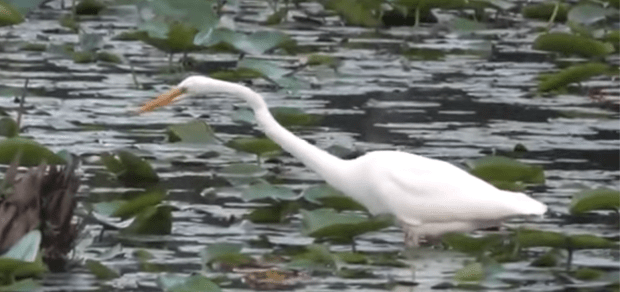
Great Egrets are also called the Common Egret or Great White Heron.

Great Egrets will generally stand and wait to see their fish. They also slowly and quietly wade through the water until their neck snaps quickly and they get their fish.

Patience. Quiet. The Great White Egret gets its dinner.

Great Egrets nest in trees.

The beautiful white plumage that adorns these graceful wading birds was used for women’s hats in the late 19th century. Those silky white plumes are called aigrettes – which gives the bird its name. At the beginning of the 20th century, an ounce of Great Egret feathers was worth $32 USD, more than an ounce of gold according to the authors of Birds of Canada. People were so outraged that some of the first legislation to protect birds and their feathers was because of the Great Egret being brought to near extinction for hats!

In Canada, the Great Egrets nest in a very small number of places – in the very southern parts of Saskatchewan, Manitoba, a small part of southeastern Alberta, and southern Quebec. They are found in the Americas, Asia, and parts of southern Europe.

“Great egret rising” by wolfpix is licensed under CC BY-ND 2.0

The Great Egrets are large birds. They are 94-104 cm (or 37-41 inches) with a wing span of 1.3 m or 4.2 feet. They weight about 1000 grams or 2 pounds. They are all white with black legs and a yellow bill like the one shown above. During breeding season, a patch between its eyes turns neon green and long plumes grow out of its back.

“Great Egret Pointing the Sky” by TexasEagle is licensed under CC BY-NC 2.0

Non-breeding Great Egrets have a small yellow patch between its eyes and bill.

“Great Egret on nest with chicks” by Photomatt28 is licensed under CC BY-NC-ND 2.0

Great Egrets build a flat nest or platform of twigs and sticks. They will lay between 1-6 eggs which are incubated for a period of 23-26 days. It will be another 21-25 days til fledging for the youngsters. Aren’t they cute!

I am getting so excited for Peregrine Falcon season to begin in Australia. The male at the 367 Collins Street Nest also known as the CBD Nest arrived with prey for the female today. He is just such a cutie. The nest camera that streams on YouTube is not up and running. It will begin operations after the eggs are laid (normally). For now there is a camera operated by the owners of the building, Mirvac. Here is the link:

https://367collins.mirvac.com/workplace/building-overview/falcons-at-367-collins?fbclid=IwAR3vGCMkdnScju_KTKjhCrcHRnbsYxJm3kAKTLIOzylSVe8PX3UmwaJEn-s

The other Peregrine Falcon nest is that of researcher, Dr Cilla Kinross, at Charles Sturt University. The scrape box is home to Xavier and Diamond and they have been working on the scrape for some time now. We expect eggs at both nests by the end of August.

If you watch both nests you will get a good glimpse into the difference between a falcon nest on a high rise building in a major city, Melbourne, and the more open rural area of Orange, Australia. The prey is very different!

As it turns nearly midnight on the Canadian prairie, the day is just starting on the Foulshaw Moss Osprey nest in Cumbria. No doubt our beautiful Blue 463, Tiny Little, will fly out from where she is roosting on the branches of the tree in the distance, to the nest. White YW has a trio of big Osprey fledglings to feed. He has demonstrated that he is perfectly capable of feeding a family of five.

Thank you so much for joining me. Take care everyone. I hope to have some local images of bird life in Manitoba for you shortly.

Thank you to the following for their streaming cams where I get my screen shots: Ferris Akel and Cumbrian Wildlife Trust and the Foulshaw Moss Osprey Nest.

Feature Image Credit: “Great egret (Ardea alba) in flight at sunrise at Venice Rookery, Venice, Florida” by diana_robinson is licensed under CC BY-NC-ND 2.0

Happenings in Ospreyland?

Oh, it is a gorgeous day on the Canadian prairies. The sky is blue – oh, such a beautiful blue without a cloud. Those, hopefully, will come this week and bring us some more needed rain.

White YW on the Foulshaw Moss nest certainly knows when Blue 463, Tiny Little, wants a fish. My goodness she can cry really loud. You might imagine everyone in the area of the nest could hear her. There is nothing shy about 463 anymore. If she wants something, everyone knows it. And that is the way Dad likes it. Otherwise, he will think she isn’t hungry.

Tiny Little is not subtle that she would like that fish sibling 464 nabbed. She is up to her old tricks – moving sticks, crying, flapping, and staring. Tiny Little is not starving! Yesterday, she had at least 3 of the fish Dad delivered to the nest. She is smart. Bulk up before migration.

When 464 finishes, Tiny Little also does what she is good at – cleaning up all the fish that the siblings leave behind.

The Crow would like it if Tiny Little would leave some fish for it, too.

Blue 463 is gorgeous. No doubt about it – she has grown into a stunning female! This looks like a good image to keep – to compare when she returns to us again in two years time. I am so optimistic about this one and Tiny Tot from Achieva. They are strong survivors.

A really beautiful – and short – video has been posted showing the ringing of two Osprey chicks at a nest in Finland. Have a look. The scenery is stunning!

As many of you are aware, Idris, the male on the Dyfi Osprey Nest in Wales, is super reliable. When he went missing on Wednesday and did not return until the late afternoon on Friday with a sunken crop, everyone became worried about what had happened to him. It was thrilling to see that he was alright. Indeed, he brought in 3 large fish for Telyn, Ystwyth, and Dysnni. While he was away, Telyn delivered fish to the two chicks on the nest without fail. Well done, Telyn!

Ystwyth on the Dyfi Nest eating a really nice fish. There are rumours that Dysnni has migrated but it is unclear if that is true. He has not been seen on the nest for a short period but he could also be getting fish somewhere else. Many birds, once they have fledged, eat off nest. Others like those at Loch of the Lowes always return to the nest. 463 at Foulshaw Moss certainly likes eating there.

Ystwyth eating a fish late Saturday, 14 August 2021. Unknown bird on perch – most likely Telyn.

Aran and Mrs G were seen on their nest in the Glaslyn Valley today together. They are keeping a close eye on that prime real estate!

The gorgeous and formidable Mrs G looking over her territory.

Idyllic.

The Osprey chick at Collins Marsh will get its official name this evening. Fingers and toes crossed. The last time I checked – thanks to so many of you – ‘Malin’ was leading the polling.

‘S’ caught a great shot of Malin getting its third feeding around 1pm today. Three fish before 1pm. We might get to that magical 5 or 6. Fantastic. But look – ‘S’ seems to have solved the mystery of why Collins is shy about delivering fish! Ouch.

Great screen grab, S!

NC0 is still at the Loch of the Lowes Osprey nest in Scotland. She delivered a really nice salmon to the nest Saturday evening. And isn’t that simply a gorgeous view as the golden rays of the sun kiss everything making it look like autumn?

Both of the chicks remain at Rutland Water’s Manton Bay Osprey Nest. Blue 33 is kept busy feeding these two.

Blue 096 with hers.

Often Blue 096 chases 095 off the nest but here he is below enjoying his fish! Nice one.

Nothing posted on the name but Malin has another fish drop and is doing some wingersizing! Thanks Dad, number four.

Thank you to all of you for joining me today. This was just a hop and a skip to make sure everyone on the Osprey nests were doing OK and they are. Doesn’t get any nicer than that. Take care everyone. Enjoy your weekend.

Thank you to the following for their streaming cams where I get my screen shots: Collins Marsh Nature Centre, Cumbrian Wildlife Trust and the Foulshaw Moss Osprey Nest, Bywyd Gwyllt Glaslyn, Dyfi Osprey Project, LRWT, Scottish Wildlife Trust and Friends of Loch of the Lowes.