Thursday Morning in Bird World

Living on the Canadian prairies, we know that spring is coming when the Canada Geese return from their winter migration. Indeed, Canada Geese are usually one of the first birds to arrive. You can hear them honking flying overhead in their large ‘V’ shape formations. They arrive in late March and stay with us until late October or November.

Like other bird species, Canada geese bond for life. They also return to the same nesting site year after year. That is the sad part. Our City is growing so fast that to see these beautiful creatures laying their eggs on dirt in the midst of broken up pieces of concrete on a building site is a tragedy.

It is spring and these geese have arrived at one of our nature centres, Fort Whyte.

You can easily tell a Canada Goose from other geese with its long black neck, its white chinny chin chin, its black legs, and light grey-brown underparts and wings.

I had gone to the park near me to put up signs not to feed the birds bread. A group of the geese came over to see what was on offer and, when they saw corn and peas, they grumped at me. These geese are so used to eating bread that they will shun the food that is good for them! That is sad. The bread makes its way into the water and decomposes creating horrible algae.

This guy was particularly offended by an offer of peas! Geese will hiss and if you get close to their nests or goslings they can bite really hard. Be forewarned!

In the fall, there are several places where you can go – including the Fort Whyte Nature Centre – to see them fly in and land on the pond. There are thousands of them. The sky fills up with the silhouettes against the orange and pink at dusk. It is beautiful.

Our nature centre had – until the pandemic – an annual Goose Flight Dinner. It was a charity event with a great meal and an opportunity to see the geese up close flying in. I had my phone. There are geese in the apricot background but they are too difficult to see. So close your eyes and imagine a black blur honking.

Have you been following the love geese? Their names are Arnold and Amelia.

On 13 July the staff at the Cape Wildlife Centre in Barnstable, Massachusetts noticed that one of the geese that lives on a pond behind their centre had a limp. The staff knew the wild bird and wanted to help. The goose was caught and it was determined that he had two open fractures in his leg. The staff explained that an open fracture means that the tissue and skin are pulled away from the bone. You can see this in the top right photo. Their best guess was that a snapping turtle had harmed Arnold. Arnold had surgery and while he was recovering, there was a tap tap at the door. It was Arnold’s mate, Amelia. Amelia waited for the surgery to be complete watching Arnold from the glass window.

@ Cape Wildlife Centre

The couple became instant celebrities. Who doesn’t need a warm fuzzy story these days?

Arnold is healing nicely. His bandages get changed and he is getting stronger. Amelia comes to visit him every day, looking in the glass door of the porch. The staff were so moved by the devotion of the geese to each other that they fixed up a pen so that Arnold and Amelia can share a meal. The good news is that Arnold will be moved to an outdoor pen once he has finished his medications. He will be returned to Amelia and the wild once his foot has completely healed.

Wow. That puts a smile on your face! Everyone loves a love story – especially if it is two birds – ‘love birds’ or is it ‘love geese?’

@ Cape Wildlife Centre

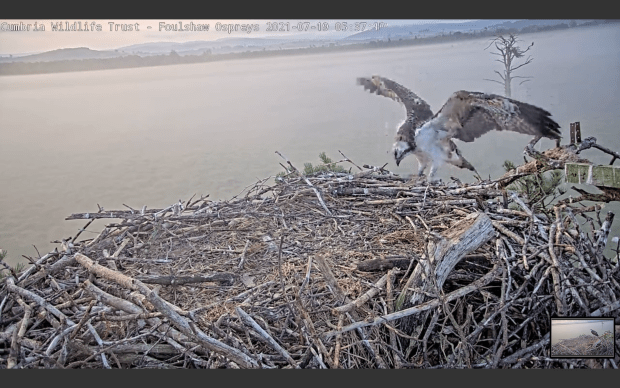
Some quick Osprey news. At the Foulshaw Moss Osprey Nest, Tiny Little slept like an adult on the perch. White YW (dad) brought in three fish so that everyone could have a nice meal during the day. That is fantastic.

After calls for emergency numbers, I received an e-mail from Katherine at the Patuxent Osprey Nest 2. They have now included the park e-mail at the top of the streaming cam. This is fantastic. There is no phone at the park that is operable 24/7.

I still recommend that everyone who watches particular nests make their own list of emergency numbers so that if you see something happening you can act quickly.

Here is a better look at that Patuxent Osprey nest as it sits in the water. Thanks ‘S’ for sending me the time stamp! Gosh, that is a really nice place for a nest.

When I checked the Foulshaw Moss nest last, no one was home! Tiny Little is out working those wings. That is fantastic.

Thank you for stopping in today to check on the birds. Everything appears to be fine on a Thursday morning in Bird World. The Osprey fledges are working their wings and getting stronger in the UK. There are still chicks to fledge there and in the US. No doubt there will be a flurry in the next couple of weeks. Take care everyone. Stay safe. I will be checking on Tiny Little throughout the day!

Thank you to the following for their streaming cams where I grabbed my screen shots: Cumbrian Wildlife Trust and the Foulshaw Moss Osprey Nest and the Patuxent Park Osprey Nest 2. Thank you to the Cape Wildlife Centre where I grabbed the images of Arnold and Amelia from their FB Page.

Tiny Little, do you have any idea how loved you are?

There are people with insomnia who are awake and get to see what Tiny aka Little Bob on the Foulshaw Moss Nest in Cumbria is doing. Has she taken another flight? Did she get a fish today? Is she sleeping duckling style? Tiny Little, you have an amazing fan club cheering you on — people from all parts of the world joined together in the adoration of a little osprey that survived and grew into a beautiful fledgling.

Some of us manage to get their first haircut in almost a year and all we want to do is get the wifi password and check in with you! We have your back young lady (or young man).

Today, Tiny Little took her third flight at 18:25:40. You weren’t gone long but you sure looked like you were excited and having some fun when you landed at 18:40:51 on the rim of the nest. You had lost that frightened look of a day or so ago.

You got yourself settled and looked out over your domain. Just look at you! You are gorgeous. It is hard to actually call you Tiny Little or Little Bob anymore since you have grown into a large bird with stout legs, big wings, and the beginnings of what could be a lovely necklace.

You were panting a little bit but you were also looking around as if you wanted to take off again! I bet flying is tiring until you get used to it and build up the strength in those wings. Now all of your aunties and uncles are telling you to do just that – you are going to be on your way to Africa in six weeks and you don’t have a ticket on a commercial airliner. You are your own pilot and navigator.

You were also hungry and hoping that a fish drop would be made. I missed the actual drop but around 19:43 you are on the nest, Tiny Little, and your sibling is tucked into a fish.

One of your admirers told me that you actually had the fish and that big sibling came and took it away. They also told me that you —– yes, you, Tiny Little – stole it back at 20:12. They even sent me a screen capture to prove it. Fantastic Tiny Little!

When I checked on you a few minutes ago, you were sleeping away. But — Tiny Little! You are not sleeping like a duckling! You are standing on the perch like an adult. One more big giant step for you today, Tiny Little.

It looks like all the rays from the moon and stars are shining down on you. By the way, did anyone tell you, Tiny Little, that they want to permanently name that perch after you? What an honour! You have sweet fishy dreams, Tiny Little. We will be waiting to see what you get into tomorrow.

Someone caught Tiny Little’s second flight. You might want to see it again!

In other Osprey news, there was a bit of a giggle over at the Llyn Clywedog Nest in Wales. If you are Only Bob and your dad, Dylan, flies in with a nice Brown Trout and your mom, Seren 5F, flies in with a mullet — which are you going to choose?

Remember. Dylan just loves Brown Trout. He will fly for 25 minutes to and 25 minutes home to get Brown Trout if he can’t get it at the local reservoir. Sometimes Dylan doesn’t like all the fishers down at the end of the reservoir where the trout are so he will travel a distance. Today, it turns out that is a good thing because Only Bob – who already has a huge crop – decided he wants mom’s Mullet. Dad, you get that Brown Trout all to yourself – and you deserve it! Look at the size of this baby of yours.

Do you think Only Bob picked Mom’s mullet because he was certain she would feed him?

The hot weather is also in Wales. The temperature was to be no less than 95 degrees F there today — that is entirely unheard of in the country. That is 35 C. Fingers crossed that there are no casualties.

I was extremely happy to pop into the Collins Marsh Nest in Wisconsin to find that the little chick on the nest was being fed. I am going to assume that there were at least two other meals after this one. Feel free to correct me if you know. I am also hoping that the local temperatures getting cooler after two days of high heat will mean regular fish drops on this nest!

Even before he was finished, the chick has a nice crop. That is very reassuring. Gosh, it wasn’t that long ago when Tiny Little was this small.

I literally just did a quick peek at the Patuxent Osprey Nest 2 to make sure that ‘Silo Chick’ had not fallen out again! I wonder if he knows that he is now known around the world for falling out of two Osprey nests in two days? It must be a record.

This is short. The haircut took the priority today. I almost feel human again.

Thank you so much for joining me. It is always a delight to have you here with us. I also enjoy all of your messages and the news you send. Take care everyone. And for those who asked, I almost forgot. We got even more rain overnight. I do not know if it is helping with the wildfires that are out of control. Many of the Ospreys that come to Manitoba in the summer to breed have their nests in these areas and it is worrisome.

Thank you to the following for their streaming cams where I get my screen shots: Neustadter Nature Center and the Collins Marsh Osprey Nest, Patuxent Park Osprey Nest 2, CarnyX Wild and Llyn Clywedog Osprey Nest, and the Cumbrian Wildlife Trust and the Foulshaw Moss Osprey Nest.

Tiny Little makes second flight!

This will be a concise posting. Today my hair will be getting a makeover for the first time since November – or was it August of 2020?

There is great news. Tiny Little (aka Little Bob) on the Foulshaw Moss took her second flight at 13:34 on 21 August. Polly Turner caught the action:

Earlier, around 8:20, Tiny Little’s crop was concave, as it is in the picture above. White YW landed on the nest with a stick. Stayed a couple of seconds and flew to land on the top of the parent tree in the background. Tiny Little got antsy. You could just feel that she wanted to fly, too.

Congratulations, Tiny Little! Let’s get those wings to working hard before you have to start your migration.

Ferris Akel has posted the highlights for his 17 July tour. Here is that link:

In other Osprey news, Osprey House in Brisbane, Australia had their first hatch on 14:58 on 20 July and their second hatch at 7:05:54. That is only forty hours apart. Well done. There is no streaming cam, but they do have a FB page if you are interested.

Thank you for popping in and joining me. Have a wonderful day. I will be back with a full report of the nests early this evening.

Thank you to the Cumbrian Wildlife Trust and Foulshaw Moss Osprey Nest for their streaming cam, where I grabbed my screenshots.

Oh, Tiny Little…and other tales

More rain has come to the Canadian prairies and that is good. There are wonderful things happening at the Foulshaw Moss Osprey Nest, too.

Earlier today 462 was eating on the flounder that came in. Tiny Little wants some and she is doing her usual wing flaps and playing with sticks, even pulling on the tail of the live fish to get at it. What a character. The two older siblings have become very tolerant of the ‘little one’ that isn’t so little!

It is Tiny’s usual look towards the tail before getting back there and pulling on it. Gosh, these birds are gorgeous.

Tiny Little has been moving sticks getting back by the tail and pretending to give it an accidental yank once in awhile. Too funny.

Tiny Little takes over from 462 eating the fish. 462 flies off the nest and 464 is quietly waits in the wings.

Tiny Little is really doing a great job of that self-feeding. She has been working on that flounder for quite awhile.

White YW flies in and delivers another flounder to 464 who begins mantling and telling the parent how happy they are.

Of course, 462 sees all the action on the nest and decides to come and check it out. They don’t want to miss anything — especially a parent on the nest to feed them. Yes, even the older ones love to still be fed by mum. But mum is not doing it. This is tough love Osprey style.

Tiny Little will not be distracted! And 464 is holding on to its flounder as best it can. Gosh those heads are hard to open. Wonder if 462 will get this one later?

These kiddos are pretty polite. I am glad that White 35 has stopped rushing in to feed Tiny Little. That might sound cruel but TL needs to become really good at self-feeding to survive. These are terrific parents. 462 has eaten earlier and both TL and 464 along with 462 will have nice full tummies for nite-nite.

Earlier Tiny Little did some great hovering.

After Tiny Little finished all of the flounder she could eat, White 35 flew in quickly and took it to the parent tree. Those adults have to be watching everything these kids do – like a hawk! The removal of the fish inspired Tiny Little to do more great hovering. I thought she was gone! If not, tomorrow. Tiny Little is now inspired to self-feed and fly. The confidence is really growing.

Tiny Little also seemed to enjoy the hovering and looking down – the fear from earlier days seems to have dissipated.

I just checked and 464 is still working on its flounder. Tiny Little is staring 464 down and 462 is simply waiting. These three are so funny. Did I tell you that 462 actually fed Tiny Little some bites earlier she begged so much!? And if I told you twice, laugh twice. That is just a hoot.

No one is rushing 464 anymore. Tiny Little and 462 have decided to become ducklings and wait!

There is a lot of worry about the Collins Marsh Reservoir Osprey Nest in Wisconsin. It is hot there. They are now experiencing some of that relentless heat that hit the Pacific NW a couple of weeks ago and the Canadian Prairies last week. It is close to 45 degrees in the nest. That could easily account for the deaths of the other two chicks. The little one was fed at sometime. I rewound the tape. I could not see the mother protecting that chick from the sun. I really hope that this is not another Electra-Wattsworth scenario! There are some Osprey parents that are ‘the greats’ – Monty and his mates Nora and Glesni, Blue 33 and Maya are up in the super strata. There are others who are normal average and some who, are not good parents. Maybe they came from a nest where food was not brought in regularly. Who knows what is the difference. Some of us believe it is good DNA. The Cowlitz nest is an example of a nest that is not that good. If taking care of your family and fledging chicks who survive migration and return to breed is the measure, Cowlitz fails. Sadly, we cannot expect every nest to be like that of Blue 33 at Rutland. Maya and Blue even fledged a nest of four chicks in 2018. Some of the others can hardly keep up with two. Still. we all want to help if we can.

There have been any number of questions about intervention to save the chick at Collins Marsh. At the present time the archaic laws of the US – those of 1948 – do not allow for interventions unless it is something clearly caused by humans. Think monofilament line in the nest. That said I will go over some interventions this year. In the early spring, the two eaglets of E17 and E18 on Harriet and M15s Bald Eagle Nest got conjunctivitis. There were probably more than a 1000 people who called in about the eaglets and their eyes. Action was taken. CROW retrieved the eaglets with the help of Joshua Tree and they were off the nest for 5 days. They returned well. Conjunctivitis is not caused by humans. At the Captiva Bald Eagle Nest, CROW removed a monofilament line. However, when the two eaglets ate a rat that was brought to the nest that had eaten rodenticide, the youngest died and the oldest lived until they were flapping and jumping and broke a blood feather and bled out on the nest. Help did not come for the eaglets when the first one looked ill. Citizen watchers warned of the rat on the nest but there was nothing happened. It was extremely frustrating. Both of the eaglets died. This was not the fault of CROW. You need action by the bodies that govern the nests. Lately a number of chicks have gone to foster parents which is also an intervention. A chick was rescued that fell into a river. That is an intervention. Laws are applied differently by different people. The laws need to be changed and brought up to date. There should also be laws against lead in hunting and fishing equipment and Minnesota is taking that on. Every state should ban the use of these because that lead is killing the birds or making them severely ill. Every day there are examples on the rehabbers sites. Hawaii just passed a law banning helium balloons because the albatross get entangled in them. Then there is the entire issue of rodenticide – which kills wildlife as well as domestic pets. Research shows that raptors kill more mice and rats than poison. Perhaps the answer is to begin at the State level with copies of appeal letters to the Under Secretary of State for the Department of the Interior.

I checked on Kindness and her dad had fed her and within fifteen minutes he was flying back in with more food for his little girl. It might seem lonely but there are benefits to being an only child on a great nest. Freedom and Liberty are fantastic parents at the Glacier Gardens nest. It is a wonder Kindness did not pop her crop today.

I have really watched Tiny Little closely today and just popped in to the other nests. The only other news I have is that the Albatross is still at the RSPB Bempton Cliffs in the East Riding of Yorkshire as reported by Sally White on the FB page. Maybe that Albatross isn’t lost. Perhaps they know something we don’t!

Thank you so much for joining me. Great progress has been made at the Foulshaw Moss. It is wonderful to see Tiny Little getting some confidence. Our rain has stopped but everything is green! It’s a good day. Take care all.

Thank you to the following for their streaming cams where I took my screen shots: Collins Marsh Reservoir and Neustadter Nature Center, Cumbrian Wildlife Trust and Foulshaw Moss Osprey Cam, and Glaciers Gardens Bald Eagle cam.

Tuesday 20 July in Bird World

It has been a very strange day. We had a tiny bit of rain during the middle of the night on Monday with lots of thunder and lightning. It was not enough rain to help anything. South of where I live in a town called Morris, Manitoba, the river is practically bone dry. Dead fish is all you see and dirt. Old timers are starting to talk about the days of the Dust Bowl. I think about all the birds that depend on the water and the fish. A follower wrote to me and asked me if I knew anything about the ospreys at a nest in Wisconsin – the Collin Marsh Osprey Nest. It is not a nest that I follow but I did check. Just as ‘S’ had noted, the only chick on the nest looks a bit thin. As it turns out there were originally three relatively healthy chicks. Now there is only one. They are not sure what killed two of them. I am hoping that the Neustadter Nature Centre will be doing a post-mortem. It could well be the heat. A bander in Wisconsin said that they had found many dead chicks in the nests. That is very very sad. In England, many of the nature areas that were closed during the pandemic were taken over by the wildlife only to open and have humans scare birds off their nests and chase animals out of the area along with purposefully setting fires. What in the world is wrong with humans? Sorry. It just seems that you go two steps forward and three backward sometimes. Very frustrating.

As you know, I really admire Ferris Akel. He has a regular tour of the Montezuma Park area, Wildlife Drive, Sapsucker Lake, and the Cornell Campus every Saturday. Ferris has someone editing his videos and they are simply excellent. Today, he posted the Red Tail Hawk highlights from his tour on 16 July. It’s OK to say, ‘Oh, my, aren’t they cute!” Have a look:

The Royal Cam princess, Taiki, on Taiaroa Head, New Zealand was weighted today. Las week she weighed 8.2 kg. Today, her mum, Lime-Green-Lime came in to feed Taiki right before weighing. Taiki is 177 days old and today she weighted 8.8 kg or 19.4 lbs. No worries about any supplemental feeds! Taiki’s mother has been in to feed her every day for the past six days. That means that she is foraging very close to Taiaroa Head which is in the very south of New Zealand near Dunedin.

Every year the New Zealand Department of Conservation bands the chicks born on Taiaroa Head. This year the bands will be white. Last year they were green. The banding is very important. It allows the rangers and all other interested parties to identify the birds when they return as juveniles, when they select mates, and when they return to breed. That banding will take place between 11-4pm NZST.

Many of you will have heard the term ‘translocation’ in relationship to the Ospreys in the United Kingdom and many of the projects of Roy Dennis and his Wildlife Foundation. There is news of a different translocation project, an extremely complicated one. To save the Black-footed Albatross on Midway because of rising sea waters, eggs are being transported 6000 km from Midway to Guadalupe Island in Mexico. The researchers say it was their only option. The waters are rising fast and soon Midway will flood.

“Black-footed Albatross” by tombenson76 is licensed under CC BY-NC-ND 2.0
“Black-footed albatross chick. Photo credit: Eric VanderWerf” by USFWS Pacific is licensed under CC BY-NC 2.0

They hope that the Laysan Albatross foster parents will accept the chicks and eggs and that those chicks will fledge and return to Mexico to breed – not Midway Atoll. So far 93% of the hand-reared albatross, in other projects, have fledged. Let us hope that this project has such a high success rate! Here is an article on this incredible project:

https://www.sciencemag.org/news/2021/06/they-were-destined-drown-how-scientists-found-these-seabirds-new-island-home?fbclid=IwAR0ZtdwlPW1PElHy6uW5c1zW-Ojt4JC825Ccgor8f_imnjxVgs1COq5NolY

Of course, rising waters and seas heating up and fish dying are not the only threats to the albatross. Another is the level of plastic garbage in our oceans. It is estimated that by 2050 if humans do not curtail their use of and dumping of plastic, there will be more of it in the oceans than there is water.

“Black footed albatross chick with plastics. Photo credit: Dan Clark/USFWS” by USFWS Pacific is marked with CC PDM 1.0

Black-footed Albatross is exclusive to the North Pacific Ocean living and breeding at the Midway Atoll which is part of the state of Hawaii. Some nest off of Japan. They breed around the age of five years. Like other albatross, they forage off of what they can find on the surface of the ocean such as squid, fish, and crustaceans. They have been known to eat refuse and carrion. When they intake the water, you can see in the image above, that they also ingest plastic floating in the ocean. It is not, of course, just the plastic that you can see but the chemicals that keep the plastics soft that are appearing in the eggs of the birds. Those chemicals are known as phthalates. These are found in the yolk of the eggs of the birds. An ongoing study on gull eggs may reveal the damage that will be done to the chicks. I will keep you posted.

Did you know that at the turn of the century it was fashionable to have an entire dead bird decorating your hat? Etta Lemon campaigned against the use of feathers of any kind in the fashion industry.

Many of the species that I write about were made or almost made extinct because of this practice – the Albatross and the Osprey – are only two.

It is 4:30 in the morning at the Foulshaw Moss Osprey Nest. Tiny Little is waking up. You can see the silhouettes of the other two siblings and the parents on the tree in the distance.

After missing out, at 13:30, Tiny Little figured out what he had to do to eat. When White YW comes into the nest with a fish, you claim the fish as yours! And TL did that. Yeah for Tiny Little!!!!!! This is a good lesson to learn. In the world of Osprey you need to be a little assertive even if you would rather not.

Thanks, Dad! So glad no one else is here!

Tiny Little has the fish between his talons and he is going to eat it. Dad took the head off so he doesn’t have to deal with those annoying bones like the ones around the eyes.

It is now 16:34 on the Foulshaw Moss Nest. Tiny Little is standing on the big stick and 464 is eating a fish. Will there be any left for Tiny Little? or will Tiny Little take off flying?

Thanks so much for joining me this morning. It is raining again where I live. The sky is light grey, the trees and plants are green and it is wonderful! It is 18 degrees, a much more normal summer temperature for us. They even say we have a chance of rain tomorrow. This will not fill up the Morris River but it might help the grass, the trees and the flowers the nectar eaters need. Take care all. Stay safe. See you soon.

Thank you to the following for their streaming cams where I get my screen shots: Cumbrian Wildlife Trust and the Foulshaw Moss Osprey Nest, and the Cornell Bird and NZ DOC Royal Cam Albatross.

The credit for the featured image is: “Black footed albatross chick with plastics. Photo credit: Dan Clark/USFWS” by USFWS Pacific is marked with CC PDM 1.0

Late Monday 19 July in Bird World

When every fledgling is hungry and Mum brings in a fish:

This is currently the state at the Foulshaw Moss Osprey nest where the three fledglings are waiting on the nest for a fish drop and each one of them is food begging. Tiny Little has lost out today so let us hope that Blue 35 shows up and feeds him. The birds do not need to eat every day – a lesson that they will have to learn.

I have watched and watched but was away for a couple of hours. It is unclear if Tiny Little had any fish today. At 22:00 one of the big siblings was on the nest eating. At first Tiny Little food called to Mum but then he laid down like his cute duckling self and didn’t continue. The big sibling ate the entire fish, flew off, and then Blue 35 left also.

Nite Nite Tiny Little. Have some sweet fishy dreams – and if you are hungry tomorrow, let everyone know it.

The film, Brave New Wilderness, is only showing in New Zealand on Vimeo right now. It is about the recovery efforts going on for the Kakapo and the Takahe. Watch for when it will be released worldwide on Vimeo. Here is that trailer:

There are now only 202 Kakapo in the world. Kakapo parrots that cannot fly. They are loners. They rarely interact with one another. The only time that they come out of their ‘own space’ is during the summer and fall breeding season or you might find 2 to 4 gathered at a food dispenser on the island. Kakapo will only breed if there is lots of food and that food must be Rimu fruit. It is sometimes called Bush Tucker and is a group of Indigenous foods that grow wild.

“Ripe rimu fruit” by Department of Conservation is licensed under CC BY 2.0

This is Sinbad and he has been fitted with a very special transmitter by the Kakapo Recovery. This transmitter will not only will give Sinbad’s GPS but will also tell the researchers and staff of the recovery if Sinbad has mated.

Because of their solitary nature the Kakapo have to be fitted with transmitters so that they can get their health checks. It has made a huge difference in the population as any ill birds can be sent out for wildlife veterinary assistance.

Some people thought it was funny but right now it is such an effort to feed four people that Laddie, LM 12, losing a fish over the side of the nest on a delivery at 17:05 feels rather tragic. I know that Tiny Little would have liked to have been under that nest to catch that fish!

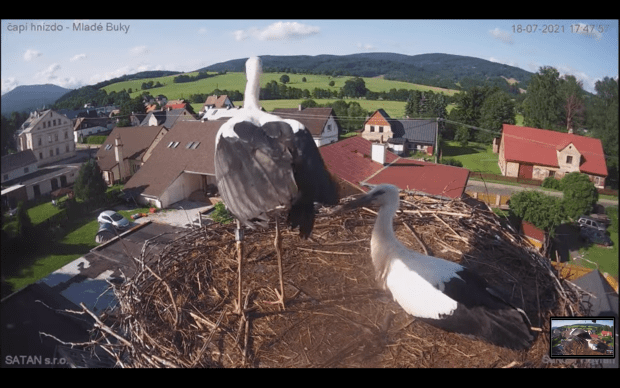
The storkling that fledged is back up on the nest with her other siblings. So everything is fine in Mlade Buky with the White Storks. Good news. So happy when the fledglings don’t get themselves into a spot of mischief.

It’s 5:54 at the Patuxent Osprey Nest 2 and Mom has a fish and there are three hungry chicks. The chick that fell into the water is doing fine. What a relief to have that little one back on the nest! One of the rescuers told my reader ‘L’ that they were fortunate because it was still low tide when they went to find the baby. Everyone is still so grateful!

I have to admit to almost having a mini-meltdown. One of the chicks was so well hidden behind mum that it looked like this nest had lost another one overboard. Thank goodness it was just the angle of the camera!

That is a short round up today. All of the UK Osprey nests are doing great. The fledglings are all flying and getting stronger save for our little one, Tiny Little. Her confidence is growing and no doubt by this time next week we will be wishing she was back being a duckling on the nest.

Thank you so much for joining me. So happy that you enjoy the birds! It is lovely to have you with us.

Thank you to the following for their streaming cams where I get my screen shots: Mlade Buky White Stork Cam, Scottish Wildlife Trust and Friends of Loch of the Lowes, Cumbria Wildlife Trust and Foulshaw Moss Osprey Nest, and the Patuxent Park Osprey Nest 2 as well as the Kakapo Recovery FB Page and SF Bay Ospreys and Golden Gate Audubon for their video.

Good Morning Ospreyland

I have a friend who lives in the Northeastern United States. She has a beautiful garden and loves her songbirds. She also adores Big Red, Arthur, and their chicks. Wicky and I often get really down in the dumps over the direction that environmental policies are going. Then we see something and begin to believe that there is hope that all this heat, drought, flooding, birds falling from the sky, etc will pass. We need one another – for on the day I am down, she is up and vice versa!

Today Wicky sent me a quote from Jane Goodall that I would like to share with you. I am including the interview in the New York Times that she sent as well. I hope you can open it.

“Traveling the world I’d see so many projects of restoration, people tackling what seemed impossible and not giving up.”

I am always impressed with how New Zealand develops positive policies for their wildlife. Another area that is doing that is Scotland. Here is a short early morning BBC programme on the restoring of the landscape at the Cairngorms National Park. I am including some images of the park for you so that you get a glimpse of the type of landscape being restored.

“Cairngorms” by wwarby is licensed under CC BY 2.0
“Cairngorms” by chuckrock123 is licensed under CC BY-ND 2.0

Of course, my interest is the Ospreys and this is the home to the Loch Garten Ospreys. It was the first place that the Ospreys returned to in the UK in the 1950s. It was the home of the Lady of the Loch, that female, often called the Norwegian by Tiger Mozone whose DNA, according to Tiger, is in every UK Osprey except for CJ7. Lady was the foundation stone.

The image below is of that historic Osprey nest that is still used.

Sadly this year there were no Ospreys breeding at the nest. I might be remembering this wrong but it seems to me that two birds arrived at the nest and people in a canoe or kayak got too close trying to take photographs and the birds left not to return. (I hope that I am not remembering another nest – I could be so feel free to correct me, please!). Fingers crossed for next year! Here are some images of the loch. It is freshwater and is full of trout. We know that Ospreys love their trout. Dylan flew 13 km to get trout for the Clywedog Nest with Seren and Only Bob a week or so ago.

What an incredible sunset.

“Sunset at Loch Garten” by chuckrock123 is licensed under CC BY-ND 2.0
“Loch Garten” by Cairngorms National Park is licensed under CC BY 2.0

This is that short programme with Ade Adepitan, MBE on the restoration of the natural environment in the Cairngorms:

It is now approaching 11pm on the Canadian Prairies. The Osprey nests in the United Kingdom are just waking up.

Good Morning Tiny Little! I wonder if you dreamed about flying?

Totally serene image of Loch of the Lowes. No one sleeping on the nest. On occasion NC0 or one of the fledglings will appear on the nest but for the most part the camera remains fantastic because sometimes you can see the Ospreys fishing in the loch.

Aila did not return from her migration. Louis waited and waited refurbishing their nest. When he could wait no longer he paired with a new female. They raised two chicks on another nest off camera. The new Mrs Louis is Dorcha. When the two chicks were ringed on 15 July it was believed that they were 4-5 weeks old and are both are believed to be male.

Beautiful Manton Bay Nest of Blue 33 and Maya. The camera will be shut off soon and we will have to wait til the Ospreys return in March. Normally Blue 33 and Maya arrive within an hour of one another. Just think – they travel 4000 miles and arrive in that close of time. It is unclear if they winter together in the same place.

The beautiful morning turned into a day of defending their nest for Blue 33 and Maya. Poor birds.

What a beautiful morning – just look at that pink sky and the green of the landscape – at the Dyfi Nest of Idris and Telyn. I can’t see a fledgling but it sounds like one of them is scratching on the microphone of the camera!

The cameras have not come on at the nest of Dylan and Seren but, wow. I found an 11 minute video shot by a photographer of Llyn Clywedog. We can get a really good look at the loch where their nest is located. It is like you are going for a walk around the water. Very restful.

It is now a sunny afternoon at Llyn Clywedog and no one is home! It is quite understandable why the owners of these streaming cams will be turning them off in the future!

Tiny Little made a short flight from one side of the nest to the other. She spends a lot of time looking down over the edge. Did someone tell me that birds are afraid of heights? Yes, they did. It was someone at the Cornell Bird Lab years ago. It is one of the reasons the little ones don’t often fall off the edge of the ledge nests.

Tiny has spent a lot of time sitting on the edge of the nest looking down.

It’s tea time at the Foulshaw Moss Nest. 463 has joined Tiny Little who is food begging. His crop is pretty flat. Good luck Tiny!

At 16:32 Dylan flew in with a live fish which 464 promptly mantled. Let’s hope mom is around to feed some of that fish to Tiny Little!

White YW is out of there as 462 flies in for the fish. This is going to get interesting. It is still alive! Good lessons.

Oh, we had a little rain and a thunderstorm during the night. It is still really cloudy and, despite the 27 degree heat, one can imagine it is cooler!

Thank you so much for joining me. It seems that everything is going along as it should with the UK Ospreys – save for our little darling Tiny Little who needs some confidence. It will come. They are all individuals. Have a wonderful start to your week. Take care. See you soon.
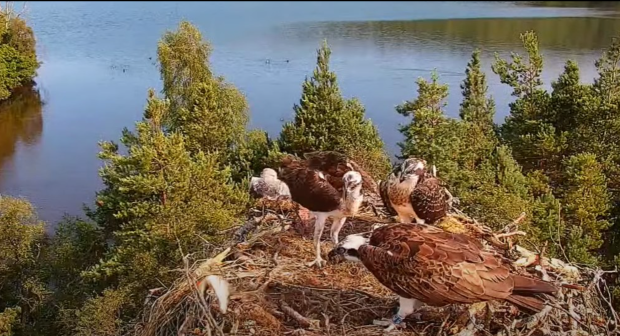
Thank you to the following for their streaming cams where I took my screen shots: Cumbrian Wildlife Trust and the Foulshaw Moss Osprey Nest, Scottish Wildlife Trust and Friends of Loch of the Lowes, Scottish Woodland Trust, LRWT, Rutland Water and the Manton Bay Osprey Nest, Carnyx Wild and Llyn Clywedog Osprey Nest, the Dyfi Osprey Project, and Bywyd Gwyllt Glaslyn. A big shout out to Wicky for sending me the Jane Goodall interview!

Fledge at Mlade Buky and other news in Bird World

We have a fledge at the White Stork nest in Mlade Buky!

Oh, this is just so wonderful. The people of this community can be so proud as these three beautiful birds leave their nest. It was their help that made it possible for these three to be alive today. Bravo.

Here is the video so you can watch it.

The heat wave has taken more tolls on birds in the Pacific Northwest not just the Osprey chicks that literally roasted in the nests. Cooper’s Hawks have been jumping off the edge of the nests so they do not get cooked by the hot sun. This is a real tragedy in the making. Even the number of birds at my feeders is down. They spend the day in the myriad of vines in the shade of the house and the lilac bushes only coming out to drink and return to shade. The outside temperature near the water bowls reads 34 C. That is hotter than it is in the West Indies! So please put out water for the birds! Find old dishes and provide them with something. Thank you!

I hope that you are able to open this. If not you could Google ‘hawks jumping out of nests to avoid heat’. This is just so sad.

The streaming cams for many of the nests are being turned off as the season ends. Glaslyn will turn off the feed to Aran and Mrs G’s nest shortly as will Rutland Water on the Manton Bay Nest of Blue 33 and Maya. We will look forward to another season with them in the future. Blue 33 and Maya are a super Osprey couple – celebrities if you will allow me to call them that. They have been together since 2015 and have fledged 17 chicks. They raised a nest of four in 2019. That is almost unheard of and really takes a strong male to feed that many. I am impressed. I told someone if I came back as an Osprey in another life I wanted Blue 33 for my mate. He is incredible. They will return to the Rutland Manton nest in late March – usually within an hour of one another.

I expect many others will follow as it is costly to run the cameras. If you go to the camera and it is not functioning check the nest’s FB page. They have probably turned off the camera til the next season. But please remember that the breeding season is only beginning in Australia with the Peregrine Falcons, Port Lincoln Ospreys, and the WBSE.

NC0 up at the Loch of the Lowes nest is out fishing for her chicks. She is incredible. She spots the fish from the nest and dives down and gets it. Here is a very rough cut of a video of the two Loch of the Lowes chicks enjoying themselves.

I never thought I would say that a Golden Eagle nestling was cute but Zenit certainly is.

Zenit is really working on his wing flaps and from his crop it appears that he has had a feeding. That is good. I am just thinking how lucky Zenit is to be in a tree nest with shade.

Kindness is one of the cutest Bald Eagle nestlings I have ever seen! Here she is again trying to nibble around mom.

Oh, how beautiful. Kindness sitting next to Mom. Everyone thinks Kindness is a female because her Dad loves to feed her!

You are getting to be a big girl, Kindness. You are 52 days old today! More than halfway to fledge which will be around 89 days – the average for the Glacier Gardens nest. (The average in Alaska is 80 days).

Tiny Little has been in the nest every time I checked on her. A fish came in and 462 ate and ate. Then 464 came and couldn’t get the fish tail down. Tiny Little was playing with it when White YW brought in another fish. Tiny Little ignored it and dad left with the fish! Silly Tiny! Some dads will feed their chicks but White YW doesn’t seem to do this very often preferring that Blue 35 take on those duties almost exclusively. Tiny Little has yet to get confident in opening up a fish with a head.

White YW returned to the nest at 17:39 and Blue 35 flew in to feed Tiny Little. Tiny did not ignore that fish this time!!!!!!!

Oh, she just loves being fed by mum. Tiny Little eats for about forty minutes.

This kiddo should be stuffed.

At 21:00, Tiny Little and big sib 462 were cuddled up duckling style read to sleep.

It is not clear to me if Tiny Little ever did a second flight today. She was flapping those wings really hard and walking around the nest looking down for a long, long time. Often I had to leave only to return to find Tiny on the nest. Maybe someone saw her fly again?

Tiny tried everything but getting over on the middle left side of the nest and just going for it like she did when she fledged was something she did not do. There were a few good hovers. Fingers crossed for tomorrow. Need to get those wings strong and self-feeding down for migration.

The couple who saved the little osprey chick that fell into the river at the Putuxent Osprey Nest 2 were surprised that so many people from around the world watch their birds! I mentioned to them the need for an emergency number on the streaming cam. Fingers crossed! Thank you to everyone that sent them a thank you note. The chick is doing well.

Thank you for joining me for a quick look at a few nests on a Sunday evening. Take care. It is very hot in so many places or there are torrential rains and flooding. So where ever you are be careful.

Thank you to the following for their streaming cams where I took my screen shots: Glacier Gardens Park, Cumbrian Wildlife Trust and the Foulshaw Moss Osprey Nest, Mlade Buky White Stork Cam, Patuxent Park Osprey Cam 2, and Asociatia Wild Bucovino.

Late Saturday and early Sunday 17-18 July in Bird World

If you have watched Kindness, the Bald Eagle nestling at Glacier Gardens, then you might have caught her nipping at her mum’s beak. It looks like she is trying to kiss mum. A couple of days ago a video was made showing Kindness interacting with her mum. My goodness, Kindness, you are lucky your mum is so patient! Have a look.

At the Port Lincoln Osprey barge, it looks like the final touches have gone on the nest renovations. The egg cup is now lined with very soft pieces of bark. Mom decides to try it out!

Dad flies in with something else on his mind! No eggs yet but mating is taking place. Season will begin soon!

As we approach fledging at all of the Northern Hemisphere Osprey nests and migration in a month to six weeks, if you fear Osprey withdrawal, here is the link to this nest. Just a warning. This nest has had instances of siblicide in the past.

The Port Lincoln’s eldest chick from the 2020 season, a female named Solly, was fitted with a satellite tracker. Solly is 301 days old and she is still hanging out at Eba Anchorage and Kiffin Island. It sure seems that Solly has found her forever home at Eba Anchorage. For those of you unfamiliar, the movements of Solly changed what everyone understood about Ospreys in Australia. It was believed that ospreys stayed near to where their natal nest was located. Solly travelled over 200 km to Eba Anchorage and Perlubie giving the researchers fresh insights to the behaviour of these ospreys.

To my knowledge there has been no sighting of DEW, her younger brother. He did not receive a tracker but he did get a metal ring and a Darvic colour band.

Suzanne Arnold Horning was on the Cornell Campus again this evening. How lucky she was to get some great images of Big Red with a squirrel down on the ground – and it wasn’t raining. (Send the rain to the Canadian Prairies when you get tired of it, Suzanne!).

It was wonderful to see Big Red with prey that she was going to eat herself. She needs to build up her strength after laying eggs, incubating those eggs, and feeding and caring for the three Ks until fledge. Even now she is doing some prey drops and is busy training the Ks to hunt.

Big Red with Squirrel. @ Suzanne Arnold Horning

The Robins were giving Big Red a lot of grief. Could it be because Arthur has been up at their nest eating their babies? Or the fact that K1 caught a bird today and it was rumoured to be a young Robin?

Robins being rather assertive around Big Red. @ Suzanne Arnold Horning

Big Red and her squirrel also attracted another visitor – a Turkey Vulture!

Would you mind sharing asks the Turkey Vulture. @ Suzanne Arnold Horning

The pair also attracted a human who was said to have tried to interfere with the situation. Both of the birds were fine. Big Red was eating and the Turkey Vulture appeared to be waiting to see if she left anything.

One of the things that I have learned is that hunting is difficult and prey is not abundant always. Raptors can wait for hours, half a day, or even a day to catch prey to eat. It is estimated that only 1 out of 3 juveniles live to the age of two years – mostly due to starvation. Humans should not interfere when a raptor is eating. As a result of the human intrusion, Big Red chose to fly away from the human who was interfering. This also caused her to leave part of her meal. The vulture did eat the rest – so in the end everyone ate- but it was a situation that should never have happened. Remember if you see a hawk hunting or eating, please leave them alone. Finding their meal is not that easy.

Turkey Vulture at Cornell. @Suzanne Arnold Horning

The scientific name for the Turkey Vulture – Carthartes Aura – means ‘cleansing breeze’. They are scavengers, eating mainly carrion. They have dark espresso coloured feathers, red legs and head, with a white beak. Like the condor, there are no feathers on their head. This is a great evolutionary trait so that pieces of the dead do not stick to them causing disease or parasites. The Turkey Vulture’s sense of smell is so great that they can find a fresh killed animal a mile away! The only raptors larger than the Turkey Vultures are the Eagles and the Condors. What I find interesting is that they are the only raptor that cannot kill their own prey. They simply do not have the right talons to do this – their feet are more like that of a chicken. That said they can tear through really tough hides with their beak. In other words, the Turkey Vulture was never a threat to Big Red.

As I prepare to settle in for the night, Tiny Little is waking up. The early morning fog over the marsh is just starting to clear. You can see the parents, or siblings, or both back on the parent tree. Tiny Little is still sleeping like a duckling on the nest. Good Morning Tiny Little! Let’s get that gear box into forward today.

Tiny Little is also checking the nest for any little tidbits of leftover fish. And just like Tiny Tot he has found some lurking under those sticks.

Tiny Little was doing some prey calling and looking up in the sky. The morning fog doesn’t seem to be clearing. What a beautiful colour it is – that sort of golden pink gradually fading into the grey-blue-green. Lovely.

Update: Tiny Little had a huge breakfast. It is now mid-afternoon and Blue 462 is working on a fish that arrived. 464 is standing next to that fish and Tiny Little, 463, is ignoring it right now. She is probably still full enough from the morning not to bother. Unclear if Tiny Little has taken a second flight today. I stayed up waiting! But had to give in to being tired.

This is the image of the afternoon line up for a fish! 462 is eating, 464 is pretending to be Tiny Little and bugging his big sibling. Tiny Little is over at the side duckling style. Tiny Little is full from breakfast and knows that Mum will come to the rescue later if she gets hungry.

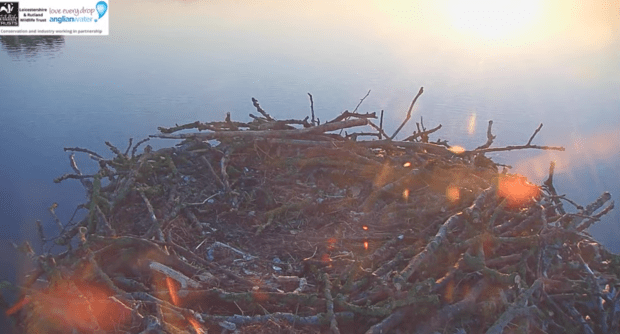
There is a beautiful peachy almost coral sky as the morning begins at the Poole Harbour Osprey nest. CJ7 and Blue 022 are roosting elsewhere.

Golden diamonds are falling on the nest of Blue 33 and Maya at Rutland Manton Bay. No one is home. They are all perched elsewhere. Blue 33 does make food drops at the nest for the two Bobs.

A little later, Blue 095 flies into the nest and settles down and then flies out again.

Blue 095

Oh, wow. Just look at that sun coming up over the Dyfi nest of Idris and Telyn in Wales. It is so bright you cannot see the perch!

A very short video of Ystwyth fledging at 7:59 am on 17 July is here:

It is serene up at The Loch of the Lowes. No one is home but it sounds like there is a fledgling on the camera perch.

What you don’t see here is that later, NC0 is on the nest, spots a fish, goes out and gets it, and gives it to LM2.

Early Morning at Loch of the Lowes. 18 July 2021

The only thing you can hear at Glaslyn are either bees or wasps on the microphone! Oh, it is so beautiful and green. It has been hot at this nest, 26-29 degrees C – and the birds are staying cool in the shade of the trees. Even with the heat the landscape looks so lush. What a gorgeous way to begin the day.

Early morning at Glaslyn. 18 July 2021

Thank you so much for joining me today. I so enjoy hearing from all of you. Stay safe! See you soon.

Thank you to the following for their streaming cams where I took my screen shots: Byrwd Gwyllt Glaslyn, Dyfi Osprey Project, Scottish Wildlife Trust and Friends of the Loch of the Lowes, Cumbrian Wildlife Trust and the Foulshaw Moss Osprey Nest, Poole Harbour Osprey Project, LRWT and the Manton Bay Ospreys. I would also like to thank the Port Lincoln Osprey Research Project and the PLO FB page where I took a screen shot of Solly’s recent tracking. And last but never least, I would like to say a huge thank you to Suzanne Arnold Horning for allowing me to use her images on my blog. She holds the copyright on them so please do not use elsewhere. Thank you.

Ystwyth Fledges and a shout out to those who helped the Patuxent Osprey chick

Yesterday was quite an anxious day with people all over the world staying up to see if the little osprey chick was saved at the Patuxent River Nest 2. In the flurry of the moment, a few people were not thanked who need to be. The first is Burky4 from the Achieva Osprey chat group. Indeed, Burky4 was the first person to mention that there were only two chicks in the nest in the nest in the Patuxent chat room. So this is a huge shout out to Burky4. Thank you! I will not know the names of everyone and I apologize – but another shout out to S Shen who then in her own words, “found the number of Tom O’Connell, director of the USGS Eastern Ecological Science Center (EESC). His business number went to voice mail which INCLUDED his cell!! Yay. I was able to text him and he gave the phone numbers for the 24 hour a day Natural Resources Emergency or Assistance.” S Shen says that another individual to be credited is Barnegat Light. I also want to thank Linda Kontol who got busy phoning numbers as well to try and get anyone’s attention after hours. I also want to thank the young man on the Wildlife Emergency Services Line again who got in touch with the Fish & Game people. It was a grand team effort and this chick might not be alive this morning were it not for the efforts of these wonderful citizen birders and government officials who worked to save this little one. And to everyone that was inadvertently missed, thank you! Tom O’Connell will be posting information on the actual individuals who went to the site this coming week.

The ‘silo’ chick is the one that went into the water, the last foster chick to be put in this nest. It is the one in duckling mode. The chick has moved but has not moved a lot. It has had a lot of excitement. Let us hope that there is no damage from either of its falls.

Every day people watching nest cams move into action when they see an animal in distress.

S Shen reminds me again how important it is to have emergency numbers readily available. She said that several years ago she noticed a chick in a Lake Barkley, Kentucky nest entangled in fishing line. There was no chat room so she went to the nest’s FB page and remembered the name of one of the chatters who said they lived close to the nest. She tracked down their phone number and called them. That person, ER, managed to get someone up to the nest and the chick was saved.

I remember that my mother had a list of emergency phone numbers for everyone helping her just in case it was needed. It was on her fridge. Here are three suggestions and I am certain everyone reading this will have more. The first is if there is a chat room associated with a nest that it have a moderator 24/7 (these are volunteers) who have emergency numbers to call the instant something happens. The second is for anyone administering a streaming cam that the local emergency wildlife numbers appear right under the name of the nest so people can locate them quickly. And the third is for everyone who watches a nest to begin to gather their own emergency numbers to call for each nest and make their emergency list for their fridge, phone, etc.

In other Osprey news, if you missed it Tiny Little of the Foulshaw Moss fledged yesterday at 20:19:57. He slept alone on the nest duckling style last night and was up early looking around. It is just a beautiful morning in Cumbria as the sun slowly rises the mist gives way to a pink hue over the landscape.

Tiny Little was doing a lot of flapping and looking. I wonder if he realizes that he actually flew yesterday?

Monty and Glesni have a grandchick. Oh, they would be so proud. Four of their chicks are now breeding. Yesterday on the Pont Croesor Nest in the Glaslyn Valley, the Only Bob of Monty and Glesni’s son, Z2 Aeron, and Blue 014 was ringed!

Blue 494 is also the first chick to hatch in this nest so there are a lot of congratulations and happiness going around. The PC nest was controversial when it was positioned where it is. Many thought it too close to the Glaslyn Nest of Aran and Mrs G. Only time will tell how this works out. For 2021, Blue 494 is also the only chick to hatch at Glaslyn with the three little ones of Aran and Mrs G dying due to the circumstances surround the storm at the end of May and Aran’s injury.

And congratulations to Idris and Telyn on Ystwyth’s fledge today! Both of their 2021 chicks have now fledged. Well done.

Doesn’t that empty nest look nice? Ystwyth is 54 days old.

She is investigating the area around the cameras.

I have some great pictures of the Ks to share with you. I will get them organized this evening. For now there is a lot of happiness to go around. Once again thank you to all of those individuals who helped save the ‘silo chick’ at Patuxent.

Thank you for joining me this morning. It is another scorcher on the Canadian prairies. There is rumour of some showers but like everywhere else in Canada we could use some rain and the birds in my garden are probably wanting their bowls and baths to be filled.

Thank you to the following streaming cams where I took my screen shots: Bywyd Gwyllt Glaslyn Wildlife video on the ringing on their FB page, Dyfi Osprey Cam, Cumbrian Wildlife Trust and the Foulshaw Moss Osprey Cam, and the Patuxent River Park Osprey Cam Nest 2.