Hatches and deaths…Late Monday in Bird World

14 June 2026

Hello Everyone,

Oh, what a day. We are chilly and it has rained heavily with hail! There was even thunder and Toby got to wear his thunder jacket. He did not react to the weather events – not once. He was calm and sleeping. So, thunder or anxiety jackets work for him.

I took videos. WP won’t let me attach them. Says they are private. Really? Missey was scared and her eyes got really big. The hail was not large but it continued to cover the deck and garden.

A fluffy cat sitting on a black table with a window in the background showing a rainy view.
A wooden patio table and chairs covered with hailstones on a rainy day, with a deck and greenery in the background.

Of course, no one believes me when I say this might be the new normal. Geez.

Sadly, the only remaining eaglet out of two has died at the White-tailed eagle nest in Scotland. Its body is being retrieved, and the camera will be down. They want to determine the COD. This is so sad. Each adult and chick is precious. They are being reintroduced to Scotland.

The White-tailed Eagle (also known as the sea eagle) was driven to extinction in the UK by 1918 due to human persecution and habitat loss. Thanks to landmark, multi-phase reintroduction programs that began in 1975, this apex predator has made a remarkable recovery and is now an established breeding species in Scotland.

The successful return of the White-tailed Eagle to Scotland occurred in three distinct phases involving the translocation of young eagles from Norway: 

  • Phase 1 (1975–1985): A partnership between the RSPB and Nature Conservancy Council began translocating Norwegian eaglets to the Isle of Rùm in the Inner Hebrides. This resulted in the first successful wild breeding pair on the Isle of Mull in 1983. 
  • Phase 2 (1993–1998): A second phase of releases took place in Wester Ross to expand the eagle’s geographic distribution across the west coast.
  • Phase 3 (2007–2012): A final set of birds was released on the east coast of Scotland in Fife, successfully establishing a population there. 

Current Status and Ecology

  • Population: There are currently around 150 to 300 breeding pairs established in Scotland. 
  • Habitat: They primarily inhabit coastal areas, sea lochs, and large inland bodies of water, which provide ample fish, waterbirds, and nesting cliffs/tall trees. 
  • Source for England: The Scottish population has been so successful that conservationists have utilized Scottish chicks to help repopulate the species in England (such as on the Isle of Wight).

Ongoing Challenges and Conflicts

While celebrated as a major conservation success, the reintroduction has caused friction with local communities. 

  • Livestock Predation: Farmers and crofters, particularly in Argyll and the West Highlands, have reported significant losses of vulnerable lambs to the eagles.
  • Management Plans: NatureScot has implemented Sea Eagle Management Schemes to help mitigate these impacts, including financial support and scaring tactics for farmers in designated areas. 

The Roy Dennis Wildlife Foundation became actively involved in the reintroduction of the White-tail eagle. The following is taken from the RDWF Website:

PROJECT START: 2019
EAGLES RELEASED: 45
PAIRS BREEDING IN ENGLAND: 2
CHICKS FLEDGED FROM BREEDING PAIRS IN ENGLAND IN 2025: 3

White-tailed Eagles were once widespread along the whole of the South Coast of England, from Cornwall to Kent, before being driven to extinction by relentless persecution that began in the Middle Ages. The last pair bred on Culver Cliff on the Isle of Wight in 1780. Many parts of southern England remain highly suitable for the species, and following the reintroduction of White-tailed Eagles to Scotland – where there are now approximately 180 breeding pairs – we were granted licences by Natural England and Nature Scot to begin an English reintroduction in partnership with Forestry England, based on the Isle of Wight. A feasibility report was submitted to both Natural England and Nature Scot as part of the licence applications. The initial licence permitted the release of up to 60 young eagles on the Isle of Wight over a five year period, beginning in 2019. It is hoped that a small population of 6-8 breeding pairs will become established within 60km of the Isle of Wight, with birds spreading east and west along the South Coast. In 2026, Natural England issued a further license to release up to 20 White-tailed Eagles over 3 years from Exmoor National Park, to support the expanding population in Southern England.”

Every chick is precious. I hope to have news of the necroscopy for you when it is released. This could take weeks.

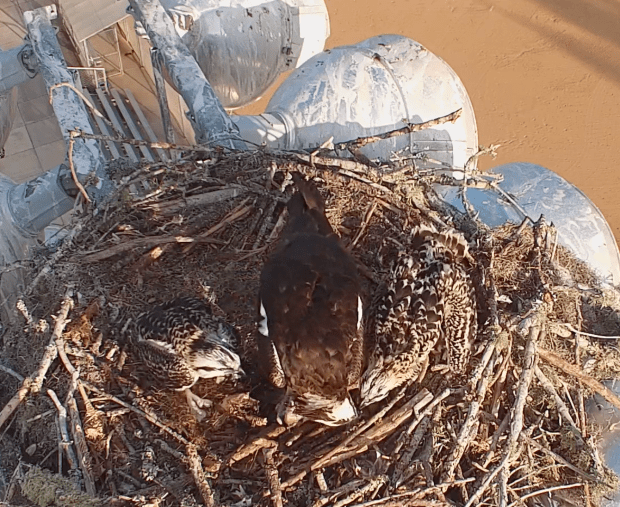
More great images from Seattle by Ping Shen of Harry, Sally, and their ‘Only Bob’. Thanks so much, Ping, for sharing these with us. Ping notes, “from the looks of things, an only child. Quite adorable, peeking at mom, and then sleeping at the foot of dad’s talon…”

An osprey perched on a nest made of sticks, looking down at a chick in the nest while surrounded by greenery.
Two ospreys sitting on their nest, with one looking directly at the camera while the other is feeding on a fish.

A beautiful sunset with Clark, Iris, and what might be another ‘Only Bob’. We are on pip/hatch watch for that second egg. We will see if Only has a sibling. I sure hope it is strong as Big Bob is a smart survivor – it has sure been beaten around by fish and nest materials.

Two ospreys are perched on a nest made of twigs and branches, with one parent bird standing close to a chick in the nest. The background shows a parking lot with trees and streetlights.

Make sure to check out the summary – what was it that frightened Louis?

Geemeff Woodland Trust daily summary for Loch Arkaig Sunday 14th June 2026

Daily summary Sunday 14th June 2026

Today was mainly about fish – there were many deliveries and both females rejected a fish at the first time of offering then accepted gladly when the male returned with it a bit later. Garry LV0 brought two fish on cam for Aurora 536 and his tally now stands at one hundred and seventeen, while Louis excelled with five deliveries, including his first flatfish this season, taking the Nest Two tally to one hundred and thirty nine. The chicks did a bit of fighting but nothing serious, and both decided mum was taking too long dishing up so tried a nibble at the fish she was holding – they’re healthy and developing as expected. There were some intruder alerts, no intruders seen on nest cam apart from a pair of Wood Pigeons who perched on Nest Two for a few moments, but local resident LizB saw two Golden Eagles flying near an Osprey around the time Dorcha was on high alert and shortly before Louis arrived with the flatfish. Later Garry and Aurora were also on alert, perhaps the pair of eagles were still in the area. Only one Eagle has ever been seen on a nest – a juvenile Golden Eagle who touched down for a nano second on Nest Two in April 2023 – but distant eagles have been caught on nest cam on a couple of occasions and Dorcha returned once with a blood injury from an eagle encounter. Both White-tailed Eagles and Golden Eagles share the forest with the Ospreys so perhaps it’s fortunate we haven’t seen them close up too often. The weather was much more settled today and the promised sunshine did materialise. It should continue dry overnight and partly cloudy with a low of 9°C, continuing with a high of 20°C tomorrow and no rain before midnight.

Today’s videos:

https://youtu.be/w7zZRXu3pZ0 N2 Louis’ first fish is small and doesn’t last long 05.29.41

https://youtu.be/XYllXMRX7vA N2 A pair of Wood Pigeons pay a visit in Dorcha’s absence 08.27.59

https://youtu.be/BecPV01-e_E N2 Both chicks don’t wait for Dorcha and have a nibble at fish two 11.22.47 

https://youtu.be/MoOhTnm6YZo N2 Louis’ third fish is his first flatfish 14.39.15

https://youtu.be/grrb8lfBmMs N1 Aurora takes fish one from Garry and they both leave 14.14.51

https://youtu.be/Gmec-mfvgPI N2 Chick2 gets impatient and tries to take bits of fish four from C1’s beak 16.05.00

https://youtu.be/IK7rPRrh6-w N1 Aurora takes fish two the second time Garry brings it 19.13.05

https://youtu.be/VpjzqTKFTYc N2 Dorcha takes fish five the second time Louis brings it 20.36.58

Bonus guide to rapid growth of young Osprey chicks – our two are 13 and 11 days old today (thanks Dyfi)

https://www.dyfiospreyproject.com/blog/emyr-mwt/rapid-growth-phase-young-osprey-chicks


Everyone’s invited to join the lively community at Woodland Trust’s Osprey forum, it’s friendly, free and everyone’s welcome:

https://www.woodlandtrust.org.uk/trees-woods-and-wildlife/osprey-cam

Buddy’s Mum catches D4 at Decorah fledging. https://youtu.be/pFLwncKkHH0?

‘L’ sent me the link to remind us that the Port Lincoln Osprey barge is now back online for the season !!!!!!!!!! https://www.youtube.com/live/47K1i7qCzaI?

‘L’ also sent me another link. A video of Wisdom’s grand chick getting banded. Oh, have a look!!!!!!!!! Isn’t it adorable?!!!!!! https://youtu.be/ZW8gHzCVBwU?

A young bird standing on sandy ground, surrounded by sparse vegetation and dried branches.
Close-up of a grand-chick with a red identification band on its leg, standing on sandy ground with some grass and strands of dried vegetation around.

I learned something. Maybe you will, too. ‘R’ sent an article on Aquaculture and shorelines. https://sercblog.si.edu/imani-black-sustainable-aquaculture-and-misconceptions/#more-13282

How big a fish can Ospreys bring in? And why can females catch bigger fish?

An osprey perched on a branch holds a mullet fish in its talons, with a lush green landscape in the background.

Is there an Osprey fishing contest going on right now? Louis brought in a whopper to Dorcha and the two surviving chicks.

A mature bird of prey stands over its nest, where several chicks are visible. The adult is holding a fish, preparing to feed the chicks in a natural setting surrounded by greenery.

Two osprey chicks have been observed at Loch Inish.

We wait to see how many chicks Aran fathered this year with his new mate. At least one! Next year, Friends of the Osprey will put a streaming camera on Aran’s nest. This is fabulous news.

It looks like donations to SaveMoonCamp, the land near Jackie and Shadow’s nest, have reached the 1/3 mark. They will need lots more funding by the deadline of 31 July 2026. It is unclear to me the precise amount of funds the group needs to get a loan to continue their fundraising. If you intend to help, please do it now! Go to SaveMoonCamp.org

The baby at Poole Harbour is just starting to get its feathers while the others are really being camouflaged now. CJ7 and Blue 022 making raising four osplets look effortless — and we know, for certain, that it isn’t.

An adult osprey stands near its nest, which contains three young chicks, surrounded by trees and foliage.
An adult osprey feeding its chicks in a nest made of branches, surrounded by a natural forest environment.

Syfadden and Clogwyn are doing fantastic with their two chicks in the Usk Valley in Wales.

A bird sitting in a nest made of twigs and branches, with a scenic landscape of fields and hills in the background.

Little Bob is trying to get under Elen at the Glaslyn Osprey nest she shares with her mate, Teifi. The two Big Bobs are napping.

An osprey standing over three fluffy chicks in a nest made of sticks, surrounded by a green landscape.

Closeby at the Friends of the Osprey Nest of Aeron Z2 and Blue 014, there are another three. They have been enjoying some trout today!

An osprey chick sitting in a nest made of sticks, overlooking a scenic landscape with hills and trees in the background.
A bird's nest made of twigs with two chicks and an adult bird on a hillside, overlooking a landscape with mountains and greenery in the background.

The single surviving osplet at Loch of the Lowes seems to be doing alright.

An osprey sitting on a nest made of twigs and branches, with greenery in the background.

This is incredibly compassionate. One of the major killers of chicks/storklets/hawklets/osplets etc in the nest is damp. These two good samaritans are blow drying the storklets so that they will hopefully survive the storms that have come to Europe.

Two people care for four stork chicks in a large nest on a rooftop, using a hairdryer to warm them.

Much better!

A stork stands on a large nest made of sticks and hay, with several baby storks resting inside. The background features a residential area with rooftops and solar panels.

What I wouldn’t give to see this at our osprey nests in North America. The kindness to stork families across Europe warms my heart every year and brings tears to my eyes.

No hatch as yet at Mlade Buky White Stork nest.

A stork standing in its nest, surrounded by sticks and grass, with a scenic view of houses and hills in the background.
Two storks nesting in a large bird's nest on a rooftop, overlooking a residential area with green hills in the background.

UK Parliament has recognized the persecution of raptors – should I add the word ‘finally’.

Second hatch at The Lesser Spotted Eagle nest in Estonia. While this might be cause for celebration, Lesser Spotted Eagles practice obligate siblicide whereby the eldest chick always kills the second. There are rare exceptions.

The following comes from Animal Diversity Web:

A majestic eagle perched on a tree branch, showcasing its brown feathers and sharp beak against a clear blue sky.

Lesser spotted eagles live primarily in patchy woodland areas, meadows, fields, and natural grasslands, often in moist environments. Although forests are not used as primary habitat, they often build nests near forest edges. Lesser spotted eagles have been found in African dry mountain and grassland savanna habitats during their winter migration. Within these dry mountain habitats, their range typically extends to a maximum elevation of 2,200 meters.

Lesser spotted eagles generally hunt by walking along the ground. However, they typically nest and perch in the branches of forest trees. When nesting and perching, lesser spotted eagles often use branches closer to the ground rather than higher in the trees.

Adult lesser spotted eagles also are distinguished by their yellow eyes, whereas adult steppe eagles and greater spotted eagles have brown eyes. Juveniles of all three species have brown eyes. The head and wings of lesser spotted eagles are a lighter shade of brown compared to the rest of its body; in steppe eagles and greater spotted eagles, the entire body is a dark shade of brown. Lesser spotted eagles also have a small head and beak for an eagle. Like other eagles in the genus Aquila , lesser spotted eagles have a white V mark on their rump. Finally, differences in the shape of the wings cause lesser spotted eagles to appear to have a longer tail (96.6 to 123.75 cm) than other closely related species. Lesser spotted eagles have narrower wingspans (145 to 165 cm), whereas greater spotted eagles have broader wingspans.

Lesser spotted eagles are considered monogamous birds. Currently there is no clear evidence of partner fidelity, however most birds return to the same nest every year.

Lesser spotted eagles breed once per year. The pair builds a platform nest, generally in a tall tree. Egg laying begins after the nest is complete in late April to early May. It is believed that males are responsible for defending the immediate vicinity around the nest. Lesser spotted eagles lay one to two eggs, but typically only one survives. The older or stronger sibling usually attacks the weaker one. Eggs are laid in the second half of April and between May 23 and 27. The egg incubation period ranges from 36 to 41 days. Fledglings have been observed in the middle of July, with a fledging period up to eight weeks. Juvenile lesser spotted eagles do not reach reproductive age until they are 3 to 4 years old.

The new babies. In rare cases, when prey is very plentiful, both have survived, but if you are watching this nest, please be advised that when I say rare, I do mean rare. Adults will often withhold prey to get the stronger eaglet to attack the other weaker one. When the kill is done, the prey returns.

A golden eagle parent standing over two fluffy chicks in a nest, surrounded by greenery and tree branches.

Two beauties at nest #5 in Finland.

A pair of ospreys tending to their nest, which contains several fluffy chicks. The nest is built from twigs and branches, with a natural landscape in the background.

At the NCTC nest, Susie fledged this afternoon. Congratulations to Bella and Scout.

I hope that Little Dewey’s crop continues to be filled.

Some fish came to the Santiam Canyon Osprey nest for Mum and the trio. They don’t get much fish. It was nice to see their crops filling.

An osprey stands next to its chicks in a nest made of twigs and moss, with a backdrop of trees and a road.
A mother bird feeding her chicks in a nest made of twigs and moss, with a residential area visible in the background.

Thank you so much for being with us today. Please take care and wish for fish at all nests!

Thank you to ‘R’ for that article on aquaculture. Thank you to ‘L’ for the links to Wisdom’s grandchick and a shout-out to Ping Shen for those great images of Harry and Sally and their baby. To Geemeff, we are always grateful for your daily summaries of all news at Loch Arkaig and your videos. To everyone who posted information on FB and images, to Raptor Persecution UK for telling it the way it is, and to the Roy Dennis Wildlife Foundation and the owners of the streaming cams – we are always thankful to you.

Henlopen Osplets die of starvation and other late Saturday and Sunday news in Bird World

11 June 2022

UPDATE: THE DEATHS OF THE THREE OSPLETS AT THE CAPE HENLOPEN STATE PARK NEST IN DELAWARE WAS CAUSED BY INTRUDERS TAKING OVER THE NEST. THE FEMALE WAS LAST SEEN ON THE NEST ON THE 10TH. ALL CHICKS WERE FINE. BOTH PARENTS ARE MISSING AND THE BIRD ON THE PLATFORM NEST IS NOT EITHER PARENT.

Oh, Saturday was just such a beautiful day. We all must treasure them and get outside and listen to the birds singing and smell the freshly mowed grass and the flowers. Our summers are so short in Canada that it is such a pleasure just sitting and listening, sometimes. Today the wee rabbit found itself underneath the square feeder by the lilacs. It was certainly enjoying those Black oil seeds and millet that had fallen to the ground. Mr and Mrs Grackle have fledglings and they are very noisy if you go anywhere near the lilac bushes – and then there is Mr Crow who arrives demanding bread, cheese, and sausages. It was quite the afternoon. I will try and take my phone out and get some photos another day for all of you. My big camera doesn’t quite understand that when it is set to CQ mode it is supposed to be ‘quiet’ and instead the noise frightens everyone within ear shot.

Saturday was not, however, a great day for Little Bit 17 at the ND-LEEF Bald Eagle nest. But it was not all bad, either. In fact, there was so little food brought to the nest that for Little Bit to have a crop was a blessing. He spent various times through day working on a raccoon that had been brought into the nest. He started working on it once at 14:39 and was still eating on it at 14:58. It looks like he ate the entire head which would have had lots of meat and fat. There were two other times that he worked on it. A fish was brought in but the older siblings seem to have been fed all of it. At one time, 16 tried to hurt Little Bit 17. It is over and Little Bit is fine. Let us all hope that there is more prey tomorrow. The nest is really relying on road kill it seems. Perhaps the river is still too high with all of the rains and too murky for the eagles to fish. Last Sunday saw a lot of fish brought to the nest – will the same thing happen tomorrow?

16 (I think it was 16 because of their actions towards Little Bit) came up wanting some of the remaining raccoon.

Mum flew in and fed the two older siblings. Little Bit stood by the side rails hoping there would be a little left but, alas, no.

All spread out and sleeping with the turtle shells. Someone said that there are at least 50 of them somewhere in the nest. You can see Little Bit’s primaries growing and his tail. I wish his head feathers would grow back. Poor thing. Any sore spots seem to have healed, thankfully.

Wish for fish everyone!

And the fish came Sunday morning. Mom brought in a Walleye at 08:28:21. At 08:40:11 Little bit 17 steals that walleye from one of the older siblings! He takes it to the porch to eat it.

You can see Little Bit pulling that fish to the porch. There is no head and he is going to heat for several minutes (7 or 8) and then 16 is going to steal it back.

At 09:59:47 Dad brought in a Blue Gill. Little Bit 17 stole the whole fish. He took it to the porch and ate the entire thing!!!!!!!!!! All by himself. Can you believe this kid? Bravo Little Bit.

Little Bit ate all of the fish and returned to look out at the world while the older siblings are up on the branches. He flapped his wings – they are growing – and stopped. You can only get a sense of how big his crop is over by the edge but he is one happy full little eaglet this morning and I have tears rolling down my eyes. He has been super brave pulling that last fish right out from under the older sibling!!!!!!

Both fledglings at the UFlorida-Gainesville have been on and off the nest eating or hoping for a delivery. At one point it started raining (or was it hail?). Middle was trying to hover off the nest and was having difficulty – of course Middle you can’t fly in pouring down rain!!!!!!! Just look at those beautiful, beautiful wings! These osplets are simply gorgeous. The feathers are absolutely perfect. Oh, I wish Little Bit was as healthy as the two fledgling ospreys.

It is rainy and windy in Gainesville Sunday morning and Middle is on the nest thinking it is a good day to stay home.

Ferris Akel has wonderful Saturday bird tours around Montezuma, Sapsucker Woods and Ithaca. At the end of the tour today, everyone lucked out as the Ls and Big Red were quickly located. I cannot tell you which chick is which from these images – so just enjoy a basket of cute little hawks.

Big Red was over on the other light stand. An adult is always around close watching the hawklets. Arthur was not spotted. He was probably off hunting!

All of the storklets still remain on the nest of Bukacek and Betty in Mlade Buky. They are growing and growing. While there is a significant difference in the size between the oldest (front right) with the youngest (back left), each is holding their own and as I have mentioned several times, there appears to be no effort to do any brood reduction by the adults. Fish must be plentiful – wonderful news!!!!!

It was a feeding fest Sunday morning in Mlade Buky. Watch how the two little ones get in there to get those fish.

Karl II and Kaia’s storklets are also growing and are being very well fed. There appears to be plenty of fish at their source in the Karula National Park in Estonia.

Kaia has fish and is getting ready to regurgitate them on the moss so the storklets can eat.

They are grabbing them with their little beaks.

Just look at the little fish in their bills. So sweet. The moss nest keeps these babies so nice and white compared to the red iron soil of Mlade Buky. The eaglets are always looking a little dirty there.

Bywyd Bwyllt Glaslyn posted some information on the osplets of Aran and Mrs G today on their FB feed. Little Bob is certainly smaller than Big Bob at the front!

There is much sadness at the Henlopen State Park Osprey Nest. One of the osplets appears to have died. I did not see it move at all today. The other osplets are weak and very hungry. Mum came in with a tiny fish. I thought she would feed the other two and they did too but, she didn’t. I fear that all will die.

It is a tiny fish. In raptors, it seems that their first priority is the protection of their territory, then to keep themselves fed and alive, and lastly the offspring. Mum has to be strong enough to fish. I do not know what if any was delivered after the 8th in terms of fish til this morning. It was not enough to keep the osplets alive and the two surviving have very concave chests.

On Sunday all three of the osplets have died. What a tragedy. The poor Mum – she lost her mate and all her lovely once healthy chicks in a few days. Incredibly sad.

There appears to be no attempt by anyone to provide a fish table for this family. Just sayin’. Most of the issues related to getting fish or other prey to the nest including those at the ND-LEEF nest can be attributed to human interference in some way or another. Changing weather patterns causing torrential rains, floods, and mudslides is impacting the rivers so that the Bald Eagles and Ospreys cannot ‘see’ to fish. Most of you are very much aware of the impact that we have had whether it is habitat destruction, rising sea temperatures due to a heating planet, etc. There isn’t much that we haven’t caused so I will not accept the answer that it is ‘just nature’ not to help out these lovely raptors.

In contrast, we have the surviving three Black Storklets in Estonia. They are being well fed and taken care of and every aspect of their future well being has been considered. Please note that they do not see ‘human animals’ very often – just the decoy mother, the step-father who feeds, and themselves. This is so they will not imprint on others.

The smallest chick even had a private feeding to ensure that it gets enough to eat with the two much larger siblings. Just like at the size of its crop when it is returned!

Everyone has been talking about the Bald Eagles raising the hawklet in their nest on Gabriola Island. Here is a delightful discussion of another Bald Eagle adopting a Red-tail hawklet a couple of years ago. Here is the complete story from beginning to successful end. Please listen. This is such an informative discussion with live footage in the nest showing the eagles and the hawklet.

The Dyfi Osprey Project posted an excellent bit of information on their FB site this morning about Osprey growth.

These are the osplets that Dyfi is referring to – the three of Idris and Telyn. We should know their names soon! Over 200 suggestions – wow.

I often wonder if the change of the plumage and the itching makes the osplets crankier during the Reptile phase that then causes them to start pecking one another????

It has been very windy up in Alaska at the nest of Liberty and Freedom. The two little eaglets don’t seem to even notice! They are having a nice meal.

The winds are raging at Loch of the Lowes too. The wee chicks are calling for food as Blue NC0 waits to see if Laddie will have some luck fishing Sunday afternoon.

Dylan brought in a perch at 16:04 at Llyn Clywedog and Seren is happily feeding all of the Bobs. The weather does not look as windy – thank goodness. This nest in the Cambrian area of Wales has been wet for several days now.

The third hatch, Little Bob, at Glaslyn is really starting to catch up. Aran is bringing in lots of fish. No one is hungry. There is even a fish sitting on the nest waiting for the next feeding. That is Little Bob by the side of Mrs G.

Poor Dorcha. The Loch Arkaig nest seems to be getting all of the bad weather. It is rainy and windy. Louis, thankfully, prevails in getting fish on this nest in the most dire of times. He is literally amazing.

I want to leave you with something beautiful. Andris has come to the nest and he is feeding the small eaglet! Mostly the males do not do this so it is very special. Oh, such a sweet little fluff ball. Andris and Anna have their Lesser Spotted Eagle’s nest in Zemgale, Latvia.

Anna is feeding the wee eaglet later. Oh, how precious.

Grinnell Jr and Lindsay are sure keeping Annie and Alden busy at the UCalifornia-Berkeley scrape. They are running all over the place chasing any adult food begging – even if they are full – and are beginning to self feed. Adorable. Being the pests they are meant to be!

Grinnell Jr has a blue band and Lindsay has a gold one.

Last but the falcons are never least, the wee little peregrine at the Manchester New Hampshire nest, Colby, woke up watching everyone fly around. At 06:52:49, Colby fludged just like Clem. I am certain the volunteers will be out to make sure he is OK and perhaps he will be returned to the nest with Clem tomorrow!

The weather certainly changed on the Canadian Prairies. We had thunderstorms all during the night and much more rain. My garden is beginning to look like a thick forest – which is what I have wanted for years – a forest in the city! The sadness at Henlopen weighs heavy today.

Take care everyone. Thank you for joining me today. See you tomorrow!

Thank you to the following for their streaming cams, FB posts and video clips: ND-LEEF, UFlorida-Gainesville Ospreys, Ferris Akel Tours, Mlade Buky, Eagle Club of Estonia, Bywyd Gwyllt Glaslyn, Henlopen State Park Ospreys, Christian Sasse, Dyfi Osprey Projects, Glacier Gardens Bald Eagles, Loch of the Lowes and the Woodland Trust, CarnyXWild, Friends of Loch Arkaig, People’s Post Code Lottery and Scottish Wildlife Trust, Cal Falcons, Peregrine Network, and the Latvian Fund for Nature.

Early Monday in Bird World

6 June 2022

Liz has posted a video of Urmas and his team removing the Black Storklets from Janika’s nest in Jegova County, Estonia on 5 June. I reported earlier that a glove like a Black Stork shape had been used to place the storklets in the basket. That information is incorrect and my apologies. Bare hands were used. One storklet, sadly, died in the nest over night before the intervention. They need temperatures of 22-28 degrees C. They cannot thermoregulate their temperatures yet. In addition, it rained and well – I hope the remaining chicks survive and thrive. It will be a first for the Veterinary College to raise Black Storklets to fledging. Good luck to Urmas and his team!

Here is the video that Liz posted:

The White Storks Bukachek and Betty still have five storklets in their nest in Mlade Buky, The Czech Republic. You can see the difference in size from the oldest to the youngest known as ‘Little Finger’ by the chatters.

Bukachek (male) is making sure that the wee storklet gets food in the image below.

It has been raining on and off. The rich Red Iron in the clay makes all of the Storks look dirty. Maybe when it is not so rainy more straw will be brought to the nest! That would help.

Awhile ago I mentioned the Lesser Spotted Eagles. Andris and Anna, at their nest in Zemgale, Latvia. The camera was down for awhile but it is now back and running. In the meantime, a beautiful little Lesser Spotted eaglet has hatched!

It is so cute and fluffy! There was only one egg so this is the only chick. Had there been two eggs, the first hatch most always predates the second. So having only one is a good thing! The parents can focus on bringing food to this cutie pie.

Voldis came to the White-tailed Eagle nest that he shares with Milda near Durbe, Latvia. He arrived at 05:30 and stayed for well over an hour.

Milda has had a terrible time since her long time mate, Raimis disappeared two years ago. I hope that Milda and her mate if it is to be Voldis have a very successful next breeding season. This year the eggs were predated.

Margit hatched on 25 April and is growing by leaps and bounds with the tender care of the parents, Kalju and Helju. This Golden Eaglet’s nest is in Soomaa National Park in the southwest of Estonia.

Oh, such a beautiful eaglet. Margit is waking up. The black dot behind the eye is the ear. It will be covered over with feathers before the eaglet fledges.

Helju just brought breakfast for Margit. Liz caught it in a video:

This is the streaming cam for this nest:

What is happening with Ahote? Ahote, the youngest of the three eaglets at the West End nest of Thunder and Akecheta, fledged on June 2. He has spent the time since then on Transmission Rock and is getting hungry unless food was delivered. Working his way back to the nest, he got some wind on his wings and got to the nest but was blown off course. No doubt he will get there! Very determined.

In the image below you can see him directly below and slightly to the right of Kana’kini and Sky.

Checking on Osprey nests in the UK, the third chick hatched at Llyn Brenig but did not survive.

Aeron Z2 and Blue 014 have had their first hatch at the Pont Cresor nest in the Glaslyn Valley.

Laddie LM12 delivered nine – yes, 9 – to the nest for Blue NC0 to feed their three Bobs at the Loch of the Lowes.

All three Bobs seem to be doing fine at the Glaslyn nest of Aran and Mrs G. Just look at how dark Mrs G’s plumage is and that necklace.

Aran has been busy delivering fish. Little Bob is not always in the most perfect position!

I do have to admit that Idris and Telyn are my favourite Ospreys in the UK along with Blue 33 and Maya.

Telyn is feeding the two older Bobs while Bobbie Bach is asleep.

Food coma!

Oh, could that be comfortable?

There is Bobbi Bach ready for his meal while the others sleep. Poor Telyn. They are surely keeping her busy.

It looks like it is starting to dry out for Dylan and Seren at the Llyn Clywedog nest. Gosh, Seren was just so wet and hunkered down keeping the three Bobs warm and dry. Let us hope the sun comes out, too, to warm them up.

Both of the Ospreys were on the UFlorida-Gainesville nest sleeping during the night.

Both are back on the nest waiting for a breakfast delivery!

Good Morning Little Bit 17! Everyone is waiting for prey deliveries at the ND-LEEF nest. I hope that the adults will feed Little Bit like they did yesterday. That would be grand.

The scrape box at Manchester NH is getting to be quite the mess! A good wind will help clear it out. It is hard to believe but this scrape will be on fledge watch beginning on the 10th or 11th of June – this coming weekend!

Nancy is on the nest at 08:40 feeding E1. It looks like they will have a beautiful day at that Bald Eagle nest in Minnesota. Wonder when E1 is going to take to the skies? Nancy has done wonders taking care of E1 and fending off intruders.

Fledge watch is on for the three at the Pittsburgh-Hayes Bald Eagle nest. It looks like only two but 17 is up higher in the tree.

There are still two eaglets – Sentry and Star – on the Redding nest of Liberty and Guardian. We are on fledge watch for these two also! It could be a very busy week!!!!!!

We are definitely on fledge watch for the eyases on the nest of Big Red and Arthur on the Cornell campus. The chicks are restless and L1 is definitely ready!

Oh, the excitement of a nest of four hawks – each itching to fly including the youngest, L4. Wonder if L1 will be the first of the oldest to go? Stay tuned.

Thank you so much for joining me this morning. Take care. See you soon!

Thank you to the following for their streaming cams where I took my screen captures: the Eagle Club of Estonia, Mlade Buky White Storks, Latvian Fund for Nature, IWS and Explore.org, Friends of LOTL and the Scottish Wildlife Trust, Bywyd Gwyllt Glaslyn, Dyfi Osprey Project, CarnyXWild, UFlorida-Gainesville Ospreys, ND-LEEF, Peregrine Networks, MN-DNR, Pix Cams, Friends of Redding Eagles, and Cornell Bird Lab RTH.

Friday Morning in Bird World

13 May 2022

Good Morning Everyone! I hope that your Friday is a very good one.

Have you seen this old film titled Osprey?

In the Q & A discussion at Cal Falcons, one big difference between Grinnell and Alden that has been noticed is that Alden hunts at night. He also seems to be hunting in exotic places bringing in various prey items. Last evening the kids and Annie had a bed time snack at 22:00.

Alden on the left and Annie, who has just taken prey item, on the right. Look at those two smiling eyases! How grand. Both ate extremely well, the little one falling into a food coma first.

All are wide awake first thing in the morning and ready for fish at the Manton Bay Osprey nest at Rutland. Blue 33 (11) has been flying in with more and more fish during the day. The three are doing very well with the flapping perch incident well behind them! A great way to start a Friday.

At 11:50 Blue 33 took a turn feeding his chicks as Maya looked on.

More food around 14:00. Maya is pretty much feeding the chicks every two hours. The trio will grow fast!

The streaming cam to the nest of the Lesser Spotted Eagles, Anna and Andris in the Spruce Tree in a forest area at Lemgate, Latvia is back on line. The couple are incubating one egg which is set to hatch in June.

Both eaglets are still on the nest at Dale Hollow. They are 75 days old today if you count hatch day (28 Feb). Gorgeous birds who are now filling in almost the entire nest. They are definitely within fledge range which is normally 10-12 weeks for Bald Eagles.

The eaglet at the Duke Farms Bald Eagle nest is four days older than the pair at Dale Hollow.

Middle Little was on the platform at the Captiva Osprey nest this morning early calling for dad, Andy, to bring in a fish. All four of the family can be seen flying around the area and since Middle Little and Little MiniO are the only fledglings, Lori has been able to take images from her kayak and is certain it is them screaming for the parents to bring fish. Lori is returning to Canada today. If you have enjoyed watching the Ospreys and all her help finding them to reassure us all are alright, why not go to the chat today and just give her a little thank you. It has been a great year at the Captiva Osprey platform – a first in a long time to have osplets fledge! Thanks, Lori.

At 07:25:29, Dad delivered a fish to the UFlorida-Gainesville Osprey nest. Middle started cheeping right away and managed to get into position quickly, on the opposite side of Mum, to get some nice fish. That is a great way to start the day at this nest. It is 22 degrees C, winds were at 6 kmh at the time of the delivery with the pressure rising. The weather forecast is for a thunderstorm later today.

Nice to see that fish this morning before the weather turns bad.

Big did not seem threatening but Middle still got around the back of Mum and over to the opposite side calling loudly for food. Good for you, Middle.

Mum did give Big the first couple of bites before Middle got up front but then she fed both. I hope Middle is getting his confidence back!

Oh, this camera can be annoying. That is Middle with its wings spread. Growing. Getting to the point that Big really cannot do too much damage other than throwing Middle off the nest — which I hope is not going to happen. The thunderstorm is forecast to begin around 16:00 nest time.

Nancy and E1 – Harriet – were rearranging straw on the nest this morning. There continues to be a sub-adult around the nest. Both Nancy and E1 continue to do as well as expected as a nest with a single parent. Look at Harriet help her Mum!

Cholyn fed TH1 at 05:33 from the fish that was left overnight.

Just look at that beautiful golden glow over the nest shining on the face of our beautiful Mum. It won’t be long til Dr Sharpe climbs up the cliff to band the eaglet. I will see if I can find out when that is going to be for everyone. If you know already, let me know!

They have fledged but both Jasper and Rocket are still hanging around the nest tree getting food from Samson and Gabby. Gabby normally migrates north when it gets hot while Samson stays in the Jacksonville area. Last year he kept feeding Legacy for some time. It is so nice to see the birds on the nest. Look close. One of the eaglets is on a branch almost at the left bottom corner.

The two eaglets on the Decorah North nest of Mr North and Mrs DNF are well and doing just fine. Bad weather has been going through the area with a Derecho or Inland Hurricane with winds of 100 mph going through South Dakota and area yesterday. Fingers crossed for all that were in its wake.

Big Red and her gang of four eyases are doing just fine this morning, too. The chicks are relaxing after having breakfast and Big Red has been on the nest doing some allopreening.

Big Red is so beautiful.

This has been a great way to start a Friday morning. All of the nests appear to be doing well. In Canada we traditionally plant the annual flowers on the May long weekend which is connected with Queen Victoria’s birthday. That is next weekend. Everyone will be at the greenhouses stocking up on flowers and vegetables and mixed in there will be me today. Take care everyone. Thank you so much for joining me today!

Thank you to the following for their streaming cams where I took my screen captures: Latvian Fund for Nature, LRWT, Cal Falcons, Captiva Ospreys and Window for Wildlife, Dale Hollow Eagle Cam, Duke Farms, UFlorida-Gainesville Ospreys, MN-DNR, Explore.org, NEFlorida-AEF, and Cornell Bird Lab RTH.

Friday Morning in Bird World

29 April 2022

Good Morning everyone. The sun is trying to shine in southern Manitoba and the sky is light blue grey. Everyone is preparing for the onslaught of more rain headed our way — will it really be 50mm? That is close to 2 inches.

Mother Goose waiting for the all clear to leap from the Decorah nest. 28 April 2022

First up. I have received a number of letters about the 5th gosling of Mother Goose at the Decorah, Iowa nest. As many of you know, three goslings were with Mother and Father Goose after they jumped out of the nest and two were not. Boots on the ground found 4 and got it with Mum and Dad. Volunteers of the Raptor Resource Project and Mother and Father Goose continued to look and call for the 5th. Sadly, it was found dead. According to the following official release, it was not the youngest that died.

This is the statement released by the Raptor Research Project on their FB page:

“The goslings jumped today! We’ll have video tomorrow, but for now, we know that: Four of five goslings survived and were last seen swimming happily in Trout Creek, foraging along the bank, and following their parents up and down the small pool below the nest. One of the four went the wrong way after jumping! We managed to reunite it with its family after some mad scrambling through the brush, a low crawl across the river bank, and a little rock jumping. This gosling seemed determined to stay with new Papa. David Kester: it took two tries to get it back where it belonged! One gosling died. We initially thought it might have been the last to jump, since it was younger and smaller than its siblings and took a while to follow them out of the nest. But the gosling we reunited with its family was smaller than the one we found dead. We suspect (but don’t know for sure), that the reunited gosling was the last gosling, and the gosling that died was gosling number two. One, three, and four joined their parents quickly, but we don’t think we saw two after it jumped.”

The ‘sad’ part of all of this is that Mother Goose is still looking for her 5th gosling. She was at the nest this morning.

The Cape Wildlife Centre taught us much last season about Canada Geese – if we did not already know. When Arnold had his digit bitten off by a snapping turtle in their pond, Amelia looked and looked for him. She waited on the porch knowing he was inside the clinic (their pond is on the grounds of the clinic). The staff helped them to be together, for her to watch Arnold’s recovery, for them to share meals, and then finally to be outside. The take away from that is that Canada Geese are intelligent and sentinel. Was the dead gosling shown to the parents? And in asking that question I am not criticizing what was done yesterday at Mother Goose’s nest. Just asking a question. If not, perhaps in the future this should be done and also, when one goose is taken into care, that the other one go along, too! They really are bonded!!!!!!

L4 at the Cornell Red0-tail Hawk nest did survive what felt like a 72 hour pip and hatch. It completed its hatch at 23:08 on the 28th of April. Here is the video of Big Red and Arthur and their four Ls! Congratulations Big Red and Arthur!!!!!! This is going to be fun. Big Red will be in her glory – 4. It is, as far as is known, a first for her.

L4 will be substantially smaller than L1 which is a week older. But, see all that prey on the nest. There is plenty of food and there is no reason not to believe that L4 will not thrive. The beaking only occurs in falcons and hawks because 1) their eyes have to become clear and focused and 2) every black beak with pink inside is potentially food. Normally subsides after a week. As far as my understanding goes, siblicide is extremely rare in hawks and falcons unlike eagles and ospreys.

Yes, Arthur, there really are four of them!!!!!!!!!!!!!

Just look at the prey pantry in this nest. Arthur is so excited it will be filled to the brim with all sorts of critters. No one will go hungry. In the image below, Big Red is checking each beak to make sure none of the Ls want any more squirrel before she quits feeding. She is a pro at taking care of chicks and Big Red loves being a Mum.

There are a couple of Bald Eagle nests that I continue to check. One of those is the National Arboretum nest in Washington, DC. Mr President and Lotus have a gorgeous eaglet who is just losing the last of the dandelions on the top of its head. However, this eaglet has been fed duck and I worry a little when waterfowl are consumed because of H5N1.

The remaining two Osplets at the UFlorida-Gainesville nest on the light stand are doing fine.

Both of the eaglets at the MN-DNR nest are doing fine this morning also. They have had some waterfowl so I continually check on them like the NADC-AEF nest.

The two eaglets on the Dale Hollow nest continue to thrive also. They are gorgeous birds and today they are (counting hatch day) 61 days old. Soon!

I know that almost everyone is a fan of Harriet and M15 at Fort Myers. It appears that E19 might have left the territory yesterday. Lady Hawk made a video of those final interactions and moments.

There is good news. Janika returned safely to her nest with Jan yesterday at 16:15. There had been a fight with an intruder and Mum is now home safely after some worry. Jan and Janika have 6 eggs in their nest in Jogeva County, Estonia. They were laid on April 15, 17, 19, 21, 23, and 25. The last time I checked on this nest – shame on me – we were waiting for Janika to return from migration! Hopefully no more intruders!

If you watch this nest – and storks are absolutely lovely with all their rituals – you must be prepared for the parents to ‘sort’ the chicks. A clutch of six is surely too many to feed – but we will find out.

The celebration is still going on in Poole Harbour. Ospreys CJ7 and Blue 022 are making history. CJ7 laid her third egg at 08:57 on the 29th of April. Will she stop at three? Oh, I hope so. Remember, these are the first osprey eggs laid for 200 years and then – the first fledges in 200 years. I can hear the ‘happiness’ for all those involved in the Osprey restoration/relocation project to Poole.

It was the tail movement that gave it all away. CJ7 should begin hard incubation now.

Want to watch history being made? Here is the link to the streaming cam at Poole Harbour.

In Latvia, at the nest of Anna and Andris in a Spruce tree in the Zemgale region, Andris brought a very small snack to his mate. So far, the Lesser Spotted Eagles have only one egg which was laid on the 26th of April. Perhaps it will hold at one!

Karl II and Kaia now have three eggs in their Black Stork nest. That nest is in Karula National Park in the very south of Estonia. Kaia is Karl’s new mate as of 2020. Their first clutch was not successful. In 2021, they fledged three! This year, Karl II returned from migration on 8 April with Kaia arriving on the 12th. I am very fond of this nest and this couple! Third season.

There is Karl II with his band and his tracker. You can follow him all the way back to the Sudan and Chad when he migrates in the fall.

Here is the link to Karl II and Kaia’s streaming cam in Estonia:

As we wait anxiously for the Peregrine Falcon nests to begin hatching – and I am really anxious for Annie and Alden – there are four eyases in the scrape in Utrecht. Each is doing very well.

Here is a video of the snack feeding a few hours ago:

Here is the link to the falcon cam in Utrecht with those four gorgeous little ones.

Here is a link to a peregrine falcon scrape cam in Belgium where there are also four little falcons.

This nest in Belgium also has a great entrance cam!

For those of us wanting an international ban on sticky glue traps, England has now banned their use. Excellent news. Here is the announcement that came yesterday, “The Glue Traps (Offences) Act, introduced by Jane Stevenson MP, bans the use of inhumane glue traps which are a widely available method of rodent control but can cause immense suffering. Animals can remain alive for 24 hours or more, eventually dying of stress, exhaustion, dehydration or self-inflicted injuries”.

https://www.dailymail.co.uk/sciencetech/article-10759059/Inhumane-glue-traps-mice-rats-set-BANNED-England.html

With the exception of the one gosling not surviving the jump at Decorah, everything seems to be fine in Bird World on Friday morning the 29th of April. Thank you so much for joining me. Take care. See you soon.

Thank you to the following for their streaming cam and/or FB pages where I took my screen captures: The Latvian Fund for Nature, The Eagle Club of Estonia, Cornell Bird Lab and RTH, Explore.org, NADC-AEF, Poole Harbour Ospreys, Oudenaarde Falcon Cam, Raptor Research Project, DHEC, MN-DNR, UFlorida-Gainesville Ospreys, and LFC Utrecht.