It might be grey skies on the Canadian Prairies but it was a golden morning on most of the nests. If I say that, will it change? Oh, let us hope not.
The third egg hatched overnight at the Manton Bay nest of Blue 33 (11) and that wee Bob was up eating with its two big siblings a few hours later. Three Bobs after worrying we had lost one with the fish ordeal yesterday. Three Bobs.
Rutland has reported that the chick that was left exposed yesterday is eating well. This is encouraging. Life is good.
Little Bob’s is eating well for hatching so recently!
With Rutland’s good news, it seemed a good time to check on the two osplets at the UFlorida-Gainesville Osprey nest. It looked like Middle had worked for position again but he was up getting fed on one side of Mum with Big on the other. Of course, Middle has to balance itself on the edge of the nest. Fish is good. It is 25 degrees C, winds are 16 kph, and the pressure is falling.
Sadly, the news is not all good. The Dahlgren Osprey nest of Jack and Harriet lost its second chick. The area has received a lot of rain during hatch and the nest is above water on the creek. I so wish that nest would be cleaned out off season and people would stop leaving toys or remove toys so Jack cannot find them if they go in the bin. Harriet cannot keep the nest orderly and she has even lost eggs in the mess. That camera is off line. The third chick did eat this morning.
There is a pip for Richmond and Rosie!
There is the nest of these two famous Ospreys on top of the old WWII Whirley Crane at the Richmond Shipping Yards in SF Bay.
It is a gorgeous day for Nancy and Harriet at the MN-DNR nest. The bad weather seems to have left the area and the winds are nice and calm. There is food on the nest. Excellent.
It is hot at the Bald Eagle nest at Decorah North in Iowa. Mrs DNF is trying to be a Mumbrella as best she can. The two eaglets have done well. No indication of any issues like there were at the Denton Homes nest (Avian Flu).
The two eyases at the Cal Falcons scrape both had a nice breakfast at 06:30 nest time. Annie is having a siesta as they sleep off the food coma.
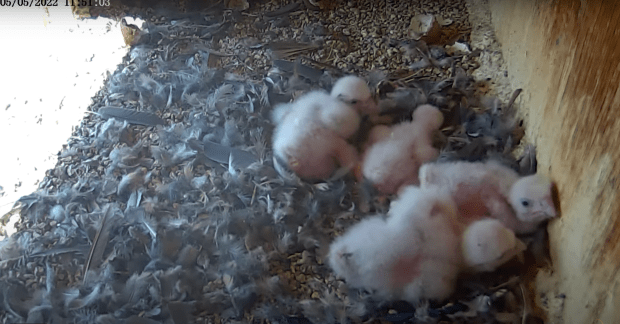
There are still five itchy growing eyases at the Manchester NH scrape. Gosh, the parents of these 5 have to work so hard. It takes so much more food and time. This Mum fed for an hour one day.
The one surviving chick at the Cromer Peregrine scrape in the UK looks good today. Hopefully all is well with this wee one.
Kaia has been aerating the nest in the Karula National Park in Estonia that she shares with her mate, Karl II. It is a beautiful day there. Looking forward to those eggs hatching. These two are great parents.
My friend, ‘S’ in Latvia was so proud last year. Kaia was a new mate. Three eggs hatched and Kaia did not ‘sort’ the chicks. Indeed, that was such a wonderful thing. The small one, the third hatch, Pikne, turned out to be a strong little female almost beating her dad to Africa for the winter migration!
For all the Peregrine Falcon fans, I have a conundrum for you and a posting from our local nest. First up, the puzzle comes from the Field Museum in Chicago. [Thank you to Holly Parsons for posting this because I would have missed it.]
Want to know what happens? Check out the Field Museum FB page.
We have several Peregrin Falcon nests in Manitoba as part of the Peregrine Falcon Recovery Project. One of them is on the Radisson Hotel in downtown Winnipeg. The streaming cam link is in the information from Dennis Swayze below. The juveniles spend a lot of time around our legislative building as they practice their flying and hunting. It is always nice to see them in the summer!
As for me, I am really busy today trying to work outside around yet another bout of torrential rain. I will check in with these and our other nests much later today. I hope everyone has a lovely Thursday wherever you are. Thank you for being with me and please take care.
Thank you to the following for their streaming cams and/or FB pages where I took my screen captures: The Manitoba Peregrine Recovery Group and Dennis Swayze, Cal Falcons, Cromer Peregrine Falcons, SF Bay Ospreys and Golden Gate Audubon, Peregrine Networks, Field Museum, Eagle Club of Estonia, Explore.org, MN-DNR, UFlorida-Gainesville Ospreys, and LRWT.
Gosh, golly. 21 degrees C. This means summer!!!! The parks, both of them, were full of joggers, walkers, people having picnics, playing ball, or tennis. The Cricket pitch was busy. Canadians are wearing short sleeves and shorts and we are happy and smiling! Last week was a different story. If it rains again on Thursday we will be back grumbling. I promise. Summer is way too short. You realize I did not say ‘spring’. Honestly we don’t have it any more. A normal summer temperature a couple of decades ago was 18 degrees C. Of course can hit 35-38 C easy. Then we all go inside grumbling. There is a sweet spot around 21-23 degrees C that is just perfect for humans and for the birds on the Canadian prairies.
Note: Bear with me. I did not edit this today!
I left this morning in search of wood ducks. Where are they? I found one couple at one park and three males and one female at another. Even more absent were the Mallards. Sadly, what else I found was that the torrential rains and rising water levels everywhere have made many of the duck and goose eggs non-viable. If the outside coating gets wet, there is no oxygen. This was sad.
The water has receded and you can see some of the clutch that has been abandoned. This area is a small island – there are two islands – in the centre of the pond. It appeared very, very crowded with geese further back incubating and a pair of Wood Ducks walking through.
I wonder how man of our waterfowl lost their eggs this season? Some goslings have hatched but I did not see a single one today. Last year I could not walk for wee ducks and geese. Let’s see what next month brings.
This Mallard couple were taking turns trying to find pond vegetation and keeping an eye on me – I was about 20 metres away but they still knew I was there. The birds around the Witches Hut at St Vital Park are very friendly. During nesting season they get a bit touchy but I think they were waiting to see if I brought any food with me.
The light was not great today. In fact, it gave some rather bizarre colours to the birds.
The colours on this Mallard might even make a Peacock envious.
The Black-capped Chickadees, six of them, were dive bombing me. Did they know I had seed for them in my pocket? or do they now see humans and think seed? Probably the latter. It is a very popular spot for walkers and people that live close by to spend an afternoon, always with birdseed. The lens I had on the camera really compromised what would have been great images taken with a phone camera rather than a 600mm lens.
They came and went many times while I stood and watched. Picking up a single seed, flying up to the tree nearby to crack it on a branch and then back for another one. I wonder how many calories they burn flying back and forth??
The Canada Geese were everywhere – and I do mean everywhere.
Tucked in near to them was a Chipping Sparrow hunting for sees and bugs.
None of those images will win any awards for photography but they are a nice memory of my day and some of the birds that I saw.
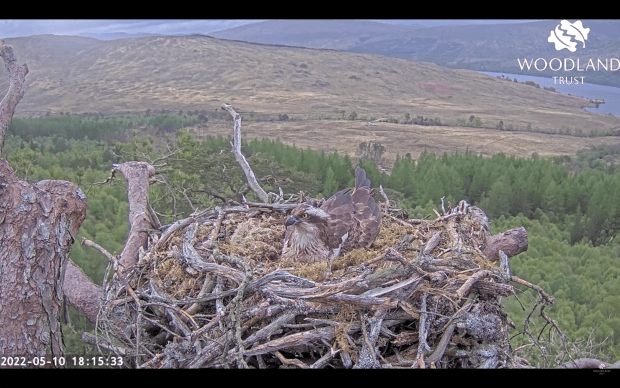
When I got home I went back and checked on the Manton Bay Osprey Nest in the UK to see if the third chick had hatched for Blue 33 (11) and Maya. Not yet but you could clearly see a crack forming. One of the reasons that this couple has such huge success is that the eggs normally hatch within a couple of days. Maya always delays incubating the first two eggs until the last has been laid. Talk about a remedy to help with food competition. Of course, it helps to have a big lake with lots of fish in it and not much competition right under your nest!
There was Blue checking out his newly hatched Big and Middle Bobs.
Big Bob looks like it is going to have an attitude.
If you stare at the egg long enough at the back on the left at about 2100, it appears there are some cracks forming. Of course, I could be losing my mind also.
So all is well at Rutland. Then skipping over to the UFlorida-Gainesville Osprey nest and gosh. Middle had a crop at 16:18. So I went back and it appeared that another fish had come to the nest around 15:00.
The fish has arrived. Middle is just lucky. If Mum moved the wrong way she would knock him off that nest. He is on the far side. The chick you are looking at is Big.
Mum is feeding Middle!
Mum continues to feed Middle.
So, today, Middle ate and had a couple of crops. This nest is like a roller coaster. Did you know that birds can get stress lines in their feathers? I don’t know if all banders check but when they checked the three lads at the Port Lincoln Osprey nest they checked for stress lines and found none. Of course, they would not have. Those three males were like three choir boys until they fledged. They they really began to do the ‘dust ups’ shoving one another off the nest, intercepting fish, stealing fish and whatever else three brothers can think to get into. Here is a ‘dog fight’ between Ervie and Falky.
And here is the ‘dust up’ between Ervie and Bazza on the nest where one falls off:
For those of you that do not know the PLO nest it is on a barge at Port Lincoln, Australia. The nest always had a history of siblicide. This year everyone held their breath when the three eggs hatched and there was Little Bob. Well, Little Bob was quite the character. He had to always be at the beak, in front. When Bib Bob tried to bully him, Little Bob just didn’t let it happen and Big Bob got tired and quit. Still we worried until everyone realized that Little Bob was getting rather dominant. At the time the three were to be banded, it was decided that the heaviest of the three would get the one satellite-pak. Everyone was sure it would go to Bazza the eldest. No. Ervie – who never missed a meal and who had been right up front that morning – got the GPS system! And we cheered! The three were Bazza the eldest with the red band, Falky the middle with the yellow, and Ervie the youngest with the dark green band. Falky – being the middle – did not always get much attention until he dove off the barge and caught a fish! Falky was also the one spotted 300 km north of Port Lincoln. Bazza was the reluctant flier and stayed on the nest to let Mum feed him. Then he left. I hope we hear about Falky and Bazza. Ervie was flying about and then Ervie got one of his talons pulled out. Who knows how. As a result he stays around Port Lincoln and has a fondness for Puffer Fish! He is adored by many.
Sometimes it is nice to sit back and remember those really wonderful nests and last year, PLO was one of the best!
If you are into the translocation project that has been going on in the UK, you will be excited to read the announcement by Poole Harbour today on their FB page:
Single Bald Eagle Mums have a difficult job especially if the nest is in an area where there are constant intruders. There had been a bit of a dry spell at the MN-DNR nest but today around 16:15 nest time, Nancy brought in a huge fish. E1 ate well. I understand that a group of school children are calling E1 – Harriet. If it isn’t official, it should be. It is a perfect name to honour her missing and believed dead young dad, Harry.
The winds are still blowing strong in Scotland and the rain will start pelting down at the Loch Arkaig nest in the West. Dorcha is doing a great job keeping those eggs incubated.
At the Loch of the Lowes, the wind is blowing but you can hear the ducks and geese flying in for the evening. Blue NC0 looks pretty content on the nest of hers and Laddie’s. Not long til there will be chicks here.
One of the things that people/researchers/naturalists and lovers of Osprey look at it is the return rate. How many fledglings from a nest in a particular year with particular parents return as juveniles and are officially seen? Well the Llyn Clywedog nest is doing a bit of celebrating today. So far two out of three of the 2020 trio have returned – 550 and 551. They only need 552 and they would have a 100% success rate. They are going to have bragging rights regardless for some time. This is fantastic news.
Richmond and Rosie have been fighting off intruders this entire season. We are a few days til hatch watch. Here is the banner for SF Bays Hatch Watch announcement at the SF Bay nest of these two great Ospreys.
Here is the link to Richmond and Rosie’s streaming cam:
This is the 15:49 feeding at the Cal Falcon nest of Annie and Alden. Cute. So cute.
This is the 16:55 feeding at the Manchester New Hampshire Peregrine Falcon scrape. Crazy!
Everything is perfectly fine at the nest of Big Red and Arthur on the Cornell Campus. L4 can almost be heard saying, “My crop’s as big as your crop! Nah, nah, nah!” Every time L1 does something, L4 seems to copy her.
Big Red looks like she is ready for an evening break before she snuggles down with these four Ls.
So far, so good. Food was on both the MN-DNR and the UFlorida-Gainesville nests. One day at a time. Today it was all good. So from me and all the garden gang and TH1 at the Two Harbours nest in the Channel Islands, good night. Take care. See you soon!
Thank you to the following for their streaming cams or FB pages where I took my screen captures: LRWT, UFlorida-Gainesville, PLO, Birds of Poole Harbour, MN-DNR, Woodland Trust, Loch of the Lowes, SF Bay Ospreys, Cal Falcons, Peregrine Network, Cornell Bird Lab RTH, and Explore.org
I had a lovely letter from a friend today. Like so many of you, she has tried to watch some of the nests and gotten attached to the birds only to have her heart pulled out when an older sibling shoves them out of the nest or, in other instances, they were starved or killed by beaking or both. It has been a tough year on the nests. Tough even for me.
My friend pulled back and has started watching Big Red and Arthur’s nest on the campus of Cornell and Annie and Alden on the grounds of UC-Berkeley. Her question this morning was simply to clarify that hawks and falcons do not practice siblicide. The answer is that the preponderance of siblicide occurs in eagles (some species more than others), egrets, boobies, herons, pelicans and, I am going to add ospreys to that list. There are lots of reasons, some explored in earlier blogs but, it is safe to say that if you wish to enjoy the birds on the streaming bird cams, falcons and hawks are generally a very safe choice as are ducks and geese. Because the chicks are precocial (are fully feathered, can walk and swim and eat on their own), the ducks and geese need those chicks to hatch all at once. They delay full incubation until the last egg is laid. Robins do that too and so do hawks and falcons. In this way, the older chicks are not that much bigger (normally) than the younger. The ducks and geese and even the raptors need their babies to fledge at the same time. So incubating them so they will hatch together really helps. It is called synchronous hatching (begins hard incubation after the last egg is laid) as opposed to asynchronous hatching where the parent immediately begins hard incubation immediately after the first egg is laid.
Annie makes a kind of chee-up sound when she is ready to put the food in the beak. The chicks learn this. Annie might well give the biggest chick the first few bites but she immediately moves around giving the youngest some. Today, the Peregrine Falcon Mother at the scrape in Oudenaarde, Belgium spent a whole hour making sure that all 5 of her eyases were fed and full. No one left the table hungry. The Mum at the Manchester NH falcon nest also has five eyases. Not one of them went to bed hungry tonight despite their size difference – the smallest had a big crop just like the largest. That is what hawks and falcons do!
A clump of falcons in a feather bed.
The wee one is piled on top of one of the siblings to stay warm.
Here is Annie feeding her two chicks brunch on Mother’s Day! Watch carefully how she feeds the big one several bites, then the small one and then goes back and forth. Annie is a pro. Both are well fed!
And Cal Falcons posted a second feeding just a short time ago. It is really cute. Alden checks in on the babies who see an adult and open their beaks. Alden is so cautious and nervous. He It very happy when Annie arrives with lunch he provided in her beak from the other side of the scrape!
Here is that feeding. It is so cute. Notice how the little one gets full and then gets back up for some more. Falcons eat everything. Nothing is wasted. Some of the first few bites were feathers.
It doesn’t get much better than the Red-tail Hawk nest of Big Red and Arthur at Cornell. Little L4 is growing and surviving and well, I haven’t watched this nest 24/7 but I have not seen any tendencies by the oldest to interfere with the younger ones.
SF Bay Ospreys does not want us to forget about Rosie on Mother’s Day. I adore her and if there is an osprey nest in the US to watch that is stable – Rosie and Richmond in SF are it! —- Oh, and no. Ospreys are not prone to Avian Flu. They eat fish.
Someone dressed Spirit up. LOL. Good thing I don’t have the software to do this!!!!!!! I think Spirit is a Jackie in the making, too.
We all loved Kindness at Glacier Gardens. Many have been watching the nest cam and have been wondering where the eagles , Liberty and Freedom, are. Well, they have built a new nest! Here is the video reveal of that find:
The camera remains off line at the UFlorida-Osprey nest if you have been checking. It is unclear when it will be back on. If it is a mechanical issue it would be difficult since the chicks are older.
The Dale Hollow Eaglets have full crops and are drying off today. These two are doing very well.
Some nest renovations have been going on at the National Arboretum. I don’t think DC9 appreciated some of those branches.
At 2045 there is still no hatch at the Manton Bay nest of Blue 33 (11) and Maya. Maya is certainly restless tonight.
If you are a fan of Lady and Dad at the Sydney Sea Eagle nest in the Olympic Forest, you will know that the couple have been working on the nest. We are about three weeks away from the first egg being laid.
Where’s Ervie? Looks like he still hanging around the barge area of Port Lincoln. Fine by me!
It has been a busy day at all the nests and throughout different regions as the migratory birds continue to move through. My garden was full of White-throated and White-crowned Sparrows again today along with the usuals. The little Chickadee couple love to have a swim!
The Starling was not so pleased when Dyson came along and wanted some of the seeds.
Dyson is trying to try out for the local gymnastics team. Look at her stretch! She is losing her winter fur and the tufts on the end of her ears are gone. Ironically, her tail is much thicker. She is in really good health. Good to see.
I hope that each of you have had a wonderful day today and, hopefully, if you could, got to spend some time outside. It really is energizing – even for a few minutes sitting in the sun. Thank you so much for joining me today. It is a joy to have you here. See you soon!
Thank you to the following for their streaming cams and/or FB pages where I took my screen captures: SF Ospreys, Cal Falcons, Peregrine Falcon Network, Cornell RTH, Friends of Big Bear Valley, NADC-AEF, DHEC, Sea Eagle Cam@Birdlife Australia Discovery Centre, Port Lincoln Osprey Project, and the LRWT.
It’s Mother’s Day and every year I send a shout out to all those great bird mothers who don’t know anything about flowers, chocolates, or going for brunch but who, as best they can, as old as some are, keep our skies filled with the sound of hawks, eagles, falcons, Sky Calls, and song. They have brought us great joy, sorrow, and have taught us so very, very much.
Each of you will have your own list. I have discovered that birds are very personal. So pause and thank your favourites!
The first bird mother I always think of is Big Red. She is not a big strong eagle or a fish hawk. No, she is a medium sized hawk that melts our hearts year after year. Big Red, the Matriarch of the Red-tail Hawks is enjoying early morning sunshine and a necklace of eyases – four of them. She surprised everyone with those four eggs. This nineteen year old probably has a lot more tricks up her talon for us.
We know she hatched in 2003 and that she was hatching chicks in 2005 but the camera did not come live until 2012. That is 7 years unaccounted for. Big Red has consistently laid three eggs and the only time since 2012 she did not fledge three was last year because of K2s beak issue. Potentially she has fledged 51 hawks. 51. Incredible.
She is always happy when there are chicks in the nest and she seems energized this year with the four.
Cholyn at the Two Harbours Bald Eagle nest in the Channel Islands gets the thumbs up this morning. At the age of 24, she is still busy raising eaglets. This year her and Chase had the soon-to-be-banded Only Child, TH1, this year. Cholyn is the mother of Thunder at the West End nest and is the grandmother to another generation of Channel Islands eagles.
Redwood Queen is 23 years and 11 months old and is currently either incubating an egg in Big Sur or brooding a chick! She survived the Dolan Fire and is famously known for her chick, Iniko Orange 1031, who also survived that fire to the surprise of many. She has hatched and fledged 6 condors and fostered and fledged 3. She is currently with 477 Phoenix. It is their second season together. Their egg failed last year. Fingers crossed for this year. Fitting that they both survived massive fires to rise again.
Mrs G, the oldest Osprey in the UK, at the age of 21-23 years is currently brooding three eggs with her mate, Aran, at the Glaslyn Nest. They had a rough patch last year so I am really hoping that this year turns out incredibly well for them.
If we count this year, she has laid 57 eggs with 46 hatched and 41 fledged.
There are lots of Ospreys. I can easily put Maya at the Rutland Manton Bay nest at the top of a list – 20 fledglings in 6 years. Is that correct? But I want to give a hat’s off to a much overlooked female at the Foulshaw Moss nest in Cumbria. Blue 35 was smart and sneaky and made sure that her third hatch —–1/8 the size of the other two older siblings at hatch – survived. She removed fish and once the older ones were asleep returned to the nest and fed Blue 463. As a result, 463 thrived and became a huge female and quite dominant on the nest. Thank you Blue 35. She was also one of the only Osprey nests to fledge three in 2021.
Peregrine Falcon Mothers. Hats off to the Mum at the Manchester New Hampshire scrape for keeping those five eyases in tip top shape. Not easy when some are extraordinarily larger than the youngest! The tiniest one is in the front. So small you can’t see it! Mum is doing a great job.
All full and sleepy.
There is one other Peregrine Falcon Mum who is now raising two eyases after losing her mate during the egg laying part of this breeding season. That falcon is Annie at the UCal-Berkeley scrape in The Campanile. She is a grandmother – they know that her daughter is on Alcatraz Island and that this is at least her second year if not more to raise chicks.
There are now too and it appears that Lynn Scofield was completely correct. The last egg is unviable. This means that egg 1 and egg 3 hatched with the potential for one chick to be Grinnell’s and the other to be possibly Alden’s. I hope so! Annie survived the death of her long term mate, Grinnell, to hatch the two chicks. Heart warming.
Why not think about your favourite ‘Bird Mums’ today? It is a great way to thank them ———— each and everyone of them ——— for the joy they bring to our lives!
Have a great Sunday everyone. There will be a nest check in later today. Thank you so much for joining me. Take care!
Thank you to the following for their streaming cams and/or webpages where I took my screen captures: Cornell Bird Lab RTH, Ventana Wildlife Society, Brywd Gwyllt Glaslyn, Cumbrian Wildlife Trust, Peregrine Falcon Network Manchester NH, Cal Falcons, and Explore.org.
The scrape boxes across the world have been welcoming eyases for about a week. Besides tulips and the crocus pushing their way up, the hatching in the scrapes is a sure sign that spring is truly here. Cute little fluffy white bundles with pink accessories. So sweet.
Manchester, New Hampshire has a scrape full! For once, every egg hatched. Remarkable.
Salisbury Cathedral! Four.
Cromer is hatching.
Chichester Cathedral has new hatchlings.
San Jose City Hall started hatching this morning! Thanks ‘B’ for letting me know.
Ares and Astrid have been incubating their four eggs in Utica, New York for 31 days today. We are on pip watch!
Want more information on the Utica Falcons, head to this link where you will find historical information, updates, and all the camera views.
Of course, the hatch that warms my heart and brought tears of such joy I was overcome happened in the scrape box at The Campanile on the grounds of UCal-Berkeley. Three eggs. Two presumed to be Grinnell’s, the last one Alden’s. First hatch this morning with what is appearing to be a crack in at least one other egg. The one thing we can say about the falcons is that they don’t waste any time getting out into the world!
Our first good look at Grinnell’s baby, wet and pink skinned.
You can see the crack in the second egg in the image below.
Our beautiful Mum, Annie.
CalFalcons made a short video clip of the first hatch.
At 11:01 Alden comes to check on things and wants to take over incubation.
Everything is going just fine. That cute little one and its precious wing is dried off. Maybe there will be one more this evening!
Thank you for joining me today for a round up on the Falcons! It has been a fantastic day! Take care everyone.
Thank you to the following streaming cams where I took my screen captures: Cal Falcons, San Jose City Hall, Utica Falcons, Salisbury Cathedral Falcons, Chichester Cathedral Falcons, Cromer Peregrines, and Manchester NH Peregrine Network.