It is Thursday evening, and Toby and I are having our ‘quiet’ time. Thursday was a busy day working in the garden. We are so excited about planting the flowers and veggies this weekend! Our neighbour has finished the longest railing for the deck, and we will be looking for over-the-rail planters for shade flowers. The colour will be ‘red’ this year!
Unless something dramatic happens, I will take at least a day off to plant and enjoy being outside instead of checking the screens. I urge you to do the same!
Not wanting to start any rumours, but where are the fish for our Iris? There is some concern about the whereabouts of New Guy2 at Hellgate Canyon. Is he around? Is he bringing fish? A piece of a fish was brought in by a male, but was it NG2? All I will say is that if these males are going to fail Iris, then do it before the eggs hatch. Crap. I desperately want to be wrong about this – just like I thought P3 was sick. It isn’t, thank goodness. Maybe just sleepy and in a food coma????
The second egg has hatched for Maya and Blue 33 at Rutland’s Manton Bay nest! Congratulations.
Geemeff’s Woodland Trust daily summary for Loch Arkaig Thursday 14th May 2026The forecasted rain held off, just the occasional shower, and nest life went on uneventfully today, no intruders or alarms. Louis delivered two fish to Dorcha, taking the Nest Two tally to sixty one, and Garry LV0 brought one fish taking the Nest One tally to sixty three. Aurora 536 made that one fish last a very long time, and it travelled a fair bit too. There was much discussion around eggs, chick hierarchy, fostering and survival rates. WTS George reposted his comment
around expectations and the challenges of nest cam watching, link in the bonus section. Tonight’s forecast is partly cloudy and light winds with a low of 3°C, continuing tomorrow with light cloud, gentle breezes and a high of 12°C.
You don’t see it very often, but Arthur got to feed his babies. Arthur would love to care more for his children, but Big Red can be very bossy in that regard! He’s rather good at this! https://youtu.be/KEBghI2Yml0?
Fish continue to come to Achieva. Jack is doing well! Keep it going.
Thank you so much for being with us for this quick check-in. It is very windy outside, and we are in a ‘yellow’ warning – it is a huge dust storm! The temperatures are still warm – 23 C.
Take care of yourself. Go outside for a walk. Listen for the soothing sound of a bird singing.
Thank you to Geemeff for their always outstanding Loch Arkaig summary, to SK Hideaways for the great videos, to all those who post on FB with recent news and videos, and to the owners of the streaming cams that allow us to witness the lives of our favourite raptor families.
The sky is a gorgeous blue with a few little tiny cottonball clouds floating about. It was grey and cold earlier and to end the day with beautiful sunshine is a real blessing.
We have the first hatch at Rutland Manton’s Bay:
I am also happy to say that thanks to Kathryn we continue to know the goings on of one of my favourite Welsh ospreys, Aran, and his new mate.
Cornell Bird Lab is doing a great job of producing short videos of Big Red and her chicks.
We are a few days away from fledge at the Venice Golf and Country Club osprey platform. Chicks hatched on 20, 21, and 23 March.
I don’t know what has gotten into Jack at Achieva but he is being much more helpful to Jill in bringing in fish as of late.
It has been almost like a tag team, with Jill bringing in a fish and Jack coming in a few minutes later with another. It sure helps. Jill can feed herself, and Little and Big can work on the self-feeding she is getting so good at.
It rained at Achieva and it looks like Jack came in with a late fish. Maybe Diane will not need to go fishing tonight.
I have waited to send this so that I could include Geemeff’s summary from Loch Arkaig and here it is:
Woodland Trust daily summary for Loch Arkaig Tuesday 12th May 2026Today was mostly peaceful on both nests, barring an intruder alert near Nest One, and an intruder Osprey actually landing on Nest Two. While Louis and Dorcha were most unhappy and furiously chased the intruder away, the watchers were pleased to solve a mystery as this intruder had visited twice before but his Darvic ring could not be read. Today however he positioned himself just long enough to see that he is Blue 2B6, hatched 2023 in Kielder, and not Blue 286 hatched 2019 in Cumbria. There’s still a slight mystery about this bird as it was initially thought to be female, but now tending towards the possibility of being male. Whichever is correct, we wish Blue 2B6 success at finding a nest and a mate but preferably away from the two Arkaig nests as hatching day comes closer. Louis brought one fish for Dorcha taking the Nest Two tally to fifty seven, and Garry LV0 brought two fish for Aurora 536 taking the Nest One tally to sixty.
Thank you for being with us today. It is time to take Toby for a last walk before bed. Tomorrow he has his first annual check up. Wish us luck! Take care all. We will see you soon.
Nitey-nite from Toby wearing his new halter. He loves orange!
I will try and get some good images of The Girls this weekend for you. I feel like I have neglected them.
Thank you to Geemeff, Heidi, and PB for their notes and news, to the owners of the streaming cams, the authors of the FB posts – we are so ever grateful for the time and dedication you take in providing us with news and views of our favourite raptor families.
We wake up, and over our morning cuppa, we count the animals at the feeders. There are always four grey squirrels, one red squirrel, two Blue Jays, and two Crows. The number of Starlings, Sparrows, Juncos, and others varies during the day. But, for two days, there have only been three grey squirrels. Thankfully, the elderly Dyson, the matriarch of all the grey squirrels, is one of those. But where is the other one?
On our walk with Toby, we passed by the house that had burned down at the corner some time ago. There on the boulevard was the grey squirrel. It had no visible signs of being hit by a car, and there were no wires for it to fall from its position. A friend of Don’s was here for lunch, and we determined with some minor science that it had probably been poisoned. Its body was brought back to the garden where it had played in the lilacs and filled its belly for several years with peanuts. I buried it between two trees. Will find a beautiful stone to sit on top – incense lifted its spirit into the wind.
My concern now turns to who is using rodenticide and why. Yes, there are mice. Most of us feed the birds, and where there is seed, there are mice. I have been told that using only Black Oil Seed and peanuts will not attract the mice as the grains do. The Crows and the Hawks catch mice; we don’t have to do anything. Owls, of course, are another great way to rid an area of rats and mice. But with rodenticide use, nothing is safe. What if the Crows had eaten the carcass? Or a pet dog? Toby? One of the feral cats? Brock? It makes my mind go crazy thinking about poisoning our world.
Luckily, our lovely company kept my mind off of rodenticide and I needed to check the ospreys while Don was busy with his friend.
I had a look, and, surprise, surprise, there is the first UK pip at Maya and Blue 33’s nest at Rutland’s Manton Bay!
It is such a deep nest. We need an overhead cam!!!!!!!!!
All is well with the trio at Big Red and Arthur’s Red-tail Hawk nest on the Cornell Campus. Yes, P3 is being fed!!!!!!!!!!!! No one is left out. We are too conditioned by the osprey and eagle nests!!!!!!!! Hawks and Falcons are notorious for making sure everyone is fed. There is no shortage of prey.
The first failed osprey nest in Maryland was in Severna Park. Was it before those failing in Virginia? It is not clear. I am receiving notes today that several other nests where Omega Protein fishes a mile off the coast of Nassawadox Creek are seeing the adults abandon their eggs. Nassawadox Creek is a tidal waterway in Northampton County, Virginia, on the Eastern Shore of the Chesapeake Bay. There will be more, and we must prepare ourselves. If you have not figured it out, the decline in osprey numbers is worse than the DDT crisis of the 1970s. Someone needs to do something about this!
Sad news coming out of Scotland over the use of an illegal trap.
There is really great news coming out of Glaslyn. Aran and Elen’s two year old chick has touched down for all to see! What a wonderful migration and so happy that one of their babies has been seen in Wales.
This is a reason to ring every osplet on every osprey nest – which is attempted in the UK but not in North America.
Everything is going well at Achieva Osprey Platform.
Geemeff’s Woodland Trust daily summary for Loch Arkaig Monday 11th May 2026
Another routine day, it started and ended with a little rain, and in between were lots of fish deliveries – both males brought three fish each, although one of Louis’ was so tiny, it needed a close up to see it was actually a whole fish and not just a scrap, and Garry LV0 also brought a tiny fish – his was still flapping. The Nest Two tally rises to fifty six, and Garry’s rises to fifty eight. It’s great to see both males supplying a steady stream of fish as hatching day starts getting nearer when it will be paramount. As the day ends, Dorcha and Aurora 536 are tucked up sitting on eggs on their respective nests, protecting them from the sporadic light rain which is set to continue through the night and most of tomorrow, with an overnight low of 6°c and a high of 13°c tomorrow afternoon.
There is so much going on. Iris’s new mate kept her company at the nest. This lad really does like to incubate, but I wish he would fish a bit more!
I love Iris and New Guy 2 watching their trains!
Thank you so much for being with me this evening. Take care! See you soon.
The two besties – Toby and Hugo Yugo – wish you a great week.
Thank you to Geemeff for all things Loch Arkaig, to ‘PB’ and Heidi for counting and identifying fish, to everyone who posts on FB with images and news updates, to Raptor Persecution for always reporting what is truly going on without any prejudice, and to the owners of the streaming cams that allow us to watch these amazing families.
Our family knows this truth all too well. You never know when you say ‘Goodbye, I love you’ if it will be the last. I will never forget the morning that our son walked out the door on his way to his summer job, and his employer phoning me two and a half hours later, wondering where Will was – because he was never late. I am so grateful that our morning was spent having breakfast together in the warm breeze of a Canadian summer. It was calm and it was beautiful. Twenty-six years later, I still miss that amazing kid. We have learned that you must treasure every moment – live life as if it is the last day, always. Never leave with a harsh word, never have to say you are sorry to someone. Surround yourself with love. And that brings us to this post…We generally do not know when the moment will come when we will see a person, a pet, or a treasured ‘bird’. We do not realise it until it is past.
Today as I drove out to Oak Knoll Farm to pick up the week’s produce and eggs, skeins of Canada Geese filled the skies. Others have photographed the Bald Eagles gathering on the river. The great migration has really begun in earnest as our temperatures dropped from 30 C two days ago to 8 C today. Fall is here, not by the calendar but by the movement of the wildlife.
And so, we must treasure all the years we have spent with these amazing birds and hope that those who are departing, or have departed, on their great fall migration will return to us in the spring.
Iris stood and posed on the nest on Tuesday 2 September as if she was ready to depart. Iris has outlived all other female ospreys that I know about and if this is her last visit to the nest and the last time we will see her this year, I hope that her migration is safe, full of huge fish, and that she returns safely to raise yet another nest of checks with New Guy in 2026.
Tiger Mozone told me years ago that it is, in part, good DNA and luck that allows some adults to thrive as long as Iris has. She will be at least 30 when she returns next year, if not 31. She has definitely had luck on her side. We have no idea where she spends her winters, but she would have honed the trip over the years, landing at the same tree and making the same stopovers. We have learned these things from the ringed birds from the UK spotted in The Gambia and Senegal.
We didn’t know when Xavier delivered that yummy parrot to Diamond five days ago, that it would be the last prey delivery. Xavier was a ‘real’ character. He always seemed so small compared to Diamond, and the poor little guy often got scolded for only being able to find a Starling. It will be Xavier’s acute desire to help incubate the eggs, brood the babies, and his sneak attempts to try and feed his children that will remain with me. He was a good provider, and we will not forget him. He takes a little piece of our heart, just like Annie and all her mates, beginning with Grinnell, when they did not return.
Life in the wild goes on. Diamond will hopefully have chicks this year. She is no youngster and has now outlived two mates. Let us hope that this new chap will warm our hearts by his intense caring for her.
At the falcon scrape on the grounds of Charles Sturt University in Orange, Australia, Diamond is bonding with the young male who has been delivering prey to her on the tower. https://youtu.be/uwc9J40eGps?
Cilla has named him Gimbir. Dr Kinross posted this:
From the Box Cam live stream info in Youtube:
GENERAL INFORMATION This site is about a family of peregrine falcons using a nest box since 2008 in a water tower at Charles Sturt Unversity, Orange, Australia. The adult female is Diamond and the new male (just arrived 31/8) is called Gimbir (Wiradjuri for spring or fountain, pronounced more like Kimber, not Jimbeer). The previous male, Xavier, disappeared on 27/8 and is assumed dead, probably from a hunting accident. He had been with Diamond since 2016 and is sorely missed.
NEWS 2nd September 2025 We don’t know yet whether Gimbir will be accepted as a new mate but there have been at least three bonding session and we know he is a good hunter as brought two large prey to the tower yesterday. I’ve made several videos of him already. He still has to prove that he can provide for a family by giving his catch to Diamond so we shall see.
Tributes to Xavier are filling FB and YouTube. I will have those for Friday. In the UK: Brianne is getting ready to break the Dyfi record for being the longest remaining fledgling. Idris is there with her, delivering fish, and he is set to beat Monty’s time between arrival and departure, which was 166 days in 2013. Idris arrived back at Dyfi on 21 March 2025 (earliest ever for any Dyfi osprey). Harry is delivering fish to Forest at Alyth. The entire family is reportedly still at Llyn Brenig. Heather saw two ospreys at Glaslyn in the distance – too far away to identify. 8 remains at the Rutland Manton Bay Nest with Blue 33 and Maya. At Poole Harbour, Blue 022 is still home but hasn’t been seen at the nest today.
Thank you to the Montana Osprey Project, Charles Stuart Falcon Cam Project, and Orange, Australia Peregrine Falcons FB for the streaming cams, videos, and posts, and Bywyd Gwylld Glaslyn for their streaming cam and Emyr Evans for his reminders.
The condolences continue to pour into Poole Harbour for the loss of 5H2 due to the goshawk attack and to Loch Garten’s 1C1 to unknown causes. It is worse when the osplets are older and flying. The number of Osprey in the UK is very small compared to North America and the loss of these two chicks on significant nests took its toll today. Last year the osplets died due to weather issues when they were so little. This year we lost a wee one at Llyn Brenig, the third hatch at Loch Arkaig when its foot caught and it could not get under Mum during the worst weather. Siblicide at Loch of the Lowes. It is hard either way but raising chicks to fledge and then losing them is just tragic.
I have had many letters asking if Loch Garten is doing a post-mortem. Yes, they are! The cameras will be turned off during the removal of the chick and then turned back on. We have seen three ‘mysterious’ deaths this year on streaming cams of Ospreys -Big at Captiva, Molate at SF Bay, and now 1C1 at Loch Garten. I included Big because there was no confirmation of why she died. Molate was visibly unwell for a few days, just like 1C1. Is it the same? (It is unclear to me as to whether GG Audubon ever removed Molate’s body from the grid as fledglings Brooks and the Visitor continue to come to the nest. Speculation is a lung infection. I do recall Molate also had trouble breathing. Curious.
Elsewhere in Bird World, life seems reasonably stable but everything can change in a few seconds – without any warning – as was the case of H52.
The great experiment by Urmas and Dr Madis to save the Black storklets of Jan and Janika would have been significant if not for the loss of all the chicks on Eedi’s nest due to predation (possibly another Goshawk attack). There is one survivor, Bonus. Bonus is doing tremendously well. He is 78 days old today. Karl II and Kaia have found the filled fish baskets and the chicks are so full that when Karl II comes in with a delivery the four of them cannot eat all the fish. Yes, it is true!
Fledging could come at any time. Bonus is overdue but because of his delayed development due to stress and lack of food, he will fly once he is ready, not by a calendar. Kaia often leaves by 11 August so we are watching to see what will happen this year.
It is mostly quiet. Many of us are watching the females in the UK to spot on leaves when. Maya is still at Manton Bay in Rutland.
I could not get a good look at her face but this is that amazing female who raised three big girls with Blue 33 this year! She is the mother of Telyn at Dyfi.
1H3 has enjoyed a nice fish delivery today.
1H1 is screaming to goodness for Mum or Dad to get a fish on the nest for her!!!!!!!!! What a beauty.
All of the fledglings could catch their own fish. The parents do not have to teach them – 60 million years is hardwired into their DNA. The fledglings just do not know that they can do it! During migration they will have to begin to fiend for themselves.
These females are such characters. Blue 33 could hear his girl across the lake! “I want a fish now!” Blue 33 is one of my great loves as far as ospreys go. He is 11 years old this year and is ending his 9th breeding season. He has raised two sets of four osplets to fledge with Maya…They are a super couple in a realm of their own.
Remember that flapping fish that we thought had killed at least one of the little ones – they survived. All three nice big girls!
It is hot at the Dyfi nest in Wales of Idris and Telyn. Tomorrow it will be 30 C. Telyn is still here. She has been chasing off an intruder which appears to be annoying her to no end. I do not blame her. Now is not the time for an injury. Telyn will leave Wales and fly to The Gambia. According to Chris Woods who travels to The Gambia in the winter, he knows precisely where her favourite perch is. Brilliant. It is always reassuring to know she has arrived safely.
Just look at all the cameras.
Relaxing down by the Dyfi River.
Emyr Evans has posted a very interesting blog testing different hypotheses about the unringed visitor to the Dyfi Nest. It has some information about fledging ages and the start of migration. Thanks EE – we love the Dyfi Data!
I see no word that Blue NC0 has left the Loch of the Lowes either. Both chicks have been flying for at least 3 weeks and they are doing some fancy landings and take offs from the nest. I was able to catch them on the nest today – one with a fish and the other screaming to Laddie LM12 (Dad) to bring another pronto! These males sure get a work out at the end of the season. No wonder their legs are so strong and muscular.
These two look to be in brilliant shape!
Mrs G is still here. She is on the perch to the left while Aran is on the one at the right.
Aran and Mrs G looking out on their territory from the Glaslyn nest. Aran is in the back, Mrs G, the oldest osprey in the UK, is in the front.
Fledgling eating a fish on the Glaslyn nest while Mrs G is at the nest.
I cannot read the Darvic rings but this looks like a different fledgling enjoying a meal earlier in the day.
I was also able to catch Seren and one of the chicks on the Llyn Clywedog nest in Wales. It is so rare to see chicks on the nest that I feel fortunate checking all of the nests and finding at least one today.
Dorcha and the two fledgling chicks were on Loch Arkaig! I did not see Louis but he is about bringing in fish.
This one desperately wants a fish!
They do not know that they are getting ready for the most challenging two years of their lives. If they live to get to the South of England or parts thereabouts, they will feed up. There are scores of birds that will be at Poole Harbour making their way to their winter homes. How many of them will survive? When we hear averages, it must be the entire raptor family, not just specific species. We know that the UK birds will either land on the Iberian Peninsula and winter or they will continue to Africa and winter in The Gambia and Senegal. I hope to get some figures for Ospreys only. It will be easy to get UK figures of 2 year survival – or thereabouts – as from the Dyfi note – all known birds have Darvic Rings except for a few nests in Scotland and maybe one hiding in Montgomeryshire in Wales. The figure is going to be low and it could provide us with more insights. Less than 1 in 3 I suspect.
Remember – send me the stories you remember about migration. I am particularly interested in the huge challenges these birds face. Get it to me by Thursday night. Thanks!
I peeked in at the Osoyoos and Fortis Exshaw nest briefly throughout the day. The heat dome is definitely hitting BC again but Soo and Olsen seem to be weathering it fine. I have also checked on Titi who has been hovering but has not fledged. Titi is in a very dangerous position if he cannot fly – he is literally the sitting osprey for that Goshawk that continues to fly around the nest! I wonder why he is not moving? We saw Nuppu try to beak her youngest to fly. Titi has no mother, only a sibling and Dad and he needs to work those wings and get out of there.
The latest updates on Victor came on 3 August. If you missed it, here it is. There has been nothing since. We must assume that Victor is continuing to progress. Treatments for heavy lead toxicity take a long time.
Thank you so much for joining me today. Take care everyone. See you soon.
Thank you to the following for their streaming cams and/or posts where I took my screen captures: Finnish Osprey Foundation, The Eagle Club of Estonia and Looduskalender, Dyfi Osprey Project, Bywyd Gwyllt Glaslyn, Friends of Loch Arkaig and the Woodland Trust, CarnyXWild, LRWT, Friends of Loch of the Lowes and the Wildlife Trust.
Good Morning Everyone. I hope that you had a marvellous weekend and for those celebrating independence day in many countries around the world, have a fun and safe time.
With all the talk about storks, ‘L’ asked a question in the comments. Did I know what happened to the White Stork couple, Malena and Klepetan? Thank you ‘L’ – that is a great question and I bet many are wondering too.
Klepetan and Malena are the best romance story in all of Bird World. The intervention to save Malena’s life after she was shot by a man in Croatia is a testament to what love can move us to do for our wildlife friends.
If you do not know the story, before you read further, please watch at least the first one of these videos so you know the background to this truly remarkable story.
Perhaps the most famous stork couple in the world were Klepetan and Malena. Malena stayed year round with Stjepan Vokic in Croatia. As you will know from the video, Malena was shot and it was only through the gentle care of Vokic that her life was spared. What devotion to keep her, clean her, feed her, prepare the nest and fish for both adults and chicks so that Klepatan and Malena could spend all their time together.
For 20 years, Klepetan migrated back and forth from South Africa to Brodski Varos, Croatia. Malena died peacefully on 7 July 2021 of old age. She was 28 years old. Klepetan was by her side when she died along with her other faithful companion, Vokic. Malena was buried in one of her favourite places. Klepetan continued to come every day wondering where his mate was. They had been together for 20 years and had raised 66 storklets. Klepetan was fitted with a transmitter. He did not return to the nest he shared with Melana in 2022. Did he also die? or find a different nest with a new mate? I am hoping to be able to find the time and help to see if Klepatan’s transmitter is still working.
Want to help out Humane Wildlife Indiana? They have an extensive wish list on Amazon including a xylophone for chickens. I have learned through one of our readers, ‘L’ how important it is to have creative stimulation or enrichment for all of the animals in care. Who would want to live strapped to a perch with nothing to do? There are lots of things on the list from a few dollars to $30 or $40. Here is the link. It is good to see what the wildlife clinics are asking for. You can always help out your local clinic too – they always need laundry detergent, bleach, hand sanitizer, wipes, and those old clean towels I keep repeating…Even if you do not intend purchasing anything for the clinic, have a look. It is possible that you intend to get rid of items that could be used at your local clinic.
So busy with Little Bit and the JJ storklets that some others get forgotten so I am also playing catch up this morning. The only surviving eaglet at the Fort St Vrain nest in Colorado, 46, fledged on the 1st of July. Congratulations everyone!
It is not just Annie and Alden bonding in the scrape! As breeding season in Australia gets closer, Diamond and Xavier are doing a lot of bonding rituals in the scrape – some short, some long. Oh, you are going to fall in love with little Xavier if you don’t know him already. Here is that video clip.
‘B’ sent me a newspaper article on the rescue of the US Steel Eaglet. It is a good read with one troubling bit – they state that he eaglet will learn to fly and be released in an area away from the natal nest. My concern is that they must teach that eaglet to hunt – just like Little Bit needs that training. In order to do that the eagles need a little of time, trained professionals, and specialized structures. It is expensive and time consuming and well worth it if neither wind up back in care. Thanks ‘B’.
I want to include a screen capture that ‘H’ sent me on Sunday. It is just a beautiful sunrise at the Boathouse Osprey nest on Hog Island, Maine. How stunning. Thanks ‘H’ for sharing this beautiful image with all of us!
The boathouse osprey cam on Hog Island is currently offline and is only showing highlights.
Two chicks on the Osoyoos Osprey nest on a misty wet morning. Let’s hope that dad gets a pile of fish on the nest today since the weekend festivities have passed.
There is a severe thunderstorm watch in the area of the Canmore Fortis Exshaw Osprey nest…send positive wishes to all!
There was also beautiful sunrise in Mlade Buky, The Czech Republic. Betty has flown in and is feeding those four great big storklings.
It is early morning in the Karula National Forest in Estonia. The four chicks of Karl II and Kaia are sound asleep. It is so good that Bonus, one of JJ’s chicks, has integrated so well into this family. It is Day 5 for Bonus.
‘T’ sent me an image of Karl II. Last year he discovered the fish basket that Urmas provided. It is about 9-10km from the nest and this year Karl II has been visiting the fish basket and bringing lots of fish to the four storklets on the nest. They are hoping that the herons do not find the basket as it will limit the fish Karl II will find.
This is the other nest where Janus, the middle chick of Jan and Janika, in Urmas and Dr Madis V’s experiment has been placed. It is doing well. Thank you ‘T’.
Takoda decided to come and visit the National Arboretum nest on Sunday. He has found his reflection in the camera. There are some great ‘selfies’ that Takoda is taking! Have a peek.
Some of you became very interested in what your country is doing to help stop avian electrocutions. Knowing what is being undertaken to help the birds is a good way to begin understanding what you can do to spread the word about the dangers and solutions. ‘A’ wanted to find out what Japan was doing and she discovered that there is a special institute working on this problem on the northern most island of Japan, Hokkaido.
“Birds of prey have the habit of perching on high places with a good view and will use tall trees as well as man-made structures such as streetlights and utility poles as perches. When raptors perch on utility poles or pylons, or when they are about to take off from a perch, they are electrocuted when their wings or other body parts come in contact with parts of the body that conduct electricity.
In Hokkaido, accidents involving electrocution of Blakiston’s fish owls, hawk eagles, white-tailed eagles, and Steller’s sea eagles have occurred to date. Electrocuted birds of prey may show severe burns and blackened feathers. Red spots called electric current spots may also be seen on the skin where the electric current was applied.
To prevent electric shock accidents, electric power companies install insulators on current-carrying parts and devices to prevent birds of prey from perching on utility poles. They also install safe perches on top of utility poles to prevent electrocution. The Institute for Birds of Prey Medicine is working to prevent electric shock accidents by analyzing electric shock accidents and consulting with electric power companies and other parties in order to develop more effective countermeasures in areas where electric shock accidents have occurred or are likely to occur.”
Thank you, ‘A’.
I wanted to see what work the Institute for Birds of Prey Medicine is doing and came across something very interesting. Fifteen years ago the use of lead (Pb) ammunition was outlawed in Japan. Today, lead poisoning remains a serious problem for raptors who accidentally consume lead pellets from illegal hunting in various places in Japan but the overall testing of raptors and discovery of those who have ingested lead has dropped significantly (lower than 25%). In comparison, the US Geological Survey discovered that between 2010-2018 (the end of the study) more than 50% of all raptors in the US had been poisoned by lead either in hunting or fishing equipment. The soft lead bullets that break into fragments have the worst impact on the raptors. Other lead fishing equipment can be mistaken by birds such as Loons who think these lead weighs are pebbles and eat them!
There is no nationwide ban in the US for the use of lead. California is the only state to ban the use of lead entirely. New Hampshire, New York, Vermont, and Maine have partial bans in fishing gear. In 1987, Minnesota banned the use of lead shot for waterfowl hunting. In 1991, a federal law in the US also banned lead shot for waterfowl hunting. The problem rests with the DNR who has lobbied against imposing any other lead restrictions on hunters. In April of 2021, three states – Maine, Minnesota, and New York introduced bills that would ban lead completely in all hunting and fishing gear. I am checking to see if HF2556 has been signed into law in Minnesota in 2022.
Do you remember the ‘Old Warrior’? He was taken into care after being found on the side of the road lethargic. He went to A Place Called Hope, another great wildlife rehabber. His lead levels were measured at 49. Very extensive lead removal treatments resulted in the old eagle with the broken leg and beak being able to go into an outside enclosure. A Place Called Hope applied to the USFWS for a license to keep the Old Warrior as an educational bird. I reached out to A Place Called Hope and they said that sadly the lead issues had caused so much damage that the Old Warrior had died. He was a poster child of trying to beat the odds. There are other kinds of ammunition – stainless steel and copper. Lead is not the answer!
There has been some concern about Blue 022 at the Poole Harbour nest. He has now been caught on camera and all is well. The two chicks have been ringed and they are both girls! Well done Poole Harbour. Congratulations and relief.
At the Rutland Mantou Bay nest of Maya and Blue 33, 1H2 and 1H3 fledged this morning. All girls are flying about and there is definitely an empty nest! They will return to harass dad for fish, no worries.
Whew! You might need an extra cup of tea or coffee to make it through this today – sorry! Lots happening in Bird World. The kids up at Loch of the Lowes are starting to get the hover going, too. Thank you for joining me today. Please take care. Thanks to everyone who sent news, photos, or comments. They are always appreciated. See you soon!
Thank you to the following for their streaming cams and/or FB pages or videos where I took my screen captures: The Dodo, HRT, Ft St Vrain and Excel Energy, Falcon Cam, Audubon Explore.org, Osoyoos Osprey Cam, Fortis Exshaw, Mlade Buky, Eagle Club of Estonia, NADC-AEF, A Place Called Hope (APCH), Poole Harbour Ospreys, and LRWT.
What a busy day in Bird World and sadly, another entry on ‘that list’.
I want to start by thanking one of our readers, ‘AM’. She left her home and pushed through all kinds of Canada Celebrations and a parade for an hour to get to the Osoyoos Osprey Nest the minute she learned of the chick’s fall. Sadly, the little one did not survive. ‘AM’ found a quiet restful place for him near the nest. Thank you ‘AM’. I also want to add that she went prepared with all the things needed to drive him to a rehabber – gloves, towels, a box, etc. Fantastic.
It is always tragic to find a wee one dead or badly injured. It was a big fall and unlike goslings or ducklings, osplets just don’t have the bounce. Sadly, we cannot stop the ospreys from bringing material to the nest but, we can urge farmers to use best practices and different baling materials. Dr Ericke Green at Montana Raptors (Iris) has been studying this problem for a long time and has found a different material for baling that is less problematic for the Ospreys — if farmers would only use it.
I am very thrilled to see all of the donations and thank you’s to Humane Wildlife Indiana. For all of you that pushed the staff at St Patrick’s Park to get help – through your e-mails, phone calls, and in chat, thank you. It takes an army of people to get help and you are a great army.
If you want to send a direct thank you to Delilah Ruiz, here is the e-mail: druiz@humaneindiana.org
Our beautiful Little Bit in care, thankfully. Tears.
There is, however, some really super news in Bird World. It comes from Cal Falcons. Annie and Alden were doing a courtship ritual in the scrape box. Alden proved himself to us over and over again as being very capable of taking good care of Annie and any chicks but – Annie had to really make that decision. Alden passed – and Annie and Alden are a couple. Yes.
Alden figured out how to overcome a physical limitation and he now has Annie and the best territory in San Francisco. I hope that their lives together are long and productive.
Looks like we are going to see the chicks doing a lot of moth chasing and loafing just like Lindsay did today! Isn’t she gorgeous? Look at those eyes and those feathers. I hope that we see Little Bit 17 get his feathers into good condition now that he has regular food.
You know. Human animals should watch some bird cams before they have children so they learn that everything one does makes an impression on children.
Other good news is coming out of Cornell. Here is today’s update on L3 who was taken into care a week ago.
“We received a brief update from the Wildlife Hospital today, reaffirming that L3 continues to do very well. The veterinarians will be performing additional radiographs in another 1-2 weeks to check up on the fractured coracoid bone, at which point they should be able to better predict a future timeline for continued healing and rehabilitation. They also shared that, based on body weight, L3 is likely a female. We will plan to post another update following the next set of radiographs — thanks for sharing all of your concerns about L3’s continued healing!” Thank you ‘SAH’ for seeing that L3 was found and was in care quickly.
Dylan has just brought in the last fish for the day to Seren and the three Bobs.
The three at Llyn Clywedog have been ringed. They are 553 a big female weighing 1710 grams at 40 days, 554 a male weighing 1485 at 40 days and 555 another male weighing 1410 at 37 days old.
The parents lose weight when they are busy raising chicks. Just look at how small Maya looks compared to the three big gals that her and Blue 33 have been feeding. Maya lost about 33% of her body weight taking the great care she did of her chicks.
Idris brought in another whopper to the Dyfi nest despite the rainy weather. Him and Telyn (Maya’s daughter) are feeding three girls, too.
It hasn’t all been rosy with the four Black storklets in the nest of Karl II and Kaia. At first Bonus was hissing at Kaia. That got better. Then the biological storklets were biting Bonus’s legs. Karl II has brought in a meal a few hours ago and things look good. Urmas needs to observe the nest closely so that the biological osplets do not get in a position of not having enough fish due to the size of Bonus.
Fingers crossed that all of this gets worked out. The biological three are looking for more fish and there is Bonus busting his crop.
I intended to include more but a kestrel has a broken wing about an hour and a half away and needs to get to Wildlife Haven – so I am off!
Take care everyone. Thank you for joining me. Donate if you can – even $5 for Little Bit. Every $ helps. See you soon.
Thank you to the following for their streaming cams and FB pages: Eagle Club of Estonia, Humane Wildlife Indiana, CarnyXWild, LRWT, Dyfi Osprey Nest, Cornell Bird Lab and Cal Falcons.
The walk in the forest and seeing some beautiful songbirds and several woodpeckers yesterday afternoon was lovely. “Forest Bathing” or shinrin-yoku. I have mentioned this word and the concept many times before but I highly recommend going for a walk outside with the trees if you are able. You can just sit, too. It is highly relaxing and really does remove stress. To my delight, there were a few – three- goslings. There should be some slightly older goslings about somewhere but I could not find them. There are lots and lots of fish in the water even in areas with lots of algae cover. I hope the Bald Eagle couple are taking the fish and not the goslings!
This little gosling was skipping along between its parents. Only one for them it appears.This Canada Goose couple have two goslings. In former years I would have seen hundreds of goslings. The little red squirrel was enjoying the seeds being dropped on the ground at the feeding station. Little female Downy woodpecker was working really hard to get the peanuts. There were lots of American Goldfinches at the feeding station today. This very dominant male did not want to share!
Still, the worry for Little Bit 17 and the disappointment that nothing has been done to secure an assessment on his condition is becoming more bewildering.
This is the status of the nest Wednesday morning. There is no possible way that the three birds – 15, 16, and 17 could last on this fast deteriorating nest very long.
This is precisely the situation that little Yurruga was in at the Orange Australian scrape. His feathers were not fully developed but he did fledge and fly only to have torrential rain and die. Little Bit now requires food. Is he catching mice and things? Maybe. But does anyone know that for sure? and has he moved a significant amount to show that he is actually mobile? And why not call in the experts to assess him?
I needed a laugh and ‘R’ sent me the shortest video from the NADC-AEF nest that did just that. Perhaps you need a giggle, too.
I wonder how many times a hawklet is taken to a Bald Eagle nest as a prey item and winds up being raised by the Bald Eagles? It happened in 2017 in Sydney, BC with Spunky and currently Malala is part of an eagle family on Gabriola Island. There is another nest in Ohio with a Red tail Hawklet being raised by the eagles!
Malala is still doing so well at the Bald Eagle nest. Lady Hawk just released a video showing her mantling two prey deliveries on Tuesday. How grand! When she was forced fledged and found her way up to the nest, everyone was so happy. Hopefully she will continue to thrive on the nest until she is really ready to do a lot of flying about.
So how many trout did Aran bring for Mrs G and the three Bobs before the rains began? On two consecutive days, he brought in 8 trout and the following day it was 13. Wow. Mrs G was more than delighted – .
Richmond has been busy bring in the fish to Rosie and the Two Bobs, too.
The two fledglings at the UFlorida-Gainesville Osprey nest wish that their Dad would bring in a lot of fish for them, too! Dad might be thinking they need to go to the local lakes and give fishing a try! I understand that the camera will be turned off at the end of the month so check out these two. They are beauties.
The little Lesser Spotted Eaglet at the Zemgale, Latvian nest of Uldis and Laila is called Hugo. Uldis has been bringing in rats, mice, and small birds to the nest. Hugo is doing well and growing so fast.
It is another wet day in Wales at the Dyfi nest of Idris and Telyn. Perhaps today is ringing day. Last year there were two chicks. Dysynni was the heaviest male chick in history. Many still think that perhaps Dysynni is a female. Measurements can be taken but to know 100% DNA tests need to be done. They are expensive for the nature centres and most often not undertaken.
It dried out for the Dyfi nest and the three chicks were ringed. The Darvic numbers are Bob 1 = 7B0 Bob 2 = 7B1 and Bob 3 = 7B2. None of them are Bobs – they are three girls! Telyn’s mother, Maya, also had three girls at the Manton Bay nest at Rutland this year. The Manton Bay chicks are getting ready to fledge.
There is currently a vote going on at the Dyfi Osprey project chat with the streaming cam. Question. Should the names of the three girls start with the same letter? or not?
It looks like it is another miserable wet day for Mrs G and Aran and the kids at Glaslyn. I wonder if Ospreys get sick of the rain like human animals do?
The Glaslyn nest dried off in the afternoon, too. Thankfully! Aran has been out chasing an intruder. Not good.
Blue NC0 is waiting for the morning breakfast fish to be brought to the Loch of the Lowes nest. As I was looking at her nest it occurred to me that it is a rare thing to see human garbage on these UK nests. Yes, the occasional carrier bag but even that is rare compared to nests in North America.
The females on the Manton Bay nest at Rutland of Maya and Blue 33 are wet on Wednesday morning – and they are waiting for Dad to bring in the breakfast fish!
By the afternoon, everyone is dry and the three girls have been doing some hovering. Aren’t they gorgeous?
I love California Condors. There is a little chick in the cliff nest at Tom’s Canyon. Cornell has set up a camera in collaboration with the USFWS. They posted a really nice video showing a feeding caught on the camera. Notice how the little one flaps its wings in anticipation of the arrival of the adult and some much wanted food.
When I went to check on Richmond and Rosie again, I was tired, too, and felt just like Rosie. If you look for an osprey nest to add to your list for next year, Richmond and Rosie are highly recommended! SF Ospreys.
The Dad at the Mispillion Harbour Osprey nest brought in a really super fish before dawn this morning. In the process Mum’s foot hit that vodka bottle and it went flying off the nest. ‘H’ caught the action and sent me a clip saying ‘Mispillion cannot be considered the party nest any longer!’. Absolutely. Thank you, ‘H’.
Lindsay made an early appearance on The Campanile ledge this morning. Gosh, those two fledgling falcons are looking so good and so strong in their flying. Yeah for Annie and Alden teaching them to survive in the wild!
Have you ever noticed that it is when one osprey looks directly into the eye of another that they often have a bit o a dust up?
The two Bobs at the Loch Arkaig nest of Louis and Dorcha did just that. Dorcha has been having to deal with an intruder thought to be a non-breeding female.
The two eaglets of Liberty and Freedom at the Glacier Gardens nest are getting their thermal down. Oh, goodness have they grown. Mum still, sadly, likes to bring in plastic bags!
Suzanne Arnold Horning posted some fantastic images of Big Red and Arthur’s fledglings of 2022, the Ls. Thank you Suzanne for allowing me to share! Gosh those Ls are cute – and doing so well. The three like to spend time together, too! How interesting. Just like Lindsay and Grinnell Jr do – playing and enjoying life.
Big Red and Arthur are delivering prey. Prey drops are often on top of buildings where it is safe for the Ls to eat. They are also expanding the area on campus where the fledglings go to hunt. This also strengthens their flying. Fantastic family. Highly recommended for your list of nests to watch next year.
There is no update on ND17 or on the Pitkin osplet that is in care. That chick might have passed – no one likes to give bad news. Fingers crossedd for Little Bit getting some assistance if he is not more mobile and has not been seen eating. There is no way that he can make it up to a crumbling nest 60 feet high – if he does, I will make a big donation to our local wildlife rehabber! Which reminds me. Tomorrow I will be spending the day at the wildlife clinic with the raptors if the weather is good. Hope to get some good images for all of you of our local ambassadors.
Thank you so much for joining me. Take care everyone. See you soon.
Thank you to the following for their streaming cams where I took my screen captures, their images or their videos: ND-LEEF, NADC-AEF, GROWLS and Lady Hawk, Bywyd Gwyllt Glaslyn, SF Ospreys and Golden Gate Audubon, UFlorida-Gainesville Ospreys, Latvian Fund for Nature, Dyfi Osprey Project, Friends of Loch of the Lowes and the Scottish Wildlife Trust, LRWT, Cornell Condor Cam, Mispillion Harbour Ospreys, the DDNR, and ‘H’, Cal Falcons, Friends of Loch Arkaig, People’s Post Code Lottery, and the Woodland Trust, Glacier Gardens, and Suzanne Arnold Horning.
There is not a lot of news in Bird World today. The rainy cold weather continues for our osprey families in the UK.
Normally ringing in the UK occurs between 35 and 42 days, not after. Fledge watch for these chicks will begin on day 52.
Blue NC0 desperately wanted to keep her chicks dry and they wished to be under Mum but…alas, the pair are just too big. They are 38 and 36 days old.
Thankfully the weather did let up towards the end of the day.
The wet cold windy weather continues at Loch Arkaig. Dorcha is desperately holding on and trying to brood her big chicks too.
Mrs G looks miserable at the Glaslyn nest.
Interesting that the Dyfi nest of Idris and Telyn seems to have escaped some of it. They will be ringed this week.
Everyone was preening their wet feathers at the Llyn Clywedog Nest of Dylan and Seren. The chicks are 35 days old. Ready for ringing.
The worst place in Wales had to be at the nest at Llyn Brenig. Mom LM6 is trying to keep them dry and there is dad LJ2 who has arrived with a fish.
It was blue sky for CJ7 and Blue 022 at Poole Harbour. Just look at him – he is three years old and is a first time dad. What a great family these two are to kick off the dynasty that will grow in the area!
Maya is a proud Mama. Just look at her and those three big healthy girls! My goodness. We wondered if they would survive the flapping fish but they did and wow. They are 48 days old. Can you believe it but in four days we will be on fledge watch for these big gals.
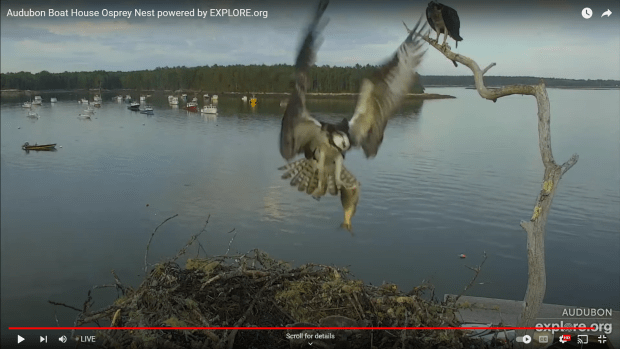
The two osplets at the Boathouse on Hog Island are growing! Looks like Dory has been better at the feeding and Skiff is getting the fish on the nest. Cute. They are so tiny. They have a long ways to go to be ready for migration.
Just look at the size of the fish that landed on the Mispillion Harbour Osprey platform! That should fill up those two and keep them from fighting! Thanks to Eagle Eyes ‘H’ it appears that bottle in the plastic bag turned out to be a vodka bottle. ‘H’ has watched the chicks use it for a pillow – she says, ‘Who knew a Vodka Bottle could be a pillow?!’ I am just glad that it is not a mesh bag or wire!
I received a nice letter from ‘C’. If I ever implied that an Osprey should go to battle with an eagle of any kind – I did not mean to. I have wondered what would have happened at the Cowlitz PUD nest if the egg cup had been deeper and if Mum could have pancaked along with the three chicks. But, no – not to fight with it. The talons of Ospreys are for carrying fish – not fighting. Because of this their nests with those lovely chicks become prey. I could not find anyone who had seen an Eagle attack an osprey nest and the adult stayed but I did wonder. As ‘C’ says, ‘Ospreys are peaceful in relation to an eagle or an owl.’ Indeed! Ospreys do not attack other raptor’s nests either. They are very gentle birds except with one another! Thanks, ‘C’!
At the UFlorida-Gainesville Nest, Big and Middle are pretty much matched. Middle gets the fish and in the end Big takes it away. They are both healthy! I caught Big with ‘snake eyes’ this morning.
My last nest is that of Little Bit 17. I went to count goslings and ducklings today and kept my fingers crossed that there would be no bad weather and the nest would be in tact. It is – and there should not be any rain or anything else until Friday. Little Bit was resting in the sun when I got home.
I am sad to announce that there were fewer goslings and ducklings north of where I live. The locals told me that the geese and ducks were there and had their nests and the two Colorado Lows came through and they all abandoned the nests and flew further north. Wow. I don’t blame them.
Two geese had a gosling each.Killdeer
Thank you for being with me today. Take care everyone. See you soon.
Thank you to the following for their streaming cams where I took my screen captures: ND, LEEF, UFlorida-Gainesville Ospreys, Poole Harbour Ospreys, Mispillion Harbour Ospreys, Bywyd Gwyllt Glaslyn, Llyn Brenig Ospreys, Poole Harbour Ospreys, LRWT, Dyfi Osprey Project, CarnyXWild, Friends of Loch Arkaig and the Woodland Trust, LOTL and Scottish Wildlife Trust, Explore.org and Audubon.
There was a lot of excitement in Bird World with the fledge (forced) of the Red-tail Hawklet at 06:17:44 from the Bald Eagle nest in British Columbia on 25 June. All day long the team at GROWLS, Christian Sasse, and David Hancock waited and watched. Twelve hours later, they were all extremely worried. Flying takes a lot of energy and every fledgling should return to the home nest before the sun sets. That way they can rest and be fed. We have had some worries in the past – Sentry at the Redding nest was gone for 4 days, I believe. Some fledglings never return like Kisatchie at the KNF nest near Alexandria, Louisiana. It isn’t always bad but…Eagles are taught how to hunt by their parents. They get their flying skills down by working on those wings and flying about returning to the nest for food. But 12 hours later, almost to the second, Malala returned to the Bald Eagles nest. It was nothing short of fantastic.
A forced fledge is when a nestling flies from the nest but did not intend to do so. Malala was frightened by the arrival of the adult with the prey and bolted. She/he is home and safe now.
At the ND-LEEF nest we are all holding our breath. Every day that the nest holds together is good for ND-17. He is old enough but it would be far better if his tail grew in a bit more and well 7 to 8 days longer on the nest would be beneficial. But, Little Bit 17 might have a forced fledge if that nest gives way. Then where does he return to rest? On a branch? to be fed? This is a very tricky situation.
Adult feeds Little Bit and then will eat the remaining squirrel pelt much to Little Bit’s surprise.
Little Bit 17 has a nice big crop. This is very good. If something should happen to this nest tomorrow, he had a really good feed that will hold him til everyone figures out how to handle the situation.
If it were my nest, I would be on the phone to Ron Magill at the Miami Zoo and the WRDC nest – and that other nest that fell with the eaglets in it – and find out how to get a large basket nest up there asap. Fill it with nest material and maybe, just maybe the adults would use it to feed Little Bit.
Little Bit on the crumbling nest alone. The rim is really falling off on the right, more and more causing the nest to appear to be tilting. Is it? I don’t know.
Keep this nest in your thoughts and send all the positive energy you can this way. We know the nest is going to completely collapse and the adults will rebuilt but, please just let it wait another week – or until 17 fledges on its own.
Each extra day we get is truly a blessing for Little Bit.
As of Sunday morning the nest is holding. At least one fish, a Blue Gill, has been delivered by Mum. Little Bit got the fish. 15 jumped down but the nest is so narrow that he cannot get passed 17 if he is mantling. This could get really dicey. There is not much room and they could both go tumbling over.
The two long-since-fledged Ospreys at the UFlorida-Gainesville Osprey nest are still having quite the dust ups over fish. Middle initially gets the fish but Big will take it at the rim of the nest. What a pair!
Ferris Akel usually ends his Saturday tour at the Cornell Campus. He will go through Montezuma, Wildlife Drive, and then to Sapsucker Woods (and sometimes other areas) before reaching Ithaca. Tonight he found a lovely Barred Owl and Great Blue Heron before reaching the hawks.
What a beauty. Great Blue Herons fascinate me by the way they quietly walk through the shallow water of wetlands or little streams and rivers and silently catch their fish. Beautiful birds that build their nests in the tops of trees. In the summer, many migrate to Manitoba and last year there was even a visit from a rare to us Green Heron.
I am used to looking at the feet and talons of raptors that I found it fascinating when Ferris focused on those of the Great Blue Heron.
Ferris was able to find both Big Red and Arthur and the three chicks. The fourth, L3 is in care for a fractured shoulder. She is expected to have a full recovery in 6-8 weeks and will be trained in flying and hunting skills before letting her into the wild.
At one time both Big Red and Arthur were on the light stands keeping their hawk eyes on the Ls.
L4 is quite the character. He is watching Arthur and when he sees him move he immediately takes off and flies to the nest. Ferris caught a glimpse of Arthur doing a prey drop but he thought it was on top of the Emerson Building not the nest.
L4 watching.
Positioning himself to take off.
Up and away. According to those on the ground, L4 is quite the little flier. That is always good news.
A strange Black Stork flew past the nest of Karl II and Kaia. The storklets watched it go past and were frightened. I wonder who it was?
The four storklets of Bukacek and Betty at Mlade Buky are growing and growing and growing. The nest also has to deal with intruders. In one instance, Betty and Bukacek are on the nest and the storklets are pancaked.
Everything is fine on the nest. Just look at the size of the eldest compared to Dad! These storklets are very healthy.
Betty and Dad are both on the nest making sure nothing happens to the storklets. When I see this I think of the Cowlitz PUD Osprey nest and wonder if both adults were on the nest protecting the chicks would the outcome have been different?
Eating some fish later.
Louis says “If Idris can do it, so can I!” And with that he landed a monstrous fish on the Loch Arkaig nest for Dorcha and the chicks. Just look at those legs – my goodness these Osprey leg muscles must be strong.
Louis removed the remainder of this fish – the last for the day and brought it in a little after 0400 for breakfast. How do you tell a fresh fish from one stored in the pantry? The fresh fish is flexible and bends; the stored one is stiff.
Today we got a good look at CJ7’s and Blue 022’s chicks. They are large enough that their heads are now higher than the nest!
Windy with some wet on the Loch of the Lowes nest of Laddie and Blue NC0. Chicks hunkered down.
It’s windy in Wales, too. The babies are tucked into the side of Telyn keeping their heads warm. I understand that the two days for ringing that are preferred are Tuesday or Thursday for the Dyfi chicks. The key in the UK is to try and get all of the chicks – every one of them – ringed. What a huge effort this is. Lovely.
It looks like Blue 33 and Maya are trying to see if any of their girls can break into that Mullet! Lessons in self-feeding.
All the rain in Wales makes it really beautiful – like here! Dylan and Seren have had to contend with intruders again today!
Mrs G and the trio are in utter misery with the cold and rain in the Glaslyn Valley today. It has been two days of damp for them – last year this type of weather happened when Aran was injured. The combination of the injury and weather and no food killed the three wee ones. So glad these three are older.
I want to share with you a wonderful story that happened precisely a decade ago when the highest waters and a huge storm hit Wales. It is from the Dyfi nest and the adults at the time were Monty and Nora. It is a tale of a rescue and a chick – of why interventions help and why ringing is important.
Please continue to send positive wishes for Little Bit 17 that the nest will continue to hold. We take it a day at a time. Thank you so much for being with me today. Take care all. See you soon.
Thank you to the following for their streaming cams, FB pages, and/or blogs where I took my screen captures or shared their stories: Dyfi Osprey Project, Bywyd Gwyllt Glaslyn, CarnyXWild, Friends of Loch of the Lowes and the Wildlife Trust, Friends of Loch Arkaig, People’s Post Code Lottery, and the Woodland Trust, UFlorida-Gainesville Ospreys, LRWT, Poole Harbour Ospreys, ND-LEEF, Mlade Buky White Storks, and the EMU.