It is 8 degrees C and will be 18 Celsius today in Winnipeg. Our City is a bit of an island with areas north and south flooded and communities being evacuated. It is also the height of bird migration. So we truly did go from winter to summer. Crazy.
News of the morning. We have a pip at Cal Falcons for Annie, Alden, and Grinnell!!!!!!!!!!! Oh, fantastic.
Baby Steps! USS4 took its first baby steps. How sweet. Just look at those strong legs!
If you missed it, Spirit branched! Jackie and Shadow have done a fantastic job raising this super ‘spirited’ eaglet. What a joy it has been to watch her grow from that first pip to now.
Many of you watched the satellite/GPS tracking of Karl II as he returned from his winter home in the Chad and Sudan areas of African. Karl II arrived at his nest n the Karula National Forest in Estonia on 8 April 8. His mate, Kaia, arrived on April 12th. This couple – who fledged three last year – have four eggs this year. They were laid on 24, 26, and 29 April and on 1 May.
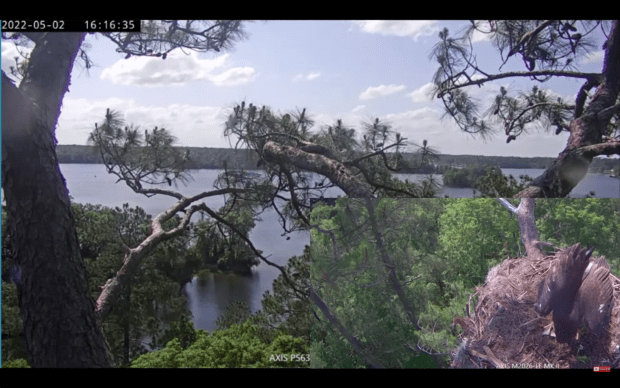
The image below is of Kaia aerating around the eggs. You can distinguish Kaia from Karl II not only because Karl is bigger but also he is banded and also has his satellite tracker on his leg.
Nancy was in the nest with E1 last evening. She is doing a great job at being an only parent.
We all love Shadow and Jackie. Here is an interesting story from yesterday but more interesting is the image of a young Shadow on the bottom right!
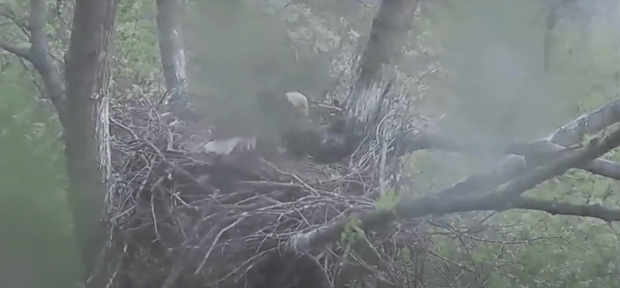
It was a foggy morning at the nest of Big Red and Arthur. Gosh I love that dark morph of Big Red’s plumage. She is so gorgeous.
L4 continues to delight. Here he is climbing over the gang from the back to get some breakfast. L4 was also seen having two crop drops by Cornell staff this morning. Way to go little buddie. No worries ever about Big Red and Arthur being able to handle four!!!!!!!!
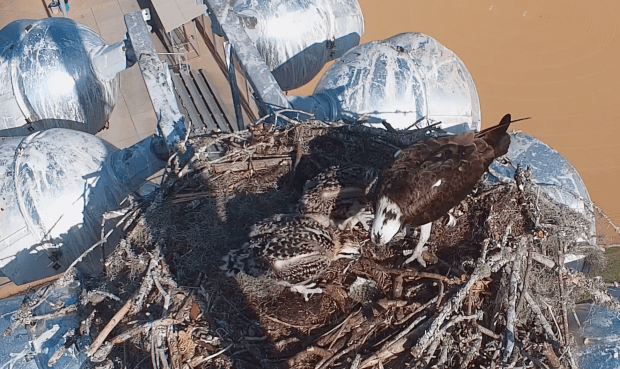
It is not entirely clear what has gone on at the UFlorida-Gainesville Osprey nest this morning. Mom was on the nest and there was a fish delivery. Was it Dad returning? or was it the intruder and the Middle wanted to be fed?
The chicks are standing and walking better. They are also growing with all the good fish that has come in. Just look at the size of that wing!
It is really a beautiful morning with the sun rising over the nest. This is Mum with the chicks.
There is what appears to be a remnant of prey but that is not Mum and that bird is not feeding the little ones. Note the design on the back of its head.
Is this Dad? I admit to not having looked at his plumage as carefully as I should have. The kids would like some fish. It is going to get hot on that nest this morning.
There you can see that design better. I wonder who this is? And where is Mum? Has she gone fishing? I will check back later to see how these two are.
I wanted to let everyone know about the pip at Cal Falcons. This is so exciting. Annie and Alden can hear the cheep-cheep of Grinnell’s chick and the egg tooth pecking away. Tears.
Bird World needs some good news and it is happening. Here is the link to their camera:
Thank you for joining me this morning. I will be back tonight with check ins on your favourite nests! Until then, I will be watching this pip while I ready the garden for summer today. Take care everyone. See you soon.
Thank you to the following for their streaming cams and/or FB pages where I took my screen captures: Cal Falcons, Cornell Bird Lab RTH, UFlorida-Gainesville Ospreys, Big Bear Bald Eagles, Pix Cams, MN-DNR, USSteel Eagles, and The Estonian Eagle Club.
A very bad storm hit the Pittsburgh-Hayes Bald Eagle nest today. Mum jumped in to stay on the nest with the triplets. That tree was swaying so much and creaking.
Everyone is soaked but those strong winds have passed through the City.
At 15:56, Alden was caught ‘loafing’ on the CalFalcons Cam. In their discussion, Sean and Lynne mentioned this posture when resting as being particular to Alden as an adult. They thought that it might be because of his injured leg and that this rest position was more comfortable.
Alden better rest. Tomorrow is 4 May and in one or two days he is going to be hunting for his and Grinnell’s family. Alden, you are adorable. And so healthy with that bright yellow cere and the lines around your eyes.
CalFalcons made a quick video of Alden when they found him.
Dr Sharpe and his team made another rescue today. On the 19th of April the Bald Eagle nest tree with a single eaglet in it on Santa Rosa Island broke. It was kept from falling into the gulley below by a single branch. The Institute for Wildlife Studies built a new nest for the eaglet and placed it back inside. Another eaglet saved! And, yes, the parents were feeding the eaglet. Apparently many of the eagles have their nests on the ground for lack of suitable trees. The local predator is the fox.
These images are reposted from the Institute for Wildlife Studies FB page. The image below shows the broken tree. The nest is on the ground in the background.
What a happy little eaglet! No injuries and you can see it has been well looked after by its parents. What a cutie.
The newly constructed nest is 1.5 metres or 5 feet off the ground. Dr Sharpe said the adults were around the entire time watching. They know where there baby is and will be right there once the humans leave.
Happy eaglet in its new nest. Thank you to the Institute for Wildlife Studies for their magnificent work at this nest and all the others in the Channel Islands that they oversee. What would these eaglets do without you?
I was doing a nest check and came across R2 at Ron and Rita’s nest in the Miami Zoo. What a wonderful surprise this morning. It was like seeing Kincaid get a fish drop yesterday. Once the raptors have fledged it is so reassuring to see them return once in awhile just to let us know they are doing fine out there.
Nancy landed on the MN-DNR nest at 19:07. Some had worried that something had happened to her. No, she appears to be fine.
Earlier today, at 15:05 Nancy landed with prey and fed E1.
E1 is of the age that Nancy can leave it to go hunting for both of them. Sadly, it appears that Harry might not return. It has been a week.
This is just a quick check on some of the nests to continue boosting our spirits. The day has been going really well with Middle at the UFlorida-Gainesville Osprey nest getting a really good feeding. Positive energy needs to go out to keep those intruders away from all of the nests. What destruction they make!
One last peek at a wee one, L4 who is melting everyone’s hearts.
Well, that little one is not shy. Today he wanted to be first in line and that is precisely where he wound up. I made a short video clip. Enjoy!
BTW. L4 came out of that with a nice big crop! You can see him getting fed by Big Red and the crop is growing every bite. Fearless this little one is.
Oh, we needed some smiles. Too many intruders. Too much sadness some time. Give me a falcon or a hawk nest. They are generally always happy – and have their very funny moments.
If you are a follower of the Port Lincoln Osprey barge and have wanted to make a donation and knew that PLO could not accept the funds, here is an announcement from today. It indicates how you can do this. Fantastic. Please read this carefully. They have laid out a good plan for using the funds received.
The 2019 fledge, Calypso, continues to be seen with her mate where they perch on a dead tree on Tunby Island. PLO have indicated that Tunby is being considered for an artificial platform as there are no good nest trees. Oh, that would be wonderful. Calypso might choose to breed with her mate this season 2022 or next year, 2023. Mum and Dad would be grandparents! How grand.
Thank you for joining me today. Take care everyone. See you shortly.
Thank you to the following for their streaming cams and/or FB pages where I took my screen captures or video clips: Cornell Bird Lab and RTH, The Institute for Wildlife Studies, MN-DNR, Pix Cams, and Cal Falcons.
Oh, I cannot tell you the level of elation when – just stopping in to check on a fledging that it is there on the nest, yelling at the parent it sees in the distance bringing in a headless fish. Oh, Kincaid, it was so very nice to see you. Thank you Louis for that great meal! The time on the Kistachie National Forest streaming cam was 15:48:36.
There is Kincaid on the branch. Oh, how lovely. I have not checked in on you enough but, it so reassuring that you are still at the nest with your parents, getting food and getting stronger at flying. That is how you will survive! Maybe you won’t ever leave. There is plenty of lake, lots of fish, and an empty eagle’s nest.
Kincaid saw Louis flying towards the nest way in the distance and she rushes down to get her dinner.
Kincaid was sure ‘wheeing’ very loud as the adult approached the tree and landed. Kincaid mantled the nice headless fish perfectly.
Kincaid did a great job feeding. She was still on the nest eating an hour later.
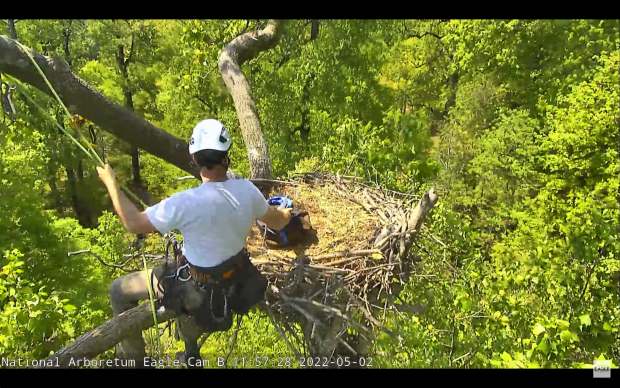
This morning DC9 at the National Arboretum Nest was banded. The eaglet was taken in a pouch down from the tree and returned. It was a very hot day in Washington, DC. 27 degrees C or 80.6. It is hotter on the top of the nest. DC9 was panting. The immediate reaction of the bander was that DC9 was a male. If I hear differently, I will let you know. Here are some images of that event.
DC 9 valiantly defended its nest. It is 10:52. DC9 is 35 years old. The perfect age for banding.
The bander sat very quiet talking gently to the little eaglet and slowly, ever so slowly got him to where he could place him in the sack.
In you go.
Down they go.
Done and dusted. The bander stayed to see that DC9 was alright. Watched his breathing etc.
DC9 is panting due to the heat and probably some of the stress. He is not going to show us his bling either.
Mr President was on a branch of the nest tree called the ‘balcony’ at 15:43. He flew down to the nest and fed DC9 at 16:22. I wonder if DC9 told Dad what a day he had had!
The cuteness factor at the nest of Big Red and Arthur is way up there. L4 is quite the ‘corker’ as my Mum would have said. Yesterday evening he was trying to eat the same piece of rabbit as its older sibling, L1. The wee one isn’t afraid of anything – even attempting to eat a bird leg this morning. It was quite hilarious. At least once Big Red had to rescue the poor darling from choking. Did I say she was a great Mum?
L4 is on the far right with that big piece of meat. Right now it is the only eyas that does not have the grey down coming in. The others are preening and itchy! Soon enough, little one. Don’t grow too quickly.
Everyone is getting a nice crop.
Then it started raining. Poor Big Red. She is getting soaked.
Then the rain stopped. All of the babies are completely dry and kept nicely warm.
It often seems like Big Red never stops feeding them! Adding one extra sure changes things on a nest!
Iris came to visit her nest today at Hellgate Canyon in Missoula. No eggs yet.
Someone commented that they thought raptors bonded for life (meaning if the mate disappears they do not take another mate) today in a short discussion about Nancy and Harry at the MN-DNR nest. Harry has been missing since Tuesday evening. He is Nancy’s second mate. Should Harry not return to the nest, Nancy will have her choice of suitors. She is an experienced female with a beautiful nest and according to the statistics there are too many single male eagles. II really hope that Harry is off healing and will return. Nancy is taking good care of E1. (E2 was shoved off the nest by E1 and subsequently euthanized due to its injuries both from the fall and from the beaking from E1 on the nest).
The oldest eaglet on the Dale Hollow nest branched today. A parent was in with a chunk of fish for Big and was feeding some fish to Middle.
The eaglets are big! Just look at the size of them.
Wow. That big beautiful wing. The eaglets are (counting hatch day) 64 days old today. They hatched on the 28th of February.
Louis and Dorcha at the Loch Arkaig Osprey nest in Scotland now have three eggs. Congratulations.
Male Ospreys are quite funny. Some bring toys and bright objects to the nest. Others land on their mates and use them as a pillow hoping to get some incubation time. At the Dyfi Nest in Wales, Idris pulls Telyn’s feathers when he wants a turn! Telyn is incubating three eggs!
Idris is also known for being ‘Daddy Longlegs’ and for his fantastic fishing abilities!
This is a reminder that Annie and Alden, the Peregrine Falcons at the Campanile on the grounds of the University of California at Berkeley are incubating three eggs which are set to hatch in four days – 6 of May (possibly the 5th). Two eggs are believed to belong to Annie’s former long term mate, Grinnell, and one is thought to belong to Alden. Everyone is very excited. When the chicks are banded, snips of feathers will be taken and a DNA test will happen. We will know the genders and hopefully which chick belongs to which Dad.
Don’t know what to expect from a Peregrine Falcon nest? or need a refresher? or just want 15 minutes of cute? Have a look at a season compilation from Glasgow.
I have not had a chance to check all of the nests! Adding the falcons and ospreys in with the eagles has been running – which is a good thing! Those nests I have checked appear to be just fine.
It is sunny and dry in Manitoba! American White Pelicans are on the river near to where I live. The floodway seems to be regulating the water inside the city the way it was designed. Thankful.
Thank you for joining me this afternoon. Take care. See you soon.
Thank you to the following for their streaming cams where I took my screen captures: Dfyi Osprey Project, Cal Falcons, Cornell Bird Lab RTH, DHEC, Scottish Woodland Trust, NADC-AEF, MN-DNR, KNF, and the Montana Osprey Project.
In all the flurry of the goslings jumping at Decorah yesterday and the fourth egg hatching for Big Red and Arthur, there was one thing that I missed. Please send your positive wishes to Nancy and the two eaglets on the MN-DNR nest. Sadly, Harry has been missing since Tuesday evening, the 26th.
The two eaglets are old enough for Nancy to go out hunting. No doubt she will take care of them and her. Harry was such a fantastic mate. This is very, very sad news.
Everything is going great at the nest of Big Red and Arthur. Big Red is such a fantastic mother. She has them all lined up to eat and she knows to get L1 fed full so it goes to sleep and the three others can eat. They are all doing well and Arthur has the larder packed with prey.
They are adorable. Big Red brought the greenery in this morning. The needles and the bark have oils and vapors that discourage the growth of fungal spores. They also retard bacteria growth and repel insects. Big Red and Arthur tend to get their greenery from Hemlock, White Pine, and Cypress while hawks in other areas, such as the West, select Juniper and Douglas Fir.
The blood on the back of the wee one is from prey. It is not injured!
Precious. They hatched on the 21, 24, 25, and 28 of April.
Here is news from Winnipeg. Isn’t she gorgeous? This is Ella and Dennis Swayze – an excellent wildlife photographer – caught this image of her and posted it giving us an update on Ella’s scrape. We have four eggs! I will be posting the link to the streaming cam as soon as it is live.
Out of habit and concern, I continue to check the West End nest of Thunder and Akecheta and the Two Harbours nest of Chase and Cholyn to make sure all of the eaglets are present.
There is Chase with TH1 today. That bush blew in and will probably leave when gusts arrive. The baby is fine from its fall. Hungry and growing and losing the few dandelions that were on its head.
All three eaglets are at home with Thunder this afternoon. Hopefully they will all stay on top of that cliff nest until it is time to fledge.
I am not 100% certain but I believe it was Middle that got the fish. He saw the adult coming and immediately was ready to mantle the delivery! Good work. Big looked on from where she was perched on the nest rim.
The eaglet was quick – hungry! Notice the crop on the eaglet perched on the rim of the nest. You can see that crop better – and how big it is – in the second image below.
That was a great mantling job!!!!!!!
Middle is really going to enjoy that fish.
Why do I think it is Middle? Middle never stops chirping when it is eating. Everything looks fine at Dale Hollow.
There is still a bit more of a white terminal band on Middle – not really a band as in hawks and falcons – but enough of a white ruffle to still identify.
There are three eaglets at the Notre Dame St Patrick’s County Park nest in South Bend, Indiana. ND15 is the oldest. ND16 is one day younger than ND15. ND17 is 5 days younger than ND15. So there is a span of five days between the oldest and the youngest. So far they have had a squirrel and a turtle today.
Little Bob is sound asleep with a really nice crop!
Here is a link to their streaming cam:
Still having eaglet withdrawal, there is also the Decorah North nest of Mr North and Mrs DNF. The eaglets are approximately one month old and cute as buttons! Are buttons cute? Who started that saying?
Here is the link to the Decorah North camera:
It is really hot on the UFlorida-Gainesville Osprey nest today. The two osplets had crops early on but I cannot rewind the camera to find the time of the feeding. It appears that they would very much like more fish brought in!
You can see the filled crop squish out at the side as the osplet presses against the twig.
Trying to stay cool.
They sure can make one nervous hanging over the edge of that nest like that!
Today, there are two nestlings at the Osprey nest of Jack and Harriet in King William, Virginia. Congratulations!
Something to put a smile on your face for a Friday. The smallest at Pittsburgh-Hays has discovered ‘the Quarterback Sneak’. Look at it grab those bites between Mum’s legs!
Lori Covert has been watching Andy and Lena and Middle (LittleO) and Little (MiniO). Andy brought a fish to the nest for Middle (Little O). Little or MiniO was seen right on Andy’s tail by Lori when he was diving. He made the dive about 10 ft or 2.5 metres from her kayak!!!!!!! What luck. He subsequently got a fish for Little or MiniO. Both kids fed. Everyone is OK at Captiva. Fantastic.
This is how Lori described it: “And MiniO was literally right on his tail feathers for the whole dive! Afterward they circled around for a couple of minutes then MiniO went back to the perch and Andy delivered the fish to LittleO.”
An article from The Smithsonian Magazine on H5N1 Avian Flu:
Thank you so much for joining me this evening. Take care everyone. See you soon!
Thank you to the following for their streaming cams, FB pages or Twitter feeds where I took my screen captures: MN-DNR, Cornell RTH, MB Birding, Explore.org, DHEC, ND-LEEF, UF-G Ospreys, Dahlgren Ospreys, Pix Cams, and Captiva Ospreys and Window for Wildlife.
Good Morning everyone. The sun is trying to shine in southern Manitoba and the sky is light blue grey. Everyone is preparing for the onslaught of more rain headed our way — will it really be 50mm? That is close to 2 inches.
Mother Goose waiting for the all clear to leap from the Decorah nest. 28 April 2022
First up. I have received a number of letters about the 5th gosling of Mother Goose at the Decorah, Iowa nest. As many of you know, three goslings were with Mother and Father Goose after they jumped out of the nest and two were not. Boots on the ground found 4 and got it with Mum and Dad. Volunteers of the Raptor Resource Project and Mother and Father Goose continued to look and call for the 5th. Sadly, it was found dead. According to the following official release, it was not the youngest that died.
This is the statement released by the Raptor Research Project on their FB page:
“The goslings jumped today! We’ll have video tomorrow, but for now, we know that: Four of five goslings survived and were last seen swimming happily in Trout Creek, foraging along the bank, and following their parents up and down the small pool below the nest. One of the four went the wrong way after jumping! We managed to reunite it with its family after some mad scrambling through the brush, a low crawl across the river bank, and a little rock jumping. This gosling seemed determined to stay with new Papa. David Kester: it took two tries to get it back where it belonged! One gosling died. We initially thought it might have been the last to jump, since it was younger and smaller than its siblings and took a while to follow them out of the nest. But the gosling we reunited with its family was smaller than the one we found dead. We suspect (but don’t know for sure), that the reunited gosling was the last gosling, and the gosling that died was gosling number two. One, three, and four joined their parents quickly, but we don’t think we saw two after it jumped.”
The ‘sad’ part of all of this is that Mother Goose is still looking for her 5th gosling. She was at the nest this morning.
The Cape Wildlife Centre taught us much last season about Canada Geese – if we did not already know. When Arnold had his digit bitten off by a snapping turtle in their pond, Amelia looked and looked for him. She waited on the porch knowing he was inside the clinic (their pond is on the grounds of the clinic). The staff helped them to be together, for her to watch Arnold’s recovery, for them to share meals, and then finally to be outside. The take away from that is that Canada Geese are intelligent and sentinel. Was the dead gosling shown to the parents? And in asking that question I am not criticizing what was done yesterday at Mother Goose’s nest. Just asking a question. If not, perhaps in the future this should be done and also, when one goose is taken into care, that the other one go along, too! They really are bonded!!!!!!
L4 at the Cornell Red0-tail Hawk nest did survive what felt like a 72 hour pip and hatch. It completed its hatch at 23:08 on the 28th of April. Here is the video of Big Red and Arthur and their four Ls! Congratulations Big Red and Arthur!!!!!! This is going to be fun. Big Red will be in her glory – 4. It is, as far as is known, a first for her.
L4 will be substantially smaller than L1 which is a week older. But, see all that prey on the nest. There is plenty of food and there is no reason not to believe that L4 will not thrive. The beaking only occurs in falcons and hawks because 1) their eyes have to become clear and focused and 2) every black beak with pink inside is potentially food. Normally subsides after a week. As far as my understanding goes, siblicide is extremely rare in hawks and falcons unlike eagles and ospreys.
Yes, Arthur, there really are four of them!!!!!!!!!!!!!
Just look at the prey pantry in this nest. Arthur is so excited it will be filled to the brim with all sorts of critters. No one will go hungry. In the image below, Big Red is checking each beak to make sure none of the Ls want any more squirrel before she quits feeding. She is a pro at taking care of chicks and Big Red loves being a Mum.
There are a couple of Bald Eagle nests that I continue to check. One of those is the National Arboretum nest in Washington, DC. Mr President and Lotus have a gorgeous eaglet who is just losing the last of the dandelions on the top of its head. However, this eaglet has been fed duck and I worry a little when waterfowl are consumed because of H5N1.
The remaining two Osplets at the UFlorida-Gainesville nest on the light stand are doing fine.
Both of the eaglets at the MN-DNR nest are doing fine this morning also. They have had some waterfowl so I continually check on them like the NADC-AEF nest.
The two eaglets on the Dale Hollow nest continue to thrive also. They are gorgeous birds and today they are (counting hatch day) 61 days old. Soon!
I know that almost everyone is a fan of Harriet and M15 at Fort Myers. It appears that E19 might have left the territory yesterday. Lady Hawk made a video of those final interactions and moments.
There is good news. Janika returned safely to her nest with Jan yesterday at 16:15. There had been a fight with an intruder and Mum is now home safely after some worry. Jan and Janika have 6 eggs in their nest in Jogeva County, Estonia. They were laid on April 15, 17, 19, 21, 23, and 25. The last time I checked on this nest – shame on me – we were waiting for Janika to return from migration! Hopefully no more intruders!
If you watch this nest – and storks are absolutely lovely with all their rituals – you must be prepared for the parents to ‘sort’ the chicks. A clutch of six is surely too many to feed – but we will find out.
The celebration is still going on in Poole Harbour. Ospreys CJ7 and Blue 022 are making history. CJ7 laid her third egg at 08:57 on the 29th of April. Will she stop at three? Oh, I hope so. Remember, these are the first osprey eggs laid for 200 years and then – the first fledges in 200 years. I can hear the ‘happiness’ for all those involved in the Osprey restoration/relocation project to Poole.
It was the tail movement that gave it all away. CJ7 should begin hard incubation now.
Want to watch history being made? Here is the link to the streaming cam at Poole Harbour.
In Latvia, at the nest of Anna and Andris in a Spruce tree in the Zemgale region, Andris brought a very small snack to his mate. So far, the Lesser Spotted Eagles have only one egg which was laid on the 26th of April. Perhaps it will hold at one!
Karl II and Kaia now have three eggs in their Black Stork nest. That nest is in Karula National Park in the very south of Estonia. Kaia is Karl’s new mate as of 2020. Their first clutch was not successful. In 2021, they fledged three! This year, Karl II returned from migration on 8 April with Kaia arriving on the 12th. I am very fond of this nest and this couple! Third season.
There is Karl II with his band and his tracker. You can follow him all the way back to the Sudan and Chad when he migrates in the fall.
Here is the link to Karl II and Kaia’s streaming cam in Estonia:
As we wait anxiously for the Peregrine Falcon nests to begin hatching – and I am really anxious for Annie and Alden – there are four eyases in the scrape in Utrecht. Each is doing very well.
Here is a video of the snack feeding a few hours ago:
Here is the link to the falcon cam in Utrecht with those four gorgeous little ones.
Here is a link to a peregrine falcon scrape cam in Belgium where there are also four little falcons.
This nest in Belgium also has a great entrance cam!
For those of us wanting an international ban on sticky glue traps, England has now banned their use. Excellent news. Here is the announcement that came yesterday, “The Glue Traps (Offences) Act, introduced by Jane Stevenson MP, bans the use of inhumane glue traps which are a widely available method of rodent control but can cause immense suffering. Animals can remain alive for 24 hours or more, eventually dying of stress, exhaustion, dehydration or self-inflicted injuries”.
With the exception of the one gosling not surviving the jump at Decorah, everything seems to be fine in Bird World on Friday morning the 29th of April. Thank you so much for joining me. Take care. See you soon.
Thank you to the following for their streaming cam and/or FB pages where I took my screen captures: The Latvian Fund for Nature, The Eagle Club of Estonia, Cornell Bird Lab and RTH, Explore.org, NADC-AEF, Poole Harbour Ospreys, Oudenaarde Falcon Cam, Raptor Research Project, DHEC, MN-DNR, UFlorida-Gainesville Ospreys, and LFC Utrecht.
How many weekends have I mentioned that southern Manitoba would be having a weather event? Well, this has to be the 3rd or 4th. Keeping track of them might make me miserable. But yes, we will have another 50mm of precipitation starting late Friday evening and into Saturday. Is it possible we will go straight from winter to summer? Spring and fall seem to be getting eliminated.
Well, let us start with the sad and end with something nicer.
Mother Goose got her 5 babies down from the eagle nest in Decorah, Iowa on the second try. The 6th egg was non-viable and the 5th gosling had only hatched the night before. It was not yet 24 hours old as I understand it.
Three of the goslings were with the parents and a volunteer with the Raptor Research Project found the fourth immediately. Mother and Father Goose called and looked for the 5th baby as did boots on the ground. Sadly, it was found deceased. The remaining four are very healthy and let us wish them a good life.
My friend ‘R’ in Pennsylvania sent me a copy of a poster. Thank you, ‘R’. The more we know, the better equipped we are to deal with situations. This is particularly geared to backyard poultry. As all of you are aware, the H5N1 strain of the Avian Flu is taking its toll on waterfowl and raptors that eat bird. Many have ‘free range’ flocks that sell eggs from chickens and ducks that are allowed to roam free. You might know of someone who could benefit from this information from the PA State Department of Agriculture.
Intruders. The birds in the SF Bay area have been having a lot of intruders – many of them lethal. Richmond and Rosie can hardly take a breath without someone, many times another Osprey, coming to their nest where they are incubating three eggs!
Oh, the female eaglet of Thunder and Akecheta has the most beautiful name. Kana’kini. My possibly poor translation is kana – powerful, and kini is beautiful and gorgeous. If that is correct it fits well with this very stunning powerful female eaglet.
Kana’kini certainly has big powerful legs. Get out the worry beads. She is jumping and flapping on the nest! But I want you to look at the small male to the right. Look at that crop! Apparently it is crab that Thunder brought to the nest. Just look at that!
Big Red is another gorgeous powerful female. I cannot explain it but the last time I checked L4 was still working away at hatching. The time of the first pip had to not so accurate???? Even if L4 does not hatch, just look at our Red-tail Hawk Mama gazing lovingly down at one of the Ls.
It was such a relief yesterday for Lori Covert to confirm that both of the fledglings of the Captiva Osprey nest are alive, flying with their parents, and obviously being fed. Little or MiniO is getting food off camera and well, ‘Lena’s boy’ Middle or LittleO loves to eat at the nest.
TH1 is in the Two Harbours nest tonight! Do you always check, too? Those railings that Dr Sharpe and his volunteers brought and fixed continue to keep the wee one end. It will not be long until Dr Sharpe is back up to the nest banding Chase and Cholyn’s only baby.
It looks like Harry and Nancy at the MN-DNR eagle nest are doing some branching demonstrations for the two big eaglets.
Lady Hawk did a great video of Harriet and M15’s E19 and E20 playing down at the pond yesterday. Oh, they are beautiful strong eaglets.
Port Lincoln has been cleaning up the barge with the Osprey’s nest getting it ready for the 2022 season for Mum and Dad. There is also a new sign for all those people who feel entitled to distress the raptors.
So far, so good with all the nests. Be sure to make a note that 5-6 of May (that is next week) is hatch watch for Annie, Alden, and Grinnell at the CalFalcons scrape. Tomorrow I hope to check on some of the European Osprey and eagle nests.
Take care everyone. Thanks so much for joining me. See you soon!
Thank you to the following for their streaming cams and/or FB pages where I took my screen captures: Explore.org, Port Lincoln Osprey Project, Cornell Bird Lab RTH, Captiva Ospreys and Window for Wildlife, and MN-DNR.
Good Morning Everyone. I hope that all of you are well and that the sun is shining bright where you are.
Middle or LittleO at the Captiva Osprey nest roosted on the rim of the nest box. He spotted Andy and started fish crying. You could have heard him all the way to Fort Myers! At 07:30:05 Andy delivered his middle child and oldest surviving of the 2022 season a really nice catfish for his efforts!
Here comes Andy! Good one, Dad. Middle (LittleO) is really hungry.
Andy gets his talon nipped again.
Catfish are really bony and a challenge to eat. I wonder if Lena will come and help?
No. Middle (LittleO) had to work on that bony fish all by himself. He flew off of the nest at 09:02.
The clean up gang came up to the nest to see what was left of that nice fish.
To my knowledge, there has been no sighting of Little (or MiniO) since she fledged.
There was an early morning fish delivery at the UFlorida-Gainesville Osprey nest. Civility continues. The time was 08:13.
Both siblings have nice crops and there will be fish left for Mum.
Chase has two big fish on the Two Harbours nest for Cholyn and TH1 this morning. After all the activity with the eaglet falling out of the nest and being rescued yesterday, it is hoped that nothing eventful happens until banding day!
Big Red is not giving much away but that 4th egg still has a lively pip happening. Cornell says that part of the shell is crashing so that is a good sign.
These three have been having a banquet of critters.
Arthur – isn’t he a darling? – got a chance not only to deliver prey to the pantry but also to brood his chicks! Fantastic.
The goslings are hatching at the old Bald Eagle nest in Decorah, Iowa. Mother Goose is really protecting them. So cute! It looks like four so far. Two more to go. There will be six in total if all hatch.
Here is a video of the hatching:
Here is the link to the camera for Mother Goose! Don’t be fooled by the Bald Eagle – this is Decorah’s old unused nest leased to Mother and Father Goose. When will the goslings jump? When they are all hatched, are dry, and have developed their protective fuzz. Probably tomorrow morning.
DN15 and DN16 are having a lovely morning with their Mum, Mrs DNF (Decorah North Female) looking over them. Because of the recent Avian Flu deaths in the Midwest, I will continue to check in to make sure everything is alright on this nest. They are looking good this morning.
All three of Thunder and Akecheta’s eaglets are up on the nest this morning! It looks grey and dreary there.
Rosa and Martin’s Only Eaglet at the Dulles-Greenaway Nest has certainly grown. It is waiting and hoping that someone is going to bring breakfast!
I am very concerned about the MN-DNR and have written to find out the status of the two eaglets. I hope that they are both just very very sound sleepers and this is not another two eaglets taken by H5N1.
At 06:03 both were tucked up under Nancy.
At 08:09 a parent was on the nest checking on them.
One ate at 08:00.
I will report later if anything is confirmed at this nest. This would be such a loss.
I hate to leave on a what could be a sad note. The number of cases of Avian Flu in the Midwest are growing. If you would like to see the spread of this deadly virus, here is a link to the USDA data:
Thank you for joining me. Please take care everyone. See you soon.
Thank you to the following for their streaming cams where I took my screen captures: MN-DNR, Cornell Bird Lab RTH, Explore.Org, Institute of Wildlife Studies, Dulles-Greenaway Bald Eagles, UFlorida-Gainesville Osprey Nest, and Captiva Ospreys and Window for Wildlife.
It has been a great day in Bird World. When everything seemed so bleak with the ‘Only Baby’ at the Two Harbours nest on the Channel Islands holding on after a fall ten feet below the nest, the sun rose. When daylight came Dr Sharpe and two volunteers hiked for an hour to reach the nesting site. The trio rescued the eaglet, built up the walls of the nest, and placed the wee one back. Everyone held their breath hoping that the parents, twenty-four year old Chase and Cholyn, would appear immediately. They waited almost three hours to return. Everyone was on pins and needles. What if they did not return was the question on everyone’s mind. One did a fly by, and then they both arrived – Cholyn with some nesting material and Chase with the first fish of the afternoon. Baby was home! It was less than 24 hours but, it felt like an eternity. Would the eaglet be able to hold on? That strong brave little one stayed put until help came!
Dr Sharpe and the rescue were interviewed by ABC news:
“Oh, please, just one more bite,” Cholyn insists. Meanwhile, TH1’s crop is about to pop. Can you see it? The parents were overjoyed to have their chick back on the nest.
Cholyn and Big Red believe that no one should leave the table hungry. Tonight, squirrel was on the menu at the Red-tail Hawk nest in Ithaca, New York.
There are still three for Big Red and Arthur. As you can see, Arthur has really been packing the pantry and I am happy to say that most of it is squirrel and chippy.
There has been little mention of egg 4. It pipped and the chick was alive last night. It is difficult to tell because the other three Ls lay on it. If it is to hatch we should see that wee one in the morning. Personally, three eyases is great!!!!!! The three Ls appear quite healthy.
Liberty and Guardian’s eaglets for the 2022 season now have names. They are Sentry and Star. Well done everyone who took part in the voting for these two at their Redding, California aerie. Just look at them. Aren’t they gorgeous?
Spirit and Jackie shared a meal together today. It is hard to grasp but just look at the size of Spirit. They said that she would be the size of a Canada Goose now!
It is often hard to go back to a nest when the older siblings have been responsible for the death of the younger. It took me a long time to ‘get over’ being upset with Solly at the Port Lincoln Osprey nest when she caused the youngest, Tapps, to die at the age of 18 days due to starvation. It was only after she fledged that I warmed up to her again and I was honestly very sad when she died on an electrical pole in South Australia eating a fish. The two surviving ospreys at the University of Florida’s Gainesville Osprey nest are really doing well. The food competition appears to have dissipated. It is quite sad that the third hatch has to be sacrificed, or so it seems, for the good of the whole in terms of brood reduction.
The two eyases at the Presidio Red-tail Hawk nest in San Francisco are also eating well and growing without much of a problem. Once in awhile the eldest tries to be dominant but things seem to be alright.
It was sunny with wind gusts at the Two Harbours nest. Chase and Cholyn had to hover and approach the nest twice to land. It was dreary and windy just around the corner at the West End Eagle nest of Thunder and Akecheta. Of the three trips up the cliffs in less than two weeks, Dr Sharpe rescued the youngest male from the West End nest who had fallen and then returned a few days later to measure and band the three. It is easy to spot the big sister in the group now with her two little brothers.
On Thursday the 28th, the Ventana Wildlife Society is holding a Zoom-chat. It is free and it begins at 4pm Pacific Time. When you register you can submit questions to the staff. Because Condors eat carrion, I submitted questions related to the current Avian Flu in relation to those beautiful California Condors.
In Latvia, the first egg at the Lesser Spotted Eagle nest has been laid. The nest is in a beautiful Spruce forest in Zemgale. The map below was posted on the English Forum, Looduskalender, and shows the area of the nest in green.
The nest is 17 metres off the floor of the forest and from its size, is believed to be at least five years years old. The couple are Anna and Andris. Lesser Spotted Eagles normally lay two eggs. If there is enough food available, both chicks will grow and fledge. If there is not, then siblicide will occur on the nest. It is good to understand this before you begin watching a Lesser Spotted Eagles nest (or a Greater or a Golden Eagle).
Andris is being shown the egg by Anna. Notice how small he is compared to the female in front.
Here is a short video of that first egg.
Here is the link to the streaming cam:
Do you love Iris, the oldest Osprey in the world? She is not only the Queen of the Ospreys but she is also one beautiful bird. Just look what good shape she is in after doing her winter migration. I am very impressed. I wonder what 28 or 29 Osprey years translates into human years??? or is there such a thing? I hope I look that good at the equivalent age!!!!!
Here is Iris this evening on her nest at Hellgate Canyon, Missoula, Montana.
Earlier, at 18:20 her mate, Louis, brings her the second fish of this season! For those who do not know Iris, Louis and Iris have this rather jaded bond. Louis also has a nest with Starr at the baseball park. This is the first year that I remember Louis bringing fish to Iris in several years. And now he has brought two! Wow.
Iris knows Louis is approaching and she does some quiet little fish calls.
Wow. That is a nice big fish. Notice the head is missing. Traditionally, males eat the head before delivering the fish to the nest.
Iris accepts Louis’s gift and flies over to the pole to eat it for her dinner. I wonder if we should be expecting eggs soon???
A marvellous book arrived in the post today. It is called Eagle Man and is about Charles Broley and his dedication to the Bald Eagle. Broley lived in Florida and in Canada. Broley was a banker; when he retired he devoted himself to bird watching. Broley became a world authority on the Bald Eagle. His observations taught us about courtship rituals, nesting, feeding, and even the migratory patterns of the eagles. I landed a copy in very good condition. It was obviously treasured by its owner, D. Gordon, who wrote on the flap that he received it in May of 1956. It is signed by Charles Broley. Inside the binding is the obituary of Broley who died on 7 May 1959 in Delta, Ontario. I am so looking forward to reading this book that inspired many to respect the Bald Eagles as many, like Dr Sharpe today, fought to bring their numbers up after most were wiped out by DDT.
Thank you for joining me. There are so many nests to cover and some will find themselves here tomorrow. Take care! See you soon.
Thank you to the following for their streaming cams or webpages where I took my screen captures: Looduskalendar Forum, Cornell Bird Lab RTH, Montana Osprey Project, Explore.org, Redding Eagles, UFlorida-Gainesville Ospreys, Friends of Big Bear Valley, Latvian Fund for Nature, Presidio Trust, and the Ventana Wildlife Society.
There is lots of Bird World news but the most important is what is currently happening on the side of a cliff face in the Channel Islands.
Cholyn flew off the Two Harbours nest around 14:32 and the wee eaglet caught on to her talon and was tossed. It is clinging to the edge of the cliff.
Here is the link to that camera. Dr Sharpe and the staff at the IWS are aware of the situation.
I am a supporter of the Kakapo Recovery in New Zealand. The effort put into caring for these flightless parrots and trying to ensure that they do not go extinct is simply more than incredible. However, I had no idea that there was a streaming cam showing Rakiura and her two foster chicks on Whenua Hou Island. Here is that link:
A short while ago, Mrs G, the oldest Osprey in the UK laid her 60th egg – the third for what we hope is the complete clutch for her and Aran at the Glaslyn nest in Wales. The time was 21:44.
Sad news has come to me from ‘B’ who saw an article about Avian Flu and the death of a Peregrine Mum who was incubating eggs in Omaha – another case in the Midwest corridor. Here is the link to the story of this scrape on the Woodmen Life Tower. ‘B’ did some further searching and discovered that there had been an outbreak of Avian Flu at a local poultry farm in the area a couple of weeks prior to this death. This is terrible news.
For those of you following the Denton Homes nest in Iowa, you will know that the three nestlings died. It appears that the adult female at the nest has consumed at least one of the carcasses. (The bodies were not removed for testing. It is unclear to me why if the H5N1 spreads so easily they would not have at least been removed and disposed of properly to stop the spread).
The fourth egg at the nest of Big Red and Arthur had a pip yesterday late. There is no word on its progress today. Big Red got up for a break and – wow – let Arthur come and incubate the kids. He also did some allo-preening of one of the chicks. Allo-preening helps remove bits and bobs of material on another bird – it gentle and often, if you watch the Royal Albatross looks very soothing. When birds clean their own feathers it is called preening.
Arthur looks so comfortable taking care of the Ls. Hopefully Big Red will let him do this more often.
It is a good thing they have been working on the rails!
Cornell posted a short video of the wee ones tussling. The hawks and falcons cannot see well when they hatch and every beak is a potential for food. This behaviour will stop in about a week. Just relax and giggle.
Both of Nancy and Harry’s eaglets at the MN-DNR appear to be alright today.
All eaglets up and accounted for at the West End nest of Thunder and Akecheta.
I did not get to check every nest like I wanted to this afternoon and I must leave for a bit. I am going to close with a really important posting from A Place Called Hope. This stuff needs to be taken off the market!
One of the wildlife rehab clinics that I really respect in the US has posted a warning that I want to share with you. Please read the information so that you can pass this on to anyone who might be using this product. Your domestic pets and the raptors will thank you!
I am, at this time, not aware of any other issues other than the chick at the side of the cliff at Two Harbours. The Bald Eagles cannot rescue the chick themselves. This would be up to Dr Sharpe and his team like the rescue of the youngest eaglet at The West End a little over a week ago. The two ospreys at the UFlorida-Gainesville nest appear to have stopped the rivalry and when I have checked both have eaten fine. If the 4th egg of Big Red is to hatch we will know by tomorrow morning. Personally I would prefer 3!
Take care everyone. Send uplifting positive energy to that wee babe on the side of the cliff at Two Harbours. Thank you for joining me today. See you soon.
Thank you to the following for their streaming cam and/or FB pages where I took my screen captures: A Place Called Hope, Cornell Bird Lab RTH, Explore.org, and the MN-DNR.
It is a beautiful morning on the Canadian Prairies. The sun is out a little bit and white snow fell overnight. The birds are very happy. They do not like the 45 kph gusts last night or the torrential rain on Saturday. I am also feeling lucky that we are not flooding and sad for the people and wildlife that are struggling with continuing flood waters in southern Manitoba and at various parts of Winnipeg.
I am going to begin with the sad news.
I wanted to make sure before I provided any more incorrect information about Little Bit. I have been monitoring the nest for many hours at UFlorida. Despite being fed Sunday after 86 hours without food, Little Bit lost its struggle to live. The precise time is unknown. The tiny wee one was almost delirious eating fish yesterday. It was such a joyful ten minutes watching Little Bit have some fish. It made us hopeful. At the time, the little one had not had a ps in a long time and at what point are its internal organs damaged? The heat at the top of the nest is hugely problematic in terms of hydration if fish are not consumed for that is where the osplets get their water. Little Bit got to eat because three fish came on the nest in quick succession. With the arrival of the third one, Big beaked Little Bit and fought with Middle. After some fish, the older two finally collapsed. It was only on their collapse that Little Bit got to eat and eat it did for ten minutes. I bet fish never tasted so good. Then another fish arrived, a 4th one, at 18:32:45. The female dragged that fish right across Little Bit’s head. It looks as if that is the precise place where Little Bit passed on. I had hoped for a miracle for this third hatch who wanted to live and who had such a wonderful start to life. This nest truly looked promising. The turn came on 10 April and for the past two weeks the baby suffered great abuse. There was a bit of a reprieve on the 18th and then the programme of siblicide began again on the 19th. — Those are a summary of the facts as we know them of Little Bit’s struggle to live on this nest. I had so hoped you would be alive and eating this morning, Little Bit. It was not meant to be. Fly high, Little One. Fly high. Soar.
The Osprey nest at Captiva is vacant this morning. Middle (or Little) was there yesterday. The parents should be feeding the chicks off camera. There has been no word on Little (or MiniO) since she fledged. If you look at the tree closest to the shore to the left of the scrape box you will see what I believe is an Osprey. This was Middle (or Little’s) tree that it liked to sit on. Perhaps it is him.
If you are in the market for a property at Captiva with an Osprey and Eagle nest, Lori Covert’s property is for sale.
The falcons and the hawks have been ignored, at times, in favour of the eagles and the ospreys so I want to check on some of these other nests while returning to a couple of Osprey nests that are normally very stable.
There is a Red-tail Hawk nest streaming cam in San Francisco at The Presidio. I had no idea. What a surprise in the wee hours of the morning when it just appeared. There are two chicks. They still have their white down and they are feisty!
The Presidio’s resident Red-tailed Hawk pair have been hard at work preparing their nest 100 feet up in one of the Presidio’s blue gum eucalyptus trees. The information tells me that “The Presidio is an important stop on the Pacific Flyway, the major north-south flyway for migratory birds, which means it’s a hotspot for birdwatching with 323 different types of birds spotted (so far!) in the park.”
The two eggs were laid the middle of March. The site does not state when they hatched but they look to be less than a week old but slightly older than Big Red’s chick, L1.
I do not know anything about this nest but I am quite excited. With only two chicks in this nest, both of them should grow happily. In general, it is easier to watch the hawk and falcon nests than the eagles and Ospreys as food competition and sibling rivalry are much less frequent.
Breakfast Monday morning. So well behaved like little falcons normally are.
This is simply fantastic news. Here is the link to follow this Red-tail Hawk family in California!
Early morning at the Buckinghamshire Council offices in the UK and there is that beautiful Peregrine Falcon. No eggs yet. Predicting soon!
We also have Peregrine Falcons in Manitoba. There are several streaming cams as part of the Peregrine Recovery Project. Ella and Pip have their scrape on the top of the Radisson Hotel in downtown Winnipeg. The couple have three eggs. Check out The Peregrine Chick on Twitter for news.
The last of the three eggs were laid on the 22nd of April and now it is hard incubation. Egg 1 was laid on the 17th with egg 2 on the 20th. Ella was tucked up tight as the cold weather returned to the ‘peg.
One of the great things that the local group has done is to compile a listing of Peregrine Falcon cameras in North America as well as world sites. It is not comprehensive as I see it does not include the Utica, New York scrape. Utica, you might want to send them a note and ask to be included. On that same page as the listing are a number of books related to Peregrine Falcons and other links. For the cameras, you just have to click on the site and presto – another cam with falcons to keep you awake!
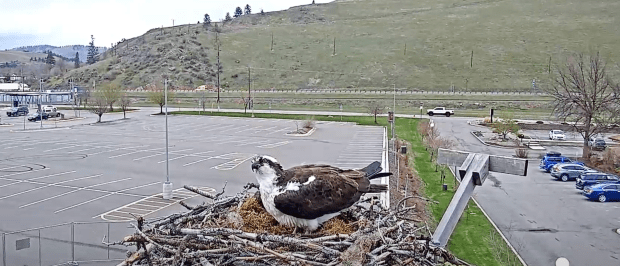
It was a gorgeous morning at the Cape Henlopen Osprey Nest in Lewes, Delaware this morning. Mum and Dad were both on the nest. Dad kept coming to see if he could have a turn at incubation and Mum kept refusing!
The site will not let me embed their camera link so search for the nest at YouTube.
L3 has hatched for Big Red and Arthur at the Cornell nest in Ithaca. That happy event happened at 06:03 this morning. Lined up from left to right: L3, L2, and L1. Big Red is trying to convince them that they want an early morning breakfast!
It looks like it is hard to keep 3 moving chicks and an egg comfortably under you, Big Red.
It is hard to see from the glare but Rhett and Scarlett are back making nestorations and mating on the Savannah Osprey Nest that was previously leased to the Great Horned Owls. I wonder how the season will go. It is late Osprey eggs in the region but, I guess we will find out!
Here is the link to this camera. Note that the Ospreys are not always on the nest.
Annie and Alden at the UCalifornia-Berkeley’s Campanile scrape are doing fantastic. What a great team they are! During the Q & A a question was asked about Alden’s personality or character. We learned some very intriguing things about Annie’s new mate. The first is that he ‘sings or talks’ a lot more than Grinnell. Alden also likes to hunt at night. The raptors are asleep but the other birds are awake and flying. The light pollution aids in hunting but the falcons have good night vision. This could also help Alden with his hunting since he has a badly healed injury in his left ankle area (this is what CalFalcons believes observing him). Alden has no trouble killing his prey but he might have difficulties holding on to it so if he dropped it at night there is less chance that a predator would get it! Smart one, Alden. It might surprise you but Cal Falcons noticed that Alden is much more aggressive in his defence of Annie and the eggs and the territory than Grinnell. For now, Alden is working hard for Annie and those three eggs. That is his only focus!
Hatch watch is May 5-6 and Sean and Lynn will be holding another Q & A at that time. These are great opportunities to learn about falcons! If you miss them, the couple are great to archive them on YouTube for you. Here is the link to the CalFalcons cam:
If you are wanting to watch an Osprey nest, I cannot recommend one more highly right now than Richmond and Rosie at the Richmond Shipping Yards in San Francisco Bay. They are a solid couple that has no trouble raising three osplets! This year they have three eggs that hatched on April 5, 8, and 11.
Here is the link to the camera of the SF Ospreys and Golden Gate Audubon:
Do you love kestrels? The first egg has been laid in the Yorkshire Dales kestrel nest! It arrived yesterday, the 24th of April at 12:50.
The Jackdaws have been a problem for this raptor couple. I hope they do not return! Here is the link to the camera which is operational from 08:00-20:00 daily, nest time.
The Cornell Bird Lab also has a kestrel nest that has four eggs. The fourth was laid on 23 April at 12:11 and it appears that hard incubation may have begun. This nest has not had a problem with Jackdaws that I am aware of!
Here is the link to this Kestrel nest in Wisconsin:
At 10:39, Mum and the two eldest surviving chicks on the UFlorida-Gainesville Osprey nest all had large crops. It is very possible that like the Dale Hollow Bald Eagle nest, this Osprey nest will settle down and there will be no more food rivalry. Only time will tell if the fish deliveries can keep up with the demand.
Thank you for joining me today. This has been a hop and skip around some familiar nests with some new ones added. I will check on all our favourites later today. Take care everyone. See you soon.
Thank you to the following for their streaming cams and/or FB pages or Twitter feeds: UFlorida-Gainesville Ospreys, Captiva Ospreys and Window for Wildlife, Presidio RTH SF, Buckinghamshire Council, Peregrine Chick, Utica Peregrine Falcons FB, Cape Henlopen SP Ospreys, Cornell RTH, Landings Savannah Osprey, and Cal Falcons.