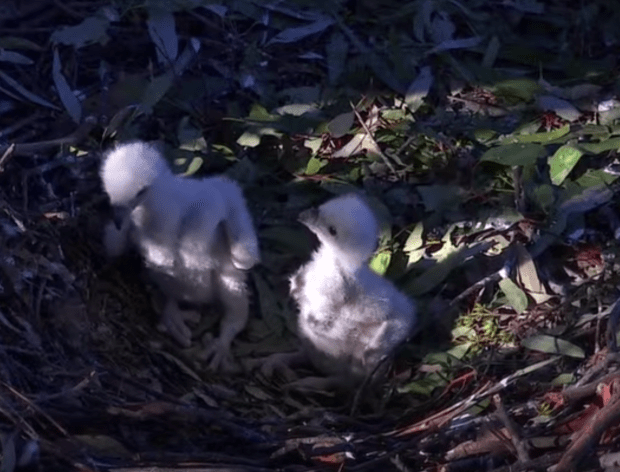
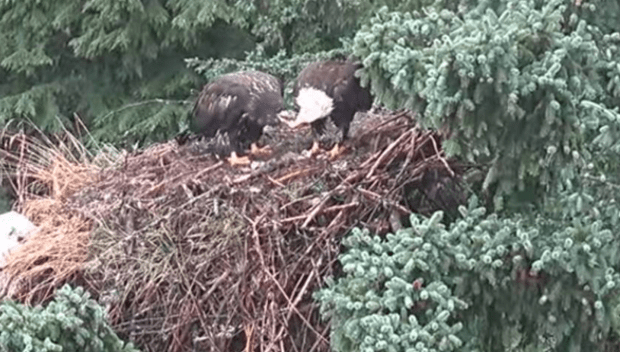
White Bellied Sea Eaglet 28 dominates feeding

The golden glow of the morning sun kissed the branches of the old Ironbark Tree in Sydney’s Olympic Forest. WBSE 27 and 28 were sound asleep in the nest bowl while an adult was on the parent branch keeping watch.

This morning breakfast arrived at 9:20:11. It was a nice chunk of fish.

28 was up at the breakfast table right away and dominated the feeding. There was no pecking and 28 was on the left side! Well, well.

It is easy to see that 28 really loves the fish! One of the things people have noticed is that the birds actually do have preferences. Some prefer fish, others prefer birds. Some don’t like specific species of birds. WBSE tend to really love their fish!

Here is a short video clip of the feeding.

WBSE 28 is still being fed after ten minutes. Indeed, Lady will still be feeding 28, almost exclusively, for another twenty minutes.

At 9:30:11 either a Pied Currawong or an Australian Magpie swooped down on the nest. Lady alerted and both of the sea eaglets pancaked on the nest.

Anyone watching the feeding would have immediately known that Lady’s alert call meant ‘danger’ and the sea eaglets stopped everything and became very still. This is what all raptors do, as far as I know. It is certainly what Osprey chicks do when their parent is alerting.

Oh, these eaglets love this fresh fish! 28 has gotten very good at the quick snatch method as well. He is very cute.

Lady finished feeding the pair at 10:01:27. They both settled down, each with a crop – 28’s was the biggest! He is in front sort of sitting up.

Right now it is easy to tell the difference – 27 has more juvenile feathers on its shoulders and wings.

No doubt, WBSE 27 might well dominate the next feeding. But it is significant to note that 28 stepped up first and was fed – and went to sleep with a very large crop. There was absolutely not a hint of sibling rivalry other than the typical ‘snatch and turn’ of 28 at times. The ‘snatch and turn’ is often a side effect reaction – grab the food quickly and turn – protecting one’s head from being pecked earlier in the chick’s life.

These two are doing very well. I hope that the Magpie or the Currawong – as well as BooBook Owl, and others do not inflict any injuries on any of the sea eagles. In fact, some of you might remember that it was a Magpie that helped WBSE 26 last year against the Pied Currawong.

The top two images are of a Pied Currawong and the bottom one is an Australian Magpie. Sometimes you only see a blur. Those familiar with the sounds of the forest might be able to tell who caused the ruckus.

“Pied Currawong ( Strepera graculina)” by Tatters ✾ is licensed under CC BY 2.0
“Pied Currawong” by Tatters ✾ is licensed under CC BY-SA 2.0

There are decided differences between the two but a split second sweep of black and white makes it difficult. The Pied Currawong has been a constant in the Sydney Olympic Forest. Perhaps it has a nest near to the sea eagles and wants the big birds – the top of the food chain – to get out of town!

“Australian Magpie” by Lisa.Hunt is licensed under CC BY 2.0

Sadly, the Currawong did chase 26 out of the forest and she wound up the next day, after a storm that evening, on the 22nd floor of a condo building about 1.5 kilometres away from the nest. The Currawong are a big problem in the forest. They also chased 25 out when it fledged and I suspect they have done this in years past. 25 never returned to the nest. No one knows what became of her. Ideally, these two beauties fledge and return to the nest for rest and food just like the Bald Eagles or the sea eagle fledglings are fed down by the Parramatta River by the parents til they can survive on their own.

It has to be mentioned that Sydney’s Parramatta River is full of dioxins. Commercial fishing is banned after elevated levels of the toxins were found in seafood from the Sydney Harbour and the Parramatta River.

“Parramatta River, NSW, Australia” by Terrazzo is licensed under CC BY-SA 2.0

The toxins leaked into the river from a shipping container company as reported in The Sydney Morning Herald on 16 May 2009. The article said, “The Patrick’s site on the Camellia peninsula, near Rosehill Racecourse, has been found to be leaking the chemical Chromium VI, posing a risk to people and marine life.”

In 2017, 2ser 107.3 reported that the Parramatta River was a “toxic time bomb.” They said, “Fifty years of toxic chemical residue is sitting on the bottom of Sydney Harbour and the Parramatta River. It’s a toxic time-bomb and disturbing this sediment could worsen already dire pollution levels. And now sweeping developments along the shore of the River could be bringing more pollution to the already sullied waters.” While many might have hoped to swim in the river before they were too elderly to do so, contaminated storm water was pumped into the river in December 2020 causing more problems.

https://www.news.com.au/technology/environment/contaminated-storm-water-pumped-from-camellia-site-into-parramatta-river/news-story/83b1a3c9e5e5c226d687ad47f0ee982e

That lovely fish that the two sea eaglets ate this morning came from this river. It is a tragedy.

Thank you so much for joining me. These are just the cutest little sea eagles. 28 is quite the character. Spend some time watching them. Everything is good.

Thank you to the Sydney Sea Eagle Cam @ Birdlife Australia’s Discovery Centre for their streaming cam where I took my screen shots and video clip.

A look at 3 feedings at the WBSE Nest

All of the other nests are relatively quiet. While I do love to see the adults sharing incubation duties, watching a bird incubate eggs can sometimes feel like watching paint dry. So I decided to go and see what was happening with the little sea eaglets. They were just finishing a meal when I started watching them. I turned away for a second and a second gull was brought to the nest by Dad at 12:47. Good gracious. Had Dad won the Silver Gull Lottery?

This is an image from the feeding when I first started watching the sea eaglets. Thank goodness for rewind. This was the first prey delivery of the day and it arrived at 12:19:01.

Both eaglets are sharing the prey and behaving themselves in this feeding. WBSE 27 is on the left and 28 is on the right. The picture shows Lady giving 28 a morsel of meat. She alternates between them. There is absolutely not a hint of rivalry.

Here they are standing up. It is a wonder they aren’t falling over from being top heavy.

They hear Dad approaching the nest.

Dad arrives at the nest with another gull. Both of them sit on their little bottoms in shock. Look at their faces seeing that prey. Also notice that 28, in the front, has a large crop, too.

The time for the second delivery is 12:47:20 as shown on the time stamp.

Remember, both have literally just eaten. Both chicks have crops. Neither one of them is ‘starving’. Indeed, there is no shortage of food on the nest. The behaviour in this second feeding demonstrates that rivalry is not always because there is less food being delivered. It is strictly about dominance on the nest.

In the image below, 27 is up by Lady getting ready to be fed. 28 is moving up from the back to go to the left of 28. I wonder why 28 did not go to the right. That is its usual spot – and it is a good place to catch the eye of Lady.

27 first gives 28 ‘the look’. Was it because 28 had to balance itself by extending its wing out and it touched 27’s back?

Whatever it was, 27 pecks 28 making sure that 28 realizes who is boss.

28 immediately goes into submission and stays that way for approximately 12 minutes while 27 eats the gull. These are the hardest things to watch on these large raptor nests between the chicks. We always want them to be nice to one another.

By the time that 28 straightens himself and gets up to the feeding place, the gull is almost gone. 27 got 98% of that gull while 28 got a few bites.

The behaviour of 27 shows that despite there being plenty of food, she will insist on dominance. She will eat first. Anyone watching large raptor nests will know that there is always a dominant bird. Often the one dominated gets very clever. They listen, watch, and learn to read ‘the clues’ so as not to be attacked. 28 has a little more learning to do. It would be interesting to see if 28 is only pecked when it is on the left.

So the time is 13:07:18 – and guess what?! A third gull arrives on the nest at 13:15:13. Yes, I am serious. Dad must have found a nest of gulls. If I remember correctly there is an old barge and the Silver Gulls make their nests there. It is not far away. Someone told me once that the pigeons are for falcons and gulls are for eagles. It certainly seems true at some of the Australian nests!

Here is the next prey item arriving on the nest.

Both chicks get up to the feeding area. 27 is on the left and 28 has its usual spot on the right. It is important to note that the eagles do not see straight in front of them; they must tilt their head a bit.

Just look at how full these two are! I do hope that Lady gets a chance to eat.

This time 28 got lots of food. Lady alternated between them. In the end, 27 was too full to eat anymore and 28 finished off that gull.

Both are in food comas.

There is no moral to this story. There is a lot of prey coming on the WBSE nest. This is the first time I have seen three prey items delivered and eaten in this short of time. WBSE 27 still feels that it needs to, sometimes, throw about her position on the nest. At this last feeding there was no rivalry. Both ate and they had big enough crops to last them til evening!

As they grow, each will need more and more food. The gull chicks are not that big. The food that is delivered is also meant for Lady. Let us hope that she gets a good meal today. The female’s lose vital nutrients making the eggs they lay and it is said that they lose approximately 30% of their body weight during the nesting phase. Hopefully Dad will bring on a nice big fish or eel for later.

The Silver Gull that Dad brings to the nest are the most common gull in Australia.

“Silver Gull” by 0ystercatcher is licensed under CC BY-NC-SA 2.0

They are found everywhere. While the adults are 40-45 cm or 15.7 to 18 inches and have a wing span of 94 cm or 3 ft, the chicks would be much smaller. Last year Dad was always raiding the nests of the gulls in addition to fish, eels, and at least one turtle. I recall that one eagle expert said that the ‘red meat’ of some prey tends to make the eaglets more aggressive than the fish. That could be what happened today or maybe 27 was just annoyed at 28 for touching her.

Both sea eaglets are eating as you can see. It is a bit unnerving to see the eldest whip the little one into shape especially since they had been doing so well. Still, this is a worthwhile nest to watch because the behaviour is so fascinating. I am going to have to watch this nest more closely. I am curious as to whether the pecking only occurs when WBSE 28 is on the left of 27. Perhaps it doesn’t matter.

The link to the WBSE camera is here:

One of the things I find most fascinating are learning the birds connected with their vocalizations in the Sydney Olympic Forest.

Thanks so much for joining me today. Stay well, stay safe. See you soon.

Thank you to the Sea Eagle Cam @ Birdlife Australia Discovery Centre where I took my screen shots.

Third Egg for Diamond and a Rescue

Saturday Morning. I don’t think that this Swainson’s Thrush knew that he would be spending so much time with me. I suspect that he did not know that he was in for an adventure and a car ride.

Indeed, it is unclear how this little one wound up behind my kitchen in the grass. There were no window strikes. He turned around and faced different directions and thinking that it was simply stunned, I waited for 45 minutes. Still nothing. It tried to fly but that wouldn’t work so…….into the comfort of the transport box on soft, soft sheets and away we went to Wildlife Haven. It was still alive on arrival. Thank Goodness.

As I answered all of the questions by the intake helper, it was a reminder that it is migration season – something we have been talking about for several weeks. Juveniles are finding themselves in trouble all over the place – so what do you do?

  1. You should have the phone number of your nearest wildlife rehabber in your contact list. Check and see if you have that and it is current.
  2. As much as you would like to, please do not feed the wildlife anything – anything. It could cause the to be worse. No cow’s milk, no baby formula! You can offer them a very shallow bowl of water – think saucer actually so they don’t drown.
  3. Do not pet them. The bird or animal is stressed enough. Any undue stress could cause them to have a heart attack.
  4. Keep them in a quiet, dark place. I have a large box that my organic groceries come in. On each side are holes for handles. This is good for the air circulation and allows the box to stay warm and dry while at the same time they are not seeing you.
  5. Don’t let your pets around the injured bird or animal.

Swainson’s Thrush does, during migration, often find itself in back gardens and parks. It often gleans for food on the ground. In our case it could also have been at any one of the feeders or on the ground where the other birds kick off seed. Something, however, had caused it not to be able to fly. It wanted to but just didn’t have the battery power. I hope that it does well in rehab and is on its way to its winter home soon.

Speaking of wildlife rehabbers, they love donations. Many of the raptors like to play with toys. Did you know that? It helps them from being bored. I cannot imagine being a Red Tail-Hawk imprinted on humans that cannot be allowed to fly free. The rehabbers are always in need of food including rabbit and cat/dog kibble. Many rehabbers post a list of wanted items on their website and, of course, they are happy for donations no matter how big or small. So when you think of gifting, think of these folks that are not for profit and survive on donations, please.

Our wildlife rehabber also has one other concern for people who feed the birds. “If you feed the animals in your yards, they may learn to depend on the availability of food from you and may not store for the winter months. So if you are going to feed later in the fall, it is best to continue feeding until the spring months.”

There is very little news out in Bird World. Birds are flying or sitting on eggs. The only ones that seem to be feeding little ones are the White-Bellied Sea Eagles and that continues to go well. Those babies are getting big. Look at those beautiful juvenile feathers coming in.

WBSE 28 can give as good as it gets. This nest has turned around for the good.

Tiny Little’s dad, White YW, is still in his territory as of this morning.

Aran still remains at the Glaslyn Nest. Mrs G was last seen on Sunday, 29 August. Aran does not normally leave til the middle of the month so his presence is not unusual. I need to check on the dates for White YW.

Can you see Aran?

Another male that is still at home is Louis up at Loch Arkaig. In fact, Louis is still feeding Aspen and Alder. I am not sure when it was that Dorcha left on her migration. This makes Louis’s fledglings some of the last to migrate. Here they are sunning themselves on a branch. — You will recall that Louis’s mate, Aila, did not return from migration this year. He made a nest with his new mate, Dorcha, away from the old nest with the camera. Louis is simply a fabulous dad. He even fishes at night if the family needs food. We wish them all the best when they do leave and look forward to their safe return next spring.

Last but never least, Diamond, the Peregrine Falcon in the scrape box on the ground of Orange University laid her third egg this morning around 06:29. Will she lay 4 eggs like the female in Melbourne? or will this be it and she will start the hard incubation. We wait and watch.

Thank you so much for joining me today. Take care and stay safe. See you soon!

Thank you to the following for their streaming cams or FB Pages where I took my screen shots: The Falcon Cam Project Charles Sturt University and Cilla Kinross, The Cumbrian Wildlife Trust and the Foulshaw Moss Osprey Nest, the Friends of Loch Arkaig FB Group, Bywyd Gwyllt Glaslyn, and the Sea Eagle Cam@Birdlife Australia Discovery Centre.

Sydney White-Bellied Sea Eaglets

There was concern that siblicide was occurring on the White-Bellied Sea Eagle nest in Sydney’s Olympic Park. It is time to put those fears aside. Prey delivery has become regularized and the two are fed regularly, growing, and are becoming curious about what is happening outside the nest.

The White-Bellied Sea Eagles are Australia’s second largest bird of prey. They have a wing span of 1.8-2.2 metres or 6-7 feet. They weigh up to 4.2 kg or 9 lbs. The female is larger and weighs more than the male. This is known as reverse sex size dimorphism. The adults on the Sydney Olympic Park Ironbark Tree are Lady and Dad. There have been a succession of breeding couples using this tree nest for decades.

In 2021, WBSE 27 hatched on 29 July at 4:57 and WBSE 28 hatched 31 July at 5:48 pm. Just to remind you how tiny they were here are two images in those first few days.

In the first image WBSE 27 was not quite 24 hours old.

In this one, WBSE is not quite 24 hours old and WBSE 27 is almost 48 hours old. You can clearly see the egg tooth, the white piece on the tip of the beak that helps them break through the hard egg shell.

Now look at the two of them. WBSE 27 is on the right with WBSE 28 on the left. You can see how 48 hours difference in age impacts the growth of the juvenile feathers.

In terms of the development, we are entering weeks 5 and 6. By week 5, the chicks will still have their white down. Pin feathers will appear on the shoulders, the back and the wing tips. If you look at the image above you can see these dark feathers coming in on each of the chicks. They should be standing on both feet, checking out the nest, and trying to pick up food. They may start to flap their wings. As we get to week 6, more and more of the dark feathers will begin to show all over the chick’s body. They will preen a considerable amount of time per day. They will now do more wing flapping and standing on both of their feet without the aid of the wings. They will continue efforts at self-feeding (if allowed, Lady does love to feed them!).

Looking forward to developments during week 7, the chicks will do a lot more preening as the dark brown juvenile feathers will continue to grow over their entire bodies. It has to be really itchy – those feathers coming in. Their tail will become noticeable. When they sit they may spread their wings. You may see them begin mantling. They will become more steady on their feet. One notable change is the chick’s interest in grapsing twigs and food with their feet. They should continue to work on self-feeding but this, of course, depends on whether or not prey is left on the nest for them to practice.

WBSE 27 is standing nicely on his feet. WBSE 28 still has a crop from an earlier feeding. You can really see how many wing feathers are coming in. Just look at that little tail developing.

It looks like 28 has a bit of a food coma. 27 is busy looking at what is happening outside the nest.

WBSE continues to work on its balance. Notice how it is holding out its wings for balance. Often the birds will use the tip of the win to keep them steady on their feet. By the end of the 6th week, they should be standing without using the wings. WBSE 28 is working hard to do this.

WBSE is also curious as to what the adult is doing up on the branch. Notice how 28 is sitting with its wings loose to the sides. Sometimes I find that the chicks on the nest are actually ahead of the development scales for that week.

Lady has come a long way in her parenting skills. Both chicks wait their turn to be fed. She will give 28 a few bites and then 27 and then back to 28. This method has given the chicks food security and reduced the pecking of 28 by 27.

Lady always looks like she is smiling to me.

Here is the link to the Sydney Sea Eagle Cam.

Thank you so much for joining me. I know that there are so many people who love these little eagles and I wanted to reassure all that the nest is very calm and peaceful and the chicks are developing normally. Take care everyone. Stay safe.

Thank you to the Sea Eagle Cam@ Birdlife Australia Discovery Centre for their streaming cam where I took my screen shots.

Monday in Bird World

If you are looking to take ‘decent’ photos of Canada geese, if it is a hot day in the afternoon, don’t bother. They are all taking siestas! Best time is in the morning and early evening. The Cooper’s hawks were not about either.

We had a lovely walk through the park anyway. It was just a beautiful end of the summer day i. The flowers are still blooming in the English Garden and there were more than eight people with their cameras cuddled up by the Bee Balm trying to see if they could catch a glimpse of a hummer. They were probably sleeping like the ducks.

Most of the time this pond is full of Canada geese. Not a one. A couple of lonely ducks out on the water.

This is the tower at the Duck Pond at Assiniboine Park in Winnipeg, Manitoba, Canada.

All of the water features and the move from full sun to shade gardens made the stroll delightful. There were a few people wishing they could put their feet in the lotus pond.

So we drove to a different, small park. That is actually where we found the geese sleeping and alerted me to why we could not see them in the big park. Only a few were foraging in the grass.

The juvenile wood ducks are getting bigger! They have tripled in size in a couple of weeks.

The Mallards were so busy digging in the dirt under the bark they hardly noticed me.

What is she looking for?

They are sifting through the mud and bark near the pond searching for bugs, maggots, and anything else that they can feed on including little plants. The behaviour is perfectly normal!

This gentleman got back in the water and cleaned himself off later.

There were a few geese not sleeping. These were hot and stood at the edge of the pond drinking for about five minutes.

Then they decided to do a lot of preening.

Mr Crow was simply upset at everyone today. There were people having picnics not too far away. I wonder if he was looking for some treats? It was actually good to see that no one was feeding the ducks cakes and bread. The signs are working!

Gosh, isn’t this male Wood Duck lovely? What stunning colours and that big red eye.

Another one of the juvenile Wood Ducks.

This little male decided to swim right up so I could get a good shot of him. They have the most gorgeous patterning. The swept back crest and those iridescent feathers are just stunning. He had to be the most handsome male at the pond today.

He swam away.

And then he turned around again.

Male ducks are called ‘drakes’.

This is a male Wood Duck undergoing eclipse during the summer. During this time he will lose his beautiful male plumage but he will get it back in the fall. Some ducks are unable to fly when they molt. The females also molt too.

Oh, isn’t this female Mallard gorgeous?

She might not be as colourful as the male Wood Duck but she is always a beauty. Did you know that female ducks are called ‘hens’?

The Mallards were simply going crazy splashing up and down in the water today. It was like they were trying to shake the plants up from the bottom of the pond so they could eat them.

What a beauty. Just before she flew off.

All of the ducks will hatch their eggs, take care of their babies, molt, regrow their feathers, and everyone will hope to eat well before they migrate.

The ducks in the nature centres and parks are not ringed so that they can be counted if they are shot! We enjoy learning about their life cycles and watching their babies grow. Oh, I would not be popular in places where hunting is popular!

Just a some notes about what is happening in the rest of Bird World. The people running the Sydney Sea Eagle cam have turned it back on. They believe that the danger for WBSE 28 has passed. Both of the little sea eagles have been eating well and prey has been regular. This is fantastic news.

The last of the Black Storklings that was fed on the nest in Jegova County took an unusual flight path when it left for migration. And then,Julge decided not to fly but to get on a boat and it is now heading for Primorsk, Russia. It should be there on 31 August. Julge is the purple line showing in the middle of the sea on the Birdmap tracking. I hope that Julge is OK and corrects his flight path. It would be very cold in that northern part of Russia in the winter.

Diamond even accepted a Starling from Xavier today for her lunch. There has been lots of mating – sounds heard on the camera – but no egg yet.

This morning Idris was on the Dyfi nest defending it. What expressions came on this Osprey! His son, Dysynni has not been seen since Saturday the 28th at 10:57.

I know that lots of people like to plan trips – when we can travel again – to see the Osprey. It seems that those down in Poole Harbour, England have hit the jackpot. All of the migrating birds are stopping there to feed and rest. So think end of August – Poole Harbour!

Thanks for joining me today. Tiny Tot and Tiny Little are out somewhere making their way in the world. We want them to stay safe – all the birds – and all of you. Take care.

Thanks to the following for their screen cams where I took my screen shots: Dyfi Osprey Project, The Falcon Cam at Charles Sturt University, Orange, and Cilla Kinross, the Sea Eagle Cam, Birdlife Australia, and The Discovery Centre and the folks running the BirdMap.

Late Tuesday happenings in Bird World

There is an excellent and rather cheeky article on the penthouse of our Collins Street Peregrine Falcons in Meanjin Quarterly coming out of Australia. The author is Ester Anatolitis. It is outrageously funny and clever. Check it out!

For anyone who missed the news, the female at Collins Street laid that second egg today at 16:43. Yahoo!

I am posting a video that was shared on one of my Osprey FB groups today. There is a bit of foul language but it is the subject and the ‘heart’ of what is going on that is important and that is why I want you to find it and watch it. It also happened in Canada! Near Ottawa. A juvenile Osprey takes its first flight. Where does it land up? On the ground, of course! It is found by this couple who help it. If you have read my posts about Malin, this is what should have happened Thursday night. The wildlife rehabber should have been allowed access to the gate and stairs to get to the top of the tower with her binoculars. She could have found Malin and helped him – just like this couple did this Osprey!

https://www.facebook.com/groups/829595230542720/posts/1938586209643611

I was actually trying not to mention Malin for once but, this video caught my eye because it is the ‘right thing to do’. The man found the Osprey in the grass after its first flight. He helped the little one out of the grass. And flapped his arms and helped it until it could fly back to its nest. Bravo.

I am really keen on tracking and banding. Originally satellite trackers were used to study the foraging ranges of sea birds. In fact, that is precisely what is going on with the Royal Cam adults in New Zealand currently. More recently, however, trackers are used to study the migratory strategies and to identify the wintering grounds of several species. Others use them to study how weather conditions influence migration. This information and much more data like it will become paramount as we try to establish if the climate crisis has an impact on breeding and wintering grounds.

This is Karl II. Karl has been fitted with a satellite transmitter for a number of years. This is his last appearance of the nest that she shares with Grafiene in the Karula National Forest in Estonia. The couple raised three healthy fledglings this year. Karl II was last seen on 22 August at 15:50. Satellite tracking indicated that Karl II was on his usual routing towards the Black Sea.

Karl II is an expert at migration. He travels from his breeding area in the Karula National Park in Estonia to spend the night in the Sebezhsky National Part in northwest Russia.

The latest transmission on the 24th shows Karl II travelled 278 km and is now near the Berezina River east of Minsk in Belarus.

The satellite tracking further showed that Karl II looked for food in the wet areas around the river and went to sleep in a forest on the bank of the river. It is an area known as the Berezinsky Biosphere Reserve.

The following information was posted about the place where Karl II is located.

“It is situated on the flat watershed of the Baltic and Black Seas, in low valley in the basin of the Berezina River. Landscape is a mosaic of coniferous and deciduous forests, lakes, peatlands (60 %), rivers, floodplain and small arable fields. Climate is temperate continental, humid, precipitation total: 690 mm/year. Average annual air temperature is 5.2 °C.
The Berezina is the main river in the reserve, flowing through its territory for over 110 km. There are 7 small lakes with the total area being about 2000 hectares in the reserve. The flora comprises more then 2000 species with 804 species of vascular plants (42 rare for Belarus).”

“File:Spring day on the river Biarezina in April.jpg” by Maria Gnedina is licensed under CC BY-SA 4.0

The female, Pikne, was the last fledgling to leave the nest for her migration. She loved being fed by dad. She is also the fledgling that has made the most straightforward routing. She flew from Latvia to Belarus and then on to the Ukraine. The map below shows the leg from Belarus to the Ukraine. She will do doubt be further still when her transmitter data is next recorded. In one day she flew 379 km.

Udu was confused in his travels. Everything seems corrected now. It is like driving a different way than Google Maps tells you and Google adjusts for the error. At the time of the latest satellite transmission, Udu had traveled 604 km in total. What the researchers are noticing is that while, Pikne is going the normal Asia Minor or Eastern route, Udu is heading towards Germany and the Western route. He was last in Poland heading southwest to Germany. This is very interesting.

There are issues, as I stated in an earlier posting, with the transmissions from the other male, Tuul. The transmission data showed little movement. I am awaiting news. It is possible that the transmitter is faulty.

The last combined image of the routes of the three for comparison.

At the same time I would like to show you what other information that the researchers and citizen birders can access. On the left hand side you can find the precise location of the bird, the speed they are travelling, and their altitude – just as if you were tracking a plane on FlightRadar. This particular information is for Pikne.

Things are not going well on the WBSE nest of Lady and Dad in the Sydney Olympic Park. Everyone was hopeful that the two sea eaglets, similar size, would get along and thrive. There was some bonking in the beginning but not a lot. That, however, has changed significantly because of the lack of prey delivered to the nest. WBSE 27 totally dominates the now much smaller 28. 27 is 27 days old and 28 is 25 days old. The rains started the issues related to prey delivery.

In the image below 27 has completely controlled the feeding and has a large crop. 28 was too frightened to try and eat.

Even when the parent is gone Little 28 is afraid to move. Like every little abused second or third hatch, 28 knows to keep its eyes open, to listen, and to keep its head down.

Little 27 waits til 28’s food starts making it sleepy and the little one moves up to the piece of prey left on the nest. 27 doesn’t care now. This is the perfect time for the parent to return to the nest and feed this baby who is so hungry.

The survival stories of our Ospreys Tiny Tot and Tiny Little are being played out on this nest in the life of 28. The Little one is starving. It needs food. It will be the first to self-feed. It is unclear if 28 got any of the food but it knows what to do. Let us hope that it is as clever as our two great survivors this year!

27 has fallen asleep. It is unclear if 28 was able to get any food. I somehow doubt it.

Lady returns. Wakes up the ‘beast’ and 27 begins hammering 28. This is turning into a horrible situation. Please send your positive energy that lots of food will come to this nest so that both are fed full! This little one needs to eat to survive.

This image was shot later in the day, hours after the morning attacks by WBSE 27.

I was told that a big fish had come on to the nest and both were fed well but I cannot find that in the footage of the streaming cam. What I do see is continued dominance and abuse by 27 over 28. No one will intervene.

I want to close with something nice because it is out there and we have to remind ourselves continually that there is ‘light’. At the same time, positive energy needs to go out to little 28 so that he can survive and thrive like Tiny Tot and Tiny Little.

One of the chicks destined to die of starvation on a nest was Tiny Little Bob, Blue 463, at the Foulshaw Moss Osprey Nest in Cumbria. But, she didn’t. She lived to become the dominant one on the nest (as did Tiny Tot at Achieva). My last post had Blue 463 screaming her head off for a fish. Well, guess what? It worked! Dad, White YW, brought her in a really nice headless fish. Tiny Little went to bed with her crop full.

So when you think that the worst is happening with WBSE 28 just remember that the ones who survive do it by being clever, by watching and listening, learning how to overcome and get what they want ——— just like that big fish about to arrive on the Foulshaw Moss nest for her queen, Tiny Little!

Take care everyone. Thank you for joining me. I hope you do not mind my including some repetition on the satellite tracking of the Estonian Black Storks. I wanted you to know where Karl II had been and is. Some do not read the newsletter every day and it is good to remember that banding and tracking are valuable tools in studying our beloved birds. I hope to have updated information on the Udu and Pikne’s locations tomorrow. Perhaps there will also be word on Tuul.

Thank you to the following for their streaming cams where I took my screen shots: The Eagle Club of Estonia, Sea Eagle Cam, Birdlife Australia, and The Discovery Centre, The Cumbria Wildlife Trust and the Foulshaw Moss Osprey Cam.

A Cracker of a Day for Malin

Oh, it’s a cracker of a day! We know that the Sharp-shinned Hawk that comes to our garden is here often but since the extreme head we had not seen him. He flipped around on the lines bringing the Internet into the house and then in a blink was in the lilac bushes. He stayed there for about ten minutes and out he flew between the houses heading north. No chance for a photo but I tried! We feed approximately 300 urban birds a day – yes, you read that right. I never grieve over the single sparrow that Sharpie is sometimes able to catch. He has to eat, too.

Sharpie is an aberration according to Cornell Bird Labs. He should not be living on the Canadian Prairies in the winter but he does! He is a year round resident. It was his mate – in January 2017 – that changed my life. It is so good to see him.

Malin is such a sweetheart. He has the sweetest face. It has been a good day for Malin, too.

Last night, Malin slept on a piece of fish about the size of the one in front and to the right of him. There was also a small Bullhead on the nest last night. Malin woke up and ate the fish he was sleeping on. Mom arrived and shared the Bullhead with him. On top of those two, Malin had four other deliveries today. A total of 6 fish! His crop is about to pop. We have never seen this Osprey chick this full. I wonder if he will use this fish as a pillow? save it for breakfast? or finish it off a little later? He is one lucky little Osprey today.

Those pesky little sea eagles will have several good feeds today, too!

WBSE 27 is the one on the left and cutie pie WBSE 28 is on the right.

There is still a tiny bit of egg tooth left but it is disappearing quickly. If you look closely under that soft down are there little pin feathers growing?

WBSE 27 hatched on 29 July and WBSE 28 hatched on 31 July. Today, they are 17 and 15 days old. This is the end of week 2 going into week 3.

  • Week 2: The wee ones are covered all in white down. Their beak is starting to grow longer but the egg tooth (the white dot) is still visible.
  • Week 3: We should be seeing the bill and the eyes enlarged but still the white down. The chicks are now doubled in size from when they hatched. They are looking around and noticing things.
  • Week 4: Those pin feathers I wondered about are starting to show on the wings. You will see them begin to preen their feathers and they should be moving around the nest picking up sticks and leaves. They will also be resting on their tarsus assisted by their wings for balance. The tarsus is the part of the leg from the top of the foot to the knee.

Ah, so sweet when they are asleep and growing!

The day is yet to begin in Latvia and Estonia. We wish that those beautiful Black Storklings get lots of fish today.

Thank you so much for joining me for this quick update on Malin. We are so pleased that Malin has had lots of fish today. He is getting so big and no doubt the more he eats the stronger the little one will get for fledge. The featured image is our little cute Malin. Take care. See you soon.

Thanks to the following for their streaming cams where I took my screen shots: Collins Marsh Nature Centre and Sea Eagles, Birdlife Australia, and The Discovery Centre.

What’s happening in Bird World?

I don’t know a person watching a nest on a streaming cam that doesn’t get anxious if food is not brought to the nestlings and fledglings on a regular basis. Most of us start doing a bit of nail biting. Today, for example, Malin had 4 feedings. It isn’t as good as five but it is better than nothing! And last Sunday Malin had nothing. We are all hopeful for tomorrow. The weather is cooling off – Malin we are wishing for six fish tomorrow!

Malin 13 August 2021
Malin 13 August 2021 after a feeding

Jake Koebernik of the Wisconsin DNR did a great job answering a lot of questions that some of us have had about Malin’s nest. One was ‘why are the fish that are delivered are so small?’ and the other was ‘why do fish deliveries drop at the weekend?’ This is his answer, “As for the nest at the Collins Marsh NC, the streams and marshes around that territory probably only offer smaller species such as bullhead, bluegills, small bass and northern pike. There aren’t large lakes or real productive rivers in that part of the state, so they are going after what is abundant and available.” Jake’s answers cleared up a lot of the mysteries. —— And tomorrow, when Malin wakes up, Malin will have its official name! Fingers and toes crossed for it to be Malin!!!!!!!

My friend ‘S’ sent a screen shot of a delivery that Telyn made to the Dyfi nest this afternoon. We both agreed that Malin’s eyes would pop out if he saw a fish this big land on the nest at Collins Marsh. That fish is bigger than Blue 491! Wow.

And if you did not hear, Idris had been missing since Wednesday and he was on the nest today, albeit with a completely sunken crop. He brought a nice fish to one of the chicks. Hoping he gets his own fill of fish. Where in the world could he have been? It is worrisome.

Telyn delivered a whopper for 491, Ystwyth who is 82 days old on 14 August

Oh, if only places that have ponds could stock them for the birds. The Pritchett Family in Fort Myers has a stocked pond for Bald Eagles Harriet and M15 and their kids and the water also allows them to cool off and clean their feathers.

We are told by the IPCC that we can expect the droughts and extreme heat to be with us. Since these changes to our climate are known to be directly caused by human activity, maybe it is time to figure out ways to help the wildlife. Providing water and food is a start.

These two little sea eaglets are just adorable and a little spunky, too. They are growing like the sunflowers in my garden that the birds planted.

Both had nice crops after this feeding.

Judy Harrington, the researcher observing the WBSE Nest in the Sydney Olympic Park forest, just released her report on what these two have been eating during the last fortnight (14 days). In fact, it is the first two weeks of their life. Harrington also records the amount of time spent feeding by both the male and the female has been recorded. Lady took on 109 feedings for a total of 21 hours and 20 minutes. Dad did 8 feedings for a total of 42 minutes. Dad has been providing most of the food – he brought in 25 items and Lady brought in 5. These consisted of the following in total: 16 Bream, 4 catfish, 2 fish, 1 Mullet, 2 Whiting, 1 Yellowtail, 1 Ibis chick, 1 nestling, 1 pigeon, and 1 bird. They have now morphed into sea eagles, the second largest bird in Australia.

Sadly, it appears that Lady was hit during the night by Boo, the BooBook Owl that lives nearby in the forest. Despite its very small size the BooBook Owl has caused injuries to the large sea eagles in the past.

It is thought that Boo, as the little owl is so fondly called, has a nest near to the Sea Eagles. To my knowledge, the WBSE have never bothered their nest but, – hey. Every parent is afraid of a larger predator and wants them to leave the area.

“Boobook owl” by jeans_Photos is licensed under CC BY 2.0

Legacy on the Fortis Red Deer Nest has fledged. She has been on and off the nest a few times today. One was to get some fish! Here she is with Mum. After all the nestling deaths during the heat wave, this is just one of the happiest moments from that nest. Look how big Legacy is next to mom. Congratulations.

It is almost impossible to see what is happening on the Fortis Alberta Exshaw nest up at Canmore. Both chicks appear to be on the nest and calling for food. It is unclear to me if one or both have fledged.

The love story of the two Canada Geese has gone viral. It warms our hearts to see these two devoted birds – Amelia finding and waiting for Arnold during his surgery and recovery and now their reuniting. My friend, ‘R’ found two more stories on them and I want to share with you what she sent to me. You could read about these two all day – and you will always walk away with a smile.


https://boston.cbslocal.com/2021/07/15/goose-surgery-visit-mate-new-england-wildlife-center-cape-cod-branch/
Female reporter admits to being teary eyed! 

https://whdh.com/news/goose-who-underwent-emergency-surgery-released-back-into-the-wild-to-be-with-his-devoted-mate-on-cape-cod/Shirts for sale: “Honk If you Love Arnold!”

The story of Arnold and Amelia has taught us all something. If you find an injured Canada Goose and are taking it into care, please take the time to find its mate! The outcome might be much more positive. If you live in an area where there are Canada Geese – let your local wildlife rehabber know about the story of Arnold and Amelia. They will understand why it is important to keep bonded mates together (and their goslings if necessary).

And news about Kona. It is nearing 100 F or 38 C on the nest in Montana. The foster mother, Scout, has been shading Kona. Everything is going well with this foster. How grand.

@ Montana Osprey Porject

Leaving you with a gorgeous image of Loch of the Lowes. It just looks so still and peaceful in the early morning hours of 14 August.

And a last peaceful image of Diamond on the ledge of her scrape box on the water tower at Charles Sturt University in Orange, Australia. We will be looking for eggs before the end of the month. Izzi was last in the scrape box of Xavier and Diamond 6 August. He was photographed on 10 August and someone thought they heard him this morning.

Thanks for joining me today. I am off to try and find some hawks tomorrow so this is coming out early. I will bring you some late Saturday news in the evening. Take care. Stay safe! If you hear of interesting bird stories – and in particular, raptors – let me know.

Thank you to the following for their streaming cams where I took my screen shots: Collins Marsh Nature Centre, Sea Eagle Cam, Birdlife Australia and the Sydney Discovery Centre, Dyfi Osprey Project, Scottish Wildlife Trust and Friends of Loch of the Lowes, Falcon Cam Project at C Sturt University, Fortis Alberta Exshaw and Fortis Alberta Red Deer. Thank you to ‘R’ for sending me the links on the coverage of Arnold and Amelia and to ‘S’ for the information on Telyn and her whopper of a fish delivery. It is much appreciated! Thank you to the Montana Osprey Project FB page for the image of Scout and Kona.

The Hornbill

There are over 50 different varieties of Hornbill. The one that I want to focus on today is the Rhinoceros Hornbill. It is the State Bird of Malaysia. I became acquainted with these amazing birds during a trip to the Sarawak in East Malaysia many years ago.

The arrow points to Sarawak. The Rhinoceros Hornbill is present also in Sabah as well as Borneo, in yellow.

You could not move through the area around the harbour of Kuching without seeing ‘something’ decorated with the motif of a hornbill – from table cloths, batik wall hangings, phone cases, and old and not-so-old wood carvings. To actually see these highly endangered birds you needed a guide to take you to the jungle areas where local tribes still live in their long houses. There the hornbill was also used as a design for the totems on the poles supporting their roof as well as on many of the art of tattoos.

“Iban? Long House near Kuching” by rosskevin756 is licensed under CC BY-NC-SA 2.0

The weavers of the area specialize in ikat. Ikat is a type of resist dying. The threads are resist dyed before they are woven. The pattern in the textile below is called the ‘Feather of the Hornbill’.

Old carving of Hornbill, Ironwood. Sarawak Museum, Kuching.

The Rhinoceros Hornbill is depicted in numerous designs in wood carving. The wooden figure above is a Kenyalang. Historically, these carvings were associated with many of the tribes in Sarawak, Sabah, and Borneo. For the Iban, the figure is an essential part of a celebration called the Gawai Kenyalang. Its role was as a messenger. It called upon the spirit world to give courage to the warriors who went out headhunting. The carvings are still made today and they are still important for the various tribal communities. Head hunting ended in the 20th century and most of the carvings are considered cultural icons.

The Rhinoceros Hornbill is a large bird, 80 to 90 cm (31–35 in) long. The males are larger than the females. The birds are covered with black feathers except for the white tail that has a single black band. Their legs are white. The Hornbill is most notable for its colourful bill which is huge. In fact, that orange and red bill is what gave the bird its name. The Hornbill uses this lightweight beak to gather its food, build its nests, seal the nest, and feed the chicks. The structure on top of the bill is called a casque. It is hollow and its function is to amplify the call of the birds. The eyes of the male are red with black rims while those of the female are white with a red rim like the one below.

“Rhinoceros Hornbill” by shankar s. is licensed under CC BY 2.0

In comparison, this is an image of the male so that you can see the difference in their eye colour. It is the easiest way to recognize each of the genders.

“Rhinoceros Hornbill” by Steve Wilson – over 10 million views Thanks !! is licensed under CC BY 2.0

The Hornbills are very unique in their nesting habits. They are cavity nesters but with a twist. When the female is ready to lay her 1-3 eggs, she will locate a cavity in a tree trunk (or sometimes a rock formation) to make her nest. Once made she helps her bonded-for-life mate seal her into the cavity with mud. The only opening is a small oval hole where the male feeds the female during her confinement that lasts 50 days. He also feeds the nestlings. This arrangement is very practical. It helps protect the nest from any type of predator including lizards and snakes. Ninety days after the chicks hatch, the female will break open the mud covering to the nest.

The Rhinoceros Hornbill is listed as vulnerable. One of the biggest threats to its existence is the loss of the rainforest where it lives and builds its nest. It is also hunted for food as well as for items that are believed to give men virility including the feathers and the skull. The large trees that occupied the forested areas of Borneo are being cut down at an alarming rate. When I was there the wood was being shipped to China on those huge boats. It was overwhelming to see the forest being obliterated.

“Rhinoceros Hornbill (Buceros rhinoceros)” by Mark Louis Benedict is licensed under CC BY-NC-ND 2.0

In other news, Tiny Little Bob or Blue 463 nabbed the first fish of the morning on the Foulshaw Moss Osprey Nest in Cumbria. Tiny Little was busy eating it while sibling 462 waited on the nest. Tiny Little is off to a great start to the day! Go Tiny Little!

Karl II arrived at 8:10 to feed the three fledglings on the Black Stork nest in Estonia. The fledglings were incredible.

The glare of the sun on the camera creates a strong glow so you can’t see clearly what is going on. Karl arrives on the right and feeds the hungry storklings quickly. The nest is in the Karula National Park in Estonia.

One of the Storklings on the Siguldas Black Stork nest in Latvia has decided to get up close and personal with the camera and its supports while it waits for Grafs or Grafiene to bring them their breakfast.

The good news at the Peregrine Falcon Nest in the scrape box on the grounds of Charles Sturt University in Orange, Australia is that Izzi – cute little Izzi – has not been in the scrape box for six days. He has been heard but he has not gone in after several altercations with Xavier. Diamond, Izzi’s mother, is expected to lay her eggs by the end of August. Here is Diamond looking out over her territory.

Also in Australia, the two little sea eaglets, 27 and 28, are just cute. They are really growing. Dad brought in a life fish and was going to feed them today. Lady flew in and stepped on the fish before it could flop all over the chicks. Then she took over the feeding. Both ate well but 27 had an enormous crop.

It continues to be as good a day as it can be in Bird World. The juvenile Ospreys are eating and eating preparing to being their migration. For some of the UK nests the average number of days is around 90 hatch days old for fledging. We will be keeping our eyes open to see who is leaving.

Thank you so much for joining me. Have a wonderful Friday everyone. See you soon.

Thank you to the following for their streaming cams where I took my screen shots: WBSE Sea Eagle Cam, Birdlife Australia and the Discovery Centre, Cumbrian Wildlife Trust and the Foulshaw Moss Osprey Nest, Falconcam Osprey Project, C Sturt University and Cilla Kinross, the Eagle Club of Estonia, and the Latvian Fund for Nature.

Feedings and fires…Storks fall from the sky over Athens

Today is a gorgeous day on the Canadian prairies. The rains helped to contain or put out many of the wild fires in our province and this morning, for a second day, we woke up to blue skies and white clouds! All of the plants are a vibrant green and the birds continue to sing. There was not enough to fill the dry creeks but the downpours we did get are a reminder of how much all life depends on water. The nestlings and fledglings would add ‘food’ to that list!

There is a constant worry that some of the late hatches are seeing dwindling food deliveries and that the parents might leave for their migration with young still on the nest. My friend, ‘S’ is concerned, as are many others, for the nestlings on two Black Stork nests – one in Latvia and the other in Estonia. Some others worry about the little osprey on the Collins Marsh Nature Centre nest that we have been calling ‘Malin’. (The official contest is underway for the official name).

Malin self-feeds from small Bullhead. 11 August 2021

Malin was receiving 5 feedings on occasion. Those were good days. The chick has not been fed well by the standards of other nests. This past Sunday, 8 August, Malin had no food. Yesterday, 10 August, he had two feedings. Today, there have already been 2 – one at 9:35 and the other around 11:42. Always these are small whole fish or pieces of fish. I have not seen a whopper on this nest.

Malin is hungry and several of us are trying to ascertain if the fish are ‘fished out’ or if the Dad has another nest – it really is unclear. A report by the Wisconsin DNR on the number of Bald Eagle and Osprey nests in the state indicate a drop of Ospreys in area 3, where the Collins Marsh nest is located, by -25.2%. While every other area saw an increase in Ospreys, Collins Marsh was only one of two that showed a decline. Does all of this reflect a growth in Bald Eagle Nests in the area? If you would like to read the report from 2019 (I have not found one for 2020), I am attaching a copy. A big shout out to ‘S’ who found this and sent it to me. Thank you.

The feedings for the nestlings of Grafs and Grafiene at the Sigulda Nest show a similar up and down pattern to that at Collins Marsh. However, there has not been a day without food to my knowledge at Sigulda.

‘S’ reports that on 9 August, the storklings had four feedings – which is considered low – but yesterday, they had only two. Today, there have been 2 deliveries by the female, Grafiene, and one by the male, Grafs. Grafiene is also like the female at the Collins Marsh nest, Marsha, who leaves for periods up to 24 hours at a time. The behaviour of these two females is very curious.

It is hoped that there is time for both the Black Storklings and the Osprey to fledge. ‘S’ advises that the minimum is ten days for the storklings. The Ospreys tend to migrate at the end of August or beginning of September in Wisconsin.

Malin is not ready to fledge. It is very worrisome for many reasons. I look at the development and growth of the Osprey fledglings in the UK and then compare this with Malin. Those in the UK have fully developed feathering and have really perfected their flying skills. They are self-feed with ease. Most have been fledged for a month. Will Malin have a month to further develop his body and skills? Will the storklings? The nest that is on the branch of the pine tree in the forest near Sigulda is so very narrow and has collapsed in the past. Will the hopping and flapping cause the little ones to fall?

The storklings are so excited when a parent arrives with fish that it does make you wonder if the could make the branch nest collapse. Grafiene covered the nest with little fish around 17:20. There was lots of food for each of the nestlings.

The storklings were eating and eating and had large crops. I wonder if a parent will bring another delivery before night?

I am including the link to the Black Stork Nest in Sigulda County, Latvia. If you wish to find the chat room or forum (with lots of information) please check the information under the streaming cam.

In Alaska, Kindness is not short of food. She has gone some days with few deliveries and other days, Dad not only leaves her food for self-feeding but today, he fed his baby girl. Dad just can’t help himself. He has an enormous soft spot for Kindness. The image below of Dad feeding Kindness is right after he had delivered prey 20 minutes earlier! Oh, Kindness, how lucky you are.

Did you know that Bald Eagles have a polarizing lens that helps them see fish in muddy waters? (Just like those who fish often wear Polarizing sunglasses.) That said Bald Eagles normally only feed in the top 15 cm or 6 inches. Their bare legs are designed to only go into the water 15 cm or 6 inches. Like the Ospreys and Sea Eagles, if they had feathered legs, they would get water logged.

You can watch Kindness here. The moderator on the camera chat is reminding everyone today that Kindness is 76 days old today. She is already flapping and jumping. The average act for fledge on this nest – not the whole of Alaska – is 89 days. (The whole of Alaska is 80 days). If she behaves like the other eaglets on this nest, you should be able to watch her until mid-September. Here is the link to that camera:

The White-Bellied Sea Eagle, Lady is feeding 27 and 28. Those little ones continue to look like white fluff balls but if you look carefully, their necks and wings are getting longer and there is a hint of ‘dark plumage’ underneath that natal down. The WBSE nest had a fright a few days ago. Dad showed up on the nest with a laceration on his leg and a cut near his throat that was bleeding. That seems to have subsided and Dad is busy catching fish for the family. (I am wondering about the small amount of salt water in the Parramatta River and its healing effects on Dad’s foot.)

27 and 28 do bonk but not much anymore. Some of the time it is instigated by the ‘little one’! They really are a good match for one another and unlike past years, viewers are remarking that they are really enjoying seeing the nest this year.

The egg tooth is disappearing as their beaks grow longer.

If you wish to watch then, here is the link to the cam:

There is some troubling news coming out in Bird World. ‘S’ informs me that the storks crossing over Greece where the wildfires are raging are being injured in large numbers as they migrate to Africa on the eastern routing. Various news agencies are reporting that people in Athens have been picking up dead storks off their lawns. This is more than sad. Here is a short news report by Reuters. I hope you can open it.

Here is a news article on the plight of these poor birds.

https://www.aljazeera.com/news/2021/8/9/disoriented-by-wildfires-migrating-storks-die-crossing-greece

A second is the number of raptors going into care. In the United States, there is an all out assault on plant life. Various levels of government are asking for and receiving permission to undertake ‘aquatic treatments’ using either Tribune or Harpoon. These are chemical herbicides and they poison birds!!!! At the moment, A Place Called Hope, has raptors in its care because of these treatments.

In Jacksonville, crews have been up doing maintenance on the NE Florida Bald Eagle cam. The presence of humans on ‘his’ nest brought Samson out from the trees and onto the nest yesterday. Wow. What a wonderful treat. Samson remains in the area and does not migrate while Gabby leaves early to travel north to cooler weather. Ironically – and sadly – this year it has been as hot in Ithaca, New York as it has been in Florida.

All three of the fledglings at the Foulshaw Moss Osprey nest were present yesterday. Poor White YW. Tiny Little Bob almost ripped his leg off trying to get at a fish delivery. Tiny Little! To steady himself, White YW had to put his talon on Tiny Little’s head. Gracious. It ended OK – no bird was injured.

For some reason all of the fledglings have been coming to the nest for fish. One will get the fish from dad, one will stalk that sibling, then they will get it and then White YW will arrive with another fish and confuse the entire situation. It is really quite hilarious. The fledglings are as big (or bigger) than Dad! You can watch them here:

https://www.cumbriawildlifetrust.org.uk/wildlife/cams/osprey-cam

Oh, wow. Tiny Little just snagged a fish from sibling 462. Fantastic.

Tiny Little is a ‘scrapper’ just like Tiny Tot. They both learned ‘street smarts’ to survive. Well done, Tiny Little! It was not that long ago that Tiny Little was shy. Her aggression will help keep her alive in the future.

News Flash. The female companion of Bucacek on the Mlade Buky White Stork nest in Czechoslovakia has been named Marketa.

Everyone reading my newsletter loves birds and animals or you wouldn’t be here. I was sent a delightful story – a view of rewilding through the eyes of a deer. Since we have so many deer in our city that have been displaced for ever more condominiums and roads, it really struck home to me. Perhaps you would enjoy reading it, too. Here is the link to ‘Rewilding is a Two Way Street. A letter from your neighborhood deer’.

https://www.hcn.org/articles/essay-wildlife-rewilding-is-a-two-way-street/print_view

Whew. That was a long newsletter. Sorry. Thank you so much for joining me. Send warm wishes to all the birds – for food and for the storks to survive as they travel from northern Europe to Africa. Take care everyone.

Thank you to the following for their streaming cams where I took my screen shots: Collins Marsh Nature Reserve, Glacier Gardens Park in Juneau, Latvian Fund for Nature, WBSE Sea Eagle Nest, Birdlife Australia, and the Discovery Centre, Cumbrian Wildlife Trust and the Foulshaw Moss Osprey Nest.