Update on SE30 and other news in Bird World

18 October 2022

Good Morning Everyone,

The sky is a beautiful royal blue, not a cloud in sight and it is -7 on the Canadian prairies. On Thursday, we will warm up by 21 degrees C to a balmy +14. I cannot wait! I can hear the Crows but, I cannot see them. The Blue Jays are already finding corn and the Dark-eyed Juncos are still in Canada. Meanwhile, despite the break in the weather which will be wonderful for checking duck numbers in the city, it is time to get all the winter closed organized, put up the garden hose, and store the summer deck furniture.

Making News:

The birders on the ground, the bogs, near the Discovery Centre really need a great pat on the back. Thanks to them we have been able to keep up with SE 30 since s/he fledged. It is fantastic. Just look at this beautiful juvenile. SE 30 looks to be doing very well, indeed. Here is the latest announcement:

I really hope that SE30 is getting their own prey and we do not see them hungry in a couple of weeks on the sidewalk. Send this wonderful fledgling all the good wishes that you can!

Floods in the State of Victoria, Australia are causing havoc for wildlife.

Native wildlife flee flood waters across northern Victoria – video | Environment | The Guardian

From the Bookshelf:

I realized that I should create a link to a book list for everyone who is searching for books on different species. I promise to do that over the winter. The latest questions have been about books on Ospreys – questions about general knowledge books and others more specific. ‘H’ gave me a poke and reminded me about one on migration that she had just read. So here goes a few good books on Ospreys to get you started.

I have two books by Alan Poole on Ospreys. They are excellent reference books. The first is Ospreys. A Natural and Unnatural History published by the University of Cambridge in 1989. There are no beautiful colour photos – it is all black and white. The second is Ospreys. The Revival of a Global Raptor published in 2019 by John Hopkins University Press. The second book is much more up to date in terms and has made use of technological advances in studying raptors to bring our understanding up to date on their lives.

One of favourite books on Ospreys is by Roy Dennis who has spent the last 60 years re-introducing raptors to England (and various sites in Europe such as Spain). His book, A Life of Ospreys, of 2009, is very good.

The book that ‘H’ wants me to mention to you is Belle’s Journey. An Osprey Takes Flight by Rob Bierregaard. As ‘H’ points out it is not just for children and the reviews say it is loved by those from 9 to 90. The book follows a fledgling osprey with a satellite tracker to her winter home so it is about migration and its challenges. Extremely well written and easy to understand.

A book by David Gessner, Soaring with Fidel, is written on the back of Belle’s Journey and offers us even more insight into the migration of the Ospreys from the NE US who winter in Brazil and Columbia. It was this book that has prompted me to want to take that journey to Cuba to sit on top of a mountain with thousands of Ospreys flying overhead. Gessner is a charismatic writer and it is not boring science which one can easily get tired of reading. Like Bierregaard, Gessner weaves the science in like a parent sneaking cough syrup to a child and they didn’t know it.

Gessner wrote a second book, Return of the Osprey. A Season of Flight and Wonder. Equally well-written but this one focuses on the breeding season, not migration.

I know that many of you are fans of the Chesapeake Bay nest. Inside An Osprey’s Nest. A Photographic Journey through Nesting Season takes you up close and personal with a newly mated pair of Ospreys. Their eggs fail. Will they accept foster chicks? It is a moving narrative with incredible pictures.

If you can get your hands on a copy, The Scottish Ospreys from extinction to survival by Philip Brown is excellent. It was published in 1979 and, like the first Poole edition, has mostly black and white illustrations. It is an excellent historical account of the demise of the Osprey in the UK and the reintroduction efforts that have been underway by individuals such as Roy Dennis.

Lady of the Loch. The Incredible Story of Britain’s Oldest Osprey by Helen Armitage tells the story of Lady who lived to have 20 breeding seasons in Scotland. It gives special insights into the challenges of the birds, banding, etc. I thoroughly enjoyed it but, it is a book about a special Osprey in a special area of Scotland. If you are looking for general knowledge, get the second book by Poole first.

There are many others some written to celebrate a notable male bird such as Monty or the history of Rutland Water and its Ospreys. I will include that in the long list for everyone.

Nest News:

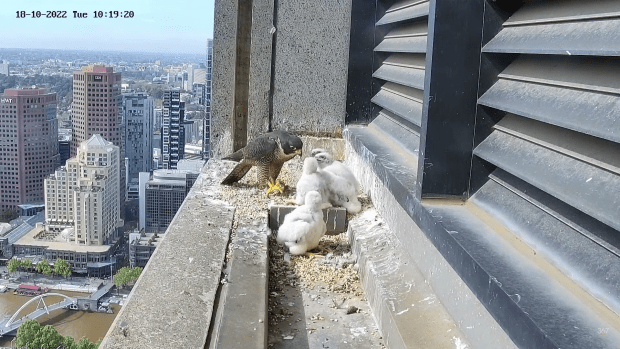
The Melbourne Four are really keeping the two first time parents busy. All of them are capable of getting up and down out of the gutter and today, when I checked, there were only three near the scrape. I did, literally, hold my breath til that little head appeared. ‘A’ loves the sound of the eyases ‘stomping’ down that metal piece of the ledge because it means that they can now get into the shade. ‘A’ might be happy but the parents appeared particularly bewildered at times today.

Poor Dad got down in the gutter with them. Just think. These two didn’t have one eyas to deal with in their first season as parents. Oh, no. They got four…lively, healthy, fat little bottomed chicks. It is perfect.

The parents must have decided that they need to bring in more pigeons. The kids had pigeon at 0646. When next I checked, Mum had come in with a pigeon and was feeding them at 1014. They had just settled down and Dad comes in with ‘something’. The time was 1031. I hope someone identifies this prey. It was big. It is so odd watching the falcons attach the prey to one taloned foot and hobble down to the scrape. It was not clear if the eyases would get up to eat but, they did. They are literally just ‘eating machines’ right now growing bigger and bigger every day.

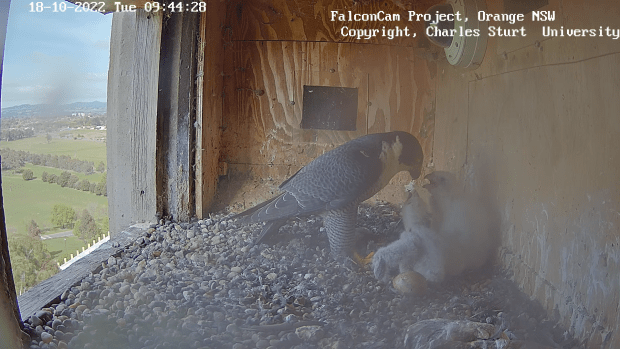
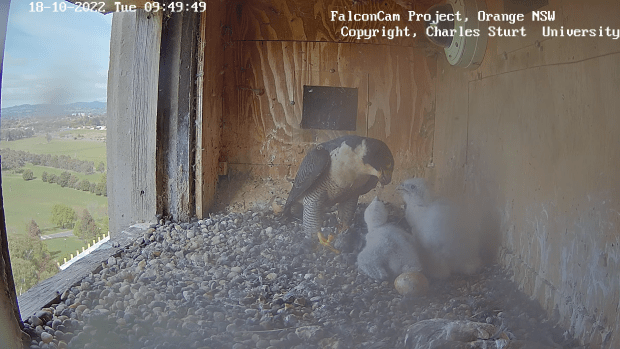
At Orange, a Starling showed up at 0624. It was the parrot that came in at 0941 that caused the most excitement. We are going to start calling Rubus ‘Rubber Neck’. My goodness Xavier makes Rubus work for his dinner. He jumps and stretches and squeals. Meanwhile, Indigo just sits there occasionally raising her neck and sometimes taking food out of Rubus’s beak. She is unphased by his antics. What a live wire Rubus is. ‘Full of vinegar’ my grandmother would say rolling her eyes thinking of all the mischief he will be getting into.

At Port Lincoln, the day was rather calm. A large fish came in early – at 0748. It was followed by a much smaller fish at 0954.

At Port Lincoln, Dad brought in a total of six fish for the day. That is a lot of fish! Just look that the crop on Big.

Middle also has a crop. Yippee. I hope that Mum was able to get enough fish for herself. It is so hard to determine that when she is so busy feeding these two growing osplets.

Rubus and Indigo ate well. The Melbourne Four could have had more prey but, the osplets were stuffed. In all it was a good day in Australia yesterday. The Melbourne Four can now easily move up and down the gutter to the scrape so they can get into the shaded area if Mum is not about.

Thank you so much for joining me today. Take care everyone. See you soon!

Thank you to the following for their posts and/or streaming cams where I took my screen captures: Amazon, Sydney Sea Eagle Cam FB, Port Lincoln Ospreys, 367 by Mirvac, and Charles Sturt Falcon Cam.

Early Sunday in Bird World

16 October 2022

Good morning, Everyone,

It was a very long night. I want to thank you for your outpourings of love and empathy for Little Bob at PLO. If love – human love – could have saved him, that nest would have been full of fish. Little Bob died of the effects of siblicide (starvation and a possible early morning injury) in the late afternoon of the 16th of October at the age of 24 days. Port Lincoln received permission to remove his body from the nest. Fran Solly (?) moved the camera away from the nest to the landscape while Little Bob was being taken off the nest.

Port Lincoln posted the following information on their observation board:

A sad day at port lincoln as #3 didn’t survive. It didn’t get fed properly these last few days and collapsed around 1 pm this afternoon and died at the end of the afternoon. PLO got permission to retrieve it for burial, but didn’t get permission to interfere before that. It is sad, but also the way of life in any nest. The other two siblings are thriving and have every chance to successfully fledge in a few weeks.

If you go to the obs board, you can also join in guessing the fledge time of the two surviving osplets. That obs board can be viewed here:

It is a shame that Port Lincoln did not get permission to intervene once they realized what was happening on the nest.

There are divided feelings on which osplet should be removed when food competition is present. Most researchers believe you remove the eldest if it can self-feed instead of the youngest – leave the youngest with the adult who will feed it. In other instances, smaller birds being beaked have been removed and fed and returned to the nests to live happily. Perhaps, in the future, should this occur again (and it almost seems inevitable at this nest if the first hatch is a big female), permission to intervene can be gained even before the eggs are laid. Just a thought.

Little Bob was loved by so many and we remain heart broken. I am glad that his suffering has ended, however. The parents have little time to grieve – they have two large osplets to care for and get to fledge.

Making News:

Warming seas, overfishing, hotter temperatures are all having a huge impact on birds. Will there be a time when Ospreys will only be able to find enough food for the parents and one chick to survive?

We have just witnessed at Port Lincoln the ospreys eating fish that were fresh and left on the nest or the one that magically appeared on the barge. Since climate change is human caused, it is time that we began to consider ways in which we can help our Osprey friends adapt – and that is through intervention. Providing fish when there is not enough. Fish tanks. There are figures of how many fish come to an Osprey nest with three chicks. The average, if I recall correctly, is somewhere around 450 fish.

Already scientists are seeing a 43% decline in Penguins. Here is the story:

https://www.theguardian.com/world/2022/oct/12/australian-scientists-observe-rapid-decline-in-adelie-penguin-numbers-off-antarctic-coast

The article might be about penguins today but, it is easy to see that the Royal Albatross chicks are requiring more supplementary feedings. What others will we be reading about?

Here is a story coming from Cyprus about the Griffon Vulture. When will countries realize that wildlife and bird watching tours add much income to an economy. So instead of trying to wipe them out with poisons why not embrace the beauty of all and celebrate it?

https://www.theguardian.com/environment/2022/oct/10/its-a-serious-problem-battle-to-save-griffon-vulture-heats-up-in-cyprus

Nest News:

There remain three active nests in Australia with chicks to fledge: 367 Collins Street Peregrine Falcons in Melbourne, Charles Sturt Peregrine Falcon scrape in Orange (Xavier and Diamond), and the two Osplets at Port Lincoln. There are currently no concerns for the falcons at Orange. Both are eating well and food is arriving with no issue. There is concern about the amount of time the female is away from the scrape box at Melbourne. My understanding is that there will be two very hot days this week that will impact the eyases. They do not, as yet, have the ability to run up and down the gutter nor are they feathered to further help them regulate their temperatures. Big and Middle should thrive at Port Lincoln.

The Melbourne Four had several feedings yesterday. The last was at 1832. The four were absolutely bursting at the seams!

Indigo and Rubus ended their day with a duckling feed. Yesterday they had Starlings, a parrot and a Rosella. Xavier is bringing in quite a variety for his family. The Rosella feeding was at 16:29:58

At 1740 a duckling arrived on the ledge which Diamond happily took to feed Indigo and Rubus. Rubus did not have a crop from the earlier Rosella feeling an hour prior and so, this little one got to fill its tummy before bed with a favourite, duck.

At Port Lincoln, after the removal of Little Bob’s body, Mum fed the two surviving chicks one of the fish that was left by Port Lincoln. She also enjoyed some of it herself. It is worth remembering that both Mum and Dad have to retain their health or the entire nest suffers. Mum worked hard to find Little Bob fish when he was eating – at the expense of herself. The females lose weight and body mass as they produce eggs, incubate, brood and feed the chicks until such time as they fledge. Often, at about 30 days, Mum will, in fact, go fishing and supplement the fish Dad brings to the nest.

I do not personally believe there will be any more problems on the Port Lincoln nest. It is not always the case, however. At the UFlorida-Gainesville nest, after the third hatch died, the eldest began to take their angst out on the second hatch. The competition continued but as Middle got bigger, it was clear that Big could not kill it. At that nest, it was evident that the Mum often favoured the eldest. It was a very interesting nest to watch – it had two strong fledglings in the end.

Middle has grown a great deal in the last couple of days as she began to figure out how to get fish and be away from Big. Let us all hope that lots of fish continues to come in and that Mum will also get her share.

Breakfast has not yet arrived at all the nests. I hope to have a very late day report on the comings and goings early on a Monday morning at the nests in Australia. Thank you for being with me and thank you for all of your outpourings of sympathy for Port Lincoln over the death of sweet Little Bob. It will be very difficult to watch that nest for many. Port Lincoln is not a nest for the faint of heart. For those of you that love Ospreys, I want to now recommend three nests in the UK: Rutland’s Manton Bay with Blue 33 and Maya. That Osprey family has raised four osplets twice!!!!!!!!!!!!!! They are Super Stars in the Osprey world. The second is at Dyfi in Wales, the home of Idris and Telyn. It just so happens that Telyn is Maya’s daughter from Rutland! The other is the home of Louis and Dorcha at Loch Arkaig. Louis melted our hearts when he helped his former mate, Aila, feed their three chicks in 2020. He is an amazing provider just like Blue 33 and Idris.

Take care everyone. See you soon.

Thank you to the following for their stories, posts, and our streaming cams where I took my screen captures: The Guardian, Port Lincoln Ospreys, 367 Collins Street by Mirvac, and Charles Sturt Falcon Cam and Cilla Kinross.

Ervie does a fly by to say ‘hi’ to Mum and other news in Bird World on Friday

16 September 2022

Oh, the best of the morning to all of you!

Thursday was a gloomy day on the Canadian Prairies with delightful periods of sunshine popping in and out – like the squirrels and the Blue Jays gathering peanuts to store for the winter.

One visitor, in particular, managed to let me get her photo – Dyson. It is difficult to tell if she is still nursing babies but, she is in good form. So grateful.

I do not know where her nest is precisely. It used to be in the century old Maple tree in the front of the house until the City cut it down this summer. Now she runs along the back lane to the West. Her tail is beginning to grow out.

Squirrels are like the Blue Jays. They can also let part of their tail break away if they are being attacked in order to survive.

One of the other garden surprises today was the visit by at least two different Blue Jay fledglings and Junior. Everyone is stashing peanuts. It is said that September is the month when the Jays do the most gathering. As a result, the pile is always large. Some Blue Jays over winter while others migrate. Will wait to see what happens.

It’s Junior. How can we tell? As the adult, he is the only one of the Jays moulting as the three youngsters only hatched in the spring. Notice that he is just getting a hint of his new crest and he does not have all of his tail feathers. The feathers that he has are nice and healthy, brightly coloured. Blue Jays can live to be 7 years old. Junior is now about 5. His parents are not longer with us as of this year. He has a mate and they were so lucky to have the 3 fledglings – they outsmarted the Crows and the Cooper’s Hawk!!!!!!! And even the GHOW. Their nest is across the line in a Maple tree. Like Samson, the Bald Eagle, Junior took over his parent’s nest.

The Sparrows find the 17 degree C a little chilly. There is a nip in the breeze and many perch on the ends of the lilac branches to get warm in the sun.

And here it is Friday mid-morning and it continues to rain. The trees and plants are loving it – the birds not so much! I see only two brave souls at the bird bath…oops, no…about 60 now!

Making News:

Ervie was flying close enough to the barge this morning to say ‘hi’ to Mum! Oh, cheeky Ervie. You just wanted Mum to remember that you are a year old now. Oh, and you were thinking she would invite you home for a fish dinner?? Oh, poor Ervie. You almost have brothers and sisters. Mum is busy. Hopefully you can have some fishing time with Dad.

The Ojai Raptor Centre reports that our beloved Victor continues to make progress and his zinc levels are normal. Oh, gosh. Isn’t that wonderful? Look how handsome this Two Harbours fledgling is!

A new subarctic seabird is breeding on the Diego Ramirez Islands. Have a read — oh, and they are using the Grey-headed Albatross’s nests!!!!!!! Thank you to Holly Parsons for posting this on the Albatross Lovers FB Group.

https://www.acap.aq/latest-news/4440-a-newly-described-landbird-the-subantarctic-rayadito-recorded-breeding-within-an-active-grey-headed-albatross-nest-on-islas-diego-ramirez?fbclid=IwAR1mfwMeFd1zXQ1cxLcegs3A6G3gR2BBVDap7uiD4VQ9p0eluDSTtFKdGDw

With Idris having departed the evening of the 13th and not seen since, the staff at Dyfi Osprey Centre will turn off the streaming cam in just a few hours. Here is that pastoral view.

The view at Glaslyn

At Loch Arkaig.

At Loch of the Lowes.

One of my friends in the UK said that it is best if we start knitting Osprey toy lookalikes until the end of March or beginning of April when the Ospreys return. That would actually be a great charity idea!

Travel safe and always with full crops our dear UK Ospreys. Full crops over the winter and safe and swift winds home in the spring.

New News:

Well, SE29 has been getting the fish deliveries on the Sydney Sea Eagles nest but, Lady, always keeping a watchful eye makes certain that SE30 gets some! Lady has blossomed over the past four years into a fantastic Mum.

The sea eaglets jumping and flapping at 0644 in anticipation of breakfast arriving.

Look at how clean the eaglets feet and talons are compared to those of Lady.

Attempts at self-feeding will continue until these two will remarkable appear that they have always been able to hold the fish down and pull with their bodies to get the flakes off. Early days of training.

SE30 waits very patiently. Remarkably civil these two. Both females? Both males?

Lady lets SE29 try and then feeds both of her babies so that each gets a good start to the day.

The second male at the 367 Collins Street Peregrine Falcon nest in Melbourne continues to make his presence felt by continuing to land on the ledge but, is he actively wanting to be involved in the raising of these eyases? or is his presence going to harm? It remains unclear as we are now 11 days from hatch watch.

His presence is clearly causing the older male whose scrape box this was to be reluctant to incubate the eggs. So what will happen when prey is needed for the eyases and Mum needs a break in feeding them? Who is actually protecting this Mum and the scrape box?

This is an image posted on 367 Collins Falcon Watchers of the two males. The original male – father of the clutch we believe – and the visitor on the right. Don’t worry! It is the camera angle that makes the one on the right appear larger.

Our cute little dad has very large yellow circles around the eye. The oneon the right does not and has a line on the right of black on white. Note: Most male Peregrine Falcons have a prominent yellow eye line like Dad 1 here and Xavier.

A close up of beautiful Mum has been posted accompanying a link to the tracking data for the nest if you are interested.

Let us all hope this works out well.

It is raining and about 11 degrees C in Port Lincoln. Rain is good but let us all hope it dries up before hatch watch on Monday!

Diamond was busy rolling the eggs before the IR camera came on Friday evening. Less than 2 weeks!

The Bald Eagles in Florida and the SE US are working on their nests – Pa Berry and Missy have been doing so for over a week now, Samson is happy Gabby is home – and those on the Channel Islands are busy, too. Oh, and I thought we would have a break after all the Ospreys migrated. BUT not all the Ospreys have migrated. ‘H’ caught Dory on the Hog Island nest in Maine! So Dory, Skiff, and at least Sloop are all still at home with no hint of starting their flight south!

‘H’ and I both think Sloop is a female from all her behaviour over the year. She can join the club of being kept home and fed well so that she is fully developed like Sarafina, Blue 497, and Padarn.

In the image below, Dory has flown onto the nest in the late afternoon on 15 August. Sloop has also been fishing – seen returning to the nest empty taloned but wet twice. Thanks ‘H’ for keeping us up to date on this nest. Much appreciated.

Migration News:

One of the Finnish Ospreys has spent a week in Ukraine and has safely departed. This is a good sign. Warm thoughts for Karl II and his family who continue to be feeding at various parts of the country.

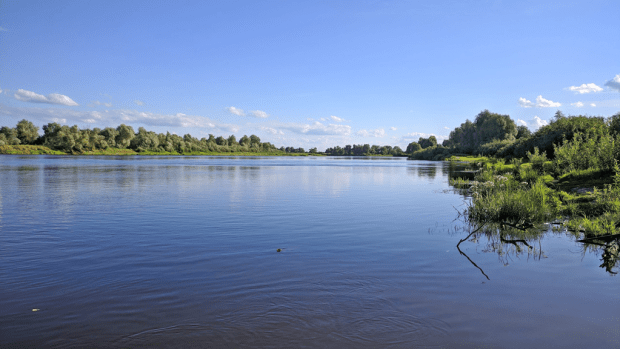
Bonus remains in Belarus near the Pripyat River. He must really be getting a lot of nice fish and frogs there.

This is an image of the area that Bonus is fishing.

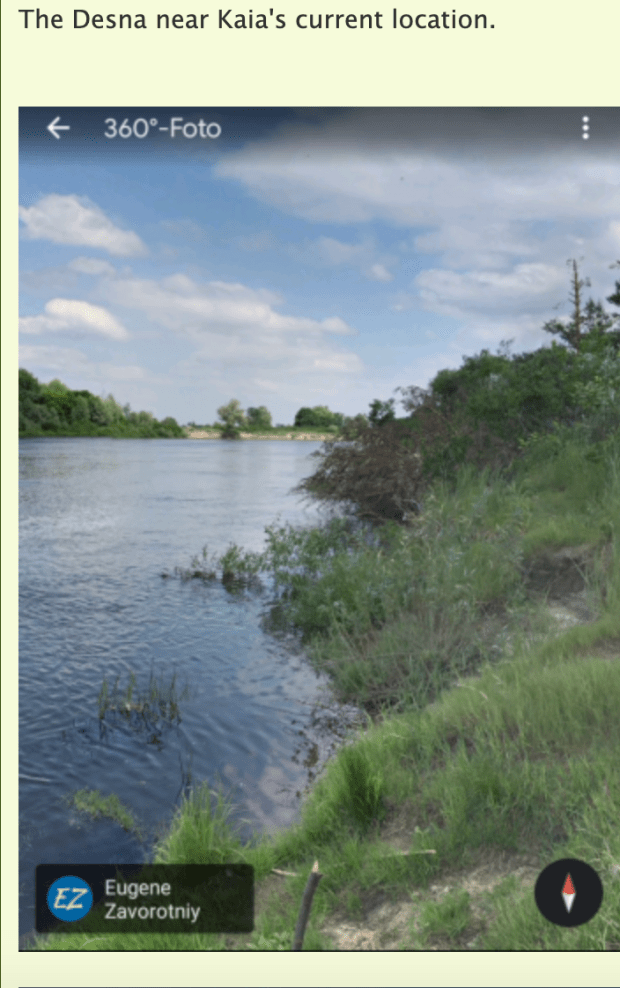
Kaia remains near the Desna River in Ukraine. No word from Karl II.

From the Archive:

I am ‘the most’ famous Red-tail Hawk in the world. Who am I? Where is my nest? Who is my current mate? and do you know how old I will be in 2023?

Thank you so very much for joining me today. I hope that each of you is well. Please take care. Looking forward to seeing you again soon.

Thank you to the following for their posts and streaming cams where I took my screen captures: Port Lincoln Ospreys, Ojai Raptor Centre, Dyfi Ospreys, Bywyd Gwyllt Glaslyn, Friends of Loch Arkaig and the Woodland Trust, People’s Postcode Lottery, Friends of Loch of the Lowes and the Wildlife Trust, Sea Eagles@Birdlife Australia Discovery Centre Sydney Olympic Park, 367 Collins Street Falcon Watchers, Charles Sturt Falcon Cam, Audubon and Explore.org, LAJI-FI, Looduskalender, and Cornell Bird Lab.


I am Big Red. My nest is on the campus of Cornell University in Ithaca, New York. My original mate was Ezra and my current mate is Arthur. I will be 20 years old in 2023. I was banded as a juvenile at Brooktondale, New York only 7.5 miles away form my nest now in the fall of 2003.

Thursday Morning in Bird World

15 September 2022

It was the perfect day to go out to the industrial area looking for ducks – and shorebirds. And then it wasn’t. Things to remember: empty the memory card in the camera after downloading all of the images to your computer or to an external hard drive and – take an extra battery, one that is fully charged! As a result of not following such advice, it became a great morning to just relax and watch the shorebirds!!!!!!!!

I am becoming quite attached to these Greater Yellow Legs (or are they Lesser?). Their movements are quick and they bob their heads up and down like falcons and hawks getting their prey into focus. So cute.

The geese have certainly been making a ruckus everywhere for a couple of days. Because there are so many of them, it is like they are taking over all the ponds and vacant fields.

Once the geese had left the area, the two Greater Yellow Legs rushed to the other end of the pond where there was a nice muddy shore. Don’t let anyone ever tell you ducks and shorebirds are ‘slow’ – they are decidedly not!

Once home, it was a real treat to see Junior. Last time we saw the Dad of the three Blue Jay fledglings, he was moulting and had lost his beautiful crest. Junior is not longer bald on the top of his head. The bright blue is coming in and it is easy to imagine what he will look like once that crest grows longer! Like the Greater Yellow Legs staying away from the geese, Junior seems not to like coming around when the Crows are about. Those three fledglings have really grown and they can be quite intimidating. Junior has also decided that he likes the Black oil seed and the White Millet that is on the ground. If you look you can see two brown legs. they are four legs to a little feeder with a roof but, this morning our dear friend Dyson & Co decided to make the feeder go sideways and everything dumped all over the place. It will not take them long to clean it up.

Look at Junior’s tail. He has kept enough to fly and has moulted the others which will grow in and replace any damaged feathers.

Have you ever heard of the term ‘fright moult’? A fright moult is when a bird’s tail feathers all fall out at once. This normally happens when a predator grabs the bird’s tail feathers. In order to save its life, the bird being attacked moults all of its tail feathers at once!

Another interesting and strange fact about Blue Jays. Their feathers are actually brown but appear to us as being the blue colour we identify with the birds because of light interference from the feather structure. If the feather is crushed, the blue colour disappears (https://www.thoughtco.com/blue-jay-birds-4692850.

I am so grateful being back in the sunroom where I can watch the birds go about their daily lives without causing them any stress. Hopefully our dear Dyson will slow down and let me get a picture of her soon. She is sooooo beautiful. Her fur is all back to normal and is bright and shiny. Did I tell you that Little Red is around, too? He loves the new fence because he can now run from his new home in the neighbour’s tree along the top of their fence to the new one here and then with a single jump he can land in the square hanging feeder and dump every seed everywhere!

In the Mailbox:

‘A’ has been watching the Sea Eagles carefully and believes that SE30 is a female. “SE30 has always been a feisty eaglet, except for a short period about three weeks ago where she seemed fearful of SE29 at feedings. Since then, she often seems to have been getting most of the food and nearly always grabs any fish tails, mantling if necessary to keep them! Size and temperament point to female. What do you think?”

Alison, I totally agree with you. SE30, at 8 weeks plus a few days, is showing every sign of being a dynamic female. She takes charge of the food and is really growing and no longer ‘takes grief’ from 29. It is unfortunate that the eaglets are not tested and ringed!

Making News:

Holly Parsons posted one of those great intervention stories of an Albatross who had had hook caught in its beak. Always happy to have a success story – and that hook just makes me ache. Poor baby.

Here is the announcement:

Thank you, Holly, for also making everyone in Australia aware of the petition for banning the release of helium balloons. This should be a world-wide effort but, it should be to ban all balloons other than those required for weather research. This is, however, a start!!!!!!!!!!

It is an ad for a camera but, for us, what is interesting are the beautiful images of the Peregrine Falcons!

Nest News:

The California Condor chick in Tom’s Canyon is 4 months old today!!!!!!!!!! Fantastic.

Ron and Rita continue to work on their artificial Bald Eagle nest in the Miami Zoo designed by Ron McGill. Gosh, the eagles seem to be busy making nestorations everywhere. Is it going to be an early season? We haven’t even said goodbye to the last UK ospreys yet!!!!!

The cameras will be coming on soon at the Southwest Florida Bald Eagle nest in Fort Myers. Harriet and M15 have been diligently working to get their nest into shape after E19 and 20! In the meantime, here is a video of M15 and Harriet working on the nest yesterday.

Shadow is at the Big Bear Valley nest starting to bring in those whoopers of sticks that only Shadow seems to find.

In Australia, the ‘little’ (not really sure that term is applicable anymore) Sea Eaglets 29 and 30 are continuing to practice their self-feeding. They are standing so much more and at least one of them is standing on the very rim of the nest. This always makes me nervous! Both Dad and Lady are also stepping in and feeding both of them. All is well in the Sydney Olympic Forest.

Diamond and Xavier continue to take turns incubating the eggs. There are a couple of weeks to go til we have hatch watch at Orange. Sadly, Diamond is also having to deal with an intruder female at Orange this year. Neither Diamond or Xavier are ‘young’ falcons but rather, slightly older.

I adore little Xavier and here he is bringing Diamond a yummy lunch.

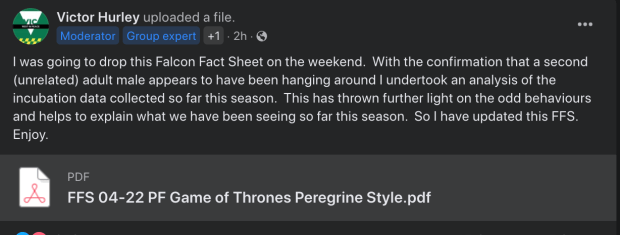
Thank you, ‘H’ for letting me know about Victor Hurley’s posting on the 367 Collins Falcon Watchers FB Page. Hurley is the key researcher for the Victoria Peregrine Falcon Project that includes the Melbourne falcons. He has now stepped in to comment on what is happening at Melbourne. Please read carefully to the end…

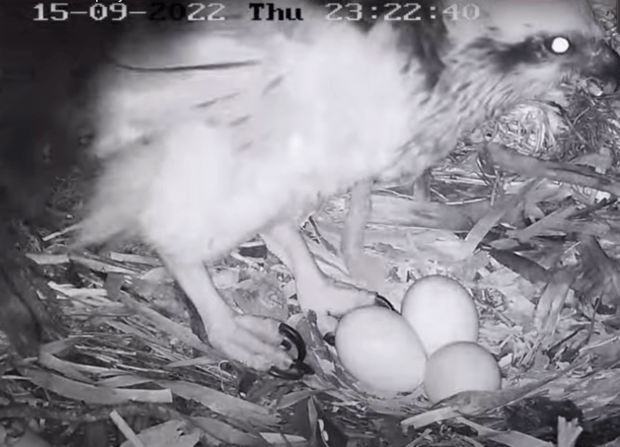
The new female arriving to incubate the eggs after a meal.

Victor Hurley has also included another fact sheet on the 367 Collins Falcon Watchers FB and has changed some of the data based on this new knowledge. (It is formatted so I cannot just post it here so you can read it, you must go there). A great article!

At Port Lincoln, the eggs are 38, 35, and 33 days old. On the 19th, egg 1 will be 41 days. Time is going to pass quickly. Hatch watch should begin on Monday.

Migration:

Things are just going quiet with the Ospreys in the UK. The last two lingering nests seem to be empty. No one appears to be home at the Glaslyn nest – Aran and Blue 497 both seem to have started their journey south. Padarn was last seen on the 12th of September at 19:20 with Idris last seen on the Dyfi Osprey nest 24 hours later on the 13th of September at 19:41. Safe travels, full crops. See you in the spring!

‘H’reports that there are still family members at the Boat House Osprey platform in Bremen, Maine. Sloop, the third hatch and reluctant fledge, is eating well having had at least 3 deliveries yesterday! She has sent a photo of Sloop excited for a delivery! She has not seen Schooner or Skipjack on the nest for 5-6 days but other osprey calls have been heard so it is unclear who remains as of today.

I am finding this very interesting. This nest is one of the most northern of all the US nests. It is migration season and we continue to have ospreys on the nest. Let’s watch and see when they depart.

Karl II and family:

All of the family members transmissions show them in the same areas that they were previously. There is no transmission for Karl II. He is believed to be at his favourite nature reserve in the Kherson Oblast region of Ukraine. I found several active reports on the current activity in the region yesterday.

Stay safe Karl II!

If you are following the new Osprey family at Belvoir Castle in Lincolnshire (my old haunt), Tim Mackrill has posted news!

From the Archives:

Do you remember: who are the storklets? what is their story?

Thank you so very much for joining me this morning. Please take care! See you soon.

Thank you to the following for their streaming cams, posts, tweets, etc that make up my screen captures: Holly Parsons and Albatross Lovers, Orange,Australia, Peregrine Falcons, Sony A1, WRDC, Condor Cam, SWFL Eagles, FOBBV, Sea Eagles@Birdlife Australia Discovery Centre Sydney Olympic Park, Charles Sturt Falcon Cam, Victory Hurly and the 367 Collins Street by Mirvac, Port Lincoln Ospreys, Tim Mackrill, ‘H’ and Audubon and Explore.org, Ukinform.net, and Dr Madis and the EMC plus the Eagle Club of Estonia.


The Black Storks of Estonia are rare and treasured. When Jan did not return and was deemed injured or dead, Janika had to try and feed her storklets. She could not manage even with the fish basket she found that Urmas, the Ornithologist for Estonia, provided. It was decided that the three surviving storklets would be taken into care at the Vet School in a stunning attempt to keep them alive by feeding with a decoy male and having a decoy female. In the image, Bonus is the largest of the three. The stotklets thrived. Two were placed with Eedie and Bonus was placed to be fostered with Karl II and Kaia. A goshawk attacked Eedie’s nest killing all the storklets. Bonus is now on migration and in Ukraine where he appears safe. Bonus is the only one of Jan and Janika’s six storklets of 2022 to survive.

Bald Eagle nest coned, other nests destroyed…and more news on Wednesday in Bird World

14 September 2022

Good Morning Everyone! I hope that you had a fabulous beginning of the week. Here we are at the middle. My calendar tells me that thing are going to begin happening in Bird World soon. First up will be the Port Lincoln Ospreys who should have a hatch in 4 days. Then it should be the Melbourne Peregrine Falcons on the 27th quickly followed by Xavier and Diamond. By the time those nests have feathered osplets and eyases, we will be fledge watching for SE29 and 30. It is going to be wonderful!

Tuesday was a big ‘T’ day but that doesn’t stand for Tundra Swan but, ’tiler’. It was fantastic to see the floor tiles in the sunroom being grouted today with the news that tomorrow I can move back in and watch my beloved garden birds. Oh, how I have missed seeing them from that perspective. A new book arrived in the post, too. Having purchased Crosley’s Guide to Waterfowl – well, logically, it seemed to me that the volume would cover Shore birds but, no. Definitely not. The new book is The Shorebird Guide by O’Brien, Crossley, and Karlson and it is wonderful. Most appreciated are the excellent images of the plumage during the seasons. It still is missing the inclusion of the females in great numbers just like all of the other bird guides who continue to focus on the more colourful plumage of the males. Yes, I am growling. LOL. Quiet and monochromatic can be viewed as ‘classic’ beauty. It certainly is with many of the female Sparrows.

Just like the ducks, my mind has been taken over by the Greater and Lesser Yellow Legs and Willets at one of our local ponds. If I close my eyes I am transported to the marsh where the shore birds are tapping away at the mud with those long long bills. Incredible. If you stay quiet and don’t move, they will completely ignore you, going on with their deep quick probing for food. They are really quite lovely. Learning to identify them is going to take some time.

The Greater Yellow Legs from the other day.

The plumage on the Mallard is really lovely.

It is overcast and cold at 13 degrees C this morning. The Crows have been for their morning hotdogs, the sparrows are wanting a bath, the Blue Jay has been flitting in and out (only one), and the cat has already been chased once. Meanwhile Little Red has been running back and forth on top of the new fence which now meets up with that of the neighbour so he never has to get on the ground to get to his new home. Yes! Little Red has found a place to live since his penthouse was torn down. So thankful. The torrential rains this year and saturated ground meant that all of the trees literally tripled in size. He found a hole in the big tree and if I look carefully, I can see him going in and out. So relieved after feeling so quilty about the shed. With my chair back in the sunroom this morning, I can watch over them and hopefully get some good images of Dyson who is looking ever so healthy and fluffy these days. Gosh, that squirrel is quick. I wonder if the Crows frighten her?

In the Mailbox:

‘A’ writes that I have awakened a love of ducks for her. That is fantastic. They are often very unappreciated, like the geese, in my City but, there is nothing so peaceful as sitting on a clean bit of lawn or blanket and watching them go about their daily paddling and preening. This is wonderful news. Thank you for letting me know! In honour of this, I have used one of our favourite ducks for ‘From the Archive’ today.

Making News:

There is growing disillusion within the environmental and raptor groups in British Columbia, Canada at the decision by the Department of Forests and the University of British Columbia to cone a long standing Bald Eagle nest on the campus of the University. Their are ongoing campaigns to stop the coning which is due to take place today, the 14th of September.

https://www.ubcproperties.com/news/eagles-nest-and-wesbrook-place-development/

Also in British Columbia, this time in Surrey, the David Hancock Wildlife Foundation is attempting to stop the cutting down of a Bald Eagle nest on the property of a Costo in that city–or get the owner to agree put up a platform nest for the eagles.

British Columbia is home to more Bald Eagles than any other area in North America. Because of this their conservation status and threat is very low – often cited as an excuse to cone the trees or cut down the nests — some 140 Bald Eagle nests were destroyed at the Site C Dam project by the province this year. Of course, what is the real count? With Avian flu still with us and in Manitoba nests and eggs destroyed by flooding with few goslings, perhaps we should be re-thinking our approach to preserve. Declines can begin to happen and spiral.

If you are in Southern Manitoba, Wildlife Haven is having its annual Open House on 23-24 September. Tickets can be pre-purchased and space is limited. It was gorgeous weather last year and the event was sold out. I can’t think of a better way to spend a few hours on a fall afternoon than getting to meet the ambassadors, tour the new flight training buildings, and check out the great vet facilities. These are the people giving our wildlife a second chance.

Do you live in New York? do you love Bald Eagles? Here is a fundraiser event you might not want to miss.

Would you like to be an Albatross detective and help get a true worldwide count of these sea birds? Here is the information.

https://phys.org/news/2022-09-albatrosses-space-wildlife.html?fbclid=IwAR2f-pbgS3RwmaNjlKRkHTidHqeg3x3ugsiu2u1TRGNoXRCHw3Z4ljbt78I

Nest News:

The Bald Eagles have been returning. Yesterday it was Gabby returning to the Northeast Florida nest to Samson.

NEFlorida Eagle Nest

Samson and Gabby love to ‘kiss’ just like Alden and Annie.

Anna and Louis are back at the Kisatchie National Forest and now Mr President and Lotus are at the National Arboretum Nest in Washington, DC.

National Arboretum Nest

They are really coming home. If you see a return, send me a note!

Thunder and Akecheta were caught sitting together on the cliffs of the Channel Islands yesterday. Oh, goodness. What an incredible year we had with Ahota, Star, and Kana’kini.

Thunder flew into the West End nest with a super fish yesterday, too… Ah, it would have been grand if one of the kids swept in and took it! Everyone misses those three amigos.

Andor was at the Fraser Point nest. I haven’t seen any new updates on Victor. We can all presume that he is doing lots of flying and strengthening those wings!

The nest that our dear Little Bit ND17 grew up on had dwindled down to only a bit of mud and straw at the joint of the branches. Everyone has been concerned that the adult eagles would not return and rebuild – knowing that if they didn’t St Patrick’s County Park in South Bend, Indiana, would not be moving the camera. Well, guess what? Dad has been caught returning to the nest! This should be a ray of sunshine for everyone. It will take work but each of us has marvelled at how quickly the raptors can whip a nest into shape. No, it will not be huge like a decade old nest but it will be a new beginning.

In the image below you can see what little is left.

It appears that Idris is finally alone to enjoy his fish and that Padarn has left the territory for her migration.

At Glaslyn, however, Aran is still bringing fish for Blue 497. It won’t be long, Aran!

497 is an incredibly beautiful osprey.

To my knowledge, Blue 497 is the only fledgling left on an Osprey streaming cam in the UK to migrate.

Did I mention mantling (when a raptor spreads its wings over its prey to conceal and protect) was one of the development stages coming quickly for the Sea Eaglets in Sydney? Well, guess which of the two was the first to demonstrate this stage of growth?

If you said SE30 you would be absolutely correct! Both eaglets held the prey down with their talons and pulled. Eventually they were fed but this is very good training. So proud of 30! Go baby. Don’t you just love the look on 29’s face? (squint)

The sea eaglets have been well fed and have been sporting crops on and off for a few days now.

Watching incubation and expecting a hatch in less than a week can be nerve wrecking.

The beautiful Mum at Port Lincoln. It is the 15th. Oh, so soon we will be having little osplets –. Cannot wait.

For Melbourne, mark your calendars for the 27th of September.

Xavier and Diamond will follow after Melbourne!

Migration News:

Into Hawks? Aren’t we all? Here is a new tool to follow the counts.

https://www.hawkcount.org/index.php?fbclid=IwAR3LRTBRBWRYUa0Fg8KoXz4OqH4Fz1t8COL4lIMb4qXRVz1F3LuxIyMcNAE

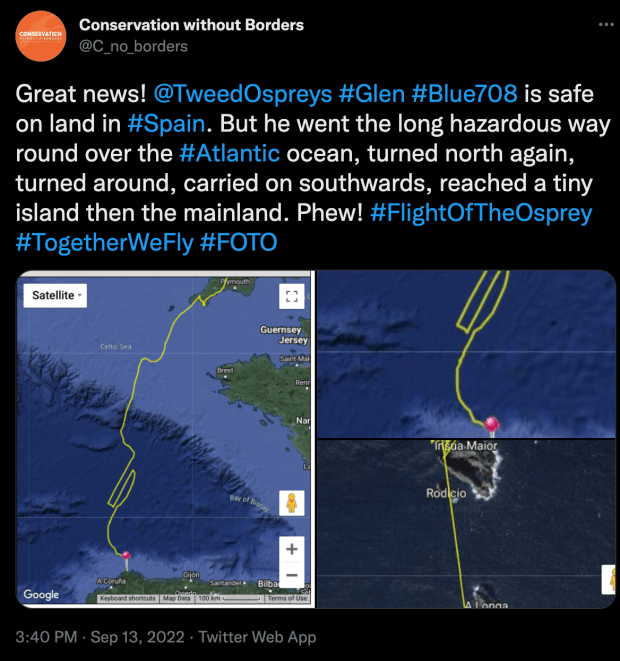
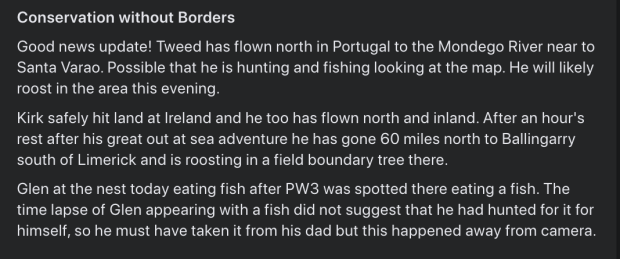
Some good news on one of the Tweed Osprey fledglings, Glen. (Sadly it appears that Kirk who had gone West and was in Ireland continued west over the Atlantic and is probably lost).

From Karl II’s family, the Estonian Black Storks from the Karula National Forest nest.

Bonus is really flying and remains in the same area he has been for several days now-the Prypjat River. He is safe. Relief as always.

Waba is at the Hrabarka River in Ukraine.

I see no transmission for Kaia or Karl II.

Audubon scientists are using data from hawk Mountain to monitor the places that raptors migrate.

https://www.hawkmountain.org/news/science/audubon-scientists-use-hawk-mountain-data-to-develop-a-new-method-for-mapping-bird-migrations

Here is the current data for Hawk Mountain in terms of this autumn’s migration.

https://www.hawkmountain.org/conservation-science/hawk-count

From the Archive:

I am not a cartoon character but, for many raptor watchers in Australia (and elsewhere), I am the most famous duck in the world. Do you remember me? What is my name? What kind of a duck am I? Whose nest did I lease? And do you remember what happened?

Thank you so much for joining me today and for your lovely notes. It is actually relatively quiet in Bird World but soon…so soon, there will be action in Australia – at Port Lincoln and Melbourne. Meanwhile, we can all enjoy the antics of the little Sea Eagles who are jumping, flapping, and learning to mantle and eat their own prey. Take care of yourselves. I look forward to seeing you again soon.

Thank you to the following for their tweets, their posts, videos, and streaming cams where I took my screen captures: Wildlife Haven, Bald Eagles of Centreport, Albatross Space, Channel Islands Eagle Lovers, Notre Dame Eagles, NEFL-AEF, NADC-AEF, Dyfi Ospreys, Bywyd Gwyllt Glaslyn, Sea Eagles@Birdlife Australia Discovery Centre Sydney Olympic Park, Port Lincoln Ospreys, 367 Collins Street by Mirvac, Charles Sturt Falcon Cam, Conservation Without Borders, and Looduskalender.


From the Archive: Daisy is a Pacific Black Duck. She first appeared on the nest of the Sydney Sea Eagles in December of 2020. She attempted three clutches of eggs – all predated by the Crows, sadly. The last clutch in 2021 almost made it to hatch. We were all cheering! Daisy stole our hearts and taught us many lessons about the challenges the female ducks face in being both incubator and security guard. The couple came this year to check on the nest. Oh, it was delightful to see Daisy and her mate but, equally, there was relief that she decided to lay her eggs elsewhere in the forest. Did you know that less than 15% of all duck eggs laid make it to hatch?

Early Monday in Bird World

12 September 2022

A bird sitting on a tree is never afraid of the branch breaking, because its trust is not on the branch but on its own wings.

I had a lovely time at an industrial park in the city again Sunday. There was the Great Egrets, the Great Blue Heron, the fast little shorebirds, some ducks, some gulls, and a lot of Canada Geese. As the Egret was flying away, a couple stopped on their bicycles and chatted with me for a long time. After they made me feel rather good by saying they watched and noticed that I did not get near the birds but rather used that long lens on my camera so as not to frighten them. (I was 250 ft away). I was very humbled. I have seen people find out there is an owl and take their children running and practically land on the raptor or people using fishing poles with line and a mouse to try and get that perfect ‘shot’ of the owl flying directly at the camera person. To me, those are not ‘birders’ they are a special irritating ilk of photographer. At any rate the couple told me about another lake not that far from where we were standing and we talked about how the city planners required the area to keep 30% of the land for nature. It is certainly a beautiful green area in the middle of gravel pits!!!!!!! Yes, I am serious. I also got a tip about a cemetery with a Cooper’s Hawk family. That was so nice.

Decades ago I looked at the world through the eyes of a ‘human’. Oh, I can hear you laughing, I haven’t turned into a hawk yet!!!!!!! Or have I? At that time I considered golf courses and cemeteries as wastes of precious land — and that was a time when I was researching British cemeteries on the Indian subcontinent! Today, the view from my eyes is very different. As humans eat up all the land they can with bigger houses and ever expanding amounts of land, the golf courses and the cemeteries are places of refuge for the birds and the raptors. The geese fill the newer cemeteries that only allow flat markers while the Crows and hawks make their homes in the older ones with the mausoleums and large head stones. If I could increase the number of golf courses and cemeteries I would! And that is a 180 degree change in thinking. (Of course the golf courses should not be using rodenticide!)

From the Mailbox:

‘L’ writes: I don’t see the male at Melbourne bringing prey to the female. Do you know what is happening?”

What a really good question because we often see Xavier bring prey directly into the scrape box at Orange for Diamond. It seems, at Melbourne, that the male has hidey-holes on the other ledges and behind some of the architectural features of the building. He will have a stash of food there for the Mum and for her to feed the eyases. You might have seen Xavier put prey in the corner of the scrape at Orange. Rest assured, she is eating and the amount of time she spends incubating, she is not catching it but the little male is doing the hunting. He is also a very good hunter from previous years – if prey stocks remain good.

Just a note about Melbourne. ‘A’ wrote and asked what was on the nest fluttering around and then answered her question. A white plastic bag had made its way up to that scrape! That is so worrisome. The Mum got it off by tearing it but oh, we humans need to pick up after ourselves.

Making the News:

There is a webinar today on migration. I just saw this posting on the Cornell Chatters FB page. Apologies for not knowing about it earlier. I hope that they will post the webinar on YouTube after. Fingers crossed.

Six more Golden Eagles were released in the UK as part of a reintroduction programme.

The bird photographers of the year have been announced….It is so sad to see that some of the images of the urban birds are around human garbage but that is their reality. Indeed, many of the European storks – and those Adjutant Storks in India – spend their time in the landfills trying to find food. I was chatting with my granddaughter this afternoon about the need for dead but not diseased animals to be taken to a specific spot for all the birds that eat carrion. It would be a tremendous help. Instead of running big incinerators using energy and pouring ash into the air, the animals like Bald Eagles, Crows, and Vultures would have food.

A detail of Kerry Wu’s award winning image of a Barred Owl.

The winners are shown in this article of The Guardian:

https://www.theguardian.com/environment/gallery/2022/sep/09/bird-photographer-of-the-year-2022-winning-pictures

This beautiful Golden Eagle gets a second chance at life because of the Audubon Centre and now she has a new home!

Nest News:

Thanks to ‘J’ I was able to go and see the Magpies attacking the two little sea eaglets on the streaming cam. Thank you ‘J’.

A number of years ago I was mortified when I saw the Magpies and Currawongs swooping at the little sea eaglets. My heart sank to my feet and my palms got sweaty. It is a difficult thing to watch for the very first time… maybe even the second. Far more enjoyable are the visits of the Rainbow Lorikeets! I did not see Lady or Dad to the rescue today…another learning experience for these two eaglets who are now in their 8th week. Soon they will have to contend with these aggressive little birds alone – even without a sibling – so best they get used to them and honk those wonderful horns of theirs.

The Sea Eaglets will be the top dogs wherever they take up residence like Lady and Dad are in the Sydney Olympic Forest. For the remainder of their lives, the smaller birds will be annoying – sometimes even downright dangerous – because they have nests with babies, too and they don’t want the big Apex Predators around them. We see it with the Mockingbirds attacking Big Red all the time. The older the eaglets get the more they will ignore the smaller birds but, for now, this is good training. I caught it on video for you.

The Sea Eaglets were fed early. You sure miss those hourly feedings when Lady was giving those wee ones little bites. Now it is so long between meals.

The adults were in the nest tree looking about for pesky intruders around mid-day.

Cornell has been busy posting images of L4 since her release from care as well as other members of the family including L2. It is so good to see the four of them – Big Red, Arthur, L2 and L4 out in the wild doing what hawks do. Cornell has said that it is working to improve the areas where the hawks might get injured – let us hope they get to it fast!

The two posts below are from Cornell’s Twitter feed.

They were not together long-Idris and Padarn. The moment reminded me of Iris and Louis on the Hellgate Canyon Osprey platform in Missoula, Montana a week plus ago. There was Idris with his daughter, Padarn, on the Dyfi nest in Wales. Idris wasn’t looking straight at the camera but Padarn was – and it gave me that same feeling of ‘goodbye’ like that eerie image of Iris and Louis. Stunning image of father and daughter – Padarn looks even more like Mrs G with ‘that look’.

BTW. Some of you will remember a question about which gender migrates first. I had used the Dyfi statistics which were colour-coded. My good source tells me that the first hatch, Pedran (2022), who was identified as a female at the time of ringing, is now deemed to be a male by Dyfi. Is this from mouth swabs? or because Pedran migrated so much earlier than Paith and well…Padarn is still with us, bless her heart. She is one healthy and robust Osprey who is well taken care of by Dad. Just look at those legs – short and stout.

Blue 497 is still at Glaslyn with Aran. It started raining last night and looks a little miserable this morning, too!

Something has caused Xavier and Diamond to leave the eggs and check on their territory at Orange.

There was a lot of alarming and looking at the sky but nothing could be seen on the ledge or tower cams. There is work, however, going on somewhere near the tower. You can hear the machinery in the background.

It was, however a great day for Xavier to have some time with the eggs. He had a two hour incubation!!!!!!!! Couldn’t hardly believe it.

Alden and Annie have been bonding and doing their little kisses in the scrape box today. Oh, isn’t it fantastic to get to see them together outside of breeding season?!

At the Port Lincoln Osprey barge, Mum had had enough of that pesky piece of pine bark and was moving it. While she did, we got a good glimpse at those precious eggs that are due to hatch at the end of the week. Can you believe it? We are finally getting there!!!!!!!

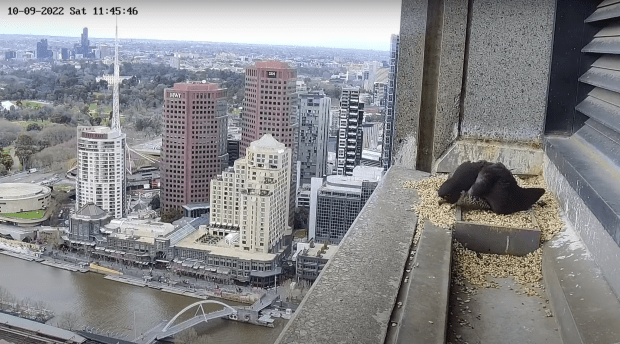
It could be my imagination but things seem to be settling down a bit at the Melbourne Collins Street scrape. The new Mum does not give Dad a lot of incubation time which he has really enjoyed in previous years. So far today, though – and it is only mid-day (1335), the eggs have not been left for long, long periods of time (like hours).

What a gorgeous view!

Migration News:

It appears that Sarafina is on her journey. It is unclear if Louis has left Loch Arkaig. He might well be eating and resting up after feeding his daughter well into September!

Checking on Karl II’s Black Stork family. Waba remains in Ukraine in an area around Manachyn.

He is fishing along the river bank.

Bonus remains in Belarus around the Priyapat River.

There is no transmission signal for Karl II. In the Kherzon region some of the villages are only now getting their cell service restored. No transmission that I can see for Kaia either.

From the Bookshelf:

Jonathan Elphick is no stranger to birds. Just Goggle his name and you will find a long list of titles by this wildlife writer and ornithologist. Birds. A Complete Guide to their Biology and Behaviour is the first title of his on my bookshelf and what a great addition it is. The book begins with a look at birds and their relationship to dinosaurs and moves quickly to bird anatomy. Anything and everything you could possible ever want to know is in this detailed chapter. The chapter on ‘flight’ was one of my favourites with its intricate drawings of the wings with the feathers labelled as to their correct names. How different birds fly, their speed, discussions on wing loading are all there along with hovering and energy saving flight. Further chapters examine food and feeding, birds as a group or society, breeding, where birds live and migration. It is, in effect, an excellent reference book filled to the brim with the most beautiful imagery. I was particularly interested in the discussion on birds and humans and was not disappointed. Elphick starts with the earliest assaults by us on birds and continues to the problems of today including human overpopulation and climate change. There are also surprises – I learned a myriad of things from each page. We listen to the duets by the White-bellied Sea Eagles at Sydney but did you know that there are actually 44 distinct bird families that sing duets? The Eastern Whipbird and the Common Swift are two. There is an excellent index and a good bibliography. Highly recommended if you are looking for a comprehensive book on all aspects of our feathered friends — including some of their quirky behaviours.

From the Archives:

Everyone fell in love with me. I have the loudest voice of any eyas! I kept the researcher fully fit walking up the stairs to keep putting me back in my scrape box. Who am I? Who are my parents? and where is my scrape box?

I have seen no recent updates on Victor or tracking information on Ervie.

Thank you so much for being with me today. Take care! See you soon.

Thank you to the following for their tweets, posts, and streaming cams where I took my screen captures: Cornell Hawk Cam Chatters, The Guardian, Audubon Centre for Birds of Prey, Sea Eagles@Birdlife Australia Discovery Centre Sydney Olympic Park, Cornell Hawks, Dyfi Ospreys, Bywyd Gwyllt Glaslyn, Charles Sturt Falcon Cam, Cal Falcons, Port Lincoln Ospreys, 367 Collins Street by Mirvac, and Looduskalender.


I am Izzi. My parents are Xavier and Diamond and I hatched in 2020. First I fludged – fell over the edge when I was sleeping. Cilla Kinross climbed the 170 stairs to put me back in my scrape. Then I fledged but hit a window and went to rehab and was taken back up the 170 stairs by Cilla Kinross. Finally, I fledged! But Mum and Dad couldn’t get rid of me. Finally as the 2021 season approached, Diamond blocked my way into the scrape which is on the water tower at Charles Sturt University in Orange, Australia. Aren’t I the cutest little falcon you have ever seen?

Saturday in Bird World

10 September 2022

Good Morning Everyone,

Friday morning turned out to be a fantastic day to go and check on the birds in a pond in one of the industrial areas of the city. There had been a Great Blue Heron spotted there according to eBird and I hoped to get a glimpse. That beautiful bird and the Lesser Yellowlegs, the Canada Geese, the Mallards, and the gulls did not disappoint.

Then as I was driving around the other side to leave I looked over and saw something ‘white’. It was a beautiful Great Egret wading in the water fishing.

What a lovely way to start the morning! I feel blessed. It is always good for the mind and soul to get out into nature, however long or short one can, and if, by chance, we get to see these beautiful creatures then it is doubly wonderful.

It is also the full moon. Around the world people will be looking up and hoping for clear skies. It is known as the Harvest Moon and is a time of thanksgiving. Many years ago, I had the wonderful opportunity to be in Kyoto during the Tsukimi or Moon Viewing Festival. Moon Viewing has been practiced in Japan since the Nara Period from 710-794. One did not look at the moon directly but, rather, observed the moon’s reflection normally in a beautiful pond. Many residences of the aristocracy had moon viewing platforms. Poems were written. Auspicious gifts placed on the tokonama while the flowers, the incense, and the hanging were changed to reflect the move to autumn. I recall stacks of mochi and vases with beautiful sheafs of grain. ‘A’ also reminds me that it is a time for eating dumplings – which we will do later this evening while watching the rabbits pound the mochi in the moon!


Making News:

Yesterday I reported that Big Red and Arthur’s youngest hatch for the 2022 breeding season had been released on the Cornell Campus. Here is the YouTube video of this fantastic event! Please note that L2 is still on campus and has not left- as believed- and hopefully these two will hook up. They were always best friends.

L4 was spotted on the Campus this morning. She has made herself right at home! Suzanne Arnold Horning got a shot of her with her phone.

The raptors really need our help to spread the word. Making the news today is an Osprey with a balloon tangled around its legs. Don’t wait to get to the state that I am in – chasing after every loose balloon I see – but help educate. Tell everyone you know and ask them to tell 5 friends and family. Soon, the web of knowledge will grow and the birds will be safer.

If you live in this area, please keep your eyes open for this bird. Thank you.

It is sadly that time of year. The Bald Eagles and other birds of prey that eat carrion get lead poisoning because our governments will not outlaw the use of lead in any hunting and fishing equipment! They need to ban the manufacture, remove the supplies off the shelves, and stop this senseless pain, suffering, and death. We know the solution. Tell your elected officials. There are alternatives. ——— Of course, as you know, my alternative is to end the recreational shooting of animals – it is barbaric.

Nest News:

Idris brings his daughter, Padarn, a flat fish for her evening tea. What a fantastic dad he has been to this healthy and robust female that will soon, should the winds blow in the right direction, head off on her migration leaving Dad some time to recuperate from what has to have been a tiring summer with three girls and Telyn to take care of!

Padarn was on the perch for the night.

She was still there on Saturday!

The sun was setting on Loch Arkaig. We will have to wait until tomorrow to see if Sarafina is still with us! But there has been no activity on the nest today.

On Saturday Louis was seen on the nest. The last time that Sarafina was seen on the nest was at 0634 on the 9th of September. There have been no visits and no nest calls by Sarafina on Saturday.

Who is home at Glaslyn? It looks like it is Aran and 497. The boys and Mrs G are gone!

Aran is over in the Oak Trees.

497 has been in the nest and on the perch. Aran did not seem to be responding! 497 has had a hard time with siblings and Mrs G around to get some of those fish. Perhaps a few days longer will get this little one in shape to fly if Dad obliges with a nice big breakfast tomorrow!

Talk about beautiful. You can sure tell she is Aran’s offspring. She may have the glare of a female Osprey, but that lovely head turned…that is Aran. Until you see the dark necklace – then Mrs G comes in.

Her dark necklace she gets from Mum, Mrs G.

The nest was empty at dusk.

497 was there on Saturday and Aran was busy bringing her fish!

Xavier convincing Diamond that it is time for her to have her breakfast so he can get some eggie time.

You can see a big change in the Sea Eagles at the Sydney Olympic Park nest. They are standing more on their feet and walking about the nest more. SE29 is really flapping its wings and investigating the branches! Yesterday, SE29 got the fish that Dad had brought to the nest but wasn’t sure what to do with it. Lady took it and fed both!!! ‘J’ wrote that she thought this was the cutest part of it – 29 trying to figure out what to do with the fish! I am grateful she mentioned those moments. You might have seen that instance. I am certain SE30 was delighted when Lady fed both of them.

Look at those nice strong legs. Great wings, too! Developing those muscles. These two are simply precious.

It is fascinating – looking at the nest – how the branches help to camouflage the eaglets.

SE29 will be 8 weeks old tomorrow. What to expect for the next couple of weeks in their development? Their wings will begin to get heavy and you will notice that they will begin to sit with them drooping. There will be more hopping and flapping of their wings and by the end of week 9 they should be able to mantle, hold their food and tear off pieces to eat. They will begin sleeping upright with their head tucked into their wing like the adults. Their feathers will continue to develop all over their body. Watch at the end of the two weeks to see them standing on one leg!

Dad on the ropes and Mum on those three eggs at the Port Lincoln Osprey barge. It is the 11th of September in Australia. Do you know what this means? We could be one week from hatch!!!!!!!!!!!

Incubation continues at 367 Collins Street in Melbourne! But there are strange things going on…I wonder how this will turn out.

Mum departed around 0856. Dad came and stayed on the eggs after they had been left for an hour. He stayed about 15 minutes. The eggs were left uncovered for another 43 minutes…and then Mum finally comes and settles down after 2 hours. She then leaves again briefly a little later. This couple appears to have trouble getting their rhythm going…let’s hope it is all worked out by hatch.

Mothering is not always easy, especially the first time!

There are still chicks on one of the Finnish Osprey nests.

The Scottish Wildlife Trust has produced a video diary of the 2022 season. It is delightful. I am missing Laddie and Blue NC0 already. Here is the link: https://scottishwildlifetrust.org.uk/2022/09/osprey-diary-at-loch-of-the-lowes-so-long-and-thanks-for-all-the-fish/?fbclid=IwAR3JhvUSWIUsN8cXuNCKE7jsqFG9pmHwewEXuPBkGB4B__4gCLFpE1O7dsA

Migration:

CROW provided a really good post today especially with regard to birds and window strike. It is migration season…have a read. Tell your friends and family to turn off their lights and also tell them how to help stunned birds. Thanks so much!

Continuing in our tracking of the Estonian Black Stork family of Karl II, there is no tracking or transmissions for Karl II today.

Bonus remains in Belarus in the same general area of the Priyapat River he has been feeding at. The fish and frogs must be plentiful!

Kaia is still feeding near the Desna River in Ukraine.

Waba is near the Makachinsky Hydrological Reserve which is also in Ukraine like his parents Kaia and Karl II.

Maya and Blue 33’s first hatch of the 2022 season, 1H1, has been seen in Portugal.

From the Archives. Two images today!

First: Can you name this nest? Do you remember the names of the chicks? It was 29 September 2021. Gold stars for anyone who can put the name with the right osplet!

Second: Do you remember the circumstance where these two images were taken?

Thank you so much for being with me today. I hope that you have a wonderful start to your weekend. See you soon!

Thank you to the following for their tweets, posts, and streaming cams that formed my screen captures: Cornell Bird Lab, Suzanne Arnold Horning, A Place Called Hope, Raptor Educational Group, Dyfi Ospreys, Bywyd Gwylld Glaslyn, Friends of Loch Arkaig and the Woodland Trust, Charles Sturt Falcon Cam, Sea Eagles@Birdlife Australia Discovery Centre Sydney Olympic Park, Port Lincoln Ospreys, 367 Collins Street by Mirvac, Ospreys, BirdCast, CROW, Looduskalender, LRWT, and Cape Wildlife Clinic.


Answer to From the Archives:

First. It is the Port Lincoln Osprey barge. Mum is feeding Bazza (top), Ervie (middle), and Falky (bottom). You can see that the osplets have lost their soft down and are in the Reptilian Phase – looking like dark black crude was poured over them.

Second. This is Arnold and Amelia the bonded pair of Canada Geese. Arnold had its foot injured by a snapping turtle and had to have surgery. It shocked the vets when they heard a tapping on the glass door. There was Arnold’s mate. The vets realized that the pair had to be together. Amelia was allowed to share meals and whenever Arnold was moved outside she would break into the pen to be with him. This was a really learning moment if every wildlife rehabber paid attention ——–do not take one Canada Goose into care without its mate. Many times volunteers pick up the injured one and whisk it off tens of miles away. The remaining one of the couple is ‘lost’ and depressed and sometimes does not eat.

Early Sunday in Bird World

4 September 2022

Oh, Good Morning Everyone. I hope this newsletter finds you well and happy.

It is a beautiful holiday Monday on the Canadian prairies. The sun is shining bright but the temperature is not going above 24 C today – a great day to go out and continue checking on the ducks and geese. Autumn is one of my most favourite times of year despite the fact that it leads us directly into winter and is often too short!

Yesterday the Cormorants and American White Pelicans were enjoying time in the shade near the dam at Lockport, Manitoba. The image below is one tiny section. There were more than 60 pelicans and 45 Double-crested Cormorants swimming and drying off in the sun.

If you live in or around Winnipeg, Fort Whyte will begin staying open Wed-Sunday beginning 21 September so that you can watch the Canada Geese arrive in the thousands at dusk. It is an amazing sight. There will be food trucks or you can bring your own picnic. The cafe might be holding its Goose Flight dinners but this is uncertain due to the same staffing shortages that are hitting the hospitality industry worldwide.

From the Mailbox:

‘H’ writes to ask me if I am familiar with moon_rabbit_rising on Instagram? Oh, yes, I am and if you love the Cal Falcons then you need to head over and see Bridgette Ahern’s incredible – and I do mean incredible – images of Annie and Grinnell and their family and now Annie and Alden and their family.

‘D’ wrote as did several others following my UK Osprey postings and information about the female departures: “Are the Dads usually the last to leave the nest?” Yes, the males are normally the last ones that leave the nest. The females usually depart about two weeks prior to the fledglings leaving and then the male stays, eats well getting his strength back, and then departs. There are always exceptions to the rule! I just had a couple of notes from ‘N’ who comments that the nests she normally watches generally have the males leaving first! It is a very poignant moment when the male arrives with a fish and waits – and waits some more – and no one comes to collect it. By now, Louis is wishing that Sarafina would fly in the same way that Idris would like to see Padarn off the nest.

Making News:

There are many times that I am proud to be a Canadian and today, it is so reassuring to see that the people in Callander, Ontario care about their Bald Eagle and its nest!

https://www.cbc.ca/news/canada/sudbury/callander-bald-eagles-1.6568714?fbclid=IwAR28VsUDKWDWjy5S-uop8h2WKVcyL8DVLdS-cV5llN-id623Kb0QHuE-hvg

If you missed the video that Ojai Raptor Centre posted of Victor flying – here it is. It is also worth a second or third viewing. Victor is doing so well.

Another juvenile eagle – this time caught up in fishing line is saved!

https://www.uticaod.com/story/sports/2022/09/03/eagle-rescue-canadarago-lake/65470809007/?fbclid=IwAR1CnT1OpPF1U68N8_S3q017q5b8WjnF56qr1ElgZt-RgvVTg9E0JePjfpk

The citizens living in the NE of England are demanding answers from the government on why hundreds of thousands of lobsters, crabs, and sea birds wound up on the shore dead.

https://www.theguardian.com/environment/2022/sep/03/we-just-want-the-truth-british-coastal-towns-fight-for-answers-over-mystery-sealife-deaths

Raptor Persecution UK is calling out Natural England as being compromised in the handling of the killing of Asta, the Hen Harrier. This is their description of the crime:

“The level of depraved brutality involved in this crime is quite shocking, even to those of us who have become hardened to the relentless illegal killing of birds of prey in the UK. It’s virtually impossible not to look at these images of Asta and imagine the horror she faced at the hands of her killer.

The calculated deviousness of whoever committed this crime deserves the full attention of the statutory regulator, Natural England, and widespread publicity about the lengths these criminals will go to hide their ongoing, appalling violence towards this species and other birds of prey.” After 18 months nothing has been done and birds of prey continue to be killed over the grouse moor hunting estates. It is not just the brutality of the killing of this single Hen Harrier but also the other 72 that have been killed and the lack of accountability that is worrisome.

Along this same theme, the Countryside Alliance is waging an all out campaign to get Chris Packham removed from the BBC because of his views about ending grouse hunting and thus, the illegal killing of raptors. If you live in the UK and have a view on this matter, please make it known.

The raptors are moving and Cape May, New Jersey likes to call itself the ‘raptor capital of North America’. See what is happening and why people are getting excited.

A win for all the sea birds comes as a South Africa court refuses to give Shell permission for offshore gas and oil drilling.

https://www.theguardian.com/environment/2022/sep/01/south-african-court-bans-offshore-oil-and-gas-exploration-by-shell

Nest News:

It is the 10th anniversary of the Bald Eagle nest at Berry College. Who didn’t love Ma Berry? and who of us did not lose their heart to B15 this season? The Bald Eagle experts take you on a trip down memory lane with the Berry Eagles but, you have to go to the Berry College FB page. They will – despite saying I can embed the link – well, it doesn’t happen! Regrets.

Suzanne Arnold Horning posted some great images of our lovely Red-tail Hawks on the Cornell Campus over this past season on the FB banner! I have not seen a new update on L3 or L4 and in this case, no news is good news.

This is one of the last shots Suzanne took of L2 before his/her migration. L2 has not been seen in a week and so she/he is off to find their own spot in the world. L2 was the first to fledge and the second to catch her own prey. Often noted as being a ‘mini’ Big Red. Beautiful hawk. Soar high and always have a full crop!

Following Karl II’s family on their migration:

Waba is in Ukraine where he has been exploring the banks of rivers for food.

Kaia remains in Ukraine in des Desna near Vovchok. She only flew 47 km – around the area feeding.

Bonus is still in Belarus in the Prypjat wetlands near Makarichi.

There is no current tracking news for Karl II.

Thunder visited the West End Bald Eagle nest in the Channel Islands at 10:38 Saturday morning. Listen to her calls. You will notice another bird flying around – you can just see the silhouette.

The Sydney Sea Eagles did not have to wait until afternoon for their breakfast today. I caught several feedings for these fast growing eaglets. Notice how well behaved they are!

It had rained and Lady is offering some comfortable out of the rain for SE29 and SE30’s heads. Poor things. They are too big to fit under her.

Dad brings in a nice fish. Lady jumps down from her parent branch to feed the wet youngsters.

Dad comes in with another prey item. It looked like a small bird but I am not entirely sure.

Ranger Sharyn posted the following information for viewers of the Royal Albatross streaming cam on Taiaroa Head, NZ after the fledgling of the Royal Cam chick QT yesterday.

It should be relative quiet while birds are incubating eggs but yesterday, there was an intruder at the scrape on the Charles Sturt campus in Orange. Cilla Kinross caught it in slow-motion:

Xavier has spent some time on the ledge protecting Diamond and their eggs.

At Port Lincoln, all is well. Mum is sleeping and incubating the eggs and Dad is down in his shed, a place he spent having some good old’ chats with Ervie. It is the 5th of September with hatch expected in a fortnight (2 weeks).

It is quiet in Melbourne at the 367 Collins Street scrape. Where is Dad you ask? He will be perched nearby – sometimes on the camera.

The amount of detail that people keep on the UK Osprey nests is truly impressive. If every nest in the world had a dedicated group keeping every single detail for each season what an impressive amount of information we would have on the breeding and behaviour of Ospreys. Llyn Clywedog just posted the number and type of fish and what this means in comparison to average deliveries elsewhere. Well done, Dylan!

Peace and Love, the two fledgling Bald Eagles of Liberty and Freedom at the Glacier Gardens nest, were on the natal nest this morning watching the traffic along the road. How lovely to see them.

Thank you so much for joining me today. Please take care. Looking forward to seeing you soon.

Thank you to the following for their streaming cams and their posts that made up my screen captures today: moon_rabbit_rising, CBC, Ojai Raptor Centre, Cape May Hawkwatch, Cornell Hawk Chatters and Suzanne Arnold Horning, Looduskalender, Explore.org and IWS, Sea Eagles@Birdlife Australia Discovery Centre Sydney Olympic Park, NZ DOC, Charles Sturt Falcon Cam, Cilla Kinross, 367 Collins Street by Mirvac, Port Lincoln Ospreys, Llyn Clywedog Ospreys, and Glacier Gardens.

Featured image is L2 taken by Suzanne Arnold Horning.

Eggs, Electrocutions, Migrations and more…Tuesday in Bird World

30 August 2022

Good Morning Everyone,

We are nearing the end of August. I keep saying the month has disappeared and it surely has! It is simply hard to believe. We had a magnificent rain that brought the garden back to life. There is nothing like a good soaking – watering from the tap doesn’t seem to do it. The garden also had a visitor this morning. I know the hawk has been around but, with all of the foliage it is hard to spot him. The new fence has, however, attracted a lot of attention and today it got approved to be the new plucking post! The image is not good. I got so excited that I hit the silly video button on the phone and not the photo. It is also from a distance through a screen -I was hiding in the shadows hoping that she would not see me inside the house taking her photo – hawks have to eat, too.

By now you will have noticed that I have added some sub-titles to my blog. There will not always be questions in the post to answer – that is up to you! But if you are wondering something, ask. I will absolutely not always know the answers but I have friends and colleagues to ask that do and they are happy to share what they know with all of us. There is generally some news and there are always things happening at the nests despite it being quite slow the end of August. I hope also to incorporate a book review section once in awhile —- when there is time to read a new book. I am currently working on two: Birds. A Complete Guide to their Biology and Behaviour. It is excellent so far – a great reference that includes topics such as Anatomy and Physiology, Flight, Food and Feeding, Breeding… The second is After They’re Gone. Extinctions Past, Present and Future by Peter Marren who tackles some of the very uncomfortable truths that we have to face. It is time, after all, to get our heads out of the sand and listen to what individuals like Marren have to tell us. Full review to follow in a few weeks when I have had time to digest and reflect the latter.

In the Mailbox:

‘B’ writes: “I have been watching Osprey nests for years. Why do the siblings attack one another after fledging when they have been nice on the nest?” Oh, this is such a timely question as the nests begin to empty themselves of parents and fledglings in the Northern Hemisphere.

Some of you will remember that the three osplets on the Port Lincoln Osprey barge in 2021 – Bazza, Falky, and Ervie – were sweet to one another as nestlings. Bazza tried a couple of times, early on, to boss Ervie but, even as little as he was, Ervie wasn’t having any of it. So the nest was very peaceful. Then they grew up. They fledged and even became interested in fishing. When Dad would bring a fish, they would descend on the nest and fight – or, rather, let’s use the Australian term, “a dust up” would occur. If you are watching the Dyfi nest of Idris and Telyn, two of the three girls remain in Wales. Whenever a fish comes on the nest, they practically knock each other about to get to that food. This is perfectly normal behaviour. They no longer see one another as siblings but as rivals who might take the only food supply. Soon, they will go their separate ways and no would have been hurt-normally -although Bazza and Ervie did get pretty rough. Please note that the PLO nest had 3 males and the Dyfi had 3 females – same gender on the nest. Same sex nests tend to be very civil after a brief set to at the beginning.

‘S’ sent me some news and included in it is a video/PowerPoint on what to expect at the Royal Albatross Taiaroa Head Colony in September. I know that many of you are fans of the albatross and watch Quarry Track chick, this year’s Royal cam chick, faithfully. I do not cover her but I look in on her. Sharon Dunne does an excellent job of providing all the information needed! This is a great information packet – have a peek. Thanks, ‘S’.

Making the News:

Drought and hydro poles killing off Europe’s White Storks. Only 10% of the hydro poles in Hungary are insulated and yet 150,000 beautiful White Storks are electrocuted each year. This well done video shows the birds, where they live, the deaths, and the fix that is required. It is now time for humans to step up to the plate and take care of the wildlife instead of doing what we have always done — put ourselves first.

And, of course, Hungary is not the only country that has this issue. We saw it in Canada when Junior was killed near the nest on Gabriola Island, in The Czech Republic, and elsewhere.

https://www.bbc.com/news/av/world-europe-62690344

A Polish Photographer has been stirring up real interest on the Internet with his image of an Osprey fishing. His name is Krzysztof Stasiaczek and the image was taken in August 2022 in Eastern Masuri, Poland.

Hancock Wildlife Foundation in British Columbia used their GoFund Me and some other private donations to build a new sun-shaded nest for Ma and Dad at Delta 2. Why? Rising temperatures in the area of the nest due to the increased heating of our planet. They released the images today. That is David Hancock with the light blue long sleeve shirt working tirelessly to continually improve the lives of the Bald Eagles…he has been doing this for at least 65 years!

Somehow we all knew that the numbers of Bald Eagles on the Channel Islands is growing – thanks in large part to Dr Sharpe ensuring the eaglets do not tumble into the sea or die under a nest from zinc toxicity.

News is coming out of the Channel Islands Eagle Lovers group that there is the possibility of a new Bald Eagle pair spotted on Santa Cruz! Sauces 2016 hatch A-63, a male named Whisk, has been seen at the old Fraser Point nest with a subadult female of approximately 3 years. Fingers crossed.

A blog by Rosie Shields who monitors the Borders nests in the UK found its way into my inbox today. You might not be interested in these Ospreys but, it is the behaviour of the female that is important. She left a nest with three chicks she was feeding to begin her migration, landed on a nest she had visited before, and sat herself down now for 9 days being fed by the resident male who is willingly catching fish for her. It is always good to learn more and more about the behaviours of Ospreys – they never cease to surprise and amaze me.

Nest News:

Annie and Alden decided it was a good idea to renew their bond in the UC-Berkeley scrape on The Campanile after the sudden visit of a mysterious male falcon. Alden initiated the bonding session. “Annie, do not look at another male falcon. Alden is a keeper!”

Alden was caught loafing in the setting sun last evening. How adorable.

Everyone is sitting waiting really impatiently to see if Diamond will lay a third egg at the Charles Sturt Orange Falcon cam in Australia. Diamond’s average between eggs is 56 hours. The second egg was 57 hours this year. Will there be a third? and will it be on time?

Xavier loves his ‘eggie’ time and Diamond was obliging this morning to let him take a turn.

Xavier left and returned around 0700 with a Horsfield’s Bronze-Cuckoo (IDed by Holly Parsons). Xavier always brings something special on egg laying day. What a sweetheart.

Xavier waits for one and a half hours to incubate those precious eggs…it is caught on video.

Diamond looks pretty contented. Let’s see what is happening in a couple of hours.

There are still only 2 eggs at Orange. It is the middle of the night. If Diamond is to lay a third egg I would surely think that it will come before 0800 on the 31st.

In Melbourne, the little Dad is getting his turn, too and those four eggs look awfully big as he wiggles and squiggles to get them under him. Yesterday he looked down and noticed one was outside!

You can almost hear him saying he hopes the new mate doesn’t lay 5! She could. Keep hoping the population of pigeons is bursting at the seams in Melbourne!

Everything seems to be going well with the Sea Eagles. They are six weeks old and standing sturdier by the day and changing their appearance with those gorgeous feathers coming in.

At Port Lincoln, Dad took over incubation and Mum is enjoying a really nice dinner time fish before tucking it in for the night.

Updates on Tweed’s three fledglings from yesterday’s post.

A Tweet from County Cork with a great photograph of an osprey believed to be Kirk. Fantastic. He has had quite the adventure. Glad Kirk is safely on land. Now to get his GPS coordinates polished.

In the UK, Louis and Sarafina are still at Loch Arkaig. Dorcha was last seen on 18 August and it appears that Willow, LW5, began her journey on the 28th of August.

Louis delivered a lovely Mackerel to the nest for Sarafina today. She has been seen down at the loch attempting to catch a fish, too. Isn’t that splendid?

Louis brought a lovely fish to Sarafina at 16:16:33 on the 30th. She is still with us as of today.

The last sighting of Willow was on the 28th.

Maya is still at the Rutland Manton Bay Osprey platform. She flew in with a fantastic fish this morning at 0619. While many of the females have now departed, Maya raised three very large and strong female chicks with Blue 33. She is taking good care of herself so she is in good shape for migration. Normally we can expect to see her and her mate, Blue 33, back in the UK at the end of March. The first eggs and the first hatches!

Seren, Blue 5F, was with Dylan this morning at the Llyn Clywedog nest looking around their beautiful territory.

It appears that Mrs G from the Glaslyn Valley nest is now on her way south. Aran was on the nest earlier and one of the fledglings was shouting out for a fish.

At the Dyfi Nest, Telyn was last seen on the 25th of August. Pedran left before Mum, and Padarn was still at the nest today. Paith has not been seen on the 30th that I am aware of so it could just be the second hatch, Padarn, and Aran left at Dyfi.

Stephen Basly posted another great image on the Notre Dame Eagles FB Group of our Little Bit 17! It was the 25th of July and is such a great image. I think Stephen worked to get it cleaned up well for all of us. Thanks Stephen!

I have not been able to access Looduskalender today for updates on the Black Storks, Karl II and his family, as they migrate.

Thank you so much for joining me today. It is a gorgeous day here – I hope it is for you, too and that you have been able to enjoy being out in nature, if possible. Take care of yourself. See you soon!

Thank you to the following for their tweets, videos, streaming cams, and blogs that make up my screen captures: NZ DOC, BBC News, Krzysztof Stasiazek, Hancock Wildlife Foundation, CIEL Rosie Shields, Cal Falcons, Charles Sturt Falcon Cam, 367 Collins Street by Mirvac, Sea Eagles@Birdlife Australia Discovery Centre Sydney Olympic Park, Port Lincoln Ospreys, Conservation without Borders, Dave McGrath, Friends of Loch Arkaig and the Woodland Trust, LRWT, CarnyXWild, Bywyd Gwylld Glaslyn, Dyfi Ospreys, and Notre Dame Eagles.

2 Fledges in Bird World and more…Wednesday morning

24 August 2022

It is hard to believe that the summer is almost over. The teachers and students do not go back to class until after Labour Day here but they continue to have classes throughout June. There is a different look to the top of the trees and I noticed today that my tomato plants are looking a little rough. In his book Mistletoe Winter, Roy Dennis describes Autumn as ‘the altruism time of diligent creatures’. He is referring to the Blue Jays which “only reached the North of Scotland in the last 40 years” and who are busy storing away acorns for the winter. Dennis notes that some of their stash will be forgotten or overlooked. The acorns will germinate inside the bramble bush protected from the deer and will, in effect, grow nuts for future generations as well as the old Oak trees. Likewise, the Red Squirrels will be working away at the hazel nut trees. The animals in the garden are becoming increasingly interested in stashing food for the winter here in Winnipeg despite the fact that the day time temperatures are still in the high 20s C.

In the Mailbox:

‘P’ wrote: “Last year you and I connected when the chick was forced off the nest and died….Was there any nesting this season? I cannot find any thing on the site at all.” It turns out that the nest in question is Collins Marsh. To refresh everyone’s memory, one chick hatched last year at Collins Marsh in Wisconsin. The fish delivered to the nest were small and not always plentiful. One or another parent seemed to be absent at times. The little osplet was adorable. One of my readers ‘S’ suggested the name, Malin meaning ‘Little Warrior’ and it won. Malin would need to be a warrior to survive on that nest. Then one day an intruder came, Mum flew off and Malin, scared to death flew off the nest, too. Malin was not ready to fledge. ‘S’ and I spent hours on the phone trying to get immediate help. It did not come. (That is a long complicated story and I am still unhappy about the response of the naturalist at the time). The platform was on top of a moved fire tower. It had no perch and it was deathly hot. As a result, the ospreys did not make a nest there this year, 2022. Were they old? did they no survive migration? Or did they also realize it was not a safe place to raise their family? I was told by DNR personnel doing nest surveys that there was an unused nest about a mile away. They might have gone there. But with the intruder and a poor food source they might have moved out of that area altogether.

‘B’ wrote and wondered, awhile ago, if there was anything else that we can do to gather things up for the rehab clinics and what might they be? So who else better to answer that question that ‘L’ who works at the Audubon Centre in Florida. ‘L’ says “I often reach out to our neighbourhood communities because as you rightly say, money is so tight for so many but its amazing what we have in our homes that would just be thrown out. I ask for any donations that are paper related. Paper towel and toilet roll cardboard inserts, newspaper for lining crates and are used for enrichment will continue to become more and more scarce since the news is on the Internet plus old or ignored dog toys like kongs and ropes. Believe it or not, one of the most popular enrichment items are paper flowers and streamer type decorations (I swear I will make raptor friendly piñatas lol). They all LOVE paper in various degrees of thickness.” What an amazing list! I will continue to add clean loved but well used towels and sheets plus all manner of cleaning supplies. Sometimes the rehab clinics have their own lists on line. You can check for local needs. I wonder about having a sort of neighbourhood drive to gather up items. And I never thought of gently used dog toys!

‘W’ writes: ‘There is a nest of baby robins in my tree. I am disturbed by persistent distress calls from from one bird and then another. I don’t know why, and I feel helplessly alarmed. I’m sitting watching the nest, hoping to see one of the robins go to the nest, during this whole time of callings neither parent has appeared. What can it be? As it happens I have asked our local wildlife veterinary student this same question only with regard to another species. The parents will move away from the nest alarming to scare the intruder away but, at the same time, they do not go to the nest to show the predator where it is. —- I have noticed also when I am on walks in the nature centre that the Canada Geese are quite protective of their little ones. One will act as a security guard while some of the others will be decoys trying to get my attention elsewhere and away from where the goslings are located. That could definitely be what is happening with the Robin family. Have any of you had similar experiences?

‘S’ asks, “YRK has been coming in to feed QT very frequently. Do you think she is looking for OGK?” I think YRK is absolutely looking for OGK. They often came in or landed close to one another when they were raising Miss Pippa Atawhai. It was really delightful to see the two of them rejoice in being close to one another. I know that YRK has even gone up the hill to Pippa’s nest – she has to be wondering what has happened to OGK and why she has not seen him. The NZ DOC will not declare OGK officially deceased until he doesn’t return in October of 2023. He was injured once and was away for 40 days but he has not been seen since the middle of May. We wait with hope but, I am a bit of a realist and I believe he is no longer with us.

‘P’ asked: Do any of the raptors fish at night? What a timely question! Last night Dad at the Sydney Sea Eagle nest brought in a fish late at night. Alden at the Cal Falcons nest seems to always hunt at night. It is thought it could be his injured leg and he hunts then to avoid the other big raptors at night. Of course the song birds are about and with the light of SF he seems to do quite well. There have been others who have brought in fish at night. We certainly know that Ospreys do fish at night but the nests escape me this morning. — Then there are the Great Horned Owls and other owls who silently hunt at night. This is their time!

From the News – Digital and Broadsheet:

It may not seem like much but this is a major victory for the anti-grouse hunting movement in the UK. What is at issue is that pheasants and grouse are imported so they can be shot by visitors to the big estates where shooting continues to be a sport. The problem is that the game’s keepers often kill raptors that come on to the estate lands to hunt. Today, the Ritz in London announced that grouse is off the menu. Expect others to follow! Yes.

https://www.theguardian.com/food/2022/aug/20/game-over-the-ritz-takes-grouse-off-the-menu-in-victory-for-environment-campaigners

Canadians are watching the geese and raptors and this morning lines of Canada Geese were seen flying south from 2 hours north of Winnipeg. This is early. Since 2019 the associations studying the climate crisis and its impact on birds have given us warnings that things are changing quickly. The insects that many depend on to feed their young are hatching earlier. If the birds arrive at the same time as what has been normal, there will be less food and thus, less offspring. The floods this spring and summer have left many moving to other areas and we have fewer and fewer ducklings and goslings in the City of Winnipeg this year. As I have noted in earlier blogs my concern is now with the few little fuzzy ducklings that are in some of the ponds. Will they survive to fledge? A heating planet means that we may well see many of the raptors breeding a month early.

In 2020, the UN had an autumn lecture on how the changing climate will impact raptors. Two years ago…things change quickly. I will be looking for an update for us for this fall but this is a good beginning to understand what changes we may see in our favourite raptor families as the planet heats.

Nest News:

Today, we have two fantastic fledges to celebrate. We have been waiting and waiting for LC to fledge from the Osoyoos nest of Soo, Olsen, and BC. This afternoon, after spending the morning jumping from the nest to a cable, LC flew!!!!!!!! The time was 14:29:24 the 23rd of August 2022. “H’ sent a video (thank you ‘H’ for this and confirmation of the time). Don’t blink. It is only seconds long.

‘A-M’ lives a bit of a distance from the Osoyoos nest. You might remember that she travelled to Osoyoos to search for the chick that fell off the edge of the nest. ‘A-M’ found the wee one dead but she placed it in a quiet spot in a very dignified way. Today, excited like everyone waiting for this moment at Osoyoos, ‘A-M’ drove in to see if she could see the family. This is her report: “I went to the nest around 4:15pm LC was on the camera pole and BC joined, they sat there for a good half hour chatting to each other. Mum flew on to pole around 16:37 and BC flew to nest. I watched Soo sit with LC on the pole and BC fly to the tree where Olsen hangs out. So beautiful to see BC fly around the area and to see LC out the nest, they both are stunning. I will check on them in a few days to see if I can capture a video clip of LC in flight.”

The other fledge was at Glacier Gardens. Love fledged. Now we will wait for Peace. Here is the video of her first flight:

There have been no sightings of the Notre-Dame Eagle family. ND15, Little Bit’s caring sibling, left the territory earlier. Little Bit has been easy to spot on his perch on the St Joseph River but the birders on the ground report that not even a squee has been heard anywhere. It is that time of year. If they have left for their migration may we all wish them strong wings, lots of prey, and a good long productive life.

There is a lot of curiosity about Trey, Mama Cruz’s 2019 fledgling with her mate, Pride. Someone has put together a video of the ‘dust up’ between Mama Cruz and Trey at the nest:

We are waiting for the first egg to arrive at the Charles Sturt falcon scrape in Orange, Australia. Today, Xavier brought in what appeared to be some road kill and Diamond was quite happy to eat it. The moderator added that the falcons are quite happy to eat road kill when other prey is scarce. All I could think of was — we don’t want a year where the prey is scarce!

The sea eaglets continue to do well. If you look at the other camera, rather than the one looking down on the nest, you will always get a good look at Lady’s fluffy white bottom! It is also nice to see the chicks in profile. Gives you a whole different understanding of their size.

They had nice crops around 1220.

And there was another feeding a few hours later.

In Port Lincoln, it has been rainy and a bit miserable. Mum thinks Dad is just taking far too long with the fish for her liking. She does do some screaming at him and is quick to get off the eggs when he arrives. Estimated hatch day is 19 September.

According to the Port Lincoln FB page, Ervie has been showing off his skills o visitors staying in the Port Lincoln Hotel! I wonder how many of us would love to be on the roof watching him????????

And just when I thought that all attention would soon be turning to the birds in Australia, look who shows up at their nest inside the Miami Zoo! Rita and Ron.

Look at that crop…it appears to be bursting the feathers at the seams.

The Papadam nest seems to have worked great for R1 and R2. If you are fans of Ron and Rita they might start working on getting it into shape for the next breeding season.

Cal Falcons caught Alden in the scrape calling Annie.

What a beautiful place to raise osplets – the Dyfi nest in Wales, home to Idris and Telyn.

It is a damp grey morning but, oh, so green and lovely. Quiet.

Earlier there was a Magpie on the nest and one of the fledglings eating a fish. I wonder if the Magpie was waiting for leftovers?

There has been an intruder on the nest today, possibly a Scottish juvenile on the move. The whole of the UK Osprey population (and all other migrating birds) are beginning to move to the south so there will be lots of visitors just stopping in at nests. I hope to have a good list of all the departures on Friday. Mrs G is still at Glaslyn. She stole a fish off one of the juveniles that Aran delivered not long ago.

Checking on Kaia, the Black Stork mate of Karl II who turned back from the Ukraine to feed in Belarus. I am watching Kaia’s movements closely as this could give us some insights into the other storks and raptors migrating from the north through the area of The Ukraine.

Kaia began her day near the Veluta Lake in Belarus where she has been for about a week. She then flew a distance of 143 km and is in the wetlands near the Pripyat River, a little northeast of Veresnitsa, and southeast of Povchin in the Gomel Oblast in Belarus. The small village has 1070 citizens. Looduskalender notes that Kaia is feeding within a few metres of another Black Stork with a tracker, Timmu. So she is feeding and remains safe. Relief. It is hoped that the storks and other raptors can find a way around the Ukraine. War has many sides and none of them are good for birds.

Take care everyone. Thank you so much for being with me today. Congratulations to Osoyoos and Glacier Gardens on their fledges. See you soon!

Thank you to the following for the streaming cams and/or posts where I took my screen captures: Osoyoos Ospreys, ‘H’ and ‘A-M’, Glacier Gardens, Explore.org and the IWS, Charles Sturt Falcon Cam, Sea Eagles@Birdlife Discovery Centre Sydney Olympic Park, Port Lincoln Ospreys, WRDC, Cal Falcons, Dyfi Ospreys, Bywyd Gwyllt Glaslyn, and Looduskalender and the Estonia Eagle Club.