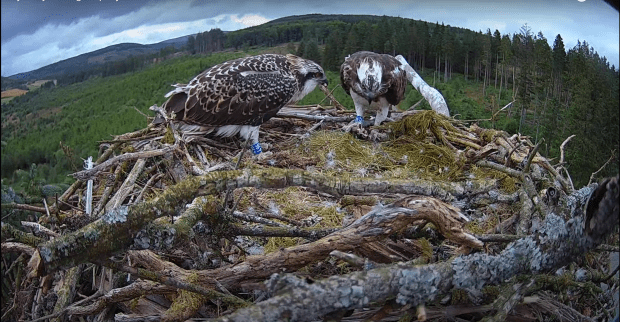
Sunday in Bird World

Today it not just about Ospreys. There have been some nests that have been overlooked lately so I am going to try and catch up on some of those for all of us.

I love how the wildlife rehabbers go to great lengths to make certain that the babies they rescue do not imprint on humans. Have a look at an eaglet that came into care and how it is being fed:

https://fb.watch/v/1NOZVD1I5/

The female White Storkling at the nest in Mlady Buky, Czechoslovakia is ready to fledge! Look how beautiful she is with her wings spread. She looks like a dancer bowing to her audience. She was making all the right moves this morning. She began flapping her wings as the sun was rising and got very enthusiastic around 6am. She is restless and continues flapping and looking out to the world beyond the nest.

Father Stork comes in to feed the three youngsters. This generous community continues to provide supplementary food for Father Stork so that he and his three babies can survive. You can see, in the background, Father Stork eating from the fish table that is provided to him and his family. Sadly, their mother was killed on one of the electrical lines and these three are alive today because of this community. It is heart warming to see that the storklings are ready to fledge. Everyone can be so proud of their efforts!

The Bucovina Golden Eaglet, Zenit, grabbed the prey delivery from Mom and completely self-fed today for the first time. Zenit mantled and flapped all the while telling Mum to go away he could do this himself. Wow. Another milestone to independence. Lady Hawk caught this magical moment in a video:

There has been a lot of discussion about goshawks lately because they have raided and killed many Osprey both in Latvia and an eagle in Spain. There is a Crested Goshawk nest in a park in Taipei. The adults failed at their first breeding attempt and had one hatch on their second. The eaglet is three weeks old. So cute.

Crested goshawks live in Asia. Their territory is from the Indian subcontinent to Taiwan. In terms of its range and numbers it is of ‘least concern’. It is, however, a protected species in Hong Kong because of the encroachment on its forest environment. The hawks are now adapting to urban living. The Crested Goshawk is 30-46 cm in length or 12-16 inches. Like other raptors, there is reverse sex size diamorphism – the female is larger than the male. They feed on insects, birds, and mammals. The nest is normally made of sticks in a tree and most often the female will lay between two and three eggs.

The image below shows a Crested Goshawk Female. Look at that gorgeous plumage.

“鳳頭蒼鷹 – 雌鳥 Crested Goshawk (Female)” by alexwhite21 is licensed under CC BY-NC-SA 2.0

In size comparison, the Northern Goshawk that has caused issues related to the death of the Osprey chicks in Latvia and Spain is approximately twice the size of the Crested Goshawk. Each species has a long tail and shorter broad wings to help them speed around the forest area where they hunt. They are more adapt at living in the forest and often lure their prey into that environment.

Here is the mom in her nest with her eaglet.

The eaglet has been ringed with two official bands.

The eaglet will fledge in 2-3 weeks. You can watch this little one grow up here:

Now let’s check on some of those Ospreys!

Foulshaw Moss. Tiny Little is still moving in to get fed. I have seen some people worrying about him but, honestly, this little one is going to be grand. At tea time on Sunday, 464 was self-feeding. Self-feeding is hard work and the chicks spend a lot of time and energy fighting with the bones in the head. They get tired. So when 464 finished eating, Blue 35 took over and fed Tiny Little and Middle Bob.

In the image below, 464 is self-feeding. Mom, Blue 35, is waiting and it is Tiny Little stretching his wing. As we will all be saying, Tiny Little isn’t so Tiny anymore. And that is a good thing!

Blue 35 has taken over the feeding and, of course, Tiny Little is right there for the bites! Tiny Little and Middle Bob have always done well together. It is really good that 464, the big female, fledged first. It is hard to imagine but a couple of days ago Tiny Little looked like an extremely young chick. Now, unless the bands are visible and you follow the chicks it is hard to tell them apart. Now that is magnificent and it shows precisely what getting a good feeding means to these chicks.

Dyfi. Right now it is pitching down rain. Earlier it looked like Dysynni was hovering so high that he was going to fledge – but, he didn’t. Ystwyth is in awe! Dysynni is 52 days old today and Ystwyth is 48 days.

I imagine that Sir Richard Branson whose Virgin Galactic’s Unity Spaceplane took off from Spaceport America this morning successfully returning to Earth from space would really like to fly like a bird. Laura Culley, falconer and great mind, told me once that humans have the DNA for feathers and flight we just haven’t turned them on. Any geneticists out there to confirm that?

And then the rains came and Idris delivered a really nice fish that Telyn is feeding the nestlings. No more thoughts of fledging today!

Poole Harbour. Both CJ7 and Blue 022 were at the nest at Poole Harbour today. They continue bonding. There is at least a month or six weeks til they head off on their migration. Let us all hope that this lovely new couple return in late March or early April – both of them – and entertain us with their antics while raising chicks.

Clywedog. Oh, it is wet and miserable at this nest in Wales today. Only Bob looks pretty miserable.

Never fear. Dylan went out and got a nice perch for Only Bob’s (Blue 496) tea time treat. Seren is happily feeding her little one. Soon Only Bob is going to be thinking about fledging too.

Look at Dylan’s strong thin legs. The other day he flew 13 km to get a trout for his family’s dinner. Thanks John Williams for confirming that distance!

Loch of the Lowes. It is raining in Scotland, too. NC0 is on the nest feeding her nestling and her fledgling their tea time meal. NC0 has been flying with Fledgling Bob over the loch. It will be wonderful to see her spend time flying with both her babies once Second Bob has fledged. NC0 has become a very good mother. She struggled at the beginning with the feeding and many thought that Second Bob would not survive and perish like little third Bob. But, look at these two now. Fantastic. NC0 really came into her own. Laddie has done his part, too!

Are you interested in France’s plan for their Osprey and White Tailed Eagles? If so, Stephanie Scofield posted the French government’s document on the Ospreys (Pandion haliaetus) FB page. If you cannot read French, have a look anyway. The graphics are very helpful. Here is that report:

Thank you so much to the person who forwarded me an image of Z1, Tegid. I do not know who to credit for the image so thank you to that individual. I hope you do not mind my posting it today!

I am so grateful to my friend ‘T’ for telling me about this brave little osprey. As many of you know, I am setting about on a ten year plan to follow the osprey hatches that were beaten and battered and deprived of food but, who made it despite all the odds against them to fledge! I want to see how their lives unfold. Sadly, many like Tiny Tot on the Achieva Osprey nest are not ringed and most are not seen on camera. So my list is short. It includes Z1 Tegid, JJ7 Captain, Tiny Little Bob Blue 463, and Tiny Tot. If you know of others please alert me. You can leave me a comment or send the information through e-mail (maryannsteggles@icloud.com). It is much appreciated.

Here is Tegid. He has a nest with chicks for the second year in Snowdonia in Wales! Look at those strong little legs, too.

It is a soaring hot day on the Canadian prairies. The birds are really enjoying the water dishes and baths – they are keeping us busy filling them. I am taking a break from cleaning my tiny home office. It got stuffed with all manner of everything during the pandemic and now it is time to get that sorted. It is so nice, like now, to stop and check in on our friends with feathers!

Thank you so much for joining me and thank you for all the letters, comments, and pictures. I love hearing from you.

Thank you to the following for their streaming cams where I take my screen shots: Scottish Wildlife Trust and Friends of Loch of the Lowes, CarnyX Wildlife and Clywedog Ospreys, Dyfi Osprey Project, Poole Harbour Osprey Project, Cumbria Wildlife Trust and the Foulshaw Moss Osprey Nest, Crested Goshawk Nest Cam in Taipei, and the Mlady Buky White Stork Nest Cam.

Oh, Tiny Little….and friends

I thought I would check on the Foulshaw Moss Osprey Nest in Cumbria. That streaming cam does not have a rewind and so it is hit or miss as to what the chicks are doing. All three were on the nest and Blue 35 was feeding them. And bless his heart, Tiny Little was right there getting many bites – lots. It was magnificent. He was pecking for bites at Blue 35’s beak before she was ready!

Blue 35 is finished feeding in the image below. Honestly, if you can’t see the bands it is getting difficult to tell which chick is chick. Can you believe it? Tiny Little looked like a mere babe two days ago!

Blue 35 gave 464, who waited patiently without being a nuisance, the skin and the fish tail. Tiny is not taking his eyes off of that tail! 462 has moved up to the front where she is moving a branch. All Tiny Little wants is that fish tail!

Then 462 gets rather exciting and starts doing wing exercises. Tiny Little is still staring at the fish tail.

Tiny Little ducks when 462 starts flapping but his eyes are locked in on that fish tail, still. 464 seems to be having trouble eating. Tiny Little is probably saying, “Let me have a try!”

462 got some good lift. I thought she was going to fledge but she didn’t. I don’t think Tiny is next. To me his tail is not long enough! Tiny Little isn’t so Tiny anymore – almost overnight this third hatch changes. He is going to bed with a nice crop. Well done, Tiny ‘Not so’ Little.

Fledgling 464 left the nest and Blue 35 returned. She moved over and found the fish tail and some fish and just guess who was right there beak to beak wanting some more dinner!!!!!!!!!!!!!! This is why Tiny Little is not so Tiny anymore.

It is very interesting. There were individuals who thought that Tiny Tot on the Achieva Nest would to be doomed once the older siblings started self feeding. You know – we need to give these Osprey mothers some credit. They try and make sure everyone is fed. Tiny Tot blossomed before our eyes at Achieva once the other sibling 1 and then sibling 2 were flying – and it looks like having one off the nest (sometimes) at Foulshaw is helping as well.

I reported that one of Monty and Glesni’s chicks, Merin, was breeding in the Lake District. Emry Evans posted some images of Merin and his beautiful daughters in his blog. You can have a read and see the lovely images, too. If the link does not open automatically, do the old cut and paste method. You should also be able to sign up for Emyr’s blogs at the bottom if you wish to do so. Emyr includes a very helpful family tree on his blog today.

http://www.dyfiospreyproject.com/blog/emyr-mwt/2021/07/07/merin-breeding-england?fbclid=IwAR1X6b1Qy5bYFNfXyFVgib_ah941eRBYXjaumRJsAZxMexV5xIGLknUz9wg

Janet Sampson is working on a very nice chart of the Rutland relatives in Wales. She has not polished it off completely but she said we can share as long as we give her credit. So thank you Janet Sampson! This is really brilliant.

Someone sent me a note and asked me if I had a favourite Osprey. Oh, my goodness. That is a difficult question to answer. So let me tell you a story first and then I will try and answer this for you.

I have always wondered what makes a ‘great’ Osprey. I have, in fact, praised the two nestlings daughters of Merin’s as being the most beautiful osprey chicks I have ever seen. Their picture is in Emry’s blog. That led me to wonder if it is performance or appearance or both. So, in that wonderful chat the other evening with Tiger Mozone, I asked him what makes a ‘great osprey’. {Tiger has an encyclopedic mind on Osprey history and Ospreys}Tiger answered with a question: “What do you know about horses?” “Well, some”. At one time I lived on an acreage and there were five horses. Had I heard of Northern Dancer was Tiger’s second question. I ask you, is there anyone who hasn’t heard of Northern Dancer? So there was my answer. Performance. Then one day my friend ‘T’ and I were chatting. If we came back in another life as an Osprey female who would we want our mate to be? Now there is the heart of the answer to my original question. I knew that ‘T’ would say Monty. I am actually quite fond of Blue 33 (11). Today I realized for me it would be a toss up between Blue 33 (11) and Idris if I were ever to return as a female Osprey….of the choices currently available. They perform for their families. These are the guys – Monty, Blue 33, and yes, Idris will prove himself – that get the fish out of the water and on the nest. There are lots of fish. Someone said today they thought that Idris could feed a four chick nest. I think he could, too and I think Blue and Monty could as well. Take good care of the females and the chicks, fledge those babies, and then have them return to breed successfully. That is a ‘great’ Osprey. I think Tiger might agree. Of course, every great male needs an equally great female. Nora, Glesni, Telyn, and Maya are doing fantastic. So think about your favourite Osprey.

There is Telyn feeding Dysynnis and Ystwyth late today. But this appears to be a first —— Telyn caught the flounder and brought it to the nest for the chicks! Yippeeeee.

Ferris had a great tour today. These are a few shots from the beginning to end.

There were two Green Herons along the drive.

When Ferris got to the Cornell Campus, he spotted K3 right away on top of the Rice Building.

Looking for K1, there was a lovely Mourning Dove family in the trees around the Fernow Building.

Big Red was up on Bradfield. Word came to the group that she had delivered prey to both K1 and K3 just a little earlier so they are both full and not food begging.

Isn’t she beautiful? She is already beginning to moult. In a week or so we will call her Big Blonde!

There she is again, same place.

Ferris looked in the pines. He could hear Robins vocalizing and thought K1 might be around. What he found was a lovely very young Robin. Oh, I wish this little one would hide! Those hawks would like you for breakfast – maybe. Robin is not their favourite treat for sure.

K1 was discovered on one of the light towers.

And then something happened and K3 came to join K1. K1 is on the top left and you can just see the little duckling, K3 laying flat out.

Arthur has joined Big Red. All four hawks are accounted for and they are fine. Good night Big Red, Arthur, K1 and K3. Have lovely hawk dreams.

That is it for a late Saturday evening. It is once again in the 33-34 C range on the Canadian prairies. The birds are draining the water bowls every couple of hours.

Thank you so much for joining me. Take care everyone and oh, tomorrow my blog will appear in the late afternoon or early evening. I have promised myself to clean out my office for several months —— it is now time! Stay safe.

Thank you to the following for their streaming cams where I get my screen shots: Ferris Akel Live, Cumbria Wildlife Trust and the Foulshaw Moss Osprey Nest, and Bywyd Gwyllt Glaslyn.

Late Friday and early Saturday in Ospreyland

There is news in Ospreyland, some good and some not so good. I am going to start with all of the good news.

Those who follow and read about Ospreys know that there are certain ‘truths’ that are held dear. These ‘truths’ get passed down through books, Websites, and conversations. One of those is that a male fledgling will ‘always’ return to its natal nest area on its first migration ‘home’. The question is how true is that statement? Is it 90% true or 80% or with all of the unringed birds is it even 50% true? There are always exceptions! It was reported today that Rutland’s Maya and Blue 33’s 2015 male chick S2 has been breeding in the Biesborch National Park in The Netherlands for the past two years. In 2020 S2 and his mate fledged three chicks and in 2021 they have two in the nest. Fabulous news.

Male 022 has been courting CJ7 since he first returned as a two year old from his first migration. Initially, this young male wasn’t quite sure of the ‘process’. What he didn’t know he made up for in enthusiasm. Could he hear everyone shouting “Bring her a fish!” Sometimes he would bring a fish but he would not share. Sometimes he shared. Meanwhile they were mating all over Poole Harbour – seriously, they were. 022 has certainly grown into understanding his role. He has been working on the nest with CJ7 and today he brought her a fish and gave it to her to enjoy – a gift. How sweet. He has done a sky dance for her and now we watch and then we will wait for next spring when everyone hopes that these two will be a couple and raise some chicks. 022’s sky dance was the first seen in 200 years in Poole Harbour. Oh, please let this couple have a nest of healthy chicks next year that fledge! Poole Harbour might announce a holiday in their honour.

The eldest chick has fledged at Foulshaw Moss, Blue 464. The others look surprised! Who will be next? That special moment was caught here on a short video:

Tiny Little has been doing a lot of wingersizing. Will he be next? He is doing a great job and I know that he is going to grow up and be as strong and fierce as Z1, Tegin.

And Tiny Little is clever, like Tiny Tot in the Achieva Nest. Today, he sniffed about and found a piece of leftover fish that the other siblings had forgotten. Tiny Little had a nice little self-feed over in that front corner. He is a survivor.

You can see that he is still Tiny but not as tiny as he once was! What a little cutie. In addition, his eyes are fine. There were some early issues, perhaps from one of the older siblings pecking him about but all seems fine now. Tiny Little is in the clown feet stage!

White YW brought in a nice fish for Blue 35 for breakfast. Guess who was first in line? You got that right – Tiny Little! Go Tiny Little, Go!

Everyone ate and had nice crops and Mom even got the fish tail.

At Loch Arkaig, there appears to be a new couple working on bonding. YP and Blue 152 have been bringing in moss and sticks to add to what Louis did in the early spring while he waited for Aila. It will be grand to have a couple in this nest next year although I have to admit that I wish it were Louis and the new Mrs Louis.

After the heat and the storms the two Osprey nests in Albert, Exshaw at Canmore and the nest at Red Deer appear to be doing well.

This is Exshaw this morning. It is a sunny dry day and the chicks are sleeping after a 5:35 am breakfast.

Legacy is doing fine, growing like a bad garden weed, down in Red Deer:

Good news coming in from Loch of the Lowes is that the first fledgling has returned to the nest and taken its second flight with mom, NC0. The first fledgling at Foulshaw Moss, has also returned to the nest. Well done!

Now for some of the sadness. The concern in Canada’s West is the growing number of wild fires active in the province of British Columbia. Last week 330 were added to a growing list of over 780 fires. The impact on wildlife now and in the future is alarming not counting, of course, the human and property cost. The province desperately needs rain and lots of it.

News has come to me from my friend, ‘T’ that goshawks have taken the lives of two banded Osprey chicks in a single Latvian nest and another chick at a nest in Spain. This is so very, very sad. The chicks were big – already ringed – in earshot of fledging.

“Goshawk” by Andy Morffew is licensed under CC BY 2.0

‘L’ has reported that a fledgling Bald Eagle was killed when it landed on a power line in Dayton, Ohio. This is so very sad because we have known for decades the problems with power lines. There could be a silver lining to this story – the community has spoken to the local power company and they seem willing to do something to their poles so that these tragedies will not happen again. Let us hope that they work fast. There are other fledglings in that nest! Indeed, every power line needs to be ‘bird friendly’. This should be standard practice.

Thank you for joining me on a sunny and going to be crispy hot Sunday on the Canadian Prairies. The news in my garden is curious. After the extreme heat wave, the number of birds at the feeders seems to be less. Strange, however, is the now regular appearance of a dozen or more Blue Jays. We always had 3. Mr Crow and family are not happy about the Blue Jays but they won’t enter the yard to try and escort them away. Perhaps the number of Blue Jays has driven the other birds away — except for Mr Woodpecker and baby. The tiny Downy fledgling was here yesterday! They are always so quick and gone by the time I have grabbed my camera.

Take care everyone. I hope to have news of Big Red, Arthur and the Ks this evening. Stay safe, stay cool. See you soon.

Thank you to the following for their streaming cams where I get my screen shots: Fortis Albert Red Deer Osprey Nest, Fortis Albert Exshaw Osprey Nest, Cumbria Wildlife Trust and Foulshaw Moss Osprey Nest, and the Scottish Wildlife Trust and Friends of Loch of the Lowes.

Alan Poole’s talk on why Ospreys are special and some other news tidbits from Ospreyland

LR1 at Loch of the Lowes fledged! Only one more to go for NC0 and Laddie (LM12). Here is the big moment:

John Williams has been trying to figure out where Dylan is getting his nice trout for the Lyn Clywedog Nest. Today, our sleuth detective, reports that an unringed male was seen leaving Nant y Moch Reservoir at 9:55 carrying a fish. The bird was flying in the direction of Llyn Clywedog. Williams watched the streaming cam and sure enough Dylan landed 25 minutes later with a trout on the nest for the Only Bob. I am certain Seren Blue5F was pleased too.

We know that Dylan is going to go as the crow flies – straight from Nanty-y-Moch Reservoir to Clywedog. But, wow. That is a good distance to travel for trout! Apparently there are too many people fishing for trout at the end of the Clywedog Reservoir and that could be the reason he is travelling so far. I am in awe.

Here is Seren Blue 5F feeding Only Bob that lovely fish:

I wanted to bring Blue 5F up today so you can see how well she is doing on this nest at Clywedogs with Dylan. Look at that lovely chick! I had a fantastic conversation with Tiger Mozone late last night. We talked about all things Osprey but one thing that Tiger mentioned early on is that Ospreys are not bonded to one another for life. It might appear that way and you have read over and over that they “bond for life”. Tiger had so many examples that it made perfect sense that they do not. So here is the thing with Blue 5F. Blue 5F hatched in Rutland in 2012. Chris Wood regularly sees her at the Tanji Marsh in Africa where she winters. She came to Glaslyn in 2015.

Aran, the mate of Mrs G, took a liking to Blue 5F and they mated in 2015. Eggs were laid on the Traeth Glaslyn Nest but as the Glaslyn Osprey News notes, “once the chicks hatched on the Glaslyn Nest he gradually lost interest” in Blue 5F and the future of their eggs. According to Glaslyn records and Tiger this went on for four years! I really hope right about now you are thinking about Iris and Louis. But, Blue 5F decided she didn’t like that arrangement so, she left! And she found the nest at Llyn Clwedog in 2020 where she is quite happy. Last year her and Dylan raised three male chicks to fledge when his regular mate did not return. This year they have the Only Bob! Give the girl a hand of applause! The entire issue of Aran and Blue 5F brought in discussions of how close nest platforms should be to one another. It might well be that they want to look into this again at Glaslyn. I am not entirely sure that the blue banded bird after Aran at the Cob was not Z2 Aeron from the Pont Croesor Nest. Time will tell if Aeron Z2 is trying to take over the Glaslyn territory.

Alan Poole, the author of Ospreys. The Revival of a Global Raptor did a 45 minute YouTube talk with nice visuals on Ospreys. It is definitely worth watching – you will learn something. You can stop and start!

Thanks for stopping in. I hope that you have a lovely weekend. Take the time to listen to Alan Poole’s talk. I think you will really enjoy it.

Thank you to the following for their streaming cams: Llyn Clywedog and Carnyx Wildlife. Thanks to Tiger for the great conversation and to John Williams for tracking the travels of the trout!

Friday Morning in Bird World

Have you ever started looking for something and found something else, equally as interesting? As it happens, yesterday I was looking for a short film about a Japanese man living in Hokkaido with his falcon. What was found was a new film released on 1 June 2021.

The documentary is the story of the only African American falconer, Rodney Stotts. Stotts says falconering for him is all about second chances – for people and for the birds. Have a look at the trailer for The Falconer:

Yesterday there seemed to be no news in Bird World and then there was. Do you follow the Welsh Osprey Nests? If you do, you will recognize the name Aran immediately because he is currently Mrs G’s mate. Aran injured his wing (primary flight feathers) at the end of May or beginning of June. He had been battling crows around the nest and then the storm came. No one knows how he got his injury. No one saw. But he was unable to provide fish for the nest while Mrs G was hatching the chicks. The volunteers and people of Glaslyn set up a fish table for Aran and Mrs G. They lost their chicks and both have been rebuilding their strength.

Yesterday, Aran was in a ferocious battle with a blue ringed bird a distance enough from the nest that it caught the attention of Elfyn Lewis of the Glaslyn FB group who posted the following image that made the rounds of several groups so I am reposting it here. Aran is the bird on the bottom. The white is the injury he sustained earlier. Are there birds attempting to usurp Aran from the Glaslyn nest? Always it would seem.

@ Elfyn Lewis

Other news comes out of Hawaii. The State of Hawaii bans the release of ‘Albatross Killing helium balloons’. It seems they are not banning the balloons but the intentional release of them. Here is that announcement through the AP:

https://apnews.com/article/hawaii-environment-and-nature-government-and-politics-fb9c1cd959ffaad608f08610be548428

What child does not love a balloon? and how many young women did I see lined up at a shop with balloons in hand for a party the other day? The question is how to dispose of them properly — and it isn’t sending them off in the air with wishes attached! Release the air, put them safely in a scrapbook, etc. Or eliminate balloons from festivities altogether. It is not only the helium balloons that injure the birds, it is also the normal ones that blow away in the wind. It is a good way to educate your children about the many challenges the birds face and that balloons and strings can kill them.

Speaking of Albatross, the Royal Cam chick, Taiki, is now 165 days old (nest time). On 5 July she weighed 8.3 kg or 18.3 lbs. She will be stabilizing her weight so that she can fledge in mid-September. Her dad, Lime-Green-Black (LGK) has now travelled over 42,000 km or 26,000 miles in total since he received his satellite tracker in February to feed his precious chick. (The mother is alive but her tracker stopped working).

It is still two months until Taiki fledges in mid-September. She is just getting her beautiful black wings, she is building play nests, and the parents are flying in to feed her. It is all very interesting and it is such a calm nest to watch. The Rangers weigh all of the chicks on Tuesday morning and that is fascinating to watch also. Humiliating for such a beautiful girl to be stuffed in a laundry basket but – it is necessary. Supplementary feedings are given should any of the chicks require it. NZ really takes good care of their birds! As North American streaming cams wind down for the breeding season, why not have a look at some of the amazing birds in the Southern hemisphere?

Taiki stretches her wings and flaps them to help them get strong.

Here is the link to the Royal Cam chick on Taiaroa Head New Zealand:

Lady and Dad will be on hatch watch in about two weeks time. This is the only White Bellied Sea Eagle Cam in the world. These beautiful birds are the second largest group of eagles in Australia. The nest is in an old Ironbark Tree in Sydney’s Olympic Park. It is not always an easy nest to watch because their can be sibling rivalry but the sea eagle chicks are so cute and the juvenile plumage is simply gorgeous.

If you are a lover of Ospreys, there is still plenty of action in the UK nests where the nestlings have fledged or are getting ready to fledge. They will be around for another five weeks or so until they leave for their migration to Africa.

In Australia, the Osprey couple on the barge in Port Lincoln have just finished lining their nest with soft materials and the streaming cam is now live. These are the parents of Solly and DEW. Solly is the female Osprey with the satellite tracker. This is also not an easy nest to watch because of siblicide.

There are two falcon cams in Australia. One is on year round and the other, the CBD Peregrine Falcons in Melbourne, will start once the falcons are back in the scrape box. Here is the link to Xavier and Diamond’s scrape box on top of the water tower on the campus of Charles Stuart University. No one knows what will happen this year. The couples’ 9 month old son, Izzi, still continues to come to the scrape box and might even believe it is his own home. In the UK, chicks from an earlier hatch have helped the parents raise their new brood. In Australia, we watch and wait!

In Eastern Europe, there has been some concern over the amount of prey being brought in to the little Golden Eaglet in Buconovia, Romania. Lady Hawk was able to capture the delivery of a hare by the father and a really good feeding yesterday. That is excellent news! When the camera was first installed he was afraid of it and he is becoming more comfortable day by day.

That’s it for Friday. The Achieva Osprey Nest has not return visit from Tiny Tot and Electra is at the nest less and less. The Canadian chicks in Alberta seem to be doing fine as is Kindness up in the Glacier Gardens Bald Eagle Nest. Fingers crossed for continuing good health to all the birds.

Thank you for joining me today in Bird World. Have a wonderful Friday. Take care, stay safe.

Thank you to the following for their streaming cams where I take my screen shots: Port Lincoln Osprey Project and the Cornell Bird Lab and NZ DOC Albatross Cam.

Bird Tales

Wow. I just want to sit and watch this short video over and over again. If you know someone who tells you that Ospreys are not intelligent and cannot problem solve, please show them this video of an Osprey nest in Vaasa, Finland:

https://fb.watch/6Da1-VNcEo/

I am going to recommend a lovely little book. It is called Hawk Mother. The Story of a Red-tailed Hawk Who Hatched Chickens by Kara Hagedorn.

The book has won outstanding awards for science for youngsters; I would say ages eight to twelve, elementary to the lowest level of middle school. My copy arrived in the post this morning. It is the true story of a Red-tail Hawk that was shot, would never fly, and was adopted by a zoologist that worked with the Cornell Lab. You can read more about their journey together on the website for Sunshine – that is the name of the Red tail hawk. That address is http://www.sunshinehawk.com Have a look.

You can purchase the book directly from Kara Hagedorn, the author and carer of Sunshine. It is also available through other on line outlets. It would be great for teachers or family who want to get children interested in birds. The images are photographs that Kara Hagedorn took of Sunshine. It is inspirational. Have a look and if you like the book and feel so inclined, recommend it to your local library. Hagedorn uses the proceeds to pay for the care of Sunshine.

Speaking of the adoption of Red-tail Hawks, I will mention again a book for adults, A Wing in the Door. Life with a Red-tailed Hawk. It is by Canadian Peri Phillips McQuay who took on the care of and rewilding of a hawk. Well written with great anecdotal stories. Find a used copy – your pocketbook will thank you. I ordered mine from amazon but went to the options so that I could get a used copy. I have no idea why the new price is so astronomical – avoid it at all costs!

And, of course, the best way to save money and space is to order through your local library. Ours will bring in books if they do not normally have them in stock.

When you finish reading the book, you will want to find out what happened to Merak. Go to Peri Phillips McQuay website and she will tell you!

I promised that I would post Ferris Akel’s Tour from Saturday, 3 July, once it was processed by YouTube and here it is. This is a full day tour that has been edited down to approximately 3 hours and 25 minutes. The Red-tail hawks on the Cornell Campus start 1:38:35 if you want to skip ahead. It starts with Big Red on the lights. There are some incredibly cute clips of the Ks preening and kissing one another!

There is not a lot going on in Bird World today. And that is a good thing. There was way too much drama when we had the storms and the extreme heat last weekend.

They continue to band ospreys in the UK – working flat out before they get too old and near fledge. Indeed, fledge watch is on for the Dyfi Nest of Idris and Telyn. Dysynnis, the male, is 49 days old today. Ystwyth is 45 days old. The chart for fledge times was also posted for that nest. Here is that information:

I love data. Just look at all that wonderful information! How many of us have been frustrated to go to a nest and not even have a history! Personally, if there is to be a streaming cam someone should take the responsibility of keeping accurate records and post them in the information section below so subscribers can see it. It would also help to have knowledgable moderators. Moderators are volunteers – they are not paid. They give up their time – a lot of it -to help us learn more about the birds. Histories and moderators would help citizen birders gain knowledge.

Nestlings such as the Two Bobs on Loch of the Lowes are just itching to fly so we are going to see some more fledging this week. They still love to have NC0 feeding them, though. Two big babies – look at the size of them – at the Loch of the Lowes! Laddie and NC0 did a fantastic job raising these two this year.

Others, such as the Two Bobs on the Manton Bay Nest, have fledged and are honing those wings while returning to the nest to eat. Blue 096, the female, has returned for a nice piece of fish this evening.

My goodness. Both of the parents at the Glacier Garden’s Bald Eagle Nest in Juneau, Alaska love to feed Kindness. I counted nothing short of six feedings yesterday!

When Kindness is finished eating, she looks like she is going to try out for The Hulk role in a new movie. It is a good things crops stretch! She is just now learning to stand and making attempts at walking. It is so sweet to watch her.

That is it for today. Thank you so much for joining me. Take care and let’s all hope that the nests just remain calm.

Thank you to the following for their streaming cams where I grabbed my screen shots: Scottish Wildlife Trust and Friends of Loch of the Lowes, Glacier Gardens Bald Eagle Cam, LRWT and the Manton Bay Osprey Nest.

White-Bellied Sea Eagles and the birds that visit their nest

In a 2014 article in The Smithsonian Magazine, Rachel Neuwer asks why there is a Sulphur Crested Cockatoo in a Renaissance image of the Virgin and child, Madonna della Vittoria. Rebecca Mead examines the image by Andrea Mantegna, painted in 1496. You can see the painting of the Madonna and child with saints in the article below (sorry, it has a copyright so I can’t show it). The Sulphur Crested Cockatoo is above the Virgin’s part in her hair a little to the left.

https://www.smithsonianmag.com/smart-news/why-there-australian-cockatoo-italian-renaissance-painting-180950227/

As I drank my morning coffee several days ago, I flipped through the latest New Yorker. In that 5 July edition, there is an article, Invasive Species.

https://www.newyorker.com/magazine/2021/07/05/where-did-that-cockatoo-come-from

Each writer considers how the Sulphur-Crested Cockatoo made its way from AustralAsia all the way to Italy focusing on the initial discovery of the bird in the painting by Heather Dalton, a British historian living in Australia.

The Mantegna is not, however, the first time that a parrot is included in a picture. Parrots show up in the murals of Pompeii, the Italian city buried by ash when Mt Vesuvius erupted in 79 CE. They are also the subject of floor mosaics in the region. Indeed, exotic birds (not just parrots) appear as subjects in many mosaics and frescoes in the Roman domus.

Alexander the Great’s army went as far as parts of India before stopping on their eastern expansion of his empire. Their presence on what is today the Indian subcontinent heavily influenced the art of the Gandharan region. In turn, Alexander acquired a parrot from the Punjab in 327 BCE. If parrots were in Italy 1700 years before the Mantegna, one might begin to ask what is all the fuss? The Barber Institute of Fine Art in Birmingham, England hosted an exhibition solely on parrots in art in 2007. They were exotic, they were status symbols, and it appears that they were present in the art of the Italian Peninsula for some 2400 years to today. Of course, they were not all Sulphur-headed Cockatoos and that could well be the reason for the continuing discussion about the Mantegna. Other species of parrots came from the southeastern coast of Africa and from the region of the Indian subcontinent and Southeast Asia. Sulphur-Crested Cockatoos originate in Australia and the islands of Indonesia and it was surely the trade through the islands of Indonesia that spirited the bird all the way to the port of Venice along with black peppercorns and other spices.

“20121210 Sulphur-crested Cockatoo (Cacatua galerita) – a first-time visitor” by Degilbo on flickr is licensed under CC BY-NC-ND 2.0

Sulphur-Crested Cockatoos are extraordinarily beautiful and are the largest of the white parrots. I have never seen them in the wild. Indeed, it was not until I watched the White-Bellied Sea Eagle streaming cam in the Sydney Olympic Park that I heard them before I saw them. It sounded like someone being murdered in the forest! Seriously. One of the moderators answered the question, “What is that?” Later, these lovelies were seen climbing all over the old Ironbark Tree.

Sulphur-crested cockatoos are nut, root, and fruit eaters and live for up to eighty years. They make their nests in tree hollows where the female lays one to three eggs. Those eggs are incubated for thirty days. The little ones remain in the nest being fed by the parents for a period of approximately sixty-five days after hatch. The breeding season for these parrots is August to January in the Southern Hemisphere.

Why am I talking about these parrots today? It is because of the White-Bellied Sea Eagles (WBSE), Lady and Dad. The two eggs that Lady has been incubating will be hatching in approximately two weeks. There is a live streaming cam that is on day and night, 24/7 year round except for maintenance. If you like birds of Australia, you can often see them coming and going around the Sea Eagles nest. The birds are either curious as to what is going on in the nest or they would like the Sea Eagles to leave! The streaming cam in the Sydney Olympic Park is the only one in the world that observes the second largest eagles in Australia.

It is in the middle of the night. This is the WBSE nest in the Ironbark Tree in the forest of the Sydney Olympic Park.

The Rainbow Lorikeets are curious. They come as a group climbing all over the branches of the tree. They are easy to spot!

“rainbow lorikeets” by cskk is licensed under CC BY-NC-ND 2.0

Every once in awhile the Galahs come to the Ironbark Tree. I think they are adorable. One of the WBSE chatters from Australia said that if anyone visits Australia and someone calls them a ‘Galah’, it is an insult meaning the person is not very smart. I have no idea how the Galah got that reputation except that I have seen several in the talons of Peregrine falcons in Australia.

“Galahs in Love” by David Cook Wildlife Photography is licensed under CC BY-NC 2.0

The Noisy Miners are definitely heard before they are seen. They are a constant in the forest around the WBSE Nest.

“Noisy miner (Manorina melanocephala) (24 – 27 centimetres)” by Geoff Whalan is licensed under CC BY-NC-ND 2.0

The Pied Currawong flits around the WBSE nest all the time. I do not like them! Once the nestlings have fledged the Currawongs gather and try to chase them out of the forest. They did this on the first try with WBSE 25 last year and during the re-fledging of WBSE 26.

“Pied Currawong” by Tatters ✾ is licensed under CC BY-SA 2.0

Then there is the smallest owl in Australia, the BooBook. Isn’t it cute? This owl, like all others, flies silently and it can see very well in the dark. It comes in the night hitting the WBSE has they roost for the night. They fly low over the nestlings trying to hit them and make them leave. One attack injured Lady’s eye last year. Despite their size they are to be taken very seriously. The BooBook often has a nest in the forest the same time as the WBSE so it is very protective and wants the eagles gone for fear they will eat its young.

“Boobook owl” by jeans_Photos is licensed under CC BY 2.0

Here is a compilation video of Lady and Dad after the first egg was laid through the 23rd of June. It shows the actual labour of the second egg and a changing of the incubation shift from Lady to Dad.

Here is the link to watch the WBSE in the Sydney Olympic Park:

https://www.twitch.tv/seaeaglecam

Be sure to check out the time difference. One of the most beautiful moments of the day is when the adults do a duet at sunrise. It is an amazing way to start the day. It wakes up the forest but it is also a continuous bonding method between the birds. The nestlings will join in with their parents when they are older. It will warm your heart. Here3 is a video clip I made after Lady laid the first egg. She leaves the nest and joins Dad on the branch for the singing.

Thank you for joining me today. It is now three days since Tiny Tot was at the nest. We are all having Tiny withdrawal. Take care everyone.

Thank you to the WBSE Streaming Cam, BirdLife Australia, and the Discovery Centre and Twitch TV where I took my screen shots and video clips.

A surprise visit to see the Ks

I was not expecting to see a notification that Ferris Akel was on the Cornell University Campus in Ithaca this evening. What a wonderful surprise! The reason that everyone wants to see Big Red and her family is not to see spectacular things but, really, it is just to know that each and every one of them is safe and well. After the worry of Hurricane Elsa and the nests along the southwest coast of Florida, this was simply a joyful treat.

Ferris found K1 on a window ledge. How she got there is anyone’s guess. My goodness she is so cute. Whoever said that she is a mini-Big Red is so right. Her plumage is such a deep brick red and she has a full red-feathered belly band, too, with lots of peach on her chest.

Look at the image below. Notice the feathered area that extends above K1’s eyelid. It starts at the beak and goes to the back of the head. It is called the supercilium. The supercilium helps keep the glare out of K1’s eyes! It is often simply called a bird’s eyebrow.

Hawks can turn their heads 270 degrees. Sometimes it looks like they can do the complete 360 but they can’t.

You can see in the image below, despite it being blurry (rain at started), the peach on the chest and the low very dark feathers of the belly band.

The cere is the area around the nostrils above the beak. You can easily see it in the image of K1 above and below. It is light yellow. Notice that the eyes are a green-gray. When K1 is an adult they will be brown getting a deeper brown the older she gets.

Last year, Big Red and Arthur’s fledgling, J3, was born with deep brown eyes.

Ferris did some close ups of K1’s back so that we could see the scapular ‘V’. When both wings are held tight to the body it is the ‘V’ on the upper back. Examine K1’s scapular V. It has its own pattern. Some people use this along with the tail and the belly band to try and identify hawks that are not banded.

You can think of the scapular V as being the way the hawk’s back looks when the wings are closed.

K1 has a white terminal band on her tail feathers. In fact, it is rather wide. Notice the dark bands. When hawks fledge, we want them to have five, preferably six dark bands, so that they get lift and control and will be successful. K1 now has at least eight dark bands. We know that she is also an excellent flier.

The tail feathers help the hawk to do controlled manoeuvres. This is why it is so much better if they are longer at the time of fledge. The wing feathers – you can see the tips of them in the image below- are the most useful for flying. Did you know that the wing and tail feathers of the fledglings are actually longer than those of the adults? This is to assist them when they are learning to fly. After their first moult, they will grow in the standard length of an adult hawk (return to a normal length). Another interesting fact is that at the time of fledging, the feathers actually weigh more than the bird itself!

At the beginning of their second year, when they moult, the fledglings will get their red tails. When Big Red and Arthur bonded, Arthur did not yet have his red tail! Lots of people questioned Big Red’s intentions. She had many suitors but I think we can all agree that Big Red knew best. She has a wonderful mate in Arthur.

Ferris found K3 in one of the pine trees near to Rice Hall’s parking lot. What gave K3 away? Robins vocalizing!

K3 is looking at something intently.

K3 was doing a lot of preening. The preen or the oil glands are at the base of the tail. These oils reinforce or condition the surface of the feathers. Just like the oil you put in your car, the preen oil changes composition during the year. This oil, once it is exposed to sunlight, has been found to contain vitamin D.

Big Red was over on the ledge at Bradfield. I almost did not recognize her. In the summer when Big Red begins to moult, she starts becoming Big Blond. It looks to me like this process is starting.

But why do hawks moult? Feathers are made out of keratin, just like human fingernails. But unlike our fingernails, feathers do not continually grow. Once they are fully formed, they stop growing. Over time the feathers get damaged. This damage comes from normal wear and tear, the sunlight, parasites, and from injuries. These feathers have to be renewed. Hawks do not moult or change their feathers all at once. They would be unable to fly or function and would die. Moult is a gradual process. Big Red does not begin her moult during breeding season. It is too hard on her. The birds deplete their calcium producing eggs and Red tail hawks can lose approximately 20-30% of their body weight by the time the chicks fledge. Big Red will spend the summer and fall getting back into condition and replacing her feathers.

Feathers help the birds fly, they offer camouflage, and they also keep the birds dry.

Arthur was on ‘the throne’ on Bradfield. Neither Big Red nor Arthur moved from their locations during Ferris’s visit. Both Ks appeared to have a crop and neither were food begging. The crop is the first stage of digestion. It is like a pouch under the beak and the mouth. The crop expands with the food. The undigestables are rolled around in the crop to form a casting which the hawk throws up or ‘casts’. The rest of the food that can be digested enters the digestive system proper. The only raptor that does not have a crop is the owl. Owls have gizzards. If you watch Ospreys you will have looked to see if the chicks have crops. That way you can tell if they have had food recently.

It was an absolutely wonderful surprise. There is nothing nicer than spending the end of the day with Big Red and her family. I hope you enjoyed seeing them, too.

This is a great shout out to Ferris Akel. Thank you Ferris for taking your time to go and check on ‘the family’. It is wonderful to know that they are all fine and well.

What is gorgeous in Ospreyland?

This entire day has been ‘weird’. It started with only four hours sleep after checking on Tiny Tot’s nest all night. I have no idea what I was thinking. Tiny wouldn’t have flown from wherever she was just to be bounced about, would she?

And then there was the intruder on the nest. This intruder is just giving me a headache. I think I want Tiny Tot to show up on that nest so bad that I forget that there have been a number of visitors to the nest, several that Tiny Tot fought off valiantly. Still there is some kind of family resemblance.

This bird is still bugging me. It is nearly 4:30 pm. I know that I took a screen shot similar to the top one where you could see the white ‘V’ and the scalloped white of the crest making the heart. Tiny Tot had that. This bird has the thick short legs of Tiny and the sweep of the feathers is long BUT it is not elegant like Tiny Tot. The eyes are not the same. But then who knows what your eyes would look like after a hurricane.

This picture of Tiny was taken on 4 July the day before she ‘seemingly’ left the nest permanently for broader horizons. You will notice the white line above the wing is the same. Each of the birds have some dark on their legs, a little strip like a band but not a band.

And this is Tiny mantling her fish on 4 July.

Sadly, these birds are not banded and we only have images to compare that aren’t always sharp and from the same angle. What do you think?

Now, I think every bird is extraordinarily beautiful, but some more so than others. Today, the Dyfi Osprey Project posted an image taken by the individual who ringed two Ospreys in a nest in the Lake District in Cumbria England. They are females, Blue 460 and Blue 461. I took a deep breath and knew that I had to redefine what ‘gorgeous’ means when looking at an Osprey chick.

These are Monty and Glesni’s grandchildren. Their father is Merin. He hatched at Dyfi in 2015. They have Monty’s piercing orange eyes! Gosh I hope they do not lose them to become yellow. Look at the crest with the peach, the soft little white beards. I will be staring at these two beauties for days.

There are reams of files, both analog and digital, tracking UK Ospreys. And this again shows why it is important to get these birds banded. It is now known that at least four of Monty and Glesni’s chicks have returned to successfully breed. Of course, there could well be others. There is Aeron (Z2) who has been chasing intruders away from his PC nest at Glaslyn, then there is Tegid (Z1), one of my third hatch wonder children, who has a nest in Snowdonia, and Clarach in Aberfoyle, Scotland. Gosh, I would love to get a close look at the chicks of Tegid and Aeron!

Mama and Legacy were both asleep when I checked in at the Fortis Red Deer Osprey Nest.

There are both parents on the nest with Legacy yesterday. She is really growing now that the hot weather is gone.

There has been a lot of bad weather going around Alberta and there are dark clouds still around the Fortis Osprey nest at Canmore today. You can just see the two Bobs if you squint. Everything in the nests seems stabilized after a turbulent period of heat and storms. Warm wishes that it stays this way.

Here is a quick check in of a few of the nests. The Two Bobs at Rutland Manton Bay continue to perfect their flying skills after fledging. The Only Bob in the Clywedog Nest in Wales has been doing some wingersizes and the Two Bobs up at Loch of the Lowes are starting to think they might like to hover and fly. There could be a number of fledges coming up in the nest week. Mrs G has been catching fish and so has Aran. The overzealous two year old, Blue 022 has been bonding some more with CJ7 at the Poole Harbour Nest. If they both return from migration it will be great to see some chicks on that nest – the first chicks in 200 years born in Poole Harbour. Will that be the headline? The eldest fledgling of Big Red and Arthur, K1, the Red tail hawks at Cornell, probably caught her first prey item today – a little vole – witnessed by the Hornings. K3 enjoyed observing! Those two are excellent fliers. Can’t wait to take another tour with Ferris Akel to see how they are doing. Will be sure to let you know.

My friend, ‘R’ knows more about Albatross and Petrels than I will ever know. She is curious about the Goony Albatross that ended up in Bempton Cliffs in the UK. He should be in the South Atlantic. Maybe he thinks he is a yellow headed Short-tailed Albatross of the North Pacific? or a gannet? ‘R’ and I will try and put our heads around this one over the coming week. Here is the story on the BBC:

https://www.bbc.com/news/uk-england-humber-57683184

And what is this about the fish being addicted to meth? What happens to the birds that eat the fish? I will be following up on that along with a tribute to Tiny Tot and a story of a Sulphur-Crested Cockatoo in a Renaissance painting. Those are coming up this week.

Thank you for joining me today. Have a really enjoyable rest of the day no matter where you are.

Thank you to the following for their streaming cams where I grabbed my screen shots: Fortis Alberta Red Deer, Fortis Alberta Exshaw, and the Achieva Credit Union. I also want to thank the Dyfi Osprey FB Page where I took the screen shot of Merin’s chicks.

A hurricane, two nests, and falcons

Elsa was a category 1 hurricane when she bore down on the Southwest Florida coast last evening. The two chicks on the Sarasota Bay Osprey Nest had their talons anchored, riding out the gusts and the rain. This was the pair of them at 23:08 Tuesday, 6 July.

Whew! No chicks blown off the nest just a good soaking.

As the gusts calmed some in Sarasota, they were picking up at the Achieva Osprey Nest in St Petersburg. It is nearly midnight. What is surprising are the number of cars on the streets and even people walking. The nest perch weaves back and forth. Oh, I am ever so glad that Tiny Tot is not on this nest! Indeed, I can see why the birds might choose to migrate north for the summer to get away from hurricane season.

All of this made all of the aunties and uncles relatively nervous. We can’t do anything but watch which is precisely the problem! And none of us knows what kind of damage the storm will do.

Instead of drinking coffee and eating way too much chocolate, I turned my mind to Peregrine Falcons.

“Peregrine Falcon” by Bill Gracey 26 Million Views is licensed under CC BY-NC-ND 2.0

Peregrine Falcons. The fastest animal on the planet. Speeds up to 390 kph or 243 mph. They are flying killing machines attacking their prey in the air instead of on land. They are magnificent creatures who appear in art, literature, culture, and sport.

“Peregrine Falcon” by DaveInman is licensed under CC BY-NC-ND 2.0

Falcons appear on the shoulders of the terracotta figures, the haniwa, on the Kofun (mound tombs) in Japan from 300-555 CE. These were royal tombs. The haniwa were not placed on the inside of the tomb but, rather, on the top of the mound as if in a ceremonial parade. They served many functions. One of those was utilitarian – they kept the soil from eroding as they would have their bottom portion pushed into the the ground.

Using Google Earth, satellite images show you the distinctive ‘keyhole’ design of these ancient burial sites. Forests now cover the sites but originally, they would have been cleared. These hollow clay figures covered the surface. Were they there to protect the deceased? did they tell about the status of their life on earth? No written records exist but we know that over time simple clay cylinders developed into very elaborate human and animal shapes like the falconer, above.

Falconry was known to be practised by the aristocracy in Japan. Taka is the Japanese word for falcon. Taka means strength and bravery. It is no wonder that the art of falconry, takagari, was adopted by the warrior class, the samurai.

The military class ruled Japan during the Edo era. During the Tokugawa Shogunate, 1603-1858, local war lords (daimyo) and the Shogun hired painters to depict the falcons on crests, screens, textiles such as boy’s kimono, in hangings as well as in single sheets or albums.

The image below is one of many woodblock prints depicting falcons. This one is Falcons with nestlings in a pine tree at sunrise by Utagawa Kuniyoshi.

Falconry is still practiced in Japan today. Here is a lovely short video about a woman who desired to take up the sport.

As it happens, I have just finished reading Queen of the Sky. That is probably why falcons are on my mind. In fact, this beautiful little book is sitting next to me. The illustrations are gorgeous.

What a marvellous little book written and illustrated by Jackie Morris. It is the story of Ffion Rees’s rescue of a Peregrine Falcon off the coast of Ramsay Island. It might be easy for someone to think, on the surface, that it is a condensed version of H is for Hawk by Helen MacDonald. If so, they would be missing the book’s heart. It is about love. “Come and see what is in my kitchen” Ffion urges Jackie. It is a story that weaves the lives of the women and the bird – love, loss, and friendship – together in a book that you will not wish to set down. Morris draws you in – you can smell the sea and the land, you can hear the gulls and you want to escape into the wild that is Ramsay Island. Required with the book are at least half a dozen tissues.

Morris tells us that the Peregrine Falcons hatched on Ramsay’s Islands are believed to be the fastest and most fierce in all of the United Kingdom. The kings of England kept many birds from Ramsay.

As a child do you recall the nursery rhyme about the Four and Twenty Blackbirds baked in a pie? Can you conjure that image? Like the one in the old coloured drawing below?

“King William IV sits with knife and fork at the ready before a pie containing blackbirds served to him by Lord Melbourne. Coloured lithograph by H.B. (John Doyle), 1836.” is licensed under CC BY 4.0

But did you know that King Henry II (1133-1189), known as Henry the Falconer, allowed his noblemen to bring their falcons with them whenever there was a feast? And adding to that, did you know that Henry’s chefs made special pies full of live songbirds (they could not have baked them!) and when they were opened the birds flew out as fast as they could while the owners took the hoods off the falcons?

Hoods protect the eyes of the falcon and help to keep it calm. They can very elaborate. This one is in the collection of the Victoria & Albert Museum in London, England. It dates from the early 17th century and is made of leather which has been incised and gilded. There is silk velvet embroidery with silver thread along with silver breads and a tuft. It is typical of the type of hoods used in Europe at the time. Isn’t it gorgeous?

@Victoria and Albert Museum, London

Can you see it in those cold stone castles with their long wooden tables, pies full of birds flying and thrashing about being chased by stealth fliers? Plucked feathers flying all about and landing in the food?

Falcons raise their eyases in scrape boxes or on the sides of cliffs or in caves. The scrape are shallow and contain gravel. It is believed that the falcons developed this method of raising their chicks to keep away the pests and diseases associated with twig nests.

There are several falcon scrapes that have streaming cams. One of the most famous couples in the United States is Annie and Grinnell who have their scrape box in the Campanile of the University of California at Berkeley. They have just fledged three boys – Fauci, Kaknu, and Wek-Wek. At this time of year, if you want to watch falcons hatch and fledge, you have to go to the falcon streaming cams in the Southern Hemisphere. Two are the CBD Peregrine Falcons otherwise known as the Collins Street Falcons in Melbourne, Australia and the scrape box of Xavier and Diamond on top of the water tower on the campus of Charles Sturt University in Orange, Australia. The CBD Peregrine Falcon Cam is not up and running yet. I will let you know when it is.

Here is the link to the live streaming cam with Diamond, Xavier, and their nine-month old son, Izzi, who refuses to leave home!

I am very happy to say that the two chicks on the Sarasota Bay Osprey Nest survived their very first hurricane. Here they are at 10 am, Wednesday, 7 July.

Tiny Tot’s nest held up perfectly well, too. No one was on it but one of the adult visitors this morning for a bit. We all assume that the impact of the storm had no harmful effects on our beloved Osprey family in St. Petersburg.

The question of who this bird is has driven me a little nuts. The bird has the white ‘V’ and the rounded white heart shape that Tiny Tot has. It has the black patch on the rear of the head that Tiny has. It has Tiny’s short thick legs. But, this is an adult!

Thank you for joining me today. Many of us are quite tired having stayed up to ride the hurricane out. It is such a relief that it has passed. If today’s blog is a little disconnected – that was the state of my mind last night. It will all pass (we hope). Take care all!

Thank you to the following for their streaming cams where I took my screen images: The Bay Sarasota Osprey Cam and the Achieva Credit Union in St Petersburg, Florida.